



Abstract
The purpose of the current study was to determine the influence of parenting style on body mass index (BMI) percentile, physical activity (PA), and sedentary time (ST) in children. Accelerometers were used to assess PA and ST in 152 fifth-grade children. Parenting style was assessed by the child participants’ responses to modified questions from the Parenting Style Inventory II and dichotomized as authoritative or non-authoritative. Multiple linear regression analyses were utilized to identify significant predictors of outcomes of interest. Parenting style did not predict ST or any intensity of PA; however, BMI percentile and gender were significant predictors of moderate-intensity PA, vigorous-intensity PA, and moderate-to-vigorous intensity PA (P < .01). BMI percentile was predicted to be lower in females with authoritative mothers (P < .01). While authoritative and non-authoritative parenting style did not predict objectively measured PA or ST in early adolescents, authoritative parenting style did predict BMI percentile in female participants.
Introduction
Analysis of the 2017 to 2018 National Health and Nutrition Examination Survey indicated 19.3% of children aged 6 to 11 years of age and 20.9% of adolescents aged 12 to 19 years of age were classified as obese. 1 Pediatric obesity is a pressing public health issue as obese youth are more likely to become obese adults and develop chronic disease later in life.2-4 Reductions in physical activity (PA) and increased time spent sedentary are predominant factors contributing to the childhood obesity epidemic.5-8 As a result, increasing PA and limiting sedentary time (ST) in children are major public health initiatives. 9
The home environment created by parents is critical for children as it lays the foundation for current and future behaviors.10,11 Parents possess the ability to influence their children through demonstrations of particular behaviors, communication with the family, and parenting style. 12 Consequently, parents may play a pivotal position through role modeling and guidance in the promotion of habitual PA and restriction of ST in an effort to prevent and treat childhood obesity. Parenting style refers to the emotional environment in which parent-child interactions occur and are usually consistent over time helping to establish a familial environment for nurturing and socialization. 13 Parenting style is commonly measured on 2 underlying dimensions: demandingness and responsiveness. 14 Based upon these 2 dimensions, parenting style is categorized into 1 of 4 parenting styles: authoritative, authoritarian, permissive, and uninvolved. 15
Authoritative parenting balances parental responsiveness and control in a manner that defines clear expectations while also being responsive to children’s needs and rights. In contrast, non-authoritative parenting (authoritarian, permissive, and uninvolved) limits support for the children’s self-realization and identity. Authoritative parenting has been associated with favorable outcomes in a variety of childhood parameters such as BMI,13,16,17 academic performance, 18 achievement strategies, 19 and participation in fewer risky behaviors when compared to their peers raised in non-authoritative families. 20 As a result, the prevailing belief is that authoritative parenting is superior in regards to adolescent health outcomes compared to non-authoritative parenting styles.
The belief that parenting style influences children’s weight status has generated interest in the notion that youth health behaviors, in this specific case, physical activity and sedentary behavior, may be modified by a particular parenting style. The household setting created by parents may dictate children’s habitual PA and ST by establishing rules in regards to PA and ST or by restricting or fostering access to PA and ST. There is not a consistent theme that emerges in the current body of literature in regards to parenting style and PA.17,21-24
Previous investigations evaluating the impact of parenting style on PA have relied on self-reported PA, which often results in an overestimation of PA and an underestimation of ST.8,25 Furthermore, previous research in this area has used the lack of PA to define ST; however, ST is not simply a lack of adequate PA. 26 Sedentary time has been identified as a distinct domain associated with adverse health outcomes. 27 In addition, the assessment of parenting style has traditionally been done by parent perception of parenting style via parent survey, rather than children’s perception of parenting style. Therefore, it is essential to understand how children perceive their parent’s parenting style in relationship to PA and ST.
The current study seeks to advance the current field of literature by objectively assessing activity with accelerometers to elucidate a relationship among parenting style, PA, and ST. We hypothesized children who identify their parents as authoritative would have lower BMI percentiles, accumulate more moderate-to-vigorous physical activity (MVPA), and less ST compared to children who identify their parents as non-authoritative.
Methods
Schools and Subjects
Five rural Midwestern schools within 2 public school districts were recruited to participate in the present study. Subjects were recruited from fifth grade classrooms. Fifth graders were specifically chosen as they are in the later stages of the middle childhood era, a time period when children begin to make their own decisions yet still rely on parental influences. 28 The fifth grade enrollment at the 5 participating schools ranged from 274 to 497 students. Schools were ethnically similar with a high proportion of Caucasian (86.4%) and smaller proportions of African-American (1.4%), Asian (1.9%), Hispanic (4.7%), Native American (3.9%), and mixed-race/other ethnicities (1.6%). Prior to physical activity compliance filtering, the initial sample consisted of 257 children (116 males and 141 females; 11 ± 1 years).
Research Protocol
Trained research assistants traveled to each school to conduct all assessments and administer the parenting style questionnaire. During regularly scheduled Physical Education class, youth participants rotated through a series of stations that were directed by the trained research assistants including: parenting style questionnaire, anthropometrics, and accelerometer fitting with wear-time instruction. A minimum of 1 assistant provided standardized instruction and supervision for the parenting style questionnaire.
Anthropometrics
Height (Adult/Child Shorrboard; Shorr Productions, Olney, MD) and body weight (Electronic Seca Scale 890; Seca, Vogel & Halke, Germany) were assessed following standard procedure. 29 Average height and weight assessments were used to calculate BMI and BMI percentile for age and gender using the Centers for Disease Control and Prevention BMI Group Calculator Spreadsheet.
Physical Activity and Sedentary Time Assessment
Physical activity and ST were assessed using accelerometry (G3TX+, ActiGraph LLC, Pensacola, FL). Accelerometers were initialized using ActiLife software (ActiGraph LLC, Pensacola, FL) to collect raw data at a sampling rate of 30 Hz for a period of 1 week. Accelerometers were worn on an elastic belt and positioned on the right hip of the participant.
Accelerometer data was downloaded and integrated into 10 second epochs. Raw accelerometer data was screened to identify children who did not meet wear time requirements using SAS (version 9.3, SAS Institute, Cary, NC). Compliance standards required children wear the accelerometer for at least 3 valid weekdays and 1 valid weekend day. A day was considered valid if the child had a minimum of 10 hours of wear time during waking hours (7:30 am-9:30 pm). Age appropriate activity count cut points were linearly scaled to accommodate 10 second epochs and used to quantify daily minutes of ST, light PA (LPA), moderate PA (MPA), vigorous PA (VPA), and MVPA. 30
Parenting Style Assessment
Parenting style was assessed by the child participant’s responses to questions adapted from the Parenting Style Inventory II (PSI-II). 31 The responsiveness, autonomy-granting, and demandingness subscales for the PSI-II had reliabilities within acceptable levels (0.72, 0.74, and 0.75, respectively) in sixth, seventh, and eighth grade samples. If a subject scored their parents as being highly controlling, frequently disciplining the child, and rarely expressing love and affection, the parenting style was categorized as authoritarian (low responsiveness and/or high demandingness). If a subject identified their parents as being somewhat controlling, occasionally disciplining the child, and frequently expressing love and affection, the parenting style was categorized as authoritative (high responsiveness and/or high demandingness). If the subject scored their parents as being lenient, rarely disciplining the child, and frequently expressing love and affection, the parenting style was categorized as permissive (high responsiveness and/or low demandingness). Lastly, if the subject identified their parents as being lenient, rarely disciplining the child, and rarely expressing love and affection, the parenting style was categorized as uninvolved (low responsiveness and/or low demandingness). 32 Consistent with previous literature, parenting style was dichotomized as authoritative or non-authoritative (authoritarian, permissive, or uninvolved) for statistical analyses, as the presence or absence of authoritative characteristics is likely to influence activity-related behavior.
Control Variables
Youth participants self-identified age, gender, school, and race/ethnicity. Due to a largely homogenous population, race was dichotomized as white or non-white. Parents of participants indicated annual household income and education on the consent form. Parental education was dichotomized as less than bachelor’s degree or bachelor’s degree or higher. Household income was included as a categorical variable.
Statistical Analysis
Descriptive statistics were calculated for anthropometric, PA, and ST characteristics and stratified by gender and parenting style. T-tests were used to evaluate differences in anthropometric measurements between males and females. Multiple linear regression analyses, stratified by gender, were utilized to determine if parenting style predicted outcomes of interest (BMI percentile, ST, LPA, MPA, VPA, or MVPA). Appropriate normality, linearity, and heteroscedasticity checks were conducted for each regression model. PA and ST regression models were adjusted for potential confounders of BMI percentile, gender, age, annual household income, school, parental education, and race. The BMI model was adjusted for gender, age, annual household income, school, parental education, race, and physical activity. All analyses were conducted using Stata statistical software package, version 12.1 (College Station, TX). The criterion for statistical significance was set at P ≤ .05.
Ethical Approval and Informed Consent
All study procedures, parental consent, and youth assent were reviewed, approved, and in accordance with the Human Subjects Institutional Review Board at South Dakota State University (approval #: IRB-1212006-EXP) and followed the principles set forth in the Declaration of Helsinki. Informed consent was signed by a parent or legal guardian and child assent was obtained prior to any study procedures.
Results
Descriptive Analysis of Parenting Style by Adolescent Demographics
A total of 154 children had compliant accelerometer data (59.9% of participants). Due to concerns of violating the assumption of independence, 1 sibling from 2 different sets of siblings were randomly excluded in data analysis. Fourteen participants were removed by case-wise deletion due to incomplete responses (family income and parent education), thus the final sample size was 140 subjects (n = 59 boys, 81 girls).
A total of 89 children classified their parents as authoritative (63.6%) and 51 children classified their parents as non-authoritative (36.4%) (Table 1). There was no difference in the frequency of boys or girls reporting authoritative or non-authoritative parenting style (χ2 = 1.02, P = .8). Children in the current study were, on average, 10.6 (±0.54) years of age. The mean BMI percentile was 63.8% with 33% of the study sample being classified as overweight or obese. There were no significant differences in height, weight, or BMI percentile between genders.
Adolescent Gender and Parenting Style.

Boys accumulated more minutes of MPA, VPA, and MVPA per day compared to girls, but there were no differences in ST or LPA between boys and girls (data not presented). Only 18 (12.9%) children accumulated at least 60 minutes of MVPA per day on average, including 5 children with non-authoritative parents and 13 children with authoritative parents. Descriptive statistics stratified by gender and parenting style are presented in Table 2. The only statistically significant difference was a lower BMI percentile for girls of authoritative parents compared to girls of non-authoritative parents (59 ± 28.4 vs 73.6 ± 26.2, P < .05).
Descriptive Statistics Stratified by Gender and Parenting Style (Mean ± SD).

P = independent sample t-tests for parenting style differences within genders.
Abbreviations: ST, sedentary time; LPA, light physical activity; MPA, moderate physical activity; VPA, vigorous physical activity; MVPA, moderate-to-vigorous physical activity.
Significant difference (P < .05).
Sedentary Time and Physical Activity Models
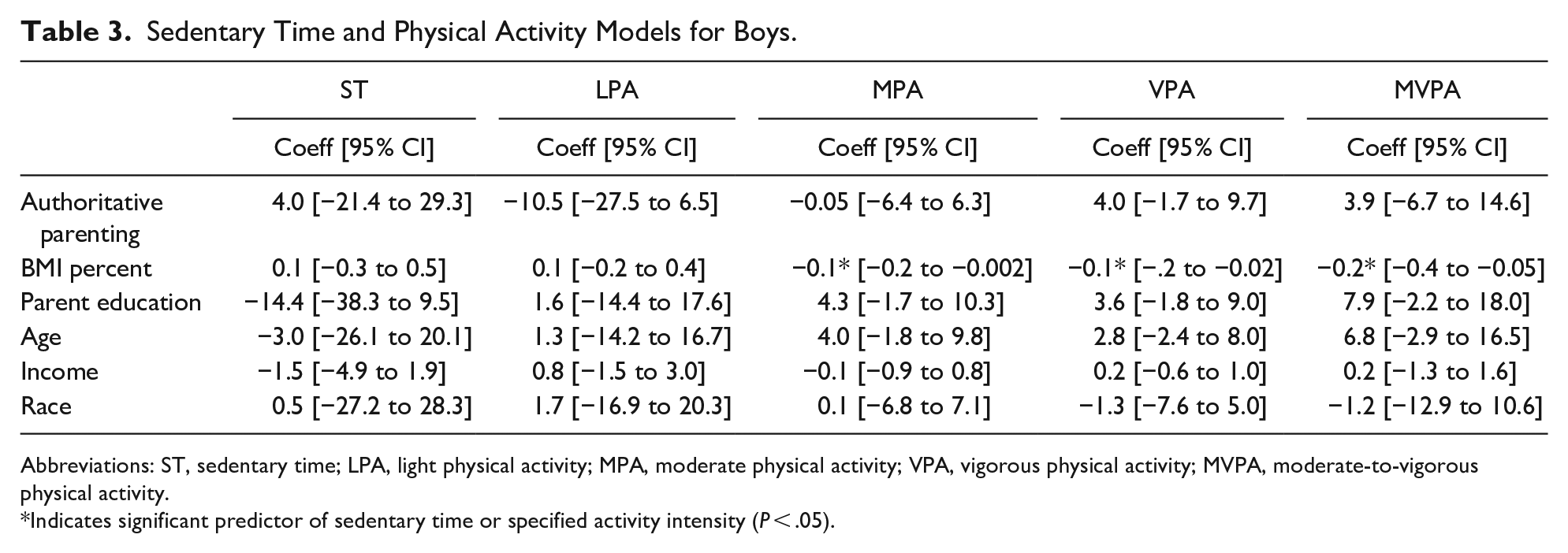
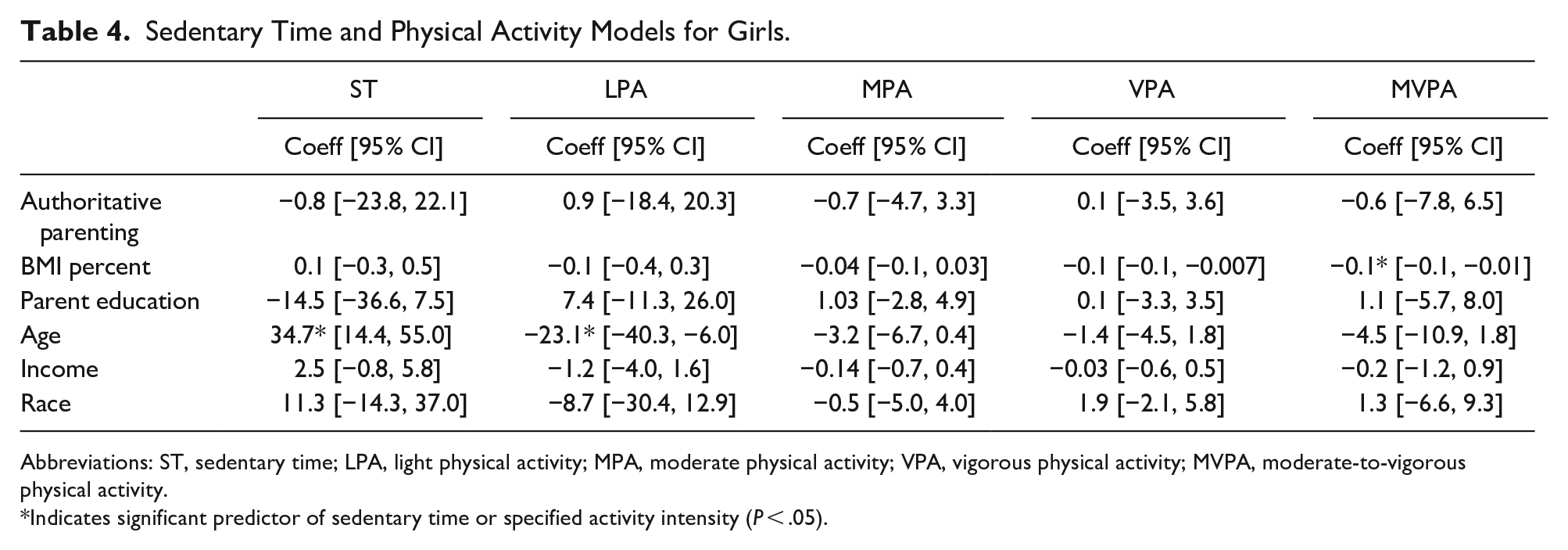
For girls, the regression analysis for ST identified age as a significant predictor of ST with each year increase in age associated with 34.7 more minutes of ST per day (P < .05). No other independent predictors, including parenting style, were identified as significant predictors for ST for girls or boys (Tables 3 and 4).
Sedentary Time and Physical Activity Models for Boys.
Abbreviations: ST, sedentary time; LPA, light physical activity; MPA, moderate physical activity; VPA, vigorous physical activity; MVPA, moderate-to-vigorous physical activity.
Indicates significant predictor of sedentary time or specified activity intensity (P < .05).
Sedentary Time and Physical Activity Models for Girls.
Abbreviations: ST, sedentary time; LPA, light physical activity; MPA, moderate physical activity; VPA, vigorous physical activity; MVPA, moderate-to-vigorous physical activity.
Indicates significant predictor of sedentary time or specified activity intensity (P < .05).
For the LPA regression model, age was the only significant predictor with a 1-year increase in age associated with 23.2 fewer minutes of LPA per day for girls (P < .05). There were no other independent predictors of LPA for boys or girls. The MPA regression model identified BMI percentile as a significant predictor for boys (P < .05), but no other independent variables were significant for boy’s or girl’s MPA. In the VPA model, BMI percentile was the only variable found to be a significant predictor for both boy’s and girl’s VPA (P < .01). In the MVPA model, BMI percentile was determined to be significant predictor for boy’s MVPA, but not for girl’s MVPA. There were no other significant predictors of MVPA for boys or girls (Tables 3 and 4). In conclusion, parenting style was not found to be a significant predictor of participant’s objectively measured ST, LPA, MPA, VPA, or MVPA.
Body Mass Index Percentile Model
Regression analysis revealed parenting style was found to be a significant predictor of BMI percentile among girls (Table 5). Girls with authoritative parents had BMI percentiles 15.4 percentage points lower, on average, compared to girls who identified their parents as non-authoritative (P < .05) (Figure 1). In addition, VPA was found to be a significant predictor of BMI percentile in girls, with each additional minute increase in VPA associated with a 1.6 unit reduction in BMI percentile (P < .05). Age, income, school, race, parent education, ST, LPA, and MPA were not significant predictors of BMI percentile in girls.
Regression Model Predicting BMI Percentile by Gender.

Abbreviations: ST, sedentary time; LPA, light physical activity; MPA, moderate physical activity; VPA, vigorous physical activity; MVPA, moderate-to-vigorous physical activity.
Indicates significant predictor of BMI percentile (P < .05).

Parenting style and BMI percentile.
Parenting style was not identified as a significant predictor of BMI percentile among adolescent boys. The amount of time spent in MPA was found to be a significant predictor of BMI percentile among adolescent boys in the current sample, with each minute increase in MPA associated with a 1.3 unit reduction in BMI percentile (P < .05). Age, income, school, race, parent education, ST, LPA, and VPA were not significant predictors of BMI percentile in boys (Table 5).
Discussion
Increasing PA and limiting ST in children are major public health initiatives. Parental influence is one mechanism identified to modify weight-related behavior in children. 33 The ability of parenting style to influence the PA behavior of children is an expanding area of research as parents are often viewed as role models for their children, according to Social Learning and Behavioristic theories. However, the majority of evidence to date has relied on self-reported measures of PA rather than objectively-measured PA and ST. To our knowledge, the current study is one of the first to utilize objective procedures to investigate the association among parenting style and PA, and the first to evaluate the parenting style relationship with ST.
The primary finding of the present study indicates parenting style is not associated with youth PA or ST; however, among girls, authoritative parenting style was found to be associated with lower BMI percentiles compared with non-authoritative parenting style. These findings add empirical evidence to the suggestion that parenting style may not influence children’s habitual PA or ST levels, but rather indicates authoritative parenting is related to children’s BMI.13,16,17,21 These results contribute to the idea that authoritative parents create an environment conducive to a desirable BMI in their children. This discovery is crucial as parenting style appears to be an important component of childhood obesity prevention efforts.
The literature does not provide a clear indication of how parenting style contributes to childhood obesity prevention efforts. The influence of maternal parenting style differed for girls and boys, with self-reported PA positively associated with non-authoritative parenting in adolescent boys but with authoritative parenting in adolescent girls. 24 A similar investigation relying on self-reported PA and sedentary behavior measures, provided divergent results by reporting PA was associated with higher family functioning (eg, authoritative parenting style) in adolescent boys; however, the relationship was not reported in adolescent girls. 16 In support of the philosophy that authoritative parenting style creates an environment conducive to movement, PA was less frequent among boys with neglectful fathers in comparison to boys with authoritative fathers. 17 As a result, the PA and ST behavior of adolescent girls and boys appears to be influenced differently by parenting style and the evidence does not provide a consensus on which parenting style is the most beneficial, particularly based on gender. The inconsistency within the literature may stem from the wide variety of tools used to assess PA, ST, and parenting style.
Hennessy et al 34 investigated the ability of parenting style to influence PA with the use of accelerometry, but used parents self-reported parenting style. The current study used a questionnaire for the child’s perception of their parent’s parenting style rather than the parents self-reported parenting style. Authoritative parenting style was not associated with youth PA but permissive parenting style was associated with the most minutes of youth PA in a sample of rural children in kindergarten through grade 5 (n = 76). 34 In agreement, the current study indicates authoritative parenting style does not influence objective measures of PA in a sample of rural fifth grade children; however, the current investigation concentrated on authoritative versus non-authoritative parenting. In addition, the current study focused exclusively on fifth grade children because early adolescents experience an acceleration of physical, psychological, sociocultural, and cognitive development not common in younger children. 35 Lastly, the current study provides evidence that ST was not influenced by parenting style, which was not incorporated in previous work. 34
The current study found ST to increase with age, even with only focusing on fifth grade children. Objectively assessed ST has been reported to increase substantially with advancing age throughout adolescence, with girls most often accumulating more ST than boys.36,37 This may indicate a crucial timing for future health programs and obesity prevention efforts, as it has been reported that the largest increase in ST occurs between the ages of 9 and 12. 38
The lack of a clear relationship among parenting style, PA, and ST suggests parenting practices and/or behaviors, rather than parenting styles, may be more instrumental in increasing youth PA and reducing ST. Parenting styles are viewed as an indirect means to impact youth behavior, whereas specific parenting practices tend to be more directly influential. 39 Parenting practices (directed encouragement, specific involvement) refer to distinctive behaviors specifically intended to influence customary behavior of the child. Parenting styles are likely to be related to parenting practices but the relationship is unlikely to be clear-cut and challenging to decipher. Varying parenting styles can implement similar practices so additional research is warranted to help elucidate the parenting style, parenting practices, PA, and ST relationship. Parenting practices, rather than parenting styles, have been found to be associated with healthy youth nutrition behavior and/or greater PA.34,40-43 As a result, in an effort to promote PA and reduce ST, it may be more appropriate to consider the analysis and modification of parenting practices and behaviors rather than solely parenting styles.
An additional explanation for the current findings could be that the controlled, structured school environment and possible before and after school care where children spend a substantial portion of their day limits the influence authoritative parents have on their child’s total daily PA and ST. Examining the influence of parenting style outside of school may be an appropriate investigation to determine PA and ST in a more variable environment. Isolating the impact of parenting style on lifestyle factors such as PA, ST, and nutrition behaviors with a cross-sectional study is challenging as youth behaviors are influenced by a complex web of social and environmental factors.
Elucidating an association between parenting style and girls’ weight status, but not between parenting style and healthy weight-related activity behavior (greater MVPA, less ST), leads the authors to postulate parenting style may result in a healthier home eating environment. The influence of parenting style has been studied on varying nutrition outcomes; however the results are inconclusive. In 2 separate cross-sectional analyses, parenting style did not have an effect on the mean fruit and vegetable intake among adolescents.40,43 Conversely, adolescents who identified their parents as authoritative consumed more fruit and ate less unhealthy snacks than adolescents who characterized their parents as neglectful, however the authors did not report a relationship with any weight outcomes. 44 Collectively, results from the literature report inconsistencies in regards to the impact parenting style has on varying nutrition outcomes, particularly in relationship to adolescent weight status. As such, future investigations should incorporate and compare parenting styles, physical activity, and dietary behavior.
While this study was one of the first to utilize objective measures of ST and PA in relation to parenting style, it was not without limitations. First, children analyzed their parent’s parenting style through self-report, which may not necessarily reflect what truly occurs in the home environment. Previous investigations have found diet and activity outcomes and body fatness to be associated with child-perceived parenting style; thus, the use of adolescents’ perception of how they are parented may be acceptable.23,45 The ability to evaluate the child’s perspective of how their parents provide guidance or influence may be more beneficial than the evaluation of how parents perceive their own behavior to influence their children. Second, participants were instructed to answer the parenting style questions on their parents as a whole so the authors did not assess the impact of maternal or paternal parenting style. Third, the overall lack of diversity within our sample limits the generalizability of the results. Fourth, causality should not be inferred due to the cross-sectional nature of the study design.
Despite these limitations, our current understanding of the impact of parenting style on children’s weight status, PA, and ST has been strengthened by utilizing objectively measured PA and ST. The current investigation signifies that although parenting style does not predict youth PA or ST, girls with authoritative parents have a significantly lower BMI percentile than girls with non-authoritative parents. As a result of this study and other research on parenting styles, in an effort to combat the current childhood obesity trend, the authors suggest parents utilize the authoritative parenting style to establish a stable, healthy family environment by demonstrating high expectations, while also being caring and emotionally responsive toward their children. In addition, incorporating a parenting component within a lifestyle intervention specifically aimed to increase PA and reduce ST may be best suited to promote healthy behaviors in youth.
Footnotes
Authors’ Note
The study sponsor had no influence in the: (1) study design; (2) collection, analysis, and interpretation of data; (3) the writing of the report; or (4) the decision to submit the manuscript for publication. All authors approve the manuscript and its submission to Global Pediatric Health.
Author Contributions
CAS drafted the manuscript, collected data, and conducted data analyses; ECHJ, JRM, and MB conceptualized and designed the study and provided critical, intellectual guidance in drafting and writing the manuscript. ECHJ took part in the acquisition of the data. All authors approved the final draft to be published.
Declaration of Conflicting Interests
The author(s) declared no potential conflicts of interest with respect to the research, authorship, and/or publication of this article.
Funding
The author(s) disclosed receipt of the following financial support for the research, authorship, and/or publication of this article: This work was supported by the US Department of Agriculture-National Institute of Food and Agriculture-Agriculture and Food Research Initiative under grant no. 2011-67002-30202.
Ethical Approval
All study procedures, parental consent, and youth assent were reviewed, approved, and in accordance with the Human Subjects Institutional Review Board at South Dakota State University (approval #: IRB-1212006-EXP) and followed the principles set forth in the Declaration of Helsinki. Informed consent was signed by a parent or legal guardian and child assent was obtained prior to any study procedures.
