



Abstract
Limited screen time has been recommended by the American Academy of Pediatrics for all children and no screen time for children under 2 years of age. With the advancement in technology, the prevalence and detrimental effects of excess screen time on children has become a global problem that can lead to health issues such as obesity and other cardiovascular diseases among both adults and children. This article examines the drivers of screen-related sedentary behavior within the home context and reports on parents’ attitude in supporting children’s associated behavior. The study implemented a mixed method approach of online questionnaire and face-to-face interviews. A total of 140 questionnaires, 10 semistructured interviews, and responses from parents were used to evaluate children’s behavior toward screen use and parents’ perception. The analysis of the article has shown that parents are concerned about their children’s screen time during weekends and holidays with a significant correlation between the number of hours their children spend on on-screen activities and their level of concern (P < .01). Also, for the same P value (P < .01), it has been found that there is a statistically significant positive relationship between children’s screen time and their food and beverages consumption. Children’s use of screen technology is becoming a challenge for parents as they present barriers to healthy physical activities. From the parents’ viewpoint, there is a need to change the screen use habit and this requires an appropriate intervention that promotes gratifying measures to induce more active behaviors to displace screen viewing.
Introduction
Prolonged sitting behavior and using screen devices are becoming exclusively observed and perceived as the inconspicuous norm in modern lifestyle. The digital world has also come to stay and is ever evolving with the availability of smartphones and tablets with at least 96% of families owning at least one TV set and 36% of children aged 8 years having one of these devices in their bedroom, 1 and an access to a range of other digital devices that allow screen-related sedentary activities. 2
Numerous studies have explored the predictors of children’s screen time (ST) and the time spent in sedentary behavior with the concern that these behaviors may have a negative impact on their health.3,4 Additionally, existing literature have established that overweight and obesity have been recognized as the fifth leading risk for global death causing 3.4 million deaths annually.5-7 Thus, the environment in which people live in and the amount of time they spend being physically inactive using these technologies has been blamed for the substantial increase of sedentary behavior. 8 Nevertheless, other studies suggest that parents serve as both role models and gatekeepers for their children’s screen behaviors and could be encouraged to teach healthy behavior9,10; simultaneously, a quantitative study that investigates children’s attitude to screen media suggests that parents with high ST are likely to influence the increase of their children’s ST. 11
School-based interventions have proposed ways to reduce prolonged sitting in children, 12 while the home domain has received little or no attention 13 ; thus, this article suggests that parents could play a role in facilitating and shaping appropriate screen use. Hence, interventions to reduce children’s excess ST in a home environment is a clear research priority for addressing sedentary behavior. The overarching aim of this article is to examine children’s ST behaviors in relation to physical inactivity in the home environment through parents’ regulatory strategies. With a focus on examining parents’ perceptions of their children’s sedentary behavior, the study explores possible measures of interventions to help modify children’s behavior within the domestic environment with a focus on ST.
The wide availability of technological devices such as televisions, smartphones, and tablets has made it easy for many households to increase the dosage of ST. 14 Most researchers argue that sedentary behavior is distinct from a lack of physical activities (PAs).15,16 A growing body of evidence demonstrates that even those who meet the national PA guidelines are at risk of premature mortality if they spend too much time sitting.17,18 However, sedentary behavior is a complex phenomenon established to occur in a different context such as a home where the family setting could encourage screen behaviors, including TV viewing, using smartphones and tablets, and playing video games. 19
Bandura’s 20 social cognitive theory advocates that learning and behavior occur by observation. Thus, the influencers in the home such as parents, siblings, and other members of the family play a central role in shaping children’s attitude toward sedentary behavior. Yet, there is a dearth in research that examines attitude to the perception of parents on sedentary behavior within the home environment. There are concerns that the PA behavior of young people are remarkably decreasing and this has heightened the global childhood obesity crisis. 21 With this decline in PA, it is imperative and a crucial timely issue given the current increased levels of children’s ST. 22 Thus, numerous studies have investigated the need for using the technology-related intervention to reduce the said behavior. For instance, Shin and Bhamra 23 evaluated the concept of utilizing human-powered products to induce PAs at home, using an exercise bike to power the television. His study concluded that the financial gain of using human power as an alternative power source was inadequate and further emphasized that the potentiality of such intervention would be more lucrative when used as means to increase PA and reduce sedentary behavior in the home environment. 24 Some studies have shown that even little time spent in light to moderate PA may increase health benefits.22,25-27 However, there are limitations in the existing literature whereby very few studies have examined the role of parents in modeling habitual PAs or discouraging these screen-related behaviors. Thus, this study aims to answer the key research questions: Do children spend too much time engaging in screen-related activities? How concerned are parents with regard to children’s ST? Last, what are the parents’ level of awareness regarding the effects of uncontrolled/unlimited ST for children? This study provides nascent insight in tackling the sedentary behavior affected by the ST from parental views.
Methodology
To explore the parental perception of children’s ST, a mixed method approach was utilized using 140 responses received from the questionnaire and 10 semistructured interviews with parents to examine children’s routine behaviors across major screen platforms: TV, computer, tablets, and mobile phones (smartphones); and parents’ ability to control this behavior. The target group in the study were parents with young children (between 5 and 10 years) and children in primary and secondary school age (between 11 and 16 years). A survey link was sent through emails and social media groups (Facebook, WhatsApp, and Twitter) to a collective of 500 parents. This contained brief information on the aim of the project prior to their completion of the questionnaire. For the interview, 10 parents were additionally recruited through the university’s communication channels. The interview guide employed open-ended questions with probes on parents’ concerns over the amount of children’s ST, physical inactivity, and their general perception toward changing the trend in relation to screen use.
For the quantitative measures, the questionnaire result had a confidence level of 95% following a sample size of 140 respondents, and with UK population size of 66 million, the study provides a margin of error of 8%. The confidence level of 95% is the probability that our sample accurately reflects the attitudes of parents in the United Kingdom. The margin of error is the range that our population responses may deviate from the sample’s range, and in this case, it is 8%.
Participant Recruitment Criteria and Ethical Approval
Questionnaire inclusion criteria were the following: parents of children between 5 and 16 years and this was informed due to current research on the aforementioned age group accumulating high ST and lack of inactivity as discussed in the introduction. Also, parents with children in the aforementioned age group are likely to experience child resistance against their control. The final criterion was the parents who had general concerns with regard to their children’s ST due to the growing trends of digital culture.
This study received approval from the Joint Inter College Ethics Committee within Nottingham Trent University with a reference number JICEC-201617-52. The online questionnaire provided the consent information prior to the beginning of the questions. Therefore, participant consent was implied through questionnaire completion. Consent was obtained from participating interviewees.
Data Analysis Techniques
For the qualitative part of the study, semistructured interviews were conducted by one of the authors who had received prior training on conducting interviews. The interviews used a preset guide that highlighted insights to the challenges parents faced in controlling their children’s ST. Some of the questions asked included the following: What general concerns do you have regarding your children’s ST? Do you consider ST the reason your child/children are inactive? How easy do you find it in controlling your child’s screen viewing? We know friends and siblings can influence; how would you describe this in your home?
Statistical testing was used to analyze the correlation coefficient (Spearman’s ρ), which is a non-parametric testing used to measure the strength of association between the level of parent’s concern and the children ST.
The following hypotheses were implemented:
Also, statistical analysis is used to test if the child/children consume food such as snack and beverages while watching TV or during on-screen activities.
Three hypotheses were tested:
For the semistructured interviews, transcripts were thematically coded; this process entailed reading and rereading text to assign the codes to broad themes and most of this was predefined based on a general read through of the interview script and broad topics covered in the literature. Thus, this involved a more deductive approach.
Results
Distribution of the questionnaire to parents was carried out between February and August 2018. A total of 140 responses were received out of over 500 people who received the link to the questionnaire. Parents were assessed on some key aspects in relation to their children’s ST, constructs like “access to screen devices,” “social influence,” “general screen behaviors,” “estimated duration of screen use,” and “most used screen device” among respondent’s children; and parent’s attitudes and how this is associated with their general concerns. Forty-nine percent of respondents were aged between 36 and 45 years, with 58% of them identifying as mothers. Table 1 shows the demographic profile of the parents recruited for the questionnaire. Information on socioeconomic status was not requested due to the United Kingdom being a posterity society whereby income does not play a vital role in the affordability of basic household facilities such as TV and video game/mobile tablets for children.
Demographic Profile of Participants.

Parents reported behavior and household characteristics of their children and its association with excess ST. The questionnaire was ultimately designed to measure the awareness of parents with regard to the amount of time their child (or children) spend on screen irrespective of device, with sections covering the frequency of screen use, parental perception on recreational ST, mediation of parents, barriers in limiting screen usage, and understanding parental view over the level of children’s PA.
Screen Viewing Time and the Role of Parents
Most parents expressed their concern over excessive ST. From Figure 1, the result from the questionnaire showed that more than half of the respondents (84%) are concerned that their children are spending a lot of time using screen devices and 76% of them reported that their children are inactive due to the said behavior.

Parent’s concern regarding time spent on screen devices.
Twenty-three percent of parents reported that the major drivers of ST were an addiction. While the concern was similar across respondents, 57 of them estimated the ST of their children averaged more than 6 hours daily. Concerns about the availability of more than one screen device (12%) and lack of outdoor play facilities (10%) were also popular responses. For parents with older children, addiction (16%), screen obsession (10%), friends (13%), society, and social media influence (9%) were the most common concerns.
From our study, the sampled parents were unaware that these behaviors could have a multitude of long-term health implications for their children, mainly because they (parents) spend a substantial amount of time on these devices themselves.
Similarly, most interviewees expressed general concerns about how much time their children spent on ST; the following response was shared by P1: Very concerned!! For all my children in fact, although my son is more inclined to read books, he still spends lots of time on his tablet and it concerns me. I try to stop them from using these devices because I notice that they lose focus by using these devices. Their general school performance has reduced at school, I need to be strict and vigilant although I still feel out of control most times. (P1)
Most participants seemed to agree with P1’s comment; P4 shares how a parent can also be an influence toward screen use: I watch too much TV myself and most times do not bother to be a good role model to them on this habit. The reason is because I am usually exhausted when I arrive home from work and TV time is my down time. (P4)
The interviewed parents all reported that their children exceeded the recommended ST limits and they raised concern over its psychological impact on their children. Even with 80% of respondent expressing their lack of control on children’s ST, some others like P6 believe that when her children are on these devices, she enjoys the quietness around the house.
I know this may sound like I am a bad parent, but I don’t think I want to have control over their ST because this is the only time I get to have absolute peace around the house. When my 2 sons play with each other around the house, it feels like the walls are going to come down that’s why I prefer when they watch TV or play video games. (P6)
Some parents appeared very unhappy about the exposure of online content for their children and would welcome an intervention that will not only control the content but also the usage.
I am so frustrated at the behaviors my son is acquiring from excess screen time, I notice he is becoming aggressive and not liking to interact with people in real life, since we bought him a new PlayStation game, he has changed so much and I wish we can control how much time he gets on it daily this might help me find better things to do around the house. (P9)
As indicated in the questionnaire result, addiction was the major concern of parents, which was supported by one parent’s observation during the interview: Every time I come home from work, I see children playing video games and watching videos on YouTube. They are usually very engaged and glued to these devices and it’s difficult to control them or convince them to do other activities. (P10)
Children’s Screen Behavior
Figure 2 displays the most frequently used screen device in the home such as TV, with estimated usage ranking more than 6 hours daily. For the study sample, the most common age group to engage in TV and tablet use was 5 to 9 and 10 to 15 years old at 35%. Most interviewed participants with children in this age category validate the above; for example, P1 states: My 2 girls love to use their tablet so much so that I regret buying it for them. . . . They can spend all day using their tablet without thinking of what to eat. (P1)
Similar to our questionnaire, results show that 41% of children spent over 3 hours on their tablets (see Figure 2). Subsequently, parents were asked regarding the amount of time their children spent on screen devices during term times, weekends, weekdays, and holiday period. Parents responded with the estimated number of hours their children engaged in each day with activities listed in this format: (1) TV watching or DVDs, (2) using computer/video games, (3) using tablets such as iPads, and (4) using smartphones for surfing the Internet (not including time spent texting and talking on the phone). A total number of 140 parents responded (see Figure 3) that a daily use average (across weekday and weekend) of 4.3 hours was calculated, which serves as our average ST across all age groups.
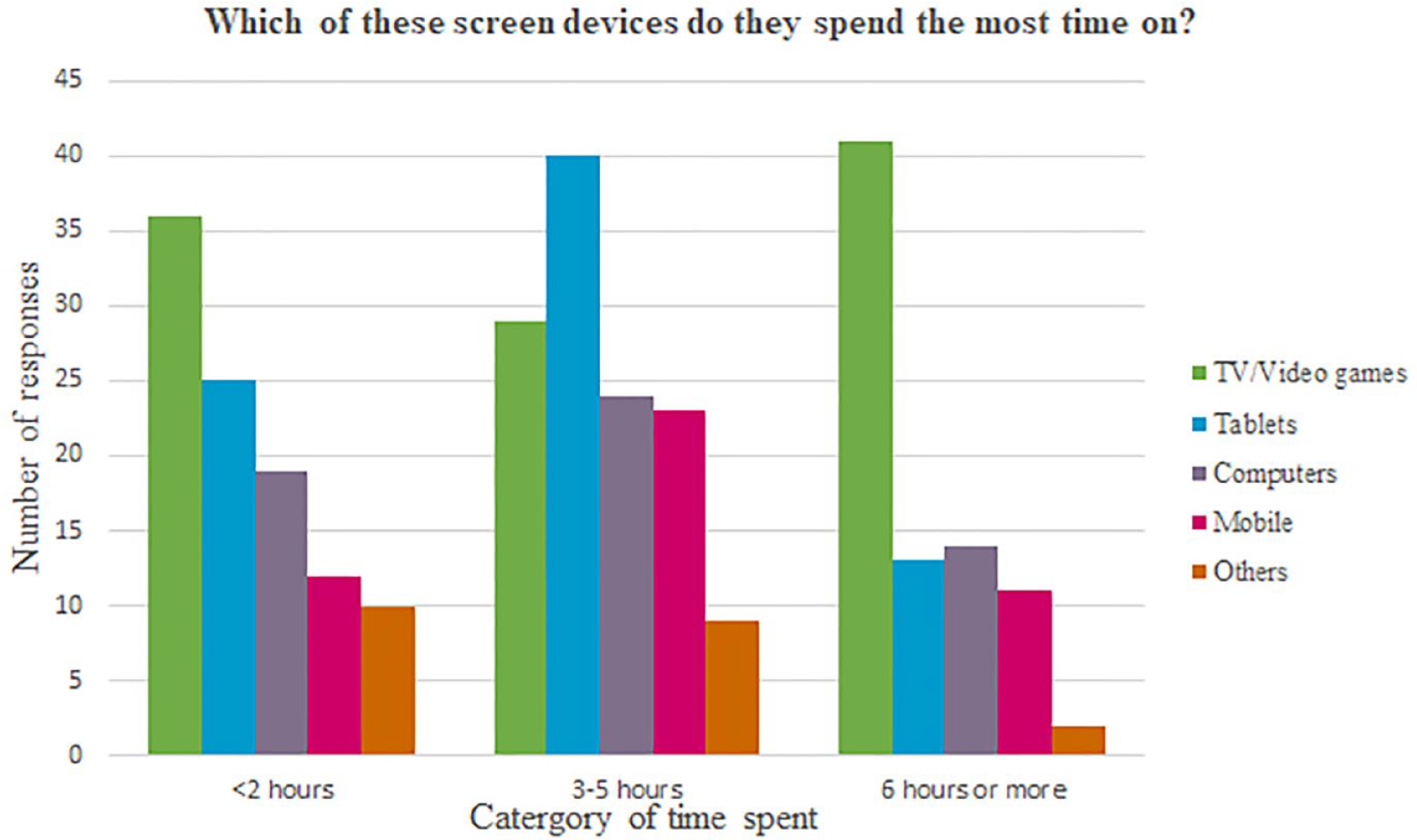
Devices participant children spend more time on.
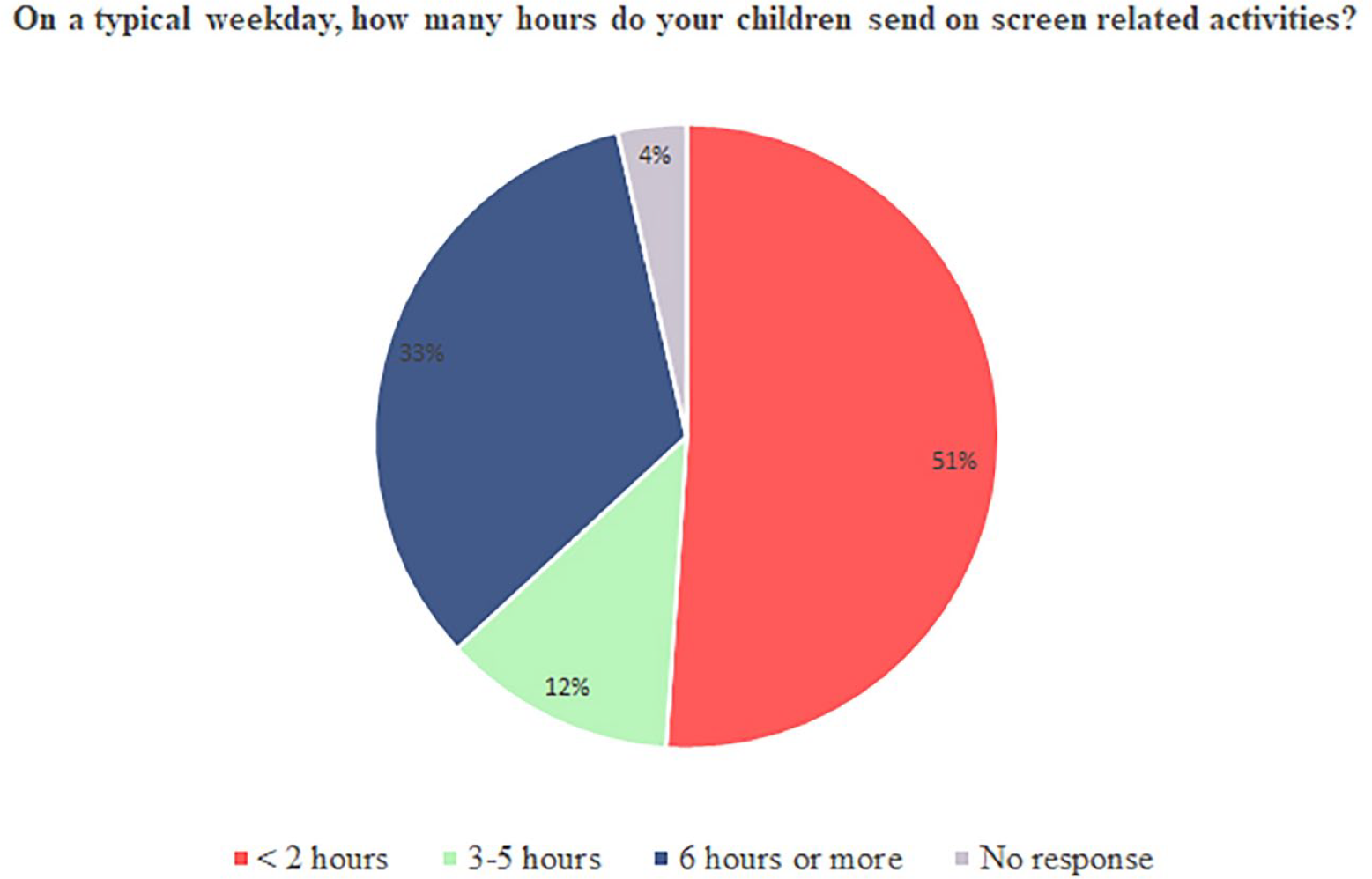
Amount of time spent on screen devices.
Concern Over Child’s PAs and Recreational Screen Viewing Time
Seventy-nine percent of the respondents agreed that ST hinders and restricts their children from having a more active lifestyle. This was also supported by the interview where P1 shared his view based on his own observation: For my girls yes, if you take away the phone and tablets, they will find ways to do more active things around the house, like helping out their mum in the kitchen or playing with each other. But my son makes an effort, he very often throws and kicks the football around the house. My older daughter is lazy when she gets home. She has always been the one who is not interested in physical activities. (P1)
Jackson 28 argued that young Britons spend 14 hours, a third of their waking hours, using smartphones, laptops, and tablets, and other studies suggest that this is not pertinent to the United Kingdom alone as other nations are also concerned especially among teenagers. 29 Parents have been asked to share their perception toward changing behavior around screen use comparing against their own childhood. All participants emphasized the fact of smartphones and tablets being invoked has made it difficult to have digital-free zones at home.
My childhood the norm was to spend 2-3 hours playing footie with friends and TV time was just a small part of it, as we only had one family TV. We played games such as ATARI with other members of the family as there was no Internet. (P10)
Social and Physical Home Environment
In relation to the influence of parents, one of the interviewees stated: I am a bad influence, ha-ha, I watch TV a lot, but for news and I also watch Senegalese movies and what I do on the PC at home is working on Solidworks and yes, I am setting a good example by doing too much screen-related activities. But the difference between me and the children
This is in line with parental support that was stressed further by Timperio et al 30 in their study as a causal factor in this association (children and friends/family). Although the result often depends on the age of the children, there is also the influential impact of parental support and encouragement. From our results, this was prevalent in children aged 6 to 11 years old and their disinterest toward PA and this was also similar from literature. 31 Our results show that the older the children, the less likely they are to engage in PA and the more they are susceptible to health issues resulting from being physically inactive. 32 Parents reported that modeling good healthy screen use could be a good way to offer their children full attention and this may take them away from spending so much time on these devices. Thus, in the home environment, making changes to the physical and social factors as an intervention measure could be a vital research proposition.
The Demand for Physical Activity
More than half of the respondents (67.4%) have reported that their children do not meet the PA recommendation of at least 60 minutes of light to moderate PA. Forty-seven percent would like to observe an improvement in the PA habits of their children, which is to at least 1 hour per day, while understanding the barriers discussed in section “Screen Viewing Time and the Role of Parents,” such as addiction (23%), lack of motivation (17%), and friends (14%). The parents who have reported lack of motivation seem less confident about their children achieving 1 hour/day PA. The interviewed parents reported that children must be given the skills and opportunity to entertain themselves without screen devices, and one parent emphasized that this will offer an even greater chance of interacting with others.
In comparison to strategies related to limiting the ST, nearly all parents (80%) are somewhat less confident about their children meeting the screen recommendations of 2 hours/day due to constant child resistance. In the current study, parents (30%) reported child resistance in the process of negotiating the reduction of ST as a big challenge in parental monitoring. This resistance was reported mostly by parents whose children use a lot of social media.
I think they resist to limiting smartphone use because they are trying to protect their social media identity, so they often have to keep up appearances. (P7)
On the contrary, another interviewed parent shared that they did not necessarily lack control, but was mostly unmotivated as they were guilty of not being very active themselves.
I have enough trouble motivating myself to exercise as it stands, let alone my children. (P6)
Promoting PA requires consistency and from the variation of views and responses, and most parents understand the significance of exercising. While parents with children aged 10 to 14 years highlighted that PA is highly important in the development of their children, some emphasized that structures within their social environment limit them from engaging in PA. Also, determinants such as increasing demand for family time were barriers in PA participation.
I want them to exercise and not play video games, or even do other active things around the house, but I would also like us to spend a lot of time together as a family, which is really difficult. (P9)
Analysis of Hypotheses
The results show that Hypothesis 1a is rejected as the correlation coefficient is low at 0.129 and it is not significant (P > .05). Hence, there is no correlation between parents’ level of concern and the hours spent during school days. On the other hand, Hypothesis 1b is accepted. Although the correlation coefficient is low at 0.224, it is significant at .01 level (P < .01). It can be established that the higher children’s ST during holidays the more parents get concerned. Hypothesis 1c is also accepted. The correlation coefficient is 0.328, and it is significant at the .01 level (P < .01). We can say that the higher children’s ST during weekends the more parents get concerned.
In relation to food during TV and other screen activities, the 3 hypotheses have been accepted. Hypothesis 2a is accepted with the correlation coefficient of 0.304, and it is significant at the .01 level (P < .01). It has been established that the higher children’s ST during school days the more they consume food and beverages. Hypothesis 2b is also accepted. The correlation coefficient is 0.446, and it is significant at the .01 level (P < .01). We can say that the higher children’s ST during holiday time the more they consume food and beverages. Hypothesis 2c is also accepted with a correlation coefficient of 0.323, and it is significant at the .01 level (P < .01). We can say that the higher children’s ST during weekends the more they consume food and beverages.
Discussion
ST norms refer to the ubiquitous use and engagement with any screen-based device in young people’s lives. 33 However, the general barriers to this habit are related to the surroundings itself, as well as a lack of parental control. The study evaluated the lack of PA and the patterns of recreational ST among children from the parents’ point of view. Although there has been a considerable variation in the viewing patterns as reported by parents, ST appears to be an increasing behavior with many children regularly engaging in at least 2 forms of ST at a time. It is important to highlight that TV viewing (ie, TV or video game) appeared to be the dominant activity despite multiple viewing, which involves other forms of screen devices. The current study showed that most children had access to mobile devices from a very young age; hence, parents with younger children often use ST as a babysitting tool, justifying the phenomenon and trend of living a smarter lifestyle. The findings from this article suggest that 86% of parents agree that if the PA of their children improved, this could aid in their development and health including adequate weight maintenance. However, another study has also shown that ST increases by approximately 1 hour per day as children develop with age. 34 Even though for young children TV viewing continues to dominate whereas older children spend more time playing video games on TV. However, their ST exceeds the American Academy of Pediatrics recommended ST of 2 hours of the day. 35 This study has used the American Academy of Pediatrics guideline as it has been globally cited by several researchers. There is currently no ST guidance provided by any UK institution, although the Royal College of Public Health has recently published its first guidance. 36 This guidance contest that evidence is weak to conclude that ST is harmful.
The findings from this study align with Bandura’s social cognitive model, which is based on the idea that children learn and are influenced by the practices within their surroundings, especially from parents. 20 Therefore, by the observation of other people’s behaviors, children tend to develop similar behaviors. 37 Our findings indicate that parents’ frequent ST also influences children’s concurrent use.
The home environment has become a space that facilitates the prominent use of screen devices. The result of this study reports that the abundant provision of screen devices in the aforementioned environment makes it easy for children to dominate most of their waking hours using them. From the statistical analysis, it could be concluded that parents get more concerned when noticing their children spending ST during holidays and weekends. During term time, the majority of the time would have been spent in schools and doing homework and hence parents have less concern. However, it seems that during weekends and holidays children get attached to their screen device and hence the parents get more concerned about their children’s screen activity. We, therefore, highlight that the dominance of these devices calls for action on why this issue should be taken as a clear research priority to create positive influences for children and their health. We also suggest that simply limiting the ST through intervention could be less effective. Our findings suggest that future interventions should focus on the determinants of these behavior and effectively offer ways to construct habitual PA and appropriate screen use for households. Thus, setting positive cues for children to adopt healthy behaviors such as inducing frequent PA could potentially help them begin to observe a change in reducing excess ST. Activities that could displace ST will further encourage and foster good behavior. Taking into consideration that most of the children are addicted to these devices, any activity/intervention that aims to bring about a significant change in behavior would need to ensure there is an equivalent motivation such as enjoyment. There is a construct that instigating the enjoyment of PA is an important determinant for children. 38 Therefore, the balance between enjoyment and building intrinsic motivation toward habitual PA becomes an essential element in creating any intervention.
In any given environment, which has the potential to impact children’s leisure time or PA, it is salient that the social and physical environmental factors be considered. 39 Consequently, the home environment can either encourage these behaviors or create a socially and physically busy environment to foster PA engagement. This could include factors such as the atmosphere parents create in relation to PA and the ST. From the results, it was clear that most parents struggled with being good role models for their children; and this significantly affects the amount of time their children spent engaging in the said behavior.
Although existing literature to date does not discuss other determinants such as social contextual influences and friends, children’s behaviors are highly influenced by surroundings, especially with whom they see as part of their lives, that is, parents. 11 The result from the current study shows that 41% of the sample spent over 3 hours on their tablets although it was unreported about ownership of these tablets. This could be justifiable with the Ofcom report that shows that 39% of children aged 8 to 11 years own either a smartphone or tablet. 40 The results of the statistical hypotheses also show that the more children stay at home and use the screen device, the more snacks and beverages they consume. Hence, there could be a negative effect from ST not only in relation to the lack of PA but also the quality of food and drinks that children consume. From the observations, it could be argued that children might miss meal time due to being engaged in watching a movie or in the middle of a video game; hence, the food patterns and obesity might be of concern and it is an area that should be explored further in the future.
Due to the abundance in screen devices available to children, inequitable standards should be employed to evaluate ST-related behaviors; hence, interventions in bringing behavior change will also need to take account ways to build sympathy between parents and children through intervention strategy such as goal setting. Following the results of the current study, there is an indication that in order to develop an effective intervention, supporting parents to increase their control toward the resistance of their children when engaging in ST is vital.
This article highlights several strengths in that it uses a mixed method approach to identify concerns of parents and at the same time it provides a wider depth of their perception and understanding of children’s screen behaviors. One of the limitations is that we discussed ST without differentiating the purposes of ST such as family TV time and using computers and tablets for homework. We acknowledge that this would have been beneficial to separate between these activities and the social environment in which these devices are used. In this study, sedentary behavior and ST were perceived in a broader perspective and this includes any screen devices. However, many variations that would have been included in this study could be an opportunity for future study.
Conclusion
This article provides great insights and novel contribution around parental concern on their children’s screen use. It highlights the notion that the home environment is highly associated with factors contributing to physical inactivity and increasing ST. ST has an association with overweight, obesity, and parents are concerned even as they generally show a lack of confidence in controlling their children. Future research is now warranted to investigate whether framing interventions tailored at displacing overall screen engagement of children with some form of PAs will increase motivation and self-efficacy. Parents are seeking guidance and provision of interventions that help mediate household’s screen use to reduce sedentary behavior, but also through building a mutual gratification between family members, for example, goal setting. Ultimately, if interventions succeed in improving health, it will be important to evaluate the increase in PA and measure its impact toward their health and well-being.
Footnotes
Author Contributions
FN: Contributed to conception and design; contributed to analysis; drafted the manuscript; critically revised the manuscript; gave final approval; agrees to be accountable for all aspects of work ensuring integrity and accuracy.
DHS: Contributed to conception and design; contributed to analysis; drafted the manuscript; critically revised the manuscript; gave final approval; agrees to be accountable for all aspects of work ensuring integrity and accuracy.
AA: Contributed to conception and design; contributed to analysis; gave final approval; agrees to be accountable for all aspects of work ensuring integrity and accuracy.
HM: Contributed to analysis; drafted the manuscript; critically revised the manuscript; gave final approval; agrees to be accountable for all aspects of work ensuring integrity and accuracy.
Declaration of Conflicting Interests
The author(s) declared no potential conflicts of interest with respect to the research, authorship, and/or publication of this article.
Funding
The author(s) received no financial support for the research, authorship, and/or publication of this article.
