



Abstract
In most childhood obesity preventive programs, parents are targeted as they are key in achieving lifestyle behavior change in their children. Because their participation is generally low, new technologies, such as text messaging, are being tested to assess if their participation increases. The objective of this study was to determine the perception that mothers of overweight/ obese preschool children have of a textmessaging program developed to support their children’s lifestyle behavior change. Text messages were sent to 60 mothers twice a week for 12 weeks; 58 of them said they received all of them. During the process mothers were contacted twice regarding their opinion on all aspects related to the messages. At follow-up, we determined perception by in depth interviews administered to participants. Results show that text messaging implemented in a personalized manner was considered successful in regards to providing useful information to support their children’s behavior change.
Introduction
Childhood obesity is currently a worldwide public health epidemic and a major risk factor for developing chronic diseases such as hypertension and type 2 diabetes in adulthood. 1 Moreover, lifestyle habits during infancy and childhood often continue into adulthood. 2 One of the strategies used to tackle childhood obesity has been the implementation of preventive programs aiming at targeting parents as they play an important role, in modifying unhealthy behaviors in children. However their participation in such programs have been generally very low. 3 Therefore, it is of utmost importance that health-promoting interventions increase participation of this group and for this reason new technologies are being explored. Evidence suggests that parents, in addition to attending primary care are enthusiastic about receiving text messages (SMS) that contain personalized information relevant to their children’s health. 4
Some health interventions that have used SMS report that they are effective in reminding participants to engage in lifestyle changes proposed. 5 Incorporating SMS as a complementary intervention, alongside traditional interventions, can be also effective for adults populations as it helps patients to manage better their diseases, such as adherence to medication and blood glucose monitoring. In addition, recent evidence have shown that SMS-interventions are cost-effective when scaling up interventions. 6 However, there are very few studies aimed at promoting behavior change using SMS in children.
The feasibility of this type of intervention is facilitated by the wide use of smartphones and internet, as is the case of the Chilean population, with 100% of the adult population having at least one device. 7 However, in Chile the use of SMS has not been explored in the prevention of childhood obesity, thus the objective of this study is to determine the perception that mothers of overweight/obese middle-low and low-income preschool children have of a text messaging program to support their a healthy lifestyle behavior change in their children.
Methodology
Participants
We contacted the Head teachers (principals) of 16 elementary schools located near our Institute which cater to middle-low- and low-income children in order to recruit mothers of first grade students with overweight or obesity. Initially, sixty (60) mothers and/or tutors were selected from 10 schools, after meeting the following inclusion criteria: acceptance to participate (mainly to focus only in families with motivation to participate, having at least 1 overweight or obese preschool child, (defined as BMI higher than 85th percentile), 8 and frequent use (more than twice a week) of the WhatsApp Messenger application from a mobile phone. This type of contact was selected given the preliminary results of the focus groups from the message validation process, where participants indicated their preference for this method over e-mail and SMS. A socioeconomic characterization survey, adapted from the 2016 Nursery School Survey which is applied at the national level by the Ministry of Education 9 was administered to all participants, where questions acknowledging the importance of behavior change of their children and willingness to participate in a new program with that objective, cell phone use and preferred time to receive the messages were incorporated.
This study employed a mixed methodology (quantitative and qualitative) and was divided into 3 stages. (I) Development of text messages, (II) Sending them, and (III) Evaluation of satisfaction and perception of the participants regarding the program.
First stage: Development and validation of 40 messages to encourage healthy eating and promote physical activity. These underwent a rigorous process and delivered via WhatsApp to the selected mothers. The process involved 3 stages: (a) initial elaboration of the messages on healthy eating and physical activity (b) 3 focus groups which included similar participants as the target population, and (c) consensus on the list of final messages obtained from 56 experts using the Delphi methodology. 10
Second stage: Sending the messages. Messages were sent to 58 participants with periodic monitoring by telephone, who had all inclusion criteria. Each participant received messages twice a week (Tuesday and Saturday), for 12 weeks (May-July 2017) and received 2 calls during 3 months to verify if they were receiving the messages and if the schedule was adequate. Each message was sent individually using WhatsApp Messenger with a software adapted for computers. Once the message was sent at the time selected by the participants, the response was recorded within 48 hours. The registration included “read and not read”. Read was considered as the “OK” or similar response by the participants. Unread was considered only the display of the message (double blue tick).
The personalization involved using their names, whether they had a son or daughter and sending messages based on the schedule they selected.
Third stage: Evaluation of satisfaction and perception of the program and its feasibility. Since the aim of this study was to determine the perception that mothers of overweight/ obese preschool children have of a text-messaging program developed to support their children’s healthy lifestyle behavior change, we did not include any indicators to measure changes on the participant’s behaviour or BMI, which correspond to a study to determine effectiveness. 11 BMI was only used as an inclusion criteria. This stage included the evaluation of the degree of satisfaction in relation to the content of the message and its length while perception evaluated their knowledge on healthy eating and physical activity and how these messages could be useful in supporting their children’s behavior change. Fifty-four participants responded to these questions over the phone. The elaboration and validation of the survey on satisfaction was carried out by a panel of experts before its application and later checked for analysis of validity and consistency. Seventeen (17) questions were included with a Likert scale, based on the methodology proposed by Martin et al. for the construction and validation of questionnaires. 12 To present the results of this survey, we categorized the questions into 4 aspects: general appraisal of the program, technical aspects of the program, participant’s opinion on the type of messages related to physical activity and healthy eating. The survey was administered by telephone to all participants 1 week after the end of the program. Descriptive statistics, such as mean, standard deviations and absolute frequencies were determined for the answers to both characterization questionnaires as well as the results of the responses of the message reading. Absolute and relative frequency tables and graphs were generated with Excel version 2011.
Six theoretical profiles 13 were developed according to the participant’s age, educational level, occupation and family composition which resulted that in-depth interviews to 8 participants would be enough to collect information on perception. We considered a saturation point, 14 that is, once no new contributions were obtained in relation to the development of the information, even addressing the questions in different ways. The analysis of the interviews was carried out based on the content analysis technique, 10 after its transcription.
Results
Participants
Participants’ socio-demographic characteristics were obtained from the initial survey, these data are presented in table N°1.
Demograhic Characteristics.
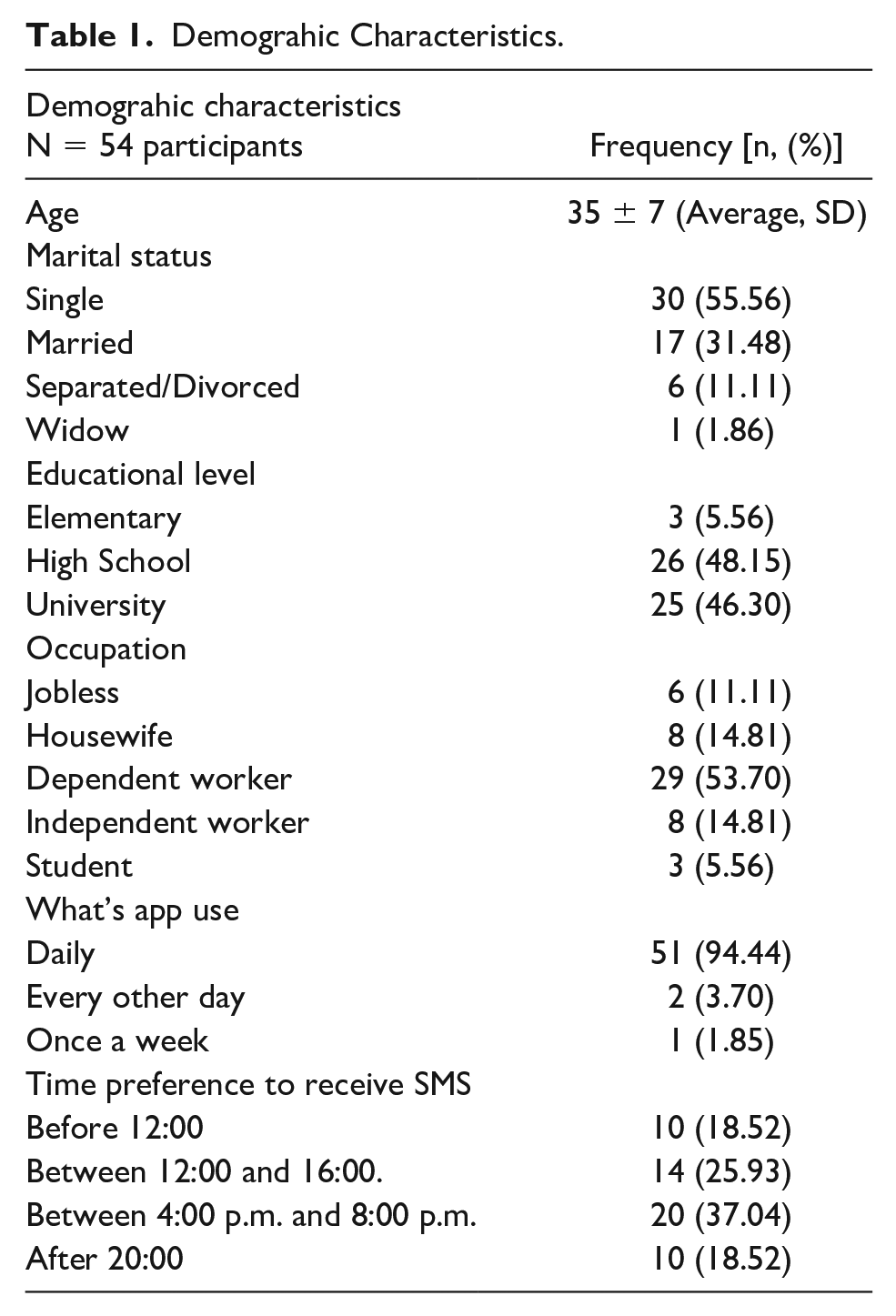
Throughout the 12 weeks, only 6 participants did not receive the messages for technical difficulties with their network providers, therefore results are based on 54 mothers/guardians (90%). To determine if WhatsApp was an effective media to deliver the messages, we use the “read” checkmark of the app, as an indicator. Considering this, messages were categorized according to the number of participants who read the text sent. This variable was further categorised on those who read 20 or more, between 20 and 12 and less than 12 of the text messages sent, being the first category the most successful and the third one, the least.
Figure 1 shows that on average, 83% of the participants read all messages sent (24 messages) while only 6% read less than 50% of the messages sent. As the number of messages and their frequency were previously agreed upon, we did not detect barriers towards the number of messages sent.

Number of participants who read the messages.
Satisfaction
The degree of satisfaction regarding receiving the messages was a key indicator to determine if this type of program can be inserted into the participants’ normal schedule. Figure 2 shows that the general degree of satisfaction was high for every category. Between 74% and 90% of the participants indicated that they were very satisfied with the recommendations proposed by the messages. Questions related to the content of the messages, frequency and use of the WhatsApp application as a platform, were evaluated by 90% of the participants, who rated them as excellent. Questions regarding the type of language used, personalization of the message and overall satisfaction of the program, were evaluated by 100% of the participants as excellent.

Results of survey on satisfaction.
Perception
A third set of indicators was elaborated to determine the specific interests of the participants as well as and obtain their recommendations to the program more feasible and interesting, assuming that their interest could be translated into future changes when implemented for a longer period of time.
The interaction of mothers with the person who sent the messages was an important influence on perception which was considered as a respectful and non-invasive mode of delivering the messages.
The main aspects were associated with the participant’s view on healthy eating and how it affects their children’s health. Therefore, mothers who actively participated in a health program, mainly in primary care clinics and schools, were more enthusiastic about receiving messages. These messages acted as a reminder of the recommended guidelines for food and physical activity. 15 That is, messages were considered as a support tool and guidance for participants as well as promoting a healthier lifestyle.
The first barrier identified in this study was lack of time. Parents reported that despite physical activity recommendations they did not have time throughout the day to meet the recommended physical activity guidelines due to long working hours as well as issues related to climate. Moreover, participants who lived in vulnerable neighborhoods considered parks as unsafe for their children to engage in physical activity.
In regards to behavior change, the messages sent to participants were considered as a support tool to ensure that they carried out activities that they would not do otherwise. These activities included going to the park, riding a bicycle and cooking the recipes. Although some participants incorporated recommendations as part of their daily routine, others considered doing so in the future. Analyzing these results with the theory of behavior change 16 we were able to classify most of the participants in either a state of contemplation or action. Participants who were classified as in the “action stage” were more likely to be presently or have participated in nutritional/ health programs. In contrast, participants who did not participate in this type of nutrition/health program were mostly classified as being in the contemplation stage.
Barriers related to cooking, such as lacking cooking skills, not enjoying cooking or relying on other family members to cook, made participants more likely to eat ultra-processed foods, such as sweet or savory snacks and fast food in general, or to cook quick meals with high caloric content, such as rice, pasta or potatoes.
To overcome these barriers, messages sent to participants included practical recommendations for increasing cooking-related activities. The recipes were simple, provided basic cooking instructions and calorie content. This type of message was based on nutritional guidelines and have an special focus on not overspending.
Discussion
In this study, perception, feasibility and satisfaction of participants were determined in a pilot messaging program aimed at mothers and/or tutors of overweight or obese pre-schoolers, in order to promote changes in their lifestyle behavior. The key features were based on previous research for developing messages with a rigorous process, personalization and use of a platform preferred by the users. 17
It is important to highlight the importance of tailored of messages, since it brings the user closer to the program, as mentioned in the meta-analysis carried out by Noar et al. 18 Given the result of the focus groups, each message was adapted to the needs of the target group, as was observed in the study by Collins et al, 19 where they describe 2 new methods for constructing and evaluating eHealth interventions, in emphasizing that adaptation can increase the effectiveness of a health behavior intervention.
The preference for practical messages as recipes or guidelines for physical activity, were similar to that reported by Sharifi et al. 20 in a study conducted in the United States, where the objective was to examine the acceptability of parents and the preferences of text messages to support behavior change related to childhood obesity. The study included 31 mothers or tutors, where participants expressed the need for specific and action-oriented advice and strategies to achieve the objectives instead of general information on healthy behaviors.
In the same line of action, Woolford et al. 21 explores d the perspectives of the participants on the content of the message delivered in a weight control program, through focus group with a total of 24 participants. Participants expressed that they preferred messages including recipes as part of a weight loss program. These results are similar to those that were obtained in this study by experts through the Delphi technique, where advice stressed that language should be inclusive, positive and direct. 16
This type of intervention poses many advantages, especially that it constitutes a low cost and easy method of delivering information. In addition, this intervention is an innovative method for supporting behavior change as highlighted by Armstrong et al. 22 . They reported that when text messaging was used in a group of 35 individuals, at the end of the 6 weeks of study, adherence increased by 56% in the application of sunscreen compared to the control group (30%). Text messaging are innovative tools to include in and increase reach community intervention. 23
Also, some participants who had been in previous programs for weight reduction indicated that these messages supported the recommendations that had been delivered to them. The study by Prestwich et al. 24 suggests that for physical activity interventions multi-components must be employed to achieve the desired objectives. Text message intervention had been successful and cost effectiveness in self-management in population with type 2 diabetes. 25
We believe that inclusion of a messaging program with characteristics such as the one we developed and determined satisfaction, Have the potential to improve adherence to recommendations, however, it is important to assess the effectiveness with other considerations such as individualized nutrition education, physical activity workshops always with a personalized perspective.
Strengths and Limitations
One of the main strengths of this study is the development of a successful 12-week pilot program and additionally determining the degree of satisfaction. This program provided participants with personalized messages that aimed to promoting healthy behavior in overweight and obese children, via their parents. However, an important limitation of this study is that the effect of the program in achieving behavior change in diet and physical activity was not determined, mainly because of the limited implementation period.
Conclusion
This study showed that it is feasible and highly acceptable to use a text-messaging program based on dietary guidelines and physical activity, for the Chilean population, through the WhatsApp Messenger application sent to mothers of overweight and obese preschool children to support lifestyle behavior change in children and their families.
Messaging can be regarded as a tool to support behavior change. We believe that a key aspect is personalizing each message with the name of each participant and establishing a regular contact with participants. This made participants feel that the researchers were genuinely interested in improving their quality of life.
Finally, the evidence that this messaging program is successful to promote changes in dietary habits and physical activity on a large scale has yet to be demonstrated.
Footnotes
Acknowledgements
We would like to thank Junta Nacional de Auxilio Escolar y Becas (JUNAEB) for funding this study, as well as all the participants for participating in the study.
Author Contributions
Solange Parra-Soto: was in charge of the study, participated in every stage and wrote the first draft and final version of the MS.
Alejandra Ortega: participated in the design of the study, developed the questionnaires, analyzed the qualitative data and reviewed the draft and final version of the MS.
Carlos Celis-Morales: resolved some queries regarding the methodology of the study and reviewed the draft and final version.
Juliana Kain: participated in every stage of the study, reviewed the draft and final version.
Declaration of Conflicting Interests
The author(s) declared no potential conflicts of interest with respect to the research, authorship, and/or publication of this article.
Funding
The author(s) disclosed receipt of the following financial support for the research, authorship, and/or publication of this article: This study was funded by the Junta Nacional de Auxilio Escolar y Becas (JUNAEB), which is part of the Chilean Ministry of Education.
