



Abstract
Background. Parents’ beliefs about and engagement in reading aloud to young children and other positive parenting practices have been associated with early childhood development (ECD) and later achievement. Aim. This exploratory study sought to assess parental attitudes and self-reported practices regarding ECD in a rural, low-income community in the Dominican Republic with many risk factors for ECD delays, including high rates of poverty, iron-deficiency anemia, and malnutrition. Methods. We used the Parent Reading Belief Inventory and open-ended questions to evaluate parental beliefs regarding reading, self-efficacy in promoting child development, current positive parenting practices, and parents’ concerns about the development of their 0- to 5-year-old children in Consuelo, Dominican Republic. We explored associations between demographic factors and strength of positive parenting beliefs and practices. Results. Overall participants had positive attitudes toward reading and their own importance in promoting their children’s development. Participants with at least some high school education had significantly higher Parent Reading Belief Inventory scores (P = .03) than those with less formal education. Participants reported frequently singing, talking, and playing with their children, but less frequently reading with them. Few participants had access to reading materials for young children. Parental interest in programs to support ECD was high. Parents raised concerns about their children’s behavior, personal and educational attainment, and early literacy. Conclusion. Children whose parents have less formal education may benefit most from interventions to promote beliefs and practices likely to improve ECD. In this community, there is high interest in learning more about ECD.
Keywords
Introduction
Early childhood development (ECD) is a strong predictor of school readiness and academic achievement, which in turn are predictors of health and economic productivity. 1 It is estimated that 80.8 million 3- and 4-year-old children worldwide have low cognitive and/or socioemotional development, placing them at risk for worse health outcomes and losses in economic productivity. 2 The Sustainable Development Goals challenge us to address gaps in equity, including those in education, health, hunger, and poverty.3,4 Our interest reflects recent calls by regional experts to enhance investment in ECD in Latin America and the Caribbean. 5 By decreasing delays in ECD among at-risk children, we can make progress on these Sustainable Developmental Goals and reduce economic inequalities.
Factors such as breastfeeding and positive parenting practices can mitigate the risks imposed by poverty, rural residence, iron-deficiency anemia, malnutrition, frequent episodes of diarrhea, and adverse childhood experiences (such as exposure to violence).6-10
Previous studies have demonstrated an association between parental beliefs about reading and the home literacy environment.11,12 Furthermore, data from a variety of countries show a positive correlation between frequency of reading at home and child reading achievement. 13 The Parent Reading Belief Inventory (PRBI), a 42-item scale that measures parents’ beliefs about the goals and processes of reading aloud to young children, has been validated in Spanish and shown to relate to parents’ and children’s early literacy practices. 14
In low-income communities in resource-limited settings with many potential risk factors for delayed ECD, quantification of risk and protective factors is an important step toward designing interventions to maximize developmental outcomes. In this study, we sought to identify current positive parenting practices among caregivers in a low-income community in the Dominican Republic. Our particular focus was on parents’ beliefs about and engagement in reading, and parents’ interest in additional education about child development and parenting practices. Parents’ concerns about ECD might serve as a starting point for future interventions or programming to promote ECD in this community. As a secondary aim, we examined associations between sociodemographic factors and positive parenting beliefs and practices. This was to determine whether particular demographic characteristics relate to parenting differences, since awareness of higher modifiable risks in certain subgroups can provide useful information for designing interventions to improve ECD.
Methods
Setting
Recruitment took place through Niños Primeros en Salud (NPS), a clinic and community-based health program that serves children 0 to 5 years of age living in the most impoverished barrios of Consuelo, Dominican Republic. Consuelo is a town of ~30 000 people located in the Eastern Dominican Republic. NPS is a collaborative partnership between local leadership, the Children’s Hospital of Philadelphia, and Centro de Salud Divina Providencia, the health center in which NPS is located.
The estimated per capita income in Consuelo is $2000 a year ($5000 less than the national average), and unemployment is high. The town’s population consists of many Spanish-speaking Haitian immigrants, a socially and politically marginalized population in the Dominican Republic. NPS offers free pediatric care, including well-child visits, sick visits, vaccinations, and follow-up home visits. At this clinic, ECD is currently not systematically monitored and there are limited community resources to support ECD. Because NPS families have existing relationships with clinic staff, including a team of community health workers, who regularly interact with families in clinic and during home visits, this site was an ideal setting for collaborating with clinical staff to conduct research and can be an ideal site for developing targeted interventions based on our research findings. Additionally, given the psychosocial risk factors of families in this community, this population is ideal for answering our research questions regarding parenting beliefs and reading behaviors in resource-scarce settings.
Over 50% of 12-month-old children served through NPS have mild or moderate anemia at 1 year of age. 15 Malnutrition, stunting, and frequent episodes of diarrhea are also common. Rates of breastfeeding traditionally have been low. Nationally, only 52% of Dominican mothers report any breastfeeding by 6 months of age. 16 Parental attitudes and beliefs about ECD and the extent to which caretakers engage in positive parenting practices such as reading, talking, singing, and playing with their children are unknown in this setting.
Subject Population and Data Collection
Parents and caregivers of children enrolled in the NPS program were surveyed in February and March 2018. To qualify for inclusion in the study, participants had to be aged 18 years or older, able to communicate in Spanish, and the primary caregiver (defined as a person who cares for the child at least 50% of the time during the day) of a child enrolled in NPS. We aimed to recruit a minimum of 50 participants, representing approximately 10% of the total population served by NPS. For participants with more than one child enrolled in NPS, we asked them to consider their child closest to the median age of NPS participants (30 months) when responding to questions.
This convenience sample was recruited during normal consultation hours at the clinic and participants were interviewed either before or after their child’s appointment, or in the community through door-to-door recruitment. Two interviewers (IM and KEW) conducted all interviews in Spanish. All data were collected on paper surveys and then transferred in a de-identified format to a secure online database. Study data were stored and managed using REDCap (Research Electronic Data Capture) electronic data capture tools hosted at the Children’s Hospital of Philadelphia. 17
Study Design
Quantitative Data
In order to examine associations between sociodemographic factors and positive parenting beliefs and practices, we collected demographic information (see Table 1) including parent and child age, parent and child sex, ethnicity (Dominican, Dominican-Haitian, Haitian, or other), neighborhood of residence, participant’s years of formal education completed, number of children, and age(s) of child(ren). To assess parents’ beliefs about and engagement in reading, we used the PRBI. The PRBI is a 42-item instrument consisting of statements to which participants respond using a Likert-type scale. Subscales and representative items are included (Table 2). Higher scores signify stronger agreement with statements about the importance of reading in ECD, parents’ role in promoting development, and availability of resources to engage in reading activities. The PRBI has been validated in multiple populations, including in low-income and Spanish-speaking populations in the United States.14,18 The Spanish-language translation of the PRBI was obtained from the authors of a project that had utilized the tool in a Mexican American population. 14 In a study using the translated version of the PRBI, the authors found internal consistency of 0.77 or higher for 5 of the 7 subscales (notably, the Reading Instruction and Environmental Input subscales had low reliability). 14 The authors also found significant correlations between overall PRBI scores and nearly all aspects of children’s home literacy experiences, suggesting high validity for the Spanish version of the PRBI. 14

Abbreviation: IQR, interquartile range.
Note that participants live in 7 different communities (“barrios”) within Consuelo that are not shown here to ensure participant privacy.
Level of significance adjusted using a Bonferroni correction, P < .0056 (P = .05/9 comparisons).
One participant with missing education data excluded from subgroup analysis.
Mann-Whitney test between high- and low-education Groups.
Note. The bold values indicates that 81% of participants were their child’s biological mother. All of the participants with high education were also biological mothers.
Parental Reading Belief Inventory.

In addition, we asked participants how many days per week they sang, talked, read, or played with their children in order to identify existing positive parenting practices. Finally, we asked about participants’ degree of interest in learning more about normal child development and about their interest in learning more about what they can do to promote their child’s development using 4-point Likert-type scales. Tests of significance were 2-tailed and adjusted using a Bonferroni correction to account for multiple comparisons.
Statistical Analyses
Total PRBI scores were calculated by first reverse-coding the negative items and then summing each item. Normality for continuous data was assessed using the Shapiro-Wilk test (P < .0001). Nonparametric data were reported as medians and interquartile ranges (IQRs; see Table 1). Ethnicity and neighborhood were analyzed categorically, and are reported as percentages. Because data collectors noticed consistent differences in participants’ apparent understanding of many of the items on the PRBI, as well as differences in knowledge about ECD, and these differences seemed related to parental education level, the sample was dichotomized as “high education” (at least some high school) versus “low education” (<9 years education/no high school) for relevant analyses.
Cronbach’s α was calculated for each PRBI subscale (see Table 2) to assess internal consistency within our sample. To understand how scores compared between our population and those of a low-income and low-middle income US population surveyed by DeBaryshe et al, 12 we compared scores to the results comprising both of these samples in the original validation of the PRBI with Mann-Whitney test. 14 Total scores in the original DeBaryshe (n = 60) had a mean of 136.91, SD 13.07, and those of a second published sample (n = 56) were modestly higher at 139.58, SD 11.75. 12 Using Mann-Whitney tests, we also examined the bivariate association between PRBI scores and demographic variables, including parent sex, participant age analyzed as a continuous variable, and education level; total number of children in the family; child sex and age; and the neighborhood in which they lived.
Qualitative Data
In order to assess caregivers’ concerns around their children’s development in an open-ended manner, we recorded participants’ opinions about ECD. Qualitative data were obtained by asking participants the following open-ended questions: “What do you most want to learn about early childhood development?” and “What do you most want to learn about your child’s development?” Responses were transcribed verbatim in Spanish and then translated into English. Additionally, participants were asked to give examples of activities they might do with their child. All responses were reviewed separately by 2 authors (IM and KEW), who generated a list of themes and subthemes using inductive thematic analysis. This method of analysis was chosen because it is useful for exploratory research and it is flexible, considerations that are particularly important given that this is the first study to our knowledge to examine caregiver beliefs about ECD in this community. 19 Consensus on the thematic content was achieved by discussion of individual responses. Many comments fit several themes/subthemes, and multiple codes were applied to each comment when appropriate. During community-based interviews, most of which took place in caregivers’ homes, participants were asked to share an example of a book they might read to their 0- to 5-year-old child.
Ethical Approval and Informed Consent
All study procedures were approved by the institutional review board (IRB) at the Children’s Hospital of Philadelphia (IRB Number: 17-014358) and the Consejo Nacional de Bioética (CONABIOS), the IRB of the Dominican government. Written informed consent was obtained from all participants.
Results
Quantitative Analysis
A total of 55 caregivers were recruited and completed study measures (see Table 1). The median age of respondents was 28.5 years (IQR = 24-36.5 years). At least some high school was completed by 35 (63.6%) participants. Respondents in the low-education group were older (median 36.5) than respondents in the high-education group (median = 26 years, P = .005). Parity was low overall with 21 (38.2%) parents having only 1 child and 17 (30.9%) parents having 2 children. The median age of children referred to in the study was 28 months (IQR = 19-36 months). There were no significant differences between low- and high-education groups in terms of number of children or age of child. Participants were most frequently biological mothers, but also included adoptive mothers, grandmothers, and one father.
Cronbach’s α for each subscale was similar to published values from previous samples with the exception of the “Reading Instruction” subscale, which was relatively low in our sample (Cronbach’s α = 0.39 for the 4 question subscale; see Table 2). 12 Notably, for the “Teaching Efficacy” subscale, Cronbach’s α improved from 0.63 to 0.88 when the subscale’s 4 reverse-coded items were removed from the calculation. Across the sample, the median PRBI score was 119 (IQR = 115-129). Total PRBI scores in the high-education group were significantly higher (median = 123; IQR = 117-130) than in the low-education group (median = 115; IQR = 113-121, P = .003). After applying a Bonferroni correction, there was a significant difference in scores between the high- and low-education groups for the subscales Teaching Efficacy (P < .001) and Resources (P = .004). Positive Affect (P = .02) and Knowledge Base (P = .02) approached but did not reach statistical significance (see Table 3). Total PRBI scores in our sample were lower than in the original validation sample (P < .001). 12 There were no significant differences in PRBI scores based on participant age, child age, participants’ number of children, or the barrio in which they live.
Total PRBI Scores and Subscale Scores a .
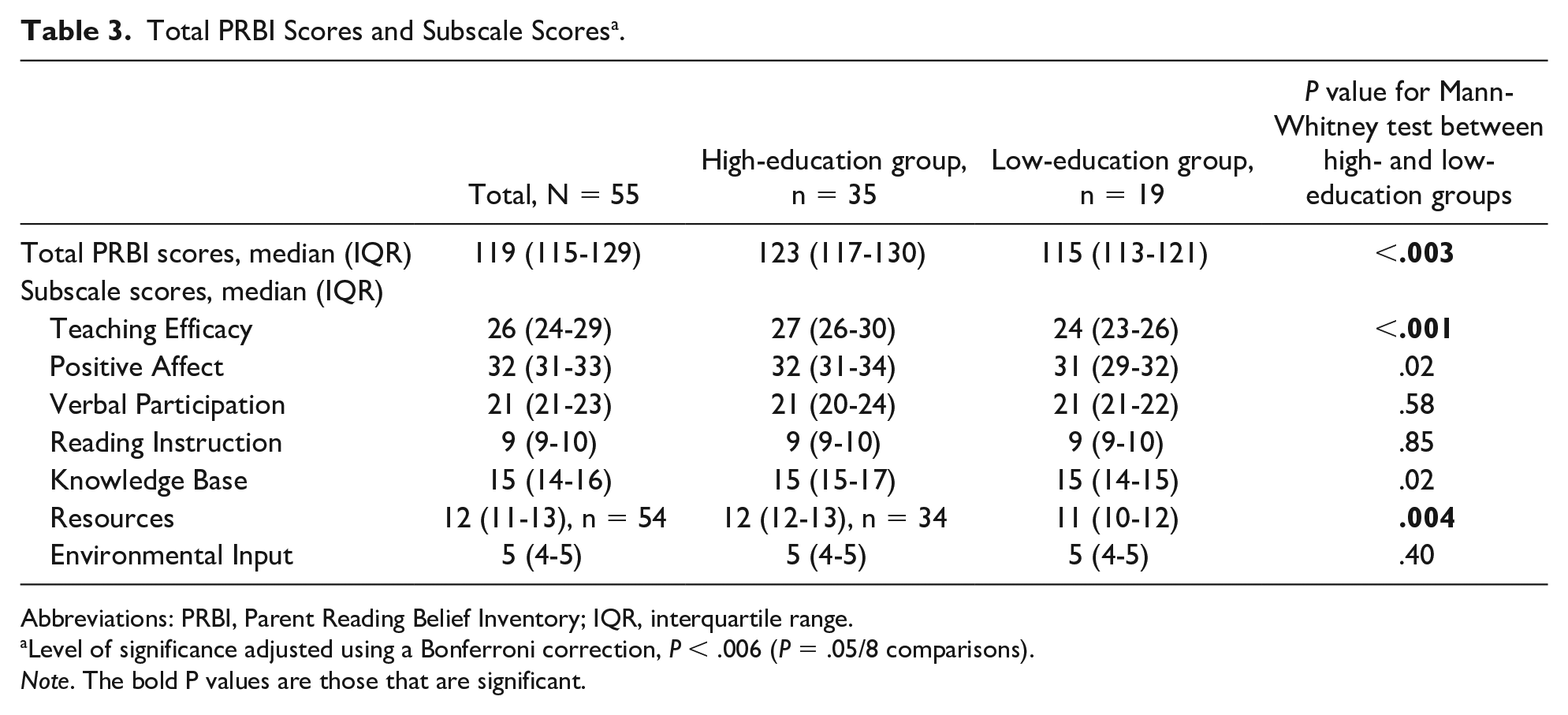
Abbreviations: PRBI, Parent Reading Belief Inventory; IQR, interquartile range.
Level of significance adjusted using a Bonferroni correction, P < .006 (P = .05/8 comparisons).
Note. The bold P values are those that are significant.
Participants reported singing, talking, and playing with their children on a daily basis (median frequency 7 days/week; singing and playing, IQR = 3-7 days; talking, IQR = 7-7 days), and reported reading with their children a median of 2 days per week (IQR = 0-4). The difference between high- and low-education respondents was not statistically significant for any of these activities nor was it significantly different for any of the other demographic variables assessed.
Qualitative Analysis
In response to “what do you most want to learn about early childhood development?” the following themes and subthemes emerged: behavioral concerns, particularly obedience; how to promote normal development; physical health, including disease prevention, hygiene, and nutrition; and parental role in ECD. In response to “what do you most want to know about your child’s development?” the following themes and subthemes emerged: behavioral concerns, particularly hyperactivity and obedience; promoting reading/early literacy; physical health, especially concerns around nutrition; personal/educational attainment; and parental role in promoting ECD. Table 4 displays participant quotes that exemplify each of the prominent themes.
Quotes From Open-Ended Questions.

When asked to give examples of activities they do with their child, participants mentioned playing with toys or objects (playing with dolls, hula-hoop, or a ball), interactive play with parent (hide-and-seek, tickling), didactic activities (counting, teaching body parts, potty training), imaginative play (playing cooking, combing dolls’ hair), routine child care (brushing hair, taking a bath), and shared or individual screen time (watching movies, taking “selfies” together). In addition, behavioral concerns were cited as a limitation on parent-child activities, and disciplinary actions were mentioned as an expected aspect of parent-child play.
Discussion
Participants had positive attitudes toward reading with their young children and about their own importance in their children’s development. These findings were more pronounced for participants with more years of formal education. All participants reported talking to, singing with, and playing with their young children more frequently than reading with them. Few participants had access to reading materials for young children. However nearly all had high interest in learning more about ECD, particularly as it relates to their children’s current behavior and long-term educational and personal attainment.
The median PRBI score among participants in this study was lower than in DeBaryshe’s samples. Participants in our sample generally do not agree as strongly with the premises tested by the PRBI compared with the primarily Mexican American and white Appalachian samples assessed previously with this tool. This suggests that the frequency and quality of parent-child emergent literacy activities in our sample is relatively low, and is consistent with caregivers’ reports of talking, singing, and playing with their young children more frequently than reading with them. The difference was particularly striking among the almost 40% of the adult participants who did not have at least some high school education. The significantly lower scores of low-education participants in the subscales of Teaching Efficacy and Knowledge Base, in particular, suggest that a disparity may exist either in caregivers’ understanding of and belief in their roles in promoting development or in the role of reading as a tool for expanding children’s knowledge about the world. The Environmental Input and Reading Instruction subscales had the lowest Cronbach’s α, which is consistent with findings from previous studies of the PRBI, reflecting inherent low internal consistency across multiple populations.14,20 These subscales should therefore be interpreted with caution.
The difference between our PRBI results and those of other studies may be due to relatively lower levels of formal education in our population, which could affect participants’ understanding of the items. Previous studies have shown a correlation between education level and positive beliefs around reading and parental self-efficacy in children’s development. 21 Additionally, some caregivers with low levels of education may have low or no literacy, and thus perceive that they are unable to engage in literacy-related activities with their children. Caregivers with less formal education may also lack the time to read with their children. Education may be a proxy for socioeconomic status, which may explain the significant difference in scores for the Resources subscale, as participants with less formal education may not have books readily available due to limited resources. There also may be cultural differences in the importance of reading with young children and the types of activities in which parents engage their children. The PRBI therefore may have limited utility as a tool for understanding parents’ beliefs about ECD and their role in their child’s development in settings where reading with children is an uncommon practice, and measures that consider other positive parenting practices should be considered.
Previous research demonstrates a variety of opportunities for parents with low literacy, or those who do not routinely engage in literacy-promoting activities, to facilitate their children’s development. For this reason, we felt it was important to ascertain caregivers’ current positive parenting practices and their goals and concerns around their children’s development. In a large cohort of low-income parent-child dyads in the United States, high-quality parental engagement during play, provision of learning materials, and high frequency of shared book-reading, singing nursery rhymes, and storytelling all were associated with children’s language and cognitive skills at multiple time points in the first 3 years of life. 22 Provision of age-appropriate reading materials combined with parental education as part of pediatric preventive care in the Reach Out and Read program has shown benefits for children’s language development and parents’ engagement in literacy activities in multiple studies, including among both English- and Spanish-speaking families in the United States. 23 Dialogic reading, a book-sharing technique that does not require parental literacy, has been shown to positively affect early linguistic development in a variety of contexts and populations. 24
Multiple studies have shown positive effects of parent education interventions on ECD in low- and middle-income countries, particularly when both parents and children are involved in the intervention. 25 In some cases, effects of these interventions were greater for younger and poorer children.26,27 On average, parents in this study reported reading to their children less than every other day. By contrast, in a survey of US American parents, 58% reported reading with their child aged 0 to 5 years on a daily basis. 28 In another study, 61% of California parents of children aged 0 to 5 years reported reading with them every day. 29 More research is necessary to elucidate the reasons for low reading rates among our sample, and improving reading rates may be an area of focus for future interventions. To address the potential barriers of time and access to books, possible interventions might also include the creation of preschool programming at or near the clinic, or implementation of early literacy curricula in neighborhoods by community health workers. Other positive parenting practices, such as signing, and talking (including with preverbal children), can also be promoted if those activities are more acceptable to families.
Our qualitative results also suggest that participants have a strong interest in improving their knowledge about how to promote ECD. The frequently cited concerns around their children’s personal and educational attainment suggest an opportunity to educate caregivers about how increasing their efficacy as teachers through positive parenting practices, including emergent literacy activities, can translate into long-term benefits for their children. The qualitative data suggest a possible disconnect between caregivers’ ideas about ECD, particularly their role in children’s development, and their long-term goals for their children. Future interventions might address how early literacy activities and other positive parenting practices can affect later academic achievement.
The frequently mentioned concerns around “hyperactivity” and “disobedience” suggest either a high prevalence of hyperactive symptomatology or unrealistic caregiver expectations of toddlers’ behavior. Iron deficiency, which is known to be problematic in this community, is a frequent comorbidity in attention-deficit/hyperactivity disorder (ADHD), although a causal link has not been definitively established. 30 Infant iron deficiency is strongly associated with ADHD and other neurobehavioral challenges in adolescents. 31 However, the extent to which that association is confounded by other risk factors is unknown. Environmental toxins such as lead may also contribute to ADHD symptoms and their prevalence is unknown in this setting. 32 Furthermore, early psychosocial stressors have been identified as risk factors in the development of ADHD symptomatology among toddlers, such as maternal depression, paternal antisocial behavior, and young maternal age at child’s birth, among others. 33 The prevalence of these risk factors is unknown in this setting. Parents’ concern about their children’s “hyperactivity” may represent an opportunity to couple caregiver education about normal developmental milestones with positive parenting practices training. An intervention that addresses caregivers’ stated concerns might be more effective than one that does not address their concerns. Furthermore, caregivers frequently cited physical health, such as the common cold and their children’s growth, as important concerns. It may be helpful to frame future programming on ECD in the context of children’s overall health.
This study highlighted strengths among the parents and caregivers of Consuelo. First, caregivers expressed a high level of investment and interest in their children’s growth, development, and personal/educational achievement. Second, caregivers are aware of the importance of their roles in promoting their children’s development and education, and are interested in learning more about what they can do to facilitate it. Finally, caregivers spend significant amounts of time engaging in positive parenting practices, including singing, talking, and playing with their children. Taken together, these findings highlight an opportunity in this community to further elucidate barriers to reading and to build culturally relevant programming for parents around early literacy promotion, specifically in conjunction with the provision of appropriate resources. There is also a need for general education about developmental milestones and normal behavior in young children.
This study has several limitations, the first being sample size. While we reached thematic saturation in the qualitative data, we might have achieved greater power in our quantitative analyses with a larger sample size, particularly given that we disaggregated the data by demographic characteristics, such as years of formal education. Furthermore, the PRBI subscales demonstrated low internal consistency, suggesting that future work in this area may benefit from use of an alternative tool to measure parental beliefs and practices around ECD. Caregivers’ literacy was not measured directly and low or absent caregiver literacy may limit the ability of those with less formal education to take part in some of the activities measured by the PRBI such as reading to the child. Activities to support early literacy among children of low-literacy parents may be an important topic of future programming in this community.
Another limitation of our study is that only the frequency, and not the quality, of interactions with children was measured. Self-reported frequency is subject to recall bias and social desirability bias, and it is unclear how caregivers play, talk, and sing with their children. Furthermore, ours was a convenience sample, consisting of caregivers who came to clinic or were present in the community when the study team was collecting data. Compared with a randomly assessed sample of the clinic population’s parents, those who came to clinic for their child’s care during the study period and those who were at home during the day are less likely to have been employed and more likely to spend the majority of their day with their children. This may have biased results toward overestimating positive parenting behaviors, so actual practices among a representative sample not presenting in clinic might be lower.
In considering the likely generalizability of these findings, it is important to bear in mind that NPS was founded specifically to target children in particularly vulnerable and impoverished communities. These results are most likely to generalize to similar populations. Thus, further efforts focused on better understanding the disparities between parenting practices among those with higher versus lower levels of education in this setting and efforts to improve ECD in this setting are most likely to inform work in settings where children are at highest risk of poor developmental outcomes.
In the future, our team plans to systematically screen preschool-aged children’s development in the NPS cohort to determine the prevalence of delays and the need for interventional programs. Possible future directions include the creation or adaptation of a curriculum aimed at parents and caregivers that addresses developmental milestones, normal early childhood behavior, and early literacy promotion, as these were the topics of interest uncovered in the present study. Such a curriculum would be most effective if adapted to serve low-literacy parents with limited resources. Another option might be the adaptation of a preschool curriculum focused on emergent literacy, which could be administered by designated personnel, such as community health workers, at strategic locations.
Conclusions
This study provides information about caregivers’ knowledge gaps and concerns with regard to ECD in a community in the Dominican Republic with high risk for developmental delays. Although participants had positive attitudes toward reading with their children, they reported low levels of actual reading as compared with other positive parenting practices (singing, talking, and playing).
Participants’ concerns around hyperactivity, disobedience, and ensuring children’s personal and educational achievement highlight opportunities for community education about developmental milestones and maximizing developmental outcomes. It may be particularly helpful to focus on enhancing knowledge about the importance of reading, including dialogic reading that does not require high levels of literacy, for caregivers with less formal education. Our findings also illuminate strengths within this community, including existing positive parenting practices, positive attitudes toward reading, and the parental role in promoting ECD, and high levels of parental interest in learning more about development.
Footnotes
Author Contributions
IM planned the project, collected data, analyzed data, and wrote and revised the manuscript. KW planned the project, collected data, analyzed data, and wrote and revised the manuscript. IJ assisted with project planning. RC assisted with data collection. AD planned the project and assisted with manuscript revision. AS planned the project and assisted with data analysis and manuscript revision. EL planned the project and assisted with data analysis and manuscript revision.
Declaration of Conflicting Interests
The author(s) declared no potential conflicts of interest with respect to the research, authorship, and/or publication of this article.
Funding
The author(s) disclosed receipt of the following financial support for the research, authorship, and/or publication of this article: The authors received financial support from the Center for Global Health at the Children’s Hospital of Philadelphia.
