



Abstract
Participation in boxing, mixed martial arts, and wrestling is extremely popular among children and adolescents. The objective of this study was to determine themes depicted in a select number of combat-related films. Twenty films were independently viewed and analyzed by 4 reviewers. The average number of positive and negative themes was 34.4 and 18.1 mean events/hour for all included films, respectively. The most common positive themes were “positive interactions with family/friends/fans,” “importance of mentorship,” and “positive interactions with a coach/trainer” (4.23, 3.63, and 3.06 mean events/hour, respectively). The most common negative themes were “choosing to do the wrong thing,” “negative interactions with family/friends/fans,” and “poor sportsmanship” (2.70, 2.00, and 1.58 mean events/hour, respectively). In conclusion, the co-viewing of combat-related films among pediatric athletes and their coaches/trainers and/or parents in order to focus on “teachable moments” may encourage the acquisition and development of positive themes and the avoidance and de-emphasis of negative themes.
Introduction
Sport participation is an important part of the development, both physically and mentally, of children and adolescents in the United States. Despite its inherently violent nature, boxing, mixed martial arts (MMA), and wrestling are extremely popular sport activities. This popularity extends to pediatric athletes in the United States, including more than 18 000 minors registered with USA Boxing, more than 6.5 million children participating in some form of MMA, and approximately 270 000 high school students participating on a wrestling team.1-3 A growing number of studies have examined the effects of sports participation, both positive and negative, on the development of children.4-6 Benefits of sports participation include developing a positive relationship with a coach, personal growth from mental and physical challenges, gaining support from family and friends, developing a sense of community, creating new friendships with teammates, decreased early sexual activity in girls, and learning skills including time management, importance of work ethic, and stress maintenance.4-6 On the other hand, potentially negative aspects of sports participation include adverse interactions with coaches or teammates, exposure to parental pressure to succeed or continue sports participation, dealing with a psychologically challenging environment, increased alcohol use, and demonstrating increased violence on and off the field.5-7
Several recently published studies have investigated the effect of media exposure, especially films, on behaviors and choices made by children and adolescents. Media exposure has been shown to contribute significantly to pediatric health issues such as early sexual activity, alcohol use, smoking, drug abuse, obesity, sleep disorders, risk-taking behaviors, and self-harm.8-20 Furthermore, studies have demonstrated that exposure to media violence may contribute to violent tendencies and aggressive behavior in children and adolescents.16-20
Although there has been a recently published study examining positive and negative themes depicted in 44 sport-related films, only 5 films included in this study were associated with combat-related sport. 21 The objective of this study was to determine the positive and negative themes depicted in a select number of combat-related films, then stratified by film rating, sport type, and genre. The authors hope that by identifying positive and negative themes depicted in combat-related films, pediatric health care providers, athletic coaches/staff, and parents can use this form of media as a guide in the education and development of children and adolescents who participate in combat-related sports.
Methods
We conducted a content analysis study and examined the positive and negative themes depicted in a select number of combat-related films released between 2006 and 2016. Combat-related films were defined as films whose main plot focused on competition involving boxing, MMA, or wrestling. Our sample of 20 combat-related films were chosen after accessing the database www.boxofficemojo.com on February 1, 2017, using search terms “sports-boxing,” “sports-drama,” and “action-martial arts” and highest reported lifetime gross profits. Included films required availability from either streaming media, video-on-demand, or digital video disc (DVD). Film rating, as assigned by the Motion Picture Association of American film rating system (www.mpaa.org) (PG [parental guidance suggested], PG-13 [parents strongly cautioned, some material may be inappropriate for children below 13 years], R [restricted—below 17 years requires accompanying parent or adult guardian], and NR [not rated]), was determined for each included film. Film genre (action, documentary, drama, family, or thriller), as assigned by www.IMDB.com, was also determined for each included film.
A data collection instrument, developed by the authors and composed of a predetermined list of positive and negative themes, allowed each of the 4 viewers (AW, CL, EB, and ZW) to independently document each event associated with a theme. For positive and negative interactions, we included both verbal and nonverbal forms of praise/encouragement and discouragement/ridicule/taunting, respectively. Certain coding guidelines were decided prior to viewing the study films. Events, either positive or negative, were actions or discussions, either stated directly in the film script or implied during a scene. Actions performed in the film and then referenced later were coded only at the initial encounter. Furthermore, a coding algorithm was developed to use when more than one theme applied to a certain scene in a film.
Mean positive and negative events per hour were determined using repeated measures Poisson regression models in SAS version 9.4 and were reported with corresponding 95% confidence intervals. The unadjusted rates and confidence intervals for each type of film, sport, and year of release were estimated by entering these factors into the models separately. The adjusted rates and confidence intervals were then estimated by including rating category, sport, year of release, and reviewer simultaneously in multivariable repeated-measures Poisson regression models for positive and negative themes. Individual positive and negative themes were then analyzed following the same procedure described for the total positive and negative themes. The Institutional Review Board at the Pennsylvania State Hershey Medical Center deemed the study exempt.
Ethical Approval and Informed Consent
The Institutional Review Board at the Pennsylvania State Hershey Medical Center deemed the study exempt. Ethical approval and informed consent was not required for this systematic review of combat-related sports films, as no human subjects/patients were involved in data collection and analysis.
Results
Table 1 describes the films included in the study. For all films, the median year of release was 2011 (Q1 2005, Q2 2016), and the mean lifetime gross profit was $35.6 million (SD = 10.8 million, 95% confidence interval [CI] = 13.4-58.2 million). Half of the included films were rated PG-13, and the sport types depicted were boxing (50%), MMA (30%), and wrestling (20%).
Description of the Combat-Related Films Included in the Analysis a .
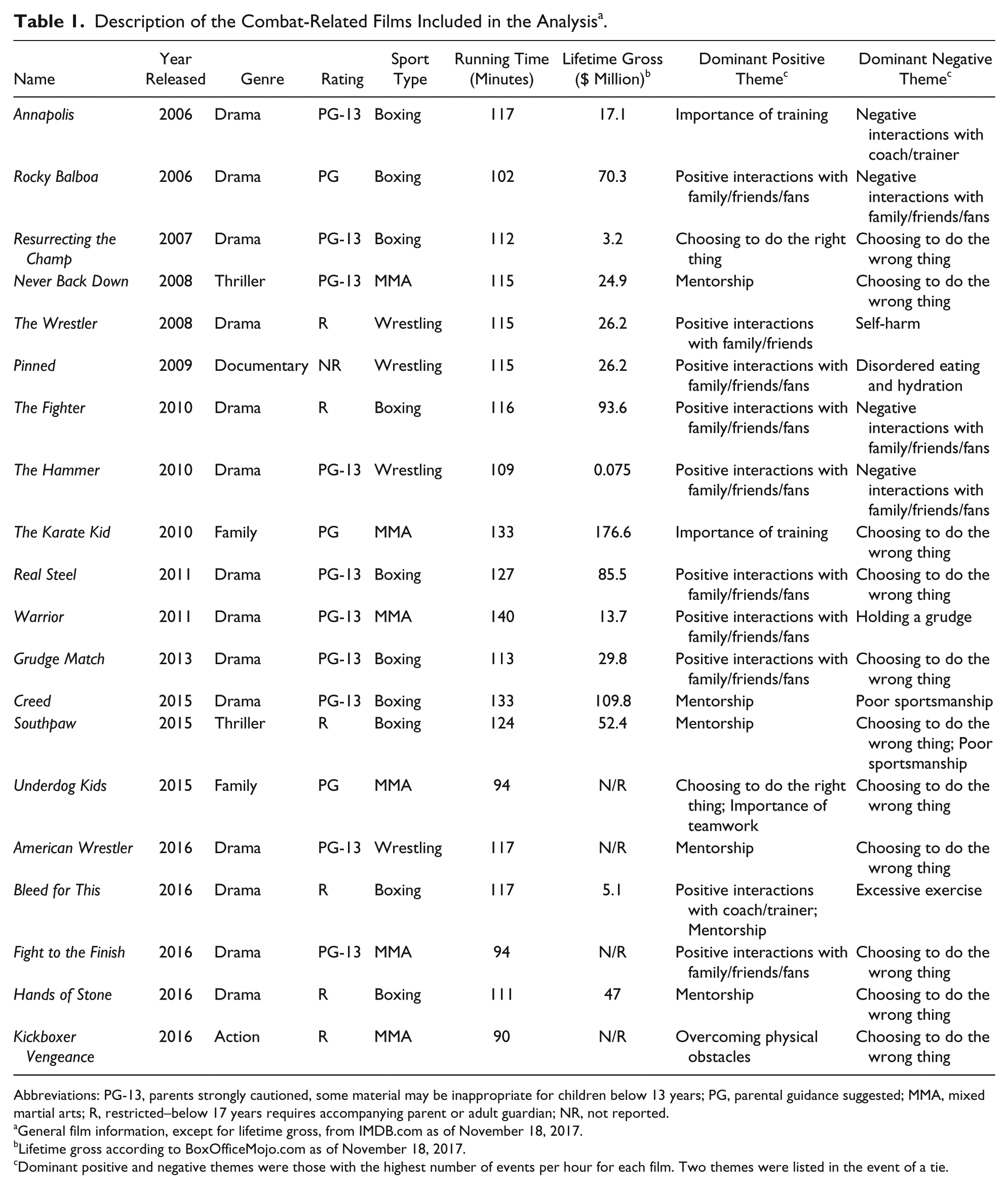
Abbreviations: PG-13, parents strongly cautioned, some material may be inappropriate for children below 13 years; PG, parental guidance suggested; MMA, mixed martial arts; R, restricted–below 17 years requires accompanying parent or adult guardian; NR, not reported.
General film information, except for lifetime gross, from IMDB.com as of November 18, 2017.
Lifetime gross according to BoxOfficeMojo.com as of November 18, 2017.
Dominant positive and negative themes were those with the highest number of events per hour for each film. Two themes were listed in the event of a tie.
The average number of positive and negative themes was 34.4 (95% CI = 30.0-39.5) and 18.1 (95% CI = 16.0-20.4) mean events per hour for all included films. Tables 2 and 3 show the mean events per hour for each of the positive and negative themes, respectively. The most common positive themes for all included films were “positive interactions with family/friends/fans,” “importance of mentorship,” “positive interactions with a coach or trainer,” “importance of training,” and “choosing to do the right thing.” The most common negative themes for all included films were “choosing to do the wrong thing,” “negative interactions with family/friends/fans,” “poor sportsmanship,” “negative interactions with a teammate or opponent,” and “holding a grudge.”
Positive Themes (Reported as Mean Events per Hour [95% Confidence Interval]) Depicted in Our Sample of Combat-Related Films, Then Stratified by Sport Type a .

Abbreviation: MMA, mixed martial arts.
Themes too small to estimate include the following: appropriate return from injury/rehabilitation; motivation for competition (higher power/God); motivation for competition (race or country); motivation for competition (helping others/charity); sports participation for all; having fun is more important than winning; and importance of proper sleep/rest.
Negative Themes (Reported as Mean Events per Hour [95% Confidence Interval]) Depicted in Our Sample of Combat-Related Films, Then Stratified by Sport Type a .

Abbreviation: MMA, mixed martial arts.
Themes too small to estimate include the following: focusing on individual goals over the team’s goals; racism; sexism; excluding others due to disability; use of performance-enhancing drugs; use of painkillers; disordered eating or hydration; and improper sleep.
In the unadjusted bivariate analyses, the overall rate of positive themes was 34.4 events per hour (95% CI = 30.0-39.5) and did not significantly differ among film ratings (P = .37) or sport type (P = .72; Table 4). Additionally, there was a significant positive linear relationship (P = .015) between the year of release and total positive themes. The overall rate of negative themes was 18.1 events per hour (95% CI = 16.0-20.4) and did not significantly differ among film ratings (P = .62) or sport type (P = .47). There was a significant positive linear relationship (P = .003) between year of release and total negative themes.
Unadjusted Bivariate a Associations for Total Positive and Negative Themes.

Abbreviations: SE, standard error; CI, confidence interval; NR, not reported; PG, parental guidance suggested; PG-13, parents strongly cautioned, some material may be inappropriate for children below 13 years; R, restricted—below 17 years requires accompanying parent or adult guardian; MMA, mixed martial arts.
Bivariates included rating and reviewer and sport and reviewer.
After performing a multivariable repeated-measures Poisson regression for the rate of positive themes and adjusting for year of release, genre, rating, sport type, and reviewer as covariates, there was a significant difference (P = .005) in the rate of positive themes among the different movie ratings (Table 5). Thus, the rate of positive themes among the different films ratings were significant with the inclusion of these factors in the regression. A second multivariable repeated-measures Poisson regression for the rate of negative themes, adjusting for year of release, genre, rating, sport type, and reviewer, showed a significant positive linear relationship (P = .002) between year of release and rate of negative messages.
Adjusted Multivariable a Associations for Total Positive and Negative Themes.
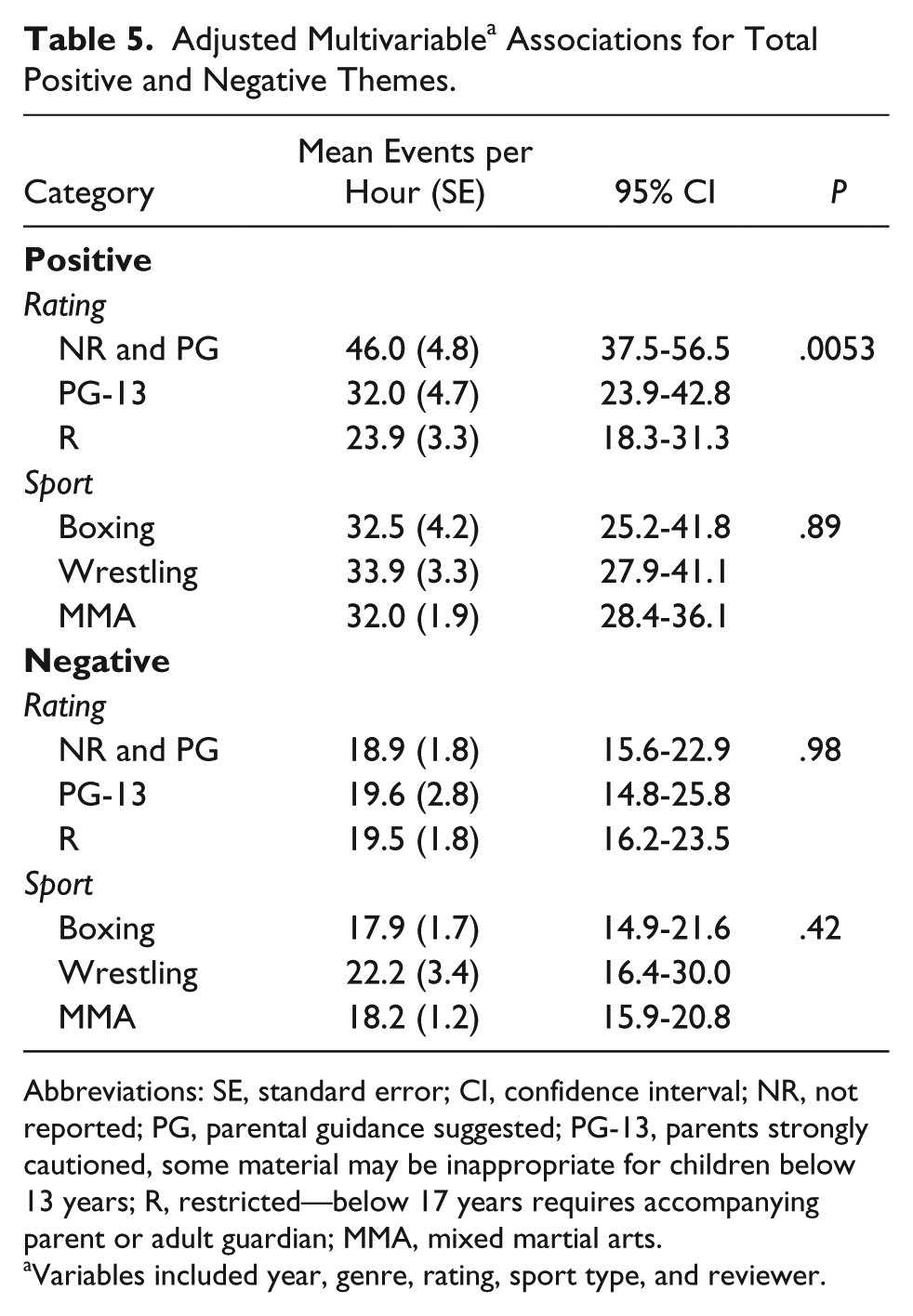
Abbreviations: SE, standard error; CI, confidence interval; NR, not reported; PG, parental guidance suggested; PG-13, parents strongly cautioned, some material may be inappropriate for children below 13 years; R, restricted—below 17 years requires accompanying parent or adult guardian; MMA, mixed martial arts.
Variables included year, genre, rating, sport type, and reviewer.
The repeated-measures Poisson regression models for the total number of positive and negative themes per hour did not find a statistically significant amount of interrater variability among the reviewers for positive themes (P = .120), but did find a statistically significant amount for negative themes (P < .001).
Discussion
Due to the popularity of sport-related films, coaches, athletic/personal trainers, health care providers, and parents have used these films to both educate and motivate pediatric athletes. It has been suggested that a child’s perceptions and understanding of positive and negative themes depicted in film can be shaped and reinforced by their parents, athletic coaches/trainers, and primary care providers. Sport organizations, such as the Positive Coaching Alliance, have suggested the co-viewing of sport films among pediatric athletes and their coaches, athletic/personal trainers, and/or parents in order to focus on “teachable moments,” using questions to guide discussion (http://devzone.positivecoach.org/browse/discussion%20guides). Questions, encouraging the acquisition and development of positive themes and the avoidance and de-emphasis of negative themes, can be developed by health care providers.
In our sample of combat-related films, the most common positive theme was “positive interactions with family/friends/fans,” and the second most common negative theme was “negative interactions with family/friends/fans.” The relationship between a pediatric athlete and their parents and/or family is paramount in promoting a child’s interest and participation in sports. Parents play a key role in an athlete’s development by staying actively involved in their sport, giving praise and understanding, and occasionally providing directive behavior. 22 Conversely, parental pressure has a tremendous impact on a pediatric athlete’s sense of self-worth, and the way an athlete perceives how their parents view their athletic ability affects how they perceive themselves.22-25 If parents engage in directive behavior (ie, telling athletes what they should be doing), they can actually cause greater feelings of pressure, and too much pressure can lead to amotivation. 26 In our sample of combat-related films, most of the discouragement from family/friends was associated with a disapproval of the athlete’s participation in the particular sport rather than engaging in directive behavior or ridicule of skill. In addition, when athletes depicted in our sample of films were discouraged by their family, it often provided them with additional extrinsic motivation to achieve their goals in order to prove their family wrong. These situations show pediatric athletes how to turn a negative theme (eg, “negative interactions with family/friends/fans”) into a positive opportunity, such as overcoming physical and mental obstacles, doing your best, or the importance of training.
The importance of a pediatric athlete developing a positive relationship with their coach and the concept of mentorship was frequently depicted in our sample of films. It has been shown that a strong positive coach-athlete relationship, followed by an athlete’s relationship with their parents, is the most influential for a student athletes’ perception of their own athletic ability and body image. 25 An athlete’s relationship with their coach is arguably “the most important sport interaction,” in that a coach’s opinion of athletic ability is worth more to an athlete than a parent’s opinion, and a positive coach-athlete relationship can increase the chances of continued sports participation.25,27 Coaching is not the same in all sports, and the dynamics of the coach-athlete relationship can vary depending on the sport. One study found that when comparing individual sports, such as combat-related sports, to team sports, the accuracy of coaching was higher in individual sports than in team sports. 28 This finding is unsurprising since there is much more face-to-face time with a coach in individual sports, allowing for attention to detail and fine tuning of skills.
Combat-related sports require a high level of technical skill in order to be successful, and this success is often associated with intensive training, setting realistic goals, and emphasizing proper nutrition and hydration. Although the importance of training was a common theme in our sample of combat-related films, 2 underrepresented themes were the following: the importance of setting realistic goals and the importance of proper nutrition and hydration.
Setting realistic goals is an important aspect of sport because it helps foster motivation to work harder and overcome obstacles. A published study found that college athletes involved in individual sports, such as combat-related sports, saw an increase in performance through goal setting compared with athletes involved in team sports. 29 Furthermore, goal setting has been associated with a decreased fear of failure in young elite athletes. 30 These findings emphasize the benefits of goal setting and the need for continuous reinforcement, assessment, and revision of these goals. Ideally, goals should be set utilizing Sullivan and Strode’s “SMAART” principle (specific, measurable, aggressive yet achievable, relevant, and timely) as this has been shown to lead to the successful attainment of set goals. 29 Additionally, set goals are most effective in improving performance when the goal is based on the improvement of oneself and not based on doing better than others or one’s competitors. 31
Proper nutrition and hydration, also underrepresented in our sample of films, is an important component to the success of an athlete. Combat-related sports in particular have a high incidence of unhealthy weight loss behaviors, as two thirds of athletes involved in weight-class sports, such as boxing, MMA, and wrestling, attempt to acutely lose weight with dehydration or fasting techniques. 32 It is often believed that lighter athletes have an increased strength-to-weight ratio, precipitating the practice “weight cutting.” Many coaches and athletes think that this practice of unhealthy weight loss is acceptable because athletes can then rapidly replenish themselves once they weigh in at a competition. However, it takes up to 48 hours to fully replenish intracellular fluids and for the body to return to peak aerobic performance after only a few days of dehydration.32-34 This misconception may lead to medical emergencies, such as exertional heat related illness and unnecessary traumatic injuries.
Violent behavior is an intrinsic component to the training and competition associated with combat-related sports, and the acts of punching, kicking, grappling, and body slamming often lead to injury. One longitudinal study found that the injury rates for boxing, MMA, and wrestling were 44, 56, and 120 injuries, respectively, per 100 000 participants. 35 However, there are identified benefits to combat-related sports, both physically and mentally. Pediatric participants in Judo, a form of MMA, gained more muscle, increased flexibility, and improved both sit-up and flexed arm hang performance compared with soccer and track athletes over the same period of time. 36 Furthermore, those participating in Judo had improved cognitive performance, enhanced motor learning, and increased sense of well-being and satisfaction. 36
We recommend that coaches, athletic/personal trainers, health care providers, and parents of pediatric athletes stress the importance of setting realistic goals and the importance of proper nutrition and hydration (2 underrepresented themes we found in our sample of films) and emphasize that, although violent behavior is often associated with participation in combat-related sports, acts of violence should be performed under the rules of the sport, and that violent themes, such as “choosing to do the wrong thing,” “poor sportsmanship,” and “holding a grudge” are often detrimental to the development of the pediatric athlete and may lead to injury.
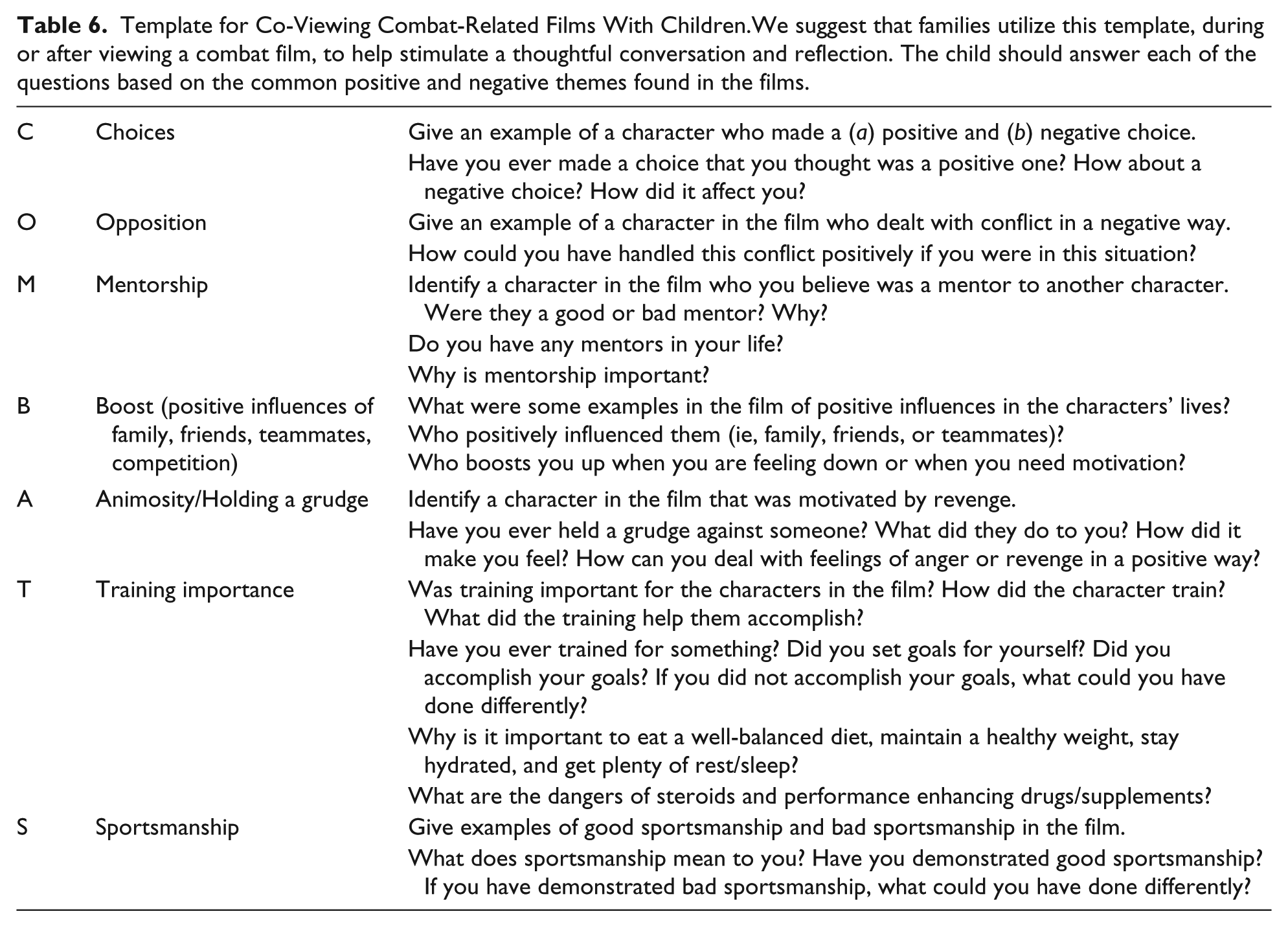
It is important for pediatric health care providers, parents/guardians, and coaches/athletic trainers to be aware of the content of combat-related films and to understand how the positive and negative themes these films depict affect children and adolescents. One method to enrich the development of children and adolescents who view these films is co-viewing these films as a family or team with active mediation. Co-viewing and active mediation occurs when the parent/guardian or coaches/athletic trainers discuss what it is being watched, either during or following the film. This method encourages the development of critical thinking and internally regulated values; it has been shown to decrease aggressive behavior, substance use, and early sexual behavior in adolescents. 37 While pediatric health care providers frequently recommend restriction and monitoring of media time, the promotion of co-viewing and active mediation would allow parents/guardians or coaches/athletic trainers to be involved in the development of their children who participate in sport. A template for co-viewing and active mediation (“COMBATS”), based on the most common positive and negative themes found in our sample of combat-related films, can be found in Table 6.
Template for Co-Viewing Combat-Related Films With Children.We suggest that families utilize this template, during or after viewing a combat film, to help stimulate a thoughtful conversation and reflection. The child should answer each of the questions based on the common positive and negative themes found in the films.
There are several limitations to our study. First, we included only 20 combat-related films utilizing a single database (www.boxofficemojo.com). Thus, our results may not be generalizable because this database search was limited by date of film release (ie, between 2006 and 2016) and highest reported lifetime gross profits, which potentially excluded films that were not listed on the database, films outside of our date-of-release time period, or “popular” films that may not have had tremendous gross profits. Additionally, with regard to reviewers’ coding of films, we found a statistically significant amount of interrater variability among the reviewers for negative themes, but not for positive themes. Although coding guidelines were defined prior to viewing the study films, each reviewer may have interpreted scenarios in the study films differently, confounded by variables such as previous sport participation or the background, gender, race, and age of the film reviewer. Furthermore, all reviewers were adults, who may interpret themed events differently than children and adolescents. Nevertheless, although our objective was to determine the positive and negative themes depicted in combat-related films, the actual number of events may not be as important as the positive and negative themes that are under-represented and require more emphasis in future films. Last, although our primary goal was to determine the thematic content of combat-related films in our sample, we did not determine the positive and negative effects that exposure to these themes have on their pediatric audience.
In conclusion, coaches, athletic/personal trainers, sport health care providers, and parents/guardians of pediatric athletes should be aware of the positive and negative themes depicted in combat-related films and stress the importance of positive encouragement, good mentorship, and responsible decision-making. Film plays an important role in how the pediatric athlete understands competition, sports participation, and relationships with peers and mentors. Thus, themes depicted in film could have both positive and negative impact on children. At critical times of growth and development, films like those included in our study may have long-term impact on a child’s behavior. It is imperative that coaches, athletic/personal trainers, and parents choose the proper time for a child to view combat-sports films, co-view these films with their athlete/team or child, and offer active mediation time to discuss these themes.
Footnotes
Author Contributions
AW, CL, EB, and ZW contributed to conception and design, contributed to acquisition, analysis, and interpretation of data, drafted the manuscript, critically revised and gave final approval of manuscript, and agrees to be accountable for all aspects of work ensuring integrity and accuracy. TSK and RPO contributed to conception and design, contributed to analysis and interpretation of data, drafted the manuscript, critically revised and gave final approval of manuscript, and agrees to be accountable for all aspects of work ensuring integrity and accuracy.
Declaration of Conflicting Interests
The author(s) declared no potential conflicts of interest with respect to the research, authorship, and/or publication of this article.
Funding
The author(s) received no financial support for the research, authorship, and/or publication of this article.
