




Abstract
Sport participation is an important part of the development of children and adolescents in the United States. Due to the popularity of sport-related films, coaches, athletic trainers, and parents have used these films to both educate and motivate pediatric athletes. The objective of this study was to develop a discussion guide template based on common positive and negative themes depicted in sport-related films, and demonstrate the application of this discussion guide template to a select number of sport-related films released from 2014 to 2018. A discussion guide template (“SPORTS ARE FUN”) was developed by the co-investigators, reflecting common themes of “Sportsmanship, Participation for All, Obstacles, Relationships, Teamwork, Setting Realistic Goals, Academics, Responsibility, Exercise/Nutrition/Rest/Drugs/Performance Enhancing Drugs, Fun, Unrelenting Spirit, and “No Pain, No Gain.” The authors hope that pediatric health care providers, athletic coaches/staff, and parents can utilize this discussion guide template in the education and development of children and adolescents who participate in sports.
Introduction
Sport participation is an important part of the development, both physically and mentally, of children and adolescents in the United States. The Physical Activity Council reported that in children born after the year 2000, 65% were at least casually active in the year 2017, 57.1% participated in team sports, and 45.8% participated in individual sports. 1 Furthermore, sport participation by high school students reached an all-time high of 7 980 886 participants during the 2017-2018 academic school year. 2
A growing number of published studies have examined the effects of sports participation, both positively and negatively, on the development of children.3-9 Identified benefits of sport participation include positive interactions with coaches resulting in an athlete’s optimistic perception of their own athletic ability and body image, developmental growth as a result of being challenged physically and mentally, supportive interactions with family and friends that affect an athlete’s sense of self-worth, having a sense of community, developing new friendships with fellow teammates, female athletes being less inclined to engage in early sexual activity, and developing life skills such as time management, work ethic, and stress management. In addition, participating in physical activity decreases the risk of medical problems such as obesity, hypertension, and hyperlipidemia, and mental health problems such as suicidal ideations, anxiety, and posttraumatic stress disorder. Conversely, identified detrimental effects of sport participation include negative interactions with coaches or teammates leading to greater anxiety, worry, and perceived performance pressure; parental directive behavior (telling athletes what they should be doing) resulting in greater feelings of pressure and amotivation, anxiety, and depression from being in a psychologically challenging environment; increased alcohol use; and increased violence on and off the field.
Due to the popularity of sport-related films, coaches, athletic trainers, and parents have used these films to both educate and motivate pediatric athletes. Sport organizations, such as the Positive Coaching Alliance, have suggested the co-viewing of sport films among pediatric athletes and their coaches, athletic trainers, and/or parents in order to focus on “teachable moments,” using questions to guide discussion (http://devzone.positivecoach.org/browse/discussion%20guides). Questions, encouraging the acquisition and development of positive themes and the avoidance and de-emphasis of negative themes, can be developed along with pediatric health care providers.
A study identifying and quantifying positive and negative themes depicted in 44 of the most popular sport-related films was recently published. 10 The most common positive themes reported in their study were positive interactions with coach, positive interactions with family/friends, positive interactions with teammates, standing your ground/deciding not to do wrong, importance of preparation, overcoming obstacles/hardships, “we can do it” attitude by the team, and importance of focusing on academics. The most common negative themes reported in their study were taunting/fighting/poor sportsmanship, drinking/smoking/recreational drug use, negative interactions with the coach, racism, negative interactions with family/friends, bullying/intimidation, cheating/lying, and demonstrating excessive anger.
The objective of this study was to develop a discussion guide template based on common positive and negative themes identified in a recently published study, 10 and demonstrate the application of this discussion guide template to a select number of sport-related films released from 2014 to 2018. In addition, we wanted to determine if themes prevalent in today’s popular culture and rarely depicted in sport-related films prior to 2014, 10 such as “sports participation for all” (gender and race equality, athletes with special needs), “balance in sports and life” (importance of academics, setting realistic goals), “importance of proper exercise/nutrition/rest,” and “consequences of drug use or performance enhancing drugs,” were depicted in our sample of films released after 2014. The authors hope that pediatric health care providers can recommend, and athletic coaches/staff and parents can utilize, this discussion guide template in the education and development of children and adolescents who participate in sports.
Methods
A discussion guide template (“SPORTS ARE FUN”), based on the 12 most common positive and negative themes identified in a recently published study, 10 was developed by the co-investigators (Table 1). The discussion guide template allows the pediatric athlete to identify examples associated with each theme as depicted in the sport-related film that they are viewing, as well as apply each theme to their lives outside of their sport.
Discussion Guide for Co-Viewing Films With Pediatric Athletes.
We encourage families, coaches, and athletic/personal trainers to use the discussion guide below, either during or after viewing the film, to provoke thoughtful conversation and reflection by having the child or adolescent answer each of the questions based on common positive and negative themes found in sport-related films.

We identified 10 sport-related films with the highest reported lifetime gross profits and released between 2014 and 2018, based on accessing the database www.boxofficemojo.com, using search terms “Sports Drama” and “Sports Comedy” (Table 2). Each of the 10 sport-related films was viewed and analyzed by one of the co-investigators (CL, VD, CF, HMW, BHW, and JB), and examples (if applicable), corresponding to each of the 12 themes, were recorded. The institutional review board at the Pennsylvania State Hershey Medical Center deemed the study exempt.
Description of the 10 Sport-Related Films Included in the Analysis.

Abbreviations: PG, parental guidance suggested; PG-13, parents strongly cautioned. Some material may be inappropriate for children under 13 years.
Ethical Approval and Informed Consent
The institutional review board at the Pennsylvania State Hershey Medical Center deemed the study exempt. Ethical approval and informed consent was not required for this systematic review of sport-related films, as no human subjects/patients were involved in data collection and analysis.
Results
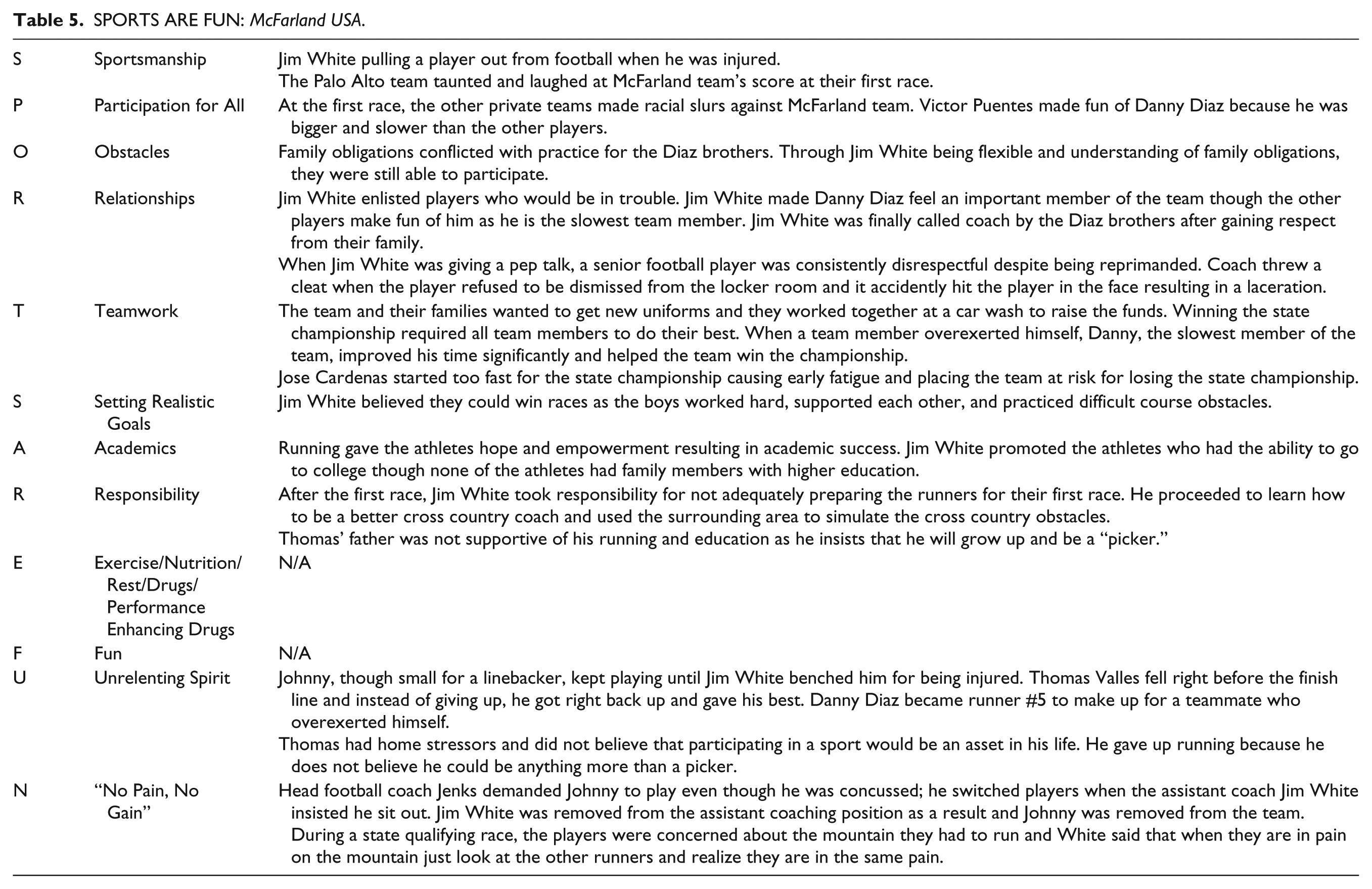
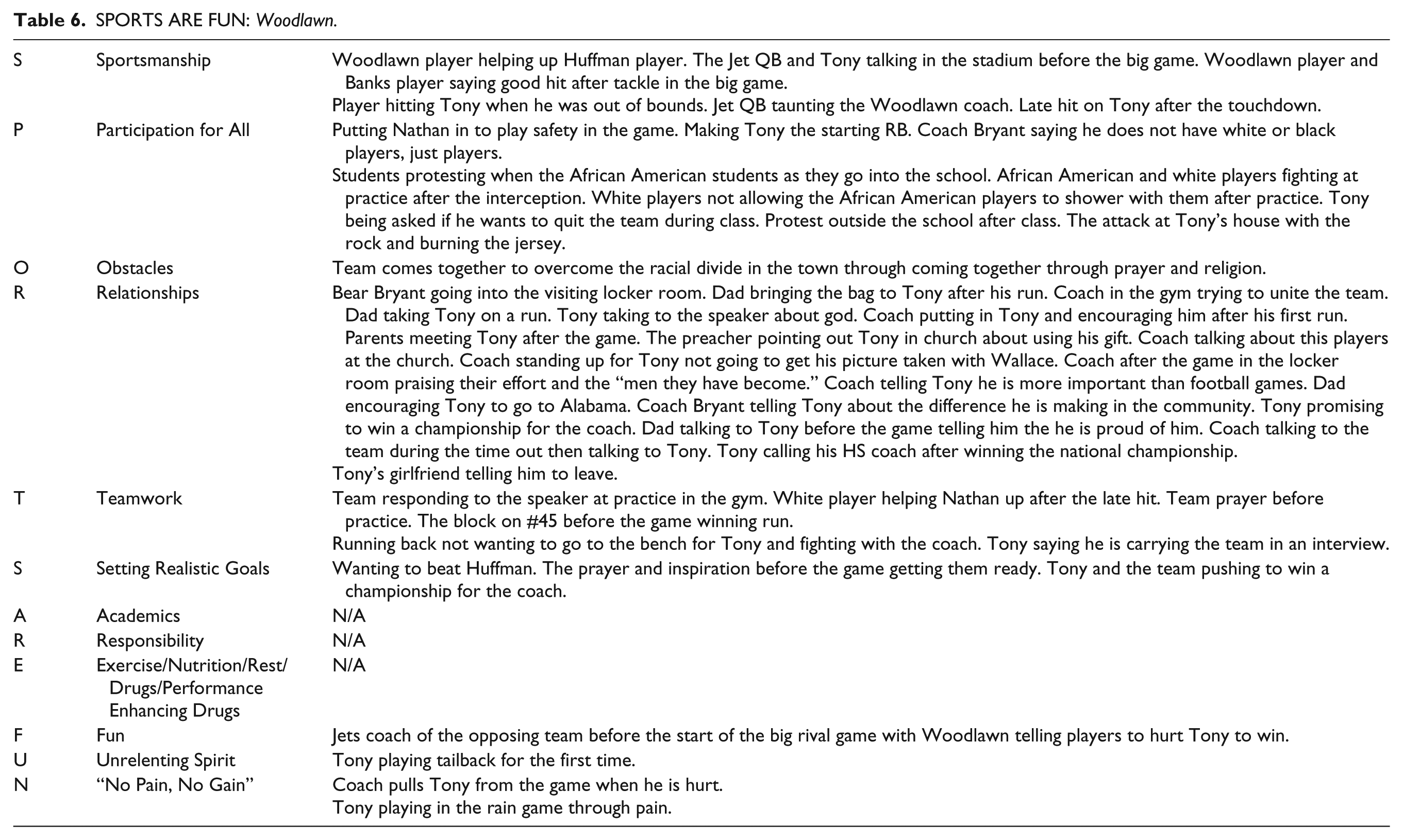
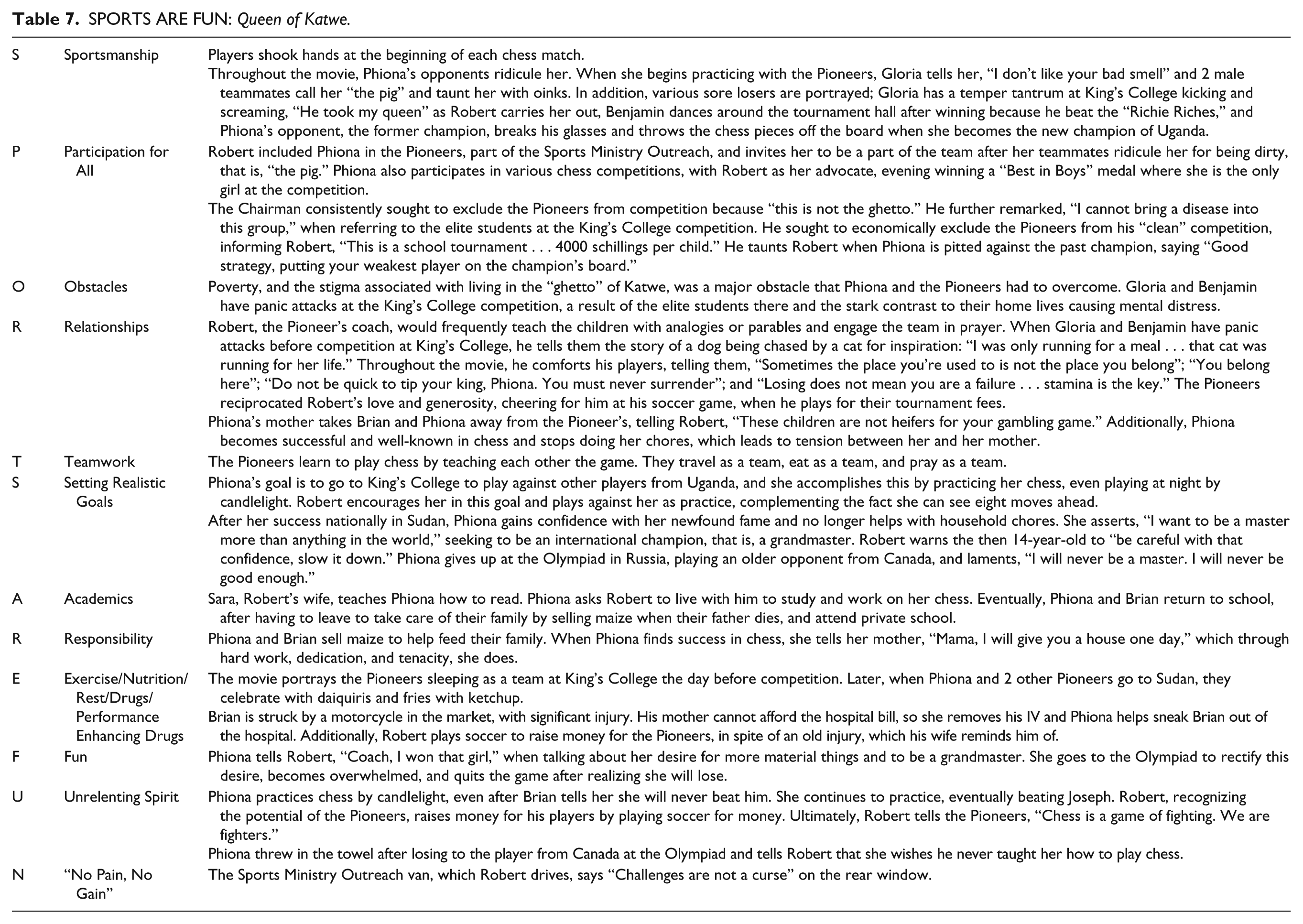
Completed discussion guide templates, reflecting the 10 sport-related films in our sample, can be accessed at https://docs.google.com/document/d/1hwKE8iaX_BCDH27wX1gziFSj_3qWIwY9TqwU8jFybtw/edit?usp=sharing. Tables 3 to 8 demonstrate completed discussion guide templates for the following films: Million Dollar Arm, When the Game Stands Tall, McFarland USA, Woodlawn, Queen of Katwe, and The Miracle Season.
SPORTS ARE FUN: Million Dollar Arm.

SPORTS ARE FUN: When the Game Stands Tall.

SPORTS ARE FUN: McFarland USA.
SPORTS ARE FUN: Woodlawn.
SPORTS ARE FUN: Queen of Katwe.
SPORTS ARE FUN: The Miracle Season.

For our sample of films, all 10 films (100%) depicted the following themes: “Sportsmanship,” “Obstacles,” “Relationships,” “Setting Realistic Goals,” and “Unrelenting Spirit”; 9 films (90%) depicted “Teamwork”; 8 films (80%) depicted “Responsibility” and “No Pain, No Gain”; 7 films (70%) depicted “Participation for All” and “Fun”; 6 films (60%) depicted “Exercise/Nutrition/Rest/Drugs/Performance Enhancing Drugs”; and 3 films (30%) depicted “Academics.”
Discussion
Several recently published studies have examined the effect of media exposure, especially films, on behaviors and choices made by children and adolescents.11-23 Examples of this research have focused on violence, gender stereotypes, smoking, alcohol use, sexual behavior, gun use, brand placement, and the effects of risk-taking behavior after media exposure. Although the objective of this study was not to determine if exposure to positive and negative themes depicted in sport-related films influenced the development and behavior of pediatric athletes, we may assume, based on these other published studies,11-23 that exposure may potentially influence the development and behavior of children and adolescents who participate in sports.
It is important for pediatric health care providers, athletic coaches/staff, and parents to be aware of the content of sport-related films and to understand how the positive and negative themes these films depict may potentially affect children and adolescents. One method to enrich the development of children and adolescents who view these films is co-viewing these films as a team or family with active mediation. Co-viewing and active mediation occur when the coaches/athletic trainers/teams or families discuss what it is being watched, either during or following the film. This method encourages the development of critical thinking and internally regulated values, and it has been shown to decrease aggressive behavior, substance use, and early sexual behavior in adolescents. 24 While pediatric health care providers frequently recommend restriction and monitoring of media time, the promotion of co-viewing and active mediation would allow coaches/athletic trainers/teams and families to be involved in the development of their children who participate in sport.
There are several limitations to our study. Although we demonstrated the application of the discussion guide template to our sample of sport-related films, the demonstration was performed by one adult co-investigator per film, and not children or adolescents for whom the discussion guide template was intended. Furthermore, we did not evaluate comprehension of the discussion guide template nor the ease of completion by pediatric athletes. Last, although the objective of our study was to demonstrate the application of a discussion guide template to a select number of sport-related films released from 2014 to 2018, we did not measure if utilization of the discussion guide template within the construct of co-viewing and active mediation influenced the behavior and development of pediatric athletes. Future research should focus on implementing the discussion guide templates, possibly in discussion groups with children or adolescents for whom the discussion template was intended, and measuring ease of completion and impact on the behavior and development of pediatric athletes.
In conclusion, we encourage the utilization of the “SPORTS ARE FUN” discussion guide template by athletic coaches/staff, parents, and pediatric athletes, within the construct of co-viewing and active mediation, to augment the education and development of children and adolescents who participate in sports.
Footnotes
Author Contribution
RPO: Contributed to conception and design; contributed to acquisition, analysis, and interpretation; drafted manuscript; critically revised manuscript; gave final approval; agrees to be accountable for all aspects of work ensuring integrity and accuracy.
CL: Contributed to conception and design; contributed to acquisition, analysis, and interpretation; drafted manuscript; critically revised manuscript; gave final approval; agrees to be accountable for all aspects of work ensuring integrity and accuracy.
VD: Contributed to conception and design; contributed to acquisition, analysis, and interpretation; drafted manuscript; critically revised manuscript; gave final approval; agrees to be accountable for all aspects of work ensuring integrity and accuracy.
CF: Contributed to conception and design; contributed to acquisition, analysis, and interpretation; drafted manuscript; critically revised manuscript; gave final approval; agrees to be accountable for all aspects of work ensuring integrity and accuracy.
HMW: Contributed to conception and design; contributed to acquisition, analysis, and interpretation; drafted manuscript; critically revised manuscript; gave final approval; agrees to be accountable for all aspects of work ensuring integrity and accuracy.
BHW: contributed to conception and design; contributed to acquisition, analysis, and interpretation; drafted manuscript; critically revised manuscript; gave final approval; agrees to be accountable for all aspects of work ensuring integrity and accuracy.
JB: Contributed to conception and design; contributed to acquisition, analysis, and interpretation; drafted manuscript; critically revised manuscript; gave final approval; agrees to be accountable for all aspects of work ensuring integrity and accuracy.
Declaration of Conflicting Interests
The author(s) declared no potential conflicts of interest with respect to the research, authorship, and/or publication of this article.
Funding
The author(s) received no financial support for the research, authorship, and/or publication of this article.
