




Abstract
Pediatricians and educators may interact daily with several dyslexic patients or students. One dyslexic author accidently developed a personal, effective, corrective reading method. Its effectiveness was evaluated in 3 schools. One school utilized 8 demonstration special education students. Over 3 months, one student grew one third year, 3 grew 1 year, and 4 grew 2 years. In another school, 6 sixth-, seventh-, and eighth-grade classroom teachers followed 45 treated dyslexic students. They all excelled and progressed beyond their classroom peers in 4 months. Using cyclovergence upper gaze, dyslexic reading problems disappeared at one of the Positional Reading Arc positions of 30°, 60°, 90°, 120°, or 150° for 10 dyslexics. Positional Reading Arc on 112 students of the second through eighth grades showed words read per minute, reading errors, and comprehension improved. Dyslexia was visually corrected by use of a new reading method and Positional Reading Arc positions.
Introduction
Speech and writing have made humans unique. Communication skills, along with reading and writing abilities, have produced separate functions for the 2 brain hemispheres (lateralization). Generally, the left hemisphere appears more important in language, and the right appears to lateralize for visual-spatial events. Language is not automatically sent to the left hemisphere but a determination is first made and, if visual-spatial, the information is directed to the right hemisphere. 1
Founded on language modalities, the phonologic attempt at understanding dyslexia is based on the lowest level of word sound structure, the phoneme. The phonologic theory of dyslexia implies an impairment of both retrieval and storage of speech sounds. Reading in an alphabetic language system requires understanding the relationship of sound to letters. This grapheme to phoneme (reading to sound) relationship is a core belief of the phonologic deficit theory. Phonemes are the smallest sound entities that distinguish closely similar words. Dyslexics exhibit phoneme unawareness.2,3
Thus, dyslexia is often considered a language disorder in both single word decoding and phonologic abnormalities. With remediation treatment, dyslexics activate the language based phonemic area of the left temporal-parietal region similar to nondyslexics.2,4,5
Since, dyslexia involves 5% to 15% of the population, each pediatrician could possibly see 3 to 6 dyslexics each day. 6 They pass through without much thought because an effective treatment is unavailable. Interest would broaden if an effective office treatment was available.
A visual origin theory for dyslexia seems a logical assumption when consideration is given to the fact that dyslexia is so closely associated with processing letters and words on the printed page. Dyslexia has been considered the result of unstable binocular fixation and vergence difficulties. Visual and ocular-motor defects would impair eye motor control, visual attention, and eye movement for visual searching. Thus, reading skills would be subject to impairment.7-10
The learning disability dyslexia is presently considered a language processing abnormality typified by phonologic skill disorders.11,12 A visual origin for dyslexia is not favorably championed.13-15 Visual origins for dyslexia are even less tenable when recent brain imaging studies demonstrate functional brain regions of decreased activity in dyslexics. 16
The US National Library of Medicine offers the following definition
17
: Developmental reading disorder (DRD), or dyslexia, occurs when there is a problem in areas of the brain that help interpret language. It is not caused by vision problems. The disorder is a specific information processing problem. It does not interfere with one’s ability to think or to understand complex ideas. Most people with DRD have normal intelligence. Many have above-average intelligence. DRD may appear with developmental writing disorder and developmental arithmetic disorder.
The following dyslexia correction methods are based on the hypothesis that dyslexia is of visual origin.
The Positional Reading Arc is predicated upon the use of cyclovergence where on looking down the eyes rotate nasally and on looking up the eyes rotate laterally. Cyclovergence is to aid in the correspondence of both eyes for stereopsis. 18
One of the authors is dyslexic and fortuitously but accidently discovered a dyslexic correction method easily controlled all dyslexic peculiarities. This accidently recognized method requires use of both a stereoscopic eye exercise and a required new reading method. The method has been successfully used on an individual basis for years and is easily adaptable to the pediatric office. Here, the reading method’s use, in an educator’s schoolroom environment by educators, is evaluated. The reading method is cost effective, simple, and highly effective. The schoolroom environment allows for the method’s use by classroom educators. Although simple, effective, and often considered unconventional, the following stereoscopic eye exercise and necessary reading method appear necessary in coping with both dyslexic reading problems and the other peculiarities ascribed to dyslexia. This new treatment method sequence is given in some detail.19,20
Methods
Dominant Eye Determination
Determination of the dominant eye is simply by punching a pencil diameter size hole through a piece of 8 × 10 inch paper. Holding the paper at arm’s length, the individual is instructed to move the paper toward them while looking through the hole. Each will look through the hole with the dominant eye, as the approaching paper is pulled to one eye.
Stereoscopic Eye Exercise
Two pennies are placed on a tabletop at the individual’s normal reading distance and slightly toward the nondominant eye side. Initially, the 2 pennies (heads up) are placed about 2.5 cm (1 inch) or less apart. The index finger is then placed centrally on an imaginary bottom-line between the 2 pennies. A small black dot is marked onto the tip of the fingernail. While looking at the black dot, the finger is slowly moved in a straight line toward the nose tip until 3 pennies form.
Holding this fingernail upward ensures a straight-line movement toward the tip of the nose. Holding the finger with the fingernail downward tends to produce an arc effect and penny fusion is difficult.
After establishing skillful ease in the formation of 3 fused pennies, the finger is drawn away so that the 3 pennies are held fused into three without use of the index finger. Initially, the 3 fused pennies may be held for only a brief moment. After a short practice period, they are readily held as long as desired. Although variable for each dyslexic, the 3 pennies generally form near 10 to 15 cm (4-6 inches) from the tabletop. The distance between the pennies is gradually widened to about 7.5 cm (about 3 inches), or the width of 4 fingers.
After easily forming the 3 pennies with use of the finger, the 3 pennies must now be held with the finger retracted. Each of the 3-formed pennies, with finger retracted, is pointed at with a finger touching the tabletop. This produces a scanning exercise while pointing to each of the 3-formed pennies. Scanning with pointing should be easily held for a minimum of 5 scanning counts of 1, 2, 3, 1, 2, 3, and so on.
Often access to 2 pennies is not possible while others feel that the use of 2 pennies is demeaning or proclaims inferiority to surrounding peers. Because of personal feelings or penny inaccessibility, the use of 2 fingers is a suggested alternative. The second and fifth fingers are extended while the third and fourth fingers are bent under the palm. Three fingernails are then formed from the second and fifth fingers. These 3-formed fingernails may then be surreptitiously scanned similar to the pennies.
This stereoscopic eye exercise is used for 5 to 7 days prior to employing the reading method, and it is a lifelong requirement. Cessation of eye exercise use results in the return of the previously corrected dyslexia.
Reading Method
All reading materials are placed slightly off center toward the nondominant eye side. The index finger is now placed on the bottom center of the first line to read. The index finger is slowly raised until the words are clearly seen. Although the words were believed clear before, the words are now distinctly clearer and easier to read. Words will, also, be blacker, sharper, and clearer. The index finger is now quickly bent and slowly retracted while maintaining clear print. Reading should only begin after the individual is readily capable of using the index finger to “make-it-clear” with the printed page. In actuality, only 1 or 2 attempts are needed to find this new focal point and “make-it-clear.” This new, elevated, focal point distance needs to be pointed out so that they can readily find it for reading without first touching the page.
Using the new focal point and with finger in place, this line is read aloud. Immediate increase in fluency is usually apparent.
After the individual reads several lines with use of their index finger, each is instructed to read by looking at the tops of the printed words.
The reading material is first placed slightly toward the nondominant eye side to ensure binocular vision. Soon the finger is not required and reading becomes automatic at this new reading point.
The reading method is simply making the words clear, removing the finger used for finding the clear focusing location, and reading at the tops of the printed words. Penny fusion occurs near 10 to 15 cm (4-6 inches) and reading improvement at 0.5 to 2.5 cm (¼-1 inch).
Periodically, an individual is unable to secure the reading focal point. They simply require raising the finger to the level of blurring. Then the finger is slowly lowered until the very lowest clear reading height is found. After recognition, they experience no further difficulty with finding this new focusing point.
Positional Reading Arc
Positional Reading Arc is performed by utilizing normal reading distances through 30° arc increments upward. At each 30° position, reading print is recorded as described according to motion, clarity, and word appearance (Figure 1). The individual’s stated preferred reading material position will usually conform to their best or second best positional arc findings.
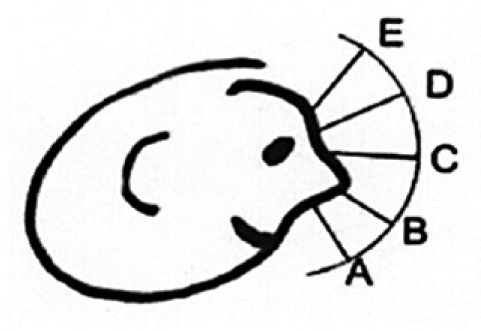
Positional Reading Arc at 30° intervals.
The reading material is slowly moved upward in an arc at normal reading distance and through Positions “B,” “C,” “D,” and “E.” The student is instructed to then bring the book to the position where the words are clearest and no longer move, jump, or push together. Following establishment of the clearest reading position, the reading material is read while holding the book in this new position. Immediate improved fluency is apparent. The words read per minute frequently increase, along with increased fluency. Words not read in Position “A” are suddenly read easily in this clearest position.
Dyslexic Positional Reading Arc Effect Group
Following the parents of 20 students signing permission slips, they were divided into a dyslexic group of 10 students and a normal control group of 10 students.
Elko Institute for Academic Achievement (EIAA)
One hundred twelve students at the local Charter School, Elko Institute for Academic Achievement, in Grades 2 through 8 became participants in the Positional Reading Arc study. After each parent signed for permission, their student was evaluated by use of the Positional Reading Arc test. The equivalence for reading material at the desktop level is Position A.
Using reading passages from Ekwall/Shanker Reading Inventory, 4th edition tests, each of the 112 students in Grades 2 through 8 were evaluated. 21 For the first test, the student sits straight, at a flat-topped desk, with the reading material lying on the desk. This is Positional Reading Arc Position “A.” Each read Form A Oral for their grade level. Reading was timed and recorded along with reading errors. Ten comprehension questions, Ekwall/Shanker Reading Inventory, are recorded for errors. Once this information was recorded, the Positional Reading Arc test followed with the reading material slowly moved from Position “A” through to Position “E” and back. The students were instructed to find that Positional Reading Arc position where the words looked clearest, blacker, and easiest to read. If there was no change, a second test was not performed. If an improved position was found, the Form C Oral for their grade level was read while holding the paper in that clearest Positional Reading Arc determinate. Again errors, words read per minute, time of completion, and errors in the 10 comprehension questions were recorded.
Spring Creek Middle School
Following receipt of the parents’ permission slips, an explanatory meeting with all involved teachers detailed their classroom participation. This teacher’s meeting was followed by a parent’s meeting. The struggling reading students in each classroom were selected by their teacher to enter the testing program. The treated students were allowed to remain in their classrooms for comparison with the other students.
French Ford Middle School
Students were selected by the special education teacher, as a demonstration group. Each had been in special education classes for several years. Their growth is measured routinely with required testing procedures. No special time was allotted to them because of participation. Eight sixth-grade special education students were demonstrated the reading method along with their teachers. Treated students’ participation was similar to the other special education students. Conforming to the other student body students, these 8 special education students were retested about 3 months after their first testing.
Results
Dyslexic Positional Reading Arc
Ten community dyslexics effectively utilized this correction Positional Reading Arc method, when reading material was moved in 30° increments upward from downward gaze (Table 1). Words that jumped, came together, scrambled about, blurred, or were wavy assumed normalcy at one of the positional arc 30° reading positions. However, the desk top was a dyslexic’s adversary and a return to word reading disarray.
Positional Reading Arc Results for Dyslexics.
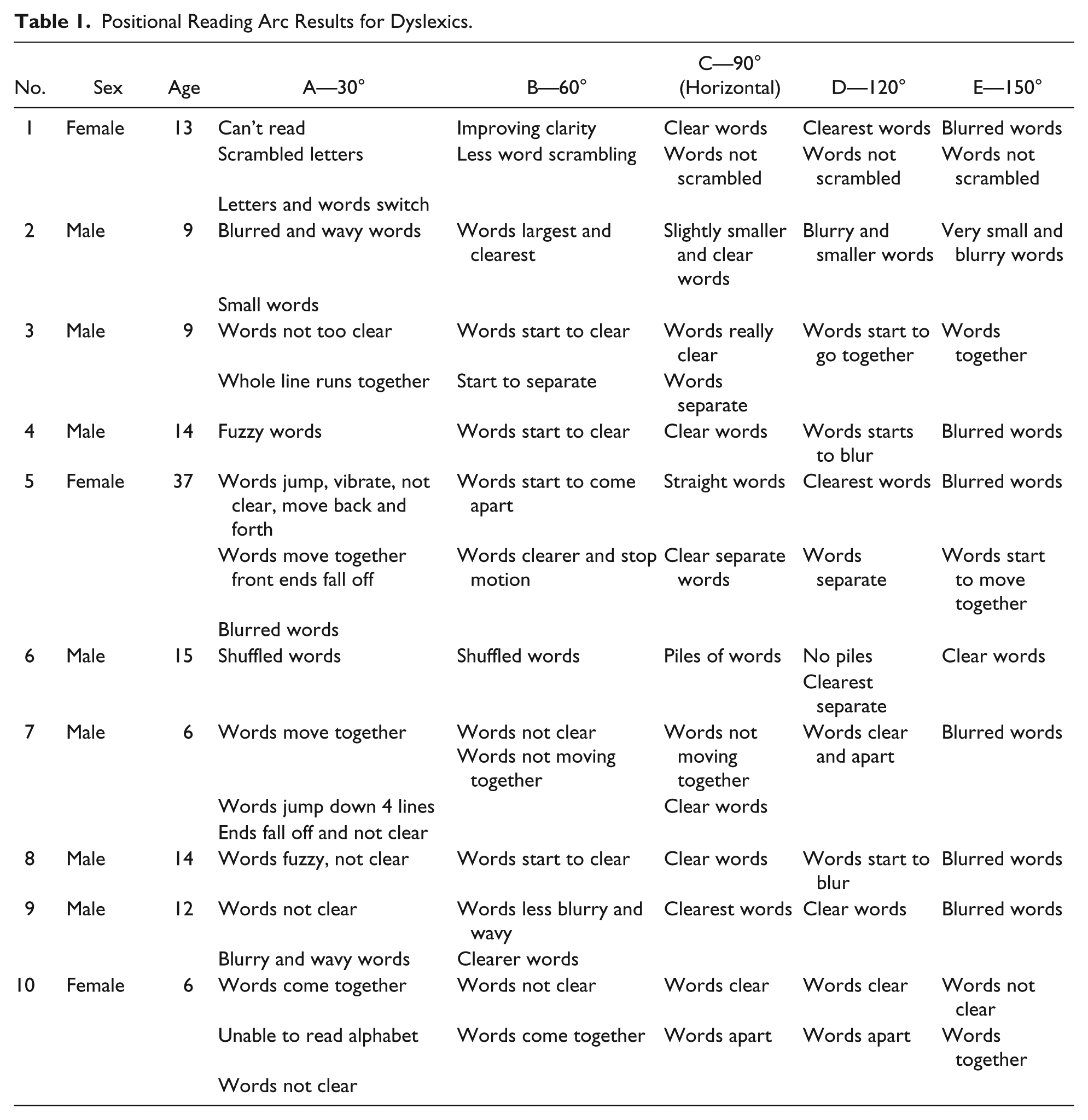
Reading Position A represents an approximate position for downward reading near desktop level. The dyslexic’s Positional Reading Arc test at Position A has the familiar desktop reading problems characteristic of dyslexia, jumping, moving, and not clear words. Movement upward, at a normal reading distance, to Point B, about 60° may have words begin to become clear, separate when joined, and represent a profound corrective change from Position A. Horizontal Position C is frequently the clearest and it is usually without word movement or disarray. Above the horizontal, Position D and Position E may be clearest for some few.
Table 2 represents findings from 10 community nondyslexics controls over the five, 30°, arc positions. They saw clear, nonmoving words throughout each position. Smaller words with decreased clarity are often noted at upward vergence angles in nondyslexics.
Positional Reading Arc Results for Nondyslexics.

Dyslexic Positional Reading Arc Appearances
It may be presumed that positional reading correction methods have been stealthily utilized by dyslexics ever since reading became a vocational need. At first, positional reading use may appear as a novel corrective measure to attain normalcy. However, its presence may represent evidence of the continual struggle with dyslexia and an adaptive hallmark, symbolic, of dyslexia.
Today, struggling dyslexics can be found coping in every reading environment. It appears that many dyslexics have discovered this ability to correct reading problems by subtle reading material positioning. One could easily make the supposition that every educator has seen this Positional Reading Arc correction ability utilized in the classroom, library, or study hall, an unusual strategy to attain reading normalcy. The flat desk or tabletop could easily be considered the dyslexic’s nemesis. This is where classroom actions as reading, general instructions, note taking, and testing are normally carried out.
Position B
Some have found that they can effectively use Position B while studying but fail or perform below expectations on testing. Examinations are usually on flat desks or tables. These individuals frequently say, “I knew it but couldn’t put it down right, I knew the answer but I couldn’t put it down on the test.” Outwardly, it appears that they were actually confirming the fact that they did not study enough. However, these students were telling their side of the story, as a dyslexic.
Position B use frequently appears in the study hall or library as a propped book against several flat stacked books. Reading books and reading materials are held with 2 hands while they slump in the chair to create a functional Position B. An occasional girl will cross her legs and support the book on and against her leg thighs while reading in a chair. These Position B individuals slump-adjust to the computer screen as needed or rise up to place the computer screen at the desirable Position B. Adaptation is subtle, effective, and temporarily releases them from the confines of dyslexic problems.
Position C
Position C is perhaps the most versatile for the dyslexic. They do very well with straight ahead computer screen levels. Frequently, Position C individuals will rise up in their chair, lean forward, and read by looking straight down. These individuals feel comfortable reading while standing up, in order to look straight down. Both young girls and women will place reading materials on their lap in order to look straight down. Similar to Position B, Position C individuals will prop a book and slouch low to read straight ahead. Occasionally, both elbows are placed on the desk or tabletop. Their head is cradled in each hand and they read by looking straight down.
Positions D and E
Positions D and E individuals are at a much greater disadvantage. They are forced to read while prone in bed or holding the book high over their head. They are the neediest for the reading method instructions. One 12-year-old girl slouched low in her chair, raised both knees high, and supported her feet flat on the edge of the chair’s seat. She held reading materials, with both hands, on the top of her knees to achieve D position. She also read and studied by sitting crossed legged on the floor next to a coffee table. After placing her chin securely on the coffee table’s edge, she read, with her chin on the table, while standing her book upright on the coffee table for a compensated Position D.
Some Positional Reading Arc D and E students will clench both hands in a cylinder fashion and place one clinched hand on the top of the other. They read by placing their chin on the top of the 2 clinched fists.
When Position D is described as the best and Position C is second best, computer screens are usually placed Position D high and the individual will further slouch for greater accommodation. They will, also, utilize Position C for reading by placing the table top reading material close to the table’s edge, pull the chair closer, and lean over to read straight down.
School Desks
One grandparent noted that, during her early school years, all classroom desks were tilted on an angle. Nondyslexics experience little or no word changes while performing the convergence arc test. It readily follows that a slightly tilted desk offers no challenging problems to the nondyslexic. Tilted classroom desks would then be similar to a flat desk, in all regards, except for dyslexics. Since most dyslexics fall within the Positions B or C level, a slanted desk easily conforms to their reading-level requirement. Many times the grandparent or parent will admit to having a reading problem, but they quickly add that educators did not know or pay much attention, if any, to their problem. It may be that dyslexia was less apparent or even nonexistent due to schoolroom slanted desks. The old ink well desk may have had hidden treasures.
EIAA School Positional Reading Arc Test
It was estimated that between 15% and 20% of the EIAA School students would find an improved reading position from Position “A.” However, 71% of the students from Grade 2 to Grade 8 stated that there was a better position; 21% chose Position “B,” 45% chose Position “C,” and 5% chose Position “D” (Figure 2).
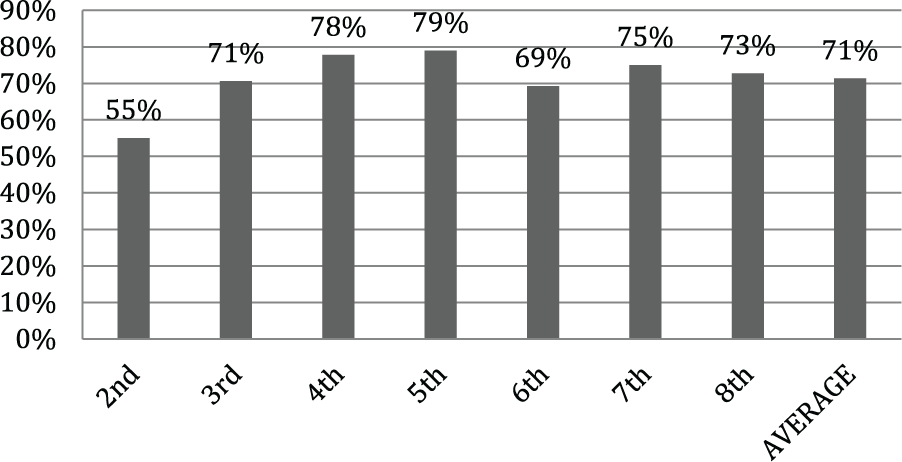
EIAA percent better reading positon.
Averages of students in each grade level who chose Positions B, C, or D as their best position for Words Per Minute, Reading Errors, and Comprehension reflect immediate results after determination of the best Positional Reading Arc Position (Figure 3).
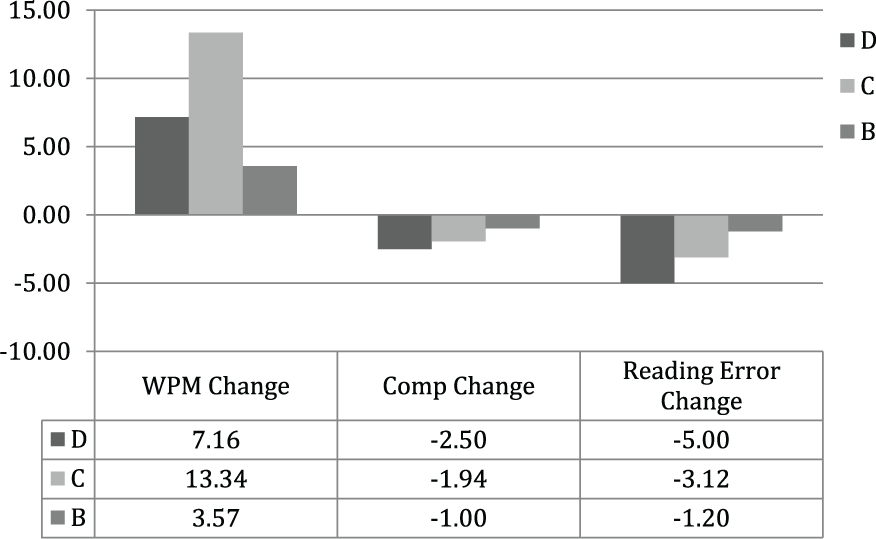
EIAA reading arc position comparison.
Words per minute changed with an increase of 13.34 words at Position C, 7.16 words at Position D, and 3.57 words at Position B (Figure 3). Merely by moving the reading material to the appropriate position allowed for an increase in words read per minute for 5 of the 7 studied grades (Figure 4). A decrease in reading errors occurred in 6 of the 8 studied grades (Figure 5).

EIAA words per minute.

EIAA reading errors.
A decrease in word errors occurred with the immediate movement of the reading materials to the most effective Positional Reading Arc Position. Position D had a reading error word decrease of 5.0, Position C a decrease of 3.12, and Position B 1.2 (Figure 3).
Comprehension errors decreased in questions answered for all grade levels. This was an immediate decrease in comprehension errors for the appropriate reading position. This selected Positional Reading Arc appears to allow for a better understanding of reading materials. The immediate response represents a visual correction by making the dyslexic peculiarities manageable (Figure 6). Comprehension for Position D is 2.5 more correct questions answered, Position C had 1.9 and Position B 1.0 more questions answered correctly (Figure 3).
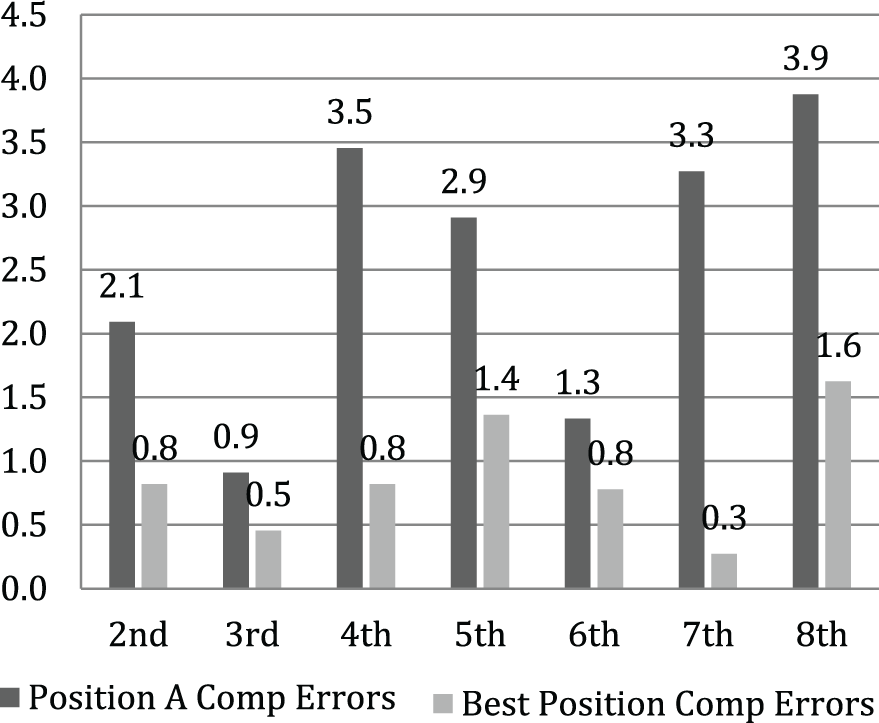
EIAA comprehension errors.
Movement of the reading material to the best Positional Reading Arc position resulted in an immediate average increase in words read, comprehension, and decreased reading errors for all Grades 2 to 8.
Overall, words read per minute increased but frequently reading speed does not change because the student continues with their same slow pace. If mention is made that they are now capable of increased reading speed, the response is usually dramatic.
If consideration is given to the bottom 10% of the students in the words read per minute, the improvement is an immediate response and appears to reflect a visual correction. This group of 11 students who scored in the 10th percentile in words per minute read is approximately 10% of the tested students. Their average words per minute increased by 25 and the average reading errors decreased by 8. Average comprehension went from a score of 66% correct to an immediate improved score of 91% correct. In schoolroom vernacular, a 66% equates to a “D” grade, while a 91% equates to an immediate increase to a grade of “A” in about 1 minute.
A combination of reading errors and comprehension errors are used to establish reading levels. 21 The greatest changes occurred in comprehension, which in turn changed the reading level. Ten students read Assessment A at the Independent level, but in the student’s best Positional Reading Arc position, 27 students read at the Independent level. On the other end of the scale, 36 students read Assessment A at the Frustration level, but only 9 read at the Frustration level in their best Positional Reading Arc position (Figure 7).
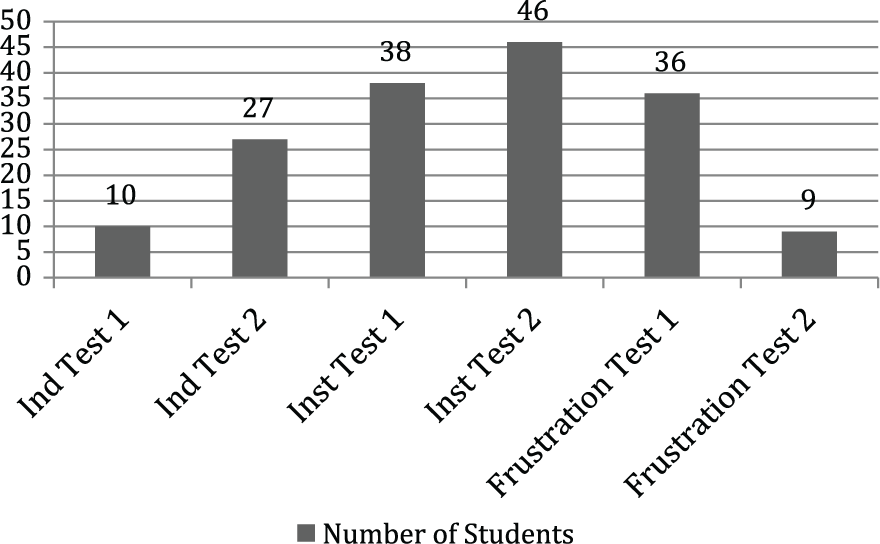
EIAA reading level, all grades.
French Ford Middle School
A demonstration group of 8 sixth-grade special education students were first given the Developmental Reading Assessment (DRA) for assessment and then again about 3 months later for growth (Figure 8). DRA2 is a valid measurement of accuracy, fluency, and comprehension as evidenced by the following validity measurements: (1) criterion-related validity, (2) construct validity, and (3) content validity.

French Ford DRA data, sixth grade.
A 10-point gain on the DRA represents 1 year’s growth. A 20-point gain represents 2 year’s growth. Student 1 of the demonstration testing only progressed 4 points and was the lowest to show progress, about one third of a year’s growth. Three students progressed 10 points or 1 year in growth and 4 students progressed 20 points or 2 years of growth. Each sixth-grade student demonstrated this growth in about 3 months. This progress was gained by students who are in special education due to a learning disability in reading. Also, these students have shown very little to no growth in the past (Figure 8).
A concerted effort as one-on-one at the French Ford School suggests that an active special education teacher may produce results of nearly one grade improvement per month.
Spring Creek Middle School
The educator’s interest in a new teaching method is correctly expressed in concern about adaptability to classroom teaching. Time expenditures are critical to the overall progress of all students and allocation of resources are of concern. At the Spring Creek Middle School, the students were part of the normal sixth- to eighth-grade classrooms. Progress was slower than a one-on-one environment where 6 different teachers taught sixth-, seventh-, and eighth-grade students (Figure 9). Overall, all treated students improved relative to their classroom peers. This growth is exemplified by the fact that this treated group was a struggling reading group. They out performed their regular classroom peers. The Grade Equivalent scores were extremely variable but all of the treated students outperformed the class average by nearly a factor of 2. This progress occurred for all 6 classrooms. Here, instructions were equal, each experienced the same assignments, and each experienced the same classroom teacher influence. A stable or slight growth was anticipated, rather than progress above that of the similarly treated classroom peers.
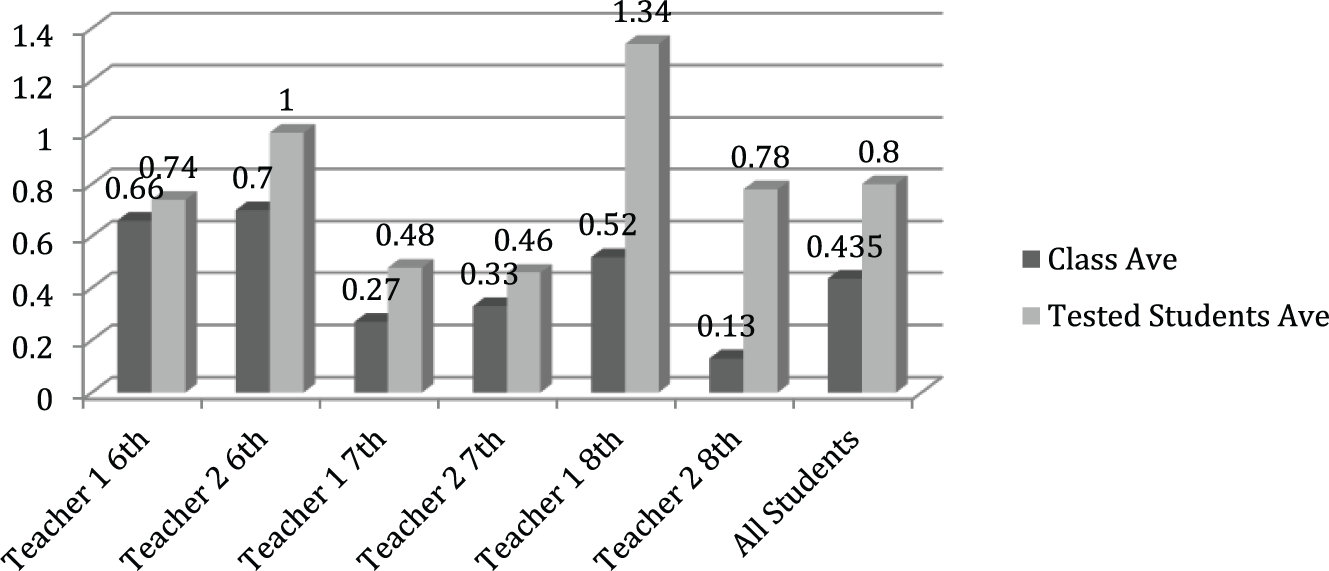
SCMS star grade equivalent data comparison.
Discussion
The economic loss from dyslexia is incalculable and the social loss is beyond description. The financial burden on education, the lack of a dyslexic’s obtainable economic and social potentials, and lower income expectations represent a few disadvantages burdened by dyslexics. Uncompensated dyslexia in a world of literacy represents a conflict of wits. However, recognition of the Positional Reading Arc correction region allows for the advantageous use of modern technology. The iPad, smartphones, and Kindle may be held in the appropriate clearest position. This secondary benefit from modern technology is an unexpected advance for dyslexics.
The compensated dyslexic, through diligence and perseverance, is capable of achieving attainable goals. However, spell check and a personal secretary for dictation makes for a smoother endeavor. So dyslexics may compensate to fit their needs and a dyslexic would have to accidently recognize a compensatory Positional Reading Arc region.
The 10 community dyslexic students with word disarray at the tabletop were completely capable of effective reading at their clearest Positional Reading Arc level. At the tabletop, dyslexics convey the appearance of having a neurologic disorder where language is neither coded nor decoded properly. However, dyslexia suddenly becomes a visual problem at the appropriate Positional Reading Arc position. No longer, “The way you look is the way you are.” The outward appearance is deceiving and allows for the impression of lazy or not trying. This simple Positional Reading Arc result suggests that dyslexics experience a confounding visual problem and not a defective neurologic processing process.
The new reading method has been successfully used on an individual basis for years.19,20 Use in the pediatrician office and by the classroom teacher would allow for initiation of dyslexic treatment at the time of recognition.
French Ford Middle School
Use of the method by the special education teacher at French Ford Middle School showed that a scheduled one-on-one program is very beneficial to reading improvement. This suggests that the pediatrician may offer the corrective measures in the office but a reading tutor or concerned parents would be advantageous, and, perhaps, necessary.
As expected, the greater the personal instruction, the greater the reading advancement. A one-on-one structure using parents, special education instructors or tutors allows for greater facility in the integration of the dyslexic student into a normal classroom. Acceptance of a new reading method may be predicated on both the motivation of the participant and on the positive influence of the parent or educator. Motivation may be as simple as the ability to read or the recognition of not being different from others. Parents frequently convey an attitude that the problem is someone else’s and they readily relieve themselves of the problem when a resource is available.
Participation in classroom activities would allow for a treated dyslexic student to achieve similar to their peers. Spring Creek Middle School appears to demonstrate an individual’s increased growth relative to their peers. The classroom is not a one-on-one environment and an expected slower but progressive growth would result. It may be anticipated that the classroom environment would not represent the necessary concentrated one-on-one atmosphere for a struggling reader’s success.
However, the treated struggling readers outperformed their regular classroom peers. This would not be an expected finding. More likely, it would be anticipated that this treated group would achieve similar to the peer group or lag less behind. Surprisingly, in all 6 classrooms, the treated group excelled beyond their nontreated classmates. One plausible explanation would be that motivation or a sense of newfound normalcy evolved. Also, struggling readers generally require greater efforts and a greater work ethic to merely remain a class member. If this work ethic was maintained during the study, then they could achieve to a greater extent than the nontreated peers. This achievement ability would lend support to the reading method’s routine use by the classroom teacher.
The Positional Reading Arc appears to determine the positional change that allows for corrections of the peculiarities of dyslexia. This change is immediate. The appropriate Positional Reading Arc position dictates the compensatory reading material placement for the correction of struggling readers. Position C individuals may easily compensate by reading in a straight down position, with the reading material on the tabletop. It was hypothesized that the Positional Reading Arc might effectively function as a diagnostic test for dyslexia. This type of specificity does not seem to be apparent. However, the compensatory use of the various positions appears to be specific for each of the Positional Reading Arc positions when used in the classroom, study hall, or at home.
A pediatrician could begin the teaching of the reading method in the office and refer the student to his patient’s schoolteacher with appropriate communication.
Once students are able to see the words clearly, they are capable of catching up quickly to their peers. Their confidence increases and they begin to read books for fun. They are no longer scared or fear ridicule when reading aloud in class. The method is designed with stealth in mind. The appearance is that of reading normally and not with required assistance similar to those students with colored overlays or special glasses. All treated classroom students improved above their tested peers.
The new reading method system is easy for teachers to learn and implement. It requires minimal time to train a student, and the results are immediate. Teacher evaluations in many states are often based on their classroom student’s growth. This reading method has the potential to assist teachers in increasing their own personal evaluations. Students appreciate the system when their schoolwork is easily completed and homework is turned in on time.
Use of this new reading method frequently results in advances of 1 grade each month until attaining grade level. It is so effective that an occasional dyslexic is told at the first visit that they are no different from others except for the necessity to use a stereoscopic eye exercise and a required new reading method for life. This reading method allows for normal reading according to abilities.
All of the peculiarities noted by the dyslexic as moving words, lines of joined words, joining of 2 or more words, shuffling words, decreased clarity, and so on, disappear at one of the Positional Reading Arc positions. Those without word motion developed clearer, sharper, blacker words. These are the same correction findings noted with the new reading method; words no longer move or come together; words become clearer, sharper, blacker; and reading is fluent, not labored or choppy. This new reading method appears to demonstrate that dyslexia is a subtle, correctable, visional abnormality. No elaborate instruments are required. This stereoscopic eye exercise is a lifelong requirement.
Each dyslexic is instructed to find that place where the print is clearer, blacker, sharper, and easier to read. The desired reading location is barely off the paper. A higher reading level is not used. The new reading level rapidly becomes automatic and the finger use is no longer a requirement.
There has been a slow trend toward cooperative learning and group-work in school classrooms. Four desks moved together formed a table, and tables were usually preferred over desks. Flat-topped desks helped facilitate the creation of a table when brought together. Cooperative learning classroom techniques were then accepted learning mechanisms. This was counterproductive for dyslexic children building their foundations of reading and writing on desk formed tables. About 10% of a school population is dyslexic and they would possibly benefit from a slanted desktop. Even though the slanted desktop conforms to Position “B.” Position “B” is where 21% of the students chose as their best position, and it still puts all closer to Position “C” that 45% of the students preferred. The change in the student’s reading is instantaneous. The one-word-at-a-time reading is replaced with fluency and without labored reading. Periods, commas, and question marks are no longer skipped over. Speed and fluency increases, along with vocal animation.
It is usually explained to educators, parents, and dyslexics that dyslexics are no different from others except for a required reading method different from nondyslexics. Dyslexia appears to require a 2-step corrective reading method. Dyslexia is corrected by 2 different visual corrective methods, a new reading method and the cyclovergence Positional Reading Arc method.
Author Contributions
Both authors participated in the study design and implementation, evaluation and treament of the students and manuscript writing.
Footnotes
Acknowledgements
Principal, staff, students, and parents of French Ford Middle School, Winnemucca, Nevada; Spring Creek Middle School, Spring Creek, Nevada; Elko Institute for Academic Achievement, Elko, Nevada; and Barbara Boone, Northeastern Nevada Regional Hospital, Elko, Nevada.
Authors’ Note
Permission is granted to publish the copyright materials of Reading Vision LLC. The permission includes all materials related to dominant eye determination, reading method, positional reading arc, and positional reading arc appearances.
Declaration of Conflicting Interests
The author(s) declared the following potential conflicts of interest with respect to the research, authorship, and/or publication of this article: The authors are partners in Reading Vision LLC that has used the reading method to treat dyslexics.
Funding
The author(s) received no financial support for the research, authorship, and/or publication of this article.