




Abstract
Background. Understanding preventable causes of neurodevelopmental disorders is a public health priority. Polycyclic aromatic hydrocarbons (PAH) from combustion of fossil fuel, lead, and mercury are among known neurodevelopmental toxicants. Method. For the first time, we comprehensively review the findings from a study by the Columbia Center for Children’s Environmental Health and Chinese partners that followed 2 groups of mother-child pairs, one from 2002 and another from 2005, in Tongliang County, China. Pregnant mothers in the 2 cohorts experienced different exposure to PAH because a local coal-burning power plant was shut down in 2004. Investigators assessed change in prenatal PAH exposure, measured using a biomarker (benzo[a]pyrene [BaP]-DNA adducts in cord blood). Developmental quotients were measured using the Gesell Developmental Scales at age 2 and IQ was assessed using the Wechsler Intelligence Scale for Children at age 5. Biologic markers of preclinical response were measured in cord blood: methylation status of long interspersed nuclear elements (LINE1), an indicator of genomic stability, and brain-derived neurotrophic factor (BDNF), a neuronal growth promoter. Analyses accounted for co-exposure to lead and mercury. Results. BaP-DNA adducts were significantly inversely associated with Gesell Developmental Scales scores in the first cohort but not in the second cohort; and levels of BDNF and LINE1 methylation were higher in the second cohort. Conclusion. In this study, reduced exposure to PAH was associated with beneficial effects on neurodevelopment as well as molecular changes related to improved brain development and health. These benefits should encourage further efforts to limit exposure to these toxic pollutants.
Keywords
Introduction
As reviewed elsewhere, fetal development is a critical period that is vulnerable to damage from toxic environmental exposures with consequences not only for health in childhood but also over the life course.1-4 The “Barker hypothesis” also suggests the origin of adult disease in events during fetal development and a consequence of deviation from normal development. 5 The nervous system is particularly sensitive throughout in utero and postnatal development. 1 While the effects of some in utero exposures on the nervous system are evident and well characterized at birth or in the early years, certain other effects do not become immediately apparent and may even go unrecognized. With improvements in diagnosis of neurobehavioral and neurodevelopmental deficits, our ability to recognize effects of environmental exposures has improved. However, identifying neurodevelopmental deficits is made complex by the latency period associated with certain manifestations of toxic insult. This phenomenon, described as “silent neurotoxicity,” makes diagnoses of neurological conditions related to in utero exposure a challenge.4,6,7 The ability of the brain to counter insults via alternative cognitive pathways 8 poses an added challenge in recognizing these toxic effects.
Scientists have come to agree that genetic factors alone explain only a modest proportion of neurodevelopmental disorders; the majority arise from an interaction between genetic predisposition, environmental factors, and psychosocial adversity.9,10 The need to understand the preventable causes of neurodevelopmental disorders is urgent. Their prevalence has increased, with approximately 15% of children in the United States between ages 3 and 17 affected by attention-deficit hyperactivity disorder, learning disabilities, intellectual disability, cerebral palsy, autism, seizures, and other neurodevelopmental deficits. 9 It is estimated that more than 200 million children under 5 years of age in developing countries are not fulfilling their developmental potential. 11 Since human potential is determined by neuronal and cognitive capacity, a reduced capacity translates to loss in economic productivity and decreased human contribution to societal welfare. Several studies have ascribed a dollar value to the economic cost of neurodevelopmental deficits because of environmental exposures12-14 and have found the value to be substantial. They noted that the cost of removing these exposures is lower than the cost of their economic burden on health and productivity. A review conducted in 2014 found about 200 chemicals to be neurotoxic and 10 of these to be developmental neurotoxicants. 15 The authors noted that this number was an underestimate since many developmental neurotoxicants go undetected given a lack of clinical manifestation, as described earlier. However, taken together, these chemicals can impose a large burden on neurodevelopment. 15
The Tongliang Case Study
In the following sections, we provide a comprehensive review of studies from a prospective cohort study conducted in Tongliang, China, by the Columbia Center for Children’s Environmental Health (CCCEH) in partnership with the Chongqing Children’s Hospital, Chongqing University of Medical Sciences. The studies measured the effects of exposure from a coal-burning power plant in the city, using benzo[a]pyrene (BaP)-DNA adducts as a biomarker, on fetal development, and neurodevelopment and behavior. The power plant was shut down in 2004, and the studies were able to follow children that were born before the closure, in 2002, and those born after the closure, in 2005. Researchers hypothesized that the children would have had different in utero exposure to PAH, which would be associated with scores on neurodevelopmental tests and markers of fetal development. These findings have been presented before, but never in combination. This article gives the full picture of the molecular and neurodevelopmental benefits of a government policy to close a polluting coal-burning plant, and does so in the context of the urgent need to prevent harm to children’s developing brains. First, we briefly summarize developmental toxicity of polycyclic aromatic hydrocarbons (PAH), methylmercury, and lead, all of which were measured in the Tongliang Cohort Studies. Then, we summarize analyses on the relationship between BaP-DNA adducts and molecular and neurodevelopmental outcomes, controlling for exposure to lead and methylmercury, both of which were co-exposures in these cohorts.
Polycyclic Aromatic Hydrocarbons
PAH are a class of chemicals that are known human mutagens and carcinogens. 16 They are released during incomplete combustion of fossil fuel and other carbon-containing fuel such as wood. They may also be ingested via charbroiled food, and soil that is contaminated with PAH. Exposure to PAH has been linked to developmental toxicity in humans17,18 and in animal models. 19 BaP is the most commonly studied PAH given its high toxicity. 20 Once in the body, BaP can be metabolized to an epoxide-diol that is highly reactive and forms covalent bonds with DNA and protein in cells. 21 By forming bulky adducts with DNA, BaP exposure may produce mutations during DNA replication, increasing the risk of cancer. PAH have also been shown to mimic steroid hormones, accumulate in adipose tissue, and cross the placental and blood-brain barriers. 3 The carcinogenic potential of PAH has been known since 1776, 22 but their effects on the nervous system, particularly the developing nervous system, have come to light only in the recent past. 23 It has been postulated that PAH may damage the developing fetal brain by increasing oxidative stress24,25 and causing vascular injury. 26 Several epidemiological studies have found an association between in utero exposure to PAH and neurodevelopment and behavior. 23 In animal studies, prenatal and neonatal exposure to PAH was associated with neurodevelopmental and behavioral effects, including depression-like symptoms and memory impairment.27,28 Although BaP-DNA adducts are on the causal pathway between PAH exposure and carcinogenesis, these adducts can also be used as biologic markers of exposure to PAH. The level of BaP-DNA adducts measured is a biologically relevant estimate of the individual’s exposure to PAH. A benefit of using BaP-DNA adducts as biomarkers of fetal exposure to PAH is that the adducts account for interpersonal variation in metabolic status and also other biological differences that can adjust the bioavailable dose of PAH in the human body, serving as an integrated index of the individual dose of PAH.
Using BaP-DNA adducts as the biomarker of fetal PAH exposure, researchers at CCCEH addressed the following questions in the Tongliang cohorts: (1) Is exposure to PAH associated with markers of fetal development, such as head circumference? (2) Does PAH exposure affect scores on neurodevelopmental tests at ages 2 and 5? (3) How does the association between PAH exposure and development differ between the 2 cohorts? Researchers measured brain-derived neurotrophic factor (BDNF), a neurotrophin involved in neuronal growth and migration during development, 29 in cord blood. They addressed the following questions: (4) Does BDNF measured in cord blood differ between the 2 cohorts? (5) Does BDNF mediate the relationship between PAH exposure and scores on neurodevelopmental tests? Finally, in cord blood, they also measured LINE1 (long interspersed nuclear element 1) methylation status. LINE1 is a genomic repeat element that accounts for about 18% of the human genome and a small proportion of these elements are capable of retrotransposition, or “jumping” to other regions of the genome, when activated. 30 Its activation is controlled by methylation of its promotor regions.31,32 LINE1 methylation has been used as a marker of global DNA methylation. Hypomethylation of the genome has been linked to cancer and disorders of genomic imprinting. 33 The researchers inquired the following: (6) Does LINE1 methylation level differ between the 2 cohorts? (7) Does LINE1 methylation level mediate the relationship between PAH exposure and scores on neurodevelopmental tests?
Methylmercury (MeHg)
Coal burning is a major source of environmental mercury in China. 34 Through biomagnification in the aquatic food chain, methylmercury can reach humans by consumption of seafood.35,36 Methylmercury is able to cross the blood-brain barrier through the neutral amino acid transport system, making the brain a target of its toxic effects. 37 The developing central nervous system is particularly vulnerable to MeHg.38-40 Studies have shown that even at modest doses, chronic exposure to MeHg during development is associated with multiple deficits in neurons and glia, including abnormal migration, differentiation, and growth.41,42 These deficits manifest as decreased IQ points in children, impaired movements, and defects in visuospatial perception and speech in children and adults.43-45 Studies aimed at understanding the mechanism of MeHg toxicity suggest that MeHg is especially toxic to proliferative cell populations. Exposure can alter the expression of many developmental regulators and genes responsible for regulating cell growth and proliferation. 46 A review of epidemiological studies reported a loss of 0.18 IQ points per 1 ppm mercury measured in maternal hair. 47 In animal models, exposure led to reduced motor activity, 48 decrease in memory,49-51 and decrease in learning. 52 This evidence of adverse neurodevelopmental effects of MeHg exposure has led to concern over consumption of seafood high in MeHg during pregnancy. 53
Lead (Pb)
Coal burning is also a source of environmental exposure to lead in China. 54 Neurodevelopmental deficits due to lead exposure have been widely studied. The groundbreaking study by Needleman et al (1979) 55 showed a decrease in classroom performance and IQ scores in children that had a high body burden of lead compared to those with lower exposure and body burden. 55 The US Centers for Disease Control and Prevention has recognized that there is no safe level below which no adverse effects occur, 56 since even blood lead levels between 2 and 10 µg/dL have been associated with persistent cognitive damage. 12 Analysis of pooled data from international population based studies estimated a loss of 6.9 IQ points with an increase of blood lead level from 2.4 to 30 µg/dL. The same analysis found that even at 7.5 µg/dL, children showed signs of intellectual deficits. 57 In the brain, lead disrupts various processes involved in learning, memory, neuronal plasticity, and long-term potentiation 58 while suppressing the release of neurotransmitters acetylcholine, dopamine, and amino acid neurotransmitters.59,60 Studies suggest lead produces this effect by disrupting neurotransmitter storage in and release from vesicles.61,62 Effects on NMDA receptors and disruption of the dopamine system have also been reported.63,64 The effects on IQ of lead toxicity persists into adulthood,65,66 adding to a long list of adverse effects, which has made lead poisoning an enormous public health concern worldwide.
Methods
The CCCEH enrolled mothers in 2 longitudinal cohorts, one with 150 pregnant women in 2002 and another in 2005, with 158 mothers. Since a local coal-powered power plant was shut down in 2004, the different times of enrollment provided an opportunity to study the effects of exposure to pollutants on fetal development. These methods have been described previously,67,68 and are briefly described below.
Study Site
The cohort study was conducted in Tongliang County, in Chongqing province. The county has a population of 810 000 and lies in a basin 3 km in diameter. Until 2004, the county relied on hydroelectric power as the main source of electricity for the months of June through November. During the dry season, the county switched to a coal-burning power plant as its main source of power. The power plant burned roughly 25 000 tons of coal each operation cycle, which operated from December to May. It was located south of the city center and did not use modern pollution reduction technology. The local government found it in violation of emission standards and ordered the plant’s closure, which took place in 2004.68,69
Exposure Profile
Burning of coal is a major source of PAH pollution in China.70-73 The power plant can be considered the main source of air pollution in the Tongliang area before 2004 since domestic heating and cooking units were switched to use natural gas in 1995, and motor vehicles in the county were in limited use in 2002. Measurement of PAH levels in air showed a spike during the power plant operation period, 69 confirming that the power plant was a major source of PAH in the air. Air monitors also showed an increase in concentration of lead and mercury in the environment during power plant operation. The coal used for power generation contained a high amount of lead, almost 1000 times greater than the lead content of coal used in US power plants.74,75 Lead detected in cord blood in this cohort can also be attributed to resuspension of residual lead-containing dust from roadside soil, even though leaded gasoline was banned in China in 2000. In Chongqing, coal combustion was responsible for 46% of total mercury emissions in the county. 76
Study Subjects
In 2002 and 2005, CCCEH recruited children born to nonsmoking Chinese women at any 1 of 3 hospitals in the county. A total of 150 children born between March 4, 2002, and June 19, 2002, and 158 children born at the same hospitals from March 2, 2005, to May 23, 2005, were enrolled. Eligibility criteria for mothers included nonsmoking status, being 20 years or older and living within 2.5 km of the Tongliang power plant. In 2002, 150 eligible women consented and 149 were interviewed. Of these, 110 children had complete data for all measures at 2 years of age and 100 children had complete data for measures on IQ tests at age 5.68,77 These subsets did not differ significantly with regard to demographic characteristics from those not included in the analysis. In the 2005 cohort, researchers had complete data on 107 children at age 2. However, due to unforeseen issues in administration, they were not able to follow-up with the cohort at age 5. Table 1 summarizes fetal development, neurodevelopment, and biomarker data from the 2 cohorts.

Abbreviations: BaP, benzo[a]pyrene; GDS, Gesell Developmental Scales; WISC, Wechsler Intelligence Scale for Children; NA, not available.
P value: <.001 by Mann-Whitney test.
P value: <.001 by χ2 test of independence.
P value: .001.
P value: <.000.
P value: .042.
LINE1 was measured as % (methylated cytosine/sum of methylated and unmethylated cytosine).
Significant at α = .05.
Personal Interview
Trained interviewers conducted a 45-minute personal interview postdelivery. They recorded demographic information, lifetime residential history, history of active and passive smoking, occupational exposure during pregnancy, medication information, alcohol use during each trimester of pregnancy, consumption of PAH-containing meat, fish consumption, socioeconomic information, environmental tobacco smoke (ETS) exposure, and education level (further details can be found in published studies67,68).
Measurement of Fetal Development and Birth Outcomes
Immediately after delivery, birth weight, birth length, and head circumference were measured. Infants delivered by Cesarean section had their head circumference measured more than once after birth and average of measurement was taken. All birth outcome used in analyses were obtained from data collected by research workers from mothers’ and infants’ medical records. 78
Measurement of Child Neurodevelopment
The GDS gives a standardized score to children between the ages of 0 to 3. The Chinese version of the GDS, which is adapted to the Chinese population by the Chinese Pediatric Society and the Department of Pediatric Psychiatry in Xinghua Hospital in Shanghai, China,67,77,79 was administered to 2-year-old children. The test assigns a developmental quotient (DQ) to each child in each of 4 areas: motor, adaptive, language, and social. The standardized mean (± SD) of the DQ is 100 ± 15; a score <85 indicates developmental delay. 67 Two physicians certified in the GDS conducted testing to obtain reliable and reproducible assessment.
The Wechsler Intelligence Scale for Children (WISC) is a standardized intelligence quotient (IQ) test made for children between the age of 5 and 16 years. Children in the cohort were administered the Shanghai version of the test, which was standardized against a Shanghai population, at age 5. This method has been widely adopted in China. 79 It assigns an IQ score to each child in 3 scales: a verbal scale, a performance scale, and a full scale. The full scale derives from the verbal and performance scales. The mean of the standardized IQ is 100 with a standard deviation of 15. Scores of <70 are classified as extremely low, 70 to 79 as borderline, 80 to 89 as low average, 90 to 109 as average, 110 to 119 as high average, 120 to 129 as superior, and >130 as very superior. Testing was conducted by 2 trained physicians to maximize reliable assessment and valid interpretation. 77
Biomarkers
Umbilical cord blood was collected at the time of delivery and maternal blood was collected, at most, 1 day postpartum. All samples were immediately transported to the field laboratory where they were separated, processed, and stored at −70°C.
BaP-DNA Adducts
BaP-DNA adducts were measured using the high-pressure liquid chromatography-fluorescence method devised by Alexandrov et al. 80 The method measures BaP-tetrols in DNA extracted from white blood cells (WBCs) 81 with a 12% coefficient of variance. 82
Cord Blood Lead and Mercury
Cord blood lead was measured in the Laboratory of the Department of Occupational Health, School of Public Health, Fudan University in Shanghai, China. Measurements were made following the US EPA standard for lead measurement. The laboratory used the PE-800 Zeeman atomic absorption spectrometer.68,83 The recovery rate of this method in the laboratory is >92%; the precision is 1.7% to 3.8%, with a limit of detection of 0.09 µg/L. Cord blood mercury was also measured at the Laboratory of the Department of Occupational Health, School of Public Health, Fudan University in Shanghai. The Automatic Mercury Analyzer AMA-254 (Milestone Inc, Monroe, CT) method was used, which can directly test total mercury in the samples without any pretreatment. The method was in compliance with US EPA method 7473. 68
LINE1 Methylation Status
The buffy coat (layer containing WBCs obtained by fractionation of anticoagulated blood) collected from blood samples were used to extract DNA. Bisulfite-DNA was assayed for LINE1 methylation status based on a protocol devised by Yang et al. 84 The assay involved polymerase chain reaction of bisulfite-treated DNA and methylation status was measured at 3 LINE1 CpG sites, chosen based on previous literature.84,85 The degree of methylation was expressed for each DNA locus as percentage methylated cytosines over the sum of methylated and unmethylated cytosines. 86 A reduction in methylation status of LINE1 would indicate decreased global DNA methylation. Hypomethylation of promotor regions would allow translation of LINE1 elements, activating these interspersed repeat elements that are capable of retrotransposition. 87
BDNF
Immunoassays for plasma levels of BDNF were performed using the BDNF Emax ImmunoAssay System (Promega) according to the manufacturer’s instruction. 78
Statistical Analyses
Through these analyses, researchers set out to answer questions regarding associations between BaP-DNA adducts and fetal growth, and neurodevelopmental scores at ages 2 and 5. They hypothesized that BaP-DNA adducts would be inversely associated with both fetal growth and neurodevelopment, and that children in the 2002 cohort would have poorer outcomes than children from the 2005 cohort. To identify potential pathways of action, they hypothesized that BaP-DNA adducts would be inversely associated with cord blood BDNF levels; BaP-DNA adducts would also be inversely associated with LINE1 methylation status. They predicted that both molecular markers would be positively associated with DQ and IQ scores.
In brief, the relationship between the environmental exposure (measured as BaP-DNA adducts) and scores on DQ/IQ tests were assessed using multivariable linear regression, controlling for co-exposure to lead and methylmercury. The associations between BaP-DNA adducts and the preclinical response biomarkers (BDNF and LINE1 methylation) were also tested using linear regression. Researchers tested whether LINE1 methylation status or BDNF levels mediated the association between BaP-DNA adducts and neurodevelopment using bootstrapping. 88 Covariates included in the models were mother’s education, gestational age, ETS, relevant co-exposure to the environmental toxicants, and sex of child. All of these analyses, with the exception of assessing the mediation effect of BDNF on the relationship between BaP-DNA adducts and neurodevelopmental outcomes, have been previously performed, and readers are encouraged to refer to studies that describe them in detail.67,68,77,78,89,90
Results
Fetal Development
In the 2002 cohort, high cord blood BaP-DNA adduct levels (above median of detectable adduct level) were associated with decreased birth head circumference (β = −0.011, 95% confidence interval [CI] = −0.023 to −0.00034). The association between high cord BaP-DNA adducts and birth head circumference, while still negative, was no longer significant in the 2005 cohort (β = −0.006, 95% CI = −0.20 to 0.007). 78 See Table 2.

Abbreviations: CI, confidence interval; BaP, benzo[a]pyrene; DQ, developmental quotient; IQ, intelligence quotient; ETS, environmental tobacco smoke; NA, not available.
Adjusted for environmental tobacco smoke, gender, mother’s weight before pregnancy, height of mother, and gestational age. Model for head circumference additionally adjusted for mother’s head circumference and caesarian status.
Adjusted for gestational age, maternal education, cord blood lead, ETS exposure, and gender.
Adjusted for gestational age, maternal education, cord lead, mother’s age, ETS exposure, and gender.
Significant at α = .05.
Environmental Exposures and Neurodevelopmental Outcomes
In the 2002 cohort, both PAH and lead exposure were negatively associated with certain DQs measured using the GDS. Mercury was not significantly associated with DQ scores. After controlling for cord blood lead, ETS exposure, sex, gestational age, and maternal education, in the 2002 cohort inverse associations were evident between cord BaP-DNA adduct levels and DQ scores in the motor area (β = −16.01; 95% CI = −31.30 to −0.72), language area (β = −16.63, 95% CI = −33.73 to 0.46), and average score (β = −14.57; 95% CI = −28.77 to −0.38). Logistic regression analysis estimated that a 0.1 increase in adducts was associated with an odds of motor area delay of 1.91 (95% CI = 1.22 to 2.97; Table 2). The same model found high cord blood lead to be associated with decreased DQ scores in the social area (β = −6.08; 95% CI = −10.53 to −1.63) and in average DQ scores (β = −4.24; 95% CI = −8.30 to −0.29), supporting the inverse association between lead and neurodevelopment. 68
In the 2005 cohort, inverse relationships between BaP-DNA adducts and DQ scores became nonsignificant when they were adjusted for the same covariates as in the 2002 cohort (motor area DQ: β = −5.90, 95% CI = −24.96 to −13.17; language area DQ: β = −20.39, 95% CI = −42.62 to 1.85; average DQ score: β = −12.38, 95% CI: −28.95 to 4.20). The odds of motor area delay were also nonsignificant (β = 2.06; 95% CI = 0.62 to 6.84) in this second cohort 67 (Table 2).
Although neither BaP-DNA adducts nor ETS alone had a significant effect on IQ measured at 5 years of age in the 2002 cohort, increased prenatal PAH exposure combined with ETS exposure, measured as an interaction term, was associated with reductions in verbal (β = −10.35; 95% CI = −19.61 to −1.10) and full scale (β = −10.10; 95% CI = −18.90 to −1.29) IQ test scores, after adjusting for potential confounders. 77 This suggests concomitant exposure to ETS and PAH could reduce IQ scores in children at age 5.
Biomarkers of Preclinical Response
Levels of BDNF were significantly higher in the 2005 cohort compared to the 2002 cohort (mean BDNF was 1266.568 µg/dL in 2005 vs 752.871 µg/dL in 2002). When data from the 2 cohorts were combined, there was an inverse, albeit modest, correlation between BaP-DNA adducts in cord blood and BDNF levels (r = −0.233, p < .01). BDNF levels in cord blood were positively associated with scores in the motor (β = 2.117; 95% CI = 0.467 to 4.965), social areas (β = 3.222; 95% CI = 1.694 to 6.068), and average DQ scores (β = 2.496; 95% CI = 0.454 to 4.539). 90 See Table 3. Mediation analysis by bootstrapping (N = 5000) found BDNF to reduce the effect of BaP-DNA adducts on DQ scores, thus suggesting it to be a significant indirect mediator of the relationship between BaP-DNA adducts and DQ scores on the motor (indirect effect: β = −2.8264; CI = −7.0222 to −0.4388), social (indirect β = −4.1361; CI = −9.2299 to −1.2466), and average (indirect β = −2.4579; CI = −6.1057 to −0.4248) scale (Table 4).
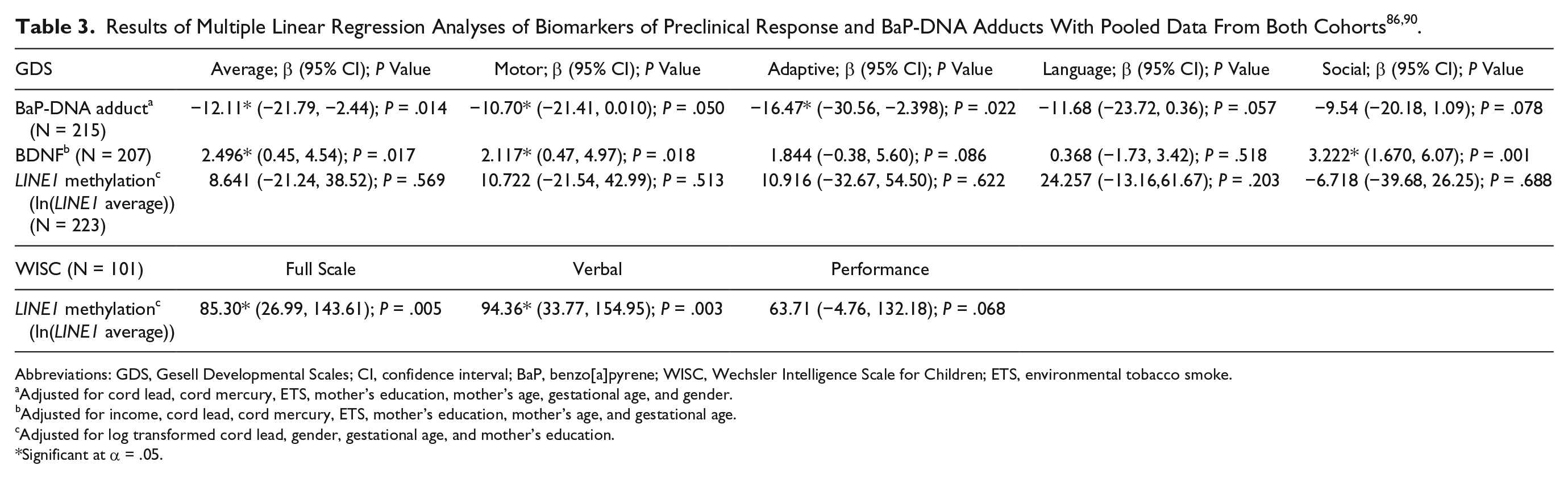
Abbreviations: GDS, Gesell Developmental Scales; CI, confidence interval; BaP, benzo[a]pyrene; WISC, Wechsler Intelligence Scale for Children; ETS, environmental tobacco smoke.
Adjusted for cord lead, cord mercury, ETS, mother’s education, mother’s age, gestational age, and gender.
Adjusted for income, cord lead, cord mercury, ETS, mother’s education, mother’s age, and gestational age.
Adjusted for log transformed cord lead, gender, gestational age, and mother’s education.
Significant at α = .05.
Results of Mediation Analysis to Determine the Indirect Effect of BDNF on the Relationship Between BaP-DNA Adducts and DQ Scores a .

Abbreviations: BaP, benzo[a]pyrene; DQ, developmental quotient; ETS, environmental tobacco smoke.
Covariates include log transformed cord blood lead, log transformed cord blood mercury, ETS, mother’s education, mother’s age, gestational age, gender, and income.
Significant at α = .05.
Regression analysis found an inverse relationship between BaP-DNA adducts and LINE1 methylation status. An increase in BaP-DNA adducts was associated with a significant, modest reduction in LINE-1 methylation (β = −0.010; 95% CI = −0.019 to −0.001). A significant, positive association was reported between LINE1 methylation status and scores on the verbal (β = 85.31; 95% CI = 26.994 to 143.614) and full scale (β = 94.36; 95% CI = 33.777 to 154.948) IQ tests at 5 years of age in the 2002 cohort. An analysis of pooled data from both cohorts did not find a significant association between LINE1 methylation and scores on the GDS DQ tests (Table 3). Mediation analysis did not find LINE1 methylation to be an indirect mediator of the relationship between BaP-DNA adducts and IQ scores, 86 that is, it did not significantly reduce the effect of exposure on neurodevelopmental outcome.
Discussion, Conclusion, and Implications
Data from this prospective cohort provide compelling evidence of neurodevelopmental and fetal developmental deficits because of exposure to air pollutants, specifically BaP, a representative PAH. The adverse effects associated with BaP-DNA adduct levels were no longer observed after the main source of PAH exposure, the coal fired power plant, was retired. The researchers found that BDNF level in cord blood was negatively associated with BaP-DNA adducts and positively with DQ scores; and a mediation effect suggests a mechanistic role for BDNF in the effect of BaP-DNA adducts on neurodevelopment, which should be further explored through toxicological studies. Since BDNF plays a role in neuronal growth and migration, 29 removal of an exposure that is associated with lower BDNF levels would be expected to reduce the likelihood of neurodevelopmental problems. Although consequences of small changes in DNA methylation are not yet completely understood, adverse effects of decreased LINE1 DNA methylation status on health have been suggested. As a marker of global DNA methylation, a reduction in LINE1 methylation has been linked to cancer and disorders of genomic imprinting.33,91 In this study, LINE1 methylation status was associated negatively with BaP-DNA adducts and positively with IQ scores, but was not a significant effect mediator. Methylation of LINE1 promotor regions also prevents activation of repeat elements that are capable of retrotransposing in the human genome. Studies have reported that during neurodevelopment, the transposition of LINE1 in neuronal DNA affords neuronal genomic diversity and plasticity 30 while others have suggested that LINE1 promoter activation can decrease genomic stability 92 and increase transcriptional noise. 93 While the biological significance remains unclear, these hypotheses suggest that disruption in LINE1 methylation during neurodevelopment could disturb normal neuronal plasticity and diversity controlled by LINE1, increase genomic instability, and interfere with gene expression. Although LINE1 methylation does not seem to mediate the relationship between BaP-DNA adducts and neurodevelopment, LINE1 methylation status may be affecting neurodevelopment independent of BaP-DNA adduct formation.
An advantage of the research is the prospective cohort study design. Such studies are less vulnerable to biases associated with case-control studies or with cross-sectional studies. They provide greater ability to understand the etiology of disease, especially related to environmental exposures. 94 The exposure change created by the closure of the power plant allowed researchers to study the benefits of reduced exposure in a population that remained similar in most ways, apart from change in exposure itself. This diminished the potential for biases inherent in recreating a counterfactual control group or comparing with a population with a lower dose but in a different setting. By using a pollutant-specific biomarker of exposure, researchers were able to account for individual variability in metabolic status and genetic phenotype, both of which may alter PAH absorption, metabolism, and the magnitude of related adverse outcomes. However, the following limitations are noteworthy. While they were able to measure prenatal exposure to PAH, researchers were not able to control for postnatal environmental exposures in children, which may also affect developmental scores. Furthermore, since PAH are lipophilic they are stored in maternal adipose tissue and are capable of being released during pregnancy. Therefore, although mothers in 2005 were exposed to lower ambient levels of PAH, their body burden of PAH may have remained high. 67 This would have led to an underestimate of the benefits of plant closure.
PAH exposure from the power plant was inversely associated with neurodevelopment and this adverse effect was attenuated with a reduction in exposure of PAH. This benefit was consistent with the observed trends in molecular markers of neurodevelopment. The observed neurodevelopmental health benefits would translate into an improvement in future quality of life and substantial economic benefits. Based on another study by CCCEH of a New York City cohort, an analysis of costs associated with PAH-related IQ deficits among Medicaid births in New York City reported an annual cost greater than US$13.7 million for the more highly exposed children. These costs were associated with special preschool needs of children in the highest quartile of PAH exposure, who had greater odds of being developmentally delayed. The authors noted that other costs associated with neurodevelopmental delay due to PAH exposure are likely to accrue over time but were not estimated in the study. 95 Using PM2.5 as a marker of outdoor air pollution, a group of researchers reported an estimated cost of US$760 million associated with medical needs of preterm birth and US$4.33 billion associated with loss in productivity due to reduced IQ points associated with PM2.5 exposure and with preterm birth. 96 A study in 2008 found costs associated with diseases of environmental origin: lead poisoning, prenatal methylmercury exposure, childhood cancer, asthma, intellectual disability, autism, and attention deficit hyperactivity disorder in the United States to be US$76.6 billion. 13 Another study in the United States considered the economic benefits of removal of lead from gasoline, assuming that the reduction in exposure increased mean IQ scores from 2.2 to 4.7 points. They estimated that in each year’s birth cohort since the 1990s, society benefited by US$213 billion, an aggregate benefit of more than US$3 trillion between 1990 and 2010, 97 suggesting large economic benefits from prevention of developmental delay because of lead exposure. These and other studies have prompted a call for an overhaul of current methods in regulation and policy surrounding chemicals known to be neurodevelopmental toxicants. Scientists have underscored the need for better ways to assess scientific evidence on these chemicals, and asked policymakers to treat chemicals of concern seriously. 98
Since coal and other fossil fuel combustion contribute large amounts of PAH to the ambient and indoor air, regions of the world that rely on thermal power generation have a high burden of PAH exposure, and this exposure occurs in conjunction with other air pollutants such as mercury, lead, and particulate matter. The global burden of disease report found that coal burning was the single largest source of air pollution related to health impacts in China, where the exposure contributed to 366 000 premature deaths in 2013. 99 Outdoor air pollution was found to be the fifth leading cause of premature death in China in 2013. 100 Globally, 2.9 million premature deaths in 2013 were attributed to coal burning and 64% of these were in developing countries. A report from the World Bank and the Institute for Health Metrics and Evaluation found that in 2013, premature deaths due to air pollution cost the world economy US$233 billion and US$5.11 trillion in welfare losses. 101 However, these measures of burden of air pollution fail to incorporate the cost of in utero exposure to air pollution and its effect on IQ and neurodevelopment, leading to an underestimate of the true costs. In addition, a greater burden of disease and health cost is borne by susceptible groups that include the fetus and young child, racial minorities, and people of a low socioeconomic status.102-104
With China agreeing to ratify to the Paris Climate agreement, we can expect the country to reduce its reliance on thermal power plants and electricity generated via combustion of coal. The evidence for significant improvements in neurodevelopment following the removal of a significant source of environmental toxins should be considered in decision making on climate and energy. The afforded benefits can provide an impetus for other developing countries to consider the full cost of coal and the corresponding benefits of reduced reliance on this polluting source.
Author Contributions
VK: Contributed to analysis and interpretation; drafted manuscript; critically revised manuscript.
FP: Contributed to conception and design; contributed to acquisition, analysis, and interpretation; critically revised manuscript; gave final approval.
DT: Contributed to conception and design; contributed to acquisition, analysis, and interpretation; critically revised manuscript; gave final approval; agrees to be accountable for all aspects of work ensuring integrity and accuracy.
Footnotes
Acknowledgements
We gratefully acknowledge our partners at the Chongqing Children’s Hospital (Drs. Tin-Yu Li, Yiguan Zhang, Zhang Y. Quan, Jiang Xie); the School of Public Health, Fudan University (Dr. Zhi-jun Zhou); the School of Environmental Science and Engineering, Shanghai Jiao Tong University (Dr. Tao Yuan); and at the Division of Atmospheric Sciences, Desert Research Institute, Nevada (Drs. Judith C. Chow, John G. Watson, Steven Sai Hang Ho).
Declaration of Conflicting Interests
The author(s) declared no potential conflicts of interest with respect to the research, authorship, and/or publication of this article.
Funding
The author(s) disclosed receipt of the following financial support for the research, authorship, and/or publication of this article: This project was supported by the V. Kann Rasmussen Foundation, The Energy Foundation, The Schmidt Family Foundation, The Rockefeller Brothers Fund, and The Porpoise Fund. The funders had no role in study design, data collection and analysis, decision to publish, or preparation of the manuscript.