




Abstract
Previous research has indicated that Indigenous Sami families in Norway use public home-based care services less often than their non-Sami peers. Based on qualitative interviews with Sami family caregivers, we explore what they experience as barriers to accessing public care services for older adults living with dementia, and how they experience collaborating with care services providers. Through a reflexive thematic approach, we identified that rather than a cultural norm of “taking care of one’s own,” the underuse of public care services among Sami families were related to several intertwined circumstances. The Sami family caregivers reported barriers to accessing public care, such as lack of familiarity with the services and cultural and language concerns and the legacy of history, and drivers for continuing family care, such as blurred distribution of responsibility, lack of continuity of care, and culturally unsafe caring environments and marginalizing practices.
Introduction
Similar to other comparable countries, in Norway, health and care authorities have conceptualized aging in place as an ambition for older adults, including for persons with substantial care needs, for example, due to advanced dementia (Ministry of Health and Care Services, 2007, 2015). Thus, most persons with dementia in Norway continue to live in their own homes for several years with increasing symptoms and, as a result, have an increasing need for support. Long-term care for older adults, including home care services, has long been considered a core responsibility of the Norwegian welfare state and is predominantly provided in municipal health and care services. As a consequence of reforms in the Norwegian healthcare sector over the past two decades, the relative number of younger users (<67 years) of municipal health and care services has doubled compared to the number of users aged 80+, and municipalities with an increased number of younger home care service users have reduced long-term institutional care for older adults 80+ (Hermansen & Gautun, 2013). In other parts of the Western world, the decline in access to formal long-term care services for frail older adults is more comprehensive (Armstrong-Esther et al., 2005; Egdell, 2013; Tatangelo et al., 2018). For example, a cross-sectional study from Sweden revealed that 50% of home-dwelling persons diagnosed with dementia did not receive any type of formal home care services (Odzakovic et al., 2019).
As a consequence of aging in place policies coupled with the increase in dementia in the older adult population (Gjøra et al., 2021) and the relative decrease in institutional long-term care services for older adults (Hermansen & Gautun, 2013), more care tasks for home-dwelling persons with dementia have been placed on the shoulders of family caregivers. Quantitative and qualitative studies indicate that family caregivers of persons with dementia experience comparatively high rates of depression, stress, and physical illnesses (Etters et al., 2008; Tatangelo et al., 2018) and that they report a number of unmet needs, such as the need for company, information, and daytime activities for the person with dementia (Kerpershoek et al., 2018; Munkejord et al., 2020).
This study regards Indigenous Sami family caregivers for older persons living with dementia. The Indigenous Sami population lives in a vast geographical area and numbers approximately 50,000 to 65,000 in Norway, 20,000 in Sweden, 8,000 in Finland, and 2000 in Russia (Vars, 2019). In Norway, three Sami languages are used: North Sami, Lule Sami, and South Sami (Ministry of Local Government and Modernisation, 2016). While North Sami is considered an endangered language, Lule Sami and South Sami are considered as severely endangered languages, but no public statistics exist on how many individuals speak the Sami languages. Historically, the Sami subsisted on reindeer herding, small-scale farming, and fisheries. At present, less than 10% of the population in the traditional Sami residential areas work in the primary industries (Claus, 2014). The traditional Sami areas have negative net migration (Eriksen et al., 2021). Hence, many Sami currently live outside the traditional Sami residential areas. Since the 1850s onward, the Sami underwent a harsh assimilation process, often referred to as the “Norwegianization process” (Minde, 2003). This Norwegianization process was imposed through taxes, laws, religious norms, as well as through the Norwegian school system in which use of the Sami languages was prohibited until 1959. Since the 1980s, there has been a change in the official approach; The Sami Parliament was established in 1989, and in 1990, the Sami were officially recognized as Indigenous people in Norway. The Sami, moreover, have rights to healthcare services both based on general legislation, such as the Patients’ Rights Act (Norwegian Ministry of Health and Care Services, 1999), and on international conventions, such as The United Nations (UN) Declaration of the Rights of Indigenous Peoples (United Nations, 2007) and The UN International Covenant on Civil and Political Rights (United Nations, 1966), which were incorporated into Norwegian legislation through the Human Rights Act (Norwegian Ministry of Justice, 1999). Moreover, Norwegian authorities have ratified The International Labour Organization (ILO) Convention No. 169 concerning Indigenous and Tribal Peoples (International Labour Organisation, 1989), which states that healthcare services should be community based to the greatest extent possible and should be planned and administered in cooperation with the community served, emphasizing the importance of training and employing local community healthcare workers. Although several studies indicate that the Sami are less satisfied with the health and care services than the majority population (Mehus et al., 2019; Ness & Munkejord, 2022; Nystad et al., 2008), the Sami do not face the same health-related challenges as Indigenous peoples in Canada, the United States, Russia, or Greenland (Symon & Wilson, 2009). Hence, in Norway, life expectancy at birth is virtually identical for Sami and non-Sami individuals, and mortality rates for specific conditions are similar (Brustad et al., 2009; Hassler et al., 2005; Statistics Norway, 2022). Results from research on the mental health situation of the Sami population, on the other side are more ambiguous, indicating that Sami reindeer herders (aged 18–74 years) scored higher on depression and anxiety scales than the majority population living in the same areas (Kaiser et al., 2010).
Guided by a principle of universalism (Anttonen & Sipilä, 2012), public health and care services in Norway should be provided equitably to all citizens regardless of age, gender, socioeconomic status, place of residency, and ethnicity. A longstanding Norwegian official policy has been to “integrate the Sami perspectives in the ordinary care services” rather than to develop services exclusively for the Sami population (Ministry of Health and Care Services, 2006, 2013). According to Norwegian government white papers, the Indigenous Sami population is more reluctant than the majority population to apply for municipal health and care services both for themselves and for relatives with long-term care needs (Ministry of Health and Care Services, 2009; Ministry of Health and Social Affairs, 1995, 2001). Rather, the Sami people are assumed to have cultural values and traditions that motivate them to primarily rely on family members or other local relationships when support or help is needed (Ministry of Health and Care Services, 2009, 2013; Ministry of Health and Social Affairs, 1995, 2001). In the same vein, Blix and Hamran (2017) found that even healthcare providers working in municipalities with both Sami and Norwegian populations believed that the Sami prefer to “take care of their own.” In line with Blix and Hamran, we argue that if not empirically correct, this assumption may lead to neglect of the healthcare needs of the Sami population, and as a result, it may create health inequities.
To date, the field of Sami family caregiving for older adults with dementia has been sparsely researched (Blix, 2016). International research on family caregivers from minority ethnic groups more generally, however, indicates that the use of formal long-term care services is lower among minority older adults than majority older adults, even though minority older adults have a higher prevalence of functional limitations and chronic conditions than older adults in the majority population (Suurmond et al., 2016), and the number of persons from ethnic minorities with dementia is expected to increase considerably in the coming years (Nielsen et al., 2015). The lower use of home-based health and care services among ethnic minority groups has been explained with reference to communication/language barriers (Greenwood et al., 2015; Parveen et al., 2017), a lack of culturally appropriate services (Duran-Kiraç et al., 2022; Greenwood et al., 2015), a lack of knowledge about existing services and how to access them (Mukadam et al., 2011; Parveen et al., 2017), limited knowledge about dementia (Duran-Kiraç et al., 2022; Mukadam et al., 2011), attitudes toward cognitive impairment (Debesay & Tschudi-Madsen, 2018), different perceptions of how one could best relieve persons in their last phase of life (Debesay & Tschudi-Madsen, 2018), and previous negative experiences with healthcare encounters (Duran-Kiraç et al., 2022; Mukadam et al., 2011). In a recent study, Baghirathan et al. (2020) found that minority family caregivers both needed and wanted formal services and support, but they feared being personally diminished by health and care services originally developed based on the majority population.
Little is known about the situation of Sami family caregivers, particularly about family caregivers for older adults with dementia and their collaboration with municipal health and care services. Larsen et al. (2016) found that collaboration between Sami and non-Sami family caregivers and healthcare providers in rural Norwegian municipalities was hampered by negotiations about ethnicity and ethnic boundary work. Moreover, a recent Norwegian survey of family caregivers for older persons with dementia confirmed that Sami respondents used home-based health and care services less often than non-Sami respondents (Moholt et al., 2020) but could not provide explanations for why this was the case. Additionally, this survey could not shed light on experiences of collaboration with healthcare providers after services were obtained. In this article, we address this knowledge gap by exploring the following two research questions: 1. What do Sami family caregivers experience as barriers to accessing public care services for older adults living with dementia? 2. After public care services are accessed, how do Sami family caregivers experience collaboration with care service providers and their own role as family caregivers?
Cultural Safety and Postcolonial Perspectives
Perspectives on culturally safe health care services, originally developed by Maori nursing leaders and educators in Aotearoa/New Zealand, emphasize the importance of cultural humility in interactions between healthcare professionals and Indigenous service users and their families (Williamson & Harrison, 2010). Culturally safe caring environments have been defined as environments
where there is no assault, challenge or denial of their [health care service users’] identity, of who they are and what they need. It is about shared respect, shared meaning, shared knowledge and experience, of learning together with dignity, and truly listening (Williams, 1999, p. 213).
Conducting research with Indigenous populations (and other minority groups) using cultural safety as analytical lens, involves a risk of explaining all identified challenges with reference to culture. Postcolonial theory and critical cultural perspectives draw attention to the impact of historical and socio-economic factors on individuals’ lives but forestalls attempts to represent these as issues of “cultural difference” (Browne et al., 2005). These perspectives acknowledge that individuals are indeed carriers of values, customs, or practices that are significant in healthcare contexts as they intersect with other factors such as income, education, and geographical location, as well as the legacy of history. Moreover, such perspectives are a strong reminder of the importance of recognizing variations in individual experience while acknowledging the shared histories of marginalization that have affected and continues to affect particular groups (Browne et al., 2009).
Methods
Study Design
To answer our research questions, a qualitative interpretive descriptive research design was used (Thorne et al., 1997). Although the research-based knowledge about the experiences of Sami family caregivers is sparse, we agree with Thorne et al. (1997) that “going in blind” can be counterproductive to knowledge development, and that a “critical analysis of the existing knowledge represents an appropriate platform on which to build a qualitative design” (p. 173). This study is part of a larger research project investigating the use and nonuse of community health care services among home-dwelling older adults and family caregivers in northern Norway (Blix & Hamran, 2017, 2019; Henriksen et al., 2020; Moholt et al., 2020, 2021). The overall project included a survey with 430 family caregivers in a sample of 32 municipalities, focus groups with healthcare professionals in municipal health and care services (henceforth, public care services) in five municipalities, and individual interviews with family caregivers in ten municipalities.
Participants and Recruitment
This study is based on individual interviews with family caregivers who identified as Sami (n = 11) in five municipalities included in the area of administration of the Sami Language Act (Ministry of Government Administration Reform and Church Affairs, 1987). To recruit the participants, written information and consent forms were sent to survey participants who had indicated that they (1) identified as Sami and (2) were willing to participate in a subsequent qualitative interview. When signed consent forms were returned to us, Bodil contacted the participants to schedule interviews. The participants (eight women and three men) included spouses (n = 4), sons (n = 2), daughters (n = 4), and an adult grandchild (n = 1) of older persons with dementia living in independent houses or assisted living facilities. The participants’ age varied from mid-30s to early 80s. Six participants were in paid employment, whereas five were retired from work.
Interviews
Based on a thematic interview guide, the participants were invited to speak freely about the everyday life and needs for help and support of the person with dementia, their own situations as family caregivers, their involvement in care provision, their contact and collaboration with the public home care providers, and their thoughts about the future. The interviews were conducted in the participants’ homes or workplaces and lasted from 1 to 2 hours. All interviews were digitally recorded and transcribed. The interviews were conducted by Bodil.
Analysis
As noted by Braun and Clarke (2022), research questions are not always fixed from the outset of a study. Sometimes they “evolve throughout the course of the research” (p. 12) as deeper insight is generated. This was also the case for this study. While we at the beginning of the study aimed to understand previously reported underuse of public care services by inquiring into barriers to accessing public care services (research question 1), we gradually, throughout the analysis described below, realized that the issue of underuse of public care service also continued after services had been allocated (research question 2). Hence, while the first research question was our starting point, the second research question was a result of our expanded focus as the analysis progressed. We engaged with the interview data using a reflexive thematic analysis approach as suggested by Braun and Clarke (2019, 2022), including the following elements: 1. Data familiarization and writing of familiarization notes; 2. Systematic data coding; 3. Generating initial themes from coded and collated data; 4. Developing and reviewing themes; 5. Refining, defining and naming themes; and 6. Writing. Rather than being linear and successive, this process was recursive. Bodil conducted the data coding and presented the initial codes to Mai Camilla. Next, we were both involved in the development, refinement, definition and naming of the themes, and in the writing process. This way of engaging with the data, through questioning, discussing, and continuous revising of the themes, allowed both “immersion or depth of engagement, and distancing, allowing time and space for reflection” (Braun & Clarke, 2022, p. 9). We concur with Braun and Clarke, who emphasized that rather than “discovered,” “themes are produced by the researcher[s] through their systematic analytic engagement with the data set” (Braun & Clarke, 2022, p. 9). Thus, our experiences, personal positionings, and theoretical and methodological expertise was a resource in the creative interpretive process. We both have substantial experience with research in and with Sami communities. Bodil is Sami but does not, due to the historical processes described above, speak the Sami language. Although the study was informed by perspectives of cultural safety, we strived to remain wakeful to how various circumstances, beyond “cultural and language differences” and the Sami people’s position as a marginalized minority, frame and shape family care and the use and non-use of public care services.
Ethics
The study was approved by the Norwegian Center for Research Data (from January 1st, 2022: Sikt), (reference number 42469). Anonymized transcripts of the interviews are stored in the Norwegian Center for Research Data archive. All participants provided informed consent to participate. The participants were informed of their right to withdraw from the study without stating a reason, and they were assured that confidentiality would be maintained. At the beginning of the interviews, the interviewer described the purpose of the interview and assured the participants of their anonymity. In an interview situation, one word often leads to another, and the interviewees can find themselves relating stories they did not intend to tell. As noted by Kvale and Brinkmann (2009, p. 73), “the openness and intimacy of much qualitative research may be seductive and can lead participants to disclose information they may later regret having shared.” We were particularly conscious of this issue in this study because the family caregivers’ stories necessarily also included information about their family members living with dementia who had not consented to participate in this study. We have strived to protect the anonymity of both the family caregivers and the persons with dementia in the quotes presented in this article. Due to the small size of the communities in which this study was conducted, to safeguard the participants’ anonymity, we chose not to combine information about the participants’ age, gender, and relation to the person living with dementia (spouse/child/grandchild) in a table. All interviews were conducted in Norwegian. Being able to conduct an interview in the Norwegian language was not an inclusion criterion, but all participants spoke Norwegian fluently. Nonetheless, Sami was the first language of several of the participants, and we are aware that interviews conducted in participants’ second language may have affected the material. One’s first language is usually richer in detail and nuance than languages acquired later in life. Moreover, the presence of a Norwegian-speaking interviewer might also have prevented the participants from addressing particular issues.
Results
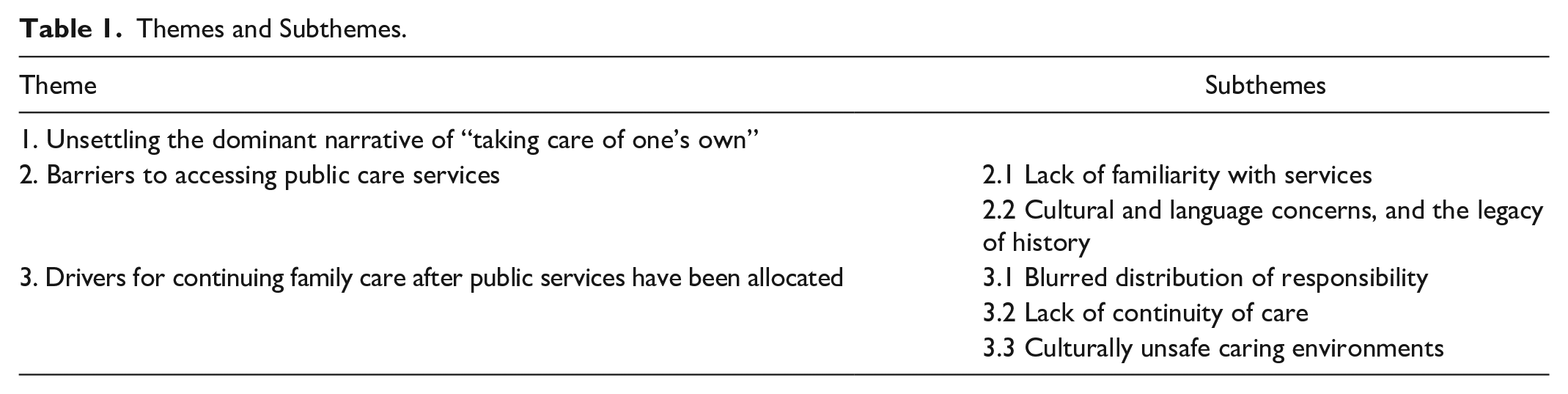
The reflexive thematic analysis resulted in three themes and five subthemes. The themes and subthemes are presented in Table 1.
Themes and Subthemes.
All participants in this study identified as family caregivers and provided help and support for an older adult living with dementia on a regular basis. Some participants lived in the same household as the older adult, whereas others did not.
Unsettling the Dominant Narrative of “Taking Care of One’s Own”
In our data, we found no support for the assumption that the Sami do not want help and support from public health and care services and prefer to “take care of their own.” Several participants resisted the dominant narrative about taking care of one’s own being a Sami cultural value. This resistance was expressed, for example, by pointing out that previous generations had also received help from public care services.
Mother was always good at asking for help. [. . .] When you grow older, you don’t always get the best care from your own. Actually, there are people who are professionals at this. [. . .] So, she got our father into the nursing home. That is why there are nursing homes: to provide help and safety in old age. (Participant 7, daughter)
However, others noted that, although perhaps historically being the norm, family care was no longer compatible with their current everyday lives.
We have been completely reliant on. . . formal care services, and we are very grateful. We would probably not have managed without formal care. As long as you are in full-time employment. . . [. . .] So, many things have. . . it is no longer. . . To put it simply, that tradition, that part of our culture has changed. (Participant 1, son)
Additionally, the participants explained their own continued efforts to provide family care as a consequence of personal traits rather than cultural norms.
It’s a long story. I’ve always been the sort of person who gets into situations like this. [. . .] Always! For as long as I can remember. [. . .] So, it’s in my backbone. But now, I feel. . . I’ve never felt it before, but now I feel angry. And I feel – will it ever be enough? Will it ever stop? Is this supposed to be my life mission until my mother passes away? (Participant 2, daughter)
The participants in this study voiced both a wish and a need for help, support and collaboration with public care services. Nonetheless, the participants described barriers to accessing the help and support they needed from public care services and various drivers for continuing family care even after public care services were allocated.
Barriers to Accessing Public Care Services
Lack of familiarity with services
For some of the participants, simply knowing that there were services available if and when they would need them made it easier to continue “taking care of their own” without help from public care services: “They could contact me and ask, “How are you? Would you like to talk?” Then, I could say, “No, I don’t need a conversation yet”. But I did realize that it’s good that they know.” (Participant 8, spouse).
However, for other participants, the provision of family care without help and support from public care services was not a deliberate choice. For some participants, taking care of their own was simply a consequence of a lack of alternatives: “Why I provide care? He needs it, so I have to. There is no one else around.” (Participant 5, spouse).
Some participants had continued to take on substantial care efforts without help from public care services for extensive lengths of time because they had not been aware of the services available.
It was my responsibility. That’s probably why it went as far as it did. I didn’t know about the services. Not until they came here from the day care center and talked with us. Then, I learned that help is available. But I don’t blame anyone. It is probably my own fault. . . that I did not seek out. . . We have, sort of, always managed on our own. (Participant 3, spouse)
The participants’ lack of knowledge about dementia and awareness about the services in parallel were described as barriers to accessing public care services.
There are two things, in my opinion, that are crucial before you ask for help. You must have knowledge about the disease, and you must know that services are available. If you don’t have knowledge about the disease, if you don’t understand that this is going to progress, it’s hard to ask for help. Then, you simply try to cope in everyday life. It may progress so gradually that you don’t see it. You don’t notice. Until it. . . Like in my case, until I had to drive around for hours searching for her [wife]! I had to call people and ask them, get up at night to look for her. . . It was difficult. (Participant 2, spouse)
For this husband, the care burden increased gradually with the progression of his wife’s disease. Overwhelmed with the day-to-day coping with everyday challenges, he did not know how and who to ask for help and support. Other participants described the feeling of being overwhelmed shortly after the person was diagnosed with dementia. In both cases, the participants wished that the services had reached out to them rather than expecting them to express their needs for help and support.
I imagine – when you end up in such a situation, there should be someone. . . A leaflet, sort of, with the name of the leader of the home care services and. . . Whom to contact if you need technical aid, occupational therapy and. . . With a phone number and. . . all sorts of things. Because you use so much time to figure out all those things. It would have been a relief if you didn’t have to do. . . all those things yourself. (Participant 9, daughter)
Cultural and Language Concerns, and the Legacy of History
Several participants emphasized the importance of the closeness to and familiarity of existing services with the older adult’s home and community: “If people live scattered around while the health care providers all live in the municipality center and they don’t have a relation with the local communities, the villages, that’s a huge minus.” (Participant 1, son). For some participants, such geographical concerns were closely intertwined with cultural and language concerns. The location of institutional long-term services in predominantly Norwegian-speaking municipality centers, far from the Sami local communities, was presented as a barrier for accessing long-term care.
As the situation is today, sending her to [the municipality center]. . . where very few people speak Sami and. . . There are perhaps a few, but not many. I think you can count them using one hand. And. . . No, we want to have her at home for as long as possible. (Participant 11, granddaughter)
Some of the participants had considered relocation to an assisted living facility where more care services would be available. The available living facilities, however, were either located geographically far away or did not have Sami speaking staff. Thus, in both cases, continuing to combine family care and municipal home-based care services was preferred.
I read in the paper about a man from [neighboring municipality] who had to move to the coast because the municipality could not provide a place for him [in the nursing home]. [. . .] But, you know, being Sami speaking on the coast, where no one speaks Sami, that is terrible. But then he got a place in [another municipality]. But that is 180 kilometers from. . . that was 180 kilometers away. That’s quite far. And his wife – she could drive, but she could not drive that far to visit her husband. (Participant 6, spouse)
The participants’ concerns were related not only to care professionals’ competence in the Sami language but also to their familiarity with Sami culture and older adults’ “background.”
I don’t know what. . . how. . . Currently, at least, if she would accept help voluntarily, I believe she would need to know those [home-care providers], who would then enter her home. [. . .] By all means – they are very competent. It has nothing to do with that. But it is about. . . understanding. . . yes, and background. I believe she’d have to concentrate much more when bumenn [local Norwegian word for settlers] come into her home. She must use so much more. . . she would need to use much more energy. (Participant 11, granddaughter)
The participants’ concerns regarding public care services also echoed the history of assimilation and historical experiences of stigmatization and discrimination. The fear that the older adult would feel inferior or relive previous experiences of inferiority in encounters with Norwegian care professionals represented a barrier for accessing public care services.
For Grandma, in her case, I think it’s related to what happened in the old days. Because the Sami, many years ago, were considered less worthy. And they were. . . sort of, unworthy. Whereas the bumenn [local Norwegian word for settlers], they were. . . how can I say this. . . they were “better”. . . yes. . . they were “neater” and. . . Yes, I suppose that’s what they believed. It’s hard to explain, but I think it’s related to the old days. (Participant 11, granddaughter)
Drivers for continuing family care after public services have been allocated
All participants in this study eventually accessed some degree of help and support from the public care services. The scope of the help and support varied. Some family caregivers only occasionally had conversations with the services, whereas some of the older adults had daily visits from the home care services. Some of the older adults attended day care centers, whereas others eventually moved into assisted living facilities where care was provided by home care services.
Blurred distribution of responsibility
Some participants expressed a desire to continue their involvement in caring for their older family member after contact with home care services was established and services had been allocated. They wished to be considered care partners rather than being left on the sidelines. However, the fear of crossing the borders to the services’ responsibilities was a barrier for fruitful collaboration. According to some participants, care professionals should be responsible for stating that the next of kin were still needed: “It is important that the care services explain that even though they do a lot, there is still a need for you.” (Participant 1, son). In such cases, the family caregivers would have preferred to be explicitly invited to collaborate. In reality, however, the participants experienced implicit and rather vague expectations from home care services.
Those working in the services, they try their best. But there is a system malfunction. You’re constantly sitting on the fence wondering, “Whose responsibility is this?” [. . .] I feel very angry sometimes because I feel that everything is put on us. (Participant 2, daughter)
Often, the task division between care professionals and family caregivers was not made clear, and family members thus did not know what they had to take care of and what they could expect from the home care providers: “I couldn’t get off work. So, I asked if they [the home care services] could accompany him to the doctor, but they couldn’t. So exactly which tasks they. . . they could do, I don’t know.” (Participant 9, daughter).
Lack of continuity of care
Participants emphasized the importance of home care providers’ knowledge about and familiarity with the person with dementia as key for the quality and continuity of care. Living in small rural communities was considered an advantage in that regard: “In small places, they [the home care providers] know people. They know who the person is. It feels safe that those coming by are not complete strangers.” (Participant 9, daughter).
However, even in the small rural communities, the family caregivers experienced that home care providers did not have sufficient knowledge about the older person: “It has occurred to me every now and then, that perhaps they don’t know who they are caring for.” (Participant 1, son).
This concern for the lack of knowledge about older persons was also related to the way the services were organized, which involves new home care providers constantly coming in: “I have noticed, every time a stranger comes in, it. . . It’s as if he would have asked, if he could, “Who is this?” So, I have the impression he never quite gets to know them [the home care providers].” (Participant 8, spouse).
The high number and high turnover of home care providers were considered barriers to the quality and continuity of care. Moreover, the family caregivers expressed concerns regarding home care providers’ competence about dementia. In such cases, the family caregivers felt that they had to be present or available both for the older adult and the home care providers and, in that sense, were more or less involuntarily involved in the provision of care.
When one of them [the home care providers] visited, she did not know what to do because the information flow was poor. And there are perhaps fifteen of them. I do understand that they work shifts and that there are many of them, and very few of them are trained nurses. Some of them have no education at all. And especially during summers because there are many. . . substitutes. (Participant 9, daughter)
Participants experienced the communication and the information flow in the services to be poor. Consequently, the family caregivers were involuntarily involved in collaboration with home care service providers to safeguard the continuity of care: “They used to call us! Every single time they visited him, they would call us and ask me what to do.” (Participant 9, daughter). To improve communication and information flow, the family caregivers would prefer to have a single contact person, a primary contact, in home care services. Thus, when they had questions, they could phone their primary contact and expect her to know their family member and to have an overview of the care situation. In addition, the family caregivers thought that this primary contact should be responsible for passing on messages and ensuring that all staff members knew what to do when providing care for each of the patients on the list that day:
I read about that – a primary contact. If there is something we. . . when there is something. . . one person we could call. We saw that messages were not passed on. Who should we call? There should be one person who could pass on messages. Like, when they have meetings and decisions are made. . . There should be one person telling about Dad. But we have to call whoever is on duty. (Participant 9, daughter)
While indirectly contributing to the continuity of care through safeguarding the information flow, the family caregivers also contributed in a more direct manner by performing care tasks that should have been provided by home care services: “I sometimes had to put him to bed myself if the home care services did not show up. ‘Cause sometimes, some of them did not keep their schedule.” (Participant 8, spouse). In such cases, the responsibilities were not blurred, and the task division was clear, but the family caregivers were nonetheless involuntarily providing care for the older adult because there were no alternatives.
Culturally unsafe caring environments
Some participants’ narratives indicated that their trust in municipal care services was associated with home care providers’ language competence. The family caregivers felt more confident that older adults’ needs were met and that the care was person-centered when the older adults could use their mother tongue in encounters with home care providers.
It is very clear who she gets along with and who she does not get along with. And all the Finnish speaking. . . My mother’s mother tongue is Finnish. She gets along with them. Somehow, it appears as if they spend more time with her. Maybe because they share the language. They laugh more. There is a completely different jargon when. . . when there is a Finnish. . . from the home care services. (Participant 2, daughter)
Other participants reported very specific experiences of language barriers for the provision of quality care in municipal care services. Concerns were that the older adults’ lack of opportunities to use their mother tongue in encounters with the care service providers could result in passivity, and the older adults’ dementia diagnosis added to this concern.
I’ve noticed, when they speak to my mother – she doesn’t even bother to answer because. . . She understands what they are saying, but she cannot answer in her own language. And I see the increased need for that when you are a little. . . if you have dementia because your mother tongue is the language you want to communicate in. So, you end up not talking much. (Participant 7, daughter)
While several participants expressed concerns about older adults’ encounters with non-Sami care service providers, some were also concerned about how older adults were treated by non-Sami users of care services. One daughter described experiences of hostility from other residents in her mother’s assisted living facility:
It makes me sad to realize. . . you’re experiencing this here as well? Racism. . . from the others [in the living facility]. When we speak Sami, they scold us – “Speak Norwegian! We don’t understand what you’re saying.” But we’re not visiting them. I just want to talk with my mother. (Participant 7, daughter)
The participants considered themselves potential bridge builders between older adults and non-Sami care service providers. However, some had experienced that they were not welcomed into fruitful collaboration with care services providers. For example, one participant described an experience of being excluded from an encounter between her grandmother and a non-Sami physiotherapist:
She was visiting a physiotherapist, and I wanted to come with her. . . be there when he was doing the exercises with her. But no. He told me to wait in the hallway. I explained about the Sami. . . language. . . unsafety and anxiety. But no. I had to wait in the hallway. I’m regretful now. . . that I didn’t insist on coming inside. (Participant 11, granddaughter)
Another participant described how she had tried to implement traditional Sami food in her mother’s assisted living facility. She considered herself a resource for the care service providers and had offered to teach them how to prepare Sami dishes but felt that they were not interested in collaborating with her on this matter.
And it’s not just the language. It’s also food culture. It was a shock for us to realize. . . She comes from. . . we have always been reindeer herders, and she is used to using those resources. [. . .] That food is nonexistent in the living facility. [. . .] I got funding for a project to teach them how to cook. . . I don’t know. It was as if I came there, and they [the personnel] just disappeared. So, I was left in the kitchen with a group of older women. But they [the older women] flourished! [. . .] They could have used us as a resource, but. . . I have often felt that since we are reindeer herders, we are nonexistent. It hurts to say it, but that’s how it is. (Participant 7, daughter)
Discussion
Our results demonstrate that rather than a Sami cultural “trait,” Sami family caregivers’ substantive and continued efforts to “take care of their own” should be considered a consequence of an intertwined set of circumstances. Participants in this study resisted dominant assumptions expressed both in Norwegian government white papers (Ministry of Health and Care Services, 2009; Ministry of Health and Social Affairs, 1995, 2001) and by care services professionals (Blix & Hamran, 2017; Dagsvold et al., 2020) that family care is preferred in Sami culture. Rather, the participants in this study expressed both a wish and a need for help and support from public care services, similar to what has been reported from research with Sami bereaved individuals after traumatic deaths (Dyregrov et al., 2014). The participants in this study were more or less involuntarily kept in positions as family caregivers by a number of barriers to accessing public care services, such as a lack of familiarity with the available services and cultural and language concerns. Moreover, the participants in this study remained in the position as family caregivers after older adults received public care services, partly because the distribution of responsibilities between themselves and the services was blurred, partly due to concerns for the quality and continuity of care, and partly due to experiences of culturally unsafe caring environments.
Several of our findings are not only valid for the Sami population. The competencies and resources needed to access services are core aspects of health literacy (IUHPE, 2018), and several studies have demonstrated associations between health literacy among family caregivers and access to services (Batterham et al., 2016), awareness about available services (Cianfrocca et al., 2018), and improved communication with health care services personnel (Mullins et al., 2016) among various groups of family caregivers. A review of research on family caregivers’ needs for information and knowledge identified information and knowledge about the disease and how to access services as crucial (McCabe et al., 2016). Moreover, experiences of blurred distribution of responsibilities have also been reported in research with non-Sami family caregivers (Aasgaard et al., 2014), and family caregivers’ concerns regarding the quality and continuity of care have been reported elsewhere (Polacsek et al., 2020).
However, other parts of our findings may be interpreted in view of the participants’ Sami backgrounds and the Sami population’s historical marginalized position in Norwegian society. Similar to other Indigenous peoples in other parts of the world, the Sami people has experienced and still experience the legacy of colonization and assimilation processes. While the older generations have the most direct and personal experiences of these policies and practices, the following generations, including the participants of this study, may be affected through the “colonial wounds” of their parents or grandparents (Blix et al., 2021). Moreover, our results indicate that subsequent generations may experience subtle forms of discrimination and disadvantages in society and in encounters with the public care services due to ignorance as well as lack of understanding and acceptance among persons of authority and other fellow citizens (Ness & Munkejord, 2022). Thus, our results clearly indicate that both the family caregivers’ and the older adults’ language, culture, and previous experiences with stigmatization and discrimination were barriers for accessing help and support from public care services and drivers for the family caregivers’ continued efforts after public care services were allocated. Some of the participants in this study reported experiences indicating that we have still not reached the longstanding Norwegian official policy goal to “integrate the Sami perspectives in the ordinary services” (Ministry of Health and Care Services, 2006, 2013). Rather, some of our results indicate that family caregivers’ endeavors to bridge the gap between the public services and the older adults, that is, actively contribute to the integration of “Sami perspectives,” were ignored or actively resisted. Thus, several participants were concerned that older adults would not receive care in culturally safe caring environments, and some reported experiences indicating that this was the case. In that regard, our results are consistent with those of Baghirathan et al. (2020), who found that family caregivers in ethnic minority communities in Bristol, UK, both needed and wanted support but were reluctant to accept it “if it came at the cost of being diminished as a person” (p. 1673). Rather than using public care services, the participants in their study turned to voluntary and community sector organizations for help and support. Similar findings were reported by Parveen et al. (2017), who found that people from ethnic minority communities were more likely to draw on services with which they were familiar, such as services provided by religious organizations. The participants in our study did not refer to community organizations as a source for help and support. This finding should be understood in light of the modern Norwegian welfare state in which the provision of personal care for older adults is considered a public responsibility rather than the responsibility of voluntary and community organizations (Ågotnes et al., 2021). Rather, care for older adults in Norway, as well as in the other Nordic countries, has long been considered a core responsibility of public care services in collaboration with family caregivers (Vabø & Szebehely, 2012). In line with Kröger (2005), however, this study indicates that the era of the “caring state” is over and that family caregivers fill an increasingly more significant role in the care of older adults.
Strengths and Limitations
Little is known about the situation of Sami family caregivers for older adults with dementia and their collaboration with municipal health and care services. As such, this study adds to a very limited knowledge base. The study includes relatively few participants and was conducted in a specific geographical context. The eleven participants in this study lived in five different municipalities included in the area of administration of the Sami Language Act. The municipalities are all located inside the Polar Circle, hence, municipalities with a South Sami population were not included. The municipalities are diverse with respect to size and composition of population, and both North Sami and Lule Sami populations are represented in the study. The participants were diverse with respect to age, gender, relation to the person with dementia, and employment. Although we understand the use of public care services is influenced by factors such as gender, we did not analyze our data using gender as lens. The size and nature of our data did not allow for an analysis of the impact of gender. The study is part of a larger multimethod research project. While the various methods applied in the larger project were well suited to generate answers to different types of questions, they also generated new questions for inquiry. This study is based on a query generating from a trend identified in the survey study. While the larger project included various groups of participants (family caregivers, health care professionals, and representatives for various seniors’ associations), the voices of older adults living with dementia were missing. Future research should aim to inquire into Sami older adults’ own experiences with use and non-use of public care services.
Conclusion
This study adds context to results from previous quantitative research demonstrating that Sami families use public home-based care services less often than their non-Sami peers (Moholt et al., 2020). While it has been assumed in both policy papers and previous research that Sami people prefer to “take care of their own,” this study indicates that this assumption is wrong. The underuse of public care services among Sami families may be explained by a number of intertwined circumstances, as elaborated in this article. Our results demonstrate the need for active outreach services and for a more explicit distribution of responsibilities between public care services and family caregivers, preferably mediated by a primary contact. While this need is probably not specific for the Sami population, other parts of our data indicate that Sami family caregivers experience cultural and language concerns and have experiences of culturally unsafe care environments and marginalizing practices, persons in the Norwegian majority would not experience. Our study indicates the necessity for families and public care services to enter into authentic partnerships. At the system level, Sami families should be included in dialogs about the planning and design of culturally safe caring environments. At the interpersonal level, Sami family caregivers should be considered bridge builders rather than substitutes. Such involvement would be in line with perspectives on culturally safe caring environments emphasizing the sharing of knowledge and experience, learning together with dignity, and truly listening (cf. Williams, 1999).
Footnotes
Acknowledgements
We would like to acknowledge professor emerita Torunn Hamran for her extensive efforts in the planning and designing of this study, and for her valuable inputs in the data generation phase of the study.
Data Availability Statement
Anonymized transcripts of the interviews are stored in the Norwegian Center for Research Data archive and may be accessed upon reasonable request.
Declaration of Conflicting Interests
The authors declared no potential conflicts of interest with respect to the research, authorship, and/or publication of this article.
Funding
The authors disclosed receipt of the following financial support for the research, authorship, and/or publication of this article: Data for this study was generated in a project funded by the Norwegian Research Council (NFR 238146).
