




Abstract
This study estimates the causal effect of randomized offers of full-day versus half-day pre-K on students’ likelihood of having English language learner (ELL) designations in early elementary grades. We leverage a randomized, controlled trial in a Colorado district serving primarily low-income Latinx families, where students assigned to full-day pre-K received more than twice as much instructional time. Although instruction was not formally multilingual, we hypothesize that additional English exposure in full-day classrooms may reduce the likelihood of a later ELL designation. Among students likely not fluent in English at pre-K entry, full-day pre-K offers reduce ELL designations in grades K–3 by 8–16 percentage points. These findings contribute to evidence on the long-term benefits of full-day pre-K and suggest the added costs of full- versus half-day pre-K may be offset by reduced need for ELL services in the early grades—an important consideration for district leaders weighing the value of expanding program duration.
Keywords
Introduction
Early childhood education programming can produce significant academic and socioemotional benefits for participants (Blau & Currie, 2004; Heckman, 2006; Wong et al., 2008). These benefits are often found to be particularly pronounced for student groups that have faced long-standing disparities in educational performance, including low-income children (Weiland & Yoshikawa, 2013), Black children (Bassok, 2010), and Hispanic children (Gormley, 2008). At the same time, evidence of the average effectiveness of early childhood education is not uniformly positive; impacts can differ considerably across contexts, and some large-scale initiatives have yielded only modest, null, or short-lived effects (Camilli et al., 2010; Deming, 2009; Lipsey et al., 2018).
Within the domain of public pre-K, policymakers are increasingly focused on identifying specific program features that consistently generate meaningful impacts (Phillips et al., 2017). Expanding pre-K from a half day to a full day is one such feature, but the evidence base is far from complete. Although there is strong evidence that full-day pre-K can improve short-term child outcomes relative to half-day pre-K (Atteberry et al., 2019), this shift also substantially increases costs: In a full-day structure, a single teacher and classroom serve only one group of students each day rather than two—one in the morning and another in the afternoon—effectively doubling the personnel and space required to serve the same number of children. Determining whether this is a wise policy investment requires weighing its higher costs against a broad array of potential benefits, many of which go beyond academic achievement.
An especially relevant outcome for assessing full- versus half-day pre-K programming is whether students later receive English language learner (ELL) designations in the early elementary grades. Doubling the hours spent in pre-K could provide particular benefits for children learning English, offering more opportunities to listen to and interact with English-speaking teachers and peers (Gormley et al., 2005; Yoshikawa et al., 2013). While ELL services are essential for students who begin elementary school without English proficiency, the ideal is for more children to start kindergarten already proficient in the language of instruction, reducing the need for additional services and maximizing learning from day 1. Moreover, prolonged ELL designation can limit time in the general classroom and reduce access to grade-level content (Umansky, 2016) and even carry social stigma (Lee & Soland, 2022; Robinson-Cimpian et al., 2016). For districts, each ELL designation entails substantial recurring costs for specialized staff, instructional materials, and program administration; national estimates suggest that districts spend between 0.39 and 2.0 times the base per-pupil amount on ELL supports each year (Jimenez-Castellanos & Topper, 2012).
This paper estimates the intent-to-treat (ITT) 1 effects of randomized offers of full-day versus half-day pre-K on students’ likelihood of subsequently receiving an ELL designation in grades K–3. We leverage a randomized, controlled trial (RCT) conducted in Westminster Public Schools (WPS), a Latinx-majority district just outside Denver, Colorado. 2 ) WPS is an ideal setting for this investigation given its high proportion of ELL students—approximately 40% of K–12 enrollment—compared with both the national average of 10.6% and the Colorado state average of 10.4% (National Center for Education Statistics [NCES], 2024). While we estimate effects for the full sample, we expect any impact on ELL designation to be concentrated among students whose primary language at pre-K entry was not English because children entering school already proficient in English are never eligible for an ELL designation. Because our goal is to present the overall experimental contrast while clearly identifying where effects do and do not emerge, we estimated pooled ITT models for the full sample and used interaction terms to show that impacts are driven exclusively by students likely still learning English at pre-K entry.
Consistent with this expectation, we found no effects for students likely already fluent in English and large, statistically significant effects among likely English learners. For this latter group, offers of full-day pre-K reduced the probability of receiving an ELL designation in grades K–3 by 8–16 percentage points relative to a baseline designation rate of between 65 and 85% among those offered half-day seats. In contrast, the estimated policy impact for students likely already fluent in English is near zero. When pooling across all students, we found smaller but still marginally significant effects—reductions of 5–8 percentage points—reflecting the averaging of strong subgroup effects with null effects for already-fluent students. In the “Discussion,” we translate these reductions in ELL designations into estimates of the associated cost savings for the district.
This paper proceeds as follows. First, we provide relevant background and context for the study, including details on the implementation of the RCT in WPS and how English learners are identified and move through the district. Next, we assess the expected influence of full-day pre-K on English learners based on existing literature. We describe the data used in our analysis and our analytic approach, including details on the construction of our particular population of interest: students likely learning English at pre-K entry. We present results from our preferred specifications, contextualize those findings in relation to existing research in our discussion, and conclude with implications of findings for policymakers, practitioners, and future research.
Background and Context
WPS Full- Versus Half-Day Pre-K RCT Implementation
In the years preceding this study, WPS offered only half-day pre-K, 3 hours per day (8:00–11:00 a.m. or 12:00–3:00 p.m.), 4 days a week (Monday–Thursday), for a total of 12 hours per week. In the years leading up to the RCT, enrollment in half-day classes lagged expectations. In 2015–16, the year before the study began, the district estimated that only about half of eligible 4-year-olds were enrolled. District leaders speculated that this shortfall might reflect a mismatch between the half-day schedule and families’ childcare needs and in 2016–17 began piloting some full-day classes to explore whether this approach would better meet community demand. WPS opened seven full-day classes in fall 2016 and added two more in fall 2017; the nine resulting full-day classes continued through the 2018–19 school year. Full-day classes operated from 8:30 a.m. to 3:30 p.m. (7 hours per day), 5 days per week, for a total of 35 hours per week. As a result, full-day classes provided more than double the amount of school hours as the half-day alternative. Because WPS initially had funding for only a limited number of full-day classes—and wanted to learn whether full-day pre-K indeed yielded greater benefits for children and families before expanding it districtwide—the district used a lottery to randomly allocate offers among applicants. Across the three cohorts of students beginning pre-K over the course of this RCT (2016–17 through 2018–19), 399 applicants were randomly offered a full-day seat, whereas 396 applicants were randomly offered a half-day seat (business as usual). This was done using a block randomized design, with randomized admissions lotteries conducted within families’ first-choice school site. Half- and full-day class environments were not systematically different in terms of programmatic content (i.e., students in both treatment and control environments experienced the same instructional experiences, where the only difference was the amount of time spent in those environments). 3 This randomization process enabled a longitudinal three-cohort RCT to estimate the effects of full- versus half-day offers on a variety of outcomes, including students’ subsequent ELL designations.
ELL Designation in WPS
In WPS, formal identification of ELLs begins at the start of elementary school, meaning that our outcome—ELL designation status—first exists in kindergarten and not before. The designation process begins during kindergarten registration with a home language survey. If parents report a home language other than English, students undergo an English language proficiency assessment, the WIDA-ACCESS Placement Test (W-APT), covering listening, speaking, reading, and writing. The W-APT is administered regardless of whether students previously attended pre-K in WPS. The W-APT is used to establish students’ initial ELL designation based on students’ assessment scores in reference to nationally normed performance thresholds. A series of additional WIDA ACCESS assessments are used to reassess ELL designation status throughout grades K–12.
For this study, it is important to note that WPS does not administer formal language proficiency assessments before or during pre-K, and no ELL designations are assigned during that time. This presents an analytic challenge: We expect to find reductions in ELL designations concentrated among the subset of children who were not already fluent in English when they started pre-K, yet we lack a direct measure of their English language development at that point. In our “Methods” section, we describe in detail how we identified this subgroup of children using available proxy information at baseline.
Literature Review
Our hypothesized mechanism for any observable effects of full- versus half-day pre-K offers on ELL designations is a simple one: an increase in dosage. Put another way, any reductions in ELL designations among students randomly offered full-day pre-K are most likely attributable to more time spent in a structured environment with English-speaking teachers and peers than their half-day-offered counterparts. To our knowledge, there is no prior literature examining the specific relationship between pre-K duration and ELL designations. However, there is suggestive evidence from related bodies of work that supports our hypothesized mechanism.
Research examining the impact of pre-K participation, broadly defined, highlights benefits for students’ early language development. Evidence suggests that pre-K participation (vs. nonparticipation), in programs of any duration, can enhance students’ early literacy skills, providing a crucial foundation for later academic success (Barnett, 2011; Pianta et al., 2009; Wong et al., 2008). Children who attend pre-K also may exhibit stronger vocabulary, phonologic awareness, and executive function than their nonattending peers (Duncan et al., 2007). Across studies, these advantages are shown to extend across demographic groups, although their impact may be particularly pronounced for children from low-income and linguistically diverse backgrounds (Gormley et al., 2005; Yoshikawa et al., 2013).
Prior examinations of pre-K with specific emphases on the role of duration in program design are limited but suggest positive benefits associated with full-day pre-K because more time in pre-K increases children’s exposure to a broad array of experiences that provide the foundation for future development (Duncan & Magnuson, 2013; Halfon & Hochstein, 2002). One study specifically comparing full- and half-day pre-K programs showed that full-day program offers yielded stronger gains in literacy than students offered half-day programs, with some benefits persisting into early elementary school (Atteberry et al., 2019). These benefits have the potential to be most pronounced for students from historically marginalized groups, including ELLs, who may have had fewer opportunities for formal exposure to English outside of school (Espinosa, 2013). Additional instructional hours may offer more time for language modeling, peer interactions, and exposure to academic vocabulary, all of which support English acquisition (Tabors, 2008).
There is also some suggestive evidence of benefits to students’ language acquisition from studies examining pre-K participation (of any duration) among ELLs specifically. Early exposure to structured, language-rich environments has been linked to oral language proficiency and academic language development for this subpopulation of students (Espinosa, 2013; Hur et al., 2020). Hispanic students, comprising the largest proportion of ELLs in the United States, have been shown to derive particular benefits from pre-K participation. Research suggests that Hispanic children who attend pre-K enter kindergarten with stronger literacy and numeracy skills than their nonattending peers (De la Torre et al., 2021; Gormley, 2008). Additionally, full-day pre-K may be especially beneficial for Hispanic ELLs because additional exposure to English during the day provides more opportunities for meaningful language interactions, leading to faster linguistic and academic development (Barnett et al., 2007; Choi et al., 2023; Winsler et al., 1999).
The pathway to English fluency for young learners varies depending on multiple factors, including a child’s home language, socioeconomic status, and the quality of educational interventions. Research suggests that ELLs typically take between 3 and 5 years to develop oral proficiency and between 4 and 7 years to reach academic English proficiency—defined as the ability to use English in academic contexts (Hakuta et al., 2000). In the context of this study, which follows students over 4 subsequent academic years following pre-K, we therefore would expect to observe some effects, should they exist.
In sum, literature supports the hypothesis that full-day pre-K, relative to a half-day program, has the potential to be particularly beneficial for English learners by fostering early language acquisition and academic preparedness. Prior evidence on pre-K participation broadly, specific evidence on pre-K duration, and evidence on pre-K participation among ELLs specifically underscores the potential relevance of early, sustained exposure to English within structured educational settings. This study contributes an additional, causal datapoint on the influence of pre-K duration on students’ short- to medium-term developmental outcomes—building on prior work by the research team that found that full-day pre-K offers resulted in reductions in special education designations over a similar time horizon (Attaway et al., 2025)—as well as the influence of early childhood interventions in supporting ELLs’ educational experiences.
Data and Methods
Data Sources
This study drew on data from several sources. First, administrative data on students from WPS came largely from the general preschool application (GAPP) completed by all families applying for the district’s pre-K. This application provides a rich set of pretreatment demographic characteristics on students in the RCT sample, including, importantly, key information on families’ primary language at home prior to pre-K. Second, the research team administered baseline assessments at the start of the pre-K year to all study children. These included a measure of children’s receptive language skills (the Peabody Picture Vocabulary Test [PPVT]) at the time of pre-K entry as well as an in-depth screening assessment for special needs supports (Early Screening Inventory–Revised [ESI-R]). Importantly for this study, the ESI-R was administered in Spanish (instead of English) if that was the child’s primary home language to avoid conflating limited English proficiency with potential developmental delays. In contrast, the PPVT was administered exclusively in English, likely capturing a combination of English language proficiency and broader language skills. Finally, WPS and the Colorado Department of Education provided administrative data on students’ formal ELL designation status throughout grades K–3 for all study students who remained enrolled in the state of Colorado (91% of RCT study sample; see Table 2).
RCT Sample
In Table 1, we present information on the full RCT study sample, comprising 795 total study children (399 offered full-day pre-K, 396 offered half-day pre-K). This RCT sample is largely reflective of the broader school district—in particular in that a large proportion of the sample (70%) was Hispanic (compared with 77% across all WPS schools; NCES, 2024). Additionally, almost half (45%) of study families indicated that English was not the primary language spoken at home. 4 Nearly 90% of the RCT sample qualified for either free or reduced-price lunch, and two thirds (66%) of parents reported their highest level of education as less than a high school diploma or GED, suggesting a composition of families from largely lower socioeconomic statuses. The general preschool application also asked if there was a history of special needs among an immediate family member (14% indicated yes), if their child was in need of language development (20% indicated yes), or if their child had problems with social situations (46% indicated yes). We will return to the likely learning English at baseline variables in the next section.
Descriptives on Study Sample

Note. PPVT = Peabody Picture Vocabulary Test; ESI-R = Early Screening Inventory–Revised; ELL = English language learner. See Table 3 for definitions of likely learning English at baseline (inclusive and restrictive) groups. This table presents descriptive statistics for the full-study sample. English language learner (ELL) designation outcome variables are provided by the Westminster Public Schools or the Colorado Department of Education. A total of 795 study children were randomized. To compare the study sample with the Westminster Public Schools overall, we examined demographics from the Common Core of Data from National Center for Education Statistics for 2016–17. The full district is 49% female, 70% free lunch eligible, 11% reduced-price lunch eligible, 77% Hispanic, and 1% Black (U.S. Department of Education, National Center for Education Statistics, 2022).
Other/unknown race includes Asian, Black, Pacific Islander, and American Indian/Alaskan Native.
The mean baseline PPVT score in the RCT sample was 91.5 (SD = 18.7), slightly below the nationally normed mean of 100 (SD = 15) on a scale of 20–160 (Dunn & Dunn, 2013). The mean baseline ESI-R score in the RCT sample was 19.5 (SD of 5.8), which is around the cutoff score between suggested categorizations of “Rescreen” and “OK.” 5 Approximately 25% of the study children were administered the ESI-R in Spanish instead of English.
Descriptives on our primary outcome variable—a binary indicator of whether or not a student had an ELL designation in each of kindergarten and grades 1, 2, and 3—are shown in the last section of Table 1. Across the total RCT sample, 34% had an ELL designation in kindergarten. This rate sustained at the same level through first grade but declined to 32% in second grade and to 31% by third grade. Between 4.8 and 9.3% of data on students’ ELL designation status was missing for sample students due to an inability to follow students who left the state of Colorado at any point after the randomization. Table 2 further disaggregates the available data on students’ ELL designation status by treatment status; it shows that missing data rates across treatment and control groups were very similar—within 1 percentage point of one another—across all grades. Table 2 also serves as a preview of our overall findings because we see that even in unadjusted proportions, the percentage of full-day-offered students with ELL designations is lower than that of half-day-offered students across all four elementary grades.
English Language Learner (ELL) Designation Status by Grade and Treatment Assignment

Note. ELL designation outcome variables are provided by the Westminster Public Schools or the Colorado Department of Education. Missing data on ELL designation are due to movement of students outside the public school system in Colorado during the study period. T= assigned to treatment; C = assigned to control.
Identifying Children Who Were Likely Still Learning English at Baseline
In our main analyses, we aimed to focus on the subset of children whose K–3 ELL designation statuses could plausibly be influenced by their pre-K experience—specifically those who were not already fluent in English at the start of pre-K. Because students were not formally evaluated for ELL designation until kindergarten, we could not directly observe their degree of English language fluency at pre-K entry. Instead, we constructed a proxy indicator that a child was likely an English learner when they entered pre-K using two other pieces of information: (a) whether the child’s family reported a primary home language other than English on their pre-K application (45% of families) and/or (b) whether the child’s baseline ESI-R assessment was administered in Spanish rather than English (25% of families). The determination regarding which language to administer the ESI-R in was made by a bilingual trained assessor in consultation with the teacher, where possible. Because the language of ESI-R administration was based on assessor judgment rather than parent report alone, these two indicators—parent-reported home language and the language of ESI-R administration—should not be expected to align perfectly; nevertheless, they showed strong directional consistency. Among students whose ESI-R was administered in Spanish, 94.5% lived in homes where a non–English language was reported, indicating that the two measures captured a substantively similar group of children likely still learning English at pre-K entry.
To address our uncertainty about which children were already proficient in English at pre-K entry, we estimated models using two variants of this important proxy: one we refer to as a more inclusive definition, where either indicator is true (N = 359, or 45%), and one we call a more restrictive definition, where both indicators must be true (N = 173, or 24%). These two variables are included in Table 1. In addition, Table 3 provides additional insight into how these groups were constructed, the size of the likely learning English group depending on which definition was used, and the rate of missingness (if either of the underlying indicators was missing, then the likely learning English variable also was missing). 6
Construction of the Likely Learning English Variable at Baseline Groups

Note. RCT = randomized, controlled trial; ESI-R = Early Screening Inventory–Revised; ELL = English language learner. ESI-R baseline assessments were administered by bilingual externally trained evaluators on the research team. Members of that team determined whether to administer the ESI-R in English or Spanish. All eligible and interested families in the Westminster Public Schools completed the general preschool application, where they indicated the primary language spoken at home. For 10.4% of children, we could not construct the inclusive and restrictive versions of the likely learning English variable; if either of the two underlying indicators was missing, then the likely learning English variable also was missing.
Table 3 also reports the share of each group later designated as ELLs in kindergarten. These kindergarten designation rates offer a useful face-validity check: If our proxies were capturing children who were likely not fully English proficient at pre-K entry, we should see relatively high rates of later ELL designation when they entered elementary school in kindergarten. The final column provides a benchmark by showing the corresponding designation rate for the full RCT sample, allowing us to gauge how much more likely these proxy-defined groups were to be designated as ELLs compared with the overall population. As shown, both definitions identified students with substantially higher probabilities of a later ELL designation in kindergarten.
The inclusive and restrictive definitions for this subgroup can be thought of as applying wider or narrower lenses to identify children who could plausibly experience a later change in ELL designation status. The inclusive definition casts the wider net, capturing all children with at least one indicator of likely learning English at pre-K entry, which may include some already fluent children. As such, estimated effects for this group could understate the impact for children who genuinely entered pre-K without English fluency. The restrictive definition, by contrast, applies the narrower lens, identifying children with both indicators and thus the highest likelihood of starting pre-K not already fluent in English. This approach may yield larger effect estimates but risks excluding some children who may have been eligible to benefit. We also present estimates across the full RCT sample for comparative purposes.
RCT Implementation
Baseline Covariate Balance
Because of the random assignment process, the treatment and control groups generally should be comparable at the outset, although small differences could emerge by chance. To assess this, we analyzed the distribution of baseline characteristics by running a series of regressions in which each baseline covariate was modeled as a function of whether the family was randomly assigned to full- or half-day pre-K. These models incorporated lottery fixed effects, accounting for the block randomization within a family’s top-ranked school choice and the specific lottery round. Table 4 presents the results, where each row corresponds to a separate regression with treatment status as the independent variable and a different baseline characteristic as the dependent variable (logistic regression was used for binary outcomes). Findings are reported using both standardized differences (Cohen’s d) and original metrics (e.g., percentages, mean scores), demonstrating that the two groups were well matched on all observed pretreatment covariates. Additionally, no clear patterns of systematic advantage or disadvantage were evident, reinforcing the overall balance between groups.
Baseline Covariate Balance Among Full RCT Sample

Note. RCT = randomized, controlled trial; Sig. = significance; PPVT = Peabody Picture Vocabulary Test; ESI-R = Early Screening Inventory–Revised The first three columns contain descriptive statistics for each covariate in each row—that is, the average value of the given variable in the respective group. Each row corresponds to a separate ordinary least squares regression with treatment status as the independent variable and a different baseline characteristic as the dependent variable. For ease of interpretation, we present estimates from an ordinary least squares regression, but we also ran the models using logistic regression for binary outcomes and confirmed that the patterns of statistical significance were nearly identical. All models included lottery fixed effects. Findings are reported using both standardized differences (Cohen’s d) and original metrics (e.g., percentages, mean scores). The N values in this table do not perfectly match those in Tables 6–8 for a few minor reasons: First, in regression analyses, we impute missing baseline covariates; we cannot do so here when the baseline covariate is the regression outcome. Second, for a few baseline covariates, there may be randomization blocks with no variation in the baseline covariate (e.g., no children in a given lottery round in a given cohort that was eligible for reduced-price lunch). N values in the table reflect the number of nonmissing observations for each covariate, and sites without variation in the outcome did not contribute to the estimate of the mean difference in the covariate between treatment and control groups. See Table 3 for definitions of likely learning English at baseline (inclusive and restrictive) groups.
Other/unknown race/ethnicity = Asian, Black, Pacific Islander, American Indian/Alaskan Native.
p > .10.
Baseline Balance in Analytic Sample
The analytic sample for each follow-up point in kindergarten and grades 1, 2, and 3 is slightly smaller than the full RCT sample due to missing ELL designation outcome data when study children moved out of the state (see Table 1). To assess whether this reduction introduced systematic differences between treatment and control groups, we reran the baseline covariate balance tests described earlier, restricting the sample to children ultimately included in the regression analyses. Given the low overall rates of missing outcome data, we did not anticipate large imbalances—and none were observed. Table 5 presents results for the 721 study children who were not missing third grade ELL designation outcomes, with parallel analyses for the kindergarten and first and second grade analytic samples shown in Appendix A in the online version of the journal. Across the 68 hypothesis tests conducted (17 covariates × 4 analytic samples), only one was statistically significant at p < .05—fewer than would be expected by chance alone. Particularly relevant for this study focused on ELLs, we also found no significant baseline covariate imbalance between treatment and control groups on probability that the home language was not English, that the ESI-R was administered in Spanish, or on our likely learning English variables. These results suggest that the process of arriving at the analytic sample does not meaningfully disrupt baseline balance between treatment and control groups.
Baseline Covariate Balance Among 721 Children Not Missing ELL Designation Outcome in Grade 3
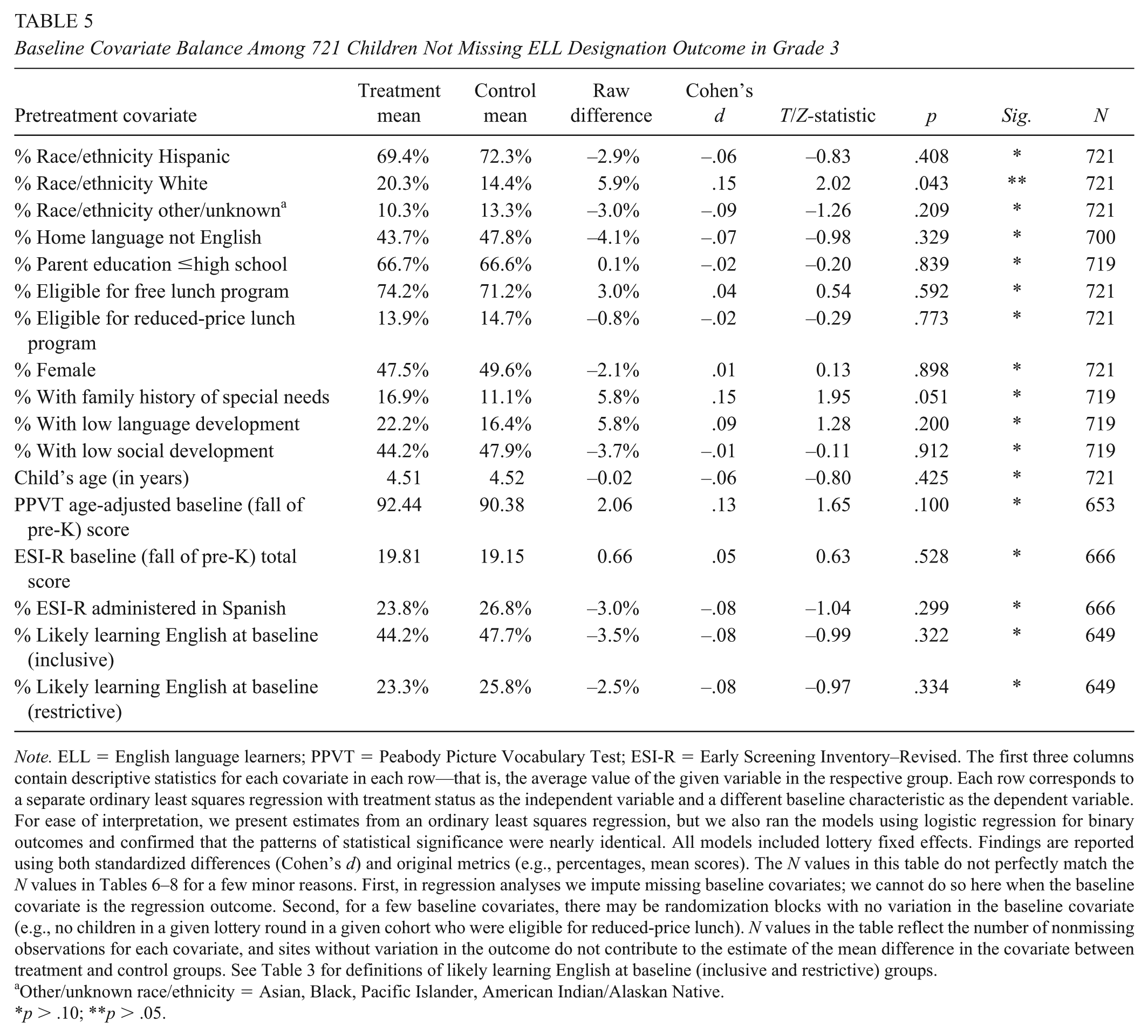
Note. ELL = English language learners; PPVT = Peabody Picture Vocabulary Test; ESI-R = Early Screening Inventory–Revised. The first three columns contain descriptive statistics for each covariate in each row—that is, the average value of the given variable in the respective group. Each row corresponds to a separate ordinary least squares regression with treatment status as the independent variable and a different baseline characteristic as the dependent variable. For ease of interpretation, we present estimates from an ordinary least squares regression, but we also ran the models using logistic regression for binary outcomes and confirmed that the patterns of statistical significance were nearly identical. All models included lottery fixed effects. Findings are reported using both standardized differences (Cohen’s d) and original metrics (e.g., percentages, mean scores). The N values in this table do not perfectly match the N values in Tables 6–8 for a few minor reasons. First, in regression analyses we impute missing baseline covariates; we cannot do so here when the baseline covariate is the regression outcome. Second, for a few baseline covariates, there may be randomization blocks with no variation in the baseline covariate (e.g., no children in a given lottery round in a given cohort who were eligible for reduced-price lunch). N values in the table reflect the number of nonmissing observations for each covariate, and sites without variation in the outcome do not contribute to the estimate of the mean difference in the covariate between treatment and control groups. See Table 3 for definitions of likely learning English at baseline (inclusive and restrictive) groups.
Other/unknown race/ethnicity = Asian, Black, Pacific Islander, American Indian/Alaskan Native.
p > .10; **p > .05.
In addition to assessing baseline balance for the full analytic sample, we also examined whether treatment and control groups were balanced within the two subgroups used to identify students likely still learning English at pre-K entry (the inclusive and restrictive configurations). These balance tests paralleled those conducted for the overall sample and relied on the same set of baseline covariates. Results, reported in Appendix A (Tables A.4 and A.5) in the online version of the journal, showed no systematic differences between treatment and control groups for either subgroup. As with the main analytic sample, any isolated imbalances fell within the range expected by chance given the number of tests conducted, providing further confidence that the subgroup analyses preserved the integrity of the original randomization.
Take-up of Pre-K Offers
Although families were randomly assigned to receive offers for full- or half-day pre-K in WPS, the decision to enroll and attend ultimately rested with them. This does not affect the validity of the ITT estimates reported in our main results. However, it is relevant context for interpreting the treatment-on-treated estimates presented in Appendix C in the online version of the journal. For readers interested in this aspect, we provide a brief discussion of take-up patterns, with additional detail available in Attaway et al. (2025).
A strong overall relationship existed between randomized offers of either full- or half-day pre-K and children’s ultimate attendance. Among the 399 families randomly offered a full-day class, the vast majority (89.5%, N = 357) attended full-day pre-K in WPS, whereas only 10.5% did not. Among the 396 families randomly offered a half-day class, 90.4% did not attend full-day pre-K in WPS. A small portion of study students ultimately crossed over from their treatment assignment to the other treatment condition: 2.5% of 399 families offered a full-day class switched to a half-day class in WPS (N = 10), and 9.6% of students who were offered a half-day class ultimately spent time in a full-day class (N = 38). This was made possible by district requirements to have 16 students per pre-K class and to fill any vacancies that arose throughout the school year. Anticipating this, the research team selected half-day RCT students to fill the seats in full-day classes using a randomized waitlist. 7
Analytic Approach
This study used an RCT with a blocked design, where families were randomly assigned within their first-choice school site, referred to as lotteries. This method ensured that families’ preferences were maintained while also minimizing potential disparities between treatment and control groups due to chance. We estimated the effect of being offered full- versus half-day pre-K (ITT) on students’ likelihood of having a subsequent ELL designation in kindergarten and grades 1, 2, and 3. Our primary results drew on a linear probability model (LPM) framework. Because the outcome is binary, we also present results using a probit specification in a nonlinear model framework in Appendix D in the online version of the journal. Although probit estimates are slightly smaller and less precise—likely reflecting reduced efficiency in small samples—the substantive patterns mirrored those from the LPM. Given the close alignment in findings and the straightforward interpretability of LPM coefficients, we present the LPM results in the main text and include probit estimates in the online appendix. The following model is used to estimate our main effects:
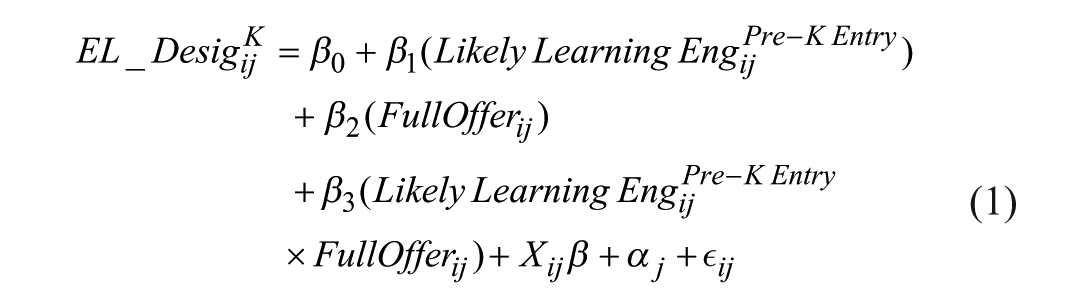
The outcome
Results
Effects Among Children Who Likely Entered Pre-K as ELLs
In Tables 6 and 7 we present our main results—the impact of full-day versus half-day pre-K offers on the likelihood of students having ELL designations in kindergarten and grades 1–3—focusing on the students who likely entered pre-K not yet fluent in English (the group for whom we would be most likely to observe policy effects). Table 6 presents results for the inclusive configuration of this likely learning English group, whereas Table 7 reflects the more restrictive configuration. In both tables, we present estimated coefficients in original units in the upper panel and estimated marginal probabilities in the lower panel. Marginal probabilities are further disaggregated to illustrate effects among the likely learning English group (either inclusive or restrictive) and their comparison peer groups (students who likely entered pre-K already fluent in English). Grade-specific outcomes are shown from left to right for Models 1 and 2 (without and with baseline controls, respectively).
Intent-to-Treat (LPM) Effects of Full- vs. Half-Day Pre-K Offers on EL Designations: Students Likely Learning English at Pre-K Entry (Inclusive)

Note. LPM = linear probability model; ELL = English language learner; ITT = intention to treat. Results presented for children identified as likely learning English at baseline (restrictive). See Table 3 for definition of this group. The indicator for membership in this group was interacted with the treatment assignment indicator for each student. In the upper panel, estimated coefficients are shown in original units (p values in parentheses). In the lower panel, estimates are converted to marginal probabilities. Results are shown for two models (M1 and M2), the first of which includes lottery fixed effects (cohort × lottery round × first-choice school) and a second of which adds a set of baseline child-level demographic control variables. The set of demographic controls included gender, race/ethnicity, free or reduced-price lunch, child age, parent level of education, family history of special education, and parent-reported indicators of children’s low language and low social development. We included a dummy to indicate missingness for the two children without general preschool applications, from which all baseline demographic data were drawn, imputed versions of baseline control variables with missing data, and dummies to indicate observations where the values were imputed.
p < .10; **p < .05; ***p < .01; ****p < .001.
Intent-to-Treat (LPM) Effects of Full- Versus Half-Day Pre-K Offers on EL Designations: Students Likely Learning English at Pre-K Entry (Restrictive)

Note. LPM = linear probability model; ELL = English language learner; ITT = intention to treat. Results presented for children identified as likely learning English at baseline (restrictive). See Table 3 for definition of this group. The indicator for membership in this group was interacted with the treatment assignment indicator for each student. In the upper panel, estimated coefficients are shown in original units (p values in parentheses). In the lower panel, estimates are converted to marginal probabilities. Results are shown for two models (M1 and M2), the first of which includes lottery fixed effects (cohort × lottery round × first-choice school) and a second of which adds a set of baseline child-level demographic control variables. The set of demographic controls included gender, race/ethnicity, free or reduced-price lunch, child age, parent level of education, family history of special education, and parent-reported indicators of children’s low language and low social development. We included a dummy to indicate missingness for the two children without general preschool applications, from which all baseline demographic data were drawn, imputed versions of baseline control variables with missing data, and dummies to indicate observations where the values were imputed.
p < .10; **p < .05; ***p < .01; ****p < .001.
Among students in our more inclusive likely learning English group (see Table 6), we found that offers of full-day pre-K reduced students’ likelihood of having subsequent ELL designations in kindergarten and grade 3 by roughly 8 percentage points (lower panel “Average difference in probability of ELL designation”). These statistically significant reductions were relative to a base probability of having an ELL designation among students given half-day offers of between 63% and 70%. Estimated reductions were comparable in magnitude for grades 1 and 2 but were not statistically significant. As anticipated, we found no statistically significant differences in likelihood of ELL designations for students likely entering pre-K already fluent in English. Results for this group are presented visually in the upper panel of Figure 1.

Reductions in likelihood of ELL designation by grade due to randomly offered full-day versus half-day pre-K among students likely learning English at baseline.
While results from our more inclusive configuration can be thought of as our lower-bound estimates, our more restrictive configuration of the likely learning English group presents a potential upper bound because the group’s members are those most likely to have entered pre-K not yet fluent in English. For this more restrictive definition (see Table 7), we found that the impact of offers of full-day pre-K were indeed larger in magnitude and more often statistically significant across all four grades than among our more inclusive likely learning English group. Full-day offers reduced students’ likelihood of having ELL designations in kindergarten and grades 1–3 among our more restrictive likely learning English group between 12.6 and 16.6 percentage points relative to an average base likelihood rate among those with half-day offers of roughly 80%. This finding is consistent in magnitude and statistical significance across all early elementary grades. Again, we found no statistically significant full-day effects among the comparison peer group of students likely entering pre-K already fluent in English. Results for our more restrictive group are shown visually in the lower panel of Figure 2. 8

Relationship between PPVT baseline scores and probability of having an ELL designation in an early elementary grade.
Overall Effects
Thus far we have focused on effects for children entering pre-K likely learning English because they were the only group for whom full-day pre-K offers could plausibly change kindergarten and grades 1–3 ELL designation status. These results also may be most relevant for district leaders because they allow expectations to be tailored to local contexts where the share of children entering pre-K not yet fluent in English may differ. For comparison, we also show full-sample estimates, which blend likely English learners with students already fluent at entry—effects here are expected to be smaller and less precise. This is indeed what we found. Presented in Table 8, we found effects of marginal significance (p < .10) across all four grades and statistically significant effects (p < .05) in kindergarten and grade 3. The magnitude of these effects ranged from 6 to 7.6 percentage point differences between the marginal probabilities of students offered full- versus half-day seats—equal to or slightly less than the size of effects we estimated for the inclusive configuration of our likely learning English group but meaningfully smaller (6.5 to 9 percentage points less) than estimates for our more restrictive group. Our overall effects, therefore, offer confirmatory evidence of two hypotheses. First, there were effects of full-day pre-K offers on students’ likelihood of having ELL designations in kindergarten and grade 1–3, even when considering the full population of study students (which included many students who entered pre-K already fluent in English and who could not have been affected). And second, both our inclusive and restrictive configurations of the likely learning English group effectively captured students who likely entered pre-K as English learners and therefore are more reflective of the effects of the full-day pre-K policy on ELL designations than estimates drawing from the full student population.
Intent-to-Treat (LPM) Effects of Full- Versus Half-Day Pre-K Offers on ELL Designations: All Study Students

Note. LPM = linear probability model; ELL = English language learner; ITT = intention to treat. Results presented for full population of study students. In the upper panel, estimated coefficients are shown in original units (p values in parentheses). In the lower panel, estimates are converted to marginal probabilities. Results are shown for two models (M1 and M2), the first of which includes lottery fixed effects (cohort × lottery round × first-choice school) and the second of which adds a set of baseline child-level demographic control variables. The set of demographic controls included gender, race/ethnicity, free or reduced-price lunch, child age, parent level of education, family history of special education, and parent-reported indicators of children’s low language and low social development. We included a dummy to indicate missingness for the two children without general preschool applications, from which all baseline demographic data were drawn, imputed versions of baseline control variables with missing data, and dummies to indicate observations where the values were imputed.
p < .10; **p < .05; ***p < .001.
Robustness Check: Relationship Between Half-Day Versus Full-Day Pre-K Offers and Continuous PPVT Scores
Although the PPVT was not designed for the purpose of measuring students’ English language skills (e.g., in the way that the W-APT and the World-Class Instructional Design and Assessment are specifically designed to establish students’ baseline English skills and mark longitudinal progress), it is administered in English and does assess students’ receptive language abilities. Therefore, we would expect some relationship between students’ baseline PPVT scores (prior to pre-K entry) and their likelihood of having an ELL designation in each early elementary grade. Additionally, we are limited in our main analyses to binary categorizations of likely learning English, as described previously, but it certainly would be preferable to have a continuous version of this measure of English ability—and for the conclusions drawn from the continuous version to echo those from the previous findings. We used students’ baseline PPVT scores as this continuous measure—a proxy for English language ability at baseline—and Figure 2 formalizes the relationship between this measure and students’ likelihood of ELL designations in kindergarten and grades 1–3 visually. In the upper panel, we illustrate this relationship between ELL designation likelihood and PPVT scores for the overall population of study students, and in the bottom panel we limit the analysis to our restrictive configuration of likely English learners (i.e., the group of students we had the strongest reasons to believe entered pre-K not yet fluent in English). Whereas our regression results presented plausibly causal estimates of full-day versus half-day offers on ELL designation likelihood in early elementary school, Figure 2 offers a separate, descriptive, and nonparametric way of examining the same underlying relationship.
Several conclusions can be drawn from this presentation. First, there was a strong relationship between ELL designation likelihood and students’ baseline PPVT scores across both panels, as we would expect. At the lowest end of the PPVT score distribution (i.e., students with the weakest receptive English language skills), there was nearly 100% certainty that students were identified as ELLs, whereas at the upper end of the score distribution (i.e., students with the strongest receptive English language skills) the likelihood diminished to zero. Second, and more critically, the visual patterns in Figure 2 echo our regression-based findings shown in Table 7. We see significant differences in the relationship between baseline PPVT scores and kindergarten and grades 1–3 ELL designation likelihood for the full student population in the upper panel compared with the restrictive likely learning English group in the lower panel. Although full- versus half-day ELL designation likelihoods are neatly aligned across the distribution in the upper panel, suggesting minimal influence of full-day pre-K offers for the full student population, there are clear differences between the treatment and control groups within our restrictive likely learning English group. For this group, across all four grades, students offered half-day seats were observably more likely to be designated as ELLs throughout the PPVT score distribution, except where the likelihoods converged to 100 and 0% at the tails. This visual offers confirmatory evidence of a meaningful policy effect among students likely entering pre-K not yet fluent in English who were offered seats in full-day pre-K classes as well as provides a visual robustness check that our main regression results were not driven by choices of model specification.
Discussion
The findings from this study provide compelling evidence that full-day pre-K offers result in significant reductions in ELL designation likelihood throughout early elementary school. Results indicate that among children who arrive to pre-K not yet fluent in English, those receiving randomized full-day pre-K offers were less likely to have an ELL designation in kindergarten through grade 3 compared with their peers receiving half-day offers. This effect was particularly strong among the most restrictively defined likely learning English group, where we observed a 15–20% decrease (8–16 percentage points) in ELL designation reductions across kindergarten and grades 1–3. These findings hold important implications for policymakers and educators working to advance students’ English language acquisition and longer-term academic success while balancing the associated costs of student support.
Our findings from this context align with existing research on the cognitive and linguistic benefits for students of pre-K participation (e.g., Barnett, 2011; Pianta et al., 2009) as well as studies highlighting the importance of instructional time in early childhood education (e.g., Duncan & Magnuson, 2013). The observed reductions in ELL designations through early elementary school are consistent with prior literature demonstrating that early and intensive language exposure can accelerate language development (Atteberry et al., 2019; Wong et al., 2008). Additionally, our findings support research suggesting that structured early interventions, such as full-day pre-K, may help narrow academic gaps for students learning English—particularly Spanish-speaking students, who comprise a large proportion of the ELL population both in WPS and nationwide (De la Torre et al., 2021; Gormley, 2008). The consistency of effects across kindergarten and grades 1–3 suggests that the benefits of full-day pre-K are not transient but persist, at a minimum, throughout the critical early elementary years. Furthermore, the lack of significant differences in ELL designation rates among students likely entering pre-K already fluent in English underscores that the observed effects are specific to students who were likely English learners at pre-K entry.
While these results highlight the potential of full-day pre-K offers as an early intervention strategy to support English language development, there are also downstream cost implications for schools and districts. Colorado spends an average of 1.08 times its base per-pupil rate to educate English learners (EdBuild, 2025), and in 2016 (the year of the study’s onset), the average per-pupil expenditure was $9,575. This means that the average Colorado public schools spent an estimated $10,341—or an additional $766 per student per year—to educate each identified ELL. In Table 9 we run some back-of-the-envelope calculations on WPS potential cost savings using these estimates and our findings on ELL designation reductions across grades. For each kindergarten and grades 1–3 and all four elementary grades overall, we use the difference in probabilities of having an ELL designation between half- and full-day offered students to calculate the number of students who may have avoided an ELL designation (including upper- and lower-bound confidence intervals) in each grade. Using these figures, we then estimate the total savings to the district as a result of the number of estimated ELL designation reductions and find that WPS likely saved around $57,000 (confidence interval range $15,300–$131,000) in costs required to support English learners. These estimates notably focus on just one potential area of cost savings resulting from an expansion of full-day pre-K, and a broader cost-benefit analysis of the WPS pre-K expansion by the research team is underway. However, these figures highlight that even with more conservative cost estimates, offers of full-day pre-K—through the associated reductions in ELL designations—can translate into significant and immediate cost savings for districts.
Estimates of District Cost Savings as a Result of Reductions in ELL Designations by Grade

Note. ELL = English language learner. This table presents estimates of upper- and lower-bound cost savings to Westminster Public Schools as a result of the reductions in ELL designations observed across grades from full-day pre-K program offers. Probability estimates are drawn from linear probability models in a noninteraction framework that included lottery fixed effects and a set of baseline child-level demographic control variables. The set of demographic controls included gender, race/ethnicity, free or reduced-price lunch, child age, parent level of education, family history of special education, and parent-reported indicators of children’s low language and low social development. Results are limited to the population of students identified as likely learning English at baseline (restrictive). See Table 3 for definition of this group. Westminster Public Schools per-pupil expenditure data from EdBuild (2025).
The findings from this study also have practitioner implications, reinforcing the importance of maximizing instructional time in early childhood education settings. A full-day schedule may provide more opportunities for structured language development, social interactions in English, and early literacy instruction—all of which are foundational components of ELL students’ academic experiences. More research is needed to understand the specific in-class mechanisms in the WPS context that led to the observed reductions in ELL designations—for example, investigations into the frequency, type, and quality of teacher–student and peer–student interactions, instructional practices, and time-use differences between full- and half-day classes specific to language instruction. Qualitative research of this nature would offer deeper insights into how additional pre-K hours contribute to early language development and also would improve the potential for replicability and generalizability to contexts beyond WPS.
Despite the strength of these findings, this study has several limitations. First, generalizability requires special attention. This study examined a specific population of students in a particular full- versus half-day pre-K treatment contrast, and results may not fully extend to other geographic regions, demographic compositions, or policy environments. Future research should continue, where possible, to replicate this type of causal analysis in states or districts with varying pre-K program structures to probe the consistency of these effects. Second, while this study captured meaningful reductions in ELL designations, it did not directly measure students’ degree of English proficiency skill. Future studies could work to incorporate longitudinal assessments of English language proficiency, such as WIDA or ACCESS scores, to provide a more comprehensive picture of how full-day pre-K impacts language acquisition beyond administrative designations because we know that the path between being a designated ELL and a former ELL is more nuanced than the binary indicator used in this study allows. Finally, future work should continue to explore how other early interventions interact with full-day pre-K to optimize both academic and nonacademic outcomes for ELLs.
In sum, this study provides strong empirical support for the expansion of full-day pre-K as a strategy for reducing ELL designations among early learners and the associated costs of ELL student support. Findings suggest that offers of full-day pre-K can meaningfully reduce ELL designations in the early elementary years, setting students on a trajectory for long-term academic success. As policymakers and educators consider strategies to support ELLs and manage budgets within financial constraints, full-day pre-K should be recognized as a key policy lever in the broader effort to provide stronger educational foundations for all.
Supplemental Material
sj-docx-1-ero-10.1177_23328584261422254 – Supplemental material for Effect of Full- Versus Half-Day Pre-K on Grade K–3 English Language Learner Designations
Supplemental material, sj-docx-1-ero-10.1177_23328584261422254 for Effect of Full- Versus Half-Day Pre-K on Grade K–3 English Language Learner Designations by Katharine Parham Malhotra and Allison Atteberry in AERA Open
Footnotes
Author Note
The opinions expressed are those of the authors and do not represent the views of the funders. Any errors are attributable to the authors.
Funding
Support for this work was provided by Arnold Ventures, the Smith Richardson Foundation, and the U.S. Department of Education Institute of Education Sciences through Award R305A220281.

Notes
Authors
KATHARINE PARHAM MALHOTRA is a postdoctoral research associate at the University of Virginia. Her research examines issues of educational equity in Pre-K–12 education policies and programs, with a particular emphasis on research–practice partnerships.
ALLISON ATTEBERRY is an associate professor of education policy at the University of Virginia. Her research examines educator labor markets, early childhood interventions, and the effects of district- and state-level policies on student outcomes. She specializes in quantitative and econometric methods and frequently partners with public agencies.
References
Supplementary Material
Please find the following supplemental material available below.
For Open Access articles published under a Creative Commons License, all supplemental material carries the same license as the article it is associated with.
For non-Open Access articles published, all supplemental material carries a non-exclusive license, and permission requests for re-use of supplemental material or any part of supplemental material shall be sent directly to the copyright owner as specified in the copyright notice associated with the article.
