




Abstract
We examined how African and Asian immigrants (re)present the interplay of identities and experiences across digital narratives composed and shared on TikTok. We found content creators’ digital narratives to be illustrative of their transbordered algorithmic identities. We drew on and extended BlackCrit and AsianCrit and African and Asian onto-axio-epistemologies Ubuntu and 정 (Jeong) to contextualize and define transbordered algorithmic identities as leveraging social media to build community with those who share experiences across identities and geographies; complicating static notions of home, place, rootedness, and memories of being, with, and among; and navigating discursive and geographic borders while negotiating presentations of individuals shaped by online interactions and encounters with digital algorithms that curate content, suggest connections, and analyze online practices. We conclude with implications for research and teaching.
Keywords
An adult son, posting to TikTok, used voiceover to narrate a video he titled, “An Immigrant Story: My Pops and I.” The son filmed his father today, hair peppered with gray, sitting on a couch, flipping through times past. The father recalled through close-ups in a photo album still images of himself, younger then, newly arrived to the United States, standing casually on a sidewalk across the street from the Out of Town News kiosk, opened in Harvard Square in 1955, closed in 2019 as newspaper and magazine readers increasingly preferred digital media, and redeveloped in 2023 as the Cambridge Visitor Information Center (Harvard Square, 2024). The father, darker hair then, smiled in photographs in front of the Statue of Liberty and the Golden Gate Bridge. The father, today, recalled to his son from the couch that he came to the United States by himself—“I don’t speak English at all. No friend, no relative. Because I want to give my kids a good education.” Finally, the father shared, as his son recorded, the reuniting with his family following their arrival to the United States 4 years after he did, moments of tension and joy in those times before FaceTime and Zoom narrowed physical distance. The father shared: “When I go to the airport to pick you up, you just look at me like, ‘Don’t know me. Who’s this?’” The son responded, “My dad made the ultimate sacrifice. . . . [W]hile our relationship isn’t perfect, the threads that bind us are stronger than the ones that tear us.”
Extending our ongoing work attending to the lived experiences of immigrant youth and young adults across communicative practices, technologies, and settings, we examined 100 such posts on TikTok, 50 by Black African immigrant and 50 by Asian immigrant content creators. Specifically, we asked: “How do Black African immigrant and Asian immigrant community members (re)present the interplay of their identities and experiences across their digital narratives?” We found content creators’ digital narratives to be illustrative of their transbordered algorithmic identities. We define transbordered algorithmic identities as involving two approaches: (a) leveraging social media to build community with those who share experiences across identities and geographies, complicating static notions of home, place, rootedness, and memories of being, with, and among, and (b) navigating discursive and geographic borders while negotiating presentations of how individuals shape and are shaped by online interactions and encounters with digital algorithms that curate content and suggest connections (Table 1). We understand transbordered algorithmic identities as critical in the necessary, ongoing work of (re)framing deficit pedagogies of immigrant youth and communities toward narratives of possibility (Lee et al., 2017; Ojiambo & Ukpokodu, 2017).
Defining transbordered algorithmic identities: Two approaches

We situate our inquiry amid urgent contexts of migration underscoring the growing representation of Black African immigrant and Asian immigrant communities in U.S. educational settings and society (Lorenzi & Batalova, 2022). Black African immigrant communities have constituted the “fastest growth in the U.S. Black immigrant population” (Tamir, 2022, para. 6), whereas it is anticipated that by midcentury, Asian Americans will comprise the largest immigrant community in the United States (Pew Research Center, 2021). In our inquiry, Asian immigrant and Black African immigrants are TikTok users self-identifying as individuals of Asian or African origin or descent living outside their ancestral home countries. We emphasize that each community negotiates varied, robust, heterogeneous intersectional identities and experiences across contexts including race, ethnicity, geography, language, and religion.
Transbordered algorithmic identities refer to the ways individuals, particularly immigrant communities, craft and enact identities through social media interactions traversing cultures, languages, and geographies. Understanding transbordered algorithmic identities is crucial in rendering visible how immigrant youth use social media to name experiences, forge connections across physical and political nation-state boundaries, negotiate linguistic borders and language and cultural communicative practices, and redefine concepts of home and belonging. While transnational refers to connections and interactions spanning nation-state boundaries, transbordered emphasizes active processes of negotiating identities and building community across and beyond cultural, linguistic, geographic, and social borders. A focus on transbordered algorithmic identities further centers and humanizes immigrant youth’s lived realities and educational narratives, urgent and intensified amid somber upsurges of rhetoric and policies—anti-Asian hate confronting Asian immigrant communities (Gover et al., 2020; T. Kim et al., 2024) and contours of anti-Blackness and at-once hypervisibility and invisibility with which Black African immigrants grapple (Agyepong, 2017; Walls, 2021; Watson & Knight-Manuel, 2020). Moreover, the profound societal resonance of the Black Lives Matter movement (Harlow & Benbrook, 2019; Kinloch et al., 2020), presidential executive orders, and nuanced enactments of solidarity that followed among Black African immigrant youth, U.S.-born Black youth, and Asian communities (Chang, 2020; Green & Montague, 2025; Jung et al., 2025a) has further amplified the necessity of attending meaningfully to digital narratives comprising immigrant youth’s transbordered algorithmic identities.
Contextualizing TikTok
More than a billion users globally, 150 million in the United States, post or view content on TikTok according to the app’s developer, ByteDance, headquartered in Beijing, China (Jackson, 2023; see also Baker-White, 2022). Yet government officials in more than 25 U.S. states and the U.S. federal government have prohibited use of the app on government-issued devices (Fung & Hickey, 2023), citing concerns “that China will use TikTok to promote its interests and gather Americans’ personal information” (Jackson, 2023, para. 5). In April 2024, then U.S. President Biden signed into law a bill passed by Congress with Democratic and Republican legislators’ support that required ByteDance to sell the short-form media app within 270 days or face a ban prohibiting its use in the United States (Maheshwari, 2023; Maheshwari & McCabe, 2024). Presidential executive orders in 2025 delayed enforcement of the ban (McCabe & Hirsch, 2025).
Federal and state policymakers imposed such restrictions at time when more than 83% of adults in the United States surveyed by the Pew Research Center about their social media use reported using YouTube, 68% Facebook, 47% Instagram, and 33% TikTok (Gottfried, 2024). TikTok remains striking among social media platforms for its rapidly growing user base—one third of those surveyed described using TikTok, up from 21% in 2021 (Gottfried, 2024). Moreover, among adolescents aged 13 to 17 years, 63% in a separate Pew study reported using TikTok, 60% Snapchat, and 59% Instagram (Anderson et al., 2023), with Instagram and Facebook launching the “Reels” feature and YouTube releasing “Shorts,” each platform following TikTok’s video-feed model that enables content creators to compose and share short videos featuring voiceovers, music, and text overlays. In turn, users navigating TikTok scroll through an algorithmically curated video feed, commenting, posting, and sharing personal experiences, connections, and responses.
Content creators and users further navigate features that leverage TikTok’s short-form storytelling, hashtags, collaborative tools, and emphasis on going viral. For example, in our analysis of 100 posts by African immigrant or Asian immigrant community members, content creators employed hashtags including “#africanimmigrant” and “#asianimmigrant” to assist users in finding and engaging with stories that appear in a user’s “#ForYou” video feed. TikTok’s algorithm recommendation system prompts users across geographic and cultural borders to view and share increasingly personalized content (Bhandari & Bimo, 2022)—in our analysis, narratives and (re)presentations of immigrant young adult’s experiences. TikTok’s “Live” and “#stitch” features further enable users to interact with such narratives by viewing live-streamed videos or composing split-screen replies—users co-voicing their own diverse digital narratives.
Situating Transbordered Algorithmic Identities in Contemporary Algorithmic Technologies
We recognize that algorithms do not merely inscribe identities on users but also interact dynamically with how individuals express and navigate their identities in digital spaces. Our theorizing of transbordered algorithmic identities intentionally incorporates such complexities. In theorizing transbordered algorithmic identities, we built on studies in digital media, cultural studies, and educational research examining the interplay of algorithmic categorizing and socially situated meanings of identity.
Cheney-Lippold (2011), for example, discussed a notion of “algorithmic identity” to contextualize how “computer algorithms have the capacity to infer categories of identity upon users based largely on their web-surfing habits” (p. 164). Such categorizing undergirds “the nuanced ways that algorithmic inference works as a mode of control, of processes of identification that structure and regulate our lives online within the context of online marketing and algorithmic categorization” (p. 164). Moreover, algorithmic technologies leverage “the iterative logging of each available datafied move” (Cheney-Loppold, 2017, p. 108) in the work of interpreting individual’s “narratives or lived experience” as sites of identity construction (Kotliar, 2020, p. 1152).
Kotliar (2020) further argued that “algorithmic identities stem from epistemic amalgams—complex blends of algorithmic outputs and human expertise, messy data flows, and diverse inter-personal factors” (p. 1152). Such algorithmic categorization includes the “value systems behind the creation of algorithmic identity categories” (p. 1156). This author additionally noted that “people’s values and needs, and their specific social position, affect the ways people are algorithmically described” (p. 1163). Illustrative of such work, Jacobsen (2022) examined Apple’s iPhone “Memories” app “to highlight the narratives algorithms tell, how they are constructed, and the potential impacts they may have on everyday life” (p. 1082). The author theorized meanings of “algorithmic emplotment” to describe how “people’s lives are rendered sequential, ordered, and ultimately meaningful and actionable by algorithmic processes“ (p. 1082). In their study of U.S.-based TikTok users, Karizat et al. (2021) developed the construct of “algorithmic privilege” to describe experiences of “users positioned to benefit from algorithms on the basis of their identities” (p. 1). The authors reported that users “changed their behaviors to shape their algorithmic identities to align with how they understood themselves, as well as to resist the suppression of marginalized social identities and lack of algorithmic privilege via individual actions, collective actions, and altering their performances” (p. 1; see also Maheshwari, 2023). Conceptualizing transbordered algorithmic identities extends the interplay of algorithmic categorizations and socially situated identities to meaningfully engage and acknowledge how individuals agentively leverage algorithms while their engagements shape and are shaped by algorithmic architectures of platforms such as TikTok.
We importantly note that continuing developments in algorithmic mechanisms, particularly in search engines and social media platforms, have introduced significant challenges (e.g., Bishop, 2018; Ulver, 2022). Algorithms have been observed to contribute to the polarization of information access, potentially hindering new interactions and limiting the sharing of diverse experiences (Noble, 2018; Smith et al., 2024). Authors have raised urgent questions underscoring “unique challenges faced by Black, Latino/a, LGBTQIA+ and other historically marginalized groups within the rapidly changing technoscape” (Smith et al., 2024, p. 3). Keyes et al. (2021), for example, found, that artificial intelligence (AI) “deployed in scientific research about identity and personality . . . can naturalise and reinforce biases”—moreover, “when AI is seen as a source of truth and scientific knowledge, it may lend public legitimacy to harmful ideas about identity” (p. 158). Stewart and Uanhoro (2023) encouraged nuanced understandings of the “quantitative debt owed to Africa” in Congolese families and communities’ contributions to advances in technologies such as statistical software and computers, particularly given Congolese labor, mineral wealth, and land facilitating contemporary advances in computing (p. 121). Tanksley (2024) examined experiences of Black students in a “critical race technology course” to consider how youth navigate “algorithmic anti-blackness and techno-racial domination within and beyond the school setting” (p. 38). Such work involved teaching that prompted youth “to resist, rewrite and reimagine algorithmic systems in race-conscious and justice-oriented ways; literacies that are rooted in a rich history of revolution, resistance and Black radical thought; and that invoke historical, intersectional and interdisciplinary knowledge toward collective liberation” (p. 38). Our theorizing of transbordered algorithmic identities extends meanings of how digital spaces enhance visibility of such digital narratives as productive tools for social change while encouraging broader, cross-cultural dialogues extending beyond TikTok to the range of social media platforms, popular media, and educative spaces. For many content creators and users, popularized narratives have historically marginalized, sidelined, and silenced such stories and storying, particularly narratives authored by immigrant youth and young adults (O’Byrne, 2019; Watson et al., 2022).
Situating Transbordered Algorithmic Identities in Research Literature
Empirical and conceptual research engaging transnational Asian immigrant and Black African immigrant communities in the United States has undergone significant transformation toward rendering visible immigrant youth and young adults robust lived realities and culturally situated ways of being (ontologies), the prioritizing of value systems such as the communal and relational (axiologies), and varied ways of knowing (epistemologies) (e.g., Chilisa, 2019; Dei, 2017; Pérez & Saavedra, 2017; Watson & Knight-Manuel, 2020; Wee et al., 2023). This shift toward nuanced explorations and expansions of onto-axio-epistemologies of transnational immigrant communities, such as Ubuntu and 정(Jeong), is propelled by the necessity to counter White, Eurocentric, monolingual, print-centric models of schooling that do not fully illuminate multifaceted educational trajectories, complex contexts (e.g., social, discursive, geographic, and embodied), and intersectional identities (e.g., racial, cultural, ethnic, gendered, class, and linguistic) of Asian and Black African immigrant youth (e.g., Awokoya, 2012; Braden et al., 2022; de los Ríos et al., 2019; Jung et al., 2025b; Yuan, 2022).
Contextualizing Transbordered Algorithmic Identities as Digital Diasporic Tellings
We thus understand transbordered algorithmic identities as the necessary work of “diasporic tellings”—an affirming and extending in digital contexts of immigrant youth and communities that urges a “global ‘balance of stories’” (Achebe, in Fetters, 2013, para. 8; see also Watson et al., 2025). Such stance taking underscores how immigrant youth and communities have long authored tellings centered in and extending their varied onto-axio epistemologies. Diasporic tellings, for example, unfold immigrant youth’s intersectional identities as complex tapestries as individuals and communities navigate allegiances and balances within and across ancestral homelands and places of settlement. Scholars thus have emphasized how African and Asian immigrant youth and young adults negotiate, tell, and (re)author racial, gendered, cultural, ethnic, linguistic, and social identities across educational and societal contexts (e.g., Hailu & Simmons, 2022; Kim, 2016; Lee et al., 2021; Watson & Knight-Manuel, 2017) and confront racism and xenophobia across an array of professional and social spheres (e.g., Dávila, 2019; Liu et al., 2023; Smith, 2020). Player (2022), for example, confronted the monolithic portrayal of Asian American girlhood, contesting sexist and racial stereotypes, whereas Allen et al. (2012) called for acknowledging multifaceted transnational identities of West African immigrants expressed through language and culture.
Situating Transbordered Algorithmic Identities as Extending Complex Identities
Transbordered algorithmic identities extend how individuals enact transnational identities, cultivate connections across borders, and meld cultural and linguistic heritage practices with new societal frameworks shaping and shaped by digital connectivity and global networks and resulting in inherently hybrid and dynamic identities (Jung, 2022; Kim, 2016; Lam, 2014; Okpalaoka & Dillard, 2012; Skerrett & Omogun, 2020). Yet, the complexity of maintaining these ties can be daunting. Dominguez and Lubitow (2008), for example, in ethnographic work in real-world physical contexts, explored how for Latin American immigrant women navigating relational identities, preserving cultural identities, and mitigating social isolation caused financial and social strain. Jaffe-Walter and Lee (2018) advocated for recognizing these transnational connections as educational assets, integral to culturally sustaining pedagogies. Authors have additionally considered how Asian and African immigrant youth navigate complex transbordered identities to underscore and extend the range of youth’s home, educative, and civic experiences across the United States and home countries (e.g., Braden et al., 2022; Kiramba & Oloo, 2020; Quinn & Nguyen, 2017; Yuen, 2022).
Transbordered Algorithmic Identities and the Urgency of Digital Connectivity Globally
In digital contexts, authors have increasingly examined contours of transnationalism within and across immigrant communities (e.g., Capstick, 2020; NurMuhammad et al., 2016; Nuñez, 2023). Digital connectivity has propelled how immigrant communities enact diasporic tellings, enabling (or inhibiting) digital narratives that transcend physical and temporal barriers and foster online communities (Dixon-Román, 2016; Jung, 2018; Kim, 2016; Lizárraga et al., 2015). Transnational individuals and communities form connections globally within and across such platforms as Facebook Groups, leveraging social media to challenge negative perceptions of their respective communities and to raise awareness about their racial and cultural heritages and traditions (Hatef, 2022; Kok & Rogers, 2017; Valandra et al., 2024). Mpofu et al. (2022), for instance, examined how Zimbabwean diaspora communities navigating Facebook Groups pages constructed transnational communities online, connecting and expanding meanings of home. NurMuhammad et al. (2016) studied how members of the Uyghur diasporic community engaged Facebook Groups as a transnational social space, negotiating ethnic and political identities. Yet, less considered is how algorithms play a significant role in shaping both the visibility of diasporic tellings and the hybrid identities that emerge through such narratives; in curating content and suggesting connections, algorithms influence how individuals navigate cultural borders and the ways they name their experiences online. We thus situate our theorizing of transbordered algorithmic identities as a generative extension of scholarship on how culturally situated onto-axio-epistemologies underscore digital diasporic tellings in social science and education research.
Expanding the Contours of Digital Diasporic Tellings
We engage this work because research literature has rendered less visible the contours of diasporic tellings and transnational ties underscoring lived experiences of immigrant communities (e.g., Akinbola, 2022; Jaramillo-Dent et al., 2022; Kaur-Gill, 2023; Pathak-Shelat & Bhatia, 2020). Additionally, less research contextualizes what it may mean to learn with and across personal narratives and lived educational experiences of African and Asian immigrant youth and the interplay of youth’s dynamic identities and embodied digital experiences (e.g., Blanks Jones, 2018; Garcia et al., 2020; Omogun & Skerrett, 2021; Zong & Batalova, 2017). Despite the proliferation of digital immigrant narratives in social media, a notable research gap exists in examining how African and Asian immigrant communities (re)present their transbordered algorithmic identities and experiences within and across social media platforms. Thus, a critical need exists for research that explores digital narratives of Asian and African immigrant youth and communities within such broader public spheres, enhancing understandings of how transnational immigrant youth leverage social media to build community and navigate discursive and geographic borders while negotiating online interactions and encounters with digital algorithms.
Theoretically Framing Transbordered Algorithmic Identities
In theoretically framing transbordered algorithmic identities, we drew on BlackCrit and AsianCrit and African and Asian Indigenous onto-axio-epistemologies Ubuntu and 정 (Jeong) undergirding the lived educational experiences and perspectives of immigrant youth and communities (Figure 1).

Theoretically framing transbordered algorithmic identities.
Contextualizing BlackCrit and AsianCrit at the Interplay of Navigating Racialization and Counterstorying
BlackCrit and AsianCrit, rooted in critical race theory (Dumas & ross, 2016; Iftikar & Museus, 2018), prompt critical analysis of racial injustices where they intersect with legal, educational, and societal structures, challenging dominant discourses and elevating perspectives of communities marginalized by the “white, colonial gaze” (Paris, 2019, p. 217). For example, Dumas and ross (2016) built on the critical race theory assertion that racism is an omnipresent, enduring fixture in U.S. society; in asserting BlackCrit, the authors contended that anti-Blackness is a pervasive and integral element in understanding societal, economic, historical, and cultural dimensions of life. Watson et al. (2022), for instance, employed BlackCrit to examine how cultural and linguistic strengths of African immigrant communities were portrayed (or not) across the popularized narrative of newspaper articles.
AsianCrit seeks to understand specific experiences of Asian American communities (Kim et al., 2021; Museus & Iftikar, 2014), particularly across contexts of race, immigration, and cultural identity. AsianCrit recognizes the racialization of Asian Americans as a consequence of White supremacy (e.g., Kim et al., 2021; Kim et al., 2024) and analyzes such stereotypes as the perpetual foreigner, yellow peril, and the model minority, all of which dehumanize and marginalize Asian Americans (e.g., Au, 2022; Williams et al., 2023). Of note, drawing again from BlackCrit’s and AsianCrit’s rootedness in critical race theory, the framings compel critical analysis through narrative and counterstorytelling (Martinez, 2020; Solórzano & Yosso, 2002)—pertinent to Black African and Asian immigrant communities composing and sharing digital narratives via social media as digital diasporic tellings.
Extending BlackCrit and AsianCrit to Contextualize Ubuntu and 정 (Jeong)
Importantly, diverse African and Asian immigrant content creators, navigating racialization and storying as they compose and share digital narratives across social media, surface nuanced African and Asian Indigenous onto-axio-epistemologies—cultural perspectives and experiences unique to individual’s cultural backgrounds. In critically talking back to enduring colonial legacies on contemporary power structures, we situate our theoretical framing of transbordered algorithmic identities in the construction of diasporic storying and knowledge (e.g., Chilisa, 2019; Daza & Tuck, 2014; Dei, 2012). Consequently, we expanded frames of BlackCrit to consider African analytic perspectives such as Ubuntu, and we extended framings of AsianCrit to consider the nunanced cultural concept 정 (Jeong, 情), which within the South Korean context is distinct from but may share similarities with such East Asian concepts. The extensions enhance our understandings of how diverse immigrant communities navigate racialization and engage in digital storytelling across social media platforms by offering unique cultural perspectives.
As Mugumbate and Nyanguru (2013) wrote, “Ubuntu derives from Nguni and Bantu languages of Africa. In Zulu language of South Africa the word symbolises being human” (p. 85). Ubuntu underscores “a social and humanistic ethic. . . . Ubuntu relates to bonding with others. This is in line with what the word expresses in most African languages: being self because of others” (p. 84). This concept of interconnectedness (Dillard & Neal, 2020; Ukpokodu, 2016) is particularly relevant to digital storytelling, emphasizing the collective nature of narrative creation and sharing within African immigrant communities. As Nyoni (2020) discussed in affirming African knowledges such as Ubuntu in higher education in South Africa, “Indigenous philosophies are founded on acknowledging lived experiences, respect for diversity and challenging the hegemony of Western eurocentric forms of universal knowledge” (p. 110). This perspective further aligns with possibilities of digital counterstorytelling toward challenging dominant narratives through sharing diverse lived experiences online. Indeed, such heritage meanings are evolving; as Nyoni noted, Ubuntu is “not frozen in time but dynamic and continually adapting” (p. 113). This adaptability makes Ubuntu particularly relevant to understanding how African heritage communities use and navigate evolving social media technologies to tell their stories. Molefe and Ngcongo (2021), for example, analyzed the critique of public figures in South Africa in the context of the Black Twitter community, extending critical humanist perspectives of Ubuntu that engaged “issues of power in a critical and emancipatory manner” (p. 46). Such applications of Ubuntu to social media contexts demonstrate how traditional African philosophies can inform and enhance digital counterstorytelling practices.
Among South Koreans, 정 (Jeong) broadly encompasses human experiences, emotions, human nature, heart–mind connectedness, and a complex web of social and ethical relationships, deeply rooted in Confucianism (Chung & Oh, 2022; Yoon, 2016). Park (2023) described Jeong as “a central concept in understanding the Korean mind” (p. 1), integral to the Korean language and everyday life. Jeong offers a unique lens through which to understand relational aspects of digital storytelling of Asian immigrant communities. The concept emphasizes the importance of emotional bonds and collective identity in narrative creation, which can manifest in how Asian content creators craft and share stories online. Translating Jeong into English is challenging because Jeong involves culturally specific emotions and ethical considerations toward people, relationships, objects, or places depending on context. Jeong generally includes feelings of affection, attachment, love, care, compassion, empathy, and attention. This concept is linked to the Chinese character 情, traditionally meaning “emotion or feeling” (Yoon, 2016). Over time, Jeong has developed into a more sophisticated and nuanced norm within South Korean culture (Chung & Oh, 2022; Park, 2023). Yoon (2016) also noted that Jeong resonates with similar concepts in East Asian cultures “such as amae in Japan and guanxi in China” (p. 6). Additionally, building with Reid (2016), we note “one feature . . . common to all Formosan languages and to nearly all MP [Malayo-Polonesian] languages is the presence of a pronominal distinction between what has been labeled 1st person inclusive plural pronoun (‘1in.pl’ = ‘we all’) and a 1st person exclusive pronoun (‘1ex.pl’ = ‘we, but not you’)” (p. 134). These emotional dimensions of Jeong can inform our understanding of how Asian immigrant communities use digital platforms to foster connections and build community through shared narratives. Theoretically framing transbordered algorithmic identities thus specifically builds with collective notions of we, such as 정 (Jeong), to underscore the centricity of interpersonal relationships, underscoring how such individual identities as “I” and “you” convey such meanings as a collective “우리 (we)” through the preservation of care and emotional bonds (Yoon, 2016, p. 4).
Together Ubuntu and Jeong offer valuable perspectives on collective identity and storytelling as cultural frameworks that enrich understandings of transbordered algorithmic identities and how African and Asian immigrant communities engage in digital storytelling and counterstorytelling practices. However, it is important to note that these concepts also may face challenges in digital spaces. Yoon (2016) cautioned that the essence of Jeong, with its communal and affective connections, often conflicts with individualistic tendencies of modern communication technologies such as social media, which prioritize personal self-presentation and may not align well with more collective notions of we. Similarly, the communal ethos of Ubuntu may be tested in the often fragmented and individualistic nature of social media platforms. Furthermore, we remain aware of how, as digital technologies, algorithms shape and are shaped by the creation and circulation of immigrant narratives, including the impact of racial technocapitalism on how such stories are amplified and suppressed and how platforms can influence users’ navigation and resistance through storytelling and identity formation.
Across these perspectives, our theoretical framework prompts new meanings of how African and Asian immigrant content creators (re)present the interplay of their identities and heterogenous lived experiences while also provoking envisionings of what may be possible through the creative expression of digital narratives comprising transbordered algorithmic identities.
Methodologic Context
To examine how African and Asian immigrant youth and young adults (re)present the interplay of their identities and experiences across digital narratives, we conducted an in-depth analysis of 100 TikTok videos, 50 composed and posted by Asian immigrant content creators tagged with “#asianimmigrant” and 50 by African immigrant content creators tagged “#africanimmigrant.” The university institutional review board determined that this study of publicly available videos did not involve human subjects as defined by the U.S. Department of Health and Human Services Common Rule regulations. Consistent with guidelines from the Association of Internet Researchers’ Ethics Working Committee (https://aoir.org/ethics/), we removed personal information from the collected TikTok social media data and only analyzed publicly available videos retrieved through hashtag searches. Moreover, as discussed by Costa et al. (2021), we remained “mindful of the context in which the social media data was [sic] shared” (p. 24; see also Stewart & Quan-Haase, 2017).
Contextualizing the Research Team
The five-person multicultural, multidisciplinary research team held a sustained interest in research and teaching that affirmed and extended the lived experiences of immigrant youth and communities and emphasized their “already present” learning practices and civic engagement (e.g., Watson, 2018). Vaughn, a Black male of African descent, taught English at a public high school in New York City and currently is a researcher and teacher-educator examined the creative, artistic, and participatory literacy and learning practices of Black African immigrant youth. Jin, a female professor of South Korean descent, is a university faculty member with expertise in language and literacy, digital literacies, experiences of multilingual adolescents and adults, and issues pertaining to Asian communities. Joel, a White male of Dutch descent, previously coordinated curriculum and taught English Language arts and social studies in Indonesia and the United States; his research experience includes participatory research with African immigrant youth and communities. Sandra, a female doctoral student, is a first-generation immigrant from Ghana focusing her research on African immigrant families, employing African frameworks and methodologies in her work. Lindsey identifies as a first-generation White college student raised in a working-class rural American community. Her experiences as an educator have involved transnational movements and work alongside East African immigrant young people and their families. We understand our varied backgrounds and experiences as crucial in learning from and with one another and understanding the culturally specific aspects of social media content creators from Asian and African backgrounds.
Data Collection
We employed a focused keyword-search strategy (Creswell & Poth, 2016) to identify videos posted to TikTok and tagged with the hashtags “#africanimmigrant” and “#asianimmigrant,” following similar social media content-analysis studies (Basch et al., 2021, 2022). We purposefully chose TikTok because of its growing popularity among young people and its algorithm-driven content. Content creators commonly use hashtags to self-identify and share experiences related to their backgrounds. Specifically, we analyzed the first 50 videos listed under the “top” videos tab when using the hashtag “#africanimmigrant” and the first 50 that carried the hashtag “#asianimmigrant.” To gain a nuanced understanding of how immigrant identities and experiences were portrayed and discussed across TikTok, we compiled the 100 videos into a spreadsheet organized across such categories as participatory literacy dimensions (given our previous literacy and language scholarship), including speakers and actors in the videos; multimodality resources used; connections to our theoretical framework—AsianCrit, BlackCrit, Ubuntu, and 정 (Jeong)—and audience engagement.
Data Analysis
Data analysis was iterative and ongoing, informed by grounded theory (Charmaz, 2006; Saldaña, 2016). Data analysis took place in distinct, collaborative phases to ensure clarity and depth, amplify transparency, and weave both intimate (insider) and distant (outsider) perspectives and research interests of the intergenerational research team (e.g., Cornish et al., 2014; Hall et al., 2005; Richards & Hemphill, 2018).
Phase 1: First-Cycle Coding
Vaughn and Jin first independently watched one video each from our dataset, coding the video in the spreadsheet using the categories noted earlier. During the next weekly meeting, Vaughn and Jin demonstrated their coding approach to the full research team. Then, prior to the following meeting, each team member individually analyzed and coded two to three videos, entering notes into the shared spreadsheet for transparency, future reference, and collaboration.
Phase 2: Collaborative Analysis and Iterative Coding
As the research team met weekly from September to the following August, each team member led discussions on videos they coded. In dialogue, we posed pivotal questions, shared introspective reflections, and expressed curiosities, continually revising and updating our coding process. For example, because we attended closely to digital narratives of racialization and storying, we extended our analysis beyond AsianCrit and BlackCrit to engage the culturally informed analytic perspectives Ubuntu and 정 (Jeong). Wandera (2019) framed the urgency of such work as “an interepistemic synergy approach, whereby tools for analyzing data . . . are sourced from both Western(ized) epistemic conceptualizations and non-Western or indigenous epistemic conceptualizations. This synergy stance necessitates constant vigilance against silencing know-how from some parts of the world” (p. 645). We undertook such an analytic approach as the necessary work of researchers and educators engaging communities, such as Black African and Asian immigrant young adults, in an analysis that affirms, contextualizes, historicizes, and extends individuals’ and communities’ already-present identities, learning, and culturally situated onto-axio-epistemologies (Watson et al., 2024).
As we updated the spreadsheet, we collectively reviewed relevant research literature to further enrich the coding process. We then coded the remaining videos from our dataset, commenting on AsianCrit or BlackCrit tenets, Ubuntu and 정 (Jeong), and contextual aspects.
Phase 3: Developing Focused Codes, Clustering Categories, and Identifying Themes
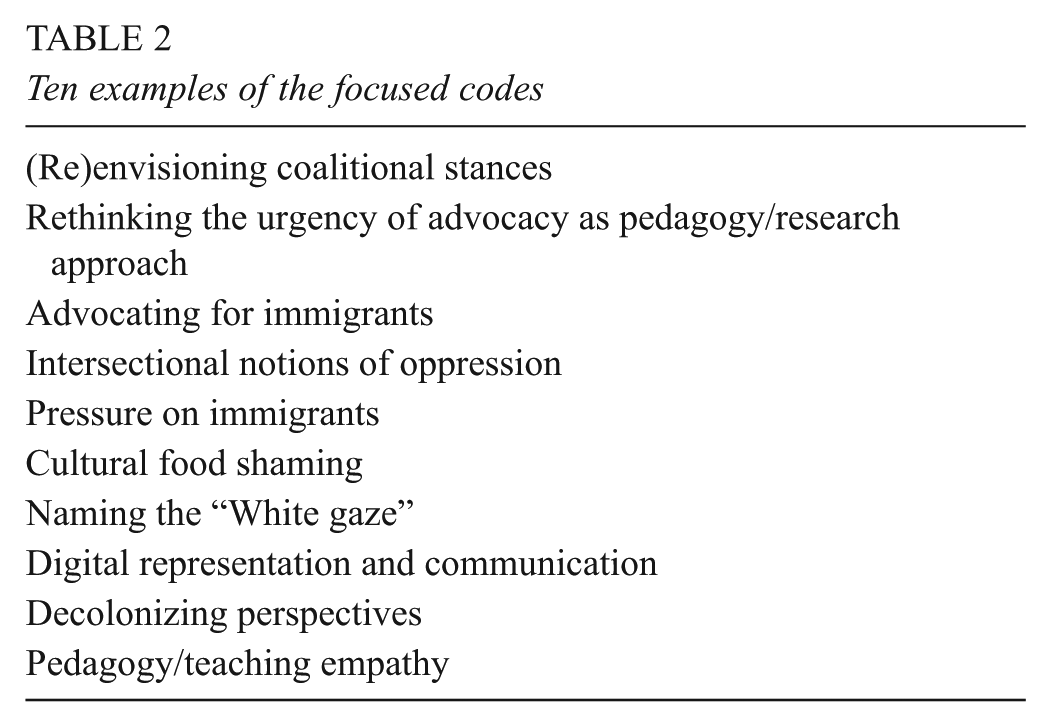
Next, each team member rewatched the dataset in groups of six videos—three featuring Black African immigrant communities and three featuring Asian immigrant communities. We each then wrote an analytic memo to accompany each group of videos, informed by our earlier coding, the research literature, and our theoretical framework. We collectively reviewed and annotated our memos, developing more than 140 focused codes (Table 2); we then clustered focused codes into 13 broader categories (Tables 3 and 4).
Ten examples of the focused codes
Clustering focused codes into broader categories

Thirteen broader categories

We identified three themes from the broader categories underscoring the complexity and robustness of how African and Asian immigrant young adults via TikTok (re)present the interplay of their identities and experiences as transbordered algorithmic identities.
Findings and Discussion
In our analysis of such vibrant digital narratives, we found that Asian and Black African immigrant young adults demonstrated their transbordered algorithmic identities in three complex ways: (a) complicating singular narratives, (b) shaping (and shaped by) contexts, heritage knowledges, and practices, and (c) unveiling tensions and navigating racialization through digital narratives.
Complicating Singular Narratives
Content creators posting digital narratives challenged constrictive singular narratives too often associated with African and Asian immigrant communities, such as the “model minority” stereotype predominantly attached to Asian immigrant communities (Iftikar & Museus, 2018) and the portrayal of African immigrant youth as “highly educated” (Zong & Batalova, 2017) or emblematic of the emerging “new model minority” (Ukpokodu, 2018). Such singular narratives obscure and delimit lived experiences of Asian and Black African immigrant youth navigating contexts of schooling such as curriculum or teachers who do not fully build with the range of students’ intersectional identities. A content creator who identified as Korean provided an illustrative example of digital (re)authoring (Abrahams, 2022) that disrupts the model minority narrative. In her video, aptly titled, “The Universal Asian Immigrant Experience,” the narrator conveyed exasperation during the college financial aid season, underscored by the caption “My Korean parents when it’s fafsa szn.” The narrator’s act of applying eye drops while background audio played of a Korean man’s impassioned yelling, interspersed with Korean expletives, poignantly empathizing with and emphasizing the strain many immigrant families face when navigating expectations of college going. Such portrayals complicate the model-minority stereotype of an academically adept community while providing a stark reminder that not every potential applicant from such communities enjoys an untroubled or financially secure pathway to higher education.
The universality of talking back to monolithic notions of the model minority became evident as viewers of the “fafsa szn” video responded with such comments as “African parents too” and “literally every poc parent.” Within TikTok’s vast landscape, content creators thus used the platform to challenge and (re)story popularized narratives, at times spotlighting moments that bind Black African and Asian immigrant communities, reflecting nuanced meanings of Ubuntu and 정 (Jeong).
Dismantling Racialized Stereotypes
In the complex tapestry of racialized identities within the United States and globally, digital narratives of Asian and Black African immigrant communities provided compelling insights. One video featured an Asian woman originally from a family in China, now living in New York, posing a question to her audience: “If America is so racist, why are Asians the highest earners in America?” She buttressed her argument across a 53-second video with statistics underscoring prevalent stereotypes and racialized discourses about Asian immigrants. For instance, the woman stated, “Did you know that Asian Americans face the highest poverty rates in NYC?” She pointed to media representations, such as the movie Crazy Rich Asians, as perpetuating certain stereotypes, and noted, “Only model minority stories are publicized while disadvantaged Asian Americans get ignored.” Most critically, the content creator dismantled the model minority myth, explaining that the deficit portrayal erases inequities propelled by systemic racism faced by the Asian community while the trope also demonizes Black and Latino/a communities. The woman’s counternarrative and (re)storying of the model minority myth effectively bridged experiences of Asian immigrants with broader racialized perspectives and transbordered identities. By highlighting the challenges of diverse Asian immigrant communities and emphasizing how they are often overshadowed by popular deficit narratives, such narratives underscored the tension between real-life experiences of Asian immigrants and the publicized, racialized discourses directed at the community.
Resisting Cultural Simplification: Reclaiming Narrative Agency
Transbordered algorithmic identities became powerful vehicles across the social media platform to challenge and deconstruct pervasive deficit narratives. An illustrative TikTok video by a young Asian woman revisited and critiqued the “stinky lunch story” trope that many Asian immigrant youth are familiar with, which has long marginalized Asian children and fostered a collective memory of a desire to conform by having “mainstream acceptable” lunches. In the video, a young Asian woman from Canada noted, “You beg your mom . . . to pack you something the white kids would eat.” The speaker highlighted how children make fun of ethnic lunches at school because of their smell and how this experience has become an integral part of the collective memory and cultural representation of immigrants. The content creator further invoked the essay, “The Limits of the Lunchbox Moment,” illustrated by Emily Chu, of a young Asian immigrant bullied in the cafeteria as they navigated everyday living informed by cultural ways, such as a parent preparing and sending a child to school with a lunch that contains ethnic foods (Saxena, 2021). The content creator, extending the essay’s insights, lamented the erosion of narrative agency among Asian American communities, their stories now modified, tailored, and made palatable to appease a dominant “White gaze.” This phenomenon can occur when popularized mainstream media seek to tell stories of minoritized communities, often with the intention of promoting diversity and inclusion. However, the result can be an oversimplified narrative that lacks nuance, focused on superficial or stereotypic portrayals that reinforce deficit narratives and further marginalize immigrant communities.
This sentiment echoed a video in our dataset featuring a woman who identified through her hashtags as “#immigrant,” “#blackamerican,” “#caribbean,” “#african,” “#haitian,” “#africanamerican,” “#migration,” and “#latinamerican.” The woman emphasized mutual cultural respect and combatting xenophobia as she posted a stitch that began with a video of a Black man subtly frowning while trying West African food; then the video proceeded with the woman’s commentary: “I never understood the need to come online to bash another culture’s food.” The video additionally featured the descriptive hashtags “#african,” “#caribbean,” “#blackamerican,” “#africanamerican,” “#immigrants,” “#ayiti,” “#nigerian,” “#westafricanfood,” and “#fufu,” underscoring digital narratives illuminating a range of social identities and the heterogeneity of Blackness and disrupting deficit-framed stereotypes impacting Black African diaspora communities including Black Caribbean communities. Evoking transbordered algorithmic identities complicates such singular narratives of learning and lived experiences of African immigrant individuals and communities, particularly because immigrant students’ experiences in U.S. schools and society are buffeted by anti-Blackness, systemic racism, anti-immigrant policies, and discrimination (e.g., Liu et al., 2023; Smith, 2023). Content creators thus reframed discursive tropes through personal storying of their lived histories and experiences, expanding interconnections to Ubuntu, and 정 (Jeong) in (re)authoring dominant narratives of immigrants, immigration, borders, and bordering. Such (re)authoring renders visible differing narratives rather than portrayals focused on the collective pain and trauma of immigrant youth and instantiations of racism, discrimination, and bias that portray immigrants as threats or burdens. Simplifying and sterilizing immigrant narratives can inadvertently sideline and misrepresent the experiences of communities. Against this backdrop, digital counterstorytelling underscoring transbordered algorithmic identities stands out as an invaluable tool to break down harmful stereotypes toward more nuanced portrayals of Asian American and Black African immigrant experiences.
Shaping (and Shaped By) Contexts, Heritage Knowledges, and Practices
Content creators experienced and expressed transbordered algorithmic identities shaping and shaped by a range of contexts in the U.S. and immigrant youth and young adults’ home countries, including, for example, such physical spaces as secondary schools, workplaces, and homes and such discursive contexts as narratives of educational attainment. In one illustrative example, a woman from Ghana, identifying herself in a caption as a “child of the African immigrant,” spoke directly to the audience. She wore a beige sweatshirt with the hood pulled up and gestured with her hands in a close-up shot. She shared that children of African immigrants, having experienced adolescence in the United States, hold varying knowledge and experiences of Africa and of their ancestry. The speaker drew necessary attention to nuanced lived experiences of 1.5-generation and 2nd-generation immigrant communities—individuals immigrating to the United States as adolescents and children of immigrants, respectively—as she shared: “We grew up at the end of the day in this foreign country [the United States]. . . . you picked up habits from this foreign country. . . . it’s ridiculous how they want you to question your identity as African born.”
Content creators leveraged TikTok as a resonant platform to voice collective experiences and digital narratives in the social, civic, and educational lives of immigrant youth and young adults, spotlighting myriad challenges while also illuminating the joys of global migrant communities. Alder (2015) and Boateng et al. (2024) highlighted food and language as cultural elements immigrant communities draw on to maintain connections to their homeland and construct meanings of identity in their host countries. Several Asian and African immigrant content creators posted content in their home languages, often with English captions. This approach fostered connections with speakers of the language globally through social media. For example, one content creator used Twi, a language of the Akan ethnic group in Ghana, West Africa, to highlight experiences of African immigrants who undertake perilous journeys by sea in boats across the Mediterranean to reach Spain and Italy. Such content resonates with Ghanaians across the diaspora while connecting with those who can relate to issues raised in the video, read through English captions. Across such digital diasporic tellings, diverse immigrant communities navigating such multifaceted transbordered algorithmic identities talk back to popularized deficit narratives.
Calling Attention to Overlooked Identities
Beyond deconstructing stereotypes such as the model minority and stinky lunch troupe, content creators composed vibrant narratives reflecting complex lived experiences and narratives of joy and liberation in ongoing work against racial violence confronting Black communities globally. One content creator led viewers on a poignant journey, juxtaposing the vast gulf between popular slogans captured on video and shared across social media, an increasingly digitally connected world, and everyday action taking directed toward Black African individuals and immigrant communities (Agyepong, 2017; Mohyuddin, 2024). The woman posted using the hashtag “#nigeriantiktok” and used captions to make present and call attention to tensions less frequently discussed in popular media, saying: “‘Blm’ [and] ‘save the africans’ will come out of people mouth but when it comes to speaking on Africans/African immigrants getting killed they will turn a blind eye on it? A nigerian man got be@ten to death by a white man in italy and everyone decided to pull out their phones to record instead of helping him?” The content creator underscored a tension in the use of social media to expose global racial violence while raising critical questions of how social media may galvanize meaningful change (Kay, 2020; Richardson, 2020).
Another content creator, with raw vulnerability, depicted the journey of immigrant children transitioning to unfamiliar educational terrains in the United States, granting viewers an intimate glimpse into navigating myriad emotional and social challenges. The video showed a Nigerian woman addressing the camera; a caption appeared, and remained on the screen: “Starting middle school as an African immigrant.” The speaker looked directly at the camera as background music played, made a crying gesture with her hand, and then pointed to the camera as a song ends with the lyric, “You gonna cry.” The video depicted African immigrant youth who often have to navigate unfamiliar education systems with minimal support while being expected to perform well. Muno and Muno (2023) argued that a one-size-fits-all approach to serving Black immigrant students can be problematic and limiting. Rather, attending to transnational algorithmic identities calls forth a deeper understanding and appreciation of the complexity and nuance of Asian and Black African immigrant identities and experiences across contexts of race, ethnicity, language, and socioeconomic status, emblematic of the take up of such stances as Ubuntu, and 정 (Jeong) underscoring the urgency of recognizing and affirming the heterogeneity of varied immigrant communities globally. Such an intersectional approach galvanizes effective and pointed support for a range of Black African and Asian immigrant students.
Unveiling Tensions and Navigating Racialization Through Digital Narratives
For content creators grappling with racialized narratives, the dynamics between Black African immigrant communities and individuals who identify as African American bear complex historical imprints of colonialism and imperialism, manifested across numerous videos. For example, a woman, identifying as a Black immigrant to the United States, noted: I have heard immigrants say, “Oh, I don’t want too many of them to come here”—as if to say their piece of the pie is going to get smaller if more immigrants come. It’s just mind boggling to me that people who have benefited from a system, and who know why they escaped to a better life would then want to turn around and shut the door to people who want to do the same.
Further complicating narratives of coalitional stances, a content creator implored Black African immigrants to recognize Black Americans in the ongoing coalitional work of demanding equal rights and access to social and educational institutions. A Black American man in one video, speaking candidly with a Black immigrant man, emphatically stated, “White people did not want to give us or you opportunities.” The speakers in conversation and the content creator’s posting of the conversation emphasized a historicized intricate dynamics of racialization and the work of Black content creators composing counternarratives to White supremacy and forging meanings of solidarity. For example, some challenged somber narratives of division between Black communities in the United States and Black African immigrant communities across contexts of educational achievement, the embracing of Black identities, and linguistic practices (e.g., Nsangou & Dundes, 2018).
Emphasizing and Affirming Nuanced Meanings of the Heterogeneity of Identities
Content creators thus brought critical attention to challenges arising when individuals do not fully recognize the heterogeneity of Blackness and Black identities worldwide. Individuals posting to TikTok, for example, talked back to a monolithic notion of Blackness that does not fully account for the Black African immigrant community’s intersectional racial, cultural, ethnic, and linguistic identities.
Experiences and stories of families and individuals who identified as having multiethnic, multilingual, and multiracial identities similarly reflected examples of content creators underscoring the heterogeneity of Asian and African immigrant communities. A TikTok creator in another illustrative example reflected on Asian parents of multiethnic, multiracial children and the unique challenges in navigating dual heritages and their child’s identity. Addressing the audience directly in a video tagged “#immigrantparents,” the content creator shared that a parent recalling their lived experiences growing up in an Asian culture, while simultaneously navigating this contemporary moment of their child born and raised in the United States, might already “have conflict, because you start to have Western ideas and individualism. . . . But coming from . . . an Asian culture, where it’s much more on collectivism and being in a household, that is why there is so much conflict.” The content creator asked how might “our generation . . . mend that path . . . Asian culture, and the values that we have, along with the Western culture.” Content creators thus promoted a more nuanced and inclusive understanding of their experiences. For example, in sharing personal stories as digital narratives, content creators accounted for multiple characteristics that comprised their complex identities, such as race, language, gender, ethnicity, nationality, and heritage. Moreover, content creators held a range of diverse identities, self-identifying as Chinese, Vietnamese, Korean, Filipino, South Asians, LGBTQ individuals, an Asian and Mexican married couple, Malaysians, and White and Asian families. In the range of communities across videos, heterogeneous portrayals of experiences and identities of Asian and Black African immigrant youth and young adults talked back to deficit-framed stereotypes and promoted a more reflective understanding of the complex and multifaceted nature of communities.
Complicating Narratives of Intersectionality and Identities
Our analysis included content creators who self-identified as first-generation immigrants and immigrant children from diverse socioeconomic backgrounds. Digital narratives prompted a nuanced understanding of Black African and Asian immigrant youth navigating layered identities, underscoring the dynamic interplay of intersectionality and identity across multiple ethnic and racial communities. TikTok content creators, with their vibrant digital narratives, thus challenged established deficit stereotypes about immigrant communities. Content creators across digital narratives further emphasized the importance of recognizing and understanding the various ways in which these identities intersect and influence one another and how they shape and are shaped by one’s experiences, sentiment embodied across perspectives of Ubuntu and 정 (Jeong). For example, a content creator who self-identified using the hashtags “#immigrant,” “#arab,” and “#asian” delved into the complexities of identity, voicing their challenges of navigating broader contours of being a U.S. citizen and the consistent mispronunciation of their name by peers and teachers as an unwelcome reminder of their distinct individuality, affecting their sense of identity.
Beyond stories suffused in struggles, content creators composing on TikTok authored digital narratives with necessary accounts of affirming. For example, a content creator, who identified as “genderqueer” and “Asian American,” shared a story of grappling with changing their “American” name—one bestowed on them by their Chinese parents. They sought a name that both reflected their queer identity and connected them to their Chinese heritage. Such content accentuates the nuances of Chinese identity and culture while building connections across diverse cultures. The digital narrative, tagged with the hashtags “#asianamerican,” “#queer,” “#diaspora,” “#immigrant,” and “#chinese,” underscored how names can be markers of an immigrant identity and the importance of affirming gender and sexuality within the complexity of intersecting identities. The social media platform thus offered contexts for individuals to meaningfully engage with their intersectional identities across social and geographic communities (e.g., Mpofu et al., 2022). Such platforms prompt connections while also empowering individuals to challenge prevailing stereotypes, educating individuals globally about unique cultural traditions. Digital narratives thus emerged as a powerful platform for individuals to extend and share their transbordered algorithmic identities, inviting global audiences into their experiences.
Implications and Conclusion
In digital narratives composed and shared across African and Asian immigrant communities, we found that TikTok content creators urged an embracing of cultural knowledges and expressions of these knowledges, infused with rich insights that resonate universally. Digital narratives thus invited audiences into a realm where individuals navigating identity markers shared intricate stories spanning language, gender, ancestral roots, and more amid myriad experiences shaping and shaped by African and Asian diaspora communities across TikTok. In composing digital narratives that demonstrate transbordered algorithmic identities, content creators challenged, (re)storied, and affirmed their multifaceted embodied identities as creators and users championing an appreciation for the range of digital diasporic tellings, narratives prompting users to look beyond surface-level stereotypes.
The Bandung Conference, in Bandung, Indonesia, in 1955 and including delegates from 29 African and Asian nations, marked a significant moment in discussing colonialism, imperialism, and the need for self-determination. The conference’s Bandung Declaration affirmed principles of respect for sovereignty, territorial integrity, peaceful coexistence, noninterference in internal affairs, and equality among nations (Tan & Acharya, 2008). Such solidarities moved beyond Cold War binaries of Western or Eastern blocs to create a third bloc (Umar, 2019) toward more personal connections, cultural exchanges, and solidarity movements across borders, strengthening ties and promoting “values of multiculturalism, diversity, and universal humanity” (Lumumba-Kasongo, 2015, p. 5). Subsequent Asian–African economic and political summits followed in 2005 and 2015 (e.g., Andry, 2017). In a contemporary moment where legislators and policymakers move to stymie the voices and identities of content creators on social media, we extend meanings of what Ndlovu-Gatsheni (2019), reflecting on the Bandung spirit, named as an ongoing “planetary spirit of decolonization and decoloniality” (p. 2) centering and extending nuanced onto-axio-epistemologies in the digital narratives of African and Asian immigrant youth and communities.
Scholars have notably discussed the political contestations and corporate capitalism embedded in the TikTok platform. For researchers and practitioners, a consideration of transbordered algorithmic identities complicates the interplay of the enduring impact of colonial legacies on contemporary power structures and the construction of diasporic storying and knowledge (e.g., Chilisa, 2019; Daza & Tuck, 2014; Dei, 2012). Regrettably, personal and often painful narratives that immigrant communities (re)story in digital narratives sometimes find themselves reified and commodified across contexts from college admissions to the school cafeteria, contrary to the ethos of affirming teaching and learning centered on love, which prioritizes empathy and authentic human connection (e.g., Paris, 2012; Watson et al., 2022). Digital diasporic narratives of African and Asian immigrant communities testify to legacies and lived realities of systemic racism embedded within educational institutions, underscoring the complexities and challenges immigrant youth face in an environment that often overlooks their unique strengths and challenges.
Consequently, researchers and practitioners might extend frameworks, research design, curricular design, and teaching practices that render visible narratives from content creators that talk back to such deficit framings as the model minority myth, which inaccurately portrays such youth as universally successful and fails to account for the intense pressures and challenges they face, which come at significant personal and emotional costs. Although content creators across digital narratives employed humor and empathy, our inquiry holds implications for educators in adopting flexible teaching strategies tailored to diverse learning needs and pressures of students, potentially offering additional support for those dealing with covert stress from such expectations or financial obligations. Educators might encourage the composing and reflection of digital narratives as youth and young adults explored the rich diversity of immigrant lives, including those who moved from heritage countries to the United States at an early age, immigrated during adolescence, or were born in the United States but spent their formative years abroad before returning. These varied lived experiences emphasized the complexity of identities and potential for fostering research inquiries and educational environments that acknowledge and support varied and unique backgrounds essential for researchers and practitioners to recognize and move beyond generalizing research stances or curricular and teaching approaches for immigrant youth because doing so can significantly impact the range and effectiveness of learning experiences.
In interacting with those who share similar or resonant experiences across social media platforms, individuals posting to TikTok underscored engagements reflective of meanings of Ubuntu or 정 (Jeong). Such possibilities were achieved by demonstrating empathy, humanity, caring for others’ experiences, and expressing emotions and attachments through interactive storying, underscoring the adaptability of Ubuntu and Jeong across digital contexts. Beyond illuminating shared challenges of immigrant children in U.S. educational settings, digital narratives compelled nuanced considerations of the urgency of narrative agency. Although we focused the present inquiry on how African and Asian immigrants (re)present the interplay of identities and experiences across digital narratives, future such research might highlight additional methodologic implications (e.g., Maalsen, 2023; Piattoeva & Saari, 2022).
In theorizing and attending to transbordered algorithmic identities, we sought to understand how Black African and Asian immigrants (re)present the interplay of their identities and experiences within and across their digital narratives. Content creators constructed communities with those who shared similar experiences across various identities and geographies, complicating singular narratives and dismantling racialized stereotypes. In navigating transbordered algorithmic identities and interacting online, content creators highlighted the often overlooked stories of African and Asian immigrants, (re)shaping the take up of such complex intersectional identities. Ultimately, attending to transbordered algorithmic identities holds possibilities for researchers and practitioners rendering visible the digital diasporic narratives of the range of immigrant communities and beyond, illuminating multifaceted contours of social media shaping and shaped by young people’s identities, and influenced by algorithms and interactions.
Footnotes
Conflicting Interests
The authors declare no potential conflicts of interest with respect to the research, authorship, and/or publication of this article.
Funding
The authors received no financial support for the research, authorship, and/or publication of this article.
Open Practices
The data and analysis files for this article can be found at https://www.openicpsr.org/openicpsr/workspace?goToPath=/openicpsr/239993&goToLevel=project.
