




Abstract
Students who are not college ready often perform better in corequisite courses than traditional developmental education, yet concerns remain about how well these courses serve the least prepared students. This study used statewide data from Texas to examine relationships between students’ high school coursework in math and English and their performance in various types of corequisite courses. It also investigated peer effects by analyzing how classmates’ high school course taking influences individual outcomes. Results show that no specific corequisite model or intensity consistently benefits students who did not complete the typical college-preparatory course sequence. Moreover, students in classes with a higher proportion of peers who did not complete advanced high school coursework had lower success rates in both developmental and college-level courses. However, these peer effects were less detrimental for students who themselves did not follow the typical college-preparatory path, suggesting that peer dynamics interact with individual preparation in shaping course outcomes.
Keywords
Introduction
A growing body of research demonstrates that students who are not college ready tend to experience greater success in corequisite courses relative to traditional developmental education sequences (Austin et al., 2024; Meiselman & Schudde, 2022; Miller et al., 2022). However, concerns have been raised that students in corequisite courses represent a broad range of abilities and levels of academic preparation, and reforms that do not specifically address achievement gaps may not adequately meet the needs of all students (Squires & Boatman, 2014). In particular, there are concerns that a one-size-fits-all approach to corequisite education may not adequately meet the needs of the least prepared students, which may result in adverse consequences such as the lowering of academic standards in these courses (e.g., Cafarella, 2023; Jaggars & Hodara, 2013).
Texas House Bill 2223 required all public institutions to scale up corequisites from 25% of developmental education students in the fall of 2018 to 100% in the fall of 2021. This statewide corequisite reform took several approaches to addressing concerns about the most underprepared students. First, the placement test, the Texas Success Initiative Assessment (TSIA), was designed so that if students incorrectly answered most of the first set of items, they received a second set of items targeted toward the lowest readiness levels, known as the Adult Basic Education (ABE) diagnostic. Students who received a score of 1–4 on a 6-point scale of the ABE diagnostic were assessed to be performing below the ninth grade level. These students were exempt from corequisite developmental education and received more specialized academic support as determined by the colleges. Daugherty et al. (2019) estimated that ~7% of first-time-in-college (FTIC) students in credit-bearing courses at Texas community colleges tested at the lowest levels of the ABE diagnostic (below ninth grade) in 2015. Second, Texas reform actions provided institutions with flexibility in determining the characteristics of corequisite courses that might best meet the needs of their unique student populations. The intensity of the developmental component could vary from <1 to 4 credit hours. Institutions also could select from among three distinct corequisite structures: (a) the concurrent/paired-course model, where students are co-enrolled in college-level and developmental courses simultaneously, (b) the sequential course within the same semester model, where students enroll in a developmental course in the first part of the semester followed by an accelerated college-level course in the second part of the semester, and (c) the non–course competency–based option (NCBO), in which students engage in for-credit academic support activities such as tutoring or self-paced online modules. This flexibility in corequisite implementation provided colleges with options such as offering longer-credit-hour developmental components in corequisite courses for students with lower levels of preparation.
This study examined whether corequisite students who did not complete a typical college-preparatory course sequence (defined here as those in classes below Algebra II or English IV) tended to perform differently based on the type of corequisite structure and intensity. Previous research in Texas found that, overall, students tended to perform similarly regardless of corequisite structure, and some students may have benefited more from a shorter intensity in the developmental component (Park-Gaghan et al., 2022, 2023). In particular, there was some evidence that the benefits of shorter corequisite courses may be greater for Hispanic students (relative to White students) and non-low-income students (relative to low-income students). However, these results may not be generalizable to students with less advanced high school course taking. It is unclear whether these students might benefit more from an NCBO that might be more closely tailored to the specific skills they have not yet mastered or from a traditional course-based format where they have more time with an instructor who can explain the content and answer questions. Additionally, although there may be some positive effects of shorter-credit-hour corequisites among all students, it is unknown whether students who did not complete a typical college-preparatory course sequence would benefit from a more prolonged course that provides more time to review the skills needed for college-level coursework.
Another issue relating to corequisite performance by high school preparation is that prior research has demonstrated that college students are influenced by the ability levels of their peers (Berthelon et al., 2019; Ran & Lee, 2024; Ryu et al., 2022). The quality of peers may be particularly important in community colleges, which often have open admissions policies that allow students to enroll regardless of their level of academic preparation (Smith & Stange, 2016). In the context of Texas corequisite reform, the composition of student ability levels in both the developmental and college-level components of the corequisite program may contribute to peer effects that influence the likelihood of students’ success in their courses. Therefore, this study also explored whether students with less advanced high school course taking tended to perform better or worse in corequisite courses if placed with more similarly prepared peers. Additionally, this study examined whether there are unintended negative consequences of having more students who did not complete a typical college-preparatory course sequence in corequisite courses among students who completed more advanced courses. Specifically, the following research questions were addressed:
To what extent does the relationship between corequisite structure/intensity and student course-taking outcomes differ for students who did not complete Algebra II/English IV in high school?
How does the share of students in corequisite courses below Algebra II/English IV affect student course-taking outcomes? a. Does this relationship differ depending on whether the student did not complete Algebra II/English IV?
This study sought to make several contributions to the research literature. First, many prior studies have explored the effectiveness of corequisites for all students or regression discontinuity studies that estimated the impacts for students near the margins of college readiness. However, students at the lowest levels of academic preparation are a particularly vulnerable group, and little is known about the best way to support these students in developing college readiness. Our study addressed this issue by examining whether students who did not complete a typical college-preparatory course sequence tended to perform differently based on the type of corequisite structure and intensity, which are implementation decisions that institutional leaders have control over and can modify if they are not meeting students’ needs adequately. Additionally, this study will contribute to a better understanding of how the course-taking preparation of classmates affects students’ own success and the success of their peers in corequisite courses. This has important implications for college instructors when considering how to adapt to diverse levels of preparation in the same classroom.
Literature Review
Relationship Between High School Academic Preparation and College Outcomes
Since the 1950s, the predominant college-preparatory high school math sequence in the United States has consisted of Algebra I, Geometry, and Algebra II (Moussa et al., 2020). This math sequence can begin in middle school and is often completed by grade 11. Most states require students to complete all three of these math courses to fulfill the high school graduation requirements, but 17 states require 4 years of math, and a few states require only 2 (Achieve, 2020). Beyond the number of courses required, some states also differ in the types of math courses taken. For example, Texas legislation under HB 5 in 2013 allowed students to substitute an alternative math class for Algebra II such as “Advanced Mathematical Decision Making,“ a more applied math course for students interested in workforce training programs (Moussa et al., 2020).
Although less rigorous graduation requirements may benefit students who do not plan to continue to postsecondary education or seek employment in science, technology, engineering, and math (STEM) fields, those who do enroll in college may find themselves insufficiently prepared for college-level coursework if they only complete the minimum requirements for high school graduation. For example, a study by Woods et al. (2018) used data from Florida to estimate logistic regression models to predict the likelihood of passing college-level courses depending on whether students only completed the minimum requirements for a standard diploma in math (Algebra I and Geometry only) and English (only a regular English course without any honors, Advance Placement [AP], or language other than English classes). The predicted passing rates for students who had only completed a standard level of preparation in high school were 48% in college-level English and 21% in math, indicating that these high school courses are not adequately preparing students for college-level work if the majority of students cannot pass them.
When students enroll in open-access institutions, they are typically required to take a placement test to determine whether they should enroll in a college-level or developmental education course in math or English. Traditionally, students scoring at the lowest levels of preparation have been assigned to multiple levels of developmental coursework, raising concerns that these students face more exit points at which they may drop out (e.g., Bailey et al., 2010). Only a few studies have examined the outcomes of the least prepared students assigned to multiple developmental education courses, and the findings are mixed. Boatman and Long (2018) conducted a regression discontinuity analysis and found that students at the lowest levels of preparation in math who were assigned to three levels of developmental education performed similarly to those assigned to two levels of developmental math. However, students at the lowest levels of preparation in reading and writing who were assigned to three levels of developmental education had better performance than those assigned to two levels on outcomes such as persistence. The authors posited that the positive effects in English may be attributed to reading and writing skills being more prominent in other courses beyond English. Another study by Xu (2016) conducted a similar regression discontinuity analysis in developmental reading and writing using data from Virginia community colleges. The findings indicated that enrollment in lower-level (and longer) developmental sequences had small but statistically significant negative effects on academic outcomes, including persistence, credit accumulation, and transfer or degree completion. Although these findings differ from those of Boatman and Long (2018), Xu (2016) suggested that this may be attributed to the different contexts of the studies, including student characteristics, placement policies, course curriculum, and the availability of support services. A follow-up study of developmental math courses found no benefits of longer developmental sequences for students at the lowest levels of preparation and some negative effects on longer-term outcomes such as credential completion (Xu & Dadgar, 2018). Even though the negative effects were not large, taking additional developmental courses imposes academic and psychological burdens on students as well as financial costs for students and institutions.
To reduce the burdens and costs associated with lengthy developmental sequences, many institutions have implemented corequisite reforms that allow students to complete developmental and college-level coursework in a subject within the same semester. Although there is considerable evidence that these corequisite courses tend to result in greater success for students overall (Austin et al., 2024; Meiselman & Schudde, 2022; Miller et al., 2022; Ran & Lin, 2022), less is known about whether there might be differential impacts based on students’ academic preparation. Ran and Lee (2024) conducted a study of corequisite courses in Tennessee community colleges and found that, overall, there was a 20 percentage point increase in the likelihood of passing introductory college-level courses in math and a 23 percentage point increase in English. In math, the gains were greatest for students from the highest-achieving test score group, but in English, the results were reversed, with the greatest gains for the lowest-achieving students. Another study examined course-taking outcomes under Florida’s developmental education reform, which included corequisite courses (Park-Gaghan et al., 2021). Although all students benefited from the reform, the gains were greater for students from the lowest two tracks of high school preparation relative to those in the upper two tracks. Given that there is some evidence that the least prepared students may benefit from developmental education reforms such as corequisites, this study will extend this work by providing a more nuanced understanding of whether the association between different types of corequisite courses and course-taking outcomes differ for students from the lowest level of preparation.
Role of Peer Effects in Influencing Students’ Academic Performance
Within the higher-education literature, there is substantial evidence that students’ academic performance may be influenced by the characteristics of their peers in multiple ways. Wolniak and Ballerini (2020) defined peer effects as denoting “whether the average behaviors of a group of students or some contextual dimensions influence the behavior of the individual students that comprise a group” (p. 2192). College students commonly experience peer influences based on the selectivity of the institution they attend, their roommates, participation in learning communities, and campus diversity (Wolniak & Ballerini, 2020). In the past year alone, three important studies have been released that examined influences from the diversity of peers. The first study, by Bowman et al. (2023), conducted a multilevel regression analysis using student-level data from 20 universities and found a positive association between the proportion of first-generation and underrepresented minority students in a STEM class and course grades, particularly for students in minoritized groups. A second study, by Oliver (2023), similarly found that Black and Hispanic students at California community colleges were more likely to pass their classes and enroll in a subsequent course in the same subject in the next term if they were exposed to a greater share of classrooms from the same race. A study by Ngo (2023) revealed that undocumented students in community college tend to have higher levels of preparation compared with their U.S. citizen peers, and having a higher share of undocumented students in a course was associated with better course-taking outcomes for U.S. citizens in the same course.
Although these findings speak strongly to the benefits of exposure to diverse groups of peers, the results are more mixed around peer effects from students from different levels of academic preparation in college courses. For example, a study by Berthelon et al. (2019) examined the characteristics of students’ peer networks from their study groups in the context of a large university in Chile. Ordinary least squares and instrumental variable estimates indicate that students tend to benefit from being in study groups with peers from similar levels of academic ability. Another study by Liu and Xu (2022) used linear-in-means models to examine how the percentage of dual-enrollment students in introductory college-level math courses influences the performance of non-dual-enrollment students in the same class. They found that college students tend to have lower pass rates and grades in courses with a higher proportion of classmates in dual enrollment. These negative effects from the share of dual-enrollment students were similar for all students regardless of their prior academic achievement, indicating “modest unintended costs” (p. 29) from the expansion of dual enrollment.
There is also some evidence that the academic preparation of peers influences the outcomes of students in corequisite courses. A study by Ryu et al. (2022) during the initial scale-up of Texas corequisite reform examined how the characteristics of both the developmental and college-level courses may influence students’ academic success in college. The authors estimated logistic regression models with college and semester fixed effects for students enrolled in corequisite math from the fall of 2018 to the spring of 2020. They found that having students with mixed abilities in the college-level component of the corequisite was associated with better outcomes than having separate college-level classes for students testing below college ready. In another study of corequisite courses in Tennessee, Ran and Lee (2024) used regression discontinuity and difference-in-regression discontinuity to examine differences in outcomes for students narrowly placed in corequisite courses relative to prerequisite courses using data from the state’s 13 public community colleges. Overall, students were more likely to pass college-level courses in both math and English if there were more college-ready peers in the same course section. However, students below college ready tended to perform worse in college-level math classes with a greater share of college-ready peers. These findings demonstrate that peer dynamics may result in differential outcomes depending on students’ own level of preparation. The authors suggested that these findings may be due to instructors being better able to teach to the student’s level if more similar-ability students are in the same class.
Potential Mechanisms Underlying Peer Effects in Corequisite Courses
Although there is strong evidence that peer effects exist, uncertainty remains about the mechanisms underlying those peer effects (Wolniak & Ballerini, 2020). Different disciplines have provided different explanations for how peers may influence college students’ behaviors and achievement, such as economic perspectives of human capital development and social-psychological perspectives grounded in human ecology theory. For this study, we followed the work of Liu and Xu (2022), which had identified three separate and potentially conflicting frameworks for understanding how the achievement levels of peers may affect students’ own success in college-level courses. The first framework is the linear-in-means models, which examines the association between students’ own outcomes and the average academic achievement of their peers. Students tend to learn from peers inside and outside the classroom and may benefit from the presence of more high-achieving peers who may help them learn more. Higher-performing peers also may indirectly influence other behaviors, such as time spent studying. Additionally, the level of rigor used by instructors also may be higher in classes with a greater share of high-achieving students, which may benefit the whole class.
The second framework considers the contrasting approach of the invidious comparison model, which proposes that students may be adversely affected by higher-achieving peers if it results in them being at the lower end of the ability distribution. Lower-performing students may face negative perceptions about their ability level compared with their higher-achieving peers, which can harm their motivation and the level of effort they put into the course. Additionally, instructors may grade more strictly if there are higher-ability students in a class, which can make it more difficult for lower-performing students to earn a passing grade.
The third framework is based on a tracking model, which suggests that students may benefit the most from being placed with peers from similar performance levels. Students may experience positive peer interactions among peers with similar levels of ability; for example, similar students tend to be more likely to be in the same social networks and may be more inclined to study together. In addition, faculty may be able to provide more targeted instructors based on the needs of the students if the course is academically homogeneous.
In this study, we further explored how the share of students in corequisite courses who did not complete a typical college-preparatory course sequence may affect student course-taking outcomes to better understand the role of peer effects in corequisite courses. In addition, we also examined whether this relationship differs depending on whether the student did not complete Algebra II/English IV given that the conceptual frameworks suggest that students from different ability levels may be differentially affected by the presence of high- (or low-) ability peers.
Methods
Data and Sample
This study used student-level records provided by the Texas Higher Education Coordinating Board and maintained by the University of Texas at the Dallas Education Research Center. The data encompassed information on student demographics, test scores, prior academic preparation, enrollment patterns, and course taking and passing rates. We examined two primary outcomes of interest: (a) passing the developmental corequisite course within the same term as the first attempt and (b) passing the related introductory college-level math or English course within the same period. 1
Data are included for all public 2- and 4-year institutions in Texas. For the first research question about the relationship between corequisite structure/intensity and student course-taking outcomes, the sample consisted of five cohorts of FTIC students who enrolled in college from the fall of 2018 to 2022 and took a corequisite math (N = 110,868) or integrated reading and writing (IRW) course (N = 85,999) during their first year. In response to the COVID-19 pandemic, nearly all courses at Texas community colleges between the fall of 2020 and the spring of 2021 were taken in online or hybrid format (Miller et al., 2024). We do not have any reason to expect that the changes in course modality during the pandemic would differ by corequisite type or intensity. The second research question examined the relationship between the share of students from the lowest level of preparation and course-taking outcomes. The same sample was used to assess the outcome of passing the developmental component of the corequisite course. However, for the outcome of passing the college-level component of the corequisite course, the sample was expanded to include all FTIC students who took an introductory college-level course in math (N = 386,417) or English (N = 535,093) with corequisite students. At most institutions, introductory college-level courses included a mix of students testing above and below college ready, so students deemed college ready did not participate in the developmental component of the corequisite.
Student placement into corequisite developmental education in Texas was guided by the TSIA, a standardized statewide placement test. However, under state policy, students may be exempt from taking the TSIA if they demonstrate college readiness through other means, such as achieving minimum scores on standardized assessments (e.g., SAT or ACT), performance on statewide exams in high school (e.g., State of Texas Assessments of Academic Readiness English III or Algebra II end-of-course exam), or completion of designated college-preparatory courses or programs (e.g., dual credit or Texas College Bridge). As a result, TSIA participation varies across students and over time.
In this study, we did not include TSIA scores as a measure of academic preparation because these data were missing for more than half the sample. The proportion of students with valid TSIA scores declined substantially across the study period—from ~70% in 2018 to just 21% in 2021. This decline likely reflects institutional shifts in placement practices during the COVID-19 pandemic, including the temporary suspension of in-person testing and the expansion of multiple measures for course placement using other criteria such as high school grade-point average and course taking. Given these limitations, we instead relied on high school course-taking patterns as a consistent statewide indicator of academic preparation across the study period.
In this study, we defined a student’s course-taking preparation based on the highest math or English course completed in high school. 2 Although this is not a comprehensive measure of academic preparation, it does serve as an important indicator of students’ exposure to college-preparatory math and English skills. The Texas Foundation High School Program (FHSP), the default graduation criteria for all high school students, includes three credits in math. Two of these credits must include Algebra I and Geometry. However, students have a wide array of choices for the third credit, including applied courses such as Financial Mathematics, lab-based science courses such as Food Science or Forensic Science, and even apprenticeship or training hours that count toward an industry-recognized credential (Texas Administrative Code §74.12). The state also has diploma options for a “Recommended High School Program” and a “Distinguished Achievement Program,” which both require four credits of math consisting of Algebra I, Geometry, Algebra II, and a fourth math course requiring Algebra II as a prerequisite or corequisite. In this study, students are defined as not completing a typical college-preparatory course sequence in math if the highest math course completed in high school was below Algebra II (or the minimum criteria for the Texas FHSP).
In English, the FHSP requires four credits in English consisting of English I, II, and III plus a fourth credit that may include options such as applied communications classes in debate or journalism, business English, or apprenticeship or training hours that count toward an industry-recognized credential (Texas Administrative Code §74.12). The “Recommended” and “Distinguished” diploma programs require 4 years of English, including English I–IV. In this study, students were defined as not completing a typical college-preparatory course sequence in English if the highest English course completed in high school was below English IV (or the minimum criteria for the FHSP).
Within the sample, ~8% of math corequisite students had not completed Algebra II, and 12% of IRW corequisite students had not completed English IV in high school. Concurrent was the most common corequisite format among all students, but there were some differences in corequisite structure by high school course preparation (Table 1). In both subject areas, students with less advanced high school course taking were ~5–6 percentage points more likely to take an NCBO and less likely to take a concurrent corequisite course relative to those who took more advanced courses. Additionally, although three-credit developmental courses were the most common intensity (comprising more than half of all corequisite enrollments), three students who did not complete the typical college-preparatory course sequence were slightly less likely to take shorter corequisites (particularly one credit or less) and more likely to take longer corequisites (three or four credits) relative to students who took more advanced courses. These differences in credit intensity by course-taking preparation were greater in math than in IRW. For example, students below Algebra II were 6.5 percentage points less likely to take a one-credit or less math corequisite than students at or above Algebra II. Students below English IV were only 2.4 percentage points less likely to take a one-credit or less IRW corequisite than students at or above English IV.
Number and percent of corequisite students enrolled in each corequisite type and intensity by subject area

IRW, integrated reading and writing; NCBO, non–course competency–based option
Note. The sample consisted of five cohorts of first-time-in-college (FTIC) students who enrolled in college from the fall of 2018 to 2022 and took a corequisite math (N = 110,868) or IRW course (N = 85,999) during their first year.
Analytic Approach
To address the first research question, a series of second-differenced regression equations was estimated to explore differential relationships between corequisite characteristics and course-taking outcomes by whether students were categorized as below Algebra II/English IV in high school. The sample was limited to students who took a corequisite course in either the fall or spring semester in their first year of college enrollment. We included a series of interaction terms to explore whether the type of corequisite differentially affected students who completed high school courses below Algebra II (math) or below English IV (English) relative to students who had completed a typical college-preparatory course sequence. More specifically, we estimated the following model for math:

This specification estimates the likelihood of academic outcome y (completion of the developmental or college-level corequisite course) for student i enrolled at college j in year t. The type of corequisite structure is represented by SEQ (sequential) and NCBO relative to the reference group of the concurrent model (the most common option). BelowAlgII is a dichotomous indicator for whether the highest math course completed by the student in high school was below Algebra II relative to students who had completed Algebra II or higher. The high school course-taking variable for English is replaced with an indicator of whether the highest English course completed was below English IV. Next, the high school preparation variable is interacted with the corequisite type indicators, represented by β4 and β5, to assess whether there were differential effects of corequisite course types for students below Algebra II/English IV. A similar model was estimated for course intensity, but the corequisite type indicators were replaced with a series of dichotomous indicators for corequisite courses with developmental components of one credit or less, two credits, and four credits (relative to the comparison group of three credits, which is the most common option). In all models, the vector S includes student demographic characteristics (e.g., race, gender, and socioeconomic status), whereas λt is a year (cohort) fixed effect. Standard errors are clustered at the college level to capture heterogeneous effects across colleges. Results are presented as marginal effects to compare the predicted probability of passing the course by corequisite type (or intensity) for students below Algebra II compared with students at or above Algebra II.
To address the second research question about peer effects, we created two new variables representing the share of students below Algebra II/English IV in the same class section for the developmental component and college-level component of the corequisite course. For the outcome of passing the developmental course, the sample was limited to students who took a corequisite course in the first year because these were the only students who enrolled in corequisite developmental courses. However, for the outcome of passing the college-level course, the sample included all students who enrolled in an introductory college-level math or English course in the first year regardless of whether they took a corequisite. This allowed us to examine whether having highly underprepared students in a college-level course affects the academic performance of all students in the class, including those who are already college ready. We estimated the following logistic regression model for math:

For the first set of results, y is the likelihood of passing the developmental component of a corequisite math course. BelowAlgIIijt indicates whether the student’s highest math course completed in high school was below Algebra II, whereas ClassShareijt represents the share of students in the developmental course whose preparation was below Algebra II. The coefficient for the interaction term, β3, indicates whether students with preparation below Algebra II were differentially affected by the share of peers in the developmental class who similarly did not complete Algebra II. The model also controls for student demographic characteristics (θ) and cohort fixed effects (λ), with standard errors clustered by college. Results are presented as marginal effects to compare the predicted probability of passing the developmental course for students in classes at the 25th percentile of students below Algebra II in the class section relative to students in classes at the 75th percentile of students below Algebra II in the class section. These results are disaggregated based on whether the student had completed Algebra II to determine whether the effects differ depending on students’ own course-taking preparation.
In the second set of results, outcome y is the likelihood of passing the introductory college-level component of the corequisite. The variable for ClassShareijt represents the share of students in the college-level course whose preparation was below Algebra II, and the interaction term, β3, examines whether students with preparation below Algebra II are differentially affected by the share of peers in the college-level class who have preparation levels below Algebra II. Finally, both sets of results are replicated for English, but the high school course-taking variables are replaced with preparation levels below English IV rather than Algebra II.
Limitations
Several limitations should be acknowledged when interpreting the findings of this study. First, our primary measure of academic preparation—completion of Algebra II or English IV in high school—served as a proxy for readiness but may not fully capture students’ skills or learning experiences. Some students may have taken alternative fourth-year courses or demonstrated college readiness through other means not reflected in the transcript data. Second, due to data limitations, TSIA placement scores were excluded from the analysis because they were missing for a substantial portion of the sample, particularly in later years during the COVID-19 pandemic. Third, although our models controlled for a range of observable student characteristics, unmeasured factors such as instructional quality, motivation, and concurrent supports also may have influenced student outcomes and peer effects. Finally, this study focused on course-level outcomes and did not capture longer-term impacts such as persistence, credit accumulation, or credential completion.
Findings
Differential Relationships Between Corequisite Characteristics and Course-Taking Outcomes by Completion of College-Preparatory Courses
To address the first research question about differential relationships between corequisite characteristics and course-taking outcomes, we began by looking at descriptive statistics. Figure 1 presents passing rates in corequisite courses based on the corequisite type and intensity. In both subject areas, the passing rates tended to be highest for the sequential model for the developmental and college-level components of the corequisite. These findings held regardless of students’ preparation based on high school course taking. For example, the average passing rate for corequisite developmental math among students below Algebra II was 61% for the sequential model compared with 47% for the concurrent model and 50% for the NCBO model. For most outcomes, the passing rates for concurrent and NCBO models were within a few percentage points. An exception to this trend was that passing rates in developmental IRW tended to be particularly low for the NCBO model. For example, for students below English IV, passing rates for the developmental IRW course were only 40% compared with 60% for the concurrent model and 64% for the sequential model.

Average corequisite passing rates by corequisite type and course-taking preparation.
Figure 2 provides similar descriptive statistics comparing course passing rates by corequisite intensity (number of credit hours) and high school course taking. In developmental courses in both math and IRW, passing rates tended to be slightly higher for the shortest (one credit hour or less) and longest (four credit hour) corequisite courses regardless of high school course taking. However, a slightly different pattern emerged in the introductory college-level courses because students in longer corequisites of three to four credit hours tended to have lower passing rates than those for students in shorter corequisites of two credit hours or one or fewer credit hours.

Average corequisite passing rates by corequisite intensity and course-taking preparation.
Next, we estimated regression models to see whether the differences in course-taking outcomes by corequisite type or intensity were statistically significant after controlling for other factors (Table 2). Across all models, the likelihood of passing each course was significantly lower for students who had not completed Algebra II (in math) or English IV (in English), as expected. In these models, we were most interested in exploring whether there were differential relationships between corequisite characteristics and course-taking outcomes by course-taking preparation. The likelihood of passing developmental math tends to be higher among all students for sequential corequisites (75.7%) than concurrent corequisites (58.5%). However, the benefits of the sequential model tended to be ~4.2 percentage points smaller for students who had not completed Algebra II in high school. For the outcome of passing introductory college-level math, there were no statistically significant differences by corequisite type, overall, or level of course-taking preparation. This indicates that students tended to have similar passing rates in the college-level course regardless of the type of corequisite course taken.
Predicted probabilities and marginal effects of passing developmental and introductory college-level courses by type of corequisite and high school course-taking preparation
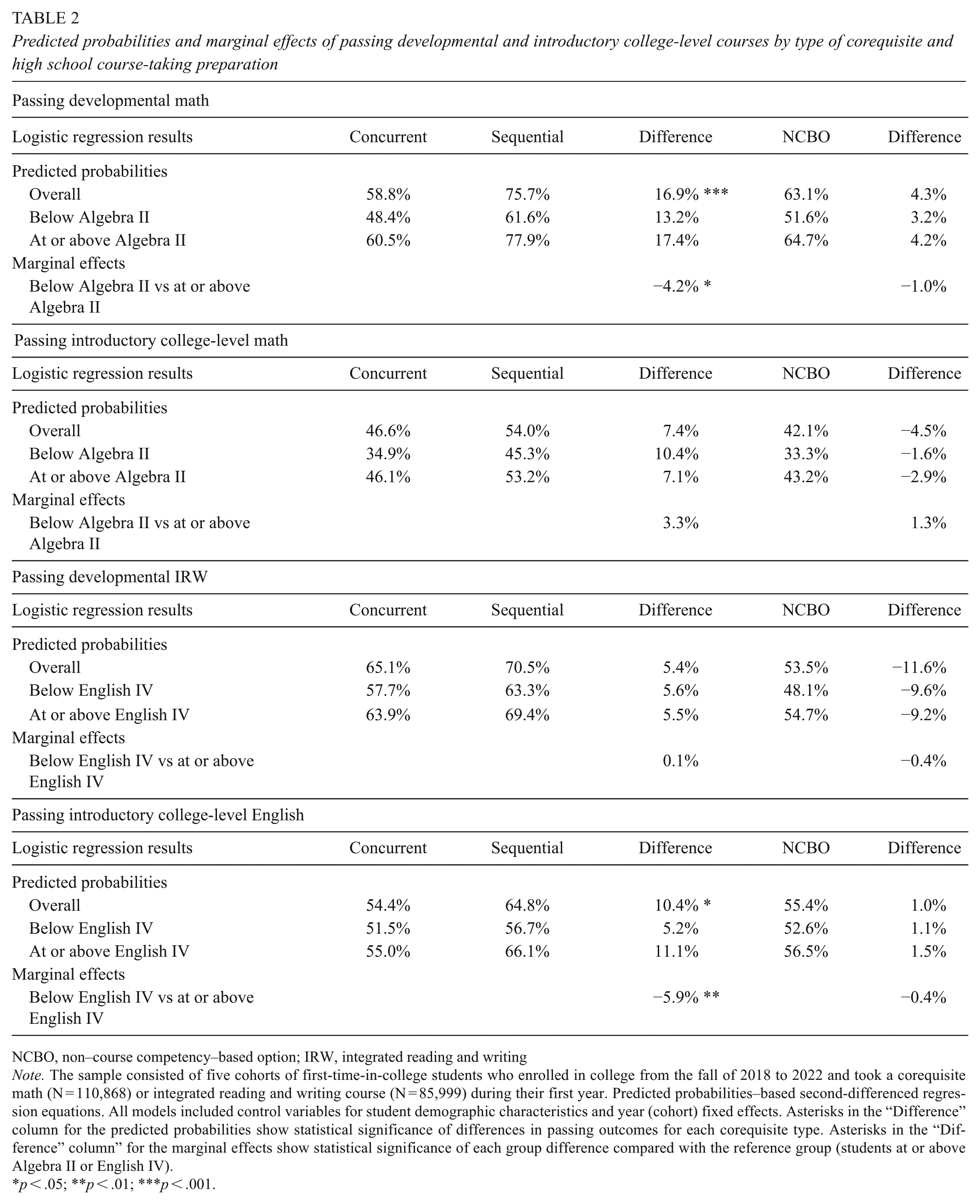
NCBO, non–course competency–based option; IRW, integrated reading and writing
Note. The sample consisted of five cohorts of first-time-in-college students who enrolled in college from the fall of 2018 to 2022 and took a corequisite math (N = 110,868) or integrated reading and writing course (N = 85,999) during their first year. Predicted probabilities–based second-differenced regression equations. All models included control variables for student demographic characteristics and year (cohort) fixed effects. Asterisks in the “Difference” column for the predicted probabilities show statistical significance of differences in passing outcomes for each corequisite type. Asterisks in the “Difference” column” for the marginal effects show statistical significance of each group difference compared with the reference group (students at or above Algebra II or English IV).
p < .05; **p < .01; ***p < .001.
There also were no statistically significant differences in the likelihood of passing developmental IRW by type of corequisite. Students both completing and not completing English IV tended to perform similarly in the developmental IRW course regardless of the type of corequisite. Yet, for the outcome of introductory college-level English, the likelihood of passing tended to be greater for students who took the sequential corequisite model (64.8%) than for students who took the concurrent corequisite model (54.4%). The positive association between passing the college-level course and the sequential model was ~5.9 percentage points smaller for students who had not completed English IV in high school.
Next, we estimated similar regression models examining the relationship between course passing rates and corequisite intensity (Table 3). In math, there were no statistically significant differences in the likelihood of passing developmental math by corequisite intensity, overall, or by completion of Algebra II. There also were no differences in the likelihood of passing introductory college-level math by corequisite intensity. The only statistically significant difference was for the interaction term between below Algebra II and four-credit corequisite intensity (odds ratio = 1.19, p = .45), indicating a positive association between being below Algebra II and enrolled in a four-credit-hour corequisite. Because students below Algebra II tended to have a lower likelihood of passing overall, the results from the interaction term indicated a narrowing of the performance gap between below Algebra II students and at or above Algebra II students in four-credit-hour corequisites. In three-credit corequisites, students at or above Algebra II were 11.6 percentage points more likely to pass college-level math than students below Algebra II. In four-credit corequisites, students at or above Algebra II were 7.1 percentage points more likely to pass (narrowing the gap by 4.5 percentage points).
Predicted probabilities and marginal effects of passing developmental and introductory college-level courses by corequisite intensity and high school course-taking preparation

Note. The sample consisted of five cohorts of first-time-in-college (FTIC) students who enrolled in college from the fall of 2018 to 2022 and took a corequisite math (N = 110,868) or an integrated reading and writing course (N = 85,999) during their first year. Predicted probabilities based second-differenced regression equations. All models included control variables for student demographic characteristics and year (cohort) fixed effects. Asterisks in the “Difference” column for predicted probabilities show statistical significance of differences in passing outcomes for each corequisite intensity. Asterisks in the “Differnce” column for marginal effects show statistical significance of each group difference compared with the reference group (students at or above Algebra II or English IV).
p < .05.
There were no statistically significant differences in the likelihood of passing developmental IRW by corequisite intensity, overall, or by completion of English IV. However, for college-level course outcomes, there were overall positive effects of shorter corequisites (one credit or less and two credits) relative to traditional three-credit-hour corequisites. The benefits of shorter corequisites tended to be smaller for students below English IV than for students completing more advanced coursework. Additionally, the gap between below English IV students and at or above English IV students tended to be slightly greater in four-credit corequisites.
Relationship Between the Share of Students in Corequisite Courses Who Did Not Complete Algebra II/English IV and Student Course-Taking Outcomes
The second research question examined how the proportion of students in a class who did not complete a typical college-preparatory course sequence affected the likelihood of passing the corresponding developmental or college-level component of the corequisite courses. In both subject areas, the average class size was between 15 and 16 students for the developmental corequisite courses (Table 4). However, introductory college-level classes tended to have larger enrollments, with an average of 34 students in math and 37 in English. The average share of peers in each class who had not completed Algebra II was 9.3% for developmental courses and 3.4% for introductory college-level courses. The average percentage of students in each class who had not completed English IV was 12.1% for developmental IRW and 9.1% for introductory college-level English.
Mean and standard deviation for class size and share of peers in class section below Algebra II/English IV by subject area

Note. The sample for the developmental course consisted of five cohorts of first-time-in-college (FTIC) students who enrolled in college from the fall of 2018 to 2022 and took a corequisite math (N = 110,868) or integrated reading and writing course (N = 85,999) during their first year. The sample of the college-level course was expanded to include all FTIC students who took an introductory college-level course in math (N = 386,417) or English (N = 535,093) with corequisite students.
Figure 3 shows the relationship between math course passing rates and the share of students in the corequisite course below Algebra II. For the developmental math course, passing rates tended to be similar regardless of the percentage of the class section below Algebra II for students below Algebra II and for students at or above Algebra II. However, for the college-level math course, passing rates tended to decline as the share of students below Algebra II increased. These trends were similar for students below Algebra II and for those at or above Algebra II.

Average math course passing rates by percentage of the class section below Algebra II.
Figure 4 shows similar descriptive statistics for English course passing rates by share of the class below English IV. For the developmental IRW course, there was a slight downward trend in passing rates as the percentage of the class section below English IV increased. For the introductory college-level English course outcome, a stronger negative relationship appeared between passing rates and the percentage of the class section below English IV. These negative relationships also appeared to be slightly greater for students at higher levels of preparation (at or above English IV).

Average English course passing rates by percentage of the class section below English IV.
Table 5 presents the regression results with predicted probabilities and marginal effects of passing developmental and introductory college-level courses by share of students in the course below Algebra I and the student’s own course-taking preparation. Students at the 25th percentile of students in the class section below Algebra II were defined as being in a class with a “low share below Algebra II.” In contrast, those in classes at the 75th percentile were defined as being in a class with a “high share below Algebra II.” For the outcome of developmental math, there were no statistically significant differences in the likelihood of passing by the share of students below Algebra II in the class, overall, or by students’ own level of preparation. For the second outcome of passing the introductory college-level math course, the sample was expanded to include all students enrolled in these college-level classes regardless of whether they also took a corequisite. This allowed us to examine whether having students who did not complete a typical college-preparatory course sequence in a college-level course affected the academic performance of all students in the class, including those who were already college ready. The results indicated that among all students, the likelihood of passing the introductory college-level math course was 4.2 percentage points lower for students in courses with a high share of peers below Algebra II relative to those in courses with a low share of peers below Algebra II. Additionally, the negative association between passing rates and the share of peers below Algebra II was weaker for students who similarly did not complete Algebra II. The difference in the likelihood of passing between low- and high-share classes of peers below Algebra II was −4.3 percentage points for students at or above Algebra II relative to only −2.2 percentage points for students below Algebra II, a marginal effect of 2.1 percentage points.
Predicted probabilities and marginal effects of passing developmental and introductory college-level courses by share of the students in the class below Algebra II/English IV and high school course-taking preparation
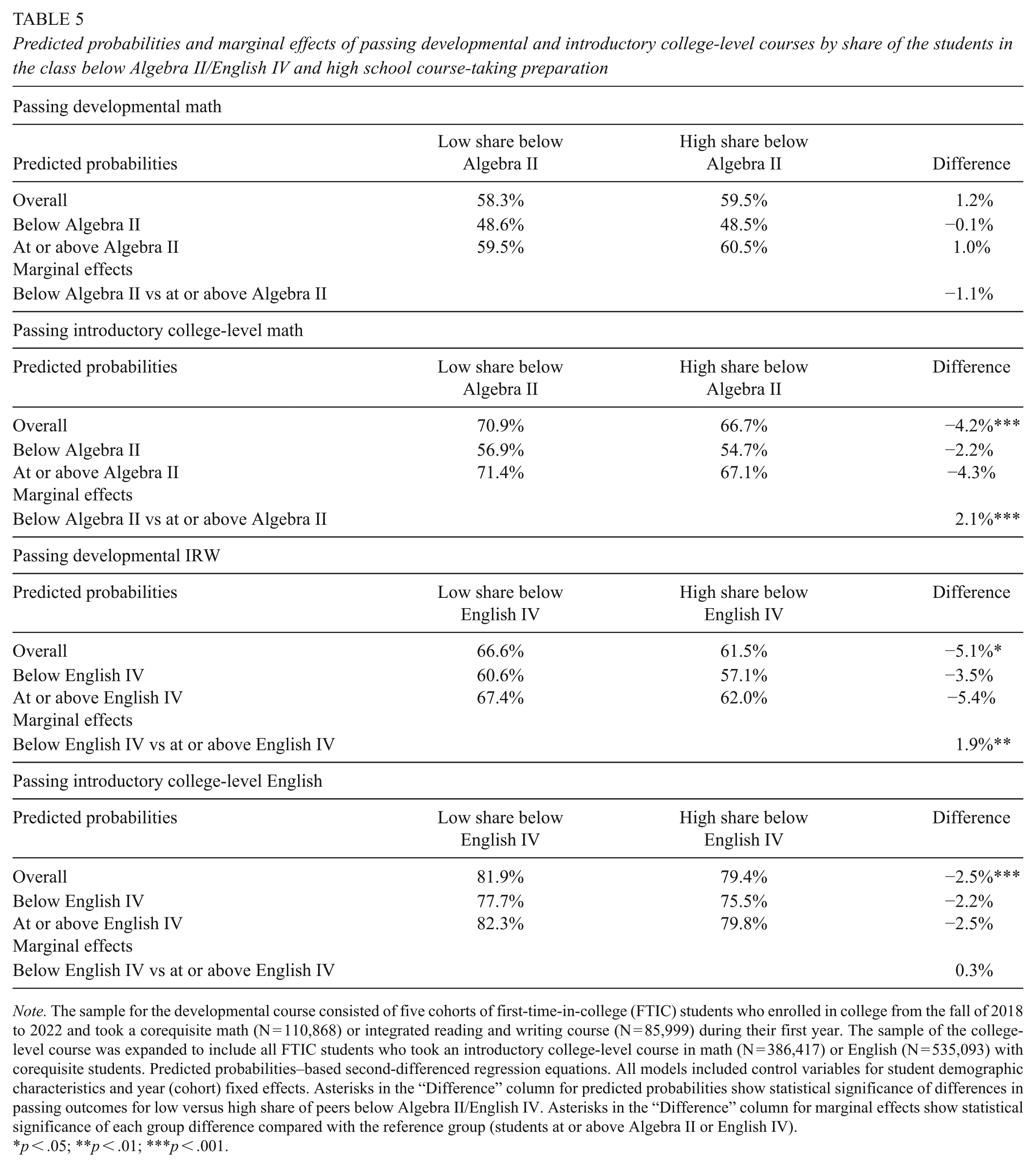
Note. The sample for the developmental course consisted of five cohorts of first-time-in-college (FTIC) students who enrolled in college from the fall of 2018 to 2022 and took a corequisite math (N = 110,868) or integrated reading and writing course (N = 85,999) during their first year. The sample of the college-level course was expanded to include all FTIC students who took an introductory college-level course in math (N = 386,417) or English (N = 535,093) with corequisite students. Predicted probabilities–based second-differenced regression equations. All models included control variables for student demographic characteristics and year (cohort) fixed effects. Asterisks in the “Difference” column for predicted probabilities show statistical significance of differences in passing outcomes for low versus high share of peers below Algebra II/English IV. Asterisks in the “Difference” column for marginal effects show statistical significance of each group difference compared with the reference group (students at or above Algebra II or English IV).
p < .05; **p < .01; ***p < .001.
Similar trends regarding peer effects were found in English. Among all students in developmental IRW, the likelihood of passing the course was 5.1 percentage points higher for students with a low share of peers below English IV relative to those in classes with a high share of peers below English IV. These effects were weaker for students who had not completed English IV themselves. The difference in the likelihood of passing developmental IRW between students in low- and high-share classes of peers below English IV was −5.4 percentage points for students who had completed English IV versus −3.5 percentage points for students below English IV, a marginal effect of 1.9 percentage points. For the introductory college-level English course outcome, the likelihood of passing was 2.5 percentage points lower for students in courses with a high share of students below English IV than for those in classes with a low share below English IV. These results were similar regardless of whether the students themselves had completed English IV.
Discussion
This study has sought to provide evidence from Texas about whether the relationship between corequisite characteristics and student success may differ based on course-taking preparation in high school. Students who did not complete Algebra II/English IV tended to have lower passing rates in developmental and introductory college-level courses than their peers who completed more advanced courses, which suggests that it does matter what types of math and English courses students complete in high school. Yet, no single corequisite type or intensity tended to consistently result in a higher likelihood of passing corequisite courses for this population of students below Algebra II/English IV. Among all corequisite students, passing rates in developmental math and college-level English courses tended to be higher for students in sequential corequisites than the most common types of concurrent corequisites. However, the benefits of sequential courses tended to be substantially smaller for students below Algebra II/English IV. Prior research has found benefits to longer teaching sessions during a condensed timeframe because educators have more leeway to integrate diverse activities within the extended class periods (Edgecombe, 2011). This may include more comprehensive discussions, greater use of hands-on activities, and team-based projects (Daniel, 2000; Jaggars et al., 2015). However, students with less advanced high school course taking may not benefit as much from this format if the support ends in the first half of the semester and they are on their own for the college-level course.
Additionally, there is some evidence that passing rates in introductory college-level English courses tend to be higher for students in shorter corequisite courses (one credit or less or two credits) relative to those who took traditional three-credit corequisites. Yet these benefits of shorter corequisites also were substantially smaller for students below Algebra II/English IV. These findings were similar to those in Florida, where most students could opt out of developmental education courses and enroll directly into college-level courses with additional support outside the classroom, such as tutoring. Student success rates on multiple outcomes improved under the reform, indicating that many students may benefit from avoiding lengthy developmental sequences as long as they are provided with adequate support services (Mokher et al., 2023). However, some students who only completed minimal math and English requirements in high school may need additional time to master the competencies needed for college-level coursework.
We also examined whether there were peer effects from the share of students in the class below Algebra II or English IV. For the outcomes of passing introductory college-level math, developmental IRW, and introductory college-level English, having a higher share of students in the class below English IV was associated with a decrease in the likelihood of passing the course. For two of these outcomes (i.e., introductory college-level math and developmental IRW), the negative association between the likelihood of passing and the share of peers who did not complete the typical college-preparatory course sequence was weaker for students who had not completed Algebra II or English IV themselves. These findings suggest that having many students in a class below Algebra II/English IV reduces the likelihood of passing but not as much for students with similarly low course-taking preparation.
These findings align with and extend prior research on peer effects in higher education by illustrating how the composition of students’ academic backgrounds within corequisite courses may shape individual outcomes. As discussed earlier, three conceptual frameworks—linear-in-means, invidious comparison, and tracking models (Liu & Xu, 2022)—offer plausible explanations for these dynamics. The overall negative association between the proportion of students below Algebra II/English IV and passing rates in college-level courses is consistent with the linear-in-means model, suggesting that students benefit from being in classrooms with more highly prepared peers who may contribute positively to the learning environment. However, the weaker negative effects observed for students who themselves were below Algebra II/English IV may reflect aspects of the tracking model, where students experience more targeted instruction or feel greater affinity and comfort among similarly prepared classmates. Additionally, the invidious comparison model suggests that less prepared students may encounter disadvantages from being with higher-achieving peers if they face negative perceptions about their own ability level or encounter higher grading standards from instructors seeking to challenge more highly prepared students. These results reinforce the importance of instructional strategies that address a broad spectrum of readiness within the same classroom and suggest that the mechanisms of peer influence are complex, operating differently depending on the student’s own academic background.
When thinking about the implications of the negative peer effects from students who did not complete a typical college-preparatory course sequence, it is important to consider Wolniak and Ballerini’s (2020) warning against taking a “reductionist view that selectivity is a viable strategy for improving higher education outcomes” (p. 2197). Excluding less prepared students from opportunities to advance their educational attainment runs counter to higher education’s mission, particularly among community colleges. The practical implications of these findings point to the need for more differentiated support strategies. Institutions may consider using data on students’ high school coursework to inform targeted academic supports, such as tailored tutoring or advising interventions for students entering with lower-level course-taking backgrounds. Moreover, given the documented influence of peer effects, faculty must be equipped to teach classes that include students with a wide range of preparation. Prior research on developmental education reform has found that faculty often report challenges with teaching classes with heterogeneous student ability levels and finding instructional strategies that work for all students (Cafarella, 2016; Jaggars & Hodara, 2013; Walker, 2015). Professional development focused on strategies for differentiated instruction, scaffolding, and inclusive pedagogy can help instructors better meet the needs of diverse learners (e.g. Walker, 2015). Policymakers and institutional leaders also should consider how course placement policies and classroom composition practices may influence outcomes not only for underprepared students but also for their peers as well.
Our findings also suggest actionable insights for educators engaged in classroom instruction. Research has consistently demonstrated that students are more inclined to interact with peers who share similar characteristics—such as academic ability, socioeconomic status, age, or geographic background—a tendency known as homophily in the study of social networks (e.g., Berthelon et al., 2019; Mauldin et al., 2022). Although this pattern is natural, it often limits the formation of diverse peer interactions that could enhance learning outcomes. When students are left to choose their own study partners, they tend to form homogeneous groups, thereby missing out on potentially enriching relationships. Educators can counteract this tendency by deliberately designing classroom activities that foster cross-group interactions. For example, assigning students to groups randomly or based on mixed ability levels can facilitate connections that would not occur naturally. These strategies increase the likelihood of social ties forming between students of varying backgrounds and skill levels. As a result, lower-performing students may benefit from exposure to higher-performing peers, improving both the overall quality of group collaboration and individual academic achievement.
Conclusion
This study underscores the complexity of effectively supporting students with less advanced high school course taking within corequisite education models. Despite the overall success of corequisite courses in enhancing student outcomes compared with traditional developmental sequences, our findings indicate that no single corequisite type or intensity is universally optimal for all students, particularly those who did not complete typical college-preparatory coursework. Sequential corequisites and shorter-duration courses, while beneficial for many, offer reduced advantages for those with less advanced course-taking preparation. Peer effects further complicate these dynamics because classes with a higher proportion of students below Algebra II/English IV generally exhibit lower passing rates; however, this impact is less pronounced among students with similarly low course-taking preparation. These insights call for reconsidering current corequisite implementation strategies and advocating for more personalized support mechanisms and pedagogic adjustments to cater to diverse student needs. Institutions must invest in professional development for faculty to equip them with the skills necessary to manage heterogeneous classrooms effectively. By fostering a more inclusive and supportive educational environment, colleges can better serve all students, particularly those with weaker course-taking preparation, ultimately enhancing their chances of success in higher education.
Footnotes

Funding
The research reported here was supported by the Institute of Education Sciences, U.S. Department of Education, through Grant R305A210319 to Florida State University. The opinions expressed are those of the authors and do not necessarily represent the views of the Institute of Education Sciences or the U.S. Department of Education. The conclusions of this research do not necessarily reflect the opinions or official position of the Texas Education Agency, the Texas Higher Education Coordinating Board, the Texas Workforce Commission, or the State of Texas.
Declaration of Conflicting Interests
The authors declare no potential conflicts of interest with respect to the research, authorship, and/or publication of this article.
Notes
Authors
CHRISTINE G. MOKHER is the James A. Shanks Endowed Professor at Florida State University’s Department of Educational Leadership and Policy Studies. Her research uses mixed methods to rigorously examine national, state, and local policies that support college and career readiness and success, with the aim of informing educational practice and policy reforms.
TOBY J. PARK-GAGHAN is the associate dean for academic affairs at the Anne Spencer Daves College of Education, Health, and Human Sciences at Florida State University and a professor in the Department of Educational Leadership and Policy Studies. His research uses quasi-experimental methods and large statewide datasets to investigate student outcomes in postsecondary education and explore potential policy initiatives that could improve student success.