




Abstract
Street youth experience similar exclusionary tendencies in German regular schools as in the society at large. These negative schooling experiences push many street youth out of school, leading to graduation gaps and causing street careers to emerge. Street schools have responded to these inequalities, offering street youth more humanizing alternatives. Drawing upon a rightful presence framework, dialogic interviews with 14 educators and 10 school leaders, mission statements, and websites of street schools, we sought to understand how street schools may foster equitable educational opportunities for their students. Analysis focused on how street schools’ educators and leaders engage in an ongoing political struggle to support their students’ educational rights. Findings reveal that street schools not only criticize existing structures of the educational system, but also consciously reject them—despite consequences. The findings accentuate where and how the systems of schooling need to change to facilitate educational equity for street youth.
Keywords
Introduction
On a cold fall day, we visited Street School A. From the outside, the building did not look like a typical school. Only a small sign indicated its purpose. Upon entering, we found ourselves in the middle of a large, warm, and winding room full of life. An LGBTQ flag was displayed in one corner, signaling that everyone is welcome. Clusters of tables were scattered around the room, and groups of youth, some with and some without educators, were working together. We also noticed some youths taking a break on a sofa and others making themselves food in the kitchen corner.
As the school leader showed us around, she asked a group of three girls if they would like to talk to us. We noticed a dog lying relaxed under the chair of one of the girls. Mandy, Bernice, and Esther (names changed) had all dropped out of regular school 1 and were now at the street school, hoping to obtain a school diploma. The girls told us about their negative experiences in regular schools, although they did not go into detail. They also told us that their experiences at their street school differ significantly. For example, they no longer feel like outsiders but rather feel fully accepted.
Dropping out of school early and (lived experiences of) being unhoused are common but not required elements of youth who attend street schools in Germany. Mandy, Bernice, and Esther belong to this group of street youth, 2 of which there are approximately 37,000 people in Germany (Hoch, 2017). This group consists of youth up to and including age 26 who either experience homelessness or who were/are at risk of becoming homeless. A second defining characteristic is an existing detachment process from “normal” socialization instances, such as school and family, and an orientation toward the “street” (Hoch, 2016). While there are no newer figures on street youths since Hoch (2017), official statistics show the rapid growth of youth homelessness in general. With around 194,000 homeless minors and young adults in 2024, the figures have doubled in the last two years (Bundesministerium für Wohnen, Stadtentwicklung und Bauwesen, 2025).
An above-average number of street youth are “pushed out” of school by policies and practices that limit students’ abilities to fully and meaningfully participate (Tuck, 2012). According to data from Hoch (2016) and Lotties (2024), around 28% of all street youths leave school early, compared to the overall average of 6% between 2016 and 2023 (Klemm, 2023). This graduation gap is similar across many western nations. In the US, the only western country known to us with a specific policy to support unhoused students (the McKinney-Vento Act), 66% of unhoused students graduate from high school—compared to 86% of housed students (Kull et al., 2019). In Canada, the figures—47% versus 91%—are also alarming (Gaetz et al., 2016). These gaps highlight the educational inequality inherent in regular schooling, which only partially meets the educational needs of marginalized groups.
Despite being pushed out of regular schools, many street youth wish to obtain school-leaving certificates (Beierle, 2017). However, after leaving school, they face immense challenges reintegrating into regular schools with few suitable alternatives (Beierle, 2019). The challenge is not unique to Germany. Similar situations exist in the US, and disproportionately so for youth of color and immigrant youth, despite efforts to legislate access (Edwards, 2019).
Although street youth worldwide face (educational) challenges, street schools 3 offer a unique solution that, in this modality, we have encountered only in Germany—for reasons we can only speculate about. While schools with similar aims exist globally, such as Monarch School in San Diego, California, their structure and reach are shaped by local policies and sociopolitical contexts. In Germany, where housing instability among students remains largely unacknowledged, no formal supports exist within the regular education system. This policy gap has led local actors to create street schools.
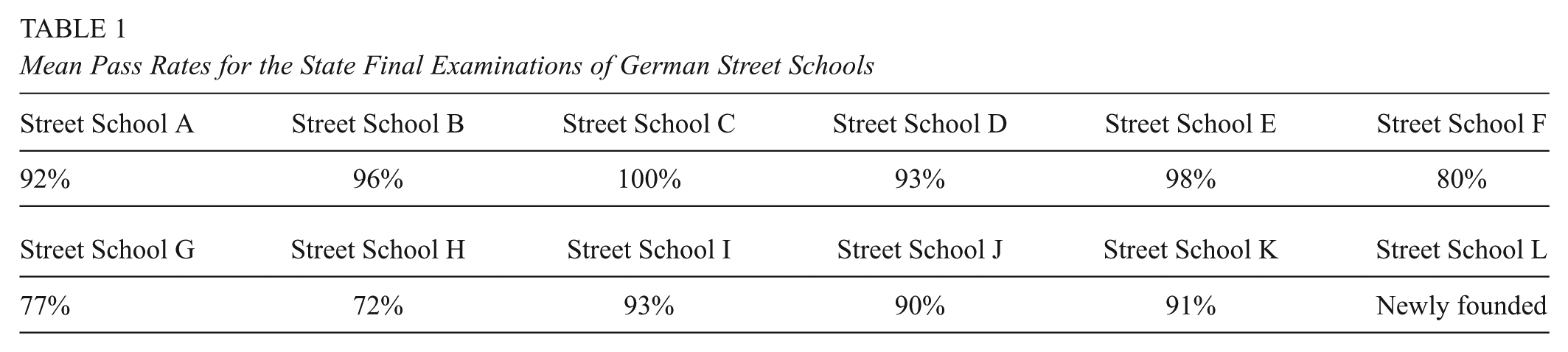
Street schools offer educational opportunities to school dropouts/pushouts in unstable housing conditions and enable them to catch up on school-leaving qualifications, while considering their (educational) needs. The pedagogical approach of street schools differs significantly from regular schools (Fischer & Tobin, 2024). Both pass rates on state final examinations 4 (Table 1) and students’ feedback suggest that this model promotes educational success and ensures street youths a rightful place in the educational system. By doing so, street schools challenge the inequitable educational status quo. By using Calabrese Barton and Tan’s (2020) rightful presence framework, we explore the following questions:
• In what ways do street schools promote rightful presence for their students?
• What challenges or limitations do they face in their efforts to promote rightful presence?
Mean Pass Rates for the State Final Examinations of German Street Schools
Experiences of Marginalization
Statistics about street youth indicate their diverse experiences of marginalization. Hoch (2016) showed that 40% of all street youths have a migrant background, while, in 2016, this was the case for only 23% of the German population (Statistisches Bundesamt, 2017). Most street youth also grow up in families experiencing poverty, although quantitative studies are lacking (Mögling et al., 2015). Additionally, there is no German study yet that has investigated a potential correlation between youths identifying as LGBTQ and homelessness (Steckelberg & Eifler, 2024)—a connection existing in the US (Morton et al., 2018).
To better understand the graduation gap and further experiences of marginalization, we explore the lives of street youth. Studies show that their childhood and adolescence are often marked by severe stress, disruption, and traumatic events, mostly caused by poverty, family conflict, and unstable family situations (Beierle, 2017). These circumstances in families can lead to unstable living situations (Bielert, 2006). If familial situations deteriorate over time, adolescents are asked to leave home by their parents, leave on their own, or are removed from families by welfare services (Annen, 2020; Sonnenberg & Borstel, 2021). Youth placed in the youth welfare system early also experience exclusion in this very system. For example, when youth come of age, they are often expected to leave the system and become independent. For many, this marks the first step toward homelessness (Annen, 2020). Thus, many adolescents experience dissociation from their families as well as the youth welfare system (Bielert, 2006).
Before detailing school exclusion experiences, we note that most cited studies involve street youths who have already left school, making it unclear if they were homeless during their school years. We therefore refer only to “young people” in the following.
Many youths experience unfair treatment and marginalization in school (Hallett & Skrla, 2017). They encounter bullying, social exclusion, and a lack of positive peer relationships (Annen, 2020; Mücher, 2020). Furthermore, many report ongoing conflicts with teachers, being labeled as problem students and experiencing sanctions instead of support (Beierle, 2017; Mücher, 2020). They only occasionally state that teachers are interested in them and their circumstances (Bielert, 2006). Consequently, they lose trust in and reject the institution of school (Mücher, 2020).
These situations have cumulative effects on the young people, contributing to withdrawing from schooling, which is often interpreted by school staff as deviant behavior requiring disciplinary action (Budemann & Schweers, 2004). For example, in Germany, one can theoretically be imprisoned for excessive truancy (Ricking & Hagen, 2016). Research also indicates that high dropout rates and poor school performances among youth can be explained by their difficult circumstances (Annen, 2020). Family disruptions and frequent school changes lead to missed lessons and limit their abilities to concentrate well when present (Mücher, 2020). Youths’ situations are exacerbated by schooling policies and practices that are not responsive to their (educational) needs, leaving them with limited individualized support and academic guidance (Annen, 2020). Regular school structures, such as attendance policies and crowded classrooms, make it challenging for teachers to support them in nontraditional ways (Braun, 2001; Mücher, 2020). Additionally, schools and teachers are not always aware of youths’ difficult circumstances and are therefore unable to help them adequately (Frietsch & Holbach, 2016).
Street youth, whether in regular or second-chance schools, make remarkable efforts to prioritize education despite facing severe hardships. First, street youth experience unstable housing. Precarious housing situations can mean, for example, that youths stay with friends for a period while being completely dependent on the hosts and having no privacy. It can also mean staying in overcrowded shelters. For some, it means having to move back in with family despite ongoing conflicts (Hoch, 2016). Additionally, they experience financial difficulties. While minors often rely on the not always available financial support of their parents, most street youths of age receive social benefits. However, benefits are reduced if requirements are not met, such as reporting address changes or showing up regularly for work readiness programs (Hoch, 2016; Mögling et al., 2015). Furthermore, applying for social benefits represents a major hurdle for youths (Mücher, 2020). As a result, they have difficulties meeting their basic needs, such as eating regularly (Flick & Röhnsch, 2009). Due to their living situation, youth are also increasingly exposed to discrimination, exclusion, and violence as well as serious (mental) health risks (Flick & Röhnsch, 2008; Sonnenberg & Borstel, 2021).
Despite negative school experiences, many street youths who were pushed out of school have educational ambitions and wish to obtain a school-leaving certificate (Beierle, 2017). They see school-leaving qualifications as key to a normal life as part of society (Kliche & Annen, 2025). However, most of them refuse to return to regular schools due to their previous experiences or are not accepted back into regular schools (Beierle, 2019, Bielert, 2006). Accordingly, after leaving school, these educational ambitions are rarely realized (Permien & Zink, 1998). Consequently, there is a need for educational services, such as street schools, that foster educational equity by offering suitable educational programs.
The Rightful Presence Framework
The rightful presence framework stems from political sociology studies of the potentials and limitations of the practice of sanctuary in sanctuary cities (Squire & Darling, 2013). In sanctuary cities, the right to participate in society is extended to all participants, including migrants who take refuge, regardless of federal policy. As Vrasti and Dayal (2016) explain, “a sanctuary city is one that grants people ‘access without fear’ . . . to municipal services regardless of their status, and also pledges to not use municipal funds to enforce federal immigration law” (p. 996). In practice, sanctuary has come to signify a culture of hospitality where newcomers are welcomed into a safe environment, protected from deportation, and granted access to city infrastructure.
Despite the warmth of hospitality, such relationships also position newcomers as guests with socially constructed and conditional rights and responsibilities (Squire & Darling, 2013). The power to host inherently involves control over those being hosted, as their status remains dependent on the terms set by the host. As refugees are granted the right to participate in society, these rights are shaped by the political context that underpins them. In other words, the conditional transfer of rights makes it difficult for refugees to leave their guest-status (Shirazi, 2018). These unequal guest-host relationships often perpetuate dominant power structures and can lead to dehumanizing rules and actions (Doty, 2006). Likewise, in schools and classrooms, inequalities present in society are manifested, thus reflecting, and maintaining, the current structure of society (Artiles, 2011; Mills & Ballantyne, 2016).
Rightful presence distinguishes between inclusionary and justice-oriented modes of equity (Calabrese Barton & Tan, 2020). Reforms, long grounded in equity as inclusion, have focused on access to and participation in schooling, with limited attention to the undergirding politics of these spaces. Such politics norm schooling and the rights to participate in relation to Whiteness and heteropatriarchy, and we further argue to economic and housing security. Thus, despite being welcomed to schooling, youth may have only limited rights as guests and are expected to take up normative, dominant practices. Youth are subject to exclusion or otherization when they do not.
Rightful presence is, indeed, a call to reform what it means to legitimately belong in a space, whether it be a sanctuary city or a classroom. As such, to be rightfully present questions the very limits of inclusion, and in so doing makes visible the possibilities for what it means (and can mean) to be fully human and present in educational spaces. To identify and understand practices and structures that contribute to rightful presence, the framework includes three tenets (Calabrese Barton & Tan, 2020, p. 436):
Allied political struggle is integral to disciplinary learning: the right to reauthor rights (Tenet 1)
Rightfulness is established through presence: making visible the intersections and justice/injustice in the present while orienting toward new social futures (Tenet 2)
Shared burden/cost between currently powered and the othered: culture of disruption toward justice, where modes of power/authority are collectively called in question (Tenet 3)
In our work in education, we see the possibilities of working toward rightful presence existing in pedagogical and curricular practices, among other practices that shape life in schools. From this perspective, at the heart of working toward rightful presence is allied political struggle among teachers and students. That is, possibilities for rightful presence emerge when students and teachers collectively engage to examine, disrupt, and transform how power operates in how participation in schooling is operationalized, including but not limited to, daily routine practices, norms, spatial configurations, and relationalities among learning community members. Allied political struggle thus makes visible the values and ideologies upon which the rights to an education are based and how they take shape in the structures that make up educational systems. Allied political struggle also makes visible the possibilities for social transformation by making present the whole of youths’ lives, including their individual and community strengths, along with their historicized oppressions.
In school settings, where students are often consigned to the status of guests, working toward a rightful presence means engaging in this very struggle to reorient life in classrooms and schools from a guest-host relationality to new concrete practices that exceed and rewrite these uneven power relations (Squire & Darling, 2013). Through political struggle, rightful presence attends to the consequentiality of interconnected histories and lived encounters of the marginalized in engaging the very question of what and who counts in schooling. It focuses on the struggle to challenge, reimagine and recreate a radically new politics of educational equity.
To be rightfully present is not a state of being so much as an ongoing or continuous process of disruption of self/other, guest-host relationalities, and their underpinning relations of power, toward new forms of legitimacy. Here, we refer to legitimacy in schooling for youth from nondominant communities such as the street youth we focus on, as precisely about making present, including making visible their historicized lives. For youth from nondominant communities, this is exactly what dominant structures seek to make invisible. Therefore, the political and social injustices experienced by street youth must be addressed, and rights must be redistributed through the allied political struggle of the more powerful (teachers and school leaders) and the less powerful (students, street youth) through both practice and policy (Calabrese Barton & Tan, 2020).
Rightful presence is a highly political ideal, with explicit attention to justice and to those who have been oppressed by dominant power structures (Tan & Calabrese Barton, 2023). Those of dominant communities historically have, by and large, been legitimated in schooling spaces because underpinning politics of the right to participate benefit them. A rightful presence stance focuses on humanizing education by calling concrete attention in the here-and-now on how normative and standards educational practices and structures actively make injustice invisible, especially that which is experienced by nondominant communities (Yeh et al., 2021).
Data & Methods
Study Context
Street schools have been independently founded by individuals or social service providers in response to the need for suitable educational programs for street youth. We define street schools as educational institutions that enable street youth to catch up on school-leaving qualifications, while considering their unique (educational) needs and circumstances. In street schools, youth are usually prepared for final examinations within one or two years, depending on individual needs. As described in the introduction, the learning environment usually differs from regular schooling. In most street schools, learning is designed for individualized or small group instruction with flexible timetables. Furthermore, social workers support youth beyond a curricular focus, such as when applying for social benefits. However, street schools generally do not have the status of a state-recognized school, and are considerably smaller, with the largest street school having about 120 students. An in-depth description of street schools and their relation to the German school system can be found in Appendix A.
Study Design, Data Generation, and Participants
The design of the study 5 and the data analysis have partly been described in Fischer and Calabrese Barton (2026). However, that publication focused specifically on science education in street schools.
This study was conducted in two phases. The first phase involved a systematic search for street schools in Germany based on the following criteria:
• A considerable proportion of students are street youths;
• The educational program is tailored to their unique circumstances and (educational) needs;
• Students can catch up on school diplomas;
• It is open to youth aged 14 to 25.
We searched the internet for street schools using relevant terms and then reviewed their websites based on the criteria. If the homepages passed an initial check, we called the educational institution and asked them to describe their educational program. Together, we determined whether they are a street school. We then invited them to participate in our study, which included interviews with school leaders and educators. Furthermore, interviewees were asked whether they knew of similar educational programs for youth in difficult circumstances. The educational programs mentioned were again examined regarding the criteria. Thus, both a criterion sampling and a snowball sampling approach were used to systematically find street schools in Germany (Mertens, 2019).
In total, twelve street schools were identified, of which ten schools agreed to participate in our study. Table 2 provides a detailed description of each. In exchange for participating, we offered to share the research findings with them and the public to raise awareness of the topic.
Description of the Participating Street Schools at the Time of Data Collection

The second phase involved qualitative data generation which included the collection of specific documents—mission statements (abbreviated with M) and websites (abbreviated with W)— and interviews (Helfferich, 2022). Interviews were conducted with ten school leaders and 14 science educators. Table 3 provides an overview of the interviewees, highlighting that their educational backgrounds often differ from those of traditional teachers. As no other person volunteered to participate and the data suggested saturation, the data collection was concluded at this point (Mertens, 2019).
Description of the Interviewed School Leaders and Educators

The interview guideline was built on the offer-and-use model by Lipowsky (2006) - a structural model of schooling. In this model, lessons are an offer that is individually used by students. The outcome, for example, learning success or enjoyment of learning, depends on the students’ use of the offer which is influenced by individual learning dispositions. The lesson’s quality is primarily influenced by the teacher’s skills. Additionally, other factors are considered that also have an indirect influence on offer and use, such as school, economic, or family circumstances. Using this model to guide our interviews, we explored educational programs in street schools and factors shaping their practices. Additionally, interviewees were asked about key challenges faced by street schools, as well as success stories of youth who attend them.
Due to the COVID-19 pandemic, we were unable to visit the street schools during the data collection. Consequently, the interviews were conducted by the first author in German via video calls on Zoom. They lasted an average of 55 minutes, with the shortest interview lasting 34 minutes and the longest 100 minutes. The visit to the street school mentioned in the introduction took place after the data analysis.
Data Analysis and Issues of Trustworthiness
We approached the data as external researchers and insider allies. One of us has taught in a street school, while the other has personally experienced transience. We conducted a qualitative content analysis of the interviews, the mission statements, and the websites. The content analysis, as described by Kuckartz and Rädiker (2021), involves a systematic, step-by-step process comprising multiple phases of analysis and interpretation. The use of different data sources enables data triangulation and thus supports a balanced view of street schools’ educational programs (Flick, 2020).
As outlined in Fischer and Calabrese Barton (2026), we began the analysis by familiarizing ourselves with the data followed by highlighting passages that indicated the promotion of rightful presence. Next, selected highlighted excerpts were individually interpreted and subsequently discussed collectively, using the three tenets of rightful presence as an analytical lens. These discussions generated an initial shared understanding of rightful presence in street schools. With this understanding in mind, we revisited the data to identify additional passages that demonstrated either the promotion or absence of rightful presence. Through iterative reflection and dialogue, we deepened our understanding of rightful presence and its possibilities, challenges, and contradictions. Next, by looking at the identified passages, we inductively identified themes and sub-themes related to our research questions. These themes were collaboratively refined into a category system comprising three main themes and various sub-themes (see Table 4). Furthermore, a coding manual was developed including illustrative interview excerpts (Appendix D). Using this manual, we systematically coded the interviews and documents. Subsequently, we conducted a more detailed analysis by paraphrasing and clustering the coded text segments. At this stage, we again examined the data in relation to the rightful presence framework, identifying where connections were particularly salient. Finally, we explored the relationship between the identified themes and the original data. The continuous collaborative discussions ensured communicative validation (Kuckartz & Rädiker, 2021).
(Sub-)Themes Showing how Rightful Presence for Students is Promoted in Street Schools

As described in Fischer and Calabrese Barton (2026), to ensure trustworthiness, we employed multiple strategies (Cian, 2021). One part of these strategies was to triangulate findings across multiple interviews and between interview and document analyses. To monitor our subjectivities, we began by investigating data independently and then engaged in a periodic peer-debriefing process until consensus. By doing so, we constantly refined our understanding of the data, our construction of codes, and the evolution of codes as well as claims. Throughout the whole process, we actively searched for disconfirming evidence—an effort that led to the third theme. Our consensus-building approach required us to articulate and reflect on our subjectivities, as we explained and justified our interpretations to one another. Finally, we maintained an audit trail to enhance transparency. The audit trail documents our methodology, including sampling strategies, interview guidelines, coding processes, and claim development (see Appendices B, C, and D).
Limitations
The study’s limitations are twofold. First, we focused on the view of educators and school leaders through interviews and document analysis. We did not interview youth for different reasons. Due to the COVID-19 restrictions, we could not visit street schools in person. Moreover, street schools are dispersed throughout Germany, making it difficult to spend time with the youth and to build trust—an essential step for collecting reliable interview data (Annen, 2020).
Second, the choice of our research methods, and the resulting data, may have limited the scope of our analysis. Based on the interviews and the documents we can only make limited statements about the extent to which the actions or attitudes of the interviewees and the approach of street schools prevent the realization of rightful presence. Consequently, our second research question focuses exclusively on the systemic challenges and limitations street schools encounter in their efforts to achieve rightful presence. We recognize that street schools and the people working there are not perfect. For example, not all street school students graduate. It remains unclear whether young people leave due to acute life circumstances or because they have not experienced a rightful presence. Still, the success of these schools—evident in graduation data and highlighted by Fischer (2025)—along with the compassion of educators and school leaders reflected in the interviews, suggests meaningful progress toward achieving rightful presence for their learners.
Findings
The interviewed educators and school leaders described their efforts to rightfully make present their students’ lives through their pedagogical practices. These efforts are seen in the following themes and subthemes (Table 4).
Rooting Practice in Sociopolitical Solidarity and Unconditional Trust
This first theme explores educators’ stances toward youth and their roles as educators in street schools. We show how core to their perspectives was the importance of rooting practices in sociopolitical solidarity and unconditional trust. Sociopolitical solidarity challenges the limits of inclusion. It calls attention to the centrality of disrupting unjust systems through building humanizing and liberatory alliances with youth, that are oriented toward social justice. For the educators this meant valuing the strengths, knowledge, and perspectives youths have because of—not despite of—their lived experiences. It also meant meeting youths at “eye-level” by giving witness to and being co-learners of students’ lives, and emphasizing community-building and actions that disrupt normative teacher-student power relations. Lastly, and cross-cutting the previous subthemes, it meant engaging these practices toward providing a safe harbor for the youths.
Valuing the Lived Experiences and Individual Strengths of Youth
The interviewees and the documents stressed the importance of valuing the youths as whole people, with powerful strengths grounded in their lived experiences. A critical aspect of this view was the importance of unconditionally accepting them and their life situations, without judgment or prejudice. In contrast to the often deficit-oriented way society views street adolescents, the interviews and the documents demonstrated “a high level of awareness” (Lena, 16 6 ) of the agency and strengths that youths have, both traditional and nontraditional. For instance, the fact that they take schooling into their own hands despite negative educational experiences and difficult life situations, and even when their views of education differ from normative practice, was viewed by educators as an expression of agency. This awareness of agency is seen in the following quote, where Joel, an educator, equated attending street schools as a willingness to fight a system that works against them: “Their greatest strength is that they are visiting our street school. That shows that they are willing to fight” (Joel, 60).
Interviewees described their students as “smart” (Lena, 34), “intelligent” (Susanna, 57), “motivated by their own questions” (Peter, 48) to learn and achieve, further demonstrating their strengths-based perspective. Educators described youths’ failure to thrive in regular school settings as consequence of how the “imperfections” (Jim, 32) of the regular school system work together with youths’ “difficult life circumstances.” While they uplift the youths’ strengths, they also acknowledge that some youths are “difficult to deal with” because of their “destructive behavior” (Susanna, 57). However, educators tried to understand students’ behavior in holistic ways and setting goals from a humanizing perspective. They, for example, were satisfied when students were able to simply rest at school, as, from their experience, becoming more grounded in the school space is often the first step to resuming schooling. This approach can be found in the story Susanna, a school leader, told us about a young person: We allowed him to sleep on our sofa. This gave him the feeling that he was accepted, and he slowly opened up. We provided a lot of support. As a result, he became more stable and was able to come more often and to work on educational content. (Susanna, 57)
Consequently, interviewees described the importance of welcoming and trusting the whole student even if this meant taking extra time. This way, more than one young person “blossomed” (Susanna, 57), for example, because they rediscover their strengths.
Yousef, another educator, described the youths as having many strengths, while viewing “gaps” in traditional school knowledge as opportunities for new questions and fascination to arise: “They have plenty of strengths. The knowledge gaps leave room for questions and fascination. Also, their life experiences and prior knowledge allows them other perspectives on topics” (Yousef, 53). While many educators from regular schools may perceive gaps in youths’ learning as missed knowledge, Yousef made clear the power and importance of lived experience—in this case, the ability to be easily fascinated, and to see questions from novel perspectives. In fact, most interviewees pointed out that adolescents’ prior experiences are valuable in the classroom and should be incorporated even when those experiences do not clearly map onto academic content.
Meeting Students at Eye-Level
Another cornerstone of the educational approach is what interviewees described as educator-youth interactions taking place at “eye-level.” In street schools, eye-level—a German metaphor—means that educators and youth work together on more equal terms, with shared power. This kind of power-sharing was not only described as distributing who has the authority to make decisions, but rather is rooted in a fundamental acceptance of the other as fully human with important contributions, as discussed above. Educators emphasized not standing above the youths because of their subject-specific knowledge and other school sanctioned forms of authority. Lena explained her role as a “learning companion”: You have to deal with each other as equals because the students bring a lot of life experience. They have mastered many things that other people don’t even know exist. That deserves appreciation. That’s why you, as a teacher, shouldn’t present yourself as the great savior. . . . You work together with them and simply figure out how you can make a difference. The term ‘learning companion’ is quite fitting since you just accompany the youths on their way. (Lena, 30)
This quote reveals how Lena valued the knowledge that youth have because of their experiences—forms of knowledge educators do not have but that are highly meaningful in learning. Rather than maintaining traditional teacher-student roles, the interviewees stressed how they are trying to disrupt these normative hierarchical structures by replacing them with mutual appreciation and respect.
Furthermore, according to the interviews, educators eschewed traditional student-teacher roles with implicit hierarchies in favor of being co-learners. That is, educators view the youths as equals with different but equally worthy prior experiences. For example, one street school’s website stated that “equality, together with diversity, represents the success factor” (W10, 22) for them. These teacher-student roles grounded in “eye-level” and in the appreciation of youths’ life experiences underpin this co-learning stance—as illustrated in the following interview quote: Only in a few other educational settings have I been able to learn as much from the students as I have in the street school. It, as corny as it may sound, really is a give and take. It’s really a very eye-to-eye situation. (Jim, 52)
Jim described how working with youths at eye-level allowed educators and youths to learn from each other in a “give-and-take.” His stance was shared widely among the interviewees, with many pointing out that this kind of power-sharing is “very important,” grounded in “people valu[ing] and respect[ing] each other“ (Lena, 30), and in seeing youths as experts of their own lives and learning processes. As Sönke, a school leader, stated, it “requires an acceptance of the other person as the only expert on personal matters” (Sönke, 22). Consequently, in street schools, the staff supports, encourages, and trusts the youth to decide on their own how and when they want to learn.
According to the interviewees, street schools may constitute the first environment in the educational lives of street youth where they are treated with respect. The different nature of this approach is reflected in how some street schools reject applications from teachers who have previously taught in regular schools. As Lena explained, “teachers who come from regular schools, can have problems with this [(approach)], because they are used to something completely different” (Lena, 38). Lena reveals the deep importance of meeting students at eye-level, noting that educators with experience in regular schools often struggle to relinquish the authority inherent in the teacher’s role and to perceive youths as capable of planning their own learning processes.
Providing a Safe Harbor for Youth
The interviewees and documents stated that the basis for every action in the street schools is building unconditional trust in youths. This trust is essential in fostering an atmosphere of safety, which interviewees viewed as a prerequisite for learning. To feel safe, educators explained, youths must be valued as whole people—even if their past or present differs from that of the educator and of traditional social norms. According to the educators, safety includes being able to express wants and needs without fear, to ask questions without being laughed at, and to make mistakes. One street school’s website portended this connection between relationship-building, missing prejudices, and learning: The most important prerequisite is to be able to engage with the students’ lifeworld and to meet them openly and without prejudices. Only through the development of sustainable and reliable relationships can learning and working together succeed in our street school. (W2, 20)
To create this atmosphere of safety, interviewees believed that youths need opportunities to build trust with the staff and with their classmates through ongoing, active relationship work. As the school leader Margot explained: “One prerequisite for our work is trust and intentional relationship building. That is the basis for working with a group like our students are. This does not happen overnight. It takes plenty of time” (Margot, 17). Margot furthermore emphasized the importance of using school time to establish and build relationships. Part of this relationship work is that educators not only show interest in the learning processes but also in the youths’ life stories and share parts of their own lives with them, again reflecting the eye-level, give-and-take emphasized earlier. Educators also described using unconventional and creative approaches to spending time together. For example, they reported going for walks or drinking coffee together with youths during/after class. While interviewees acknowledged relationship work is filled with tensions, maintaining relationship work and seeking to understand the youths’ perspectives was named essential: “We keep relationships just like parents do. Even if children mess up, parents will still say, ‘I love you and I will always take care of you.’ And that’s our mantra. We maintain relationships, too” (Bernd, 52). The interviewees explained how these experiences are often in stark contrast to youths’ prior school experiences. Thus, the youths in street schools often need to be convinced that educators are authentic and trustworthy; that they are on their side and will not push them away if they “misbehave.” The eye-level relationships and a stance of trust in favor of the youth are what educators believed help them to see and interpret youths’ actions and behaviors in supportive ways. As Manuela, a school leader, described: “Of course, many behaviors, such as ‘I’m not up for it,’ can also mean: ‘I’m not up for it because I don’t understand it right now’” (Manuela, 46).
Additionally, according to the interviews and documents, street schools actively promote positive group cohesion and mutual trust, for example, through team-building activities. In her interview, Johanna described a pivotal conversation she had with one youth. In the following quote Johanna explained that such a group feeling represents a strong contrast to previous school experiences and a valuable resource for the youths: A participant once told me that every student was a misfit in their former classes. But in the street school, they have formed a class of misfits—that no one is a misfit anymore. That’s the best thing. It enables them to work together much better. (Johanna, 54)
To ensure this atmosphere of safety, interviewees emphasized that any form of violence, exclusion, discrimination, and racism is unwelcomed in street schools. In contrast to the youths’ experiences in regular schools, educators want their schools to become a permanent place of refuge, as Lena explained, “the school itself should be a place of refuge to help over certain times” (Lena, 92).
The interviewees emphasized that the youths in their schools are never given up on. They stressed how they always seek new and creative ways of providing support and standing by the youths’ side—particularly because some youths lack a trusted confidant or a space to “unwind.” Educators expressed the wish to show them that—even if their families or other institutions no longer want them—they are welcome. This includes an optimistic view of the youths’ futures and a belief that they will realize their goals—regardless of their pasts or recent setbacks: “Successes will come in any case. However, the path to success often consists of small steps. Setbacks are always part of the process” (W2, 20).
Taking Actions in Making Youth’s Lives Visible and Building New Humanizing Structures
This second theme explores how street school educators envision and build school structures that are humanizing to youths by making visible how regular schooling marginalizes them on their educational pathways. The educators do this not only by critiquing the educational status quo but also by transforming school structures that elide youths’ (educational) lives. This means that educators view structures as flexible and mutable, while showing an awareness of and acting on the (educational) needs of youth. The lack of alternative infrastructures in the broader educational system led the educators to seek infrastructural change in their own schools to meet the youths’ needs and to foster learning processes attuned to their desired futures.
Making Visible, Critiquing, and Seeing Dehumanizing Educational Structures as Mutable
Twelve interviewees pointed out how regular schooling is often incompatible with youths’ circumstances and learning needs. Joel stated succinctly: “The youth don’t drop out of school for no reason. . . . The formal education system is simply too static” (Joel, 16). In explaining why regular schools are incompatible, interviewees described how several regular schooling structures dehumanize street youth, contribute to their trauma, and cause further harm. Structures mentioned included attendance policies, structure of schooltime, rigid regulations, mandatory learning groups, and insufficient support for their specific needs. Interviewees described how these structures are often intertwined, exacerbating the harm that youths experience.
Interviewees emphasized the importance of recognizing how school structures contribute to youths being pushed out of school and thus being prevented from reaching their potential. Educators explained that they encounter students who drop out because of rigid school hours that do not account for their challenges, such as finding food or places to sleep and study. As Jim, an educator, described, “you need to know why our students are in this situation” (Jim, 32) and It is important, when you work as an educator in a street school, to understand that it is not difficult life circumstances—they also play a role—but rather structural problems of the school system that led to the students’ dropout. These structures need change. (Jim, 32)
Seven interviewees discussed the challenges faced by the rigidity of regular schools’ structures. See how the street school leader Bernd critiqued the German attendance policy and its consequences: We don’t use these harmful means [for truancy] of the school authorities: fines, hours of community service, a week of trial detention for the students. We are not subject to these legal requirements, and we also reject them. . . . These sanctions to get students out of truancy and into school show how helpless the system is. (Bernd, 38)
Bernd showed how he takes risks by rejecting the German policy to provide more humanizing policies for their students.
Interviewees also referred to the exclusion the youths experience in regular schools because of these rigid structures leading to pushouts/dropouts.
In street schools, there should be . . . the possibility to structure your school day as you want to. Coming and going as you please, because that’s one reason why students often stop going to school—because of these strict rules. (Jim, 14)
The way “these strict rules” exclude students becomes more evident in Lena’s quote: The problem with schools is that they often follow a certain concept that sometimes cannot be integrated into the lives of young people. For example, certain school hours or dress codes; that’s where it starts to no longer fit into their lives. (Lena, 16)
Regular schooling with its rigid structures, interviewees explained, do not always align with the circumstances a life in unstable housing conditions may bring. Consequently, rules like fixed “school hours” push street students out of the regular school system.
Further, both interviewees and documents pointed out that even when alternative educational opportunities are available, they may not be suitable for the youth with their specific educational needs. They cited many examples, including long waiting times to get into alternative schools, high tuition, inflexible school schedules, and high prerequisites for participation. The lack of alternatives was criticized by Susanna, a school leader: I’ve been doing this for decades now, and it doesn’t stop that youths drop out of school at similar ages, as different as individual problems are. That’s why we need to develop solutions together. (Susanna, 23)
Interviewees described a deep desire to offer something different from regular education. They viewed street schools as a counter-design that works in radically needs-oriented ways to respond to the inequalities created by the regular schooling system. Educators and school policy documents viewed educational structures as flexible and adaptable to meet the needs of learners, especially when those structures dehumanize youth, and/or prevent their well-being.
First, part of seeing structures flexible is a willingness to question and disrupt routine structures.
The biggest challenge is not to fall into a routine. Not into a: “We’ve done it this way for the last three years; it works great this way.” But rather, every time there are new students, we have to rethink: “How can we do this? How can we adapt this?” Accordingly, a great deal of flexibility must be maintained. (Joel, 34)
Because of their awareness of how the structures of the regular school system actively excluded their youth, educators reject compulsory attendance. Instead, they view students as capable to decide when they are able to attend school or not, reflecting the eye-level-approach again. While educators encourage the youth to be present as often as possible, they also recognize that youth may miss school or be late for various reasons, such as a need to care for their mental health or to find new sleeping places. This can be seen in the following quote of a street school’s mission statement: “Non-attendance at short notice is not questioned but recognized as part of the students’ lives” (M7, 19).
While educators suggested that non-compulsory attendance is crucial to a youth feeling welcomed and safe, a consequence of this voluntary participation is the often-low attendance rates of street schools, which can be as low as 50%. One educator, Yousef, described this challenge as follows: We always try, in consultation with students, to increase their attendance . . .. Of course, they can also stay at home after calling in. But because our rules are relatively unconstrained—and they know this—it is sometimes difficult to build up and maintain attendance. (Yousef, 31)
Therefore, most street schools tend to make individual arrangements with youths about their attendance, based on what the young people can accomplish in their circumstances. For example, when youth are absent for an extended period, interviewees described reaching out personally and encouraging them to attend again, without consequence, reflecting both the voluntary participation and a desire for humanizing relationships.
Second, disrupting routine practice involves not just challenging normative practices, such as compulsory attendance, but also engaging in new practices that create opportunities for the youth. Consider the structural feature of some street schools of flexible school hours. Some schools modify their school hours to meet the students’ needs and their sometimes unpredictable life situations. As Sönke explained, “we don’t check attendance, and we let everyone know that we don’t do so. Everybody can come when they want” (Sönke, 59).
Furthermore, flexible school hours make ongoing (re)entry possible. Hence, street schools also allow for extended absences, such as when youth are participating in therapy, or when their circumstances become too unstable for schooling. As explained on one website: Once active participation has ended, it can be resumed at any time after a clarifying conversation and consideration of the changed situation. Based on our experience, there will be some participants who will only succeed in passing the final examination after several re-starts. (W3, 91)
Trouble-free reentry without barriers is critical to fostering youths’ chances to educationally succeed in street schools. The interviewees explained how street schools are aware that the educational paths of youths are not always straightforward in a traditional sense—and that this can be reflected in attendance patterns as well as youths’ desires and views for their futures.
Third, educators viewed instruction itself as a key flexible structure. As Peter explained: “You have to think about teaching more freely. Teaching should not just mean that one distributes tasks and operationalizes every step” (Peter, 54). Educators described constantly asking themselves—and the students—whether the current setting meets their needs: Flexibility is very important. Both regarding the instruction and regarding the teaching setting. If an educator says: “I need a blackboard, and people should sit in front of me.” That will not work. The educator rather has to be open: “The person, I’m working with right now, wants to work in the garden. How can I use this?” (Philipp, 48)
Sönke described this flexibility in instruction as supporting youths in leading a “self-determined life” and achieving goals they have set themselves through voluntary and not forced learning.
Awareness of the Youths’ Needs for Making Learning Desirable/Possible
There were several ways interviewees described engaging and combining flexible structures in a needs-based way that centered youths’ desires and futures, including fostering individualized and differentiated instruction, learned-centered approaches, small learning communities, and after school and community learning opportunities and spaces. Consider the example provided by Yousef who explained how they worked with students’ unique situations, such as one young woman who was both a mother of a child and unhoused. He described her “drive to take care of myself and my child” and how they worked closely with her, tailoring lessons to her schedule and interests, further stating: “This person graduated with a lot of support from us . . .. Because of our individual learning arrangement, she could work through the learning materials quite well” (Yousef, 65). Yousef further revealed that the young woman not only completed the high school diploma but also started studying social work at a university.
Individualized instruction was described by educators through constantly adapting the pace of instruction, the duration of learning phases, providing options to take breaks independently, the intensity of supervision, and the focal content. Observe how the educator Philipp described adapting biology lessons when discussing making learning relevant: We had a student who was pregnant as a teen. She heard about reproductive biology for the first time in our biology lesson. Our English teacher did the biology lessons with her. . .. She took a book and sat down with the book and the student. The student then did all the learning on her own. The English teacher only had to speak about her own pregnancy. As soon as you find the topic, which can be difficult sometimes, it works well. (Philipp, 72)
As Gunter, a school leader, explained, such an adaptation is in stark contrast to instruction in regular schools, which often fail to meet the learning needs of youth: Many didn’t fail at school because of their difficult life circumstances that led to school becoming secondary. Rather, school struggles with the burden of having to present content in 45 minutes for 30 people in a way that everyone can learn. . . . Individuals will always come up short. (Gunter, 30)
Interviewees and documents emphasized that educators adapt content by considering the needs and wants of the youth, or as one educator explained, “school should be a place where you learn what you need to achieve what you want” (Sönke, 46).
Interviewees also described the importance of fostering small learning communities among their students, working to negate the trauma that youth described experiencing in large group contexts. Consider the following quote that shows how the youths’ backgrounds are taken into consideration: You have to meet people where they are. They have had different experiences. Trauma and addiction are very big issues. You can’t work in larger groups. . . . You need a lot of educators to allow for very small groups or one-on-one teaching. (Stefan, 11)
This school leader, Stefan, described the importance of ongoing relationship work and small groups as an answer to students’ needs and their difficult (educational) pasts. He also highlighted how they practice flexibility in instruction to support students with traumatic experiences.
Holistic Support and Futuring as Integral Part to Learning Processes
Collectively flexible structures are meant to shift the very purposes and goals of schooling to support youth in imagining and working toward their own desired futures. Sönke explained how they helped a youth who wanted to become a YouTuber. They showed him how to shoot and edit videos and how to reach a wide audience. In addition, the street schools support the youths by answering practical questions: How can I go to university? What degree do I need to get a certain job? How do I get internships? In this way, young people can find their way to realize possible life prospects.
Additionally, interviewees described concerns for youths’ opportunities and access to resources for safe sleeping, food, and caring relationships, and how each of these affect students’ possibilities for studying. Educators talked about being responsive to youths’ needs as a process that extended beyond the classroom. Crucial to this holistic approach is the belief that schools must offer more than instruction: “It is difficult to study when I don’t know what I’m going to eat tonight. That’s why every participant receives support and counseling through social workers. Also, we make sure that their livelihood is secured” (Louis, 59). Interviewees pointed out that without basic needs secured, learning may not be possible. Therefore, they take care of any need that hinders students from participating physically and mentally. In contrast to regular German schools, many street schools provide free meals. Gunter, a school leader, said that they even go grocery shopping with individuals if necessary. Furthermore, the interviews showed that some street schools offer individuals a sofa to sleep if they were unable to sleep the previous night.
By providing additional services, street schools seek to ensure that a lack of resources due to the unstable housing situation does not negatively impact the youths’ learning opportunities and therefore their prospects. For example, they provide rooms in the school for studying and lockers for storing personal items, resources not always provided in regular German schools. Additionally, social workers ensure that the youths receive support for the challenges associated with their unstable living situations, so that they can focus on realizing their goals: “We want to enable the students to live their lives independently” (Manuela, 36).
The interviews and documents indicated the social workers’ boundless commitment to support the youths. For example, social workers at one street school are available around the clock, and at another street school, youths, if necessary, are visited at home. Furthermore, social workers continue to accompany the youths after graduation to support them in their transitions to vocational trainings or jobs.
Resisting Dehumanizing Structures, even if the Possibilities for Change are Constrained
The third theme shows how street school educators act to resist dehumanizing school structures, even when the possibilities for change are constrained due to policies, financial impacts, and access to resources. While doing so, street schools take risks to achieve educational equity for their students.
Taking Risks to Stand with Youth
The interviewees showed that street schools, by taking a stand to make schooling more humanizing, subject themselves and their schools to risk. For example, even though many street schools already face financial challenges due to funding policies of the state, refusing to mandate guidelines, such as compulsory attendance, can further limit their access to state funds.
Sometimes, the question comes up: “Why don’t you try to certify your school? Then you could claim funds from the employment agency.” But as soon as our school is certified, we would be subject to certain guidelines. And that takes away the freedom to work flexible and unbureaucratically. (Fabian, 86)
In some cases, street schools have proffered agreements with local authorities to continue to receive funding while not enforcing compulsory attendance. However, these agreements, as Bruno explained, mandate the disclosure of attendance records, limiting youths’ privacy. This results in public funding agencies threatening to cut funding due to the often-low attendance rates: The agencies that finance us have access to the attendance lists. If too few students are present, then cuts can be made. Then they say: “You say you have about 10 to 15 students. But only three have been there regularly for months. You don’t need so much funding.” (Bruno, 36)
This problem shows that agencies are often not aware of the (educational) challenges that unstable housing situations create and the extent to which rigid structures can have marginalizing effects. School leaders emphasized that they have to keep explaining to public offices the particularities of their students.
Additionally, one school leader, Stefan, noted that because public funding is typically provided only for students under the age of 21, they have to limit attendance to students who meet the age cut off, limiting their reach. Interviewees described these financial challenges as a constant struggle for survival that involves uncertainty: One challenge is funding. That is a constant battle. You can never say: “Yes, that’s secured now.” Sometimes there is funding for a whole school year, sometimes only for a few months. And then you have to find new solutions. We have to keep looking for supporters. We approach everyone we hope will support us financially, such as companies and foundations. It is about our survival. (Amanda, 27)
Street school educators and leaders have become resourceful in filling the resource gaps imposed by the system. They rely on donations from local businesses and individuals to address budgetary challenges imposed by the system. They also draw from personal and professional networks, such as psychologists, university faculty, or local companies, to provide support. Furthermore, educators mentioned that they use their own money to buy learning materials.
Bumping into the Constraints of the (Educational) System
Another challenge is rooted in the marginalized position of street schools in the broader German education system. Apart from one school, the street schools do not have the legal status—or the associated rights—of a state-recognized school. This leaves street schools, as interviewees elucidated, with limited agency in relation to funding and state requirements. For example, street schools are not officially allowed to accept students who are still subject to compulsory education.
7
However, some street schools found ways to make exceptions. One educator explained how they rely on caseworkers in administrative bodies to provide formal support for youth who wish to attend street schools: There are cooperative caseworkers who like our school. For example, we have a student who is too young to participate, still has to go to a regular school. And the caseworker says, “If he participates voluntarily at your school, that’s fine with me.” Then there is the opposite where social welfare payments are cut because our students don’t go to a regular school. (Philipp, 38)
As this quote also shows, full-aged youths who obtain unemployment benefits may be subject to financial retribution if they participate in street schools, since caseworkers in job centers sometimes do not accept street schools as substitutes to compulsory work readiness programs. This further highlights how existing public structures and the missing status as a state-recognized school contribute to the marginalized position of street schools and their students.
Further, while street schools support students to graduate, they have no say in the requirements for meeting a state-endorsed diploma. In Germany, all students from non-state-recognized schools are required to pass a final examination, the so-called non-student examination, whose content varies from state to state, to receive an endorsed diploma. This presents significant challenges for both educators and youth who have built educational relationships at eye-level and follow student interests in developing lessons. Educators described having to find creative ways to connect student interests to mandated content. Johanna captured the view of many of the interviewees when she explained how she leverages students’ interest and experiences to build lessons related to required content in Biology. She explained that she draws from the places where youth live and spend their time to design meaningful learning experiences: I have carried out excursions with them regarding the topic ecosystems in a way that is playful and connected to their own lives. In one excursion, I gave them the following assignment: Introduce me to the ecosystem of the city. What parts of cities are there that meet the definition of an ecosystem? That way they can relate the content to their life. (Johanna, 14)
Furthermore, due to the missing public accreditation, street schools are not allowed to administer state exams. This means, as Jonathan explained, that the sometimes traumatized youths are forced to go back to a regular school—usually a partnering high school—to sit for the exam.
A big challenge is that the exams are taking place at regular schools and are conducted by teachers who embody exactly why our students left regular schools. . . . And this thought: “I have to take the exam. I have to go back to a real school.” That alone is difficult for many. (Jonathan, 76)
There are only isolated indications in the interviews and the documents of how street schools deal with this challenge. For example, educators from individual street schools said that they accompany their students to the examination schools. One exception can be found in the only street school that is publicly accredited. Here, the educators, in cooperation with the local education authority, are allowed to administer the exams themselves on site, without having to cooperate with an external school. Furthermore, according to the interviewees, the partnering schools rarely understand the youths’ circumstances and educational needs. Some partnering schools assume that every student has all the necessary work materials, for example a computer, for final exams. Here, street school educators described repeatedly taking on a mediating role and educating these schools.
Lastly, some students find the more open approach of street schools challenging as they are used to highly structured schools. One school leader, Louis, explained that a need-based approach meant being aware of the students’ orientation to schooling, and how their approach affects them: Not every young person likes it here. This voluntariness, this community and openness. I’ve had people here in the taster course who said, “I need people to kick my ass. I need grades. . . . I need someone to tell me if I’m late, I will get punished.” (Louis, 67)
While school leaders and educators may reject certain regular school structures to be responsive to students’ needs, the quote above shows that these new structures do not always meet the needs of every youth. The interviews left unanswered the question of whether these young people not being reached by the street schools are finding what they need in other (alternative) schools.
Discussion
In this study we sought to understand how street school educators and leaders work toward rightful presence with their students, who mainly live in unstable housing situations, and the challenges they face in doing so.
Youth living in unstable housing are among the students whom the German educational system has most failed (Fischer et al., 2023). Normative schooling structures, including attendance policies, support structures, and school schedules, have inscribed such youth as outsiders and others who do not belong. They have also inflicted harm by making their lives and needs invisible in the everyday work of schools (Annen, 2020; Mücher, 2020). Furthermore, the deficit-oriented discourses surrounding the educational experiences of street youth further highlight their otherness—the traumatized other in need of repair—centering any possibility for change on what the youth lack. When youth do “make it,” they are held up as both the exception and the rule, further dehumanizing those who do not. Even in circumstances where regular schools welcome street youth, they are often left navigating a precarious liminal space between insider/outsider, a conditionally welcomed stranger expected to thrive within schooling structures not intended to serve them well. At its core, access to schooling, including structures intended to help such youth “fit” into regular schooling, is insufficient for street youth in the German educational system, and we argue, also in all western schooling systems.
Our study illustrates that street school educators engaged in the ongoing process of reconstituting schooling as a site of contestation and political struggle as they sought to promote conditions that may support the rightful presence of their students. Educators did so through interconnecting and disruptive everyday practices and actions, which included: a) rooting their practices in sociopolitical solidarity and unconditional trust, b) taking action toward making youths’ lives visible and building new humanizing structures, and c) resisting dehumanizing structures even if the possibility for change is constrained. These practices and actions fostered allied political struggle aimed toward collective disruption and transformation of existing power relations, while making present youths’ whole lives constitutive of new relations and futures. It is within these practices that possibilities for working toward rightful presence for street youth reside. For example, educators’ actions and stances shifted the purpose of education in street schools away from a primary focus on the traditional artifacts of schooling to fostering legitimacy and a space of belonging, reversing the invisibility that such youth face in regular school settings. In this way, they responded to the youths’ need for a place “where belonging is noncontingent” (Walls & Louis, 2023, p. 1).
Educators also engaged practices and actions that accounted for youths’ whole lives with a critical awareness that demanded being co-learners of those lives. Building on Malenfant et al. (2023), educators engaged in a kind of solidarity with the youth that valued and legitimized the youths as “experts in their own realities” (p. 769). These political alliances, grounded in solidarity, made visible the manifold ways that traditional forms of schooling absent street youth. Their attention to how regular schooling structures dehumanized and harmed youth, and their efforts to reconstruct those systems in solidarity with youth, called into question the very limits of the right to participate in schooling as it is. In this way, these practices supported the conditions necessary for rightful presence to emerge (see Table 5).
Practices and Stances of Educators as well as Structures of Street Schools to Promote Rightful Presence for Youth in Unstable Housing Situations in German Street Schools

Furthermore, these practices and actions reveal how fraught the process of supporting conditions for youths’ rightful presence can be. Political struggle is ever-present in the daily practices of street school educators, whether recognized or not, and is central to young people’s opportunities to learn. Street school educators and leaders encountered numerous challenges that constrained their possibilities for supporting educational justice for their students, for example, educational policies or funding opportunities. However, their practices and actions called into question how dominant power took shape in the very mundane structures of schooling, from attendance policies to school schedules, making visible the inequalities that the youth faced in their daily lives in schools. As educators made such structures visible, they also sought to intervene by acting as if these structures were flexible, even when state policy indicated they were not. Educators knowingly took risks to do so, describing how they faced the daunting task of fundraising if state funds were rescinded. These constraints show where change needs to happen to realize educational equity for street youth in Germany.
Another key insight is that the work of street school leaders and educators gestures toward a politics of making present across scales-of-activity. By “present” we mean to be in a particular place (“I am here”), in relation to a particular time (“I am here now, with a particular past and a desired particular future”). By a politics of making present, we invoke these spatial and temporal resonances by bridging the gap between youths’ lives defined by their “unsuitable” housing status and lived lives, and the purposes and goals of schooling in society through educators’ actions (Squire & Darling, 2013). The aporic spaces that result become the contested sites of struggle that can make for new concrete possibilities in the present, oriented toward desired futures. That these possibilities exist in the here-and-now pushes back against orientations of an abstracted justice of the future that guides so much educational policy (for example, if you do this now, you will be prepared for life later).
The practices and actions of street school educators and leaders can be interpreted as making present the injustices that street youth encounter in regular schooling through their critical awareness and solidarity, and they did so in ways that historicized these injustices. They showed an ethical orientation toward making present the very binaries that position youth as outsiders in educational spaces. Rigid constructions of schooling reproduce binaries such as insider/outsider, homed/homeless, good/bad, educated/dropout, and ultimately position street youth as undesirable, uneducable, and deviant (Padilla, 2022). By positioning themselves on eye-level with the youth, they disrupted these binaries in ways that demand imagining new and uncertain ways of being together in school and that question nearly all the normative aspects of schooling—attendance, schedules, curriculum, pedagogy, and learning outcomes. Resisting rigid and fixed views of schooling and of youth pushes back against the powered binaries that shape life in schooling and often serve to harm street youth. Thus, the educators’ eye-level stance informed not only how educators seek to relate to their students, as co-learners, co-owners of learning agendas, and critical witnesses, but also how they formulate what an education can be, at any given moment, for any youth. These insights build on Cruz’s (2011) argument for the importance of witnessing “against the grain of power” (p. 549), as important acts of resistance to support the visibility of homeless youth. We further argue that educator’s eye-level stances are necessary for youths’ rightful presence, moving beyond visibility to legitimacy reformed through restructured just power relations. In this way educators can make space to recreate a politics of making present while uplifting a moral obligation to do things differently.
This brings us to our third point. Educators’ practices put into focus a key tension at the heart of rightful presence. Their work involved multiple forms of coordinated actions in solidarity with youth, including social action (building humanizing relationships), political action (reorganizing local power arrangements in schools through flexible structures), and legal action (redefining relationships with the state to alter policy). The involvement of legal actions illuminates the challenges of imbricating local practice into broader systems as “the enactment and institutionalization of rights remain in tension with one another” (Squire & Darling, 2013, p. 71). Indeed, many of these educators’ practices are likely viewed as illegitimate if viewed from normative schooling perspectives, and yet their efforts work to legitimize youths’ lives and desires. An educational alternative that recognizes more than testing outcomes and that creates spaces and conditions for social change has to seek transformation across these scales-of-activity even when the ideal is only in the making (Villenas, 2019).
We do not intend to present an idyllic view of street schools or their educators. As our third theme findings point out, their work is rife with tension. They often feel caught between the mandate of the state and the needs of their students. They spend their own money and time—some of them are even volunteering—in acts of solidarity. And they worry about how their view of schooling and education may fail students in succeeding in the larger political system, which has already rendered such as invisible. And while some educators may approach this work with a savior mentality, the vast majority of those we interviewed rooted their practice in solidarity (as noted in our first theme), striving to share power and engage as allies or companions—supporting youth in ways that youth themselves find meaningful and empowering (e.g., Andrä & Behnert, 2024, or Mücher, 2020).
Policies, such as the 1986 McKinney-Vento Homeless Assistance Act (42 U.S.C. §11431 et seq) in the US, are good starting points for addressing concerns related to barriers to educational access and stability. This act mandates barrier-free enrollment to free public education—without proof of residency or health or medical records—and requires schools to help with school supplies, fee waivers, and transportation, along with a designated liaison in schools with high levels of transience. However, and relevant to this study, this act does not specify how schools should be accountable for meeting the act’s requirements (Wynne et al., 2014), nor does it address the experiences such youth have while in school.
This study reveals how such policies, while important, are insufficient. New policies are required that frame opportunities for learning once in school, not in normative terms, but in terms that account for the lived experiences of street youth. We concur strongly with Kopec and Smith (2024) in the value of leveraging the lived experiences of youths’ experiencing homelessness in policy making, and we further argue that teachers, who are engaged in allied political struggle with them, can be “a valuable form of expertise that can lead to more effective policy” (p. 1).
With this in mind, several policy implications arise from this study that may support the rightful presence of street youth in educational spaces. At a minimum, key policies need to change. Street schools should have public funding options without the obligation to implement certain rules that contribute to further harm of street youth, such as compulsory attendance. Furthermore, public funding should not be linked to the fulfillment of traditional success outcomes. The findings of this study make it clear that, for example, attendance rates are not a suitable parameter for success. Additionally, attending a street school to obtain a school diploma should be seen as fulfilling job readiness training obligations so that unemployment benefits for youths would not be cut. Moreover, if final exams are to be required for state-endorsed diplomas, then these exams should be allowed to be administered in street schools or in spaces not associated with trauma, and the content of such exams should be locally negotiable. Minors, who are still subject to compulsory regular schooling, should be granted access to street schools as a viable alternative to regular schooling, and there should be pathways for such access to occur without parental consent.
Conclusion
In this study we sought to illuminate the political significance of the practices and actions of street school leaders and educators that exceed normative views of education equity for street youth, seeding possibilities for young people’s rightful presence. These seeds become evident, for example, in Esther’s, Bernice’s, and Mandy’s testimony, which was alluded to in the introduction. Street school leaders’ and educators’ work and ideas are imperfect and fraught approximations located within a complex system of power that denies any straightforward enactment. Their work is constrained by a broader political system that structurally works against youth. Nevertheless, educators’ efforts at the local scale gesture toward the present—in their classrooms and schools—as hopeful starting points with potential rippling effects for broader political change in schooling across spaces and time.
Supplemental Material
sj-docx-1-ero-10.1177_23328584251378078 – Supplemental material for Educational Equity for Street Youth: Examining Street Schools through the Lense of Rightful Presence
Supplemental material, sj-docx-1-ero-10.1177_23328584251378078 for Educational Equity for Street Youth: Examining Street Schools through the Lense of Rightful Presence by Matthias Fischer and Angela Calabrese Barton in AERA Open
Supplemental Material
sj-docx-2-ero-10.1177_23328584251378078 – Supplemental material for Educational Equity for Street Youth: Examining Street Schools through the Lense of Rightful Presence
Supplemental material, sj-docx-2-ero-10.1177_23328584251378078 for Educational Equity for Street Youth: Examining Street Schools through the Lense of Rightful Presence by Matthias Fischer and Angela Calabrese Barton in AERA Open
Supplemental Material
sj-docx-3-ero-10.1177_23328584251378078 – Supplemental material for Educational Equity for Street Youth: Examining Street Schools through the Lense of Rightful Presence
Supplemental material, sj-docx-3-ero-10.1177_23328584251378078 for Educational Equity for Street Youth: Examining Street Schools through the Lense of Rightful Presence by Matthias Fischer and Angela Calabrese Barton in AERA Open
Supplemental Material
sj-docx-4-ero-10.1177_23328584251378078 – Supplemental material for Educational Equity for Street Youth: Examining Street Schools through the Lense of Rightful Presence
Supplemental material, sj-docx-4-ero-10.1177_23328584251378078 for Educational Equity for Street Youth: Examining Street Schools through the Lense of Rightful Presence by Matthias Fischer and Angela Calabrese Barton in AERA Open
Footnotes
Declaration of Conflicting Interests
The authors declared no potential conflicts of interest with respect to the research, authorship, and/or publication of this article.
Funding
The authors disclosed receipt of the following financial support for the research, authorship, and/or publication of this article: We would like to thank the Hanns Seidel Foundation for funding this research with support from the Federal Ministry of Education and Research (BMBF) in Germany. We also gratefully acknowledge the European Science Education Research Association (ESERA) and the Heidelberg University of Education for supporting Mr. Fischer’s research stay at the University of Michigan.

Notes
Authors
MATTHIAS FISCHER was a research fellow and doctoral student at the Heidelberg University of Education, Department of Physics, and is now working as a teacher at the Englisches Institut in Heidelberg, Germany; email:
ANGELA CALABRESE BARTON is the Alvin Demar Loving Sr. Collegiate Professor of Education at the University of Michigan, School of Education, Ann Arbor, MI; email:
References
Supplementary Material
Please find the following supplemental material available below.
For Open Access articles published under a Creative Commons License, all supplemental material carries the same license as the article it is associated with.
For non-Open Access articles published, all supplemental material carries a non-exclusive license, and permission requests for re-use of supplemental material or any part of supplemental material shall be sent directly to the copyright owner as specified in the copyright notice associated with the article.
