




Abstract
This article is based on a critical ethnography study conducted in a continuing education department of a cégep in the Montreal area (Québec). The main objective of the research was to describe and analyze educational practices in this specific educational setting. To understand the conditions under which those practices are carried out, the study describes the life pathways of those adult students and the effect it has on them years after their graduation. The current paper presents some of the results obtained. Those results lead us to propose a theoretical foundation for transformative learning theory based on the concept of recognition. Moreover, this article invites scholars to study TVET and other education institutions as social justice institutions that must ensure the conditions of possibility for social justice.
For almost two decades, I have taught adults returning to school in postsecondary vocational training. As I progressed in this career, I had the chance to observe changes in the students’ respective “identity” from the beginning to the end of their school trajectories and sometime after. In this context, even though my role is to teach specific skills linked to a predefined curriculum, I always feel the impact of their learning extends beyond the simple acquisition of new skills. They acquire more than a renewed ability to perform new tasks, they gain a new life perspective. The decision to return to training and their passage through the curriculum seems to be a pivotal moment where they gain self-esteem and confidence in their abilities. Those anecdotic observations led me to understand how the institution, the teachers, and the learning of new skills contribute to those perceived changes.
This article is based on an empirical study carried out as part of ethnographic research conducted in a continuing education department of a general and professional teaching college (referred to as cégep, their French acronym) in the Montréal (Québec, Canada) area (Martel, 2023). The main objective of the research was to describe and analyze educational practices in this specific educational setting. To understand the conditions under which those practices are carried out, the study describes the life pathways of those adult students and the effect it has on them years after their graduation.
This article is divided into four sections. First, I present the theoretical framework used for the study, a critical theory of adult education. Next, I present the research methodology and data analysis method. The results obtained are then presented. Finally, I present a conclusive discussion around how this theoretical proposal sheds new light on the transformative effect of the learning journey and helps us to better understand the institution that could lead to the transformation.
Towards a Critical Theory of Adult Education: Transformative Learning as a Critical Theory of Adult Education
Transformative learning theory (TLT) has enjoyed great success to the point of establishing itself as a field or metatheory in education (Hoggan, 2018). This construct has taken on great importance in the public discourse about lifelong learning, in international adult education policies (UNESCO, 2022), and in research unrelated to adult learning and education (ALE) (Hoggan & Hoggan-Kloubert, 2022a). Just as Knowles’ conceptualization of andragogy was a great source of mobilization for the adult education community (St Clair, 2023; St Clair & Käpplinger, 2021), the treatment of Mezirow’s theory seems to suffer the same fate but with a different outcome (Hoggan & Hoggan-Kloubert, 2022a). Recently, Fedeli and Olatunji (2024) have shown the evolution of TLT and the work of the researcher community to make it dynamic and adaptable to diverse contexts and recent contemporary challenges. They also emphasize that Mezirow himself was a supportive member of that movement. However, the polysemy of the concept of transformation could have rendered it inoperant to formulate ubiquitous explanations of the change in personal, social, or cultural perspective of those who embraced a transformative learning pathway (Kegan, 2018). Somehow, I think the open and welcome development around TLT could be seen as a sign that it will remain, if not as a single unified theory or metatheory, as a potent heuristic to conceptualize some type of learning.
Without questioning its relevance or proposing an in-depth critique, I nevertheless question its current form and its ability to cope with new issues of marginalization and alienation in our societies.
The Evolution of Society and the Adult Learning and Education Field of Research
Adult learning and education (ALE) as a field of research was slowly instituted following the development of new preoccupations that come with a change in the organization of modern society. This could be illustrated by the change of perception in adult learning capacity during the 20th century alongside the acceleration of access to formal and informal training linked to social evolution (Houle, 1961; Tough, 1979, inter alia). ALE has transformed itself, particularly in relation to the social structure of the time and studies that were carried out in this context. The evolution of the vision of learning at any age opens the way to the observation and educational analysis of the great diversity of life courses induced by social, political, and economic change (Bélanger, 2015; Elder, 1998; Hoggan & Hoggan-Kloubert, 2022b). The period following the sixties seems to be a pivotal moment for the development of the ALE field.
As with Houle, Tough, and Knowles, others in the same period have done great work in promoting the importance of adult education and put an emphasis, not only on its possibility but on its value for the person and the society. In the same period, lots of jurisdictions were concerned about alphabetization and the general education of adults. From a critical perspective, Paulo Freire’s (1970) writings were influential in this sense. It is in the context of the civil rights movement in America that Mezirow identifies the transformative power of education on marginalized people. He became an important voice on the emancipatory perspective of ALE.
A Critical Theory of Education: Transformative Learning
Mezirow sketches out his theory from a field study of the journeys of American women who have returned to school through specific college and university programs or who have become involved in the feminist and civil rights movements. As they become aware of the gaps in their perspectives of meaning, Mezirow finds that they act to change them and adopt new ones that are more relevant to their daily lives. In so doing, they develop a more adequate frame of reference for understanding and interpreting their experience of the lifeworld (Lebenswelt). These meaning perspectives are defined as “the structure of cultural assumptions within which new experience is assimilated to - and transformed by - one’s past experience” (Mezirow, 1978, p. 101). To model the learning achieved by them, Mezirow defines transformative learning as “the process of using prior interpretation to construct a new or revisited interpretation of the meaning of one’s experience as a guide to future action” (Mezirow, 2000, p. 5). When it is transformative, learning emancipates people by enabling them to acquire new frames of reference to be more “inclusive, discriminating, open, emotionally capable of change, and reflective so that they may generate beliefs and opinions that will prove more true or justified to guide action” (p. 7).
Although the heritage of pragmatism and symbolic interactionism (Blumer, 1969; Dewey, 1933; Mead, 1934) is important in his theoretical construction, Mezirow was strongly influenced by the critical pedagogy of Freire (1970, 1973) and chose to follow the tradition of European critical theory, drawing mainly on the work of Habermas (1979, 1984) based on communicative action, rational discourse and intersubjective acceptance of the other.
By defining language as a social fact, by placing its use at the heart of the possibility of reaching rational agreement between individuals, and by endowing this practice with a cognitive dimension, Habermas gives communication a critical potential with an emancipatory capacity for both the individual and society. However, in developing his theory, Mezirow seems to have overlooked some of the interpretative richness of the approaches from which he drew his inspiration, notably symbolic interactionism, which would have enabled a detailed account to be given of human interactions in decision-making leading to transformative learning processes, but also of the process of creating meaning through interactions with others. As a result, it is often criticized as being too rational and individualistic (Clark & Wilson, 1991). What’s more, I consider his position to be epistemologically at odds with the aims of critical theory, which seeks to analyze society and culture and highlight power structures. Habermas’s Critical theory mostly accounts for domination in terms of social structures, cultural presuppositions, and conditions of mutual understanding, not mainly in terms of psychological factors specific to individuals.
Instead, Mezirow’s theory emphasizes a more rational, individual view of the decision-making process (Collard & Law, 1989). Thus, while not completely ignoring interpersonal deliberation processes, sources of external influence, the culture of belonging groups, or issues of power and domination, he restates them through a simplified vision of taken-for-granted assumptions from which we must emancipate ourselves (Mezirow, 2003). His reliance on the work of Habermas, particularly in his strategic choice of what seemed relevant, is also criticized (Collard & Law, 1989; Fleming, 2018b).
TLT is concerned with the conditions conducive to changes in perspective and the results of such change but not with the cognitive or psychological processes of learning per se. This approach aims to account for the finality of the process of transforming the individual’s relationship to himself, to his experiences, to others, and to the environment within the Lebenswelt; to uncover the rational decision-making processes that enable the individual to break with the deficiencies of his previous frame of reference to acquire a new one that would be more suitable and emancipating.
Kegan (2018) has criticized Mezirow’s overly polysemous concept of transformation, arguing for a primarily epistemological view of transformation. To be so, transformation must be radical and affect the mental schemas that, in his constructivist perspective, enable us to apprehend the world differently. Others have criticized Mezirow’s individualistic vision, which fails to consider social factors and relationships with others in the key moments of transformative learning (Collard & Law, 1989). From our point of view, like Habermas’s (1984, 1989) work on public space and communicative action, TLT is normative and involves an ideal of rationality that does not really echo the situations experienced by many adults at odds with their life course. What triggers a return to education seems to involve dimensions that are broader and less rational than those proposed by Mezirow, especially as this rational calculation does not explicitly incorporate even the social, psychological, and emotional conditions required to make this choice (Illeris, 2014). However, I find it interesting in that it places learning not just at the level of a cognitive or psychological theory of development but at the heart of a critical theory of society that allows for the integration of social, political, and economic factors. This strength is essential to account for the multitude of situations that lead many adults, at various points in their lives, to embark on a return to education and for the emancipating, empowering, and self-constructing effects of the learning process and the individual’s enrolment in a training context. By extending the temporality of the analysis and considering the individual’s socio-historical anchorage, TLT calls for consideration of the characteristics of individuals’ adult life pathways.
A Theoretical Refoundation on the Concept of Recognition
The nature of critical perspectives makes them prone to reconfiguration and criticism. As with Marxism, all critical theories need to adjust their “heuristic perspective” or “normative principles” to remain relevant in proposing a path of emancipation for constantly evolving contemporary societies. Nevertheless, we still have to advocate for change in society. As Carspecken (1996, p. 7) wrote: “Criticalists find contemporary society to be unfair, unequal, and both subtly and overtly oppressive for many people. We do not like it, and we want to change it.” To do so, we must have a critical education theory that can help us diagnose and describe “problems” and form ideas to reduce inequalities and injustices. This is, in part, what Honneth (2014) proposes with his theory of social justice. He proposes to rethink the way we analyze contemporary societies in their normative condition. In this context, “`normative` reconstruction means categorizing and ordering [social routines and social institutions] according to the impact of their individual contributions to the stabilization and implementation of [socially legitimated] values” (Honneth, 2014, p. 6). In the long run, I propose to follow this idea and extend TLT as the basis of a critical theory of education.
Other scholars (Fleming, 2014, 2016, 2018a, 2021; Finnegan, 2022; Huttunen & Heikkinen, 2004) have proposed a refoundation of the TLT based on the work of other critical theorists, notably Honneth (1995) on the struggle for recognition. First, this proposal relies on the conceptual richness of the concept of recognition and the existence of symbolic conditions of alienation or marginalization in today’s societies. Second, in the modernization of critical theory advocated by Honneth which, after Habermas’s communicative turn, proposes a refoundation around the Hegelian concept of recognition. It is essential to emphasize that Honneth’s work draws extensively on Habermas’s. Honneth proposes to shift the foundation of critical theory from communication to recognition. This movement makes recognition the basis without which individual emancipation cannot be fully achieved. For him, “the reproduction of social life is governed by the imperative of mutual recognition, because one can develop a practical relation-to-self only when one has learned to view oneself, from the normative perspective of one’s partners in interaction, as their social addressee” (Honneth, 1995, p. 92). Lack of recognition, disrespect, or misrecognition could lead to “negative […] reactions of shame or anger, offence or contempt” (Honneth, 1995, p. 257).
To recognize someone is to publicly signify positive and coherent identification in relation to the person’s social context, and it is only within a horizon of mutually shared practices that recognition can be accomplished (Voirol, 2005). Voirol makes clear what is meant by recognition and how it enables Honneth to integrate a greater dimension of moral justice into the analysis of domination. For Habermas, it is the violation of the procedures of agreement through language that prompts subjects endowed with communicative skills to reassert the normative conditions of public discussion. [...] Honneth shows, on the contrary, that the dynamics of protest originate less in the violation of the rules of linguistic agreement than in an experience of offense linked to the violation of intuitive principles of justice
1
(Voirol, 2006, p. 17).
Thus, the decolonization of the lifeworld, or emancipation from domination, becomes a struggle for recognition as a legitimate and equal member of society or culture. The educational context, particularly in the horizon of educational practices, is a propitious place to see recognition actualized and the effects of its absence, or worse, of its opposite, contempt or disrespect. For Honneth (1995), the development of recognition for the individual takes place in three hierarchical spheres: the sphere of family or love, which enables the development of self-confidence; the sphere of society or law, which is linked to self-respect; and the sphere of the state, social institutions or solidarity, which enables the development of self-esteem. Later, he will propose a reconstructive analysis of those institutions in the scope of their normative value to make social justice possible. In order to determine the ‘reality’ of freedom in our current social relations, we need to reconstruct the spheres of action in which mutually complementary role obligations ensure that individuals can recognize each other’s free activities as conditions for relation of their own aims. (Honneth, 2014, p. 127)
Without ruling out the possibility that it may affect other spheres of recognition, we consider that transformative learning is mainly linked to this third sphere. Self-esteem is built by the respect we receive for our work, in the broadest sense, in society. The notion of work in today’s context takes the more general form of any act that leaves a trace, as much in the public space as in the private sphere (Ferraris, 2012).
Issues of misrecognition would act as one of the vectors of rupture, in Mezirow’s sense, and must be considered in teaching approaches (Fleming, 2016). In this sense, the dialectic of recognition should be at the heart of the educational process and guide the relationship between teacher and student. As proposed by Huttunen and Heikkinen (2004), teachers need to be careful not to fall into the negative circle of recognition and tend towards positive support for it. “[The] positive circle is developed through reciprocal recognition, which means that the persons respect each other as persons and appreciate each others’ skills and abilities. The negative circle means that the persons downplay each other.” (Huttunen & Heikkinen, 2004, p. 164). Recognition is at stake in the relationships between learners, their peers, and teachers.
For most of these teachers, it’s a professional reconversion that has to be carried out in situ, without the benefit of prior training, bringing with it multiple challenges (Coppe et al., 2021). Thus, on both sides, issues of self-esteem, confidence in one’s ability to succeed, and negotiation of one’s role in daily life and interactions with groups become apparent. The teacher must therefore face up to his or her challenges as he or she accompanies students as they grapple with their challenges. Despite these, teachers have a moral injunction to support and accompany students in learning a new social role and to reinforce their self-esteem by recognizing this situation, the work students are doing, and the progress they are making (Huttunen & Heikkinen, 2004).
In my view, this proposal adds depth to the analysis by taking a dialectical account of the individual, psychological, moral, social, and political dimensions while maintaining the normative aims and emancipatory perspective of TLT. The ethics of recognition then becomes the new mode of action at the heart of the decision-making process, reducing the rationality requirements that have been criticized in TLT (Fleming, 2018a). In this context, recognition is seen as a vital need for personal development (Taylor, 1994) and can be interpreted as a source of motivation for understanding the return to study. For Honneth to achieve a productive relationship with themselves, humans require inter-subjective recognition of their abilities and achievements. Should this form of social approval fail to arise at any level of development, it opens up, as it was, a psychological gap within the personality, which seeks expression through the negative emotional reactions of shame or anger, offence or contempt (Huttunen & Heikkinen, 2004, p. 165).
The dialectic of recognition can play an important role in supporting adults in training, especially when we consider that they are in a process of transformation. They are seeking a new and more adequate Becoming in response to social constraints.
Methodology and Methods
This article is based on a critical ethnography study (Carspecken, 1996) conducted in a cégep continuing education (CE) service in the Montréal (Québec, Canada) area, which welcomes around 1000 adult students annually. Its integration into Montréal’s educational offering makes it an important training site for these students, particularly for individuals with varied migratory, employment, and training backgrounds. This empirical study was carried out to describe and analyze educational practices in this specific educational context, no hypothesis having been formulated beforehand. The findings emerge from the data analysis.
The ethnographic investigation includes data from intensive fieldwork, biographical and thematic interviews, and document analysis. It also relies on the researcher’s experience as an adult instructor for more than a decade. It was deployed in three phases.
First, the fieldwork took place over two months. I comprise three separate weeks of intensive observation of lecturers in the classroom context. A total of 32 classes were observed for a total of 96 hours (7 teachers, 5 cohorts, and 10 courses). All classes were recorded (audio and video), and extensive field notes were taken. Teachers’ experience ranges from 1 year to more than 10 years. All were given at least one course in the same program during the fieldwork period.
Next, I conducted interviews with these teachers to deepen our understanding of their practices and obtain their views on adult education at cégep, their students’ learning journey, and the role they have in this context. I also conducted interviews with graduates (n = 12) to characterize their backgrounds, the support measures that enabled them to succeed in their training, and the effect it has on them. Graduates were between 24 and 60 years old when they returned to CE. To be included in the study, they must have graduated from the same program more than two years before the interview. They were recruited via public messages on social media (LinkedIn).
Finally, we interviewed students (n = 14) who were active during the fieldwork to learn about their backgrounds and contextualize their educational experiences. Students were recruited via messages published on the cégep intern communication system.
Interviews were conducted in person or online, according to participant choice. All interviews were recorded, and verbatims were produced. The verbatims were analyzed to extract themes relevant to the research objectives and the conceptual framework.
During all the phases of the research, documents such as internal cégep policies, ministerial directives, laws and regulations, collective agreements, minutes of various meetings, and documents related to the program of study (syllabus, course outlines, framework plans) were collected to help contextualize the experience of the teachers and the student in the institution.
The research was approved by the cégep ethical committee. Consent of all participants in the study was voluntary, and explained their right to withdraw at any time with no negative repercussions.
Multiple Pathways to Emancipation: The Case of TVET for 26 Adult Students
To contextualize the educational practice in the context of cégep CE, I characterized the pathways of 26 adults (14 students and 12 graduates) who have decided to return to full-time training in TVET institution. In so doing, I identified common characteristics that led to this decision. Even when they have a simple or mostly linear pathway without many obstacles, they go through a similar process before making this important decision. This process includes a period when they experience a form of misrecognition which, in Mezirow’s terms, could be interpreted as a disorienting dilemma. The data also show, for the 12 graduates, the positive impact their decision had on them, even 10 years after their graduation. The educational practices of teachers were also analyzed from the point of view of both the graduates and the teachers. It was shown that they have an important impact, not only from the skill and classroom support they bring to the students but also from the general frame of their intervention.
Pathways to Returning to Full-Time Education
Initial School and Adult Life Pathways.
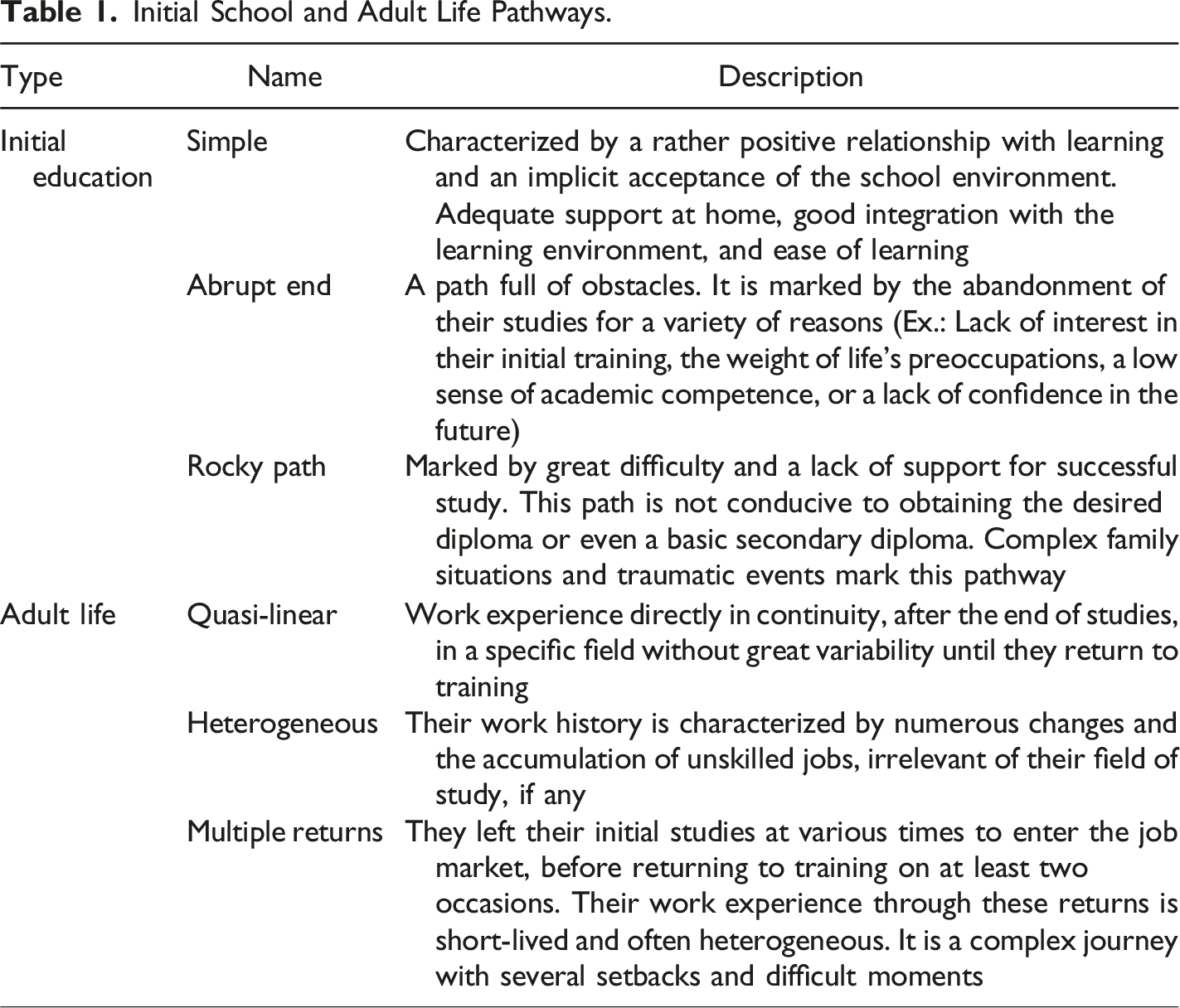
The initial educational pathway ends with the discontinuation of studies, with or without a basic or qualifying diploma. The adult life pathway includes the post-school period up to their last return to cégep CE. It may include multiple returns to school, with or without a diploma. Figure 1 illustrates the compounded pathways of the 26 participants (students and graduates) in the study. The study did not follow up with the students after they finished the program. All 12 students in the study graduated, but no data is available on their subsequent pathways. No graduates in the study had a “Multiple returns” adult life pathway. Compounded initial school and adult life pathways of the participants (students and graduates).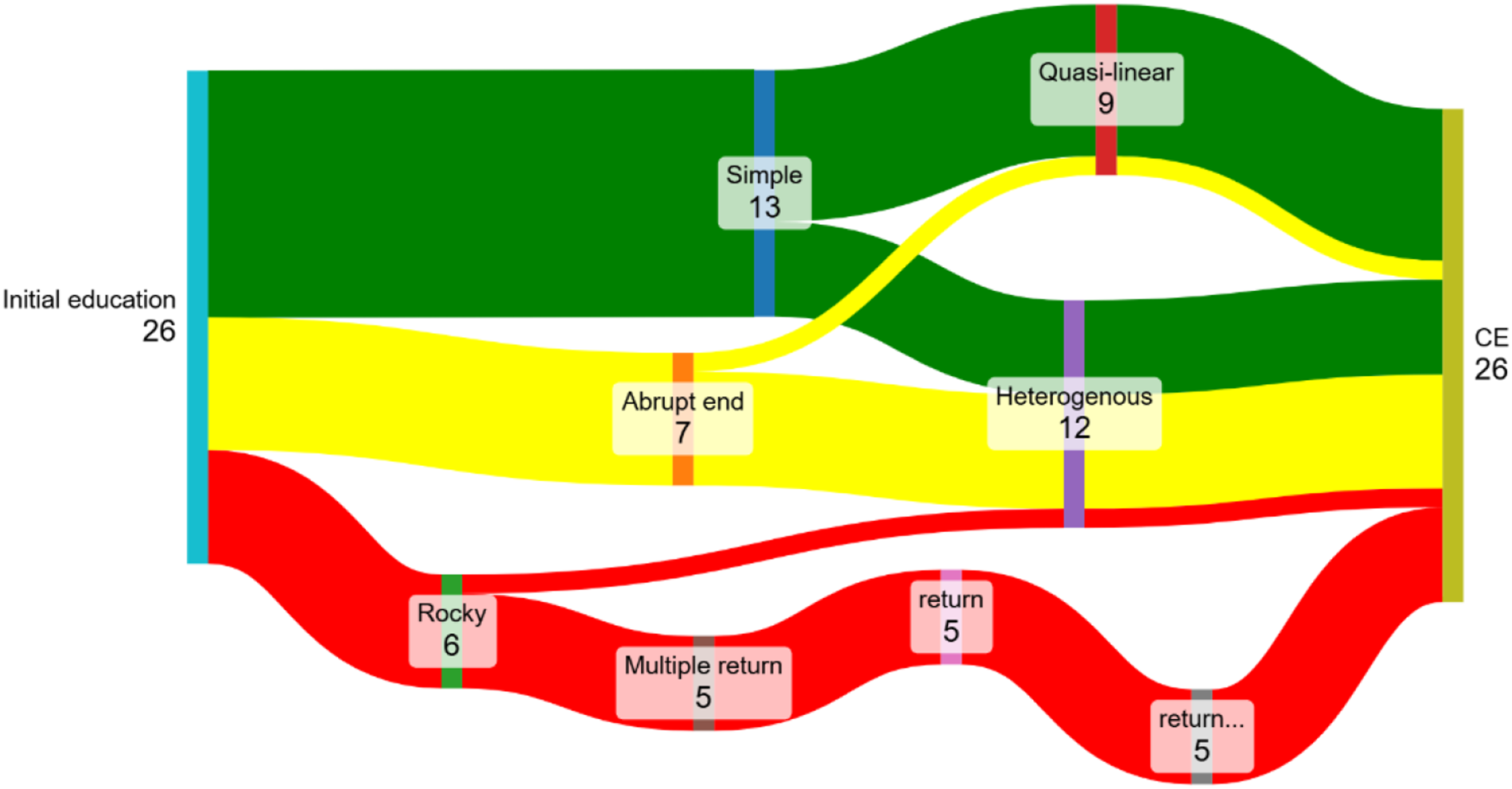
A Pivotal Moment of Transition from Adult Life to Full-Time Student
Irrespective of initial schooling and adult life path, the decision to return to school seems to take place in similar contexts for all the participants. This context could be summarised with four core elements. First, data show that this decision is taken when the person is in a state of misrecognition, feels unappreciated by others, is not recognized for their true worth, or is no longer able to give meaning to their daily life. This may be compounded by a low sense of competence, a depressive episode, or a perceived stagnation in their career. The situation is also frequently linked to a form of socio-economic precariousness. Then that completely demoralized me. Going back to the calls [...] every day, the calls I got were [...] I had a breakdown with that
2
. (JD) But you realize that hours in the cinema, at night, during the day, on contract, isn’t necessarily what’s going to take you far in life. [...] Then we realized that with our salaries, it wouldn’t happen. (JCB) After that, I worked my way up the ladder over the two years I was here. But I had no purpose in it. I didn’t like it. [...] Yes, management. I was in management, in fact. [...] After that, I had nothing to do, really. [...] And I couldn’t see myself going on like that indefinitely. (JR)
Those are examples of situations of misrecognition that could lead to “deprive a person of [the capacity to build] a form of self-realization” (Honneth, 1995, p. 134). It is also in the sense of TLT, a vector of rupture that could lead to action.
Second, this decision is propelled by dissatisfaction and an opportunity that presents itself. This decision is often triggered or supported by an outsider. All but one participant said a relative told them about a program or a possible source of funding. We were listening to the radio, and then we heard an announcement. My girlfriend was like, hey, you want to go back to school? Why don’t you give it a try? (JD)
They all mention that they had already expressed a desire to go back to school; some have had this project for years without being able to actualize it. People around them were aware of it. It was an idea I’d already had. (CD)
The mutual recognition of an individual’s needs and will appears significant in the data collected from the study. For many participants, it did not solely arise from their will; rather, it was “socially shared”. This illustrates the influence of others in the decision-making process and the fulfillment of desire.
Third, even though some of the participants had not succeeded initially, they saw school as a possible solution to change their situation. If they don’t all have a positive image of the school, they all have a non-negative thought about it. In the sociopolitical context of contemporary Québec, they all think about school being a valid solution for them. An institution that can help them succeed in their research of new perspectives. I like school, I like learning, but I’m just not good at school [...] but I like school, I like learning. I’m always learning something. (PC)
The school as an institution is seen as a means to emancipate, capable of being the bearer of the normative condition to realize one’s project.
Fourth, a return to school is encouraged by favorable socio-economic conditions, such as the availability of financial support in the form of loans or grants from the government or the family. This latent project can then become a way out of a situation perceived as inadequate. So I was looking for solutions, and at one point I spoke to a guidance counselor, who explained that there were government programs that could help me go back to school. [...] Then, because of that, I got the kick I needed to go back to school. (JG)
A Transformative Experience
As mentioned, adults returning to school are in a state of misrecognition. The decision to go back is a way out of this situation and is perceived as an important moment, even a totally unexpected turning point that has completely transformed their lives. The struggle for recognition and mutual recognition of their will rendered them able to act. They took the path of returning to full-time education, but they didn’t anticipate the impact this decision had on them. This can be seen in two different ways among graduates
3
. First, in the enthusiasm they all demonstrated as they talked about their experience in CE. Even 10 years after their graduation, this is still a memorable moment that they remember with pleasure and joy. They remember the hard work and the difficulties they encountered, but also the support they received from their peers and teachers. They all remember it as a good moment in their lives. It was probably the best choice I ever made in my entire life. (FT)
Second, in what they were able to achieve as a result. Graduates emphasize that their lives have been affected in many ways. They perceive it as a creator of opportunity, opening a new field of employment and enlarging their initial perspective. It’s more like a springboard that brought me to a springboard that brought me to my current job. (FXL) Career-wise, I wouldn’t be here. In terms of salary, I wouldn’t be here either. [...] I’m super comfortable, super well, I feel like I’m progressing, I feel like I’m developing, I feel like... It’s the word career... (FT)
Their attitudes and perceptions of themselves and their abilities have changed. It acts as a catalyst for a transformation in their attitude towards themselves. It means a lot to me, because in the end, it allows me to change my mind. (PG)
Some have become personally aware of their ability to learn, even at an advanced age where they were thinking that it could be harder. It also made me realize that I was still capable of studying, even though I was old. I’m still capable of assimilating things. (MD) It was a great source of pride for me to prove that I could do it, that I could concentrate and calm down. If I like something and decide for myself that’s what I’m doing, I can do pretty much what I want. (ST)
Many saw it as a passage to “adulthood”, a pivotal moment in their lives. Even after 30, after working in unskilled jobs and having had multiple school experiences, they seize this opportunity to identify themselves as adults. I felt I had credibility as, I mean, an adult, a professional, all that. Really, from... well, after the program or during, there. [...] There really is like a before and after in my life. (WC)
For others, the changes have affected several spheres of their personal and professional lives, such as propelling them out of their initial social class without being related to their economic status. I came from the building sites, then I came from the garages, from physical work... from a rougher environment [...] now it’s different. (FT)
While they all mentioned the efforts required to succeed, the fact remains that, for them, the result has been important in terms of their new being. Moreover, they are transformed in multiple ways, not only in terms of cognitive change (knowledge) but also in respect to their perception of themselves. Self-esteem, the third sphere of recognition, is mainly impacted by their journeys. It’s not just in themselves but in relation to the mutual recognition they have received from their peers and their teachers.
Teachers who Put Students at the Center of Their Concern
Observational data and interviews with participants (teachers, students, and graduates) show that most of the teachers put the student at the center of their concern. What I observed from 6 of the 7 teachers exceeded the expectation of their role or contract 4 . First, it was observable in the dedication to the quality of their educational practices. Most of them were available to answer question that goes outside of the course consideration. They stay in the classroom during breaks to help students. They also make themselves available before and after class and even during lunch. They arrive sooner in class and leave well after the course schedule. Teachers self-report to reply to email until late at night and during the weekend. Students also mentioned this high level of availability.
We also observed intervention in class that goes beyond the subject of the course. Teachers try to make students think about their future selves. Teaching is not always about skills or knowledge, but about what they will have to become to be able to be an active member of their society.
All graduates interviewed spoke about the respect, help, and comprehension they received from those teachers. It was in terms of attitude, rigorous teaching, help outside the class related or not to the topic of the class, etc. They remember being treated with respect in most cases.
Teaching in an adult education context asks for more than the transmission of skill and knowledge. It’s embodied in an attitude of recognition of the other person’s experience and the need to accompany them on their journey.
Conclusive Discussion
The journey of students returning to school begins when they notice a loss of meaning in their lifeworld, a form of misrecognition, and seek to emancipate themselves from the social constraints that have led them to this situation. Temporarily, they become students to acquire new skills that will enable them to open their perspective of meaning and respond more adequately to the constraints of their lifeworld. In line with TLT, as a student, the adult possesses the capacity to learn, the possibility of change, and the autonomy to test the newly acquired reference schemes. This passage results in the emergence of a transformed person who possesses skills enabling him or her to be better adapted to the demands of the social world and their perception of themselves. As previously stated, they gain self-esteem and the ability to take on new challenges, as shown in the data.
Recognition: The Student and the Teacher
The perceived role of training in the lives of graduates shows the impact of this choice on their lives. It also underlines the transformative nature of access to training. Moreover, even though the transformative learning scope is absent from the specific curriculum, and the teachers aren’t aware of TLT literature or even of any critical education theory or andragogical model, they were considered by the graduates as a big part of their transformative journey. Paradoxically, teachers pursue aims compatible with the emancipation and self-realization of individuals in a context mainly organized to form qualified workers. The observed goal of education is not the pure and simple transmission of knowledge or the acquisition of skills per se, but reintegration into the labor market so that they can realize their full potential and “appear in public without shame” (Honneth, 2006, p. 175).
I observed that the teachers’ educational practices are aimed at supporting and providing a context that favors the success of adults in training. Beyond the acquisition of targeted skills, teachers are committed to a broader perspective that involves sharing experiences, passing on advice, and providing support. They are acting from a transformative perspective, placing the individual’s future at the heart of their education process.
While issues of legitimacy and struggles for recognition affect students from the outset, they also need to be placed in a more global context, and teachers included. It’s important to note that college continuing education teachers, like those of other TVET institutions, were not necessarily destined for the teaching profession (Coppe et al., 2021). These teachers are also experiencing a kind of rupture in their careers. They had to learn their new trade in a foreign setting. Knowing how to occupy the right place, the right role, and how to act appropriately in various teaching situations must be acquired through practice and training; a practice that must take place, not in a controlled environment, but in the situation, in action. Huttunen and Heikkinen (2004) suggest that this negotiation of roles in the struggle for recognition gives rise to situations that risk descending into the negative circle of recognition. The quest for recognition and authority on the part of teachers leads some to adopt behaviors that are deleterious to the formation of students’ self-esteem, which is, by definition, against the moral injunction to support and accompany them in their transformative journey.
The implications of TLT for teaching and the education system could lead to a reconsideration of how teachers conceive their role, the construction of their professional identity, and the relationship they establish with students. In this respect, educational institutions such as cégeps must guarantee the normative conditions necessary to establish mutual recognition between these social actors. These conditions are contextual and linked to “the cultural horizon inherited from society” (Honneth, 1995, p. 134). This requires a reconstructive analysis of the normative conditions under which these values are possible (Honneth, 2014).
To better understand the transformative path of adults returning to school, I believe we need to consider Honneth’s Critical theory, which places the struggle for recognition at the heart of both individual and social action. It will inform us better on how to support them during their journey. To do this, I’m going one step further and proposing to consider refoundation, not only through the concept of recognition but also through the lens of his latest work on social justice.
Transformative Learning and the Theory of Social Justice
The individual’s search for recognition must be understood from a broader societal perspective. It is dependent not on an individual desire for freedom or self-realization without regard for others but on the institutions of social justice that provide the normative conditions that enable social freedom. Haber (2004) explains that a theory of recognition can only advocate a social life […] that honors, as far as possible, the recognition needs of its members by assuring them of the possibility of enjoying the self-confidence, self-respect, and self-esteem made possible by the existence of well-made spheres of recognition
5
(p. 84).
Honneth takes up the Hegelian concept of recognition, firstly as a source of legitimacy for their ability to act in social space (Honneth, 1995) and secondly, by extension, as an essential condition of social freedom (Honneth, 2014). Without recognition of the other as a “generalized other”, it is not possible to found a society based on the ethical or good life. For Mead (1934), the process of self-realization enables a subject to develop abilities and characters about which the reactions of others lead the person to believe that he or she possesses a unique value for his or her social environment.
Social freedom implies that we grant the same qualities to others as we do to ourselves and that we have a normative expectation of this same recognition. Recognizing the other as oneself and being recognized as the other is the basis of the possibility of ethical life. Ethical life is the condition of social freedom, ensuring that everyone can realize their full potential. In our view, it must also be the aim of the education system to help people realize their full potential through lifelong learning.
This recognition cannot simply be the fruit of individual freedom taken at the expense of others but must be achieved in the search for a mutual understanding of self-fulfillment. Social institutions such as the family, the market economy, and the democratic state must be able to perform the conditions for achieving recognition (Honneth, 2014). An ethical society should be able, through institutions, to guarantee conditions of mutual recognition in which the formation of personal identity and personal fulfillment can take place under good conditions (Carré, 2013).
In his definition, Honneth (2014, p. 61) proposes that “[justice] must entail granting all members of society the opportunity to participate in institution of recognition”. Justice must, therefore, be embodied in social institutions that enable the conditions of social freedom to be realized. A theory of social justice should help us to apprehend the symbolic and material conditions that authorize “the good life”. Unlike other theories of justice, such as Rawls (1971), Honneth does not postulate a transcendent ideal or seek to define the objective conditions for achieving justice (distribution, access to resources, etc.), but presupposes that the principles of justice (love, equality, social solidarity) are available to people through the institutions of societies. Social order depends primarily on the chance for individuals to realize their aspirations for a “good life” in their affective relationships, respecting their rights and their contributions to a social community.
Honneth seeks to analyze today’s society on the basis of its own normative presuppositions. He does not admit that there are universal norms that can act as guides in all social institutions but that these emerge and are embodied in historical materiality. For doing so, Honneth proposes a reconstructive analysis that aims to extract these normative values from their empirical context and to ground these ideals in historical reality. This analysis can then take a critical look at the role of social institutions in realizing individual aspirations. Consequently, critical theory must consider the symbolic dimension. It must also enable us to take account of situations of alienation that have no echo in the public sphere and denounce situations where individuals are invisibilized. Honneth’s proposal moves away from Marxist presuppositions based primarily on the principle of redistribution (material dimension) to account for struggles for recognition (symbolic dimension) (Fraser & Honneth, 2003).
This moves us to see the educational system as a social justice institution that promotes the possibility of transformation of individuals and society. Therefore, I propose that TLT should also be applied, not only from an individual perspective but also as a construct that could be seen as relevant to analyzing social institutions. In addition to including recognition as an important element of TLT, I propose to work on broadening its scope to allow the study of social institutions and the conditions of social freedom through education.
It is in this respect that I propose that a critical theory of adult education that aims at emancipation and self-realization through lifelong learning must be grounded in a social justice theory. What’s more, I believe that schools and the education system cannot be conceived of as a domain of activity outside society. They must be thought of in their social role and with their social stakes. They are traversed by currents of influence, and they influence society. As such, as a social institution, the educational system in which cégeps and continuous education are embedded is the bearer of norms and values that must ensure the conditions of possibility for social justice. This could lead us to rethink the role of the educator, his or her pedagogical practice, the structure of the education system, and its link with the political system.
Footnotes
Declaration of Conflicting Interests
The authors declared no potential conflicts of interest with respect to the research, authorship, and/or publication of this article.
Funding
The authors received no financial support for the research, authorship, and/or publication of this article.
