




Abstract
The literature on parental engagement in diverse schools has examined the role of parents’ class, race, and ethnicity in shaping their engagement. It argues that while White and socioeconomically privileged parents often align with school expectations and wield influence, parents of color and low-income parents may struggle to shape school policies. Studies suggest that additional factors such as advocacy styles, prioritization of social-emotional well-being, and perceptions of racial inequalities can also explain parents’ engagement. Drawing on fieldwork in an urban, diverse, public (non-charter), gentrifying school implementing a diversity in admissions policy, I propose parents’ “race frames” and their alignment with the administration’s race frames as an additional typology of parental engagement. I analyze a conflict over discipline policy, a topic at the heart of education, gentrification, and race relations to illustrate the role of race frames in parents’ engagement. The findings underscore the importance of examining parental values and alignment with school values to understand effective parental engagement and promote progressive school policies.
Keywords
Introduction
The literature on parental engagement in racially, ethnically, and economically diverse schools focuses on parents’ class, race-ethnicity, and their intersections as drivers of parents’ engagement styles and outcomes (Delale-O’Connor et al., 2019). Studies show White and socioeconomically privileged parents enjoy more power than others in their interactions with schools. They fit schools’ expectations for involvement and have a positive history of power relationships with schools, making it easier for them to engage with staff (Lareau, 1987; Lareau & Horvat, 1999; Lewis-McCoy, 2014). In contrast, parents of color and low-income parents may be stigmatized and discounted by school staff and experience a lack of fit between their culture and resources and schools’ demands and expectations, and thus must work harder to shape school policies and might experience less success (Delpit, 2006; Diamond & Gomez, 2004; Rollock et al., 2014).
The literature on parental engagement in diverse schools has focused on race and class, but some studies on parental engagement in different contexts have offered additional typologies of engagement, including the type and level of parental advocacy (Auerbach, 2007; Cooper, 2009), parents’ prioritization of their children’s social-emotional well-being over achievements (Debs et al., 2023; Lee, 2024), their approach to concerted cultivation (Delale-O’Connor et al., 2019), their perceptions of race relations (Reynolds, 2015), and their analysis of racial inequalities in schools (Marchand et al., 2019).
In this article, I add to the understanding of the dimensions shaping parental engagement and its outcomes in diverse schools. I draw on 2 years of observations of school committees and interviews with parents and administrators in a racially, ethnically, and economically gentrifying diverse public (non-charter) school implementing a diversity pilot to increase the share of low-income students of color. I show how parents’ race frames (Warikoo & de Novais, 2015) as separate from their socioeconomic positions and identities (DiMaggio et al., 2017), and that the frames’ alignment (Huguley et al., 2021; Lareau & Horvat, 1999; Lewis & Forman, 2002; Threlfall & Auslander, 2023) with the principal’s race frame shaped parents’ engagement and their power at the school.
I focus on a conflict around the school’s discipline and anti-bullying policies that erupted during the implementation of the diversity pilot. Discipline is highly racialized in the American context, and the conflict at the school happened during broad public and policy debates about race and discipline, along with questions about the relationships between school gentrification and disciplinary disparities (Diamond & Lewis, 2019; Okilwa & Robert, 2017; Pearman, 2023; Warren, 2022). During the conflict, which centered on the behavior of three Black low-income boys, one racially heterogeneous group of parents expressed diversity or color-blind race frames, asking the school to ignore students’ racial and economic backgrounds when determining and enacting the discipline policy. These parents advocated for punitive measures and anti-bullying education for students, staff, and parents. Another racially heterogeneous group of parents expressed a power-analysis race frame, framing the conflict as resulting from systemic structural inequality, specifically the tendency to criminalize low-income Black boys. They advocated for restorative justice, counseling, and racial equity education. The second group aligned with the principal’s race frame and had the upper hand in the conflict. This alignment eventually led to the enactment of anti-punitive, restorative-justice-based discipline policies. The parents who were misaligned with the principal were unable to get their policies endorsed and implemented, although some were White, highly educated, middle-upper class, and major fundraisers for the school.
These findings contribute to the literature on parental engagement in diverse schools and schools more broadly. First, I add race frames as a typology of parental engagement and show how a race frame is separate from and additional to racial, ethnic, and economic positions. Second, the analysis suggests that parents’ values and their alignment with school values are important to understand parents’ engagement and ability to shape school policy. Third, my qualitative analysis ties race frames to policy outcomes. Finally, my findings have implications for school leaders trying to promote progressive disciplinary policies; specifically, mapping parents according to their support of policies, and the cooperation of parents and administrators who share a similar understanding of race relations are important steps.
Literature Review
Parental Engagement in Diverse Schools
School diversity is not the same as school integration. Diversity refers to a demographic mix of students of different racial, ethnic, and economic backgrounds. Integration includes the effort to address relationships between groups and change existing power structures (Lewis et al., 2015). Diversity does not (Berrey, 2015; Moody, 2001). Throughout the article, I use both terms according to how they are used in the literature I cite and my fieldwork data. When I say “diverse school,” I mean a school with a mix of students from different racial, ethnic, and economic backgrounds. The word integration, which I use mainly in the findings, denotes an intention to work on race relations, invest in racial equity, and undermine power relations in the school.
Literature on parents in diverse schools has often turned to parents’ racial, ethnic, and class backgrounds to explain parental engagement and its outcomes (Delale-O’Connor et al., 2019). A key question is which parents have the power to shape school policies and influence students’ experiences and outcomes. 1 Lareau and colleagues (Lareau, 1987; Lareau & Weininger, 2003; Lareau et al., 2016) famously argued that middle and upper-middle-class parents feel more comfortable in schools, have interaction styles that better fit with school staff, and are better received, and thus can advocate for their children. Elsewhere, Lareau and Horvat (1999) showed that White parents’ interaction styles better fit schools’ “rules of the game” and are received more positively by school staff than those of Black parents; the latter are often seen as hostile, impacting their ability to shape their children’s placements and experiences. Other studies have found that White, economically privileged parents shape school policy and curriculum to fit desired goals (C. M. Billingham & Kimelberg, 2013; Posey-Maddox, 2013; Posey-Maddox et al., 2014), hoard opportunities (Lewis & Diamond, 2015; Lewis-McCoy, 2014), and prepare their children to engage with school staff (Calarco, 2011, 2014, 2020; McCrory Calarco et al., 2022). A line of research examining the intersection of race and class among Black parents has shown how race–class intersections promote or inhibit their support of their children’s schooling, and emphasized differences between middle-upper-class and lower-class Black parents (Diamond & Gomez, 2004; Posey-Maddox, 2017; Rollock et al., 2014).
Parental engagement in schools also depends on parent–school alignment along various dimensions (Lareau & Horvat, 1999; Lewis & Forman, 2002). A school, in this perspective, is a specific environment with unique characteristics and certain rules of the game that open different possibilities of engagement and affect how parents’ engagement is accepted and accomplished (Cobb, 2017; Delale-O’Connor et al., 2019; Lareau et al., 2016). Much of the literature on parent–school alignment considers the fit in socioeconomic composition between parents and school staff or student overall composition (Delale-O’Connor et al., 2019; Lewis & Forman, 2002) or the alignment between schools’ class-based expectations and parents’ practices (Diamond & Gomez, 2004; Lareau & Horvat, 1999; Posey-Maddox, 2017). Some studies have explored the alignment between Black parents’ perceptions of race relations and a school’s culture of racial discrimination (Huguley et al., 2021; Threlfall & Auslander, 2023). A few studies have examined parent–staff value congruence as necessary for parents’ successful engagement (Hauser-Cram et al., 2003; Lasky, 2000). However, these latter studies tie parents’ values to their socioeconomic positions, ultimately explaining alignment as a class and race issue.
Alternative Typologies of Parental Engagement
While much of the literature on parents’ engagement focuses on race and class, some studies have suggested alternative characteristics of parental engagement. Auerbach (2007), for example, studied variations among lower-class parents in how they construct their role in their children’s schooling. She argued that parents differ in their moral, navigational, and emotional capital, and this typology shapes their engagement with their children’s college aspirations. Marchand and colleagues (2019) suggested Black parents’ recognition and analysis of race and racism in schools as a new conceptualization of parental engagement. A parent who is aware of these issues might engage differently with schools than one who is unaware. Huguley and colleagues (2021) expanded the typology of Black parents’ school involvement by dividing engagement into categories. Some Black parents engage in navigational and reform-based school involvement as their ongoing response to perceived systemic issues of racial inequality. Others engage in compensatory home-based involvement to support the child’s schooling, especially with race-focused content and agendas. Still other parents engage in racial academic socialization, combining educational values with specific race-based cultural socialization to instill motivation and resiliency.
A recent study looked at economically privileged parents from different racial and ethnic backgrounds and suggested characterizing parents based on parental preferences for a happy environment for their child, labeling them “happiness-oriented” parents (Debs et al., 2023). The researchers found that a happiness orientation appeared in parents from diverse racial and ethnic backgrounds, and these shaped children’s placement in schools. They contrasted these parents with others who were competitive-oriented and cared about social advantage, suggesting these orientations as typologies of engagement.
Together, these alternative typologies suggest that our understanding of parental engagement in diverse schools could be enriched by including parents’ cultural and political schemas and their perspectives on school-related issues (Auerbach, 2007). However, these studies have mostly looked within race and class groups to understand this variation, have not looked at diverse schools, and some have explored parents’ perspectives and not the alignment between parents and schools on these typologies.
Theoretical Framework: Race Frames Typology and Alignment
I suggest an additional typology of parental engagement and alignment in diverse schools: parents’ race frames. 2 Race frames are people’s understanding of the meaning of race and its role in society (Warikoo, 2018; Warikoo & de Novais, 2015). Warikoo and de Novais (2015) showed that race frames are relevant for understanding White college students’ approaches to affirmative action and interracial contact. Race frames could be beneficial for understanding engagement in diverse schools where race and race relations are key issues, whether implicitly or explicitly, in everyday practices (Lewis, 2003; Pollock, 2009). I address race frames as separate from parents’ race and class identities, building on recent scholarship that shows people’s attitudes and beliefs are not necessarily tied to socioeconomic positions (Diehl, 2022; DiMaggio et al., 2017; Hastings & Pesando, 2024).
Following Warikoo and de Novais (2015), I discuss three race frames: color-blind, diversity, and power-analysis. A person with a color-blind race frame sees racial and ethnic groups and group identities as irrelevant in the post-civil rights era. In this perspective, differential outcomes are not due to racial power relations but are a result of market dynamics or cultural differences between groups; thus, relationships and policies should not be based on racial and ethnic identities (Bonilla-Silva, 2006; Cobb, 2017; Davis et al., 2015; Doane, 2017; Pollock, 2009). A color-blind race frame resists affirmative action policies or any policies that consider group characteristics over individual ones (Bonilla-Silva, 2006; Warikoo, 2016). It resists acknowledging the connection between race and discipline but insists that discipline is about behavior, and behavior is correlated with race (Heriot & Somin, 2018).
Individuals endorsing a diversity race frame usually reject the color-blind race frame. They argue that demographic diversity is important and should not be ignored or negated, as it benefits societies and organizations and broadens the scope of identities, experiences, and perspectives brought into them (Bell & Hartmann, 2007; Berrey, 2015; Hartmann, 2015; Hartmann & Gerteis, 2005). Policymakers expressing a diversity race frame create policies that celebrate and promote individual differences, but these policies are often criticized for retaining merely symbolic attitudes and not being attuned to power relations or to changing power structures (Berrey, 2015; Mayorga-Gallo, 2019; Warikoo, 2016).
Those endorsing a power-analysis race frame emphasize the institutional rather than the personal nature of social inequality, focusing on systemic problems of resource distribution and access to opportunities, and highlighting race and racism as fundamental problems of the American social system (Bonilla-Silva et al., 2004; Kendall, 2012; Omi & Winant, 1986). Policies and relationships with a power-analysis race frame consider people’s race and class positions and attend to social and structural issues rather than individual ones (Warikoo, 2018). This frame is similar to the critical engagement suggested for Black parents by Marchan and colleagues (2019). It expands on it by including parents from different racial backgrounds and by viewing it as one frame among several.
Building on this typology of race frames, I ask what role race frames, as separate from parents’ race and class positions, and parent–school race frame alignment, play in shaping parents’ engagement and power in diverse schools.
Study Context: National Debates on Race and Discipline
I address these questions within a broader historical, national context. I collected the data during the last months of Barack Obama’s presidency and the first election of Donald Trump, a time characterized by intense public and academic debate around race relations. At the time of the study (2016–2018), it was well-established that discipline policy in the United States is layered with racial discrimination, and Black boys are disciplined much more than any other group, with severe consequences for their future (Diamond & Lewis, 2019; Hwang et al., 2024; Jabbari & Johnson, 2024; Scott et al., 2017; Warren, 2022). The Obama administration marked a shift in policy by making racial disciplinary discrepancies one of the missions of the Department of Education’s Office of Civil Rights and calling for restorative justice practices to replace the use of punitive measures characterizing the previous “zero-tolerance” era (Okilwa & Robert, 2017). These changes received much pushback. Critics argued that they failed to consider that Black students might be involved in more disciplinary incidents than others. Moreover, not using punitive measures would create more chaotic classrooms for students who were struggling, thus hurting them, while leaving teachers without the ability to address student behaviors (e.g., Heriot & Somin, 2018).
The national debates about race and discipline have also appeared in the context of school gentrification. Scholars have noted that with the rise of gentrification in U.S. cities, urban schools that used to serve Black and Latinx low-income students have seen an increase in their shares of White middle class and upper-middle-class students, a phenomenon called “school gentrification” (Green et al., 2020; Posey-Maddox, 2014). This occurred when the general trend nationally was towards renewed segregation (Mordechay & Ayscue, 2020). The trend has triggered questions about racial relations and equity within these schools (Fast, 2023, 2025a; Freidus, 2016; Green et al., 2023; Roda, 2020). Pearman (2023) argued that when a school is gentrified, it might have consequences for the discipline of Black students. For example, staff might compare existing students’ behavior to the behavior of new, White, affluent arrivals, changing how low-income students of color are evaluated and treated, regardless of actual changes in behavior. Staff may also change their disciplinary behavior based on White parents’ attitudes towards discipline, for example, if they demand punitive measures towards students of color. Low-income students’ behavior could change because they feel more stress and greater social comparison when there are suddenly more affluent children at the school. However, gentrification may also improve discipline because there are typically more resources when White middle-upper-class families join the school, and they demand more child-centered approaches. Pearman (2023) found that gentrification was moderately related to increased racial and ethnic disparity in students’ suspension rates but suggested the mechanisms tying gentrification to disciplinary outcomes needed more study. The current qualitative analysis of race frames and discipline in a gentrifying school is a step in this direction.
Data and Method
Study Site
The data for this article come from 2 years of observations and interviews at Prospect (pseudonym), a zoned elementary public (non-charter) school serving pre-kindergarten to sixth grade students in a large Northeastern U.S. city. Data were collected between 2016 and 2018 when the school implemented a voluntary diversity pilot (details below). Prospect was established in 2012 in a census tract experiencing racial and economic gentrification (+38.5% White and +136.25% median income percent change between 2000 and 2015). It replaced a public school closed because it was “failing” and “unsafe,” fitting with known trends in school closures and the gentrification of Black neighborhoods (Pearman & Greene, 2022). When Prospect opened, it was branded as a school combining elements of progressive education, such as project-based learning and emphasis on arts and other extra-curricular activities, with a traditional, rigorous focus on language and math. 3 The closed school served only Black and Latinx students, with more than 90% eligible for free or reduced-price lunch (FRPL). When Prospect opened, it mainly served these students. However, from the beginning, it drew a group of White gentrifying parents and a small but increasing share of middle- and upper-class parents of color. The school had fewer than 200 students in 2016; by 2018, it served almost 400.
Figure 1 presents the school’s demographics from the year it opened to the end of my study (2012–2018). The figure shows two notable trends. First, the share of FRPL students declined from 82% to 64%, threatening the school’s Title I status. Second, the share of Black students dropped from 59% to 46%, and the share of White students increased from 7% to 18%. These trends were even more substantial in pre-kindergarten and kindergarten classes, in line with the literature on gentrifying schools (Candipan, 2020).

School Composition 2012–2018
In 2014, the principal, who established the school in 2012, along with a group of mothers from the diversity committee, joined other schools in gentrifying neighborhoods in the city that asked the city’s Department of Education (DoE) to replace the existing choice admission system with a controlled admission system. Prospect’s goal was to slow the arrival of White and economically privileged families who were threatening the school’s Title I status and shifting the school’s population. The request was initially refused, but, in November 2015, DoE informed Prospect and six other schools that it would pilot a diversity admissions pilot. These were only a handful of schools in the district, but it was the first time the city attempted an integration program in decades.
The pilot started with admissions for the school year 2016–2017. It specified criteria for setting aside seats for students entering pre-kindergarten and kindergarten classes each year. At Prospect, 20% of the seats were designated for English Language Learners 4 (ELLs), students who were part of the city’s welfare system, and students in temporary housing. The pilot was administered through DoE’s application system. If parents chose Prospect as one of their priorities in the online choice system, a pop-up question asked them to check the criteria applicable to the family in the school’s set-aside priorities. If parents marked any boxes as applicable, their children got priority over students who were not eligible based on the criteria after siblings of existing students received seats. The diversity pilot failed to change the composition of the school. I discuss the results of the pilot elsewhere (Fast, 2025b).
Data Collection
The data were collected during the first 2 years of the diversity pilot (2016/2017–2017/2018). The data presented here are part of a larger research project I conducted on the implementation of the diversity pilot in three schools, where I asked about the role of parents in its implementation, how their role was shaped by neighborhood context and their interactions with school administrators, and how parents, administrators, and neighborhood context shaped the pilot’s outcomes. Data collection for the broader project was guided by a comparative case study approach to identify conditions enabling the development of a social phenomenon within unique cases by comparing them (Small, 2009). In this article, I focus on Prospect.
As I describe below in the Results section, during my fieldwork, there was a conflict over discipline policies and alleged bullying, and participants in the conflict tied it to the school’s diversity and integration efforts (see also Fast, 2025a). After it erupted, it frequently came up in my observations, and I added a question about it to my interview protocol: “I recently heard that there are some issues around discipline and bullying at the school; I wondered what you heard or thought about it.” The frequent mention of the conflict and the way parents and administrators tied it to race, inequality, diversity, and integration led me to focus on it as a central event in my data collection.
Observations
As my initial research goals concerned parents and their interactions with administrators, my fieldwork focused on administrators’ and parents’ committees and activities at the school. During my fieldwork at Prospect, I observed 16 School Leadership Team (SLT) meetings, 16 Parent–Teacher Association (PTA) meetings, and 10 diversity committee meetings (totaling about 100 hours). The SLT was a state-mandated governing body and included the principal, parent coordinator (unique role of parent liaison at the school), teachers, and parents. Its official role was to set and track school policies and vision and to address DoE’s goals. Parents were elected to an SLT seat in annual elections taking place during PTA meetings.
The PTA was a voluntary parent-controlled body comprising an executive committee and a general assembly of parents. The executive committee was elected and included co-chairs, a secretary, and a treasurer. Parents had to submit their names for the annual elections. Parent assemblies took place in the 3rd week of each month, on a Thursday evening and the following Friday morning, to accommodate parents’ schedules. The agenda was the same for both assemblies. The principal usually gave an update at the beginning of the meeting and then left; the parent coordinator usually gave an update and stayed for the meeting. The formal agenda, which usually pertained to school events and fundraising, was followed by an open floor session for parents’ issues.
The diversity committee was voluntary and comprised of parents only. It was established by the principal and a mother in the second year of the school. According to interviews, it was formed after several conflicts around school communication and culture erupted between parents of color from the closed-down school who transferred to Prospect and the new White parents. The parent coordinator or principal sometimes attended to discuss specific issues. The diversity committee had a parent chair, a voluntary position. This parent usually planned an agenda for the meeting based on coming events, like Black History Month celebrations, things that happened at the school that needed the committee’s attention, or programs the committee wanted to participate in or bring to the school. The discussion often went off-topic to include issues parents raised. Unlike the SLT and PTA, the diversity committee had no official position at the school or authority to promote decisions or policies; however, as I go on to show, mothers on the diversity committee yielded influence at the school (see also Fast, 2025a).
Interviews
During the 2 years of fieldwork, I conducted eight interviews with the principal, one with the assistant principal, and three with the parent coordinator (the parent coordinator changed between the 2 years, so I had two interviews with the first and one with the second). Interviews lasted 45–75 minutes and followed a semi-structured protocol. I started by asking for updates on the diversity pilot implementation and followed up with questions arising from recent observations and conversations with parents. I also had many informal interactions with the principal and parent coordinator, catching up in the school corridors before and after observations (see Pollock, 2009, on the importance of the informal aspects of data collection in schools).
I also conducted interviews with 21 parents. I focused on parents holding leadership positions (on the SLT, PTA, and diversity committee). I followed Small’s (2004) guidance on studying the “valuable few” in ethnographic research on leadership and change in communities. When the conflict around discipline and bullying began, I interviewed the parents involved and considered them part of school leadership, even if they did not have official committee roles. In addition, I interviewed parents who only occasionally attended school events and parents who were mostly uninvolved. I took two steps to reach these parents. First, I used snowball sampling, asking parents I interviewed to connect me to parents they knew who were not involved in school leadership. Second, when I attended school events, such as Black History Month celebrations, I approached parents who did not usually attend school events and asked if they would consent to an interview. While this method did not extend the sample to parents who did not attend school events, it broadened my sample’s level of parental involvement.
Table 1 presents the composition of the parents interviewed based on their self-identified race-ethnicity and education, and indicates their involvement in the school. Out of the 21 parents interviewed, nine identified as Black, eight as White, and four as something else (e.g., Afro-Latina, South Asian). I merged the “other” category and all educational levels under college into one category to avoid identifiability. Overall, 18 of the 21 parents had a college education. More than half had a graduate or professional degree, and another eight held a bachelor’s degree. The proportion of graduate and professional degrees was similar across racial groups. The level of education was not surprising, as parents involved in committees in gentrifying schools tend to be highly educated (Posey-Maddox, 2013). Three parents did not have a college or high-school education, and all three identified as Black. Only one interviewee was a father, and four were uninvolved in any school committee during my study. These latter parents are marked by asterisks in the table.
Parents’ Interview Sample Characteristics (N = 21)
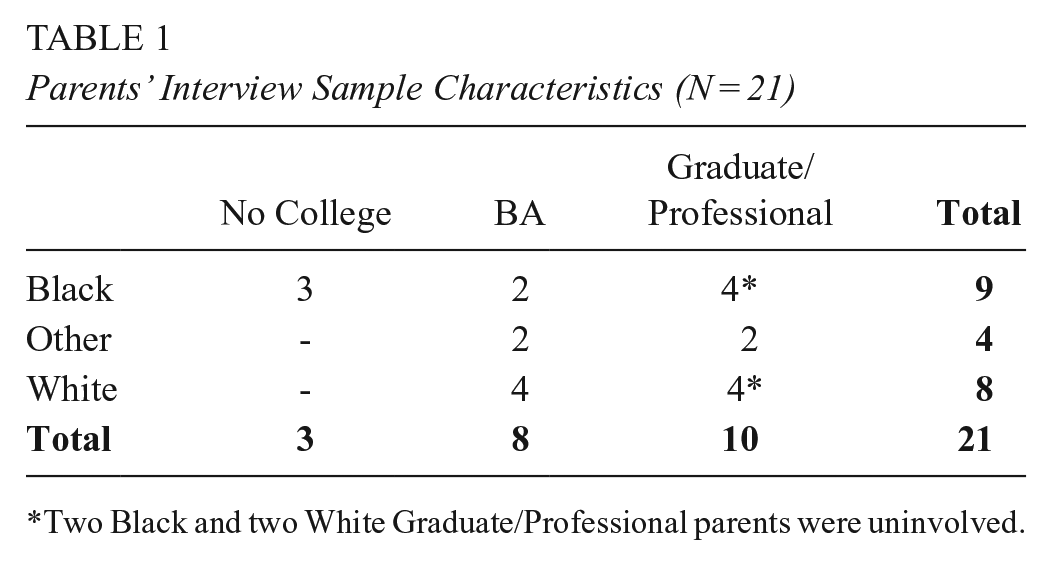
Two Black and two White Graduate/Professional parents were uninvolved.
Interviews with parents were semi-structured; the interview protocol developed as the study progressed to address relevant topics coming up in meetings and conversations (see Appendix 1 for the interview protocol). I started each interview by asking parents for general demographic information, their educational biography, and how they came to live where they did. Then I asked how they chose the school for their children, what their experience so far was, and what the most significant challenges were that the school was facing. If the parents were a part of the PTA, SLT, or diversity committee, I asked what these bodies did and how they perceived their work. I also asked parents to define diversity, explain the diversity pilot in their own words, and give their opinions. Finally, when real-time issues arose during my observations, I included questions about them. Parents’ interviews lasted 40–90 minutes. All interviews were recorded and transcribed, except for two cases when interviewees preferred not to be recorded. In those cases, I took notes during the interviews and wrote them down immediately thereafter.
Data Analysis
Data analysis was guided by a flexible coding approach combining deductive and grounded theory (Deterding & Waters, 2021). Appendix 2 presents the complete coding scheme, which includes themes corresponding to the interview protocol and the literature, grounded, bottom-up themes, and the later race frame typology analyses. Initially, I read through a sample of interviews; I analyzed them according to the interview protocol and based on concepts in the literature (e.g., parents’ background, school choice considerations, definitions of diversity). Then, I performed thematic ground-up analysis to add codes emerging from the data, paying specific attention to discipline and bullying. I observed that parents had different approaches to race relations and defined diversity and integration differently, with different policy implications. After I read the literature on race frames and ideologies, I named the frames and created an additional top-down coding scheme. In the last stage, I hired a research assistant to analyze the data according to these frames. She received the entire study’s coding scheme, including initial indexing, grounded themes, and race-frame typology. She coded the parents’ data (N = 60) with Dedoose software and categorized every parent with a race frame (“Descriptor” in Dedoose). To include variations within parents (a parent might express multiple frames), race frames were coded both within the interview text whenever they emerged, as isolated quotations, and for each parent as an overall characteristic. When contradictions emerged, and the research assistant was unsure how to code expressions or characterize a parent, we discussed the examples until we reached agreement.
Positionality
My position in the field as a researcher was multifaceted. On the one hand, I am a White woman of Eastern European origins, so I was positioned as White. This probably shaped my relationships and the level of openness and trust created between me and my interviewees; White parents may have seen me as similar to them, while parents of color saw me as White and thus potentially distant. On the other hand, I am not American and was an international graduate student at the time, with a non-American accent. This positioned me as White, but not an American White, thus potentially permitting me to develop closer relationships with parents from more marginalized and non-White groups with whom I could connect based on my foreign status. Another important aspect of my positioning is that I am politically progressive in my views and supportive of the political goals the school leadership was pursuing in a way that potentially biased my research. To tap into a full spectrum of opinions, I did not disclose my perspective on the pilot. I showed quiet support (nodding, affirming) of the interviewees’ values and perspectives, regardless of their alignment with mine. However, when the study ended, I presented my findings to the SLT and suggested future actions. Finally, I entered the field as a mother to a newborn. I did not foresee this, but this part of my identity quickly became key to my access to the field. Mothers at the school were happy to “adopt” me as a new mother and impart their wisdom. My status allowed closer relationships to develop and generated openness about child-rearing, educational choices, and practices. Simply stated, it made my interviewees more open to me and my presence in the field.
Findings
To show the role of parents’ race frames and their alignment with the administration’s race frame on parental engagement and its outcomes, I focus on what I term “the bullying conflict.” 5 A conflict around the school’s anti-bullying and disciplinary policies erupted during the second year of the diversity pilot (2017–2018). The events that preceded the conflict and were agreed upon were as follows: three Black boys in an upper grade often misbehaved, and at least one student had left the school because of repeated incidents with them. The principal put the guidance counselor in charge of the situation and refused to use punitive measures. The conflict centered on the interpretation of their behavior and how to handle them. One group of parents blamed the principal for not taking care of the problem, advocated hiring an anti-bullying consultant, organized a vote at the PTA for funding for an anti-bullying program (the vote passed, but the money was never allocated), and involved the school district. The principal and an opposing group of parents resisted labeling the issue bullying, insisted the boys’ behavior was due to systemic issues of poverty, and funded an anti-racist, rather than anti-bullying, parents’ workshop. The conflict first became public at a PTA meeting in January 2018, when, during the open floor session, a mother blamed the principal for hiding the issue from parents.
Table 2 summarizes the three race frames I identified, along with relevant literature, related perspectives on the conflict at the school, and suggested policy solutions by the different actors. I start by presenting the principal’s race frame as the rules of the game (Lareau & Horvat, 1999). I then turn to the race frames expressed by the two groups of parents and their suggested solutions. I end with a discussion of the alignment, or lack thereof, between parents and principal, showing how each group of parents fared in shaping the school’s discipline and anti-bullying policy.
Race-Frames in the Bullying Conflict

Note. Adapted from Warikoo & de Novais (2015).
Principal’s Race Frame
The principal, a self-identified Black Caribbean woman, set the school mission, the diversity pilot, and the bullying conflict within an explicit power-analysis frame (Warikoo & de Novais, 2015), defining clear rules of the game for the school (Cobb, 2017; Lareau et al., 2016). In our first interview, when the pilot was just announced and before the conflict around the alleged bullying began, she described her goals for the diversity pilot to stop Black students from going to bad high schools and to close the acheivement gap between Black students and their peers. In another pre-conflict interview, the principal said low-income students were her top priority. She said she communicated this priority to prospective parents during the open house tour (most parents on tours were White), ensuring they understood what they signed up for when coming to the school. The principal then tied her attempts to have a diverse, integrated school to disciplinary issues. Expressing a power-analysis frame, she assumed serving White parents would create issues around acceptable behavior, as often happens in gentrifying schools (Pearman, 2023). She wanted it to be clear that she prioritized letting children in the self-contained (special education) class, who were all students of color, “misbehave” over placating White parents: I made it a point in my last prospective parent tour to say you need to know when you come here that you can handle some of the differences. . . . It isn’t so easy when is your own child that has to be the pioneer and sit in the classroom. It’s not an easy decision. I want to be transparent and let the parents know that, and I make it a point now that if they’re walking on the tour and children in self-contained [special education] class run amok in there, so be it. This is who we are. It’s part of managing expectations upfront so the parents know it’s not utopia.
The principal clearly connected school diversity and discipline; her power-analysis race frame requires changing institutional practices and habits and refuses a merely symbolic commitment to diversity (Berrey, 2015; Winant, 2015).
When the conflict around discipline and bullying began, the principal framed it similarly around race and power. In a meeting with the SLT in February 2018, 1 month into the public conflict, she problematized the word “bullying.” She told parents that the school’s social worker would conduct a workshop for parents to help them define bullying and distinguish it from everyday conflict: “Bullying is a word that is thrown around a lot, but most of the time, it’s conflict. They are kind of addressed the same way. Research talks about building classroom climate, and getting all stakeholders involved.” She refused to remove the three boys from the classroom or to apply punitive measures, and said she would focus her energy on counseling and social-emotional work.
A few months after the conflict became public, the principal came to the diversity committee to discuss it. She was explicit about the racial inequality aspects and spoke about school integration rather than diversity, indicating her mission at the school was to foster equitable race relations (Lewis et al., 2015). Her power-analysis frame denounced a diversity race frame where the mix of students is symbolic, without costs: Everyone is in [a] different place in their journey [towards school integration]. As a school, we are in a specific place, but parents in their specific place don’t always understand that there are costs. [Integration] is an idealistic idea that people love and there are intentions, but when the rubber meets the road, people need to understand that there is negotiation around your values, that you have to let go of. . . . In a community like ours, some people come in with a private school attitude that if they do not like something, I will just get rid of them. But I can’t; I have to attend [to] both sides, and people need to understand that some kids behave a certain way because of systemic issues. People want to see blood; they want suspension, but there is a criminalization, specifically of our Black students, and when I am accused of defending Black students, I plead guilty.
The principal set the boys’ behavior within a power-analysis race frame: they behaved this way because of systemic problems and were being criminalized. Further, some parents were trying to carry their privilege into the school with their “private school attitude,” and it was her job to stop them. Simply stated, her job was to protect Black boys from criminalization.
Parents’ Race Frames
Diversity and color-blind
Two racially heterogeneous groups of parents headed the bullying conflict, one opposing the principal and one supporting her. The first group comprised four publicly vocal members who demanded that the school be more punitive and implement an anti-bullying intervention for students, staff, and parents. Susan, a White college-educated mother born in the city and raised in the suburbs, was part of this group. She was the one who made the conflict public at the PTA open floor session: There is a problem of bullying [in school], and people don’t know about it. . . . It’s like our hidden little secret, “here is our beautiful school, look we are diverse,” keep getting the funds in, and not talking about the bullying problem that we have. . . . And two kids left [the school].
6
And kids been harassed thrown to the wall, my kid was piggybacked while peeing. And there are the same perpetrators that’s been doing that, and [the mayor] took down the suspension because it tends to be to certain pockets of economics, and I am aware of the socioeconomics of the school.
In her opening statement, Susan detailed the terrain of the conflict as she saw it: the disciplinary policy at the school was related to the principal and the city’s policy trends of decriminalizing disciplinary policies to stop racial discrepancies in discipline (Okilwa & Robert, 2017). When she mentioned the school and the city’s efforts to decrease the suspension rates of “certain pockets of economics,” she was referring to efforts made to decrease the suspension rates of low-income Black and brown boys. She also tied the bullying conflict to the diversity pilot and blamed the principal for ignoring the issue because of the push for school diversity. In her presentation, Susan remained color-mute and race-evasive (Chang-Bacon, 2022; Pollock, 2009), not talking about color or race explicitly. She argued celebrating diversity and promoting anti-punitive policies harmed children at school. She was color-mute in her words and color-blind in her demands for policies that did not account for students’ backgrounds. However, she clearly pointed to the Black boys and the principal’s treatment of them.
One of Susan’s partners was Sarah, a White mother with a bachelor’s degree who worked in a large media company. She was married to a Black man and raised children she described as biracial. She was also originally from the city and not a gentrifier like most other White parents at the school. This identity was important to her when she described her relationship with the school. I interviewed Sarah twice, the first time in the initial months of the diversity pilot implementation (Fall 2016), before the conflict erupted, when she was still pleased with the school, and again towards the end of my study (Spring 2018), in the aftermath of the events, when she had decided to transfer her children to a different school.
Sarah initially chose Prospect because it was diverse. When we first met, she expressed a diversity race frame that focused on the benefits of diversity and included some aspects of a power-analysis frame. In our first interview, she said, “Public education should be about encountering diversity,” and “all people should have access to the school they want, not only highly educated Whites.” At that point, she was happy with how things were going but was concerned with how the lower grades were becoming primarily White, as is typical of gentrifying schools (Candipan, 2020). She wanted the diversity pilot to succeed.
As the conflict around the bullying allegations played out, Sarah became hostile to the school and the principal. In our second interview, in the Spring of 2018, throughout which Sarah continuously cried, I asked her what she thought about the school’s diversity efforts: I don’t even think that it changed, necessarily the student body. It changed [the principal’s] mentality. Because she developed a real mission for being seen as a school that was about diversity. And what happened during those few years that she put so much energy into helping all of the children, she neglected a lot of children.
Sarah expressed a diversity frame where diversity is encouraged as long as it is celebratory, remains symbolic, and does not require privileged community members to incur a cost (Berrey, 2015). Sarah felt the push for diversity changed how her children were treated. She then expressed a color-blind frame, wherein policies should be uniform for all children, regardless of background. She attacked the principal for letting the alleged bullies’ backgrounds shape her treatment of them: She [the principal] let children’s stories outside of the classroom, their history, their story, what was going on in the home, get in the way of how she saw them at the school. . . . And so, in school, there wasn’t equality. All children were not held to the same level of responsibility, the exact expectations at school, or the same expectations by teachers, because some children had harder lives at home. And it shifted how she treated children in the school.
Sarah’s approach before the conflict began used a diversity frame; she wanted differences to be celebrated and children to encounter others from different backgrounds. However, when the conflict erupted, and she felt her children were victims, she became upset with the principal for her power-oriented approach and rejected restorative justice solutions. Instead, in line with color-blind frames, she wanted all children to be treated equally.
James and Maria, a Latinx couple from the neighborhood who ran a local church, stood together with Susan and Sarah. James and Maria refused to be interviewed for my study but knew who I was and did not object to being included in my observational data. My accounts of their role come from my observations of public debates of the conflict in which James was a vocal participant. James expressed a color-blind frame and attacked the principal for how she dealt with the conflict, specifically how she, in his perspective, let students’ backgrounds shape her policy. I observed James during a “school climate workshop” organized by the diversity committee and led by an organization offering racial equity and empathy workshops. The diversity committee organized this workshop in response to the parents’ bullying allegations, trying to address the racial tensions at the school. James and his wife attended the workshop, but Susan and Sarah refused to do so. The workshop’s facilitator guided a discussion around equality and equity using a well-known image, where two people, one tall and one short, are trying to watch a football game from behind a fence—an image of structural constraints. According to the facilitator, an equality approach would mean giving both the same-sized boxes to stand on, thus maintaining the height and visual differences. In contrast, an equity approach would mean giving the shorter person a taller box, so the visual perspective would be similar. The message was clear: dealing with disciplinary issues from an equity perspective requires considering students’ structural constraints.
James was vehemently opposed to this approach. In the discussion that followed, he said, “Letting boys of color get away with their actions because their life circumstances are complex is discriminatory.” He argued the principal’s disciplinary approach, focusing on counseling, did not require these boys to meet the same standards as other students. The principal was “damaging these boys,” he said, by employing a restorative justice approach because it would not help them in the future. James was expressing a color-blind race frame by insisting policies should not consider racial and ethnic identities (Bonilla-Silva, 2006). Moreover, like critics of restorative justice policies, he suggested that policies considering students’ backgrounds are discriminatory and harm those students they intend to protect (Heriot & Somin, 2018; Winant, 2015).
To summarize, the parents who opposed the principal rejected her restorative justice approach and power-analysis race frame. They asked the school to ignore the fact that the boys accused of bullying were Black and came from economically struggling families. They demanded punitive measures and asked the school to implement an anti-bullying workshop for students, staff, and parents. They asked the PTA to fund the workshop. The money was approved, but the workshop never took place. These parents also involved the school district and asked it to inspect the principal’s handling of the situation; there was a school visit by district officials, but nothing happened.
Power-analysis
On the other side of the conflict was a racially mixed group of college-educated mothers who were all members of the diversity committee, which focused on addressing racial and ethnic inequality in the school. These mothers expressed a power-analysis race frame and supported the principal. They saw the children’s behavior as stemming from poverty and other structural disadvantages, refused to call the incidents bullying, and asked for counseling and restorative justice, not punishment. Rashmi, a South Asian mother with a bachelor’s degree, co-chaired the diversity committee during the 2017–2018 school year. She talked about disciplinary issues in an interview. She included the details of how her son was attacked, but then shifted to look at the structural reasons for the bullying: Yeah, there was one kid in the class who had many behavioral problems. Even I think the first thing he did was went after my son with like a fork, or a big knife. . . . You know he’s got a lot of stuff going on, and it’s really hard to control him, very disruptive. But I think his family situation is really sad, too. It’s very transitional, and in that example, I was so conflicted because my son is the type who will just be friends with everyone and will, he’s still doing some of the things that he learned from that kid. And so, part of me is like, ugh, that’s frustrating because those are bad things that he’s picking up; at the same time, I want to care about that kid. A part of me was like, “oh, just remove him just to make things easier,” but at the same time, that’s not fair. I don’t know what happened because I think his mother couldn’t pay rent and got kicked out and she didn’t register kids on time, and I just hope that he didn’t get lost in the system, you know. And I just think how we all have responsibility for that kid.
Rashmi said she was deliberating an approach that would remove the child. However, expressing a power-analysis frame, she knew it was wrong, as she interpreted the child’s behavioral problems as the result of structural barriers of poverty and saw the school and parents as obligated to care for him. Accordingly, she proposed a policy solution that required a social rather than an individual solution (Warikoo & de Novais, 2015) by suggesting that the school should take responsibility for the child.
Sharon, a self-defined "woman of African descent living in America,” who had an MBA and worked in city government, also used a power-analysis frame. Sharon joined the school in the second year of the diversity pilot after she and her family moved to the city from the suburbs. She said in her interview that she chose the school because of its commitment to integration. Accordingly, she joined the diversity committee in her first month at the school. I asked her in an interview if and what she knew about the bullying conflict, given that she was new at the school. She answered: There is a core group of fourth to fifth graders, so [they are] not new at the school. I do not know the parents, but according to everything I heard, I assume that the parents who are raising the issue are White and the parents of the kids who are “bullies” [air quotes with her hand] are Black. I heard one of the parents [raising the issue] say that the intent on diversity and integration is not their thing.
Without knowing the details of the situation or the involved parents, Sharon interpreted the conflict through a power-analysis race frame as a racial issue, assuming the parents complaining were White (she was partially correct), and that they blamed Black students. She pointed out that these parents were not focused on the school’s mission of diversity and integration, thus folding discipline together with integration, as the principal did. When I asked what needed to be done about the alleged bullying issue, she said it required a candid conversation at school around the “racial tension line . . . while not discounting anyone’s perceptions.” For Sharon, the focus of the conflict was racial tension, thus reflecting a power-analysis frame seeing race and racism as central issues underlying American society (Omi & Winant, 1986).
Jane, a White, college-educated mother, had a similar perspective. During a diversity committee conversation, she said firmly that the school did not have a bullying issue, but a climate and violence issue, and there were no clear victims. Jane was mainly concerned about the implications the bullying label had for the boys. Ann, a White college-educated mother who worked in the publication business, established the diversity committee with the principal. Ann led the battle against Susan, Sarah, James, and Maria. She tried to shut down the proposed anti-bullying workshop. She was angry that the consulting firm Susan and Sarah chose was not local, was unfamiliar with their specific contextual problems, and did not attend to issues of diversity and integration in the program. She asked, “Did anyone talk to [the consulting firm] about who we are? Did anyone ask them if they ever serviced a socioeconomically diverse community?” For Ann, the diversity of the school was the reason for the conflict around the alleged bullying and this was the problem that needed to be addressed.
The mothers on the diversity committee framed the conflict through a power-analysis race frame and insisted the problem, both with the boys’ behavior—to the extent that there was a problem—and with the way parents dealt with it, was a result of structural racial issues. Their suggested solutions focused on restorative justice rather than punitive measures and a community approach rather than the individual targeting of the students. They set up a racial equity workshop to address the conflict and fought everything Susan, Sarah, James, and Maria suggested.
Race Frame Alignment and Misalignment
By the end of the year, the alleged bullies remained in their classrooms, parents were invited to an equity workshop, but not to an anti-bullying workshop, and the principal hired a counseling team. The school’s discipline policy remained within the parameters of restorative justice and anti-punitive approaches. Overall, the policies implemented to deal with the bullying conflict aligned with the power-analysis race frame supported by the principal and the second group of parents.
Susan and Sarah were both surprised by these outcomes. As White, educated, fundraising mothers, they assumed their standing at the school would provide an advantage. I interviewed Susan in the aftermath of the conflict. Susan said she was astonished when she discovered that even though she and Sarah were major fundraisers, they could not allocate money for the anti-bullying training they chose: The PTA didn’t approve the amount of money that we wanted . . . which was very frustrating too, because me and my friend probably raised half of it. Over the years, yeah. We’ve really knocked that garden party out of the water over the years.
As a major fundraiser, Susan expected to have the power to shape school policies and was surprised to discover she did not. Similarly, scholarship on parents’ engagement in diverse and integrated schools that focuses on parents’ race and economic positions and identities would expect Susan, as a White college-educated mother, to have a more significant influence (e.g., Lewis & Diamond, 2015; Lewis-McCoy, 2014). However, this was not the case.
Sarah, like Susan, was frustrated with the school because of how it handled the bullying conflict and was furious that she could not change the policy. As a White college-educated mother and a significant fundraiser, she expected to shape policies and processes. Sarah ultimately mobilized her power in another direction. She transferred her children to a different school, choosing the exit strategy when she felt she had no voice (Hirschman, 1970). The school was whiter and more economically privileged. Choosing less demographically diverse schools for their children is a known strategy of White-privileged parents in gentrifying neighborhoods (e.g., Candipan, 2020; Hailey, 2022). This choice suggests Sarah might have looked for a school where her values and race frames were a better fit with the administration’s, as her misalignment with the principal at Prospect was a source of pain.
The principal, who held a clear power-analysis frame, framed her relationship with these mothers as resulting from structural racial tensions. Towards the end of the year, I spoke to her again about the conflict that erupted around the alleged bullying incidents. She was willing to admit there was a disciplinary problem at the school. However, the main issue, she thought, was not bullying, but her relationship as a Black school leader, with White privileged mothers and the power relations this relationship entailed: They come in with this air of “we’re taking this higher. We’re taking this to the media. We’re going to the superintendent.” And it’s just this whole power thing. . . . I think there’s also a perception on their part that, as a person of color, I’m either protecting the Black boys or I have a different tolerance level for bullying. . . . I’m wondering if they feel that because we’re people of color, [so] we think these behaviors [are] okay? . . . And they want to know. They’re demanding, “What’s being done?”
By saying this, the principal circled back to what she said before the conflict started about White parents on tours and her message to them about what an integrated school is like. She retained her power-analysis framing. First, she refused to call low-income Black students “bullies” and attributed their behaviors to structural issues (Diamond & Lewis, 2019). Second, she blamed the opposing parents for their unwillingness to make sacrifices to create an integrated environment (Berrey, 2015). Third, she saw her conflict with these parents as being about power relations between a Black principal and White privileged parents. 7 This created a complete misalignment (Lewis & Forman, 2002) between the principal and the parents who held color-blind and diverse race frames and left them unable to change the school policy.
The mothers on the diversity committee, a mix of college-educated White mothers and mothers of color, were aligned with the principal on all three aspects. They explained the boys’ behavior as resulting from structural problems, supported a restorative justice and equity approach, saw the conflict as resulting from the school’s composition and not from actual disciplinary problems, and blamed the other parents for not adequately supporting integration. Although they shared many socioeconomic characteristics with the opposing group, they aligned with the principal’s power-oriented framing of race relations and were able to shape school policies.
Discussion
Building on 2 years of fieldwork in a diverse public elementary school implementing a diversity pilot, I have shown how parents’ race frames and their alignment with the principal’s race frame shaped parents’ engagement at the school and the outcomes of their engagement. My results suggest parents’ race frames are an important mechanism of engagement that is separate from and additional to their race and class positions.
My analysis adds nuance to the literature on parents’ engagement in diverse schools and in schools more generally, where much of the scholarly attention has been directed at parents’ race and class (e.g., Lareau, 1987; Lewis-McCoy, 2014; Rollock et al., 2014). My findings emphasize two things. First, race frames, and more broadly, parents’ perspectives, attitudes, beliefs, and values, shape their engagement. Studies have addressed the relationships between parents and teachers based on teachers’ perceptions of parents’ values (Hauser-Cram et al., 2003; Lasky, 2000), but have attributed parents’ values to their class positions. I suggest parents’ values need to be evaluated as an additional dimension of their engagement in schools, able to explain engagement patterns and how engagement is received, including parents’ power to shape school policies. Second, value alignment or congruence between parents and school administrators (i.e., the principal) shapes parents’ power. Lareau and colleagues (2016) identified the rules of the game as a crucial mechanism in the intergenerational transmission of class privilege. I suggest the rules of the game are not only class-coded: It also matters what values and attitudes school administrators set as the rules determining which parental behaviors and engagement are legitimate. As I have shown, this alignment is not just class- and race-based.
My analysis adds to a growing literature on alternative typologies of parents. In recent work, Debs and colleagues (2023) suggested that parents’ school choice should be understood based on whether they are focused on their child’s emotional well-being or are achievement-driven. They recognized these types of parents across racial groups and suggested this typology has implications for school integration. Focusing on Black parents, Marchand and colleagues (2019) and Huguley and colleagues (2021) showed that these parents’ understanding of race relations and racial discrimination in schools is formative of their engagement, and they have a typology of engagement that separates their school-based from their home-based involvement. These studies did not explicitly name their proposals “alternative typologies.” However, they built a foundation for emerging work that views relationships between parents and schools and parents’ power to shape school involvement and their children’s experiences beyond parents’ race and class. I have advanced this literature by defining the typology of race frames, showing its importance in a diverse school, and explaining how it works to shape school policies. I have further contributed to the field by indicating the importance of alignment between parents’ frames and the school’s frames. Parents’ orientation, involvement, and engagement, and their ability to shape the school and their child’s experience, depend on the school’s—here, the principal and parent leaders—framing of similar issues. As the examples of Sarah and Susan suggest, White, college-educated, fundraising mothers do not automatically accrue power. Other factors of alignment and misalignment should be considered.
My work also contributes to the literature on race frames. Scholars have identified race frames used by individuals and organizations when they address issues of group relations and inequality (Berrey, 2015; Bonilla-Silva, 2006; Warikoo & de Novais, 2015) and noted the silence or evasiveness around these issues (Chang-Bacon, 2022; Pollock, 2009). Warikoo and de Novais (2015) emphasized the importance of identifying the mechanisms connecting race frames with policies. My work demonstrates such a mechanism. The data show what policy solutions are tied to different race frames (e.g., anti-bullying vs. anti-racist workshops) and reveal that the alignment between actors and between actors and organizations, or those who hold power in them, is important.
Conclusion
This study has implications for school leaders. It suggests that when principals want to promote a vision—as the principal of Prospect did—they should try to understand where parents stand on the issue and gather the support of parents who believe in the cause. In practice, this requires mapping parents’ values and perspectives on certain core issues at the school and understanding where support or resistance can emerge from. Specifically, for diverse schools seeking school integration and for principals interested in addressing race relations in their schools, I suggest mapping parents not only by their race and ethnicity, but also by their approach to integration and race relations. Principals could do round tables, for instance, or invite conversations with parents from different classrooms, grades, backgrounds, and levels of involvement. It is crucial to listen to parents outside leadership roles, as parents in leadership positions might align with the principal in a way that obscures other voices. Further, when policymakers want to develop parent engagement programs, they should take parents’ values into consideration and plan how to engage parents’ values and frames to create change.
An important limitation of my suggestions is school leadership turnover (Snodgrass Rangel, 2018). A principal who holds firmly to integration and racial equity goals might not be there the following year. Future research should discern between school-as-organization frames and values, which might be part of the school’s identity beyond a specific leader, and idiosyncratic frames and values that characterize a school. This would be helpful for designing long-term parental engagement and change. Another fruitful area of research would be to explore how the different racial frames might shape teachers’ and students’ experiences in schools, an area of research that was beyond the scope of the current study.
A limitation of this study is that the data were collected in 2016–2018 at one school. The time of data collection was characterized, on the one hand, by Obama’s presidency and his administration’s actions to address the relationships between race and discipline (Okilwa & Robert, 2017), and on the other hand, by a growing backlash to these approaches, evident in the first election of Trump and his rejection of progressive policies, especially on race relations (see Heriot & Somin, 2018). The bullying conflict, tying together school integration, gentrification, and discipline (Pearman, 2023), and the different race frames and suggested policy solutions, were emblematic of the times. Since then, there has been a growing push against progressive policies, especially those addressing diversity, equity, and inclusion (DEI). Trump’s first act in his second presidency was to eliminate DEI programs. Thus, the issues at the heart of the conflict at Prospect and the identified race frames are as relevant today as a decade ago. Understanding how the bullying conflict unfolded at Prospect can help those fighting for restorative justice and anti-punitive measures in times of backlash and dwindling government support. Future research should explore how these race frames are playing out today, with the growing pushback against Critical Race Theory and DEI programs.
Supplemental Material
sj-docx-1-ero-10.1177_23328584251368336 – Supplemental material for Race Frames as an Alternative Typology of Parental Engagement in a Diverse School
Supplemental material, sj-docx-1-ero-10.1177_23328584251368336 for Race Frames as an Alternative Typology of Parental Engagement in a Diverse School by Idit Fast in AERA Open
Supplemental Material
sj-docx-2-ero-10.1177_23328584251368336 – Supplemental material for Race Frames as an Alternative Typology of Parental Engagement in a Diverse School
Supplemental material, sj-docx-2-ero-10.1177_23328584251368336 for Race Frames as an Alternative Typology of Parental Engagement in a Diverse School by Idit Fast in AERA Open
Footnotes
Acknowledgements
The author thanks Ayala Perez-Benhaiem for the dedicated data analysis.
Declaration of Conflicting Interests
The author declared no potential conflicts of interest with respect to the research, authorship, and/or publication of this article.
Funding
The author disclosed receipt of the following financial support for the research, authorship, and/or publication of this article: This work was generously funded by the Center for Engaged Scholarship dissertation writing fellowship.

Notes
Author
IDIT FAST is an assistant professor at the School of Education, Ben Gurion University of the Negev. Her research interests are in parent–school relationships, school diversity and integration, and educational policy implementation.
References
Supplementary Material
Please find the following supplemental material available below.
For Open Access articles published under a Creative Commons License, all supplemental material carries the same license as the article it is associated with.
For non-Open Access articles published, all supplemental material carries a non-exclusive license, and permission requests for re-use of supplemental material or any part of supplemental material shall be sent directly to the copyright owner as specified in the copyright notice associated with the article.
