




Abstract
Schools in gentrifying neighborhoods often experience demographic changes in enrollment. The purpose of this qualitative holistic case study is to describe how leaders and teachers in a diversifying elementary school in a gentrifying neighborhood perceive and experience diversity. Drawing on Turner’s value of diversity framework, we use inductive coding to analyze interviews and also use documents to inform our findings. Although Greenleaf was striving to be intentionally diverse, consensus did not exist about the meaning of “diversity” or the desired form of diversity. Challenges associated with decentering Whiteness and resisting upholding the racial contract existed as educators worked to establish a shared mission, ensure diverse staff voice and representation with a White leader, and navigate complications of power and privilege among White families. Educators highlighted the value of diversity for developing students’ multicultural capital and global cosmopolitanism as well as the collective benefit of reducing divisiveness for our nation.
Over the last two decades, gentrification has changed the residential composition of neighborhoods in many cities across the United States (Ellen & Torrats-Espinosa, 2018). As White, middle-class residents move into low-income communities of color, some schools are also experiencing changes in student enrollment (Green et al., 2022; Mordechay & Ayscue, 2020, 2022). Amidst these demographic shifts, teachers and leaders often strive to navigate the tensions associated with gentrification in order to serve a different student body (Mordechay, 2022). While neighborhood demographic change may present an opportunity for creating more diverse and integrated learning experiences, it also poses challenges. The field of education needs a more nuanced understanding of how school leaders and teachers navigate and leverage the shifting landscape of urban inequality created by patterns of gentrification (Milner, 2012).
The purpose of this qualitative case study is to provide a description of how school leaders and teachers in a gentrifying elementary school perceive and experience diversity. To truly understand how educators view diversity, we must first understand how they define “diversity” and whether or not they believe their school is diverse. Therefore, we explore the following questions: How do leaders and teachers in a gentrifying elementary school conceptualize diversity? What do leaders and teachers in a gentrifying elementary school perceive to be the benefits and challenges of having more White students attend a school that historically served predominantly students of color?
Our findings indicate that although Greenleaf was striving to be an intentionally diverse school in a gentrifying community, consensus did not exist about what “diversity” meant or what the desired form of diversity was. Numerous challenges associated with decentering Whiteness and resisting upholding the racial contract existed as educators worked to establish a shared mission and values among all school community members, ensure diverse staff voice and representation with a White leader, and navigate complications of power and privilege among White families. However, educators also highlighted the value of diversity for developing individual students’ multicultural capital and global cosmopolitanism through exposure to people who are different, the opportunity for students to experience a safe space, and the influx of additional resources. In addition, educators underscored the collective benefit of diversity for reducing divisiveness for our nation and world.
Literature Review
Gentrification is often defined by neighborhood increases in educational levels, housing values, and income. While socioeconomic changes have long been central features of identifying gentrification, race has recently become a more prominent variable because recent waves of gentrification frequently entail upper-middle-class White people moving into historically low-income communities of color (Ellen & Ding, 2016; Pearman & Swain, 2017). Gentrification is often accompanied by reinvestment in community services and neighborhood assets, but it also risks losing community culture and history, as well as displacing and marginalizing long-standing residents of color (Hyra, 2015; Lipman, 2008). In some cases, neighborhood gentrification leads to more racially and socioeconomically diverse schools, but the pace of school demographic change is variable and generally slower than neighborhood demographic change (Green et al., 2022; Mordechay & Ayscue, 2020, 2022).
This aspect of gentrification necessitates further attention as racially diverse, desegregated schools are associated with improved academic performance, enhanced intergroup relations, and better long-term life outcomes (Linn & Welner, 2007; Mickelson & Nkomo, 2012). Academic outcomes for students of color include higher academic achievement, lower dropout rates, and higher graduation rates (Balfanz & Legters, 2004; Mickelson et al., 2013, 2020; Swanson, 2004). Such schools are also associated with improved critical thinking, communication, and cultural competency as well as a reduction in prejudice and stereotypes (Allport, 1954; Pettigrew & Tropp, 2006; Siegel-Hawley, 2012; Tropp & Prenovost, 2008). Later in life, students of color who attended desegregated schools have a greater likelihood of living and working in desegregated, racially diverse environments; securing higher status and better paying jobs; experiencing better health outcomes; and having a lower likelihood of incarceration (Braddock & McPartland, 1989; Johnson, 2011, 2019). Although the overall benefits of desegregated, diverse schools have been well established in decades of social science literature, the way in which these benefits may (or may not) occur in the gentrifying context has not been fully explored. It is important to note that desegregation and gentrification are different processes. While gentrification can potentially lead to desegregation, that may not occur. Similarly, the benefits associated with desegregation may or may not exist in gentrified schools. In fact, recent scholarship indicates that low-income students of color who lived in gentrified neighborhoods did not experience improved academic achievement (Keels et al., 2013; Pearman, 2019; Pearman & Steyer, 2023).
Removing barriers and bringing together people of different races in the same school is an important first step for enhancing diversity; however, without attention to what occurs within such a school, students of color may be marginalized and excluded from educational opportunities (Lewis & Diamond, 2015). They may experience tracking into lower status classes, under-identification in gifted and talented programs, and overrepresentation in special education and exclusionary discipline (Ford et al., 2008; Losen & Martinez, 2020; Losen & Orfield, 2002; Oakes, 2005; Roda, 2015; Skiba et al., 2011; Wright et al., 2017). Grounded in this existing body of literature, the current study seeks to describe the value, benefits, and challenges associated with serving a demographically changing student body that includes more White students in a specific context—that is, in a gentrifying school that historically served predominantly students of color.
Recent research on the challenges associated with gentrification notes school leaders’ difficulties with maintaining a diverse student body and facilitating integration (Roda, 2020). As their schools gentrify, school leaders are charged with communicating and marketing their schools to families, developing school climates, and managing staff (Butler & Boggs, 2023). School leaders are tasked with advocating for low-income families amid gentrification while also adapting to school choice policies (McGhee & Anderson, 2019). While school leaders may understand the impact of gentrification, their work is complicated by enrollment changes, shifting neighborhood dynamics, and resource allocation (Green et al., 2023). Further, numerous leadership challenges arise when navigating complex dynamics among parents, including opportunity hoarding by White advantaged parents (Freidus, 2019; Mordechay, 2022; Roda, 2020; Siegel-Hawley et al., 2017; Tilly, 1999). Additionally, teachers in urban school districts report many benefits of diverse student populations (e.g., exposure, variety, respect, representation) but also note that incorporating many cultural backgrounds can draw on teachers’ biases and their limited knowledge of diversity (Bonner et al., 2018). In a study of perceptions of the relationship between student demographics and school quality in New York City schools, Freidus (2022) noted that school staff viewed the enrollment of White families as a way to improve a school’s reputation. The mixture of benefits and challenges may bear particular importance when student populations undergo rapid changes in racial and ethnic composition.
Previous research in schools with changing racial compositions has demonstrated how teachers’ and leaders’ outward actions and inward conceptualizations adapt in response to these changes. For instance, schools implement various strategies to increase diversity, such as marketing to affluent White families (Cucchiara, 2013; Jabbar, 2016; Lubienski, 2007), enabling the selection of desired students (Jennings, 2010; Jessen, 2013), and excluding students of color who historically attended neighborhood schools. Intentionally diverse schools have been found to arise when teachers and school leaders implement what they learned from culturally relevant professional development and share power (Kahlenberg & Potter, 2012; Shields, 2010). District policies sometimes need to be changed, such as establishing school lottery quotas to ensure access for students of color (Jabbar & Wilson, 2018). While policies may be intended to maintain equity in gentrifying districts, they may also reflect the power of privileged families and fuel further gentrification (Diem et al., 2019).
Explorations of the term “diversity” in contexts other than gentrifying schools generally find that “diversity” is often equated with race. In 166 interviews with adults from four major metropolitan areas of the country, participants shared positive yet vague attitudes associated with the term “diversity,” and those who defined “diversity” often referred to it as a “buzz word” or euphemism for talking about race (J. M. Bell & Hartmann, 2007). Similarly, an ethnographic study of two schools in Salt Lake City, Utah, found that White educators often used “diversity” as a way to refer to race without actually talking about race (Castagno, 2014). In their study of Black students’ perceptions of diversity on a university campus, Griffin et al. (2016) found that Black students defined “diversity” in terms of race, and Black immigrant students expanded their definitions to include “ethnicity” as well.
In their review of the literature on middle-class parents and urban public schools, Posey-Maddox et al. (2014) concluded that White parents sought racially and socioeconomically diverse schools in order to provide their children with exposure to the “real world”; yet, as they sought to develop cultural capital for their children and selected the “whitest” public schools available, White parents’ behaviors and choices were inconsistent with their professed desires for diversity. Hernández’s (2019) literature review identified three conflicting discourses for White middle-class families’ choice of diverse schools—(1) an integration discourse grounded in their desire to resist a perceived unequal, divided society; (2) an instrumental discourse based on the desire for their children to obtain useful capital for the future; and (3) a right mix discourse highlighting the need for the “right” balance of White and non-White students and a critical mass of White families. In interviews with 33 progressive White urban parents who were seeking diversity for their children’s school, Evans (2024) found that rather than unintentionally reproducing racism as prior scholarship had described, some of these White parents possessed anti-Black stereotypes that led them to avoid predominantly Black schools. Shifting from approaching diversity as a discourse and attending to the language of diversity, Mayorga-Gallo (2019) described diversity as a racial ideology that is useful for understanding White people who acknowledge racial inequality but continue to center and reproduce Whiteness (Mayorga-Gallo, 2019). Based on White residents’ conceptions of race in their perceived diverse neighborhoods, Mayorga-Gallo (2019) identified four tenets of diversity ideology that frame diversity as: (1) acceptance, requiring tolerance and inclusion; (2) intent, centering good intentions; (3) commodity, objectifying people of color to benefit White people; and (4) liability, focusing on negative aspects of diversity. Through these tenets, Whites maintain Whiteness and White supremacy. Together, these scholars demonstrate the often-conflicting ways in which White people embrace diversity as they acknowledge and attempt to address existing racial inequality, use diversity for their own (or their children’s) benefit, and prefer a limited degree of diversity because of perceived threats of what they consider too much diversity.
The conceptual framing of racial change and potential responses can be integral to school-level decisions. Being intentionally diverse requires that school staff clearly define and embrace the meaning of “diversity” in their schools. Research on preservice teachers found that they hold individualistic or categorical definitions of diversity, emphasizing its multidimensionality (C. A. Bell et al., 2007; Paine, 1989). Staff at primarily White independent schools also have expressed numerous dimensions of diversity, including wealth, gender, sexual preference, and age (French, 2017). Some school leaders have recognized and acknowledged diverse student populations but could not coherently explain diversity beyond the recognition of each individual student (Young et al., 2010). Diversity can become either a catchall for all “others” outside of the dominant groups (Liddicoat, 2021) or a broad concept that distracts from the structural marginalization of certain communities (French, 2017; Vaught & Castagno, 2008). Collaboratively defining diversity with the school staff and community enables leaders to emphasize equitable goals to support all students (Nofal, 2021).
An agreed-upon definition of diversity has implications for school operations. The history of a school and community can influence administrators’ response to racial change. For example, a study of a suburban school experiencing growth in its African American population led administrators to minimize racial diversity and maintain colorblind policies and practices (Evans, 2007). As school populations become more diverse, teachers may differentially enforce disciplinary policies, with teachers in desegregated, diverse schools often using discipline less equitably than in segregated schools (Capers, 2019). A disconnect between conceptual understanding and practical implementation can be a roadblock in supporting a diverse student population (Chikkatur, 2021; Welton et al., 2015; Young et al., 2010). Diem et al. (2019) noted that district policies may aim for intentionally diverse schools, but examining tensions within those schools is critical for understanding power dynamics. However, little previous work has investigated how teachers and leaders in gentrifying schools that historically served students of color define and perceive diversity—a gap that the current study seeks to address.
Theoretical Framework
To examine how educators perceive and interact with diversity in a demographically changing environment, we ground our study in Turner’s (2018) framework of valuing diversity. Turner asserts that three central concepts explain the value associated with diversity: global cosmopolitanism, racial capital, and multicultural capital. As the world becomes increasingly interconnected, there is a perceived value to learning about people with different backgrounds in order to develop skills and knowledge for living in a more globally cosmopolitan world. The concept of global cosmopolitanism drives White families to pursue enrollment in schools that are diverse. In addition to global cosmopolitanism, racial capital and multicultural capital are also important components of the value of diversity. Racial capital is the value assigned to racial identity by the individual, others, or institutions (Leong, 2013) and is typically gained through in-person interactions, regardless of how deep or meaningful those interactions may be. Racial capital may be considered a form of social capital in that individuals gain value in the form of status or reputation by being associated with people of color. In the case of education, racial capital could be understood as the value that White people gain from attending a school with people of color. Multicultural capital is defined as “cultural capital gained through skills and knowledge associated with non-White cultures” (Turner, 2018, p. 798) and is desirable for competition in a global society. Again, in the context of education, White students who attend schools with students of color could develop or acquire multicultural capital.
It is important to note that Turner’s (2018) work was situated in the context of demographic change in Wisconsin and was unrelated to gentrification. The dynamics of demographic change and gentrification may be quite different than demographic change brought about through other mechanisms, such as, for example, immigration as in Turner’s study. In such instances, changes in ethnic and linguistic makeup could be prominent, whereas demographic change in gentrifying contexts is more likely to result in shifts in racial and socioeconomic composition. We acknowledge these differences and believe that by utilizing Turner’s framework of valuing diversity in a different context, that of gentrification, we have been able to further refine and extend the framework’s existing three central concepts of global cosmopolitanism, racial capital, and multiracial capital.
While this framework asserts multiple ways in which diversity is valued, research indicates that there are limits to White families’ preference for diversity. For example, White families prefer schools and neighborhoods where the share of Black students and families of color is less than what they perceive to be too large (Billingham & Hunt, 2016; Card et al., 2008). While valuing diversity, White people often persist in maintaining hierarchical racial structures, including centering Whiteness (Leonardo & Hunter, 2007) and upholding the racial contract (Mills, 1997). Through the relationship between race and property, historical forms of domination continue to shape present-day social dynamics, contributing to White privilege becoming a standard or norm (Harris, 1993). The concept of the racial contract is based on the idea that White supremacy is a central feature of contemporary society (Mills, 1997). This racial contract can limit the opportunities of people of color and prevent them from attaining the same privileges often associated with Whiteness.
As we examined how educators conceptualized diversity as well as the benefits and challenges they associated with having more White students enrolled in a school that historically served predominantly students of color, this framework encouraged us to focus on the ways in which educators discussed the value of diversity in terms of global cosmopolitanism, racial capital, and multicultural capital as well as their encounters with Whiteness and the racial contract. Therefore, as we present our findings about participants’ conceptualizations of diversity as well as their beliefs about the benefits and challenges associated with having more White students in a school that was historically predominantly students of color, our findings highlight how Greenleaf leaders and teachers centered Whiteness and adhered to the racial contract. For example, the existence of a White male leader with a staff that was predominantly of color served to bolster the racial contract, as did efforts to retain White families that required appeasing White families rather than providing needed attention to students of color and navigating inequitable distribution of power among White parents and parents of color in the PTO. However, our findings also reveal the ways in which our participants resisted centering Whiteness and worked to disrupt the racial contract. For example, participants discussed establishing a shared mission and values related to being an intentionally diverse school, discouraging White families’ opportunity hoarding of preK seats without a long-term commitment to the school’s mission, including staff and families in trainings to build trust and community across lines of difference, ensuring diverse staff voice and representation, and persisting in teaching about race and racism despite some vocal White parent opposition to doing so. Our findings also demonstrate how Greenleaf teachers and leaders viewed global cosmopolitanism as a valuable benefit of diversity for students of all racial groups and multicultural capital as another benefit of diversity, particularly for White students.
Methods
This qualitative holistic case study provides a description of how leaders and teachers perceive and experience diversity in a gentrifying elementary school. Case study research is appropriate because it allows us to address the “how” and “why” of a phenomenon (Yin, 2017). In this holistic case study, we focus on Greenleaf educators as a single unit of analysis rather than identifying and analyzing smaller subcases. We primarily draw on interviews, and we also use documents to inform our findings.
Site Selection and Description
We purposefully selected Greenleaf Elementary School because it is located in a historically Black neighborhood that has been experiencing rapid gentrification in the mid-Atlantic region of the United States. In recognition of its important place in the community’s history, the principal explained and school materials documented that a camp for freedmen stood in the school’s location during the Civil War. The area is one block from a commercial street that was previously well-known for its red-light district but now is home to some of the city’s most popular restaurants, bars, shops, theaters, and art galleries. Numerous new residential areas have been developed, and since 2000, the real median housing value has increased from $412,000 to $646,000. Similarly, the median household income increased from $59,936 in 2000 to $109,923 in 2019. The neighborhood’s racial composition also changed from 2000–2019: The share of Black residents decreased from 29% to 18% while the White and Asian shares increased from 55% to 63% and 3% to 6%, respectively, and the Hispanic share increased slightly from 12% to 13% (Table 1).
Neighborhood Social-Demographic Characteristics, 2000 and 2019

Note. Numbers based on authors’ calculations of 2000 Decennial Census and 2019 American Community Survey; 2019 data based on a 5-year moving average.
All dollar values are adjusted for inflation (2017 dollars).
Greenleaf Elementary has also experienced transition, construction, and increasing diversity. In 2012, the school was slated to be closed; however, parents and community members rallied to keep it open. Similar to other schools in gentrifying areas that seek to improve their “curb appeal,” Greenleaf underwent a modernization project, completed in 2018. According to the architect’s description of the project, new features include a rain garden, a glass lobby, and outdoor architectural features commemorating the school’s history as a site for freedmen. Classrooms were resized and hallway alcoves and reading nooks were constructed. Participants acknowledged that renovating the school undoubtedly made it more appealing to new, wealthier families who were moving into the neighborhood. Concurrently, enrollment shifted, with the Black share decreasing from 67% to 49% and the White share increasing from 5% to 20% from 2010 to 2019 (Table 2). However, the distribution of White students was uneven, with substantially larger shares in the younger grades. In 2019, White students accounted for 43% of prekindergarten students, 19% of kindergarten, 16% of first grade, 3% of second grade, 10% of third grade, 0% of fourth grade, and 9% of fifth grade. The school’s Hispanic share of enrollment remained relatively stable with a slight decline from 28% to 26%. In 2010, no Asian students attended the school, and in 2019, Asian students accounted for 4% of the total enrollment. In addition to the enrollment shifts, the composition of teachers became more diverse as well. In recent years, the share of White teachers declined from approximately 69% to 50%, with most of the change coming from an increase in Black teachers, whose share grew from 28% to 44%. The remainder of the staff was 3% Latino and 3% Asian.
Greenleaf Enrollment by Race, 2010–2011 and 2019–2020
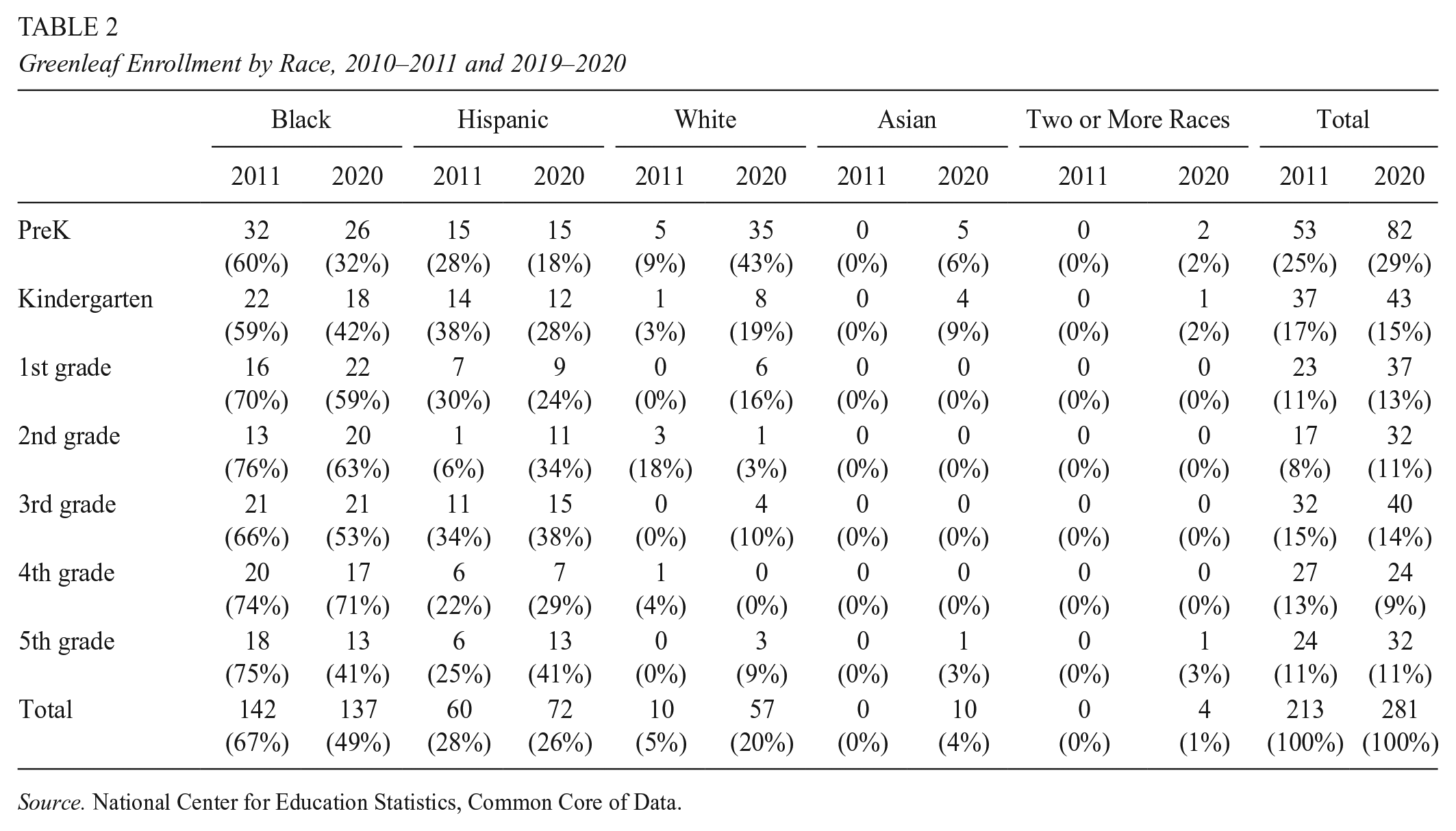
Source. National Center for Education Statistics, Common Core of Data.
The school district assigns students to a base school based on their address, and feeder patterns are established for all K–12 schools. Families can apply to schools that offer special programming, but they are not guaranteed a seat at schools other than their base school. Prekindergarten (PreK) programming in the district is offered to all students aged three and four, and families must apply for a PreK seat. Students can attend one school for PreK and then a different school for K–5 because families may apply to other schools in the district or seek schooling options outside the school system. Given the rapid gentrification of the neighborhood and the racial change in the school, Greenleaf was an ideal site for this study.
Data Collection
We analyzed neighborhood and school demographics to identify Greenleaf as our study site. We collected data primarily through interviews, and we also used documents to inform our findings. We initially spoke by phone with Greenleaf’s principal, Mr. Miller, who was enthusiastic about participating in this research. After obtaining the district’s approval, we recruited participants via email and informed them that they were invited to participate in a study to gain a better understanding of how school leaders, teachers, and staff think about diversity. Therefore, educators who agreed to participate were likely interested in discussing the topic of diversity. Of the 34 teachers at Greenleaf, 8 participated in interviews along with both of the school leaders. We ultimately conducted semi-structured interviews with 10 participants (Table 3), including the principal, assistant principal, mathematics coach, English learner teacher, and teachers from prekindergarten through fifth grade. Their self-identified races/ethnicities include Black, White, Latina, biracial, and Chinese. We use pseudonyms for all participants and the school.
Participants

Semi-structured interviews lasted approximately one hour and were conducted virtually. Guided by Turner’s (2018) valuing diversity framework, we asked participants to discuss their motivation for joining the school, their definition of diversity in the abstract as well as their perceptions of the current state of diversity at Greenleaf, their goals for diversity at Greenleaf, their experiences with teaching or leading in a school experiencing demographic change, the value they place upon diversity, the value of diversity for the students and the school, and the benefits, challenges, and unintended consequences associated with an increasing enrollment of White students at Greenleaf. All interviews except one were audio-recorded and transcribed. For the unrecorded interview with Ms. Wang, we took detailed notes, and because she preferred not to be quoted, we have incorporated her perspectives when we discuss participants more generally. To supplement our interview data, we collected data from publicly available documents, including school and district websites, media coverage, fundraising websites, architecture websites, and social media. We gathered student enrollment data from the National Center for Education Statistics Common Core of Data.
Data Analysis
Data analysis began with memoing during data collection. The memoing enhanced our ability to reflect on emerging themes, identify areas for follow-up and further exploration, note connections to the literature, and communicate among team members.
The next step was the inductive coding of transcripts. Three of the authors independently coded the same two interview transcripts and compared codes. We developed a codebook and repeated this process to ensure intercoder reliability. Guided by our theoretical framework and research questions, we initially generated descriptive and in vivo codes that revealed educators’ perceptions and valuations of diversity as well as their descriptions of the benefits and challenges associated with demographic change in their school. This process produced 32 codes, including, for example, exposure to different backgrounds, resources from high socioeconomic-status families, opportunity hoarding, White resistance, White families leaving, tension among staff, and power dynamics among parents. In our second round of analysis, we combined these codes into five broader categories and ultimately generated the four themes described in our findings (Saldaña, 2013). To enhance trustworthiness, we sought disconfirming evidence by identifying participant comments that were inconsistent with what most other participants had shared. We also analyzed documents. However, given the public nature of the documents we collected, we were not able to include quotes or specific details from the documents in our findings because doing so would make our participants and school site identifiable. Instead, we relied on the documents to triangulate our interview data and provide additional contextual information to help us better understand aspects of this case. Finally, we developed case assertions about how leaders and teachers conceptualize and perceive diversity in a gentrifying elementary school.
Limitations
Our initial research design included observations of the school community. We collected data during the 2020–2021 school year when Greenleaf was conducting virtual schooling due to the COVID-19 pandemic; therefore, we were unable to conduct observations. However, we believe our interviews provide a rich source of data on educators’ perceptions of diversity. Relatedly, our participants’ responses may have been different if we had conducted the study during a time of traditional in-person schooling because the way in which diversity is valued, how Whiteness is centered or resisted, and how the racial contract is upheld or disrupted could be manifested in different ways online versus in person.
Positionality
We draw on Milner’s (2007) framework of researcher racial and cultural positionality to examine our racial, socioeconomic, and gender identities, which we believe are particularly salient given the focus of this study on diversity. As a team of researchers, three of us identify as White individuals who were born in the United States and one of us is a foreign-born individual of Middle Eastern descent. We all identify as middle-class, cisgender researchers, including two females and two males. We acknowledge that along these outwardly visible dimensions of diversity, we are part of the majority and are privileged in our society and in our education system. These aspects of our identities, which we shared with some participants and not with others, likely impacted the relationships we established with participants and our interpretation of the data.
In addition to our personal identities, our professional experiences also impact our research. All four of the authors are former teachers, which was helpful for building rapport with our participants and understanding the general experience of being an educator. However, none of us taught in Greenleaf’s school district, nor did any of us have relationships with any of our participants before starting this research study. Therefore, we approach this study and our participants with some shared experiences as teachers but as outsiders to this school community.
Findings
In discussing diversity, Greenleaf educators consistently highlighted the school’s mission to be “intentionally diverse”; however, a clear, unified definition of diversity did not emerge. Similarly, participants’ perspectives varied regarding the desired form of diversity for Greenleaf, with some participants favoring a school that reflected the surrounding community and others expressing concern about the school becoming more White. The mission to be intentionally diverse was often discussed within the context of its challenges, such as establishing a shared mission and shared values among all school community members, ensuring diverse staff voice and representation with a White leader, and navigating complications of power and privilege as more White affluent families entered the school community. Alongside these complex challenges, Greenleaf’s educators highlighted three key benefits of a diverse school: exposure to people who are different, the opportunity for students to experience a safe space, and the influx of additional resources—the last two of which were accompanied by unintended negative consequences. Thus, although Greenleaf educators were striving to be intentionally diverse, consensus did not exist about what “diversity” meant or what the desired form of diversity was. Although there were numerous challenges associated with decentering Whiteness and resistance to upholding the racial contract, educators also highlighted the value of diversity for developing individual students’ multicultural capital and global cosmopolitanism as well as the collective benefit of reducing divisiveness for our nation and world.
Definitions of Diversity
Greenleaf Elementary’s educators and website expressed pride in stating that the school is intentionally diverse. Greenleaf educators emphasized the influence and importance of a diverse student population and teaching staff, underscoring the value of diversity at Greenleaf. However, participants presented divergent definitions of diversity.
Divergent Definitions of Student Diversity
Many participants proposed definitions of diversity focused on individual characteristics, including race, ethnicity, socioeconomic status, language, perspectives, and life experiences. The predominant focus was on student diversity by race, ethnicity, and socioeconomic status. Some participants mentioned students whose identity is Latino or Asian American, but the default consideration was between Black and White students, likely because of the history of the school and community. Ms. Davis, a White mathematics coach, sought to clarify that “when people hear diversity they think ‘all Black,’ and that is, in fact, not diverse at all.” Her prior experience featured schools with what she perceived to be little diversity, perhaps suggesting why some definitions of diversity focus on singular characteristics of race, language, or simply “non-White.” Connecting race and gender, Ms. Johnson, a Black fourth-grade teacher, described diversity as “anything that . . . is not . . . White male.” Ms. Garcia, a Latina fifth-grade teacher, shared that her perception of diversity extended beyond race or ethnicity as she noted the importance of wealth, resources, and parental education and explained that a lack of racial/ethnic diversity in her class did not allow her “to see if [wealth is] correlated with race.” Also focusing on race and socioeconomic status in her comments about diversity, Ms. Thomas, a White prekindergarten teacher, noted the “weird conflation . . . of race and economic status.” Similarly, Principal Miller, a White male, defined diversity as “majority minority and at least 40–50% low-income families.”
Expanding on these definitions, Assistant Principal Williams, a Black female, stated, “Diversity is not . . . singularly tied to race. So for me, diversity is about experience. It’s about background. It’s about access. It’s about ability.” She added that this definition includes “opinion and viewpoint and voice,” noting the impact of whose perspectives and voices are being heard. She highlighted the need for authentic rather than “token” diversity, a value that is respected in the fabric of the school community. Emphasizing the changing nature of the community, Principal Miller, a White male, described that being an intentionally diverse school meant increasing “the relational trust across lines of difference in grade level and family income and home language and all those axes . . . to knit more of a kindred community.”
Importance of Racial Diversity Among Staff
In addition to student diversity, participants also highlighted the importance of diversity among the staff, with an emphasis on racial diversity among the teaching staff. Ms. Smith, a biracial first-grade teacher, explained that “almost . . . all of our classroom teachers are people of color.” Ms. Garcia, a Latina fifth-grade teacher, stated that “we have more Black staff in our school than [any other school] I’ve ever been in before.” In 2021, 15 of 34 teachers were Black. She also noted that the school was hiring Latino teachers to represent the student population better; however, in 2021, only one of 34 teachers was Latina. Ms. Johnson, a Black fourth-grade teacher, pointed out that the staff needed more Latino teachers, as “our teaching staff needs to reflect our students.” Despite these comments, almost all the prekindergarten teachers, whose classrooms feature the largest proportions of White students, were White. Beyond racial diversity, Ms. Davis, a White mathematics coach, asserted that variation in teachers’ years of experience and leadership provided another important type of diversity. Our participants’ conceptualizations of diversity suggest multiple dimensions of school diversity—including students and staff—across race, ethnicity, wealth, language, and experience.
Desired Diversity
Greenleaf educators also had different perspectives about the desired type or level of diversity for their school. As gentrification brought more affluent White families into the area, staff struggled with whether diversity meant the school population should represent the neighborhood or the city. While some participants believed the school should reflect the community, there was also concern about Greenleaf becoming more White.
Uncertainty Regarding the Desire to Reflect Community Demographics
Participants referred to the goal of having the school represent the local community’s demographics. Ms. Smith stated, “I don’t have a pie chart in mind, but I think that I would want it to be representative of [the city] as a larger community and representative of the public school system. . . . We’re not a [predominantly White] type school community, and it shouldn’t look like one of those schools.” Although some alignment with local demographics seemed important to many staff, participants also mentioned the challenge of pinpointing the desired “mix,” given how fast the neighborhood and city were changing. Ms. Anderson, a White English learner teacher, explained that “I don’t have a magic number, but I think now [the city] is what, like 60% [Black]? . . . Something around there could make sense and be helpful. I think even that probably isn’t enough in terms of equity because the demographics of [the city] are changing as people are just pushed out of the city.” Ms. Davis, a White mathematics coach, described the opportunity for building a diverse community: “Given where we’re located, . . . there’s no reason why we wouldn’t have White families, Vietnamese families, families that speak Amharic, Ethiopian families . . . and we do have [all of those].” In discussing what constitutes desirable and practical diversity, participants’ ideas often lacked specificity and were shaped by larger demographic processes outside the school.
Concern About Becoming Too White
Of the 10 participants, 8 expressed concerns about the school becoming more White. Perhaps the clearest and most common illustration of these concerns arose through participants’ fear of unintentionally creating a space that permitted White families to wield power over school operations; in essence, they feared that the shifting demographics of the school would lead to centering Whiteness. Ms. Jones, a Black fourth-grade teacher, was concerned that the effort to become more racially diverse by enrolling more White students could reinforce a message of “White superiority.” For Ms. Jones, a commitment to diversity entails having “a good chunk of [White] folks, because I do think there’s a lot to be gained from a diversity perspective” while also maintaining a majority of students of color. Some participants mentioned the school’s history as primarily serving Black students when describing the desired diverse student population. Ms. Smith, a biracial first-grade teacher, stated that “in my dream world, [the student body] would still be predominantly Black.” Several participants cited examples of nearby schools that failed to walk the tightrope of the “right” mix of students. Ms. Johnson, a Black fourth-grade teacher, warned, “[Without active efforts,] we’ll become just like a White school.” While Greenleaf educators were committed to diversity, most were unclear about how much diversity was enough and how much racial change was too much.
Challenges Associated With Intentional Diversity
While all participants noted the school’s mission of prioritizing intentional diversity, this mission was often discussed within the context of its challenges and complications. Many challenges were apparent, but the most common fell into three subthemes: shared mission and values among all in the school community, diverse staff voice and representation with a White male leader, and complications of power as more White affluent families entered the school community. Undergirding these challenges were educators’ concerns about centering Whiteness and upholding the racial contract in their schools.
Shared Mission and Values
Participants consistently highlighted the school’s emphasis on diversity, typically describing the school as “intentionally diverse.” Many participants noted that Principal Miller, the White male leader of the school, had a crucial role in developing and holding firm to the school’s mission. Despite these efforts, in some instances, some White families’ actions demonstrated a limited commitment to the school’s mission.
Principal Miller mentioned that the school is “currently accidentally diverse . . . as a function of this period of gentrification . . . but we have an opportunity to make it something more than that.” This observation aligned with the publicly announced mission statement of the school, which declared the school to be “a proud and intentionally diverse” school that loves and challenges students while preparing them to “thrive in life.”
Despite this stated commitment, incorporating all staff, families, and community members into the mission was a challenge. One step was to publicly state the school’s status as intentionally diverse, and Greenleaf repeatedly stated its mission in newsletters, on its website, and during recruitment events and open houses. Ms. Anderson, a White English learner teacher, described that the staff wanted to ensure that families entering the school were doing so for the right reasons: “If you are not in it for that [mission], then this might not be the place for you.” She continued, “This is a new thing we’re putting out there. . . . It’s a hard step to take, and if you’re not super committed, . . . it can be hard.” Principal Miller also espoused this view: “It’s first being crystal clear about what we’re aspiring to and what kind of school we strive to be, so that we’re not trying to bend over backwards to keep people. . . . If that’s the kind of work you’re trying to do, then let’s roll together.” Principal Miller’s comment demonstrated the fine line that Greenleaf educators walked to create a diverse school while resisting pressures to center Whiteness by giving in to perpetuating the privilege of White gentrifier families. Ms. Thomas, a White prekindergarten teacher, echoed this thought: “If we can build a strong enough culture and community across race and class background, we can . . . shore this thing up and keep people [at the school].”
By stating the need to “keep people” at Greenleaf, Ms. Thomas identified a consequence of racial change. As White families entered the community, they often enrolled students in the school’s free, universal prekindergarten only to remove them prior to upper grades to seek “greener pastures” and avoid what they perceived as “unsafe” classrooms with many students of color. The school’s feeder pattern contributed to concerns among White families, who viewed its associated middle school as unsafe and low performing. To staff and leadership, this pattern suggested limited commitment or inauthentic alignment with the school’s mission. Greenleaf worked actively to sustain commitment among families through organized trainings and discussion groups, as well as consistent, repeated messaging to reiterate the school’s values. Though these active efforts were important, Ms. Smith, a biracial first-grade teacher, highlighted that “we’re a public school that can’t say ‘no.’ And so I think that we’re trying to make the messaging clear, but I think still, at the end of the day, who comes, comes.”
Diverse Staff Voice and Representation With a White Leader
Meeting the challenges of upholding a school’s mission and values requires a resolute and unified staff. The development of such a staff culture at Greenleaf occurred through multiple avenues and introduced various challenges, including hiring a diverse staff, ensuring the voices of staff of color and White staff were heard, and navigating the complexity of having a White leader with a large community of color.
Staff Voice and Representation
In general, staff were grateful for Principal Miller’s leadership and prioritization of hearing all staff members’ voices. Still, staff had conflicting perceptions of Principal Miller’s openness to the opinions of teachers of color and White teachers. Ms. Smith, a biracial first-grade teacher, perceived a “concern around access . . . to leadership and resources,” noting that this concern “creates tension” and enables White teachers to have more influence, ultimately centering Whiteness. However, Ms. Jones, a Black fourth-grade teacher, expressed that Principal Miller and Assistant Principal Williams, a Black female, attended to the voices of staff of color more extensively than the voices of White staff, saying, “If folks of color talk, it’s like ‘Pump the brakes, . . . things need to change.’ Whereas if other folks say things, . . . I don’t think he prioritizes it as much.” Ms. Thomas, a White prekindergarten teacher, saw this conflict but noted that, from her perspective. “my principal and the assistant principal, they are really trying, and I see growth and change.” Ms. Garcia, a Latina fifth-grade teacher, expressed that “some healing [probably needs] to happen” to progress beyond what Assistant Principal Williams called a “racialized staff dynamic” that resulted from staff turnover upon Principal Miller’s arrival.
This tension between different perspectives was evident in Principal Miller’s process of dismissing and hiring staff to improve teaching effectiveness and alignment with the school’s mission. He explained that there had been “more than 50% turnover since [I] arrived, and that’s hard and painful.” He noted that these changes were necessary to improve the quality of instruction, but some participants pointed out that many teachers of color were dismissed. While Principal Miller fired some teachers of color, he also hired many more, resulting in a teaching staff that had more teachers of color, particularly Black teachers, than before his arrival (see “Site Selection and Description”).
Challenge of Having a White Male Principal
Principal Miller’s White male identity complicated the process of dismissing and hiring staff as well as other decisions. He could identify with affluent White families who were gentrifying the area while also exemplifying the stereotypic societal image of a leader. His background at an elite selective university, with Teach For America, and in the district’s principal preparation fellowship program gave him privilege and access in ways often denied to educators of color. Principal Miller himself noted the challenges created by his identity: “I think [district leaders] thought that a school like [Greenleaf] would be a good fit for someone like me. And, on a cynical level, . . . I think they thought I would be reassuring to gentrifying young White families.”
Ms. Johnson, a Black fourth-grade teacher, felt the situation was as positive as possible: “I think that . . . having a leader that’s willing to . . . say, ‘I’m a White man in power, and I know that creates a dynamic,’ and being willing to do the work . . . I think [that] is important.” Still, tension around Principal Miller’s White male identity persisted. Ms. Smith, a biracial first-grade teacher, expressed the challenges of reconciling Greenleaf’s diverse student population with its leadership, saying that Principal Miller is “such a good principal . . . but I think that, again, it’s just always going to be super messy” with the combination of a White leader and a large community of color. Several comments reflected what Ms. Jones, a Black fourth-grade teacher, succinctly stated: “I wouldn’t wanna work for a White man, but if I had to . . . I wouldn’t want to work for any other White man.” Most of the participants praised the intentionality and mission of the leadership team and the school as a whole, but the challenges created complications that required consistent and mindful attention.
Power and Privilege Among White Families
In addition to the challenges associated with staff and leadership, several concerns focused on White families who were altering the balance of diversity and access for the community that had historically been represented in the school. In particular, participants noted challenges of power and privilege associated with White families’ opportunity hoarding and resistance as well as inequitable distribution of power among families from different racial groups.
White Families’ Opportunity Hoarding
A prime example of opportunity hoarding was, as noted previously, White affluent parents enrolling students in the prekindergarten program, then moving to a different school after kindergarten or first grade. As Ms. Thomas, a White prekindergarten teacher, observed, Principal Miller’s attempt to dissuade “White people who are not committed to . . . staying for all five years” from enrolling demonstrated a commitment to the school’s mission. This action also exemplified one way in which Greenleaf educators resisted centering White middle-class desires and instead attempted to disrupt the racial contract so as not to allow the actions of White families to marginalize and exclude families of color. Shaping the enrollment process in this way was intended to limit the ability of White families to take advantage of the school’s resources and to ensure that newly enrolled White students remained in the school and students from marginalized backgrounds were able to enroll. Because of lottery admissions in the district, staff at the school perceived this approach as critical for maintaining a diverse student body rather than becoming increasingly centered around affluent White families.
Still, many participants expressed concern that White families were engaging in opportunity hoarding and using their privilege in ways that prevented families of color and low-income families from accessing their neighborhood school and programs—essentially, concern that Whiteness was, in fact, being centered and the racial contract was being upheld. Ms. Johnson noted, “It does make me feel . . . [that some] families . . . are using us, like, until they can find something better.” The problem was compounded by local housing, as Ms. Garcia, a Latina fifth-grade teacher, described: “Every year, families are being pushed out, . . . not even just out of the neighborhood, but to . . . other states.”
Within this context, Ms. Smith, a biracial first-grade teacher, thought that “sometimes [White families] come in without the humility and awareness that . . . I’m not here to acquiesce to your every whim.” The time needed to meet the demands of wealthy White parents limited the time she could spend on students with substantial learning or resource needs, creating an issue which Ms. Smith called the “equity of my attention.” Ms. Jones, a Black fourth-grade teacher, agreed, saying that when “there’s not a mutual understanding, it can be beyond detrimental, because we’re spending all our energy and resources trying to appease [White parents] when we could be working in tandem with them so that we can serve the kids who need it the most.” Ms. Smith and Ms. Jones expressed their dismay with the way Whiteness was centered and had the effect of marginalizing students who needed their attention more.
White Parents’ Resistance
Multiple participants cited other concerns related to White parents’ resistance. Following the January 6 insurrection at the U.S. Capitol, when Principal Miller, a White male, sent an email newsletter noting the event and its relevance to the school’s culture, one parent criticized him for “being too political and . . . divisive.” However, this act was consistent with his overall approach to addressing important social and political issues that affect the school community. In other instances, White families objected to lessons celebrating Black history and classroom conversations about the presidential election of 2020. Ms. Smith, a biracial first-grade teacher, reported that the parents from one White family “didn’t feel comfortable with conversations that we were having, even though, [they were] kind of just Civics 101, like, you gotta know who the new president is.” Ms. Johnson, a Black fourth-grade teacher, observed that conversations about these and other national events, such as the protests following George Floyd’s murder, upset some White parents who “felt like it was not appropriate for their kids, whereas Black parents have to talk about these things . . . regardless of age.” Thus, school staff sometimes encountered notable resistance as White parents attempted to control the messaging their children received. Nonetheless, in their efforts to decenter Whiteness, many Greenleaf educators persisted in identifying and discussing the role of race and racism in society.
Inequitable Power Distribution Among Parents
Multiple participants discussed the challenges of maintaining a balanced power distribution among parents. Principal Miller, a White male, noted the importance of “making sure that our PTO [Parent Teacher Organization] leadership, . . . who are really vision- and values-aligned, are sounding our message.” Ms. Thomas, a White prekindergarten teacher, stated she did not want “the parent power to shift over completely into the hands of White families who are not going to stay.” Assistant Principal Williams, a Black female, shared an example of the ripple effect of the shifting parent power: “We have this one parent [of color] who is amazing. . . . We kind of ‘voluntold’ her to join the PTO and she was just like, ‘I don’t feel like I fit. These are lawyers and doctors and they’re talking and I don’t talk like they talk.’” She added that other parents of color had said they felt alienated and sensed the formation of cliques, actions that revealed ways in which Whiteness was being centered and the racial contract was being upheld. She described these actions as mostly unintentional but highlighted the importance of “noticing and naming when we see things that could . . . be racialized.” At the same time, Assistant Principal Williams stated that some White parents on the PTO felt “slighted and felt that it was a little unfair” to limit their participation. Finding the right balance of power was a continuous and complex process.
Some teachers reported more positive experiences. Ms. Anderson, a White English learner teacher, acknowledged that “the affluent White people with interest [who are] accustomed to having their voices heard, might come in and overtake things,” but she had not experienced that at Greenleaf. Similarly, Ms. Smith, a biracial first-grade teacher, described previous concerns with an unrepresentative PTO at Greenleaf, but she noted that a Black woman now leads the PTO and “it is much more representative of our kids and our families than it has been.” With intentional training and discussions, Greenleaf staff and parents were able to move toward decentering Whiteness and instead prioritizing intentional diversity, although not without challenges along the way.
The Benefits of Diversity in a Gentrifying School
Even with these complex challenges, Greenleaf’s educators highlighted three key benefits of a diverse school for all students. In doing so, their beliefs about the value of diversity aligned with the concepts of global cosmopolitanism and multicultural capital. First, diversity allows students from all racial backgrounds to experience exposure to people who are different from themselves. A diverse student body also allows students to experience a safe space. Finally, having diverse families at the school brings additional resources for students.
Exposure to People Who Are Different
In alignment with framing diversity as a valuable form of capital, exposure to other people, perspectives, and cultures was by far the most frequently discussed benefit of diversity among Greenleaf’s educators. Participants described the importance of exposure to people who are different for individual students and our nation. Rather than focusing on the value of diversity for developing racial or multicultural capital for individual students, some participants highlighted how diverse classrooms enhanced student learning. As Principal Miller, a White male, stated, “We all learn best across difference when we’re stretched in our experiences and our perspectives and our comfort zone.” Ms. Anderson, a White English learner teacher, agreed: “There’s that depth of ideas in being with people from different cultures, from different beliefs, from different lived experiences. . . . It’s going to push you to grow yourself and think more deeply.” On the other hand, Principal Miller commented, “When you’re in a homogeneous classroom, . . . there are teachable moments and learning opportunities that just don’t arise when everyone is thinking the same way and coming from the same background.”
Greenleaf educators also highlighted that a diverse school helped students understand and appreciate people from other racial groups, key features of developing multicultural capital. Ms. Garcia, a Latina fifth-grade teacher, reflected, “It’s so powerful to see my White students in class with a majority Black population because they’re getting to hear these conversations and these stories and these perspectives that, if you don’t hear about them or experience them again until you’re in college, then you’re not going to grow up with a really positive representation of them. . . . I think it creates this deep appreciation for other cultures.” These comments suggest the value that Ms. Garcia and other educators placed on multicultural capital for White students as they developed skills and knowledge associated with cultures other than their own. Similarly, Ms. Smith, a biracial first-grade teacher, described that “you meet so many people as adults who are like, ‘I grew up in a White town,’ and then use that as a terrible preamble to why they think a horrible thing. . . . And it’s like, ‘You don’t have that excuse. You have friends who . . . identify in all these different ways.’” Greenleaf educators described the importance of exposure to diversity, particularly early in students’ lives, as a way to improve race relations and students’ perceptions of other racial groups.
Greenleaf educators also asserted that attending a diverse school prepared students for the future and the “real world,” highlighting the concept of global cosmopolitanism and their belief in the value of multicultural capital as desirable for being competitive in a diverse and interconnected global society. Assistant Principal Williams, a Black female, stated, “The world is not homogeneous . . . and so to learn in an environment that looks like the environment you will ultimately be in in the real world is a great benefit.” Ms. Davis, a White mathematics coach, explained, “Interacting with people who are different than you is a skill that we have to cultivate, and I think that is more easily facilitated with kids that don’t look like you.” She added that developing this skill helps set Greenleaf’s students up for “future success.”
In addition to the personal value, Greenleaf educators also discussed the public value of exposure to other people for the nation and world. Ms. Anderson, a White English learner teacher, explained, “If you only talk to people who believe what you believe, it’s going to polarize people, and you see that right now politically.” Ms. Garcia, a Latina fifth-grade teacher, also pointed to the current divisiveness in our country and the way in which diverse schools can help address this concern. She asserted, “Part of the problem with our world today is that there’s just so many silos. It’s important for people to empathize with others and really understand their perspectives and their points of view because if we don’t, we’re always just going to speak over each other and . . . be really polarized as a country and as Earth.” Principal Miller, a White male, reiterated this sentiment: “If we’re going to knit this country back together in a way that’s actually aligned with our ideals as a nation, we need diverse schools.”
Safe Space
Greenleaf’s educators highlighted the role of diversity in helping them create a safe space for students. In particular, they described that no students felt like “the only.” That is, “not the only child of color, . . . not the only White child in a class.” Ms. Garcia, a Latina fifth-grade teacher, believed that “there is something to be said about racial affinity groups. I know that’s rare to say for such young kids, but it’s real. You look around and you’re like, ‘Okay, I feel safe here.’” At Greenleaf, students often have classroom peers from backgrounds similar to their own and, therefore, feel connected and safe in their classrooms. Ms. Garcia continued, “Kids thrive in an environment where they don’t feel like, ‘Oh, I’m a minority kid here.’ Everyone’s a minority. . . . This is a really diverse environment.”
Several participants noted that exposure and openness to others facilitated the creation of a safe space that welcomed all students and allowed them to truly be themselves. Ms. Anderson, a White English learner teacher, recounted a time when a student felt safe and described its impact on students’ learning: We’ve been studying African Americans who are accomplished in STEM. . . . One little girl who wears a hijab said, “I’d like to see, are there any women in STEM that wear hijabs?” That made us . . . look for [pictures of] women in hijabs who are in STEM. . . . I wouldn’t have thought of that. It took her coming forward to make me realize that. . . . So those are the kinds of wonderful moments that there are, but that’s all because those children feel safe in the conversation and in the space they’re in.
Participants explained that creating safety in a diverse classroom “takes a lot of work.” With guidance from external trainers, teachers have participated in repeated and sustained professional development about race and equity and “what it takes to build a safe and inclusive classroom.” While participants generally agreed that having a safe space is extremely valuable, some also noted concerns that this safe space prevents students from experiencing the “real world” that they will encounter outside of the school community.
Resources
Finally, participants described additional resources that had become available to the school since the community had been gentrifying and more affluent White students were enrolling in the school. Ms. Johnson, a Black fourth-grade teacher, explained, “We have a lot more resources than a lot of those other schools do. They can’t even do some of the stuff that we do at our school.” She highlighted the PTO’s strength at organizing to gather resources and explained, “We have parents who will buy groceries for families. We have a GoFundMe account that we’re constantly asking people to donate to. And because we have parents who are very political or engaged, and so higher socioeconomic statuses, they have networks that can donate a lot of money or donate their time, or they know other organizations that can come and help us.” These resources were particularly beneficial during the COVID-19 pandemic as Greenleaf’s low-income families, particularly families of color, needed support for childcare and food.
In addition to larger efforts, such as those coordinated by the PTO, White families also contributed their individual resources to the school. Ms. Smith, a biracial first-grade teacher, described “one White family that I love.” They had conveyed to her that they were receiving an excellent education for their children, and “they said, . . . ‘You can count on us to buy the donuts.’ And I was like, ‘Thank you.’ Right? If you’re going to come here, buy the donuts. Bring the sharpeners. Make a little auction or something.” She recognized that this family and some other White gentrifier families felt that they “want to be part of something.” She believed their actions conveyed the sentiment that “I’m getting something and I want to give something.” Ms. Smith described, “That type of family . . . has reverence for the community and understands those things, . . . that’s a huge benefit, honestly, for us.” Ms. Davis, a White mathematics coach, shared an example of another White family who, during the COVID-19 pandemic, “ran a pod in their garage, and intentionally invited whomever from the class.” She explained that Principal Miller prioritized “families that really needed childcare” to be included in the pod.
Although many White families were “leveraging so much of their privilege to help all of our students,” that was not true for all White families. Ms. Smith, a biracial first-grade teacher, explained, “That’s still a minority of what White parents who enter our school expect.” Greenleaf educators also explained that due to the influx of wealthier families, the school no longer qualified for financial assistance through Title I. While Greenleaf gained some resources from individual families and their networks, the school lost resources from federal funding for schools with large shares of low-income students. As with other changes, this shift demonstrates the balance of benefits and challenges that result from a changing student body and community.
Discussion
This study describes the complexities that teachers and leaders perceived to be associated with a diversifying school in a gentrifying neighborhood. Ultimately, a clear, agreed-upon definition of diversity did not exist, and similarly, the perceived value of diversity was neither clear nor simple. Diversity is complex and challenging, but our participants believed the benefits were worth the challenges. This school was committed to working toward intentional diversity and effectively leveraging the resources that gentrifying families brought to the school without marginalizing longtime families and students. In essence, although not always successful in doing so, they sought to decenter Whiteness and resist upholding the racial contract. Their comments aligned clearly with two of the concepts in Turner’s (2018) framework—global cosmopolitanism and multicultural capital—but less so with the third concept, racial capital. Greenleaf educators’ perceptions of and experiences with diversity demonstrated the positive value they placed upon diversity, whatever the term meant to them.
Variation existed in how participants conceptualized diversity and how they described their desired form of diversity. Local demographics provided a conceptual anchor for some educators’ visions of diversity, but there were no clear efforts to determine a collectively agreed-upon goal for the school’s intentionally diverse mission. This lack of specificity perhaps gave leaders more flexibility in recruiting families within the context of rapidly shifting neighborhood demographics, but it also raised concerns about the school’s long-term diversity goals. Nofal (2021) suggested a context-specific practical agenda for educational leaders to address diversity in their organization, beginning with identifying the goal, the motivation, and a specific implementation plan. Without such an agenda, a shared definition of diversity, and a common view about who should be in their school, it could be difficult for Greenleaf leaders and teachers to work together to attain their mission of being an intentionally diverse school. Indeed, unanchored definitions of diversity may undermine efforts to build diverse communities, particularly as these efforts become increasingly complicated by the broader, dynamic forces of gentrification and economic inequality.
Although Greenleaf educators did not share a common definition of diversity, they continuously referred to their school as being diverse. They generally acknowledged that the lower grades were more racially diverse than the upper grades as the lower grades included more students from multiple racial groups, but in discussing the challenges and benefits of a diverse school, they maintained the idea that their school was, in fact, diverse. This perception persisted even though, by some of their own definitions, certain classrooms or grade levels would not be considered “diverse.” Thus, the complexities of connecting definitions of diversity to real-life settings can be quite challenging.
Greenleaf educators described three main challenges of working in a diversifying school in a gentrifying neighborhood, all of which revolved around developing a community committed to intentional diversity. More specifically, these challenges—adhering to the school’s mission, ensuring diverse staff voice and representation with a White leader, and navigating privilege and power dynamics among parents—all involved the adult members of the school community, including leaders, teachers, and parents. Our finding regarding the challenges of working with parents is consistent with prior research on privileged White parents in gentrifying schools (Ayscue et al., 2022; Freidus, 2019; Roda, 2020; Siegel-Hawley et al., 2017) and underscores the ways in which such parents push to center Whiteness and uphold the racial contract (Turner, 2018).
Educators at Greenleaf navigated the challenges of defining a shared history and identity, establishing relationships across diverse groups, and attempting to erect equitable parent leadership structures and practices. While these challenges reflect many that have been discussed in previous research on school gentrification (Mordechay, 2022), our participants highlighted the importance of identifying gentrifier parents who would take active roles in facilitating the school’s mission by decentering Whiteness and disrupting the racial contract. The strategy of finding the “right” White families was intended to guard against the power dynamics frequently introduced by privileged parents in school gentrification contexts. However, Greenleaf educators acknowledged that although the school was unambiguously committed to “intentional diversity,” as a public school, it could not refuse enrollment. Indeed, participants expressed that the new mix of parents at Greenleaf presented a fresh set of challenges and demands as well as new opportunities that sometimes undermined the school’s diversity goals. This finding aligns with Roda’s (2020) finding that school leaders face difficulties leveraging gentrification in a way that promotes diversity and integration without catering to the demands of advantaged families. In addition, our study highlights the complexity of a diverse staff working together in a diversifying school, especially when the principal was a White male and half of the teaching staff was comprised of women of color.
Unlike previous research that describes ways in which students of color may be marginalized within racially diverse schools (Ford et al., 2008; Lewis & Diamond, 2015; Losen & Martinez, 2020; Losen & Orfield, 2002; Oakes, 2005; Roda, 2015; Skiba et al., 2011; Wright et al., 2017), our participants did not describe such instances at Greenleaf. The lack of discussion about exclusionary practices within the school could be due to policies and practices that were in place to prevent such occurrences. It is also possible that because racial diversity was increasing primarily in prekindergarten and early grades, these issues may not have presented themselves yet.
On the other hand, when describing the benefits of a diverse school—exposure to people from different backgrounds, creation of a safe space, and influx of additional resources—most participants focused on students rather than adults. Educators’ intention to support students’ learning, growth, and well-being centers students in their work and vision. Therefore, it is understandable that they were willing to navigate the challenges from the adults in order to provide a learning environment that they believed was beneficial for children.
Consistent with Turner’s (2018) framework describing the value of diversity, our participants highlighted the benefit of students’ exposure to people from different backgrounds as a primary benefit. In doing so, their comments suggested they believed in the value of developing multicultural capital, particularly for White students as they developed skills and knowledge associated with cultures different than their own. Without naming it, our participants discussed the concept of global cosmopolitanism (Turner, 2018) as they emphasized the value of diversity for preparing students for the future, for the “real world.” While their perspectives were clearly aligned with the ideas of global cosmopolitanism and multicultural capital, our participants did not as clearly communicate beliefs about the value of racial capital. It is possible that a similar study with gentrifier parents might be more likely to uncover such a value more clearly, but the educators in our study did not suggest that they believed developing racial capital was among the most important benefits of a diverse school.
In addition to the ways in which our participants’ conceptualizations of the value of diversity were consistent with the ideas of global cosmopolitanism and multicultural capital (Turner, 2018), our participants also focused on the benefit of diversity for enhancing student learning. By pushing students of all backgrounds to engage in deeper thinking as they were exposed to the ideas, questions, and experiences of people who were unlike them, promoting deeper thinking and learning is a benefit that is not as clearly captured in the ideas of global cosmopolitanism, racial capital, or multicultural capital. Extending Turner’s (2018) framework on the value of diversity, which focuses primarily on the value of diversity for individuals, our participants highlighted the benefit of diversity for the collective—that is, the nation and the world. They believed that learning in a diverse setting was important in order to address the current divisiveness of the United States and “knit this country back together.”
While highlighting the benefits of diversity, our participants also revealed the unintended consequences of two such benefits. For individual students, having a diverse school and classroom meant that educators could create safe spaces where students did not feel isolated as the “only” student from a particular group. While our participants viewed this as a positive feature of diversity, they also acknowledged that such safe spaces did not adequately prepare students for the real world that is less “safe.” For the school as a collective, the influx of more affluent White families brought additional resources, which participants viewed as a benefit. However, the increased resources meant that the school lost its Title I status, an unintended consequence that detracted from the school’s preexisting resources. These two benefits of diversity were, in fact, double-edged swords that also introduced unintended negative consequences.
Implications
It is well established that in urban gentrified areas, housing market and real estate pressures are especially stark (Guerrieri et al., 2013). This issue arose continually in our conversations with participants. Indeed, the potential pressure of displacement at neighborhood schools has been echoed by other studies on gentrification and schools (Pearman, 2020). This begs the question: How much influence does one school have if the surrounding housing situation changes? While state and local policies that underscore deep and fundamental relationships among housing, communities, and schools are extremely important, there is much that local schools and districts can do to navigate gentrification. Recent studies by Roda (2020) and Mordechay (2022) found that school leaders and teachers can act as critical intermediaries who attend to power dynamics among different groups of families and that promoting diversity and integration must be done thoughtfully to ensure that gentrifiers do not engage in exclusionary behaviors or opportunity hoarding.
First, as a whole staff, teachers and leaders could establish a shared definition of diversity and come to a consensus on goals for both student and staff diversity (Nofal, 2021). With the definition and goals serving as anchors for their work, staff can develop a plan for achieving their goals. Such a plan would likely include crafting a mission statement that clearly conveys the school’s core values, similar to Greenleaf’s mission to be “intentionally diverse.” The plan could also include marketing and recruitment practices that would aid in reaching and sustaining the school’s diversity goals for students as well as recruitment and hiring plans to aid with diverse representation among staff. In addition, staff should determine how they will assess progress toward their goals. As they implement their plans, staff should continuously monitor progress and refine their action plans as needed.
Furthermore, it is imperative that leaders at diverse schools in gentrifying contexts create school cultures that facilitate equal-status interactions among students, families, and staff from different backgrounds. Professional development for leaders and teachers about working with diverse groups of parents and educators could address some challenges at diversifying schools in gentrifying communities.
Clearly, addressing the challenges of gentrification more meaningfully will require coordinated and cross-sector cooperation. Such cooperation is crucial not only in schools and districts but also in housing, transportation, and land use practices (Mordechay & Cordes, 2024).
In addition to the current investigation’s goal of understanding educators’ perceptions and experiences with diversity in a gentrifying school, future research should explore similar topics from the perspective of students and parents. Given that students and parents are key members of any school community, expanding our knowledge of their experiences in a gentrifying school could enhance our understanding of the benefits and challenges associated with diversity for all members of the community. Future research could also examine how relationships and power are developed among staff by exploring the issues of staff turnover, staff demographics, and White leadership in gentrifying schools.
Conclusion
This study provides new insights into how teachers and school leaders perceive and experience diversity as they seek to “get it ‘right’” in a gentrifying elementary school. It demonstrates their impact as they strive to bring the benefits of diversity to their students and others. Moreover, it deepens our understanding of how these educators experience and address the challenges presented by diversity. These findings can inform scholars and practitioners in urban education and beyond who are addressing issues related to social practices, staff culture, resources, leadership, the need for policy changes, and other challenges in gentrifying neighborhoods and schools.
Footnotes
Declaration of Conflicting Interests
The author(s) declared no potential conflicts of interest with respect to the research, authorship, and/or publication of this article.
Funding
The author(s) received no financial support for the research, authorship, and/or publication of this article.

Authors
JENNIFER B. AYSCUE is an associate professor in the Department of Educational Leadership, Policy, and Human Development at North Carolina State University; email:
KFIR MORDECHAY is an associate professor of education and policy studies at Pepperdine University; email:
GAGE F. MATTHEWS is an institutional researcher at the Milwaukee Institute of Art & Design; email:
JULIE WHETZEL is a doctoral student at North Carolina State University and an Education Program Consultant at the NC Department of Public Instruction; email: