




Abstract
Hispanic-Serving Institutions (HSIs) advance servingness (i.e., racially-affirming support for Latin* students through campus programs and services) to promote academic success. However, the role of mathematics instruction in servingness is underexamined. Given how gateway mathematics courses filter out racial diversity in STEM majors, insights about Latin* students’ experiences of instruction in these courses can enhance servingness. This study analyzed 27 undergraduate Latin* students’ experiences of servingness through classroom participation in gateway mathematics courses at an HSI. We focused on classroom participation due to its well-documented influence on Latin* students’ mathematics identities and STEM persistence. Latin* students largely reported supportive instruction that reduced risks of participation. However, cultivating a racially-affirming community (a key aspect of servingness on the broader HSI campus) was also necessary to disrupt racialized influences and ensure Latin* students’ equitable access to participation. We conclude with implications for research and practice to advance servingness through STEM education across HSIs.
Keywords
Ideologies of whiteness (e.g., colorblindness, myth of meritocracy) frame mathematics as ‘neutral’ and disconnected from social realities (Leyva, McNeill, & Duran, 2022; Martin, 2019). However, Latin* 1 students experience racial oppression in undergraduate mathematics, where they navigate isolation, microaggressions, and inequities of support (Oppland-Cordell, 2014; Placa et al., 2024). Dominant beliefs of neutrality and individualism in mathematics deny cultural responsiveness through instruction. When these beliefs are challenged, instruction leverages collectivistic values in Latin* culture, such as interdependence and family loyalty, to establish learning opportunities that affirm students’ identities and nurture academic success (Adiredja et al., 2020; Leyva, 2016, 2018; Leyva, McNeill, et al., 2021). Such instruction that embraces Latin* students’ backgrounds as strengths is particularly limited in undergraduate classrooms. Mathematics faculty readily appeal to dominant values of the discipline and thus reinforce inequity among Latin* leaners (Garcia et al., 2020; McNeill et al., 2022).
Racial equity for Latin* students through instruction is critical in gateway mathematics courses for STEM majors, such as calculus. Latin* students’ success in these courses contributes to persistence and a sense of belonging in STEM (MacArthur & Dobie, 2023; Perez et al., 2024). However, such success often comes with the undue cost of Latin* students’ resilience to overcome structural inequities, such as limited access to high-quality instruction and advanced mathematics before college (Champion & Mesa, 2017). Latin* students must also adopt self-protective strategies to navigate educator biases associated with views of cultural deficits and stereotypes of ability (Garriott et al., 2019; McGee, 2016). Instruction, thus, plays a key role in alleviating educational inequities and promoting cultural responsiveness to remove systemic burdens for STEM success. With the pervasive role of calculus and other gateway courses in filtering Latin* students out of STEM (Apkarian et al., 2024; Melhuish et al., 2022; Weston et al., 2019), it is crucial to examine instruction that resists structural barriers and fosters equity.
Hispanic-Serving Institutions (HSIs) are important contexts for exploring racial equity in gateway mathematics. College campuses with the HSI federal designation enroll at least 25% Latin* students and vary in levels to which they foster culturally-responsive educational experiences (Núñez et al., 2015; Santiago, 2006). Latin* students’ campus realities, thus, differ in terms of having their cultural values and racial identities embraced for equitable outcomes (Garcia, 2017, 2019). Garcia et al. (2019) proposed a framework of servingness to examine institutional practices for strengthening connections between Latin* enrollment and equity. This framework, as further described later, offers a lens for understanding as well as addressing discontinuity of servingness in and out of STEM educational contexts. That is, Latin* students at HSIs often find racially-affirming support outside of STEM departments, yet regularly experience oppression in STEM classrooms (Convertino et al., 2023; Herrera et al., 2022). Relationships between instruction and support across broader HSI campus contexts, however, have not been central in analyses of Latin* students’ STEM experiences (Ro et al., 2024). Such insights can guide STEM instructional reform for continuity in servingness across campuses with different trajectories of coming into their HSI identities.
Latin* students at HSIs report racialized experiences in gateway mathematics, including calculus (e.g., Leyva, 2022), statistics (e.g., Shi et al., 2023), and introduction to proof (e.g., Brown, 2018). One form of oppression is limited access to participation (e.g., sharing ideas, asking questions). This reality is concerning as participation positively impacts mathematics identity development and STEM retention (Apkarian et al., 2024; Oppland-Cordell, 2014). Thus, further research at HSIs (as described above) that explores gateway mathematics instruction for equitable participation is crucial for what we refer to as instructional servingness. To this end, our study addresses the question: How do Latin* students’ experiences of participation in gateway mathematics classrooms reflect how instructional servingness is limited or embraced?
Findings from our study showed how cultivating a racially-affirming community was central to instructional servingness that promoted equitable participation. Such a community reflected forms of support across the broader HSI campus that destabilized dominant ideologies in mathematics (e.g., individualism, neutrality), challenged racism and interlocking systems of power, and embraced collectivistic norms and values in Latin* culture. We leverage our findings to raise research and practice implications that promote instructional servingness in STEM.
Literature Review
Our study builds on research about Latin* students’ STEM experiences at HSIs and racial equity in gateway mathematics instruction. Below, we highlight key findings and areas for further inquiry across these bodies of research to capture the present study’s contributions.
Latin* Students’ STEM Experiences at HSIs
Undergraduate Latin* students navigate racial oppression in STEM at HSIs, including isolation (Leyva, 2022; Placa et al., 2024), stereotypes of ability (Flores et al., 2023; McGee, 2016), and pressures to communicate in English (Bravo & Stephens, 2023; Shi et al., 2023). Latin* women and nonbinary students face underrepresentation and academic underestimation due to race and gender (Contreras Aguirre, et al., 2020; Herrera et al., 2022). Such oppression limits access to support and participation in STEM classrooms (Garriott et al., 2019; Herrera et al., 2022). In a study about Latina/o 2 engineering majors, Garriott et al. (2019) found how overlapping racial and gender stereotypes made Latinas doubt the value of their classroom contributions. Latinas, as a result, held back on asking questions to avoid deficit judgments. These findings suggest that instruction plays an important role in facilitating equitable participation. However, prior research explored Latin* students’ STEM experiences broadly without exclusively focusing on classroom contexts and perceptions of instruction (Placa et al., 2024; Ro et al., 2024). Our study adds such insights specific to Latin* students’ experiences of mathematics instruction at an HSI.
Identity-conscious support from relationships with faculty who hold common identities nurtures Latin* students’ STEM success at HSIs (Herrera et al., 2022; Perez et al., 2024). For example, in the Perez et al. (2024) study of Latina STEM persistence, researchers found how participants sought out faculty of the same race and/or gender who understood their struggles and could help them navigate. Similar support in STEM peer relationships is also a positive influence (Choi, 2023; Herrera et al., 2022). In a study about STEM realities of transferring from Hispanic-serving community colleges (Herrera et al., 2022), Latinas built peer support networks with women of color that disrupted isolation and inspired them to persist. Thus, faculty and peer support increases Latin* students’ sense of belonging in STEM.
Relationships formative for Latin* STEM success were largely developed in HSI spaces outside of classrooms, such as campus organizations (Choi, 2023), internships (Herrera et al., 2022), and learning centers (Placa et al., 2024). STEM classrooms limited opportunities for such relationships in two ways. First, lack of diversity restricted connections with faculty and peers holding similar identities (Herrera et al., 2022; McGee, 2016). Second, ideologies of whiteness in STEM (e.g., individualism; prioritizing technical skill over social connections; Battey & Leyva, 2016) clashed with Latin* cultural values of collective support and interdependence (Perez et al., 2024; Rodriguez & Stevens, 2023). Instruction must be transformed to address this clash and remove burdens placed on Latin* students to find support on their own. With servingness readily experienced outside of STEM classrooms, instruction can be enhanced by embracing elements of such support. However, broader contexts of HSI campuses were overlooked in research on Latin* STEM experiences (Ro et al., 2024). Our study fills this gap by exploring mathematics instruction that promotes campuswide support for racially-affirming classroom experiences.
Instruction in gateway courses at HSIs is a source of discouragement for STEM retention. Latin* students reported faculty advising them to drop courses (Choi, 2023) and reconsider STEM majors (Garriott et al., 2019). These practices and coursework struggles led students to question their ability and sense of belonging in STEM (Perez et al., 2024; Placa et al., 2024). Placa et al.’s (2024) study documented an exception to such pervasive discouragement in gateway STEM instruction – namely, a chemistry professor nurtured Latina students’ STEM pursuits by motivating them to excel and connecting them with former students successful in the course. This finding shows how instruction can resist STEM gatekeeping and facilitate support networks. However, it was a fleeting consideration of supportive instruction in the literature.
Despite the importance of gateway course instruction in STEM trajectories, it has not been the focus of research about Latin* students’ STEM experiences at HSIs. A review of research on servingness in STEM (Ro et al., 2024) showed that such instruction has been central in studies about equity-oriented pedagogical reform (e.g., Broussard et al., 2021). However, HSI campus contexts and student experiences of racial (in)validation through instruction went disregarded. The previously-described need for research on Latin* students’ STEM instructional experiences and connections to campuswide support is, therefore, especially important in gateway courses. Mathematics, in particular, was frequently raised across findings about Latin* students’ racialized STEM experiences in and beyond gateway courses (Garriott et al., 2019; Leyva, 2022; Perez et al., 2024; Shi et al., 2023). Perez et al. (2024), for instance, depicted how challenges in introductory “weedout” and advanced mathematics courses made Latina students reconsider STEM majors. This widespread influence of mathematics motivates our focus on instructional servingness in calculus and other gateway courses at an HSI.
Racial Equity in Gateway Mathematics Instruction
Calculus is a long-standing gatekeeper of STEM majors (Ellis Hagman, 2021), in addition to other mathematics courses like college algebra (Bhattacharya et al., 2020) and introduction to proof (Brown, 2018). Research on racial equity in these courses conveys how instruction impacts access to classroom participation, which has implications for STEM persistence. For instance, studies uncovered how active learning practices in calculus (e.g., asking students to explain their thinking, holding class discussions) encouraged participation that contributed to strong mathematics identities and STEM retention (Apkarian et al., 2024; Ellis Hagman et al., 2014). At the same time, research shows that equity in such outcomes is not guaranteed (Brown, 2018; Leyva & Alley, 2023; Leyva, Amman, et al., 2022). One such study of calculus instruction (Leyva, Amman et al., 2022) uncovered how practices of destigmatizing mistakes and questions, without also disrupting stereotypes of ability, resulted in racially minoritized students’ limited participation. These insights suggest how research on gateway mathematics instruction for equitable participation is needed.
In continued exploration of racial equity in gateway mathematics, it is important to center Latin* students’ experiences. Latin* students were sampled in studies described above, but they were not the sole focus. In-depth exploration of Latin* students’ experiences can inform instruction responsive to their uniquely racialized realities. Our study provides such needed research by analyzing instruction that promotes Latin* students’ participation access.
An exception to de-centering Latin* student experiences in gateway mathematics was research that examined racial equity through the active learning practice of groupwork (e.g., Oppland-Cordell, 2014; Rios, 2024). Findings showed how groupwork was a site of oppression that suppressed participation. Deficit views of Latin* student ability shaped physical exclusion from groups and disregard for contributions (Brown, 2018; Rios, 2024). In Rios’s (2024) study about multilingual students of color, linguistic stigma (e.g., having an accent) collided with racial and gendered oppression to limit Latino students’ comfort with and access to participation. At the same time, groupwork can increase Latin* students’ participation (Bhattacharya et al., 2020; MacArthur & Dobie, 2023; Oppland-Cordell, 2014). A study focused on Mexican-American students in calculus (Oppland-Cordell, 2014) captured how groupwork carved opportunities to overcome racialized tensions about participation. Positive and negative impacts of groupwork in the literature depict how it can promote equitable participation, through that is not necessarily ensured.
Given how instruction shapes participation access (Ellis Hagman et al., 2014; Leyva, Quea, et al., 2021), practices for facilitating groupwork can reinforce or disrupt racial inequity in this regard. Such insights, however, were left implicit in research on groupwork. Researchers’ interpretations of their findings addressed the value in further exploring these practices (MacArthur & Dobie, 2023; Oppland-Cordell, 2014). For instance, MacArthur and Dobie (2023) reflected on how heterogenous grouping and discussion opportunities could have promoted Latina/Hispanic women’s equitable participation in calculus group exams. They called for studies more closely attending to such practices that mediate groupwork (in)equity. With groupwork used across classrooms in our study, we address this need to examine instructional practices during peer collaboration that influence equity in Latin* students’ participation.
Several studies about Latin* students in gateway mathematics took place at HSIs (e.g., Bhattacharya et al., 2020; Convertino et al., 2023; Rios, 2024). However, much like research reviewed earlier about Latin* students in STEM, relationships between mathematics instruction and HSI campus contexts were virtually unexplored. Bhattacharya et al.’s (2020) study of a culturally-responsive redesign for a college algebra course points to the value of examining such relationships. Their redesign, which increased Latin* students’ achievement and sense of belonging in STEM, included instructional planning alongside advisors in the Educational Opportunity Program—a key source of campuswide servingness at the HSI site. By contextualizing mathematics classroom experiences in HSI campus ecosystems, research can characterize instruction that disrupts the discontinuity of servingness in and out of STEM environments. Our study adds such knowledge by exploring practices of instructional servingness for equitable participation in gateway mathematics classrooms.
Conceptual Model
To guide our study, we used a conceptual model that combined two theoretical frameworks: the servingness framework (Garcia et al., 2019) and the framework of instructional equity in gateway mathematics (Leyva, McNeill, et al., 2021; Appendix A). Before presenting the model, we address how intersectionality offers a theoretical foundation to merge the frameworks. Intersectionality refers to racism and interlocking systems of power (e.g., cisheteropatriarchy, classism) shaping unique experiences of oppression and agency for multiply-marginalized people (Crenshaw, 1991). Such realities influence constructions of identity over time and across contexts, including mathematics (Collins & Bilge, 2020; Joseph et al., 2024; Zavala, 2014).
Researchers who proposed our model’s combined frameworks called for use of intersectionality to extend analyses of servingness and instructional equity in mathematics. Namely, Garcia and Cuellar (2023) posited that intersectional use of the servingness framework critically examines HSI structures’ effectiveness in addressing within-group diversity of needs and identities among Latin* students. Similarly, Leyva, Amman, et al. (2022) argued that intersectional analyses using their framework can reveal variation in equitable instructional practices responsive to multiply-marginalized realities for nurturing mathematics identity formation.
With intersectionality as a foundational theoretical perspective, our conceptual model responds to calls for intersectional engagement of the frameworks exploring servingness and equity in gateway mathematics instruction. The servingness framework (Garcia et al., 2019) contributes specificity in accounting for intersectionality of Latin* experiences in gateway mathematics courses and at HSIs. At the same time, the framework on instructional equity in gateway mathematics (Leyva, McNeill, et al., 2021) sheds light on how Latin* students’ classroom realities impact intersectional opportunities for servingness.
Figure 1 presents our conceptual model. Below, we show how the constituent frameworks overlapped and worked together to analyze instructional servingness. Aligned with our exploration of mathematics instruction as embedded in the broader HSI context, the model is an adapted version of the servingness framework. Our adaptations infuse elements from the framework on mathematics instructional equity, which are flagged with blue font in Figure 1.

Conceptual Model.
Gateway Mathematics Instruction as a Structure for Serving
The servingness framework includes “structures for serving,” or sources of racially-affirming support at HSIs. Gateway mathematics instruction was the main structure for serving examined in our study (Figure 1c), which falls under culturally-relevant pedagogy in the framework. We explored relationships between servingness in instruction and across an HSI campus, so our model preserves other structures for serving that Garcia et al. (2019) outlined. The servingness framework recognizes the systemic impact of white supremacy on HSI structures and student experiences. Similarly, the framework for instructional equity in gateway mathematics accounts for sociohistorical forces that shape inequitable learning opportunities (Leyva, McNeill, et al., 2021). These forces (e.g., stereotypes of mathematical ability, gendered norms in Latin* culture) are linked to racism, white supremacy, and cisheteropatriarchy. Our model shows how mathematics instruction at HSIs is situated in a white, cisheteropatriarchal society that impacts its quality as a structure for serving (Figure 1b). Consideration for cisheteropatriarchy and other systems (e.g., classism) that interlock with white supremacy responds to the call for intersectional analyses of servingness (Garcia & Cuellar, 2023).
In addition to systemic influences, our model accounts for dominant ideologies and institutional structures as “external influences on serving” (Figure 1a). We preserved external influences in the servingness framework and added “logics in mathematics education” from Leyva, McNeill, et al. (2021). These logics are dominant beliefs in mathematics that organize educational structures and practices—e.g., equating correctness with ability and using gateway mathematics success to gauge STEM potential (Battey & Marshall, 2024; Leyva, McNeill, et al., 2021). The ‘neutral’ nature of logics, anchored in ideologies of white cisheteropatriarchy (e.g., colorblind racism, gender neutrality), disallows instruction to disrupt systemic influences noted earlier and thus reproduces inequitable learning opportunities. As our model depicts, logics in mathematics education and other external influences impact instructional servingness.
Mathematics Classroom Participation as an Indicator of Serving
Another set of elements in the servingness framework are “indicators of serving,” or experiences and outcomes from the presence or absence of racially-affirming support in HSI structures (Figure 1d). These interrelated indicators are validating experiences (e.g., Spanish-speaking peer connections), racialized experiences (e.g., microaggressions), academic outcomes (e.g., college completion), and non-academic outcomes (e.g., racial identity). Our model preserves the framework’s set of validating and racialized experiences as they are relevant to our study. We added “access to mathematics classroom participation” from the Leyva, McNeill, et al. (2021) framework as the core academic outcome for our study. Although we did not explore STEM degree completion and mathematics identity as outcomes, the model includes these indicators associated with participation access (Battey et al., 2022; Oppland-Cordell, 2014).
The model’s arrows pointing from structures for serving to indicators of serving (Figure 1e) represent mechanisms of serving, or processes that promote or thwart servingness. Drawing on the Leyva, McNeill, et al. (2021) framework, our model allowed for examining mechanisms of mathematics instruction that did or did not translate into classroom participation (indicator of serving). Such mechanisms reflect how instruction reinforces or disrupts systemic forces and external influences that impede servingness. Documenting these mechanisms captures limitations and opportunities in instruction for embracing servingness outside of STEM classrooms. These insights, therefore, characterize practices of instructional servingness in gateway mathematics with mechanisms for equitable participation.
Methods
The present analysis comes from a larger project, titled Transformative Inclusion in Postsecondary STEM (TIPS), that explores Latin* students’ and mathematics instructors’ perceptions of instructional servingness at an HSI (Sonoma State University, SSU). We focused on Latin* students’ perspectives in this analysis to generate in-depth insights on how instruction is experienced across two types of gateway mathematics courses: (1) requirements for STEM majors (e.g., calculus, introduction to proof); and (2) requirements for general education (e.g., finite mathematics). 3 The first author from Vanderbilt University (Leyva) led the research. The research team also includes two SSU mathematics faculty as well as undergraduate and graduate student assistants from both universities.
Study Context and Participants
SSU is a medium-sized, public, and largely residential university in the western U.S. When our study began in 2021, its Carnegie classification was “Master’s College & Universities: Larger Programs” with an undergraduate classification as “four-year, full-time, inclusive, higher transfer-in.” Full-time undergraduates were about 45% white, 40% Latin*, 5% multiracial, 5% Asian, <5% Black or African American, and <3% some other race (IES NCES, 2021). About 60% of students were women and 40% were men. 4 Latin* students made up approximately 40% of enrolled women and 30% of enrolled men.
Lecturers and tenure-line faculty, who are predominantly white, taught courses in our study. They commonly used active learning practices (e.g., groupwork, class discussions). Course enrollment ranged between 15–30 students. For recruitment, a SSU staff member sent e-mail messages to enrolled students with a form for expressing interest. Research team members at SSU visited classrooms to provide a study overview and distribute the form. Instructors were not informed if any students were participants. Participants were compensated $20/hour.
We recruited a total of 38 Latin* students. Given our focus on instructional servingness in gateway courses for STEM majors, our analytical sample (27 of the 38 students) was enrolled in these courses. Most participants were first-year students. Table 1 lists participants’ pronouns, ethnoracial-gender identities, 5 and status of intending to major in STEM. About 75% of students were interested in STEM majors (e.g., computer science, mathematics, psychology).
Latin* Student Participants

Our sample was largely reflective of SSU’s undergraduate profile (IES NCES, 2021). Two-thirds identified as female or a woman. Participants were of traditional college-attending age with most being 18 or 19 years old. Less than a quarter were transfer students. Over half held status as low-income, first-generation college students and/or had Mexican heritage (common among Latin* students at SSU). We do not specify participants’ mathematics courses and intended majors to mitigate the risk of revealing identities. If providing ethnoracial identity (e.g., Salvadoran) increased identifiability, we only specified gender. To the extent possible, we sampled for having multiple students in each course section and for ethnoracial-gender variation.
Data Collection
Data collection took place in fall 2021 through fall 2022. Researchers outside of SSU collected data to protect participant confidentiality, including two Latina cisgender women of Mexican heritage, two Latin* cisgender men, a Latiné Indigenous biracial woman, an Asian nonbinary person, a Black cisgender woman, and a white transmasculine person. Three types of data were collected: (1) event journaling, (2) individual interviews, and (3) group interviews.
Event Journaling
Participants during fall 2021 and spring 2022 (17 of the 27 students) were invited to complete event journaling (Leyva, McNeill, Balmer, et al., 2022; Leyva, Quea, et al., 2021). As an adaptation of diary methodology for documenting daily forms of racism and misogyny (Swim et al., 2001, 2003), event journaling was used to report events from mathematics instruction perceived as oppressive or supportive for Latin* students. Participants submitted entries via an online form (see Appendix B in the “Open Practices” section). Submissions included a description of events and reflection on their oppressive or supportive nature. Students journaled throughout the length of their courses without a required number of submissions. 6 If participants from fall 2021 took another gateway course in spring 2022, they were invited to continue journaling. We sent personalized, biweekly e-mail reminders for entries.
Journaling preserved details about events (e.g., wording of verbal interactions, timing in class) and in-the-moment reactions. These details are often lost in recall during interviews after time has elapsed. Journaling also contextualized the nature of mathematics instruction at SSU, which was further explored through individual and group interviews (our primary data sources).
We collected 86 journal entries for the present analysis. Thirteen of the 17 invited students submitted entries. The average number of entries per participant was 5 (ranging between 1 to 23 entries per student). Two of the 13 journaling students submitted only one entry.
Individual Interviews
In fall 2021 and spring 2022, the same 17 student participants completed a semi-structured individual interview that lasted 60–90 minutes. Interviews took place near the end of each semester. They were conducted via Zoom since researchers were outside of SSU. Virtual interviews also accommodated participants’ schedules and reduced attrition after study sign-up. Interviews were audiotaped and transcribed. As possible, we matched interviewers and participants by ethnoracial and/or gender identity to build comfort for discussing systemic oppression. Participants were welcomed to respond in English and Spanish.
Appendix C (see “Open Practices” section) contains the individual interview protocol. The first two sections collected background information (e.g., identity descriptors, course details; questions 1–4) and explored perspectives about servingness at SSU (questions 5–7). Students reflected on meanings of having their Latin* identities served, examples from their experiences, and connections with other identities (e.g., class, gender). We also asked about such support in mathematics. Next, participants read an excerpt from SSU’s HSI taskforce report about faculty creating culturally-responsive learning environments and disrupting racism. After reading, they were asked about the extent to which their mathematics experiences reflected this campus mission.
Using stimulus-based interview methodology (Törrönen, 2002), the interview’s next two sections were structured around written prompts of instructional events that reflected themes from journaling (questions 8–17). They were composites of journal entries. (For more details on our methodological approach to developing stimulated-response prompts, see Leyva, McNeill, et al., 2021; Leyva, Quea, et al., 2021). One prompt was written from a faculty perspective and addressed outreach to Latin* students struggling in a course. The second prompt, which was central for our analysis, was written from a student perspective and focused on classroom participation. For each prompt, we explored students’ perceptions of the instructional practice and connections to servingness. Appendix C shows that parallel questions were posed for each prompt. Below, we list aspects of Latin* students’ perceptions that we explored and sample questions for the classroom participation prompt:
relevance of Latin* identity and overlapping identities (e.g., How comfortable do you feel as a [Intersectional Latin* identity] to participate in mathematics? Why is that?);
similarities to and differences from participants’ classroom experiences (e.g., What does your mathematics instructor do/say that makes you more or less inclined to participate?);
connections to servingness (e.g., How do opportunities to participate in mathematics relate to being served as a [Intersectional Latin* identity] at SSU?); and
recommendations for improving mathematics instruction to enhance servingness (e.g., If you could change something about mathematics instruction at SSU to better serve Latin* students through access to classroom participation, what would you change?).
Group Interviews 7
Following individual interviews, we conducted group interviews with a new cohort of Latin* students in fall 2022. These semi-structured interviews, which ran between 90 and 120 minutes, were audiotaped and transcribed. They were held in person during a fieldwork trip to SSU. The in-person format allowed for more natural, dynamic interactions in groups than often afforded through a virtual interview. Eleven 8 of the 27 participants completed a group interview. We conducted five interviews with 2–4 participants in each group. Students were grouped by course type (e.g., calculus). As possible, we matched participants with at least one student by gender to mitigate them feeling tokenized and explore variation in intersectionality. Three researchers (a Latiné cisgender man, an Asian nonbinary person, and a Black cisgender woman) conducted the interviews. We also matched interviewers and participants by gender to build comfort for discussing gendered racism, transphobia, etc. The Latiné researcher (Leyva) was present for all interviews. Participants were welcome to respond in English and Spanish.
To ensure methodological consistency, group interviews followed the same protocol as individual interviews (see Appendix C). This alignment reduced disparities in data across individual and group interviews. The only way that group interviews differed was inclusion of a third prompt about groupwork—an instructional practice raised frequently in earlier data collection. Like individual interviews, questions for the groupwork prompt (questions 18–22) were parallel to those for other prompts. Furthermore, some interviews only had two participants. These groups provided a similar amount of space for participant reflection as individual interviews, thus further ensuring data consistency across interview types.
We conducted group interviews for three reasons. First, these interviews with additional Latin* students explored frequency of perspectives about servingness. Second, sequencing group interviews after journaling and individual interviews enabled us to further examine insights that emerged earlier in our study, including groupwork. Third, the interviews allowed for unearthing variation in servingness among students with similar intersectional identities and in the same course type. Interviews fostered group dialogue about such similarities and differences.
Data Analysis
The entire research team analyzed versions of data that researchers outside of SSU de-identified. Details that explicitly or implicitly revealed identities were redacted (e.g., unique campus involvement, course-specific content). One researcher per university coded each participant’s data set. SSU coders included two mathematics faculty and four undergraduate researchers, including a Latinx nonbinary person, a Black mixed cisgender woman, three white cisgender women, and a white cisgender man. As possible, at least one Latin* team member coded each data set. We also effortfully matched researchers and participants by gender. Such coding assignments allowed for insider perspectives in analyzing students’ experiences.
We first inductively coded data for relationships between servingness in mathematics instruction and across the SSU campus. The conceptual model (Figure 1) provided a theoretical orientation for coding. Figure 2 presents our coding scheme with examples.
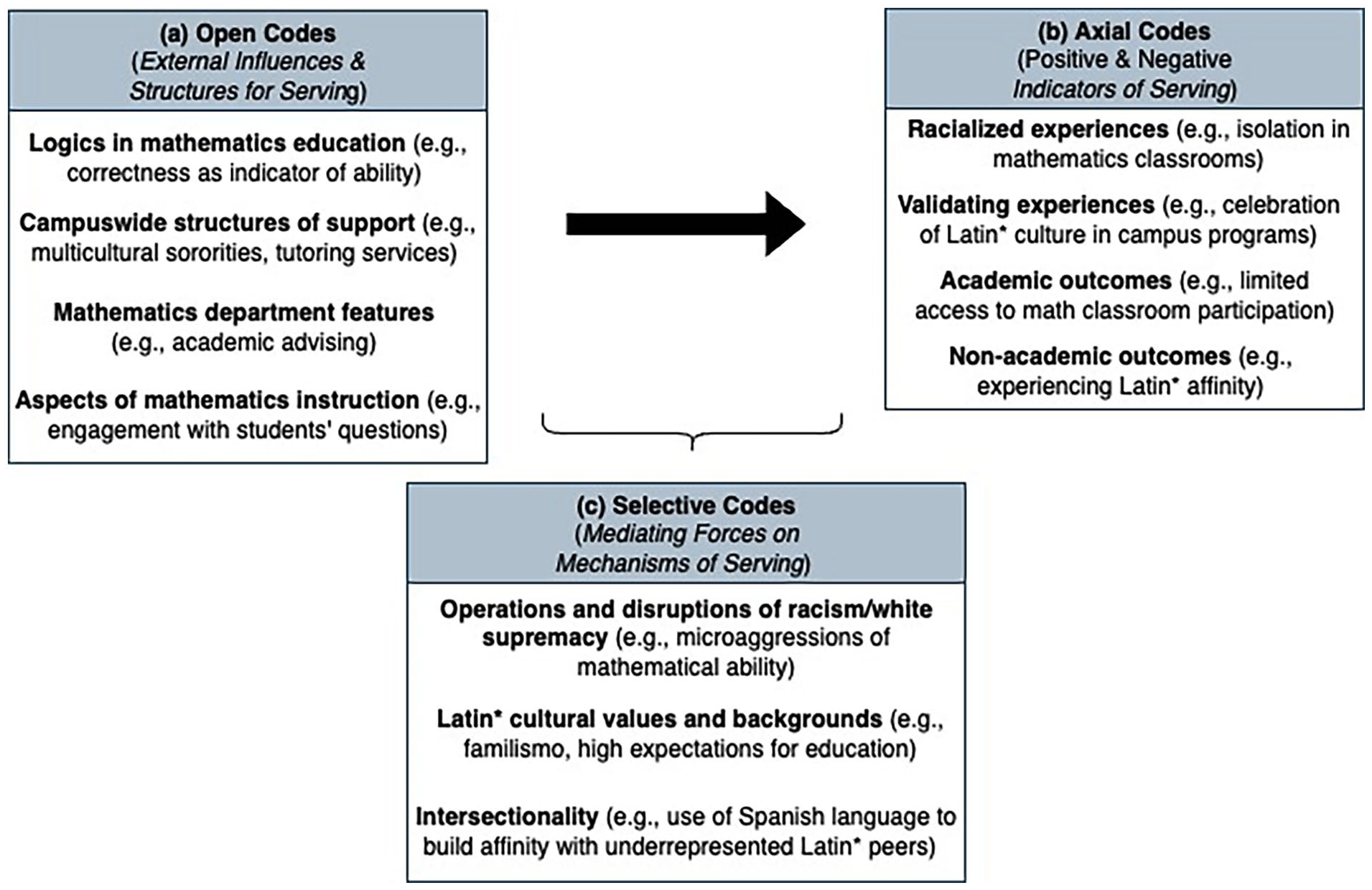
Coding Scheme.
A grounded theory approach guided analysis, including use of open, axial, and selective codes (Charmaz, 2014; Corbin & Strauss, 2014). Open codes flagged institutional and ideological forces in and out of mathematics instruction that limited or promoted servingness. These codes identified external influences on serving and structures for serving (Figure 2a). We generated four open code sets: (1) logics in mathematics education; (2) campuswide structures of support; (3) mathematics department features; and (4) instructional aspects. Open codes, therefore, documented servingness influences at campus, departmental, and classroom levels.
Axial coding flagged positive and negative impacts on servingness. These codes captured relationships between structures for serving (flagged with open codes) in terms of how they limited or fostered servingness, thus documenting indicators of serving (Figure 2b). Flagged indicators included racialized and validating experiences, in addition to academic and non-academic outcomes. Axial codes elucidated how racialized and validating experiences of instruction, which are shaped by external influences (e.g., logics in mathematics education), impacted continuity of servingness from campuswide structures. For the present analysis, these codes illuminated impacts of instruction (a structure for serving) on servingness for Latin* students’ equitable access to classroom participation (academic indicator of serving).
Selective codes characterized relationships between open codes (external influences on serving and structures for serving) and axial codes (indicators of serving). These codes revealed mechanisms of serving (Figure 2c) in terms of how racism, white supremacy, and interlocking systems of power were reinforced or resisted to impact servingness. Selective codes flagged how Latin* identities figured into these mechanisms, including cultural values/backgrounds as well as intersectionality. Central to our analysis, these codes depicted how racial and culturally-mediated forces shaped instructional mechanisms that impacted servingness via (in)equity of participation.
After independently coding a participant’s data set, each pair of coders debriefed and synthesized codes into themes. Following the grounded theory tradition (Corbin & Strauss, 2014), themes elucidated open/axial/selective coding connections. The themes provided theoretical explanations for how servingness was fostered or denied through mathematics instruction and other campus structures. Coding pairs exchanged themes during weekly team meetings for cross-case analyses of Latin* students’ perspectives. A subset of the team (authors for this article) explored relationships between servingness across the SSU campus and in mathematics instruction with a focus on classroom participation. We compared themes for servingness in mathematics instruction with those for other campus structures. Such comparisons illuminated shortcomings and opportunities in instruction to embrace servingness from elsewhere on campus, which impacted participation access. This analysis addresses our research question about instructional servingness through experiences of mathematics classroom participation.
Trustworthiness
We adopted three strategies to ensure trustworthiness: (1) prolonged engagement; (2) triangulation; and (3) peer debriefing and memoing (Gay et al., 2018; Mertler, 2022). Our study reflects fieldwork across three semesters, including two semesters of journaling for sustained insights into contexts of mathematics instruction. The sequential nature of data collection allowed for ongoing analysis to confirm, disconfirm, and nuance emergent themes. Analysis of individual interview data explored alternative explanations for servingness in journaling themes. Insights from individual interviews guided inquiry in group interviews to deepen analysis of instructional servingness, including the role of groupwork. Group interviews also shed light on limitations in earlier analyses through engagement with multiple student perspectives at a time.
Triangulation in data collection and analysis also built trustworthiness. Stimulated-response prompts across interviews were developed based on journaling, thus layering our data sources. These prompts allowed for systematic exploration of all participants’ views on themes from journaling and their relevance to servingness. Embedding insights from journaling into interviews provided opportunities for member checking. For data analysis, our team triangulated journaling and interview data when coding. We also triangulated multiple participants’ coded data sets to generate cross-cutting themes, identify illustrative cases, and consider disconfirming evidence.
For peer debriefs and memos, interviewers discussed insights right after each interview and later shared notes in team meetings. Our meeting notes generated a record of memos for our collective sensemaking. Memos tracked observations, emergent themes, and unique cases. Peer debriefs and memoing ensured consistency in analysis. We started coding with the entire team flagging content and writing memos about potential codes for three participants’ data sets. Using our conceptual model (Figure 1) as a guiding perspective, we exchanged memos to jointly develop the coding scheme. We refined codes after peer debriefs, followed by recoding data and revising themes as needed. Presence of multiple researchers for debriefs and memoing added to reflexivity in our inquiry process, which we further address in the next section.
Researcher Positionality
The team brought awareness of our positionality to the research, both as individuals and a collective. There is robust diversity in our team across social identities (e.g., race, gender), professional roles (e.g., tenure-line faculty, undergraduates), histories in mathematics (e.g., former majors, current instructors), and institutional affiliations. This multiplicity of perspectives guided our collaborative work to develop protocols, conduct interviews, and analyze data. We leveraged this diversity to cultivate identity-affirming experiences for participants and generate nuanced insights on servingness. At the same time, we remained conscious of our respective areas of social privilege and oppression as researchers studying instructional servingness.
Strong Latin* representation in our team provided informed insights into participants’ experiences of race and culture. Nearly half of our team is Latin* with most holding femme and queer gender identities that were largely reflected in our study sample. These insider perspectives were engaged through identity-matching in interviews and coding. Since social proximity and distance from participants can risk distorting their experiences through analyses, we bracketed our lived realities when engaging with participant reflections. Collaborative inquiry in a diverse research team also mitigated individual biases that filter Latin* student experiences to enhance validity.
We adopted an asset-based study approach that centered Latin* students as knowledge sources for instructional servingness. Our analysis framed participants’ struggles, such as limited classroom participation, as reflecting systemic and ideological forces that must be disrupted. To challenge the deficit discourse that Latin* students must change for STEM success, our study focused on needed reform in instruction. We infused multiple participants’ voices in our findings to capture variation in perspectives on servingness and avoid an essentializing portrayal of Latin* student experiences. The findings reflect diversity in ethnoracial and gender identities, intended majors, gateway mathematics courses, and experiences of classroom participation.
Limitations
Prior to reporting our findings, we account for two study limitations. First, the study was limited in exploring variation in how ethnoracial backgrounds (e.g., Mexican, Salvadoran) and gender shaped servingness. Most participants were Mexican females or women despite an intentional effort to recruit for a breadth of identities. Intersectional insights on servingness, as a result, largely reflect experiences of race, gender, and culture specific to Mexican women. Despite limited diversity in the sample, our analysis reflects intersectional realities for a sizable portion of Latin* women at SSU where many come from Mexican backgrounds.
Second, our capacity was limited to make claims about how instructional servingness in mathematics impacted STEM major persistence. Since most participants were in their first year at SSU, many expressed an interest in STEM majors but had neither declared a STEM major nor begun relevant coursework. It was, therefore, too early to learn about experiences in STEM majors and how mathematics instruction played a role. However, our findings still importantly revealed practices of instructional servingness as potential influences on STEM trajectories, especially since participation in gateway mathematics courses has a well-documented impact on retention.
Findings
Before presenting the findings most central to our research question about instruction, we account for participants’ views of campuswide servingness. Cultivating a racially-affirming community played a key role in campus support. We define a racially-affirming community as an environment of collectivistic support that advances racial equity for Latin* students. After elaborating on campuswide servingness, we report findings about how mathematics instruction limited and promoted cultivation of a racially-affirming community. We present cases of Latin* students’ experiences illustrative of how absence or presence of such a community impacted instructional servingness through participation opportunities.
Cultivating a Racially-Affirming Community for Servingness
Building a racially-affirming community is a mechanism of serving (i.e., a process through which HSI structures facilitate servingness; Figure 1e). Several structures at SSU exhibited this mechanism. These structures for serving (i.e., campus sources of servingness; Figure 1c) built such a community via responsiveness to Latin* students’ cultural backgrounds and status as first-generation college attendees, in addition to disrupting racism and interlocking systems of power (e.g., classism). This servingness translated into two positive indicators of serving (i.e., validating experiences and success outcomes; Figure 1d)—namely, alleviating educational inequities and fostering Latin* affinity. Table 2 presents Latin* student perspectives for these indicators. We featured five perspectives below that portray how a racially-affirming community across campus had positive impacts in gateway mathematics or as STEM majors.
Student Perspectives on Campuswide Servingness at SSU
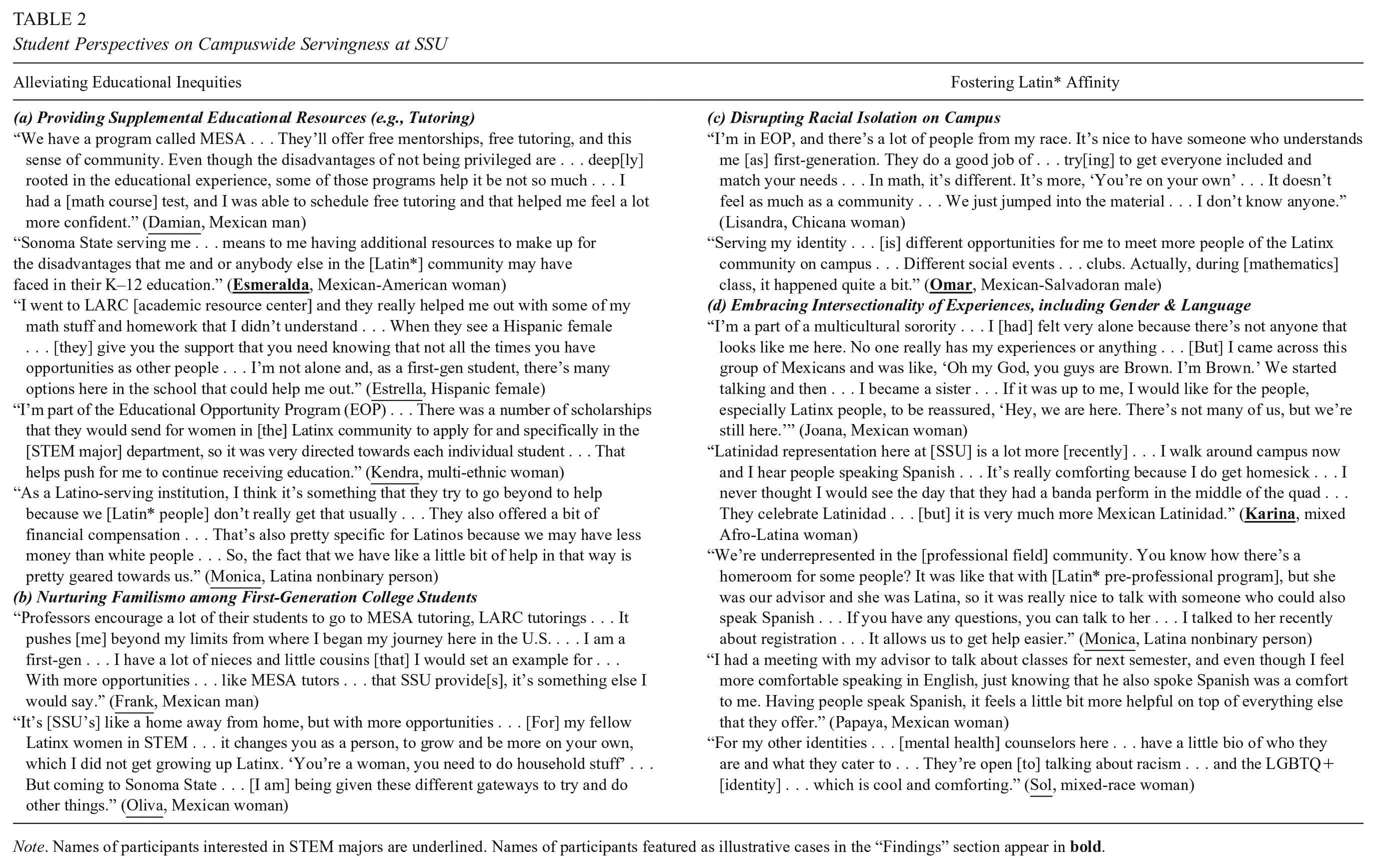
Note. Names of participants interested in STEM majors are underlined. Names of participants featured as illustrative cases in the “Findings” section appear in
Alleviating Educational Inequities
Campuswide servingness alleviated educational inequities that most Latin* students at SSU faced due to their low-income, first-generation backgrounds. Tutoring was frequently reported as addressing mathematical struggles due to P–12 educational inequities. For example, Damian9† (Mexican man, he/him) shared how tutoring and other services in Mathematics, Engineering, and Science Achievement (MESA)—a STEM educational equity organization—provided such support: “They’ll [MESA] offer free mentorships, free tutoring, and this sense of community. Even though the disadvantages of not being privileged are . . . deep[ly] rooted in the educational experience, some of those programs help it be not so much.” 10 MESA provided a community that helped Damian overcome educational disadvantages for success in a mathematics test. Structures like MESA and the Educational Opportunity Program (EOP) exhibited a mechanism of building a racially-affirming community with resources to disrupt inequities and support achievement (see Table 2a).
Supplemental resources like tutoring and financial aid fostered servingness by facilitating college access. This support was meaningful as most Latin* students were the first in their families to navigate U.S. higher education. Opportunities to study at SSU embraced Latin* students’ value of familismo (family loyalty) in terms of positively representing families through academics and becoming role models for younger generations (see Table 2b). To illustrate, Oliva† (Mexican woman, she/her) viewed SSU as allowing Latin* women in STEM like her to go beyond gendered cultural expectations of domesticity instead of attending college: “It’s [SSU] like a home away from home, but with more opportunities . . . which I did not get growing up Latinx. ‘You’re a woman, you need to do household stuff’ . . . [I am] being given these different gateways to try and do other things.” The family-like space at SSU extended resources available at home for Oliva’s development. Servingness through educational access, thus, cultivated a racially-affirming community to pursue family-oriented goals of success. Building such communities that alleviated educational inequities was a key mechanism of servingness.
Fostering Latin* Affinity
Connecting with Latin* peers and staff was another indicator of serving. Programs, support services, and organizations fostered affinity to disrupt isolation on campus where Latin* students were underrepresented (see Table 2c). Lisandra (Chicana woman, she/ella), for instance, described how racial affinity in EOP contributed to a sense of community that was missing in mathematics: “There’s a lot of people from my race . . . They do a good job . . . to get everyone included and match your needs . . . In math, it’s different. It’s more, ‘You’re on your own.’ . . . It doesn’t feel as much as a community.” The racially-affirming community in Latin* affinity spaces brought students to feel comfort in their identities and that their needs were met.
Intersectionality of experiences, including language and gender, was embraced in affinity spaces (see Table 2d). Opportunities to speak Spanish not only ensured multilingual learners’ equitable access to support, but also built community among staff and peers. Monica† (Latina nonbinary person, they/them) shared how having a bilingual Latina advisor in a program for Latin* pre-professionals 11 added comfort when seeking guidance as a STEM major: “You know how there’s a homeroom for some people? It was like that with [program name] . . . It was really nice to talk with someone who could also speak Spanish . . . It allows us to get help easier.” The association between Monica’s program and a homeroom in U.S. schools suggests formation of a support network. Such programs, thus, exhibited a mechanism of servingness by creating a racially-affirming community where the Spanish language was a resource for affinity and equity.
Multicultural sororities were affinity spaces that supported intersectionality of race and gender. Joana (Mexican woman, she/her) met fellow Mexican women from low-income backgrounds in her sorority (see Table 2d). Solidarity of sisterhood like in her sorority was essential to cope with majority-white spaces like mathematics.
When you are in a very white space . . . you think, “What if they make fun of me for asking this question? What if I’m the one who doesn’t get it?” . . . There’s only like three Mexican girls in my [mathematics] class, and we all see each other like, “I see you. You see me. We see each other.” We’re going to gravitate towards each other.
Joana’s sorority facilitated Latin* affinity that she had to build on her own in mathematics, where she encountered isolation and microaggressions. Affinity spaces at SSU, thus, provided a racially-affirming community for establishing support networks that embraced Latin* intersectionality.
Overall, the mechanism of cultivating a racially-affirming community advanced campuswide servingness. SSU structures built this community by disrupting influences of racism and interlocking systems of power (e.g., educational inequities, racial-gendered isolation). In addition, such community nurtured students’ goals as first-generation college attendees tied to the Latin* cultural value of familismo. Students, as a result, had equitable access to learning opportunities and experienced identity validation. Although such servingness often supported students in navigating gateway mathematics, structures for serving were outside of classrooms. The next section presents how mathematics instruction limited and embraced such servingness.
Servingness in Gateway Mathematics Instruction
This section first provides an overview of findings across all 27 participants’ experiences of mathematics instruction. We account for the extent to which instruction embraced servingness through cultivating a racially-affirming community and its impact on classroom participation. Figure 3 presents a visual summary of these findings.

Visual Summary of Findings.
Our overview references aspects of Figure 3 to show how elements of our conceptual model mapped onto our findings. After our overview, we present two paired cases of Latin* students’ instructional experiences that were most illustrative of variation in instructional servingness and (in)equitable participation.
Overview of Findings for Entire Sample
As described earlier, campuswide servingness mitigated sociohistorical and systemic influences of racism and interlocking power systems that shape structural inequities and everyday oppression (Figure 3b). These influences included limited access to high-quality teaching before college, linguistic stigma, racial isolation in classrooms, and microaggressions tied to stereotypes of ability. Students saw these influences producing concerns that their questions and ideas would be negatively judged in mathematics. Cultural values and backgrounds also shaped vulnerability with participation (Figure 3b). First-generation college students navigated pressures of flawless participation associated with representing families and being raised with high expectations for education. Our literature review showed how Latin* students’ racialized experiences in gateway mathematics has been well-documented. We, therefore, prioritize reporting on findings about the extent to which instructional servingness was embraced. (Appendix D presents illustrative perspectives of Latin* students’ mathematics classroom participation as a racialized experience.)
Dominant logics in mathematics education (Figure 3a) also contributed to wariness of participation. Such logics include correctness signaling innate ability and success being based on individual effort. Two-thirds of participants (18 out of 27) reported instruction that resisted such logics. These practices included prioritizing mathematical thinking over correctness, framing mistakes as sites for learning, and guiding students through problem solving (Figure 3c). Because these practices reduce the stakes of participation for all students, we refer to them as generally-supportive instruction (or supportive-for-all practices; Leyva, Amman, et al., 2022). For Latin* students navigating racialized and culturally-mediated influences described earlier, there remained risks—even with generally-supportive instruction—that limited their participation.
Table 3 presents a breakdown of Latin* students’ reports for generally-supportive instruction and participation access. Of the 18 students who reported supportive instruction, half had limited access to participation where they only engaged in certain contexts (e.g., one-on-one with instructor, groupwork), were developing comfort to participate, or did not participate at all.
Reports of Participation Access & Presence/Absence of Generally-Supportive Instruction

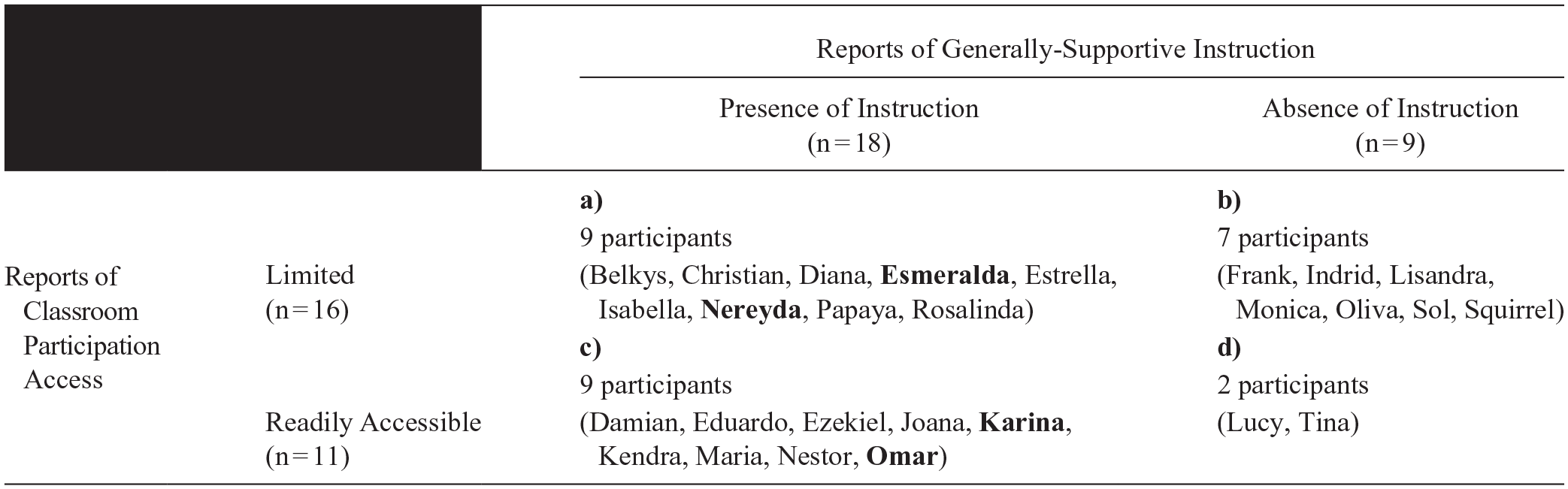
Note. Names in
Another seven students expressed discomfort with participation in classrooms that lacked supportive instruction. Therefore, despite a robust presence of generally-supportive instruction, over half of the sample (16 of 27 students) had limited participation opportunities. Generally-supportive instruction, therefore, was important yet insufficient to ensure equitable participation.
Further explaining the insufficiency of generally-supportive instruction, our analysis revealed how cultivating a racially-affirming community—a key mechanism of campuswide servingness—was largely absent in mathematics classrooms. Such a community was built through cultural responsiveness as well as disruptions of systemic and sociohistorical forces. Thus, unmitigated racialized influences in instruction thwarted formation of a racially-affirming community. Latin* students, as a result, faced inaccessible participation even with generally-supportive instruction (Figure 3d). Most students for whom participation was accessible reported instruction that built a racially-affirming community. Such instruction promoted validating experiences where participation felt safe and valued (Figure 3d). As depicted through illustrative cases in the next section, the mechanism of building a racially-affirming community (Figure 3e) was essential for instructional servingness to facilitate Latin* students’ participation access.
Illustrative Cases of Instructional Experiences
This section presents two paired cases of Latin* students’ instructional experiences. The first pair focuses on Nereyda and Esmeralda, and the second pair focuses on Karina and Omar. We highlight these pairs for multiple reasons. The cases are representative of the most frequently reported types of instructional experiences. Namely, both pairs reflect generally-supportive instruction where participation was either limited (Table 3a) or readily accessible (Table 3c). 12 In addition, the cases are most illustrative of how servingness through cultivating a racially-affirming community impacted equity in classroom participation. The highlighted case pairs also include multiple STEM majors and diversity in ethnoracial-gender identities.
“When You Share Your Identity . . . [and] Classmates Share Their Identity With You, It Creates a Safe Place of Trust”
Nereyda (Salvadoran woman, she/her) and Esmeralda† (Mexican-American woman, she/her) reported generally-supportive instruction, such as prioritizing student learning over correct answers, allowing revisions for written work, and offering help in and out of class. These practices challenged the logic of equating correctness with mathematical ability and resonated with participants’ views on servingness as alleviating educational inequities. For Esmeralda, servingness at SSU was “having additional resources to make up for the disadvantages that [she] or anybody else in the [Latin*] community may have faced in their K–12 education.” Nereyda similarly perceived servingness as ensuring Latin* students’ access to help: “Be willing to teach it [content] to me over and over again until I understand . . . They [Latin* students] don’t think they’re going to get the help they need.” Esmeralda saw her instructor destigmatizing mistakes as removing pressures of academic perfection for first-generation Latin* college students like her: “I think that’s great . . . [because] for a lot of Latinx students . . . they may be the first of their families [to attend college], so they feel that pressure to do good . . . There’s definitely a bad feeling associated with having something incorrect.” Generally-supportive instruction lessened vulnerability of participation.
Despite instruction that encouraged participation, Nereyda and Esmeralda were unable to readily participate due to unchallenged stereotypes and microaggressions of ability. Nereyda described wariness of being wrong due to racial and gender stereotypes: “It’s very common for us Latinx students to be concerned with getting things wrong. I struggle with that a lot . . . There’s that stereotype that women aren’t really good at math . . . Hispanic students, they need a little bit more attention.” Similarly, Esmeralda recounted how white men in class talked over her and seemed to distrust her ideas because of her race, gender, and English language fluency. Such microaggressions and pressures to prove Latin* students’ ability were participation barriers.
They [white men in class] already assume that I don’t know as much . . . If I say something wrong, then it’ll prove them right. That’s why I do let people talk over me . . . I don’t feel like it’s just . . . prov[ing] my intellectual capability to myself, but [for the] whole community . . . They don’t really trust [when] we have to work together . . . Is it because of the way I look or even . . . the way I’m speaking?
As a Mexican-American woman in a predominantly white classroom, Esmeralda navigated potentially deficit views of ability that shaped racialized risks for sharing her ideas. Her suppressed participation also stemmed from concerns about being stereotyped as a loud Mexican-American woman, especially when celebrating her mathematical successes: “I will get more loud . . . like ‘Oh, I found the solution!’ But it can be really discouraging when somebody tells me, ‘Oh, you’re being really loud. Quiet yourself.’ That’s what I think of when I think about that harmful stereotype.” Instruction that alleviated pressures of correctness, thus, only went so far to ensure Latin* students’ participation without also disrupting microaggressions and stereotypes.
Unchallenged systemic/sociohistorical forces tied to racism and intersectional oppression, as described above, thwarted creation of a racially-affirming community as a foundation for Nereyda’s and Esmeralda’s participation. Both cases depicted this reality in groupwork contexts. Groupwork was a promising way to resist the dominant logic of individualism in mathematics, in addition to embracing affinity and collective support in campuswide servingness. However, racialized vulnerability of participation presented barriers to experiencing groupwork this way. Esmeralda, for example, was wary of taking up too much space and calling attention to working in an all-Mexican group: “[The instructor] asked everybody a question . . . But I didn’t want to answer [and] add on to . . . us being a little group . . .[She] was like, ‘Oh, [Esmeralda], why don’t you share? . . . I didn’t want to say anything.” Working with Mexican peers disrupted isolation in a majority-white classroom and fostered Latin* affinity. However, stereotype threat (noted earlier) and hypervisibility of Esmeralda’s group prevented her from experiencing a racially-affirming community for comfort with participation. Her case conveys the value of instruction that challenges these racialized influences for servingness in groupwork.
Nereyda also described discomfort with groupwork participation in a classroom that lacked peer support: “Everyone’s doing their own thing, and I’m lost. No one’s really talking . . . [or] helping each other . . . The professor, he goes around and helps people, but . . . I can’t speak up.” This classroom culture of individualism, coupled with stereotype threat and silence about issues of social identity, figured into Nereyda’s wariness to participate. She saw discussions of identity, including Latin* students’ racialized realities, building a community of safety to make participation more accessible. Such community took form outside of mathematics.
In my [social science]
13
class, we talk a lot about our identities constantly and it creates a safe space. And with math, we should because it would make people not so intimidated . . . When you share your identity . . . [and] classmates share their identity with you, it creates a safe place of trust . . . I don’t have to constantly be worrying if I’m doing things correct or not because I know that my classmates won’t judge me.
The logic of neutrality in mathematics shaped instruction that left Nereyda’s racialized-gendered tensions about participating unaddressed. This classroom dynamic, including a void of peer support, withheld a racially-affirming community for groupwork participation. Unlike Esmeralda’s case, Nereyda was in a majority-Latin* classroom. This situation arguably expands opportunities for racial affinity and identity-based comfort for servingness. However, both cases capture how the presence of Latin* peers did not guarantee a racially-affirming community without instruction that alleviated the vulnerability of classroom participation.
Nereyda’s and Esmeralda’s cases reflect how generally-supportive instruction without a racially-affirming community restricted Latin* student participation. Supportive practices (e.g., prioritizing student thinking over answers; Figure 3c) resisted the logic of equating correctness with ability to make participation less vulnerable (Figure 3a). Instruction, however, fell short in disrupting racialized influences (e.g., isolation, stereotypes; Figure 3b) that made participation tenuous for both Latin* women. With mitigating systemic influences as central to servingness, instruction was limited in granting participation access (an indicator of serving; Figure 3d). Logics of individualism and neutrality in mathematics (Figure 3a) restricted opportunities to challenge racialized influences and build a racially-affirming community as a mechanism of instructional servingness (Figure 3e). Groupwork was an entry point to embrace collectivistic support in servingness. However, without a racially-affirming community, Nereyda and Esmeralda were left managing tensions that suppressed their groupwork participation (Figure 3d).
“That’s Been Really Supportive in My Latinidad in STEM . . . It’s [Mathematics] a Place Where I’m So Comfortable”
Like the previous two cases, Karina† (mixed Afro-Latina woman, she/they) and Omar† (Mexican-Salvadoran male, he/him) reported generally-supportive instruction. Karina’s instructor expressed value for questions and emphasized that thinking mattered more than final answers. Omar’s instructor reminded students that learning happens from mistakes: “There’s absolutely no pressure to speak your mind and say what answer you had.” Instruction, thus, resisted the logic of correctness equated with mathematical ability to stimulate participation.
In contrast to the prior cases, instruction in Karina’s and Omar’s classrooms cultivated a racially-affirming community along with general-supportive practices. Both were predominantly Latin* classrooms, so opportunities for racial affinity contributed to building such a community. The previous cases, however, showed that Latin* peer presence does not ensure a racially-affirming community. Below, we develop Karina’s and Omar’s cases to depict how instruction cultivated such a community by alleviating educational inequities and fostering Latin* affinity—indicators of campuswide servingness. Such practices contributed to a mechanism of instructional servingness that promoted both students’ equitable access to participation.
Alleviating educational inequities
Karina and Omar experienced instruction that resisted sociohistorical narratives of deficit about Latin* students in mathematics. Such instruction alleviated educational inequities associated with being a multilingual learner (for Karina) and the quality of high school mathematics teaching (for Omar). For instance, embracing use of Spanish in Karina’s classroom not only affirmed her ability as a multilingual student, but also resisted linguistic racism as a participation barrier in her educational history. They 14 often feared speaking in classrooms where English was the dominant language: “My accent slipping in and out, not being able to say certain words . . . in front of the class. It’s such a big fear . . . I can grasp the concept, but I can’t . . . translate the words correctly.” Karina’s prior discomfort stemmed from concerns that her accent and emerging English fluency would be subjected to deficit judgments. She contrasted these earlier experiences with mathematics at SSU, where translanguaging (namely, switching between use of English and Spanish) was encouraged.
I felt more like a sore thumb about my Latinidad in other subjects . . . I’m so comfortable in the math . . . A lot of what you hear [is] just Spanish going around . . . [The instructor] actually encourages us to speak Spanish . . . I will forget the English words and I’ll say it in Spanish, and then it’s really nice to not have someone be like, “Huh? What?”
Asset-based framing of speaking Spanish through translanguaging alleviated educational inequities that Karina faced as a multilingual learner. Unlike Nereyda’s and Esmeralda’s cases, Karina felt a reprieve from microaggressions that suppressed their classroom participation outside of mathematics at SSU. Such disruption of inequities and linguistic racism, thus, built a racially-affirming community in the mathematics classroom where Karina readily participated.
Similarly, Omar reported instruction that alleviated inequities from high school where Latin* students’ contributions were undervalued and needs were overlooked. His comfort level with mathematics classroom participation in high school and college differed: “I do feel a good connection with my teachers specifically in [mathematics course] about not being right . . . I felt a little less valued being a Latino student [in high school] . . . It was more, ‘You better get something right,’ or otherwise I’ll end up failing.” Deficit views of Latin* students in high school shaped pressures of correctness when participating. In contrast, Omar perceived intent in his university instructor frequently praising Latin* students that made participation comfortable in SSU. He journaled how such praise resisted stereotypes of ability to build a supportive environment.
He [instructor] was more likely to affirm or support other Hispanic/Latinx students . . . [He] complimented my work repeatedly . . . There’s a positive pattern of behavior of encouragement . . . [that] raises a welcoming environment for Latinx students. Showing that anyone can do a great job no matter what race . . . There is no monolith.
Instructor praise for Latin* students challenged stereotypes that limited participation as captured in the previous cases. Such praise operated similarly to asset-based treatment of Spanish in Karina’s case that mitigated racialized vulnerability of participation. Instruction at SSU alleviated educational inequities from high school to nurture Omar’s mathematical success. As a result, a mechanism of establishing a racially-affirming community brought Latin* students’ ability to be recognized and Omar’s participation access to be ensured.
Fostering Latin* affinity
Another way that instruction in Karina’s and Omar’s classrooms cultivated a racially-affirming community was fostering Latin* affinity, particularly through groupwork. Both students reported Latin* affinity in campuswide servingness. Karina saw speaking Spanish as critical for such campus connections: “Latinidad representation here at Sonoma is a lot more recently . . . I hear people speaking Spanish . . . [and] it’s really comforting because I do get homesick.” However, as an Afro-Latina, she encountered barriers to language-based affinity: “I still get the looks when I speak in Spanish because . . . I’m not the ideal when people think of Latinidad . . . People just assume you’re Mexican . . . [or] you’re Black.” Karina’s Afro-Latina identity departed from essentializing views at SSU that all Latin* students are fair-skinned and Mexican. As a result, anti-Black colorism caused their race to be questioned when they were speaking Spanish and thus limited opportunities for Latin* affinity. Karina’s mathematics classroom, however, disrupted such isolation and microaggressions. Groupwork provided opportunities to speak Spanish without fearing negative judgment as well as to build relationships with Latin* peers, including an Afro-Latino classmate.
That’s been really supportive in my Latinidad in STEM because . . . everyone I’m [in class with] understands the struggle of being Hispanic and in math . . . I have another [group] member. He’s Afro-Latino, and it’s really cool to see someone else in my class . . . When we’re doing groupwork, a lot of [what] you hear [is] just Spanish . . . It’s [mathematics] a place where I’m so comfortable.
Instruction that encouraged translanguaging and facilitated Latin* peer collaboration fostered racial affinity that embraced servingness. Thus, a mechanism of building a racially-affirming community through instruction enabled Karina to experience validating peer support as a Latin* STEM major, in addition to comfort with participating as an Afro-Latina multilingual learner.
Omar’s case similarly conveys how groupwork built a racially-affirming community where he readily participated. Viewing servingness as fostering Latin* affinity (“different opportunities for me to meet more people of the Latinx community”), Omar shared how “during [mathematics] class, it happened quite a bit.” His instructor structured groupwork for students to collaborate with peers across social identities. This practice resisted the logic of neutrality in mathematics that renders social issues as irrelevant. In a majority-Latin* classroom, it was common for Omar to have Latin* peer collaborators despite being in racially-diverse groups. Much like Karina’s experience, Omar met Latin* peers who became figures of support: “[The instructor] wanted us to get to know each other [by] putting each other in different groups . . . I’m able to have friends of different perspectives [for] like [mathematics course] . . . [and who can] help me . . . [with] a problem because of our race or cultural bias.” Groupwork, thus, fostered Latin* affinity for peer support to succeed mathematically and navigate racial oppression.
Although Latin* students gravitated toward one another, Omar felt his contributions as a Mexican-Salvadoran male were valued in racially-diverse groups: “When it comes to being [put] into different groups . . . I’ve always felt like I’ve been appreciated and valued . . . I’m usually with a lot of Latinx students . . . so we tend to group together, but I feel like all our answers are valued [in assigned groups].” With groupwork in an instructional context that resisted sociohistorical narratives of Latin* students lacking ability, Omar did not feel tensions when collaborating like Nereyda and Esmeralda experienced in their classrooms. An instructional mechanism of creating a racially-affirming community promoted Latin* affinity and nurtured Omar’s participation in the presence of non-Latin* peers.
Karina’s and Omar’s cases depict how instruction with a mechanism of cultivating a racially-affirming community established equitable participation access. Similar to the previous cases, instructors adopted generally-supportive practices (e.g., framing errors as entry points for learning; Figure 3c) and infused groupwork. These practices resisted dominant logics of individualism and correctness as a marker of mathematical ability (Figure 3a), which expanded participation opportunities. In contrast to the previous cases, Karina’s and Omar’s instructors were responsive to Latin* students’ racialized vulnerability with participation. Instructional practices, such as use of translanguaging and publicly praising Latin* students’ contributions, addressed such vulnerability by resisting systemic/sociohistorical influences tied to race (e.g., linguistic racism, stereotypes; Figure 3b). This explicit regard for racial and intersectional oppression challenged the logic of neutrality in mathematics (Figure 3a) to promote equitable participation.
Overall, both paired cases show how instructional servingness goes beyond generally-supportive practices and requires confronting racialized influences like in campuswide servingness. Instruction with a mechanism of building a racially-affirming community advanced such servingness for equity in classroom participation (Figure 3e). When this mechanism was missing, like in Nereyda’s and Esmeralda’s cases, participation remained risky and inaccessible. The contrast in groupwork participation across both paired cases conveys the significance of a racially-affirming community that Latin* peer presence alone did not guarantee. Instructional servingness, as Karina’s and Omar’s cases portray, disrupts mathematics as a racialized experience and thus translates into Latin* students’ classroom participation opportunities (Figure 3d).
Discussion
Findings in our study align with existing literature in three ways. First, the analysis resonates with research about Latin* students’ STEM experiences at HSIs that shows how programs and support services outside of academic departments advance servingness (e.g., Perez et al., 2024; Placa et al., 2024). Second, the documented vulnerability of mathematics classroom participation echoes prior insights on Latin* students’ racial and intersectional oppression in STEM classrooms (e.g., Flores et al., 2023; MacArthur & Dobie, 2023). Third, our analysis corroborates existing work that conveys how gateway mathematics instruction reinforces and disrupts such oppression (e.g., Oppland-Cordell, 2014; Rios, 2024). The present study’s alignment with prior research underscores the value of exploring instructional servingness in gateway mathematics. We extend the literature by characterizing the cultivation of a racially-affirming community as a mechanism of servingness and its enactment through mathematics instruction. Below, we elaborate on three extensions of prior research through our findings.
Relationships Between Instruction and Campuswide Servingness
The present study uniquely explores relationships between mathematics instruction and the HSI campus context. As argued in the literature review, instruction has not been the main focus in analyses of Latin* students’ STEM experiences, and studies of racial equity in gateway mathematics instruction did not consider campuswide influences. We addressed these limitations by capturing how cultivating a racially-affirming community (a key mechanism of campuswide servingness) disrupted racialized mathematics experiences. This mechanism was responsive to low-income, first-generation status and resisted oppressive sociohistorical influences of racism.
The mechanism of building a racially-affirming community can further explain how STEM instruction in prior research limited servingness, including inequities of classroom participation. Illustrative cases in our findings, for instance, convey how such a community of trust and comfort is needed to alleviate racialized vulnerability of participation documented in past studies (e.g., Flores et al., 2023; Rios, 2024). Our analysis also extends insights on supportive STEM educational practices for Latin* students at HSIs. Such insights are nascent in the field as studies either noted a single example of supportive instruction (Placa et al., 2024) or focused on student outcomes from a course redesign rather than instruction (Bhattacharya et al., 2020). We build on this prior work by detailing instructional practices that fostered a racially-affirming community and facilitated participation access. By elucidating connections between mathematics instruction and HSI campus structures, the current study adds novel perspectives to address the need for continuity of servingness in and out of STEM contexts (Ro et al., 2024).
Disciplinary Influences of Mathematics
Our findings also extend and diverge from extant research through a disciplinary focus on mathematics. Prior work about Latin* student experiences at HSIs largely framed analyses in terms of STEM broadly. Although studies considered various types of STEM majors and courses (e.g., Herrera et al., 2022; Placa et al., 2024), norms and values specific to these disciplines were not foregrounded in analyses. We extend this research by accounting for how the culture of mathematics shaped instructional servingness. Specifically, our study uncovered how dominant logics in the discipline (e.g., correctness as a marker of ability) mediated (in)equitable participation through instruction. Such discipline-specific insights are critical to document in gateway courses like calculus, where instructional experiences are consequential for Latin* STEM persistence. The role of logics developed in our findings, thus, nuances prior insights on servingness in STEM through explicit regard for how such support varies in disciplinary spaces.
Furthermore, our study conveyed how generally-supportive practices that resist dominant logics in mathematics were essential yet insufficient for mechanisms of instructional servingness. Unlike the highly discouraging nature of gateway mathematics experiences in the literature (e.g., Shi et al., 2023), generally-supportive instruction was common at SSU. At the same time, we showed how such supportive instruction must also resist racialized influences in order to build a racially-affirming community where Latin* students can readily participate. These findings extend studies on servingness focused on STEM instructional reform where racialized classroom realities went unconsidered (e.g., Broussard et al., 2021). Our analysis also adds to emerging research on servingness through instruction within STEM disciplines (e.g., Race et al., 2021; Rodriguez & Ross, 2024). Given how mathematics is a service department to STEM degree programs across college campuses (e.g., calculus as a prerequisite for upper-level courses in STEM majors), our discipline-specific findings extend knowledge about instruction for Latin* STEM success beyond the classroom.
Latin* Cultural Values of Collectivism
A final way that the current study extends prior research is by portraying the significance of embracing Latin* cultural values in instructional servingness. Our literature review showed how Latin* student experiences were often not the primary focus in studies about equity in gateway mathematics (e.g., Apkarian et al., 2024; Ellis Hagman et al., 2014). By foregrounding Latin* students’ perspectives, we contribute a novel account of equitable and culturally-responsive instruction. To illustrate, an intriguing insight from our study was how Latin* students’ commitments to positively represent their families as first-generation college attendees shaped their experiences of mathematics classroom participation. The value of familismo motivated academic success, which was embraced in campuswide servingness. At the same time, it figured into limiting participation opportunities if instruction did not challenge racialized influences and the disciplinary logic of correctness equated with ability. While prior work on servingness in STEM education has addressed cultural complexities of familismo (e.g., Núñez et al., 2021), we uniquely bring this perspective to the context of mathematics instruction.
The mechanism of building racially-affirming community in our findings reflects Latin* cultural values of mutual support and interdependence. Instruction upholding individualism as a logic of whiteness in mathematics (e.g., lack of peer support in Nereyda’s classroom) presented barriers to embracing collectivistic ways of knowing and being in Latin* culture. As an entry point for collectivism, groupwork was often adopted, but Latin* students’ participation was not ensured. We extend prior research on Latin* students’ mathematics groupwork experiences (e.g., Oppland-Cordell, 2014; Rios, 2024) by detailing instructional practices to facilitate equitable participation. Such practices included publicly praising Latin* students’ contributions, structuring racially-diverse groups, addressing microaggressions, and honoring use of translanguaging. A mechanism of creating a racially-affirming community through these practices alleviated racialized risks of participation and promoted peer collaboration (see also Leyva et al., 2024). As Karina’s and Omar’s cases illustrated, such a community fostered a collectivistic ethos in groupwork where students experienced Latin* affinity and built support networks that resonated with campuswide servingness. Such network formation is essential in gateway mathematics courses as it provides Latin* students with a long-term source of peer support for navigating STEM major pathways (Leyva, 2016, 2022, 2024). These insights extend research on Latin* students’ STEM experiences at HSIs that left room to explore how instruction mediates supportive peer connections (e.g., Perez et al., 2024). The present study depicts how honoring Latin* cultural values of collectivism advances instructional servingness for equitable participation in mathematics.
Implications
Our findings raise implications for research. Future work can extend our study by exploring instructional servingness in different HSI contexts. Variation in student demographics, co-curricular offerings, and campus histories of supporting Latin* students shape differences in servingness. For instance, studies can focus on emerging HSIs (i.e., institutions close to meeting the Latin* enrollment threshold for HSI designation). Such studies can uncover intentional support in mathematics across campuses with increasing Latin* underrepresentation and rising levels of servingness. Capturing a multiplicity of servingness across HSI sites can inform instruction advancing missions of Latin* support with responsiveness to institutional differences.
Additional studies can delve deeper into intersectionality. As conveyed in our literature review, Latin* cisgender women’s experiences have been the main sources of insights into intersectional aspects of servingness in STEM. We call for research that builds on this work as well as the present study through intersectional analyses focused on Latin* cisgender men and nonbinary students. With these populations also at the margins in mathematics education research (Bullock, 2018; Leyva, 2017; Leyva & Nazemi, 2024), such future work can further texture gendered aspects of instructional servingness. Explicitly considering cultural norms across ethnoracial backgrounds (e.g., Mexican), multiracial identities, and other social differences (e.g., disability, sexuality) also allows for more nuanced intersectional insights (Leyva & Joseph, 2023).
Different dimensions of instructional contexts and their impacts on servingness warrant further study. Future work can extend our focus on classroom participation by examining curricular content and support structures (e.g., office hours) in gateway mathematics. Longitudinal work can explore how Latin* student experiences of participation, curricula, and support in gateway mathematics at HSIs influence STEM major persistence. Such inquiry must also be pursued in more advanced mathematics courses where educational equity has been underexplored. In addition, future research can continue our discipline-specific inquiry across other STEM areas with unique norms and values that influence instructional servingness.
Our study also informs implications for practice. The current U.S. sociopolitical climate, where equity efforts are attacked, calls for instructional servingness as a collective responsibility among mathematics instructors and HSI campus leaders. With less visibility compared to university programs (e.g., EOP), there is often flexibility in mathematics classrooms for engaging in creative insubordination (Crowson & Morris, 1985; Gutiérrez, 2016)—that is, instructors can discreetly adopt equity-oriented practices and not refer to them as servingness in evading anti-DEI forces. With servingness as a collective effort, instructors can collaborate with and learn from Latin* students to promote equitable participation. Students, for instance, can write short mathematics autobiographies that describe on- and off-campus support as well as connections to their racial and intersectional identities. Discussion of autobiography themes can guide instructors and students in co-developing classroom norms for a racially-affirming community, where Latin* and other minoritized groups can readily participate.
Partnerships between HSI mathematics instructors and campus leaders are also vital in the collective work of instructional servingness. To avoid anti-equity censorship, partnerships could adopt an intentionally broad framing in the campus community (e.g., “fostering STEM success”) while still engaging the work of servingness. Upper-level administrators, such as vice presidents, must incentivize such partnerships by allocating resources (e.g., course releases, financial compensation) and rewarding involvement in personnel decisions (e.g., tenure, staff promotion). Administrators must also broker partnerships between instructors and staff, such as student affairs leaders and support service directors, to mitigate power asymmetries and ensure bidirectional learning.
In terms of instructor learning, workshops on mathematics instruction allow staff to share their expertise on campuswide servingness for translation into classroom practices. Videotaped classroom instruction can be used to exchange ideas for refining practices, in addition to stimulating instructor reflection on their positionality as agents of servingness. Workshops with multiple instructors scale up practices beyond individual classrooms and across course sections.
Staff also benefit from partnerships by learning to embed academic support into their servingness efforts. Like many HSIs, structures at SSU largely focused on social aspects of servingness (e.g., managing isolation across campus). Academic support for mathematics was mainly offered in tutoring. Partnerships across HSIs can guide staff in infusing such support into campus spaces where Latin* students already feel seen and affirmed from a social perspective. Staff and instructors can co-design study groups in these spaces to expand Latin* students’ peer support for homework and exam preparation. We also call for partnership work that builds an intergenerational network of mathematics peer mentors within these campus spaces. Appointed mentors can offer guidance to Latin* mentees enrolled in gateway mathematics courses that they completed. Staff can learn from instructors who build a racially-affirming community in mathematics to adapt such practices in structuring study groups and training mentors. This partnership work nurtures Latin* mathematical success beyond classrooms and into HSI campus spaces for social support.
Conclusion
Instructional servingness in mathematics classrooms enhances HSI efforts in providing Latin* students with a robust ecosystem of support. The centrality of a racially-affirming community, which Latin* students in our study largely experienced outside of mathematics, conveys that servingness cannot be advanced in silos but collectively. Mathematics instruction is crucial in this effort as disciplinary logics of neutrality and innate ability cause servingness to be deemed irrelevant and a responsibility elsewhere on campus. However, building a racially-affirming community transforms mathematics instruction as an experience that resists such logics, disrupts systemic oppression, and embraces Latin* students’ collectivistic values. Such servingness is critical for equitable participation in gateway mathematics courses that impact Latin* students’ academic trajectories at HSIs.
Supplemental Material
sj-docx-1-ero-10.1177_23328584251367037 – Supplemental material for Racially-Affirming Community in Instructional Servingness for Latin* Students’ Gateway Mathematics Classroom Participation
Supplemental material, sj-docx-1-ero-10.1177_23328584251367037 for Racially-Affirming Community in Instructional Servingness for Latin* Students’ Gateway Mathematics Classroom Participation by Luis A. Leyva, Nicollette D. Mitchell, Rocío Posada-Castañeda, Martha H. Byrne, Ronimar Luna-Bazán, Yamit Ashkenazy and Enrique Abreu-Ramos in AERA Open
Supplemental Material
sj-docx-2-ero-10.1177_23328584251367037 – Supplemental material for Racially-Affirming Community in Instructional Servingness for Latin* Students’ Gateway Mathematics Classroom Participation
Supplemental material, sj-docx-2-ero-10.1177_23328584251367037 for Racially-Affirming Community in Instructional Servingness for Latin* Students’ Gateway Mathematics Classroom Participation by Luis A. Leyva, Nicollette D. Mitchell, Rocío Posada-Castañeda, Martha H. Byrne, Ronimar Luna-Bazán, Yamit Ashkenazy and Enrique Abreu-Ramos in AERA Open
Footnotes
Appendix A
Appendix D
Student Perspectives on Racialized and Culturally-Mediated Influences on Mathematics Classroom Participation

“In the past, I’ve had bad experiences with asking teachers for extra help after class . . . My geometry teacher, she would get frustrated when her students wouldn’t understand what she was teaching from the get-go. At one point, she said it was unbelievable how hard it was teaching us.” ( “My algebra teachers [were] not being as supportive to Latino students. My high school teachers never truly extended their help and the way they were teaching had been faulty to where the teacher would assume that everyone had done the homework correctly and everyone understood it.” ( “Math isn’t my strongest subject . . . I have failed a few classes because my [high school] teachers didn’t know how to serve me or other students like me . . . I have that fear [of being wrong in mathematics] because . . . with past experiences . . . I would feel bad that I gave the wrong answer. And rather than guiding me . . . they would be like, ‘Oh, just go sit down. I’ll explain it.’” ( “Knowing this is what I’m paying for, it better be worth my time. I always ask a lot of questions . . . My parents didn’t go to university. I don’t get help at home . . . How am I supposed to know this? . . . We are Hispanic, and we don’t have math as a really strong background.” (Tina, Mexican-American woman) “There is a big fear of . . . be[ing] wrong . . . For a lot of Latinx students . . . they may be the first of their families . . . who are in this position [of attending college], so they feel that pressure to do good . . . From my upbringing . . . I did have stricter parents. Doing something wrong in the first place doesn’t feel necessarily good because we would get negative reinforcement, so there’s definitely a bad feeling associated with having something incorrect.” ( “Going back to [being] first-generation, setting an example . . . We [Latin* students] go with the mindset, ‘We got to be great. We can’t get one exam wrong. We can’t get anything wrong’ . . . We don’t want [it] to be that [the] sacrifice [of immigration] meant for nothing . . . We came to college to live a better life.” ( “I haven’t spoke up [in] class because I’m not sure and I don’t want to embarrass myself if I don’t do it right . . . It might tie into not feeling safe in the environment enough to speak . . . First-generation status, coming from a low background may play a factor in it . . . You’re doing your own path and you have to figure things out . . . If you’re going to answer something [in mathematics], it has to be right. I don’t think there’s ever been like, ‘Oh, you can be wrong. It’s okay. We’re learning.” (Lisandra, Chicana woman) |
“When you are in a very white space . . . you think, ‘What if they make fun of me for asking this question? What if I’m the one who doesn’t get it?’ . . . There’s only like three Mexican girls in my [mathematics] class, and we all see each other like, ‘I see you. You see me. We see each other.’ We’re going to gravitate towards each other.” (Joana, Mexican woman) “There aren’t that many people that look like me . . . I’m supposed to show perfection . . . If you’re in front of people that you don’t know and don’t look anything like you . . . you’re representing your culture, your family [and] being Latino . . . I will not go up [to the board] if I’m not sure about the answer.” ( “I do tend to get a bit anxious sometimes for presenting my math solution . . . I came over here at the age of six without knowing English . . . When the class is full, has a lot of students, it does make me feel a bit more uncomfortable in a way, a bit more nervous to present my idea. . . . Some words I can’t pronounce them correctly, so I struggle a bit getting my phrasing out there.” (Christian, Mexican man) “I’m not brave enough [to ask questions] because of the language barrier . . . [even if] she’s [instructor] like, ‘How are things going? Do you guys have any questions?’ . . . If I do ask questions, I’m afraid that they’ll think I’m dumb and . . . should not be there . . . We’ve [Latin* people] always [been] seen . . . not as smart as . . . white or American people because we had to learn a second language.” ( “There’s that stereotype that women aren’t really good at math . . . That impacts me in the classroom . . . Hispanic students, they need a little bit more attention . . . It’s the stereotype . . . They [Hispanic students] don’t speak up because they don’t think they’re going to get the help they need.” ( “We [Latin* people] already are underrepresented in the STEM field, and having teachers who aren’t willing to help . . . causes for students to lose their interest in STEM or feel unmotivated . . . He [math instructor] acts a bit rude towards us . . . When we are treated badly by the people who are supposed to help us, it makes our voices quieter.” ( “I am pretty comfortable with sharing [my ideas in class], but also I have really bad anxiety about how people will perceive me differently if I do something wrong or [it] doesn’t match what the professor is doing . . . In some way, because I’m Brown and because I am Mexican, I have to prove myself to others and . . . show that I am worthy, even though I obviously shouldn’t.” ( |
Note. Names of participants interested in STEM majors are
Acknowledgements
Any opinions, findings, and conclusions or recommendations expressed in this article are those of the authors and do not necessarily reflect the views of the National Science Foundation. Thank you to Brigitte Lahme, Ben Ford, and Omayra Ortega for their support as fellow project leaders at the HSI research site, Sonoma State University. Our team expresses appreciation for AERA Open’s editorial leaders (Melissa Martinez, Terah Venzant Chambers, Kara Finnigan, Natasha Sterzinger, and Angela Labistre Champion) for guiding the manuscript through the peer review and production processes. Thank you to the anonymous peer reviewers whose feedback helped in refining the quality of the manuscript. We are also grateful for Dan Battey’s feedback on an early draft of the manuscript. Our team values TIPS graduate and undergraduate research assistants’ contributions to data collection and analysis in the study. Thank you to Lena Fromme and Sarah Tucker at Sonoma State for administrative support with project management.
Correction (November 2025):
This article has been updated to correct errors in the reference “Leyva, L.A. (2022),” including the title of the conference proceeding paper, the hyperlink, and the university name.
Declaration of Conflicting Interests
The author(s) declared no potential conflicts of interest with respect to the research, authorship, and/or publication of this article.
Funding
The authors disclosed receipt of the following financial support for the research, authorship, and/or publication of this article: This article is based on the project Supporting HSI STEM Departments to Achieve Transformative Inclusion in Undergraduate STEM Education, supported by the National Science Foundation under DUE Grant No. 1953472.
Open Practices

Notes
Authors
LUIS A. LEYVA (él/he) is an associate professor of mathematics education and STEM higher education at Vanderbilt University—Peabody College of Education & Human Development, PMB 230, GPC, 230 Appleton Place, Nashville, TN 37203–5721;
NICOLLETTE D. MITCHELL (she/her) is a doctoral candidate in Learning, Teaching & Diversity at Vanderbilt University—Peabody College of Education & Human Development, PMB 230, GPC, 230 Appleton Place, Nashville, TN 37203–5721;
ROCÍO POSADA-CASTAÑEDA (she/her) is a graduate research assistant for the Transformative Inclusion in Postsecondary STEM project at Vanderbilt University, PMB 230, GPC, 230 Appleton Place, Nashville, TN 37203–5721. She holds a master’s degree in public health from Vanderbilt University.
MARTHA H. BYRNE (she/they) is an associate professor of mathematics at Sonoma State University, 1801 E Cotati Ave., Rohnert Park, CA 94928;
RONIMAR LUNA-BAZÁN (they/them/elle) is an undergraduate research assistant for the Transformative Inclusion in Postsecondary STEM project at Sonoma State University, 1801 E Cotati Ave., Rohnert Park, CA 94928. They hold a bachelor’s degree in mathematics from Sonoma State University.
YAMIT ASHKENAZY (she/her) is an undergraduate research assistant for the Transformative Inclusion in Postsecondary STEM project at Sonoma State University, 1801 E Cotati Ave., Rohnert Park, CA 94928. She holds a bachelor’s degree in mathematics with a teaching credential from Sonoma State University.
ENRIQUE ABREU-RAMOS (he/him) is an undergraduate research assistant for the Transformative Inclusion in Postsecondary STEM project at Vanderbilt University—Peabody College of Education & Human Development, PMB 230, GPC, 230 Appleton Place, Nashville, TN 37203–5721. He holds a bachelor’s degree in cognitive sciences from Vanderbilt University.
References
Supplementary Material
Please find the following supplemental material available below.
For Open Access articles published under a Creative Commons License, all supplemental material carries the same license as the article it is associated with.
For non-Open Access articles published, all supplemental material carries a non-exclusive license, and permission requests for re-use of supplemental material or any part of supplemental material shall be sent directly to the copyright owner as specified in the copyright notice associated with the article.
