




Abstract
In evaluating the experiences of students and educators during the COVID-19 pandemic, considerable attention has been given to teaching and learning. Less research examines school climate, an important predictor of academic outcomes. This study explores school climate in fully remote and hybrid learning environments between Fall 2020 and Spring 2021. Leveraging the expertise of K–12 student services professionals (school counselors, psychologists, and social workers), we qualitatively compared perceptions of aspects of school climate (i.e., relationships, well-being, and self-efficacy) for students and educators. While we expected hybrid schools to have some advantages over fully remote schools for school climate, we found that both types of schools were grappling with disaster educators. Similar issues, such as concerns about student isolation and the demands placed on educators, emerged across participant descriptions of school climate in both settings. The findings can inform planning for future disruptions and crisis events in schools.
Keywords
As the world emerges from the acute stages of the COVID-19 pandemic, an essential next step for policymakers and educational leaders is to evaluate the policies that guided schools during the pandemic. These efforts can inform planning for future disruptions and crisis events (Grissom & Condon, 2021). A primary consideration is how to mitigate the impact of disruptions to schooling on teaching and learning, as these are the main drivers of student and school performance. Accordingly, considerable research attention has been given to the impact of the pandemic on students’ academic achievement (e.g., Engzell et al., 2021; Kuhfeld et al., 2022; Van Lancker & Parolin, 2020) and changes to teachers’ instructional practices and working conditions (e.g., Johnson et al., 2023; Kaden, 2020; Pressley, 2021). Although achievement and instructional practices are impacted by school climate in that they facilitate teaching and learning (Cohen et al., 2009; Zullig et al., 2010), few studies have addressed school climate during the pandemic. This study addressed this research gap by exploring school personnel’s perceptions of school climate during the pandemic.
School climate consists of the physical, social, and emotional components of the learning environment as perceived by its members, especially students and staff (Loukas, 2007; Thapa et al., 2013). The physical component of school climate includes the space where the learning takes place, whether it is the traditional brick-and-mortar building with classrooms or a remote, online environment (Jia et al., 2023; Moore et al., 2011). The social component of school climate includes the relationships between and among students and educators (Loukas, 2007). The emotional component of school climate includes individuals’ well-being (Aldridge & McChesney, 2018; Aldridge et al., 2016; Lester & Cross, 2015). Well-being is an umbrella term that encompasses concepts like happiness, experiences of positive and negative feelings, and self-efficacy (Centers for Disease Control and Prevention [CDC], 2018; Crisp, 2001; Wong et al., 2021). A positive school climate is associated with positive outcomes for students and educators (e.g., Bradshaw, 2016; Dutta & Sahney, 2022; Fei & Han, 2020; Zysberg & Schwabsky, 2021).
During the peak period of the pandemic between March 2020 and early into the 2020–21 school year, most K–12 schools in the United States (U.S.) primarily operated in one of three physical learning environments (Bartlett, 2022; Lieberman, 2020). Schools that were fully remote operated only in virtual spaces, with no in-person, face-to-face instruction. Roughly half of all U.S. school districts opened with remote-only learning environments in Fall 2020 (Education Week, 2020). Schools that offered a hybrid learning environment combined remote instruction with face-to-face learning (Bartlett, 2022). Hybrid learning environments typically allowed smaller, rotating groups of students to opt into attending school in person a few days a week. They conducted virtual remote instruction, either synchronously or asynchronously, for students who were not in-person (Bartlett, 2022). About 27% of districts across the U.S. employed a hybrid model in the fall of 2020, and the remaining 24% of districts reopened fully face-to-face (Education Week, 2020).
Guidance from state educational agencies about what type of learning environment schools should employ during the pandemic was “fragmented and piecemeal,” leaving the bulk of decision-making up to local education agencies and schools (Willse, 2024, p. 24). Whether schools operated in a remote or hybrid environment was usually determined by school district and county government officials, whose decisions were influenced by a variety of interrelated factors, such as health considerations, population density, demographics, socioeconomics, collective bargaining agreements with teachers’ unions, and political party affiliation (Harris & Oliver, 2021; Singer, 2022).
This paper explores the similarities and differences in the social and emotional components in remote and hybrid learning environments, according to student services professionals (SSPs)—school counselors, psychologists, and social workers. Due to their job responsibilities and interactions with students and other school professionals, SSPs have unmediated insights into student and staff experiences of school climate (Britzman, 2005; Campbell & Dahir, 1997; Childers & Fairman, 1986; Education Trust, 2019; Kaplan & Geoffroy, 1990). The findings from this study can be used with public health and student achievement data to guide decision-making about the suitability of remote and hybrid learning environments in future pandemics or disruptions to schooling. To achieve this end, our study asked the following research questions:
How do SSPs describe the social and emotional components of school climate for students and school professionals?
How do SSPs’ perspectives differ between remote and hybrid learning environments?
SSPs’ perceptions of school climate in remote and hybrid learning environments offer important insights that can help policymakers and educational leaders prepare for future pandemics and other disruptive events.
The Importance of School Climate
School climate encompasses the physical, social, and emotional facets of the learning environment, as perceived by stakeholders, particularly students and staff (Loukas, 2007; Thapa et al., 2013). A positive school climate is an important predictor of student outcomes, and it can explain much of the net differences in academic outcomes between schools of similar demographic and social compositions (Dronkers & Robert, 2008). Similarly, students experiencing family instability perform better when they attend schools with positive, academically oriented climates (Cavanagh & Fomby, 2012). A positive school climate is associated with stronger performance on summative assessments, higher rates of high school graduation and college-going, lower rates of exclusionary discipline, and lower rates of chronic absenteeism (Bradshaw, 2016; Gage et al., 2016; Jones & Shindler, 2016; Lindstrom et al., 2016; Van Eck et al., 2017; Worrell & Hale, 2001).
In a systematic review of the literature on the relationship between school climate and achievement, Kutsyuruba et al. (2015) found that a positive school climate does more than meet students’ academic needs. It fosters their emotional and social needs as well. For teachers and staff, a positive school climate is associated with increased motivation and performance, greater job satisfaction, higher retention, and more positive perceptions of working conditions (Cohen et al., 2009; Dutta & Sahney, 2022; Fei & Han, 2020; Hirsch, 2005; Zullig et al., 2010). Both students and teachers who positively perceive their school climate also report greater self-efficacy (Aldridge & Fraser, 2016; Hosford & O’Sullivan, 2016; Zysberg & Schwabsky, 2021). A positive school climate has been shown to moderate students’ and teachers’ feelings of low-self-efficacy (Loukas, 2007; Meristo & Eisenschmidt, 2014; Zysberg & Schwabsky, 2021).
The relationship between a positive school climate and higher achievement is perhaps best explained by students’ psychological identification with or attachment to their schools (Maxwell et al., 2017). Students who experience greater attachment to their schools are more likely to engage in behaviors that increase their learning opportunities, such as engagement with academics and interactions with peers and teachers (Bolin, 2005; Ma, 2003; Ray et al., 2007; Walls et al., 2021).
Schools with positive school climates are focused first and foremost on student success both in and out of the classroom (Dulay & Karadağ, 2017; Haynes et al., 1997; Kutsyuruba et al., 2015). They are known for having consistently positive, collaborative relationships both between and among students and staff, as well as for maintaining high expectations and providing consistent support for students (Haynes et al., 1997; Roderick et al., 2011). Other characteristics found in schools with positive climates include respect, trust, and caring (Sutherland, 1994). Schools with positive climates also have lower rates of bullying and violence (Burdick-Will, 2013; Cosgrove et al., 2017; Gottfredson & DiPietro, 2011).
The positive perceptions students and staff held about their schools were often hampered by the pandemic. For example, Metrailer and Clark (2022) found that while there was no significant relationship between teachers’ reports of occupational stress and perceptions of school climate, there was a negative association between increased stress due to the transition to remote and hybrid learning environments and perceptions of school climate. Similarly, for students, student engagement and attendance, necessary components of a positive school climate, decreased during school closures and in remote and hybrid learning environments (Darling-Hammond et al., 2020; Jordan, 2020; Sedillo-Hamann et al., 2021). Rather than viewing remote and hybrid learning environments as a singular phenomenon, our study aims to parse out the differences in climate according to the specifics of each learning environment.
Theoretical Framework: SSPs as School Climate Experts
Our study leveraged SSPs’ roles in schools to understand the similarities and differences in school climates between remote and hybrid learning environments during COVID-19. SSPs are uniquely positioned to provide insights into school climate, especially in the context of the pandemic.
Whereas academic curricula and achievement are the focus for instructional staff in school, “school climate is the guidance curriculum” (Kaplan & Geoffroy, 1990, p. 8). SSPs facilitate organizational health in schools (Childers & Fairman, 1986, p. 322). In advancing a positive school climate and promoting student learning, SSPs provide a variety of services for students and school staff, including academic support, professional learning, and mental, social, and emotional well-being (Berliner, 2009; Bryan et al., 2009; Carey & Dimmitt, 2012; Cleveland & Sink, 2017; Kraft et al., 2015; Lapan et al., 2012; Stauffer & Mason, 2013).
For students, SSPs address academic achievement, chronic absenteeism, student behavior, substance abuse, and difficulties in students’ home lives, such as child abuse and neglect (Musheno & Talbert, 2002). On the academic side, SSPs usually have the most knowledge about students considered at risk of academic failure or dropping out, and their efforts to provide interventions and services for these students can positively impact their achievement and other outcomes (Battistin & Schizzerotto, 2012; Range et al., 2014; Webley, 2012).
SPPs also play a key role in supporting diverse student populations, including potentially vulnerable or marginalized student populations, such as students of color and students who identify as sexual and gender minorities. SSPs advocate for equity to improve student achievement, promote inclusive and culturally responsive curricula, and actively engage with parents (Amatea & West-Olatunji, 2007; Asplund & Ordway, 2018; Bemak & Chung, 2005; Mason et al., 2017; Nassar-McMillan et al., 2009).
SSPs are key in supporting student mental health (Lapan et al., 2012). Year over year, the number of students who report experiencing some mental health crisis while in school is increasing (Costello et al., 2014; Early & Vonk, 2001; Hertz & Barrios, 2021; Reger et al., 2020). Mental health care for school-age children is most likely provided in school settings (Costello et al., 2014). These school-based counseling services have been shown to improve children’s depression and anxiety symptoms moderately (Whiston et al., 2011). On top of providing direct mental health services, school counselors, social workers, and psychologists are often responsible for coordinating interventions and case management services for students (Adelman & Taylor, 2002). For staff, SSPs address teacher stress, lack of support from school administrators, and relationships with students and parents (Musheno & Talbert, 2002). The availability of support personnel is a critical organizational feature in schools that has been shown to reduce teachers’ stress and uncertainty (Adams et al., 2017; Kraft et al., 2015; Stauffer & Mason, 2013). Counseling resources in schools can help mitigate stress and burnout for teachers, especially those working in high-poverty schools (Stauffer & Mason, 2013). Unsurprisingly, given the extensive support they can provide teachers, SSPs are also associated with higher teacher retention rates (Chang, 2012).
In their own words, SSPs provide unique expertise in schools, cheerlead students, staff, and parents, and pitch in to do whatever is needed to help students and staff be successful (Goodman-Scott & Ziomek-Daigle, 2022). The panoply of roles and responsibilities SSPs assume in schools requires regular and sustained interactions with all school populations, including students, educators, and leadership (Kaplan & Geoffroy, 1990; Nystul, 2015). Moreover, because of the counseling nature of their jobs, a considerable amount of information is shared with SSPs in confidence, making SSPs “aware of information not available to the larger system” (Kaplan & Geoffory, 1990, p. 10). Accordingly, SSPs possess the greatest knowledge and insights of school climate (Kaplan & Geoffroy, 1990; Ray et al., 2007). As Sedillo-Hamann et al. (2021) noted, the COVID-19 pandemic only amplified the vital role of SSPs in schools. In a survey comparing pre- and post-school closure perceptions of school climate and other issues, Hilts and Liu (2023) found that SSPs became even more dialed into school climate during the COVID-19 pandemic than previously. This is likely because they were acutely dialed into students’ academic and mental health needs (Antoni, 2020; Pincus et al., 2020). Our study leverages the knowledge of SSPs to gain greater insight into how remote and hybrid learning environments shape school climate.
Data and Methods
This qualitative paper drew data from a more extensive mixed methods research study that explored SSP, adolescent, and parent perceptions of school-based mental health services and supports during the COVID-19 pandemic, especially for students struggling with suicidal thoughts and behaviors (see Marraccini et al., 2023). In this arm of the research, we leveraged transcripts of in-depth interviews completed with SSPs to explore the similarities and differences between hybrid and remote learning environments on the experiences of students and staff regarding school climate in the fall of 2020 and winter of 2021.
Participants
Interview participants worked as SSPs in K–12 schools in a southeastern U.S. state during the 2020–21 school year. The state has over 110 public K–12 school districts. Politically, the state is purple and a mixture of urban, suburban, and rural municipalities. The state education system heavily emphasizes local control. Guidance from the state’s public health and education agencies gave school and local officials discretion in determining the safest environment for students and staff during the 2020–21 school year. Like many others, school districts in the sampled state used county-level rates of COVID-19 infections in determining whether to employ a remote or hybrid learning environment (Harris & Oliver, 2021).
As part of the more extensive mixed methods study, we recruited SSPs across the state using email listservs for professional networks and in-state university alumni associations to complete a survey. Our goal in leveraging these listservs was to reach every SPP in the state. However, we relied on the listserv managers to distribute the survey, which means we cannot know precisely how many SPPs in the state were actually reached. We acknowledge that this blind spot may be a potential source of bias. It is possible that only highly engaged professionals would read and take action from these emails, which means that our participants are the only ones with strong opinions about pandemic schooling.
At the end of the survey, respondents were asked whether they were interested in participating in a follow-up phone interview regarding their experiences working in schools during the pandemic. In total, 81 professionals completed the survey. Of these, approximately 20 participants indicated a willingness to participate in an interview, and we ultimately conducted 14 phone and Zoom interviews. Recruitment was an ongoing effort until we reached saturation in the responses participants shared in their interviews (Birks & Mills, 2022; Morse, 1995).
Participant Demographics
Table 1 presents the demographic characteristics of interview participants (N = 14), which closely mirror national demographics for SPPs. The SSPs were majority female (92.9%) and white (92.9%) and identified their role as school counselors (78.6%). These findings were similar to the overall sample of survey respondents and reflect the national demographics of SSPs. According to recent data from the American School Counseling Association (2021) and the Bureau of Labor Statistics (2022), 77.0% of school counselors in the U.S. are white, 87% are female-identifying, 83.7% of school psychologists are white, 73.2% are female-identifying, and 65.9% of school social workers are white, and 82.5% are female-identifying.
School Mental Health Professional Participants’ Demographics, School Contexts, and Learning Environments

Fifty percent of participants were employed at schools in rural areas during the 2020–21 school year. This proportion is much higher than the national average of 14% in 2020. However, the Southeastern U.S. has a higher percentage of people residing in rural areas, as does the state where participants worked (U.S. Department of Agriculture, 2021). Half the participants worked at suburban (42.9%) and urban (7.1%) schools. No participants were working at a fully in-person school at the time of data collection. Slightly more participants, 64.3% (n = 9), said their school was operating remotely, and 35.7% (n = 5) said their schools used a hybrid model. Although there is no guarantee that selection bias did not occur, we believe that because our sample of SPPs is generally representative of state and national trends, selection bias within the sample is minimal.
Data Collection
Interviews took place between December 2020 and March 2021 and were conducted virtually. At the beginning of each interview, a research team member collected demographic (gender, race, and ethnicity), employment (type of SSP), and school (location, level, environment, and type) information from the participant.
The interview followed a semi-structured format, which allowed participants and interviewers to explore topics that arose in the conversation (Brinkmann, 2020) (See Appendix A). The conversation is “free to vary” (Fylan, 2005, p. 66). During interviews, participants were asked to address three main topics: school experiences and connectedness, school influences on suicide-related thoughts and behaviors, and school services and supports, as well as how learning environments impacted these three areas. During and after each interview, the interviewer completed field notes, which helped inform and improve data analysis (Miles & Huberman, 1994; Patton, 2002).
Data Analysis
Interviews were audio recorded and transcribed. Clean interview transcripts were uploaded to NVivo for analysis (Lumivero, 2023). Throughout the coding process, two coders worked independently to code the data and then came together weekly for at least an hour to discuss findings, reach a consensus, and revise the codebook as needed. Disagreements in findings were resolved through discussion and by adhering to coding definitions, which were clarified if necessary. Data analysis for this study occurred in three phases: (1) deductive and inductive coding using direct content analysis, (2) refinement of codes through applied thematic analysis, and (3) summative content analysis to develop themes.
In the first phase, deductive and inductive approaches were taken (MacQueen et al., 1998). Deductively, the coding dyad began analysis using direct content analysis guided by a baseline a priori coding framework that addressed the entire interview agenda. Direct content analysis is useful for “identifying, organizing, and categorizing the content of narrative text” (Patton, 2002, p. 551). It allows researchers to interpret text to develop themes and inferences about the data (Krippendorff, 2018). Inductively, applied thematic analysis was used to refine the a priori codes that had been established based on the interview agenda (See Appendix B). Applied thematic analysis draws upon techniques from basic inductive thematic analysis, grounded theory, and phenomenology to develop and present comprehensive representations of participants’ experiences (Guest et al., 2011).
In the second phase, we leveraged the “richness of data” from the semi-structured interview format (Harvey-Jordan & Long, 2001, p. 219). The interview protocol was primarily designed to uncover the SSPs’ perceptions of school experiences and school-based mental health service delivery for students, especially those who were struggling with suicidal thoughts and behaviors during the pandemic. In this second analysis phase, we more closely examined participants’ descriptions of their experiences and observations of students and staff in the remote and hybrid learning environments. In the interview protocol, to contextualize their current experiences in their schools and the mental health needs of students in crisis, participants were asked to describe how they believed the pandemic had influenced students and staff at their schools.
To examine the topic of school climate more closely in our data, we used grounded theory to develop a series of new codes that drew from multiple sources: the interview data itself, the debrief forms, and the literature on school climate. Using these sources, new codes emerged that described how SSPs perceived the relational, well-being, and self-efficacy components of school climate for the students and staff at their schools. In the final phase of our analysis, we sought to understand better the similarities and differences between remote and hybrid environments. We compared participants’ responses for each emergent theme based on whether their school operated in a remote or hybrid learning environment during data collection.
Finally, we employed summative content analysis to interpret the coding output and develop themes. Members of the research team first reviewed the coding output specifically related to the school climate components in the data. To qualitatively explore differences between learning environments, we sorted participants’ responses for each code by whether an individual participant’s school operated in a remote or hybrid learning environment at the time of data collection. Next, we prepared analytic memos to organize and depict the major themes that emerged for each code (Harrison et al., 2019). In the analytic memos, we also compared and contrasted responses according to the learning environment to decipher the extent to which a school’s learning environment factored into themes. Finally, to confirm that our themes were representative of our interview sample and the two learning environments, we conducted frequency counts of participants who discussed each theme (Boyatzis, 1998; Hsieh & Shannon, 2005).
Methodological Integrity
Several steps were taken to ensure the trustworthiness of our findings and to maintain methodological rigor (Lincoln & Guba, 1985). In each phase of analysis, two research team members analyzed the data separately and then came together weekly to reach a consensus and discuss their findings. The researchers also refined the coding structure during these consensus meetings to include emergent themes. Using multiple coders for qualitative analysis allowed us to assess the reliability and validity of our findings regularly (Creswell & Poth, 2016; MacQueen et al., 1998). Additionally, to further bolster the credibility of the study, data collection and the first round of analysis occurred simultaneously between December 2020 and March 2021. This meant that the research team was “deeply oriented to data and the atmosphere of the field during this time” (Alizadeh et al., 2020, p .4).
As a final quality assurance measure, we present the findings related to learning environments and their impact on students’ and staff’s relationships, well-being, and self-efficacy in two ways. First, we described each theme and provided illustrative quotes for each in narrative form. Second, we reported the frequency counts of participants who discussed each theme. Cloutier and Ravasi (2021) argued that qualitative researchers should leverage the use of tables because tables are “useful devices to help ensure—and reassure—readers about the trustworthiness of their research process and the robustness of the data backing the conclusions they draw” (p. 114). Our findings are presented below.
Findings
This section describes the themes related to school climate that emerged from our analyses. These themes centered around the social and emotional components of school climate that emerged in our analyses. These themes were common across both remote and hybrid learning environments. In Figure 1, we illustrate the process used to organize the themes and subthemes to compare and contrast SSPs’ reports of school climate in hybrid and remote learning environments. As the figure shows, remote and hybrid learning environments had far more similarities than differences. As an additional measure to demonstrate the commonalities expressed by participants working in both learning environments, we show the frequency counts for each theme and subtheme in Table 2.
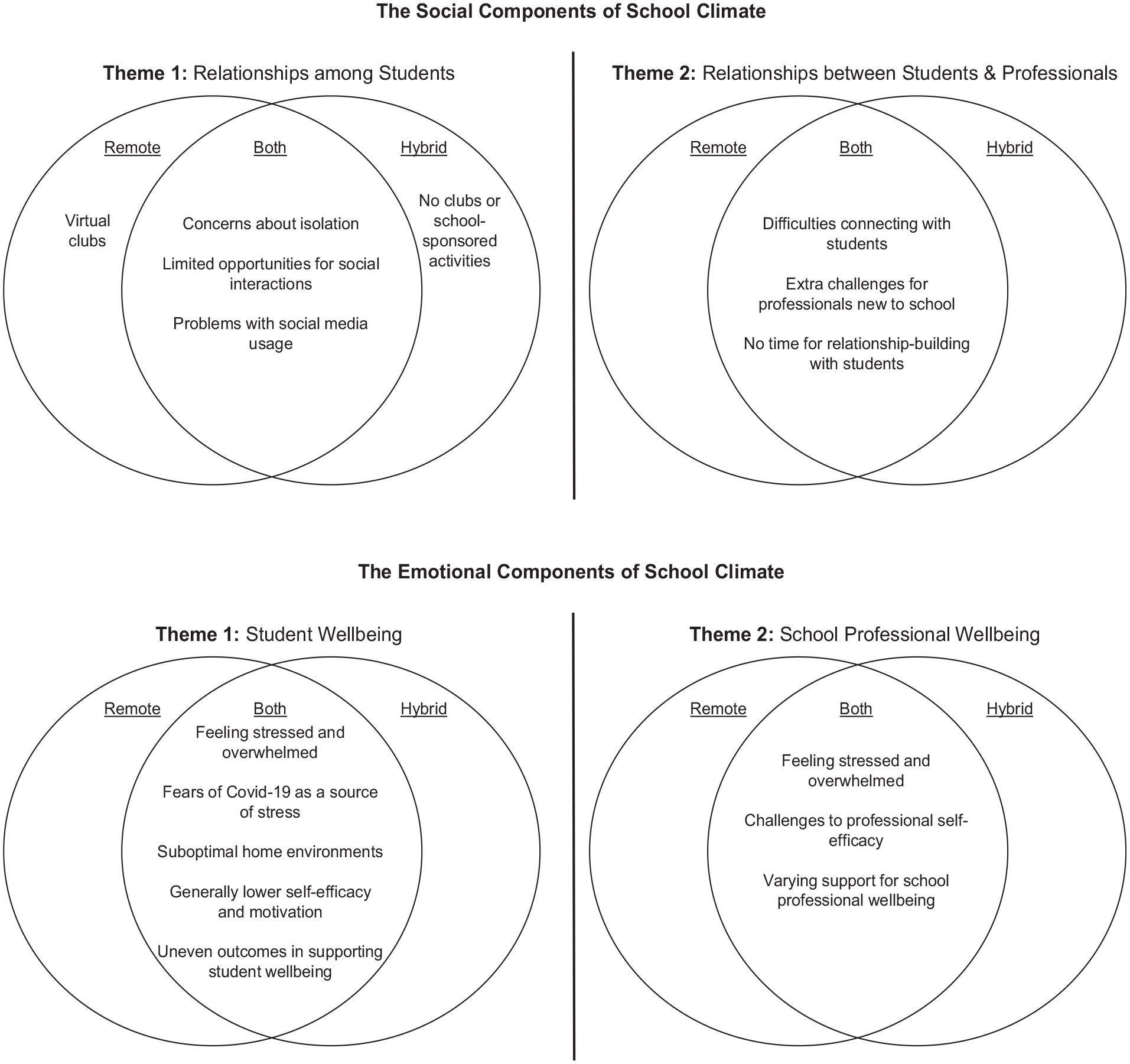
Process of Developing and Organizing Themes for the Purposes of Comparing and Contrasting Learning Environments
Themes and Frequency Counts for Codes Related to School Climate Factors

Although we had hypothesized that there would be clear advantages to a hybrid learning environment for the social and emotional components of school climate, our analyses uncovered more similarities than differences in school climate between the perceptions of SSPs whose schools were operating in remote environments and those that were operating in hybrid environments. Participants shared many of the same concerns about the negative experiences they observed for the students and staff in their schools during data collection.
Social Components of School Climate
The social components of school climate consisted of (1) the relationships among students and (2) the relationships between students and school professionals. According to participants, the opportunities for students and staff to develop and strengthen these relationships during the first half of the 2020–21 school year were more limited. Connections were more difficult to make when interactions occurred either fully online in remote learning environments or partially online in hybrid learning environments. Participants described how their schools and students attempted to redress the loss of socialization for students to varying degrees of success. We observed across these themes that the challenges that SSPs described were similar across both learning environments. Participants’ observations suggest that the hybrid learning environment, which was conceivably meant to moderate some of the isolation and diminished opportunities for socialization and relationship-building for teachers and students, did very little to overcome these difficulties.
Relationships Among Students
Participants described a social cost for students due to the pandemic. They expressed concerns that students were more isolated than before. Students had few opportunities for organic socialization with peers due to social distancing requirements in hybrid schools or because they never interacted face-to-face. Students attending school remotely rarely turned on their cameras or participated in class except through text chat, according to participants. Participants felt that the isolation contributed to students’ worsening mental health. Adding to students’ isolation, clubs and school-sponsored activities were limited.
Concerns About Isolation
SSPs working in both types of learning environments described students at their schools as “isolated” compared to when schools were operating in person. Because of the decrease in face-to-face interactions in both remote and hybrid learning environments, some SSPs reported that there were fewer instances of bullying and conflict between students. Still, students’ experiences of depression, anxiety, and suicidal ideation seemed to worsen. Participant 1, who worked in a remote school, explained that her department relies on students to report their peers’ struggles with mental health. In a remote environment, it is more difficult for students to observe these changes in each other. She described how this process typically worked in the past: When we’re in the building, we have a lot of kids that come in, and they’re worried about their friends. They know something’s going on and that something’s different because they notice the mannerisms change or maybe somebody is more distant, but when we’re virtual, they do not see that as well.
Participant 2, who worked in a remote high school, added that students’ home lives are often not conducive to healthy social interactions with family members and people living in students’ households, which only adds to students’ isolation. Participants suggested that this was due to family circumstances (e.g., poverty, abuse, neglect), as well as the developmental age of students in middle and high schools.
Limited Opportunities for Social Interactions
Socialization was not much better for students in hybrid learning environments. Participant 13, who worked in a hybrid middle school, explained that the opportunity for students to socialize organically changed “tremendously” with all of the social distancing measures her school had put in place. Students rotated through their in-person class days with the same group of students, meaning meeting new peers was no longer happening. She said: Hopefully, you like the kids that are in your room because you’re spending the day with them. In the lunch room, they go through and pick their food and sit at the table. Most of the time, they can sit where they want, and now they take their lunch to their classroom and sit at the desk that they sat in [all day].
Adding to this, a second hybrid SSP, Participant 14, said that a big reason for students to come to schools, especially for students who struggle academically, was the chance to spend time with friends and to participate in non-academic activities. However, with all of those things “stripped away,” students were less interested in coming to school and less engaged when they did attend.
Conversely, participants working in remote schools reported that students were still interacting with each other face-to-face even though they were not doing so in school. Participant 6 remarked that it would be “naive” for school professionals to assume that students were not seeing each other. Similarly, Participant 2 added that students had told her specifically that they were still seeing each other outside of school.
School-Sponsored Clubs and Activities
As Participant 14 noted, extracurricular activities stopped occurring at her hybrid school, which only added to students’ experiences of social isolation. On the other hand, some remote schools tried to keep clubs going virtually to allow students to interact with each other in a non-academic context. Two participants in remote schools described how a small handful of their virtual clubs were still meeting with varying degrees of success. For example, at Participant 1’s middle school, the robotics team was meeting virtually to solve various challenges like building a catapult using household items, and 30 students in the craft club had recently met to share their Thanksgiving crafts. However, virtual clubs were not the answer at Participant 2’s remote high school. She said that ninth-grade students, new to the school, were reluctant to join virtual clubs. Likewise, Participant 5, who worked at a remote middle school, said that while she was encouraging students to get involved in virtual clubs, few had done so.
Problems With Social Media Usage
One way that students sought to overcome their isolation and limited opportunities to interact with peers was through social media. In both hybrid and remote schools, SSPs reported that social media usage had increased among students as a way to maintain relationships and connections with peers. However, they also concurred that this mechanism for social interaction caused more harm than good. Participant 3, whose school was hybrid, observed that increased social media usage hurt students’ mental health and well-being because they constantly compared themselves to others. Participant 5, who worked in a remote middle school, said her school had initially encouraged students to use school-provided technology, such as Google Meet, to make friends. Later on, however, the school walked back this encouragement after seeing how much the technology was “misused” by the students, some of whom used it to exchange inappropriate pictures and messages.
Relationships Between Students and School Professionals
Many of the relational challenges SSPs described that students experienced in remote and hybrid learning environments were also salient to the experiences they described themselves and other school professionals having regarding their relationships with students. All 14 participants remarked on how the pandemic impacted educators’ relationships with their students, with nearly all enumerating how remote and hybrid learning environments hampered relationship-building with students. Six SSPs explained that they and their colleagues leveraged the existing positive rapport they had with students before the pandemic. However, their ability to do so harkens back to new students’ difficulties in developing connections with other students at their school, as discussed in the previous subsection. It also reinforces another point made by SSPs about the relationships between students and school professionals, which was that professionals new to their schools in the fall of 2020 found it particularly onerous to connect with students whom they had not met in person or with whom they were only able to interact sporadically. Moreover, participants also shared how complicated it was for them and their colleagues to juggle student relationships with the demands of teaching in remote and hybrid environments.
Difficulties Connecting With Students
Before even being able to forge a meaningful relationship with students, SSPs said that in many instances, even reaching a student posed a tremendous obstacle. High absenteeism and low engagement rates in virtual settings plagued teachers and other school professionals in both remote and hybrid environments. Participants in both types of environments expressed concern for students who were not engaging in school at all. They were especially fearful that students’ academic, personal, and mental health needs were not being addressed because these needs could not even be identified. Participant 13, who worked in a hybrid school, listed the various approaches she and her colleagues took to reach students: There have just been attempts with different types of outreach. If they don’t come to [a] scheduled Zoom, if they aren’t there when we try to call, or no one answers, then someone else is trying to reach out to them. It’s using a different phone number at night or phone number early in the morning. We’ve done multiple home visits to try to engage students.
Going one step further, other participants added that students would sign into school remotely but would not turn their cameras on or participate in class. As Participant 7 from a remote school explained: When I do a classroom observation, there’s a circle on the screen that says the student is in the class and has logged in, but when the teacher calls their name, there’s no response. When the teacher ends the class and everyone is logging out, there are three or four students every single time still not logging out because they’re not physically sitting in front of the computer.
Participants reported that having students be so disengaged from school was hard on the professionals in their schools. They said some were more successful than others in forging positive relationships with students, even under the unusual circumstances of remote and hybrid learning environments. Nevertheless, school professionals felt that not being consistently in person with students hampered their ability to build relationships. As Participant 7 later acknowledged, she did not know as many students on her caseload as she usually would have personally.
School professionals’ difficulty building relationships with students had trickle-down effects beyond just the socialization that the relationships provided. Participant 14, who worked at a hybrid school, explained that it appeared in students’ academics. There were fewer instances where students “would work really hard for just this one certain teacher” who had shown them a lot of “compassion, kindness, and love.” She felt that because they were not regularly meeting face-to-face and did not have authentic opportunities to bond, students did not see teachers as “cheerleaders” anymore. Participant 14 said there were more instances of teachers and students having conflicts over workload and academics than normal.
Extra Challenges for Professionals New to Schools
One group of school professionals who experienced great difficulty building relationships with students was educators new to their schools in the fall of 2020 when the schools were operating in hybrid or remote learning environments. This meant these school professionals had few to no chances to interact with students face-to-face. Participants shared that it was, therefore, much harder to establish trust when students or a new colleague had not met them. Participant 5, who was brand new to her remote middle school, explained what it was like to try to get to know students at her school site. She said: It’s super hard, especially being new at a new school, because the kids don’t know who I am, and typically, I would call students down to my office every week to make sure they knew me. Being a new counselor this year, I would have called every single student down to make sure they knew my face or popped into their classroom, so it’s just hard to put my name out there and make sure students know who I am . . . But virtually, the kids are . . . barely engaging in their classes, so engaging in anything extra is hard to ask.
Additionally, Participant 9, new to her hybrid school, said she felt a “little behind the eight ball” in figuring out how to reach out to students. She noted that being able to see them on campus sometimes was helping somewhat with building connections. Still, between having fewer regular face-to-face interactions with them and some students never coming to school in person, she said it was still “very, very hard.”
Building relationships when new to the school was similarly challenging for new teachers. According to Participant 1, the new teachers at her remote school were totally “overwhelmed,” which led them to come across as “stiff” to students. Participant 1 described how new teachers’ stiffness meant that students did not perceive the new teachers as approachable or collegial as they did teachers they already knew or as they may have perceived the new teachers if they had encountered them in a fully in-person learning environment. Other participants working in remote and hybrid schools shared that professionals who had worked at their schools before the pandemic had it “maybe a little easier” when it came to building connections with students because they could leverage shared histories and bonds with students forged before the pandemic.
No Time for Relationship-building With Students
Six participants, four hybrid and two remote, felt that the demands placed on school professionals to provide instruction and connect with students in a new and unfamiliar learning environment, coupled with the dramatic decrease in student engagement in schooling, shifted professionals’ priorities away from relationship-building with students. Participants observed that much of their time and teachers’ time was spent chasing down absent and underperforming students, with little to no improvement in these students’ attendance or academics. Participant 10 from a remote school described what this was like when he said: I think teachers are working their butts off, and we’re doing a lot of spinning of the wheels. Like the hour-and-a-half meeting I was in earlier today was trying to figure out these same kids that we’ve been trying to figure out what’s going on with them all year, and we’re putting more time into that, and I know the results we’re going to yield [are] going to be very little.
Similarly, Participant 14 from a hybrid school shared some frustration about how much time she spent focused on attendance issues when what she felt she should be doing in her role was working to “reduce barriers to student success.” As a result of this shift in responsibilities, the participant was experiencing “very, very low engagement with students,” which she said was “sad and worrisome” for her.
The demands on teachers’ time were a more salient point of discussion among participants in hybrid schools. Three SSPs discussed more in-depth how taxed the teachers at their schools were due to the responsibilities of running hybrid classrooms. Participant 9 described the new responsibilities of teachers in the hybrid learning environment and their impact on teachers and the school as a whole: I think it’s been overwhelming, it’s been challenging. In my opinion, that is because they have to maintain in-person students, complete virtual students, and hybrid students all in the same class period. They work a lot to answer the same questions over and over again. They’ve been very taxed. In the last three months, we’ve had eight teachers quit. We’ve just lost two of our eighth-grade math teachers this last week.
The challenges of working in a hybrid school left teachers with little time for relationships. As a result, participants shared that many student-teacher relationships had become only about ensuring students were turning in their work because teachers were struggling to keep up with the deluge of students who were falling behind due to a lack of engagement in school. Participant 3 elaborated further on why student-teacher relationships had deteriorated so much in the hybrid learning environment: [Teachers are] very overwhelmed with the amount of kids who are struggling in comparison to what’s normal. That’s across our entire district. As we can tell from the news, across the nation, it’s up, the number of kids who are failing courses. It’s definitely taking its toll on the relationships that kids are having with their teachers. Either they’re not having a truly engaging one, or it’s just a very punitive, “Why aren’t you doing something?”
Much like the finding that extracurricular activities were less operational in hybrid schools, these observations illustrate additional challenges seemingly unique to the hybrid learning environment regarding relationships.
Emotional Components of School Climate
Just as the social components of school climate were diminished in remote and hybrid learning environments, the emotional aspects of school climate were also impeded. In particular, SSPs in our sample discussed how remote and hybrid learning environments hurt students’ and school professionals’ well-being and self-efficacy. Participants shared that both students and school professionals were struggling with their mental health and feelings of being overwhelmed, stressed, anxious, and depressed. Adding to students’ stress were many new responsibilities at home, such as caring for younger siblings. Adding to school professionals’ stress was just how much busier and more difficult their jobs were in remote and hybrid environments compared to when schools met fully in-person. To address well-being, participants shared that their SSP and school leadership teams were taking steps to support students and school professionals to varying degrees of success.
Regarding student self-efficacy and motivation, participants described how little motivation many students had. Regarding school professional self-efficacy, participants described how their and their colleagues’ efforts on the job did not match the outcomes they observed, such as poor student academic performance, low student motivation, and chronic absenteeism. Participants felt that school professionals’ herculean efforts were not making a difference. Lastly, harkening back to the lack of state and district guidance for operating remote and hybrid learning environments, participants expressed frustrations at the limitations placed on them and other SSPs for being able to provide mental health interventions and support for students experiencing mental distress.
Once again, we observed few differences between the reports of participants working in hybrid and remote learning environments, which suggests that the promise of hybrid learning environments in potentially mitigating some of the social-emotional consequences of social distancing in schools during the pandemic did not materialize. Participants reported that the hybrid learning environment did little to improve student well-being, self-efficacy, and motivation, as participants reported that students struggled in both learning environments. Additionally, participants observed that teachers in hybrid schools had “double” the workload, which added to their feelings of being stressed and overwhelmed. On the other hand, SSPs working in hybrid schools reported that they could provide one-on-one services to students in person much in the same way they had been before the pandemic. However, these services were limited to only the students attending school in person. Additionally, hybrid participants reported that students were struggling with many of the same mental health and emotional challenges as were described by remote participants.
Student Well-being
During interviews, all participants discussed how students’ well-being decreased in remote and hybrid learning environments during the pandemic. Participants described how students felt overwhelmed, anxious, and depressed. In addition to feeling overwhelmed about navigating remote and hybrid learning environments, participants also identified two major sources of stress for students: the fear of contracting and spreading the COVID-19 virus and the responsibility of caring for younger children in the home. Although participants described how students were experiencing greater mental distress during the Fall of 2020 because of other issues, such as student disengagement and chronic absenteeism, some students were not receiving the interventions and support they needed. Participants shared that their SSP offices attempted to reach these students and provide well-being services for all students, although these measures were limited in their success.
Feeling Overwhelmed and Stressed
Every participant in the sample discussed the toll that the pandemic took on students’ well-being, with many talking about how completely “overwhelmed and so stressed out” students were during the Fall of 2020. Participant 6 from a remote school said that “overwhelmed” was “the biggest word I’ve heard from kids” so far in the school year. Participant 13 from a hybrid school summarized how students were feeling when she said: There’s more anxiety and frustration, hopelessness, helplessness. [Students feel like,] “I can’t do anything about this. It’s not getting any better, when is this going to end, what is this going to be like.” There’s no sense of comfort looking into the future because you don’t know what the future looks like.
Many other participants’ observations of student well-being echoed Participant 13’s remarks.
Students’ feelings of being overwhelmed and stressed manifested in their academic work. Participants explained that students responded to being stressed and overwhelmed in a variety of ways, although they observed that a majority of students were completely checked out and disengaged from their work. For students who were anxious at baseline, participants said that they were more anxious than before because they could not interact with teachers and receive support and reassurance from them as frequently and consistently. Participant 5, from a remote school, explained that anxious, perfectionist students had become among those who were not succeeding academically in the remote environment, whereas they had excelled before. She described why this was the case: For students who have school anxiety, a lot of times students will say that they’re doing a lot of work, but there isn’t a lot of work being turned in necessarily. Sometimes, it’s that the student is doing so much work, but they’re a perfectionist, and they’re not turning it in because they feel like it’s not good enough. Sometimes, they do 15 minutes of work, but that’s really overwhelming to them, so they feel like they are doing a lot of work, but they, in fact, are not. I feel like sometimes the students just don’t have an accurate perception because of whatever mental health situation is going on. It’s kind of impeding their ability to see their school work accurately.
As Participant 5’s remarks convey, students’ struggles with their mental health and well-being showed up in their academic work. Participant 2, from a remote school, described how many students at her school felt “stuck,” and some would not even come out of their bedrooms, according to conversations she had with some parents.
Participants also described how academic expectations and pressure from parents and teachers had mostly stayed the same despite the massive change in learning environments. Some participants felt that the academic pressures students experienced needed to be commensurate with how the world around them had changed. Participant 3, from a hybrid school, explained that teachers and parents were hampering students’ well-being by not acknowledging how the pandemic had changed schooling. She said: The expectations from parents and teachers, I don’t think, have necessarily been as adjusted as maybe I would have hoped. We’re still operating under the amount of work that students need to do as we were pre-COVID, which is, in my opinion, a little unreasonable for some of the classes. I understand [that] an honors and an advanced-level, college-level course, obviously, needs to have more intense rigor for those students because that’s the purpose of those courses, but there are some [other] things that I find a little over the top.
Adding to this point, Participant 3 noted that some students’ mental health did not allow them to perform at the academic level they used to. She said, “It just breaks my heart to hear because we are really asking them sometimes to do something that they can’t do.”
Fears of Covid-19 as a Source of Stress
When drilling down into some of the factors that contributed to the decrease in students’ well-being, two participants, one from a hybrid and one from a remote learning environment, talked about how the very frightening reality of a highly transmissible, potentially deadly virus, was a source of stress for students. Anxieties about passing the illness along weighed heavily on students’ minds. Both participants noted that this fear was higher among students raised by grandparents. Participant 13, from a hybrid school, said that several students at her school were not attending school in person because they feared bringing it home to their elderly caretakers. She described students’ thought processes about being exposed to the virus, “If I get COVID, I’m going to take it home to my parents; they could die, my grandparents could die. I don’t want to be sick.” Being able to stay remote helped assuage this fear for students, according to Participant 13.
Participant 2, from a remote school, said that anxiety around grandparent caretakers contracting COVID-19 was “a biggie” for students. The two participants postulated that fear of the virus added to students’ diminished well-being. While anxiety about COVID-19 persisted, the observations from these two participants suggest that students may have benefitted from being able to be remote to limit the possibility of contracting and spreading the virus to vulnerable family members.
Suboptimal Home Environments
In addition to the students’ fears about bringing COVID-19 into their homes, participants shared that many other issues in students’ home lives were sources of stress. Participants shared that the challenges students experienced at home impacted their well-being and manifested in their school engagement and performance. Participant 9, from a hybrid middle school, summarized the types of stressors some students were experiencing at home and how the pandemic amplified these problems. She said: [The pandemic] is just a magnifying glass on issues that probably were involved in the students’ world that are now [already]. Now, they don’t have a greater responsibility for coming to school; we’re just seeing them fall back further behind. [It’s the] kids who are living with their grandparents, kids who we know have substance abuse issues, kids that are involved with domestic violence, kids who are now having to stay home to watch their brothers and sisters so the parents can go to work. For [some] 8th graders, their parents are saying, “We want them to work now.” They’re coming and watching their Zoom videos at nighttime, but they’re not being engaged during the day . . . We’re not able to check the boxes of seeing them every day, watching them eat, whether they are clean, and whether they have their needs met when they just fall off. We’re just like, “Okay, we’re seeing more of what has been underlying all along.”
Other participants listed similar stressors that students faced at home. Like Participant 9, SSPs felt monitoring and addressing these issues was easier when students were regularly in school. Additional concerns that SSPs wished they were better able to support included students struggling with eating disorders, students experiencing homelessness and housing insecurity, and students whose parents had mental health or substance abuse issues. Four participants, two hybrid and two remote, also emphasized that taking care of younger siblings was a big concern for the students at their school. For these reasons, Participant 2 explained that for many students, “home is not a good place for them to be.”
Generally Lower Self-Efficacy and Motivation
Participants observed that students’ self-efficacy and motivation decreased during the pandemic. Several participants described students as having no motivation to engage in school or academics without fully face-to-face classes. They connected the decrease in students’ self-efficacy to the remote and hybrid learning environments, which participants felt interfered with students’ self-beliefs and willingness to be successful. Several participants described how students did not seem to comprehend that the work and grades they earned in the Fall of 2020 did matter for their academic careers after the work and grades during the Spring 2020 school closures did not, even though they participated in school remotely during both semesters. Other participants had observed that teachers had become much more lax about grading and generously gave out participation grades and points for items students did that were not related specifically to academic content. While participants acknowledged that these efforts did help disengaged students from school not to fail, they discouraged students who were engaged from working as hard. Overall, participants strongly believed that the decline in student self-efficacy and motivation could be resolved when students return to fully in-person learning.
Participant 13, from a hybrid school, explained why students were only learning or interested in learning if they were in the school building. She said: They just really need to be in the building. They need to be in there for their mental health and their academic well-being as well. That’s what kids do at this age; they go to school. That’s kind of their “job,” so anytime you’re not doing what you’re supposed to really be doing, then that’s just a jolt to your system. It’s been an interesting and difficult year.
Her remarks convey how the disruption to normal school operations disrupted students’ systems. As a result, students had low motivation or desire to complete school tasks, as other participants noted. Participant 14, from a hybrid school, added that the physical act of being in the school building provided “external motivation” for students to engage in their work. She elaborated on why this was the case for students when she said: Come into the building, and the teacher is going to tell you to sit down, and if you fall asleep, she’s going to wake you up. We cannot open up a kid’s brain and pour the knowledge in, but it’s much easier to engage a kid when they’re in front of you and your building.
Adding to this point, Participant 8, who worked at a remote school, said that students struggled to be motivated to complete schoolwork in their homes because they still saw home as “a place for them to sleep and eat and [have] fun and [be] kind of carefree.” She later added that she wished news media and district leadership acknowledged that learning from home was a major adjustment for students.
Uneven Outcomes in Supporting Student Well-being
Given everything participants shared that was interfering with students’ well-being, SSPs were eager to find ways to support their students. All participants talked about different measures that the SSP offices at their schools had attempted to identify and reach students who may be struggling. For example, three participants talked about how their SSP and leadership teams had been conducting home visits. Participant 6, from a remote school, said that home visits were arguably the most effective tool her team used for contacting students who may be struggling. She said: For a lot of the kids, we’ll do home visits. We always say [to parents], “If you don’t answer the phone, we’ll come knock on your door because we are dedicated to helping your kid, and whatever it takes, we are going to do it. We’ve gone to kids’ houses, and they’ve been asleep at noon. The poor kid is just like, “I can’t wake up, I can’t get up in time, I’m too tired, I’m overwhelmed.”
Participant 6 continued that by seeing students face-to-face in their homes, she could provide support and resources to them and their parents. However, the participants who discussed conducting home visits said. At the same time, they found visiting students reassuring that they were unharmed and safe; the visits did little to change their behavior or engagement with school.
Similarly, four participants said their schools had used a needs assessment survey to help identify students who may be experiencing mental distress. However, they noted that response rates were low, and students who did not attend school were not completing the surveys. Likewise, SSPs in schools implementing social-emotional curricula in classes to support students’ well-being said these programs only benefited students already in school. Participant 10, from a remote school, shared that even students who were engaged in school were reluctant to seek help. His school used a survey to catch students who may have benefitted from extra support. The participant explained: You don’t hear kids asking for help there like you might expect. When someone has been listed as a kid needing help, I’ve emailed or called them using Google Phone. They’ll say, “I accidentally clicked that. Sorry.” That’s where it ends.
For these reasons, participants felt that students’ needs were being “underreported.” Adding to this point, Participant 7 said, “You can hear it in the kids. They’re not telling you things they’d tell you in my office.” As will be discussed in more detail below, school professionals felt frustrated and worried about their students, which also impacted their well-being.
School Professional Well-being
The shift to remote and hybrid learning environments dramatically shifted how school professionals conducted business. As noted earlier, one consequence was that school professionals, especially teachers, struggled to build relationships with students, as much of their time was spent tracking down missing school work and chronically absent students. Unsurprisingly, participants also reported that working in these new learning environments hampered school professionals’ well-being, much as it did for student well-being. Like students, participants shared that school professionals felt stressed and overwhelmed. Both remote and hybrid participants described how much harder school professionals were working in Fall 2020 and the toll it took on their well-being. Some SSPs discussed how their office sought to help school professionals as they had with students. Although participants also wished they could do more to help their colleagues, they were limited by time and resources.
Feeling Overwhelmed and Stressed
Participants acknowledged that school professionals, especially teachers, were “doing the best they can” given the challenging circumstances they were experiencing in Fall 2020. Participants said teachers were “extremely overwhelmed” by and experiencing “extra stress” from teaching responsibilities and trying to meet students’ needs. Three participants from hybrid schools also described how the responsibilities placed on teachers in hybrid learning environments added to teachers’ feelings of being overwhelmed. Participant 3, from a hybrid school, illustrated this point when she said: I think that teachers are very overwhelmed with the amount of things they’re having to juggle at the same time. While we are in hybrid . . . they’re tryin’ to figure out how to [teach] effectively while trying to still stay engaged, while trying to reach out to kids who aren’t logging in . . . It’s messy.
Participants from remote schools also noted that school professionals face a “constant struggle” in performing their everyday tasks.
Participant 7, who worked at a diverse, urban middle school, said that teachers felt overwhelmed and stressed because they were struggling to meet students’ different needs. Teaching in a remote learning environment showed teachers firsthand the challenges and privileges students in their classes had. Participant 7 explained: The pandemic has really highlighted the different privileges that students grow up with. When they’re all in the same building and all in the same classroom, it’s hard to pick that out, but when you are teaching children from their homes, and maybe they don’t have great Internet, so they’re constantly kicked out of [Google] Meets, or maybe they have two siblings working beside them, so it’s hard for them to concentrate; it really highlights the difference in home structures and the difference in what students are handling . . . Hopefully, if anything good comes out of this, teachers will see that they have students from such different privileges in their classroom, and sometimes you can’t treat every kid the same because . . . they have very different needs, which is a tall order and it’s a lot to— when you think of students catering to ninety different needs, I can imagine that can be a bit overwhelming for teachers.
Later, Participant 7 added that because of how much work teachers had, they were “absolutely exhausted.” The other participants discussed how teachers and school professionals shared similar remarks and observations about how much more stressful their work had become in the new learning environments.
Challenges to Professional Self-Efficacy
Participants’ descriptions of how remote and hybrid learning environments impacted their and their colleagues’ professional self-efficacy fell into two categories. First, participants described how hard school professionals, especially teachers, worked with little to no success or improvement in students’ attendance or academic performance. Participant 6, working in a remote school, described what this looked like: Teachers have tried; teachers have really, really tried; I give our teachers so much kudos, so many creative things to try to increase that engagement to turn their cameras on, to speak up, and unmute themselves, to try and increase that engagement and make it as similar as they can to a normal classroom.
Participant 6 and others described how downtrodden and demoralized teachers felt because they spent their days “talking to black screens.” While Participant 6 acknowledged that school professionals might not feel like their work was as effective in the remote learning environment, she felt they deserved more praise and acknowledgment. She said: As educators, everyone has had to show so much resiliency, flexibility, and ingenuity, and that just speaks to how amazing educators are, all of them. Everyone should get kudos or pats on the back for having to adapt. We’re still having school, and I don’t think anyone’s ever had to do this before. We’ve been doing it for almost a year, so I think that’s something to be proud of.
Other participants agreed school professionals deserved more credit for their hard work, even though it went unrecognized by the outside world. Participant 14 equated school professionals’ work to the film Groundhog Day, since they did the same things repeatedly and nothing ever changed. In particular, participants working in hybrid environments also felt that the professionals at their schools had truly gone above and beyond in their jobs. Participant 9, from a hybrid school, called the teachers’ workload at her school “double” because they needed to offer everything to students in person and remotely.
Participants wished outsiders understood how difficult the school year had been for teachers and school professionals. Participant 10 explained that others need to be more understanding of the efforts teachers have been putting forth. He said, “This is not online education. This is disaster education. We’re not going to reap the same rewards that we would in a standard year.”
Second, participants in both hybrid and remote learning environments expressed frustration at the restrictions placed on them by their districts to provide mental health evaluations and interventions online. In short, most districts prohibited SSPs from engaging in this work if students were not in-person. Additionally, in hybrid schools, participants also had to discontinue group therapy sessions in light of social distancing measures. Participant 4 said that students enjoyed and needed group sessions. She felt students were struggling without that opportunity to connect with peers who shared similar struggles. Participant 2, who worked in a remote environment, said being unable to perform some of the essential functions of her job like her “superpower had been taken away.” Participants working in hybrid schools acknowledged that students who attended school in person could seek support from SSP but that the students who did so were only those who were actually attending school in person.
These mandates were particularly hard for SSPs, who felt that not being able to address students’ mental health needs was likely making these issues worse. Participant 5 explained that her school would only allow students to meet with her online if their parents signed a permission form, which she said was “already a barrier, especially because students sometimes need to talk about what’s going on with their family.” Additionally, her district said if any student disclosed thoughts or behaviors related to suicide to her, she needed to immediately “stop the conversation and call their parents.” She explained: I’m restricted in what I’m allowed to talk to them about, anything that would be considered confidential normally, which is almost everything I’m not allowed to discuss.
Participant 10 called the restrictions about what SSPs could discuss with students “censorship.” He said that counselors “need to be able to talk to the kids about anything that they need to talk to us about” because that is “part of what you have to deal with to be there for the kids.” When schools return to fully in-person operations, participants expect their offices will see a major uptick in students needing mental health support. Participants hoped that school districts would consider ways to help them connect with students safely when they cannot meet face-to-face.
Varying Support for School Professional Well-being
Four participants discussed some services they and school leadership attempted to offer teachers and school professionals to support them through this stressful period. However, these participants shared that they wish their schools and districts were doing more to help support educators. For example, two participants, one hybrid and one remote, described how their districts and school administrators encouraged mindfulness practices to help school professionals combat stress. While the participants appreciated the message, as Participant 3 said, it could have been more useful in practice. She said, “You get the email that’s like, ‘Here’s some strategies to try,’ deep breathing and stuff like that. That’s helpful, but it’s not reducing anyone’s workload.” Instead of messages like that, Participant 3 wished her school leaders would encourage more professionals to utilize the employee assistance program for mental health services.
Other participants reported that their schools were a bit more proactive in supporting school professionals to manage their feelings of being overwhelmed and stressed. For example, one hybrid participant shared that her school was running a weekly mental health and wellness drop-in for staff that a social worker staffed. She explained, “It’s a time to let things off your chest. It’s a safe space for listening and validation but also [to get] some solutions.” At Participant 10’s school, the principal had implemented two strategies to support teachers and staff. Even though students were remote, Participant 10 said most school professionals were still working out of the building. First, Participant 10 said that his principal modeled mindfulness practices at the start of any meeting. Second, Participant 10’s principal and other district leaders had created “resilience rooms” for teachers and staff. The rooms have snacks and comfortable seating, allowing teachers to unwind.
Nevertheless, participants felt like more could be done to help school professionals’ well-being since they were being “spread thin” by all the new demands of remote and hybrid learning environments. Participant 11 added that more could be done to support teachers and other professionals if the state put more resources and personnel into SSP positions, enabling SSP offices to be more responsive to the needs of both students and professionals.
Discussion
This study aimed to add to the emerging “playbook” of factors that educational leaders and policymakers may want to consider in the event of future pandemics or other disruptions to schooling (Marshall & Bradley-Dorsey, 2022, p. 159). Specifically, we aimed to understand how professionals perceived school climate during the pandemic, considering differences and similarities across those working in remote and hybrid learning environments. The findings from this study can be used in tandem with research on how learning environments impact student achievement and public health infrastructure to guide decision-making about learning environments (Engzell et al., 2020; Goldhaber et al., 2022; Kaffenberger, 2021; Kuhfield & Tarasawa, 2020). In analyzing the insights of SSPs about the social and emotional components of school climate in remote and hybrid learning environments in the fall and early spring of the 2020–21 school year, we found relatively few differences between the two. Participants in both learning environments observed similar struggles for students and school professionals. They shared similar concerns about the impact of not attending school fully in person on relationships and well-being for both students and teachers. School experiences were further hampered by the pressure to rapidly adjust to teaching and learning with new technology and new social distancing protocols.
Regarding the social components of school climate—the relationships between students and between students and teachers, participants described how students struggled with isolation and the limited opportunities for authentic, organic social interactions in remote and hybrid learning environments. They also shared that school professionals struggled to build positive connections with students. Participants identified several things contributing to this difficulty, including when professionals were new to a school in the 2020–21 year and had no established relationships with students and the demands that hybrid and remote learning environments placed on educators’ time. In recounting their observations of student-teacher relationships in particular, participants saw that teachers struggled to balance providing instruction with keeping up with students who were falling behind academically or chronically absent. Because of these new responsibilities in the remote and hybrid learning environments, participants felt teachers had little to no time to build relationships with students. Our findings align with prior research showing that the pandemic negatively impacted educators’ working conditions (Kaden, 2020; Pressley, 2021). Our findings are consistent with previous research on the negative experiences associated with the pandemic, which did not distinguish between remote and hybrid learning. This suggests that the challenges faced in both environments were similar, highlighting the difficulties experienced by students and educators alike.
Regarding the emotional components of school climate, well-being for students and school professionals, participants emphasized how both groups felt stressed and overwhelmed by the physical shift in school climate and the new expectations this shift meant for their work. According to participants, not being in a fully in-person learning environment interfered with students’ motivation and self-efficacy to succeed and keep up with their schoolwork. Professionals described how many students in both hybrid and remote learning environments had fallen behind academically or were chronically absent, which participants described as both a cause and symptom of students’ feelings of being stressed and overwhelmed during this time. Participants also noted that the stress of being in the home more than usual was especially difficult for students with difficult home lives. For school professionals’ well-being, participants also shared that they and their fellow school professionals felt like the amount of effort they put into their jobs was not commensurate with the results they saw around student engagement, achievement, and attendance. These findings align with prior research showing that the pandemic negatively impacted student attendance and engagement (Carvalho et al., 2020; Darling-Hammond et al., 2020; Jordan, 2020; Sedillo-Hamann et al., 2021) and teacher stress (Metrailer & Clark, 2022). We also believe policymakers and educational leaders should carefully consider family backgrounds, support, and socioeconomic status of students when making decisions about how to best meet their needs academically and otherwise during pandemics and other disruptions from school.
Implications for Policy
In our analyses of the social and emotional components of the two learning environments, two important policy implications emerged regarding hybrid learning environments. First, participants working in hybrid environments described students as having a similar lack of connectedness and socialization as students attending school in fully remote environments. According to SSPs, some students never utilized the in-person component of the hybrid environment, which meant they did not get the advantage of interacting with their peers and school professionals in person. Additionally, hybrid participants said that because of the stringent social distancing protocols their schools followed for in-person schooling, the interactions that students and school professionals had in schools were incredibly limited. The participants in our study did not observe the potential advantages of a hybrid learning environment for students’ socialization. Altogether, from the perspective of SSPs, our findings suggest that hybrid learning environments did little to improve the school climate for students.
Second, participants in hybrid schools characterized teachers as simultaneously running two separate learning environments, one remote and a second face-to-face. Participants described teachers as essentially pulling “double” duty. Accordingly, SSPs working in hybrid learning environments felt that teachers in their schools were especially stressed and taxed by the circumstances in which they worked in the fall and early spring of the 2020–21 school year. Because this finding suggests that a hybrid learning environment places additional demands on teachers, it offers a critical policy consideration about the efficacy of the hybrid learning environment in the context of the nationwide teacher shortage. In future pandemics or other school disruptions, policymakers and educational leaders should consider whether the hybrid learning environment could potentially exacerbate teacher retention issues.
Limitations and Future Directions
Although our study of school climate matches public health findings on the efficacy of the hybrid learning environment, our conclusions have limitations. As a qualitative study with 14 participants, our paper can only describe the relationship between school climate and learning environment. Participants’ accounts of the impact of hybrid and remote learning environments on school climate cannot show whether there was a relationship between school climate and student achievement during the COVID-19 pandemic, although extant research on learning loss during the pandemic strongly indicates that there may be. Future research should endeavor to understand how educators adapt to online instruction and further probe how student learning was impacted by the shift to online instruction. Additionally, while we firmly believe in the knowledge and expertise of our sample on school climate, they can only provide their own perspectives, which are limited in their generalizability. For future research, we recommend that researchers consider longitudinal studies on post-pandemic school climates or comparative analyses across regions, as these types of studies would highlight the importance of continuing this line of inquiry.
For these reasons, we strongly urge policymakers and educational leaders to consider these findings in conjunction with literature on public health and student achievement when making decisions about learning environments in the event of future disasters, pandemics, or other disruptions to schooling. We say this with the caveat that leaders should consider the time spent out of school, whether it’s for a short-term issue such as a snowstorm or a long-term disruption such as a pandemic, in determining the appropriate learning environment. Additionally, factors such as educator capacity, continuity of school-based services, and infrastructure should also be considered.
Moreover, policymakers and educational leaders should seriously consider the suitability of a hybrid learning environment when coupling this finding about teacher stress with the prior finding that the hybrid learning environment seemingly did not improve students’ experiences of social isolation. These findings suggest that the hybrid learning environment does little to improve the social components of the school climate for teachers and school professionals.
At the same time, it is important to acknowledge that participants also shared some potential advantages for a hybrid learning environment over a remote learning environment because there were some opportunities for face-to-face interactions. For example, as SSPs, participants felt that these interactions were especially important for enabling them and their fellow SSPs to identify and provide services and interventions for students who may need additional support. However, participants shared that because so many students in hybrid environments never came to school in person, they suspected that there were many more students experiencing challenges or crises who were not being identified. Moreover, due to school district policies, even identified students who were not in person and needed SSP assistance may not have received the support they needed. Taking into account these considerations for school climate, along with public health findings on hybrid learning (Goldhaber et al., 2022; Liu & Liu, 2020), we conclude that policymakers and educational leaders should approach adopting a hybrid learning environment with caution and a critical eye in the event of future pandemics or disruptions to schooling.
Supplemental Material
sj-docx-1-ero-10.1177_23328584251338058 – Supplemental material for “This Is Not Online Education. It’s Disaster Education”: A Qualitative Study of Remote and Hybrid School Climates During COVID-19
Supplemental material, sj-docx-1-ero-10.1177_23328584251338058 for “This Is Not Online Education. It’s Disaster Education”: A Qualitative Study of Remote and Hybrid School Climates During COVID-19 by Megan R. Griffard, Marisa E. Marraccini, Danette Barber, Lauren Sartain and Dana C. Griffin in AERA Open
Footnotes
Declaration of Conflicting Interests
The author(s) declared no potential conflicts of interest with respect to the research, authorship, and/or publication of this article.
Funding
The author(s) disclosed receipt of the following financial support for the research, authorship, and/or publication of this article: Funding for this study was provided through grants from the following organizations: the National Center for Advancing Translational Sciences; the Society for Study of School Psychology; the National Institutes of Health (:UL1TR002489); the National Institute of Mental Health (:K23MH122775, :L30MH117655); and the North Carolina Collaboratory at University of North Carolina at Chapel Hill through an appropriation made by the North Carolina General Assembly.

Notes: This manuscript was accepted under the editorship of Dr. Kara Finnigan.
Authors
MEGAN R. GRIFFARD is an assistant professor of educational policy and leadership at the University of Nevada, Las Vegas. Her research focuses on disruptions to schooling, such as climate disasters and pandemics.
MARISA E. MARRACCINI is the Donald & Justeen Tarbet Faculty Scholar in Education Associate Professor at the University of North Carolina at Chapel Hill. Marraccini specializes in promoting the mental health and well-being of students and preventing health risk behaviors.
DANETTE BARBER is a Ph.D. candidate in Educational Psychology at the University of Nevada, Las Vegas. Her research interest is in educator self-efficacy.
LAUREN SARTAIN is an assistant professor in educational policy at the University of North Carolina at Chapel Hill. Lauren Sartain is a quantitative researcher, using experimental and quasi-experimental methods to understand the impacts of policy changes on students, teachers, and administrators.
DANA C. GRIFFIN is an associate professor and the area chair in Learning, Development, and Psychological Services at the University of North Carolina at Chapel Hill. Dr. Griffin researches parent involvement and school-family-community partnerships.
References
Supplementary Material
Please find the following supplemental material available below.
For Open Access articles published under a Creative Commons License, all supplemental material carries the same license as the article it is associated with.
For non-Open Access articles published, all supplemental material carries a non-exclusive license, and permission requests for re-use of supplemental material or any part of supplemental material shall be sent directly to the copyright owner as specified in the copyright notice associated with the article.
