




Abstract
States and colleges nationwide are adopting corequisite reforms, where students concurrently enroll in developmental and college-level coursework. Leveraging the concept of collective sensemaking and interviews with 54 actors at 16 community colleges implementing a statewide corequisite mandate, we examine the policy signals actors received, how personnel in different roles interacted to create an implementation plan, and how institutional supports and constraints shaped collective responses to policy. We find that actors within the same institutions—and even the same position—received different types of policy signals, often shaped by gatekeeping behavior among administrators over which actors should inhabit core implementation roles. Actors with peripheral roles were detached from the early deliberation of policy signals, minimizing their influence over implementation.
Keywords
Community colleges serve one-third of all college students and disproportionately enroll students of color and students from low-income families (Snyder et al., 2019). Almost two-thirds of community college students are deemed not “college-ready” in math and, until the advent of recent reform efforts, were placed into prerequisite developmental education (dev-ed) courses that do not contribute credits toward credentials (Bailey et al., 2010). Only 20% of dev-ed students complete their first college-level math course, which is required to earn a degree. In response to dismal rates of dev-ed completion and calls for reform, states and college systems are adopting corequisite coursework in which students concurrently enroll in college-level and developmental courses, thereby broadening access to college-level credits.
Twenty-four states now use corequisite coursework to accelerate student access to college credits (Education Commission of the States [ECS], 2021). Implementation requires institutional actors to engage in collective sensemaking, negotiating over policy signals and how to translate policy into practice (Coburn, 2001). They must disseminate information to relevant personnel and students, redesign course sequences, determine access to reformed math courses, and distribute the workload. Many implementing administrators, faculty, and staff previously enacted and maintained the traditional prerequisite approach to dev-ed.
Examining the implementation of large-scale reforms within institutions illuminates how practitioners with varying roles and responsibilities make collective decisions in response to policy change (Bell & Smith, 2022; Coburn, 2001; McLaughlin, 1987). We drew interviews with 54 actors implementing dev-ed math reform at 16 Texas community colleges (one-third of colleges in the state) to understand how community colleges responded to a statewide corequisite mandate. We leverage collective sensemaking to examine how institutional actors translated policy signals and negotiated implementation plans (Coburn, 2001).
Our results illustrate that individuals with different organizational roles and implementation responsibilities received different policy signals. Core implementers—administrators and faculty with primary responsibilities to develop corequisite implementation plans for their college—were more likely to receive direct policy signals from state agencies. They collaborated across several waves of deliberation over how to adapt, combine, and adopt policy signals into educational practices. Peripheral implementers were more likely to receive filtered policy signals—messages shaped by others at their institution—and entered collective deliberation at a later junction, primarily tasked with adopting (or ignoring) decisions made by colleagues with core responsibilities. We also found that institutions’ financial resources and research capacity shaped collective policy responses, informing how actors distributed the workload and assessed compliance, with important consequences for meeting policy aims.
Next, we describe the paradigm shift in dev-ed and evidence for corequisite reforms, followed by an overview of the literature on how institutional actors participate in dev-ed reforms. After presenting our research questions (RQs), we describe our collective sensemaking framework and methodological approach before turning to our findings.
The Rise of Corequisite Reforms in Mathematics
Under the traditional prerequisite dev-ed model, fewer than one-third of students assessed as not meeting college readiness standards complete their developmental coursework (Bailey et al., 2010). Prior research suggests that an effective approach for increasing gateway math course completion is to allow students to enroll in introductory college-level math concurrently with dev-ed (Cho et al., 2012; Jenkins et al., 2010). Students can accrue degree-bearing credits, improving momentum toward a degree, while receiving developmental support (Adelman, 2006; Jenkins et al., 2010). Experimental and quasi-experimental research illustrates the positive effects of enrolling in corequisite compared with prerequisite dev-ed math coursework (Logue et al., 2016, 2019; Meiselman & Schudde, 2022; Ngo & Melguizo, 2022; Ran & Lin, 2022; Schudde & Ryu, 2024).
Adopting large-scale postsecondary reforms is challenging; personnel must typically revise programming and requirements with a limited warning (Nienhusser, 2018; Nix et al., 2021). These challenges may explain the varied timelines for implementation of corequisite reforms observed across colleges in Tennessee, ranging from 1 to 4 years after their statewide mandate, despite requirements that colleges be at scale after a 1-year pilot (Ran & Lin, 2022). Descriptive results suggest that specific design elements of corequisite math—that is, department decisions over how the dev-ed supports are structured or which instructors teach them—are less important for student outcomes than is simply enacting the reform (Ryu et al., 2022). Yet implementing agents must still grapple with those design decisions. Examining the negotiation between institutional actors working to implement dev-ed reform may illuminate why colleges sometimes enact dev-ed reforms “in ways that undermine their potential benefits” while also informing our broader understanding of policy implementation (Brower et al., 2017; Edgecombe et al., 2013, p. 5).
The Role of Institutional Actors in Dev-Ed Reform
Policy implementation in higher education is often an exercise in translating policy into action (Hodara et al., 2017; Nienhusser, 2018). When a policy mandate is made at the state or the system level, policymakers often leave its implementation to the institutional actors with relevant expertise, affording discretion over how they carry out policy provisions (Lipsky, 2010; McLaughlin, 1987). This discretion has important implications: The collective decisions made within institutions can result in institutions implementing the same policy differently, contributing to heterogeneous effects (McLaughlin, 1987).
Organizational change, often necessary in large-scale education reform, requires political, social, and cultural transformations within the institutions (Kezar, 2001). Enacting curricular reforms, in particular, often necessitates those instructors “want [that] change, take an active part in changing, and have the resources to change” (Cohen, 1990, p. 326). If college personnel oppose policies from the government or upper administration, they may actively and passively stymie policy implementation, screening out or rejecting policy messages they deem undesirable (Brower et al., 2017; Logue, 2017; Meyer & Rowan, 1977). Brower et al. (2017) examined institutional actors’ reactions and implementation responses to Florida’s dev-ed reform policy—which made dev-ed optional—and found that the composition of personnel’s varied responses (mix of staff with oppositional, supportive, or neutral reactions) contributed to differing levels of implementation across institutions. More research is needed to further illuminate the negotiation that occurs across various roles within institutions and the push-pull process between colleagues as colleges work to implement large-scale policy directives.
Varied Implementation Responsibilities Across Institutional Actors
Creating broad changes at the institutional level requires shifts in behavior among personnel who hold different roles in the organizational hierarchy and who have varying power and exposure to policy signals (Fligstein & McAdam, 2011). Institutional actors, including administrators, faculty, and student support staff, may take on specific roles in implementation, each requiring different levels of information and support (McLaughlin, 1987).
Administrators
Administrators are at the front lines of policy implementation and organizational change, often tasked with communicating a vision for reforms and ensuring it “penetrates all levels” of the college (Chase et al., 2021; Eddy, 2003a, p. 12; Kezar 2012). If administrators focus on “surface features” of policy reforms without engaging topical expertise, they may miss the reform’s “core intent”; therefore guidance and new practices should include input from topical experts (Spillane & Callahan, 2000, p. 401). Distributed leadership—where personnel with appropriate technical expertise take on leadership roles at various levels of the organization—is essential when enacting large-scale reform efforts (Kezar, 2012; Spillane et al., 2004). Once reforms are underway, administrators can leverage data on short-term outcomes and communicate about the effectiveness of reforms to improve staff morale (Eddy, 2003b).
Mid-level managers, like deans and department chairs, play an important role in diffusing reform information to instructors (Chase et al., 2021; Spillane et al., 2002). As liaisons between upper administrators and faculty, department chairs require clear information about which responsibilities they should take on, how to delegate responsibilities, and whether and how to reallocate resources (Chase et al., 2021). The work of mid-level administrators goes “in two directions”: They are street-level workers responsible to upper-level administration and leaders dependent on other street-level workers—faculty—to carry out policy implementation (Lipsky, 2010; Spillane et al., 2002). Enacting reforms require informal negotiation, mediation, persuasion, and coalition-building (Conrad, 1978; Hearn, 1996). To realign the goals, values, and perceptions of faculty and staff toward policy aims, administrators must create conditions in which personnel feel ownership over policy implementation (Pierre & Røiseland, 2016).
Faculty
Knowledge and expertise—accumulated through years of teaching in and navigating a complex bureaucracy—can contribute to faculty’s power over organizational processes and resistance to institutional change (Grissom et al., 2015; Spillane et al., 2002). Faculty have domain over course sequences and curricula in their departments and over teaching approaches in their classrooms (Mesa et al., 2014). As dev-ed reforms proliferated over the past decade, so did complaints from faculty that state policies accelerating and condensing dev-ed coursework circumvent faculty expertise (Cafarella, 2016; Nix et al., 2021). Faculty are more likely to perceive dev-ed reforms as successful when they are faculty-driven rather than driven by administrators or outside actors (Cafarella, 2016; Schudde et al., 2024). However, even in contexts with state-initiated reforms, faculty often have discretion over curricula and course placement recommendations. They are responsible for setting cut scores on placement tests to determine students’ initial placement, whereas other personnel, such as institutional researchers and advisors, describe their own roles as auxiliaries (Melguizo et al., 2014).
Teachers negotiate technical details of policies through conversations with colleagues, reconstructing policy messages and deliberating about whether and how to adopt and apply policy directives in their classrooms (Coburn, 2005a). At community colleges, however, faculty rarely receive professional development for teaching due to time and resource constraints, which means collaboration over how to implement reforms often occurs informally (Edwards et al., 2015; Grubb, 1999). Curriculum development resources can facilitate faculty engagement with policy directives in the midst of large-scale reforms (Chase et al., 2021; Jenkins et al., 2021).
Advisors
Although faculty are the arbiters of which courses are required and who gains access to them, advisors typically relay that information to students. Academic advisors serve as the face of institutional student success initiatives and a primary source of policy information for students, transmitting and translating policy signals (Karp & Stacey, 2013; Schudde et al., 2021). When dev-ed courses became optional in Florida, if students learned about the shift in policy, they did so through advisors (Brower et al., 2017). When advising staff did not revise guidance to incoming students, policy-uninformed students were more likely to enroll in dev-ed coursework despite it being optional. At times, advisors conveyed expectations of reform-resistant instructors, sending students messages about course “rigor” to prepare them for “sink or swim attitudes” among faculty (Brower et al., 2018, p. 122).
Mediating between faculty and students requires advisors to have clear communication with faculty. In a descriptive study comparing success among students in corequisite versus prerequisite developmental math programs, advisors’ effectiveness in corequisite reforms hinged on their receiving frequent and coherent communication from faculty and administrators (Atkins & Beggs, 2017). In the absence of transparent information about student eligibility for new course pathways, advisors’ “detachment” from the implementation process may stymie reform efforts (Atkins & Beggs, 2017; Brower et al., 2017, 2018, p. 822).
External Actors
Policies are complex and implementing them successfully can require substantial resources. Although colleges rely on institutional actors to interpret and translate state policies into concrete action, they also increasingly draw on external intermediaries—nonsystem actors and organizations that mediate between policymakers and implementers—to provide additional resources and help with interpretation and implementation (Coburn, 2005b; Gandara et al., 2017; Haddad, 2021; Hodara et al., 2017; Honig, 2004; Ness et al., 2015). Often, after policy reforms pass, external actors, including those at educational advocacy groups, professional development organizations, and other non-profits, offer guidance to institutional actors, facilitating initial and ongoing planning and interpretation. Providing practitioners with training and opportunities to collaborate with colleagues in reform-focused activities can facilitate deeper understanding of a policy’s implications for practice (Chase et al., 2021; Jenkins et al., 2021). Connecting with peers about reforms in formal and informal settings enables educational leaders and practitioners to develop actionable curricular changes, troubleshoot challenges, and triangulate across “multiple and sometimes conflicting messages” (Chase et al., 2021; Coburn, 2001, p. 162).
Research Questions
To further understand how institutional actors implement large-scale policy initiatives, we examined how community college personnel collectively made sense of Texas’s statewide mandate for corequisites in math. We asked several interrelated questions:
Which policy signals did institutional actors receive about the corequisite mandate and how did signal receipt vary across roles and implementation responsibilities?
How did institutional actors collectively deliberate policy signals and make decisions to implement the policy change?
How did supports and constraints vary across institutions and how did that shape whether and how the institution met policy targets?
Conceptual Framework
Research on policy implementation ranges from a macro, top-down perspective focused on statutes or policy language to a micro, bottom-up perspective recognizing that policies are shaped by behaviors of implementers (Coburn, 2005a; Lipsky, 2010; McLaughlin, 1987). A meso-level approach captures the interactions and roles of actors within organizations charged with responding to policy mandates. We leverage Coburn’s (2001) concept of collective sensemaking to examine how actors interact to interpret and negotiate policy signals.
Whereas purely micro-level policy implementation models, like individual sensemaking, focus on individual actors’ interpretation of policy signals (Coburn, 2005a; Schudde et al., 2021; Spillane et al., 2002), a meso-level approach focuses on individuals’ roles, their interactions within the broader system, and the way institutional context shapes their capacity to implement reforms. Collective sensemaking recognizes that actors make sense of policy messages “through conversation and interaction with their colleagues,” developing “shared understandings” as they collaborate to make decisions (a process of collective deliberation) about practice (Coburn, 2001, p. 148). Personnel who inhabit different roles in policy implementation will likely experience varied incentives and constraints and receive different policy signals while enacting institutional change (McLaughlin, 1987). By delineating the roles of institutional actors in our analysis, we can examine the extent to which collective deliberation varies across role responsibilities during the implementation process.
Sensemaking involves “noticing and bracketing” and “labeling and categorizing” received information to find meaning in ambiguity (Weick et al., 2005, p. 411). It includes three central elements: (a) policy signals, such as policies’ language; (b) cognitive schemas, which comprise actors’ knowledge, beliefs, and attitudes; and (c) actors’ social contexts, including both macro-contexts (e.g., professions, communities, or, in our case, the higher education system) and micro-contexts (e.g., social norms, formal organizational structures, and informal social networks; Spillane et al., 2002). In our case, we examine interactions that occur within the meso context, given our interest in organizational actors in their institutional context. Policy signals include both direct policy signals—“formal policy,” such as “legislation, brochures, regulations” (Schudde et al., 2021; Spillane et al., 2002, p. 392), and other “carrier” messages about those policies, such as indirect policy signals from institutional materials, typically carried by individual and collective actors to others in the organization (Coburn, 2001, p. 146). Prior research suggests that most policy signals received by implementing agents are “carried” signals; policy information is often “filtered” by other actors at the institution (Coburn, 2001, p. 146; Schudde et al., 2021, p. 933). Policy signals alone do not typically describe how actors should proceed (Spillane et al., 2002). Instead, individuals’ schemas and macro-, meso-, and micro-contexts shape how they focus on or ignore certain aspects of a policy. Variation in a policy’s outcomes is inherent, resulting from differences in individuals’ prior experiences, social contexts, and how institutional actors interact to make implementation decisions. When policies fail to achieve their outcomes, sensemaking focuses not on the policy itself but on how people understand it, and—in the case of collective sensemaking—how they work together to navigate policy signals and translate them into practice.
As institutional actors respond to multiple pressures and policy initiatives, they must interpret multiple messages about policy (Coburn, 2001). Actors occupying different roles in the organizational hierarchy hold different role responsibilities for implementation and, as such, receive different policy signals (Fligstein & McAdam, 2011; McLaughlin, 1987). Thus, we first examine which policy signals actors received, how those differ across roles, and the consequences of receiving different policy signals within the same institutional context (RQ1).
After receiving policy signals, implementing actors must “negotiate their response,” determining whether and how to “adopt, adapt, combine, or ignore” policy messages through interactions with colleagues, referred to as “deliberation” in the sensemaking literature; at the meso level, collective deliberation among implementing actors leads to collective decisions about educational practices (Coburn, 2001, p. 147). Actors with different implementation roles may perceive varied “demands, priorities, and values” within their institution and broader macro-contexts (McLaughlin, 1987, p. 175). Collective sensemaking with an eye toward the negotiation that occurs among institutional actors with varied roles and policy information allows us to consider how college personnel with differentiated role responsibilities make collective decisions about policy implementation (RQ2). The conceptual framework also enables us to examine the extent to which supports and constraints vary across institutions (RQ3), shaping collective deliberations and colleges’ abilities to meet policy goals. Figure 1, described in the results section, maps the conceptual framework from our analysis.
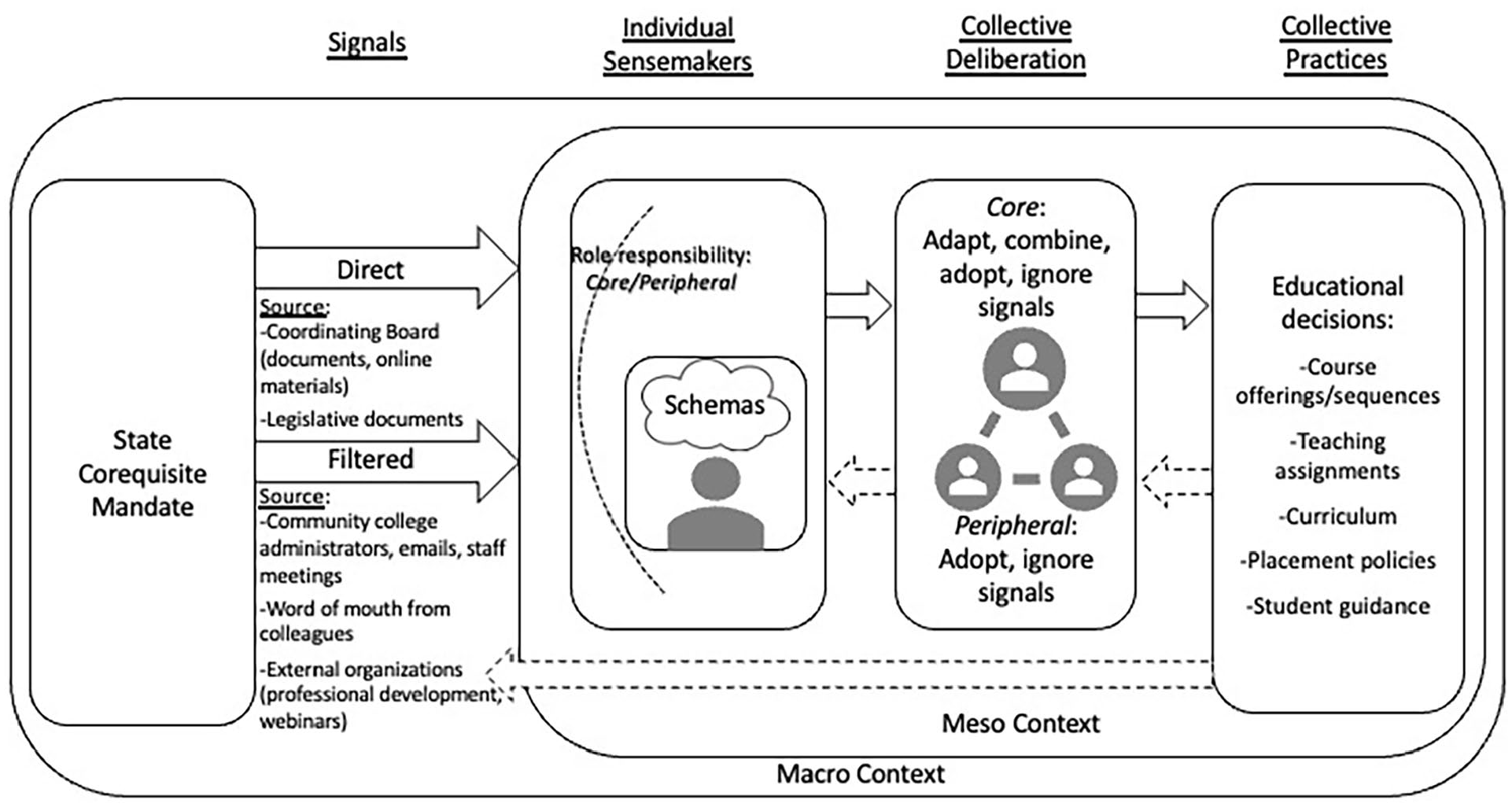
Collective sensemaking of statewide corequisite reform.
State Contexts
Texas’s public higher education system includes 50 community colleges and is among the largest and most diverse in the United States, second in size only to that of California (Snyder et al., 2019). Before recent reforms were enacted, colleges across the state still offered dev-ed math sequences that were up to three semesters long. In 2011, almost one-half of community college students did not meet the state’s college readiness standards (Texas Higher Education Coordinating Board [THECB], 2016). Three years later, only 29% of those students had passed out of dev-ed math, and only 16% had completed a college-level math course, which is required for a college degree (THECB, 2016).
In 2017, the Texas legislature passed House Bill 2223 (HB2223), also referred to as “the corequisite mandate,” which mandated that Texas colleges rapidly scale corequisites. The law required a 3-year progression (or “stair-step”) of increased enrollments in corequisite coursework: by fall 2018, 25% of students enrolled in dev-ed had to participate in a corequisite model; the threshold increased to 50% by fall 2019 and to 75% by fall 2020 (THECB, 2018). As part of their statutory authority, the THECB produced draft rules for HB2223 in the summer of 2017 and offered a 30-day window for public comment before finalizing. In late 2020, the THECB leveraged its rule-making authority to expand the corequisite mandate, requiring that, by fall 2021, 100% of students below college-readiness standards enroll in corequisites (THECB, 2020).
The phased nature of the mandate offered a unique window of opportunity to examine how institutional actors grappled with implementation. During our data collection in the fall of 2020, colleges were rolling out new courses to comply with HB2223 while learning they would need to meet new, higher standards instituted by the THECB for the next academic year. Before 2018, about 20 of the 50 community colleges offered corequisite math, with most early adopters offering only one or two corequisite courses and tightly restricting student eligibility (Meiselman & Schudde, 2022). After the first wave of the corequisite mandate (fall 2018), 30% of colleges did not meet the required threshold for enrollment in corequisite math (Morales-Vale, 2019).
Although HB2223 and the THECB’s final rules set timelines for meeting enrollment targets, colleges had flexibility regarding how to meet policy requirements. They were not explicitly told how to reach the thresholds; that was left up to negotiation within implementing organizations. To support colleges in making these decisions, the state held and co-sponsored facilitated workshops where college personnel could ask questions, hear examples of corequisite course structures, and connect with colleagues about the next steps (THECB, 2018).
Methods
To explore how institutional actors navigated corequisite reform in Texas, we drew on data from interviews with personnel at 16 community colleges in fall 2020. We also interviewed staff at intermediary organizations that offered implementation support for colleges.
Sampling and Recruitment
To ensure we had variation across colleges in our sample, we identified community colleges at different stages of implementing the mandate and used purposive sampling. We relied on descriptive statistics provided by the THECB that captured the percentage of eligible students at each college enrolled in corequisite math in fall 2018 and 2019. We organized and stratified the list into groups of colleges falling below the threshold, approximately at the threshold, and above the threshold (based on performance for 25% and 50% of eligible students in corequisite math in fall 2018 and 2019, respectively), selecting at least five colleges per stratum. Ultimately, we collected data at five low-, six medium-, and five high-implementation colleges. We anticipated variation in the process of collective sensemaking and implementation across strata but found consistency in collective sensemaking processes across colleges in our sample and therefore address RQ1 and RQ2 for all colleges. In our analysis for RQ3, we observed differences in resources and constraints across implementation strata. Supplemental Appendix A (available in the online version of this article) describes the sampled colleges in more detail, including the variation within and across strata.
We used purposive sampling to recruit personnel involved in coordinating corequisite implementation decisions (academic and student affairs administrators), designing math sequences and corequisite courses (math faculty and department chairs), and advising students on math course selection (advisors/math coordinators). We aimed to interview two or three staff per institution, but experienced variation across colleges that ranged from one to five participants. In each interview, we also used snowball sampling, asking participants for referrals for colleagues involved in corequisite math implementation. We conducted 54 interviews, of which 49 were with staff implementers across the 16 colleges and 5 were with staff at organizations that assisted colleges with implementation. Table 1 describes the participants, including their pseudonym, institution, and strata (whether their college met enrollment targets for corequisites), role at the college, and whether their implementation role responsibilities were core or peripheral (based on their participation in ongoing decisions about how to implement HB2223).
Description of Participants
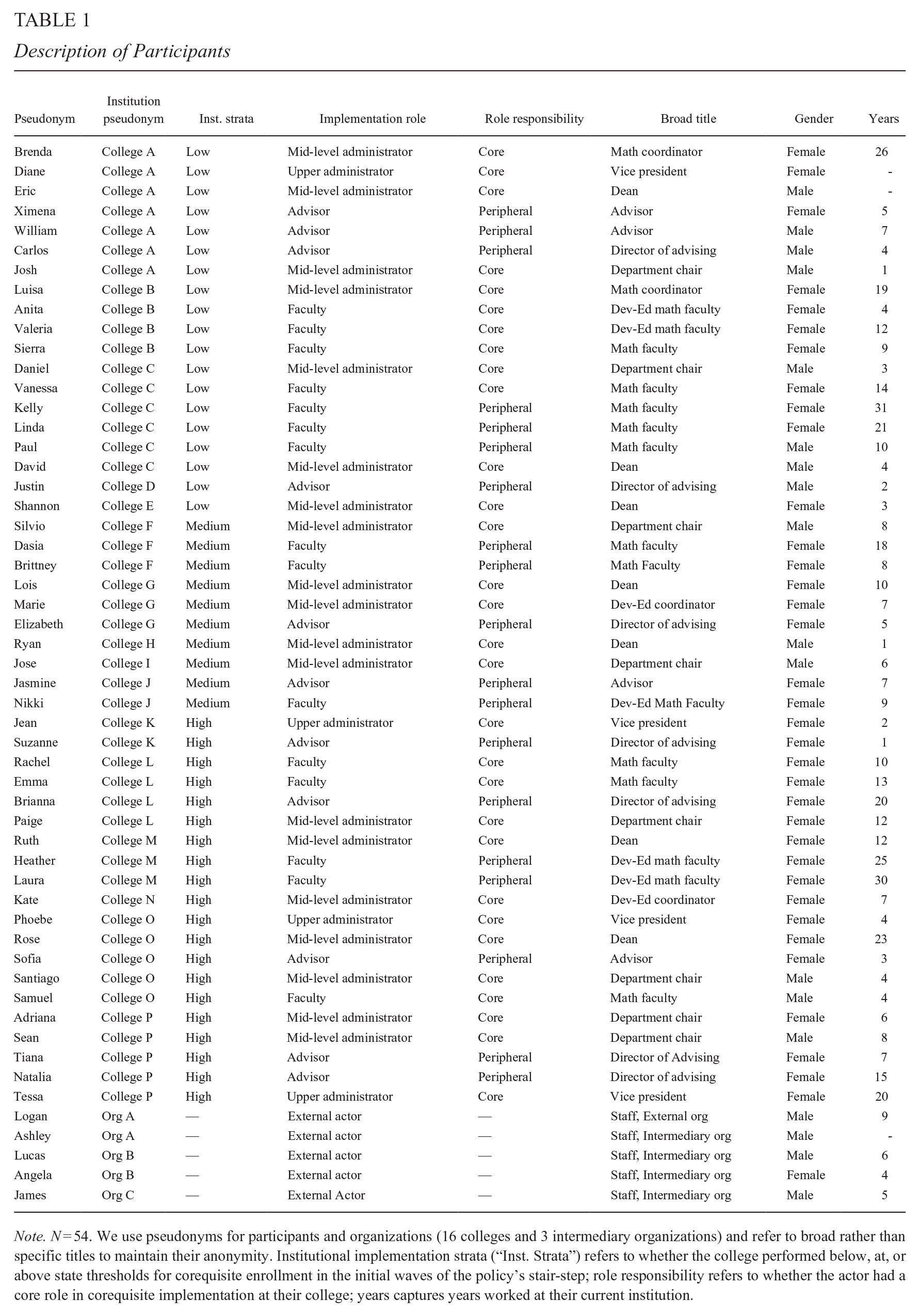
Note. N = 54. We use pseudonyms for participants and organizations (16 colleges and 3 intermediary organizations) and refer to broad rather than specific titles to maintain their anonymity. Institutional implementation strata (“Inst. Strata”) refers to whether the college performed below, at, or above state thresholds for corequisite enrollment in the initial waves of the policy’s stair-step; role responsibility refers to whether the actor had a core role in corequisite implementation at their college; years captures years worked at their current institution.
Data Collection
We conducted 60-min semi structured interviews, which we recorded and transcribed. We first asked general questions about dev-ed and the goals of reforms. We then explicitly asked participants to describe HB2223, how the policy informed changes at their college, and what role they played in implementing those changes (we provide our semi-structured interview protocols in Supplemental Appendix B in the online version of the journal). Given the timing of our research, some interview questions were retroactive; we asked staff to recall implementation after the initial phase of the mandate had been enacted. However, because all colleges were still in the process of expanding access to corequisites and at least one-third of the sample lagged in meeting the state’s required thresholds, we captured the ongoing negotiation of implementation plans and struggles in real time. If respondents did not mention the new rule, we probed to see whether they were aware of a plan to move to 100%.
Among the 49 personnel at 16 colleges, we spoke with 4 upper administrators (e.g., vice presidents of student success), 19 mid-level administrators (8 department chairs, 7 deans, and 4 coordinators who oversaw faculty), 15 math faculty, and 11 advisors. The five external actors from intermediary organizations each played a role in the state’s rulemaking deliberation and in supporting community college faculty and staff as they implemented HB2223.
We also collected and reviewed policy documents, including rulemaking materials and commentary, the house bill (proposed and passed), and FAQs provided by the coordinating board for college personnel. Throughout the rollout of the policy, the first author attended conferences and workshops—most of which were facilitated by intermediary actors in Org A, B, and C—designed for college personnel, observing reactions to presentations by policymakers, intermediary actors, and math faculty from various contexts, along with round table discussions among institutional actors of how to implement the policy at specific colleges.
Data Analysis
We coded transcript data in Dedoose, a qualitative software program, using a hybrid method (Miles & Huberman, 1994). We first developed general descriptive codes based on the literature and sensemaking theory. In subsequent analysis, we created subcategories inductively. All three authors coded transcripts after reaching an agreement about the application of codes.
We initially coded the staff transcripts for broad themes, including the staff members’ perceptions of dev-ed in math; how they learned about the state’s new corequisite policy, HB2223; their knowledge and perceptions of HB2223; the role they (and their colleagues) played in implementing corequisites; and plans for continuing to move toward scale. To complete initial coding and enhance the validity of our findings, all team members individually coded one transcript and met to talk through discrepancies, resolve disagreements, and determine necessary revisions to the coding scheme. Each coder coded a second transcript, which was checked by the first author, and the team met again to resolve discrepancies and further clarify the coding scheme. Then each coder individually coded a caseload of the remaining transcripts. The first author checked a random set of transcripts throughout the coding process, and the team met each week to discuss and resolve coding questions and disagreements about their caseload.
After the initial coding, we examined excerpts captured by our general codes thematically, identifying how personnel described and interpreted policies and the role they played in implementing the policy at their college. We categorized themes and ideas that emerged inductively from the data and used them to build a meta matrix. We focused on how staff understood and operationalized policy messages about HB2223 to create broad themes. The emergent themes illustrated the varied roles of different staff members based on their positions at the college, the differing information they received, and how staff negotiated within and across their organizational unit in the implementation process. Throughout the process, we worked toward consensus by adding more details or adjusting the interpretation of themes and codes.
We created qualitative matrices (Miles & Huberman, 1994) to synthesize findings across personnel, campuses, and data sources to examine implementation processes and the varied roles and policy information across participants. We derived categories for the matrices from the themes identified during coding. For each staff member, our matrix captured demographic data, the person’s role in the college, how they defined or understood HB2223 and related dev-ed policies, how the staff member learned about HB2223, how their understandings influenced their behavior, what role they and other actors played in selecting and implementing a plan for enacting HB2223, and their experiences working with others in making those decisions.
We examined the matrices for patterns and themes within and across categories to draw out major findings. We found that the data best fit a meso-level theory of policy implementation and worked from the matrix to create additional memos for the various roles of institutional actors, outlining findings that emerged related to information received about the policy, supports and constraints they experienced in implementation, and how actors with different responsibilities worked toward collective decisions.
Throughout the data collection and analysis processes, we worked to verify or correct our interpretations of participants’ responses to maintain our study’s credibility and trustworthiness. In addition to interviews, we collected documents and data from institutional websites about corequisite course sequences and course placement recommendations. The first author attended corequisite workshops and conferences to observe conversations between implementing actors as they navigated implementation. When possible, we triangulated data across sources (interviews from other personnel, institutional surveys, data reported to the THECB, and our field notes from corequisite workshops and conferences in the state) to ensure our data and analyses were consistent and accurate. We conducted member checking by soliciting feedback from practitioners who played a key role in policy implementation at colleges throughout the state and from researchers studying similar processes in other contexts (Miles & Huberman, 1994).
Results
We now turn to our results, which illustrate how a state-level initiative like the corequisite mandate is implemented through interactions and collective decisions across a web of actors, both within and beyond the institution. Based on our findings, Figure 1 presents a model of collective sensemaking that highlights the implications of actors holding different implementation role responsibilities. Actors’ role responsibilities shaped the types of policy signals they received (the dotted curve in the individual sensemaking phase represents a “filter” for policy signals based on core or peripheral responsibilities) and how they participated in different phases of collective deliberation, as we elaborate below. As shown in the figure, individual sense makers initially use prior background information (schemas) to make sense of policy signals, but collective deliberation occurs when actors interact to adapt, combine, adopt, or ignore policy signals, ultimately collaborating to determine educational practices. Next, we describe variation in information received across implementation roles (RQ1); then we describe how actors in and across roles and levels of the organizational hierarchy interact to deliberate policy signals and implement policy change (RQ2). Finally, we describe the supports and constraints actors experienced and explicate how those factors influenced meeting policy targets (RQ3).
Varied Role Responsibilities and Policy Signals
To translate policy signals into implementation, institutional actors interact with one another and external actors to deliberate over policy signals. In this section, we describe variations in implementation responsibilities across administrators, faculty, and advisors, as well as across actors at intermediary organizations. We then describe how access to policy signals varied across actors with core and peripheral implementation responsibilities.
Roles and Responsibilities
Administrators
Administrators held several responsibilities in HB2223 implementation, with some variation between the roles of upper and mid-level administrators. Many were involved in early decision-making and ongoing oversight of implementation at the college. Upper administrators (n = 4) served a “facilitative” role (Phoebe, College O), kicking off the implementation process. Their responsibilities included getting other personnel to “acknowledge what our task was” (Jean, College K) and to consider the “implications and options for implementing. . . and how that worked with the parameters of our system” (Phoebe, College O). To anticipate and overcome “kinks” in implementation, upper administrators enabled communication across campus units, updating and integrating systems to align with new corequisite models. For example, when HB2223 passed, “a lot of things” at College A were “still manual, because [the registration system] or the scheduling system didn’t work 100% for paired courses” (Diane). Diane collaborated with the registrar, advisors, and faculty to ensure that both course scheduling and registration appropriately captured paired courses and that the final products aligned with revised course schedules agreed upon by the faculty.
The responsibilities of mid-level administrators (n = 19)—including deans, department chairs, and program coordinators—also involved facilitation, but the work was more specific to their unit(s). Math department chairs served “as the liaison with upper admin and faculty” and “maintain[ed] responsibility for everything that comes from the top down, making sure it’s disseminated to the faculty” (Daniel, College C). Mid-level administrators were responsible for drafting an “easy-to-work-from” preliminary plan (Marie, College G) and determining which faculty were responsible for refining math corequisite implementation plans. Paige (College L) explained: “I have to create this picture of what it’s going to look like from the beginning so that we can plan it out, and let people know what we’re going to be doing, and get groups to work on it.” Although the middle managers contended that “faculty lead the work” on implementation (Eric, dean, College A), several acknowledged: “I’m the one that wrangles them . . . I get everybody together to make a decision about how we’re going to implement, what we’re going to do, rules that we need to follow” (Marie, College G). Through this role, mid-level administrators held core responsibilities for implementing the mandate.
Faculty
Faculty implementation responsibilities included complying with rules prescribed by middle and upper administrators, collaborating with department leaders on teaching assignment redistribution and course sequence redesign, and redesigning curricula. A refrain we heard often was “faculty drive the curriculum” (Eric, College A). Most faculty acknowledged that, once in the classroom, they “control how [they] administer [corequisite courses] in a lecture setting” (Dasia, College F). However, department chairs assigned a subset of faculty core responsibilities to create an implementation plan, including deciding how to revise course sequences and placement criteria. Faculty not selected for core responsibilities served peripheral roles, as we describe below, primarily voting on whether to approve practices determined by their colleagues.
Advisors
Advisor implementation responsibilities included enacting placement criteria for courses, guiding student course selection, and facilitating course enrollment. Although they serve as the face of the policy change for many students, they held peripheral responsibilities in their colleges’ implementation processes. Advisors were typically not involved in deliberations over how to implement; they described themselves as downstream in terms of policy signals, often receiving filtered signals about HB2223 that focused primarily on course placement and enrollment. Carlos (College A) explained: “All we can do because we are the guide, is say to the student: ‘Based on your score, this is where you stand. You should be sitting in this class.’” Advisors relied on math department materials to inform course placement processes.
External Actors
Actors whom we spoke with from three intermediary organizations (orgs) helped inform the rule-making process for HB2223 and supported colleges in implementation. Angela (Org B) explained: “Before the THECB publicly released any rules, they reached out to us, along with [Org A], to say, ‘What do we need to put in here?’ So, we drafted guidance about how to craft those rules.” Orgs A, B, and C—separately and collaboratively—offered workshops, webinars, and other support to colleges as they worked to interpret and implement HB2223. Given inequities in resources across colleges, which were “all over the map,” the orgs felt they needed to “look out for smaller, less-resourced colleges” that may have a difficult time obtaining guidance and implementing the policy (James, Org C).
The intermediary orgs “got some money to do professional development, through a series of webinars, to help faculty understand the bill” (Lucas, Org B). James described how they coordinated their efforts: Org A focused on college practitioners implementing English corequisites, Org B focused on math corequisites, and Org C helped with coordination and outreach to college stakeholders. The workshops sought to address the “huge demand” for both “basic design questions,” like “Where do you put the developmental component? How many hours? Does it feed naturally? Is there a tutor?,” and complex logistical challenges, including those regarding “student information systems and scheduling” (Lucas, Org B). Lucas elaborated: “We tried to help them think through not only what the questions were, but possible solutions.” Through workshops, intermediary orgs became a key source of filtered policy signals, with many institutional actors relying on them for clarity about how to implement the mandate.
Direct or Filtered Policy Signals: Who Gets Access?
We define policy signals as the information personnel received about the corequisite mandate, HB2223. Participants described two types of signals about the policy: direct (legislative documents and emails/memos from the THECB) and filtered (forwarded emails, faculty meetings, workshops, word of mouth from colleagues). It was quite uncommon for faculty and advisors to initially receive direct policy signals; instead, they received filtered policy signals that were “carried” from administrators at their institutions, though some were eventually able to access direct policy signals through online resources their administrators shared.
Core Implementers and Direct Policy Signals
Information about the new policy trickled down through colleges, starting with upper administrators who typically received information directly from the coordinating board. All the upper administrators reported initially learning about HB2223 through direct policy signals, either from the THECB or during the legislative session. After the bill passed, they all received “straightforward” emails from the THECB with information about the policy, which “just basically gave us the policy verbatim. But there weren’t a lot of specifics about how it should be carried out—and that’s where all the questions were” (Jean, College K). Mid-level administrators like deans and department chairs, on the other hand, received both direct policy signals and filtered signals, often on an accelerated timeline compared with more peripheral actors in the institution. They initially received filtered policy signals about HB2223 from upper administrators, ranging from “warnings” of “hey, this is coming down the pipeline” to emails from the district office (Adriana, College P). However, most mid-level administrators reported also receiving direct policy signals from the THECB (n = 12) once the policy passed, in addition to other information from intermediary organizations (n = 10) about navigating policy rules.
Carrying Signals to Non-Administrators
Institutional actors that did not serve as points of contact for the THECB (e.g., presidents, chief academic officers, deans) were often not sent direct policy signals, but sometimes gained access to them through referral by other core implementers. In this way, policymakers assigned upper administrators a core role and left it to them, as we elaborate below, to distribute information and determine which other personnel to share those signals with. All 15 faculty respondents reported receiving filtered policy signals about HB2223, learning about it from department and college leaders, though two faculty heard about it from an intermediary organization. Faculty meetings served as a primary source of information on the bill, along with emails from the college, many of which were forwarded from “district to college, then college to department” (Brenda, College A). Paul (College C) explained: “Mainly we had lots of division meetings where we’d get in there and talk about it and how we were going to do it.” Because the information from administrators provided the “bare bones” with sources to “find additional information” (Brenda, College A), to receive direct policy signals, faculty had to deliberately seek them out (e.g., through online searches) or be designated as a core implementer to engage more directly with the THECB (e.g., be referred to THECB webinars or resources). Most faculty acknowledged that after receiving the initial notification, they leaned heavily on mid-level administrators—primarily department chairs and program coordinators—and key upper administrators for information about the policy and its implications for the math department.
Ultimately, carried policy signals were passed along like a game of telephone from administrators to math faculty to advisors. One math faculty member, Rachel (College L), explained: “Rumor is the best way to learn more about policy. So, whispers at department meetings.” She noted that, after the initial “whispers,” she “got an email at the department level from the department chair, but there wasn’t an official memo or something.” Although some advisors were informed about HB2223 at the same time as faculty, such as at a “system-wide meeting where [upper administrators] explain[ed] how everything was going to work” (Sofia, College O), most advisors learned about the mandate from the math department’s “relaying the information” (Elizabeth, College G) due to their peripheral role. Ximena, at College A, explained: “It really came down from the math department. They were like, ‘We’re going to restructure our courses and build different levels to accommodate the number of students that need to be in these classes.’” Advisors acknowledged that the materials from departments, rather than policy documents from the state or intermediaries, were essential guidance for them. William, an advisor at College A, said: To be honest with you, I never looked at the house bill. I looked at the new common entry scores, because that was my tool. Whenever the scores were updated, we got a new common entry chart, and I would use that to determine the student placement.
Most advisors, like William, described being unsure of the details of HB2223 and referred to placement charts as primary sources for implementation information.
Collective Deliberation: Who Gets to Adapt, Combine, Adopt, and Ignore Policy Signals?
To translate the stated policy into implementation plans, institutional actors interacted with actors inside and outside their organization. In response to RQ2, we found variation in the collective deliberation processes across role responsibilities. Actors with core implementation responsibilities worked to collectively determine whether and how to adapt, combine, adopt, and ignore policy signals across iterations of sensemaking, whereas actors with peripheral roles were typically incorporated into later iterations, leaving them to either adopt or ignore filtered policy signals from colleagues with core roles. As illustrated in Figure 1, collective sensemaking is a recurrent process with various waves of collective deliberation. In this section, we examine how core and peripheral actors negotiated their responses to policy signals during three waves of deliberation: (a) as institutional actors worked with policymakers and intermediary orgs to refine policy rules and definitions, (b) as middle managers delegated tasks and coordinated working groups to develop implementation plans, and (c) as advisors and faculty clarified how implementation plans translated to student course enrollment, placement, and guidance.
Deliberating Over Direct Policy Signals: Initial Collective Sensemaking Processes
Core implementing actors engaged in collaborative discussions to understand the rules and implications of HB2223, where actors from colleges, intermediary orgs, and the THECB interacted through question-and-answer sessions and formal feedback mechanisms to negotiate the rules and definitions for the policy. Soon after HB2223 passed, institutional actors with core implementation responsibilities examined the bill and asked for clarification from the THECB about which models would count as corequisites. Phoebe (College O) described it as typical for new legislation to “start with just a little bit of information,” where “it takes time and these questions to be asked by those of us who are in the field to actually see what legislation means and how it’s going to impact practice.” In questioning and debating the mandate’s terms, institutional actors, policymakers, and external actors deliberated over the direct policy signals.
As the THECB entered the rule-making phase, college administrators were eager to find out whether their ongoing dev-ed reform efforts would comply. Several reported concerns about whether specific paired-course formats would comply with the policy, including “8 week–8 weeks” (8 × 8), which provide an 8-week dev-ed math course followed by an 8-week college-level course in the same term, and boot camp-style “4 × 12” paired courses, with “4 weeks of remedial leading into 12 weeks of college level” (William, College A). Vanessa, math faculty at College C, described this early confusion over which models complied with HB2223: “There were some questions that were raised in the beginning that we got conflicting answers about. We were told we could do 8×8s; then we were told that wasn’t okay, that it wasn’t a true coreq model.” These competing policy signals often came through conversations with THECB actors as the agency worked to determine its own guidance for implementation.
Concurrent with institutional actors seeking clarification about the implications of HB2223 for their preferred practices, the THECB invited actors at intermediary orgs to offer suggestions during the state’s rule-making phase. The Orgs’ suggestions did not include embedded prerequisites like 8 × 8 and 4 × 12 models. Lucas (Org B) noted that many of “the parameters” and “a lot of the rules” outlined for HB2223 “are what [Org B] offered” as guidance. However, Org B preferred “more strict parameters than what we ultimately got” for “the definition of coreq that’s on the books.” The final rules from the agency struck a balance between guidance from Org B and practitioners’ preference for maintaining embedded prerequisites. In the rules and FAQs for enacting HB2223, the THECB emphasized that just-in-time corequisites were preferable but allowed institutions to maintain the 8 × 8 (and 4 × 12) format as long as “the progressing student is not barred from entering the latter half (i.e., college-level component) of the corequisite” (THECB, 2108). This was “a design choice” aligned with the stated preferences of several college actors, Org B did not support it because it was “not a just-in-time model.”
Lucas explained: “I think the reason they did it is because [College H] and a couple of other colleges had already moved to 8×8 semesters for all of their classes. So [THECB] kind of had to in order to not preempt some existing structures.” Some colleges were frustrated because they perceived the clause that students could not be held back from the college-level component as “not allowing for 8×8” and thereby “changing expectations” from the THECB’s assurances that they could maintain current practices (David, College C). Overall, the agency’s final corequisite definition balanced allowing an approach that many colleges were already using (8×8s) with ensuring students could take the college-level course within the same term as dev-ed.
After rules were established, institutional actors regularly negotiated with org and THECB actors over the terms and conditions by which colleges’ implementation plans met the state agency’s rules. Additional deliberation over policy signals occurred through workshops and conferences held by intermediary orgs and the THECB. Kate, a dev-ed operations coordinator at College N, described the “first corequisite conference” offered by the THECB as including “a lot of definitions and options.” It reiterated for college personnel that “there were so many different ways to do it.” These early conversations, held after the rules were released in 2017, further clarified which educational practices would comply with the mandate. Subsequent conferences and workshops organized by intermediary orgs and the THECB offered additional space for institutional actors to hear “everybody else’s ideas” and assess “what was working and what wasn’t” so colleges could refine their implementation approach (Shannon, dean, College E).
Distributing the Workload: Selection Into Core Role Responsibilities
Armed with policy signals from the state and intermediary organizations, administrators set goals for compliance and determine which faculty would participate in decision-making. Most mid-level administrators leveraged their power to strategically choose faculty leads—those who would have core responsibilities to develop preliminary plans for course sequences and placement criteria. By distinguishing between core and peripheral faculty for implementing corequisites, mid-level administrators enabled key negotiations to occur in smaller, more manageable settings and shaped the power that specific faculty had over collective deliberations.
To select faculty leaders, department chairs often prioritized experience and carefully avoided faculty who were “highly resistant” and “deeply suspicious” of HB2223 (Daniel, College C), although they also asked for faculty input. At College F, the corequisite math committee was “volunteer-based”; with Dasia noting “we were never forced.” In her case, she was happy to teach corequisites but did not join the committee because she preferred to “stay out of politics.” Ruth, a dean at College M, described the early challenges that gave way to smaller working groups: “Just imagine the meetings and planning, the meetings and planning, roadblocks, tears, disagreements.” Mid-level managers’ decisions over whether and how to encourage participation among some faculty and not others served as both a political act and a functional necessity. Department chairs omitted resistant faculty who “believed students are going to fail left and right” (Daniel) or who refused to teach corequisites: “If someone really doesn’t want to teach it, it might not be the best situation for them to be involved” in the working group (Silvio, College F). Daniel invited faculty with relevant experience: “We had faculty who I call my specialists—who focused on teaching only dev-ed or really had their pulse on how dev-ed works.” However, mid-level administrators also relied on faculty who were willing and/or able to lead the discussions, especially in cases where “nobody liked the idea” of corequisites (Vanessa).
Faculty working groups were “primarily responsible for some of the inner workings, making decisions of ‘how are we going to do this?,’” including “how to change the structure, figure out the kinks” (Dasia, College F). Daniel (College C) worked with “three faculty, really” to “come up with a draft, a plan to disseminate to the other faculty.” Negotiating revised course sequences and placement criteria in a small group of specialists resulted in a “faculty-driven” plan—rather than “unilateral decisions”—that emphasized expertise of core faculty who “had taught dev-ed for so long” that they “knew a lot more about this than the average faculty” (Daniel). Vanessa, a professor at College C, elaborated: “It’s really just a conversation with a few people, and then we implemented from that.” “As part of the math committee” at College O, Samuel determined “system-wide placement cut scores,” working with other math faculty to “decide where the cut score should be” for different courses and sequences. Working groups also decided which college-level math courses “to coreq first,” and each subsequent year “add[ed] more sections of those combinations” (Vanessa).
Working groups ultimately presented proposals to all math faculty: “They’d say ‘how do you feel about that?’ . . . and we would always vote, so it was a united decision” (Dasia). This way, even faculty not in the working group “had a voice” and “gave some input” in final deliberations (Valeria, College B). However, the decision was typically a yes or no vote on adopting the implementation plan, minimizing peripheral faculty’s ability to adapt and combine policy signals (i.e., those not in the working group collectively deliberated over policy signals by adopting or ignoring them, as shown in Figure 1). By voting yes, they adopted the filtered signal by affirming the implementation plan. For peripheral faculty teaching coreq coursework, they could further deliberate adopting versus ignoring filtered signals and educational practices in their classroom. “As far as curriculum and design,” faculty “are the experts in their discipline” (Ruth, College M); they control what happens in the classroom.
After making changes to course sequence and offerings, new course sequences and paired courses had to be staffed. Teaching assignments are “faculty-driven really” with new coreqs taught by “whoever volunteers,” Vanessa (College C) explained, “as far as what I want to teach, when I want to teach, how I want to teach. If we have sections that nobody has picked up, then [the department chair] will ask for volunteers to take those.” At colleges in our sample with low initial implementation rates, faculty were less likely to volunteer. Josh, department chair at College A, had to explicitly ask faculty to teach the courses. It was challenging because “faculty would rather teach calc one because they can teach all the theory and the theoretical stuff” to more advanced students, “as opposed to teaching a college algebra with a coreq on it” (Josh). As a result, some faculty felt corequisites were “forced” on them (Josh).
As colleges moved toward scale with corequisites, however, faculty could no longer shirk. Dasia, at College F, explained: “When we first introduced it, it was ‘Hey, would you like to volunteer to teach a coreq?’ Then eventually there was no more ‘Would you volunteer?’ It was ‘You’re going to have to.’” At her college, each full-time faculty member now must sign up for at least one set of corequisite coursework (both the college- and dev-ed-level course). The approach instilled some “fear” of “loss” (i.e., layoffs), among both full-time faculty, who felt they had no choice but to take on corequisites, and long-time dev-ed instructors, who were concerned by full-time faculty teaching developmental courses (Dasia).
Signals Across Silos: Navigating Math Implementation Plans and Academic Advising
Although advisors serve on the front line in communicating course offerings and placement criteria to students, they held peripheral implementation responsibilities—typically left unaware of changes to math course sequences and placement criteria until decisions were made by faculty working groups. Suzanne, director of advising at College K, acknowledged: “I learn from the department, because they’re pretty much at the front line, whereas I don’t always get to be at the front line.” Elizabeth, a director of advising at College G, described the advising team’s pipeline for filtered policy signals about changes for math course enrollment; she said: “Basically, I spoke with the math chair, got clarity from her, and made sure I understood it. Then I got with my team of advisors, and we walked through the process.”
At times, advisors expressed how little agency they had in deciding how to implement the mandate, as Ximena (advisor, College A) lamented: “It wasn’t really like we have a voice in this, it was just ‘here’s how we’re enacting it.’” Phoebe, an administrator at College O, argued that part of the delay in transmitting the decisions about new course offerings and placement criteria arose from other personnel’s perceptions that advisors “want hard, fast guidelines for placement” and “like the black-and-white.” Early conversations among administrators and faculty involved negotiating ambiguity about how to reach state targets for corequisite enrollments. Advisors were incorporated in later phases of sensemaking and implementation, after deliberation over adapting policy signals was complete and “black-and-white” filtered guidance could be passed to advisors from the math faculty. They pointed to placement guides, including rubrics and charts, provided by math faculty as essential tools that informed their implementation and helped them align their placement responsibilities with the math department’s policy implementation plan.
For many colleges, communication between faculty and advisors was not automatic; both upper and mid-level administrators were essential for creating a flow of information across different units. The “relationship- and connection-building between the departments” was one of the biggest areas of growth during implementation (Diane, College A). Without clear guidance, advisors might not implement the vision created by corequisite working groups. At College P, faculty and administrators realized during their first corequisite pilot that advisors had not placed any students into corequisites—they ignored policy messages to place students into coreqs, opting instead for traditional prerequisite dev-ed. In response, faculty created clearer signals in the form of a new placement chart to help advisors navigate updated placement criteria: What we did at that point is we developed a differentiated placement chart. It’s a document that the math people developed with questions [for advisors] to ask students to figure out where they need to go. There’s noncognitive things in there as well. There’s a guide on how the advisor should make that decision for a student. (Tessa, College P)
The new document more clearly outlined different corequisite math courses and how advisors should guide students. Other colleges similarly described efforts to “open the line of communication” between advisors, math faculty, and administrators (Diane, College A). They held dedicated meetings where “the chair and [dean] would meet with our advisors” about the ongoing changes; “faculty came in to explain the value of [corequisite] models, the dev-ed sequence changes, the scoring . . . to help advisors understand” (Eric, College A).
At the same time, some faculty expressed concern that once they passed on information about their implementation plan to advising staff, they did not know what happened. Dasia (College F) explained: “We can share that with the advisor, but at the end of the day, it’s up to the advisor with the student or the student alone” which math course the student enrolls in—“we don’t have a say in that.” She acknowledged that this left faculty implementers unsure of whether advisors were adopting or ignoring their policy signals. Without a feedback loop, either through data sharing or auditing course enrollment numbers, core implementing agents were uncertain of whether they met state and institutional policy targets.
Supports and Constraints: Variation in Resources Across Institutional Contexts
Beyond resistance from personnel, many of the challenges colleges faced in implementing HB2223 came down to informational constraints and resources—financial and structural—which are part of the meso context. In Figure 1, the meso context (the institution) sits within the field’s macro context (the state and its higher education system) and houses the implementing actors, shaping their collective deliberations and practices through institutional supports and constraints. We observed clear differences in institutional supports and constraints between colleges lagging in implementation and those meeting or exceeding implementation thresholds, where the meso context shaped the policy signals personnel gained access to and the ability of actors to share information with one another across different phases of the collective sensemaking process. Both mid- and high implementers were more likely to report on covering faculty time for preparing new courses, paying for professional development, or relying on real-time data to assess whether they met policy targets. In Supplemental Appendix A (available in the online version of this article), we provide information about the resources at each college, which may offer additional insights on institutional conditions.
Constraints
Low-implementation colleges suffered from challenges with communication, including dissemination of direct and filtered policy signals and adequate data to assess compliance with the corequisite mandate’s enrollment targets. Shannon, a dean at College E who oversaw the math department, described how College E’s developmental department, originally distinct from the math department, reached out about wanting a “support class that was attached to a credit-level class” but “we didn’t really know that there was a purpose . . . I didn’t know that there was this house bill that was driving that.” The math department was unaware of HB2223, but the dev-ed department had been informed. This lack of communication from upper administration to both the dev-ed and math department—which eventually combined to enact corequisites—led to confusion. Shannon explained that the newly combined math department then had to “start from ground zero and had to work our way up” in terms of gaining access to information about corequisite reforms and formulating a plan to meet the enrollment targets. Other low-implementation colleges, like College A, similarly described miscommunication about whether and how to meet corequisite mandate requirements, where internal policies made compliance difficult. Josh (Department chair, College A) noted that the “lack of uniformity” in the district’s communication about standards for corequisite courses made it difficult to know what rules he needed to follow for those courses in comparison to other courses. His college fell behind for several years due to holding corequisites to the same standards for course enrollment (e.g., needing to be “80% full” for the course to “make”); due to low student enrollment, the courses were continually dropped from the schedule. His department needed clearer guidance on how to juggle college-specific policies and the new state mandate.
Several personnel at low-implementation colleges described uncertainty over whether they met corequisite enrollment targets, noting that they did not have timely access to necessary metrics. Luisa, a math coordinator at College B, explained, “our institutional researchers (IR) and dean create state reports to send to the coordinating board” and “are in charge of making sure we’re doing everything we need to” but often did not pass that information to the math department. In the first 2 years, College B was below the implementation targets set by the state. She “still didn’t know” if they met the target in the fall of year 3: “they haven’t told me yet.” The lack of a feedback loop left Luisa and the math faculty unsure if their strategy was working. Daniel (College C) similarly faced a lag in receiving data from IR and did not know whether they met thresholds. He explained that when IR “did the numbers on all of it” in year 1, the faculty “were shocked” to realize that they hadn’t met the target. The next year, they also “came up a little short” but found out too late to make changes; these delayed metrics made it harder for the department to realize that the department had misinterpreted the way the coordinating board would “count corequisites” (Kelly, math faculty; see Supplemental Appendix A in the online version of the journal for more information). At our interview during the spring semester, Daniel noted: “I haven’t received the fall data back.” The lag in data sharing prevented core implementers from receiving feedback about current educational practices, how they align with policy signals, and if they should be adapted.
Resources to Support Implementation
Compared with their peers at low-implementation colleges, representatives from colleges in compliance with HB2223 enrollment targets were much more likely to describe a feedback loop distributing relevant data to implementing actors and resources to support faculty implementers in building new course structures. Access to real-time data on course enrollments appeared essential to ensuring that colleges met enrollment thresholds and access to success rates in college-level math courses helped boost faculty buy-in. Investments in faculty, including time for course preparation, facilitating communication between paired instructors, and offering professional development, reduced the burdens of enacting reforms.
Data Infrastructure and Tools
Colleges that met yearly targets (medium- and high-implementation colleges) monitored course enrollments as they happened. College G audited corequisite enrollment to ensure they met HB2223 targets: “The math chair, she would audit, I would assist with auditing,” Elizabeth (advising director) explained, “We’d make sure that students were where they needed to be.” Using real-time data can quickly inform changes. College O’s district office provides “dashboards with enrollment data” so faculty “can look at real-time, daily enrollment data to keep track of their percentages” (Phoebe). Phoebe “sends faculty reminders” to check the dashboards “so that they can see what their enrollments look like” and “make some changes” by reconsidering placement practices if below targets.
Up-to-date metrics can also improve morale and motivation; administrators described how statistics illustrating student success improved faculty confidence in the corequisite model. College O’s dashboards provide student “pass-through rates,” which capture both whether those in corequisite coursework pass the college-level course and overall rates of passing college-level math. Phoebe explained why college-level data on pass-through rates was so vital: What [faculty are] experiencing on a daily basis makes them feel like, “I don’t know if this is working as good, because it used to be that all of my students were passing my class, and now I’m not seeing that pass rate as high.”
Exposure to the college-level pass-through rate can disrupt their interpretation of that daily experience. The disconnect between their daily perception and overall student outcomes occurs because, pre-HB2223, many faculty who were not dev-ed math specialists taught courses comprising students assessed as college-ready. After broadening access to college-level courses, faculty are exposed to students who did not meet college-readiness standards, which contributes to their sense that fewer students succeed. Yet more students pass college-level math if they are given the opportunity to take it. When faculty have access to overall metrics, they can observe the increase in passing college-level math at their institution.
Providing data to math faculty on student outcomes helped counter their instincts that reforms that appear effective in other contexts “would not work here [at their college]” (Kate, College N). Kate, a dev-ed director at College N, explained: It’s one thing to look at data from Tennessee or Kentucky . . . but when you see your own data and can visually see that, in 2015, this many students passed College Algebra . . . We had really low percentiles: 30%, 26% passing College Algebra and now with the corequisite, that’s up to 60–70% by year 2 implementation. You can’t really argue, with those statistics, that it’s not working.
She described a common scenario in which faculty were skeptical that corequisites could work at their institution—convinced that evidence from other colleges reflects different types of students than those they teach. Faculty who observed shifting outcomes at their institution acknowledged a change of heart. Paige, at College L, admitted she was “upset about it” when the policy first passed “because I don’t like to be told what to do” but noted, “having access to the data helped us [faculty] get that it’s better than what we had before . . . There isn’t much resistance anymore. Now we can actually look and see ‘Oh, this is successful.’” Access to statistics from her own college helped illustrate that the reforms were effective in her context.
Supporting Faculty Implementers
As colleges worked toward policy targets, faculty with core responsibilities for implementation needed to swiftly develop new courses and related materials. Ideally, colleges compensate faculty for the time it takes to develop new materials and ensure access to appropriate professional development. Silvio, a math department chair at College F, described accommodating faculty engaged in implementing the new courses: In some cases—the initial new corequisite courses, [faculty] were able to get some extra service contract, reduced teaching loads . . . In my area, I was involved with [faculty] on the ground floor in the discussions, in the meetings, making things available for them. Able to send one or two to conferences, bring back things that they were learning. Giving them the opportunities. How do you get those things? Having the support of my supervisor who is the president of the college.
Silvio emphasized the resources necessary to develop materials for the new paired coursework and that support from institutional leadership—approval from the president of his campus—was essential for providing the financial resources to invest in faculty: “We realized that to be able to do the work, [faculty] need time to think about what they’re going to do, discuss amongst themselves, without being in a rushed environment.”
Another challenge colleges faced was staffing new course structures using the existing instructor pool. Most colleges had faculty who had been teaching traditional dev-ed courses for decades. Brittney, a math professor at College F, described the problem: A lot of our adjuncts could only teach dev-ed math because they had a bachelor’s degree, but to teach a math class, you have to have a master’s degree. So that became an issue also from a scheduling perspective. How do they teach these classes when they can only do part of it? So, I know that was a point of contention in the beginning.
In Texas, instructors do not need a master’s degree (or equivalent) to teach dev-ed courses but must have that training to teach college-level courses—which created a predicament for colleges implementing corequisites. Ruth, from College M, described the panic that arose among dev-ed instructors, who would exclaim: “I won’t have a job—are you trying to get rid of my job?” Keeping dev-ed instructors often meant assigning them the corequisite dev-ed support course while faculty with graduate training taught the college course. Vanessa (College C) elaborated on the challenge of co-teaching: “It gets very tricky; you’ve got to have lots of good communication.” Her department “really doesn’t recommend” separate faculty teach paired courses “unless we have no other classes for those professors to teach.” This was a key challenge for all colleges in our sample: They wanted to retain dev-ed faculty and to leverage their expertise but struggled to make it work given limited financial resources. In some cases, colleges retained dev-ed instructors only for their remaining standalone dev-ed courses, which, under HB2223’s stair-step, would eventually cease to exist. Nikki, an adjunct at College J, explained: “Teachers are losing their jobs because you can’t teach college level without a master’s degree. I can’t teach that many classes anymore. That is why I’m going for my master’s.”
College M, which quickly scaled corequisites after HB2223, used two approaches—both of which required significant financial investment—to retain faculty experienced at teaching dev-ed math. First, they paired “a dev-ed specialist” and “a transfer person” (college-level faculty) (Ruth, administrator). The college paid the dev-ed instructor—“who is a specialist at what they do”—to sit in on the college-level course and offer just-in-time support. The setup, where “the students see [them] as a team,” was “unique” because “the college is telling the [dev-ed] teacher to be in there; it’s part of their load” (Ruth). Heather, a dev-ed math instructor at College M, “really pressed to be in that transfer-level classroom and get paid for it.” She acknowledged the long-term costs of the approach: “At first, [the administration] was like, ‘Well, how long will you need to do that? A semester or two?’ We’re like, ‘No, it’ll be forever that we need to do that.’” Without sitting in the classroom with the college-level instructor, the dev-ed instructor “would have no idea what [they] said” and how to support students. The long-term costs motivated College M’s second investment in dev-ed faculty: “The college said, ‘Anyone who does not have their masters, the college will use professional development money and pay your tuition’” (Ruth). After earning graduate credentials, current dev-ed instructors will be able to teach both dev-ed and college courses. At colleges meeting enrollment thresholds, these investments in faculty offset the burden of reforms and helped overcome fear of potential negative consequences of restructuring course sequences.
Discussion
In response to evidence that prerequisite dev-ed coursework contributes to negative outcomes for college students, states and college systems across the United States have rapidly adopted corequisite reforms, allowing students to enroll in college-level courses in the same term as developmental support (ECS, 2021). In this study, we drew on interviews with personnel at 16 community colleges, as well as at supporting intermediary organizations, to understand how implementing actors made collective decisions in response to Texas’s statewide corequisite mandate, HB2223. We explored variations in the responsibilities of implementing actors and the policy signals they received (RQ1), analyzed actors’ interactions and negotiations in enacting an implementation plan (RQ2), and examined the supports and constraints that shaped their ability to meet prescribed policy targets (RQ3). Our research builds on prior findings about the challenges of implementing large-scale postsecondary reforms (Brower et al., 2017; Logue, 2017; Nienhusser, 2018) and extends Coburn’s (2001) theory of collective sensemaking to capture variation in actors’ implementation responsibilities and policy signals received.
Our findings suggest that actors within the same institutions—and even the same institutional role—receive different types of policy signals, often shaped by gatekeeping behavior among administrators (Fligstein & McAdam, 2011; McLaughlin, 1987). Actors with core role responsibilities—primarily administrators, mid-level administrators, and selected faculty they tapped for core implementation responsibilities—received direct policy signals from state agencies. Core implementers deliberated over how to adapt, combine, and adopt signals into educational practices over several iterations of the collective sensemaking process, including early deliberations across organizations to refine the mandate’s rules and definitions and subsequent deliberations within their institution to delegate tasks and collaborate in working groups to operationalize policy rules. Peripheral implementers primarily received filtered policy signals—messages shaped by others at their institution—and entered collective deliberations at a later decision-making junction; advisors and peripheral faculty did not develop the implementation plan but rather clarified how it would translate to course sequences and to students’ course enrollment, placement, and guidance.
Mid-level administrators, particularly department chairs, bore the brunt of responsibilities for information dissemination, task delegation, and ground-level negotiation and, as such, they held considerable power in determining which additional personnel would receive direct policy signals and gain full access to collective deliberations. By assembling faculty working groups to devise their department’s implementation plan, these middle managers served as gatekeepers over core implementation responsibilities, influencing the bargaining power of individual faculty. (We apply the term gatekeeping differently than Coburn, 2001, who used it to capture how teachers’ professional organizations selectively ignored some policy messages and prioritized and disseminated others.) In selecting faculty leads—anointing them with core responsibilities—to serve on working groups, department chairs omitted faculty they perceived as likely to thwart the committee’s efforts from early deliberations. Creating differentiated responsibilities for actors with the same role enabled administrators to implement reforms despite resistance among personnel. Although prior research suggests that curricular reforms require instructors to “want” and actively participate in change, we find that middle managers’ actions demonstrate how change is also enacted by distributing power to a few and minimizing the power of others (Cohen, 1990, p. 326). Department chairs’ role in diffusing policy signals and delegating responsibilities echoed recent research on the challenges department chairs faced in responding to guided pathways reforms (Chase et al., 2021). Leveraging distributed leadership and topical expertise allowed middle managers to focus on the “core intent” of policies, making necessary changes to math sequences and placement criteria (Kezar, 2012; Spillane & Callahan, 2000, p. 401).
Faculty with peripheral role responsibilities were largely removed from opportunities to deliberate over direct policy signals. For instance, they did not participate in early conversations to clarify definitions and determine which types of courses aligned with THECB’s rules during the rulemaking process nor did they translate the final THECB rules into an implementation plan for their department as part of the corequisite working group. Some faculty, like Dasia, were willing to teach corequisite courses but opted out of core implementation responsibilities because they perceived the early deliberations over direct policy signals as too contentious. Instead, they entered collective deliberation primarily through voting on—mainly adopting—the resulting implementation plan. Peripheral faculty could also potentially ignore policy messages, at least temporarily, by opting out of teaching corequisite coursework in contexts in which that was possible. However, as colleges moved toward scale, full-time faculty were increasingly asked to teach at least one paired course, as we saw with College F.
Advisors also served a peripheral role in corequisite mandate implementation. They lacked power over corequisite implementation, despite their essential role in informing students of the policy change and ensuring compliance with the implementation plan. Because advisors were primarily responsible for enrolling students in new corequisite math courses, math faculty and advisors needed to communicate across their units. Advisors relied on filtered policy signals from faculty about the department’s plan and clarity in the role they should play in achieving policy outcomes, particularly in how they should place students. Faculty needed feedback from advisors (and administrators) to ensure they were meeting annual course enrollment targets. When the feedback loop between units at colleges was not optimized, it was difficult to ensure peripheral actors like advisors accurately interpreted the implementation plan and carried it out with fidelity. Next, we elaborate on how our findings can inform policy and practice.
Implications for Policy and Practice
In addition to offering insights about how actors negotiated policy signals and varied role responsibilities to implement dev-ed reform, our results also illustrated how an institution’s meso contexts—primarily through resources—can be leveraged to support implementation. Based on our findings, we recommend that states and colleges enact corequisite reforms:
Communicate direct policy signals with personnel in the units responsible for implementation, with clear guidance on how to further disseminate policy information to other personnel at the college;
Invest in institutional data infrastructure and feedback loops to disseminate information on course enrollment and student outcomes;
Provide faculty with support to overcome burdens of reform, including release time and professional development.
We describe each of these recommendations in the context of our results.
First, we found that communication across different units in a college was essential for implementing the policy with fidelity and assessing compliance. For example, breakdowns in communication between academic units could result in key personnel completely missing policy signals, as we saw at College E, where the dev-ed department was informed of the corequisite mandate but the math department was not. This problem could potentially be solved at the macro level (i.e., the state) through outreach by policymakers to additional points of contact rather than relying on upper administrators to share direct policy signals. Clear guidance from state agencies about various institutional roles that must be informed in the initial communication regarding the mandate could also ensure that relevant implementing actors are aware of policy changes earlier in the process.
Other communication pitfalls occurred within the institutional (meso) context when colleges lacked adequate data feedback loops to capture non-compliance with enrollment requirements. At colleges with strong data systems, implementing actors were notified when the percentage of students in corequisites was below the policy target, enabling quick intervention. At College P, when advisors did not enroll students in new corequisite courses created by math faculty, the college’s real-time feedback loop identified flawed implementation. After learning about lower-than-anticipated course enrollments, math faculty created a new tool to offer advisors clearer instructions aligned with the implementation plan. Colleges enacting similar reforms without a timely feedback loop are unlikely to adjust as quickly, thereby hindering institutional change (Eddy, 2003b).
In addition to auditing course enrollments or creating dashboards to meet policy targets, high-implementation colleges used data to illustrate successful outcomes, enabling administrators to increase support for corequisites among personnel. Many faculty (across all implementation strata in our sample) acknowledged initial skepticism about corequisites, dubious that positive outcomes from other contexts would translate to their college. After seeing evidence of the effectiveness of their own reforms, the faculty “couldn’t argue” with the results (Kate, College N). As colleges across the country move to implement large-scale changes to dev-ed, we strongly recommend investments at both the macro and meso level—from the state and colleges—in research and data capacity to ensure implementing agents can observe how the reforms influence student outcomes.
Finally, overcoming common challenges in corequisite implementation—including compensating employees for the additional labor associated with reforms, making use of experienced dev-ed instructors, and providing professional development—requires financial resources. A small number of colleges released faculty from some of their teachings to allow curricular development, paid-for professional development opportunities, and/or subsidized graduate education toward necessary credentials. These initiatives reduced the burden on faculty and assuaged heightened concerns about layoffs. However, most colleges did not have the resources to take these steps. Texas’s Legislative Budget Board described HB2223 as having “no significant fiscal implication” for the institutions (Parks, 2017); yet our results illustrate that there were substantial costs to implementing with fidelity, particularly given the workload placed on faculty. There are costs to implementing policy change, especially reforms that require overhauling longstanding systems and enabling communication across units. Although the THECB sponsored webinars and conferences to support institutional actors, many administrators emphasized the need for additional money to offset the unintended consequences of the reforms. As other states and contexts take on large-scale reforms, they need to anticipate the significant costs associated with planning, staffing, and assessing reforms. They should incorporate faculty feedback on the necessary support to enact reforms during the policy design phase, where mandated reforms fund the necessary support accordingly.
Conclusion and Implications for the Field
Our findings support an updated model of collective sensemaking that explicitly acknowledges that actors with different role responsibilities receive different information and may participate in different phases (and different forms) of collective deliberations. To understand an organization’s response to large-scale policy change, models of collective sensemaking need to be able to capture the complexity of policy signals and differentiated role responsibilities across actors within a given organization. Although Coburn (2001) acknowledged differences in how actors within the same group—teachers—constructed understandings and “negotiated technical and practical details” of policy signals (p. 158), prior iterations of collective sensemaking did not consider variation in the role responsibilities of actors similarly positioned in the organizational hierarchy. Yet we find that mid-level managers intentionally shaped and differentiated the role responsibilities of other actors.
Our results suggest that an institution’s implementation of large-scale policy reform occurs through an iterative process of collective deliberations in which actors with core role responsibilities are more likely to receive direct policy signals and wield power over whether and how additional actors at their institution weigh in on implementation decisions (Coburn, 2001; McLaughlin, 1987). Future research should leverage longitudinal data to examine how roles of and interactions between implementing agents change over time, including how implementing actors renegotiate and reconstruct policy messages as new issues emerge and contexts change. Given that higher education institutions may be more decentralized and have different norms and structures (e.g., the siloing that occurs between faculty and advisors) than other educational systems, additional research is also necessary to understand if differentiated policy signals and implementation roles similarly occur in K-12 policy implementation.
Supplemental Material
sj-pdf-1-epa-10.3102_01623737241310456 – Supplemental material for Collective Sensemaking During State-Mandated Dev-Ed Reforms: Variation in Policy Signals and Collective Deliberations Across Actors’ Role Responsibilities
Supplemental material, sj-pdf-1-epa-10.3102_01623737241310456 for Collective Sensemaking During State-Mandated Dev-Ed Reforms: Variation in Policy Signals and Collective Deliberations Across Actors’ Role Responsibilities by Lauren Schudde, Kimberly Pack-Cosme and Kamil Q. Brown in Educational Evaluation and Policy Analysis
Footnotes
Acknowledgements
The opinions expressed are those of the authors and do not represent views of the National Institutes of Health. All opinions and any errors are our own.
Declaration of Conflicting Interests
The author(s) declared no potential conflicts of interest with respect to the research, authorship, and/or publication of this article.
Funding
The author(s) disclosed receipt of the following financial support for the research, authorship, and/or publication of this article: The research reported here was supported by the Eunice Kennedy Shriver National Institute of Child Health and Human Development through grant P2CHD042849 (Population Research Center) awarded to the Population Research Center at The University of Texas at Austin.

Authors
LAUREN SCHUDDE, PhD, is an associate professor of educational leadership & policy at the University of Texas at Austin. She studies how to ameliorate social inequities in the United States through higher education policy, particularly at broad-access institutions.
KIMBERLY PACK-COSME, MEd, is a doctoral candidate in educational leadership & policy at the University of Texas at Austin. She studies educational transitions, stratification within postsecondary institutions, and how policies and practices can improve educational transitions and intervene on stratification.
KAMIL Q. BROWN, PhD, is an adjunct professor in the college of education and human development at Texas A&M University, Corpus Christi. He studies college access, including how admission personnel leverage organizational behavior and strategic action to influence the allocation of access and admission opportunities within their institutions.
References
Supplementary Material
Please find the following supplemental material available below.
For Open Access articles published under a Creative Commons License, all supplemental material carries the same license as the article it is associated with.
For non-Open Access articles published, all supplemental material carries a non-exclusive license, and permission requests for re-use of supplemental material or any part of supplemental material shall be sent directly to the copyright owner as specified in the copyright notice associated with the article.
