



Abstract
This study uses framing theory and the concept of causal stories to examine beliefs about causes and solutions to improving chronically low-performing schools in response to Michigan’s school turnaround policy. Across cases, policymakers and district leaders assigned most responsibility to poor leadership, poverty, and chronic educator turnover as primary causes of problems leading to turnaround identification. These causal stories were most often framed as side effects of policy or practice rather than as intentional actions. However, a notable subset assigned blame more directly to intentional policy action (or inaction) that would help districts counteract the effects of concentrated poverty, such as weighted funding. In terms of solutions, most leaders believed that improved funding was necessary to strengthen and stabilize the workforce and meet the nonacademic needs of children—for instance, attending to the deleterious effects of poverty through wraparound services or efforts to address trauma.
Keywords
Introduction
School turnaround policies have become increasingly prominent in the last two decades. Broadly speaking, turnaround policy seeks to first identify chronically low-performing schools and then intervene in some manner to dramatically improve student academic outcomes over a relatively short time frame (Schueler et al., 2022). A key debate about the causes and solutions to improving “chronically low-performing schools” concerns the degree of responsibility practitioners should or can take for persistent underperformance because identified schools tend to be concentrated in high-poverty, historically marginalized communities (Zavadsky, 2015). For example, some believe that achievement gaps are a symptom of poverty and racial or structural inequalities and that we must address these root causes if we hope to improve them (e.g., Ladson-Billings, 2006), while dominant narratives focus on how policymakers can hold schools accountable to improve instruction to address these gaps (Mehta, 2015). These frames imply two very different approaches or solutions to school improvement. How policymakers and district leaders in the lowest performing schools frame challenges and the causes of underperformance affects the policy implementation process and the solutions they choose (Coburn, 2006). Achieving the aims or goals set by policymakers greatly depends on the buy-in of educators to policy mandates, as seen in several prominent cases that were met with substantial resistance, such as school closure (Wilson et al., 2023), teacher evaluation (Bleiberg et al., 2021), and Common Core Standards (Loveless, 2021). Put simply, studies need to examine how those charged with implementing a new policy make sense of it.
Frames are expressed in words, concepts, and propositions and reflect underlying assumptions, ideologies, and judgments about problems and solutions (Mintrop & Zumpe, 2016). Thus, policy designers’ and implementers’ underlying frames are critical to understand because they shape possibilities and limitations in practice. Research on framing underscores how powerful frames can be. In an experimental study on the use of metaphors to describe crime, changing even a single word had a profound effect on what people believed about the nature of the problem and their favored solution, leading the authors to conclude that frames have “profound influences on how we conceptualize and act with respect to important societal issues” (Thibodeau & Boroditsky, 2011, p. 1).
In addition, policy implementation is an inherently political process (Honig, 2006). Political scientists have introduced the idea of causal stories in which “image making, where the images have to do fundamentally with attributing cause, blame, and responsibility” helps define a policy problem and garners support for actions and agendas (Stone, 1989, p. 282). Causal stories are ideas about causation and involve who or what is to “blame,” convey beliefs about root causes of policy problems, “locate the burdens of reform [in different ways],” and are wielded in struggles “to influence which idea is selected to guide policy” (p. 283). In this view, “problem definition is the active manipulation of images of conditions by competing political actors” because actors often attempt to interpret a negative condition “out of the realm of accident and into the realm of human control” in an explicit or implicit effort to gain support for their policy ideas or problem frames (p. 299). Fundamentally, causal stories and problem frames reflect choices or beliefs of actors and affect how policies are understood and implemented and the political capital of policy ideas (Mehta, 2015; Stone, 1989).
This study uses framing theory and the concept of causal stories to examine how key actors define root causes and solutions in the context of Michigan’s Partnership Model of school and district turnaround. In 2018, the Michigan Department of Education (MDE) identified schools performing in the bottom 5% and asked superintendents and charter network leaders to engage in a strategic planning process, culminating in a written document called a “Partnership Agreement” that included specific and measurable student achievement and other process goals that would be achieved over a 3-year period. Schools that did not meet the goals they set over this 3-year period could face high-stakes accountability consequences, including closure or reconstitution. MDE first identified 123 schools (about 18% of these were charter schools) across 36 districts or charter networks for Partnership. District or charter leaders were assigned to work with state-appointed MDE liaisons charged with assisting during the strategic planning process, serving as a general resource for improvement efforts, and connecting leaders with external resources. Additionally, Partnership districts were able to apply for “21H” state grant funding to help pay for new initiatives, such as targeted professional development, new curricula, or teacher incentives and coaching. Finally, leaders were asked to identify and engage external partners in their local communities that would help them meet their goals. Overall, the threats of the policy were like prior turnaround policies because leaders needed to meet student achievement goals or face high-stakes consequences, providing strong incentives for Partnership plans to focus on instructional improvement.
The role of turnaround in school improvement underwent a significant shift in 2016 with the passage of the federal Every Student Succeeds Act. Under Michigan’s Every Student Succeeds Act plan, the state decided to shift the responsibility for turnaround planning and implementation from the school to the district level, creating a prominent role for superintendents and districts to design and implement their Partnership Agreements under the belief that districts are one of the most important units of change (Torres et al., 2023). Because superintendents must collaborate with state agents on strategic planning that guides the entire policy implementation process, it is crucial to understand the beliefs, rationale, and values they hold that influence this process and whether their beliefs match with underlying policy logics or theories of action. Given their important roles in the policy design and implementation process, I analyzed interviews from 21 Partnership leaders (district superintendents, network leaders of charter management organizations, and two charter principals) alongside interviews with 13 policymakers 1 responsible for the design and/or implementation of the reform and asked:
What diagnostic frames/causal stories and prognostic frames are expressed by Partnership leaders and policymakers around turnaround identification?
How do the problem frames and causal stories about the causes and solutions of turnaround identification compare between Partnership leaders and policymakers?
Theoretical Framework: Framing Theory and Causal Stories
Framing theory is used in a wide range of disciplines, including psychology, political science, sociology, public policy, and education, to study the social process through which different actors define or diagnose problems and articulate solutions. Frames can be broadly defined as an individual’s ways of interpreting and approaching social problems (Park et al., 2013). For example, individuals may interpret the root causes of academic failure within communities or by blaming educators, while others may see these problems as a symptom of larger structural forces, such as poverty and racism. Frames can be negotiated and changed through interaction but are strongly influenced by structures of power and authority (Coburn, 2006; Park et al., 2013; Woulfin et al., 2016), making it important to understand frames of those who hold substantial power to influence policy and implementation.
I examine two categories of framing theory in this study: diagnostic and prognostic frames. Diagnostic frames involve how one defines problems, while prognostic frames involve articulation of solutions, including goals and tactics for achieving them (Benford & Snow, 2000). An individual’s problem frames can illustrate beliefs about root causes and solutions. Individuals can also use these frames to align and resonate with the interests, values, or beliefs of others to mobilize them (Woulfin et al., 2016).
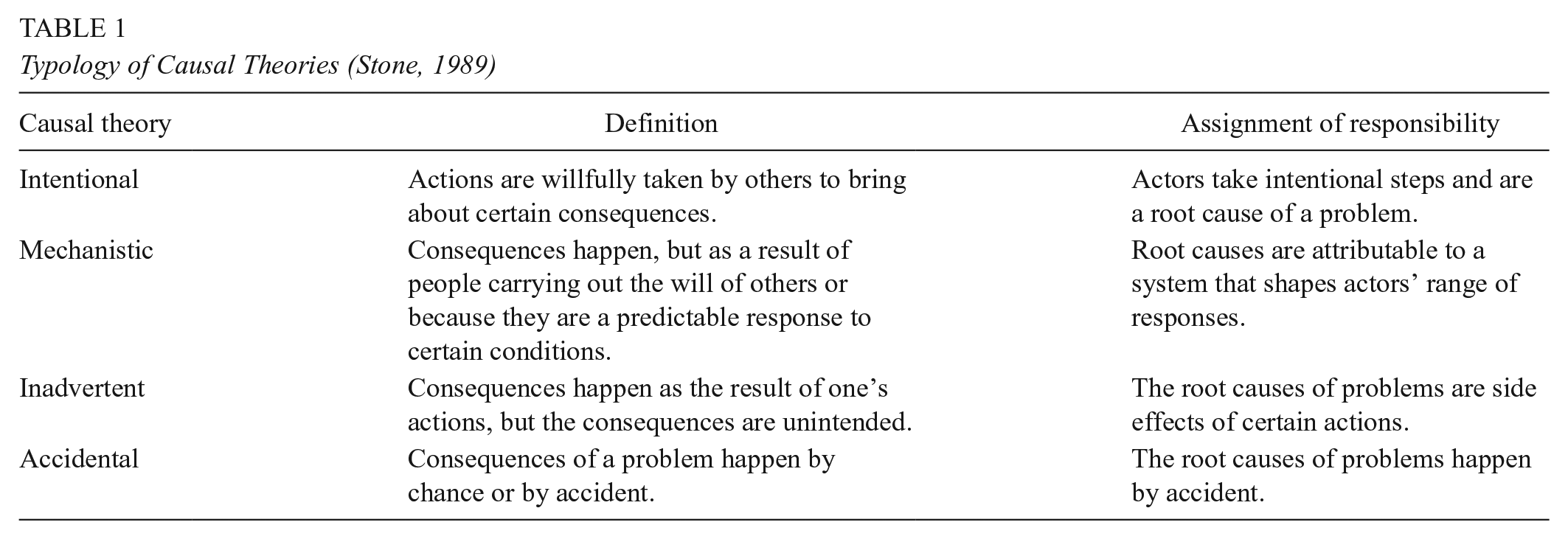
Closely related to the idea of diagnostic problem framing is the concept of causal stories, introduced by Stone (1989). Causal stories address the question of how problems shape policy agendas and “how difficult conditions become defined as problems in the first place” (Stone, 1989, p. 299). Despite knowing that problem frames strongly shape the success or failure of a policy (Coburn, 2006), we have little understanding of how key actors understand or manipulate images of conditions that define the problem of turnaround. According to Stone (1989), causal stories “purport to demonstrate the mechanism by which one set of people brings about harms to another set” (p. 283), and these stories are often contested and employed by political actors to shape policy agendas. This study compares frames and categorizes them into one of four theories or quadrants. This typology involves identifying action, purpose, and consequence in understanding policy problems (see Table 1 and Figure 1 for definitions and examples).
Typology of Causal Theories (Stone, 1989)

Causal theories and attribution of blame in school turnaround policy.1
According to Stone (1989), actors may attempt to stake out strong positions to attribute blame, and these positions are likely to be more successful in defining problems. There are two relatively strong, “pure” positions, accidental and intentional, and two mixed positions, mechanical and inadvertent. Stronger positions may assign blame more directly to people or policies (intentional) or causes outside human control (accidental), whereas the other positions are more subtle and indirect, making it potentially more difficult to understand and assign blame to people or policies. Figure 1 illustrates this typology and offers examples of how actors could frame the root causes of turnaround identification according to each category.
Policy problems are often contested, and turnaround policy is no different, as it assumes that schools and families have substantial control over problems that others believe are caused by historical inequities or inequitable government policy (e.g., Ladson-Billings, 2006). This study examines how turnaround might be understood and contested (or not) in ways that could affect educator buy-in and the nature/scope of the policies and practices that get enacted.
Background Literature
What Leaders Value: Critiques or Status Quo of Accountability Policy?
Much of the literature on turnaround policy implicitly or explicitly accepts its main assumptions—that technical and instructional solutions are the key to dramatically improving student outcomes in marginalized communities. Although leaders’ diagnostic and prognostic frames matter for policy implementation, less work is conducted on whether policy implementers agree with these assumptions and what they believe is necessary to improve. Leaders’ frames are informed by values and beliefs. A long-standing debate when it comes to understanding root causes of chronically low educational performance in impoverished neighborhoods serving historically marginalized communities of color is whether poverty or schools are most responsible (Mehta, 2015; Noguera, 2017; Turner, 2015). For instance, Mehta (2015) meticulously documented how accountability policy—in which the problems and solutions to educational failure were increasingly located in teaching and schools—became the status quo and dominant political paradigm for both political parties over time. On the other hand, scholars have long argued that government helped create such conditions as racial segregation and concentrated poverty, which significantly limit the power of schools to achieve the standards set by policymakers (Diem & Welton, 2021; Noguera, 2003; Rothstein, 2017).
What leaders believe and value within this debate matters. District leaders often focus solely on teaching and learning rather than on using the resources they do have to ameliorate the negative effects of poverty (Milner, 2015). Turner (2015) studied how district leaders responded to racial demographic change in their communities and found that “leaders’ meaning-making and policy responses obscured systematic inequalities in students’ lives, including those stemming from race, immigration, and poverty” (p. 4), causing them to elevate instructional and technical approaches to improvement over solutions that would aim to understand and address environmental factors shaping students’ experiences and lives. In their research, Diem and Welton (2021) found that “when states design policies that are intentionally race neutral, local policy actors are influenced by the messages coming from their policy environment and intrinsically follow suit with race neutral attitudes, structures, and practices” (p. 28). The current study extends this work by explicitly studying and comparing district leaders’ and turnaround policy designers’ beliefs about causes and solutions and whether they are critical of or uphold the status quo around accountability policy.
Framing, District Leadership, and Education Policy Implementation
It is important to understand how policy is framed and how leaders make sense of it because this information can shape how schools respond to a policy’s demands (Spillane, 2002; Woulfin et al., 2016). Coburn (2006) argued that “how a policy problem is framed is important because it assigns responsibility and creates rationales that authorize some policy solutions and not others” (p. 343). In a yearlong ethnography of one school’s response to the California Reading Initiative, Coburn (2006) used framing theory to understand how school staff responded to and implemented the policy. Findings illustrated how the framing process was contested, with leaders’ articulated problem frames motivating and being taken up by some, but not others, depending on their social networks, beliefs, and practices (Coburn, 2006). This study underscored the powerful role of leadership in problem framing and the importance of these frames resonating with a sufficient number of policy implementers. For example, when school leaders ignored parts of the policy (decoding and children not meeting standards), little focus or change occurred in these areas (Coburn, 2006, p. 366), suggesting a need to more deeply understand how leaders themselves frame problems during the policy implementation process because what they highlight or ignore will shape how educators engage at the school level.
Scholars consistently find that district leaders act as boundary spanners, mediating the relationship and implementation between state policy and school practice as they work to create coherence between the demands of external reforms and the internal goals and functions of the district (Honig, 2012; Marsh & Wohlstetter, 2013; Rorrer et al., 2008; Torres et al., 2023). Consistent with Coburn’s (2006) analysis, this mediating role includes district leaders’ interpretation of policy in ways that shape its enactment. For example, Woulfin and colleagues (2016) examined how 14 district leaders framed Connecticut’s new teacher evaluation policy and found that most highlighted the accountability aspect of the policy, while fewer framed the policy as one that emphasized the teacher development logic of the reform. In a different case study, researchers found that principals strategically framed data-driven decision-making to introduce and implement data-use policy, which helped mobilize educators around creating and meeting common goals (Park et al., 2013). Each study highlighted the importance of understanding how school and district leaders’ frames compared with reform or policy logics.
Finally, researchers often overlook how policymakers themselves frame policy—and how this might shape the policy-setting and implementation process. The extent to which goals align with policymakers’ frames matters because it can contribute to whether a policy has the political capital to persist over time (White, 2018). White (2018) surveyed state education policymakers about Michigan’s teacher evaluation and tenure policy to see whose voices they listened to and found that they were largely unresponsive to the general public’s and teachers’ voices—although nearly all (Democrats and Republicans alike) said that they valued the individual and organized voices of district leaders and principals—suggesting that these actors could “have a profound effect on teacher evaluation policy” (p. 17). Thus, investigating frame alignment between policy designers, such as legislators, and policy targets, such as superintendents (Honig, 2006), can provide insights into political possibilities, leader sensemaking, and implementation.
The Logics of Sanctions or Support in Turnaround Policy
Accountability policy, including school turnaround, has historically varied in terms of the relative emphasis on accountability and sanctions or support and resources to encourage low-performing schools to improve test scores. No Child Left Behind–era policies under Bush and Obama included school restructuring, takeover, reconstitution, and closure and were criticized for being too prescriptive and punitive (Schueler et al., 2022), although studies showed that strategic management (including strategic planning processes) helped account for cases when turnaround had positive effects (Redding & Nguyen, 2020; Strunk et al., 2016).
Michigan’s Partnership Model is consistent with some pre–No Child Left Behind accountability policies, such as Chicago’s School Probation Policy, which came after a wave of state and federal school improvement efforts that often punished the lowest performing schools for their performance outcomes (Finnigan & Stewart, 2009). The Probation Policy was remarkably similar to Partnership in that low-performing schools were identified for turnaround, provided with external supports, and made to work with “probation managers charged with monitoring the school planning process and improving the leadership of the school. Schools were also required to work with external partners who provided curricular and instructional assistance” (Finnigan & Stewart, 2009, p. 591). Findings from successful turnaround in this context highlighted the role of transformational leaders who were able to establish a shared vision and common goals and then align supports around these (Finnigan & Stewart, 2009). These responses were all closely linked to leaders’ interpretation of the Probation Policy (Finnigan & Stewart, 2009), highlighting (a) how accountability policies such as these can influence leaders and their responses in ways that lead to greater success and, by extension, (b) the need to understand how policy designers and implementers interpret and frame the demands of accountability policies.
Methods
Data Collection
For this study, I analyzed qualitative data consisting of interviews conducted in 2018–2019 with Partnership leaders who were closest to the design of the Partnership Agreement—either superintendents or charter school leaders—in 21 of 35 Partnership schools or districts and with 13 state employees and policymakers who had substantial knowledge of or involvement with the design of the policy (see Table 2). I aimed to interview as many Partnership leaders as possible and was able to interview the majority, with sufficient variation in their responses and contexts to achieve “saturation,” which occurs when you tend to hear similar responses as you continue collecting data across a variety of individuals and contexts (Merriam & Tisdell, 2015). The interviews with policymakers ranged from those who had power over the policy’s design (e.g., policymakers and state superintendents) and those charged with guiding policy implementation (e.g., MDE instructional support staff and leaders who worked in the Accountability Reform office, which provides technical support for implementation of the policy, including oversight of MDE liaisons who work directly with Partnership leaders).
Participants by Role, Level of Experience, and Organizational Type

Nine Partnership districts were charter schools, and the remainder were traditional public schools. Seven of these charter schools were managed by four different Charter/Educational Management Organizations that provide central office supports to a network of charter schools. In those cases, I analyzed interviews with leaders of these organizations who operated in a similar role as a superintendent and helped write Partnership Agreements. The other two cases were stand-alone charter leaders who took on operational responsibilities that superintendents/central offices would typically manage (Torres et al., 2019).
Data Analysis
Interviews were semi-structured, lasted between 45 and 60 minutes, and were transcribed. Questions focused on various aspects of policy implementation and decision-making, such as how they perceived the policy and crafted their Partnership Agreement. A subset of questions that I analyzed for this study focused on having each participant define the biggest problems their organization was facing that led to Partnership identification, what the causes of those problems were, and, considering that framing, what they believed were the best solutions for addressing those problems. To preserve anonymity, all schools/districts were assigned hockey team pseudonyms, and specific professional titles were generalized. The first round of coding focused on data reduction and was primarily deductive, attempting to capture patterns in how participants viewed the problems their district faced and how they viewed and enacted the Partnership Agreement. For example, codes included challenges and benefits of the reform and the conditions that affected coherence of the reform (including available resources, district politics, and leadership). The second round of coding analyzed a subset of these initial codes that were aligned to the theoretical framework and captured diagnostic and prognostic frames. A third round of coding categorized diagnostic frames according to the four causal story categories (see theoretical framework). Finally, within and cross-case comparisons were made by using an Excel matrix that had superintendent and policymaker interview excerpts, allowing me to view variations and similar patterns and to identify trends and themes (Miles & Huberman, 1994).
Limitations
A key limitation of this study is that data were collected in relatively brief (45–60 minutes) semi-structured interviews that were part of a larger study on Partnership turnaround. Therefore, I was unable to gather a richer understanding of context and process across cases to help better answer why these leaders articulate particular frames, how their experiences inform their frames, and how their beliefs shape their actions. Nonetheless, studying what leaders’ beliefs are and how they compare across a variety of contexts and roles is still important because these leaders are responsible for implementation and design of policy. Future studies should more deeply explore the processes and contextual elements that inform leaders’ frames.
Findings
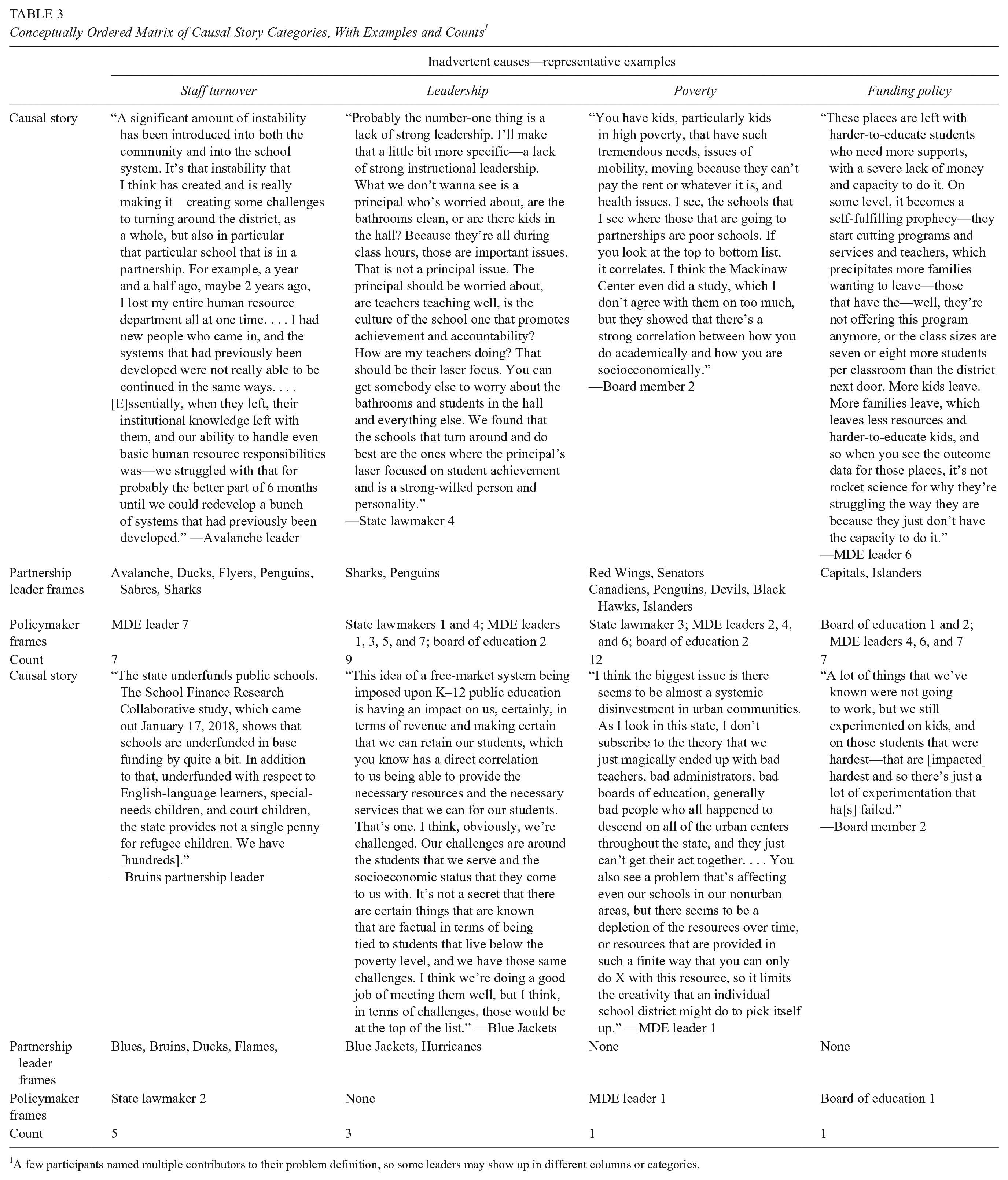
Problem frames reflect important underlying values and beliefs that shape what gets taken up in policy implementation (Coburn, 2006), and causal stories can profoundly affect policy problem definitions and (therefore) policy agendas (Stone, 1989). Most participants told inadvertent causal stories (n = 35), followed by intentional (n = 10) and mechanistic (n = 1). Inadvertent causes happen “when people do not understand the harmful consequences of their willful actions. . . . [C]onsequences [may be] predictable by experts but unappreciated by those taking the actions [and can include carelessness or recklessness]” (Stone, 1989, p. 286). They are distinguished from mechanistic causes in terms of perceived intention. Mechanistic causes are “designed by humans to produce certain consequences. . . . [T]he effects of the actions are intended but the actions are guided only indirectly; someone’s will is carried out through other people” (p. 286). According to Stone, when it comes to pushing responsibility for a problem to particular actors, “mechanical causation is a somewhat stronger claim, because it implies intended consequences” (p. 289). The vast majority of participants conveyed “weaker” diagnostic frames (categorized as inadvertent). Such problems were portrayed as unintended consequences of policies or people (see Table 3 for examples). This suggests that causes are unintended side effects of individual actions or policies, with some exceptions.
Conceptually Ordered Matrix of Causal Story Categories, With Examples and Counts 1
A few participants named multiple contributors to their problem definition, so some leaders may show up in different columns or categories.
As seen in the second section of Table 3, a subset did convey intention, saying such things as “the state underfunds public schools,” noting the “systemic disinvestment in urban communities,” or attributing cause because of a free-market system “imposed” on public education, or “experimenting” despite knowing that those experiments would not work. Below, I present some of the different categories of intentional and inadvertent diagnostic frames.
Diagnostic Problem Frames: Leadership as Inadvertent Cause
Participants often diagnosed the causes of the problems facing Partnership schools and districts as a leadership problem. However, which leaders (e.g., legislators, governors, boards, district leaders) were to blame as well as how responsible they were perceived to be and why varied. One critical finding in answering research question #2 related to how policymakers’ frames on leadership were much more prevalent compared to those of Partnership leaders (see Table 3). Although policymakers had a stronger tendency to name leadership as an inadvertent cause of the problems facing districts, Partnership leaders focused much more on contextual factors that limited their capacity to address these issues—particularly poverty, systemic injustice, and such policy issues as teacher and funding inequalities—which were all connected and framed as root causes. Looking across cases, leadership was categorized as an inadvertent cause because participants did not view leaders’ actions as intentionally causing harm (e.g., a leader or school board member embezzling funds). Instead, their actions (e.g., carelessness, lack of ability, rapid leadership turnover) created unintentional harm.
A lack of strong educational leadership was a big part of the problem of chronic academic underperformance for more than half the policymakers in the sample. When asked about the main causes of the problems facing Partnership schools and districts, a former governor’s representative who spent time visiting some turnaround schools and districts answered:
Probably the number-one thing is a lack of strong leadership. I’ll make that a little bit more specific. A lack of strong instructional leadership. . . . The principal should be worried about, are teachers teaching well, is the culture of the school one that promotes achievement and accountability? How are my teachers doing? That should be their laser focus. . . . We found that the schools that turn around and do best are the ones where the principal’s laser focused on student achievement and is a strong-willed person and personality. . . . I think the other really, really important piece of this—and this is on the benefit to the Partnership Model—is district buy-in and district leadership. We found that in a lot of cases, the district support just wasn’t there. Whether that was professional development that wasn’t aligned to the needs of the school, or if it was weak leadership at the district level. School boards were a huge, huge problem and actually remain a huge problem for some of these schools.
Two different state lawmakers echoed this idea. For example, one explained:
I think school success is primarily based on leadership, local leadership. If you’ve got local leaders, and from the principal or from the superintendent down to the janitor, they’re all onboard with student success, good things happen. You don’t need laws or you don’t need agreements to do that. You just need leadership. Trying to instill leadership in school districts that simply don’t have it isn’t gonna change anything without changing the principal players. That, again, comes back to why constitution and closure were in the original law. Some things you can’t fix without breaking.
Acknowledging that poverty and teacher shortages were the most important contributors, the superintendent of Penguins made a similar point about leadership, noting that they needed to rehire staff and leadership to change “the toxicity in the actual [Partnership] school . . . [because it] wasn’t going to change. . . . [W]e just started all over again, and you set the expectations you want.” Although these participants cited school and district leadership, others placed greater responsibility on inconsistencies and lack of coherence due to constantly changing state leadership, goals, and policies. In this sense, inconsistent leadership at the state and policy levels was named as an important contributor to the problems facing Partnership districts, as a third lawmaker explained:
I think probably what we need generally is sustained leadership. We need a department and a governor who are pulling in the same direction and setting up the same endpoint, goals, target of where we’re all trying to get to, and that they can see it through over time. Part of that requires rallying different forces around those goals, and part of it is having some perspective or some ability for local communities to participate with schools, to participate in a way that recognizes their situation and gives them an ability to get to where we all wanna get to. That’s what I would wanna see. I think that we probably haven’t had that kind of coherent leadership and that’s a challenge because people—they just change.
Although acknowledging that adequate funding was an issue for schools and districts identified for turnaround, a senior state official
2
repeated this refrain—constant changes in leadership made it difficult to maintain coherence:
I think it’s the board and superintendent and constant change in leadership. One of the things we know that—if you’re changing leadership every 1, 2, 3 years, you’re making teachers and staff go like this. You’re never gonna get reforms in place. Because everyone comes in and brings their own reforms. Then staff says, well, we don’t like this one. We know the superintendent’s gonna be gone in 2 years. So we’ll just wait it out. . . . And, candidly, a lot of times we find in some—not in a lot of cases, but a small number of cases—the board is all about getting family and friends hired and not about performance. So I think school boards are a problem in some of these areas. Relationship between school board and superintendent is a problem. I’ll put that on both, not one or the other.
These perceptions about turnover in leadership as an inadvertent cause extended to the school level in one case. The leader of Sharks explained that “teachers were very unhappy” as three different leaders were hired in the first 3 years of the school, teachers were introduced to new initiatives, and then these leaders abruptly left. Although these narratives focused mainly on leadership, discourse around structural inequalities was not as prevalent in the diagnostic frames of those responsible for policy design, although not from those of district leaders, an issue I take up in the next section.
Diagnostic Problem Frames: Poverty and Funding as Systemic Causes
The most common way that participants framed problems had to do with poverty (n = 13). These views were categorized as inadvertent, namely because no one identified policy or specific people as a contributor to poverty (intentional) or as the result of a system designed to reproduce these results (mechanistic).
Two senior state officials pointed to funding cuts and the need to spend more in turnaround districts because the needs and challenges of concentrated poverty in these communities were greater. For example, one said, “Funding certainly could have been a part of this. As [a former] superintendent of a local district, I did nothing but cut for 7 straight years. We still improved test scores, but it does have impact. So, school finance [is] an issue.”
Many leaders stated that it was simply harder to educate students in Partnership schools because of poverty and many of the issues related to it. As the leader of Canadiens put it: “A lot of the partnership schools specifically are in neighborhoods with a high degree of uncertainty, crime, deeper concentrations of poverty. All those issues affect the day-to-day experience of students instructionally.” Others coupled the issues of poverty and funding and said they were the responsibility of the state to address. One lawmaker said:
We have communities with more resources within the community, and we have communities with less resources within the community. We also have differential levels of public and state support, and oftentimes, those track along the same dimensions, the committees that have the most resources within the community and not just wealth, right? Just socioeconomics and things like that will oftentimes receive more money from local and state taxes than school districts with more poverty. . . . The state system is not bridging that, it’s not bringing it closer. I think that that’s the main challenge.
Here, the lawmaker explicitly located responsibility for the problem by saying that “the state system is not bridging that.” Others, like the leader of Bruins, were straightforward in saying “the state underfunds public schools.” In these ways, a subset of Partnership and policy leaders located responsibility more in the intentional quadrant when it came to school funding policy.
Diagnostic Problem Frames: Inability to Recruit and Retain Teachers and Leaders
Intimately connected to the issue of funding and social injustice, another theme repeated mainly by Partnership leaders was that problems with teacher retention and recruitment were at the core of the problem with building and sustaining turnaround efforts. A representative quote from the superintendent of Ducks summarized these views:
Number one is teacher retention and recruitment because it is a complex, complicated issue in that it’s tightly aligned to funding. When you’re a declining enrollment district, which many of the Partnership districts are, that means you’re also losing funding and you have to cut teachers, which also means that you’re not always able to compete or provide a competitive compensation package. How do we recruit and retain teachers in districts that are educating concentrated groups of vulnerable students for lesser pay?
This quote underscored a core issue that many others repeated: It was extremely difficult to attract and keep high-quality teachers when surrounding districts could offer easier working conditions and higher pay. These leaders pointed out that issues of funding could hamper teacher recruitment and retention efforts. Charter leaders echoed these concerns, with the leader of Flyers further adding that issues with turnover and an inability to stabilize the teaching staff made it difficult to implement anything:
We’ve been unable to have one program model implemented more than 1 year due to a turnover in either leadership and/or teachers. High-quality, certified teachers is a very large obstacle that we continue to face. In a building with 19 total teachers, four of them are certified teachers, so we have a serious shortage in the availability of certified teachers. . . . About two-thirds of them are on provisional certifications, and a third of them are long-term substitutes. . . . Historically, this school has turned over at least 50% of its teaching staff. . . . [So] there’s the consistency issue, which prevents the model from being able to really take hold, and then there’s the lack of talent.
It should be noted here that the leader of Flyers pointed out an annual 50% turnover rate and a third of teaching staff being long-term substitutes, which made it difficult to implement complex school improvement efforts that required significant expertise.
Prognostic Frames: Funding and Meeting the Needs of the Whole Child
Given how they were framing the root causes, one obvious solution or prognostic frame that Partnership leaders and some policymakers articulated involved more funding. As the Ducks superintendent said, “The solution is to really redefine the way in which we fund schools.” One state board of education member said that increased funding could go toward stabilizing the quality of teachers and leaders in these schools, but noted the political difficulty of doing so:
I think money should go [toward] hiring more teachers and [reducing] class sizes. That’s because it’s a proven, well-researched intervention that has been shown to really make a difference. I think given the limitations of it, providing support and counseling on best practices, on getting really good curriculum in the schools, I think is good, would be probably the best you could do with [funding where it is]. . . . Having people to go in and then train others, the only problem is that with [teacher turnover], if you do all this training and you don’t have a stable workforce [and] the principals are coming and going. . . . Certainly all of the education groups are saying that’s what’s needed. . . . I think the governor is committed to that, to adding more funding.
An MDE employee charged with financial oversight added insight into this issue:
One of the struggles of MDE is they didn’t really receive a lot of funding to do this work. . . . I think that’s gonna be a challenge for schools, is that they have all these potential new standards they have to meet and no way to really get there financially. [These districts have] really high [turnover], and they can’t get enough teachers. They have a ton of subs. When your teaching staff is a third of it has been outsourced to subs, it’s a struggle to have any sort of real result.
Both participants noted that funding was one key strategy to address a core problem: supply and turnover of educators in Partnership schools. Reflecting the lived experience of the Flyers leader in the prior section, this MDE employee noted that it would be hard to get any positive results when such a large portion of teaching staff was “outsourced to subs.” Despite these realities, a Republican legislator’s preferred fix was to point the finger in the other direction and address problems with “governance, accountability, and the Department of Education itself.”
By contrast, educators dealing with the problems directly aimed to address the influence of external forces (e.g., poverty) in addition to organizational problems. The leader of Blues, in describing historical funding inequities, said, “There’s a lot of social injustice that’s happened in [this district] for decades. This isn’t a new problem that happened. . . . We’re trying to have some wins for the kids and some wins in the community. It’s more than just a school and teaching kids to read. Right?” The idea that these schools/districts needed to first meet various nonacademic needs in these communities—akin to the idea of Maslow’s hierarchy of needs—came up frequently in Partnership leaders’ prognostic frames. Roughly half of Partnership leaders described attempts to address challenges through “whole-child” goals and strategies that would simultaneously help them meet the achievement goals demanded by the policy.
For instance, the superintendent of Penguins understood that dealing with poverty meant that noninstructional solutions were critical.
This idea that schools had to meet students’ basic needs first to be able to focus on achievement was a common one. The leader of Canadiens added:
The other focus area outside of human capital has been wraparound services, so how to provide more support for behavior, discipline, medical, dental, and mental health from an overarching point of view to fill gaps in that we know that students who face poverty, those obstacles get in the way of just focusing on teaching and learning every day.
Finally, the leader of Black Hawks also took a comprehensive approach to training staff to address some of the more fundamental needs of students:
We made the decision this school year to have 100% of our staff, from our lunch ladies to our janitors to our teachers, our principals, everybody trained in ACEs, Adverse Childhood Experiences, to start the conversation about how childhood traumas impact students’ day-to-day interactions.
In sum, and in contrast with the popular image of school turnaround as a technical/instructional approach to rapidly improving instruction and student achievement, most of the solutions that Partnership leaders and policymakers pointed to first addressed more fundamental problems, such as funding, governance, or the basic needs of students. Many pointed out that solutions, therefore, would be more costly compared to those for locales that did not face problems as severe as theirs.
Discussion and Implications
This study focused on the “causal stories” policymakers and Partnership leaders told about turnaround identification and how they framed problems and solutions. Across cases, policymakers and district leaders assigned most responsibility to poor leadership, poverty, and chronic educator turnover as primary causes of problems leading to turnaround identification. These causal stories were most often framed as side effects of policy or practice rather than as intentional actions. However, a notable subset assigned blame more directly to intentional policy action (or inaction) that would help districts counteract the effects of concentrated poverty, such as weighted funding. In terms of solutions, most leaders believed that improved funding was necessary to strengthen and stabilize the workforce and meet the nonacademic needs of children—for instance, addressing the deleterious effects of poverty through such things as wraparound services.
Another theme was to blame the actions of leaders for inadvertently causing or exacerbating the problems facing Partnership schools/districts. However, which leaders (e.g., legislators, governors, boards, district leaders) were to blame varied. For instance, although some policymakers directly blamed weak district or board leadership for being historically ineffective, others emphasized that chronic turnover of leadership at all levels (political, state, and district) made it difficult to achieve the coherence necessary to make lasting changes. Perhaps unsurprisingly, when it came to leadership, legislative policymakers tended to blame district leaders, while district leaders assigned responsibility to policy and policymakers (see Table 3).
I found that although a subset expressed intention (n = 10), the majority diagnosed the problem as inadvertent causes (n = 35). Stone (1989) suggested that mechanistic and inadvertent causes were potentially weaker in terms of assigning blame and advocating for one’s position and implied less resistance or pushback against the policy. This suggestion was reflected in Partnership leaders’ generally positive feelings about the policy and the supports it offered (Burns et al., 2023) and implied the possibility of less resistance to and greater longevity for the reform compared to policies that might be more contentious (for example, school closure). Still, the actual supports the policy offered (e.g., modest 21H grant funding, the call for community Partnerships unfunded by the state, MDE liaisons) were not generally aligned with participants’ diagnostic and prognostic frames. In other words, participants noted fundamental issues with funding, turnover, and poverty, but the reform itself (with its focus on instructional improvement) did not provide sufficient support to tackle these structural problems. The majority of diagnostic frames suggested that more comprehensive supports, such as weighted funding (to stabilize the educator workforce) and separate funding for wraparound services, were warranted, not just the technical and instructional supports offered by the reform. More state support is consistent with scholarship on meeting the needs of impoverished minoritized students and is a necessary but insufficient step toward racial equity (Milner et al, 2015; Noguera, 2003), although even with increased funding, districts’ “color-evasive” policies and practices have the potential to reproduce racial inequality without addressing cultural bias, deficit thinking, and prejudice (Diem & Welton, 2021; Turner, 2015).
Compared to Partnership leaders, the Partnership Model and some policymakers tended to take a narrower and more technical view of educational problems than did those on the “front lines.” Overall, Partnership leaders took a more holistic view that did not ignore structural inequality and believed that these inequalities limited the effectiveness of technical solutions. This result points to a divide between policy and practice in which those approving or crafting policies could better integrate the voices and realities of those charged with implementation. Evidence suggests some readiness for this to happen. White (2018) found that policymakers were most open to listening to educational leaders in the policy process. She noted (p. 16): School leaders “tend to think of the entire [education governance] system as a hierarchical-linear system, meaning that they feel they cannot influence parts of the system much ‘higher’ or ‘lower’ than their level” (Jean-Marie, Normore, & Brooks, 2009, p. 17). Further, a recent survey conducted by the Education Week Research Center (2017) found that 65 percent of school and district leaders have avoided political activities out of concern that they might create problems with their jobs.
Educational leaders’ advocacy may be particularly important and well received, especially considering that Partnership leaders’ views were aligned with those of some policymakers.
Finally, these leaders’ diagnostic frames stood in contrast with the idea of school turnaround as a technical/instructional approach to rapidly improving instruction and student achievement, as evidenced by turnaround policies historically emphasizing sanctions and replacement of schools and educators (Schueler et al., 2022). Most of the solutions that Partnership leaders and policymakers pointed to first addressed more fundamental problems, such as meeting the basic physiological and psychological needs of students. Given that these schools and districts served the most vulnerable populations and therefore had to meet a much greater range of needs, it is no surprise that funding was diagnosed as a major barrier to being able to meet goals centered on improving teaching and learning. Coburn’s (2006) work showed that leaders emphasize different aspects of a policy and ignore others, which has significant implications for policy implementation. Given Partnership leaders’ relative autonomy to craft their Partnership Agreement, many diagnosed the core issues at a more basic level than the instructional core: They focused on stabilizing the teaching force and meeting basic needs first, even though the policy emphasized improving teaching and learning. This study is limited to discussing beliefs about causes and solutions, but future studies should test how these beliefs affect implementation and advocacy on behalf of their districts and communities.
Footnotes
Acknowledgements
I am grateful to the many people who gave their time in support of this work, including research participants, and those who provided technical and research support, such as Sandy Waldron, Jason Burns, and Rebecca Jacobsen. I would also like to thank Dr. Josh Cowen and Dr. Katharine Strunk for their support on this larger research project. Finally, thank you to research partners at MDE, such as Dr. William Pearson, Dr. Gloria Chapman, and many staff at Michigan State University’s Education Policy Innovation Collaborative, for their assistance.
Declaration of Conflicting Interests
The author(s) declared no potential conflicts of interest with respect to the research, authorship, and/or publication of this article.
Funding
The author(s) disclosed receipt of the following financial support for the research, authorship, and/or publication of this article: I would like to thank the Michigan Department of Education (Grant Number 180000000795) for funding the research reported in this study. Results, information, and opinions represent the analysis, information, and opinions of the author(s) and are not endorsed by or reflect the views or positions of grantors, MDE, or any employee thereof. All errors are my own.
