




Abstract
Prior research suggests that more effective teachers may also be better mentors for preservice student teachers, but the specific measures of cooperating teacher effectiveness considered in the prior quantitative literature (value added and performance evaluations) are infrequently observable to individuals responsible for student teaching placements. In this paper, we consider a more easily observed proxy for mentor effectiveness: National Board (NB) Certification. We find that NB teachers are considerably more likely to host student teachers, and student teachers supervised by NB teachers are slightly more likely to be hired within three years, all else equal, but we find no consistent significant relationship between cooperating teacher NB Certification and the later attrition or value added of the teachers they supervised.
Keywords
Introduction
Teachers certified by the National Board (henceforth, NB teachers) have long been touted as a resource for school improvement, including through the mentorship of new and prospective teachers (Darling-Hammond, 2010; Farrell, 2005). There are good theoretical and empirical arguments to think there may be benefits associated with having National Board–certified teachers (henceforth referred to as NBCTs) serve as cooperating teachers for student teachers (henceforth referred to as “teacher candidates”) completing required preserve student teaching. The National Board for Professional Teaching Standards (NBPTS) argues that the National Board Certification process emphasizes teacher commitment to student learning, community, subject matter expertise, and continual self-improvement. Matching teacher candidates with NBCTs introduces the opportunity for candidates to integrate some of these characteristics in their own teaching practice.
The number of teachers certified by NBPTS has grown by roughly 100,000 over the last two decades. 1 The 120,000 NB teachers in 2020–21 (NBPTS, 2022) represent about 5% of the public school teacher workforce nationwide. States and districts sometimes note the perceived benefits of NBCTs; for example, the Kentucky Department of Education notes that “teachers who successfully meet National Board Certification requirements strengthen the teaching profession by mentoring new teachers, serving as role models and master teachers for teacher candidates, and assisting other teachers who seek National Board Certification” (Waddle, 2023). But despite few documented policies incentivizing or prioritizing student teaching placements with NB teachers, likely due to the informal nature of student teaching placements in most settings (e.g., St. John et al., 2021), it is clearly a policy that could be implemented if these placements are viewed as beneficial. Specifically, NB Certification is easily observable to the individuals responsible for student teaching placements for teacher education programs and districts alike, and therefore, it could be used as a factor in placement decisions.
This issue is important because, empirically, a growing body of quantitative evidence shows that candidates who enter public schools tend to be more effective (based on district evaluations or value added measures) when a more effective cooperating teacher oversaw their student teaching (Bastian et al., 2020; Goldhaber et al., 2020; Goldhaber, Ronfeldt, et al., 2022; Ronfeldt et al., 2020). There is also some evidence that having an NBCT predicts better preservice practices of candidates (Bastian et al., 2022). The few studies that examine whether having an NBCT predicts the in-service effectiveness of candidates (e.g., Ronfeldt et al., 2021) are, however, based on relatively small samples.
Qualitative evidence documents how teacher candidate learning operates through the observation of their cooperating teacher and through direct coaching or mentoring (Grossman et al., 2012). The structure of the National Board Certification suggests that NB teachers may offer an easily identifiable way to tap into both mechanisms, as NB teachers are typically more effective on average than their peers (Cowan & Goldhaber, 2016; Goldhaber & Anthony, 2007; Harris & Sass, 2009). Additionally, the self-reflective components of the National Board Certification process, which involve analyzing personal teaching practices, may improve teachers’ abilities to provide constructive, specific feedback to candidates.
In this paper, we add to the literature on the relationship between cooperating teacher characteristics and the outcomes of teacher candidates who become public school teachers. We use data from Washington state to characterize the likelihood that NB teachers serve as cooperating teachers and link NBCTs to future employment (public school entry and retention as teachers) and value-added effectiveness of the candidates they mentor. To our knowledge, there is no existing large-scale evidence on these relationships. Specifically, we use information about candidates linked to cooperating teachers from a sample of teacher education programs (TEPs) to investigate five research questions:
To what extent are NB teachers more likely to serve as cooperating teachers than their peers?
What factors predict whether candidates complete student teaching with an NBCT?
To what extent are candidates supervised by NBCTs more or less likely to enter the public school teacher workforce than those not supervised by NBCTs?
To what extent are candidates supervised by NBCTs more likely to stay in the public school teacher workforce?
To what extent are candidates supervised by NBCTs more effective teachers?
We find that NB teachers are more likely to host a candidate than their peers, all else being equal. Candidates with science, technology, or math (STEM) endorsements and with higher basic-skills licensure test scores are more likely to complete their student teaching with an NBCT, while candidates with a special education endorsement are less likely, all else equal.
Relative to peers whose cooperating teachers were not NB teachers, candidates supervised by NBCTs are significantly more likely (by about 2 percentage points) to be hired within three years of student teaching. We observe little differential in teacher attrition based on supervision by an NBCT, and consistent with prior research (Bastian et al., 2020; Ronfeldt et al., 2021), we find little evidence of a positive relationship between cooperating teacher NB status and future candidate effectiveness.
One of the challenges in interpreting these results is that TEPs and school districts place students differently. As noted in St. John et al. (2021), Washington student teacher placements have high-level similarities across TEPs. There are incentives for TEPs and districts to create high-quality and high-impact placements, but implementation varies across placing authorities. This unobserved variation can lead to concerns about nonrandom selection of student teachers to CTs. One method of controlling for this is to include TEP-level fixed effects so our results compare student teachers with others in their program. However, it is important to note that while our findings account for a robust set of controls, they should be considered “descriptive” as we are unable to demonstrate a causal relationship with our data definitively .
Background: The Importance of Student Teaching and NBCTs
A growing body of quantitative research investigates the aspects of teacher preparation that influence employment outcomes and teacher performance. Much of this recent research has focused on candidates’ student teaching experiences. Student teaching often provides candidates with their first teaching experiences before entering the workforce and is widely recognized as the most important component of an effective teacher preparation program (National Research Council, 2010). Although early quantitative research on student teaching focused primarily on the school and district in which student teaching occurs (Boyd et al., 2009; Goldhaber et al., 2017; Ronfeldt, 2012, 2015), there is an increasing focus on the cooperating teachers who supervise candidates’ student teaching assignments.
The few studies that connect cooperating teachers to the employment outcomes of the candidates they mentor find little evidence that the characteristics of cooperating teachers predict the likelihood of candidates' workforce entry or early-career attrition (Goldhaber, Krieg, Theobald, & Goggins, 2022a). There is an emerging research base, however, showing that early-career teachers tend to perform better (i.e., have higher value added) if they worked with higher-performing cooperating teachers during their student teaching. For instance, among candidates who enter the public teaching workforce in Washington state, a one SD increase in cooperating teacher value added is associated with 18% of an SD higher early-career value added in math and 11% of an SD higher value added in ELA (Goldhaber et al., 2020). 2 Similar research from Tennessee finds a slightly more modest relationship: a one SD increase in cooperating teacher value added is associated with a 6% SD increase in early-career value added and also finds significant associations between the observational performance ratings of cooperating teachers and the early-career observational ratings of candidates who eventually become teachers (Ronfeldt et al., 2018). 3
Across alternative measures of cooperating teacher competencies and qualifications, the associations with candidates’ early-career performance are less consistent. Cooperating teachers’ years of experience have been found to significantly predict candidates’ early-career value added in North Carolina (Bastian et al., 2020) but not in other settings (e.g., Goldhaber et al., 2020; Ronfeldt et al., 2021). Higher cooperating teacher scores on licensure exams, prior-year leadership ratings, and prior-year ratings on facilitating learning also have no significant association with candidates’ early-career value added (Bastian et al., 2020).
Recent experimental evidence has offered some potential mechanisms for these relationships, suggesting that effective cooperating teachers improve candidates’ feelings of preparedness (Ronfeldt et al., 2020) and their instructional skills (Goldhaber, Krieg, Theobald, & Liddle, 2022b). However, it remains unclear how TEPs responsible for placing candidates into student teaching assignments can directly leverage these results. Perhaps most problematically, the cooperating teacher characteristics that predict better future outcomes for candidates (e.g., evaluation ratings or value-added estimates) are not generally observable or accessible to TEPs. This motivates the focus of the current study on NBCTs, which is more easily observable to training programs and districts responsible for placements.
A few studies on cooperating teachers have included information on their NB teacher status, and the findings are mixed across outcomes. In one study, working with an NBCT is associated with higher value added for candidates in the top GPA quartile by 12% of an SD and 11% of an SD lower value added for candidates in the bottom GPA quartile (Bastian et al., 2020). Across all GPA quartiles, Bastian et al. (2020) find no significant relationship with early-career observation scores. A more recent study using a smaller sample in the same state found that NBCTs are associated with 7% of an SD higher candidate performance on the edTPA, a preservice, portfolio-based teaching assessment (Bastian et al., 2022). Prior work in Chicago found that NBCTs have small negative effects on candidates’ self-perceived preparedness, cooperating teacher-perceived preparedness, and first-year observation ratings (Ronfeldt et al., 2021). Research in San Francisco found positive but insignificant and imprecise associations between having an NBCT and classroom observation scores (Zhu et al., 2019).
This paper largely follows the methodology of these prior studies (Bastian et al., 2020, 2022; Ronfeldt et al., 2021) but with considerably larger sample sizes. For instance, Bastian et al. (2022) and Ronfeldt et al. (2021) observed approximately 530 and 280 NBCTs, respectively. Even Bastian et al. (2020), which observes the largest sample of NBCTs, cannot rule out effects smaller than 6.3% of an SD for value added and 4.5% of an SD for observational scores. Our subsample of over 2,700 candidates assigned to over 1,800 NBCTs translates to at least double the precision seen in existing evidence and more easily “rule out” important relationships between student teaching with an NBCT and later effectiveness. Moreover, with nearly statewide data on student teaching placements discussed later, we are also able to investigate the likelihood that NBCTs are observed hosting a student teacher relative to other teachers in the state, which is a novel contribution to the existing literature on this topic.
Data and Setting
Washington state is an excellent setting for studying the role of NBCTs. Washington has relatively large incentives for teachers to achieve National Board Certification and has, in recent years, been one of the states with the most new NB teachers in the country (NBPTS, 2013, 2014, 2015, 2016, 2018a, 2018b). We combine data from three different sources to paint a comprehensive picture of the relationship between NBCTs and future candidate outcomes: (a) data on over 20,000 teacher candidates and their student teaching placements provided by 15 in-state TEPs; (b) longitudinal data on all teachers and students in Washington public schools provided by the Washington State Office of the Superintendent of Public Instruction (OSPI); and (c) comprehensive data on all NB teachers in the state since 1999, provided by NBPTS. We discuss each of these data sources in the subsections that follow and conclude this section by providing some summary statistics for our sample.
Teacher Candidate Data
The foundation of our analytic data set is information on candidates and their cooperating teachers provided by 15 TEPs in Washington. We observe student teaching assignments for 20,478 candidates and 13,414 unique cooperating teachers (1,819 of which are NB teachers) from these 15 programs between the 2001–02 and 2018–19 school years. Our variable of interest for this study, whether each candidate has an NBCT, is the time-varying indicator for the cooperating teacher holding an active certification. An important feature of the data environment is that Washington state requires cooperating teachers to have a minimum of three years of teaching experience. While generally followed, our data suggests that a small number of candidates (2.32%) in Washington train with cooperating teachers who have less than three years of experience.
The 15 TEPs participating in this study do differ from other TEPs in the state along several dimensions: the average participating institution is larger, has higher average SAT scores, and enrolls more students of color than the average nonparticipating institution (Goldhaber et al., 2021). Another important feature of the candidate data available for this study is that it is dominated by TEPs located west of the Cascade Mountains, a geological barrier in Washington. These TEPs prepare over 90% of all new teachers west of the Cascades who graduated from in-state TEPs, but only about 60% in the eastern half of the state (Krieg et al., 2020). Because there are considerable economic and demographic differences between the west and east sides of the state, we caution against generalizing our findings. That said, we view this as a greater limitation in our investigation of RQ1 (predicting which teachers host a student teacher) than for our other research questions. Specifically, while in RQ1 we must assume that every teacher not observed as hosting a student teacher in this sample did not host a student teacher at all, thus introducing errors for teachers disproportionately east of the Cascades who host a student teacher from a TEP not participating in this study, the other research questions are specific to the candidates in this study and thus not subject to the same source of error. We, therefore, report primary results for RQ1 estimated just for districts west of the Cascades, but to ensure that sample sizes are as large as possible, we estimate models for the other research questions using placements for all districts in the state.
OSPI Data
We connect the candidate data described previously to longitudinal data on students and teachers provided by Washington state’s OSPI. These data include student-level demographics and math and reading test scores for grades 3–8. From 2006–07 through 2008–09, we link students in grades 3–5 to their classroom teacher by their proctor on the state exam. 4 From 2009–10 through the most recent year of available data, 2018–19, the state’s CEDARS data system links students to their classroom teachers through unique course identifiers. 5 Our value-added measures and corresponding models are thus constrained to math and reading teachers in these grades and years.
For cooperating teachers and candidates hired into a Washington public school, OSPI data include information on teacher background, credentials, and individual characteristics for the entire study period. We observe individual years of teaching experience; highest academic degree earned; areas of teaching endorsement, performance on endorsement assessments and number of attempts; performance on and number of attempts taking the Washington Educator Skills Test - Basic (WEST-B) for math, reading, and writing; and individual demographics.
In some of the analyses in the following sections, we use additional information about the schools in which student teaching takes place, as well as the schools that candidates are hired into. Specifically, we compute the percentage of a school’s students who are underrepresented minorities (URMs), code the location of schools (relative to the Cascades as well as area urbanicity), and calculate the number of classified as well as certificated staff per 100 students. 6 In addition, we make use of two school-level measures that have been shown to be connected with candidates’ student-teaching placement and hiring: (1) the number of certified teacher job openings in the year after student teaching (Krieg et al., 2020) and (2) the stay ratio, which measures the percentage of teachers who remain in the school over a five-year period (Goldhaber et al., 2017).
NBPTS Data
The final data source comes from NBPTS, which provided data on all 11,603 NB teachers in Washington since 1999. Figure 1 shows the number of NB teachers in the state, the total number of K–12 public school teachers in the state, and the share of teachers who are NB teachers over time. As the figure shows, the number and share of NB teachers increased rapidly over two decades from less than 1% through 2004 to over 9% in every year since 2012. This increase has important implications for our analysis, which we discuss in the next section.

National Board teachers as a share of all teachers in Washington over time.
Teacher records from NBPTS contain the date of a teacher’s first application for National Board Certification, the date originally certified, the date of certificate expiration, and details of the certificate type and applicant name. For teachers who have renewed their certificate, the expiration date reflects that extended period of validity. We can link 92% of individuals in the NBPTS data to the OSPI administrative data on teacher characteristics (described above) by fuzzy matching on teacher name and school, followed by teacher name and district, and lastly by teacher name. 7 We transform these data into a time-varying indicator for holding an active National Board Certificate for all teachers in all years, where the indicator spans the calendar year when certification is first awarded through the calendar year when the certification expires or the end of the panel. Thus, the variable of interest in this paper, whether a candidate works with an NBCT, is a time-varying indicator for whether a candidate’s cooperating teacher has an active certificate in the year of student teaching.
Analytic Datasets and Summary Statistics
Table 1 provides summary statistics for all teachers in Washington who are eligible to host a teacher candidate (based on having three years of teaching experience) and who teach west of the Cascade Mountains (i.e., where our data likely have nearly comprehensive coverage of student teaching placements). Because some teachers supervise more than one candidate over multiple years, we present Table 1 in terms of teacher-years. As a result, the same individual may be in the cooperating teachers (CTs) column when they supervised a student and in the non-cooperating teachers (non-CTs) column when they did not. For the purposes of the table, we focus solely on the 2009–10 through 2014–15 school years because these are the years with the most comprehensive student teaching data (Krieg et al., 2020).
Characteristics of Washington Teaching Staff by Cooperating Teacher Status

Notes. Values are across teacher-years spanning 2010 through 2015 with at least three years of experience, currently working in districts west of the Cascade Mountains. Stars in the CT column indicate statistically significant averages relative to the non-CT column to their immediate right. Panel A presents general characteristics of each subsample. Panel B presents value-added scores for those within each subsample for whom we observe them.
p < 0.05, **p < 0.01, ***p < 0.001.
In these six school years, we observed over 222,000 eligible cooperating teacher/year observations. Overall, these eligible cooperating teachers average over 15 years of experience, with the modal teacher being a woman who works in a suburban district and holds an elementary endorsement (column 1). The second and third columns of Table 1 present descriptive statistics for teachers during the year they supervised a candidate (column 2) and for years when they did not (column 3). Cooperating teachers differ from non-cooperating teachers in meaningful, observable ways (the asterisks in column 2 show statistical differences with column 3). Most relevant for our analysis, NB teachers are clearly more likely to serve as cooperating teachers: over 18% of cooperating teacher-years in these districts and years had an NBPTS credential (at the time of supervision) as compared to about 10% of non-cooperating teacher-years. Cooperating teachers in this sample are also less experienced on average (i.e., after accounting for experience eligibility), are more likely to hold an advanced degree, and have higher credential test scores. Cooperating teachers also tend to teach in schools that have more URM students, are more urban, and are closer to the nearest TEP. The bottom rows of the table show that, among eligible cooperating teachers with value-added estimates (described in the next section), cooperating teachers have significantly higher value added than those who do not supervise candidates.
Returning to the full sample of 20,478 candidates, Table 2 provides summary statistics disaggregated by whether the candidate worked with an NBCT during their student teaching in columns 1 and 2. Column 1 shows that candidates supervised by NBCTs are more likely to be endorsed in STEM or English-language learning (ELL) and less likely to be endorsed in special education and elementary education. Moreover, they score higher on all phases of the WEST-B licensure test and tend to have student teaching placements in schools with lower stay ratios and more URM students.
Descriptive Statistics of Washington Teacher Candidates by Cooperating Teacher’s National Board Status

Notes. Columns are grouped by cooperating teacher’s National Board Certification status. Stars in the NB columns indicate statistically significant averages relative to the non-NB column to their immediate right.
p < 0.05, **p < 0.01, ***p < 0.001.
The rest of Table 2 focuses on the two primary subsamples for the remainder of the analysis: all candidates hired into the state’s public teaching workforce (columns 3 and 4) and all candidates hired into subjects and grades in which we can estimate their value added to student test scores (columns 5 and 6). The comparisons between candidates hosted by NBCTs and other candidates largely hold in these samples, but we can also compare raw differences in outcomes. As shown near the bottom of columns 3 and 4, candidates hosted by an NBCT are less likely to leave the workforce at any point over the course of our study period. As we discuss later, this is partially because candidates in the earlier years of data were both less likely to match with an NBCT for their student teaching (see Figure 1), and attrition rates in these years were generally lower. Finally, we see no significant differences in mean value added between candidates who are and are not hosted by an NBCT.
Methodology
Given that RQs 1 through 4 are all yes/no questions, we answer them by employing a series of logit models of the form:

where
We first apply Equation (1) to the question (RQ1) of whether NB teachers are more likely to serve as cooperating teachers. Specifically, the sample consists of all teachers in Washington (or all teachers in a subsample), where teachers who supervised a candidate are assigned
To understand which candidates are more likely to be placed with an NBCT (RQ2), we make use of Equation (1) but consider the sample of all candidates in the data and redefine y = 1 as the case where an NBCT supervises the candidate and 0 otherwise. In this case,
RQ3 asks whether candidates are employed in a Washington K–12 public school teaching job. We might expect strong mentors to improve candidates’ hiring prospects through mechanisms such as providing hiring-specific advice, writing strong letters of recommendation, or forming networks among NB teachers. Here, too, we consider the sample of all candidates; we define
Next, we investigate the relationship between cooperating teacher characteristics and teacher retention (RQ4). We restrict the sample to candidates hired into a public K–12 teaching job. For these individuals, we consider each annual observation and define y as a binary indicator for whether a candidate leaves the teacher workforce at the end of that school year. We include all years of data for all hired teachers until the first year they leave the workforce; this is equivalent to discrete time hazard models used in prior work (e.g., Ronfeldt, 2012). In these models,
Our final research question (RQ5) relates supervision by an NBCT to the effectiveness of hired candidates, which we expect could transfer either through observed teaching practices or direct coaching. We estimate these models in two stages: first, as described in Koedel et al. (2015), we estimate a one-step value added of all teachers in the state, and then we use these estimates as the dependent variable in a second-stage regression that includes an indicator for having been supervised by an NBCT. This allows our first stage to leverage all statewide data to get precise estimates of the coefficients in the following value-added model of student test score gains:

In Equation (2), outcome
We then use these annual teacher value-added estimates

In Equation (3),
The primary threats to interpreting the results of these models as causal are all related to various forms of nonrandom selection. For instance, one might imagine that teacher candidates who are more committed to working in public schools could seek out NB teachers to supervise student teaching and would also be more likely to be employed and less likely to leave teaching. If the control variables failed to fully account for this commitment, we might conflate the effect of having an NBCT with the educational commitment of the candidate. While we include rich control variables to account for potential selection bias, we characterize our results in descriptive terms in the next section and, where appropriate, speculate on the likely direction of any biases that might result from nonrandom sorting.
A final caveat to this analysis is that we are unable to rule out effects on value added if we expect that the effect of working with an NBCT on candidates operates only through the elevated efficacy of NB teachers. Prior literature suggests that the regression coefficient of cooperating teacher value added on first-year teacher math value added is about 0.2 (Goldhaber et al., 2020), and NB teachers across Washington state between 2010 and 2015 had about 0.04 SDs higher impact on student performance than their peers. Taken together, we would expect the association between working with an NBCT and early-career value added to be about 0.008 (0.2*0.04) SDs of student performance, which is a very small effect to detect even with these large sample sizes. However, this does not rule out the possibility that there is a relationship between cooperating teacher NB status and early-career teacher effectiveness beyond what we would expect based on the higher effectiveness of NB teachers alone, perhaps because of greater mentorship skills or differences in less easily measurable dimensions of effectiveness.
Results
To What Extent Are NB Teachers More Likely to Serve as Cooperating Teachers Than Their Peers?
In Table 3, we report estimates from Equation (1), which investigates the likelihood of teachers hosting a teacher candidate in a given academic year. All models in Table 3 are estimated for all eligible teachers (i.e., with at least three years of experience) who work west of the Cascade Mountains, where our coverage of student teaching placements is best. We also display these results visually in Figure 2 for ease of interpretation. As with all remaining tables in the paper, Table 3 presents the marginal effects of the logit results so each coefficient can be interpreted as the change in the probability of observing the binary outcome. For instance, the first column displays the results of a simple logit regression of NBCT status on the likelihood of serving as a cooperating teacher. We find that NB teachers are 2.16 percentage points more likely to host a student teacher than a non-NB-certified teacher. In this sample, 7,114 out of 213,857 teacher-years were spent supervising candidates, a rate of about 3.3%. Thus, NB teachers are about 65% (= 2.16/3.3) more likely to supervise student teachers than non-NB teachers.
Relationships Between Teacher and School Variables and the Probability of Hosting a Student Teacher

Notes. All models include year fixed effects. All estimates are for the subsample of teacher-years in districts west of the Cascades with at least three years of experience. Controls not included in the model but not shown in the table: teacher experience (years), the number of endorsements a teacher holds, indicators for district urbanicity/suburbanicity/rurality, the interaction between an indicator for graduates from an observed TEP program and the log distance to that program from their current district, the log distance to nearest TEP and its square, school stay ratio, and the school certified and classified staff per 100 students. For all models, we include indicators for missing teacher value added in both subjects and replace missing observations with the sample mean.
p < .05, **p < .01, ***p < .001, standard errors clustered at individual teacher level.
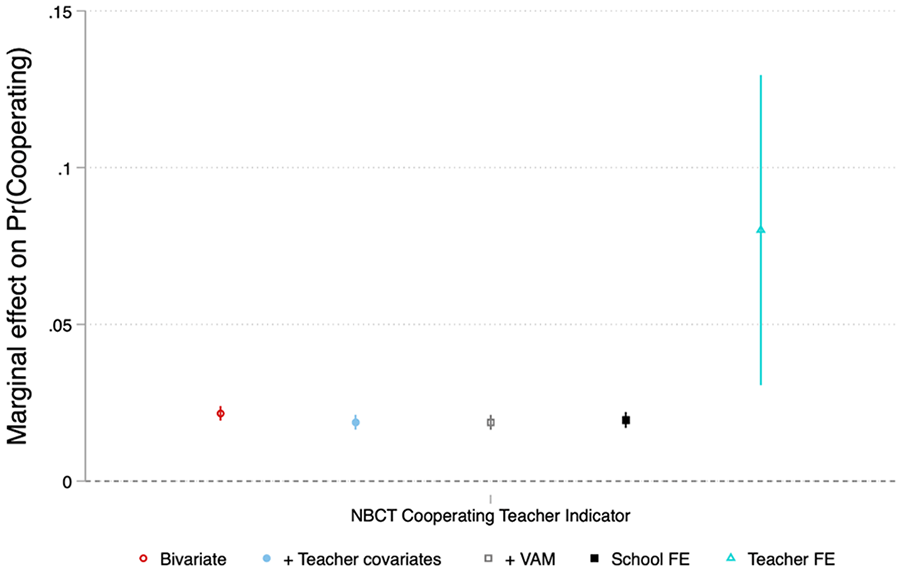
Relationship between teachers’ National Board Certification status and probability of serving as a cooperating teacher.
Column 2 augments the first column with variables that might impact the likelihood that a teacher hosts a student teacher. Column 2 demonstrates that teachers with master’s degrees, female teachers, and teachers who graduated from one of the TEPs participating in this study are more likely to supervise candidates. Though not reported in Table 3 due to space constraints, teachers employed in districts further from TEPs are less likely to supervise candidates, as are teachers in townships or rural areas. Teachers serving in urban districts are more likely to supervise student teaching than those in suburban areas. These findings suggest that proximity to TEPs is an important correlate of cooperating teacher service. However, the inclusion of all of these variables does little to overturn the importance of being an NB-certified teacher. The estimated impact of being NB-certified on supervising a student teacher remains at almost two percentage points. This finding remains unchanged when teacher value added is included (column 3) and when school fixed effects are included (column 4). Finally, we include teacher fixed effects in column 5 and show that individual teachers are about 8 percentage points more likely to host a student teacher in years they have NB teacher status than in years they do not (note that this model is identified only by teachers who host a candidate during the sample period, which explains why this marginal effect is so large). Together, these models suggest a strong association between NB teacher status and the individual likelihood of serving as a cooperating teacher. This association could imply either that TEPs and schools use NB teacher status as a signal of potential mentor quality in matching decisions or that NB teachers are more willing to mentor teacher candidates.
What Factors Predict Whether Candidates Complete Student Teaching With an NBCT?
We address our second research question in Table 4 and the accompanying Figure 3, which reports marginal effects from logit models where the dependent variable equals one if a candidate was supervised by an NBCT. Here, the units of observation are all candidates, and the independent variables represent candidate characteristics. All models include fixed effects for a candidate’s student-teaching year. A quick glance at the coefficients in all three columns of Table 4 suggests that few candidate characteristics predict being supervised by an NBCT. Of the included regressors, only endorsement type is consistently statistically significant across specifications. STEM-endorsed candidates are six percentage points more likely to be supervised by an NBCT; in contrast, candidates endorsed in special education are about three percentage points less likely to be supervised by one. Given the overall 13.3% rate of NBCT supervision, these numbers suggest that endorsement type is a strong predictor of supervision. Importantly, NB teachers in Washington are more frequently endorsed in STEM (20% vs 12%) and ELL (6% vs 4%), less frequently endorsed in special education (13% vs 16%), and equally likely to be endorsed in elementary than non-NB teachers. This variation aligns with the direction of associations we observe with candidate endorsements and thus may capture matching candidates with mentors according to subject areas.
Relationships Between Candidate Variables and Probability of Matching With an NBCT Cooperating Teacher

Notes. All models include intern-year fixed effects. For all models, we include indicators for missing WEST-B scores and replace all missing scores with zeros.
p < .05, **p < .01, ***p < .001, standard errors clustered at TEP institution level.

Relationships between candidate characteristics and probability of matching with an NBCT.
We also find that candidates with higher WEST-B scores are significantly more likely to be supervised by an NBCT. Specifically, a one-standard-deviation increase in WEST-B score (about 18 points) is associated with a 1.1 percentage point increase in the likelihood of matching with an NBCT. However, this coefficient is an order of magnitude smaller and no longer statistically significant when institution fixed effects are included in the final column. This suggests that most of this relationship is across TEPs (i.e., TEPs with higher-scoring candidates also tend to place more candidates with NBCTs) rather than within TEPs (i.e., higher-scoring candidates are no more likely to be supervised by an NBCT than other candidates at their TEP). This is important to keep in mind because if stronger candidates seek out NBCTs as mentors, we will associate any changes in outcomes in our later research questions with NBCT mentorship when it, in fact, reflects selection bias among candidates. This does not seem to be the case, however, when comparisons are made within TEPs.
To What Extent Are Candidates Supervised by NBCTs More Likely to Enter the Public School Teacher Workforce?
Table 5 provides estimates of the likelihood that student teachers are observed in Washington public schools within three years of student teaching (columns 1 through 3). All models in Table 5 include TEP fixed effects as well as intern year fixed effects, so the comparison group is other candidates who attended the same TEP and completed their student teaching in the same year. As a point of reference for interpreting subsequent effect sizes, 73.9 percent of student teachers supervised by NB-certified teachers are hired within 3 years, while 67.9 percent of all other student teachers were hired within that time—a six-percentage-point difference that might be explained by the control variables in Table 5.
Relationships Between CT and Candidate Variables and Employment Outcomes

Notes. All models include intern-year fixed effects. Standard errors in columns (1) through (3) are clustered by teacher education program (TEP); these models include TEP fixed effects. Standard errors in columns (3) through (6) are clustered by individual; these models include school year fixed effects. Controls not included in the model but not shown in table: cooperating teacher (CT) experience, CT masters plus (indicator), student-teaching (ST) school stay ratio, ST school percent URM students, ST school teacher openings next year, ST district urbanicity (indicators), ST quarter (indicators), candidate WEST-B number of attempts and average score. Models controlling for WEST-B also include an indicator for WEST-B score missingness and replace missing scores with zeros. Models controlling for CT value added include indicators for missingness in each variable and replace missing values with the sample mean. ELA = English language arts; ELL = English language learner; NBCT = National Board–Certified teacher; STEM = science, technology, engineering, math; SPED = special education.
p < .05, **p < .01, ***p < .001.
Given that many candidates are not immediately observed in the workforce in the year after being certified to teach but do show up eventually (Goldhaber, Krieg, Theobald, & Goggins, 2022a), Table 5 reports the coefficient estimates for specifications that describe the likelihood of employment within three years of student teaching. We also display the associations just for the NBCT indicator in Figure 4. After controlling for a number of cooperating teacher and student teacher characteristics, we find a statistically significant relationship between student teaching with an NBCT and workforce entry; candidates supervised by an NBCT are about 1.8 percentage points more likely to enter the teaching workforce within three years than candidates supervised by non-NB teachers.

Relationship between cooperating teacher National Board Certification status and candidate-hiring outcomes.
Unsurprisingly, we find that candidate endorsement areas are meaningfully associated with hiring outcomes. Specifically, endorsement in STEM, special education, and ELL are associated with 11, 19, and 6 percentage point increases in a candidate’s likelihood of being hired within 3 years, relative to candidates endorsed in elementary. As we noted previously, it is possible that candidates are matching specifically with cooperating teachers who share their area of interest. We find that matches of this sort are also associated with better hiring outcomes for candidates: interning with a cooperating teacher who shares an endorsement area is associated with a 2.5 percentage point increase in hiring probability within three years—a 4.15% increase. We also find that student teachers supervised by female cooperating teachers are more likely to be hired.
The third column of Table 5 also presents an exercise in assessing National Board Certification. Our sample includes cooperating teachers who will become board-certified as well as cooperating teachers who have let their certification lapse. One interesting question has to do with the actual status of certification: Does being certified improve student-teacher outcomes, or are there characteristics of the cooperating teachers who will be (or who have been) certified that impact outcomes? The third column introduces two new variables: CT future NBCT is a binary variable equal to one for current cooperating teachers who will, sometime in the future, become NB-certified. CT expired NBCT is a binary variable equal to one if the cooperating teacher had been certified but let the certification expire. As shown in the third column, in neither case are future or expired certified supervisors statistically different from noncertified supervisors, nor does the inclusion of these variables alter the coefficient on being NB-certified. This suggests that something about becoming certified, rather than just the people who become certified, aids supervisors in helping their student teachers find jobs.
To What Extent Are Candidates Supervised by NBCTs More Likely to Stay in the Public School Teacher Workforce?
We now turn to the relationship between student teaching under an NBCT and workforce attrition among hired candidates. One potential pathway for this association may be that stronger mentors provide more realistic expectations about the reality of teaching, better preparing candidates for the challenges of the job. In columns 4 through 6 of Table 5, we report the marginal effects from estimating Equation (1) in which y = 1 if a teacher leaves the workforce at the end of the school year and y = 0 otherwise. We visually present the point estimates for the NBCT indicator in Figure 4. As described previously, we estimate discrete-time hazard models across all observable years for each hired candidate. We have also estimated our models on a subsample of teachers’ first two years in the workforce, not shown in Table 5, because teacher attrition is highest in early-career years, and teacher preparation effects tend to fade out the longer teachers are in the workforce. These results are qualitatively similar to those for the full sample and are available upon request. We estimate specifications that control for cooperating teacher and hired candidate value added (column 4) and make comparisons only between teachers in the same school (column 5). We also experiment with future and expired NB-certified supervisors in column 6. All models compare candidates who interned in the same year and attended the same TEP institution. For context, 7.2% of these teachers leave the workforce in a typical year.
Focusing primarily on the indicator that candidates had an NBCT as a supervisor, we find no statistically significant evidence that candidates placed with NBCTs are any more or less likely to leave the teacher workforce than candidates placed with non-NBCTs. The standard errors on these estimates are about a third of a percentage point, and given that all point estimates are less than 0.2 percentage points, we can rule out effects of more than about 0.6 percentage points in either direction. The same holds for candidates’ early-career years, with no statistically significant relationship between having an NBCT and attrition.
Given that the summary statistics in Table 2 show a significant raw difference in attrition between candidates according to working with an NBCT, we explore which controls in Table 5 explain why the model presents no statistical effect of NBCTs. In particular, we decompose the change in the coefficient on NBCTs from a null model (−0.0002) to the full model in Table 5, column 6 (−0.0014), to investigate the contribution of having an NBCT on attrition relative to other factors that may be correlated with this pairing (Gelbach, 2016). We find that nearly the entire differential in mean attrition between candidates supervised by NB teachers and non-NB teachers is explained by controlling for year effects; that is, candidates in later years are more likely to be supervised by an NBCT (see Figure 1) and less likely to leave the workforce.
Are Candidates Supervised by NBCTs More Effective Teachers?
In Table 6, we present estimates from Equation (3), which assesses the extent to which NBCTs might transfer their efficacy to candidates. We show the point estimates for the NBCT indicator across both math and ELA in Figure 5. In columns 1 through 3, we predict math value added for all the years we observe in the value-added sample. Columns 4 through 6 show the same for ELA value added. Each model includes year fixed effects, and all but the first and fourth columns include school fixed effects. While we include several potential predictors of teacher value added, the variable of interest in these regressions is “NBCT,” a binary variable indicating if the candidate trained with an NBCT. The last column for each of the math and ELA value added include the future and expired NB-certified variables. For all math specifications, the NBCT coefficient is not statistically different than zero and represents a relationship with value added of less than 0.8 percent of an SD. Moreover, the standard error on these estimates is very small, about 0.01 SDs of student performance, so we can rule out with 95% confidence relationships of more than about 0.025 SDs of student performance in either direction.
Relationships Between CT, Candidate, and Student-Teaching Characteristics on Value Added

Notes. Standard errors are clustered by teacher. All models include year effects and the following controls: CT experience, CT masters plus; for both ST school and current school stay ratio, percent URM students, district urbanicity; ST quarter; candidate WEST-B number of attempts and average score; candidate years of experience (indicators); and indicators for working in the same school level, school, or district as student teaching. Models controlling for WEST-B and CT VAM include indicators for missingness and replace missing scores with zeros and the sample mean, respectively. CT = cooperating teacher; ELA = English language arts; ELL = English language learner; NBCT = National Board–Certified teacher; SPED = special education; STEM = science, technology, engineering, math; ST = student teaching.
p < .05, **p < .01, ***p < .001.

Relationships between cooperating teacher National Board Certification status and value added among hired candidates.
We see similar patterns for ELA value added in Table 6, with estimates pooled across all hired candidates (column 4) and comparing hired candidates within schools (columns 5 and 6). Column 4 suggests that working with an NBCT may have a negative relationship with hired candidates’ value added in ELA, though this result is not robust to the inclusion of school fixed effects (column 5). We conclude that—despite the relationship between cooperating teacher effectiveness and candidates’ future effectiveness found in the prior literature and shown in the additional rows of Table 6—little of this relationship is captured by working with an NBCT. In conclusion, we do not find evidence of a positive relationship between NBCTs and early-career teaching effectiveness, but as discussed in the previous section, we cannot rule out the very modest association expected based on differences in cooperating teacher effectiveness alone.
Discussion
This paper contributes to a growing literature connecting the characteristics and qualifications of cooperating teachers to the later effectiveness of the teacher candidates they supervise. While prior research has shown that teachers tend to be more effective when they student taught with a more effective teacher (Bastian et al., 2020; Goldhaber et al., 2020; Goldhaber, Ronfeldt, et al., 2022; Ronfeldt et al., 2020), and student teaching with a NBCT predicts better preservice teaching practices (Bastian et al., 2022), the relatively small sample sizes in the prior literature connecting student teaching with an NBCT to the in-service effectiveness of candidates (e.g., Ronfeldt et al., 2021) have limited broader conclusions of the value of student teaching with a NBCT. The primary contribution of this paper, therefore, is the “precise zero” finding on the relationship between student teaching with an NBCT and teacher effectiveness in math and retention and the slightly negative relationship with teacher effectiveness in ELA, all estimated from a very large sample of preservice candidates in Washington. In other words, not only do we not find evidence that student teaching with an NBCT predicts better future teacher effectiveness, but the precision of our estimates rules out even modest positive relationships between these variables.
That said, one important caveat is that our effectiveness analysis focuses solely on value added to student test scores. Recent research (e.g., Jackson, 2018; Kraft, 2019) has found that teachers also contribute to consequential non-test outcomes of students (e.g., attendance, course grades, grade progression, discipline, and college-going); further emerging evidence explores associations between cooperating teacher assignments and teacher contributions to non-test student outcomes (Backes et al., 2023). Whether having an NBCT influences the ability of teachers to contribute to students’ non-test outcomes, or outcomes in subjects which are not tested, is unknown and represents a potentially fruitful area for future research, particularly since NB certification may be more aligned to teacher skill areas better captured by non-test outcomes.
Conclusion
The emerging literature on student-teaching placements and student and teacher outcomes reveals strong evidence that cooperating teachers play a crucial role in teacher-candidate development and future outcomes. Identifying who will be an effective cooperating teacher, however, is not straightforward in part because measures such as evaluation ratings and teacher value added are not readily accessible for the entire pool of potential cooperating teachers. School districts and TEPs, therefore, lack a straightforward way to determine who should serve as a cooperating teacher. Having NB teachers serve in this capacity is a potential solution, given that NB teacher status signals teacher quality in several studies (e.g., Cowan & Goldhaber, 2016), and the certification involves the development of a reflective teaching practice. As we note at the outset of this paper, some school districts appear to be pursuing this solution by encouraging NB teachers to become cooperating teachers (Espinoza et al., 2018).
We investigate this issue further by examining (a) the likelihood that NB teachers serve as cooperating teachers and (b) the relationship between having an NBCT and a range of outcomes (e.g., the odds that a candidate ends up employed in the teacher workforce and, contingent on employment, their estimated impact on students). On the first question, we find strong evidence that NB teachers in Washington are far more likely than non-NB teachers to serve in a cooperating teacher role. On the second question, we find that having an NBCT significantly predicts the odds that candidates end up employed as K–12 public school teachers within three years. We cannot, however, determine the degree to which this association relates to skills learned while apprenticing with NB teachers (e.g., NBCTs help develop skills that make candidates more employable), networking effects (e.g., NBCTs help candidates connect to people who help them obtain employment), or selection on unobservable factors (e.g., candidates who are already more likely to become teachers seek out NBCTs). Although working with an NBCT predicts the likelihood of a candidate being hired to teach, we find little difference in retention or value added among hired candidates—and a slightly negative difference in ELA—compared to their peers who did not have an NBCT.
Additional inquiry might also explore more proximal outcomes to the student-teaching experience and dimensions of teaching that are developed through the National Board Certification process. Research on preservice teacher outcomes, such as the edTPA portfolio assessment (Bastian et al., 2022), finds a relationship between NBCTs and candidate performance, suggesting NBCTs may support preparedness along other dimensions of teaching, even if they do not have large impacts on longer-term outcomes like value added and retention.
Finally, there are a few implications of these findings for teacher education practice and policy. It is clear from this analysis that NB teachers are more likely to host student teachers than we would predict based on their other observable characteristics alone, which suggests that TEPs and districts are already targeting these teachers to host student teachers. Should they be? On the one hand, given the significant scope for change in student teaching placements—for example, only 3% of teachers in Washington host a student teacher in any given year (Goldhaber et al., 2020)—districts and TEPs may want to look further afield and/or for potential mentors with less-easily-observable proxies for effectiveness. On the other hand, some districts and TEPs in Washington already report difficulty recruiting cooperating teachers, and if NB teachers are more likely to host student teachers because they are also more willing to host student teachers, then perhaps this targeting still has benefits for candidates.
Footnotes
Acknowledgements
The opinions expressed are those of the authors and do not represent the views of the Institute or the U.S. Department of Education. This research was also supported by the National Center for Analysis of Longitudinal Data in Education Research (CALDER), which is funded by a consortium of foundations. For more information about CALDER funders, see  . Michael DeArmond, Joe Doctor, Andrew Kwok, and Maia Goodman Young provided helpful feedback, which meaningfully improved this paper. Finally, we wish to thank Nate Brown, Jessica Cao, Elliot Gao, Marcelle Goggins, Andrew Katz, Tony Liang, Stephanie Liddle, Arielle Menn, Natsumi Naito, Rain Ortega, Cameron Thompson, Stacy Wang, Malcolm Wolff, Hilary Wu, and Yunqi Zhang for their support with data collection and cleaning.
Authors’ Note
The research presented here would not have been possible without the administrative data provided by the Washington Office of Superintendent of Public Instruction through data-sharing agreement 2021DE-001 or without the student teaching data provided by teacher education programs from the following institutions participating in the Teacher Education Learning Collaborative: Central Washington University, City University of Seattle, Evergreen State College, Gonzaga University, Northwest University, Pacific Lutheran University, Saint Martin’s University, Seattle Pacific University, Seattle University, University of Washington Bothell, University of Washington Seattle, University of Washington Tacoma, Washington State University, Western Governors University, and Western Washington University.
Declaration of Conflicting Interests
The author(s) declared no potential conflicts of interest with respect to the research, authorship, and/or publication of this article.
Funding
The author(s) disclosed receipt of the following financial support for the research, authorship, and/or publication of this article: Some data in the research was provided by the National Board for Professional Teaching Standards. All conclusions stated in this report are those of the authors, and no endorsement by the National Board for Professional Teaching Standards should be implied. This research was supported by the Institute of Education Sciences, U.S. Department of Education, through grant #R305A180023 to the American Institutes for Research.
Open Practices
Data access and replication code available at doi: 10.3886/E224383V1
Note: This article was accepted under the editorship of Kara Finnigan.
Notes
Authors
DAN GOLDHABER is the director of the National Center for Analysis of Longitudinal Data in Education Research (CALDER) at American Institutes for Research and also the director of the Center for Education Data and Research (CEDR) at the University of Washington, 3876 Bridge Way North, Suite 201, Seattle, WA 98103;
JOHN KRIEG is the director for institutional effectiveness at Western Washington University, 516 High Street, Bellingham, WA 98225;
RODDY THEOBALD is deputy director of CALDER and managing researcher at American Institutes for Research, 3876 Bridge Way North, Suite 201, Seattle, WA 98103;
GRACE FALKEN is a research consultant and the Center for Education Data & Research (CEDR) at the University of Washington. Her research focuses on the labor markets of teachers and other public school staff.