




Abstract
Increasingly, there is consensus that equitable mathematics instruction incorporates ambitious and culturally responsive (CR) practices. Using self-reported survey data and mixture modeling, we examine teachers’ emphasis on ambitious, traditional, and CR mathematics practices. We offer an emergent typology for characterizing teacher engagement with CR teaching in mathematics. One-half of teachers—predominantly White and experienced—reported rarely engaging in CR practices, focusing exclusively on a mix of ambitious and traditional practices. One-third of teachers emphasized some CR practices alongside ambitious and traditional practices. Less than one-quarter of teachers—predominantly teachers of color—emphasized ambitious mathematics and a robust set of CR practices. Teachers who de-emphasize CR teaching reported believing in it but having low self-efficacy. We offer implications for policy and practice.
Keywords
In recent years, the mathematics education field has recognized that equitable mathematics instruction not only privileges classical mathematics knowledge (what the field considers to be academic mathematical knowledge; Gutstein, 2012), but also cultural responsiveness—that is, leveraging students’ cultural assets and attending to social justice (Abdulrahim & Orosco, 2020; Aguirre & Zavala, 2013; Gay, 2018; Gutiérrez, 2012; Gutstein, 2006, 2012). For instance, the National Council of Teachers of Mathematics’ (NCTM, 2021) position statement on access and equity emphasizes the need for teachers to be “responsive to students’ backgrounds, experiences, cultural perspectives, traditions, and knowledge” to support equity in mathematics teaching (Paragraph 1). Similarly, California’s most recent K-12 mathematics framework calls for equity and engagement, offering examples for how to “utilize and value students’ identities, assets, and cultural resources” in mathematics instruction (California Department of Education [CDE], 2021, p. 3).
These calls occur amid the ongoing push to teach classical mathematics using ambitious practices. For the last several decades, the mathematics education field has called for shifts from traditional instructional practices (e.g., direct instruction, emphasis on rote computation) to ambitious mathematics teaching practices (e.g., facilitation of mathematical discussion and active learning) that support the development of both conceptual understanding and procedural fluency (NCTM, 2000; Smith et al., 2005). Several large studies characterize teachers’ use of ambitious versus traditional mathematics instructional practices (e.g., Desimone & Long, 2010; Hill et al., 2018). However, the extent to which teachers focus on ambitious or traditional practices while simultaneously attending to cultural responsiveness is underexplored. Work that has attended to these different domains of mathematics instruction suggests that attention to culturally responsive (CR) practices requiring critical knowledge—knowledge of power and social injustices (Aguirre & Zavala, 2013; Gutstein, 2012), such as “challenging social inequities and confronting stereotypes” (Powell et al., 2016, p. 26)—is most often overlooked.
Understanding the nature of teachers’ engagement in these different dimensions of mathematics instruction is particularly important given both the complexity of these approaches, as well as what we know from scholarship about factors that influence teachers’ instructional choices. Teachers’ beliefs about instructional approaches and curricula, and their self-efficacy for particular practices, play a substantial role in influencing how teachers approach instruction (Coburn, 2005; Comstock et al., 2023; Remillard & Bryans, 2004; Spillane & Jennings, 1997; Tschannen-Moran et al., 1998). Teachers bring together different practices in a variety of ways, drawing on their prior beliefs, knowledge, and skills and the myriad signals from the field about “good” instruction (Cohen, 1990). Teachers’ school, district, and policy contexts also influence instruction and equity-focused work in particular—by shaping teachers’ access to resources like professional learning (PL), expert colleagues, and instructional leadership (Coburn, 2001; Comstock et al., 2022; Khalifa et al., 2016) and exerting pressures on teachers to teach in particular ways (Achinstein & Ogawa, 2012; Horn, 2018). Identifying patterns in how teachers integrate mathematics practices across dimensions, and how factors like teachers’ beliefs, self-efficacy, curricular use, and environmental contexts relate to their practices, are important for guiding interventions and tailored teacher supports.
In this study, we use teacher survey data to characterize teacher practice based on self-reports from 205 middle school mathematics teachers across five racially, ethnically, and linguistically diverse school districts in four states. We address the following questions:
In what ways do mathematics teachers report engaging with dimensions of equitable mathematics?
Do teachers’ characteristics, beliefs about CR teaching, self-efficacy for CR teaching, views of the mathematics curriculum, and curricular use describe differences in how teachers report engaging with dimensions of equitable mathematics?
How are teachers distributed across schools and districts, based on their reported practices?
In doing so, we make important contributions to the literature. First, we examine broad patterns in reported mathematical practices across a large sample of teachers, building on the robust body of small-N scholarship in CR teaching and CR mathematics teaching (e.g., Aguirre & Zavala, 2013; Groulx & Silva, 2010; Gutstein, 2012; Gutstein et al., 1997; Ladson-Billings, 1995; Parker et al., 2017; Young, 2010). Second, we build on the work of scholars bridging ambitious mathematics practices and CR teaching practices (e.g., Aguirre & Zavala, 2013) by examining how teachers in this large sample report integrating ambitious and CR practices in their daily instruction. Third, we contribute to the small but growing literature base on CR teaching self-efficacy (e.g., Comstock et al., 2023; Siwatu, 2007) by examining the relationship between self-efficacy and teachers’ reported engagement in different dimensions of CR teaching. Finally, we apply methods that have not yet been used to examine teachers’ CR teaching practices to discern these within-teacher patterns. In doing so, we contribute to the field an emergent typology for characterizing teacher engagement with CR teaching in mathematics that can guide future scholarship and practice in how to understand and support teachers to take up CR teaching in mathematics.
Study Context
In this study, we examined 205 middle school mathematics teachers’ reported beliefs and practices in a set of five school districts across four states (Table 1; all district names are pseudonyms). Each participating school district was engaged in a professional learning (PL) partnership initiative funded by the Bill & Melinda Gates Foundation. The funder required districts to serve 50% or more Black, Latino/x, English learners, and/or low-income students. In these initiatives, districts partnered with external organizations, such as PL providers and curriculum developers, to enact curriculum-embedded PL focused on middle school mathematics to promote student learning. Thus, this study’s sample offers a depiction of the mathematical instructional practices across a set of equity-oriented, racially and linguistically diverse public school districts, and a unique description of teacher beliefs and practices related to equitable mathematics instruction.
District Demographics and Background Information

Note. PL = Professional learning; EL = English learner. “Other Race” refers to all other groups (i.e., American Indian/Alaska Native, Native Hawaiian/Pacific Islander and Two or more races) with percentages lower than 10%. Source of student enrollment and demographics is the NCES Common Core of Data. Not all schools in our sample provided publicly available data on EL percentages. This table provides descriptive information on each district partnership from which our data originate. All district names are pseudonyms.
Each PL partnership designed their own PL initiatives, and thus there were important similarities and differences across districts in their connection to cultural responsiveness and equity. For instance, River Valley, Windy Rock, and Pebbletown School Districts included some attention to teacher reflection on identity and implicit bias in their PL initiatives. Lower County School District spent some time in PL sessions discussing sociopolitical issues, whereas Springview School District dedicated PL time to adapting and providing teachers with mathematical instructional units centered on issues of social justice, such as disproportionality in Covid-19 infections in communities of color. Pebbletown School District had a distinct focus on supporting students, especially multilingual learners, to develop mathematical identity, counteracting traditional and White-normative notions of who gets to be a mathematician. Although the differences across districts signal potentially important implications for teacher practice, our analysis does not allow us to disentangle the causal effects of each of these design features on teachers’ practice.
Conceptual Framework and Review of the Literature
This study is grounded in a conceptual framework that positions mathematics teaching and learning as a sociocultural process—one that demands an understanding of knowledge as situated within cultural practices (Aguirre & Zavala, 2013; Gutiérrez, 2012; Nasir et al., 2008). To conceptualize dimensions of equitable mathematics instruction from a sociocultural perspective, we bridge Gutstein’s (2006, 2012) framework for three types of knowledge necessary for equitable mathematics with scholarship on ambitious and traditional mathematics (Desimone & Long, 2010; Hill et al., 2018) and culturally relevant and responsive pedagogies (Aguirre & Zavala, 2013; Gay, 2018; Gutstein et al., 1997; Ladson-Billings, 1995). Gutstein (2006) describes one form of knowledge necessary for equitable mathematics as classical mathematics knowledge—what we often think of as academic mathematical knowledge associated with mathematical excellence (Aguirre & Zavala, 2013). Conversations in the mathematics education field about ambitious and traditional mathematics practices center on how to best engage students in the development of classical mathematics knowledge—for example, through an emphasis on conceptual understanding, procedural fluency, mathematical discourse, and real-world application (Choppin et al., 2022; Hill et al., 2018; Lampert et al., 2010; Smith et al., 2005).
A second type of knowledge is what Gutstein (2006) refers to as community (or cultural) knowledge. Community/cultural knowledge speaks to the knowledge required of teachers to understand students’ cultural and community identities and the specific assets that students bring to the mathematics classroom. We align this type of knowledge with dimensions of culturally relevant and responsive pedagogies that call attention to the importance of cultural competence—the need for mathematics instruction to affirm students’ cultural identities and build on their funds of knowledge (Aguirre & Zavala, 2013; Moll & González, 2004), which requires deep community and cultural knowledge of students (Gutstein, 2012).
Finally, Gutstein (2006, 2012) identifies a third form of knowledge: critical knowledge (Gutstein, 2006). Critical knowledge speaks to the dimensions of culturally relevant and responsive pedagogies that focus on critical consciousness, which concerns awareness and recognition of injustice and power dynamics in broader society (Gay, 2018; Gutstein, 2016; Ladson-Billings, 1995). This dimension requires that teachers themselves have critical knowledge of prejudice and injustice, can support students to develop their own critical consciousness, and can leverage mathematics as a tool for empowering students to address social justice issues (Gay, 2018; Gutstein, 2016). This form of knowledge includes understanding power and social inequality and issues of social justice.
With these dimensions in mind, we ground our study in two bodies of scholarship: (1) ambitious and traditional mathematics instruction as a way to teach classical mathematics and (2) the role of cultural identity and critical consciousness in mathematics. We also review the literature on how teachers have integrated these dimensions of mathematics instruction and what factors influence how teachers approach instruction.
Classical Mathematics: Ambitious and Traditional Mathematics Instruction
Classical mathematics knowledge is what the field considers to be academic mathematical knowledge (Gutstein, 2006), and consensus on how to teach classical mathematics has shifted over time. We discuss two approaches to teaching classical mathematics knowledge: traditional and ambitious practices. Over the last several decades, the field of mathematics education has had a consistent focus on shifting teacher practice to emphasize ambitious mathematics practices (Smith et al., 2005; Stigler & Hiebert, 2009). Mathematics reform advocates of the 1990s and 2000s critiqued traditional “stand-and-deliver” modes of instruction that focused on teaching discrete mathematical procedures and computation (e.g., see Stigler & Hiebert, 2009). Instead, reform advocates argued for greater focus on not only procedural fluency, but also conceptual rigor (e.g., providing cognitively demanding tasks, supporting real-world application) in ways that put more responsibility on students to deeply engage with and drive learning (Choppin et al., 2022; Hill et al., 2018; Lampert et al., 2010; National Mathematics Advisory Panel, 2008).
Scholarship examining mathematics teaching in large samples in urban U.S. districts suggests that mathematical instruction tends to emphasize routine mathematical procedures and explicit instruction, which we refer to as traditional instruction, and devote much less time to conceptually-focused tasks and ambitious practices such as discourse-rich and student-driven activities (e.g., Desimone & Long, 2010; Hiebert et al., 2005; Hill et al., 2018, Litke, 2020; Smith et al., 2005). Nationally representative data has shown that students experience predominantly traditional mathematics instruction in both elementary and middle school (Desimone & Long, 2010; Gottfried et al., 2023; Smith et al., 2005). Other non-representative studies of mathematics classrooms have shown the prevalence of traditional, teacher-directed lesson formats with minimal student collaboration in elementary mathematics lessons (e.g., Hill et al., 2018; Weiss et al., 2003) and in high school algebra (Litke, 2020). Yet, within these more traditional formats, researchers have found evidence of modest take-up of more conceptually-focused instructional practices, such as supporting students to develop mathematical explanations (e.g., Hill et al., 2018, Litke, 2020). On the whole, this existing scholarship suggests that teachers’ use of ambitious practices is limited. Importantly, however, this literature offers limited attention to instructional dimensions that make mathematics equitable—such as cultural responsiveness.
Cultural Responsiveness: Cultural Identity and Critical Consciousness
Alongside this effort to promote and support ambitious mathematical practices, some mathematics education scholars have focused on the importance of attending to equity in mathematics instruction through explicit integration of culturally responsive and social justice-oriented practices (e.g., see Civil et al., 2019 for a review; also Gutstein, 2006, 2012; Gutiérrez, 2012). This perspective has engendered several frameworks for mathematics teaching and learning (Civil et al., 2019)—for example, culturally responsive/relevant mathematics teaching (Aguirre & Zavala, 2013), mathematics for social justice (Gutstein, 2012; Gutstein et al., 1997), and critical mathematics (Gutstein, 2016).
What these scholars of equity-oriented mathematics share is attention not just to attainment of classical mathematical knowledge and skills, but also to instructional practices that address cultural competence and critical consciousness (Abdulrahim & Orosco, 2020; Gutiérrez, 2012; Gutstein, 2006, 2012; Ladson-Billings, 1995; Wilson et al., 2019). Scholarship has documented how teachers can attend to students’ cultural identities by adapting standardized curricular resources (Gay, 2018), attending to issues pertinent to students’ “social and physical world” (Gutstein, 2012, p. 1; see also Wilson et al., 2019), and facilitating activities that build on how students’ cultures engage with the content (e.g., Savage et al., 2011). Reflecting attention to students’ cultural identities, Gutstein’s (2012) community/cultural knowledge includes being responsive to “the knowledge that resides in individuals and in communities that usually has been learned out of school” and “the cultural knowledge people have, including their languages and the ways in which they make sense of their experiences” (p. 1). As such, being responsive to this dimension of knowledge includes building on examples of students’ cultural, historic, and everyday lived experiences, and using students’ cultural backgrounds to make learning meaningful.
Developing critical consciousness requires that teachers engage in reflection to examine their own beliefs about students, race, and culture (Abdulrahim & Orosco, 2020). Critical consciousness requires critical knowledge (Gutstein, 2012)—“knowledge about why things are the ways that they are and about the historical, economical, political, and cultural roots of various social phenomena” (p. 2). Critical knowledge undergirds teachers’ ability to critically assess their curricula and instructional materials to identify biases and stereotypes, challenge Eurocentric curricular perspectives, and support students to understand and challenge social injustices in their lived realities (Abdulrahim & Orosco, 2020; Brown-Jeffy & Cooper, 2011; Gay, 2018; Powell et al., 2016).
Integrating Practices Focused on Classical, Community/Cultural, and Critical Knowledge
The focus of this study is on understanding broad patterns in the types of practices that teachers emphasize—spanning ambitious and traditional mathematics practices that center on classical mathematics knowledge, as well as CR practices focused on cultural identity and criticality, which require community/cultural and critical knowledge (Gutstein, 2012). Prior literature offers insights into these dimensions of equitable mathematics that may be more or less emphasized than others. For instance, scholarship using frameworks from culturally relevant and responsive pedagogies has often concluded that the most overlooked aspect of these pedagogies is critical consciousness (Anderson et al., 2017; Comstock, 2025; Ladson-Billings, 2011; Powell et al., 2016; Rubel, 2017; Young, 2010). Scholars attribute this oversight in large part to teachers themselves having not examined and developed their own critical consciousness (Ladson-Billings, 2011).
Less work bridges the scholarship on ambitious mathematics with CR mathematics, although Aguirre and Zavala (2013) make important contributions. In their observation tool for assessing dimensions of CR mathematics teaching, they integrate aspects of ambitious mathematics with practices pertaining to cultural identity and social justice. Through analysis of six beginning teachers’ PL experiences centered on this tool, the authors conclude that leveraging such a tool fosters growth along specific dimensions of CR mathematics teaching, calling attention to the importance of attending to the specific practices that make up CR mathematics teaching. Another key contribution to this area is Wilson and colleagues’ (2019) study of teacher practices across seven case study classrooms. They identify specific instructional practices, such as positioning students as having mathematical authority, that serve equity goals while also engaging students in conceptually oriented mathematics instruction. Importantly, the scholarship on mathematics teaching from a sociocultural lens typically focuses on key moves enacted by exemplary teachers and qualitative studies that offer rich depictions of practices (e.g., see Bonner, 2014; Gutstein, 2016; Ladson-Billings, 1995). Less common are studies of the practices of a broad range of teachers, although such studies are important for understanding patterns in how teachers approach mathematics instruction, and how supports can be tailored to specific practices that make up equitable mathematics teaching.
Factors Shaping Teacher Instruction
Finally, research also shows that teachers’ background characteristics (race/ethnicity, gender, and years of experience), beliefs, self-efficacy, and curricular material use shape their instruction. For example, veteran teachers are often less likely to take up ambitious instruction (Smith et al., 2005). Teachers of color tend to engage more regularly in practices aligned with cultural responsiveness (Blazar, 2021; Comstock et al., 2023). A robust literature links teachers’ beliefs and self-efficacy with their instructional practices (e.g., Comstock et al., 2023; Cross, 2009; Tschannen-Moran et al., 1998). In particular, socioculturally grounded, equity-focused instructional approaches like CR teaching are rooted in assumptions that a teacher believes that all students are capable of academic success and that culture and race play a central role in teaching (Gay, 2018; Ladson-Billings, 1995; Parker et al., 2017).
Also critical to teachers’ choices about instruction is how they engage with the curriculum. Teachers may vary in their views about the appropriateness of the curriculum for their students (Donnell & Gettinger, 2015; Handal & Herrington, 2003), and mathematics curricula tend to align with Eurocentric cultural practices (Rubel, 2017). Thus, a critical aspect of equitable mathematics is adapting curricula to reflect the cultural practices of all students (Gay, 2002).
In addition to individual-level factors, teachers’ school, district, and policy contexts meaningfully influence their instruction generally, and equitable instruction in particular. The resources teachers have access to in their schools and districts—including PL, peer expertise, and equity-oriented leadership—shape teachers’ instruction (Coburn, 2001; Desimone, 2009; Khalifa et al., 2016). The policy context also shapes teachers’ engagement in equity-oriented instruction, as studies suggest that pressures from standards and accountability policies can restrict teachers’ engagement in practices that center students’ cultural assets and identities (Achinstein & Ogawa, 2012; Horn, 2018; Stillman, 2011; Young, 2010).
Our Contribution
We bolster this existing literature by examining how much emphasis middle school mathematics teachers across five districts place on specific practices aligned with ambitious and traditional (reflecting classical mathematics knowledge) and CR (reflecting some aspects of community/cultural and critical knowledge) dimensions of mathematics. Using mixture modeling, we generate a typology of teacher approaches to equitable mathematics, which offers important findings about broad patterns in middle school mathematics teachers’ instruction. Scholars have leveraged these methods to understand practices in a variety of areas, including school leadership (e.g., Boyce & Bowers, 2016; Urick & Bowers, 2014), technology use (e.g., Graves & Bowers, 2018), and teacher leadership (e.g., Bowers et al., 2017). Collectively, these studies show that mixture modeling—specifically, latent profile or class analyses—allows for identification of overarching patterns in educator practices, yet it has not been applied to the ways teachers engage in different dimensions of equitable mathematics. In doing so, we bolster conversations in the mathematics education field on ambitious mathematics and CR mathematics with data on broad patterns in teacher practices, calling attention to limited engagement in CR teaching practices overall, especially certain practices that demand criticality and cultural knowledge. Our findings highlight the types of CR practices commonly overlooked in practice, as well as the characteristics and contexts of teachers most commonly employing CR practices. We offer implications for researchers, policymakers, and practitioners on how to better support equitable mathematics practices, drawing particular attention to the importance of teachers’ self-efficacy for CR practices.
Methods
The analysis presented in this paper represents a piece of a larger study focused on how several districts leveraged curricular resources and PL to support middle school teachers to adopt ambitious and equity-oriented instruction. As part of this broader study, we administered a survey to teachers in five districts between January and March 2020 (prior to Covid-19 disruptions). For this broader study, we aimed to measure a range of constructs, including teachers’ perceptions of their curricula, their PL experiences, beliefs about teaching and their students, and self-reported instructional practices. Regarding instruction, we initiated the broader study with an emphasis on understanding the extent to which teachers took up ambitious versus more traditional mathematics instructional practices, and the extent to which they attended to students’ cultural identities in doing so. Our goal for this study was to see whether distinct profiles of teachers could be identified based on their self-reported instructional practices. As we analyzed their survey responses more closely for this paper, we noted differences in teachers’ reported CR practices, which led us to further distinguish teachers based on nuances in how they reported focusing on the cultural and critical domains of equitable mathematics (Gutstein, 2006). In what follows, we detail our data and sample, measures, and analytic approach.
Data and Sample
The overall survey response rate was 52%, with two partnerships below 50% and three between 63% and 94%. Teachers were compensated for their participation in the survey ($40/teacher). The final sample consisted of 205 middle school mathematics teachers, was majority female (76%), and was racially/ethnically diverse (49% White, 33% Black, 5% Latinx, 4% Asian, 3% mixed-race, and < 1% Indigenous; Table 2). In comparison, the 2017–2018 U.S. teacher labor force was 79% White, 7% Black, 9% Hispanic, 2% Asian, 1% American Indian/Alaska Native, and 2% multiracial (Irwin et al., 2021). Although the findings presented are not generalizable to the broader teacher workforce, the sample is illustrative of public schools that serve high percentages of racially/ethnically minoritized students and are engaging in PL around improving instruction, and provides a unique broad-based description of teacher beliefs and practices related to equitable mathematics teaching in this context.
Descriptive Statistics
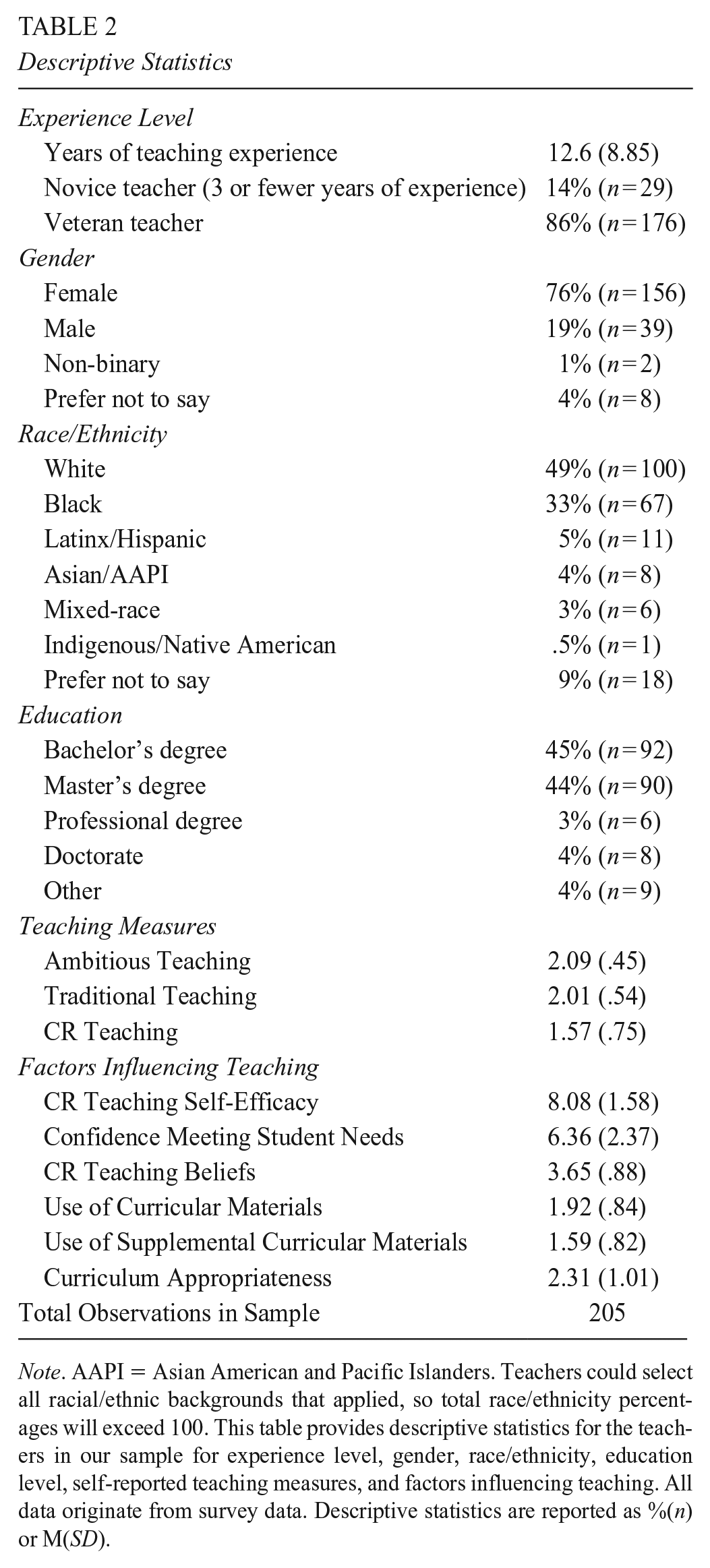
Note. AAPI = Asian American and Pacific Islanders. Teachers could select all racial/ethnic backgrounds that applied, so total race/ethnicity percentages will exceed 100. This table provides descriptive statistics for the teachers in our sample for experience level, gender, race/ethnicity, education level, self-reported teaching measures, and factors influencing teaching. All data originate from survey data. Descriptive statistics are reported as %(n) or M(SD).
Measures Used in Mixture Modeling
We note two important points about our measures. First, because we had multiple aims within the broader study and to ensure the survey was of reasonable length, we selected subsets of items on previously validated survey scales, which we detail next. We based our selection of survey items and, when appropriate, revisions to the survey text using cognitive interviews and expert reviews (Desimone & Le Floch, 2004). We conducted cognitive interviews with nine teachers representing a range of experience and identity characteristics to ensure that our items were eliciting the types of responses we intended. During cognitive interviews, we asked teachers to read aloud each survey item and discuss their thinking as they determined how to answer each question, and we adjusted items for clarity as needed. Second, given our broader study’s emphasis on ambitious, traditional, and CR practices, we oriented our instructional measures and data collection around these constructs specifically. We asked teachers to report on their confidence with, beliefs about, and frequency of use of various instructional practices aligned with ambitious, traditional, and CR teaching.
Importantly, given that we did not design the study with Gutstein’s (2006, 2012) framework in mind, our measures are imperfect representations of the classical, community/cultural, and critical domains. Nevertheless, our scales attend to aspects of each of these domains, and, as we describe in detail below, responses to the multiple CR survey items upon which our survey was developed diverged across teachers, with some CR-related items emphasized by one teacher group and different items emphasized by another. Thus, despite that these survey items do not comprehensively characterize Gutstein’s three constructs—especially the critical domain—we choose to use Gutstein’s framework for sensemaking, especially to help disentangle and explain patterns we observe across teacher profiles. The key variables of interest for the mixture modeling were items in the following scales (see Table 3).
Teaching Items
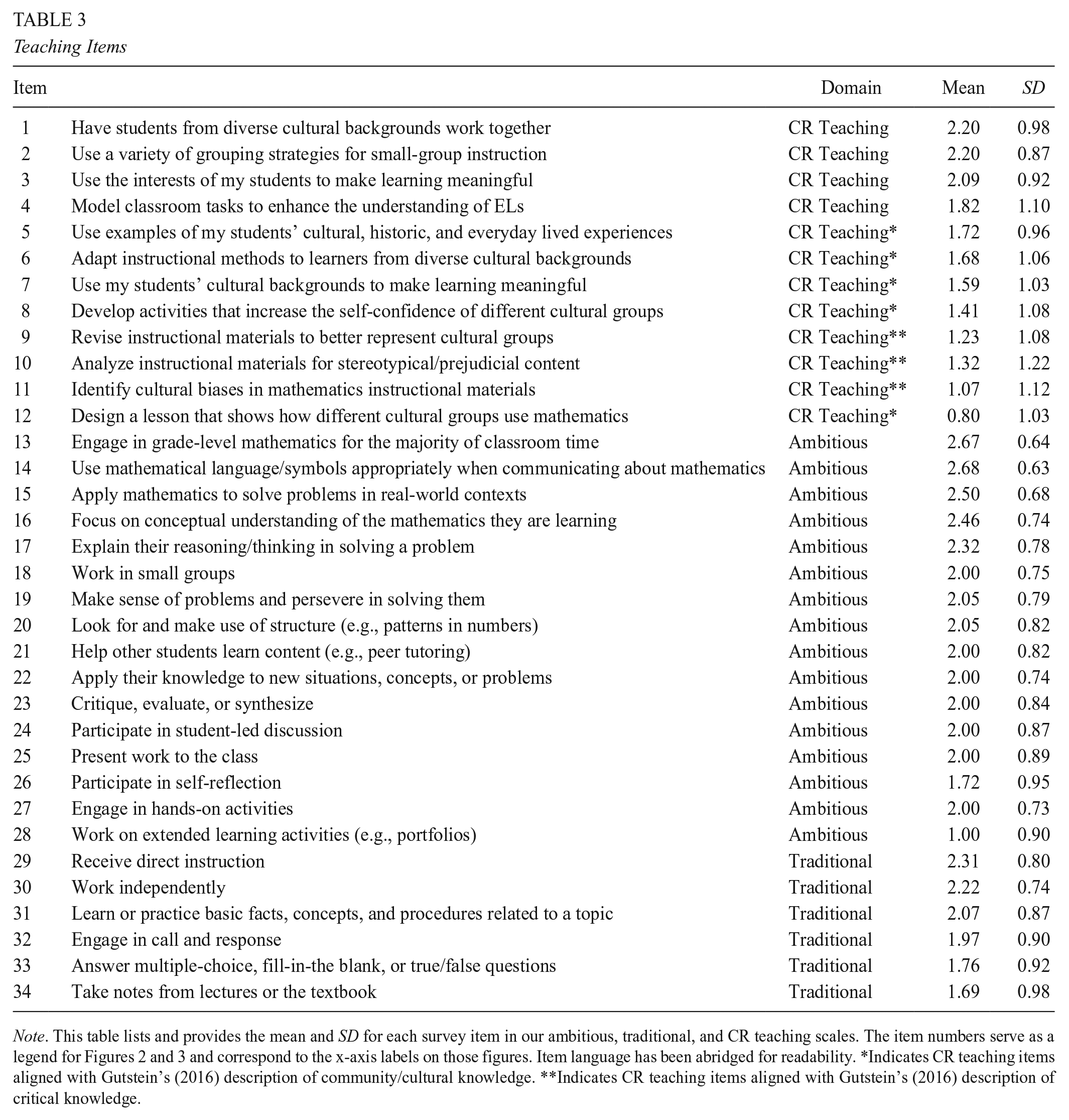
Note. This table lists and provides the mean and SD for each survey item in our ambitious, traditional, and CR teaching scales. The item numbers serve as a legend for Figures 2 and 3 and correspond to the x-axis labels on those figures. Item language has been abridged for readability. *Indicates CR teaching items aligned with Gutstein’s (2016) description of community/cultural knowledge. **Indicates CR teaching items aligned with Gutstein’s (2016) description of critical knowledge.
CR Teaching scale
We adapted items for the CR teaching scale (α = .91) from the multicultural efficacy scale (Guyton & Wesche, 2005), and the CR teaching self-efficacy and outcome expectations scales (Siwatu, 2007). We made two key adaptations: (1) since each scale had at least 30 items, we selected a subset of items to get at central ideas to CR teaching; and (2) we adapted the selected items to use a frequency Likert scale, rather than agreement or confidence. Teachers were asked to report how often they engaged in a series of activities using a 4-point frequency scale: Never (0), A few lessons (1), About half of all lessons (2), Most or all lessons (3). 1 We did this because of our interest in teachers’ self-reported frequency of engagement in different types of practices, and because prior work has shown behavior-based survey measures to be a valid and reliable way of measuring teacher practice (Desimone, 2009; Mayer, 1999).
Ambitious and traditional instruction scales
We adapted items for the ambitious instruction (α = .87) and traditional instruction scales (α = .68) from the Rand Corporation’s American Teacher Panel surveys (Opfer et al., 2016). We selected a subset of items to ensure that we captured mathematics-specific practices aligned with current standards of mathematical practice (e.g., look for and make use of structure in mathematics) as well as more general pedagogical practices that emphasize conceptual rigor and procedural fluency. Our items ask teachers to report the frequency with which they engage in various instructional strategies aligned with ambitious and more traditional teaching approaches (Table 3). Teachers were asked to report how often they engaged in a series of activities using a 4-point frequency scale, Never (0), A few lessons (1), About half of all lessons (2), Most or all lessons (3). 2
Variables used to characterize teacher profiles
To further characterize the resulting teacher profiles, we used the following items and scales:
Teacher background characteristics
To understand the resulting typologies, we examined a series of variables on teacher background characteristics: gender—1 for female and 0 for male; and reported years of teaching experience; and race/ethnicity—1 for teacher of color (Black, Latinx, Asian, mixed-race, Indigenous, or Middle Eastern) and 0 for White. We use these categories to capitalize on large enough sample sizes for our analyses. Importantly, however, both our race/ethnicity and gender variables are crude measures (e.g., by grouping all minoritized teachers together; using a strict binary of female/male), which we discuss in our limitations.
CR teaching self-efficacy
An additional indicator variable included an eight-item measure of teacher’s CR teaching self-efficacy (α = .94), used in other analyses (Comstock et al., 2023). Items were adapted from the Multicultural Efficacy Scale (Guyton & Wesche, 2005) and the CR teaching self-efficacy scale (Siwatu, 2007). We again generated our scale by selecting a subset of items from these previously validated scales, with attention to alignment between our self-efficacy and CR teaching scales. On a scale of 0 to 10, teachers rated their confidence in implementing CR teaching practices on items such as, “Adapting instruction to meet the needs of my students,” and “Using my students’ cultural backgrounds to help make learning meaningful.” On average, teachers reported high self-efficacy for CR teaching (8.08 out of 10; Table 2).
Confidence meeting student needs
This six-item scale (α = .93) was constructed using items adapted from the Center on Standards, Alignment, Instruction and Learning (C-SAIL; see c-sail.org) to assess teachers’ confidence, measured on a scale of 0 to 10, in using the curriculum to meet the needs of students who were performing on grade level, below grade level, above grade level, those with individualized education plans, those from low socioeconomic households, or those designated as English Language learners. Items included “Teaching the curriculum to students performing on grade-level in math,” and “Teaching the curriculum to students who are from low-income families.” On average, teachers reported moderately low confidence for meeting student needs (6.36 out of 10; Table 2).
CR teaching beliefs
Teacher beliefs items were adapted from the CR teaching outcome expectations scale (Siwatu, 2007) and teacher perceptions of CR teaching scale (Phuntsog, 2001). This scale consisted of seven items measured on a 6-point Likert scale (Completely disagree, Mostly disagree, Slightly disagree, Slightly agree, Mostly agree, Completely agree), such as “Culturally responsive practice is essential for creating an inclusive classroom environment” and “Encouraging respect for cultural diversity is essential for creating an inclusive classroom environment.” The scale demonstrated reliability of α = .56 and has been used in other analyses (Comstock et al., 2023). Given this lower-than-ideal alpha, we examined the alphas for each of the resulting teacher profiles in our typology; these ranged from 0.46 to 0.89.
Use of curriculum and supplemental materials and curriculum appropriateness
We measured the use of curricular and supplemental materials (α = .91 and α = .92, respectively) using items adapted from the National Evaluation of Curriculum Effectiveness survey (Blazar et al., 2019). For both curricular and supplemental material use, teachers responded to a 4-point frequency scale addressing the extent to which they used materials for assignments and assessments—for example, “To choose the objectives for your lessons” and “To create the activities for your lesson.” The curriculum appropriateness scale (α = .76) was derived using adapted items from the Center on Standards, Instruction, Alignment, and Learning (C-SAIL; see Desimone et al., 2019) and Marsh and colleagues’ (2005) curriculum and instruction scale. On a 6-point Likert scale (Completely disagree, Mostly disagree, Slightly disagree, Slightly agree, Mostly agree, Completely agree), teachers reported the extent to which they perceived that they had the resources and flexibility to fully implement curricula pertinent to their students’ capabilities. The scale consisted of items such as “I need to supplement the curriculum to meet the needs of my students” and “The curriculum is too rigorous for most of the students I teach.”
Analytic Approach
We used latent profile analysis (LPA) for this study to determine if teachers could be grouped into different profiles based on their relative emphasis on instructional practices aligned with CR, ambitious, and traditional teaching (Figure 1). LPA is a form of mixture modeling that allows for identification of underlying groups of individuals based on patterns in their observed data (Jung & Wickrama, 2008; Oberski, 2016; Samuelsen & Raczynski, 2013; Vermunt & Magidson, 2004). LPA is a “person-centered” approach to analysis that allows for the grouping of individuals based on some characteristic(s), rather than “variable-centered” approaches like factor analysis (Jung & Wickrama, 2008, p. 303). The person-centered nature of LPA makes it an especially appropriate approach for this study given our interest in identifying unobserved groups of teachers based on their ambitious, traditional, and CR instructional practices.

Conceptual and Statistical Model of the Latent Profile Analysis (LPA) of Teachers’ Reported Practices.
Given that our primary interest was to identify the ways in which teachers emphasize some practices relative to others, we ran an LPA with our 34 teaching survey items, with each teacher’s survey items centered around that teacher’s global mean among all 34 items. The centered items essentially function as a teacher fixed-effects model applied to LPA, leveraging within-teacher variation across items to identify a given teacher’s relative emphasis on different teaching practices. We included teaching survey items (ambitious, traditional, CR teaching) and not covariates in our LPA model. We used the tidyLPA package in R to conduct the LPA (Rosenberg, 2021). LPA first cycles through a series of models to estimate the relative fit of each. The estimated models vary in terms of the covariance matrix structure across profiles and the number of profiles (we tested one through five profiles; see Pastor et al., 2007 and Rosenberg, 2021). We used the most constrained covariance matrix structure (equal variances and covariances set to 0) to maximize degrees of freedom.
To specify our model, we relied on fit statistics, as well as theory from our conceptual framework. Our fit statistics suggested a preferred model. We report AIC, BIC, log likelihood (-LL), Entropy, and bootstrap likelihood ratio test (BLRT) statistics, as well as the analytic hierarchy process (Akogul & Erisoglu, 2017), which takes into account a range of fit indices (Table 4). 3 We also took a theoretically-driven analysis by examining the patterns in teachers’ reported practices across the domains of ambitious, traditional, and CR instruction. This more theoretically-driven approach suggested that differences between profiles as identified by the LPA loosely aligned with Gutstein’s (2006, 2012) classical, community/cultural, and critical domains. Given that we did not enter our study with Gutstein’s framework in mind, our measures are not in perfect alignment with Gutstein’s concepts. Still, we found this theoretically-driven openness to an alternative framework for classifying our data and findings to be illuminating, and revealed an emergent typology of teachers’ equitable mathematics practices.
LPA Fit Statistics
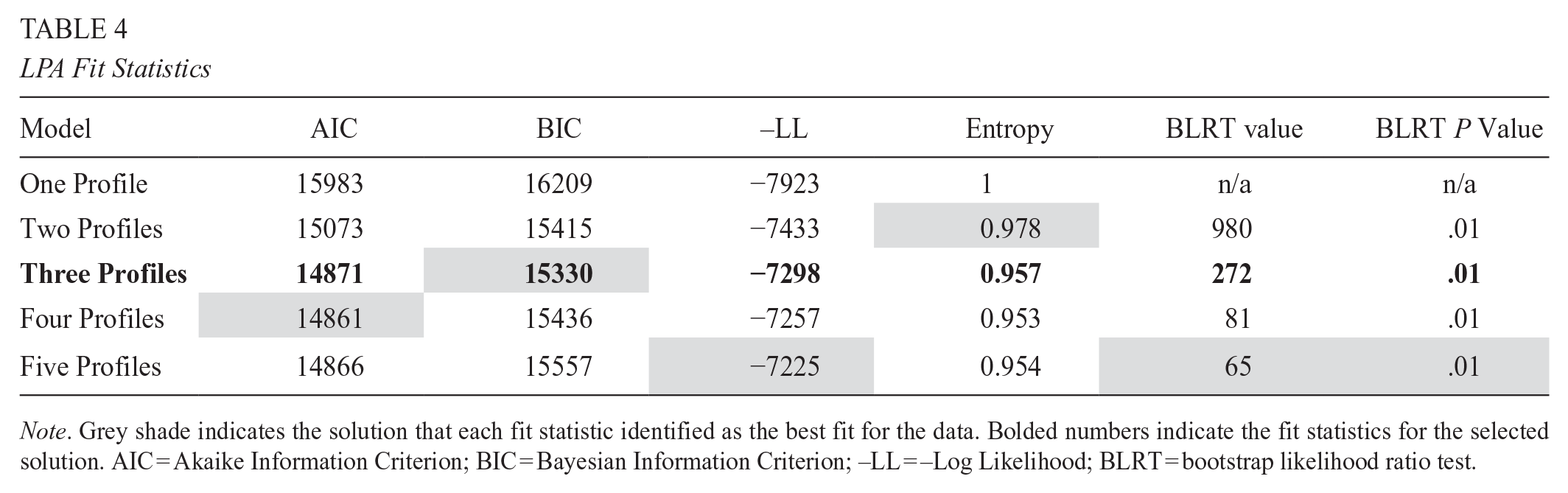

Note. Grey shade indicates the solution that each fit statistic identified as the best fit for the data. Bolded numbers indicate the fit statistics for the selected solution. AIC = Akaike Information Criterion; BIC = Bayesian Information Criterion; –LL = –Log Likelihood; BLRT = bootstrap likelihood ratio test.
To characterize the profiles (Research Question 2), we engaged in a series of descriptive models using ordinary least squares (OLS) regression with robust standard errors. Following the recommended practices in the literature (Bolck, et al., 2004; Nylund-Gibson, et al., 2019), we regressed each covariate described above onto the three profiles that emerged from our LPA using the three-step BCH approach, which accounts for the fact that teachers are placed into profiles with error; these teacher-level prediction errors are included as weights in the OLS regression.
Finally, we examine how teachers from different profiles are distributed across schools and districts (Research Question 3) to glean some information about teachers’ contexts. We begin with a descriptive analysis of the percentage of teachers from each profile in each district. We then focus on schools with three or more teachers from our sample, noting that our sample averages just 3.7 teachers per school across 55 schools. Given these small numbers, we need a segregation measure that can handle small samples while providing meaningful comparisons. The H-information theory index (Reardon & Firebaugh, 2002) serves this purpose by measuring how evenly teachers from each profile are distributed across schools. H compares each school’s composition to the overall sample composition, with values ranging from 0 (indicating teachers from different profiles are evenly distributed) to 1 (indicating complete separation of profiles). This analysis reveals whether teachers from different profiles share working environments or are clustered in separate schools, which could signal important differences in teachers’ workplace contexts.
Results
Overall, we found that teachers in our sample make up three distinct groups of teachers, based on the combinations of instructional practices that teachers emphasize and de-emphasize. We explain these results in the sections that follow. Throughout our results, we use the terms teacher “profile” and teacher “group” interchangeably.
LPA Results: Three Latent Teacher Profiles
Based on our LPA, we found three latent profiles that represent three distinct groups of teachers. We aimed to select the solution that represented both low AIC and BIC values and that also has a low log likelihood statistic, a sufficiently high Entropy (0.80 or above; Clark & Muthén, 2009), and a BLRT p value indicating a better fit of Model K relative to Model K-1 (Spurk et al., 2020). The fit statistics offered somewhat conflicting information about the best solution, but in practice the three-profile solution was clearly superior (Table 4). AIC indicated a four-profile solution, BIC indicated a three-profile solution, and log likelihood and BLRT indicated a five-class solution, with four- better than three-, and three- better than two-profile solution. The analytic hierarchy process (Akogul & Erisoglu, 2017) identified the best solution to be the three-class solution. Although some indices identified four- and five-profile solutions as superior to three, we found that the four-profile solution was exactly the same as the three-profile solution except that a fourth profile consisted of one teacher, and that the five-profile solution was exactly the same as the three-profile solution except the two additional profiles consisted of just one teacher each. Given that all model fit statistics indicated that three or more classes were preferable to two, that the three-profile solution had an Entropy statistic of 0.96 (well above threshold), the analytic hierarchy process selected the three-profile solution, and that there was no practical difference among the solutions with 3–5 profiles, we selected a three-profile solution.
Characterizing Profiles Based on Emphasized and De-Emphasized Practices
Each profile of teachers is distinct based on the combinations of teaching practices that teachers in the group emphasized and de-emphasized, which are apparent in Figure 2. In that figure, we provide two visualizations to aid in characterizing these groups. In the first (Figure 2a), we plot teachers’ reported frequency of engagement with each practice for each group. These data represent the group means for each item of teachers’ observed (raw, uncentered) survey values. For example, if a teacher selected “About half of lessons,” their observed value is 2. Averaging all teachers’ observed values within a group for each item provides the values plotted in Figure 2a.

Frequency and Relative Emphasis of Reported Practices: (a) Reported Frequency of Practices and (b) Relative Emphasis of Reported Practices
Figure 2b is based on the centered Likert score, where we removed the teacher’s global mean across all items in the survey responses; these centered response items are what we used for the LPA analysis. Then, using the centered data, we take the mean for each item for each teacher profile and plot those means. Mean emphasis is a within-group indicator, meaning that for each group we can observe which specific survey item (i.e., instructional practice) that group emphasizes relative to the group’s overall level of emphasis. For instance, a zero on the y-axis in Figure 2b means that, for teachers in the profile, they use that instructional practice at the same frequency that they use all instructional practices on average—it is the profile’s average frequency of use of that instructional practice. Consequently, we consider items with mean emphasis falling below zero to be de-emphasized, on average, by teachers in that group, and items with mean emphasis falling above zero to be emphasized, on average, by teachers in that group.
As can be seen, Figure 2b is a translation of 2a, with each profile shifted vertically by its own average (i.e., its own fixed effect). We provide Figure 2a and 2b side-by-side because knowing teachers’ reported frequency of engagement in each practice (Figure 2a) helps us to more meaningfully interpret their relative emphasis/de-emphasis of reported practices (Figure 2b). For example, in Figure 2a, the average response for the CMT profile on the item “Design a lesson that shows how different cultural groups use mathematics” (Item 12) was 0.168—corresponding to somewhere between “never” and “a few lessons” on our Likert scale. Figure 2b shows that the Classical Mathematics-Focused Teacher (CMT) profile’s centered mean for this same item was −1.51—indicating that, relative to that group’s mean reported frequency, teachers in this profile de-emphasize this particular practice. Together, these figures tell us (1) the raw average value for each profile on each item (Figure 2a) and (2) the relative value for each profile on each item, oriented around teachers’ mean reported frequency across practices. In what follows, we draw on both visuals to characterize the resulting groups, which we also summarize in Table 5.
Interpreting Teacher Profiles: Practices Emphasized and De-Emphasized

Classical mathematics-focused teachers
The first group of teachers—a group we have termed Classical Mathematics-Focused Teachers (CMTs; Table 5)—are teachers who dramatically emphasized practices aligned with classical mathematics knowledge, including both ambitious and traditional practices, well above CR teaching practices. The differences in emphasis in this group were particularly stark, which is evident in this group having the largest range of centered values (range = −1.510 to 1.163; see Appendix, Tables A2–A3 for numeric values for each item for each group).
This group emphasized almost all classical mathematics practices across ambitious and traditional domains. Among those highly emphasized practices were ambitious practices including engaging in grade-level mathematics for the majority of classroom time (Item 13; mean emphasis = 1.163), using mathematical language/symbols appropriately when communicating about mathematics (Item 14; mean emphasis = 1.084), applying mathematics to solve problems in real-world contexts (Item 15; mean emphasis = 0.906), and focusing on conceptual understanding of mathematics (Item 16; mean emphasis = 0.817). Notably, these teachers emphasized traditional practices alongside ambitious ones, although to a lesser extent. These traditional practices included providing direct instruction (Item 29; mean emphasis = 0.648), having students work independently (Item 30; mean emphasis = 0.549), and having students learn or practice basic facts, concepts, and procedures (Item 31; mean emphasis = 0.302), which may reflect findings in the literature that teachers engage in ambitious practices alongside traditional ones (Hill et al., 2018).
While CMTs de-emphasized a handful of ambitious and traditional practices, the only practice that they de-emphasized in a meaningful way was engaging students in extended learning activities (Item 28; mean emphasis = −0.867). In terms of frequency, CMTs reported engaging in this practice at a level equivalent to less than a few days on the Likert scale (mean reported frequency = 0.821; see Figure 2a). No other classical mathematics practices came close to that level of de-emphasis.
Overall, CMTs clearly de-emphasized CR teaching practices. In total, this group had 14 practices that fell below zero in emphasis (i.e., the group mean, below which indicates de-emphasis relative to the mean; Figure 2b). Of those 14 practices, nine were CR teaching-related. Furthermore, the observed values of reported frequency (Figure 2a) suggest that CMTs reported, on average, engaging in a majority of CR practices (Items 6–12) in just a few lessons, at most. In addition, the least emphasized practices in this group corresponded to the CR practices that require substantial effort to understand and be responsive to students’ cultural identities (e.g., designing a lesson that shows how different cultural groups use mathematics—mean emphasis = −1.510) and/or critical knowledge of bias, prejudice, and cultural representation (e.g., identifying cultural biases in textbooks or other instructional materials for mathematics—mean emphasis = −1.431; analyzing instructional materials for potential stereotypical and/or prejudicial content—mean emphasis = −1.381; revising materials to include a better representation of cultural groups—mean emphasis = −1.233).
In sum, the CMTs emphasized classical mathematics practices in their self-reports, including both ambitious and traditional practices, and highly de-emphasized most CR practices, especially practices requiring criticality and cultural knowledge of their students.
Engagement and classical mathematics-focused teachers
The second group of teachers—which we call Engagement and Classical Mathematics-Focused Teachers (ECMTs)—are teachers who, like CMTs, emphasized most classical mathematics practices, and also emphasized engagement-focused CR practices. The differences in emphasis in this group were less stark than CMTs, evident in the smaller range of their centered values (range = −1.321, 0.824) and much less drastic dips in their trendlines (Figure 2).
Regarding classical mathematics, ECMTs emphasized many of the ambitious and traditional practices that CMTs emphasized. Notably, ECMTs’ top emphasized practices were identical to CMTs’ top emphasized practices (Table 5)—for example, using mathematical language/symbols appropriately when communicating about mathematics (Item 14; mean emphasis = 0.824), engaging in grade-level mathematics for the majority of classroom time (Item 13; mean emphasis = 0.759), focusing on conceptual understanding of mathematics (Item 16; mean emphasis = 0.550), and applying mathematics to solve problems in real-world contexts (Item 15; mean emphasis = 0.405). Also, like CMTs, they strongly de-emphasized engaging students in extended learning activities (Item 28; mean emphasis = −0.966).
The key differences between CMTs and ECMTs are evident in their treatment of CR practices. Unlike CMTs, ECMTs emphasized half of CR practices (Figure 2b), including: using student interests to make learning meaningful (Item 3; mean emphasis = 0.389); using a variety of grouping strategies for small-group instruction (Item 2; mean emphasis = 0.308); using students’ cultural backgrounds to make learning meaningful (Item 7; mean emphasis = 0.098); having students from diverse cultural backgrounds work together (Item 1; mean emphasis = 0.066); and using examples of students’ cultural, historic, and everyday lived experiences (Item 5; mean emphasis = 0.034). Notably, using students’ interests to make learning meaningful and using a variety of grouping strategies (Items 3 and 2, respectively) were emphasized most. Taken together, this combination of practices suggests that these teachers prioritize adaptations to instruction to make it more meaningful and engaging for students.
At the same time, similar to CMTs, the lesser emphasized CR practices for this group include items that speak to criticality and deep cultural knowledge of their students—for example, designing a lesson that shows how different cultural groups use mathematics (Item 12; mean emphasis = −1.32); identifying cultural biases in textbooks or other instructional materials for mathematics (Item 11; mean emphasis = −0.434); and revising instructional materials to include a better representation of cultural groups (Item 9; mean emphasis = −0.370). However, these teachers did emphasize one critical practice: analyzing instructional materials for stereotypical/prejudicial content (Item 10; mean emphasis = 0.050). Interpreting these emphases alongside reported frequency in Figure 2a suggests that ECMTs reported engaging in most CR practices well above CMTs—nearly all of their de-emphasized CR practices had mean frequencies of 1.5 or above (corresponding to between “a few lessons” and “about half of lessons” on our Likert scale).
In sum, ECMTs emphasized classical mathematics alongside some CR teaching practices with much less dramatic differences in emphasis between most practices compared with CMTs. Yet, ECMTs did not emphasize all CR teaching practices. They tended to emphasize CR practices that foster engagement, while de-emphasizing most CR practices that require criticality and cultural knowledge. Notably, CR teaching scholarship highlights that a common misinterpretation of CR teaching is equating this paradigm for teaching exclusively to strategies for engaging students (Comstock, 2025; Sleeter, 2012).
Multidimensional equity-focused teachers
We call the final group of teachers Multidimensional Equity-Focused Teachers (METs) because of their engagement in practices that go beyond just classical mathematics and their limited variation in emphasis on different practices (Table 5), evident in their fairly stable trendlines in Figure 2, and their small range in mean emphasis (−0.347, 0.367). According to our definition of emphasis as items with a mean emphasis greater than zero and de-emphasis as means less than zero (Figure 2b), METs do emphasize certain practices above others. However, interpreting these values alongside their reported frequency of engagement in each of these practices, depicted in Figure 2a, we see that these teachers, overall, are engaging in all practices at a mean frequency of two or higher (a two on our Likert scale corresponds to “about half of lessons”). Furthermore, while CMTs and ECMTs de-emphasized some similar practices, as indicated by their low peaks—for example, designing a lesson that shows how different cultural groups use mathematics (Item 12) and having students work on extended learning activities (Item 28)—METs did not.
Finally, while we observed that both CMTs and ECMTs de-emphasize most or all practices oriented around criticality and cultural knowledge of their students, METs do not share this pattern. For instance, these teachers emphasized analyzing instructional materials for stereotypical/prejudicial content (Item 10; mean emphasis = 0.224), revising instructional materials to better represent cultural groups (Item 9; mean emphasis = 0.153), and designing a lesson that shows how different cultural groups use mathematics (Item 12; mean emphasis = 0.129; Figure 2b). In terms of reported frequency, METs had a mean for each of these items of greater than two (Figure 2a). METs did, however, de-emphasize one practice that is more critically oriented: identifying cultural biases in mathematics instructional materials (Item 11; mean emphasis = −0.157). (In fact, all three groups de-emphasized this practice.) However, again, in terms of reported frequency, METs had a mean of 1.976—very near “about half of lessons” on our Likert scale, meaning that METs report relatively less time identifying cultural biases relative to other instructional practices they pursue, but they are still incorporating this critical practice nearly half the time, on average.
In sum, METs differed markedly from CMTs and ECMTs. These teachers engaged in all practices at fairly high levels (Figure 2a) with relatively little variation in how much they emphasized different practices (Figure 2b). Overall, METs reported engaging in a range of instructional practices aligned with equitable mathematics, including practices aligned with classical mathematics knowledge and CR practices that require criticality and cultural knowledge of students (Aguirre & Zavala, 2013; Gutstein, 2016). Although our survey measures do not comprehensively attend to the cultural and critical domains of equitable mathematics, we interpret the METs’ relatively even emphasis across practices as an indication that these teachers appear to be more likely than teachers in our other two profiles to reflect a more comprehensive, multidimensional approach to equitable mathematics.
Looking across profiles
Overall, we found key patterns across groups in the combinations of instructional practices that teachers engaged in, emphasized, and de-emphasized. In Figure 3, we reorient profiles based on their engagement in practices that align with community/cultural, critical, and classical knowledge (including practices aligned with both ambitious and traditional mathematics; Gutstein, 2012). We are cautious not to over-interpret our data given our measurement limitations with respect to the community/cultural and critical domains. However, we do aim to draw attention to the distinctions across profiles, highlighting here: (1) how far CMTs are from practices indicative of community/cultural and critical knowledge, given these teachers’ low reported engagement in practices such as designing a lesson that shows how different cultural groups use mathematics; (2) ECMTs’ engagement in practices aligned with classical and some cultural dimensions, such as using students’ cultural backgrounds to make learning meaningful, but limited attention to practices aligned with critical knowledge such as identifying cultural biases in textbooks; and (3) METs’ multidimensional engagement. Given that we find some—albeit limited—indication that ECMTs and METs engage in cultural and critical practices, we situate these two groups on the cusp of different sections of our visual representation.

Visual Representation of Teacher Profiles.
Characteristics of the Three Profiles of Teachers
In addition to characterizing the instructional practices of teachers in our sample, we also sought to understand more about the teachers themselves and how they may differ across profiles. We synthesize key characteristics of each profile in Table 6 and explain them in more detail in the sections that follow.
Teacher Profile Distinguishing Characteristics

Multidimensional equity-focused teachers
METs—the group of teachers reporting multidimensional practices—had the greatest percentage of teachers of color than the other groups (83%; Table 6 and Table 7, Model 2). These teachers were also majority female (69%) and experienced teachers (only 14% novice teachers).
Descriptive Statistics by Profile.

Note. This table provides results from three ordinary least squares regression (OLS). OLS regression results are weighted following Nylund-Gibson et al. (2019) using the three-step BCH method (Bolck, et al., 2004). The reference group for each model is Classical Mathematics-Focused Teachers (N = 101). Model 1 regresses the indicator variable female on the two other teacher profiles. Model 2 regresses the indicator variable white teacher on the two other teacher profiles. Model 3 regresses the indicator variable novice teacher on the two other teacher profiles. Robust standard errors are in parentheses. Coefficients can be interpreted as the difference in percentage of female, white, or novice teachers in the teacher type compared to the Classical Mathematics-Focused Teachers. Equal provides the p value of the F-test that the mean values are statistically significantly different from each other.
p < 0.05, **p < 0.01, ***p < 0.001.
Interestingly, despite engaging most regularly in equity-focused practices, METs expressed the lowest levels of agreement with beliefs about CR teaching on average (Table 8, Model 2). These beliefs statements included items such as “culturally responsive practice is essential for creating an inclusive classroom environment” and “encouraging respect for cultural diversity is essential for creating an inclusive classroom environment.” Importantly, these teachers still agreed with beliefs statements about CR teaching on average; they just did not express the highest levels of agreement with these beliefs statements relative to the other groups. Thus, while these teachers implemented CR practices in their classrooms more than others, teachers in the other two profiles reported greater levels of beliefs in the importance of cultural diversity and cultural responsiveness than these teachers. Consistent with these findings, we also found a slight negative correlation between teachers of color and beliefs (−0.18). This finding is notable, as it may reflect social desirability of such items, which we discuss further below. We also note, however, that our CR teaching beliefs scale showed lower than ideal reliability (α = .56), so we interpret these beliefs findings with caution.
Teacher Survey Items By Profile

Note. This table provides results from six ordinary least squares regression (OLS). OLS regression results are weighted following Nylund-Gibson et al. (2019) using the three-step BCH method (Bolck, et al., 2004). The reference group is Classical Mathematics-Focused Teachers (N = 101). Note that in all models where a survey response is used as a dependent variable, the survey response is un-centered and in the observed Likert scale. Model 1 regresses the continuous variable confidence meeting student needs on the two other teacher profiles. Model 2 regresses the continuous variable CR teaching beliefs on the two other teacher profiles. Model 3 regresses the continuous variable CR teaching self-efficacy on the two other teacher profiles. Model 4 regresses the continuous variable curricular use on the two other teacher profiles. Model 5 regresses the continuous variable supplemental use on the two other teacher profiles. Model 6 regresses the continuous variable perceptions of curricular appropriateness on the two other teacher profiles. Robust standard errors are in parentheses. Coefficients can be interpreted as the difference in the mean survey scale value of the teacher type compared to the mean value of the Classical Mathematics-Focused Teachers. Robust standard errors are in parentheses. Equal provides the p value of the F test that the mean values are statistically significantly different from each other.
p < 0.05, **p < 0.01, ***p < 0.001.
On average, METs reported using their curricular materials less and using supplemental materials more than CMTs (Table 8, Models 4–5). This pattern aligns with the reported practices of these teachers—in particular, METs reported engaging in practices that required modification of instructional methods and materials (e.g., revising instructional materials to better represent cultural groups). Taken together, these findings indicate that METs may be adjusting their curricula and incorporating supplemental resources to be responsive to their students’ cultural identities. Also, given their focus on extended learning activities, which are rare in curricula, these teachers likely also need supplemental resources to plan for those extended activities.
Engagement and classical mathematics-focused teachers
ECMTs were about 48% White teachers, were majority female (74%), and had a significantly greater percentage of novice teachers than the other groups (26%; Tables 6 and 7), signaling that these teachers may have room to grow, especially related to CR teaching. These teachers also reported, on average, significantly greater levels of self-efficacy for CR teaching and confidence in meeting student needs (Table 8, Models 1 & 3), compared with CMTs. Finally, like METs, ECMTs reported significantly greater usage of supplemental materials in their instruction, compared with CMTs (Table 8, Model 5), which may also reflect their attention to making learning meaningful and engaging for their students by bringing in additional materials to bolster their curricula.
Classical mathematics-focused teachers
Finally, CMTs were majority White (62%), female (80%), and experienced teachers (only 7% with < 3 years experience; Tables 6; Table 9, Models 1–3). CMTs had the greatest percentage of White teachers of all groups. Despite their limited use and emphasis of CR teaching practices, CMTs reported significantly greater agreement with statements indicating beliefs about cultural diversity and CR teaching, compared with the other two groups (Table 9, Model 5). One explanation of this pattern could be the social desirability of the items themselves. Teachers took our survey in early 2020, at a time when attention to cultural responsiveness and equity were widely called for and not yet politicized in the widespread way we have seen since. At the same time, CMTs reported the lowest confidence with meeting student needs and self-efficacy with CR teaching of all groups (Table 9, Models 4 & 6), which may also account for the misalignment between their beliefs and reported practices. Another possible explanation of this mismatch is related to mathematics content in particular—our survey items measuring beliefs about CR teaching and cultural diversity were not specific to mathematics. Aligned with prior work that indicates common conceptions of mathematics as “culture-free” (Parker et al., 2017, p. 387), CMTs may believe that CR teaching and cultural diversity are important, but not in mathematics specifically. Finally, unlike the other two groups, CMTs often use their curricular materials, and use supplemental materials less often (Table 9, Models 7–8), which tracks with their limited engagement in CR practices around revising and adapting instructional materials.
Descriptive Statistics and Teacher Survey Items: Classical Mathematics-Focused Teachers

Note. This table provides results from nine ordinary least squares regression models (OLS). OLS regression results are weighted following Nylund-Gibson et al. (2019) using the three-step BCH method (Bolck et al., 2004). The reference group is teachers in ECMTs and METs (N = 104). Models 1 to 3 regress indicator variables female, White teacher, and novice teacher, respectively, on the Classical Mathematics-Focused Teachers indicator. Models 4 to 9 regress continuous mean scores of teacher surveys related for confidence meeting student needs, CR teaching beliefs, CR teaching self-efficacy, curricular use, supplemental curricular use, and perceptions of cultural appropriateness on the Classical Mathematics-Focused Teachers indicator. For Models 1 to 3, coefficients can be interpreted as the difference in percentage of female, White, or novice teachers in the teacher type compared to the ECMTs and METs combined. For Models 4 to 9, coefficients can be interpreted as the difference in the mean survey scale value of the Classical Mathematics-Focused Teachers teacher type compared to the mean value of the ECMTs and METs combined. In all models where a survey response is used as a dependent variable, the survey response is uncentered and in the observed Likert scale. Robust standard errors are in parentheses.
p < 0.05, **p < 0.01, ***p < 0.001.
Distributions of Teacher Profiles Across Districts and Schools
Teachers can vary in their use of CR teaching practice because of their own decisions to use such practices as well as broader contextual influences in their school, district, and policy environments. These contextual influences can both encourage and impede the use of CR teaching—for example, culturally responsive school leadership may promote and support CR teaching (Khalifa et al., 2016), whereas standardized testing pressure may impede teachers’ efforts to engage in CR teaching (Horn, 2018). Given these multiple potentially competing environmental factors, we focus on the variability of CR teaching practices across districts and within schools as evidence of how contextual factors may influence teacher practices.
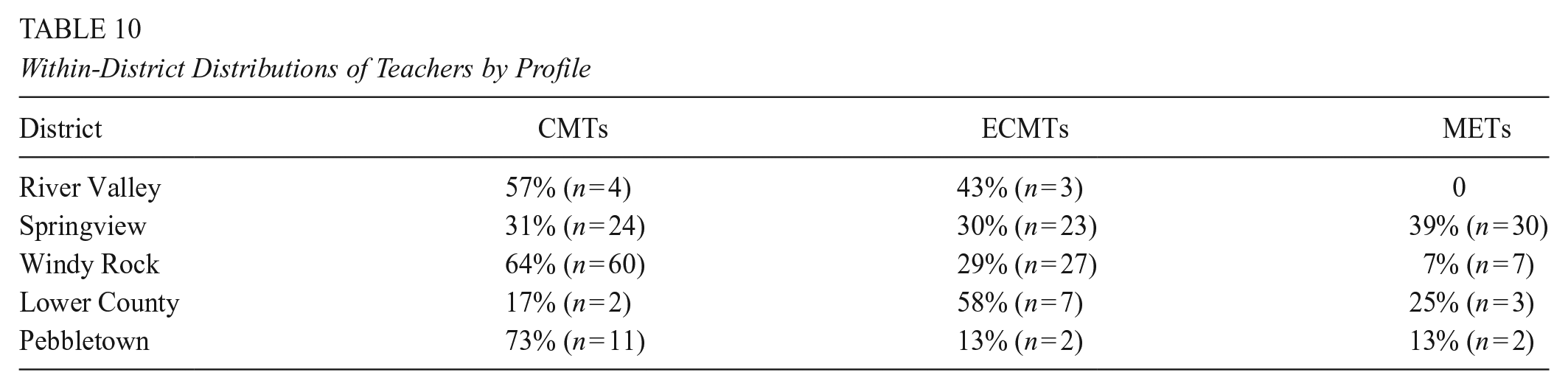
Regarding district-level distributions, we found some differences in the distributions of teachers across profiles in each district (Table 10). Most districts had fairly small numbers of participating teachers, so drawing firm conclusions from these distributions is challenging. However, the distributions within Springview and Windy Rock School Districts—the two districts with the largest number of participating teachers—are notable. Springview had a relatively even distribution of teachers in each profile, yet nearly all of the METs in the study work in Springview (n = 30 of the 42 METs). In contrast, Windy Rock had a more skewed distribution of teachers across profiles, with a majority of CMTs and very few METs. Without being able to draw causal claims, we note that the PL in Springview emphasized, in part, using instructional materials focused on relevant sociocultural issues (e.g., distributions of Covid-19 infections across communities of color). The concentration of METs in this district could indicate that the PL focus on providing teachers with concrete materials grounded in social justice were helpful for supporting CR teaching. In contrast, Windy Rock had relatively fewer METs, and this district’s PL emphasized making learning relevant to students’ interests with fewer examples and less attention to criticality.
Within-District Distributions of Teachers by Profile
Regarding the distribution of teachers across schools, the proportional analysis is less useful because we have as many schools as we have teachers belonging to specific profiles. Thus, we use the information H-index as described in the methods section. Here, our assumption is that if CR teaching practices are generally invariant across schools—that is, if, for example, CMTs are concentrated in the schools in which they teach—this could be evidence that school environmental factors deeply shape and privilege certain teaching practices. If, conversely, CR teaching practices are generally evenly distributed across schools—that is, if, for example, CMTs are represented across schools—this could be evidence that teacher preferences play a larger role in teaching decisions. When we restrict our sample to schools with at least three teachers, this leaves us with two school districts: Springview and Windy Rock. We found that CMTs and ECMTs show relatively low segregation (H = 0.20 and 0.19)—that is, they are relatively evenly spread across schools. METs show greater segregation (H = 0.34), a pattern we observed earlier when looking at district concentration.
Given that the H-index does not have a clean interpretation, we also calculate segregation levels for other teacher characteristics that prior literature suggests may be subject to school sorting processes—specifically, teacher race/ethnicity (i.e., teachers of color vs. White teachers) and experience (i.e., novice teachers vs. more experienced teachers)—which can be used for comparison. The segregation levels we observe for teaching practices are substantially lower than racial segregation among teachers (H = 0.72) but comparable to novice-experienced teacher segregation (H = 0.31). Thus, compared to these other indicators, we might conclude that teacher profiles are relatively evenly distributed across schools in our sample. Still, those teachers who report engaging most frequently in CR teaching show greater clustering in certain schools, which may signal the importance of supportive collegial environments, leadership, and curriculum development for CR teaching.
Limitations
Several limitations to our study should be considered. Most importantly, our survey instruments do not offer comprehensive coverage of the community/cultural and critical domains of Gutstein’s (2006, 2012) framework. As theorized, the community/cultural domain encompasses community concerns, such as gentrification, and how these concerns can be taken up with and through mathematics. Likewise, the critical domain is concerned with issues of social justice and empowerment. The broader study—of which this analysis is one component—focused on ambitious and traditional mathematics that attended to students’ cultural identities, and, as such, our measures were not initially developed to be in alignment with Gutstein’s domains. Although our items allow us to gauge how much teachers reported critiquing their instructional materials for prejudice and bias, they are limited in their coverage of community/cultural and critical domains. Still, our analysis directed us to Gutstein’s framework because of the nuanced distinctions we saw between teacher profiles in their reported engagement with CR practices, and we found it notable that only one group of teachers—METs—reported engaging in practices across domains. We see our contribution to be an emergent typology of current equity-oriented mathematics approaches that can and should be extended through: (1) the development of more comprehensive survey measures and (2) more work that examines broad patterns in not just whether teachers engage in CR teaching, but which dimensions of CR mathematics teachers emphasize more than others.
Related, there are inherent limitations to using survey data to examine teacher practices. First, these measures are subject to respondent bias and social desirability, especially surveys about cultural competence (Larson & Bradshaw, 2017). To alleviate some of this bias, we rely on behavior-based measures of teacher instruction, which prior work has shown to be a valid and reliable way of measuring teacher practice (Desimone, 2009; Mayer, 1999). Moreover, by using teacher-centered items for the construction of profiles we remove any systematic over-response bias present in teachers, although this process does not remove over-response bias if such response patterns are associated with CR-specific items. Second, our beliefs survey items do not focus on CR teaching behaviors in mathematics specifically. This is important, given that prior work that has shown strong misconceptions among mathematics teachers that CR teaching does not apply to mathematics (e.g., Parker et al., 2017). In addition, our beliefs scale demonstrated less-than-ideal reliability with an alpha of α = .56. Future measurement and empirical work should examine teachers’ reported beliefs on scales about CR teaching more generally, such as ours, as well as CR teaching in mathematics specifically, as this may strengthen existing measures and reveal important nuances that our scales could not capture.
Finally, survey analysis requires operationalizing very complex phenomena, such as equitable mathematics teaching, race/ethnicity, and gender, into concrete items. Ambitious mathematics and CR teaching instruction represent robust teaching philosophies, the complexity of which is lost when boiled down to a list of practices. Still, we argue that attempting to understand broad patterns in teachers’ engagement with these practices—including their subdimensions—is a useful line of inquiry, as it can serve as a starting point to tailor PL to common misunderstandings and beliefs. We also note that teachers were not evenly distributed by race among our PL partnerships: A majority of teachers of color in our sample taught in one district, while a majority of White teachers taught in another. While consistent with prior literature (e.g., Sleeter, 2001; White et al., 2020; Young, 2010), our findings about the association between race and instruction may reflect differences in district contexts. Finally, given sample size limitations, we use crude measures of race/ethnicity (grouping all minoritized teachers together) and gender (using a strict binary of female/male). We acknowledge that neither of these measures is ideal. Using a race/ethnicity measure that groups all minoritized teachers is not reflective of the diversity of experience and identity across teachers of different racial/ethnic backgrounds and vastly oversimplifies race/ethnicity, and using a gender measure that recognizes two categories is not reflective of the range of gender identities individuals may hold.
Discussion and Implications
In this study, we aimed to understand how teachers integrate different dimensions of equitable mathematics instruction, based on teacher reports, and what factors help to explain those patterns. In doing so, we make critical contributions to the literature by identifying broad patterns in teachers’ engagement in CR mathematics teaching.
Ultimately, our framework and methods allow us to contribute to the field an emergent typology for characterizing teacher engagement with CR teaching in mathematics that can guide future scholarship and practice in understanding and supporting teachers with CR mathematics teaching. Critically, one-half of teachers in our sample—the CMTs, who were predominantly White, experienced teachers—reported rarely, if ever, engaging in CR practices, focusing only on classical mathematics through a mix of ambitious and traditional practices. About a third of teachers—the ECMTs—emphasized some CR practices alongside ambitious and traditional practices, but seemed to relegate CR teaching to engagement strategies. Critically, less than one-quarter of teachers—the METs, who were predominantly teachers of color—engaged in a multidimensional set of practices that span ambitious mathematics, and some practices that require cultural knowledge and criticality. Despite low emphasis on CR practices overall, there may be room for growth: teachers who de-emphasize CR teaching reported believing in it but having low self-efficacy for it, suggesting that supports tailored to building teachers’ self-efficacy for CR teaching—and their criticality—offer promise (Comstock et al., 2023). Furthermore, we found some clustering of teachers based on profile in certain districts, and while teachers from each profile were fairly evenly spread across schools, teachers engaging most in CR teaching are more often clustered in schools than teachers in the other groups. We situate these findings in the literature and offer implications for policy and practice in the sections that follow.
Teachers’ Engagement in Ambitious, Traditional, and CR Practices
Overall, we found that teachers in our sample make up three distinct groups of teachers based on the combinations of instructional practices that they emphasize and de-emphasize. Teachers in all three groups emphasized classical mathematics through a blend of both ambitious and traditional practices. Our findings resonate with prior work that has shown that teachers take up ambitious practices within traditional formats, such as engaging students in cognitively demanding tasks within a teacher-directed format (e.g., Hill et al., 2018; Litke, 2020).
The key distinctions among our three groups were around whether and how they integrated CR practices alongside practices aligned with classical mathematics. Only one group of teachers—METs—reported engaging in multidimensional practices that spanned ambitious mathematics and some practices that require cultural and critical knowledge. This group was the smallest (N = 42), representing less than one-quarter of the teachers in our sample. They also were predominantly teachers of color, which reflects the notion that teachers of color bring greater multicultural knowledge to their teaching than White teachers (Blazar, 2021; Comstock et al., 2023; Sleeter, 2001; White et al., 2020).
In contrast, CMTs, who tended to be White and experienced teachers, clearly de-emphasized CR teaching practices, and ECMTs, who tended to be novice teachers, reported emphasizing only some CR practices—in particular, those that focused on engagement—while de-emphasizing most CR practices that were more specific and required criticality and cultural knowledge. This finding suggests that ECMTs might reflect misinterpretations of CR teaching documented in the literature—specifically, that CR teaching is often misunderstood to be practices purely for the purpose of engagement, rather than a critical approach that speaks to deep understanding of students’ cultural identities and demands critical consciousness (Comstock et al., 2023; Sleeter, 2012). The fact that both CMTs and ECMTs (totaling over three-quarters of our sample) de-emphasized dimensions of CR teaching, especially those that attend to cultural knowledge and criticality, provides evidence that patterns from small-scale case study research occur on a much broader scale: teachers most commonly overlook CR practices requiring critical knowledge (Aguirre & Zavala, 2013; Gutstein, 2012; Powell et al., 2016; Young, 2010). This finding speaks to the importance of supporting teachers both to understand and develop these dimensions of CR teaching. Notably, given that ECMTs were more often novice teachers, there may be room for improvement as they continue honing their craft.
Also notable across groups were patterns in groups’ reported beliefs about CR teaching and cultural diversity. Although beliefs are central to CR teaching (Gay, 2018), teachers who hold beliefs aligned with CR teaching do not necessarily engage in CR teaching practices (Civitillo et al., 2019; Guerra & Wubbena, 2017), which was reflected in our findings. CMTs reported the highest agreement with beliefs about CR teaching and cultural diversity despite reporting very little engagement with and emphasis on CR teaching practices. The fact that our beliefs survey items were not specific to CR teaching in mathematics suggests that CMTs may agree with CR teaching generally, but perhaps not in the context of mathematics (Parker et al., 2017). This finding underscores the importance of ensuring that mathematics teachers understand that attending to the cultural and critical dimensions of CR teaching is just as important in mathematics as other subjects (Gutstein, 2012; Nasir et al., 2008).
It also may be important to consider these beliefs findings alongside our self-efficacy findings. ECMTs reported the highest self-efficacy for CR teaching, above even METs. This discrepancy may reflect the concept of intellectual humility—“recognizing the limits of one’s knowledge” (Porter & Schumann, 2018, p. 139). METs—as potentially more knowledgeable and experienced with CR teaching—may have a better understanding of what it takes to do CR teaching well. ECMTs, on the other hand, might have less developed understanding of CR teaching and thus a weaker sense of what it takes to engage in CR teaching more robustly. CMTs, on the other hand, reported the lowest self-efficacy for CR teaching. Together with our results about beliefs, CMTs may believe in CR teaching but simply do not know how to do it. Importantly, as Young (2010) and others have pointed out, studies of teachers’ self-efficacy for CR teaching (e.g., Siwatu, 2007) often overlook the critical consciousness dimension of CR teaching. Using Gutstein’s (2006) framework, we draw attention not just to the extent to which different groups attend to certain critical dimensions of CR teaching, but also the relationship between self-efficacy and teachers’ reported engagement in these dimensions of CR teaching.
Finally, although our data are limited in allowing us to discern patterns between teacher practices and their contextual environments, we draw on our exploratory descriptive analysis of the distributions of teacher profiles across schools and districts to generate hypotheses about teachers’ environments. Prior work suggests that teachers’ school, district, and policy environments play an important role in shaping teacher instruction, including teachers’ engagement in CR teaching (e.g., Comstock, 2025; Horn, 2018; Khalifa et al., 2016). In our distributional analysis, we found district-level concentrations of teachers—especially for MET teachers—but a more even distribution of teacher types across schools, with METs still most clustered relative to the other teacher profiles.
These school-level findings suggest that the working environments of individual schools in our sample do not systematically restrict teachers from engaging in CR teaching on a broad scale—and, indeed, each district we examined had some emphasis on CR practices in their PL initiatives. Still, the fact that METs were most clustered relative to other teacher profiles indicates the importance of teachers’ working environments: it could be that METs are drawn to certain schools because they encourage CR teaching in alignment with those teachers’ beliefs. It also could be that teachers in those schools benefit from relationships with colleagues who prioritize CR teaching.
The clustering of MET teachers in districts signals the importance of district context. First, the PL in Springview School District emphasized, in part, using instructional materials focused on relevant sociocultural issues (e.g., distributions of Covid-19 infections across communities of color), and this is where most of the MET teachers in our sample work. This finding could indicate that this district’s PL focus on providing teachers with concrete materials grounded in social justice were helpful for supporting CR teaching. In contrast, the PL Windy Rock emphasized, more vaguely, making learning relevant to students’ interests, and this district has very few MET teachers relative to CMTs and ECMTs. Although we cannot draw causal claims about the effects of districts’ policies and PL initiatives, our findings offer exploratory considerations to inform systematic analyses on the role of PL design around CR teaching and district context in ultimately shaping the nature of teachers’ engagement in CR teaching. Future studies should examine more systematically the relationship between the nature of engagement in CR teaching and teachers’ contextual environments (e.g., see Comstock, 2025; Pagán, 2022), including the nature of PL activities teachers have access to, how leaders and policies support CR teaching (or not), and the extent to which PL communities in teachers’ schools are open to new ideas and practices—all of which may affect teachers’ engagement in CR teaching.
Implications for Policy and Practice
Our findings resonate with prior work and theory that characterizes cultural relevance and responsiveness as a disposition (Comstock et al., 2023; Seriki & Brown, 2017). This study underscores that when supporting teachers with equitable mathematics instruction, the field should consider not just the technical details of teaching (e.g., how to engage students in cognitively rigorous tasks), but also teachers’ development of the cultural and critical knowledge required for CR teaching. Although some teachers may have this knowledge already, our results suggest that we need more information about teachers’ cultural and critical knowledge, as well as supports for developing that knowledge. In particular, our findings speak to the importance of PL opportunities that engage teachers in critical reflection of their beliefs, while also developing their self-efficacy for CR teaching. If low self-efficacy accounts for why teachers, such as the CMTs, report high agreement with beliefs about CR teaching and cultural diversity, but low engagement in CR teaching practices, then a practical intervention school leaders could take would be to improve educators’ self-efficacy for CR teaching.
Furthermore, the fact that teachers tended to integrate different combinations of practices suggests that PL might be most productive if it builds on the ways teachers are already taking up particular practices. In this way, PL could cater to the specific practices that teachers do not already engage in. Further, understanding how teachers integrate multiple teaching approaches could inform productive coaching models. For instance, METs could be paired with ECMTs to offer support that is tailored to the CR practices that ECMTs de-emphasized. If schools leverage METs, they should also recognize these teachers for their labor to avoid the “identity taxation” that teachers of color often experience when their supports—especially supports that reflect their racialized identities—go unrecognized (Hirshfield & Joseph, 2012). Such an approach focuses on the productive practices that teachers are already engaging in and positions METs as teacher leaders with expertise to support their colleagues’ development. It is also notable that teachers who tended to emphasize some CR practices (METs and ECMTs) also reported supplementing their curricula, which aligns with ideas from CR teaching that tailoring instruction to students’ cultural identities and backgrounds demands curricular adaptation (Gay, 2002). These findings indicate that schools, districts, and curriculum developers might consider ways to support these kinds of adaptations.
Our findings also suggest that rather than focus PL on only one teaching approach (e.g., ambitious mathematics), teachers may benefit from PL that specifically aims to show how ambitious and CR teaching approaches can be integrated. As more districts consider offering teachers PL on CR teaching, they should consider PL that puts CR teaching in conversation with other demands for mathematics teaching (e.g., conceptual rigor) and makes explicit how these approaches can coexist and complement one another. This implication resonates with scholarship that suggests that CR teaching in mathematics can be particularly challenging, and few strong examples of CR teaching in secondary mathematics exist (Parker et al., 2017). By offering teachers explicit examples of how CR teaching integrates with rigorous mathematics instruction, while also supporting the development of the beliefs, mindsets, and self-efficacy required for CR teaching, districts might better support teachers to effectively engage in equitable mathematics.
Finally, our findings offer broad descriptive patterns in the nature of teachers’ reported engagement with CR teaching in mathematics, with some indication of how practices vary across contexts, resonating with prior work that highlights the importance of teachers’ contextual environments in shaping their practice. Scholars of CR teaching and practitioners who support CR teaching should leverage opportunities to understand the contextually rich work of CR teaching through qualitative and mixed-methods studies of how teachers’ contexts shape their instructional decisions. Such work would further strengthen the field’s understanding of how best to support culturally responsive instruction and culturally responsive school systems.
Footnotes
Appendix
Teaching Items and Profiles’ Emphasis and De-Emphasis: Classical Mathematics Practices (Ambitious & Traditional)


|
Note. CMT = Classical Mathematics-Focused Teachers (n = 101); ECMTs = Engagement and Classical Mathematics-Focused Teachers (n = 62); METs = Multidimensional Equity-Focused Teachers (n = 42). Mean emphasis is a within-group indicator; each group has its unique range, which is necessary for interpreting how large or little the emphasis is for that group. Ranges are: CMTs = (−1.321, 1.163); ECMTs = (−1.321, 0.824); METs = (−0.347, 0.367). Green highlight indicates CMT values, red highlight indicates ECMT values, and blue highlight indicates MET values.
Funding
The authors disclosed receipt of the following financial support for the research, authorship, and/or publication of this article: This research was supported by the Bill & Melinda Gates Foundation grant INV-000745 and the Institute of Education Sciences, U.S. Department of Education, through Grant R305B200035 to the University of Pennsylvania.

Notes
Authors
MEGHAN COMSTOCK is an assistant professor of education policy at the University of Maryland, College Park. Using a range of methodologies, she studies the implementation and politics of equity-oriented education reforms and policies related to teaching, leadership, and cultural responsiveness.
KENNETH A. SHORES is an associate professor specializing in education policy in the School of Education at the University of Delaware. His research encompasses both descriptive and causal inference and is focused on educational inequality, including racial/ethnic and socioeconomic inequality in test scores, school disciplinary policy, classification systems, school resources, and school finance.
ERICA LITKE is an associate professor of mathematics education at the College of Education and Human Development at the University of Delaware. Her research focuses on understanding and improving instructional quality in mathematics, supporting teachers to enact ambitious and equitable mathematics instruction, and connecting instructional practice in mathematics to broader policy-related issues in education.
LAURA M. DESIMONE is Director of Research for the College of Education and Human Development at the University of Delaware, and L. Sandra and Bruce L. Hammonds Professor, Education and Social Policy and Educational Statistics and Research Methods. She studies policy effects on teachers and students, with an emphasis on studying what makes professional learning effective for supporting productive change in the classroom.
CAMILA POLANCO is a doctoral student in Human Development and Family Sciences in the College of Education and Human Development at the University of Delaware. Her research interests include prevention programming for at-risk youth and social-emotional skill development.
KIRSTEN LEE HILL leads a private research firm that supports organizations with measurement and evaluation. She leverages her background in research-practice partnerships, evaluation, and survey design to make research accessible and meaningful for practitioners working in the social good space.