




Abstract
Persistent social inequities in the United States demand attention to culturally responsive (CR) teaching, which requires a specific disposition toward students and teaching. Using survey data of secondary teachers (N = 417) in seven urban districts across the country engaging in equity-oriented professional learning (PL) initiatives, we examine the relationship between teachers’ beliefs about, self-efficacy for, and engagement in PL around CR teaching and their self-reported CR teaching practices. We find correlational evidence that teacher-reported self-efficacy with CR teaching and engagement in PL focused on CR teaching are associated with higher self-reported frequency of CR teaching. We also find that teachers who have beliefs aligned with CR teaching have a stronger relationship between their CR teaching self-efficacy and self-reported CR teaching practices. Finally, we find evidence that changes in CR teaching self-efficacy are associated with changes in self-reported CR teaching—suggesting that CR teaching self-efficacy may drive changes in CR teaching.
Keywords
Introduction
Persistent social inequities and the increasingly diverse U.S. student population create an imperative for teachers to enact culturally responsive (CR) orientations toward instruction (Gay, 2010; Irwin et al., 2021). CR teaching is instruction that leverages students’ cultural assets (Gay, 2010). Although multiple frameworks for culturally relevant, responsive, and asset-based pedagogies exist (e.g., Banks & Banks, 1995; Gay, 2010; Ladson-Billings, 1995; Paris, 2012), such teaching generally emphasizes three tenets: (a) supporting students’ academic success; (b) supporting students to understand, value, and sustain their own cultural identities; and (c) supporting students to critique social injustice (Gay, 2010). Findings from a rich literature base suggest that CR teaching offers a holistic educational experience for all students, one that can enhance motivation, connectedness to school, and learning (e.g., Aronson & Laughter, 2016; Gay, 2010).
Importantly, CR teaching is not just a set of instructional practices but a teaching approach that requires a particular disposition toward students and teaching. Drawing on conceptual scholarship on CR teaching and teaching dispositions (e.g., Borko et al., 2007; Howard & Rodriguez-Minkoff, 2017; Seriki & Brown, 2017), we argue that a CR disposition includes (a) teachers’ beliefs about students, teaching, and cultural diversity (Civitillo et al., 2019; Gay, 2010; Seriki & Brown, 2017) and (b) teachers’ self-efficacy for CR teaching (Gay, 2010; Groulx & Silva, 2010; Siwatu, 2007). We operationalize teachers’ beliefs about CR teaching (henceforth “CR beliefs”) as their perceptions of the importance of CR teaching, cultural diversity, and race-consciousness in teaching. We operationalize CR teaching self-efficacy (henceforth “CR self-efficacy”) as teachers’ reported confidence with engaging in a range of CR teaching practices, such as creating positive relationships in the classroom and using students’ cultural backgrounds to make learning meaningful. Although CR teaching scholarship supports the importance of teachers’ CR beliefs and CR self-efficacy (Gay, 2010), existing studies are primarily small-N case studies, and studies on CR self-efficacy often focus on preservice teachers (e.g., Groulx & Silva, 2010; Siwatu, 2007).
Furthermore, a CR disposition is informed by teachers’ teaching and life experiences and racial identities. Teachers’ self-efficacy for and use of CR teaching practices may differ by their racial/ethnic identities, cultural backgrounds, or years of experience (e.g., Carey et al., 2018; Cruz et al., 2020; Gay, 2010; Milner, 2006; Siwatu, 2011b; Sleeter, 2001) as well as their access to and engagement with professional learning (PL) designed to support CR teaching practices (Parkhouse et al., 2019).
In this study, we complement existing scholarship by drawing on survey data from a large, racially/ethnically diverse sample of middle school teachers across seven large U.S. school districts engaged in PL around equity-focused curricular reform efforts. We descriptively examine the relationship between teachers’ CR beliefs, CR self-efficacy, and engagement in PL around CR teaching and their reported enactment of CR teaching. We also examine whether changes in these constructs over time are associated with changes in self-reported CR teaching. Finally, we examine which self-reported CR practices are more or less common and about which teachers feel more or less self-efficacious, with important implications for shaping teacher support and PL. To do this, we ask:
How do teachers’ CR beliefs, CR self-efficacy, and PL engagement relate to self-reported CR teaching? Does having strong beliefs moderate the relationship between CR self-efficacy and self-reported CR teaching?
To what extent is change in beliefs about CR teaching and cultural diversity, CR self-efficacy, and PL on cultural responsiveness associated with change in self-reported CR teaching?
What self-reported CR teaching practices do teachers report feeling most self-efficacious with and using most frequently?
Study Context
Data come from a larger study of 12 curricular-aligned PL partnerships funded by an education-focused philanthropic foundation. Partnerships were funded to enact 2-year initiatives, beginning in the summer of 2019. Each partnership included a school district and an external organization (e.g., PL provider, curriculum developer) and was organized around providing curriculum-embedded PL to teachers, coaches, and other stakeholders. Participating districts served student populations that were at least 50% Black or Latinx, multilingual learners, or students from low-income families. The stated goals of the partnership initiative were to enact curriculum-aligned PL in mathematics, science, or English language arts (ELA) in ways that support improved student learning and student outcomes, particularly for students who have been historically marginalized. Examples of PL topics included reviewing the specifics of the site’s adopted curriculum, adapting the curriculum to be culturally responsive, and analyzing student work to address deficit thinking and implicit bias among teachers. We focus this study on seven of the partnerships because these partnerships participated in our first and second survey administrations and thus allow us to examine cross-sectional and longitudinal relationships in CR beliefs, CR self-efficacy, PL, and CR teaching. The study context allows us to pursue these questions in the context of racially and linguistically diverse public school districts that have committed to improving instruction along these lines in the hopes of developing more equitable outcomes for students.
Conceptual Framework
As depicted in our conceptual framework (Figure 1), we assert that to engage in CR teaching, teachers must have a CR disposition, which comprises CR beliefs about students, race, and cultural diversity and CR self-efficacy (Bandura, 1977; Gay, 2010; Ladson-Billings, 1995). The conceptual scholarship on CR teaching identifies that a key problem with how CR teaching has been enacted is that schools have taken a “reductionist” approach—reducing CR teaching to a set of instructional practices without interrogating the aspects of teacher disposition so central to CR teaching (Seriki & Brown, 2017). Ladson-Billings (1995) focuses on a set of beliefs and conceptions about students, teaching, and race that teachers should have to effectively engage in CR teaching. Reviewed in more detail below, these beliefs include holding high expectations of students’ capabilities and understanding race as an important aspect of individual identity and sociocultural importance. Seriki and Brown (2017) equate this set of beliefs to a “culturally relevant disposition” (p. 3). Importantly, however, other scholars of asset-based and CR pedagogies also highlight that a key aspect of successful CR teaching is teachers’ beliefs about their own capabilities of engaging in CR teaching—their CR self-efficacy (Gay, 2010, 2018; Siwatu, 2007). Thus, our conception of a CR disposition includes teachers’ beliefs about cultural diversity and race, students, and teaching as well as their self-efficacy for engaging in such pedagogy.

Conceptual framework.
Based on prior literature, we hypothesize that teachers’ CR beliefs and self-efficacy are positively associated with their self-reported use of CR teaching (Gay, 2010; Ladson-Billings, 1995; Zee & Koomen, 2016), depicted by the arrows connecting these constructs to CR teaching in Figure 1. We also hypothesize that the relationship between CR self-efficacy and teachers’ reported use of CR teaching is strongest when teachers believe in the importance of cultural diversity and the major tenets of CR teaching—depicted by the arrow from beliefs to the line connecting self-efficacy and CR teaching, indicating an interaction effect. Finally, we hypothesize that a CR disposition and CR teaching are influenced by key aspects of teachers’ identities and experiences: teachers’ racial/ethnic identities, their years of experience as a teacher, and PL that supports teacher learning related to CR teaching (Parkhouse et al., 2019)—indicated by the arrows connecting teacher identity and experiences to CR disposition and CR teaching.
Because our aim in this study is to understand how CR beliefs, CR self-efficacy, and PL relate to CR teaching and the interaction between CR beliefs and CR self-efficacy, we focus on the bolded paths in our conceptual framework. Importantly, although these relationships are likely recursive—where, for example, more experience with CR teaching builds self-efficacy—we are interested in testing particular hypotheses, supported in the literature, that CR beliefs, CR self-efficacy, and PL can work to foster CR teaching.
Literature Review: CR Teaching as Disposition
CR teaching scholarship speaks to the importance of understanding CR teaching as not just a set of pedagogical moves but a disposition toward teaching and learning (Seriki & Brown, 2017). Attention to general teacher dispositions became a focal debate in the 2000s after the National Council for Accreditation of Teacher Education included dispositions in its requirements for all teacher candidates (National Council for Accreditation of Teacher Education [NCATE], 2002). Definitions of dispositions have varied, but they are often described as beliefs, values, attitudes, or “habits of mind” and represent a tendency to act in a particular way (Borko et al., 2007; Dottin, 2009; Villegas, 2007; Welch et al., 2010). Related to the discussion of general teaching dispositions, the CR teaching literature suggests that CR teaching requires a specific disposition toward students and teaching.
In this study, we operationalize a CR disposition as having two components: CR beliefs (i.e., teachers’ beliefs about cultural diversity, race, and the value of CR teaching) and CR self-efficacy (teachers’ beliefs about their own capabilities for engaging in CR teaching) (Bandura, 1977; Gay, 2018; Ladson-Billings, 2006; Siwatu, 2007), and we examine how these components together relate to teachers’ use of CR teaching. Next, we review literature on CR teaching, CR beliefs, general and CR self-efficacy, and the role of teachers’ racial/ethnic identities, years of experience, and PL in informing CR teaching.
CR Teaching and Beliefs About Cultural Diversity
In this study, we use the term CR teaching to synthesize across prominent asset-based instructional frameworks from Gay (2018) and Ladson-Billings (1995). CR teaching emphasizes several core tenets, including high academic expectations for all students, development of students’ cultural competence (i.e., supporting students to understand and value their own cultural identities while also understanding the perceived dominant culture), and critical awareness of power dynamics in broader society based on race and culture (Gay, 2018; Ladson-Billings, 1995). To accomplish these tenets, CR teaching includes building strong relationships with and among students, leveraging students’ linguistic and cultural identities to make instruction meaningful, making home-school connections in instruction, being responsive to issues important to students, and preparing and empowering students to critically analyze and respond to social issues (Abdulrahim & Orosco, 2020).
To have a CR disposition, teachers must hold a range of asset-oriented beliefs about students, cultural diversity, and race in teaching. CR teachers combat deficit thinking about students—negative assumptions about students’ capacities and motivations based on their racial or ethnic identities, home lives, or other identity characteristics (Gay, 2010; Ladson-Billings, 1995; Parker et al., 2017; Villegas & Lucas, 2002). CR teachers also believe in the importance of incorporating students’ racial/ethnic identities into instruction (Ladson-Billings, 1995). Further, CR teachers eschew a “color-blind” approach to teaching—one that ignores race in an attempt to see all students as equal. Rather, they see race and race consciousness as central to effective instruction (Brown-Jeffy & Cooper, 2011; Parker et al., 2017).
In this study, we build on Gay’s (2010) argument that “beliefs and attitudes always precede and shape behaviors” (p. 49), and, thus, that attending to beliefs is a critical precursor to CR teaching. Some empirical scholarship that examines teachers’ beliefs about cultural diversity and their teaching practices shows congruence between them. For example, in a case study, Civitillo and colleagues (2019) find that teachers with CR teaching–aligned beliefs engaged more frequently in CR teaching, whereas teachers with color-blind ideologies showed less engagement with real-world problems or issues related to structural racism and inequality.
At the same time, other empirical scholarship has shown that beliefs do not necessarily directly translate into action. Guerra and Wubbena (2017) find that teachers with negative beliefs about student diversity engaged less frequently in CR teaching; however, teachers with positive beliefs about incorporating student identity into instruction engaged only minimally in CR teaching. This scholarship suggests that although beliefs are, to some degree, associated with teachers’ use of CR teaching, they are just one aspect of a CR disposition.
Teacher Self-Efficacy and Instruction
Self-efficacy is the belief in one’s capacity to accomplish a task (Bandura, 1977). In education, teachers’ self-efficacy has been found to be associated with teachers’ deeper engagement with PL and, subsequently, instructional improvement as well as greater dedication to addressing student learning needs, greater planning and organization, greater persistence in the face of challenges, and greater willingness to innovate and learn new practices (Gibson & Dembo, 1984; Thoonen et al., 2011; Tschannen-Moran & Hoy, 2001; for a review, see Zee & Koomen, 2016). Teachers’ self-efficacy also affects students; studies have found that low teacher self-efficacy is associated with lower student achievement and student self-efficacy (Tschannen-Moran & Hoy, 2001).
The scholarship on general teaching self-efficacy, its predictors, and its outcomes is robust, yet we know less about CR self-efficacy specifically. The small literature base that has focused on CR self-efficacy suggests that teachers generally feel more self-efficacious about making connections and building relationships with students and meeting students’ instructional needs than they do about practices that require specific cultural knowledge, such as emphasizing the contributions of particular cultural groups to their content area (Cruz et al., 2020; Siwatu, 2007, 2011a; Siwatu et al., 2009). Furthermore, teachers’ CR self-efficacy has been found to vary by teaching context. Siwatu (2011b) finds that preservice teachers reported feeling more self-efficacious about teaching in suburban rather than urban contexts. This finding is important, given that most studies of teachers’ CR self-efficacy take place in suburban settings (Siwatu, 2011b). Attending to other teaching contexts, especially urban districts, which tend to serve large populations of students of color and English learners, is a critical component to understanding teachers’ CR self-efficacy.
Despite research suggesting that CR self-efficacy and CR beliefs are crucial to CR teaching (Civitillo et al., 2019; Gay, 2010; Siwatu, 2007), no studies have examined how these constructs relate to each other and CR teaching. Understanding more about how these two constructs—which are so critical to effective CR teaching—interact is an important contribution to the literature and the field. For instance, understanding this interaction might inform whether PL should target particular aspects of a CR disposition (e.g., beliefs about cultural diversity, self-efficacy) over others, or whether it is necessary to address multiple aspects of a CR disposition simultaneously. Furthermore, teachers can hold conflicting beliefs, have differing levels of self-efficacy to carry out CR teaching, and experience differences in school-level supports and resources—all factors that may affect instructional decisions (Guerra & Wubbena, 2017). Thus, understanding the role of PL in CR teaching is critical as well.
Factors Influencing CR Disposition: Teacher Identity, Experience, and PL
Prior research also points to several factors that can influence teachers’ CR disposition and CR teaching—in particular, teachers’ racial/ethnic identities, years of experience, and PL opportunities.
Centrality of Teacher Identity to CR Teaching
Rich qualitative scholarship speaks to the salience of teachers’ racial/ethnic identities in their efforts to engage in CR teaching (e.g., Brown-Jeffy & Cooper, 2011; Dover, 2013; Duncan-Andrade, 2007; Ware, 2006). Sleeter (2001) argues that preservice teachers of color tend to bring “richer multicultural knowledge” to their instruction than do White preservice teachers (p. 95). Teachers with a strong sense of their own racial/ethnic identities embrace and hold high expectations for students of color (Ware, 2006). Furthermore, teachers of color and teachers who share backgrounds with their students, such as immigration status, racialized experiences, and other aspects of cultural upbringing, may be better attuned to cultural biases in instructional materials and inequalities more broadly (Duncan-Andrade, 2007; Ware, 2006; Young, 2010).
Teaching Experience
Scholarship on CR teaching and years of teaching experience is limited. However, the scholarship that does exist suggests that as teachers’ years of teaching experience increase, their self-efficacy for CR teaching also increases (Cruz et al., 2020), which is consistent with studies of more generalized self-efficacy (Rubie-Davies et al., 2012). Notably, teacher education scholars have long called for teacher education to better prepare teachers to engage in CR practices (Carey et al., 2018; Sleeter, 2001; Villegas & Lucas, 2002). Further, scholars note the importance of providing novice teachers with opportunities to not just engage in the theory of CR teaching but also practice CR teaching in teacher education (Groulx & Silva, 2010; Howard & Rodriguez-Minkoff, 2017). Together, this scholarship suggests that teachers might develop their skills for CR teaching after entering the classroom, given the opportunity it provides for putting theory into practice.
The Influence of PL on CR Teaching
Recently, CR teaching has become more of an integral focus of efforts by some leading educational organizations, districts, and states to improve instruction, particularly through PL (e.g., California Department of Education, 2021; National Council of Teachers of Mathematics [NCTM], 2021). This focus is important. Despite limited causal studies of the impact of PL on teachers’ use of CR teaching (for a review, see Bottiani et al., 2018), correlational and qualitative research suggests that PL that specifically focuses on CR teaching development has positive effects on teacher practices and student outcomes (Aronson & Laughter, 2016; Parkhouse et al., 2019; Savage et al., 2011). Some empirical studies also show that PL that explicitly focuses on tenets of CR teaching influences teachers’ CR beliefs and self-efficacy (Fitchett et al., 2012; Parkhouse et al., 2019; Psalti, 2007; Tucker et al., 2005). This scholarship suggests that a CR disposition, then, is malleable—that is, it can change over time, based on teachers’ experiences.
Contributions of This Study
Existing scholarship offers critical takeaways about teachers’ CR beliefs and self-efficacy. First, this scholarship offers insights into aspects of CR teaching with which teachers feel more and less self-efficacious (e.g., Cruz et al., 2020; Siwatu et al., 2009), although the focus is primarily on preservice teachers (see Cruz et al., 2020, for a key exception) in suburban contexts (Siwatu, 2011b). Understanding practicing teachers’ CR self-efficacy, especially those in large urban districts, is important for informing the focus of in-service PL, particularly in the policy context of calls for CR instruction. Furthermore, teacher learning interventions can lead to increased CR self-efficacy (e.g., Fitchett et al., 2012; Psalti, 2007; Tucker et al., 2005). Understanding how practicing teachers’ self-efficacy relates to their instruction is important for determining whether building teachers’ CR self-efficacy will ultimately have an influence on their instructional practices.
Most importantly, although studies have documented CR beliefs and self-efficacy, no studies to our knowledge examine the ways that teachers’ CR beliefs and self-efficacy and CR teaching interact to inform teachers’ engagement in CR teaching. Yet conceptual work on CR teaching highlights the importance of a CR disposition toward teaching that incorporates self-efficacy for and beliefs about the importance of honoring and leveraging students’ cultural assets for instruction. Furthermore, the self-efficacy literature, especially CR self-efficacy, does not typically examine longitudinal patterns in teachers’ self-efficacy (Neugebauer et al., 2019). Our study is based on teachers’ reports across two points in time, allowing us to leverage fixed effects—a more rigorous design than cross-sectional correlational studies, which cannot account for unobserved teacher and district characteristics that may influence the relationship between self-efficacy and instruction.
Methods
We draw on two teacher surveys administered online to teachers in early 2020 (prior to COVID-19 disruptions) and early 2021 as part of our broader study of 12 PL partnerships. This larger study gave us a unique opportunity to collect a rich amount of longitudinal self-reported survey data on teachers’ beliefs, self-efficacy, and instruction.
Data and Sample
We leveraged responses from teachers in seven partnerships that participated in both surveys. The overall response rate on the first survey was 48%; two partnerships had response rates below 50%, and five had response rates between 62% and 88%. For the second survey, the overall response rate was 62%; one partnership had a response rate of 50%, and the remaining partnerships had response rates between 63% and 72%. 1
In this study, we used two analytic samples: a pooled sample and a longitudinal sample. Given the centrality of teachers’ race/ethnicity in CR teaching (e.g., Sleeter, 2001), we subsetted our samples to only teachers who reported their race/ethnicity on our survey, which removed 59 teachers from our pooled sample of 476. Notably, those 59 teachers reported significantly more frequent CR teaching and higher CR self-efficacy compared with the final pooled sample (see Appendix A). Still, given the centrality of teachers’ background characteristics, especially race/ethnicity, to CR teaching, we opted to exclude those 59 teachers from our analysis. The final pooled sample consists of all teachers who took our first and/or second survey and reported their race/ethnicity. This includes teachers who took one or both surveys, so some teachers are duplicated in the sample. 2 To then account for changes over time in those duplicated teachers’ responses, we paired this cross-sectional analysis with analysis of just the teachers who completed both surveys, using a fixed-effects approach described in more detail below. The final pooled sample consisted of 541 observations (417 total middle school teachers: 21% completed the 2020 survey only, 49% completed the 2021 survey only, and 30% completed both surveys), was majority female (76%), and was racially/ethnically diverse (8% Asian, 50% Black, <1% Indigenous, 9% Latinx, 3% multiracial, and 41% White) (see Table 1).
Descriptive Statistics

Note. Descriptive statistics are reported as M(SD) or percentage. For race/ethnicity categories, teachers could select more than one option, so these numbers do not add to 100%. For other categories, numbers may not add to 100% due to rounding. AAPI = Asian American and Pacific Islander; CR = culturally responsive; PL = professional learning.
Our longitudinal sample represents a teacher panel that consists of only those teachers who completed both surveys, thus allowing us to look at change over time in their responses. The final longitudinal sample consisted of 248 observations (124 total middle school teachers), was majority female (77%), and was racially/ethnically diverse (6% Asian, 45% Black, <1% Indigenous, 9% Latinx, 2% multiracial, and 47% White) (see Table 1). In comparison, as of 2017–2018, the U.S. teacher labor force was 2% Asian, 1% American Indian/Alaska Native, 7% Black, 9% Hispanic, 2% multiracial, and 79% White (Irwin et al., 2021). Notably, this sample did not significantly differ from the pooled sample in terms of reported CR teaching, CR self-efficacy, CR beliefs, PL on CR teaching, or demographics.
Although the findings from our samples were not generalizable to the broader U.S. teacher population, the racial/ethnic diversity of our sample allowed us to examine how self-efficacy with, beliefs about, and PL on CR teaching related to teachers’ CR teaching use, while including a sufficiently large sample size to study differences between teachers of color and White teachers.
Measures
CR Teaching Scale
Our dependent variable for this analysis, the CR teaching scale (α = .92) 3 , consisted of nine items, which were adapted from previously validated scales, including the multicultural efficacy scale (Guyton & Wesche, 2005) and the CR teaching outcome expectations scale (Siwatu, 2007). Teachers were asked to report how frequently they engaged in various CR teaching practices on a 4-point frequency scale, from never to most or all lessons. See Table 2 for these and all survey items.
Survey Scales and Items

Note. Descriptive statistics are based on pooled sample (N = 541). Items have been shortened for readability. CR = culturally responsive; ELA = English language arts; EL = English learner; PL = professional learning; SD = standard deviation.
CR Teaching Self-Efficacy Scale
The CR teaching self-efficacy scale (α = .93) served as a key explanatory variable in our analysis. Adapted from the multicultural efficacy scale (Guyton & Wesche, 2005) and the CR teaching self-efficacy scale (Siwatu, 2007), this eight-item measure of teachers’ CR self-efficacy asked teachers to rate their confidence on a scale of 0–10 in implementing CR teaching practices.
CR Teaching Beliefs Scale and Indicator Variable for Highly Aligned Beliefs
The teacher beliefs scale (α = .66) comprised items adapted from the CR teaching outcome expectations scale (Siwatu, 2007) and teacher perceptions of CR teaching (Phuntsog, 2001). This scale consisted of five items measured on a 6-point Likert scale from completely disagree to completely agree. Items focused on teachers’ beliefs about the value and importance of a CR instructional approach and cultural diversity. In addition to using the composite teacher beliefs scale (a continuous variable), we created a dichotomous indicator variable that identified teachers with highly aligned CR teaching beliefs. The variable equaled 1 if a teacher’s scale value was 4 or greater and 0 if a teacher’s scale value was less than 4.
Interaction Between Highly Aligned Beliefs and CR Self-Efficacy
To examine whether CR beliefs moderate the relationship between CR self-efficacy and reported CR teaching, we used an interaction term between the indicator variable for highly aligned beliefs and the continuous variable for CR self-efficacy (AlignedBeliefs*SelfEff).
PL on Cultural Responsiveness Scale
To assess the extent to which teachers perceived their PL included a focus on cultural responsiveness, we used a scale consisting of six items (α = .86). Teachers were asked to report the extent to which their PL supported them to engage in CR practices on a 4-point scale from not at all to a great extent.
Teacher Background Characteristics: Race/Ethnicity and Experience
To incorporate teachers’ self-reported race/ethnicity into our models, we used a dichotomous variable indicating 1 for teacher of color (Black, Latinx, Asian, mixed-race, Indigenous, or Middle Eastern) and 0 for White. To incorporate experience levels, we used a dichotomous variable indicating 1 for novice teacher (3 years or fewer of teaching experience) and 0 for experienced teacher (more than 3 years of teaching experience).
Analytic Approach
Because we aimed to test specific hypotheses about relationships between CR beliefs, CR self-efficacy, PL, and CR teaching, we leveraged a three-part regression approach that allowed us to examine specific paths in our conceptual framework. Our approach leveraged cross-sectional associations, fixed-effects models, and descriptive analysis of teacher reports to provide a more nuanced description of the ways that teachers’ self-efficacy, beliefs, and perceived PL focus related to their use of CR teaching.
Cross-Sectional Patterns in Self-Efficacy, Beliefs, PL, and CR Teaching
We first drew on our pooled sample to examine cross-sectional patterns in the relationship between self-efficacy, beliefs, and CR teaching. To do so, we used ordinary least squares regression with standard errors clustered at the teacher level. Clustered standard errors account for correlation within teachers, given that some teachers in the pooled sample were repeated. For each model, we regressed teachers’ reported CR teaching frequency on their CR self-efficacy, CR beliefs, perceptions of PL, self-reported race/ethnicity, and self-reported years of experience. We ran models examining the association of each core construct with CR teaching separately as well as a combined model, given that these constructs were somewhat correlated (e.g., the correlation for the CR self-efficacy and PL is 0.19). Separate models allowed us to see the independent effect of each construct on CR teaching, so we analyzed these results alongside the combined models. The combined model was as follows:

where
Changes Over Time in Self-Efficacy, Beliefs, PL, and CR Teaching
Next, we leveraged the longitudinal nature of our teacher panel to understand how teachers’ reported self-efficacy, beliefs, PL, and CR teaching had changed over time and to examine what may have driven teachers’ changes in CR teaching. To do so, we used 2 years of data to examine within-teacher changes in our core constructs of interest, using teacher and partnership fixed effects. Fixed effects account for unobserved characteristics that may be correlated with our independent and dependent variables. For instance, a teacher’s racial attitudes may be correlated with their CR self-efficacy and their reported use of CR teaching and thus may confound the relationship between self-efficacy and self-reported CR teaching. Fixed effects control for these unobserved characteristics that may influence teachers’ use of CR teaching. Likewise, PL is likely more similar within partnerships; partnership fixed effects account for those within-partnership similarities.
Using our longitudinal sample, we first examined within-teacher change descriptively and visually by calculating the difference in each teacher’s reported self-efficacy, beliefs, perceived PL focus, and CR teaching over time. We plotted these differences, using scatterplots to examine whether there was a correlation between change in our independent variables of interest and in CR teaching, our outcome variable. We then employed fixed-effects regression models, using the longitudinal sample. We used the following model:

where
Descriptive Analysis
Finally, we disaggregated our CR teaching and CR self-efficacy scales into item-level descriptives to examine which practices teachers reported engaging in most and least frequently. This descriptive analysis offered an indication of specific areas in which teachers might need additional support to engage in CR teaching—information about which practices may be worth targeting in future PL.
Sensitivity Tests
We acknowledge that teachers of different racial/ethnic backgrounds bring different experiences to their work and that using a combined measure for all teachers of color oversimplifies racial/ethnic background. Given the importance of teachers’ racial/ethnic identity to CR teaching, we conducted sensitivity analyses in which we ran the same set of models, using a subsetted sample of only teachers identifying as Black or White (N = 446 for pooled sample and N = 210 for longitudinal sample; see Results and Appendix B).
Results
Our results indicate that CR self-efficacy and PL on cultural responsiveness were correlated with CR teaching use and that having beliefs highly aligned with CR teaching increased the strength of the relationship between CR self-efficacy and CR teaching use. Within-teacher changes in CR self-efficacy were associated with changes in teachers’ reported use of CR teaching, suggesting that changes in self-efficacy may drive changes in use of CR teaching. In this section, we present our cross-sectional results, within-teacher analysis of changes over time, and descriptive analysis of CR self-efficacy and self-reported CR teaching.
Cross-Sectional Associations: How CR Beliefs, Self-Efficacy, and PL Relate to CR Teaching Use
We find that, on average, CR self-efficacy and PL on cultural responsiveness had a positive association with self-reported CR teaching use, controlling for teacher race and experience (Table 3). A 1-point increase in CR self-efficacy was associated with a 0.14-unit increase in reported CR teaching use (Model 1). Similarly, a 1-point increase in the extent to which teachers viewed PL as focused on cultural responsiveness was associated with a 0.36-unit increase in CR teaching. These patterns were robust in Model 4, where all variables were included in the model.
Cross-Sectional Association Between CR Self-Efficacy, Beliefs, and PL and CR Teaching
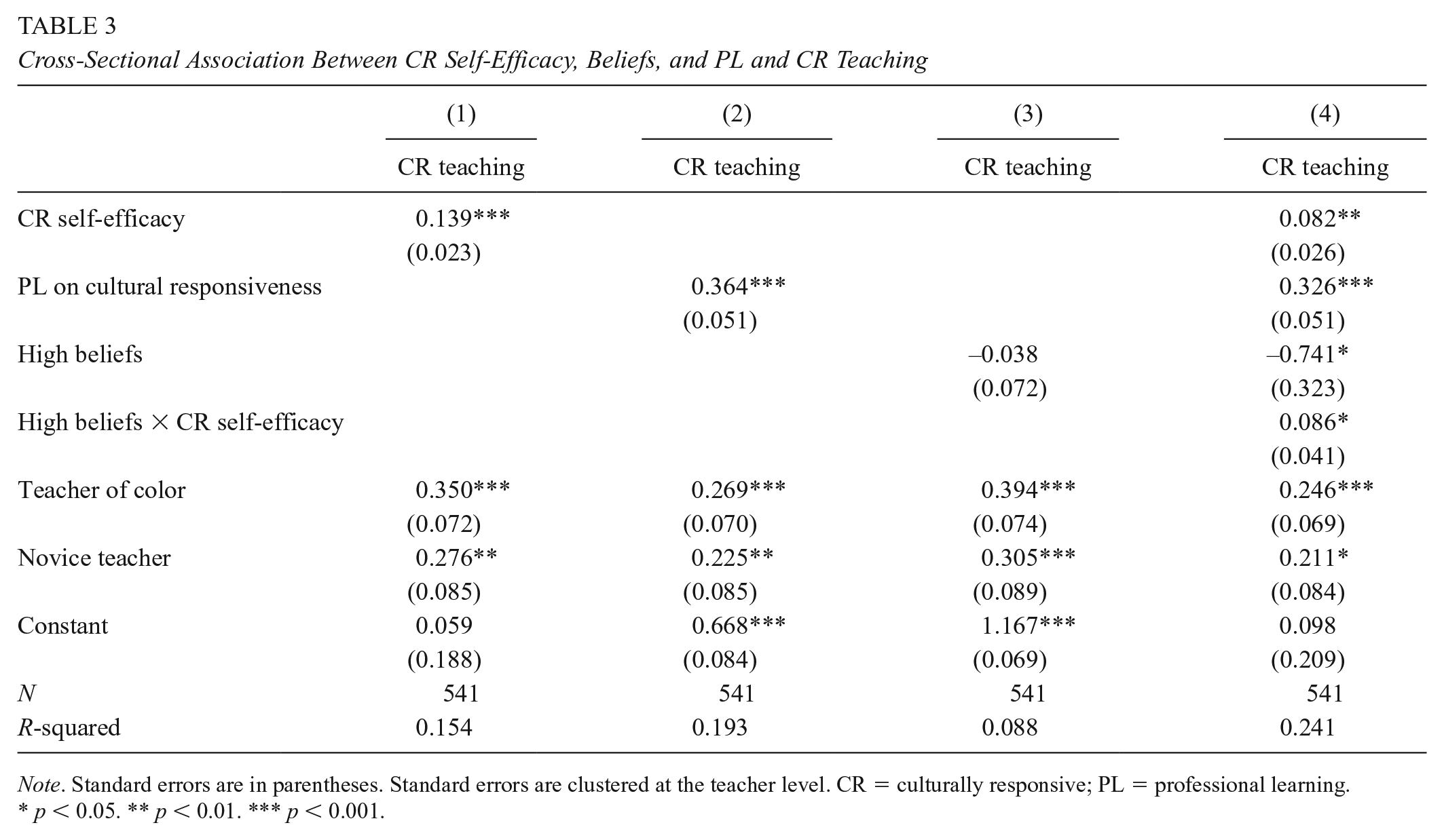
Note. Standard errors are in parentheses. Standard errors are clustered at the teacher level. CR = culturally responsive; PL = professional learning.
p < 0.05. ** p < 0.01. *** p < 0.001.
Our results also indicate that having highly aligned CR beliefs was related to the association between CR self-efficacy and reported CR teaching. On its own, having highly aligned CR beliefs was not correlated with self-reported CR teaching use (Model 3). In our combined model (Model 4), however, our results show that having strong beliefs moderated the relationship between self-efficacy and self-reported CR teaching (the significant interaction term). In other words, among those teachers with beliefs strongly aligned with CR teaching, the relationship between self-efficacy and self-reported CR teaching was stronger—a 1-unit increase in CR self-efficacy corresponded to a greater increase in CR teaching use, compared to teachers who had less aligned beliefs. This relationship is depicted for veteran teachers of color in Figure 2.

Moderation effect of highly aligned beliefs on the relationship between CR self-efficacy and CR Teaching.
Although our primary interest is in the interaction term, which was significant and positive, it is notable that we see a negative relationship between the main effect for CR beliefs (Models 3–4, although only significant in Model 4). This result might indicate that teachers held particular beliefs, but, consistent with other studies of the relationship between beliefs and practice (Guerra & Wubbena, 2017), that beliefs on their own did not translate directly into practice.
The cross-sectional results in Table 3 also indicate that teachers of color, on average, reported engaging in CR teaching at higher rates than did White teachers. We report this finding with caution, however: This estimate was confounded by the clustering of teachers by race in particular districts within our sample. Approximately 78% of all Black teachers in the sample were clustered within a single partnership, and approximately 68% of all White teachers in our sample were clustered within a different partnership. Teachers’ perceptions of the extent to which their PL focused on cultural responsiveness differed across these two partnerships as well: a mean of 1.74 on the PL on cultural responsiveness scale for the partnership serving a majority of Black teachers, compared to 1.33 for the partnership serving a majority of White teachers—a significant difference (p < 0.001). Thus, although the scholarship on CR teaching highlights—conceptually and empirically—the salience of teachers’ racial identity in their efforts to engage in CR teaching (e.g., Brown-Jeffy & Cooper, 2011; Dover, 2013; Duncan-Andrade, 2007), it is difficult to disentangle whether the differences in CR teaching that we present here were associated with teachers’ racial identities or some aspect of the context in which they taught and were supported. This is a key benefit of the fixed-effects analysis that follows. Because these models were based on change within a teacher within a partnership, they control for this potential confound between race and partnership.
Finally, there were consistent differences in reported CR teaching between novice and veteran teachers as well. In all models, novice teachers reported engaging in CR teaching more frequently than did veteran teachers.
Within-Teacher Changes: How Changes in Teachers’ CR Beliefs, CR Self-Efficacy, and PL on Cultural Responsiveness Relate to Changes in Self-Reported CR Teaching
We next examined within-teacher changes
We first descriptively and visually examined the associations between within-teacher change in each of our constructs of interest. We find that although the mean within-teacher change was fairly low, teachers were relatively split in terms of whether they increased or decreased their CR teaching, self-efficacy, beliefs, and perceptions of PL (Table 4). For instance, although the mean within-teacher change for CR teaching was 0.02—nearly 0—a total of 58 teachers in our longitudinal sample increased their reported CR teaching, and 61 decreased. Of those who increased their use of CR teaching, the mean within-teacher change was 0.60 on a 4-point frequency scale—i.e., more than half a scale point. Likewise, among those whose use of CR teaching decreased, the mean within-teacher change was −0.54—again, more than half a scale point. Thus, a within-teacher change analysis shows variation in the extent to which teachers increased or decreased along each of our core constructs. This variation in changes is notable, as this study took place during the COVID-19 pandemic and the racial justice protests of 2020. Some teachers may have prioritized increasing their CR teaching during that time, whereas others may have found this approach more challenging, given the constraints of virtual instruction.
Within-Teacher Change in CR Teaching, Self-Efficacy, Beliefs, and Perceived Focus of PL

Note. N = 124 (unique teachers in longitudinal sample). CR = culturally responsive; PL = professional learning; SD = standard deviation.
Given that teachers did change in their self-efficacy, beliefs, perceived PL focus, and CR teaching over time, we then examined the correlations between changes in self-reported CR teaching and changes in CR self-efficacy, beliefs, and PL on cultural responsiveness (Figures 3a–3c). The first scatterplot shows a slight upward trend, indicating a positive correlation between change in CR self-efficacy and change in self-reported CR teaching use (r = .32). The second scatterplot shows no clear pattern—thus, we find no relationship in the change in beliefs and change in CR teaching usage (r = –.18). The third scatterplot also shows no clear trend, indicating no correlation between the change in PL on cultural responsiveness and change in self-reported CR teaching (r = .12). Importantly, these scatterplots chart the change in CR teaching relative to change in CR self-efficacy, beliefs, or PL on cultural responsiveness. These changes could be negative or positive—for instance, Figure 3a shows that among teachers who decreased in their self-efficacy, they typically also decreased in their use of CR teaching. Likewise, among teachers who increased in their self-efficacy, they typically also increased in their use of CR teaching. These graphs provide context for the fixed-effects models: We would expect, based on the patterns in these scatterplots, that changes in CR self-efficacy would be associated with changes in self-reported CR teaching in our fixed-effects models. In contrast, we would not expect there to be an effect of beliefs on CR teaching or changes in PL on cultural responsiveness on CR teaching in the fixed-effects models.

Within-teacher change in CR self-efficacy and correlation between change in CR self-efficacy and change in frequency of CR teaching use.

Within-teacher change in CR teaching beliefs and correlation between change in CR teaching beliefs and change in frequency of CR teaching use.

Within-teacher change in perceived focus of PL on cultural responsiveness and correlation between change in perceived focus of PL and change in frequency of CR teaching use.
Table 5 presents results from the fixed-effects models. The results show that change in CR self-efficacy was positively associated with change in self-reported CR teaching in the separate and the combined models. Thus, change in self-efficacy for CR teaching was associated with, and potentially driving, change in use of CR teaching. As expected, given the correlational patterns in Figures 3a–3c, changes in PL on cultural responsiveness and changes in whether a teacher had highly aligned beliefs were not associated with changes in self-reported CR teaching. 4
Fixed-Effects Models

Note. Models include partnership and teacher fixed effects. Standard errors are in parentheses. Standard errors are clustered at the teacher level. CR = culturally responsive; PL = professional learning.
p < 0.001.
Sensitivity Tests: Patterns Among Black and White Teachers
In sensitivity tests, we subsetted our pooled and longitudinal samples to include only educators identifying as Black or White (i.e., excluding other racial/ethnic identities). We did this to examine differences among racial/ethnic identities more closely and to understand how sensitive our findings were to different subpopulations of teachers based on race/ethnicity. Our results are consistent with our main findings. In our cross-sectional models, we find that teachers’ self-efficacy and PL were positively associated with their use of CR teaching and that teachers’ CR beliefs moderated the relationship between self-efficacy and self-reported CR teaching (although only marginally significant). Black teachers reported engaging in CR teaching more often than did White teachers. In our fixed-effects models, we again find that change in teachers’ self-efficacy was associated with, and may have driven change in, their reported use of CR teaching. Thus, although our main findings do not portray the nuanced differences among teachers based on their racial/ethnic identities because of our combined indicator for “teacher of color,” our findings remain the same when we subset our sample to Black and White teachers.
Patterns in Teachers’ Self-Efficacy for and Use of Specific CR Teaching Practices
Finally, we descriptively examined teachers’ reports of CR self-efficacy and self-reported use of CR teaching practices at the item level to understand which specific practices teachers reported feeling more and less self-efficacious with and which practices they reported using more and less frequently. Similar to prior research (Cruz et al., 2020; Siwatu, 2007; Siwatu et al., 2009), we find that teachers felt most self-efficacious with practices that related to building strong relationships with students (e.g., creating positive relationships in the classroom and helping students feel like important members of the classroom), and they felt least self-efficacious with practices requiring specific cultural knowledge of their students (e.g., using students’ cultural backgrounds to help make learning meaningful and adapting instructional materials to adequately and appropriately represent cultural groups; see Figure 4a). Teachers reported least frequently engaging in practices that required specific adaptations or analysis of curricular and instructional materials (e.g., identify cultural biases in textbooks; see Figure 4b).

Teacher self-efficacy for CR teaching by practice in 2021.

Teacher frequency of use of CR teaching practices in 2021.
Limitations
A few limitations to our study warrant discussion. Although survey scales were based on existing scales, the survey literature on CR teaching is nascent, and more work is needed to refine and validate these scales, particularly with populations of teachers that vary in terms of racial/ethnic identity and other identity characteristics (Gay, 2010; Ladson-Billings, 1995). Additionally, research suggests that surveys of individuals that address cultural competence can suffer from social desirability bias (Krumpal, 2013; Larson & Bradshaw, 2017). Thus, teachers’ responses may have reflected their awareness of the beliefs they thought they were expected to have rather than more accurately conveying the beliefs they internally held. Relatedly, although behavioral measures can be validly and reliably measured by using survey items (Desimone, 2009; Mayer, 1999), teachers may have overreported their use of CR teaching due to social desirability. We find that item responses showed variation, suggesting that despite the risk of social desirability, these results provide some insights into the degree of teachers’ beliefs and practices. In addition, the survey sample may not generalize to the broader population of teachers, as the teachers in this study were involved in PL partnerships that were designed—at least in part—to focus on equitable outcomes for students typically marginalized by schools. Finally, we note that this study is not causal, although we leveraged longitudinal data by using fixed-effects models, which allowed us to reduce some of the bias associated with correlational results.
Discussion and Conclusions
Issues of equity in education have been pushed to the forefront in recent years, led by a resurgence in calls for systematic changes in the way we educate students in the United States (Villegas & Lucas, 2002). This study offers a unique and broad-based examination of teachers’ beliefs, self-efficacy, and practices in the context of districts making explicit efforts to enact equity-oriented PL and instruction. Our findings are consistent with the notion that CR teaching is more than just a set of practices—rather, CR teaching requires a particular disposition that relies heavily on teachers’ CR self-efficacy and beliefs that cultural diversity and responsiveness are important aspects of teaching (Gay, 2010; Ladson-Billings, 2021). Still, although CR teaching scholarship suggests the important role teachers’ CR beliefs and self-efficacy play in CR teaching (Gay, 2018), few studies have focused on the relationship between teachers’ beliefs and self-efficacy as they attempt to enact CR teaching in a large, racially/ethnically diverse sample of teachers. Teachers’ self-reported beliefs and efficacy in comparison with their frequency of implementing CR teaching offer teacher educators and PL providers insights into what teachers are thinking and how it translates to their practice, information that can be used as a starting point for engaging discussions about CR teaching. With more professional organizations emphasizing the importance of CR teaching and PL being used as a mechanism to improve CR teaching, lessons learned in this area are particularly important (e.g., NCTM, 2021).
Our analysis suggests three key takeaways about the nature of a CR disposition and CR teaching, all of which have implications for supporting teachers to engage in CR teaching. First, we find that, on average, CR self-efficacy has a positive association with CR teaching use, controlling for teacher demographics, and that having beliefs highly aligned with CR teaching increases the strength of the relationship between CR self-efficacy and self-reported CR teaching. Second, our results indicate that participation in PL on cultural responsiveness is positively correlated with self-reported CR teaching, controlling for teacher demographics. Third, and perhaps most importantly, we find that changes in CR self-efficacy are associated with changes in self-reported CR teaching. That is, teachers who increased in their CR self-efficacy also tended to increase in their frequency of reported CR teaching enactment. Notably, we entered this study interested in testing specific hypotheses about relationships between aspects of a CR disposition, PL, and CR teaching. Our findings offer concrete evidence of how these constructs are related, which serves as an important contribution to research and practice. Future work might build on our findings and the conceptual framework employed in this study by using alternative approaches—for instance, using an exploratory approach, such as structural equation modeling, to examine an expanded conceptual framework.
Importantly, our study took place amid COVID-19 disruptions to schooling and the racial justice protests of 2020, which may help explain why some teachers may have decreased their use of CR teaching while others increased their use over time. Along with schooling disruptions, teachers’ PL shifted entirely online after March 2020, with varied access and foci across partnerships. Thus, in some cases, teachers may have been able to continue and increase their CR teaching practices in response to sustained support and a desire to be more responsive to students’ diverse cultural identities during a time of great racial unrest. However, in other cases, with more limited access to supports, teachers may have decreased their CR self-efficacy and CR teaching use.
Collectively, however, these findings suggest that focusing on building teachers’ self-efficacy for CR teaching may be a critical way to support increased use of CR teaching in the classroom. We also note that our findings are correlational, which suggests the potential for a bidirectional relationship between teachers’ self-efficacy and CR teaching. For instance, initial CR self-efficacy may be critical for being willing to engage in CR teaching. And still, the more a teacher enacts CR teaching practices, the more they may increase in their self-efficacy. At the same time, if teachers do not routinely practice implementing a CR teaching approach with sustained PL (Desimone, 2009), initial self-efficacy—and, subsequently, engagement in CR teaching—could dwindle. Thus, our findings highlight the importance of building teachers’ CR self-efficacy to foster CR teaching and, bridging with what we know about the importance of sustained PL (Desimone, 2009), suggest that teachers should be offered ample opportunities to practice and build that self-efficacy over time.
Regarding specific approaches in PL, Bandura’s (1977) theory of self-efficacy suggests that the observation of others as they model behaviors and activities (or “vicarious experiences”) can build self-efficacy. PL on CR that is closely connected to the curriculum may build stronger self-efficacy among teachers, as it provides a clearer example of how to develop this type of pedagogy. This finding aligns with prior research on CR teaching and preservice teachers, which suggests the importance of incorporating self-efficacy-building activities into training (Siwatu et al., 2009).
Critically, study findings suggest that attention to cultivating multiple components of a CR disposition—i.e., CR beliefs and self-efficacy—is necessary for deepening CR teaching. Prior work suggests that even teachers who intentionally engage with CR pedagogies have difficulty seeing how their own cultural biases influence their instruction (Young, 2010). Shifting “from ways of doing to ways of being” (Seriki & Brown, 2017, p. 3) requires sustained dedication from teachers (and leaders) to interrogate the ways their long-held and implicit beliefs and practices uphold hegemonic values in schools.
Given the growing racial and linguistic diversity in the United States and persistent social inequities, understanding how best to foster CR teaching is critical (Gay, 2010; Irwin et al., 2021). CR teaching offers students an educational experience with myriad benefits, including increased motivation, feelings of connection, and improved learning (e.g., Aronson & Laughter, 2016; Gay, 2010). Our study suggests that cultivating teachers’ CR disposition is a necessary aspect of fostering CR teaching (Seriki & Brown, 2017). Providing teachers with ongoing opportunities to examine and shift their beliefs and deepen their understanding of issues of race and cultural diversity as well as opportunities to build self-efficacy and refine teaching practices can help ensure that all students receive the benefits of CR teaching.
Supplemental Material
sj-docx-1-ero-10.1177_23328584221140092 – Supplemental material for A Culturally Responsive Disposition: How Professional Learning and Teachers’ Beliefs About and Self-Efficacy for Culturally Responsive Teaching Relate to Instruction
Supplemental material, sj-docx-1-ero-10.1177_23328584221140092 for A Culturally Responsive Disposition: How Professional Learning and Teachers’ Beliefs About and Self-Efficacy for Culturally Responsive Teaching Relate to Instruction by Meghan Comstock, Erica Litke, Kirsten Lee Hill and Laura M. Desimone in AERA Open
Footnotes
Funding
This research was supported by the Bill & Melinda Gates Foundation grant INV-000745 and the Institute of Education Sciences, U.S. Department of Education, through Grant R305B200035 to the University of Pennsylvania.

Supplemental Material
Supplemental material for this article is available online.
Notes
Authors
References
Supplementary Material
Please find the following supplemental material available below.
For Open Access articles published under a Creative Commons License, all supplemental material carries the same license as the article it is associated with.
For non-Open Access articles published, all supplemental material carries a non-exclusive license, and permission requests for re-use of supplemental material or any part of supplemental material shall be sent directly to the copyright owner as specified in the copyright notice associated with the article.
