




Abstract
California’s K–12 funding and instructional policies for English learners have changed significantly over the past two decades. This paper uses student-level longitudinal data from 2006 to 2019 to examine the learning outcomes of successive cohorts of students who were classified as English learners in kindergarten as they progressed through California’s changing public school system. First, we find ELs grew more diverse linguistically over time. Second, we find that their third-grade achievement improved in math and English language arts and achievement gaps narrowed in both subjects. Third, we find that more recent cohorts reported slightly higher rates of English proficiency acquisition by the end of grade 5. Finally, we find that the proportion who were reclassified by grade 5 increased dramatically for the first two cohorts of our study but then remained constant for the next five years. In the most recent cohort we can observe, only 53% of students who entered kindergarten as ELs were reclassified by the end of grade 5.
Keywords
Introduction
More than one in eight students in the United States is educated in California’s public school system (NCES Enrollment, 2023). Forty percent of California students speak a language other than English at home, the vast majority of whom are classified as English learners (ELs) upon school entry and receive EL services, such as targeted English language development instruction (California Department of Education, 2024). Much work has shown the large and persistent achievement gap between English learners and their peers (e.g., Fry, 2007; Garcia, 2015; Rumberger & Gándara, 2004). But, rigorously quantifying this gap and other learning outcomes for EL students is challenging as students regularly exit the EL subgroup through reclassification while other students enter the EL subgroup continuously whenever they first register for California schools. This paper uses a longitudinal analysis of stable cohorts to document achievement and proficiency for English learners.
In addition, this paper provides a first step in understanding the impact of the following series of policy changes that took place in California in the last two decades: California mandated that all teachers acquire training and specific authorization to teach ELs (beginning in 2004 with the Williams v. California settlement), required instructional materials specific to ELs statewide (in 2004 in that same settlement), instituted the Common Core math and English language arts standards (in 2010 when adopted by the State Board of Education) and a new English language development framework (in 2012 when adopted by the State Board of Education), overhauled its school funding system to fund ELs at a higher rate (in 2013 with the Local Control Funding Formula), and reinstituted bilingual programming (in 2016 when voters passed Proposition 58). These major policy shifts had the potential to change student learning outcome patterns for ELs.
Using population student-level longitudinal data obtained from the California Department of Education, we provide a descriptive analysis of trends in key outcomes across successive cohorts of California ELs. This work is descriptive, not meant to identify the specific impacts of any of those individual policies but rather to understand generally how ELs have fared during this era and how their achievement compares to their non-EL peers. We track demographics for 13 successive cohorts of students who entered as ELs from kindergarten through their entire trajectory in California schools from SY 2006–07 to SY 2018–19; our analysis of proficiency relies on students having completed first grade and thus is restricted to 12 of the 13 available cohorts. We follow our first cohort through their potential graduation year from high school and follow eight cohorts through the end of elementary school in grade 5. We describe demographic changes, trends in academic outcomes, trends in timing to English proficiency, and timing to reclassification to shine a light on the backgrounds and academic trajectories of these students.
First, we find that kindergarten ELs are increasingly diverse linguistically, with the share of Spanish speakers decreasing over the time period, and speakers of Mandarin, Vietnamese, Cantonese, Korean, and Arabic growing. Second, we find that their academic achievement in third grade has improved over time, shrinking the achievement gaps between K-cohort ELs and other students in ELA and math. Third, we find that the overall share of K-cohort ELs who became proficient in English by the end of elementary school increased slightly over this time period. Finally, we find that reclassification rates improved dramatically between the kindergarten cohorts of 2006 and 2008 but then stabilized and have remained constant between the kindergarten cohorts of 2008 and 2013. In the most recent cohort observed completing fifth grade, only 53% of K-ELs were reclassified by the end of elementary school, even though 72% had reached English language proficiency on the CELDT. In other words, approximately half of students who entered kindergarten as English learners remained English learners when they completed elementary school six years later.
Taken together, these results show significant improvements in the academic trajectories of California’s ELs over time. To explain these changes, three possible explanations emerge: first, it is possible that the thresholds used for initial EL designation changed over time in ways that could contribute to the patterns observed. We explored this possibility and found that test-takers with similar initial kindergarten English language assessment scores were classified consistently over our study period as either ELs or initial fluent English proficient (see Figure A1). Second, it is possible that more recent kindergarten cohorts were systematically different than earlier kindergarten cohorts in ways that might have improved their test scores. But our analyses of the socioeconomic and demographic familial backgrounds of successive kindergarten cohorts (discussed in more depth later) allow us to conclude that more recent cohorts are only slightly more proficient in English upon kindergarten entry and thus that compositional change is not likely a significant cause of improved performance. Instead, we turn to the third possible explanation: elevated achievement patterns are attributable to improvements in the school learning environments that kindergarten ELs experienced during this time period.
Background
California Policy Context
During our study period of 2006 to 2019, the instruction of English learners was in flux due to a wide-ranging set of new state policies and from the lingering effects of previous policy. This policy landscape is depicted in a timeline in Figure 1, which shows that California introduced new regulations around teacher preparation, curriculum, school funding, early learning opportunities, and language of instruction for ELs.

Selected timeline of California’s English learner–related policies by Kindergarten cohort.
Since 1999, all teacher preparation programs statewide had been required to incorporate lessons on EL instruction (Santibañez & Umansky, 2018); however, that provision only covered new teachers. In 2004, the settlement of Williams v. California extended the requirement, mandating that all teachers acquire training and specific authorization to teach ELs. These changes were implemented based on research showing that teachers of ELs need to be able to implement EL-specific scaffolds, to possess EL-specific teacher expertise (e.g., linguistics), and maintain an EL-specific equity orientation with respect for cultural/ethnic/linguistic diversity in order to help their students succeed (Santibañez & Snyder, 2018). Nine years after Williams, in 2013, the ACLU cheered in a report that “Williams is working,” pointing to large reductions in the number of teachers instructing ELs without certification to do so (Chung, 2013).
California also reformed its curricular standards during this time period. In 2010, the California State Board of Education adopted the Common Core standards and began promoting these standards in professional development sessions with teachers and administrators. Two years later, the state revised its English language development standards to align with the Common Core and, two years after that, produced a joint English language arts/English language development curriculum framework to guide instruction. In 2015, the state implemented new state standardized testing also aligned with these goals (California Department of Education, 2014). The Common Core instituted more complex academic literacy targets, and researchers openly worried whether teachers and schools were prepared to help ELs reach that higher bar (Goldenberg, 2013). A study of the Common Core in California about three years after the new curriculum frameworks were adopted showed uneven implementation and mixed results, with modest improvements in student outcomes for districts that adopted the recommended instructional materials (Gao & Lafortune, 2019), and that study did not focus on English learners specifically, leaving unanswered questions about the effects of the curricular shift on this key subgroup.
English learners also faced a new school funding environment in California during this time period. The 2004 settlement of Williams v. California required adequate instructional materials specifically for ELs and ensured regular facilities assessments for adequacy (SB 550, 2004). Then, in 2013, the passage of the Local Control Funding Formula (LCFF) directed large amounts of money toward the education of English learners and gave school districts broad authority and greater discretion in how to spend the increased funding while also stipulating that districts regularly consult with communities when making spending decisions. LCFF committed $18 billion in increased state support and distributed it on the basis of pupil needs (defined in part by the proportion of students in the district that are English learners), then incrementally distributed funds over a 7-year period until fully funded in SY 2018–19. Early analyses of district-level spending plans showed that, after LCFF, which required attention to English learners in district spending plans, districts increased their focus on English language development courses and dual immersion programs, both of which should have driven an increase in EL performance (Contreras & Fujimoto, 2019). Johnson (2023) found positive and significant effects of LCFF-induced increases in per-pupil spending on academic achievement for every grade assessed (3rd through 8th and 11th), in both math and reading, for every school that experienced this new infusion of state funds and for the kindergarten EL subgroup.
There have also been major expansions of public pre-K, which may have important implications for enriching the early learning opportunities for English learners. Beginning in SY 2012–13, every elementary or unified school district was required to offer transitional kindergarten for eligible children who turned 5 late in the calendar year. 1 Moreover, these expansions of public pre-K–12 investments in education have been sustained over the past decade, with TK eligibility set to expand to all four-year-olds in future years. The expansion of TK and preschool may represent an important policy opportunity to narrow school readiness gaps (Johnson, 2024). Amidst growing evidence that school resource equity and funding adequacy matters for educational achievement and socioeconomic success in adulthood (Jackson, 2020; Jackson et al., 2016; Johnson & Jackson, 2019; Lafortune et al., 2018) and early evidence on the successes of TK implementation in California (Johnson, 2024; Manship et al., 2017), we would expect to see improvements in EL performance due to these investments.
Finally, in 2016, California voters passed Proposition 58, repealing the 1998 Proposition 227 and allowing bilingual education throughout the state. Although districts were not required to create bilingual education programs, they were encouraged to do so. They were also required to meet with community members to discuss the programs and offer bilingual programming if enough parents requested it (Hopkinson, 2017). Research has consistently shown the advantage of bilingual education in improving English proficiency in the short- (Goldenberg, 2013; Willig, 2004) and long-term (Umansky & Reardon, 2014). Many voting guides and advocacy groups relied on this literature when advocating for the proposition and are thus hopeful that EL outcomes improved after the proposition’s passage in 2016.
This study presents the academic achievement, English proficiency, and reclassification outcomes of ELs from 2006–2019. Beginning in 2006 when California’s data system first allows for longitudinal tracking across different datasets (e.g., English proficiency, demographics, and annual achievement tests) and ending before the COVID-19 pandemic, this time frame allows us to track how this series of equity-focused policies described previously may have improved outcomes for EL students. We note that, for some outcomes, especially those in later elementary school or in middle school, policy changes that happened during the later years of our data (e.g., Proposition 58’s expansion of bilingual education in 2016) are not yet fully reflected in these achievement results.
The Kindergarten EL Framework
English learners are federally defined as students who do not speak English as their primary language at home and who have difficulties speaking, reading, writing, or understanding English (No Child Left Behind, 2002). In California, as in 20 other states, students are first identified as English learners by the administration of a home language survey with questions about the languages used most frequently in the home; as in 26 other states, California students are also administered an assessment of English proficiency upon school entry (Rafa et al., 2020). From SY 2000–01 through SY 2017–18, this initial assessment was performed using the California English Language Development Test (CELDT). In 2018–19, the state shifted to the newly developed English Language Proficiency Assessments for California (ELPAC). To maintain a stable measure of performance throughout our study, we focus on the long period in which CELDT was utilized to test English proficiency. This state-administered test determines eligibility as an EL student and provides information about annual progress, while district criteria are also considered in determining when a student no longer needs EL services.
Much work has shown the large and persistent achievement gap between English learners and their peers (e.g., Fry, 2007; Garcia, 2015; Rumberger & Gándara, 2004). Data from the National Assessment of Educational Progress show a large gap between ELs and non-ELs in both math and reading in grades 4 and 8 in California and nationwide. For example, in grade-4 reading, non-EL students scored 32 scale score points higher than EL students; measured in terms of proficiency acquisition instead, 37 percent of non-EL students scored at or above proficient on the exam while only 10 percent of EL students did the same. Although scores for both groups have improved over the last several decades, the gap persists (NAEP Data Explorer, 2022). The size of the gap may be misleading, however, because the students who have gained proficiency in English are transferred out of the EL group so that the “EL” group excludes students who were initially ELs but who no longer are classified as such.
The process by which students transfer out of (“exit”) English learner status is known as reclassification. Reclassification in California, as in Florida, New York, and Texas, among others, requires a student to pass an English language arts assessment in addition to an English proficiency exam (Rafa et al., 2020). Therefore, because standardized test scores are themselves an input into EL status, the achievement gap described previously between ELs and non-ELs may be underestimated because ELs with the highest test scores are more likely to be reclassified and thus enter the non-EL pool, accentuating the size of the gap.
In addition, as immigrant students who have sometimes experienced inconsistent schooling enter California schools later in elementary or middle school, they enter the EL pool and reduce average scores, further accentuating the size of the gap. This phenomenon has been well documented in the literature (Hopkins et al., 2013; Linquanti, 2001; Saunders & Marcelletti, 2013). Furthermore, prior research has shown that reclassification rates differ by gender, home language, socioeconomic status, initial English proficiency levels, and age of entry into the school system (Conger, 2008; Grissom, 2004). Thus, when work focuses on current ELs (including newcomer students and excluding reclassified students from the analyses), it disproportionately excludes many former ELs with high academic outcomes and results in selection biases that may distort and mask the progress of ELs.
In order to understand how the K–12 system is supporting and educating English learners, we track the progress of a more stable cohort. This highlights an important aspect of our study design and the contribution of our detailed descriptive evidence: we follow all California public school students who have received EL services starting in kindergarten, hereafter known as kindergarten ELs (K-cohort ELs). We then follow these K-cohort ELs through all their years in school, including the years after their reclassification. This design excludes EL students who enter the California school system after kindergarten, such as a new student who moves to California at age 14. This re-definition of the sample from current English learners to students who were English learners at the beginning of kindergarten has potential to offer practitioners and researchers new insights about the progress of English learners over time that may challenge our existing understanding of the educational landscape for this population. We can more clearly gauge progress of EL students using this longitudinal, tracking-over-years approach. This approach, however, excludes students who enter as English learners in grades later than kindergarten and thus cannot inform our understanding of their academic achievement, proficiency, or reclassification.
Past Research on Kindergarten English Learner Outcomes
Previous work describing the pathways of kindergarten ELs to English proficiency in California has focused on more limited time periods, a limited number of school districts, and/or specific subgroups. Umansky and Reardon (2014) show that, among Latino ELs who entered kindergarten in one large California school district, half of students reached English proficiency on the CELDT after five years. Hopkins et al. (2013) focused on the 2003 cohort of Sanger Unified School District kindergarteners and showed that most students reached intermediate English proficiency on the CELDT in two years but could take up to seven years to reach early advanced or advanced benchmarks (the level necessary for reclassification). Thompson (2012) utilized nine years of data from the Los Angeles Unified School District to show that students typically took four to five years to reach English proficiency on the CELDT. Other national work has shown a similar time frame of four to seven years (G. Cook et al., 2012; Hakuta, 2000; Linquanti & Hakuta, 2012).
While there is some existing work from other regions of the country (e.g. G. H. Cook et al., 2008; Hakuta, 2000) that have also investigated this question of English proficiency acquisition and academic achievement for kindergarten ELs, our analyses of the learning outcomes of California schoolchildren present a unique opportunity to illuminate potential progress and draw new insights of ongoing challenges due to California’s racial/ethnic, socioeconomic, and linguistic diversity; immense size of the EL population; and the complex set of policy changes that occurred over this time frame that may have shaped their learning trajectories. We also show results conditional on initial English proficiency, which can vary widely among entering kindergarten ELs. From 2006 to 2019, approximately 42% of EL students scored at a beginning level of English on their initial CELDT while the remaining 58% demonstrated at least early intermediate skills. This element of heterogeneity among ELs is under-discussed in the literature, which typically focuses on other elements of EL variation such as location, home language, and socioeconomic disadvantage (Jepsen & de Alth, 2005; Our Nation’s English Learners, 2024).
In addition to proficiency acquisition, this paper also discusses reclassification as an outcome. Under state law, school districts can reclassify their students when they meet standards for English proficiency and demonstrate basic academic skills relative to English proficient students. Although all districts must use these criteria under state law, districts choose what tests to use to assess these criteria and what cutoff scores to use. In addition, under state law, districts must obtain teacher and parent/guardian support for a student’s reclassification.
Research nationally generally shows that about half of English learners had been reclassified by the end of elementary school (Grissom, 2004; Thompson, 2012, 2017; Umansky & Reardon, 2014). But reclassification processes are highly variable across districts, and attempts to standardize it statewide have thus far only partially succeeded. California law allows for reclassification when students meet English proficiency and demonstrate basic academic skills, as well as receive parent and teacher approval. Although that may seem straightforward, each district can choose what test to use to assess basic skills and what minimum thresholds for scores to use to satisfy reclassification requirements. A recent survey of 231 California school districts, representing a third of the state’s English learner population, showed that “districts use a huge range of assessments and benchmarks” (Hill et al., 2021). Even across a single district, reclassification policy can change many times in a short period. For example, between September 2009 and May 2015, Los Angeles Unified—the California district with the most English learners—changed its reclassification guidance four times (Aquino & Loera, 2013; Elliott, 2009; Loera & Maldonado, 2014, 2015). Past research has unsurprisingly shown that different district reclassification policies are correlated with different district reclassification rates (Hill et al., 2014). Therefore, though this paper will present a figure on the trends in reclassification rates, this paper primarily focuses on English proficiency as measured only by the consistent statewide test: the California English Language Development Test (CELDT). The use of a consistent assessment and a stable cohort over more than a decade makes this study unique in the field.
Data
We constructed a student-cohort-by-year dataset using administrative data of K–12 school records from the California Department of Education. The California Department of Education (CDE) classifies English learner status in four categories: English Learner (i.e., a student who speaks a language other than English at home and scored below proficient on their initial assessment of English abilities), English Only (i.e., a student who speaks only English at home), Initial Fluent English Proficient (i.e., a student who speaks a language other than English at home but scored as proficient in English on an initial assessment upon school entry), and Reclassified Fluent English Proficient (i.e., a former English Learner who has been reclassified).
From 2000–2017, California used the California English Language Development Test (CELDT) to both assess English proficiency upon school entry and to measure progress to proficiency relative to a students’ grade level. 2 The CELDT measured not only overall proficiency levels but also proficiency across four domains: listening, speaking, reading, and writing. During this time period, districts typically required students to score a 4 (early advanced) on the overall exam as well as a 3 (intermediate) or above on each of the eligible subtests for proficiency. 3 We describe how this overall score is calculated in Table A1.
With these data, we describe the pathways of students who were initially classified as ELs based on their CELDT scores and received English language services in kindergarten. In order to build our dataset, we linked a student’s EL status with their school enrollment, demographic information, and academic achievement on state standardized tests in English and math over time. This includes race/ethnicity, gender, language spoken at home, and an indicator of socioeconomic disadvantage in kindergarten or in the earliest year for which it is available. 4 These longitudinal data enable us to track all students as they progress through California’s public school system, even as they move between public schools and districts within the state. While we cannot track the outcomes of students who move out of the state, analyses of attrition due to migration out of state is modest and has not changed appreciably over this time period (Johnson, 2023). 5
We restricted our primary analytic sample to students who were in kindergarten in California public schools at some point between 2006 and 2017. We used CDE’s indicator of EL status to create a binary measure of whether a student was classified as an EL in kindergarten (we call these students “kindergarten ELs” or “K-cohort ELs”).
Our full sample includes all students who began kindergarten at some point between 2006 and 2017, regardless of their EL status and whether or not they attended California schools before that date (e.g., some students may have previously attended transitional kindergarten and/or pre-K). We linked students to the fall of the first school year in which they attend kindergarten and count grades from that point (i.e., a “third grader” is someone in their third school year after the year of kindergarten entry). The examination of learning outcomes by years since kindergarten is in recognition that grade progression (and grade repetition) are potential outcomes influenced by the quality of learning conditions in schools, and thus the grade a student is observed in a particular year may in part be endogenous to policy reforms enacted. 6 By focusing on K-cohort ELs for our analysis, we excluded newcomer students who entered schools after kindergarten; their acquisition of English and academic achievement patterns are less well-studied and may look different from their peers (Umansky et al., 2022). Our primary analytic sample thus includes 5,854,122 students. We can track EL status for 97.3% of them, and 35.8% (roughly 2.10 million) received English language services in kindergarten. Our analytic sample excludes the 2018 kindergarten cohort because insufficient time has passed to observe their outcomes before our data ends in 2019, though we do include this cohort in our analysis of demographic trends.
Methods
We first describe the demographic composition of kindergarten English learners in California. We present the home language composition of this population by year, then present socioeconomic status by year within each home language group. We also present the distribution of initial English proficiency scores on CELDT by year and the percent of each home language group who scored intermediate or above on their initial CELDT exam of English proficiency.
We show how the academic achievement of kindergarten English learners in California has changed over time. To gauge academic achievement, this paper uses test scores on state-administered standardized tests. We converted test scores to national grade-level equivalent units using test scores from the National Assessment of Educational Progress and following the methods described in Reardon et al. (2019). This enables our examination of academic achievement in reading and math to trace out potential absolute improvements (and/or declines) in learning outcomes across cohorts and grades, comparable to the national average subject-specific achievement among 2005 kindergarten cohorts in a standardized and consistent way.
We also report the cumulative proportion of kindergarten EL students reaching English proficiency by each grade. We first present the cumulative percentage of kindergarten EL students scoring a 4 (early advanced) on their overall score, then the cumulative percentage of kindergarten ELs scoring a 3 (intermediate) on each language domain, and finally the cumulative percentage of kindergarten ELs who have reached both the overall score and domain thresholds and are thus considered proficient in English by the state as explained in Table A1. These are calculated via discrete-time survival analysis (Willett & Singer, 2004). The model used to estimate the hazard function is:

where
We run an additional set of hazard models that condition on a cubic function of students’ initial English proficiency score. Conditional on a flexible function of initial scores provides a test of whether the trends in attainment of English proficiency are explained by increasing initial proficiency.
Key Findings
Changing Composition of California’s Kindergarten ELs
In Figure 2A, we present the home language composition of ELs in California when they started kindergarten and break out all languages representing more than one percent of K-cohort ELs during SY 2018–19, our most recent year of data. This figure demonstrates the prevalence of Spanish, spoken by more than three-quarters of all K-cohort ELs. This percentage has decreased over time though with Spanish speakers accounting for 83.8% of ever ELs in 2006 and 77.3% in 2018 (a decrease of 6.53 percentage points, or 8%).

Descriptive statistics of California’s kindergarten-cohort English learners: Panel A: Home language, panel B: pet low socioeconomic status by home language, panel C: initial CELDT score distribution, and panel D: initial CELDT by home language.
In addition, we find that Mandarin recently replaced Vietnamese as the second most-spoken home language among kindergarten ELs. The prevalence of kindergarten ELs speaking Mandarin in the home doubled over the time span of our data, now reaching 2.9%. Arabic’s prevalence doubled over this time span as well, replacing Korean as the fifth most commonly spoken language of kindergarten ELs. Finally, California’s linguistic diversity has increased with other languages now representing more than 12% of the total. These other languages include Russian (1% in 2018), Punjabi (1%), Tagalog (1%), Farsi (0.7%), Japanese (0.7%), and Armenian (0.7%), among many others.
In Figure 2B, we present another demographic characteristic of California’s kindergarten ELs: socioeconomic status. Socioeconomic status (SES) is calculated based on the percentage of students who are eligible for free or reduced-price lunch or whose parents/guardians have not received a high school diploma. 7 We find that Spanish-speaking ELs are of low SES at a higher percentage than other home language groups. We also find that the percent of kindergarten ELs who are of low socioeconomic status increased slightly from 66.8% in 2006 to 68.7% in 2018 (an increase of 1.9 percentage points, or 2.8%). This percentage has not always been stable though, with a peak in 2012 during the Great Recession when 79.3% of kindergarten ELs were of low SES. Students who were not classified as English learners in kindergarten also experienced an increase in socioeconomic disadvantage during the Great Recession to a peak of 46% low SES in 2013; unlike for K-ELs though, this percentage has not declined much since then with that group at 43% low SES in 2018.
Figure 2C shows the distribution of scores on an initial exam of English proficiency (i.e., CELDT), which students took upon their entry into California schools through the end of SY 2017–18. We observe that the percentage of students scoring in the beginning level of proficiency decreased modestly from 46.3% to 40.1% (a reduction of 6.2 percentage points, or 13%). The percentage of students scoring early intermediate increased slightly as did the percentage of students scoring intermediate, and the percentage of students scoring early advanced or advanced (i.e., clearing the CELDT threshold for Initial Fluent English Proficient) did not change over time. Recent cohorts are slightly more proficient in English upon entry. Later we test whether this increase accounted for any changes in proficiency and reclassification.
Finally, Figure 2D finds the relationship between home language and initial CELDT scores. Mandarin-speaking kindergarteners generally had higher initial CELDT scores on average upon school entry than other sub-groups, with more than half scoring intermediate or above on their initial exam; by contrast, fewer than a third of Spanish-speaking kindergarteners scored intermediate or above on their initial exams. Therefore, the slight increase in initial CELDT scores observed in Figure 2C may be explained by the changing of home language composition of California’s K-ELs seen in Figure 2A.
Academic Achievement of California’s Kindergarten ELs
In Appendix Figure A2, we show the traditional snapshot view of the achievement gap in English language arts (ELA) and math. 8 We privilege third-grade test scores because third grade is the first tested grade on the California Assessment of Student Performance and Progress and therefore can be observed for the longest time span of our dataset. Panels A and B present a traditional view of the achievement gap, comparing third-grade students who receive EL services to all other students. In this snapshot, we find a widening achievement gap in both ELA and mathematics between third graders who are designated EL and those who are not. But, as explained previously, this may not be an accurate picture of trends in achievement and achievement gap due to the changing composition of the EL and non-EL pools.
In Figure 3, we report third-grade academic achievement trends using the K-cohort EL framework. In this framework, we focus on all students who were English learners in kindergarten and track their outcomes over time into third grade, then compare them to students who were not English learners in kindergarten. We observe two key phenomena.
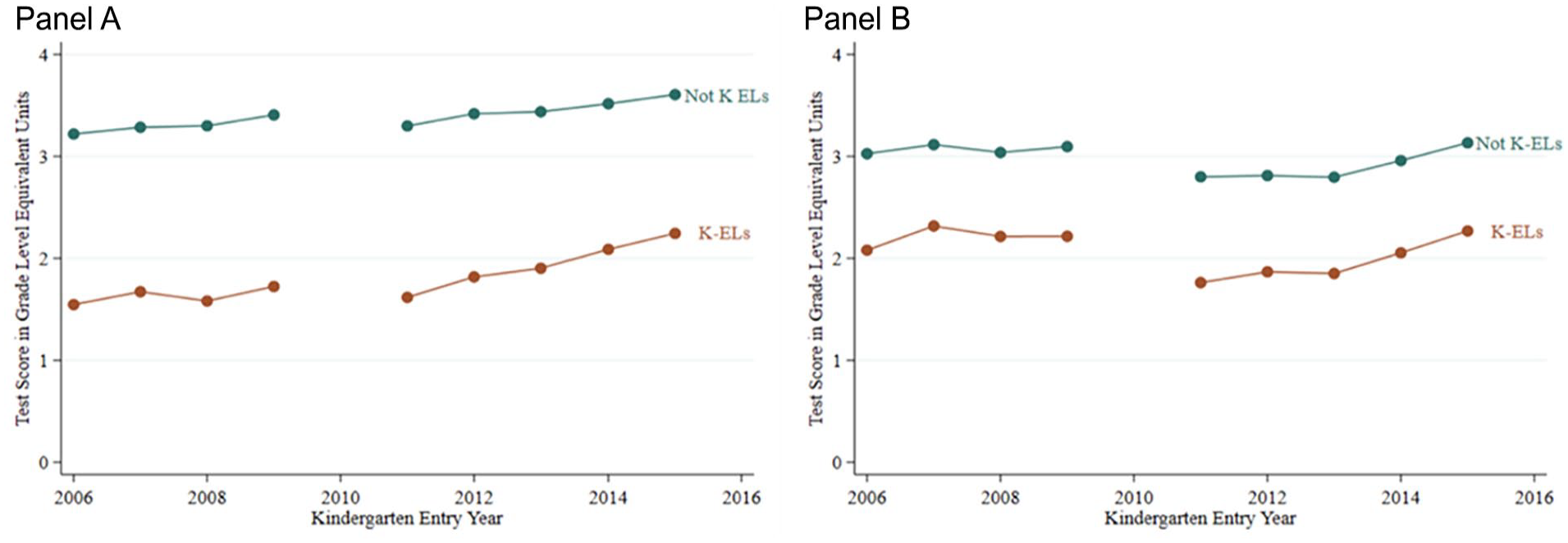
Academic achievement of California’s kindergarten-cohort English learners: Panel A: third-grade ELA, not K-ELs vs. K-ELs, and panel B: third-grade math, not K-ELs vs. K-ELs.
First, we find that achievement in third grade for K-cohort ELs improved in both math and ELA over this time period. We see that the third-grade test scores of K-cohort ELs improved by 0.70 grade levels in ELA between the cohorts that began kindergarten in 2006 and 2015 and that third-grade K-cohort ELs were performing in ELA above a second-grade level in 2018–19. In math, K-cohort ELs improved by 0.19 grade levels and were also performing above a second-grade level in third grade.
Second, in contrast with Figure A2, the kindergarten EL framework used in Figure 3 shows that the third-grade achievement gap between students entering kindergarten as English learners and those that were not English learners has shrunk in both subjects. For students in the 2006 K cohort, non-K-ELs outperformed K-ELs by 0.95 grade levels on math. For the 2015 cohort, the math achievement gap remained but had declined 9% to 0.86 grade levels. The third-grade ELA achievement gap shrank from 1.67 grade levels for the 2006 cohort to 1.36 grade levels for the 2015 cohort (a 19% decrease). These findings are consistent with prior research showing larger achievement gaps for English learners in English than math (Kim & Herman, 2009; Santibañez & Umansky, 2018). These trends are broadly similar for fourth- and fifth-grade achievement in ELA (Appendix Figure A3). For math, though, achievement gaps in fourth and fifth grade grew over this time period. This was driven primarily by improved math test scores for students who were never ELs rather than by a change in the performance of K-EL students (Appendix Figure A3).
Acquisition of English Proficiency for California’s Kindergarten ELs
In Figure 4, we present the cumulative percentage of kindergarten EL students scoring a 4 (early advanced) or above as this was a common requirement for reclassification during this time period. We show the cumulative percentage of students meeting the threshold on the y-axis and denote kindergarten cohorts on the x-axis, with the color of the bars showing the grade when K-EL students in that cohort reached the level 4 score. Figure 4 demonstrates that kindergarten EL students are reaching the early advanced designation earlier than before. For kindergarteners in 2006, only 24.1% of K-cohort EL students were at this level by the end of first grade. For kindergarteners in 2015, 40.1% had reached this level (a two-thirds increase).
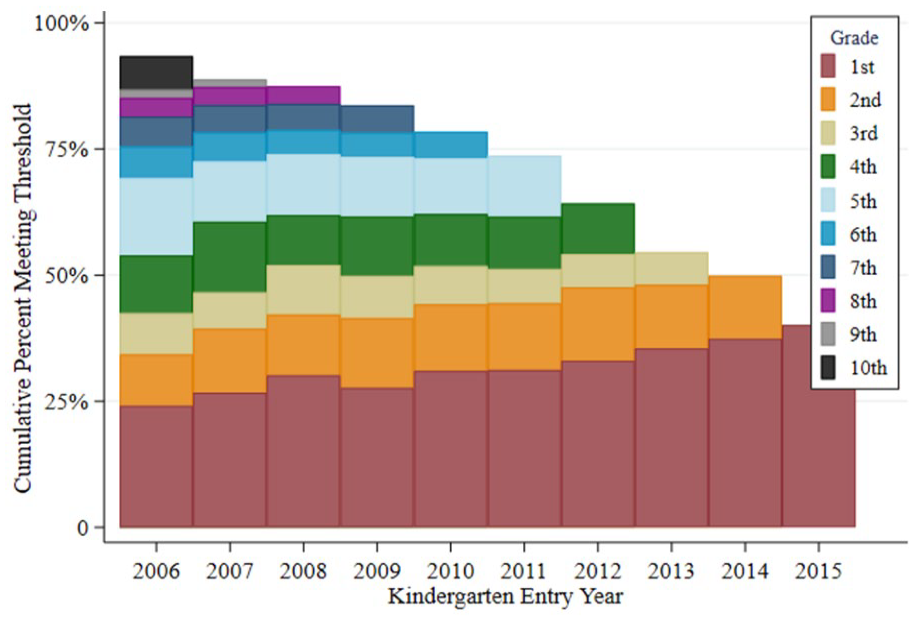
Cumulative percent of K-cohort ELs with overall score of early advanced on CELDT.
For the older cohorts that we can observe through the end of fifth grade, Figure 4 also finds that early advanced acquisition by the end of elementary school has not changed much. In 2006, our first class, 69.2% of K-cohort EL students reached early advanced by the end of fifth grade. For the kindergarten cohort of 2011, the most recent class we can observe on the CELDT who have been followed through the end of elementary school, 73.7%—approximately three-quarters—of kindergarten ELs reached early advanced by the end of elementary school.
We next describe the trend in the percentage of K-cohort EL students who have reached intermediate in each domain by each grade. In Figure 5, each panel represents one of the CELDT sub-tests from 2006 to 2015. 9 Improvements occurred across listening, speaking, and reading; the largest change in the rate of acquisition by cohort was in reading performance. The percentage of students scoring a 3 (intermediate) or higher on the CELDT writing exam at the end of first grade was relatively flat between the entering cohorts from 2009 and 2015, while the percent scoring intermediate for reading improved by 23.0%, the percent scoring intermediate for speaking improved by 19.7%, and the percent scoring intermediate for listening improved by 16.7%.

Cumulative percent of K-cohort ELs intermediate or above, by CELDT subtest: panel A: listening; panel B: speaking; panel C: reading; and panel D: writing.
Additionally, as expected, students generally scored intermediate on listening and speaking much earlier than they did in reading and writing. Specifically, in the most recent cohort in our sample, 69.7% of K-cohort ELs scored intermediate in listening by the end of first grade and 77.7% scored intermediate in speaking, while only 43.1% scored intermediate in reading and 34.3% scored intermediate in writing. These differences shrink but still persist as students age. In our most recently observed cohort of fifth-grade K-cohort ELs, 96.3% scored intermediate in listening and 97.3% scored intermediate in speaking, while 84.9% scored intermediate in reading and 88.9% scored intermediate in writing.
In Figure 6, we present the rate of CELDT proficiency acquisition over time and find that the rate of English proficiency acquisition has behaved similarly to the early advanced overall designation, increasing in early grades but, increasingly, only slightly by the end of elementary school. In the most recent cohort we can observe to the end of grade 5, 72% of kindergarten ELs had reached English proficiency by grade 5 (after at least six years in California schools) and thus were eligible for reclassification.

Cumulative percent of K-cohort ELs meeting state guidance for English proficiency on CELDT.
Acquisition of English Proficiency for California’s Kindergarten ELs, by Initial Level of Proficiency
Figure 7 reports the estimated cumulative percent of students reaching English proficiency by year of entry for K-cohort ELs, similar to Figure 6, but conditional on initial English proficiency. We include three panels to find the rate at which students at that score level acquired English proficiency by their kindergarten cohort. We illustrate this with three scores: Panel A shows progress for a student with a score of 250 (20th percentile), panel B shows for students entering with a score of 325 (37th percentile), and panel C shows students entering with a score of 400 (75th percentile).
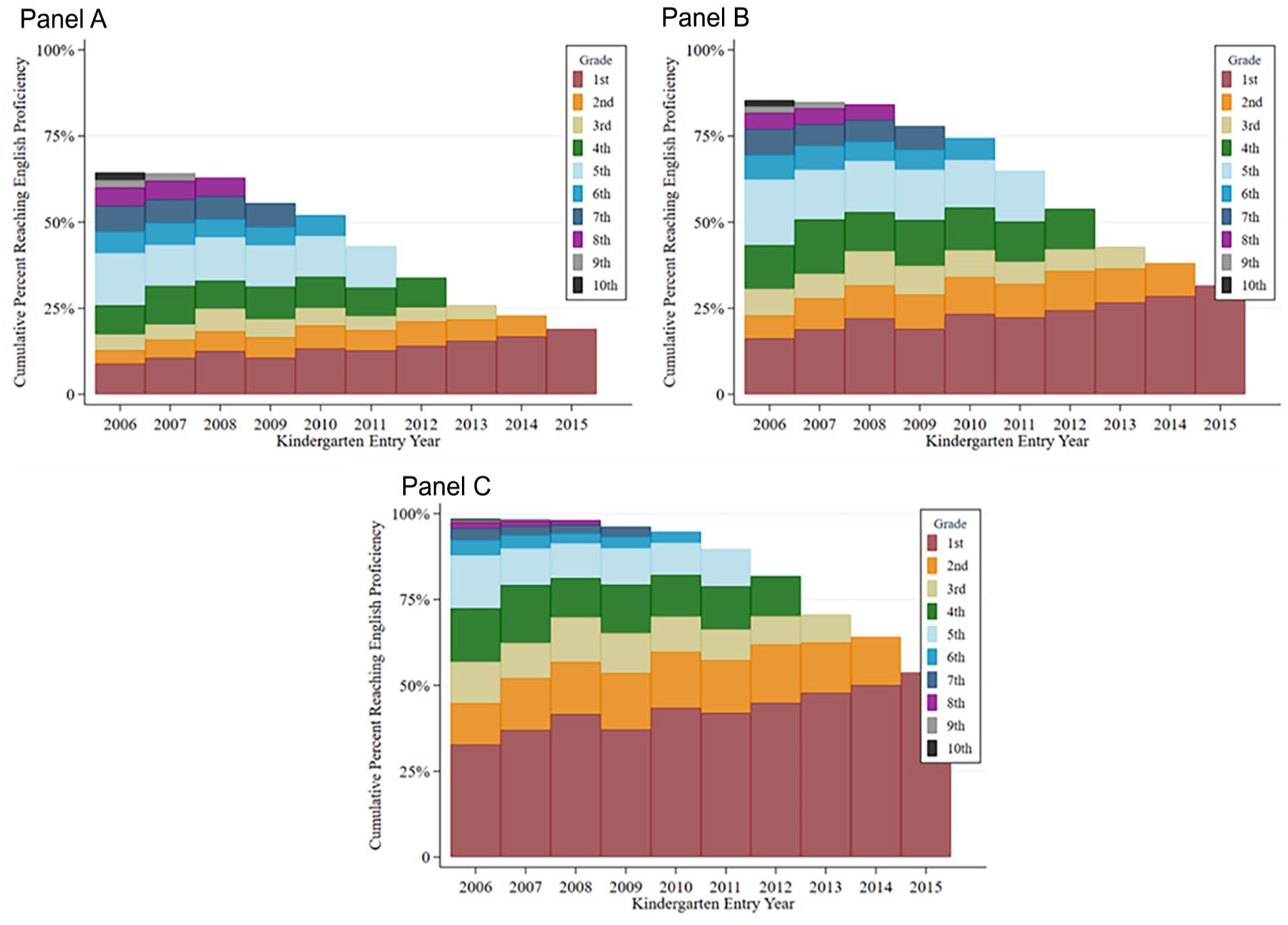
Cumulative percent of K ELs meeting state guidance for English proficiency on CELDT, by initial score: panel A: initial score of 250, panel b: initial score of 325, and panel c: initial score of 400.
We find significant improvements in the likelihood of English proficiency acquisition in early elementary school grades across successive cohorts of students at all parts of the distribution of initial (K) English proficiency. Specifically, between 2006 and 2015, the percentage of students with low initial levels who were proficient by the end of first grade improved by 112%, while the percentage with middle initial levels improved by 95%, and the percentage with higher initial levels improved by 64%.
However, by the end of elementary school, after all students in our data had attended California public schools for six years (or more, if they attended TK), large gaps still remain. Only 43.1% of K-cohort ELs with low initial scores had reached English proficiency. This compares to 89.7% of K-cohort ELs entering with high initial scores.
Time to Reclassification and Long-Term English Learners
In this paper, we have thus far found that rates of English proficiency acquisition and ELA test scores are improving on state standardized tests (a common indicator of that basic academic skills criterion). We then ask whether that has translated into faster reclassification or more reclassification.
Figure 8 reports the trend in the rate of reclassification for K-ELs. When compared with the picture of proficiency acquisition in Figure 6, Figure 8 demonstrates the gap between proficiency and reclassification. Although 72% of K-cohort EL students had reached English proficiency on the CELDT by the end of fifth grade and thus were eligible for reclassification under criterion 1, barely 50% were actually reclassified. 10

Cumulative percent reclassified by grade and year.
In Figure 8, we find that an increase in reclassification rates has occurred primarily due to increased reclassification in the early elementary grades. In the kindergarten cohort of 2008, less than 1% of EL students had been reclassified by the end of first grade. In the kindergarten cohort of 2017 (the most recent cohort that we observed finishing first grade), 13.7% had been reclassified by that point in time.
Figure 8 also shows big changes between the kindergarten cohort of 2006 and 2008. In 2006, our first cohort, we observe that only 18.6% of K-cohort EL students had been reclassified by the end of fifth grade. In the 2008 kindergarten cohort, 52.2% of EL students had been reclassified by that same point in time.
But, after the kindergarten cohort of 2008, there were no large improvements in the rates of reclassification by the end of elementary school. In other words, the percentage of students who are long-term English learners (LTELs)—traditionally defined as students who have been classified as English learners for more than six years without making steady progress (Menken et al., 2012)—was stable from the kindergarten cohorts of 2008 to 2013. In each of those cohorts, approximately half of the students who entered kindergarten as English learners remained English learners when they completed elementary school six years later. In the kindergarten cohort of 2013 (the most recent cohort that we observed finishing fifth grade), 52.9% of students had been reclassified by the end of elementary school.
To further explore the rates of students becoming long-term English learners and what happens as they progress into middle school, we focus on a single cohort—the kindergarten cohort of 2010, the last cohort for which we can observe the conclusion of middle school in eighth grade—and present descriptive statistics in Table 1.
Characteristics of Long-Term English Learners (LTELs)
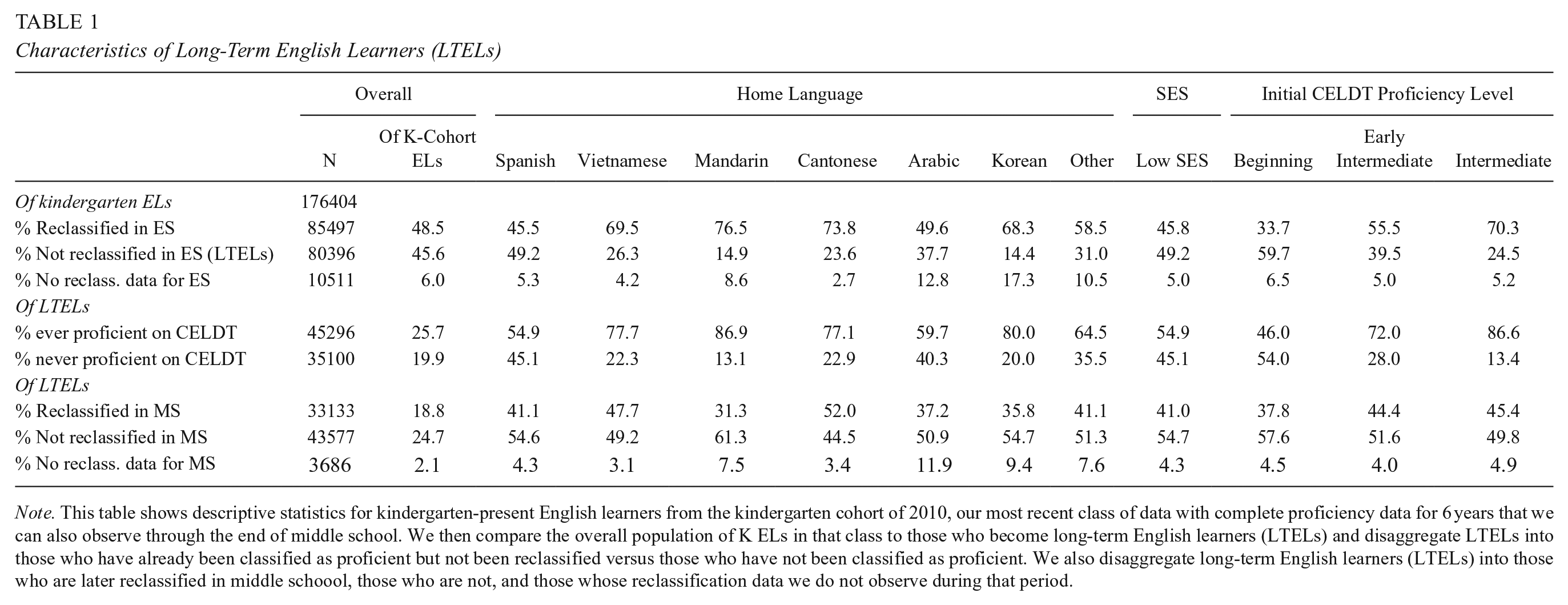
Note. This table shows descriptive statistics for kindergarten-present English learners from the kindergarten cohort of 2010, our most recent class of data with complete proficiency data for 6 years that we can also observe through the end of middle school. We then compare the overall population of K ELs in that class to those who become long-term English learners (LTELs) and disaggregate LTELs into those who have already been classified as proficient but not been reclassified versus those who have not been classified as proficient. We also disaggregate long-term English learners (LTELs) into those who are later reclassified in middle schoool, those who are not, and those whose reclassification data we do not observe during that period.
In that cohort, 48.5% of K-ELs were reclassified in elementary school. More than half of those not reclassified in elementary school (LTELs) scored proficient on the CELDT during that time and thus were eligible for reclassification on the basis of that criterion, again demonstrating the gaps between proficiency and reclassification discussed earlier. We also note disproportionality in the characteristics of LTELs. Almost half (49.3%) of Spanish-speaking students in a K-EL cohort became LTELs while only 14.9% of Chinese-speaking students in a K-EL cohort became LTELs. This may, in part, stem from the different entering English skills of those two groups but may also reflect that students from different language groups tend to attend schools in different neighborhoods and experience different educational environments.
Another 18.8% of K-ELs in this cohort were reclassified in middle school. Among K-EL students for whom we can observe reclassification data in both elementary and middle school, 73.1% were reclassified by the end of middle school. In other words, more than a quarter of K-ELs in this cohort who remained in California schools for nine years were not reclassified during that time period.
Discussion
This paper uses population student-level longitudinal data from the California Department of Education from 2006 to 2019 to describe the demographic characteristics and pathways of students who were classified as English learners in kindergarten. We find that most kindergarten ELs in California speak Spanish at home, though that percentage has decreased over this time span as other languages (e.g., Mandarin and Arabic) have become more common. We also find that kindergarten ELs are slightly more socioeconomically disadvantaged than their never-EL peers. We additionally find that third-grade achievement is steadily improving for kindergarten ELs in math and ELA and that achievement gaps are shrinking in both subjects. Our results also highlight how cross-sectional snapshots and reliance on aggregated time-series data can provide a misleading portrait of the patterns of achievement among students initially classified as English learners in kindergarten. Specifically, in contrast to our findings using longitudinal data on those classified as English learners in kindergarten to show that achievement gaps are shrinking, past research using cross-sectional snapshots of current English learners has typically shown widening or stable achievement gaps over this time period (Garcia, 2015; Murphey, 2014).
We then turn to proficiency, an important precursor to reclassification (i.e., exiting English learner status). We find that more recent cohorts of kindergarten EL students reached English proficiency earlier than ever before but that only slightly more students reached English proficiency by the end of grade 5. Improvements in English proficiency have been made among students across the full distribution of initial English proficiency, but students entering with low levels of English proficiency still often do not reach English proficiency by the end of elementary school. In the kindergarten cohorts that started school between 2006 and 2013, only 40% of those with low initial English proficiency were proficient by the end of grade 5.
We similarly note that reclassification rates in the early grades have risen sharply but that cumulative rates by the end of fifth grade have increased only slightly. In addition, in our most recent cohort that we can observe through the end of middle school and among students we can observe for that entire time period, 48.5% were not reclassified by the end of elementary school (after six years observed in California schools) and 26.9% were not reclassified by the end of middle school (after nine years in California schools). Reclassification has been shown to increase access to mainstream curriculum and improve EL’s sense of self-efficacy (Lee & Soland, 2023). Reclassified English learners also report higher senses of belonging, controlling for student and school characteristics, than current English learners, suggesting that reclassification can improve perceptions of school climate (White et al., 2023), though the degree to which it succeeds also depends on how teachers respond to reclassification (Chin, 2021). Reclassification also moves students out of English learner instructional services; research has shown that some students believe their placement in those services to be informed by racism, and many more students have found the services themselves to be “academically limiting” and “socially isolating” (Brooks, 2023). Therefore, these improvements in the speed of reclassification are important to document as is the prevalence of not reclassified students into middle school (LTELs).
Taken together, these results show significant improvements in the academic achievement and English proficiency acquisition rates of California’s kindergarten ELs for the cohorts who began kindergarten between 2006 and 2015, likely related to improvements in the school learning environments that kindergarten ELs experienced. Our results suggest that some combination of the policies described earlier—from more rigorous requirements for teacher preparedness for English learner students to increased funding and the introduction of TK—have likely contributed to this improvement in EL outcomes.
Our analysis does not allow us to conclude which policies contributed most to this positive change, nor if some policies had negative effects and were outweighed by more positive ones. The patterns of improvement for academic achievement in math and ELA across successive cohorts of kindergarten ELs are aligned with the timing of LCFF implementation and the staggered rollout of increased funding, while the improved rate of progress in time to English proficiency appears to be gradual and steadily improves throughout the analysis period, suggesting a potentially positive role for policies of the early 2000s, such as the Williams v. California mandates for teachers to earn EL-appropriate credentials. It is important that future research attempt to identify these mechanisms, particularly the effects of LCFF as it became fully funded, the effects of the introduction of TK and its ongoing expansion, and the effects of the return of bilingual programming. This will require data on additional cohorts of students (as data becomes available) and estimation strategies that can plausibly identify the effects of these policies and potential synergies among them. In addition, as more recent cohorts—who have experienced higher rates of TK enrollment and more robust funding for traditionally underserved subgroups through LCFF—progress into middle and high school, future research should monitor whether rates of proficiency acquisition and reclassification improve. In addition, though this work focused on the academic achievement and English proficiency acquisition of kindergarten ELs, it is important that research examine these processes and trends among newcomer students arriving in later grades, whose learning trajectories are not well understood.
These results also provide detailed information for policymakers about how much work remains to improve EL outcomes. For the cohorts we were able to study through fifth grade (those that began kindergarten from 2006 to 2013), the percentage of students reaching proficiency by the end of elementary school remained almost flat, demonstrating the challenge the state has had in trying to reduce the number of long-term English learners. As the newer cohorts of EL kindergarteners—who have experienced more funding under LCFF, along with TK and more fully prepared teachers—move through the schooling system, researchers will be able to see if EL progress is accelerated further.
We believe our findings have three important policy implications. First, this paper demonstrates the need for additional monitoring mechanisms for kindergarten ELs as a subgroup distinct from ELs and for tracking their academic trajectories after reclassification to ensure that data accurately represents the outcomes of a stable group of students. California has begun this work, presenting ever ELs as a subgroup in the state standardized test score reporting system but still does not report ever ELs as a subgroup on the California School Dashboard. Even this ever-EL subgroup includes newcomer students who likely should be separated from kindergarten ELs to demonstrate their distinct academic trajectories.
Second, this work illuminates the size and persistence of a gap between when students achieve English proficiency and when they are reclassified. We find that almost three-quarters of K-cohort EL students are English proficient as measured by CELDT by the end of elementary school but only half of K-cohort ELs had been reclassified by that same time point. Reclassification in California is determined based on four criteria of which meeting English proficiency is only one. Students must also demonstrate basic academic skills relative to English-proficient peers on other tests, a requirement that many students find challenging to meet. Although the federal government mandated in the 2015 Every Student Succeeds Act that states develop uniform procedures for reclassification, in California, each school district or charter management organization still retains the ability to determine on what test this criterion is measured and what threshold score is necessary for proficiency. For example, in 2023 in Los Angeles Unified, the state’s largest district and the district that serves the most English learners, students in fourth grade had two choices for how to demonstrate basic skills (Reclassification Criteria Chart, 2023). They could either score approaching grade level on the i-Ready Reading Diagnostic or score standard met or exceeded on the California Assessment of Student Performance and Progress. It is worth noting that, among fourth graders in Los Angeles Unified who speak English at home, more than half would not have met that latter criteria. In other words, though many native English speakers do not meet the criteria for reclassification based on their ELA scores, they are not placed in supplementary courses for English language development while non-native English speakers with similar ELA scores who have already demonstrated English proficiency continue to be subject to these requirements.
The requirement of an additional test in addition to an English proficiency assessment is not unique to California. In 2023, 27 states required English learners to pass at least two tests for reclassification (Morales & Lepper, 2024); these states collectively serve 76% of the English learners in the United States (author calculations using EL population from English learners in K–12 Education by State [2022]) and include Texas, Florida, and New York.
Even when a student has met two test-based requirements for reclassification, another barrier to reclassification can emerge from the bureaucratic processes required to recognize when a student has met those two criteria and obtain the required parent and teacher approval to reclassify. Previous research in California and Texas (where a similar law requires teacher consultation for reclassification and a hearing to approve reclassification decisions) has highlighted that reclassification varies tremendously across districts as different districts act upon the same law differently. For example, students in El Paso are nearly twice as likely to be reclassified as those in Laredo, even controlling for the same demographic and academic characteristics, including their state standardized test scores and English proficiency levels (Mavrogordato & White, 2017). The California study specifically highlighted “the long chain of staff and actions” that can be subject to error or inaction from overburdened administrative staff and, therefore, can often not be completed even for eligible students (Estrada & Wang, 2018). When a new law went into effect in Michigan that made it the default for students to be reclassified if they had met English proficiency criteria without requiring action from district staff, reclassification rates for the marginal eligible student increased by 35 percentage points (Bartlett et al., 2024). This research demonstrates the role that additional criteria, and specifically administrative burden, play in reclassification and partially explains the gap observed between the attainment of English proficiency and reclassification.
Third, our work shows that the rate of proficiency acquisition for students entering with little English skills has remained low. Only 43% of students who entered with low English proficiency were proficient in English by the end of fifth grade for the most recent cohort we can observe (those who began kindergarten in 2013). This suggests a need to build targeted interventions in elementary grades that differentiate between students entering with intermediate or high English skills and those entering without that language familiarity. This could involve a separate English language development track for students at risk of becoming LTELs in schools with a sufficiently large English learner population, additional professional development for teachers about how to differentiate in a classroom with wide variation in initial English skill, or the provision of additional instructional aides to work with particular high-need students (Buenrostro & Maxwell-Jolly, 2021). Absent that support, the status quo—in which most elementary EL students, regardless of entering skill level, are in the same class together with a single teacher who views their lowest-performing students in a deficit framework and feels they do not have sufficient curriculum or support to grow the wide range of skills in their classrooms (Hopkins et al., 2019)—will continue to persist. In addition to ways English language development support could be improved, students entering with lower initial English proficiency are more likely to come from families with low socioeconomic status. Policies with the potential to disrupt the role of poverty in achievement, such as additional school funding based on community characteristics like high rates of poverty (Levin & Brodziak, 2021), could also potentially disrupt the persistently high rates of LTELs.
We believe these findings have national ramifications beyond the California context. California educates one-eighth of all US students and an even higher share of the country’s English learners, making it the ideal setting to analyze English learner outcomes. But other states also face the challenge of achievement gaps between ELs and non-ELs. A number have tried to improve their outcomes through a myriad of policy choices, from increasing funding to improving teacher training. The takeaway from this paper—outcomes for ELs in California have improved as EL policy has changed—should be a source of optimism nationwide and encourage policymakers to consider ways to support continued growth through clear data categorizations, increased attention to the gap between proficiency and reclassification, and targeted interventions for students entering schools with limited English skills.
Supplemental Material
sj-docx-1-ero-10.1177_23328584251318304 – Supplemental material for A Longitudinal Portrait of California’s Kindergarten English Learners & Their Learning Outcomes
Supplemental material, sj-docx-1-ero-10.1177_23328584251318304 for A Longitudinal Portrait of California’s Kindergarten English Learners & Their Learning Outcomes by Sarah Novicoff, Sean F. Reardon and Rucker Johnson in AERA Open
Footnotes
Acknowledgements
We are grateful to Linda Darling-Hammond, Dion Burns, Jennifer McCombs, and Heather Price at the Learning Policy Institute and to Jonathan Isler and Sela Fessehaie at the California Department of Education for their gracious support of this project and data partnership.
Declaration of Conflicting Interests
The author(s) declared no potential conflicts of interest with respect to the research, authorship, and/or publication of this article.
Funding
The author(s) received financial support for the research, authorship, and/or publication of this article from the Learning Policy Institute.

Notes
Authors
SARAH NOVICOFF is a PhD candidate in educational policy and economics of education at Stanford University, 520 Galvez Mall, Stanford, CA 94305;
SEAN F. REARDON is the Endowed Professor of Poverty and Inequality at Stanford University, 520 Galvez Mall, Stanford, CA 94305;
RUCKER JOHNSON is the Chancellor’s Professor of Public Policy in the Goldman School of Public Policy at the University of California, Berkeley, 2607 Hearst Ave, Berkeley, CA 94720;
References
Supplementary Material
Please find the following supplemental material available below.
For Open Access articles published under a Creative Commons License, all supplemental material carries the same license as the article it is associated with.
For non-Open Access articles published, all supplemental material carries a non-exclusive license, and permission requests for re-use of supplemental material or any part of supplemental material shall be sent directly to the copyright owner as specified in the copyright notice associated with the article.
