




Abstract
In this quantitative toponymic study, we examine U.S. public schools named after Confederates, enslavers, and segregationists (CESs). We find that 4.7% of all public schools (n = 4,172) had CES namesakes, although this number declined slightly after the BLM/George Floyd protests in the summer of 2020. Most of these are named after enslavers, while 467 are named after Confederates and 210 after segregationists. While nearly one-quarter are named after presidents, the remaining three-quarters of namesakes have no such claim on American history. More than half of schools with CES namesakes reproduce their embedding geographies, highlighting how schools amplify the toponyms of other geographies and public spaces. Of particular concern, Black students are particularly concentrated in schools with Confederate namesakes. We discuss the potential harm of these “symbols” and conclude with policy implications.
Keywords
Catalyzed by high-profile tragedies such as the Charleston church massacre in 2015, the deadly “Unite the Right” white supremacist rally in Charlottesville in 2016, and the murder of George Floyd in Minneapolis in 2020, communities across the United States are grappling with racist public symbols (e.g., Mitchell, 2018, 2020). This movement has resulted in a concerted emphasis on eliminating symbols of white supremacy, particularly the Confederacy, from public spaces (Southern Poverty Law Center, 2021).
For example, Richmond, Virginia, the former capital of the Confederacy, removed its final Confederate statue honoring Ambrose P. Hill in December 2022 (Kuta, 2022). At the University of North Carolina at Chapel Hill, students toppled the “Silent Sam” Confederate Memorial in 2018, prompting an acrimonious and ongoing battle over what the university should do with the statue (Killian, 2020). And the U.S. military successfully implemented changes to rename nine Army bases, including Fort Bragg in North Carolina, and other Confederate iconography on military installations before the end of 2023 (Watson, 2023).
Public scrutiny has also turned to PK12 public schools, particularly those named after Confederates (Brown, 2015; Mercer, 2020). EdWeek reported that at least 36 campuses were renamed in the wake of Charlottesville (Mitchell, 2018). For example, the Dallas Independent School District in Texas removed Robert E. Lee, Stonewall Jackson, and William L. Cabell, some of the more prominent faces of the Confederacy, as school namesakes. However, Dallas did not change the names of other schools, including W. H. Gaston Middle, named after a Confederate soldier. The impetus to rename schools has not been limited to those named after Confederates. San Francisco proposed renaming schools honoring George Washington, who enslaved people, and Abraham Lincoln for his controversial decision to hang 38 Sioux Indians who participated in the “Minnesota Uprising” of 1862. However, San Francisco ultimately rescinded its proposal (Romo, 2021). It should be emphasized that this movement has not been limited to the U.S. Indeed, it may be viewed as part of a broader decolonization movement that has focused on renaming schools globally—such as in Zimbabwe in the early 2000s (Masakure & Nkomo, 2023).
In May 2024, the Shenandoah County Public School district in Virginia restored the names of two schools named after prominent Confederates, which they had changed just four years earlier in the wake of the George Floyd/BLM movement. Calling the changes a “knee-jerk reaction” which was not “loyal” to the community, which is 90% White, the district’s board voted 5–1 to reinstate the names of Stonewall Jackson High School and Ashby Lee Elementary School, which honor Confederates Stonewall Jackson, Robert E. Lee, and Turner Ashby (Rosenzweig-Ziff, 2024). While it is unclear at the time of this writing whether this is an isolated case or emblematic of national retrenchment on the issue of school names, it highlights a broader pattern of White backlash in response to the demands for racial equality leveled under the George Floyd/BLM movement.
Despite recent public media attention to controversial school namesakes, there is surprisingly little empirical work addressing such school names in America and even less foregrounding issues of race and racism. In this study, we build on previous work examining schools named after Confederates, which have received the bulk of public attention. However, we also examine the ways in which schools honor namesakes that are more broadly problematic, including those that enslaved other people and those that worked to uphold racial segregation in schools and public life more generally. Towards that end, we adopt a critical lens to examine the toponyms, or place names, of public schools in the U.S., seeking to understand the prevalence and characteristics of schools with namesakes who were implicated in the perpetuation of racial and ethnic injustice via enslavement and segregation.
Critical Toponymy
Our work is focused through a lens of critical toponymy. While toponymy studies the naming of geographic places more generally, critical toponymic perspectives observe that place names are not neutral, but the product of power relations. According to this perspective, place names reify the preferred historical and social narratives of those who wield power to assign names (Alderman, 2002, 2008; Post & Alderman, 2014; Rose-Redwood et al., 2010). Moreover, these names are not just manifestations of public memory, they are mechanisms of the so-called “technology of power” by which power dynamics are reproduced through toponyms that signal who is valued and who belongs (Rose-Redwood et al., 2018).
In the U.S. as in other societies, this power dynamic is highly racialized, with place names often burnishing the reputations of White historical figures, marginalizing the contributions of people of color, and downplaying America’s pernicious history of racial oppression (Rose-Redwood et al., 2022). As Rose-Redwood and colleagues note, place names often undergo “habitualized forgetting” in which the historical significance or contention “fades into the background noise of everyday life” (Rose-Redwood et al., 2022, p. 450) and are therefore seen as immutable and institutional, neutral and normal. Because of this, such commemorative toponyms serve to “naturalize” racism, like other forms of colorblind racism as typologized by Bonilla-Silva (2006).
Public schools are places that are of crucial symbolic importance in societies. They are central to constructing students’ identities from a young age and serve as a key marker of community identity (Alderman, 2002). Their names are internalized by students from preschool through alumni reunions and define communities as meaningfully as any county boundary that determines who picks up your trash or what street name you plug into your GPS. School names, therefore, are a particularly powerful mechanism by which we as a society habitualize the forgetting of the worst aspects of our history and inscribe official, sanitized narratives onto the key public institutions that transmit values and knowledge to future generations (O’Connell & Forrest, 2020). Public schools named after people who espoused and enforced White supremacy, therefore, may be even more socially salient than toponyms of administrative boundaries like counties, streets, etc.
The power of school names is keenly, if not explicitly, observed by those in power. For example, in research on name changes in Romania, Rusu (2019) observed a process of “toponymic cleansing” after a regime change and Communist power seizure. Likewise, historians have documented that, like Confederate monuments, schools were often named after Confederates in the Deep South during the Jim Crow and Civil Rights eras in response to African Americans demanding their full rights of citizenship as an effort to reshape the dominant narrative of Civil War History as a just battle for states’ rights and economic dispute only tangentially related to the enslavement of people of color (Hartley, 2021).
Literature on Public School Names
Extant research on school names, like toponymic research on issues of place naming more generally, generally falls into one of two camps (Tent, 2015). It may be qualitative or intensive, seeking to understand how and why toponyms emerged or changed. Conversely, it may be quantitative or extensive, seeking to understand patterns of such names. While there is a larger corpus of toponymic work on school names in international contexts (Masakure & Nkomo, 2023; Rusu, 2019; Thelma et al., 2022), and emerging work on university naming policies (Rose-Redwood et al., 2024), in this review we focus on U.S. K–12 public school namesakes.
A handful of studies have examined historical or current processes of naming or renaming of schools, often using qualitative approaches. This processual approach mirrors recent expansion within the field of critical toponymy to further understand not only names themselves but also “how certain place names come into being, who is in control (or not) of naming practices, [and] whose lived experiences are written into (and out of) the naming process” (Rose-Redwood et al., 2024, p. 2).
Qualitative toponymic studies have generally focused on districts’ renaming schools in honor of Black historical figures. For example, Moran (2019) examined school naming practices in Kansas City’s segregated school system from 1940 to 1953. Moran found that when overcrowding forced the district to convert all-White schools to schools for Black students, the district renamed schools after Black luminaries such as Benjamin Banneker and Booker T. Washington as a “code for the race of the students and the neighborhood that the school served” (p. 66). Essentially, Kansas City’s school names, even in commemorating Black Americans, served to reinforce the boundaries between black and white communities. Kansas City’s process, led by White district officials, stands in stark contrast to St. Louis in 1890, where Black public school principals named the twelve elementary schools in their community in what Lyons and Davis (2017) describe as an effort to construct a “geography of resistance” (p. 3), even if the ultimate effect of delineating Black and White schools was similar.
Looking at more recent school renaming processes, Mansfield and Lambrinou (2022) used an intrinsic case study method that involved attending public events to examine changes in two Alexandria, Virginia, public schools. Invigorated by the Black Lives Matter movement in the wake of George Floyd’s murder, students led an effort to change the names of schools originally named after T. C. Williams, the district’s former superintendent and ardent segregationist, and Matthew Fontaine Maury, a Confederate Naval officer. In appealing to the district to change the school names, they found that students cited the psychological impacts on students of color. Regarding T. C. Williams specifically, one student asked, “Do you really care for us when you name our whole entire school, [when] our ‘brand,’ is named after a racist man?” (Mansfield & Lambrinou, 2022, p. 38).
Quantitative scholarship on U.S. public school names has sought to examine the prevalence and location of schools with Black namesakes. For example, Alderman (2002) examined school names from 1997–98 and found that 110 schools were named after Martin Luther King, Jr., as in Kansas City and St. Louis studies above. Interestingly, Alderman found that these schools were concentrated in central cities, albeit not necessarily majority-Black areas. Likewise, Tretter (2011) used geospatial techniques to map regional differences in schools commemorating African American namesakes, focusing on 15 male and 15 female namesakes. Tretter found that such schools were concentrated in areas with a higher concentration of Black residents, in the South, and in small towns.
More recently, a handful of studies have focused on the prevalence of controversial namesakes, such as Confederates. In a recent report building on the work of Greene et al. (2007), Greene and Kingsbury (2023) examined schools named after U.S. presidents between 1987 and 2021, documenting a decline in the share of schools with presidential namesakes over time. Greene and Kingsbury also probed changes in schools named after Confederate leaders and other categories, such as civil rights leaders, presidents, and common names. However, their analysis was limited to 225 total namesakes, including presidents. Notably, they did not distinguish presidents who were enslavers, who supported racial segregation (e.g., Woodrow Wilson) or who supported/belonged to the Confederacy (e.g., John Tyler) from other presidents. EdWeek produced the only other prior work on controversial school namesakes in 2016 and subsequently updated it several times (Mitchell, 2020). EdWeek found over 200 public school campuses named after historical figures with ties to the Confederacy, most of which were in the South. While EdWeek did not provide specific information on their methodology, it appears they examined primarily high-profile Confederates and have added at least a few signatories of the Southern Manifesto.
It should be noted that existing work on toponymy focuses on toponyms at a single geographic level—e.g., school names, city names, county names. To the best of our knowledge, no prior research has sought to explore the ways in which more micro-level school names may be layered and mutually reinforcing or mitigating of other meso- or macro-level toponyms such as county names. For example, a school that is indirectly named after an enslaver via its county name—e.g., Lee County High School, may not only naturalize the school name but further compound the effect of the administrative Lee County boundary. Conversely, even if a county is named after an enslaver—as is quite common in the South—schools in that district may have more affirmative namesakes (e.g., Alderman’s [2002] findings regarding the prevalence of schools named after Martin Luther King, Jr.), potentially mitigating the impact of the administrative boundary name.
Current Study
In this study, we take a critical quantitative approach, seeking to understand the degree to which current public schools commemorate historical figures who were explicitly linked with the perpetuation of racial and ethnic injustice via enslavement and segregation (Alderman, 2002; Alderman & Rose-Redwood, 2020; Rose-Redwood et al., 2010; Tent, 2015). Toward that end, we examine the names of all public schools in the United States and compare each school’s name to a compiled index of potential namesakes that is substantially broader in scope than those used in prior literature.
Prior quantitative work (Greene & Kingsbury, 2023; Mitchell, 2020) has focused mainly on identifying schools named after a narrow subset of members of the Confederacy. We build on this work by including thousands of additional individuals who had Confederate ties, who were known to enslave other people (i.e., enslavers), or who were committed to retaining racial separation in public life (i.e., segregationists, signatories of the Southern Manifesto, and members of the Ku Klux Klan). Like prior scholars (Greene & Kingsbury, 2023), we also identify schools with namesakes in these categories that were also presidents.
We also delineate schools with what we call indirect namesakes (i.e., named after the town, city, county, or other geography in which they are embedded). This permits us to understand the ways in which school namesakes are part of a multi-scalar system, through which toponymies work in concert to naturalize racial and ethnic injustices. This is of particular concern given the unique role that schools play in transmitting values and knowledge to our youngest citizens. In addition, given the public attention to school names in the wake of the BLM/George Floyd protests, we also examine changes in school names since the summer of 2020 to determine how these social shifts may have been associated with renaming practices.
Finally, little extant research has connected school names with the characteristics of students who attend them (for an exception, see Alderman (2002), which documented the racial composition of schools named after Martin Luther King, Jr.). As such, we know little about the degree to which, for example, students of color may be exposed to school names honoring those who opposed their equal inclusion in society. Thus, our empirical scope extends beyond the mere prevalence of such schools to document where they are located and who they serve. Towards that end, we examine geographic distributions by state/region and urbanicity. We also document the racial/ethnic and socioeconomic characteristics of the students who attend these schools.
Method
We examine the extent to which school namesakes honor those with documented histories of opposing racial equality by comparing the names of 89,252 U.S. public schools from the National Center for Education Statistics Common Core of Data (NCES CCD) against an index of 3,249 historical figures who were Confederates, enslavers, and segregationists (CESs). We also compare school names from 2019–20 (prior to the George Floyd/BLM protests) to school names in the most recent year of data 2021–22 to examine change in school names over this period. We then use descriptive analyses to explore the characteristics of schools with CES namesakes, focusing on patterns of variability by geography, urbanicity, and school racial/ethnic and socioeconomic composition. Below, we discuss our data sources and our process for creating the index of CESs, identifying schools with CES namesakes, examining changes in namesakes over time, and analyzing the characteristics of these schools.
Creating the Index of Confederates, Enslavers & Segregationists
We obtained the names of all public schools in the 50 states and DC from the NCES CCD. We excluded only technical/vocational, juvenile justice, and alternative schools (we included charter schools), mainly because such schools generally lacked school websites, and their names were often structurally similar to “Tidewater Juvenile Detention Center” or “Sierra-Osage Treatment Center.” Our final sample of 89,252 schools enrolled 49.4 million students, comprising 98% of all public school students. We analyzed school names from the 2019–20 and 2021–22 school years, bookending time points that allowed us to assess the current prevalence of such school names and changes in the wake of the BLM/George Floyd protests in the summer of 2020.
We compared the names of each public school to a broad index of historical figures with histories of racism (See Richards et al., 2024 for the complete list). In total, we identified 3,249 individuals as potential CES school namesakes in our three categories as follows:
Confederates (n = 828)
Our index of Confederates included all members of the Confederate States Congress; Confederate generals, commanders, and other high-ranking officers or notable enlisted military; and high-profile Confederate sympathizers. This list included all Confederate namesakes identified by the Southern Poverty Law Center (n = 315), which tracks Confederate monuments and memorials by state, and all those found by EdWeek (n = 106). We also include hundreds more Confederates. For example, our list included the U.S. President John Tyler, whose death was not officially recognized in Washington due to his Confederate loyalties, as evidenced by his brief tenure in the Confederate Congress, and who was buried in a coffin draped in the Confederate flag (Hollywood Cemetery, n.d.).
Enslavers (n = 2,348)
To identify enslavers for our index, we adopted a two-pronged strategy. First, we identified presidents (n = 12) and members of Congress (n = 1,851) who were enslavers, as documented recently by the Washington Post (Zauzmer Weil et al., 2022). In addition, we independently investigated the namesakes of each of the 3,006 U.S. counties to identify other prominent enslavers (this method also identified some Confederates, but none that were not also identified via the process above), because counties are often named after enslavers and their plantations, particularly in the South, and schools are often directly or indirectly named after counties, this technique captured hundreds of enslavers of local prominence that our other methods had not captured.
Segregationists (n = 233)
Our index of segregationists included known members of the Ku Klux Klan, those who signed the Southern Manifesto, and other powerful individuals who opposed integration. For example, the latter group included school superintendents who opposed integration but were still honored through the names of local schools. Perhaps the most prominent segregationist on the index was President Woodrow Wilson, for his reinstatement of segregation in the U.S. government and at Princeton University and his praise of the Confederacy and the Klan (Little, 2020).
A few notes regarding the index of potential namesakes are warranted. First, it should be noted that these categories are not mutually exclusive. Indeed, 159 fell into two or more categories (largely enslaver and Confederate). One individual, Nathan Bedford Forrest, spanned all three categories as a Confederate General, enslaver, and first Grand Wizard of the Ku Klux Klan. Because each individual with multiple “affiliations” also fell into the Confederate category and given the particular public concern for Confederate namesakes, we ultimately classified these as Confederates for our descriptive analyses, to ensure that we do not double or triple count the total number of schools with such namesakes (since schools are our unit of analysis). However, we discuss the number of schools that fall into multiple categories in detail in the findings below.
Second, it should be acknowledged that this process undoubtedly yielded an incomplete list of Confederates, enslavers, and segregationists and was limited to those featured most prominently in the historical record. For example, while we identified a handful of women who were enslavers, our list is likely to under-represent women, whom the historical record often neglects. Thus, our estimates almost certainly represent the lower bound for the true prevalence of CES namesakes. However, by capturing the most prominent and wealthiest of these groups, we believe that it provides insight into those most likely to have schools named after them.
Identifying Schools with CES Namesakes
After constructing our index of CESs, we employed a multi-step, convergent process to identify schools in the NCES CCD with these namesakes. First, we filtered out all schools in the NCES CCD data whose names did not contain the surnames of any of our CES namesakes. In this process, we allowed for full and partial matches: We retained schools with names like “Leesburg High School” as a potential match for Robert E. Lee. This initial screening resulted in a list of 20,708 schools for closer manual examination.
At least one research team member checked each of the remaining school names against the full index of CES historical figures. When unambiguous evidence linking a school’s name to a person on our index was found, the researcher coded it as a match (e.g., when the school name was “Robert E. Lee Elementary”).
When a campus name matched one of the surnames on our index, but its namesake was ambiguous (e.g., “Lee High School”), the researcher coded it as a possible match. For all possible matches with ambiguous namesakes, we scoured online sources to determine if the school’s namesake was identified: 1) on the school’s or district’s official website, 2) in any news media accounts, often addressing naming controversies (i.e., via Google News), 3) on any maps (i.e., Google Maps) featuring the school, or 4) on the signage outside the school (as visible on Google Street View or Google Images). If this search yielded evidence that the school was named after one of the potential CES namesakes, it was coded as a match. If not, it was excluded from the analysis. As a result of this process, the 20,708 possible matches were narrowed to 4,537.
To make final determinations, each match and possible match was reviewed by at least one additional researcher according to the process above. Only when two or more researchers were confident that the namesake was an unambiguous match was it included in our final analyses.
This process almost certainly resulted in a conservative estimate of the true prevalence of schools with CES namesakes, owing not only to the inexhaustive index of historical figures but also to high rates of ambiguity in school names (e.g., “Lee Elementary” and “Jackson Middle School”). Many schools’ namesakes could not be determined based on available information. For example, of the 53 schools with names like “Lee Elementary,” “Lee Middle,” or “Lee High,” we were unable to determine any school namesake for more than half (n = 28). It is likely that some of these schools are or were originally named after Robert E. Lee (or—particularly in Virginia—after other enslaving members of the Lee family). However, schools and communities may have intentionally removed references to their namesakes while retaining the surname on the school. Of course, other schools may simply have namesakes who share the surname of Confederates, enslavers, and segregationists (Lee, again, as an example, is a very common surname). Hence, we chose not to make any inferences about such schools.
Coding CES Namesakes as “Indirect”
For each school that was determined to have a CES namesake, we further coded each school as either: (1) directly named after the namesake, or (2) indirectly named after another geographic unit that itself has a CES namesake. Specifically, we examined schools that were named after their towns, cities, or counties. We deemed such schools as having CES namesakes that are “indirect” in nature. For example, Maury High School in Norfolk, Virginia, named after Matthew Fontaine Maury, who served in the Confederate Navy, was coded as having a direct CES namesake as it is located in the city of Norfolk which is named after a county in England. However, Lee High School in Lee County, Arkansas, was coded as having a CES namesake, and was further coded as having an indirect namesake that embedded in its local geographic unit (e.g. county).
Examining Change in CES Namesakes over Time
We captured changes in school names between the 2019–20 and 2021–22 school years by matching the strings of school names as reported in the NCES CCD in each of these years. We used an exact matching procedure to determine if the school names were different in the bookending years. For names that did not match, we compared the initial school name with the new school name to determine if the school had been renamed or if the mismatch was due to a change for other reasons, such as punctuation or spelling. The exact matching process yielded 190 potential name changes. Of these, our team determined that 92 were meaningful changes. For all schools that changed their name, we researched and documented the race/ethnicity and gender of their new namesakes.
Analyzing the Characteristics of Schools with CES Namesakes
After identifying schools with CES namesakes, we examined where they are located and what types of students they serve relative to other U.S. public schools using data from the NCES CCD for the 2019–20 school year. We identify each school in terms of its state and Census region (i.e., Northeast, South, West, and Midwest), as well as urbanicity (classified as urban, suburban, or rural/town). We use NCES CCD data to examine the racial/ethnic profile of each school, in terms of the proportion of students identifying as American Indian/Alaska Native (AI/AN), Asian/Pacific Islander (Asian/PI), Black, Hispanic, White, and Multiracial (two or more races). We also explore the socioeconomic characteristics of schools in terms of the share of students qualifying for free- or reduced-price lunch (FRL).
Findings
We find that despite controversies and reform efforts in recent years, a substantial number of school names still honor Confederates, enslavers, and segregationists. However, the share declined slightly after the BLM/George Floyd protests in the summer of 2020. A substantial proportion of these are named after presidents who were enslavers, and many reinforce the toponyms of the city or county in which schools are embedded. Such schools are asymmetrically distributed by geography and student characteristics: Schools in the South and rural areas are particularly likely to have such namesakes. Moreover, Black students are particularly likely to attend schools with Confederate namesakes. Below, we discuss these findings in detail.
Which Confederates, Enslavers, and Segregationists Were Schools Named After?
We identified at least one school named after 628 of the 3,249 individuals in our index of CES historical figures (19.3%). Table 1 provides more detail on who schools are named after, including the ten most frequent namesakes in each category (i.e., Confederate, enslaver, segregationist). Not surprisingly, the most frequent individual namesakes are Thomas Jefferson (n = 265) and George Washington (n = 236), both U.S. presidents and enslavers. Other frequent namesakes are founding fathers Benjamin Franklin (n = 193) and James Madison (n = 136), both of whom were enslavers. Notably, 78 schools are named after Andrew Jackson, an enslaver with a brutal record of ethnic cleansing and Indian Removal. Another 63 are named after Confederate General and enslaver Robert E. Lee, perhaps the single most central figure in the ongoing debate around the renaming of public spaces. A number of schools are also named after Confederates Albert Sidney Lanier (n = 17), the so-called “Poet of the Confederacy,” and Confederate General Thomas “Stonewall” Jackson (n = 16). Woodrow Wilson (n = 111), who espoused deeply racist views and re-segregated much of the federal government (Little, 2020), is by far the most common namesake in the segregationist category.
Most Common Confederate, Enslaver, and Segregationist Namesakes by Category


How Many Public Schools Have Confederate, Enslaver, or Segregationist Namesakes?
Figure 1 illustrates the prevalence of schools with CES namesakes disaggregated by category (e.g., Confederate, enslaver, or segregationist), status as president, and whether the toponymy is direct or indirect via its embedding geography.
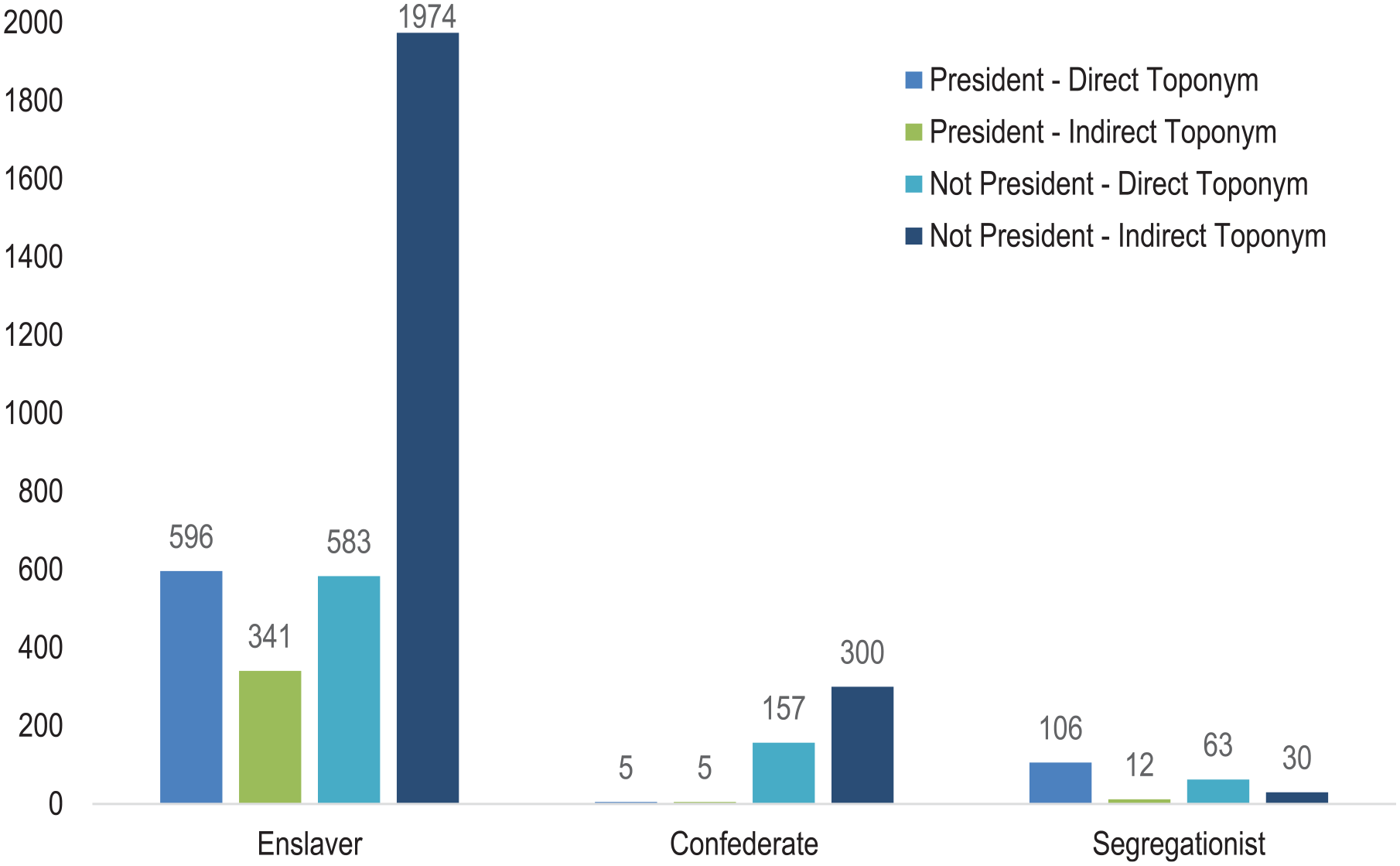
Frequency of Schools with Confederate, Enslaver, and Segregationist Namesakes, Disaggregated by Status as President, and Indirect/Direct Toponymy.
We identified 4,172 U.S. public schools named after at least one of the CES namesakes on our index as of 2020 (see Richards et al., 2024 for the complete list). Overall, 4.7% of public schools have some form of CES namesake, and over one in every 20 public school students (5.4%) is enrolled in a school with such a namesake. A handful of schools, like Lee-Jackson Elementary in Mathews County, Virginia, are named after two such individuals (in this case, Robert E. Lee and Stonewall Jackson).
Most of these schools (83.7% or 3,494) are named after enslavers. A much smaller fraction is named after Confederates (n = 467 or 11.2% of schools with CES namesakes) or after segregationists (n = 211 or 5.1%). As outlined above, this categorization scheme is based upon mutually exclusive categories, reclassifying those that were Confederates and enslavers or Confederates and segregationists as Confederates. We found 245 of the 4,172 schools were named after individuals who fell into multiple categories. Eight were named after Nathan Bedford Forrest, Confederate General and enslaver who was also Grand Wizard of the Ku Klux Klan. The other 237 were named after Confederates who were also enslavers.
A substantial share of schools are named after U.S. presidents who were also enslavers, Confederates, or segregationists and who, therefore, have more complex historical legacies. Indeed, roughly one in four schools with CES namesakes were named after one of the 12 presidents who enslaved people, John Tyler (Confederate), or Woodrow Wilson (segregationist) (n = 1,065 or 25.5%). Perhaps more notably, however, three-quarters of all schools with CES namesakes do not have such a clear claim to American history.
Our analyses suggest that school names frequently reinforce the toponyms of other geographies and public spaces. Indeed, nearly two-thirds of the schools with CES namesakes are indirect (n = 2,662 or 63.8%), meaning that the CES namesakes are named after counties, cities, and other geographies. As Figure 1 illustrates, the degree to which CES namesakes are indirect depends on the category: Schools named after segregationists are particularly unlikely to be indirect, with only one in five schools with a segregationist namesake named indirectly via their geographies (n = 42 of 211). By contrast, roughly two in every three schools with a Confederate or enslaver namesake are indirect toponyms (n = 305 or 65.3%, and n = 2,315 or 66.3%, respectively).
A comparison of school names in 2020 and 2022 revealed that a number of schools with Confederate, enslaver, or segregationist namesakes were renamed after the summer of 2020, which was characterized by BLM/George Floyd protests. Indeed, 92 of the 4,172 schools with CES namesakes (2.2%) were renamed over this period. Notably, 18 schools named after Robert E. Lee and eight after Stonewall Jackson, two of the highest-profile members of the Confederacy, were renamed. Perhaps more notably, 11.1% of all schools with Confederate namesakes were renamed, reflecting the particular concern with expunging the Confederacy from public spaces (n = 52 of 467; Selvin & Solomon, 2020). However, as noted previously, one district in Virginia reversed course in 2024 and reinstated two Confederate school names (Rosenzweig-Ziff, 2024).
What Types of Schools Are Named After Confederates, Enslavers, and Segregationists?
Below, we explore the characteristics of schools with CES namesakes, focusing on patterns of variability by region, urbanicity, and school racial/ethnic and socioeconomic composition.
Region/State
Figure 2 and Table 2 highlight the disproportionate concentration of schools with CES namesakes in the South: While just over a third of all schools are located in the South, 56.2% of all schools with CES namesakes are in the South. In all, 7.5% of Southern schools are named after a Confederate, enslaver, or segregationist. The South also had by far the highest share of schools with specifically Confederate namesakes, accounting for 92% of such schools. The Northeast region had the lowest rate of CES namesakes at 3.4%: Schools in the Northeast are less than half as likely to have a CES namesake as schools in the South.

Geographic Distribution of Public schools with Confederate, Enslaver, or Segregationist namesakes.
Demographics and Geographic Distribution of Schools Named after Confederates, Enslavers, and Segregationists

At the state level, Kentucky has the largest share of schools with CES namesakes: Nearly one in five schools in Kentucky (17.1%) is named after a Confederate, enslaver, or segregationist. Other states with particularly high shares of schools with CES namesakes are Georgia (15.2%), Mississippi (13.4%), North Carolina (10.8%), and West Virginia (10.1%). Only Alaska has no schools with CES namesakes, as identified on our index. The map in Figure 2 provides additional detail on the geographic distribution of schools with CES namesakes by state.
Urbanicity
Table 2 also reports the share of schools with CES namesakes by urbanicity. Schools with CES namesakes are disproportionately concentrated in rural areas: 6.4% of rural schools have such namesakes, compared to 3.8% of urban schools and 3.1% of suburban schools. While rural schools account for 41.3% of public schools overall, they account for 56.7% of schools with CES namesakes. This disproportionality is particularly acute for schools with Confederate namesakes—rural schools are almost twice as likely to be named after Confederates as urban schools and almost three times as likely to be named after Confederates as suburban schools. However, rural schools are particularly likely to have indirect toponyms—i.e., are named after the county in which they are embedded (i.e., 85.2% of CES namesakes in rural areas vs. 46.7% in suburban and 24.8% in urban areas). Interestingly, while urban areas tend to have fewer CES namesakes overall, they are somewhat over-represented in segregationist namesakes, more than half of which were named after Woodrow Wilson.
School Racial/Ethnic and Socioeconomic Composition
Table 2 and Figure 3 highlight the differential concentration of students in CES schools by race/ethnicity and socioeconomic status. On average, schools with CES namesakes enroll slightly larger shares of both Black and White students and slightly smaller shares of Hispanic and Asian/PI students than schools overall. Specifically, schools with CES namesakes had enrollments that were, on average, 16.6% Black, as compared to 14.9% for schools overall. Schools with CES namesakes also enrolled higher shares of students eligible for free- and reduced-price lunch—55.7% vs. 52.0% overall.

Relative Probability of a Student Attending a School with a Confederate, Enslaver, or Segregationist Namesake by Race/Ethnicity and Socioeconomic Status.
As Figure 3 illustrates, these aggregate patterns mask the acute overrepresentation of Black students in schools with Confederate namesakes. Relative to non-Black students, Black students are 1.7 times more likely to attend schools with Confederate namesakes. Black students and, to a lesser extent, Hispanic students are also particularly likely to attend schools named after segregationists (1.3 and 1.2 times relative to non-Black and non-Hispanic students, respectively). By contrast, White students are disproportionately likely to attend schools named after enslavers (1.4 times relative to non-White students).
As noted above, a number of schools (n = 92) were renamed after the summer of 2020, particularly those with Confederate namesakes. We also observed systematic differences in the types of schools that were renamed. Notably, schools that enroll higher shares of Black students were particularly likely to remove their CES namesakes: Black students accounted for 26.1% of schools that were renamed vs. 14.8% of schools with CES namesakes that were not renamed. Schools in urban areas were also particularly likely to change their names—7.5% of schools in urban areas with CES namesakes changed their name over the three-year period, while less than half of a percent of such schools in rural areas were renamed.
Discussion
Through school names, we both write and transmit our history and values to our youngest generations of citizens. In recent years, U.S. public school names with namesakes associated with racial oppression have become increasingly contested, reflecting a broader international movement toward reckoning with the legacies of enslavement and colonialism (Masakure & Nkomo, 2023; Rusu, 2019). In this study, we provide the widest-ranging empirical examination of the patterns and prevalence of CES school namesakes in the U.S. to date. Unlike previous reports, we attend to not only schools memorializing Confederates but also those named after enslavers and segregationists. We find that thousands of U.S. public schools honor such individuals either directly or indirectly, constituting a much larger number than has been identified by previous research (Greene & Kingsbury, 2023; Mitchell, 2020). Indeed, 5.3% of all students attend a school named after someone who worked to perpetuate racial and ethnic injustice via enslavement and segregation.
Importantly, our findings almost certainly underestimate the number of such schools, owing to anemic documentation of school namesakes by schools and districts, intentional efforts to minimize references to offensive namesakes, and our stringent criteria for determining when schools had such namesakes. In addition, our index of CESs, although likely to capture the most prominent historical figures in each category (i.e., Confederate, enslaver, and segregationist), relies on often incomplete historical records, and likely neglects many individuals in these categories.
Many of the schools we identified are named after former presidents who were enslavers and perhaps have a more complex legacy than Confederates and segregationists owing to their historical importance and status as founding fathers or statesmen. However, we contend that documentation of such cases is important, not only ipso facto, but from a policy perspective—as evidenced by the fact that some communities, such as San Francisco, have moved to rename such schools (Romo, 2021). Moreover, San Francisco’s effort, while unsuccessful, may be emblematic of broader trends away from highlighting presidents who were also enslavers. In their work examining schools named after U.S. presidents, Greene and Kingsbury (2023) document a decline in presidential school namesakes. Greene and Kingsbury attribute this shift to the increased reluctance of school boards to adopt “patriotic” names. But such changes may alternately reflect a more widespread understanding of the role of presidents in perpetuating racism.
It is not surprising that Southern schools are particularly likely to be named after Confederates, enslavers, and segregationists, given the South’s historic economic reliance on enslaved labor and subsequent glorification of Confederate soldiers and officers, its imposition of Jim Crow segregation, and its massive resistance to school integration. It is perhaps more surprising that such namesakes are also relatively common outside the South, with more than 1,800 schools with CES namesakes in other regions of the country. Schools outside the South were particularly likely to be named in honor of enslavers and segregationists, rather than Confederates.
Our analyses are the first to take a multi-scalar approach to school naming, highlighting how school names intersect with and amplify America’s history of racism and the toponyms of other geographies and public spaces. Nearly two-thirds of schools with CES namesakes are indirectly named after the places in which they are situated, namely counties and cities. For example, Forrest City High School and Junior High School in Arkansas are both named after a city which itself is named after Nathan Bedford Forrest, Confederate General and the first Grand Wizard of the Ku Klux Klan. While such namesakes may honor Confederates, enslavers, and segregationists indirectly, they foreground the namesake in the community’s identity, potentially animating what would otherwise be a less personally salient administrative boundary like a county name. As we discuss at length below, attaching these namesakes to community schools holds the potential to reinforce racist toponyms for other administrative boundaries that are particularly ubiquitous in the South.
Importantly, a number of schools were affirmatively renamed since the summer of 2020 and the BLM/George Floyd movements of the time. This was particularly true of schools that honored Confederates and of more racially diverse schools in urban areas. Of the 92 renamed schools, 43 selected another namesake. These new namesakes were particularly likely to honor Black, Indigenous, and People of Color: Roughly three-quarters (n = 33) were renamed in honor of Black namesakes, and more than half were named in honor of at least one woman (n = 23; of these, 2 were named after a husband and wife). Many were named after prominent local educators—principals, superintendents, coaches, and cafeteria workers. Two schools each were named after journalist Ida B. Wells, mathematician Katherine B. Johnson, and Congressman John R. Lewis. However, the experience of Shenandoah County Public Schools in Virginia, which after just four years returned to its Confederate school names, highlights how tenuous these gains may be (Fieldstadt & Brown, 2022; Rosenzweig-Ziff, 2024).
Defenders often argue that rather than glorify racism, such school names offer a history lesson of sorts. With this rationale in mind, we surveyed the websites of each school with a Confederate namesake. Few provided unvarnished accounts: In most cases, schools fail to provide any information about their namesakes, an apparent attempt to distance themselves from their legacy. In cases where schools do provide biographical information on their namesake, they often omit any links to racism. For example, Turner Ashby High School in Virginia, named after a Commander in the Confederate Army, describes Ashby ambiguously and disingenuously as follows:
The name Turner Ashby High School was selected by the Rockingham County School Board because of the school’s location in the Ashby District of the county. The Ashby District was named for General Turner Ashby who fought and died in a battle near Harrisonburg during the Civil War.
Likewise, Jemison Elementary in Chilton County, Alabama (itself named after William Parish Chilton, Sr., member of the Provisional Congress of the Confederate States), tersely describes its namesake Robert Jemison, Jr., a Confederate Senator who owned six plantations and enslaved more than 120 people: “Mr. Jemison operated a stage line which used this community as an overnight resting place for passengers.” In El Paso, Texas, a middle school named after Lawrence Sullivan “Sul” Ross notes that Ross “was the 19th Governor of Texas and the first president of the Agricultural and Mechanical College of Texas (now Texas A&M University),” omitting his role as a Confederate General.
A handful of schools, like Ross Middle in San Antonio (also named after Sul Ross), provided somewhat more historically accurate accounts of their schools’ Confederate namesakes. However, they often elect to portray their namesake in a positive light. Curry High School in Alabama notes that “[t]he school was named for Jabez Lamar Monroe Curry. This American statesman and educator worked for sixty years to make education possible for all children in the South. He served in the U.S. House of Representatives, the Confederate Congress, and the Confederate Army.” While Curry was indeed an advocate of state-supported common schools, he was also an ardent supporter and defender of the institution of slavery (Link & Dictionary of Virginia Biography, 2020).
School names may be symbolic, but like Confederate monuments, they may also inflict real psychological harm. Limited evidence on monuments suggests they exert real effects on the people who live with them. Britt et al. (2020) found that by privileging the narratives of Confederate sympathizers, Confederate monuments negatively contributed to Black and indigenous citizens’ feelings of belonging in their communities. Likewise, Waldron (2012) found that they may cause psychological distress as reminders of historical oppression.
A school’s name underscores the school’s and community’s values as much as a statue in the town square. Students may have similar or heightened responses in schools they are legally required to attend, where they are confronted with these namesakes not just in the signs that hang on school buildings but through school cultural norms (i.e., “The Lee Way”), the jerseys and apparel they wear on their backs every day, and the athletic teams they support that “sportswash” the legacies of these namesakes. Indeed, Mansfield and Lambrinou found that students who spoke out against the name of former T. C. Williams High School in Alexandria, Virginia, clearly emphasized the negative psychological effects of the name and its “brand” on students of color (p. 38).
Given that such names are fundamental to ensuring a safe and enriching learning environment for all, it is therefore particularly troubling that Black students are disproportionately concentrated in schools with CES namesakes—especially in schools honoring Confederates. Overall, more than 6% of Black students in America attend a public school named after someone who either enslaved Black Americans, who fought for the Confederacy and its right to continue to enslave Black Americans, or who was committed to retaining racial separation in public life.
By identifying the namesakes of these schools, we are also opening the door to more research building on Mansfield and Lambrinou (2022), which examines the specific psychological and social impact of these school names on students and communities—particularly on students of color. As the names are often representative of areas where violence, hate, and oppression against Black citizens occurred throughout different eras of history and, indeed, are still occurring (Henderson et al., 2021), it is important to understand how the names shape the students’ experiences today. Mansfield and Lambrinou’s work also highlights the power of local communities, and students who are most proximally affected by these names, to effect change in these names via their grassroots action.
Our work on school namesakes through the lens of critical toponymy builds on a small but emerging literature in this area. While our work describes the prevalence of CES namesakes in U.S. public schools, we echo the calls of other place-naming scholars to critically examine the processes behind the naming and renaming of schools and other public spaces (Radil, 2017; Rose-Redwood et al., 2024). For example, more research should delve into current school renaming processes in the wake of the BLM/George Floyd era, probing the social and political conditions under which those names changed and the new names that were chosen to represent those schools. Such scholarship should build on inroads made by Mansfield and Lambrinou (2022) and Tretter (2011) examining anti-racist naming practices in honor of new namesakes. Conversely, work on areas and contexts in which such names continue to be retained and re-affirmed—such as in Shenandoah County, Virginia—seems equally critical.
Finally, our exploratory survey of Confederate school websites suggests that these artifacts exhibit considerable variability in terms of the extent to which schools embrace or distance themselves from their namesakes. Further work should more carefully examine how websites, signage, mascots, and other artifacts reinforce or attempt to conceal a complete portrait of their namesakes. In addition, future intensive work may attend to how school and district leaders, particularly those with strong equity orientations, make sense of their role in building narratives around the identity of their schools with CES namesakes.
Conclusion
Public school names are key arenas through which societal values are transmitted to our youngest citizens. Despite their importance, little prior research has studied school names as a subject of empirical interest. Applying a critical quantitative toponymic lens, we shed light on the degree to which public school names honor historical figures who perpetuated racial and ethnic injustice via enslavement and segregation. Despite the growing diversity of U.S. public schools, thousands of schools have names that still commemorate, directly or indirectly, Confederates, enslavers, and segregationists. Many of these schools are in the Deep South, but almost half are not. Many are named after presidents who were also enslavers, but three quarters are not. And while a handful changed their names after the BLM/George Floyd protests of 2020, the vast majority did not.
School names may be symbolic, but they have real consequences for students. For many, including BIPOC students, they serve as inescapable reminders of historical oppression and colonialism. For other students, they may reinforce a worldview of racism and White privilege. While it is perhaps neither feasible nor necessary to remove all such namesakes from schools, it must be emphasized that they are not features of our landscape, but are social choices regarding whose narratives we privilege. They are mutable and subject to community voice and political will at the local level. Decisions to retain them should not result from cloak and dagger ahistorical scrubbing of America’s racist history. Instead, they should rest on an affirmative case for the value of these symbols in the context of a historical record that withstands scrutiny.
While we document some recent movement away from such namesakes, the current wave of historical denialism exemplified by the attempts to quash discussion of race and to diminish Black history in education spaces poses a threat to continued progress. Moreover, even modest gains can be ephemeral, as is underscored by the case of Shenandoah County. Sustained advocacy is necessary to ensure that these important toponyms—and the political processes and policies that underlie them—are more equitable and representative of the communities that American public schools serve.
Footnotes
Acknowledgements
We want to acknowledge the contributions of several colleagues without whose instrumental contributions this paper and its associated databases would not have been possible. Particular thanks go to Nehemiah Ankoor, Camila Cigarroa Kennedy, and Kori Stroub.
Author Note
This work is licensed under a Creative Commons Attribution-Noncommercial 4.0 International (CC BY-NC 4.0) License.
Declaration of Conflicting Interests
The author(s) declared no potential conflicts of interest with respect to the research, authorship, and/or publication of this article.
Funding
The author(s) disclosed receipt of the following financial support for the research, authorship, and/or publication of this article: The research reported here was supported by the Institute of Education Sciences, U.S. Department of Education, through Grant R305B200009 to Michigan State University. The opinions expressed are those of the authors and do not represent views of the Institute or the U.S. Department of Education.

Authors
MEREDITH P. RICHARDS is an associate professor of Education Policy in the Annette Simmons School of Education at Southern Methodist University, 3101 University Blvd, Suite 345, Dallas, TX 75205. Her research centers on the role of education policies in exacerbating social stratification and segregation.
ANNIE GENSTERBLUM is a PhD Candidate in Education Policy at Michigan State University. Her research centers local governance and policy implementation at the state and local levels. She currently serves as the Education Policy Research Specialist for the Georgia School Boards Association, 5120 Sugarloaf Pkwy, Lawrenceville, GA, 30043.
CAROLINE BARTLETT is a PhD Candidate in Education Policy and K–12 Educational Administration at Michigan State University, 514 S Jenison Ave, Lansing, MI 48915. Her research is dedicated to rethinking the development, implementation, and effectiveness of educational policy to expand opportunities for underserved student populations.
COURTNEY THRASH is a researcher at the Kinder Institute for Urban Research's Houston Education Research Consortium at Rice University, 6100 Main St. MS-208, Houston, TX 77005. Her research focuses on the sociology of education, particularly early childhood education, social inequality, and quantitative methods.
CHEYENNE PHILLIPS is a PhD student in Education Policy and Leadership at Southern Methodist University, 3101 University Blvd. Suite 345, Dallas, TX 75275. Her research interests broadly focus on the intersection of educational policy and inequity with specific emphasis in school choice, desegregation, and student homelessness.