




Abstract
The current study investigated the prevalence and outcomes related to Head Start (HS) children’s dual enrollment in state-funded prekindergarten (state Pre-K) using a secondary analysis of a statewide integrated administrative dataset (N = 2,986). It also explored whether a program partnership between HS and the local school district (within the same geographic service area) was associated with HS children’s higher enrollment in Pre-K. Findings showed that over half of the children attending HS additionally participated in Pre-K. Such dual enrollment, which reflects more daily hours of center-based early care and education, predicted higher teacher-reported school readiness skills, including cognitive, language, literacy, math, physical, and social-emotional skills. The rate of HS children’s dual enrollment was higher when their HS grantee had a stronger partnership with the local school district. Our findings highlight the importance of systematic efforts to maximize the utilization of ECE-allocated resources for low-income children.
Keywords
A substantial number of empirical studies evidence the importance of early childhood education (ECE) programs for supporting children’s learning and development (Duncan & Magnuson, 2013; Gray-Lobe et al., 2023; Kline & Walters, 2016; Yoshikawa et al., 2016). Quality ECE programs promote lifelong success in education, income, and health (García & Heckman, 2021; Gormley et al., 2023; Heckman et al., 2010; Kline & Walters, 2016; McCoy et al., 2017). Cost-benefit analyses have shown that public investment in ECE programs generates returns between five and seven times larger than their costs (García et al., 2017; Heckman et al., 2010). Studies have also demonstrated ECE programs’ potential to close the observed achievement gaps between low-income children and their peers (Administration for Children and Families [ACF], 2010; R. Lee et al., 2014; Magnuson et al., 2007; Walters, 2015; Weiland & Yoshikawa, 2013). With such empirical evidence, public investment in ECE programs, such as Head Start and state Pre-K, has continuously increased.
Head Start
The federal Head Start (hereafter referred to as HS) program is one of the long-standing and largest targeted ECE programs that has received much public and research attention. To promote school readiness for disadvantaged children under age 5, HS offers comprehensive services, including educational, social, health, nutrition, and parental outreach (Administration for Children and Families [ACF], 2016a). Children who qualify for HS services include those belonging to families with incomes below the poverty line, families experiencing homelessness, or families receiving public assistance (e.g., Temporary Assistance for Needy Families [TANF]). Foster children and children with disabilities are also eligible for HS services (see more details in Early Childhood Learning and Knowledge Center [ECLKC], n.d.-b).
Since its inception in 1965, HS has helped over 36 million children from primarily low-income families (ECLKC, 2020a). Federal funding for HS has steadily increased, reaching over $10 billion in 2020 (ECLKC, 2020b) and serving over 363,000 four-year-olds (Kids Count Data Center, 2020). One central tenant of the HS program is its focus on the systematic engagement of families and communities to support the comprehensive approach. The Head Start Parent, Family, and Community Engagement (PFCE) Framework (ECLKC, n.d.-a) reflects this commitment by providing a systematic guide to integrating family engagement into HS programs. National research demonstrates the success of this approach, suggesting that most HS parents were frequently engaged with program events, parent/teacher meetings, home visits, and classroom volunteering (Aikens et al., 2017).
The value of HS on children’s outcomes has also been well established by research (ACF, 2005, 2010; Kline & Walters, 2016; R. Lee et al., 2014). The Head Start Impact Study, the first randomized control trial study of HS with a nationally representative sample, found benefits on children’s development (e.g., language and literacy) at the end of the HS (ACF, 2010). For subgroups of children needing additional support for optimal development, such as dual language learners and children entering HS with lower cognitive skills, HS impacts lasted through first grade in several domains including cognitive, social-emotional, and health (ACF, 2010). Kline and Walters’s (2016) analysis of the Head Start Impact Study further demonstrated HS benefits in language and cognition among children who would not otherwise attend center-based preschool programs or had a lower chance of participating in HS.
While the current literature provides a wealth of information about child and family experiences and outcomes related to HS, we know little about HS children’s participation in other ECE programs beyond HS. This is particularly relevant given that most HS programs have historically operated only half-day programs. HS regulations set a minimum threshold for center-based programs at 3.5 hours per day, 4 days per week over 128 days per year (ACF, 2020). National estimates in 2019 showed that approximately one-third of children in HS were in programs operating less than 6 hours per day for either 4 days (15%) or 5 days (18%) per week (ECLKC, 2021). While the 2016 revisions to the Head Start Program Performance Standards mandated that programs offer 1,020 hours of HS services each year, one-quarter of HS centers did not receive additional funding to ensure such requirements could be met in the 2020–2021 period (Friedman-Krauss et al., 2022). These estimates suggest that many HS children spend much time outside the HS program. Indeed, data from the Family and Child Experiences Survey (FACES) 2009, a longitudinal study with a nationally representative sample of first-time HS attendees, showed that over one-third of HS children (approximately 37.8%) had additional, concurrent childcare arrangements before or after HS (Malone et al., 2013). These suggest that studying HS children’s experiences focusing only on HS provides an incomplete picture of their non-parental care utilization and experiences during their early years.
Expansion of State-Funded Prekindergarten
The expansion of state-funded prekindergarten (hereby referred to as Pre-K) over the last decade has also changed how families engage with the HS program in the context of other ECE systems. Pre-K is a state-funded, designed, and administered education program primarily serving 3- and 4-year-olds that has experienced nearly double the economic investment from states in the last decade ($5.4 billion in 2010 [Barnett et al., 2011] to 9 billion in 2020 [Friedman-Krauss et al., 2021]). Unlike HS, where all programs nationwide share common standards, there is considerable variability among states’ Pre-K system models, availability, quality, and investment amount because the oversight is not federally regulated. Estimates suggest that 34% of U.S. 4-year-olds are enrolled in Pre-K, although the percentage varies widely across states from 0% (Idaho, Indiana, Montana, New Hampshire, South Dakota, and Wyoming) to 84% (District of Columbia) (Friedman-Krauss et al., 2021).
The expansion of Pre-K was initially seen as “the biggest challenge the [HS] program has ever faced” (Zigler et al., 1993, p. 27). The concern was that the efforts put into Pre-K and HS often compete for children to serve, staff, physical space, and other resources (Zigler et al., 1993). Indeed, some scholars challenged HS, arguing that federal programs are often more expensive to operate than state programs, and thus, HS should demonstrate higher program outcomes to have comparable cost-effectiveness over Pre-K programs (Kline & Walters, 2016). Despite these concerns, an early study with national data found no evidence of declining child enrollment in HS programs located near Pre-K programs that were expanding (Bassok, 2012). At that time, Bassok (2012) discussed that this might reflect HS programs’ systematic efforts to serve more children under 4 in response to the expansion of Pre-K.
Considering that both HS and Pre-K have limited capacity to provide a full-day program for all eligible children, some scholars view that the expansion of Pre-K opens an opportunity to provide extended hours of services for children and families in need of full-day programming (Bassok, 2012; Gilliam, 2008). The idea is that, with a well-established partnership, a blended program that operates with combined state and federal resources would make it possible to provide longer hours of services for families and children who need it. In 2015, the Office of Head Start proposed a performance standard that aimed for 100% of center-based enrollment to operate at least 1,020 hours over 8 or more months per year (ACF, 2016b), but this standard was revised to 45% due to insufficient funding (ACF, 2020). Similarly, many states primarily fund a part-day program and have far less funding to offer access to all eligible children (Friedman-Krauss et al., 2021), even with the substantial increase in Pre-K investment. While literature is somewhat limited on the impact of blended funding on program operations, a recent study on ECE funding streams revealed that it is a common practice among ECE providers to pool funding from multiple sources (Duer & Jenkins, 2022).
Longer Hours in Center-Based Care
Whether and how extended daily exposure to center-based care affects young children’s development has received substantial research attention. Findings are somewhat mixed, especially for social-emotional behaviors (such as externalizing behaviors): Studies report positive effects (Atteberry et al., 2019; Reynolds et al., 2014), negative effects (Belsky et al., 2007; Coley et al., 2013; Loeb et al., 2007), and null effects (Rey-Guerra et al., 2023). Dearing and Zachrisson’s (2017) review of research concluded that “in studies using more rigorous approaches to reduce selection bias, results are mixed and often inconsistent with the hypothesis that a high quantity of child care causes externalizing problems” (p. 133). Research investigating the moderating role of program quality on externalizing behavior suggests that these inconsistent findings may be due to variations in program quality, including factors such as caregiver’s sensitivity, responsiveness, emotional availability and positivity, and the level of stimulation provided for the children’s development (McCartney et al., 2010). Others suggest that the specific mechanism of mixed findings is unclear because in order for center-based care to be harmful, the quality of center-based care has to be exceptionally lower compared to other nonparental care (Rey-Guerra et al., 2023).
Literature offers somewhat more consistent evidence about academic and cognitive outcomes. Research generally agrees that extended participation in center-based ECE programs, including HS, which may vary in quality, has the potential to enhance children’s academic and cognitive development (ACF, 2020; Atteberry et al., 2019; R. Lee et al., 2014; Li et al., 2013; Loeb et al., 2007; Magnuson et al., 2004; Robin et al., 2006; Walters, 2015). The promise of more hours of exposure in center-based programs is that it will allow teachers to identify and address individual child’s educational needs and provide children more time for small-group activities and various learning opportunities (V. E. Lee et al., 2006), which, in turn, promote early learning and development. Empirical evidence from a randomized control trial showed that full-day pre-K classrooms, which operated 6 hours per day, 4 days a week, provided longer hours of exposure to academic activities (e.g., reading/literacy, math, social studies, and science) and nonacademic activities (e.g., visual/performing arts, structured and unstructured play) than half-day pre-K classrooms, which operated 3 hours per day, 4 days a week (Atteberry et al., 2019).
Beyond its effects on early learning, longer center-based care could potentially benefit families. It is hypothesized that stable, high-quality programs promote parental employment and education/training, which increase family resources (e.g., financial resources), and more positive parent-child interactions that correlate with improved cognitive, social-emotional, and health outcomes for children (Burchinal et al., 2022). Such benefits of longer hours of center-based care for children’s development and family functioning may be particularly evident within economically disadvantaged families, a demographic akin to those served by HS. In fact, Ruppanner et al. (2021) discussed that publicly funded ECE programs like HS and Pre-K could substantially lower the cost of childcare for families and enhance maternal employment among low-educated mothers.
Program Partnership
There have been increasing national efforts to support program partnerships as a way to enhance services, promote successful transitions, and provide more comprehensive support for young children and their families (Preschool Development Grantees Technical Assistance Center, 2019). Both the Improving Head Start for School Readiness Act of 2007 (Public Law 110-134), which reauthorized the HS program and Every Student Succeeds Act (Public Law 114-95), which governs the K–12 public education policy, highlight the value of collaborative program partnerships, particularly among programs serving children living in disadvantaged communities such as those eligible for HS (Head Start State and National Collaboration Offices, 2016). An increasing number of districts and states are implementing partnership strategies to support low-performing schools (Council of Chief State School Officers, 2019). However, how such partnerships may or may not be working in early childhood, specifically with HS programs that are not funded or monitored directly by state education agencies, has received limited research attention.
There are multiple configurations of partnership, and this makes it hard to clarify its meaning. One somewhat notable example uses a graduated continuum to describe partnership activities. Built upon Mattessich et al.’s (2001) work, Sedgwick (2016) classified collaboration along a continuum based on the strength and intensity of partnership activities between organizations. First, cooperation is the least integrated form of partnership and mainly comprises sharing of information. Second, coordination includes sharing resources and establishing joint processes (e.g., shared professional development, sharing joint application, sharing space, or may locate in the same building). Third, collaboration requires the most integrated level and involves the joint establishment of a more formal structure for the relationship between programs (e.g., joint oversight for shared classrooms or documented memorandum of understanding for shared services or professional development). From our knowledge, no research to date has studied the potential effects of this type of leveled program partnership on child, family, or program outcomes.
Study Context
Using a population-level administrative data system, the current study aimed to understand HS children’s dual enrollment in Pre-K in Iowa. Iowa has one of the longest-standing state preschool programs and a solid network of HS providers with varying degrees of partnerships with the elementary school kindergarten programs they feed. With nearly 70,000 preschool-aged (3–4) children and the highest percentage of families with all available parents in the workforce among all 50 states (73%; U.S. Chamber of Commerce Foundation, n.d.), Iowa has made significant investments in early childhood within the last 20 years focused on systems improvement and capacity building. Coordinated through the Iowa Department of Education Office of HS State Collaboration, Iowa has a robust network of 18 HS grantees (including one Migrant and Seasonal HS) that serve approximately 8,500 three- to four-year-olds annually. During the period of study focus (2017–2018), Iowa HS programs only offered a half-day program, though there has been increasing movement to offer full-day programming since then. Iowa’s state pre-K, named Statewide Voluntary Preschool Program (SWVPP), began in 2007 and provides 10 hours per week, part-day 4-year-old preschool in public schools or community settings through contracts at no charge. SWVPP serves nearly 25,000 children annually in 98% of school districts. In 2019–2020, 66% of 4-year-olds living in Iowa were enrolled in Pre-K (National Institute for Early Education Research [NIEER], 2021).
As seen in many other states, Iowa’s HS and Pre-K programs are committed to providing high-quality services that are governed by regulatory frameworks for evaluating and improving quality classrooms. Iowa HS classrooms follow the federal Head Start Program Performance Standards (HSPPS; ACF, 2016b), and Iowa’s Pre-K programs are required to meet one of three approved preschool program standards: HSPPS (ACF, 2016b), National Association for the Education of Young Children’s (NAEYC) Early Learning Program Standards and Accreditation (NAEYC, 2019), or the Iowa Quality Preschool Program Standards (Iowa Department of Education, 2017). This means that Iowa’s HS and Pre-K classrooms are monitored and evaluated on a regular basis to maintain high-quality learning environments for children.
Current Study
Growing emphasis on program collaboration among ECE programs (Preschool Development Grantees Technical Assistance Center, 2019) with limited resources to independently offer full-day programing (like HS and Pre-K) has provided increasing opportunities for HS children to have longer hours of center-based care by additionally participating in Pre-K, sometimes within the same building and sometimes separate. However, this potential new trend of dual enrollment has not been empirically studied. We know little about its prevalence, potential effect on children’s school readiness, and the role of program partnership between HS and local school districts (to where Pre-K programs belong) in HS children’s additional participation in Pre-K. The current study aimed to investigate these gaps in understanding.
Limited research on HS children’s concurrent ECE experiences is perhaps largely due to the difficulty of accessing data capable of studying unduplicated counts of children across multiple service systems (Barnett & Yarosz, 2007). The few exceptions include small local data collection efforts or large national and longitudinal datasets that are very expensive, rely on parental self-report, and are uncommon. To address such complexities, integrated administrative data systems are valuable tools for research as a way to merge data at the individual-child level that has traditionally been kept separate (Fantuzzo & Culhane, 2015). In 2019, Iowa capitalized on recent investments in an early childhood integrated data system and generated, for the first time, a longitudinal state-representative dataset of administrative records for an entire cohort of preschool-aged children. The current study comprises a secondary analysis of that integrated dataset from 2019 using Iowa’s Integrated Data System for Decision-Making (I2D2), which has gained national recognition as one of the only early childhood integrated data systems that includes HS data (which is collected individually by grantees and not in a centralized, statewide system; Gabay et al., 2022).
Using this integrated dataset, this study examined the following research questions:
How prevalent is it for HS children to concurrently participate in Pre-K?
Is dual enrollment in HS and Pre-K associated with better school readiness?
Is the rate of dual program enrollment higher when HS grantees and school districts have a stronger partnership?
Methods
Data Source
The current study employed a secondary analysis of the Early Childhood Iowa Longitudinal Study (ECILS), a state-representative dataset of administrative records created in 2019 using Iowa’s I2D2. ECILS includes rich information about child and family characteristics, experiences, and developmental outcomes collected from birth to kindergarten for children born between 2007 and 2012 and who attended kindergarten in Iowa between the 2014–2015 and 2017–2018 academic years (Ntotal = 258,834). Multiple administrative data systems were integrated to create the ECILS using I2D2, including (a) HS child enrollment data from Iowa’s HS grantees, (b) birth records from the Iowa Department of Public Health, (c) preschool enrollment and kindergarten records from the Iowa Department of Education, (d) Child Care Assistance (CCA) records from Iowa Department of Human Services, (e) Teaching Strategies GOLD (TS GOLD) preschool assessments maintained by the Iowa Department of Education through a statewide license accessible to all preschool programs, and (f) HS grantee and school district partnership data collected by the Iowa HS state collaboration office. Extensive data cleaning and verification were conducted before integrating and matching datasets, following standardized data verification procedures, including internal consistency and missing data reviews (Rouse et al., 2022).
Participants
Our final participants comprised 2,986 children who were born in and attended kindergarten in Iowa in 2016–2017 or 2017–2018 when the most recent data was available at the time of the investigation. These children were from 16 out of 18 HS grantees in the state, which is the most complete data available at the time of the study. These 16 HS grantees collectively cover 104 school districts in their service area. Several sampling criteria were applied. First, we restricted our sample to children who attended HS and were eligible to enter kindergarten in the following school year (n = 4,798). We restricted the remaining children to those who enrolled in kindergarten in Iowa a year after HS and had birth records in Iowa’s administrative system (n = 3,782). Finally, we included children who enrolled in HS for at least 6 months in the school year. This criterion was to reduce the possibility of misidentifying children to have dual enrollment when they sequentially attended HS and state-K (e.g., enrolled in HS for a few weeks and then moved to Pre-K) or vice versa. As a sensitivity analysis, we tested whether the results from the children who enrolled in HS for at least 6 months in the school year would remain the same for children who enrolled in HS for at least 3 or 9 months in the school year. Approximately 65% of the study’s participants were White, 90% lived in poverty, 15% had mothers with low education, and 18% had teen mothers (see Table 1). In comparison, the rates for the representative sample of children born and enrolled in kindergarten in Iowa during the 2017–2018 school year were 78% White, 49% in poverty, 9% with mothers having low education, and 7% with teen mothers (Rouse et al., 2022).
Descriptive Statistics of Child and Family Characteristics, Family Risks, TS GOLD Scores, and Partnership for the Total Sample and Subsamples
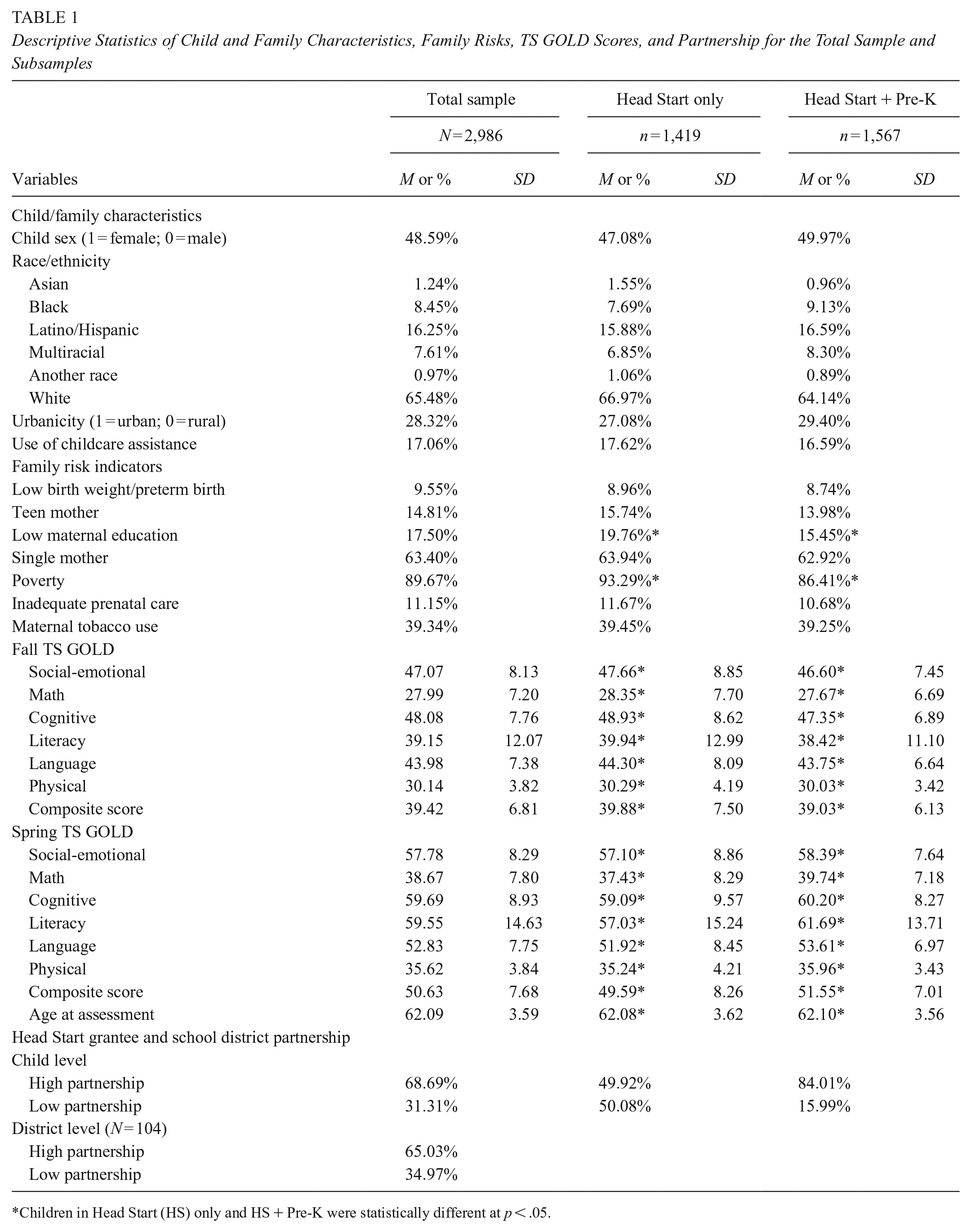
Children in Head Start (HS) only and HS + Pre-K were statistically different at p < .05.
Measures
Dual Enrollment Status
HS children who showed up in Pre-K enrollment records from the Iowa Department of Education were identified as having dual enrollment. All other HS children without Pre-K enrollment records were identified to be enrolled in HS only.
School Readiness
Children’s school readiness skills were reported by their teachers using TS GOLD (Heroman et al., 2010). The assessments were administered twice per year, at the beginning and end of the HS year. TS GOLD is a teacher-reported assessment that captures children’s developmental progression and current skill levels in six domains: social-emotional (9 items, α = .96 in our sample), mathematics (7 items, α = .95), cognitive (10 items, α = .97), literacy (12 items, α = .96), language (8 items, α = .97), and physical (5 items, α = .94). Each item was rated using a 10-point scale from 0 to 10 with a 2-point interval, with a higher score indicating the presence of more advanced behaviors and skillsets. For example, a social-emotional item grants a child a score of 2 if the child “uses adult support to calm self,” a score of 6 if he/she “is able to look at a situation differently or delay gratification,” and a score of 8 if he/she “controls strong emotions in an appropriate manner most of the time.” TS GOLD is designed to align with the Common Core State Standards, state early learning guidelines, and the Head Start Child Development and Early Learning Framework (Lambert, 2020). We used the total score of each domain in this study. Descriptive statistics of TS GOLD scores are presented in Table 1. This secondary data analysis was employed after all data were collected; thus, no teachers knew the goal of this study at the time of the assessment.
Program Partnership
Following HSPPS (ACF, 2016b), Iowa’s Head Start State Collaboration Office (Iowa HHSCO) routinely collects data from HS grantees about their partnerships with each local school district using a biannual survey. The survey was designed to identify the status of HS program coordination and inform statewide planning efforts led by the HSSCO. HS directors were asked to report their relationships with all districts in their service area. Given the larger geographic areas that HS grantees serve, many have partnerships with multiple school districts, but each school district had partnership data with only one HS grantee.
Iowa HSSCO developed the questions for the collaboration survey using HSPPS guidelines and Sedgwick’s (2016) work on collaboration. The response options were five levels from the lowest to the highest: (a) “no working relationship,” indicating little to no contact between programs (1.48%); (b) “communication,” indicating exchange of information regularly (7.93%), which is corresponding to “cooperation” in Sedgwick’s work; (c) “enrollment coordination,” indicating programs having written agreements on coordinated enrollment to maximize enrollment and capacity utilization (6.58%); (d) “programmatic coordination,” indicating having written agreements to provide shared staff training and services to children enrolled in both programs (40.81%); and (e) “collaboration” indicating joint sharing of space, materials, and personnel resources and children whom they serve (by having blended classrooms; 43.20%) and this indicates the highest level of partnership as does in Sedgwick’s work. Iowa HSSCO divided the concept of “coordination” into two levels in the survey (i.e., enrollment coordination and programmatic coordination) to further distinguish the degree of joint processes between the two programs.
We empirically explored the distribution of these partnership data and consulted the HSSCO director to formulate the best analytic approach. The distribution and preliminary analysis suggested using a dichotomous approach, with 16% of responses in the lower three levels of collaboration. Supplemental analysis revealed distinctive differences between the top two levels of partnership and the other three lower levels in their prediction of HS children’s Pre-K enrollment: The top two levels clearly had a stronger association with Pre-K enrollment (odds ratio = 12.08 and 16.67) compared to other lower levels (odds ratio = 2.86 and 5.86). In consultation with the Iowa HSSCO (Garner, personal communication, 2021), we recoded the partnership data to be a dichotomous variable indicating high partnership (collaboration and programmatic coordination) and low partnership (enrollment coordination, communication, and no working relationship). The high partnership reflects whether the programs work together to coordinate their delivery of services in a way that children enrolled in both programs receive similar services across them.
Children’s school district information was identified based on their Pre-K school district if they were enrolled. For children who did not attend Pre-K, we used their kindergarten school district information as a proxy that reflects these children’s Pre-K school district. Descriptive statistics of this variable are provided in Table 1.
Child and Family Characteristics
The Iowa Department of Public Health maintains verified information about children born in the state and their families at the time of birth. These birth records were used to code demographic child characteristics, including child sex (1 = female); child race/ethnicity (White [reference group], Asian, Black, Latino/Hispanic, multiracial, or another race); and residence urbanicity (1 = urban). Birth records were also used to code the following family/birth risk characteristics: (a) inadequate prenatal care (1 = yes) defined as children whose mother received no prenatal care, prenatal care only in the third trimester, or fewer than four prenatal visits overall (Osterman & Martin, 2018); (b) premature or low birth weight status (1 = yes) identified by premature birth (<37 weeks’ gestation) or low birth weight (<2,500 grams; Hamilton et al., 2018); (c) teen mother (1 = yes) indicating mothers aged 15 to 19 at the time of a child’s birth (World Health Organization [WHO], 2004); (d) single mother status indicating no spouse or unmarried mothers at the time of birth (1 = yes); (e) low maternal education (1 = yes) defined as mothers at least 18 years old who completed less than 12 years of schooling; (f) household poverty (1 = yes) indicated by whether mother received Medicaid (i.e., family income <133% federal poverty level [FPL]) or the Special Supplemental Nutrition Program for Women, Infants, and Children (WIC) at the time of childbirth; and (g) maternal tobacco use indicating whether the mother reported any tobacco use during pregnancy. We further controlled the child age during the spring assessment (outcome) and the CCA recipient status during the HS year to control for additional publicly funded non-parental care experiences beyond HS and Pre-K.
Analytical Approach
Research Question 1: Prevalence of Head Start Children’s Enrollment in Pre-K
To identify the percentage of HS children enrolled in Pre-K, we first identify unduplicated counts of children recorded in the HS enrollment data and Pre-K enrollment data from the Iowa Department of Education. Then, descriptive statistics were examined, and chi-square and t-test analyses were employed to compare the characteristics of children and families between children enrolled in HS-only and HS children dually enrolled in Pre-K.
Research Question 2: Additional Pre-K Enrollment and School Readiness
To examine whether children’s school readiness skills at the end of the HS year differ depending on their Pre-K enrollment status (HS only vs. HS and Pre-K), structural equation models (SEM) were run using Stata 16. We used maximum likelihood estimation with clustered standard errors considering the nesting of children within school districts (Preacher et al., 2010). Preliminary analyses checking intra-class correlation (ICC) showed low values ranging between .05 and .08. We estimated a model that predicted each TS GOLD domain with freely estimated covariances among TS GOLD domains (see Figure 1 for an analytical model diagram). Acknowledging that correlations among the spring TS GOLD domains were high, as shown in our data (Table 2), we additionally analyzed a model with a composite of TS GOLD scores (i.e., the average scores across six domains) as an outcome. For both models, we included the following control variables: baseline fall scores of the outcome, child age at the time of spring assessment, recipient status of CCA during the HS year, child race/ethnicity, child sex, urbanicity, and the seven indicators of family/birth risk characteristics. Model fit was evaluated using two indices provided by Stata when using clustered standard errors: standardized root mean squared residual (SRMR) and coefficient of determination (or R2). An SRMR value lower than .08 is generally considered a good fit (Hu & Bentler, 1999). The coefficient of determination ranges between 0 to 1, and a higher value indicates a better model fit.

Structural equation modeling model diagram: Association between dual program enrollment and school readiness outcomes
Correlations Among Key Variables

Note. Significant correlations at p < .05 were shown in bold. All school readiness skills shown in the table were from the spring assessments.
Research Question 3: Program Partnership and Additional Pre-K Enrollment
Multilevel logistic regression was employed to examine whether children were more likely to enroll in Pre-K if their HS grantees had a stronger partnership in place with the child’s school district. The multilevel logistic regression addressed the nesting of children (Level 1) within school districts (Level 2; N = 104) by incorporating random effects for school districts. ICC was .80. The outcome variable was a dichotomous variable indicating children’s dual enrollment status in HS and Pre-K (1 = yes). The predictor variable was the partnership level between HS and the school district for each child. The same set of control variables used in Research Question 2 was included in this model.

Our model estimated each child’s probability of dual enrollment as a function of the strength of the partnership. In this equation, log (Yij/1- Yij) represents the log odds of dual enrolment for child i, in district j; β0 is the intercept; β1 is the regression coefficient for partnership; partnerij indicates if the child’s district had a high (partnership = 1) or low (partnership = 0) partnership with the HS grantee. District variance (uj) and child variance (eij) were estimated at random. Child and family characteristics were added to this equation as control variables.
A sensitivity analysis was run with the enrollment data aggregated at the school district level (N = 104). Thus, the unit of analysis was at the school district level. For each school district, we computed the percentage of HS children who were enrolled in Pre-K within the school district (the number of HS children enrolled in Pre-K in the school district divided by the total number of HS children in the school district). Simple regression analyses were run with the partnership data as a predictor and the % of children who dually enrolled in both programs within the school district as an outcome.

The percentage of children dually enrolled in each district (Y) is modeled as a function of the coefficient of partnership; β0 is the intercept; β1 is the regression coefficient of partnership; partnership indicates if the district had a high (partnership = 1) or low (partnership = 0) partnership; and e is the residual.
Additional Analytical Consideration
All analyses were done using Stata 16. Missing data were almost nonexistent for demographic variables, family/birth risks, and service usage, with only four variables having any missing data and up to 0.23%. Depending on the outcome, initial school readiness skills had missing rates between 4% (social-emotional skills) and 14% (literacy). This study did not impute missing data due to the small missing rate. In administrative data, missingness reflects true cases in which services were not used, or intake was not made, and missingness in administrative data is not missing at random. In addition, most missing data were from outcome variables (child school readiness), and we followed Von Hippel’s (2007) advice against imputing missing data in outcome variables.
Results
Prevalence of HS Children’s Enrollment in Pre-K
We first estimated the proportion of HS children who were also enrolled in Pre-K in our sample. Findings showed that 52.5% of HS children concurrently enrolled in Pre-K, while the remaining 47.5% of HS children did not.
Table 1 presents the characteristics of HS children and families who did or did not enroll in Pre-K. Results from chi-square testing showed the two-group differences in child and family characteristics and school readiness skills. In general, children who attended HS only presented higher school readiness skills in the fall but lower skills in the spring than their HS peers who additionally participated in Pre-K. A higher percentage of children in the HS-only group lived in poverty (93.3% vs. 86.4%; X2 = [1, N = 2,984] = 38.22, p < .001) and had mothers with lower education (19.8% vs. 15.5%; X2 [= 1, N = 2,984] = 9.45, p < .01) at birth compared to HS children who also enrolled in the Pre-K. No other group differences were found in child sex, race/ethnicity, urban residence status, and other family/birth risks.
Table 2 presents correlations among all variables examined in this study. HS children enrolled in Pre-K presented higher school readiness skills in the spring than their peers who participated in HS only (r = .06 to .17). In general, child and family risk characteristics were significantly related to children’s spring school readiness skills (r = –.12 to –.03). Children’s school readiness skills were highly correlated with one another (r = .62 to .89).
HS Children’s Pre-K Enrollment and School Readiness
Findings from the SEM analyses showed that teachers reported higher school readiness skills in spring across all examined developmental domains for children enrolled in both programs compared to the HS-only group. As presented in Table 3 and Figure 1, HS children who had additional exposure to Pre-K presented significantly higher scores in social-emotional (b = 1.61; β = .10; p < .05), math (b = 2.32; β = .17; p < .01), cognitive (b = 1.57; β = .09; p < .05), literacy (b = 4.96; β = .19; p < .01), language (b = 1.59; β = .11; p < .05), and physical (b = 0.70; β = .09; p < .001) skills in spring controlling for fall skills. The effect size (β) of group difference ranges from .09 to .19. The SRMR value was .07, and the coefficient of determination was .91, indicating the model fit was acceptable (Hu & Bentler, 1999). When examining the composite of TS GOLD by average across the six school readiness domains, the results remained the same: HS children who had additional exposure to Pre-K presented 0.15 SD points higher than the HS-only group (b = 2.39; β = .15; p < .001).
Results of Structural Equation Models: Association Between Dual Program Enrollment and School Readiness Outcomes

p < .05; **p < .01; ***p < .001.
Two sensitivity analyses were conducted to evaluate the robustness of the findings. First, we tested whether the findings from our sample (i.e., the children who enrolled in HS for at least 6 months) would remain the same when studying children who enrolled in HS for at least 3 or 9 months. The significance of the findings remained the same when analyzing a sample of children who stayed in HS for at least 9 months (N = 1,820): Children participated in both programs presented higher skills in social-emotional (b = 2.02; β = .14; p < .01), math (b = 3.05; β = .23; p < .01), cognitive (b = 1.90; β = .13; p < .05), literacy (b = 5.09; β = .24; p < .01), language (b = 2.13; β = .16; p < .05), and physical (b = 1.08; β = .15; p < .01) domains, than children who attended HS only. The effect size (β) of group difference ranges from .13 to .24. When studying children who stayed in HS for at least 3 months (N = 3,163), all significant findings remain the same except for one domain: HS children who attended Pre-K presented higher skills in social-emotional (b = 1.61; β = .11; p < .05), math (b = .34; β = .17; p < .01), literacy (b = 4.99; β = .20; p < .01), language (b = 1.50; β = .11; p < .05), and physical (b = 0.73; β = .09; p < .05) domains. The effect size (β) of group difference ranges from .09 to .20. The only exception was found in the cognitive domain (b = 1.43; β = .11; p < .10), where no difference was found between HS only versus HS + Pre-K group.
Second, a set of fixed effect models was estimated to examine the association between dual enrollment and child readiness skills within school districts. This analytical model considers the possibility that school districts who established partnerships with HS grantees may exhibit distinct characteristics compared to school districts without such partnerships. Results showed that children who attended Pre-K in addition to HS had higher school readiness skills than HS children in the same school districts who did not attend Pre-K. Specifically, children enrolled in both programs presented higher skills in social-emotional (b = 2.35; β = .28; p < .05), math (b = 3.31; β = .43; p < .01), cognitive (b = 2.81; β = .32; p < .05), literacy (b = 5.96; β = .41; p < .05), language (b = 2.48; β = .33; p < .05), and physical (b = 1.33; β = .35; p < .001) domains. The effect size (β) of group differences were calculated following Lorah (2018) and ranges from .28 to .43.
Program Partnership and Dual Enrollment in HS and Pre-K
In our data, about 69% of the HS children participated in HS grantees that reported stronger partnerships with the child’s school district (i.e., programmatic coordination or collaboration), and the remaining 31% of children from HS grantees reported a lower-level partnership with the child’s school district (i.e., enrollment coordination, communication, or no working relationship). Results from the logistic regression (Table 4) showed the likelihood of HS children’s joint enrollment in Pre-K was 48 times higher if their HS grantees had a stronger partnership with their school district (b = 3.87, SE = 0.87; odds ratio = 48.11).
Associations Between Program Partnership and Head Start Children’s Dual Enrollment (Nchild

p < .05; *** p < .001.
Similar findings resulted from the sensitivity analysis performed with the aggregated Pre-K enrollment data at the school district level. When school districts had stronger partnerships with HS grantees, about 32% more HS children were dually enrolled in Pre-K in the school district (b = 31.60; p < .01).
Discussion
With the growing public investment in ECE programs, increasing attention has been paid to children’s experiences and outcomes from publicly funded ECE programs. In this study, we investigated the two largest public ECE programs, HS and Pre-K, to explore (a) HS children’s additional, concurrent enrollment in Pre-K; (b) the potential effect of additional enrollment in Pre-K on HS children’s school readiness; and (c) the potential effect of program partnership between HS grantees and school districts on the HS children’s additional participation in Pre-K.
Within our study of children from 16 out of 18 HS grantees in Iowa, over 50% of the children who enrolled in HS at least 6 months a year before kindergarten were concurrently enrolled in Pre-K. In Iowa, HS and Pre-K offered only half-day programs during the study period, despite the fact that Iowa has one of the highest rates of available parents being employed (Iowa Department of Human Rights, n.d.), meaning that many families in Iowa need full-day care. Considering the state context, this estimate supports the national suggestion that the expansion of Pre-K is an opportunity to serve low-income children more comprehensively beyond what HS can do alone.
We further found that children enrolled in both programs were reported by teachers to have better skills across all six development domains at the end of the preschool compared to children who only attended half-day HS. It is hypothesized that extended exposure to quality ECE programs promises more opportunities for stimulating learning experiences for disadvantaged children than they would otherwise experience (V. E. Lee et al., 2006). The current findings from HS children align with this literature, demonstrating the benefit of longer hours of center-based program exposure in early development (e.g., ACF, 2020; Atteberry et al., 2019), including social-emotional domains where the literature has offered mixed evidence. Perhaps more importantly, this study extends our understanding that such benefit is similarly observed in economically disadvantaged children even when they receive extended exposure across different ECE programs.
It should be noted that, however, this study cannot eliminate the possibility that the group differences in child outcomes were due to the differences in family characteristics between HS children who participated in Pre-K and their peers enrolled in HS only. Families of dual program enrollees may have easier access, more knowledge of the public ECE system, and more flexibility to participate in both programs. Indeed, our data showed that children who had dual participation, relative to those who had only HS participation, had more advantageous family characteristics at the child’s birth, although their school readiness skills at the entry to HS were lower: More of them had higher-educated mothers, and fewer of them were identified to have experienced poverty at birth compared to children who participated in HS only.
Multiple concurrent care experiences during early years are less well understood than sequential care experiences. Children’s utilization of public ECE programs is even more scarce. We call for future studies of dual enrollment in HS and Pre-K to examine how the characteristics of children who participate in both programs differ from those who participate in one program and whether and how the operation of two programs affects the participation of families having varying levels of social support, flexibility, and access to transportation. Future studies with detailed data on the operation of the two programs can also clarify how the programs’ daily schedule arrangement, including instructional time and other activities (e.g., unstructured play, transition, and napping and nesting), affect early development. Future research can further clarify whether the advantages of extended preschool exposure manifest differently depending on whether this experience is offered through two half-day programs or a single full-day program. In addition, given empirical evidence suggesting ECE programs’ fadeout or convergence effects (e.g., Lipsey et al., 2015; Love et al., 2002), it remains pertinent to explore whether the potential benefit of prolonged hours of preschool attendance found during the preschool year sustains in subsequent school years.
The high prevalence of HS children’s enrollment in Pre-K and the potential benefits of extended hours of center-based care both point to the importance of program partnerships between HS and Pre-K to maximize the utilization of program resources to better serve children. Our findings provide initial evidence that stronger program partnerships among HS and local school districts were linked to a higher rate of dual enrollment in HS and Pre-K, which was found to be a significant predictor of better school readiness outcomes for children in HS. These findings suggest that federal legislation such as Every Student Succeeds Act (ESSA), which emphasizes improved partnerships between HS and local school districts, could be further leveraged to support children. Given that most programs in this study reported stronger partnerships, it is evident that there are models and methods available to foster collaboration. These efforts could be documented and replicated for other programs—particularly as new HS programs emerge or local districts expand or close, new relationships would need to be built.
Historical challenges with siloed data and particularly fragmented early childhood services were addressed in this study through the use of an integrated data system. This strength maximized efficiency in data use and facilitated a statewide perspective about population-level engagement and use of early childhood services. To our knowledge, this is one of the first studies to use administrative data from HS programs integrated with public school data to document unduplicated counts of children across programs and study unique patterns of enrollment across disparate public systems. The development of a fully integrated system like I2D2 required a comprehensive set of legal agreements with each HS grantee and the other public service systems, but now that those agreements and relationships are in place within a sustainable infrastructure, there is an opportunity for ongoing partnership-based research. Efforts like this are increasingly possible with the expansion of statewide longitudinal data systems that include early childhood data from systems beyond the state education authority, like the one used in this study. Future research should continue to use these comprehensive data systems and expand the reach of data to include other relevant systems such as early intervention, child welfare, and home visiting. Such expansions could help the field better understand the experiences of HS children, opportunities to engage in additional programming that may support their school success, and identify gaps in service systems that could also be strengthened by supportive collaborations and partnerships.
Limitations and Future Research
Study limitations should be noted to inform future research. First, we found similar effects across all dimensions of child outcomes assessed in TS GOLD, which indicates the possibility of the same teacher reporting developmental domains generality. Empirical studies have raised concerns regarding TS GOLD’s capacity to differentiate children’s skills across learning domains and distinguish skills between children from the same classroom (e.g., Miller-Bains et al., 2017; Russo et al., 2019). Further, although TS GOLD specifies behavioral expectations for each rating and offers examples for teachers to refer to (e.g., “cleans up when music is played”), teacher ratings of children’s skills, like TS GOLD, suffer from potential rater biases such that teachers rate children’s performance differently based on their characteristics (e.g., sex, age, initial skillsets) or experiences (e.g., additional enrollment to Pre-K), which can compromise the validity of their assessments (Mashburn & Henry, 2004; Vitiello & Williford, 2021).
Second, as in many other secondary data studies, this study has limitations due to unavailable data. At the time of this study, we did not have several variables, including child and family characteristics that are more proximal to preschool entry, children’s special education/IEP status, history of children’s ECE program utilization prior to age 4, or sibling status indicators among the children included in this study. Owing to data unavailability, this study is also limited to identifying the unique predictability of program partnerships on dual enrollment above and beyond HS program characteristics that may affect HS partnerships with school districts. In addition, the level of quality provided in HS and Pre-K is somewhat unknown (though each must adhere to national standards). Because program effects differ by quality (e.g., Bloom & Weiland, 2015), and program quality effects are context-dependent (e.g., McCoy et al., 2016), we call for future dual-enrollment studies to consider program quality in their examination. We also did not have details that would explicitly allow us to articulate what dual enrollment looks like for each child. For example, we are aware that some children were enrolled in programs that operate both HS and Pre-K in the same buildings, which reduces the transportation burden for parents. However, other children were enrolled in programs that did not operate in the same building. The partnership data also did not include information about how curricula may be shared or complementary or the nature of teacher communication among programs. Future research on ECE program partnerships would benefit from more data, including the timing of services, colocation status, transportation, and teacher-level partnership information. We further acknowledge that our data is limited to understanding HS children’s other ECE utilization beyond Pre-K, although we have included children’s use of CCA in analysis. CCA, a government program that assist low-income working families in covering childcare expenses, plays an important role in supporting disadvantaged families to access alternative childcare services, such as private preschools.
Last, given the correlational nature of this study, causal inference should not be made. Specifically, children who participated in both programs may be characteristically different from children who participated HS only, and such initial differences may explain differences in children’s school readiness. It is worth noting, however, that baseline fall scores of the outcomes were controlled in our analytical model.
Conclusion
This study offers several main takeaways that can inform policy and program improvement efforts. First, our findings show that additional participation in Pre-K is a common experience for children who enrolled in half-day HS programs. This finding indicates that it is important to consider multiple concurrent care experiences to gain a more comprehensive understanding of ECE effects on the development of children enrolled in HS. Second, our findings suggest that HS children may benefit from increased hours of center-based care via outlets like Pre-K. Such findings call for systematic efforts to maximize the utilization of ECE-allocated resources for low-income children. Third, our study provides preliminary evidence that a stronger partnership between HS and the school district is one way to enhance HS children’s enrollment in Pre-K, which creates opportunities to have more hours of center-based care. By utilizing state administrative data, this study further demonstrates a value of an integrated data system approach to describe state-level public service utilization that has the potential to inform its policy. The system used in this study includes relevant stakeholders infused in regular research-to-practice dialogue. Such a system can inform regular enhancements in program practice and provide an opportunity to systematically infuse evidence-based decision-making to enhance outcomes for children facing adversity.
Footnotes
Declaration of Conflicting Interests
The author(s) declared no potential conflicts of interest with respect to the research, authorship, and/or publication of this article.
Funding
The author(s) disclosed receipt of the following financial support for the research, authorship, and/or publication of this article: This project was supported by the Administration for Children and Families (ACF) of the U.S. Department of Health and Human Services (HHS) as part of a financial assistance award totaling $100,500 with 100 percent funded by ACF/HHS (Grant number: 90YE0228-01-02). The contents are those of the author(s) and do not necessarily represent the official views of, nor an endorsement, by ACF/HHS, or the U.S. Government. For more information please visit the ACF website, Administrative and National Policy Requirements.

Authors
JI-YOUNG CHOI is an associate professor of human sciences and a faculty associate at the Crane Center for Early Childhood Research and Policy at The Ohio State University, 175 E. 7th Avenue, Columbus, Ohio 43201; choi.
LAURA C. BETANCUR is a research associate at Iowa State University, 774 Columbia Road NW, Washington, D.C. 20001;
HEATHER L. ROUSE is an associate professor of human development and family studies and a director of Iowa’s Integrated Data System for Decision-Making (I2D2) at Iowa State University, 2360 Palmer, Ames, IA 50011-1084;