



Abstract
While intelligence and motivational variables are well-established predictors of academic achievement, Need for Cognition (NFC), the stable intrinsic motivation to engage in and enjoy challenging intellectual activity, has not yet been considered comprehensively in this field, especially not longitudinally. By applying latent change score modeling, we examined the incremental value of NFC, considering well-established motivational constructs and prior achievement in the prediction of academic achievement across different subjects in a longitudinal approach across two time points in a sample of secondary school students (
Keywords
In recent decades, a great deal of research has been conducted on the prediction of academic achievement. While meta-analyses indicate that intelligence is the strongest predictor for academic achievement (e.g., Deary et al., 2007; Roth et al., 2015; Zaboski et al., 2018), motivational variables (e.g., ability self-concept, interests, and values) have consistently been found to have incremental value for academic achievement (e.g., Kriegbaum et al., 2018; Steinmayr et al., 2019).
Initially introduced in the context of social psychology, increasingly, an additional predictor of academic achievement came into the focus of research in this field: the personality trait Need for Cognition (NFC), defined as the stable intrinsic motivation of an individual to engage in and enjoy challenging intellectual activity (Cacioppo & Petty, 1982; Cacioppo et al., 1996). NFC has been shown to be related to academic achievement in different stages of academic life (e.g., Ginet & Py, 2000; Grass et al., 2017; Luong et al., 2017; Preckel, 2014; for a meta-analytical review see von Stumm & Ackerman, 2013) and to motivational variables as well as aspects of information processing associated with success in learning. As examples, NFC was found to be related to ability self-concept (e.g., Dickhäuser & Reinhard, 2010; Luong et al., 2017), interest in school (e.g., Preckel, 2014), or deeper processing while learning (Evans et al., 2003; Luong et al., 2017).
The enjoyment of accomplishing something, the interest in task engagement, and the intrinsic value of working on a task have been suggested to be relevant to learning and academic achievement and have been integrated into models of achievement motivation (e.g., Wigfield & Eccles, 2000; see also Wigfield & Cambria, 2010, for a review). Surprisingly, the concept of a more general joy of thinking—that is, NFC—has not yet been investigated systematically together with established motivational indicators or integrated into models for the prediction of academic achievement, especially in school contexts. In particular, longitudinal studies are missing that have a comprehensive look at the interplay of all relevant variables.
As one notable exception, only 2021, a large longitudinal study with over 3,000 Flemish grade 7 students examined a comprehensive set of variables—including intelligence, the Big Five, a range of different motivational measures, and NFC—in order to determine their value in predicting academic achievement in school (Lavrijsen et al., 2021). Their results showed intelligence and NFC to be the strongest predictors of academic performance. The ability self-concept was the best predictor within the group of motivational variables. This underscores the importance of considering NFC along with established predictors in gaining a comprehensive picture of the prediction of academic achievement.
We follow up on the cross-sectional (e.g., Keller et al., 2019b; Luong et al., 2017) and the few longitudinal studies (Lavrijsen et al., 2021; Preckel, 2014) regarding the role of NFC in predicting academic achievement that examined NFC together with established motivational characteristics. By addressing more school subjects than usually examined, considering prior achievement, and assessing all variables at two points of time in a sample of secondary school students, we go beyond previous work to provide new insights into the interplay of academic achievement, NFC and motivational variables, and the incremental value of NFC in this context.
Achievement Motivation and Its Relation to Academic Achievement
Achievement motivation is operationalized through various variables and can be seen as an essential predictor of academic achievement (e.g., Hattie, 2009; Steinmayr & Spinath, 2009; Steinmayr et al., 2018; Wigfield & Cambria, 2010). Well-established concepts such as ability self-concept, hope for success, and fear of failure, or variables such as interests and values can be found under this umbrella term (Hulleman et al., 2016; Steinmayr et al., 2019). These constructs are part of prominent motivational theories, especially in the context of expectancy-value theories (cf., Atkinson, 1957; Eccles & Wigfield, 2020; Elliot & Church, 1997; Wigfield & Eccles, 2000).
As early as 1957, Atkinson introduced an expectancy-value model based on Murray’s (1938) work (Atkinson, 1957) that comprised essential achievement motives—namely, approaching success and avoiding failure—as the basis for expectancies for success. Atkinson viewed these motives as relatively stable dispositions describing individual differences in the relative strength of approach and avoidance behaviors, respectively (for an overview, see Wigfield et al., 2009). Then, in turn, trait-like motivational variables such as hope for success and fear of failure can be seen as antecedents for approach and avoidance performance goals, respectively (Elliot & Church, 1997). Based on Atkinson (1957), the expectancy-value theory of Eccles and Wigfield (e.g., Eccles & Wigfield, 2020; Wigfield & Eccles, 2000) comprises the most relevant predictors of achievement motivation and the resulting performance as well as variables influencing these predictors (e.g., cultural or social influences). In this model, expectations of success and values are directly associated with achievement. However, again directly influencing expectations of success and values associated with a task, goals, and self-schemata can be found in the model, with the ability self-concept being one of these variables. Ability self-concept, in turn, has proven to be of utmost importance in educational contexts (see later discussion). So, based on the described expectancy-value approach, to get a comprehensive picture of achievement motivation in school, the aforementioned variables should be included. They are each briefly described in the following sections.
Ability Self-Concept
Ability self-concept can be described as generalized or subject-specific ability perceptions that students acquire based on competence experiences in the course of their academic life (Möller & Köller, 2004). They thus reflect cognitive representations of one’s level of ability (Marsh, 1990), which affects students’ academic performance (e.g., Wigfield & Eccles, 2000). A meta-analysis found moderate correlations with academic achievement (
Hope for Success/Fear of Failure
Murray (1938) considered the Need for Achievement as one of the basic human needs and as a relatively stable personality trait. His concept was extended by McClelland et al. (1953), who differentiated the achievement motives hope for success (the belief of being able to succeed accompanied by the experience of positive emotions) and fear of failure (worry about failing in achievement situations and the experience of negative emotions). Such affective tendencies in the context of achievement motivation are reflected, for instance, in the choice of task difficulty, affinity for risk, and quality of task completion (Diseth & Martinsen, 2003). Hope for success may facilitate knowledge acquisition, whereas fear of failure may impede it (Diseth & Martinsen, 2003). A meta-analysis found achievement motivation in the sense of hope for success weakly to moderately positively related to academic achievement (
Task Values—Interest
Another important motivational indicator that was also included in the influential model of Wigfield and Eccles (2000) (see also Eccles & Wigfield, 2020) describes task values. Such task values focus on importance, perceived utility, and interest in a task and costs associated with it, whereas the latter is often omitted (cf. Jacobs et al., 2002). Findings on relations between task values and academic achievement point to reciprocal relationships between them (Li et al., 2021). Furthermore, there is some evidence that the interaction of task values and self-concept may be of special relevance for predicting academic achievement, although the state of evidence on this is still mixed (Meyer et al., 2019). Specifically on the domain of interest, a number of papers are available on the relationship with academic achievement in school, with correlations being in a low-to-moderate range (for an overview, see Steinmayr et al., 2019). A meta-analysis on the relationship between interest and achievement found moderate positive correlations between these two variables (Schiefele et al., 1992).
Need for Cognition and Academic Achievement
NFC describes the stable intrinsic motivation of an individual to engage in and enjoy thinking (Cacioppo & Petty, 1982). While individuals with lower NFC scores tend to rely more on other people, cognitive heuristics, or social comparisons in decision-making, individuals with higher NFC scores show a tendency to seek, acquire, and reflect on information (Cacioppo et al., 1996). Conceptually, NFC belongs to the group of investment traits (von Stumm & Ackerman, 2013). These traits determine how individuals typically invest their cognitive resources and how they deal with cognitively challenging material. As such, NFC mirrors the typical cognitive performance of a person while intelligence as an ability trait represents the potential maximum cognitive performance (von Stumm et al., 2011). NFC has been shown to be rather modestly related to intelligence and its fluid (Fleischhauer et al., 2010) and crystallized (von Stumm & Ackerman, 2013) components.
NFC correlates with academic achievement across different stages of school and university. For example, in a longitudinal study, examining over 700 secondary-school students (grade 5 at T1), Preckel (2014) found a weak positive correlation primarily for math in secondary school. NFC incrementally predicted grades in math over and above intelligence at T2 and T3. Ginet and Py (2000) found a mean correlation of
Concerning the interplay of intelligence and NFC in the context of academic achievement, Strobel et al. (2019) found that reasoning ability and NFC both significantly predicted higher grade point averages (GPA). Interestingly, NFC also moderated the relationship between intelligence and GPA: at higher levels of NFC, the relation between reasoning ability and GPA was diminished. Although this finding requires independent replication, it could point to a potentially compensating effect of NFC.
NFC and Motivational Aspects of Learning
The increased willingness to invest mental effort and attention in task and information processing that is typical for individuals with higher NFC is also associated with positive correlations to various traits, behaviors, and indicators relevant to learning. Evans et al. (2003) found associations of NFC with deeper processing while learning. Dickhäuser and Reinhard (2010) reported strong associations of NFC with the general ability self-concept and smaller correlations with subject-specific ability self-concepts. Luong et al. (2017) not only reported moderate-to-high correlations of NFC with aspects of the ability self-concept but also with learning orientation, processing depth, and the desire to learn from mistakes. Preckel (2014) found medium correlations between NFC with learning goals and interest in various school subjects (for the latter association, see also Keller et al., 2019b). Furthermore, Elias and Loomis (2002) found NFC and efficacy beliefs to be moderately correlated. Their results suggested that the relationship between NFC and GPA was mediated by efficacy beliefs in a way that individuals with higher NFC had higher efficacy beliefs, which in turn had a positive effect on academic achievement. Diseth and Martinsen (2003) examined another indicator of performance motivation: in a student sample, they found a high positive correlation between NFC and hope for success and a medium negative relationship between NFC and fear of failure. Bless et al. (1994) report comparable findings. In a large sample of seventh-grade students, Lavrijsen et al. (2021) found a strong positive correlation between achievement motivation and no significant relation between NFC and fear of failure.
Several studies examined NFC along with other motivational variables and found NFC to explain variance in academic achievement beyond established motivational variables, such as learning orientation or ability self-concept (Keller et al., 2019b; Luong et al., 2017). As mentioned previously, Preckel (2014) demonstrated incremental validity of NFC over and above intelligence in the prediction of math achievement in a sample of grade 5 students. Keller et al. (2019b) examined the incremental validity of NFC in the prediction of academic achievement in three samples from Luxembourg (grade 9), Finland (grades 6 and 9), and Germany (grades 3 and 4). NFC incrementally predicted performance in math and German or Finnish, respectively, over and above ability self-concept and interest in the Finnish and Luxembourgish sample and—to a smaller amount—in German in the fourth grade of the German sample. Luong et al. examined the relevance of NFC in a Finnish sample of over 4,000 students (from the third, sixth, and ninth grades; 10 to 16 years of age). In the overall sample and in school years six and nine, NFC was a significant predictor of academic achievement along with ability self-concept, control motivation, and learning orientation. Meier et al. (2014) examined potential predictors of the attendance of a gifted class in a sample of about 900 students attending grade 5. They found that NFC, compared to other motivational constructs like academic interests and goal orientations, significantly predicted the attendance of a gifted class even when controlling for cognitive ability and other factors like parental education level or ability self-concept. Lavrijsen et al. (2021) longitudinally examined the predictive value of intelligence, personality (Big Five and NFC), and different motivational constructs (e.g., autonomous/controlled motivation, achievement motives, and goals) for academic achievement in a sample of 3,409 Flemish grade 7 students. They found intelligence, NFC, and the ability self-concept to be the strongest predictors of math grades and performance in standardized math tests.
The Present Study
Overall, NFC has been proven to be a promising predictor of academic achievement over and above other motivational constructs. Yet, so far the evidence on its incremental predictive value is limited by the mainly cross-sectional nature of available studies and by the fact that only a few school subjects were considered. Furthermore, up to now, prior achievement was not integrated as performance predictor in studies examining NFC. This is a limitation insofar as besides students’ cognitive abilities their prior achievement is a relevant predictor of future academic achievement (e.g., Hailikari et al., 2007; Steinmayr et al., 2019).
With the present study, we aim at adding to the existing body of research by examining NFC, well-established trait-like motivational indicators rooted in expectancy-value approaches (ability self-concept, hope for success and fear of failure, interests, each of them general and subject-specific) and academic achievement (assessed via GPA and grades in German, math, physics, and chemistry) each at two points of time. In doing so, we will be able to extend insights by Lavrijsen et al. (2021), who assessed NFC only at one point of time. Furthermore, by considering GPA plus four subject grades, we extend the existing literature on predicting academic achievement in school not only in general and in the domains of math and German (see Steinmayr & Spinath, 2009) but also in focusing on the further domains of physics and chemistry. Both are subjects where an in-depth understanding of the content and models is essential to be able to successfully manage the tasks within the courses in school, so the role of NFC is of special interest in such subjects. By applying latent change score modeling, we will be able to determine the influence of our different predictors on the change of academic achievement in general and in different domains in school over time. At the same time, correlated change can be examined—that is, after controlling for their initial levels, how closely changes in academic achievement, NFC, and motivational constructs coincide. As it is well known that there are reciprocal relations between academic achievement and ability self-concept (see Guay et al., 2003; Wu et al., 2021), it is of special interest to examine such potential relations for NFC as well.
We examine the following research questions and assu-mptions:
Is Need for Cognition able to predict changes in academic achievement over time? Because of evidence of relations of NFC with academic achievement in cross-sectional studies (e.g., Ginet & Py, 2000; Luong et al., 2017), we expect NFC to also be able to predict changes in academic achievement over time, with higher NFC being associated with higher achievement gains.
What is the incremental value of Need for Cognition in the prediction of academic achievement over and above different motivational constructs and prior achievement in school? Based on previous findings (e.g., Keller et al., 2019b; Lavrijsen et al., 2021), we assume that NFC will positively predict academic achievement even when the influence of established motivational variables and prior achievement is controlled for.
Are longitudinal changes in motivational variables, Need for Cognition, and academic achievement in school related to each other? To our knowledge, there is no prior evidence on correlated change of NFC and the other variables examined here. Therefore, we can only speculate that NFC and academic achievement will mutually influence each other as has been observed for the interplay between motivational variables and academic achievement (e.g., Wu et al., 2021).
Methods
Openness and Transparency
We report how we determined our sample size, all data exclusions, all manipulations, and all measures in the study (cf. Simmons et al., 2012), and we follow JARS (APA Publications and Communications Board Working Group on Journal Article Reporting Standards, 2008). Data were analyzed using R (version 4.3.1, R Core Team, 2023). All data and code for reproducing our analyses are permanently and openly accessible at https://osf.io/34yav/ or via https://doi.org/10.17605/OSF.IO/34YAV. This study was not preregistered.
Participants
Sample size was determined by pragmatic considerations—that is, to collect as many participants as possible given existing time constraints and the longitudinal nature of the project. We eventually managed to recruit a sample of N = 277 adolescents (60% female) at the first measurement occasion (T1), of which N = 251 adolescents (61% female) also took part in the second measurement occasion (T2) that took place 53–59 weeks later. Data collection took place within a larger project about gender differences in STEM subjects. Students attended eleventh grade at two academic-track schools in the German federal state of Baden-Württemberg at T1. All students attended courses in German and math as well as—depending on their course choice—physics or chemistry. The course size comprised 20 students on average. The age range was 14–19 years (median = 17 years) at T1 and 15–20 years (median = 18 years) at T2. With the sample size accomplished at T2, we were able to detect correlations of r ≥ .18 at α = .05 (two-sided) and 1 − β = .80. Yet, we used an approach to handle missing values to raise power and also performed post hoc power analyses for the latent change score modeling approach actually used for the present research (see the section Statistical Analyses).
Material
We used the following self-report measures to assess the measures of interest for the present study.
Academic achievement was assessed using school grades in general—that is, GPA and grades in German, math, physics, and chemistry via self-report. School grades range from 0.75 (excellent) to 6 (insufficient). For better interpretability, we reversed this coding via
Need for Cognition (NFC) was assessed with the 16-item short version of the German NFC scale (Bless et al., 1994). Responses to each item (e.g., “Thinking is not my idea of fun,” reverse coded) were recorded on a seven-point scale ranging from −3 (completely disagree) to +3 (completely agree) and were aggregated to the total NFC score. The scale has been shown to exhibit comparably high internal consistency, Cronbach’s
Hope for Success and Fear of Failure were assessed using the Achievement Motive Scales (German version: Göttert & Kuhl, 1980). For the present study, we used a short form measuring each construct with seven items. All items were answered on a four-point scale ranging from 1 (does not apply at all) to 4 (fully applies). Example items for the two scales are “Difficult problems appeal to me” and “Matters that are slightly difficult disconcert me.” Both scales exhibited high internal consistencies in previous research, with Cronbach’s
The Ability Self-Concept in school in general and in the four subjects—German, math, physics, and chemistry—were assessed with four items per domain using the Scales for the Assessment of Academic Self-Concept (Schöne et al., 2002) (example item: “I can do well in . . . [school, math, German, physics, chemistry].”). Items were answered on a 5-point scale ranging from 1 (does not apply at all) to 5 (fully applies). As previously shown, the scales’ internal consistency, Cronbach’s
Interest in school in general and in the above four subjects were measured using interest subscales of the Scales for the Assessment of Subjective Values in School (Steinmayr & Spinath, 2010). Answers to three items per domain (example item: “How much do you like . . . [school, math, German, physics, chemistry].”) were recorded on a 5-point scale ranging from 1 (does not apply at all) to 5 (fully applies). In previous research, the scales showed high internal consistency, Cronbach’s
For each of the previously mentioned constructs, we used regression-based factor scores derived from measurements models as composite measures. Specifically, we fitted four measurement models of (1) school grades estimated directly from the manifest school grades in order to have the same level of abstraction and to handle missing values for these variables as well; (2) the motivational traits in question, that is, NFC, Hope for Success, and Fear of Failure as well as domain-general and domain-specific; (3) ability self-concepts; and (4) interests. Separate models were fitted because an analysis of all constructs specified in one model failed to converge. Item-based measurement models were specified except for NFC. Here, a parceling approach was used (Little et al., 2002), where based on the item loadings derived from a one-factor solution of a principal components analysis, four parcels with about equal average item loadings per parcel were determined in an iterative procedure with 10,000 iterations that ensured a minimum difference in the average item loadings (please note that this procedure ensures computational reproducibility but does not necessarily solve the problem of parcel allocation variability; see Sterba, 2019, an issue that we unfortunately cannot address here in more detail). All measurement models had a good to very good fit according to the criteria of Hu and Bentler (1999) (see later; robust CFI ≥ .930, robust RMSEA ≤ .065, SRMR ≤ .057).
Procedure
Testing took place during a regular school day between March 2008 and 2009. Tests were administered at school during a regular class, which was scheduled for our study. Parents of underaged students (age <18) provided informed consent. As the school actively supported the study, participation rate was very high (96%). However, some students could not participate at measurement point 1 or 2 due to illness or other reasons (T1:
Statistical Analysis
We used RStudio (version 2023.6.1.524, Posit Team, 2023) with R (version 4.3.1; R Core Team, 2023) and mainly employed the R-package lavaan (version 0.6.-15; Rosseel, 2012) for statistical analysis and papaja (Aust & Barth, 2018) for manuscript creation. For further R packages employed, see the Supplement.
First, the variables were separated into five sets, each containing the T1 and T2 measurements of the variables Hope for Success (HfS), Fear of Failure (FoF), and Need for Cognition (NFC) as well as either GPA, overall ability self-concept regarding school, and general interest in school, or domain-specific grades, ability self-concept, and interest in German, math, physics, and chemistry. All measures were initially analyzed with regard to descriptive statistics, reliability (retest-reliability
Possible differences between the measurement occasions T1 and T2 were descriptively assessed via boxplots but not considered further given the scope of the present paper. Correlation analyses were performed separately for the five sets of data (see Table 1 and Supplementary Tables S1 to S4). Where appropriate, the evaluation of statistical significance was based on 95% confidence intervals (CI) that did not include zero. Evaluation of effect sizes of correlations was based on the empirically derived guidelines for personality and social psychology research provided by Gignac and Szodorai (2016)—that is, correlations were regarded as small for
Robust Correlations of the Variables in the Analyses on Grade Point Average
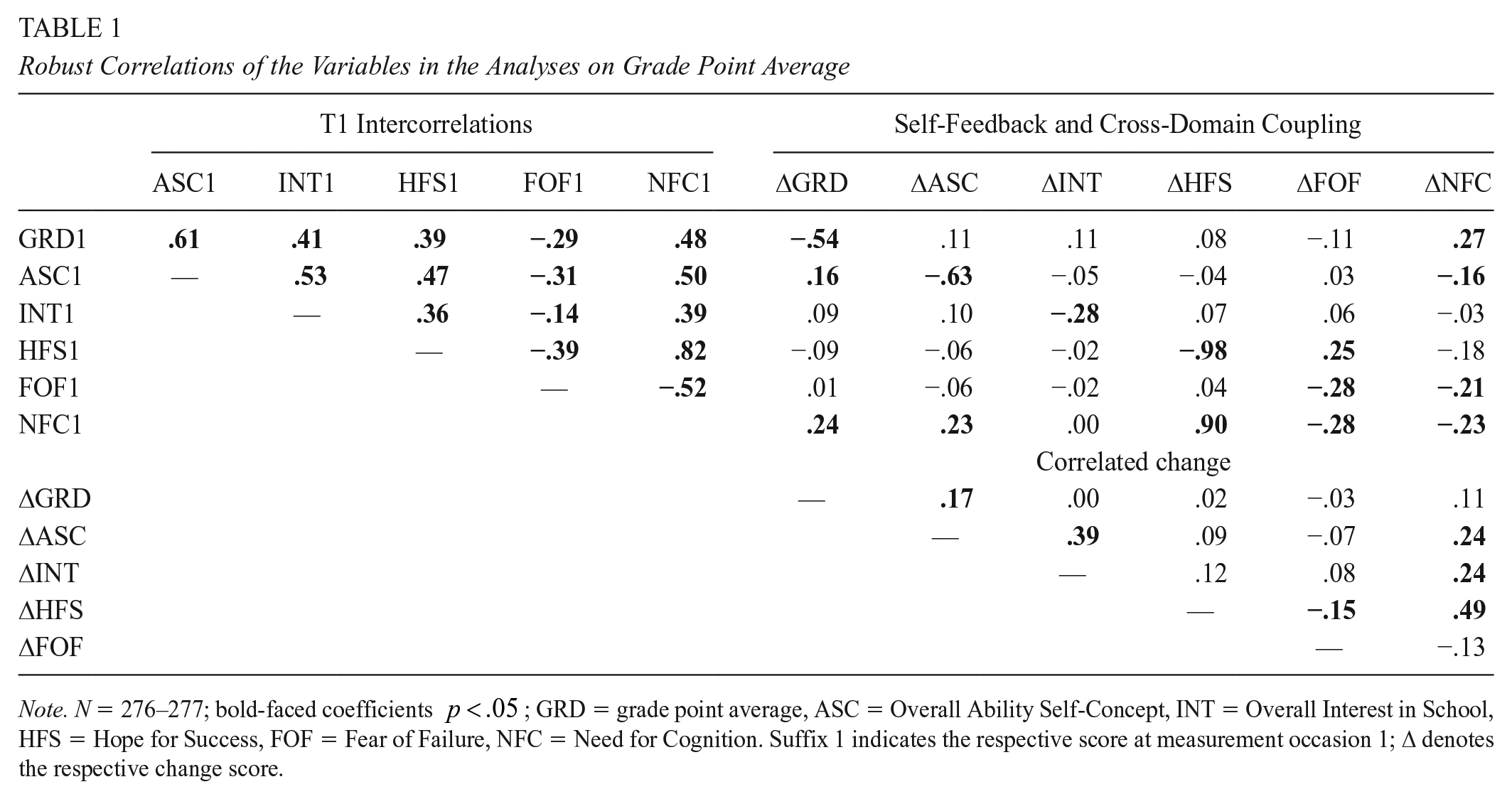
Note. N = 276–277; bold-faced coefficients
To address our research questions, we used the latent change score modeling approach (see Kievit et al., 2018) that allows to examine (1) whether true change in a variable has occurred via a latent change score that is modeled from the respective measurements of this variable at different measurement occasions, here T1 and T2; (2) to what extent the change in a variable is a function of the measurement of the same variable at T1 (self-feedback); and (3) to what extent the change in this variable is a function of the measurement of other variables in the model at T1 (cross-domain coupling). Thereby, cross-domain effects—that is, whether the change in one domain (e.g., academic achievement) is a function of the baseline score of another (e.g., NFC) and vice versa—can be examined. In addition, correlated change of the variables of interest can be examined—that is, to what extent does the change in one variable correlate with the change in another variable after taking into account self-feedback and cross-domain coupling (i.e., to what extent do the residuals of the change scores correlate). Figure 1A provides an example of a bivariate latent change score model that illustrates the relevant paths to be estimated. For illustrative purposes, however, we do not provide an exhaustive depiction of the results of the latent change score models, but only of the subset of variables that actually contributed to a change in school grades (for detailed results, see the Supplement).

Latent change score models. (A) Example of a bivariate latent change score model (for details see text); legend to lines: dotted = loadings fixed to one, red = self-feedback β , blue = cross-domain coupling γ , grey = correlation ϕ of predictors at T1, green = correlated change ρ ; (B) grade point average (GPA); and (C) to (F) subject-specific changes in grades at T2 (indicated by prefix ∆) as predicted by their respective T1 levels as well as by Need for Cognition (NFC) and (overall as well as subject-specific) Ability Self-Concept (ASC) at T1. Coefficients are standardized coefficients. Please note that for reasons of simplicity, we omitted to plot the T2 variables throughout panels (B) to (F) because all paths involving these variables are fixed to one.
Latent change score modeling was performed using lavaan with MLR as an estimation technique—because missing data in all five variable sets were missing completely at random (MCAR), Little’s tests,
Results
Prediction of Domain-General Grades
All variables of interest exhibited good internal consistency—Cronbach’s α as well as MacDonald's
Table 1 gives the intercorrelations of the variables of interest with respect to overall grades, domain-general ability self-concept, and general interest in school as well as Hope for Success, Fear of Failure, and NFC. Specifically, this table provides (1) the variables’ intercorrelations at the first measurement occasion T1, (2) the regression of the change scores on the T1 scores, and (3) correlated change—that is, the intercorrelation of the change scores. With regard to (1), all variables of interest showed high intercorrelations at T1, |r| = .29 – .82 with the latter correlation being that between NFC and Hope for Success. With regard to (2), change in grades was predicted by self-feedback—that is, the T1 scores of grades, β = −.54, p < .001 (i.e., lower performance in the previous year was associated with less change in the following year)—and cross-domain coupling with NFC, β = .24, p = .024 (i.e., higher NFC in the previous year was associated with higher change in grades in the present year). Table 2 details the statistical results for the paths pertaining to self-feedback and cross-domain coupling. With regard to (3), overall school grades showed correlated change only with the overall ability self-concept, β = .17, p = .003.
Results of Latent Change Score Modeling of the Interplay of Overall Grades, Domain-General Ability Self-Concept, Interest in School, and Motivational Traits

Note.
Figure 1B illustrates the results of the latent change score modeling with regard to the prediction of change and correlated change in academic achievement, while Table 3 provides more details on the statistical results. Please note that for reasons of simplicity, we (1) omitted to plot the T2 variables throughout Figure 1B–F, because all paths involving these variables were fixed to one, and (2) focused on the variables that were the most important predictors of changes in school grades—that is, T1 grades, ability self-concept, and NFC. Results for specific grades can be found in Supplementary Tables S2–5 with regard to mere intercorrelations (analogous to Table 1) and S6–9 with regard to detailed statistics on these intercorrelations (analogous to Table 2 and partly reproducing the content of Table 3, i.e., the results on the prediction of changes in grades).
Multiple Regressions of Subject Grades at T2 on Predictors at T1
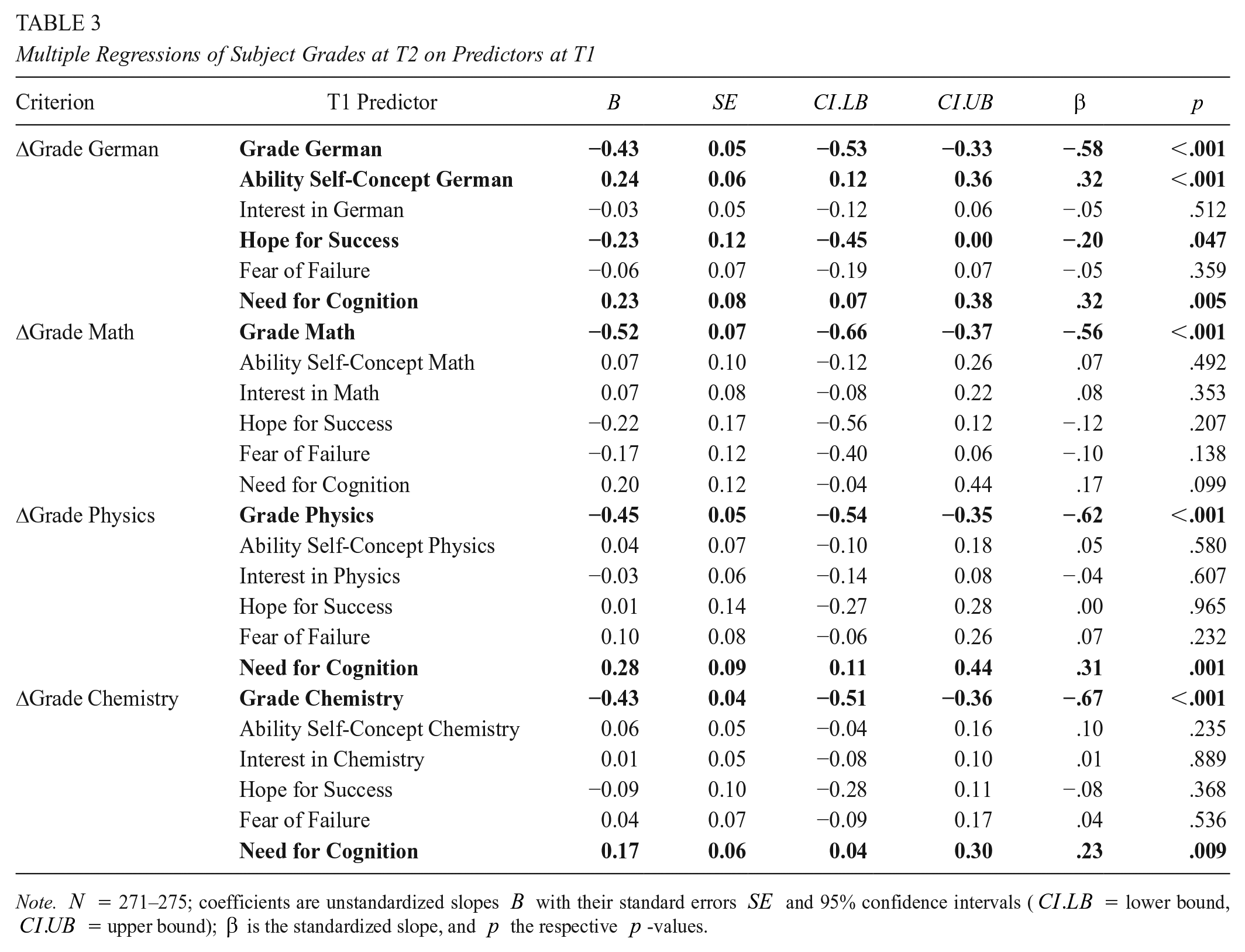
Note. N = 271–275; coefficients are unstandardized slopes B with their standard errors
Prediction of Domain-Specific Grades
Table 3 and Figure 1C–F give the results for the four specific subjects examined—that is, German, math, physics, and chemistry (see also Supplementary Tables S2–9). As can be seen, the only variable that was a significant predictor of change in grades was NFC, significantly so in German, physics, and chemistry, β ≥ .23, p ≤ .009, and not negligible in math, β = .17, p = .099. It has to be noted that Hope for Success also was a significant predictor of the change in grades in German, β = −.20, p = .047, but seemed to be largely redundant to NFC in most of the analyses.
Discussion
The present study was conducted to provide new insights into the interplay of academic achievement, motivational variables, and NFC. Building on and extending previous findings (e.g., Lavrijsen et al., 2021; Preckel, 2014), in a sample of secondary school students, we examined the (incremental) validity of NFC for explaining academic achievement and its development, considering ability self-concept, interest (general and domain-specific), hope for success and fear of failure as well as prior achievement in the prediction of academic achievement (assessed via GPA and grades in German, math, physics, and chemistry). By assessing each variable at both points of time, we were able to apply latent change score modeling and, hence, to determine the influence of these predictors on the change in academic achievement over one year. At the same time, we examined correlated change in these variables—an aspect that was not done before concerning NFC. The main results follow.
Validity of NFC for Predicting Academic Achievement Over Time
NFC showed positive concurrent and predictive correlations with achievement and all motivational variables, except for fear of failure, for which concurrent and predictive correlations were negative. This correlational pattern was found for domain-general measures as well as for the four subjects. Correlations were of medium to large effect size and comparable to previous findings: we found strong associations of NFC with ability self-concept (comparable to, e.g., Dickhäuser & Reinhard, 2010), medium-sized correlations with interest (comparable to Preckel, 2014, or Keller et al., 2019b), and a strong positive relation to hope for success and at the same time a medium-sized negative association with fear of failure (see, e.g., Diseth & Martinsen, 2003). These findings clearly support the relevance of NFC for learning and the development of achievement. Of all variables under study, NFC showed the second-highest correlations with GPA, after ability self-concept. With regard to the four subjects, NFC showed the third-highest correlations with grades, after domain-specific ability self-concept and domain-specific interest.
Correlations for all subjects were large, which is comparable to findings, for example, by Ginet and Py (2000) or Luong et al. (2017). While previous findings usually focused on GPA, math, and first language (e.g., German, French), our findings extend the knowledge of NFC and academic achievement to two STEM subjects, namely physics and chemistry. The strong associations (about r = 0.35) highlight the importance of NFC in subjects that require conquering the models and approaches to get an in-depth understanding, which is an inherent conceptual aspect of NFC (Cacioppo et al., 1996).
In line with former findings (Hailikari et al., 2007; Steinmayr et al., 2019), prior achievement showed a strong relation to GPA at the second time of assessment. Also mirroring previous findings (Steinmayr et al., 2019), among the motivational variables, ability self-concept showed the highest correlations with academic achievement, and this held for general as well as domain-specific ability self-concept. Concerning the prediction of change in grades, NFC and the general ability self-concept significantly positively predicted change in GPA. Furthermore, NFC predicted changes in physics, German, and chemistry, while domain-specific ability self-concept was a significant predictor only for the latter two.
Incremental Validity of NFC Over and Above Established Motivational Constructs and Prior Achievement
The importance of NFC for learning becomes even more apparent when looking at the latent change score models. Findings revealed that—with the exception of Math—NFC predicted changes in grades for GPA and all subjects alongside prior achievement. Compelling evidence of the incremental validity of NFC also emerges from further examination of the latent change score models. For GPA and German, prior achievement positively predicted changes in grades, as did NFC and general or domain-specific ability self-concept, respectively. For German, Hope for Success was another relevant predictor, but it is noteworthy that it seemed to be largely redundant to NFC in most of the analyses, which is also indicated by a high intercorrelation of both variables (r = .82). One reason for this finding might be that the items of both scales had similar content. The differentiation of both variables should be a subject of further studies. Concerning physics and chemistry, only NFC was found to predict changes in grades for this subject alongside prior achievement. Only for math, NFC just missed the significance threshold and did not explain achievement over and above the other predictor variables, and prior achievement was the only relevant predictor. It is noteworthy that the stability of math’s grade was lower than that of the other subjects included. There could be many possible reasons for this finding; however, we are not able to draw firm conclusions on the basis of the available information. Subject and potential teaching-specific differences should be addressed in further studies. To conclude, with regard to all grades examined and comparable to the results of Keller et al. (2019b) and Lavrijsen et al. (2021), respectively, NFC proved to be a valuable predictor of academic achievement besides prior achievement and ability self-concept. Taking a differentiated view, compared to one of the best-established predictors in educational research—the ability self-concept—NFC was even more able to predict academic achievement. As mentioned previously, extending previous findings by including two STEM subjects highlights convincingly that NFC enfolds its potential especially in subjects that require deeper thinking. Hence, NFC should definitely be considered alongside established motivational variables to gain a comprehensive picture of the factors that influence grades and their development.
Interplay of All Predictors
By applying latent change score modeling, we were also able to gain insights into the interplay of the examined variables. We took a closer look at the variables with the broadest predictive value, namely prior achievement, ability self-concept, and NFC. For all three variables, their level at the first measurement occasion predicted changes in their respective level at the second time of assessment. Changes in NFC could also be predicted by prior achievement in GPA, German, and math, whereas for changes in ability self-concept, prior achievement was only predictive in the German and physics models. Furthermore, concerning correlated change, the amount of change in grades at the second measurement occasion correlated with changes in ability self-concept for GPA and all subjects except German—that is, changes in grades were mostly accompanied by changes in ability self-concept and vice versa. This is a plausible interplay as ability self-concept is subject to change through feedback and the experience of success or failure and enhances achievement, in turn (e.g., Marsh et al., 2005; Spinath & Spinath, 2005). The same association was observable for changes in grades and NFC in German, math, and physics. Thus, the change in grades was accompanied by a larger change in the enjoyment of and motivation for thinking, particularly in these subjects. Changes in ability self-concept and NFC, in turn, were correlated in the GPA and chemistry models. Taken together, this lends support to self-enhancement and skill-development processes for both ability self-concept and NFC. While such positive reciprocal relations between academic achievement and the ability self-concept are well-confirmed (Marsh & Martin, 2011; Möller et al., 2011, 2020), to our knowledge, this has not yet been demonstrated for NFC as well. Academic achievement and NFC appear to strengthen or weaken each other. Therefore, fostering NFC at school can be an essential part of ensuring that children can develop their full intellectual potential. The findings of Meier et al. (2014) support this assumption: for the attendance of a gifted class, the level of NFC played a pivotal role even after controlling for cognitive ability or ability self-concept.
Limitations and Further Directions
Some limitations of our study must be noted. We assessed all data in a convenience sample, and while it was large enough to have adequate power to detect small-to-medium correlations, post hoc power analyses remain inferior to a priori power analyses. While such analyses can be easily done for simple effect sizes such as correlations, mean differences, or explained variance, power analyses for structural equation modeling are more difficult to perform. We, therefore, advocate for the use of packages like the semPower package (Moshagen & Erdfelder, 2016) for a priori power analyses for structural equation modeling in future studies. Furthermore, our sample was not representative of the German population of adolescents, as we assessed data only in two schools of one German federal state. Concerning the prediction of academic achievement, it must be noted that grades are not a truly objective criterion. They do not fully reflect performance, but an entire range of confounding aspects play into it. Course composition can play a role as well as the teachers themselves; teacher changes can bring grade changes, and changes in the students’ frame of reference can affect motivation and performance alike. As, on the other hand, these aspects enlarge error variance and therewith the risk of not finding associations or influences, respectively, our results represent a relatively conservative estimate of potential associations and predictive values. Furthermore, there were missing values in the data. Yet, the FIML approach to handling missing values employed here was shown to lead to adequate estimates for the standard error of regression estimates (Larsen, 2011).
Third, we relied on latent change score modeling while powerful alternatives exist, such as next-generation cross-lagged models (e.g., Núñez-Regueiro et al., 2022), which, however, unfold their full potential for more than the two measurement occasions in our study. Also, we did not have the opportunity to examine the predictive value of intelligence together with the predictors in our study. Although we assessed prior achievement as a relevant predictor also mirroring intellectual potential, further studies should also assess intelligence to gain a more comprehensive picture of the interplay of all variables of relevance. Moreover, because of the trait characters of NFC, Hope for Success, and Fear of Failure, we did not assess these variables in a domain-specific way. As research concerning NFC showed that there is also a domain-specific component for this variable (Keller et al., 2019a), which is especially relevant in math, it could be worthwhile to incorporate domain-specific measures at least for NFC in future research. This could also be helpful to further clarify the reasons for the observed differences in results for the subjects examined here. In the background of the findings concerning physics and chemistry as STEM subjects and the potential that was shown for NFC, it would be interesting to include a broader range of subjects in future studies to be able to examine differences in the predictive value of NFC in subjects with different characteristics or requirements, respectively. Finally, it would be interesting to longitudinally investigate NFC together with established motivational variables, especially in critical stages of school life, for instance, when decisions about school tracks are made.
Conclusion
Taken together, using a longitudinal approach and including a large set of established trait-like variables of academic motivation, the present study shows that NFC is of incremental value when aiming at a comprehensive picture of the prediction of academic achievement. Associations of NFC with grades were comparable or even stronger than for well-established motivational variables. In the prediction of grades over time, NFC could largely consistently prove its predictive and incremental value over and above prior achievement and academic self-concept. Furthermore, a reciprocal influence of NFC and academic achievement could be demonstrated with the first evidence for skill development as well as self-enhancement processes taking place in this interplay. To sum up, we propose that NFC should be included in models aiming at comprehensively explaining academic achievement in school. In addition, we consider fostering the general joy of thinking and conquering cognitively challenging tasks a worthwhile endeavor to help children unfold their intellectual potential.
Supplemental Material
sj-docx-1-ero-10.1177_23328584231218961 – Supplemental material for On the Interplay of Motivational Characteristics and Academic Achievement: The Role of Need for Cognition
Supplemental material, sj-docx-1-ero-10.1177_23328584231218961 for On the Interplay of Motivational Characteristics and Academic Achievement: The Role of Need for Cognition by Anja Strobel, Alexander Strobel, Franzis Preckel and Ricarda Steinmayr in AERA Open
Footnotes
Declaration of Conflicting Interests
The author(s) declared no potential conflicts of interest with respect to the research, authorship, and/or publication of this article.
Funding
The author(s) received no financial support for the research, authorship, and/or publication of this article.

Authors
ANJA STROBEL is full professor of personality psychology and psychological assessment at Chemnitz University of Technology (
ALEXANDER STROBEL is full professor of differential and personality psychology at Technische Universität Dresden (
FRANZIS PRECKEL is full professor of giftedness research and education at the Department of Psychology, University of Trier (
RICARDA STEINMAYR is full professor of educational and differential psychology at Technical University Dortmund (
References
Supplementary Material
Please find the following supplemental material available below.
For Open Access articles published under a Creative Commons License, all supplemental material carries the same license as the article it is associated with.
For non-Open Access articles published, all supplemental material carries a non-exclusive license, and permission requests for re-use of supplemental material or any part of supplemental material shall be sent directly to the copyright owner as specified in the copyright notice associated with the article.
