




Abstract
Though schools do not track in Brazil, I find that racial classroom segregation in Brazil is on par with recent estimates from North Carolina high schools (Clotfelter et al., 2020). How does racial classroom segregation occur without tracking, and in a supposed “racial paradise,” no less? Using national, student-level data spanning from 2011 to 2017, I describe racial classroom segregation among Brazilian 5th and 9th graders and assess potential mechanisms identified in the literature. The findings are consistent with segregation by chance in which (1) schools initially segregate students by using effectively random classrooms assignment practices and (2) schools choose to move forward with these initial assignments, even when they are highly segregating, rather than make race-conscious adjustments. This is consistent with the myth of racial democracy, a prominent colorblind ideology in Brazil that promotes the legitimacy of de facto racial segregation and undermines the legitimacy of race-conscious desegregation.
Keywords
Introduction
Classroom segregation – how the grouping of students for whole-class instruction maps onto student characteristics – has long concerned education and inequality scholars who argue that it enables differential treatment within schools, particularly along racial and economic lines (Bowles & Gintis, 1976; Mickelson, 2001, 2015; Oakes, 1990, 1992, 2005). To date, racial classroom segregation research has focused primarily on racial segregation that occurs downstream of segregation by academic status. These practices take the form of (1) tracking, where students are sorted for formally differentiated instruction explicitly on the basis of perceived ability for one or more subjects, with varying rigidity (i.e., varying interdependence of classroom assignments across subjects and grades), and (2) pseudo-tracking, which are practices that academically sort students into classrooms in ways that diverge from archetypal tracking in that instruction is not formally differentiated or perceived ability is not the sorting criterion. The latter can involve sorting by perceived ability without formal instructional differentiation or sorting by other academic criteria (e.g., by prerequisites, course schedules, past grade retention).
US high schools are particularly known for producing racial classroom segregation via tracking and pseudo-tracking, and for the charged debate surrounding these practices. A recent study in North Carolina provides a high quality and up-to-date benchmark of how much racial segregation occurs under tracking; there, white/black segregation among 10th graders has a Dissimilarity Index score (D) of .20 (vs.
Among racially diverse school systems, it is difficult to imagine a less likely place for racial classroom segregation than Brazil. Brazil does not formally track classrooms or have curricular differentiation programs like those that are tied to classroom segregation in the US (e.g., honors, gifted and talented, advanced placement). Brazil also prides itself on higher cross-race interaction and the absence of de jure segregation in its history, with political leaders often evoking a favorable comparison to US segregationism and racial conflict and some going so far as to proclaim Brazil a “racial paradise” (Telles, 2004). This may underly the apparent absence of racial classroom segregation in the literature on racial segregation and Brazilian education.
This paper provides the first national description of racial classroom segregation in Brazil. Contrary to expectations, repeating the Clotfelter et al. (2020) analysis in Brazil’s public schools reveals that racial classroom segregation in both 5th (
Instead, the key unlocking this puzzle is what I call “segregation by chance,” the practice of producing segregation by using an effectively random assignment process. The composition of Brazilian schools is such that even truly random assignment would systematically produce substantial racial segregation. I contend that in Brazil there is widespread use of effectively random classroom assignment processes, which schools may accomplish without drawing random numbers (e.g. by assigning students haphazardly or alphabetically) and which schools facilitate by accepting racially segregation initial classroom assignments. These two practices together segregate classrooms en masse. This explanation is compatible with historical conditions and Brazil’s colorblind ideology of racial democracy, which facilitate the legitimacy of de facto racial segregation and undermine the legitimacy of race-conscious desegregation.
The segregation by chance explanation is also consistent with a long line of measurement research demonstrating that random assignment can produce substantial segregation. I draw from Critical Race Theory (CRT) to build on this literature. Specifically, I depart from the random expectation benchmark tradition, a methodological approach producing measures that use the expected value of segregation under random assignment (henceforth, the random expectation) to measure what would occur in an ideal, colorblind system, then analyze segregation only insofar as it is above this benchmark. I develop the concept of segregation by chance to instead understand randomness in the assignment process as a segregation mechanism that, like any other, results from modifiable practices and is worthy of scrutiny.
The analysis proceeds in two stages. First, I describe the extent of racial classroom segregation in Brazil. Second, I consider whether segregation by chance is the primary classroom segregation mechanism, testing four hypotheses consistent with a segregation by chance regime and comparing the case for segregation by chance to the cases for the mechanisms that have featured in the classroom segregation literature. The findings are consistent with racial segregation that is primarily, though not solely, segregation by chance.
Classroom Segregation without Tracking?
Tracking
Tracking is ever-present in the international literature on classroom-level segregation. Yet Gamoran’s (2010) international review lists only six countries that track within schools. Many nations sort between schools rather than within them (Hanushek & Woessmann, 2006) and tracking countries like the US only track in some schools and at some grade levels. However, tracking is a crucial feature of US educational discourse, having come into fashion as a response to the racial integration of schools (Mickelson, 2001), come under fire in the push for detracking, and remained the topic of a heated political battle (Loveless, 2011; Oakes, 2005; Oakes et al., 1997; Wells & Serna, 2017). That discourse has so dominated the classroom segregation literature that tracking is now the primary framework available for understanding classroom segregation. It remains unclear whether classroom segregation does not occur without tracking or if classroom segregation only appears to be an epiphenomenon of tracking because of narrow case selection in the literature.
One non-tracking context that has received attention is US elementary schools, where tracking affects less of the course schedule and fewer students but is not entirely absent (e.g., gifted and talented programs). Though few classroom segregation analyses include US elementary schools, those that do consistently find low racial segregation (Clotfelter et al., 2003, 2008, 2020; Conger, 2005; Kalogrides & Loeb, 2013; Morgan & McPartland, 1981). In fact, two of these studies offer evidence that at least some US elementary schools proactively balance their classrooms with respect to race; Clotfelter et al. (2003, 2008) find that some North Carolina districts have less average racial classroom segregation than would have occurred under random assignment, indicating that there may be intentional balancing efforts in those districts. This is striking given the persistence of racial segregation throughout US society, and may lead one to believe that widespread classroom segregation does not occur in non-tracking contexts.
Pseudo-Tracking
I refer to another well-researched set of mechanisms as pseudo-tracking. These are practices that academically sort students into classrooms in ways that diverge from archetypal tracking in that instruction is not formally differentiated or perceived ability is not the sorting criterion. In the US, scholars have attended to racial segregation in advanced courses due to racial patterns in who gets earlier access to prerequisite courses and who does not, the canonical example being segregation in high school math due to unequal access to algebra in middle school (Domina et al., 2016). Rather than tracking students into remedial, middle-track, and honors classrooms within a given math topic (e.g., geometry), this practice segregates students across math topics by giving them access to a topic at different grade levels (e.g., some freshman taking algebra and others taking geometry). Pseudo-tracking can also be caused by how courses are scheduled; for example, English Learner (EL) courses may conflict with higher-level offerings on a topic such that students taking classes in that topic are effectively segregated by EL-classification (Umansky, 2016). In Arizona, particularly burdensome EL requirements that take up 80 percent of students’ instructional time effectively limit EL-classified students to a distinct, substandard curriculum (Lillie et al., 2012). As these examples illustrate, these pseudo-tracking practices in the US tend to occur within a broader tracking context in which there are widespread programs that formally differentiate instruction, such as honors classes, gifted and talented programs, middle school algebra, and advanced placement courses.
Similarly, Brazilian schools could be only nominally non-tracking. What little is known about classroom segregation in Brazil comes from a small literature focused on the possibility of pseudo-tracking of a different variety than the US pseudo-tracking discussed above. Brazilian public schools do not have comparable programs differentiating instruction, so the pseudo-tracking processes discussed regarding Brazil involve academic sorting into classrooms without formally differentiated instruction.
One type of pseudo-tracking that may occur in Brazil is sorting classrooms by test scores, or achievement. Soares (2005) reports that 32% of the total achievement variation in Minas Gerais occurs at the classroom level, which is three times the amount of the school-level variation. In a national study of 5th graders in 2009, de Oliveira et al. (2013) identify 10% of schools in which at least 33.4% of the variation within the school is between classrooms. In a study reported by Instituto Unibanco (2017), Mariana Leite identifies 426 elementary schools across the country with substantial classroom segregation by test scores and reports that higher-performing classrooms are assigned more experienced teachers than lower-performing classrooms in the same school and grade. While only about five percent of 5th grade students and four percent of 9th grade students in my sample have principals who report assigning students to classrooms based on achievement, more may do so informally (see Table 1 below).
Descriptive Statistics of Schools in the Analytic Sample, Over All Years

Note: Students are included in the analytic sample if they responded to the race question. Schools are included in the analytic sample if they are public schools within which all classes in the given grade have at least 75% of students responding to the race item and there are at least two classes. Expectation variables are produced via simulation. Correlates are missing due to non-response or inapplicability (e.g., if there is only one shift in the school building). Segregation, stratification, and teacher disparity variables are further restricted for comparability (see Appendix A).
Other scholars consider sorting by age/grade distortion, the discrepancy between a student’s age and that expected at his/her grade level due to delayed entry, stop-out, and/or retention. Bartholo and de Costa (2014) find evidence of age sorting in Rio de Janeiro’s public school system, although it is not within schools as they are defined in the present study. In Brazil, students are often divided into separate shifts that attend classes in the same institution at different times of day. In the present study, I define a school as an institution-specific shift, as this is the population among which classroom assignments are made (others might use school to refer to the set of shifts that share the same location and administration). Bartholo and de Costa (2014) find substantial shift segregation – segregation between schools that share a location and administration – by race and class that results from selecting students into shifts according to age/grade distortion. An earlier study by de Costa and Koslinski (2006) suggests this process also occurs at the classroom level; they found Rio de Janeiro schools dividing their classrooms by age and making exceptions for high-income and high-achieving students. Principals frequently indicate that they age sort classrooms; about 35% of 5th graders and 37% of 9th graders in my sample have principals who report age sorting (see Table 1 below).
Altogether, these studies indicate that Brazilian schools may be sorting students on academic criteria as a pseudo-tracking assignment practice. However, it remains unclear whether either practice promotes substantial racial segregation at a national scale.
Parent Lobbying and Teacher Steering
Another possibility is that segregating practices that are typically secondary to tracking independently promote segregation in non-tracking contexts. Tracking is both a primary mechanism of classroom segregation and a context that promotes secondary, segregation-exacerbating mechanisms. The latter are the focus of a subarea of the tracking literature that considers whether and why schools are sometimes more racially and economically segregated than academic differences predict. Scholars explain this “knock-on” segregation with consideration of how status influences a dynamic classroom assignment process, showing that classroom segregation is influenced by biased assessments of ability, parent lobbying for classroom assignments, teacher steering during the assignment process, and schools competing for the enrollment of advantaged students (Delany, 1991; Grissom et al., 2015; Lewis & Diamond, 2015; Naff et al., 2020; Oakes & Guiton, 1995; Watanabe, 2008).
Of these secondary segregation mechanisms, parent lobbying and teacher steering do not require tracking and could occur in non-tracking contexts. Parent lobbying for classroom assignments and access to particular teachers and peers can contribute to segregation, both because racially privileged parents are more likely to lobby for classroom assignments (Delany, 1991; Oakes & Guiton, 1995) and because they lobby more successfully (Lewis & Diamond, 2015). Another potential contributor is teacher steering. Grissom et al. (2015) describe the micropolitics of classroom assignment in which teachers compete for high status students, steering lower-status students into classrooms with lower-status teachers.
Segregation by Chance
Another possible mechanism of classroom segregation in non-tracking contexts is what I call segregation by chance, which is the practice of producing segregation by using an effectively random assignment process. It has long been understood in the segregation measurement literature that segregation occurs under random assignment (Cortese et al., 1976). The expected value of segregation under random assignment, or random expectation (variously referred to as random segregation, small-unit bias, index bias, expected segregation, and random unevenness), is a function of group (i.e., racial groups) and unit (i.e., classrooms) size and can be substantial when either are small (Cortese et al., 1976). This is akin to the problem of random sampling with a small N; important characteristics (e.g., race) are likely to be unbalanced across treatment conditions (e.g., classrooms) because the random assignment variable happens to be correlated with race in some iterations despite being uncorrelated with race on average. When schools group students into classrooms using criteria uncorrelated with race, they can produce substantial racial segregation because classrooms are small samples of the school-grade population.
Though it is not impossible that some principals use random number generators, in practice schools may use effectively random assignment – approaching assignment haphazardly or using arbitrary, rather than random, criteria like the alphabetical order of names – to similar effect. Moreover, the classroom assignment process involves both initial assignments and later reassignments, which could conceivably exacerbate or alleviate initial segregation levels. Both must be effectively random for the overall assignment process to be effectively random.
How Much Segregation Can Occur by Chance?
To date, the literature has centered on random expectation benchmarks, used the random expectation as a benchmark, either treating it as a bias and subtracting off or using it as a non-zero null hypothesis. The “true” segregation is then measured as the deviation from the random expectation. This is a common approach in other areas throughout the sciences when a measure of interest has a non-zero random expectation. In the segregation literature, it is found in studies of organizational segregation (F. D. Blau, 1977; Bygren, 2013; Carrington & Troske, 1997; Cortese et al., 1976; Fossett, 2017; Winship, 1977) and network homophily (P. M. Blau, 1977; Fararo & Skvoretz, 1987; McPherson et al., 2001).
Analyses simulating random assignment in observed data involving small units have demonstrated that random assignment can produce substantial segregation in practice (e.g., Bygren, 2013; Carrington & Troske, 1997). This is true of Brazil’s classrooms, where simulations show that random assignment would produce racial classroom segregation on par with pseudo-tracking practices. Figure 1 shows the distribution of racial classroom segregation in Brazilian public schools in four simulated assignment processes: random assignment and sorting by age, test scores, and a noisy proxy of test scores (

Distribution of Classroom-Level Racial Segregation (H) by Simulated Classroom Assignment Processes, Over All Years and Grades.
This finding is particularly instructive in light of a broader literature on colorblindness and racial segregation. While some literature on colorblind segregation focuses on how assigning students to classrooms or schools using ostensibly colorblind but race-correlated criteria promotes racial segregation (e.g., perceived ability in tracking, neighborhoods in school assignments), others have gone further, arguing that preventing racial segregation can require the active pursuit of racial integration. Scholars have demonstrated how the failure to promote racial integration facilitates the racial segregation of schools in the US in the contexts of laissez-faire school choice policies (Roda & Wells, 2013) and court decisions barring race-conscious remediation (Ayscue et al., 2018; Mickelson et al., 2021). That even truly random assignment can systemically produce racial segregation puts this insight into stark relief.
Does Segregation Occur by Chance? Toward an Alternative Approach
While the finding that random assignment simulations produce high segregation in Brazil indicates that there is the potential for substantial segregation by chance, it does not indicate whether there are effectively random classroom assignments in Brazilian schools or how common this is. Figure 1 speaks no more to the existence of segregation by chance than it does to the existence of age or achievement sorting. While this is trivially true, consider that the random expectation benchmark tradition estimates segregation net of the random expectation. In using the random expectation as a benchmark, this approach positions the practice of producing segregation through effectively random assignment as the alternative to segregating. It is as though, in the absence of other segregation mechanisms, segregation by chance is inevitable. It is neutral rather than something to scrutinize, as demonstrated by the literature’s incuriousness regarding whether and to what extent it has occurred.
This is because the literature to date conceptualizes segregation by chance as the ideal, specifically the colorblind ideal. While this is often implicit, it was initially explicit, with Cortese et al. (1976) arguing that the appropriate comparison is a world in which “race had no effect” on assignments (p. 633). On one hand, this is strange. Colorblind assignment is not the inevitable alternative; institutions must forego less-segregating alternatives in favor of it. Even a school that uses random initial assignments can reassign students to decrease segregation or re-randomize assignments until arriving at a less segregating draw. Nor is it neutral; it predictably produces high segregation en masse, as shown in Figure 1.
On the other hand, rather than strange, the colorblind ideal is common sense in the US. Here, CRT is instructive. CRT is a wide-ranging branch of critical legal theory that, among other things, challenges the colorblind ideal that equates race-neutrality with equal treatment. CRT studies often demonstrate how colorblindness instead upholds racial inequality, as in the aforementioned cases of laissez-faire school choice and the barring of race-conscious remediation (Bell, 1995; Crenshaw, 2019). Bobo et al.’s (1997) laissez-faire racism and Bonilla-Silva’s (2006) colorblind racism are theories of post-civil rights era US racial ideology that explain how the colorblind ideal is a fundamental, commonsensical notion supporting the racial order. Specifically, formal legal equality is taken to mean that the US is racially egalitarian, notions of racism are confined to discrete acts of overt interpersonal prejudice, and racially unequal outcomes are attributed to cultural differences rather than non-meritocratic processes. Crenshaw (2019) has also demonstrated how the commonsensical colorblind ideal colors science as well as lay notions, orienting research methods and constraining race scholarship’s purview.
The random expectation benchmark tradition’s use of the colorblind ideal explicitly orients the research method and it does so to the detriment of understanding how segregation is produced. In addition to precluding investigation of whether segregation by chance has occurred, the traditional approach can also conceal other segregation mechanisms. As Figure 1 indicates, if achievement sorting was standard practice in Brazil, it would produce similar racial classroom segregation as would occur under random assignment. Random expectation benchmark methods would find minimal “true” segregation worth investigating, a consequence not of achievement sorting creating little segregation but of the high random expectation.
My segregation by chance approach departs from the literature by understanding randomness in the assignment process as a consequence of practices. Understanding it is a practice emphasizes that school choices, actions, and inactions have ramifications for whether and how much they segregate by chance, whereas random expectation benchmarks are invariable to schools’ actions. Rather than a neutral condition, segregation by chance is open to scrutiny; it’s possibility raises questions of whether, how, and to what extent it occurs.
Legitimacy and Segregation in Brazil
I turn now to considering how the Brazilian ideological context may shape how classroom segregation occurs by facilitating and constraining the legitimacy of racial segregation and desegregation. I follow Weber’s (1978) descriptive account of legitimacy as the condition of being “approximately or on the average, oriented toward determinable ‘maxims’” such that a legitimate condition is understood to be accordant with broadly accepted norms and values, inducing an obligation to at least tolerate it (31).
When Brazil entered the 20th century, slavery had only recently been abolished, in 1888. Compared to the US, Brazil had a far greater population with both European and non-European ancestry, owing to the male-dominant demographics of Portuguese colonizers who more often had children with non-whites compared to the colonizers of the US who primarily migrated as families (Telles, 2004). At the turn of the century, Brazil was in the midst of branqueamento, a national eugenics policy promoting European migration and cross-racial marriage as a grand project to design a white nation through the dilution of black blood (Loveman, 2009).
Only a few decades later, the government was actively promoting the ideology of racial democracy, which may be understood as a distinct, Brazilian counterpart to the US’s laissez-faire and colorblind racism (Bobo et al., 1997; Bonilla-Silva, 2006). Racial democracy is a patriotic, racism-denying ideology that reframes Brazil as a “racial paradise” with a single, mixed Brazilian race and presents multiraciality as a consequence of racial harmony (Bailey, 2009; Freyre, 1946; Telles, 2004). The 1964-1985 military dictatorship embraced the myth of racial democracy and brutally crushed dissidents, hampering racial justice movements.
Today, racial democracy lives on; in response to the murder of João Alberto Silveira Freitas, former Vice President Mourão declared “there is no racism” in Brazil (Camazano, 2020). However, this ideology is increasingly contested by the growing Black Movement, which promotes positive black identity among Afro-Brazilians and challenges racism and inequality (Bailey, 2009; Telles, 2004). Some consider racial democracy to now serve primarily as an aspiration: the promise of a raceless society once racism is extinguished (Bailey, 2009).
Importantly, racial democracy grew in explicit recognition that Brazil did not implement de jure segregation and anti-miscegenation like the US, and frames Brazil as non-segregationist as opposed to the “post-racial” framing used in the US (Bailey, 2009; Bobo et al., 1997; Bonilla-Silva, 2006; Telles, 2004). De facto racial segregation is commonly assumed to be epiphenomenal, typically to class. This is the case with respect to housing despite sizable racial residential segregation net of class (Telles, 2004). This myth of a race-neutral and racially harmonious Brazil is a pre-existing narrative that lends legitimacy to de facto racial segregation not otherwise readily explained.
Alternatively, race-based integration faces meaningful barriers to legitimacy. Another important component of racial democracy, antiracialism, construes the discussion of race and racism as a racist, foreign intervention (Guimarães, 2001; Schwartzman, 2009). Crucially, antiracialism goes beyond its US corollaries in denying the existence of race not only as an axis of oppression but as a socially meaningful category. Though Brazilians see one another as raced – reliably categorizing photographs into racial groups (Bailey, 2009), for example – it is considered improper to make racial ascriptions explicit. Ascriptions to darker racial groups are particularly improper; when ascribing the race of someone one sees as black, it is polite to instead use a lighter category like moreno (Schwartzman, 2009). This system of manners upholds the pretense of a single Brazilian race even as it implies the superiority of whiteness. This can work against race-based classroom integration by calling into question the appropriateness of school administrators who might otherwise acknowledge student color differences and use this information to organize less segregated classrooms.
This does not mean race-based integration is without its proponents. Most notably, public colleges began adopting racial affirmative action policies in 2001, a major win for the Black Movement. Yet Telles and Paixão (2013) note that by 2010, “class quotas ha[d] become more common than race quotas, even though the debate ha[d] been almost entirely about race quotas” (p. 10). They argue that the strong opposition to race quotas specifically reflects denial of racism’s role in creating racial inequality in higher education. The rationale of equalizing opportunity failed to legitimate race-based college integration despite awareness of stark racial inequities in college-going. Classroom integration efforts within schools may also struggle to garner legitimacy, particularly when classroom segregation is not an established social problem.
Altogether, these factors make Brazil particularly susceptible to classroom segregation by chance, which can only be a substantial driver of racial segregation if school administrators choose not to intervene when effectively random initial assignments happen to produce high segregation. Otherwise, schools could keep segregation by chance low by monitoring drafted classroom assignments for substantial racial imbalance and reassigning some students to decrease that imbalance before the schoolyear begins.
Data
I investigate classroom segregation in Brazil using Prova Brasil 2011-2017, a publicly available dataset based on a biennial, nationwide student achievement test that includes a student survey with self-reported demographic information as well as identifiers linking students to their classrooms (which are stable across subjects), shifts, and school administrations (Instituto Nacional de Estudose Pesquisas Educacionais Anisio Teixeira, 2017). I use these identifiers to link Prova Brasil to Censo Escolar 2011-2017, a biennial national survey of teachers and principals (Instituto Nacional de Estudose Pesquisas Educacionais Anisio Teixeira, 2017). Collected at the end of the school year, this survey aims to include all Brazilian public-school 5th- and 9th-graders except those attending very small schools.
I focus on public schools in which classroom segregation is possible, restricting the data to multi-classroom schools where there is one set of students eligible for assignment to one set of classrooms per school-grade-year (e.g., each shift within a school administration is a school). I also include schools only if all classrooms have race item response rates of at least 75%. This drops students in roughly equal proportion across racial groups (among race-responders) and regions, but there may be undetected non-response patterns that make the 5th and 9th grade samples not representative of all Brazilian students in multi-classroom schools. Nonetheless, the samples cover a broad swath of the country and include thousands of distinct school systems, allowing me to identify general patterns. The full sample includes 53,452 school-year observations in 5th grade and 32,068 in 9th grade (see Table 1 for descriptive statistics). Overall, the samples include over 5.3 million students.
Measuring Racial Segregation
With the exception of Figure 2, which replicates another study’s method, I measure racial segregation across classrooms in the same school-grade-year using the multigroup Information Theory Index, denoted H. This measure enables me to use more than two racial groups and to decompose segregation without bias (Reardon et al., 2000; Reardon & Firebaugh, 2002). Tracking analyses often consider how classroom segregation becomes curriculum-wide segregation; here, I focus on the production of classroom segregation itself, as Brazil’s public schools typically group students into classrooms that remain together for all subjects.

Binary Classroom Segregation (D) by Race in Brazil and North Carolina in 2017.
H operationalizes segregation as the degree to which students are unevenly distributed across classrooms given a school’s population in a given grade and year. H is based on entropy (

where

where
I use multigroup H to simultaneously consider the segregation of all racial groups (Reardon et al., 2000; Reardon & Firebaugh, 2002). To stray as little as possible from students’ emic racial categories and capture the experiences of as many students as I can, I do not combine or drop categories. Instead, I measure segregation among all six response categories in the Prova Brasil survey: white, parda/o (roughly, brown; positioned between white and preta/o and often combined with preta/o to form an Afro-Brazilian or negra/o category), preta/o (roughly, black), indigenous, amarela/o (roughly, Asian), and “I don’t know.” The latter category, which is a more common response in grade 5, is included to reflect the distinct racialization experience in which the dominant racial schema is experienced as ill-fitting or is outright rejected.
These considerations raise the broader issue of potential race misclassification given Brazil’s relatively porous racial schema (Telles, 2004). One can think of the race measure as being statistically noisy, in which case racial segregation is biased downward (Dickens & Levy, 2003; Owens et al., 2016). Segregation could also be biased by excluding race non-responders and restricting the sample based on the response rate; however, in the analytic sample, the response rate is not significantly associated with racial segregation at the
Research Question 1: How Racially Segregated Are Classrooms?
The first stage of the analysis considers how much racial classroom segregation there is in Brazil. To get a sense of how segregated classrooms are, I use two benchmarks: tracking high schools in the US and racial segregation at other scales of Brazil’s school system.
Tracking in US high schools is the quintessential case of racial classroom segregation. Due to localized data systems and privacy barriers, classroom data in the US is typically available only at small scales and there does not appear to be anything capturing nationwide tendencies. Arguably the best large-scale estimates of how much racial segregation currently occurs under tracking come from Clotfelter et al.’s (2020) recent study which found disconcertingly high average levels of white/black classroom segregation in North Carolina’s high schools in 2017. Figure 2 compares their estimates among 4th graders (who are not tracked) and 10th graders (who are tracked) to my findings – following the same procedure – for racial segregation among Brazilian 5th and 9th graders in 2017. These estimates, unlike all other estimates in this study, follow Clotfelter et al. (2020) in using the Dissimilarity Index (D). D is a binary segregation measure that captures the proportion of students who would have to change classrooms for a school to have no classroom segregation. D tends to be greater than H due to differences in how the indices are constructed. D is also particularly sensitive to how race is operationalized, so I estimate racial segregation in Brazil several ways; I compare whites to all non-whites, to negros (a composite of pardos and pretos), to pardos, and to pretos. Regardless of the operationalization, Brazilian classroom segregation levels in both primary (.18 ≤ D ≤ .29) and secondary (.16 ≤ D ≤ .25
Another way to understand the degree of racial classroom segregation is to ask how much of the racial segregation of Brazilian students in the analytic sample is due to classroom segregation by comparing segregation at various scales. I estimate this using the decomposition method of Reardon and co-authors (Reardon et al., 2000; Reardon & Firebaugh, 2002), beginning with all identified institutional units then collapsing into the most consequential units (e.g., shift-level segregation is excluded below because it was minimal in each year-grade; see Appendix B for details). Figure 3 presents the proportion of multigroup racial segregation (

Racial Segregation Decomposed by Segregation Scale, by Year and Grade.
This analysis focuses on public school students, but Brazil has a large and inordinately white and upper-class private school population. Private school demographics are not public, so in Appendix B I estimate a lower bound on the contribution of classroom segregation to overall segregation, including private school students, by assuming all private school students are white. Under these highly conservative assumptions, I find that public school classroom segregation accounts for at least 25-28% and 19-22% of the racial segregation in the whole (public and private) education system in grades 5 and 9, respectively.
Appendices C and D enrich the description of the extent of classroom segregation. Appendix C provides visual representations classroom segregation in schools that fall at different levels of multigroup segregation and Appendix D describes how each racial group dyad contributes to multigroup classroom segregation.
Research Question 2: Is Segregation by Chance the Primary Mechanism?
Hypotheses
The second stage of the analysis considers what causes this classroom segregation, asking: is segregation by chance the primary mechanism of Brazil’s classroom segregation?
The primary challenge for this analysis is that a dispositive causal account of the segregation by chance hypothesis is elusive and there are no studies attempting to identify segregation by chance as a mechanism. One cannot directly measure the randomness of a process by the outcome it produces. Instead, I compare observations to a simulated world of truly random classroom assignments nationwide and I use the random expectation in each school-year-grade as a regression predictor that imperfectly proxies for effectively random classroom assignment under segregation by chance. Note that it is unclear how to identify the causal effects of the random expectation predictor; it is mechanically associated with classroom size and racial composition and controlling for them would leave it with no variation. In lieu of causal analysis, I compare segregation by chance to alternative explanations using a combination of simulations of classroom assignment processes, observed characteristics, and regression analyses comparing the observed segregation pattern to a simulated random assignment world.
I consider four hypotheses consistent with segregation by chance being the primary classroom segregation mechanism:
1) Classroom segregation has a similar pattern relative to the random expectation as it would in a random assignment world, mirroring the random expectation along the
2) Classroom segregation has a similar pattern relative to the expected segregation values under pseudo-tracking practices as it would in a random assignment world, rather than mirroring the expected pseudo-tracking values along the i line.
3) The random expectation is a strong predictor of classroom segregation with explanatory power approaching what it would be in a random assignment world.
4) Variables proxying for non-random processes are not much stronger predictors of classroom segregation than they would be in a random assignment world.
Note that nationwide truly random assignment is the most extreme version of segregation by chance. As a practical matter, even if segregation by chance is the primary segregation mechanism, one would expect some differences from a random assignment world because (1) multiple mechanisms may be at play within the same school, (2) different mechanisms are at play in different schools, (3) some schools may reassign students, increasing or decreasing segregation after effectively random initial assignments, and (4) computer-assisted random assignment is an imperfect model of effectively random initial assignments.
Segregation Predictors
Simulating assignment processes
I consider several potential predictors of segregation (see Appendix A for additional details). Four of these predictors are school-grade-year expected values drawn from the simulated assignment processes used in Figure 1: random assignment and sorting by age, test scores, and a noisy proxy of test scores. In each simulation, I assign the students in the observed data to hypothetical, equal-sized classrooms in their school-grade-year to model what would occur under a particular assignment regime.
I proxy for segregation by chance by simulating random classroom assignment, giving each student an equal probability of being assigned to each classroom. I simulate 50 assignments in each school-grade-year and take the mean to estimate the random expectation.
The findings reported by Soares (2005), Oliveira et al. (2013), and Instituto Unibanco (2017) indicate that there could be achievement-based pseudo-tracking in Brazil while the findings of de Costa and colleagues indicate that there could be age-based pseudo-tracking. I estimate three sorting expectations via simulation. To proxy for age sorting and strict achievement sorting, I assign students by the rank of their age and the average of their Portuguese and Math scores, respectively. To account for two shortcomings in the achievement measure – that it uses end of year scores and that schools may sort by perceived ability rather than achievement – I also proxy for noisy achievement sorting by sorting students on a noisy proxy for their test score average, adding classical error to it such that the reliability is t. The noisy achievement sorting simulation includes random variation, so I simulate 50 assignments per school-grade-year and take the mean to estimate the sorting expectation.
Other pseudo-tracking proxies
The simulated variables are imperfect proxies for the assignment processes. Though there appears to be no other option for proxying for segregation by chance, there are observed characteristics that also proxy for age and achievement sorting. I consider the sorting practices reported in Censo Escolar principal surveys, segregation by age and test scores, and racial stratification by age and test scores within each school-grade-year. The racial stratification measures account for the fact that achievement and age sorting can only produce racial segregation to the extent that there are racial differences in test scores or age.
Parent lobbying and teacher steering proxies
The classroom segregation literature also raises the possibility of segregation produced by parents lobbying for particular classroom assignments (Delany, 1991; Lewis & Diamond, 2015; Oakes & Guiton, 1995) as well as the possibility that segregation is produced by teachers steering students so as to teach their preferred pupils (Grissom et al., 2015). The literature ties these processes to parent and teacher status differences, respectively; higher SES parents are more effective lobbyists and teachers with greater status (for which experience has previously been used as a proxy) have greater micropolitical power to leverage in the competition for pupils. I proxy for parent lobbying with measures of SES segregation and racial stratification by SES, where SES is measured as the highest educational attainment of the student’s parents. One shortcoming is that SES non-response is high, so the subsample could be distinct from the full population of multi-classroom public schools in Brazil. I proxy for teacher steering with measures of white-nonwhite student disparities in their teachers’ status, for which I use years of experience, salary, and an indicator of tenure status as status indicators. Note that the high missingness of the teacher disparity estimates are primarily from cases in which disparities are not possible (e.g., the same teachers teach all classrooms or the teacher characteristic is invariant across teachers) such that this missingness is unlikely to distort the picture of segregation in Brazil.
Proxying for segregation as a local anomaly
Segregation can also be a local anomaly driven by the tendencies of specific school administrations, municipalities, states, or regions where there is more willingness to segregate or desegregate by race. In a random assignment world, classroom segregation would be geographically diffuse with geographic tendencies caused only by variation in the random expectation due to variation in classroom size and racial composition. Though local idiosyncrasies are not inconsistent with the presence of segregation by chance – assignment processes, particularly reassignment practices, might vary with geographic patterns in racial ideology – it would be misleading to speak of a national segregation by chance regime if the segregation was specific to a handful of places.
I consider local tendencies using municipality, state, and region identifiers and 2 proxies for administrative tendencies: “segregation in peer shift” and “segregation in adjacent years.” Segregation in peer shift is the classroom segregation level of the school that is administered by the same staff and is in the same grade and year, but uses the building at a different time of day than the given observation. Segregation in adjacent years is the average classroom segregation level in the same school-grade in the observations just prior and following the given observation. In a random assignment world, there would be some consistency across peer shifts and adjacent years due to drawing assignments under similar classroom size and racial composition conditions, but also variation across shifts and time due to differences across random draws.
Measures of Explanatory Power
I estimate how strong a predictor is by how much variance it explains and its predicted contribution to nationwide segregation. These metrics are based on grade-specific bivariate models of schools within years. I estimate 5th- and 9th- grade two-level hierarchical multiple regression models in which level-1 is the school-year-grade and level-2 is the year-grade. Given a predictor

where
I measure the variance explained by a predictor,

where
Another way to consider how much segregation the predictor explains is to consider the proportion of nationwide classroom segregation that one would attribute to the predictor if the bivariate model described a causal relationship. The estimates are not causal, so the predicted contribution should not be confused with the actual contribution, which is unknown. Given a predictor
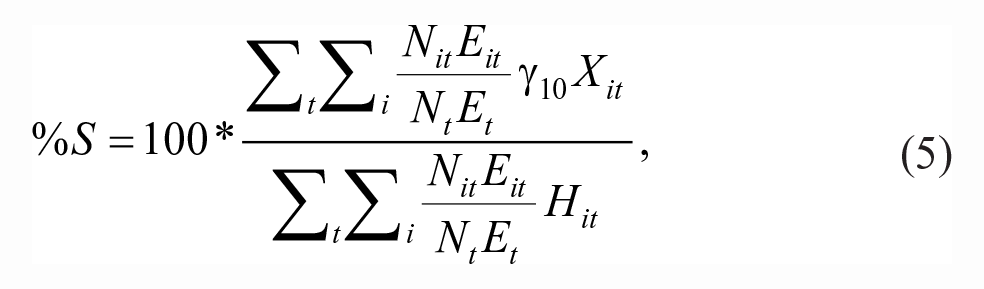
where
Hypothesis 1: Segregation vs. the Random Expectation Fits a Random Assignment World
I assess the first two segregation by chance hypotheses graphically. In Figure 4, I plot observed classroom segregation against my simulated random expectation and sorting expectation variables. The Grade 5 Segregation and Grade 9 Segregation lines are LOWESS lines displaying the pattern of classroom segregation in each grade while the Segregation Under Random Assignment line indicates what would occur in a random assignment by plotting one set of random assignment simulation results (this line differs little across the 50 simulations). The x-axes of the top right and bottom panels are sorting expectation variables, each indicating the expected value of segregation under a given sorting practice. These panels each include a Segregation Under Given Sorting Practice line plotting one set of simulation results for the same sorting practice. The Segregation Under Random Assignment line in the top left panel and the Segregation Under Given Sorting Practice line in each other panel all fall along the H line where

Relationships between Observed Racial Segregation (H), Simulated Random Segregation, and Simulated Sorting Segregation, by Simulated Expectation.
The top left panel of Figure 4 tests Hypothesis 1 by visualizing the pattern of classroom segregation relative to the random expectation. If it is consistent with Hypothesis 1, the observed segregation lines should behave like the Segregation Under Random Assignment line, mirroring the random expectation along the
Hypothesis 2: Segregation vs. Sorting Expectations Fit a Random Assignment World
The other three panels in Figure 4 test Hypothesis 2 by visualizing the pattern of classroom segregation relative to the three sorting expectation variables, comparing this to both what would occur in a random assignment world (the Segregation Under Random Assignment line) and what would occur in a world using sorting (the Segregation Under Given Sorting Practice line). In each case, the two observed segregation lines and the Segregation Under Random Assignment line all fall substantially flatter than the
Appendix E reports estimates from a multiple regression model including the four simulated expectation variables to assess whether the bivariate patterns in Figure 4 are confounded due to collinearity among the simulated expectations. In both grades, the random expectation again has a near
Hypothesis 3: The Random Expectation’s Explanatory Power Fits a Random Assignment World
I assess the third and fourth hypotheses using the

Variance Explained (H) by Predictor, Brazil vs. a Simulated Random Assignment World, Grades 5 and 9.
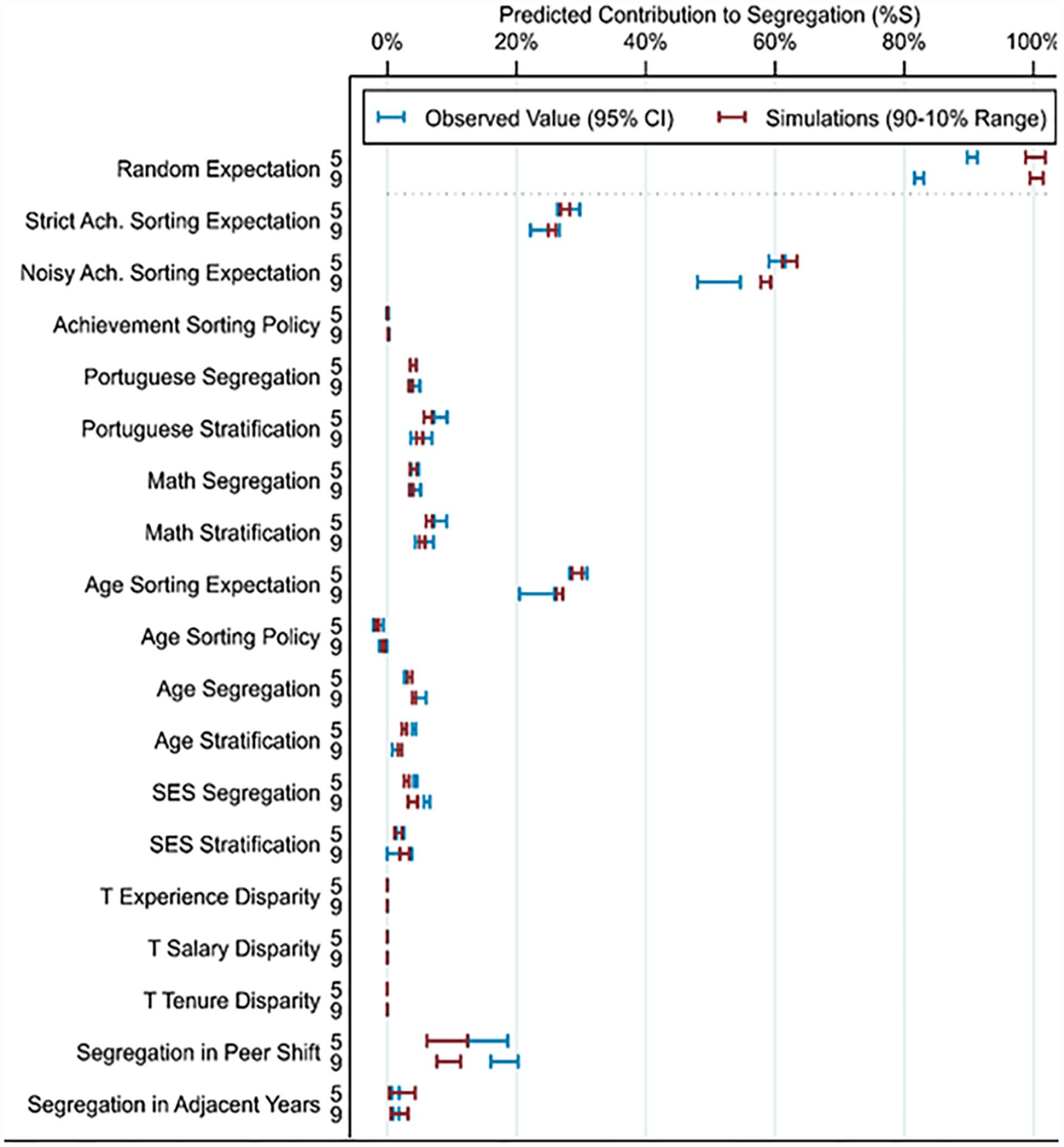
Predicted Contribution to Segregation (
The first two rows of Figures 5 and 6 test Hypothesis 3, that the random expectation is nearly as strong a predictor as it would be in a random assignment world. Turning first to Figure 5, the random expectation explains 15.9% of the total variation in racial segregation in the 5th grade sample and 23.6% in the 9th grade sample. This is both substantively high and high relative to the other predictors, but lower than what would occur in a random assignment world (
Though the random expectation
Hypothesis 4: Other Predictors’ Explanatory Power Fit a Random Assignment World
Figures 5 and 6 test Hypothesis 4 by considering the explanatory power of the predictors that proxy for segregation mechanisms other than segregation by chance. If one of these predictors proxies for an influential segregation mechanism, its
Figures 5 and 6 show that most of the variables are weak predictors and few are meaningfully stronger predictors than they would be under nationwide random assignment. This is the case for the 7 proxies I consider for pseudo-tracking by achievement (the achievement sorting expectation, the indicator for principal-reported achievement sorting, and segregation and stratification by Portuguese and math test scores), the 4 proxies for pseudo-tracking by age (the age sorting expectation, the indicator for principal-reported age sorting, and segregation and stratification by age), both proxies for parent lobbying (segregation and stratification by SES), and the 3 proxies for teacher steering (white-nonwhite disparities in teacher experience, salary, and tenure status). Across both grades, each of these predictors explains either less than 2% of the observed variance or less variance than they would in a random assignment world. None have a %S value more than 3 percentage points greater than it would be in a random assignment world. Among the 5 predictors proxying for the possibility that segregation is driven by local anomalies, I find that segregation is similarly diffused across regions and states as it would be in a random assignment world and that the segregation of a school in one year is no more predictive of segregation in the same school in another year than it would be in a random assignment world.
On the other hand, municipality random intercepts and segregation in peer shift are inconsistent with a random assignment world, standing out more than any other predictor besides the random expectation. For example, the %Vfor municipality intercepts in 5th grade is nearly double, or 5.1 percentage points greater than, what it would be in a random assignment world. While classroom segregation is not heavily concentrated among particular municipalities (at least 88.1 percent of the variance is within municipalities), municipality-average segregation levels vary substantially more than they would in a random assignment world. One challenge to interpreting the findings for municipality random intercepts, segregation in peer shift, and the random expectation is that these three predictors are likely to be highly correlated with one another. To disentangle their relationships to classroom segregation, Table 2 presents two-level and three-level regression models, restricted to the subsample of schools with multiple shifts, with different possible combinations of the three variables (see Appendix F for the written model). In both grades, the random expectation is a robust predictor with a near 1:1 relationship to segregation (columns 1, 4, and 6) and adding municipality random intercepts to models including segregation in peer shift substantially increases the explained variance (column 2 vs. column 5). On the other hand, segregation in peer shift is not a robust predictor, becoming null or changing sign when adding municipality-year random intercepts (column 2 vs. columns 5 and 6).
Hierarchical Multiple Regression Models of Classroom Racial Segregation (H), by Grade

Note: Each column presents the results of a 3-level HLM model with municipality-years at level 2 and years at level 3 such that each coefficient is the tendency in the average municipality in the average year over 2011, 2013, 2015, and 2017. Each sample is restricted to observations for which segregation in peer shift is observed and municipalities with at least 10 such observations. Variance explained is the percentage reduction in level-1 variance as compared to an empty 2-level model of observations within years. Coefficient variation is in standard deviation units with p-values in parentheses. Segregation is estimated using multigroup H index.
Discussion
Though the literature on racial classroom segregation has focused primarily on tracking in US high schools, Brazil’s non-tracking 5th- and 9th-grade classrooms are roughly as racially segregated as North Carolina’s 10th grade classrooms. Classroom-level segregation is a primary source of overall racial segregation in Brazil’s school system, accounting for more segregation than regional-level and school-level segregation. How does this happen? To answer this question, it was necessary to depart from the random expectation benchmark tradition to conceptualize segregation by chance. The segregation measurement literature’s response to the possibility of segregation by chance has been to benchmark segregation estimates to the expected value under random assignment, in accordance with a colorblind ideal. I instead consider segregation by chance as a practice in which actions and inactions produce segregation by making the assignment process effectively random. Understanding that it is neither neutral nor inevitable, I proceed to scrutinize it as one of several potential segregation mechanisms.
The analyses presented here are consistent with segregation by chance being the primary source of racial classroom segregation in Brazil. In simulations, random assignment and pseudo-tracking practices produce similar amounts of classroom segregation. To understand whether segregation by chance is occurring, I compare Brazil to a simulated random assignment world in graphical and regression analyses using the random expectation as a proxy for segregation by chance as well as several proxies for non-chance segregation measures derived from simulations and observed characteristics. The findings point both toward segregation by chance and away from other mechanisms discussed in the literature. The random expectation is highly predictive of observed racial segregation; their bivariate association is strong enough that the random expectation would account for over 80% of 5th grade segregation and over 90% of 9th grade segregation were the estimated relationship causally identified. Meanwhile, proxies for pseudo-tracking, parent lobbying, and teacher steering practices are little more predictive than they would be in a random assignment world. Note also that the low explanatory power of the pseudo-tracking proxies, particularly segregation by test scores, is also inconsistent with the possibility that surreptitious or otherwise unseen tracking is the source of racial segregation.
Segregation also does not appear to be driven by administrative tendencies; schools’ racial segregation levels vary as much over time as they would in a random assignment world while the segregation levels of peer shifts are unrelated net of municipal tendencies. The variation over time is particularly difficult to explain outside of segregation by chance because it is inconsistent with any segregation sources associated with school features that are stable over short periods (e.g., staff and student composition, organizational culture, community practices). Classroom segregation is also geographically diffuse; state differences explain similar amounts of variation as they would in a random assignment world. Even municipality differences – which explain more variation than they would in a random assignment world – explain less than 12 percent of the overall variation, indicating diffuseness at the municipality level as well. While the national propensity for classroom segregation is consistent over space and time, underlying this stability is a remarkably noisy and local process, much as it would be in a random assignment world.
Nonetheless, segregation by chance is not the sole source of classroom segregation. The random expectation explains less variation and has a somewhat smaller implied contribution to segregation than it would in a random assignment world. Though this could be partly due to the differences between effectively random and truly random assignment, graphical analyses show that there is consistently more segregation in 5th grade than there would be in a random assignment world. Municipality random intercepts also explain more variation than they would in a random assignment world. Additionally, in some regression estimates the coefficient on the random expectation is significantly greater than one, indicating that some of the non-chance segregation is correlated with the random expectation (e.g., a feedback effect). Finally, the patterns of classroom segregation in 9th grade are more consistent with a random assignment world than those in 5th grade, across all analyses.
Conclusion
This case study demonstrates that racial classroom segregation is not specific to tracking contexts. Despite the abundance of non-tracking contexts, the classroom segregation literature has rarely looked at them. The findings presented here illustrate the need to cast a wider net: racial classroom segregation in Brazil is on par with that in the US high schools that have captured researchers’ attention, and it appears to be primarily due to segregation by chance, a mechanism that has received little attention.
Though classroom segregation has garnered little interest in Brazil, the findings amplify the importance of classroom assignments as a target for intervening in racial segregation in education. I find that classroom segregation is the largest source of racial segregation in the public school system, more than school, municipal, and regional segregation. Additionally, Alves and Soares (2007, 2008) have demonstrated that learning gains vary greatly between same-school classrooms in Brazil, highlighting the importance of classroom assignment. Botelho et al. (2015) identified widespread racial discrimination in grading in Brazil; if racially segregated classrooms may amplify racial inequity. Moreover, racial classroom segregation reduces interracial contact (Moody, 2001). Mickelson and Nkomo’s (2012) US-focused review of the effects of heterogeneous schools and classrooms identify numerous benefits that may come from reducing classroom segregation by chance in Brazil: The empirical social science evidence from the United States shows that integrated education is positively related to K–12 school performance, cross-racial friendships, acceptance of cultural differences, and declines in racial fears and prejudice. These outcomes among K–12 students undergird long-term outcomes: higher educational and occupational attainment across all ethnic groups, better intergroup relations, greater likelihood of living and working in an integrated environment, lower likelihood of involvement with the criminal justice system, espousal of democratic values, and greater proclivity for aspects of civic engagement. Together the short- and long-term outcomes foster the structural and attitudinal antecedents for the development of a socially cohesive, just, multiethnic, democratic society. (p. 208)
To the extent that racial democracy beliefs are aspirational rather than racism-denying, as Bailey (2009) contends, they demand educational integration. Integration requires much more than classroom desegregation, including fostering equal-status intergroup contact within classrooms, desegregating at higher scales (e.g., among local schools), and bridging Brazil’s sharply unequal public/private divide. However, the findings presented here demonstrate that desegregating classrooms would be a valuable step forward.
One challenge to questioning the legitimacy of segregation by chance is that segregation by chance lends itself to interpretations that deny the agency and responsibility of schools: if it happened by chance, how could it be helped? In the case of classroom segregation, the answer is: quite easily. Segregation by chance can only be a substantial driver of racial classroom segregation if schools choose to accept the racial segregation that results from effectively random initial assignments. Even a school using random assignment can keep segregation low by monitoring proposed classroom assignments for racial imbalance and, when there is concerning imbalance, reassigning some students to decrease segregation before the schoolyear begins.
The more interesting question might be: if it is only by chance, why don’t schools just fix it? It is implausible that it is due to racial ambiguity rendering segregation invisible in Brazil, as Brazilians reliably racially categorize one another (Bailey, 2009). Instead, I offer an explanation rooted in racial ideology, arguing that racial classroom segregation without a clear source may be more tolerated, and race-based integration less tolerated, in Brazil than in the US. Brazil’s relationship to racial segregation is shaped by the absence of de jure segregation in the 20th century. This is a long-standing, government-promoted cause célèbre used to promote the narrative that Brazil is a “racial paradise.” This ideology – racial democracy – imagines Brazilians as a single mixed race and Brazilian society as free from racial difference. As a national myth, racial democracy lends legitimacy to de facto racial segregation, framing it as not racial per se. Another consequence of racial democracy is antiracialism, a system of manners that hampers race-based integration efforts by discouraging explicit racial ascription. Though intervening in classroom segregation by chance imposes only minor practical burdens, these ideological factors may engender political challenges and threaten to make it persist.
Racial segregation by chance may be a feature of other Brazilian institutions as well; prior work has shown the potential for substantial occupational segregation by chance in other contexts (Bygren, 2013; Carrington & Troske, 1997). Additionally, racial segregation by chance may also be relevant to other societies, such as France (Beaman & Petts, 2020), where there also exists widespread denial of the social reality of race and taboos around discussing race. Though there are colorblind and post-racial tendencies in US discourse, the prominent role of schools in US conceptions of illegitimate racial segregation may render segregation suspect even without a clear source, promoting race-conscious reassignments. Economic segregation by chance may be more likely in the US given norms minimizing economic differences, poor data and visibility of economic characteristics, and broad acceptance of economic segregation. Much as a colorblind racial ideology facilitates racial segregation by chance in Brazilian schools, a class-blind ideology and data infrastructure may facilitate economic segregation by chance in US schools.
Critical Race Theory challenges the colorblind ideal by arguing that colorblindness upholds racial inequality. In this vein, several education scholars have demonstrated that preventing racial segregation can require the active pursuit of racial integration (Ayscue et al., 2018; Mickelson et al., 2021; Roda & Wells, 2013). The findings of this paper echo this insight: assigning students to classrooms without regard to race and therefore without concern for racial integration has been a substantial source of racial segregation throughout Brazil’s public schools. Integration should be sought proactively.
Supplemental Material
sj-docx-1-ero-10.1177_23328584231176456 – Supplemental material for Classroom Segregation without Tracking: Chance, Legitimacy, and Myth in “Racial Paradise”
Supplemental material, sj-docx-1-ero-10.1177_23328584231176456 for Classroom Segregation without Tracking: Chance, Legitimacy, and Myth in “Racial Paradise” by Josh Leung-Gagné in AERA Open
Footnotes
Acknowledgements
I owe a special thanks to Sebastian Muñoz-Najar Galvez. I am also grateful for particularly helpful feedback from my AERA Open reviewers, the Secretaria de Educação de Minas Gerais, and from workshops supported by Stanford’s Lemann Center for Educational Entrepreneurship and Innovation in Brazil, Center on Poverty and Inequality, Sociology and Education Network, and Center for Education Policy Analysis.
Funding
The research reported here was supported by the Institute of Education Sciences, U.S. Department of Education, through Grant R305B140009 to the Board of Trustees of the Leland Stanford Junior University. The opinions expressed are those of the authors and do not represent views of the Institute or the U.S. Department of Education or the Board of Trustees of the Leland Stanford Junior University.

Supplemental Material
Supplemental material for this article is available online.
Author
JOSH LEUNG-GAGNÉ is a research scholar at the Stanford University Center on Poverty and Inequality and can be contacted at
References
Supplementary Material
Please find the following supplemental material available below.
For Open Access articles published under a Creative Commons License, all supplemental material carries the same license as the article it is associated with.
For non-Open Access articles published, all supplemental material carries a non-exclusive license, and permission requests for re-use of supplemental material or any part of supplemental material shall be sent directly to the copyright owner as specified in the copyright notice associated with the article.
