




Abstract
The introduction to this Special Topic Collection has two parts. To provide background and context for the articles in the collection, Part 1 tells the story of the Early Childhood Longitudinal Study program at the National Center for Education Statistics. It offers an abridged history of this program and describes the designs of the two national kindergarten cohort studies (ECLS-K and ECLS-K:2011) whose data were analyzed by the authors of each of the articles. Part 2 provides a brief overview of the five articles. It includes a summary of key findings from the articles and important patterns in the data. It highlights areas that have improved over the past decade and areas with little improvement. Limitations of the findings that are directly connected to the ECLS-K and ECLS-K:2011 designs are identified as well as other design limitations that have implications for future data users.
Keywords
The five articles in this Special Topic Collection individually and collectively are a testament to the contribution the two national cohort studies have made and continue to make to our knowledge of the early school years. The articles use data from both the ECLS-K and ECLS-K:2011 to revisit important questions around children’s school readiness and achievement gaps, the early life experiences of kindergartners, the nature of kindergarten programs in the United States, and the practices that schools use to support children’s transition to kindergarten. All five articles focus on whether there have been changes or improvements over the past decade or so since the ECLS-K was conducted.
The introduction to this Special Topic Collection has two main parts. To provide background and context for the collection, Part 1 tells the story of the Early Childhood Longitudinal Study program at the National Center for Education Statistics (NCES). It offers an abridged history of this program and describes the state of national data on young children and the early education policy environment that led to the creation of the ECLS-K. It describes the multiyear planning process that preceded the study’s launch in fall 1998. It identifies key challenges faced by the designers of the first-ever national study of kindergarten children. It discusses how these challenges were ultimately addressed in the final study design and the implications of the design decisions for research using the ECLS-K data, including the research reported on in this Special Topic Collection. Given the topics of the articles in this collection, the focus is on the design of the kindergarten and first-grade waves of the study. Because the design of the ECLS-K:2011 mostly replicated the design of the ECLS-K, the amount of design work required prior to conducting the fall 2010 baseline data collection was significantly reduced. Nevertheless, changes that were made in response to new policies and questions surrounding children’s early school years, and changes made to improve on the ECLS-K design, are described here.
Part 2 provides a brief overview of the five articles. It includes a summary of key finding from the articles and important patterns in the data. Limitations of findings that are directly connected to the ECLS-K and ECLS-K:2011 designs are identified.
National Data Gaps and Education Policy
Prior to 1990, there were few sources for national-level data on children’s learning experiences during the years leading up to school entry and over the first years of their formal schooling. 2 What data were available came from federal household surveys, school administrative records, and school surveys. The October Supplement to the Current Population Survey (CPS) was a source for recurring data on school enrollments, including enrollments in nursery school and Grades K–5 (U.S. Census Bureau, 1988). 3 Supplements to the CPS and later to the Survey of Income and Program Participation were used to describe children’s participation in child care while their mothers worked or went to school (Casper, Hawkins, & O’Connell, 1994; O’Connell & Bachu, 1987; U.S. Census Bureau, 1982). NCES Common Core of Data compiled state data on public school enrollments for grades K through 5 (U.S. Department of Education, 1990). The Schools and Staffing Survey that was first launched in 1987 collected detailed information about public and private elementary schools and their staff (U.S. Department of Education, 1991). The National Transition Study that was conducted in 1988 provided a profile of public kindergarten programs and the transition activities they offered to children and families as children moved from preschool, day care, or home into kindergarten (Love, Logue, Trudeau, & Thayer, 1992).
The picture of children and their early care and educational experiences that could be drawn using these data sources was incomplete. Data on nursery school enrollments underestimated the number and percentage of preschool-age children who attended formal programs outside of their home. Childcare participation rates that focused only on children whose mothers were working or going to school ignored those children who attended early childhood programs for enrichment purposes. Household surveys offered little information about the programs and schools that children attend and about those who are responsible for their care and education. School surveys and administrative records data filled this gap in part, but they did not include early childhood programs that were not attached to regular schools, were often limited to public schools, and collected limited information on the characteristics of the children and families they served. Thus, it was not possible to use these data to examine the impact of school and program characteristics and practices on child outcomes.
Data on children’s early learning experiences were fragmented and incomplete, but national data on children’s development prior to school, the knowledge and skills they have when they start school, and changes in these over the first years of school were almost nonexistent. The National Assessment of Educational Progress (NAEP) regularly assessed children’s reading and mathematics achievement, but the earliest assessments were not administered until children were 9-year-olds or fourth graders. 4 In addition, NAEP’s research design provided only a snapshot of children’s reading and math achievement at a single point in time. As a result, it was not possible to study children’s growth in these areas and to link differences in their rates of growth to home, classroom, and school factors.
Beginning in 1986, the National Longitudinal Study of Youth 1979 (NLSY79) assessed the language, reading, and math skills; social-emotional development; behavior problems; and health status of children who were born to the study women (Chase-Lansdale, Mott, Brooks-Gunn, & Phillips, 1991). Follow-up assessments administered every 2 years could be used to study children’s growth in these domains of development. However, the child sample of the NLSY79 does not constitute a nationally representative sample of children, and the sample size for any single age (for example, 3-year-olds or 5-year-olds) is small. In addition, given the ages of the women in the study, the majority of children assessed in 1986 were born to teenage or young mothers.
The shortcomings of existing national data and the need for high-quality data to inform early education policy received greater attention in the mid- to late-1980s. A number of factors contributed to this, including a growing awareness of the importance of children’s early years, reinforced by Goal 1 of the National Education Goals; the changing nature of both children’s preschool and early school experience; and calls for schools to be more responsive to the backgrounds and experiences of the children they serve.
The critical importance of the years leading up to school for children’s ultimate success in school was signaled strongly by the President and the 50 governors when they made the first of the eight National Education Goals the “Ready to Learn” goal (National Education Goals Panel, 1999; Vinovskis, 1999). 5 This focused attention on the education programs and early childhood experiences of children and on the ways in which children’s health, family, and early care and education experiences interact to affect their chances of succeeding in school. Later the National Education Goals Panel, Goal 1 Technical Planning Subgroup, would call for a national assessment of children’s school readiness skills that included measures in multiple developmental domains (Kagan, Moore, & Bredekamp, 1995).
Between 1970 and 1985, children’s participation in preschool programs prior to kindergarten more than doubled. 6 And enrollment in kindergarten expanded greatly over a similar 20-year period, with increasing numbers of children attending full-day programs (Jamieson, Curry, & Martinez, 2001). Both of these trends contributed to increased expectations for academic achievement in kindergarten and first grade. In other words, children were expected to do more at an earlier age. Two-year kindergarten programs and kindergarten retentions are some of the ways that schools used to adapt to these escalated expectations (Shepard & Smith, 1988). However, the data required to explore these issues were lacking. There were limited national data on the characteristics of kindergarten programs and their curricula, and no national data on teacher expectations and beliefs.
During this time period, there were also significant changes in the composition of the student population. For example, the number of students from racial-ethnic minorities and the number of children from homes where English was not the primary language were on the rise (U.S. Department of Education, 1993, 2007). Although data from national longitudinal studies, such as High School and Beyond (HS&B) and the National Education Longitudinal Study of 1988 (NELS:88), could be used to examine the school experiences and outcomes for these groups of children, the studies were limited to secondary schools and secondary school students.
Studies Designed to Fill Existing Data Gaps
During the 1990s, a number of new studies were developed and conducted with the goal of filling some of the gaps in existing data. 7 Many of the studies that are well known today were started during this time. Their data are used by researchers from different disciplines, and they have served as data sources for indicators in federal reports (e.g., National Education Goals Panel Annual Report, America’s Children, Condition of Education, Digest of Education Statistics). The NCES National Household Education Survey (NHES) program first conducted surveys with national samples of parents of young children in winter and spring 1991, providing detailed information about children’s participation in early care and education programs and related topics (U.S. Department of Education, 1997). 8 The first Head Start Family and Child Experiences Survey (FACES), sponsored by the Administration for Children and Families, was conducted in 1997, collecting descriptive data from a nationally representative sample of children attending Head Start, their families, teachers, and programs that were used to measure program performance (U.S. Administration for Children and Families, 2005). 9 The Panel Study of Income Dynamics added a supplement to its core data collection that included direct assessments of the children of study participants (Hofferth, Davis-Kean, Davis, & Finkelstein, 1997). 10
The ECLS program included perhaps the most ambitious set of new early childhood studies developed during this time period. In the mid-1980s, NCES conducted a systematic internal review of all of its existing data systems to ascertain whether it was providing the types of data that were needed by both the policy and research communities. The absence of data on children during the years leading up to school and during the first years of schooling was identified as an important gap that was limiting NCES’ ability to respond to important contemporary issues in education, including data on the knowledge and skills of beginning schoolchildren. 11 The ECLS was one of the outcomes of this review.
The program was originally envisioned as three interconnected longitudinal cohort studies (birth cohort, kindergarten cohort, and fourth-grade cohort), with adjacent cohorts sharing 2 overlapping years of data collection in order to create synthetic cohorts that could be used to produce estimates for longer periods of time. For example, both the birth cohort and the kindergarten cohort would collect data on children during kindergarten and first grade, and the data from the two studies would be combined to create a synthetic cohort of children during the years leading up to school (birth to kindergarten) and through the early school years (first through fifth grades). NCES and Department of Education priorities and budget considerations ultimately reduced the program to two studies: ECLS-K and ECLS, Birth Cohort (ECLS-B). ECLS-K was launched first (fall 1998), and the ECLS-B followed several years later in 2001.
Designing a National Longitudinal Study of Kindergarten Children
Before a final decision was made to launch a national longitudinal study of kindergarten children, NCES conducted a series of internal planning activities. There were three goals. First, NCES wanted to ensure that there was a real need for a new longitudinal study of the education of young children that it assumed would be difficult to design and conduct and that would require significant agency resources (staff and financial) over a number of years. Second, NCES wanted an initial assessment of the feasibility of such a study. Third, NCES would use these activities to identify the basic parameters that would guide all future design work. The planning activities included commissioned papers from experts in child development, preschool education, elementary education, sampling, survey methods, measurement, and statistics. In-person meetings were held where paper authors presented their ideas, suggestions, and recommendations with discussion of key topics and issues. The activities took place over a 3-year period and culminated with the statement of work for a procurement to design the ECLS-K and to conduct a large-scale feasibility study.
This level of planning was not typical of NCES studies. However, the ECLS-K was not like any other study that NCES had designed and conducted before. NCES had no experience selecting national samples of kindergarten programs, some of which were offered outside of regular public and private schools. Working with and assessing the skills of 5- and 6-year-olds was something totally new to the agency. There were also many unknowns regarding children’s movements as they completed kindergarten and entered first grade and the levels of sample attrition that might be expected. As a result of these and other factors, there was a lot of skepticism about whether a study of kindergarten children was even feasible. Also, there was not uniform agreement that kindergarten was the first year of children’s formal schooling, since many children never attended kindergarten before entering first grade.
The input that these experts provided through their individual papers, presentations, and group discussions was used by NCES staff to (a) define the purposes of the ECLS-K, (b) identify the key issues and questions that the study should address, and (c) articulate the general parameters of the ECLS-K design (sample design, constructs and available measures, and data collection approaches). The primary purpose of the ECLS-K, like that of other longitudinal studies sponsored by NCES, would be to provide rich descriptive information about children’s skills at specific points in their education careers, the growth in these skills over time, and the experiences that contribute to or hinder children’s growth. Data from the ECLS-K would be used to explore the associations between a wide range of child, family, classroom, and school variables on children’s skills and other child outcomes (for example, grade retention, childhood obesity). The study would be used to answer a variety of questions in four key areas: (a) school readiness, (b) children’s transition to kindergarten and to first grade, (c) the relationship between children’s kindergarten experience and their academic performance in Grades 1 through 5, and (d) children’s growth and progress through elementary school. 12
Preliminary Design Parameters
A product of the planning activities described above was a set of preliminary study design parameters that would serve as a guide for the work that was done over the next 5 years to refine the study design, conduct a study of the feasibility of the design, and finalize the design before the first wave of national data was collected in the fall of 1998. Several features of the design that NCES viewed as critical to the success of the study and that required a significant amount of work are described below.
Target Population
The target population of the ECLS-K was to be all children enrolled in public and private kindergartens in the United States. This included children attending kindergarten in traditional public and private schools as well as those attending kindergartens that were offered by preschool and early childhood programs. Because a complete frame of kindergartens did not exist, frame development work was required to increase the coverage of kindergarten programs and kindergartners. 13
Maximum Inclusion
A minimum number of children should be excluded from the study. Thus, all children enrolled in a kindergarten class in the sampled schools were to be eligible for sampling. In contrast to other studies that were conducted at that time, a child’s eligibility was not to be based on whether or not he or she could participate in the child assessments (U.S. Department of Education, 1996a, 1996c). The lone exception to this rule was if a child’s individualized education program stated that the child could not participate in research studies. Furthermore, once a child was selected as a study participant, the goal was to include him or her in the study to the maximum extent possible. For example, if a child could not be assessed because of a disability or a language issue, his or her parents and teachers were still asked to participate. Expert panels were convened to consider how best to include children with disabilities and English language learners (ELLs) in the study and how to increase the amount and quality of data that were collected about each group.
National Assessment of Children’s Skills
For the ECLS-K, NCES adopted a conceptual model of school readiness that was consistent with the one set forth by the National Education Goals Panel, Goal 1 Technical Planning Group (Kagan et al., 1995). ECLS-K would assess kindergarten and first-grade children in a number of critical domains, such as physical development, social and emotional development, language, approaches to learning, cognition, and general knowledge (U.S. Department of Education, 2002a). It would rely on several sources for obtaining this information, including direct assessments of children and teacher and parent reports. 14 Like the assessments used in other NCES longitudinal studies, the ECLS-K assessments were to provide accurate estimates of children’s skills at specific points in time (for example, fall and spring kindergarten and spring first grade) as well as growth in these skills over time. They must also measure these skills across a broad range of abilities and levels and minimize the possibility of floor and ceiling effects. Given the broad scope of the assessment and the limited time that the study could expect to spend with each study child, the assessment must be as efficient as possible.
Data Collection Schedule
The original ECLS-K design was to include two waves of kindergarten data collection (fall and spring) with annual follow-ups in the spring of the school year for first through fifth grades. Data collected on this schedule would provide baseline information on children’s skills as they enter school for the first time and prior to the influence of school (fall kindergarten) as well as their progress over the kindergarten year (fall–spring change). Data collected in the spring of subsequent years would provide new information on important academic and developmental outcomes as children completed each grade and their annual progress in academic subjects (for example, reading and mathematics) and changes in other developmental outcomes such as social skills and problem behaviors. 15
Finalizing the ECLS-K Design
Guided by the preliminary design parameters, NCES worked with an interdisciplinary team to finalize the ECLS-K design. The core design team included developmental psychologists, sociologists, sampling statisticians, and survey methodologists. 16 Working together, they developed the ECLS-K assessment battery and the survey instruments that would be used to collect data from children’s parents, classroom teachers (and special education teachers for those children with a disability), and school administrators. The team developed strategies for assessing children with disabilities and those who were English language learners (ELLs) and devised the procedures that would be used to contact and obtain data from parents, teachers, and administrators. Members of the team created a sampling design that would achieve the goals of the study. A large field test was conducted to judge the feasibility of selecting a sample of kindergartens and kindergarten children, assessing these children’s skills across a broad set of developmental domains, and collecting information about the different learning environments experienced by these children through a battery of survey instruments. 17 During this time, the team also explored the feasibility of oversampling American Indian children in order to support separate analyses of this group of children and explored a design enhancement that would include a sample of children who had attended Head Start the year prior to kindergarten. Neither of these was included in the final study design for different reasons. Oversampling American Indian children would have required major changes to the study’s sample design (for example, the number of schools would need to be increased by roughly 20%), and it would have significantly increased the cost of the study. The Administration for Children and Families decided to focus on children who were entering Head Start for the first time, the population of children represented by FACES, and not those who would be off to kindergarten the following year, who would have been included in a supplemental ECLS-K sample.
Assessing Children’s School Readiness Skills and the Growth in These and Related Skills
The most challenging task for the design team was developing an assessment battery that would provide an accurate picture of children’s knowledge and skills in multiple domains when they first entered school and at specific time points and that could be used to measure how these changed as children completed kindergarten and moved on to the early elementary school grades (first through fifth grades). The team considered a number of measures and approaches before reaching agreement on the design of the ECLS-K assessment. It considered and dismissed using existing standardized reading and math assessments because they did not meet one or both assessment criteria. First, the assessment should measure those skills that are taught in school and the precursors of those skills. Second, the assessment should have a sufficient number of items at the low and high ends of the ability distribution in order to accurately measure the skills of children who are performing lower or higher than expected for children their age or grade. Instead of using existing standardized measures, the ECLS-K developed its own assessment drawing on items from existing measures whenever possible. The effects of this decision on estimates of children’s school readiness skills and achievement score gaps can be found in the work of Murnane et al. (2006) and Rock and Stenner (2005). Both found that the size of the White–Black achievement gaps was smaller in studies using the ECLS-K assessment than in studies that used more general measures of achievement, such as the Woodcock-Johnson or Peabody Picture Vocabulary Test. Furthermore, studies using the ECLS-K assessment show that these gaps grow larger over the early school years than do studies using broader measures of achievement.
The team decided to use a two-stage adaptive assessment for reading, math, and general knowledge (kindergarten and first grade only). This increased the accuracy of the assessment for all children and its sensitivity to changes in the skills children acquired between assessments. It also lessened the chances of floor and ceiling effects and improved the efficiency of the assessment (U.S. Department of Education, 2002a). The efficiency of the assessment was further improved by the use of laptop computers. Assessment items and any rules for routing children to the appropriate parts of the assessment were programmed on the laptops. Assessors read the items and recorded children’s responses using their laptops and used paper easels to display stimuli for the child (for example, pictures for receptive vocabulary items).
The Academic Rating Scale (ARS), a teacher report measure, was developed to enhance the value of the assessment battery using best practices for ensuring the accuracy of teacher ratings of students’ academic performance (Perry & Meisels, 1996; U.S. Department of Education, 2002a). This measure captured information about the process of children’s learning, such as the strategies that they use when reading or solving math problems, which could not be measured well by the direct child assessment. It also served as a source for information about children who could not participate in the direct child assessment due to a disability or language issue.
The team recognized that it was not possible to measure children’s social skills and behaviors using direct measures of these domains. Such measures were too costly to administer, required too much time, and were subject to interrater reliability issues, so the study followed the practice of using teacher and parent reports of these (Meisels, Atkins-Burnett, & Nicholson, 1996; U.S. Department of Education, 2002a). 18 Here, the decision was to use or adapt existing measures as much as possible with new items drafted to fill gaps in the coverage of the ECLS-K domains.
Assessing Children Who Were ELLs and Children With Disabilities
In the early- to mid-90s when the ECLS-K was being designed, sizable numbers of ELL children and children with disabilities were excluded from assessments that were administered to them as part of a national study. Furthermore, the decision to assess a child or not was often made by school officials, teachers, or field staff based on their beliefs about whether the child had the necessary skills to participate in the assessment (U.S. Department of Education, 1996a, 1996c). The ECLS-K design team, working with individuals who were experts in the assessment of ELLs and children with disabilities, developed an assessment battery and protocol that would maximize the number of such children who would participate in the assessment. In addition, whether a child could participate in the assessment or not was based on the child’s performance, not on the judgments of others.
All children were eligible for the ECLS-K direct child assessment, but for ELL children and for children with a disability, the extent of their participation was contingent on their English language proficiency and type of disability, respectively (U.S. Department of Education, 2001, 2002a). 19 ELL children’s pathway through the assessment was determined based on their performance on an English language screener. With a few exceptions (children who were blind and those who were deaf), most children with a disability participated in the direct child assessment using one or more of the accommodations that field staff were allowed to use (U.S. Department of Education, 2001, 2002b). Administering a language screener and using a broad range of accommodations were intended to help ensure that each child would be assessed fairly and accurately.
An Evolving Design
Up to the time that the ECLS-K was launched in fall 1998, it included an annual data collection in the spring of each school year from kindergarten through fifth grade, with a fall kindergarten collection to establish a baseline for children as they first entered school. This design allowed for estimates of the annual change in students’ skills and behaviors with adequate data points to support growth curve analyses. The fourth-grade data point also offered the opportunity to link the ECLS-K reading and math assessments with the fourth-grade assessments administered in the NAEP. A weakness of this design was the lack of fall data beyond kindergarten. Thus, the design limited researchers’ ability to estimate within-school-year learning and to examine factors that may account for differences in what and how much learning occurs for different groups of children during the school year. It also restricted investigations of summer learning and efforts to estimate school effects by contrasting the learning that occurs when school is and is not in session.
A fall first-grade data collection, which was added with support from the National Institute for Child Health and Human Development, partially addressed these limitations by administering the ECLS-K assessments to a subsample of students and by asking their parents a series of questions about how their children spent the summer months. This addition allowed researchers to examine school-year versus summer learning for kindergarten and first grade and to estimate school effects on student achievement and achievement gaps (Downey, von Hippel, & Broh, 2004). However, the value that a fall first-grade data point added was offset when NCES dropped the second- and fourth-grade data collections in response to budget pressures. The absence of a second-grade data collection made it nearly impossible to measure the rapid developmental changes that children experience between ages 5 and 7 years, commonly known as the 5-to-7-year shift (Sameroff & Haith, 1996). This age period includes many children who will be transitioning from first to second grade. The new design also made it difficult to estimate the annual gains children make in reading and math and to pinpoint when racial-ethnic and socioeconomic gaps in achievement accelerate or stabilize. 20
Final Kindergarten and First-Grade Design
The design that emerged from the multiyear design process and extensive field testing is well documented (U.S. Department of Education, 2001, 2002b). Key features of the final design are summarized in Table 1.
Features of the ECLS-K and ECLS-K:2011 Study Designs
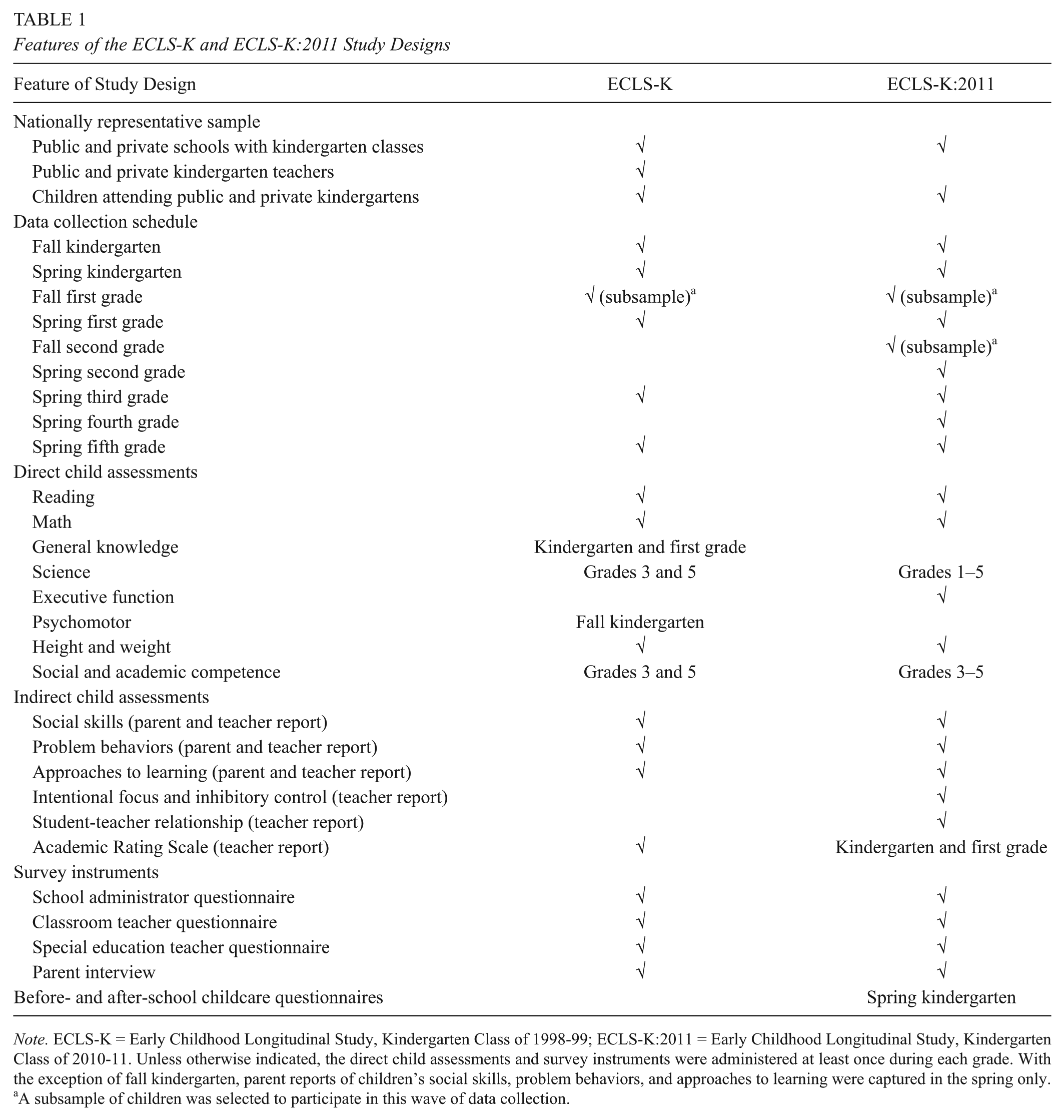
Note. ECLS-K = Early Childhood Longitudinal Study, Kindergarten Class of 1998-99; ECLS-K:2011 = Early Childhood Longitudinal Study, Kindergarten Class of 2010-11. Unless otherwise indicated, the direct child assessments and survey instruments were administered at least once during each grade. With the exception of fall kindergarten, parent reports of children’s social skills, problem behaviors, and approaches to learning were captured in the spring only.
A subsample of children was selected to participate in this wave of data collection.
The final design shares a number of features with earlier NCES longitudinal studies (for example, nationally representative sample of schools and children, assessment of children’s academic skills and achievement). However, it differs in some important ways from these earlier studies, due largely to its focus on younger children. There are more frequent waves of data collection, at least during the first 2 years of the study, and data are collected in the fall and spring during these years. Thus, it is possible to estimate directly both school-year and annual learning rates for two grades. This is not possible with other NCES longitudinal studies, which are limited to biennial data collection. ECLS-K administers a much broader assessment battery that includes the traditional measures of children’s reading and math achievement along with measures of their physical development (height and weight), social skills, and problem behaviors. The reading and mathematics assessments were administered individually rather than to small groups of students, and the reading, math, and general knowledge items that a child was asked to answer were determined in real time based on their answers to a common set of routing items, not on their performance during an earlier round of data collection. 21
Parents and teachers played a larger role, and thus the burden on both groups was significantly greater than in prior NCES longitudinal studies. A parent interview was conducted at each wave of data collection for all children who were eligible for the round. In contrast, HS&B asked a sample of parents to complete a survey at baseline only, and NELS:88 asked parents of all study eligible students to complete a survey twice (baseline and second follow-up; U.S. Department of Education, 1995, 1996b). Teachers in the ECLS-K answered a two-part survey that includes questions about the classes they taught and their background (Part 1) and individual questions about each study child in their classes (Part 2). Because of the ages of the children participating in the study, parents and teachers served as proxy reporters for the types of questions that might be found in the student questionnaires used in earlier longitudinal studies of secondary school students (for example, questions about children’s participation in activities with family members and in extracurricular activities at school).
In addition to the core data collection activities, several special studies and supplements were included to enhance the information collected by the study and its value to the research and policy communities. These design enhancements were often funded by other federal agencies (for example, measurements of children’s height and weight at each wave of data collection were supported with funds from the U.S. Department of Agriculture, Economic Research Service. A special study to assess the validity of parent reports of children’s participation in Head Start was funded by the U.S Department of Health and Human Services, Administration for Children and Families).
ECLS-K:2011
Following on the success of the ECLS-K and in response to the need for current information about elementary school children’s skills and experiences, a new kindergarten cohort (ECLS-K:2011) was designed with baseline data collected in the fall of the 2010–2011 school year. Data from the new cohort alone and together with data from the ECLS-K provides information on children and their home and school experiences following a decade that saw major changes in education policy (for example, passage of No Child Left Behind and the Race to the Top initiative) and schools (far more charter schools and more school choice). The demographics of the student population continued to shift with increasing numbers of Hispanic and ELL children in the lower grades, and the role of technology continued to grow (for example, more and wider use of the Internet, cell phones, and texting).
The ECLS-K:2011 design shares much in common with the design of the ECLS-K, and because the goal was to largely replicate the design of the earlier study, NCES did not engage in a long design process (U.S. Department of Education, 2015a, 2015b). Nevertheless, there are important differences in the designs of the two studies (Table 1).
The most noticeable and significant difference between the two studies is the inclusion of annual data collections in the ECLS-K:2011 with fall and spring data collected in kindergarten and first and second grades. This change addresses some of the shortcomings of the ECLS-K design. Researchers now have the data they need to estimate annual changes in children’s skills and school-year and out-of-school learning beyond first grade and to identify the patterns in learning and development that take place between the springs of first and third grades.
Several notable changes were made to the child assessment battery that was used in the ECLS-K. The ECLS-K:2011 assesses children’s science knowledge and skills earlier. 22 This change was made in response to the ongoing concern about the performance of American schoolchildren on both national and international assessments of science and the growing importance of science, technology, engineering, and mathematics education in elementary schools. Measures of children’s executive function (working memory and cognitive flexibility) were added to the ECLS-K direct child assessment. Executive function is important for children’s school readiness and is predictive of later school achievement (Blair & Razza, 2007).
A set of items that measured children’s basic reading skills was administered in English to all children regardless of their home language and performance on the language screener. In the ECLS-K, children who spoke a language other than English at home and who did not achieve the cut score on the language screener were routed out of the reading assessment (as well as the general knowledge assessment). As a result, these children are not included in many of the analyses of children’s school readiness and analyses of the racial-ethnic gaps in readiness and reading achievement (Fryer & Levitt, 2004; Reardon & Galindo, 2008; West, Denton, & Hausken, 2000). Administering a set of basic skills items to all children was designed to address this limitation. Scores were produced for this group of children, which means that a much larger percentage of Spanish-speaking children and children who speak other languages will now be included in estimates of children’s early reading skills and studies of how these skills change over the early school years. However, this change in routing rules and procedures makes it more difficult to compare reading scores from the ECLS-K and ECLS-K:2011, an issue that Reardon and Portilla (2016) discuss in their article.
Many kindergarten children are cared for by individuals other than their parents before and/or after school. Information about such care was limited to a small set of parent interview items in the ECLS-K. In order to understand better how children spend these nonschool hours, a before- and after-school component was added to the ECLS-K:2011. Before- and after-school caregivers who were identified in the fall parent survey were asked to complete a two-part self-administered questionnaire (caregiver questionnaire and child-level questionnaire) in spring kindergarten. Providers were asked about the characteristics of the study child’s care arrangement, their backgrounds, and professional development opportunities and activities. 23 The overall response rates for both the provider and child-level questionnaires were low, suggesting the potential for bias in the estimates derived from these data (U.S. Department of Education, 2015a, 2015b). Moreover, the amount of missing data for children who are in a before- and after-school childcare arrangement represents a major challenge for data users.
ECLS-K asked all teachers in the sampled schools to complete a teacher survey. A kindergarten teacher sampling weight was included in the study data file for researchers to use when conducting teacher-level analyses. Using this weight, the kindergarten teacher questionnaire data could be used to produce national estimates for kindergarten teachers (Hausken, Walston, & Rathbun, 2004; U.S. Department of Education, 2001). ECLS-K:2011 did not replicate this approach, and as a result, data are available only for teachers of one or more of the study children, and no teacher weight is provided by NCES. This change makes it more difficult to compare the characteristics of kindergarten teachers and kindergarten classrooms in school year 2010–2011 to those in school year 1998–1999.
The ECLS-K:2011, like its predecessor, includes several special studies that are funded by other federal agencies. For example, the National Institute of Deafness and Other Communication Disorders is sponsoring hearing screenings, and the Administration for Children and Families funded the before- and after-school childcare provider questionnaires.
Research Using ECLS-K and ECLS-K:2011
Researchers from different disciplines have used the ECLS-K to study a wide range of questions related to children’s education, development, and health. Findings from the ECLS-K can be found in reports prepared by NCES and other federal agencies and in policy briefs and reports from foundations and public policy organizations. Articles using the data have been published by the major journals of education, psychology, sociology, and economics as well as by many others. Chapters in books on a variety of topics in education have relied on the ECLS-K data. An online bibliography of reports, books, and journal articles using ECLS-K data can be accessed at the NCES website (http://nces.ed.gov/bibliography). 24
A listing and summary of all the topics that have been the focus of research using the ECLS-K is beyond the scope of this introduction. However, several topics stand out because of their close connection to the main purposes of the ECLS-K. The release of “America’s Kindergartners” in early 2000 (West, Denton, & Hausken, 2000) and “The Kindergarten Year” later that year (West, Denton, & Reaney, 2000) painted a broad picture of the knowledge and skills that the nation’s children possessed when they entered kindergarten and after 1 year of school and of how these varied by gender, race-ethnicity, and other child and family characteristics. Over the coming years, researchers would use the ECLS-K to delve deeper into the factors that contributed to these beginning school skills and to disentangle the effects of race-ethnicity and socioeconomic status on these skills (Fryer & Levitt, 2004; Murnane et al., 2006). The ECLS-K would be used to identify the beginnings of the racial-ethnic and gender achievement gaps that had long been documented in studies of older children (Fryer & Levitt, 2010; Lee & Burkam, 2002; Penner & Paret, 2008; Rock & Stenner, 2005) and to track these gaps over the early school years (Fryer & Levitt, 2006; Murnane et al., 2006; Rathbun & West, 2004; Reardon & Galindo, 2008). Researchers used the data to study the influence of school, classroom and teacher, family, and child factors on the growth in children’s reading and math skills and on their social skills and behaviors (Bodovski & Farkas, 2007; Caemmerer & Keith, 2015; Morgan, Farkas, & Maczuga, 2015; Murnane et al., 2006). One line of research focused on children’s transition to school, the ways that schools and early childhood programs supported this transition, and the effects of different types of transition activities on the ease with which children made the transition and on student achievement (Galindo & Sheldon, 2012; Schulting, Malone, & Dodge, 2005).
The authors of the articles in this Special Topic Collection contributed to the earlier research using the ECLS-K and to the knowledge base on children’s early school experiences and on their growth and development over the early school years. The research that is summarized in the articles uses data from both the ECLS-K and ECLS-K:2011 to expand on this earlier work. Three of the articles describe key features of the environments that nurture children’s development and learning before and during kindergarten and the ways that schools support the transition to kindergarten. The two other articles take another look at the racial-ethnic, income, and gender disparities that have been studied extensively using data from the 1998 cohort. All five articles look at the changes that have occurred over the 12-year period between the two kindergarten cohort studies.
Children’s Early Learning Experiences
The first of the three articles on children’s learning experiences describes the resources that are available to children at home (for example, books and computers) and the investments parents make in their children’s learning through shared reading and other in- and out-of-home enrichment activities and by enrolling their children in a childcare or early education program (Bassok, Finch, Lee, Reardon, & Waldfogel, 2016). It also describes the beliefs that parents hold about the skills that children need to be ready for school. The other two articles shift the focus away from children’s home and family life to the supports they receive from the schools they attend and to the learning environments of their kindergarten classrooms. Little, Cohen-Vogel, and Curran (2016) describe the types of transition practices that are used by public schools to help ease children’s adjustment to kindergarten, which include both low-intensity practices, such as sending information home to parents, and high-intensity practices, such as teacher visits to children’s homes or preschoolers visiting a kindergarten class. Bassok, Latham, and Rorem (2016) describe the beliefs and expectations held by public school kindergarten teachers, the attention teachers give to different subjects (for example, reading, math, science, art, and music) and the time they spend on different skills and topics within these subjects. They also describe how kindergarten teachers organize their classrooms, the pedagogy they use, and how they use standardized assessments.
Together the three articles address the question of whether there have been changes to children’s home, school, and classroom experiences over the past dozen years and if so, how much change has taken place. They also examine whether different groups of children (for example, children from low- versus high-income families) and schools serving different populations (for example, schools serving different percentages of disadvantaged students) have experienced the same types of changes and to the same or a similar degree and whether disparities in the resources and investments that have been shown to contribute to children’s preparation for school and to their growth in academic and behavior skills over time have remained the same, narrowed, or widened.
According to the findings in the articles, children’s homes, schools, and classrooms have changed in many ways that should presumably better prepare them for school, ease their transition to kindergarten, and help them to succeed as they move through kindergarten and the early elementary grades. For example, kindergartners in 2010 had more books in the home, engaged in literacy and enrichment activities with their parents (or other family members) more often, and had greater access to computers than did their peers in 1998 (Bassok, Finch, et al., 2016). 25 Public schools were more likely to use a variety of transition activities but not always (Little et al., 2016). The percentage of schools that sent information about kindergarten home to parents, offered parents and children the opportunity to visit a kindergarten class before the start of the school year, and hosted parent orientations increased from 1998 to 2010. But schools in 2010 were less likely to have preschoolers spend time in a kindergarten classroom or to have shorter school days at the beginning of the school year than schools a decade earlier. Kindergarten classrooms also changed over this time period and took on some of the characteristics that had been previously associated with first grade (Bassok, Latham, et al., 2016). Reading and language arts continued to be taught daily in nearly all kindergarten classrooms, and there was an increase in the percentage of teachers who reported teaching math daily. Music and art were less likely to be taught daily, and other forms of arts (dance and theater) were more likely never to be taught.
There were also changes in how children were evaluated and how information from tests and standardized assessments was used. Kindergarten teachers made some changes in how they evaluated the children in their classes but not others (Bassok, Latham, et al., 2016). In 2010, they were more likely to evaluate a child’s achievement relative to others in the class and to local, state, or professional standards, but the importance they assigned to the individual child’s improvement over past performance and to the child’s classroom behaviors (for example, conduct, cooperativeness with other children) was the same as it was more than a decade earlier. Schools continued to use readiness assessments at the same rate, but the ways they used these changed over time (Little et al., 2016). In 2010, they were less likely to use such tests to support delaying a child’s entry to kindergarten and as a screening instrument for determining if a child needed more testing to evaluate whether there was a special need that required additional services. At the same time, schools were more likely in 2010 to use readiness assessments for determining a child’s placement and to help teachers tailor instruction to the individual child.
Overall, the three articles found little evidence that the changes to children’s home, school, and classroom experiences were limited to one particular group. 26 However, the amount of change was not always equal, and as a result, the gaps in children’s experiences narrowed in some areas. Bassok, Finch, et al. (2016) found that the gap between the most (90th percentile of household income) and least (10th percentile of household income) advantaged children’s access to home computers, and their exposure to a range of in-home and out-of-home learning activities narrowed from 1998 to 2010. The gap in the number of books in children’s homes narrowed but not the gap in the frequency with which parents engaged in literacy activities with their children. Schools’ use of many of the transitional activities was related to the composition of the student body (Little et al., 2016). Schools with higher percentages of students who received free lunch, non-White students, and ELL students were less likely to use many of these activities, including sending information home, child visits to kindergarten alone and with a parent, and parent orientation meetings. 27 There were overall increases in the percentages of kindergarten teachers using basal reading and math textbooks and whole-class instruction, but the increases were larger for those teachers in schools serving larger percentages of disadvantaged children (Bassok, Latham, et al., 2016). Teachers in these later schools also reported the largest declines in art and music instruction.
Teacher and Parent Beliefs
Bassok, Latham, et al. (2016) examined the beliefs held by public school teachers about the role of parents and preschools in preparing children for school and the importance of different academic, self-regulation, and social skills for a child’s readiness for kindergarten. They found large increases in the percentages of teachers who believed that attending preschool is very important for success in kindergarten and that children who receive formal instruction in reading and math in preschool will do better in elementary school. They also report large increases in the percentage of teachers who believed that parents should make sure that their children know the alphabet before they start kindergarten. Teachers’ beliefs about the importance of academic skills, such as knowing the letters of the alphabet and counting to 20, increased more than their beliefs about children’s self-regulation (for example, can follow directions and sits still and pays attention) and social skills (for example, takes turns and shares). However, in both 2010 and 1998, teachers rated children’s nonacademic skills as more important than their academic skills.
The patterns of school readiness beliefs reported by Bassok, Latham, et al. (2016), using teacher data from the ECLS-K and ECLS-K:2011, represent a continuation of a pattern that goes back to 1993. The Kindergarten Teacher Survey on Student Readiness administered the same set of items to a national sample of public school kindergarten teachers in the spring of the 1992–1993 school year (Heaviside & Farris, 1993). Teachers in 1993, like those in 1998 and 2010, rated children’s nonacademic skills as more important than their academic skills. Furthermore, the percentages of teachers who rated children’s academic skills as very important or essential were lower than the percentages who rated these skills in this way about 5 years later. For example, a smaller percentage of kindergarten teachers in 1993 compared with teachers in 1998 believed that knowing most of the letters of the alphabet (10% versus 19%) and counting to 20 (7% versus 13%) were skills children needed to be ready for kindergarten.
Bassok, Finch, et al. (2016) find that parents, regardless of income, were more likely in 2010 than in 1998 to consider each of a set of academic and nonacademic skills as essential to be ready for school. However, their data seem to suggest that parents at all income levels believed that children’s social skills, attention, and communication skills were more important than their academic skills at both time points. This pattern is consistent with the earlier findings reported by West, Hausken, and Collins (1993b), who used national data from the 1993 NHES and a 1993 Fast Response Survey of public school kindergarten teachers. They found that both parents of preschool children (children who would enter kindergarten in the fall) and kindergarten teachers placed greater importance on children’s nonacademic skills.
School Readiness and Achievement Gaps
The two remaining articles in this volume examine whether the gaps in school readiness skills and achievement reported by researchers using the ECLS-K data are still present 12 years later and whether they have narrowed or widened. Reardon and Portilla (2016) describe White–Black and White–Hispanic gaps in beginning school skills for children who entered kindergarten in fall 1998 and 2010. 28 They focus on traditional cognitive or academic skills, such as reading and mathematics, as well as skills in other domains of school readiness (social competence, approaches to learning, and problem behaviors). Cimpian, Lubienski, Timmer, Makowski, and Miller (2016) take a close look at gender gaps in mathematics when children first enter school and after they have completed several years of schooling (Grades 2 and 3). They examine these gaps using children’s scores on the ECLS direct math assessment and teacher perceptions of children’s math skills as reported using the ARS. Whereas Reardon and Portilla take a more traditional approach of comparing differences in group means, Cimpian et al. examine gender disparities for children whose performance is in different regions of the achievement distribution (e.g., are gender gaps equal for low versus high achievers?).
Reardon and Portilla (2016) find that the disparities in school readiness skills seen a little more than a decade earlier persist, although some of the gaps have narrowed. There are still White–Black and White–Hispanic gaps in math skills as children enter school for the first time, but there is evidence that the White–Hispanic gap has declined by about 14%, whereas the White–Black gap has either remained the same or declined slightly. White–Black reading gaps are present at both time points and smaller than math gaps, but there is insufficient evidence to conclude that reading gaps have declined or stayed constant. 29 There continue to be income disparities in the math and reading skills of first-time kindergartners, but the gaps are significantly smaller in 2010, declining by 10% and 16%, respectively.
Some of the more interesting findings reported by Reardon and Portilla (2016) pertain to racial-ethnic and income gaps in the teacher-reported measures of children’s social competence and approaches to learning. White–Black gaps in self-control declined by more than 25%, and both the White–Black and White–Hispanic gaps in approaches to learning declined substantially (28% and 50%, respectively).
Cimpian et al. (2016) find that the gender gap pattern in mathematics that was observed in the ECLS-K is for the most part replicated in the ECLS-K:2011. That is, there are no or very small gaps (favoring boys) during kindergarten, but the gaps widen over the first 3 or 4 years of school. They also report that the gender gap is not uniform across the achievement distribution. It appears first among children with the highest math skills and spreads throughout the distribution over the first few years of school. However, the gap among the children at the top of the math achievement distribution continued to widen across these early school years. Beginning in kindergarten and continuing over the next 2 to 3 school years, teachers rated girls’ learning behaviors (approaches to learning and externalizing problem behaviors) more favorable than boys’. However, even when boys’ and girls’ learning behaviors were rated similarly and when they scored the same on the direct math assessment, teachers rated the math skills of girls lower than those of boys, a pattern that was present across the entire achievement distribution beginning in first grade. Finally, girls’ more positive learning behaviors appeared to be more beneficial for lower math performers than for those with the highest math skills.
Positive and Troubling Patterns
The findings reported in the five articles are both encouraging and troubling with regard to the education of our nation’s children. Income gaps in children’s beginning school math and reading skills have narrowed, as have White–Hispanic math gaps. These are encouraging patterns, but as Reardon and Portilla (2016) point out, it will take many more years to fully close these gaps at the rates observed. Less encouraging are the findings pertaining to the school readiness of White and Black children. There was a much smaller decrease in the size of the White–Black math gap as compared to the White–Hispanic gap, and the White–Black reading gap stayed much the same as it was 12 years earlier. That so little progress has been made in narrowing the reading skill gap is sad. This is especially troubling given how much attention has been given to developing children’s early reading skills in preschool programs, such as Head Start, over the past decade. However, on a positive note, according to Reardon and Portilla, the available evidence suggests that any progress that has been made in closing the achievement gaps appears to be due more to children of color improving their skills rather than to any decline or stagnation in the skills of White and higher-income children. These racial-ethnic patterns mirror those observed in NAEP over the past decades (Hemphill & Vanneman, 2011; Vanneman, Hamilton, Baldwin Anderson, & Rahman, 2009). The resiliency of the White–Black gaps continues to be troubling and requires additional research and attention by policymakers and school officials.
In 1998 and 2010, girls and boys arrive at kindergarten with about the same math skills, but the gender gap widens quickly, with boys outperforming girls on a standardized measure of math achievement. Gender gaps are noticeably larger for children who have the strongest math skills and are present when children enter school, suggesting that their origin begins earlier in their lives. Moreover, teachers in both cohorts continue to rate girls’ math proficiency lower than that of boys even when their prior math achievement, classroom behavior, and approaches to learning are the same. More research aimed at identifying the factors that contribute to the emergence and widening of gender gaps after children begin school and to teachers’ ratings of the math skills of boys and girls is needed. There is also the question of whether and how the different skills measured by the ECLS math assessment (direct child assessment) and the ARS (teacher ratings of children’s math skills) may contribute to the findings that boys and girls with similar scores on the math assessment are rated differently by their teachers on the ARS. As noted earlier, the two measures tap different aspects of children’s math proficiency. The direct assessment measures the outcomes of children’s learning, and the ARS assesses both outcomes and the processes that students use when tackling a math problem.
Children entering kindergarten in 2010, regardless of their family income, have more access to books and computers in their homes and engage more often in literacy and learning activities with family members than children who started kindergarten more than a decade earlier. Gaps in children’s access to these home resources and parental investments still exist, but in many cases, they are smaller than they were previously, due largely to higher percentages of low-income children having access to such resources and investments. However, there are two findings that are especially surprising and require a closer look. First, there was no change in the income gap for children’s exposure to home literacy activities, which Bassok, Finch, et al. (2016) measured using a composite of four activities. Two of these pertained to the behavior of parents or other family members (parent reads books to child, parent tells stories to child), and two pertain to children’s behaviors (child reads to others, child looks at picture books). The gaps between the least and most advantaged children widened for two of these items (child reads to others, parent tells stories to child) and was smaller for one (parent reads to child). Thus, the four items appear to be tapping different aspects of the home literacy environment, which requires additional study.
Second, there was some evidence that the gap in children’s participation in center-based childcare increased. However, the most surprising findings were the decline in center-based care for children in the lowest income group (10th percentile) and that the rate of decline for this group was more than 3 times higher for publicly funded programs than for private center-based programs. The reasons for this are unclear and require more study. Connecting the decline of low-income children’s participation in center-based programs to the economic conditions of the time, such as high rates of unemployment, is problematic given that most children left publicly funded programs. One possibility that could be investigated is whether the change in participation rates by type of care is related to changes in the demographic composition of the population. The population of first-time kindergartners who are Hispanic increased by about 11% from 1998 to 2010. Hispanic children historically participate in center-based programs at lower rates, with Hispanic parents often opting for parent care or other forms of relative care (Mamedova & Redford, 2015; West, Hausken, & Collins, 1993a; West, Wright, & Hausken, 1995). Disentangling the effects of income and race-ethnicity could be accomplished using data from the ECLS and the NHES, which administers the same questions to parents of preschool and kindergarten children, and could shed light on the reasons for the findings reported by Bassok, Finch, et al. (2016).
Children’s kindergarten classrooms changed in ways that one would expect, given the policy climate of the past decade, but not in others. In 2010, the percentage of kindergarten classrooms that taught math daily increased, reaching a level that was close to reading and language arts. However, there was no change in the percentage of classrooms that taught science daily, but there was a small increase in the percentage that taught science at least once a week. Thus, despite efforts to expose children to science and the scientific approach earlier on, it appears that science is still not an integral part of the kindergarten curriculum. As the amount of time children spend each day on core academic subjects increases, they have less time for other subjects and enrichment activities, such as music and art. Kindergarten classrooms look less like early childhood and kindergarten classrooms of the past in a number of other ways, as fewer classrooms had interest areas and activity centers and more teachers used textbooks, basal readers, and worksheets. The percentage of children spending time each day engaged in child-selected activities declined, whereas the percentage who spent time each day engaged in teacher-directed, whole-class activities increased. The changes observed in kindergarten classrooms are consistent with changes seen in teacher and parent expectations regarding the skills children need to be ready for school and the skills they should learn in preschool and kindergarten programs. Over the past two-and-a-half decades, both teachers and parents have continued to place greater importance on academic skills. Whether these changes are good or bad for children as a whole and for different groups of children will be debated. Additional research is needed to assess the impacts of these changes individually and collectively on children’s development and learning and on their adjustment to kindergarten.
Schools continued to use readiness assessments at the same rate, but the ways they used these changed over time. In 2010, they were less likely to use such tests to support delaying a child’s entry to kindergarten and as a screening instrument for deciding if a child should be evaluated further to determine if there was a need that required additional services. At the same time, schools were more likely in 2010 to use readiness assessments for determining a child’s placement and to help teachers tailor instruction to the individual child. It is unclear whether these shifts in the use of data from readiness assessments are a good or a bad thing. States developing kindergarten entry assessments often want a tool that will provide state and local officials with information about the incoming population of kindergarten children for planning purposes and as a way of evaluating the effectiveness of its preschool programs. At the same time, they want information that teachers can use when assessing the instructional needs of their children and when planning classroom activities (Ohio Department of Education, 2016). Whether this is too much to expect from a single test remains an important question.
The height and weight data collected in the ECLS-K together with data from the different survey instruments and child assessments have been used extensively to study childhood obesity, the factors that contribute to obesity, and its effects on child outcomes (Datar & Sturm, 2006; Miyazaki & Stack, 2015). Given the attention that has been given to childhood obesity over the past decade and to its negative consequences for children’s short- and long-term health, the findings regarding children’s opportunities to participate in physical activities during the school day are encouraging (Bassok, Latham, et al., 2016). The percentage of teachers reporting that children in their class had recess daily increased by nearly 10%. Furthermore, the percentage of teachers reporting that children had physical education daily stayed the same, even in an environment where more of the school day is devoted to academic subjects.
Limitations of the Studies and ECLS-K and ECLS-K:2011 Design
The research described in this Special Topic Collection has benefited from several features of the ECLS-K and ECLS-K:2011 designs. Data from the ECLS-K assessment battery on large, racially and ethnically diverse national samples of children are used to examine academic and other development outcomes for children from different backgrounds. School administrator survey data provide a national picture of school policies and practices and how these may vary by different characteristics of the schools and the populations of students they serve. Parents and teachers of the study children answered questions that are used to describe the homes and classrooms of kindergarten children and how these differ across income groups. The commonalities between the sample designs, instrumentation, and data collection methods of the two studies permit cross-cohort comparisons. The authors have taken advantage of this to identify (a) trends in children’s outcomes and experiences, (b) areas where there have been improvements in children’s skills and reductions in achievement gaps, and (c) changes in the environments that influence children’s growth and development.
There are also features of the study designs that have limited the research found in this Special Topic Collection and that will challenge others who will use the data in the future. Some of these were identified by the authors of the articles, but others were not.
We see early evidence of the value of having second-grade child assessments in the Cimpian et al. (2016) article on gender gaps in mathematics. These data provide new evidence about the nature of the gender gap between the end of first and third grades. However, the value of the second-grade data for the purpose of understanding factors that contribute to gender gaps is offset by the absence of an ARS in Grade 2. Without the ARS, it is not possible to study whether the relationships between the math achievement of boys and girls and their teachers’ perceptions of their math skills extend beyond first grade.
The procedures used in the ECLS-K:2011 to decide the pathway that ELL children would follow through the direct child assessment were modified in order to increase the number of children with reading scores. Many children who would have been screened out of the reading assessment in the ECLS-K are now included in analyses of children’s reading skills at school entry and the growth in those skills from kindergarten through Grade 5. However, the samples of children with valid reading scores in the two cohorts are no longer the same, which led Reardon and Portilla (2016) to exclude reading from their cross-cohort analysis of White–Hispanic gaps. The impact of different screening procedures on estimates of children’s reading skills and reading achievement gaps needs to be carefully studied. This is an issue for many studies that include assessments of ELL children, not just for ECLS. 30
ECLS-K:2011, unlike the ECLS-K, did not select a sample of kindergarten teachers. As a consequence, there is no kindergarten teacher weight, and it is not possible to use the data from the ECLS-K:2011 to produce teacher-level estimates. This changes the analytic approach and the way that the findings are reported. All estimates of kindergarten teachers and their classrooms will be reported at the child level. And cross-cohort analyses of teachers and classrooms will need to be done at the child level.
Data on children’s childcare arrangements are limited in several ways. Information about the types of childcare arrangements children participate in prior to entering school is collected retrospectively from parents. Once children start school, parents provide basic information on the types of before- and after-school childcare arrangements that they use. A survey of children’s before- and after-school programs and caregivers was added to provide more detailed information about these programs and caregivers that parents cannot provide. Unfortunately, there is a large amount of missing data as a result of low response rates to the before- and after-school survey that will limit the value of these data. Also, as Bassok, Finch, et al. (2016) point out, it may be more important to know about the quality of children’s care arrangements and how this has changed over time than it is to know if and whether the type of arrangements change. The before- and after-school survey was a potential source of data on structural quality, but it does not include observational measures of process quality. Including such measures would be extremely expensive and of limited value unless response rates improve. Collecting data on either structural or process quality or both is not possible for children’s preschool arrangements without major changes to the study sample design.
Information on children’s home life comes from parent responses to a set of interview items. Social desirability is always a concern when using data derived from such responses, and as Bassok, Finch, et al. (2016) discuss, socially desirable responses can impact the gaps seen in children’s early experiences if norms have changed differentially for different groups of parents (for example, parents in low- versus high-income families). In addition, the measures of family investments used in both cohort studies are limited to the frequency of child–parent interactions and children’s exposure to different experiences. There are no data on the quality of parent–child interactions or the quality of the experiences. To a large degree this is a function of decisions made originally by the ECLS-K study design team that were reconfirmed by the team responsible for the design of the ECLS-K:2011. In both cases, the decision was made to focus more on the breadth than on the depth of information the study would collect. The decision was also made not to visit children’s homes, a decision that was based primarily on cost considerations. This decision ruled out any use of nonsurvey methods, such as observations of parent–child interactions.
Conclusion
I introduced the two national longitudinal kindergarten cohort studies that have been conducted over the past decade and the five articles in this Special Topic Collection. I described the research and policy environment in the mid-1980s that contributed to NCES’s decision to explore the feasibility of conducting a national study of kindergarten children in the United States. A brief overview of the early and intensive design work that preceded the launch of the ECLS-K was included. Features of the ECLS-K design, some of which changed over time, were described along with challenges that had to be overcome in order to successfully conduct a study of children as they entered kindergarten and moved on through the early elementary school years. Similarities and differences in the designs of the two cohort studies that the authors of the articles used to study changes to the early environments of young children and to their academic and nonacademic skills were identified. Key findings from the five articles individually and collectively were summarized. Different aspects of the ECLS-K and ECLS-K:2011 designs that limited the research reported in the articles and that have consequences for future users of the data were identified.
A central goal of longitudinal studies at NCES is to enable researchers to compare current cohorts with those of the past (Gamoran, 2016). When designing the ECLS-K:2011, NCES replicated the design of the ECLS-K for the most part. The research reported in this volume took advantage of this, using data from the two cohorts to examine whether kindergarten children’s homes, classrooms, and schools and their early reading, math, and behavioral skills had changed over the past 12 years. It explored whether the income and racial-ethnic gaps in children’s early experiences and skills that had been observed in the past persisted. The research took the important first step in documenting whether and if there had been changes and if gaps had narrowed or widened over time. Each of the articles speculated as to the reasons why gaps may have changed or stayed the same over time, but there were no or few tests of these hypotheses. What now needs to be done is to delve deeper into the data from these two studies and other sources to understand why some gaps have narrowed whereas others have stayed the same or become worse.
Footnotes
Notes
Author
JERRY WEST is a research affiliate in the Department of Human Development and Quantitative Methodology, University of Maryland, College Park. Formerly, he was a Senior Fellow at Mathematica Policy Research and Director of the Early Childhood and Household Studies Program at the National Center for Education Statistics. His research interests include school readiness, preschool and kindergarten programs, and longitudinal research.