




Abstract
Some states have enacted inclusive policies that reduce constraints and uncertainty for undocumented students, potentially changing their academic decisions and postsecondary goals. We explore shifts in continuing undocumented community college students’ course-taking before and after the California DREAM Act, which provided access to state financial aid. We use difference-in-differences comparisons with permanent residents, refugees, and U.S. citizens who were unaffected by these policies to examine policy impacts. After its implementation, continuing students increased their enrollment intensity, primarily in degree-applicable and transferable courses, and decreased coursework in career/technical education. This suggests state financial aid may have broadened postsecondary possibilities and made transfer to a 4-year institution a more viable option for undocumented students. At the same time, access to aid did not increase undocumented students’ credit loads to the level of their peers, underscoring the reality that other constraints continue to shape undocumented students’ participation in higher education.
Keywords
Estimates suggest as many as 450,000 undocumented students are enrolled in U.S. colleges and universities, comprising 2% of all college students (Feldblum et al., 2020). Even though research shows that undocumented students enter college more academically prepared and outperform their peers with legal status (Conger & Chellman, 2013; Hsin & Reed, 2020; Ngo & Astudillo, 2019), studies have also uncovered declining enrollment intensity and increased stop out among undocumented community college students relative to other immigrant students (Terriquez, 2015). These trends underscore how undocumented status is a “master status” that significantly impacts college experiences and outcomes (Gonzales, 2011; Terriquez, 2015). The reality is undocumented college students face multiple forms of legal, social, and economic exclusions and constraints; encounter unwelcoming campus climates due to a lack of inclusive policies and practices; and contend with the broader context of racism and xenophobia in society (Abrego & Gonzales, 2010; Bjorklund, 2018; Suárez-Orozco et al., 2015; Teranishi et al., 2015). These challenges and barriers, among others, can influence college choices and stifle educational progress for undocumented students.
Policy can play a role in removing some of these constraints and barriers by addressing material challenges and the systemic exclusion of undocumented individuals. This study examines the impact of one such policy—the California DREAM Act—which removed some systemic barriers in higher education by providing undocumented immigrants with access to state financial aid resources. Implemented in 2013, the California DREAM Act allowed eligible high school graduates meeting certain residency, merit, and need-based requirements to apply for state-funded financial aid and tuition and fee waivers. In the community college setting, eligible low-income undocumented students received Board of Governors (BOG) awards waiving tuition and enrollment fees, worth as much as $600 per semester for a full-time student (Assembly Bill [AB] 131, 2011; Fisher, 2016). Important to this study, some undocumented students who were already enrolled also suddenly became eligible for the fee waivers.
We investigate how access to financial aid under the California DREAM Act may have affected the course enrollment decisions of continuing students who found themselves newly eligible for aid. This is an important contribution to the literature because research on policies impacting undocumented students has tended to examine in-state resident tuition (ISRT) policies and has focused on new undocumented student college enrollment. In contrast, this study examines the impact of a financial aid policy on undocumented students who were already enrolled and were faced with decisions about continuing enrollment. Although the existing literature on financial aid for low-income students (e.g., grant aid) has found positive impacts on persistence and degree completion (Nguyen et al., 2019), the magnitude of the effects of aid might be different for undocumented students who are faced with a unique set of constraints. With our data, we are able to examine whether access to aid changed persistence, enrollment intensity (credit loads), and the types of courses students enrolled in, including courses that are transferable to 4-year colleges and courses in career and technical education (CTE; occupational and vocational courses that prepare students for the workforce). Our focus is on shifts in course enrollment decisions because policies like the California DREAM Act can alleviate some of the financial constraints and immediate uncertainty about college affordability by reducing the cost of college and thereby change students’ course-taking decisions.
The data set for the study derives from a large urban community college district located in California and includes complete college transcripts that span the implementation of the California DREAM Act. An advantage of the study over prior work is that it relies on student-level data that include an indicator of students’ residence status. Focusing on cohorts entering just before the implementation of the policy, we conduct a difference-in-differences (DD) analysis with individual fixed effects that examines individual students’ course-taking choices before and after the policy change. Identification relies on comparisons between the course-taking of undocumented students to the course-taking of immigrant students with permanent resident and refugee status who were enrolled in the same community colleges but who were unaffected by the California DREAM Act. We also provide comparisons with U.S. citizen students and conduct subgroup analysis by earlier and later cohorts and by race/ethnicity to explore whether the California DREAM Act corresponded with shifts in course enrollment decisions among different groups of continuing students over time.
We find that the California DREAM Act, in making state financial aid resources more inclusive of undocumented students, changed undocumented students’ course enrollment decisions. After it was implemented in January 2013, undocumented students increased their average credit loads and subsequently completed more college credits, indicating low-income undocumented students were financially constrained prior to having access to aid. We show that these credit load increases were primarily in transferable courses, which suggests undocumented students may have seen transfer to a 4-year college and bachelor’s degree completion as a more viable possibility. Yet while the availability of aid increased undocumented students’ enrollment intensity, it did not on average increase their credit loads to the level of permanent residents, refugees, or U.S. citizens, underscoring the reality that other constraints continue to shape undocumented students’ participation in higher education—evidence of what Negrón-Gonzales (2017) called “constrained inclusion” for undocumented immigrants.
One challenge to the validity of the study is that the California DREAM Act was part of a constellation of policies enacted around the same time that may have affected undocumented students’ postsecondary decisions. We therefore conducted analyses to see how the executive order Deferred Actions for Childhood Arrivals (DACA), which began accepting applications in August 2012 just prior to the California DREAM Act, may have biased the estimates. This resulted in the same conclusions: Access to state financial aid increased enrollment intensity, particularly in transferable courses. The patterns are in contrast to findings from studies of the impact of DACA on postsecondary enrollment, which have found that DACA decreased college enrollment intensity (Amuedo-Dorantes & Antman, 2017; Hsin & Ortega, 2018). In other words, while DACA’s provision of work permits led to a greater shift away from higher education and toward work, increases in aid had the opposite effect.
Given our focus on continuing undocumented college students, this study draws from and extends the literature on postsecondary experiences of undocumented students in higher education. It also adds evidence to our understanding of how changes in financial aid can affect the academic choices of continuing students (Castleman et al., 2018) and specifically how it expands and broadens possibilities for undocumented community college students.
Constraints and Uncertainty for Undocumented Students
Undocumented college students are among the most vulnerable student populations due to the lack of policies that protect their access to education beyond the K–12 system. 1 Consequently, undocumented students face a host of challenges and obstacles in pursuing higher education, including but not limited to a lack of access to financial aid, a lack of clear and guiding information about higher education, unwelcoming campus climates, constant fear of deportation, and an ever-changing political landscape (Abrego & Gonzales, 2010; Bjorklund, 2018; Ortiz & Hinojosa, 2010). In light of these realities, this study draws on frameworks that have been used to describe how individuals make educational decisions in the face of constraints and changing policy contexts. We employ constrained choice theory, uncertainty, and constrained inclusion to explore how undocumented college students respond to a new financial aid policy.
Constrained Choice Theory
The challenges that undocumented immigrants face means that their college enrollment decisions must be considered in light of the broader set of constraints and uncertainty created by their legal status. We therefore draw on constrained choice theory, a sociological framework that describes how social positions and social policies determine the set of options that individuals have. It has been applied to individual decision-making about health, for instance, to understand health disparities between men and women and the role that social policies and processes at multiple levels (e.g., community, work, family) play in health choices (Bird & Rieker, 2008). From this perspective, the college-going and course-taking decisions and postsecondary aspirations that undocumented students have are shaped by broader social forces and social policy constraints.
In the study context, low-income undocumented students do not have access to the same financial aid resources as low-income students with permanent resident or refugee status or U.S. citizenship; the latter are typically eligible for state grant aid and the federal Pell grant. Following from constrained choice theory, low-income undocumented students may therefore be forced to enroll in and pay for fewer courses (i.e., lower enrollment intensity) and pursue less costly postsecondary pathways (e.g., short-term credentials) due to unmet financial need and the stress created by these conditions (Murillo, 2021; Raza et al., 2019). Conversely, low-income undocumented students who are already enrolled in college may change their course enrollment decisions in response to a new financial aid policy because it alters the context in which undocumented students make their college choices.
Uncertainty
Uncertainty also factors into the forward-looking investments that students make. Students may be uncertain of their ability to complete their education, and/or they may not have complete information that allows them to accurately estimate the costs and benefits of postsecondary decisions (Altonji, 1993). This may be particularly salient for undocumented immigrants in the United States. Factors such as limited financial resources and the precarity of these resources, fear of deportation, and uncertainty around the ability to reap the same labor market returns to higher education as their peers work together to complicate postsecondary decisions (Flores, 2010b). Policies like the 2013 California DREAM Act might change undocumented students’ course-taking decisions in higher education because these policies remove some uncertainty about paying for college and thereby change the future outlook and realm of postsecondary possibilities for undocumented students.
Constrained Inclusion
Negrón-Gonzalez (2017) described this unique set of constraints and uncertainty—and the feelings they engender for undocumented immigrants—as “constrained inclusion.” Although policies like state DREAM acts may reduce some of the uncertainty and constraints that undocumented immigrants face and enable undocumented immigrants to make different choices, they remain stymied by the lack of a pathway to permanent legalized status. This has also been characterized as entrapment in a “jaula de oro” (Los Tigres del Norte, 1984), a “golden cage” where there is but the “illusion of freedom” (Pérez Huber, 2015, p. 94). Ellis et al. (2019) described this liminality as “legal abjectivity” in reference to how “partially inclusive immigration policies can (re)create liminal subjectivities” (p. 161). Even as policies reduce and relax constraints, “these young persons continued to feel excluded, fearful, and uncertain about their futures,” and “their new status could not relieve them from their experiences of abjectivity” (Ellis et al., 2019, p. 168). In this regard, it is possible that financial aid policies absent a pathway to citizenship may only lead to small shifts in course enrollment decisions or no shifts at all.
Policy and the Postsecondary Decisions of Undocumented College Students
Existing research has investigated how social policies have alleviated uncertainty and reduced constraints for undocumented immigrants. We review here the set of policies that has been enacted at federal and state levels to be more inclusive to undocumented immigrants pursuing higher education. We pay particular attention to studies that have examined how these policies have affected continuing students.
In-State Resident Tuition
According to the National Immigration Law Center (2020), at least 21 states and the District of Columbia have enacted legislation that makes college more accessible and affordable for undocumented students by allowing them to pay ISRT. Prior to ISRT, undocumented students may have been categorized as international or out-of-state students and charged higher tuition rates than in-state students. ISRT, by categorizing undocumented students as in-state residents, reduces the sticker price of higher education for prospective undocumented students.
ISRT policies have changed the postsecondary participation of undocumented students, with a number of studies finding increases in college enrollment and attainment among undocumented students in states with ISRT policies (Darolia & Potochnick, 2015; Dickson & Pender, 2013; Flores, 2010a, 2010b; Kaushal, 2008; Koohi, 2017). For example, undocumented students living in states with ISRT policies were 1.5 times more likely to enroll in college than those living in states with no such policies (Flores, 2010b). ISRT also affects the timing of college enrollment and in which institutions undocumented students choose to enroll (Darolia & Potochnick, 2015). Highlighting the power of ISRT for promoting undocumented student college enrollment is the corollary finding that states with ISRT bans saw significant reductions in undocumented student college enrollment (Villarraga-Orjuela & Kerr, 2017).
Most of the aforementioned results considered the effects of ISRT on new college enrollments, but some studies have also identified the impact of ISRT policies on continuing or already enrolled students. One of the first was an analysis of undocumented students in Texas, the first state to offer ISRT. Flores and Horn (2009) found that after the policy, ISRT-eligible students persisted at the same rate as non-ISRT-eligible students. When ISRT benefits in New York were suddenly removed, Conger and Turner (2017) found that the corresponding price increase reduced undocumented student reenrollment by 8% and degree completion by 22%. Notably, these effects were strongest among students who entered college just prior to the price increase. Another study of ISRT for undocumented students in Colorado found heterogeneous effects of ISRT between newly enrolled and continuing students (Grosz & Hines, 2020). The introduction of ISRT policy in Colorado increased the credit hours and persistence of newly enrolled undocumented students but did not significantly change the credit hours or persistence of continuing students (Grosz & Hines, 2020).
Although this suggests that a reduction in costs might not affect the course-taking decisions of continuing undocumented college students, it is important to note that students already enrolled prior to ISRT are those who can afford to pay the full cost of attendance. Accordingly, and despite research speaking to the positive impact that ISRT policies have on undocumented students, ISRT policies are limited in their ability to reduce all the barriers to college enrollment for undocumented immigrants. The policy makes college affordable for those who can pay the full amount of in-state tuition but not the most resource-constrained undocumented students. Because undocumented students are largely unable to access state and federal sources of aid due to their legal status, low-income undocumented students face significant financial hurdles in accessing higher education, even in states with robust ISRT policies.
Financial Aid Policies
A handful of states have introduced state legislation allowing undocumented students to qualify for state financial aid resources, such as the California DREAM Act, the Texas DREAM Act, the Jose Peralta New York State DREAM Act, the New Jersey DREAM Act, and the Retention of Illinois Students & Equity Act. These states are also among those with the largest undocumented immigrant populations (Passel & Cohn, 2019).
Researchers who have examined the impact of policies providing financial aid in addition to the in-state tuition discount have found significant effects on college enrollment and persistence (Bozick et al., 2016; Holzman, 2016; Ngo & Astudillo, 2019). For example, the California DREAM Act (ABs 130 and 131), the focus of this study, expanded the pool of California students who were eligible to apply for state-funded financial aid for colleges and universities. Passed in 2011 and implemented in 2013, AB131 specifically allowed in-state students to apply for state-funded financial aid. Prior to this, undocumented students who attended California high schools for a minimum of 3 years and met other criteria qualified only for ISRT through AB540 (2001). AB131 granted all AB540-eligible students access to state financial aid, including undocumented students. Those attending a California community college could apply for BOG fee waivers, which waived tuition and enrollment fees for students meeting established income standards (AB131, 2011). For a full-time student, this amounted to roughly $600 per semester in benefits (Fisher, 2016).
Studying one California community college district, Ngo and Astudillo (2019) found the introduction of the California DREAM Act increased the gender and racial/ethnic diversity of the undocumented student cohort and narrowed the GPA-enrollment gap 2 between undocumented and U.S. citizen students. The policy also appeared to increase credits attempted and completed and semester-to-semester persistence among newly enrolled students. While this study provided evidence on how access to financial aid changed undocumented students’ participation in higher education, it did not examine how aid affected a key group of undocumented students—those who had already been enrolled prior to the DREAM Act and suddenly became eligible for state financial support.
Changes in aid for continuing students
The case of undocumented college students becoming suddenly eligible for aid is important to the broader financial aid literature because there are few examples of policies that drastically change aid eligibility for continuing students. While there is literature on the detrimental effects of losing aid (LaSota et al., 2022), in our search, we found just one study that examined how access to new aid affected the academic choices and retention of continuing students. Castleman et al. (2018) found that eligibility for need-based financial aid increased STEM course enrollment and completion by 20% to 35% among academically ready Florida college students who were already enrolled (Castleman et al., 2018). Given that some undocumented college students in California found themselves with a new source of financial aid when the DREAM Act was announced, we explore whether it increased retention and changed course enrollment decisions.
To the best of our knowledge, there are no studies that have focused on how access to financial aid may affect the specific course enrollment decisions of continuing undocumented students, including credit loads and types of coursework. Employing constrained choice theory, uncertainty, and constrained inclusion as guiding frameworks, we explore whether a policy that reduces constraints and uncertainty affects the course enrollment decisions of undocumented community college students, if at all. In addition to examining enrollment intensity after the California DREAM Act, we also examine types of courses students enrolled in, including transferable courses and CTE courses. The guiding research question for this study is: How did the course-taking of continuing undocumented community college students change after the California DREAM Act, which provided undocumented students with access to state financial aid?
Data
We investigate the impact of the California DREAM Act on the course enrollment decisions of undocumented community college students using data from the California Community College (CCC) system, which is estimated to serve approximately 50,000 to 70,000 undocumented students (California Community Colleges Dreamers Project, 2019). Specifically, we gathered longitudinal student-level data from one large community college district (CCD) in a large urban center in California. CCD is more racially diverse than the CCC system as a whole, with the student demographic reported to be 55% Latinx/a/o, 5% African American, 13% Asian, and 16% White. 3 Of the CCD student population, 23% are non-native English-speaking, and 51% fall below the poverty line.
The data include all first-time students who enrolled in CCD between Fall 2011 and Fall 2012 (N = 22,394) and term-by-term enrollment records for each student through Fall 2015. The study is possible because CCD provided student-level demographic information that includes an indicator of immigration status captured on registration forms. We used students’ reported residence status to identify likely undocumented students. These are students who marked Other Visa (7.7%) as opposed to the other available categories: U.S. Citizens (88.1%), Permanent Residents (3.7%), Refugees (0.1%), Student Visa: F-1 or M-1 (e.g., international students; 0.1%), Temporary Resident – Amnesty (0.3%), or Visitor Visa: B-1 or B-2 (0.004%). Notably, Other Visa was the second largest group after U.S. citizens. We dropped 361 observations (1.6%) for which values of this variable were missing. The data are also limited to students who graduated from the local school district, which overall is about 80% of first-time CCD entrants. Given the residency requirements of the California DREAM Act, this restriction makes it more likely that we are identifying undocumented students.
Because the identification strategy hinges on an individual fixed-effects model (described further in the following), we identified and removed from the sample a small number of students whose resident status changed at any point between initial enrollment and Fall 2015. This was 247 out of 22,394 students (1.1%), most of whom were initially classified as permanent residents or refugees (57%); 81 were initially classified as Other Visa (33%). We also removed from the sample 87 students in the Other Visa categories whose records indicated receipt of some financial aid prior to January 2013. This resulted in a final analytical sample of 22,060 students enrolling during the five terms (fall, winter, spring, summer) between Fall 2011 and Fall 2012, of which 8% (N = 1,699) were likely undocumented students.
Table 1 shows self-reported age, gender, race/ethnicity, primary language, and average first-term outcomes, disaggregated by residence/immigration status. The first column shows the characteristics and outcomes of all students entering between Fall 2011 and Fall 2012. Column 2 includes undocumented students only, Column 3 includes permanent residents and refugees only, and Column 4 includes U.S. citizens only. While 67% of the full sample is Latinx/a/o, 86% of undocumented students identified as Latinx/a/o. Among those students who are likely undocumented, 51% report Spanish as their primary language, and 44% report English as their primary language. The final two columns show differences in means between undocumented students and permanent resident and refugee students and between undocumented students and U.S. citizen students.
Characteristics of Analytical Sample, Community College District Students Entering Fall 2011 to Fall 2012
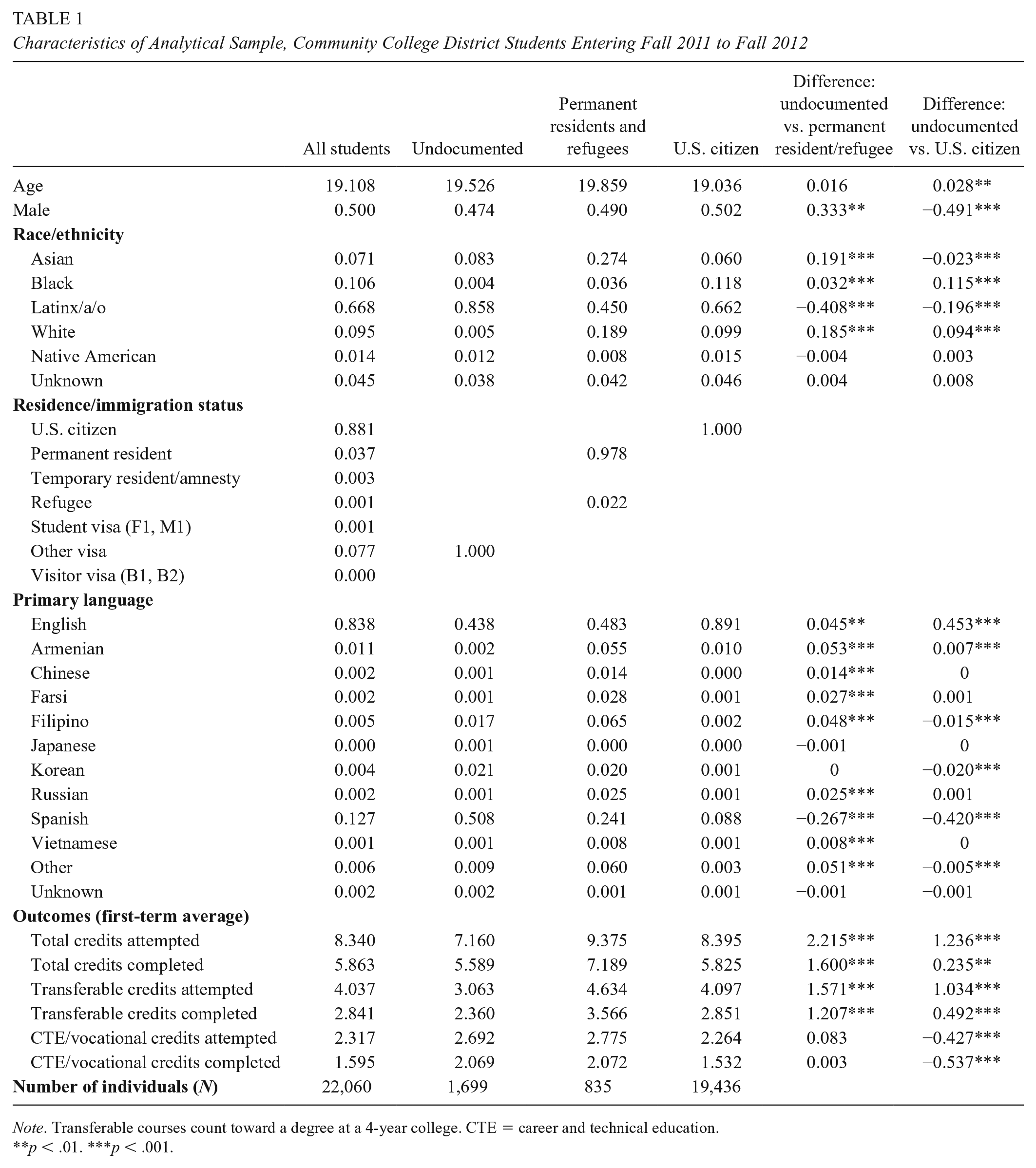
Note. Transferable courses count toward a degree at a 4-year college. CTE = career and technical education.
p < .01. ***p < .001.
Our claim that Other Visa students are likely to be undocumented students is bolstered by the fact that this group of students sees a dramatic increase in financial aid receipt following the introduction of the California DREAM Act in 2013. As Figure 1 makes evident, very few, if any, students who indicated Other Visa at the time of enrollment received fee waivers before the California DREAM Act was implemented in 2013. After 2013, however, over 60% of Other Visa students who were already enrolled and had not received tuition and fee waivers ultimately received them. As described previously, we removed Other Visa students from our analytical sample whose records indicated receiving some form of state or federal aid prior to January 2013.

Share of students each term receiving tuition and fee waivers or other financial aid, disaggregated by resident status.
Methods
The longitudinal student-level data include each student’s history of courses taken and grades earned for the duration of enrollment. These academic records, which include information on the specific types and sequence of courses taken, can provide a window into the goals and aspirations of college students (Adelman, 2006; Hagedorn & Kress, 2008). This allows us to investigate how gaining access to financial aid support may have altered the course-taking decisions of undocumented students who were already enrolled prior to California DREAM Act implementation.
Specifically, we developed outcome indicators for enrolling in Spring 2013 (the first semester after the California DREAM Act was announced), remaining enrolled in Spring 2014, and total credits and attempted and completed each term. Because our interest is in examining whether reduced constraints shifted the academic and career possibilities of undocumented students, we also disaggregated by type of course enrollment. Attempting degree-applicable and transferable courses can serve as indicators of transfer intent and/or associate’s or bachelor’s degree aspiration. Attempting CTE/vocational courses can serve as an indicator of course-taking for the purposes of earning certificates and licenses for certain trades and careers. We see these outcomes as important for understanding how state financial aid, by reducing constraints and decreasing uncertainty, may have broadened postsecondary possibilities.
Difference-in-Differences Design
Our first set of analyses examines changes in the course-taking patterns of undocumented students before and after the California DREAM Act using a DD design. In this approach, undocumented students enrolling in CCD prior to the California DREAM Act are the treated group because they may become eligible for financial aid during the course of their enrollment. Other students whose financial aid eligibility did not systematically change serve as a comparison control group. Permanent residents and refugees—who are also immigrants but have access to more state and federal financial aid for higher education—are the primary control group. However, we also assess the robustness of the results to different compositions of the control group by comparing undocumented students to U.S. citizen students because they were enrolled at the same time but were unaffected by these policies. Provided that there are parallel trends between the treated and control groups prior to the policy change, the research design allows us to identify the impact of the policy on any changes in course enrollment behaviors. The DD model is:

where
A strength of the identification strategy is the inclusion of individual fixed effects µi
This is an intent-to-treat (ITT) analysis because we do not observe all DREAM Act eligibility criteria (e.g., income, merit, and high school attendance). The resulting DD estimate can therefore be interpreted as the impact of the introduction of the California DREAM Act on the group of undocumented students who had enrolled just prior to the policy announcement. Following the presentation of the main results, we describe the validity and robustness checks we conducted to assess the internal validity of the estimates.
Findings
We first present a visualization of the differences in course-taking patterns between documented and undocumented students before and after the California DREAM Act. Figure 2 shows the mean of each outcome by term for undocumented students and permanent residents and refugees. Figure 3 shows the mean of each outcome by term for undocumented students and U.S. citizens. The vertical line indicates the introduction of the California DREAM Act in 2013.
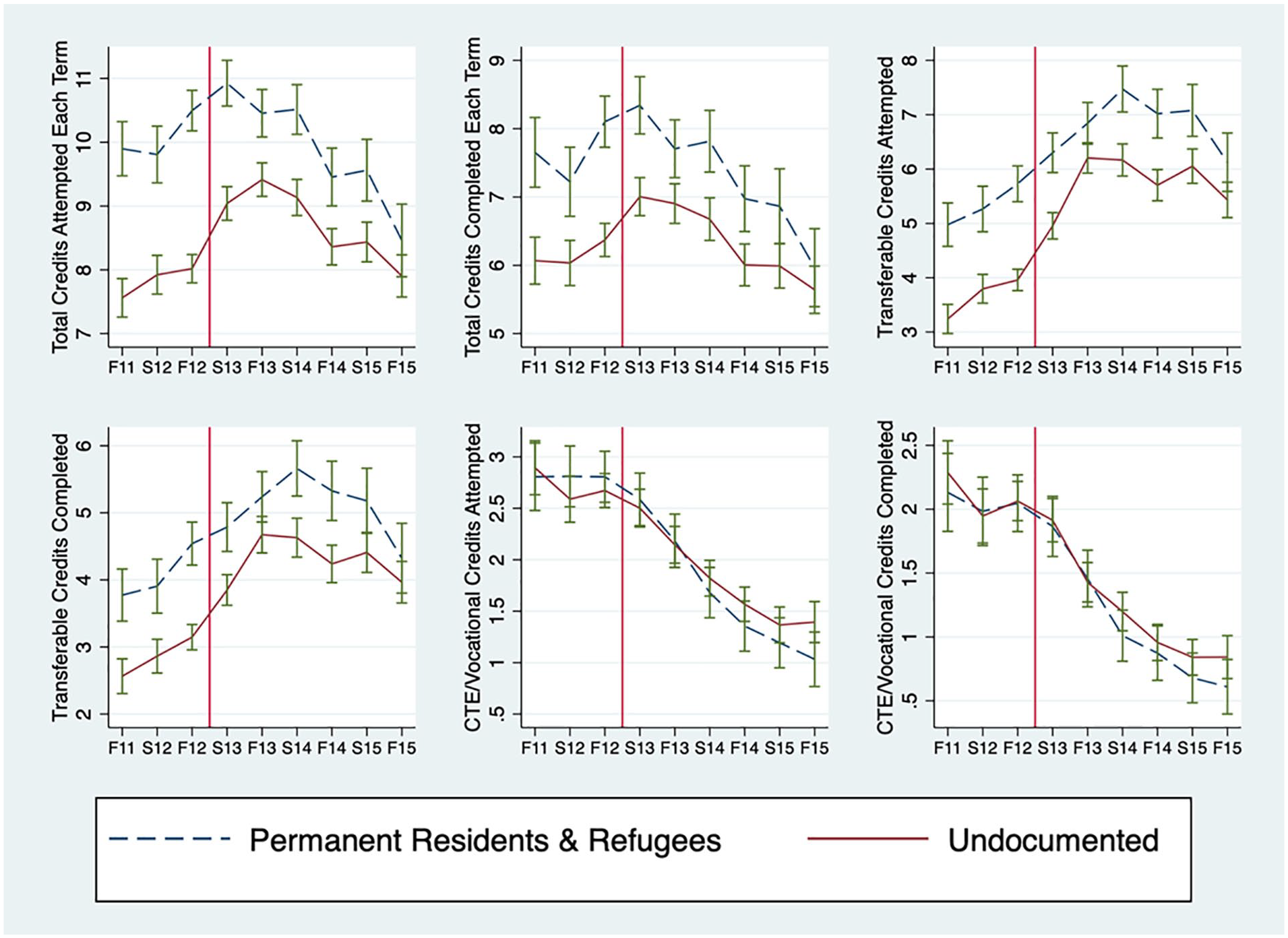
Credits attempted and completed each fall (F) and spring (S) term (undocumented vs. permanent residents and refugees).

Credits attempted and completed each fall (F) and spring (S) term (undocumented vs. U.S. citizens).
Figure 2 shows that prior to the California DREAM Act, undocumented students attempted and completed fewer total credits on average and fewer transferable credits on average than permanent resident and refugee students. However, there is a steeper positive increase in total and transferable credits that undocumented students attempted and completed in 2013 after California DREAM Act aid became available. It is important to note that although the gap in enrollment intensity narrows, the gap remains. The figure also shows the two groups attempted and completed about the same number of CTE/vocational credits.
Figure 3 indicates undocumented students were enrolling in, on average, fewer total credits and fewer transferable courses prior to the California DREAM Act than U.S. citizens. However, their credits completed were about the same. Again, there is a noticeable increase in the number of total and transferable credits after the policy change, resulting in credit attempts that are nearly on par with other students by Fall 2013 (although still lower overall). In contrast to permanent residents and refugees, Figure 3 also shows that undocumented students had higher enrollment in CTE/vocational courses before the DREAM Act, but this decreases to the level of U.S. citizen students after the policy.
Difference-in-Differences Estimates
These trends are confirmed by the first set of DD estimates in Table 2. We show in Panel A our main analytical sample (Other Visa students vs. permanent residents and refugees). We also present in Table 2 the same analyses with varying control groups. Panel B compares only Other Visa students to U.S. citizen students. Panel C includes all permanent resident, refugee, and U.S. citizen students in the control group.
Impact of the California DREAM Act on Undocumented Student Persistence and Course Enrollments

Note. Transferable courses count towards a degree at a 4-year college. Model includes term and individual student fixed effects. CTE = career and technical education.
p < .01. ***p < .001.
Columns 1 and 2 of Table 2 show the effects of the California DREAM Act on enrollment in the Spring 2013 term and the Spring 2014 term, an indicator of persistence. These results indicate that the availability of California DREAM Act aid did not change the probability of enrollment for undocumented students compared to other students.
Columns 3 and 4 of Table 2 show the effect of the introduction of the policy on average units attempted and completed. The DD coefficient suggests access to financial aid resources increased enrollment intensity among undocumented students. Undocumented students on average attempted about 1.2 more total credits and completed 0.82 more credits after the policy.
We then examined credit attempt and completion by type, focusing on transferable credits (i.e., to a 4-year institution) and CTE/vocational credits. Columns 4 and 5 of Table 2 show that undocumented students attempted 0.78 more transferable credits and completed 0.60 more transferable credits than they did prior to the policy.
Although there does not appear to be a significant difference in CTE course enrollment when comparing undocumented students and permanent resident/refugee students, there is a significant decline in CTE/vocational course enrollment when comparing undocumented students to U.S. citizen students. In Panel B of Table 2, Columns 6 and 7 show a decline in average CTE/vocational credits attempted, with undocumented students attempting 0.19 fewer credits and completing 0.27 fewer credits.
These estimates corroborate the trends depicted in Figures 2 and 3 and indicate that the introduction of the California DREAM Act increased undocumented students’ credit loads. These increases were primarily in transferable courses, suggesting that undocumented students may have seen earning a degree and/or transferring to a 4-year institution to be more viable options. This increase in credits attempted corresponded to a significant increase in transferable credit completion as well, indicating that financial aid also made these degree and transfer aspirations more likely to come to fruition. Nevertheless, gaps between undocumented students and permanent residents and refugees and between undocumented students and U.S. citizens remain in terms of enrollment intensity, suggesting the availability of aid did not address all constraints in undocumented students’ decision-making about higher education.
Subgroup Analysis
Newer versus earlier cohorts
Because we focused on students who entered between Fall 2011 and Fall 2012, just prior to the implementation of the DREAM Act, we also disaggregated the results by cohort to see if there were differences in the impact of aid for newer students and students who had entered earlier. 4 These results are presented in Panels A (Fall 2011 cohort) and B (Fall 2012 cohort) of Table 3. The results are similar to the main results with respect to total credits attempted and completed and transferable credits attempted and completed. It is important to note that the Fall 2012 cohort also enrolled after the announcement of DACA in June 2012. These results suggest the implementation of the DREAM Act did increase the enrollment intensity and transferable credits of undocumented students who entered after DACA was announced; these students experienced a shift in aid availability after just one term of enrollment and subsequently increased their enrollment intensity.
Impact of the California DREAM Act by Undocumented Student Subgroups

Note. Transferable courses count toward a degree at a 4-year college. Model includes term and individual student fixed effects. CTE = career and technical education.
p < .05. **p < .01. ***p < .001.
Undocumented Asian and Latinx/a/o students
We also reestimated the DD separately for Asian students and Latinx/a/o students, the two largest undocumented student populations. This is important because researchers have described racial/ethnic differences in undocumented immigrants’ experiences, including differences in socioeconomic status and poverty (Bohn et al., 2021) and differences in how they navigate the decision to disclose their status (Cho, 2021; Patler, 2018), which can affect access to resources like DREAM Act aid. These subgroup results, presented in Panels C (Asian) and Panel D (Latinx/a/o) of Table 3, show that the California DREAM Act changed the course enrollments of undocumented Latinx/a/o students but not undocumented Asian students. Compared to Latinx/a/o students with permanent resident or refugee status, undocumented students attempted 0.73 more credits and completed 0.5 more credits after the policy change. There is some indication, however, that undocumented Latinx/a/o students were 1 percentage point less likely to remain enrolled through Spring 2014 than their counterparts with permanent resident/refugee status. These results suggest that it is important to further examine how undocumented Asian and Latinx/a/o students access and use financial aid and the extent to which this is related to differences in undocumented status and identity.
Validity
Parallel trends
The validity of DD to enable causal inference hinges on the existence of parallel trends between the treatment and control groups prior to the enactment of the policy. That is, the two groups should be trending similarly with respect to the outcomes of interest; the only significant deviation from these trends should be due to the policy change and only in the treated group. To check the parallel trends assumption, we regressed each outcome on an interaction term between the undocumented status indicator and each prepolicy term indicator. These results are presented in Table 4. We observed parallel trends for all outcomes, as indicated by nonsignificant interaction terms.
Prepolicy Trends in Each Outcome (Parallel Trends Analysis)

Note. Transferable courses count toward a degree at a 4-year college. Model includes term and individual student fixed effects. Observations after January 2013 are dropped. CTE = career and technical education.
p < .05. **p < .01. ***p < .001.
Falsification exercise
We created a fake policy in Spring 2012, 1 year prior to the actual California DREAM Act, and ran the same analysis as our main results, excluding observations after 2013. This exercise allows us to explore whether students may have changed their behaviors in anticipation of the California DREAM Act and to assess the exogeneity of the policy, important for understanding whether our main results can be attributed to the policy shock in 2013. As shown in Table 5, there were no significant DD estimates with the fake policy.
Falsification Exercise With Fake Policy in Spring 2012

Note. Transferable courses count toward a degree at a 4-year college. Model includes term and individual student fixed effects. Observations after January 2013 are dropped. CTE = career and technical education.
p < .001.
DACA
A potential threat to the validity of these estimates is President Barack Obama’s June 2012 announcement of DACA, an executive order that provided protection from deportation and access to work permits for eligible undocumented immigrants (U.S. Citizenship & Immigration Services, 2017). Even though the policy’s goal was to remove some challenges undocumented immigrants face by providing a work permit that allowed them the opportunity to pursue additional employment opportunities, DACA has also been shown to influence undocumented students’ postsecondary decision-making. For example, using data from a large public university, Hsin and Ortega (2018) found that DACA incentivized work over educational investments, with enrolled students reducing coursework while increasing work hours. It is therefore possible that the results presented in our study are driven by or influenced by DACA or even the broader signal of social support and acceptance surrounding DACA.
Without access to complete DACA eligibility information or any information about which students received DACA, we attempted to investigate and disentangle the DACA confound in three ways. First, Panel B of Table 3 shows results when we restricted the DD analysis to only those students who entered following the DACA announcement. The ITT estimates of the California DREAM Act were essentially the same as the main results. Second, we show in Table 6 that results are robust to including a time-varying indicator of DACA eligibility. This indicator is based on being an eligible age in an eligible time period (under the age of 31 as of June 15, 2012). The limitation of this analysis, however, is that about 95% of undocumented students in the Fall 2011 to Fall 2012 cohorts remained eligible for DACA (based on age) through Fall 2015, and so there is fairly little variation in this indicator. Third, we examined the effects of the DACA announcement in June 2012. We restricted the DD analysis to all cohorts who entered before Fall 2012 and examined changes in the course enrollment outcomes in Fall 2012. These results are presented in Table 7. There is a significant decrease in total credits attempted; undocumented students in Fall 2012 attempted 0.60 fewer total credits after DACA was announced. Because the first DACA applications were not processed until October and November 2012 (Svajlenka & Singer, 2013), after students had enrolled in the fall term, we believe this decrease in credits attempted is connected to the announcement of DACA rather than actually receiving DACA status (and the associated work permits). Nevertheless, this decrease in enrollment intensity is in line with prior work (Hsin & Ortega, 2018).
Sensitivity of Results to DACA Eligibility Indicator
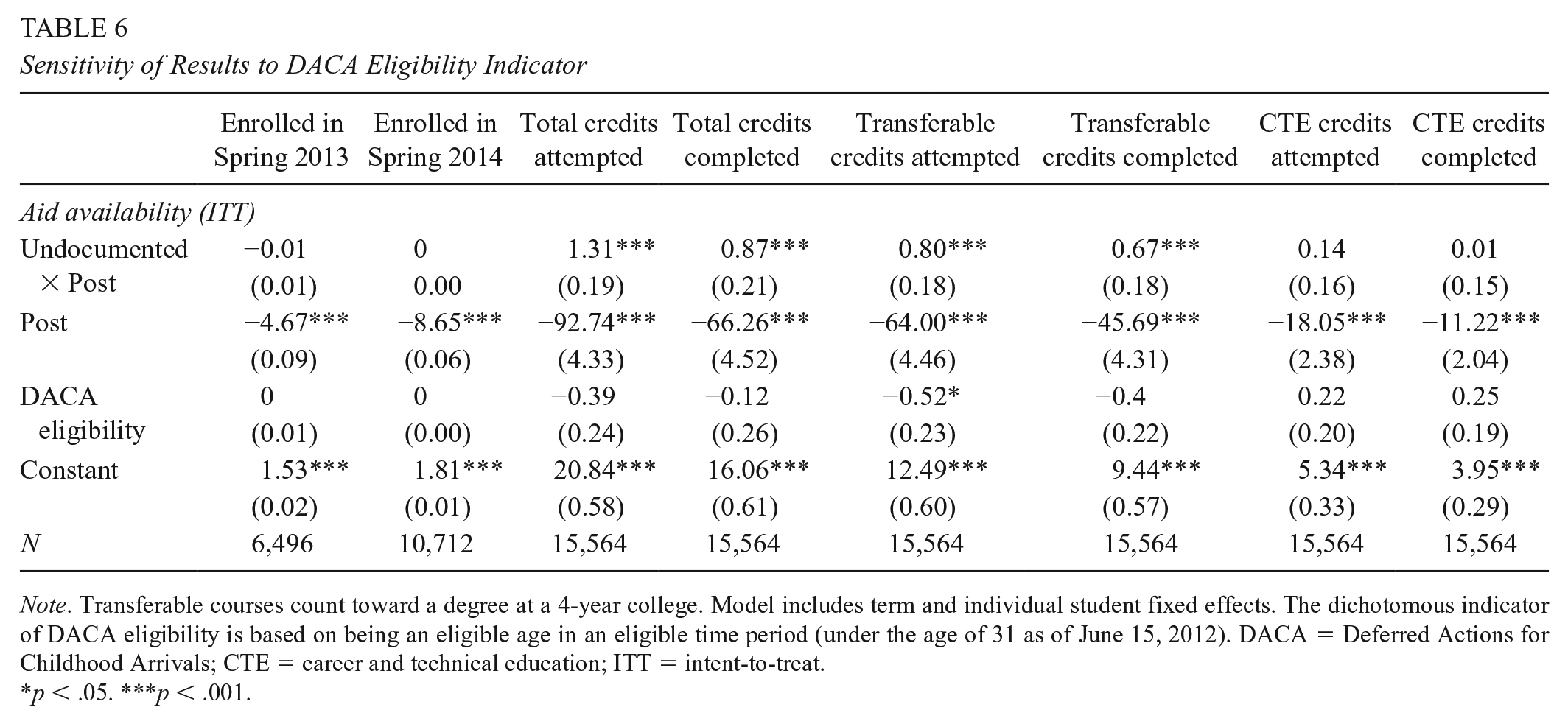
Note. Transferable courses count toward a degree at a 4-year college. Model includes term and individual student fixed effects. The dichotomous indicator of DACA eligibility is based on being an eligible age in an eligible time period (under the age of 31 as of June 15, 2012). DACA = Deferred Actions for Childhood Arrivals; CTE = career and technical education; ITT = intent-to-treat.
p < .001.
Impact of June 2012 DACA Announcement (Through Fall 2012)

Note. Transferable courses count toward a degree at a 4-year college. Model includes term and individual student fixed effects. Observations after January 2013 are dropped. DACA = Deferred Actions for Childhood Arrivals; CTE = career and technical education.
p < .001.
Although these analyses suggest some confounding effect of DACA on undocumented students, we note that the DACA estimates show a decline in enrollment intensity. In contrast, our main results show that the overall effect of the California DREAM Act was to increase enrollment intensity. We therefore may actually be underestimating the effects of financial aid for undocumented students during this time period.
Discussion
This study offers a window into the postsecondary decisions of undocumented students at a time when educational goals and aspirations may have shifted dramatically in response to a state policy that increased access to financial aid for undocumented college students. By focusing on course-taking behaviors using student-level transcript data, we examined how the California DREAM Act may have worked to allay some of the uncertainty and reduce constraints that undocumented college students face. On average, undocumented students who remained enrolled after the California DREAM Act attempted 1.2 and completed 0.82 more college credits, primarily in transferable courses. Given the prepolicy average for undocumented students was 7.16 credits attempted, this translates to a 17% overall increase in credits attempted for a 100% increase in aid (i.e., all tuition and fees waived). Undocumented students also reduced their average credit loads (by 7%) in CTE/vocational courses when compared to U.S. citizen students. Because we observed increases in transferable credits (and some decreases in CTE), one interpretation is that the California DREAM Act may have broadened postsecondary possibilities. By reducing the cost of college and reducing uncertainty about paying for college in the future, the California DREAM Act may have made bachelor’s degree attainment and transfer a more viable possibility for undocumented community college students.
Despite the increase in credit loads, there was still a gap in the total number of credits attempted between undocumented students and their permanent resident, refugee, and U.S. citizen peers. Constrained inclusion provides a framework for understanding these results because it describes how undocumented individuals’ constraints are only partly absolved through inclusive policy (Negrón-Gonzalez, 2017). While undocumented students acted on the broadened possibilities that the California DREAM Act facilitated, their undocumented status and current social policies continue to determine the set of options they ultimately have. In other words, their college-going and course-taking decisions and postsecondary pathways continue to be shaped by broader social forces and social policy constraints, including access to federal financial aid and a pathway to citizenship.
Although we could not completely disentangle the effects of the California DREAM Act from the effects of DACA, we note that the results of aid reported in this study are opposite to the estimated effects of DACA, which show that the policy led to reduced college enrollment among undocumented students, presumably because they were able to pursue additional employment (Amuedo-Dorantes & Antman, 2017; Hsin & Ortega, 2018). Given many undocumented students in our sample were DACA-eligible, we may actually be underestimating the positive effects of financial aid for undocumented students on credit loads.
What is particularly striking is that this policy influenced the postsecondary decisions of undocumented students who were already enrolled in college and presumably on a certain postsecondary pathway. The findings therefore not only add to our understanding of undocumented students in higher education but also to the financial aid literature on how aid affects continuing students. The results show that continuing students increased enrollment in the semesters immediately following the implementation of the California DREAM Act. The increase in transferable credits also suggests that this new source of aid also affected academic choices. Undocumented students perhaps saw degree completion and 4-year transfer as more possible with the promise of financial support.
Implications
The findings underscore the power of state and federal policymaking for expanding opportunities and broadening possibilities for undocumented immigrants. Nevertheless, the lack of access to financial aid in the majority of states remains a perpetual challenge for undocumented students across the country. More states should enact inclusive policies that allow undocumented students to access state financial aid resources for higher education. Based on these findings, doing so can increase undocumented students’ higher education participation and accelerate progress toward degree completion.
The promise of these financial aid policies must also be considered in light of constrained inclusion. Inclusive policies like state DREAM acts, drivers’ licenses, or worker protections may reduce some of the uncertainty and constraints that undocumented immigrants face and enable undocumented immigrants to make different choices, but they remain hindered—and stuck in the jaula de oro—by the lack of a pathway to permanent legalized status. At the time of this writing, no concrete bills for a federal DREAM act or pathway to citizenship have advanced for legislative consideration, leaving the fate of undocumented students precarious and unknown.
To this end, state and federal reforms are only one means of reducing constraints. Higher education institutions also need to consider their own institutional policies and how they support undocumented students (Enriquez et al., 2019). With respect to the community college setting, specific recommendations for practice include flexible course offerings and requirements, access to clear and guiding information, access to psychological services that support undocumented students’ holistic well-being, and continuous professional development and training for staff and faculty (Ngo & Hinojosa, 2021). The creation and staffing of Undocumented Student Resource Centers can also support these efforts (Cisneros & Valdivia, 2020). Given the volatility of state and national political climates, it is critical to conduct additional research on inclusive policies and practices on campus that can support undocumented college students (Enriquez et al., 2019; Muñoz et al., 2018; Ngo & Hinojosa, 2021; Nienhusser, 2014).
Conclusion
This study offers evidence of the significant and real consequences that public policy can have on the educational decisions of undocumented students. While inclusive financial aid policies like the California DREAM Act can temporarily change or remove some of the constraints and uncertainty undocumented students face, they are still but fragmented and incomplete measures in the absence of comprehensive immigration reform. Although the Biden-Harris administration made campaign promises to take immediate actions to provide pathways to legal residency for undocumented immigrants in the U.S. (Biden-Harris, n.d.), undocumented immigrants’ lives will remain in limbo until an immigration reform is officially passed. This reform must include a robust set of policies that not only removes existing constraints and provides access to opportunities and resources in higher education and beyond but also guarantees true inclusion through a pathway to citizenship.
Footnotes
Acknowledgements
This study was supported by a grant from the Spencer Foundation (Award No. 201900035). Opinions reflect those of the authors and not the granting agency. A prior version of this article was presented at the annual conference of the Association for the Study of Higher Education in Portland, Oregon. The publication fees for this article were supported by the UNLV University Libraries Open Article Fund.
Open Practices
The setup files for this article can be found at  . The data for the study cannot be shared due to a restricted-use agreement with the educational agencies from which the data were obtained. The Data Access document describes how one could obtain the data and how the set-up files, which if applied to the data, would generate the results in the article.
1.
2.
Before the California DREAM Act, the incoming GPAs of undocumented students were substantially higher than U.S. citizen students. After the policy, the average incoming GPA of undocumented students declined.
3.
“Latinx” is referenced as a gender-inclusive term, particularly because the term connotes “the intersectionality of sexuality, language, immigration, ethnicity, culture, and phenotype” (Salinas & Lozano, 2019, p. 307).
4.
Authors
FEDERICK NGO is an assistant professor at the University of Nevada, Las Vegas. His research examines the role of higher education policy in facilitating college access and success, with a focus on community college students.
JUANITA K. HINOJOSA is a doctoral student at the University of Nevada, Las Vegas. Her research focuses on the experiences of Latinxs in rural higher education and Hispanic-serving institutions.