




Abstract
State policymakers in the United States have in recent years experimented with new initiatives to change the procedures used by public institutions to assess and assign academically underprepared students to non-credit developmental education (or remedial) courses. This study explores whether the most recent developmental education reform in Floridas—Senate Bill 1720 has affected student enrollment in the Florida College System (FCS) institutions and whether the enrollment effects vary by race/ethnicity and age. Through a difference-in-differences analysis, we did not find statistically significant effects of the reform on the college enrollment in Florida, neither on the racial or age compositions of the student population, compared to non-Florida institutions in the surrounding region. These null results provide valuable implications for policy and research consideration in Florida and beyond.
Keywords
Introduction
While the higher education system in the United States provides tremendous opportunities for students to continue their education beyond high school, many lower-performing students face substantial barriers to doing so. Most 2-year community colleges provide open access admissions which allow any high school graduates to enroll regardless of their incoming level of academic preparation. Traditionally, community colleges have offered developmental (or remedial) education courses as a way to develop the reading, writing, and/or math skills of underprepared students (Ganga et al., 2018; Rutschow et al., 2019). Typically, through the use of standardized test scores, community colleges require students who scored below college-ready on the placement test to enroll in one or more noncredit developmental education courses to improve their skills for college-level studies. The intended goal of traditional developmental education models was to increase underprepared students’ chances of access and success in higher education (Ganga et al., 2018). However, in recent years, traditional developmental education has been under scrutiny partly because of the high cost of providing instruction and services to the large number of students identified as in need of remediation (Ganga et al., 2018). Additionally, questions have been raised with respect to traditional developmental education due to the lack of evidence of its effectiveness on student success, concerns about standardized test placement errors, developmental curricula design, and external factors such as lack of institutional support and services (T. Park, Woods, et al., 2016; Rutschow et al., 2019).
In response to the aforementioned challenges, state systems and various colleges have begun to experiment with a wide range of approaches to developmental education reform to improve students’ success in developmental education (Rutschow et al., 2019). In Florida, a large-scale developmental education reform—Senate Bill 1720 (SB 1720) was implemented in fall 2014 across the 28 institutions that comprise the Florida College System (FCS). The reform not only exempted many students from developmental education based on certain criteria, but it also required FCS institutions to provide new instructional modalities for remaining developmental courses to help improve students’ acceleration through these courses (Mokher et al., 2019). Given the reform’s intent to enhance the effectiveness of developmental education and accelerate students’ progress to college-level courses and degree completion, it is likely that the reform could motivate more students to attend college, particularly those students who would have previously been required to take developmental education courses. Exempt students can now save time and money by not taking developmental education courses, and non-exempt students may perceive a greater likelihood of success in the new instructional strategies for developmental education courses. Thus, in this study, we examined the enrollment effects of the SB 1720 reform on student enrollment in FCS institutions. We also examined possible differences in the enrollment patterns by students’ age and race/ethnicity since younger students are more likely to be exempt from developmental education after SB 1720; and the reform may narrow racial/ethnic gaps in college completion costs (Mokher et al., 2021). Two research questions of this study include:
RQ1: To what extent did the development education reform as stipulated by SB 1720 affect student enrollment in FCS institutions?
RQ2: How did the enrollment effects vary by race/ethnicity and age?
The policy examined in this study has strong relevance to higher education in the international context. As higher education moves from the elite to the mass higher education stage and then to universal access, students enrolled in higher education would inevitably become more diverse in terms of academic preparation (Trow, 1973). Thus, developmental (remedial) education and other approaches to address student under-preparation would become relevant to higher education reform in other countries. Specifically, the findings from this study make a contribution to the research literature on community college reform by providing a better understanding of whether changes to developmental education may influence the college choice process. We utilize human capital theory to frame the mechanisms through which changes in the time and costs associated with developmental education may influence students’ decisions about whether to enroll in college. The study also seeks to identify any variation in the impact of the reform among student subgroups who may stand to benefit differentially from the changes.
Developmental Education Reforms
Recent studies estimate the total annual cost of providing developmental education at all colleges to be approximately $7 billion (Scott-Clayton et al., 2014), and the estimated annual cost to students and their families to be around $1.3 billion (Ganga et al., 2018). While the total costs of developmental education are high for states and students themselves, research indicates that the traditional approaches in developmental education have not resulted in improvements in student success in higher education (Bettinger & Long, 2009; Boatman & Long, 2010; Scott-Clayton & Rodriguez, 2015; Woods et al., 2019. With only 28% of developmental students earning a degree within 8 years compared to 43% of non-developmental students, there are considerably higher college dropout rates among students enrolled in developmental courses (Attewell et al., 2006; Jaggars & Stacey, 2014; T. Park, Woods, et al., 2016). As such, state systems and individual colleges across the United States are implementing developmental education reforms to improve student college readiness (Daugherty et al., 2018; Ganga et al., 2018).
Three main types of developmental education reform have been noted by policymakers and researchers, which include (a) assessment reforms that use multiple measures such as high school GPA to improve the accuracy of assessment and placement, (b) instructional reforms in developmental courses, and (c) student services and supports reforms that provide additional support for students in developmental courses (Rutschow et al., 2019). For instance, the California State University system and North Carolina community colleges have reformed their assessment and placement exam systems by dropping the use of placement exams and customizing placement system (Ganga et al., 2018). Additionally, some states have sought to accelerate students’ progress into college-level coursework by making developmental courses optional for some high school graduates like SB 1720 in Florida in 2014. For example, California’s Assembly Bill 705 (2018) required community colleges to modify course placement procedures to maximize the probability that students will enter and complete transfer-level coursework in math and English during their first year. Some colleges have eliminated developmental education offerings, while others may recommend but not require these courses.
Senate Bill 1720 in Florida
In some states in the United States, legislation has been implemented by policymakers to mandate changes to the ways to procedures for placement testing and developmental education among all public colleges within the state. In 2013, the state of Florida passed SB 1720 which dramatically changed how developmental education is delivered among the 28 FCS institutions and who is required to take it. This reform gave students the option to bypass developmental education if they entered a Florida public school in grade 9 in 2003/2004 or later and earned a standard high school diploma; or were active duty military personnel. Prior to fall 2014, all students enrolling in FCS institutions were required to take a developmental education placement exam. Based on students’ test scores, the institutions decided whether these students needed to enroll in developmental education courses, or if they could directly enroll in college-level coursework. After SB 1720 passed, many students were eligible for the exemption of placement tests and developmental education courses altogether. As for students who were not eligible for exemption, they were still required to enroll in developmental courses if they scored below college-ready on the placement test. In addition, institutions in the FCS had to offer at least one of four approved accelerated instructional modalities including contextualized, modularized, compressed, and co-requisite with institutional support to better help students’ learning and success in developmental education. Colleges were also required to provide enhanced advising and academic support services.
Existing literature on developmental education in Florida has explored how college leaders approach the institutional change process under the implementation of SB 1720 (Mokher et al., 2020) and students’ course taking decisions and educational outcomes after the reform (T. Park, Woods, et al., 2016; T. Park et al., 2018; Woods et al., 2019). Some recent studies that examined the effectiveness of SB 1720 utilized an interrupted time series design to compare the outcomes of pre-reform and post-reform cohorts and found that students were more likely to take and pass college-level math and English courses after the reform (e.g., Mokher et al., 2020; Park-Gaghan et al., 2020). An underlying assumption of such studies is that the size and demographic composition of the incoming student population remain similar before and after the reform. However, this assumption has not been empirically tested. While the timeframe of our study (2011–2016) occurred prior to enrollment disruptions due to the COVID-19 pandemic, there still may have been other underlying influences on student enrollment during this time. National community college enrollment data in 2017 indicated that “community college enrollment has declined sharply since its peak in fall 2010” (Juszkiewicz, 2017, p. 9). Several factors influencing changes in students’ college enrollment decisions over time include economic forces with more job opportunities while the economy continues to recover from the Great Recession, and changes to college affordability for students of different ages and demographics (Juszkiewicz, 2017). Under this nationwide community college enrollment context, the current study analyzes statewide community college enrollment patterns to examine the possible relationship between SB 1720 and enrollment for all students and college enrollment for students of different age and racial/ethnic backgrounds.
Theoretical Framework
The theoretical framework guiding this study is human capital theory (Becker, 1964). Human capital theory has been largely used as an economic and policy theory; it is also highly relevant to education, especially regarding students’ college enrollment choices. According to human capital theory (Becker, 1964), students’ decisions to enroll in colleges are influenced by the costs of investing in higher education such as tuition, fees, and textbooks; and the expected benefits of attending colleges, such as higher lifetime earnings and social status enhancement due to the development of human capital. Yet developmental education courses may not be treated as the same type of educational investment as college-level courses. While developmental education English credits may be associated with slight increases in earnings, developmental education math credits may actually result in negative impacts on earnings and the likelihood of employment (Hodara & Xu, 2016). Since developmental education is costly and has low (or even negative) expected returns, we posit that removing these costs and increasing student’s chances of return could increase enrollment. When developmental education became optional for exempted students in Florida, exempt students no longer needed to spend time in developmental education and could accelerate their progress into college-level courses. Based on the human capital theory of weighing the expected costs and benefits of college enrollment, it is likely that SB 1720 could incentivize more high school graduates (especially these who met the exemption criteria) to attend college. This motivates our focus on examining whether the reform has impacted student enrollment in FCS institutions in general.
It is also worth acknowledging the role of race and ethnicity associated with the human capital theory when examining students’ college decisions at the enrollment stage (Flores & Park, 2013; Juszkiewicz, 2017). Perna (2000) argued that students from different racial and ethnic backgrounds may hold different views of the costs and benefits of higher education. These differences in the views could lead to differences by students of different racial and ethnic backgrounds in college enrollment decisions. To make human capital theory more useful for understanding college decisions of students from different cultural backgrounds with diverse demographics, Perna (2000) expanded the theory to include examinations of social capital and cultural capital of different racial and ethnic student groups to understand their higher education investment decisions. The expansion of human capital theory to include student demographics has guided the second research question of this study regarding how SB 1720 affects student enrollment in FCS institutions by race and ethnicity.
Our hypothesis is that the SB 1720 reform could potentially impact student enrollment in FCS institutions since traditional developmental education could function as a barrier affecting students’ preparedness and success in higher education and this reform gives students more options for developmental courses. Specifically, prior to the reform, students tested below college readiness had to take up to two developmental courses in math, reading, and/or writing, which could discourage students from enrolling in college because they would have to take and pay for several non-credit courses before they could take college-level courses that count for credits. However, providing more students with the option to enroll directly into college-level courses or a faster process through developmental courses with offering new instructional modalities after SB 1720 could make college education more affordable and reduce students’ time in developmental education, which is likely to motivate more students to decide to go to college after the reform.
Additionally, the effects of SB 1720 on student enrollment in FCS institutions may differ by age and race/ethnicity subgroups of the student population. As the exemption criteria targeted high school graduates who entered a Florida public school in grade 9 in 2003/2004 or later, younger students are more likely to meet these criteria and be eligible for the exemption of developmental education after the reform, which could lead to the enrollment difference by age. It could also be the case that younger students have recently taken math courses in high school and may not feel like they need a “refresher” in math as much as older students (Bettinger et al., 2013), so reform initiatives of bypassing or accelerating developmental education may be more appealing to younger students. In addition, younger students may have greater expected returns to additional educational investments as they have longer career trajectories relative to older students.
Second, developmental education reform has the potential to provide greater benefits for students from underrepresented racial/ethnic backgrounds. Melguizo et al. (2008) argued that minority student groups disproportionately spent more time and money taking nontransferable developmental courses despite the mission of community colleges to promote access and equity. Bailey et al. (2010) examined racial/ethnic achievement gaps in developmental education outcomes and found that compared to White students, Black and Hispanic students were more likely to be assigned to developmental courses and Black students were significantly less likely to complete the developmental education sequence. In additional study by Bahr (2010) found that the likelihood of assignment to developmental education was higher for Black and Hispanic students relative to White students, which may be attributed to different levels of math skills upon college entry. Earlier research on SB 1720 in Florida found that students of color were more likely to be tested and placed in developmental education prior to the reform and are also more likely to benefit from being exempted after the reform as several studies show that SB 1720 has helped to narrow racial/ethnic gaps in the college coursetaking costs and college-level course completion rates (e.g., Mokher et al., 2021; Park-Gaghan et al., 2020). Given that minority student may benefit more from the reform, the enrollment patterns may also be different for students of different racial/ethnic backgrounds.
Methodology
To evaluate the possible effects of SB 1720 on student enrollment in FCS institutions and variations among student subgroups, we used difference-in-differences (DiD) analyses to examine enrollment effects in FCS institutions after SB 1720, compared to non-Florida institutions in the surrounding region. To be specific, we compared enrollment changes at the 28 FCS institutions which experienced the SB 1720 reform (considered as the treatment group) to enrollment changes at other public 2-year institutions in states in the Southern Regional Education Board (SREB) region that did not have statewide reforms to developmental education during the same period of time. Thus, public 2-year institutions in Alabama, Arkansas, Georgia, Kentucky, Louisiana, Maryland, Mississippi, Oklahoma, South Carolina, and Texas were included in the control group. The remaining SREB states (Delaware, North Carolina, Tennessee, Virginia, and West Virginia) were excluded because they experienced other developmental education reforms during the same period of time. This is a well-established empirical strategy when state policies in Florida were evaluated (e.g., Zhang et al., 2013). We conducted a robustness check by restricting the comparison group to four SREB states that are considered most similar to Florida: Georgia, South Carolina, Texas, and Louisiana. The results remain the same.
Since SB 1720 was passed in 2013 and formally implemented in the 2014 to 2015 academic year, enrollments in fall of 2011, 2012, and 2013 were included in this analysis as the pre-policy years; and fall of 2014, 2015, and 2016 as the post-policy years. This research design allows us to analyze trends in public 2-year institution enrollments in Florida over time, and to compare enrollment changes in Florida to changes at other similar institutions in SREB states. By controlling for the effects of time and confounding variables, the DiD design is an appropriate method to address our research questions while reducing the bias of the estimates of the developmental education reform’s impacts.
Sample and Variables
In the treatment group, the sample includes 28 public 2-year institutions in the FCS. These institutions are chosen because all these institutions experienced the SB 1720 reform in Florida since the fall of 2014. We collected fall enrollment data on grand total undergraduate students—as well as enrollment data disaggregated by subgroups for Black, Hispanic, White, and undergraduate age under 25—from the Integrated Postsecondary Education Data System (IPEDS) (National Center for Education Statistics, n.d.) for these 28 FCS institutions. To create the control group, we used the sector variable from the IPEDS data system to help us identify the public 2-year institutions in SREB states that did not experience developmental education reform during this time. Resultantly, 229 public 2-year institutions in SREB states were included in the control group. Similarly, we collected fall enrollment data on grand total undergraduate, Black, Hispanic, White, and undergraduate age under 25 years, from IPEDS for these 229 institutions. After excluding observations that include missing values on any of independent variables, we obtained a final sample comprising 28 FCS institutions (168 institution-year observations) and 216 institutions from SREB states (1,283 institution-year observations). In addition, because there are observations that miss on the enrollment of undergraduates aged under 25 years but do not miss on other outcome variables, the sample size for model that examines enrollment of undergraduates aged under 25 years is smaller than the other models. Specifically, there is one institution that has no data on enrollment of students under 25 years in any of the 6 years between 2011 and 2016 and therefore is excluded from the sample. There are some institutions that have missing data in some of the years, resulting in an analytic sample of 243 institutions and 1,278 institution-year observations.
Throughout the literature, factors that affect college enrollment can be divided into two categories: institutional characteristics, which are related to enrollment policy such as tuition and fees; and state characteristics such as unemployment rates, youth population, and per-capita income (Flores & Shepherd, 2014). In this study, we included annual measures of in-state average tuition for full-time undergraduates and average amount of federal, state, local, institutional, or other sources of grant aid awarded to undergraduates as institutional controls to differentiate confounding effects of tuition and financial aid from the effects of the developmental education reform. We collected average tuition and grant aid data from the IPEDS for institutions in both the treatment and control groups. For state controls, we included annual measures of racial and ethnic composition of the population, youth population (18–24 years), unemployment rate, and per-capita income using data from SREB fact book tables. Similarly, the purpose of including these state controls is to separate out time effects of these control variables from the reform’s effects on college enrollment by race/ethnicity and age.
Overall, we estimate the following model for institution i and year t:

where y is the outcomes of interest (i.e., total enrollment or subgroup enrollment). The variable “After” takes the value of 0 for years 2011 to 2013 prior to Florida’s developmental education reform and 1 for the post-reform years of 2014 to 2016. The interaction among the Florida institutions both before and after SB 1720 is compared to the control group to give an estimate of the reform’s effect, shown in the equation as ζ. The institutional and state controls are captured by the vector Sit. For institutional controls, we control for the effects of tuitions and financial aid. For state controls, we include unemployment rates, per capital income, demographic information, as well as a categorical variable indicating the state in which an institution is located. Finally, we include λt as year fixed effects to control for the longitudinal nature of the data.
Figures 1 and 2 present the testing of the parallel-trend assumption of the DiD model. Figure 1 plots the pre-policy and post-policy trend of total enrollment for Florida and SREB for 2011-2016. Figure 2 plots the pre-policy and post-policy trends of enrollment of subgroup populations for Florida and SREB for the same time period. The total enrollment clearly shows a stable time trend for both Florida and SREB states before the policy was implemented in 2014. Enrollment of subgroup populations show a similar stable time trend before the policy. Figures 1 and 2 suggest that the enrollment trends were very similar before the policy for FCS institutions and institutions in SREB states, implying that absent from the reform, the enrollment numbers for Florida and SREB states are expected to change at the same rate. Any post-reform differences in the enrollment trends can thus be attributed to the policy effects.

Time trend of total enrollment.

Time trends of enrollment of subgroup populations.
Findings
Table 1 presents the descriptive statistics of the key independent and dependent variables for both treatment and control groups, pre- and post-SB 1720. Figure 3 illustrates the magnitude of the changes in the pre-reform and post-reform years; and Figure 4 shows the standardized mean differences between FL and SREB states for the pre-policy and post-policy years. It shows that overall enrollment in public 2-year colleges in both Florida and SREB states declined from 2011 to 2016, with institutions in SREB states experiencing bigger decrease compared to Florida (−7.50% vs. −3.83%, respectively). These average enrollment decreases were largely driven by White and Black students, whereas enrollment of Hispanic students increased in both Florida and SREB states during the same period of time. The average Black undergraduate fall enrollment decreased in both treatment and control groups (−6.19% vs. −11.46%), indicating greater declines in SREB states. In comparison, there were fewer differences in the changes to White and Hispanic college student enrollment in Florida and SREB states during this period of time.
Descriptive Statistics for Outcomes, Institutional Characteristics, and State Characteristics in Public Two-Year Colleges in Florida and Other SREB States During the Pre-Reform and Post-Reform Years.
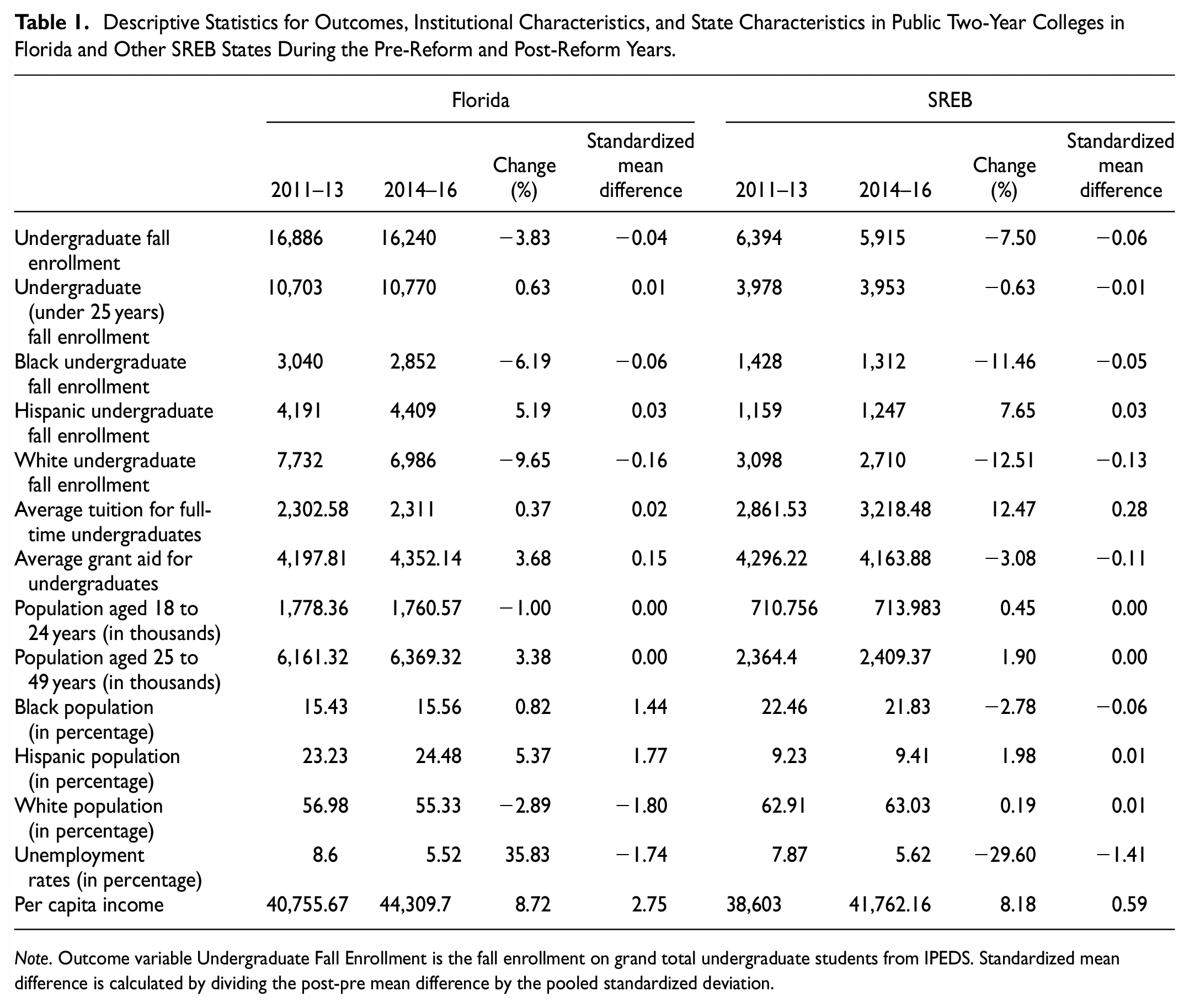
Note. Outcome variable Undergraduate Fall Enrollment is the fall enrollment on grand total undergraduate students from IPEDS. Standardized mean difference is calculated by dividing the post-pre mean difference by the pooled standardized deviation.
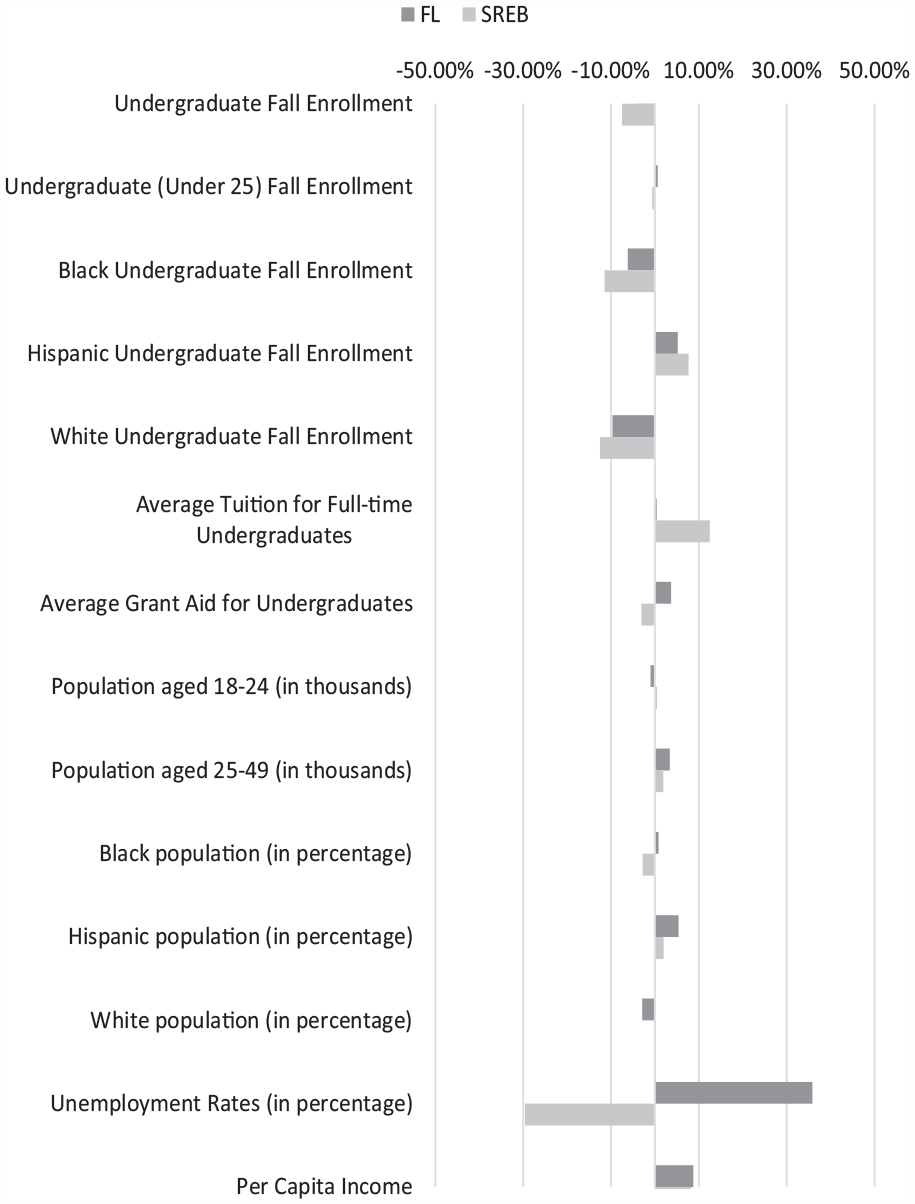
Percent change in the pre-reform and post-reform years for outcomes, institutional characteristics, and state characteristics in Florida and SREB states.

Standardized mean difference in the pre-reform and post-reform years for outcomes, institutional characteristics, and state characteristics in Florida and SREB states.
In terms of enrollment by age, Table 1 shows that the average enrollment for undergraduates under age 25 years in FCS institutions slightly increased by 0.63% after SB 1720 compared to a decline of 0.63% in the control group. The number of the youth population aged from 18 to 24 years experienced a 1.00% decrease in Florida and 0.45% increase in SREB states after 2013 according to the state data. However, in both Florida and other SREB states, population aged 25 to 49 years slightly increased (3.38% vs. 1.90%, respectively) after 2013.
Among the institutional and state characteristics, Table 1 shows that the average tuition for undergraduates in FCS institutions increased by 0.37% after 2013; it increased by 12.47% in public 2-year institutions in SREB states. Average grant aid for undergraduates in FCS institutions increased by 3.68%, while it decreased by 3.08% in SREB institutions. Also, the changes in the unemployment rates in Florida and SREB were very different with 35.83% increase of unemployment rates in Florida, while 29.60% decrease of unemployment rates in SREB states after 2013.
We estimated the DiD models for each of the five outcomes separately: (1) total enrollment; (2) enrollment of aged 18 to 24 years population; (3) Black enrollment; (4) Hispanic enrollment; and (5) White enrollment. We first estimated the models without covariates and only controlled for the fixed effects of states and year. The results were reported in Table 2.
Difference-in-Differences Results (Without Covariates), SB 1720 Effect on Enrollment.

Note. Cluster-robust standard errors in parentheses.
p < .001. **p < .01. *p < .05.
All the DiD estimators for policy effect (After × Florida) were not statistically significant, except for the model for White enrollment. The DiD estimator for White enrollment was negative and statistically significant, suggesting that less White students in Florida enrolled in FCS institutions after the policy compared to White students in SREB states. However, after accounting for the institutional and state controls, none of the DiD estimators were statistically significant (see Table 3). These results indicate that SB 1720 did not have significant effects on enrollment in FCS institutions in Florida compared to similar institutions in SREB states. Furthermore, the racial and age compositions of the student population also experienced no significant changes at FCS institutions after the implementation of SB 1720 relative to public 2-year institutions in SREB. To test whether where were anticipatory effects of the reform, we ran analyses where 2013 was considered a treatment year. The patterns were the same with the main results.
Difference-in-Differences Results, SB 1720 Effect on Enrollment.

Note. Cluster-robust standard errors in parentheses.
p < .001. **p < .01. *p < .05.
Discussion and Implications
We found no evidence that SB 1720 impacted college enrollment in FCS institutions in the post-reform period compared to public 2-year institutions in SREB states, both in terms of the number of incoming students as well as the racial/ethnic and age compositions of the student body. Non-significant estimators or null results are not always meaningless and undesirable, as Jacob et al. (2019) suggested, “when designed and interpreted appropriately, null results have the potential to yield valuable information beyond simply ‘this didn’t work’” (p. 581).
In order for SB 1720 to influence students’ college choice decisions, students would need to be aware of their level of college readiness and how the reform policy could reduce the time and money spent on non-credit courses. In-depth, qualitative analysis is needed to explore high school students’ reasons for enrolling or not enrolling in local community colleges, and the extent to which the reform may have influenced these decisions. Conley (2007) indicated that most grade 9 students misperceive their levels of college-readiness due to misleading high school assessment practices as well as misalignment between the requirements for high-school graduation and college success. For those students who have misperceptions of their college readiness, SB 1720 may be less likely to affect their enrollment decision because they believe that they are already prepared for college. Yet even if students are aware that they are not college-ready, they may not know that they could save time and money by bypassing developmental education due to SB 1720. Future research about how the reform was communicated to high schools and to students and their families could provide insight into why the reform may have had no impact on college enrollment.
Additionally, human capital theory suggests that individuals are more likely to invest in education if the expected benefits exceed the costs. If younger students and minority student groups perceive that developmental education is not a primary determinant in the costs of higher education, then the reform may not influence their enrollment decisions. Similarly, if the prospective student population needs more time to understand the benefits of the reform, the enrollment effects might be more promising in the long-term. Future studies may examine additional years of data since it may take time for individuals to understand and react to policy changes.
This study could contribute to informing decisions about developmental education reform in several ways. First, as existing literature on developmental reforms has not explored college enrollment changes after reform, it is worth exploring how these reforms may impact student access to higher education since developmental education has historically been viewed as an important way to support students’ access to higher education.
Second, the DiD model design is an appropriate way to differentiate time effects from developmental policy effects by comparing the enrollment changes within the policy treatment group to other similar control group. This research method has not been used widely in analyses of the effectiveness of developmental education reform, but it could provide more insightful results for policy analyses.
Third, Florida is not the only state which has experienced or is going to experience developmental education reform. The findings regarding student enrollment changes by race/ethnicity and age after SB 1720 from our study, although not significant, still provides insightful implications for both policymakers and institutional practitioners in developmental education reforms. Future research is needed about how reform changes and their impacts are communicated with prospective students and whether they are utilizing this information to make more informed decisions about college enrollment.
In addition, the empirical evidence presented in this study on the non-significant effects of Florida’s most recent developmental education reform on student enrollment patterns in FCS institutions lend further support to the analytical approaches in previous studies on the effects of the same policy on student educational progression and success such as the ones in Park-Gaghan et al. (2020) and others. Thus, the findings from this study have implications for policy considerations and additional research.
Footnotes
Declaration of Conflicting Interests
The author(s) declared no potential conflicts of interest with respect to the research, authorship, and/or publication of this article.
Funding
The author(s) disclosed receipt of the following financial support for the research, authorship, and/or publication of this article: The research reported here was supported by a grant from the Bill & Melinda Gates Foundation (OPP1161017). The opinions expressed are those of the authors and do not represent views of the Gates Foundation.
