




Abstract
The Common Core State Standards in Mathematics and Next Generation Science Standards encourage substantial shifts in teaching, but how to enact change is not specified. This mixed-methods exploratory study shows how different implementation supports were related to teachers’ use of standards-aligned instructional practices in the Chicago Public Schools. It provides comparative evidence that professional learning opportunities were strongly related to instructional practices, whereas curriculum and instructional resources had more modest and mixed relationships. In particular, collaboration with colleagues around instruction had consistently positive relationships with instructional practices in math and science, and these relationships were as strong among teachers who perceived many barriers to standards implementation as those who did not. We discuss implications for education leaders as they make decisions about how to best support teachers in standards-aligned math and science instruction.
Keywords
The Common Core Standards for Mathematics (CCSS-M) and the Next Generation Science Standards (NGSS) were adopted by the majority of U.S. states to ensure all students have the knowledge, skills, and capacities to thrive in college and careers and as informed citizens (Common Core State Standards Initiative, 2021; Windschitl & Stroupe, 2017). In addition to specifying the content that students should know at each grade level, the standards outline practices that students should be able to do as mathematical and scientific thinkers. Strong implementation has proven challenging, especially in terms of the practice standards. Implementing instruction for the conceptual learning demanded by the practice standards requires teachers to learn new skills and to exercise judgment. There are no step-by-step directions to follow, but resources such as professional development, access to standards-aligned curricula, and instructional materials could support teachers implementing the standards.
Thus far, few studies have examined the relationships between different types of supports and instruction aligned with the standards. In turn, districts have received little guidance on the best ways to help teachers navigate the vast instructional shifts necessary to teach standards-aligned knowledge and skills. This article provides evidence on standards implementation supports for teachers in the middle and high school grades (6–12) in the Chicago Public Schools (CPS), a large heterogeneous urban district. The district implemented the CCSS-M and NGSS by providing instructional materials and establishing a teacher leader model for professional learning in math and science and by recommending curricula in mathematics. Through a survey of math and science teachers across the district, we examine how teachers’ use of these implementation supports was related to their use of standards-aligned instructional practices. Although we do not explicitly examine changes in teachers’ instructional practice, we control for student reports of instructional practices in their school in the prior year. We show the relative size of the relationships of supports with instructional practices, individually and controlling for other supports, and whether supports were related to better instruction even when teachers reported facing barriers to change. We supplement our understanding of the ways in which implementation supports influenced instruction through interviews with teacher leaders, whose perspectives help explain what made some supports more effective than others.
Review of Literature
Instructional Improvement in Response to Standards Reform Has Been Challenging
Making deep changes in practice is difficult, and policymakers often underestimate what it takes to realize large-scale behavior change (Frank et al., 2004; Hatch, 2013; Hess, 1998; O’Day & Smith, 2016). The standards call for a level of student engagement in math and science that requires fundamental changes in teaching—not just in terms of content but in terms of instructional practices across all areas of content. For example, to successfully teach the NGSS, teachers should have an understanding of science and engineering processes, such as scientific modeling, and they should support student sense-making in culturally inclusive ways, such as through effective classroom discourse (Colley & Windschitl, 2016; National Research Council, 2012). The practice standards in mathematics call for learning of “processes and proficiencies” to support conceptual understanding, which include asking students to “make sense of problems and persevere in solving them,” “reason abstractly and quantitatively,” and “construct viable arguments and critique the reasoning of others” (Common Core State Standards Initiative, 2022).
Nationally representative surveys have found that in response to these demands, most math teachers have changed instructional materials and instruction to support conceptual understanding in some of the ways outlined by the standards (Bay-Williams et al., 2016; Kane et al., 2016; Opfer et al., 2016). However, there is variation in math teachers’ use of standards-aligned practices across grade levels and student ability groups (Edgerton & Desimone, 2018; Edgerton et al., 2020; Schweig et al., 2020). Teachers have expressed concerns about their ability to carry out the instructional shifts required by the standards in ways that support students with a range of abilities and with inadequate preparation in previous grades (Edgerton & Desimone, 2018; Scholastic and Bill & Melinda Gates Foundation, 2014).
In science, case studies suggest that teachers have made changes to what they are teaching, but most teachers struggle to integrate content as specified in the disciplinary core concepts with science and engineering practices and cross-cutting concepts (Friedrichsen & Barnett, 2018). Even when teachers deliver lessons designed to be aligned to the NGSS, they may not elicit student engagement in high-level thinking about science concepts (Lotter & Miller, 2017; Tekkumru-Kisa et al., 2019). A national survey of science instruction found that years after standards adoption, most science classes had not shown fundamental changes necessary to achieve the NGSS (Blanilower et al., 2018).
Instructional Change Depends on Implementation Supports
Although the CCSS-M and NGSS were adopted by states, how they are implemented has been largely left up to districts (Desimone et al., 2019; National Research Council, 2012). The strategies districts and schools use to support teachers’ capacity to enact interventions are likely to matter greatly for whether ambitious instructional reforms ultimately lead to improved teaching and learning (Cohen & Ball, 1999). One of the most commonly adopted implementation supports is new curriculum materials, which can improve outcomes by promoting teacher learning and by guiding instructional practice (Arzi & White, 2008; Ball & Cohen, 1996; Davis et al., 2017; Davis & Krajcik, 2005; Nowicki et al., 2013). For example, educative curriculum materials can support development of teacher content knowledge and pedagogical techniques (Davis & Krajcik, 2005), whereas student-facing materials can shape classroom activities and assignments (Nowicki et al., 2013). Another support fundamental to most reform efforts is professional learning (PL), which can improve teacher practice and student outcomes when designed with certain key features, including opportunities for collaboration, expert support, and sustained learning over time (Darling-Hammond et al., 2017). Teachers who participate in PL can go on to improve the instruction of other teachers in their schools as teachers interact and share their expertise (Frank et al., 2004; Moolenaar et al., 2012; Sun et al., 2013). In turn, contexts that provide more opportunities for professional exchange and collaboration show greater improvements in student achievement (Daly et al., 2010).
Some studies have found that PL on the CCSS-M is associated with improved teacher pedagogical content knowledge and development of standards-aligned lessons (Chu et al., 2019; Schoen et al., 2019). In two quasi-experimental studies, students showed academic improvements in classrooms and schools where teachers received more PL on the CCSS-M (Allensworth et al., 2021; Kane et al., 2016). The few quasi-experimental studies that have examined changes in math curricula, on the other hand, found no evidence that developing or shifting materials in response to the CCSS-M (Kane et al., 2016) or using textbooks developed after the standards were adopted (Blazar et al., 2019) had significant impacts on student outcomes. That said, some specific curricular and supplementary materials aligned with the CCSS-M have shown positive relationships with student outcomes. Kane and colleagues (2016) found positive impacts of the Go Math! curriculum by Houghton-Mifflin Harcourt, whereas qualitative evaluations of “formative assessment lessons” and summative assessment tasks developed by the Mathematics Assessment Resource Service (MARS) have shown positive relationships with standards-aligned lessons (Inverness Research, 2014; Research for Action, 2015). These were some of the curricular resources and instructional materials CPS made available to teachers.
In science, studies on NGSS supports have used quasi-experimental or experimental designs to find promising impacts on instructional practice and student outcomes from interventions that combined PL with an NGSS-aligned curriculum and/or instructional materials (Anderson et al., 2018; Harris et al., 2015; Holthius et al., 2018; Krajcik et al., 2021). A subset of this work suggests that PL is a prerequisite for standards-aligned curriculum materials to have positive impacts (Harris et al., 2015; Krajcik et al., 2021). These findings are echoed in smaller scale and/or qualitative work that found PL aligned with the goals of the NGSS can improve teachers’ understanding of NGSS-aligned pedagogical shifts and NGSS-aligned classroom instruction (Osborne et al. 2019; Reiser et al., 2017; Roth et al., 2009; Shernoff et al., 2017; Tyler et al., 2018).
Interpreting this literature, we see the most robust evidence for the effectiveness of PL at improving instruction aligned with the CCSS-M and NGSS and student outcomes. Some curricula and instructional materials may improve student outcomes, depending on which specific materials are used and whether they are combined with PL.
Districts Have Struggled to Provide Adequate, Evidence-Based Supports
Despite recognition of the promise of PL around the new standards, the opportunities have often not met the need. A few years after states adopted the standards, the majority of math and science teachers felt that they needed additional standards-aligned PL (Haag & Megowan, 2015; Kane et al., 2016; Makkonen & Sheffield, 2016; Scholastic and Bill & Melinda Gates Foundation, 2014), especially on the math and science practice standards (Hamilton et al., 2016; Swars & Chestnutt, 2016). Most teachers participated in PL with less frequency and depth than is sufficient for meaningful changes in instruction (Blanilower et al., 2018, Desimone et al., 2019). Furthermore, science classes with high proportions of low-achieving students were less likely than classes with mostly high achievers to have teachers who participated in extensive, high-quality PL (Blanilower et al., 2018).
Districts also have varied in terms of the curricula and instructional materials they have made available and the ease with which teachers have been able to access and implement the materials coherently (Gao et al., 2018; Makkonen & Sheffield, 2016; Porter et al., 2014; Smith & Thier, 2017; Swars & Chestnutt, 2016; Timar & Carter, 2017). Providing high-quality science materials has been especially challenging for districts. Despite the development of several promising curricula aligned to the NGSS, relatively few of these materials-based interventions have been scaled, leaving many schools to rely on materials that do not support high-level learning and conceptual development aligned to the new standards (Boesdorfer et al., 2020; Harris et al., 2015). Although an ideal world would have high-quality curricula, sufficient instructional materials, and plentiful PL, the reality is that states and districts continually must make decisions about how best to allocate time and resources.
One study that provides information to guide decision-making around different implementation resources is the Kane and colleagues (2016) report on CCSS implementation across five states, which compared a range of implementation strategies to teacher value-add on math tests. Teacher reports of standards-aligned PL, classroom observations with feedback, and test score–based performance evaluations all showed positive relationships with student achievement. The authors found no evidence that value-add on test scores was related to teachers’ reports of shifting their instructional materials in response to the standards, working to develop their own materials, or collaborating with colleagues in their schools.
The current study builds on this work. Although the Kane et al. (2016) study found no relationships between materials or collaboration with student test scores, these strategies can look very different across contexts and can be used in different ways. They also may vary in effectiveness depending on whether they are used alone or in combination with other strategies. We examine instructional practices based on the degree to which teachers used resources aligned with the standards, as opposed to how much they changed resources or developed materials themselves; the latter two were the focus of the Kane et al. study. We also compare relationships among teachers who had different perceptions of barriers to implementing the supports. After analyzing supports individually, we analyze them together to see how simultaneous use is related to instructional practices. Finally, we provide descriptive qualitative information on how the implementation supports studied quantitatively worked in practice. We ask:
1.Which district supports were most strongly associated with teachers’ reports of their standards-aligned instructional practices?
● Were combinations of supports particularly strongly associated with practices?
● Were there supports that compensated for teachers’ perceptions of barriers to standards enactment?
2.How did teacher leaders describe the supports that they found most useful for changing their instructional practices?
This study differs from existing research in a number of ways, beyond those mentioned previously. It examines both math and science; this allows us to contrast different types of instructional resources given that these differed between the two subjects across the district. It focuses on implementation of the practice standards. Other research, particularly on the math standards, has examined teachers’ general changes in instruction or focused on the content standards. It also provides evidence that teachers’ reports of standards-aligned practices were indeed related to students’ gains on standardized assessments in math and science, at least at some grade levels.
School and district leaders must make difficult decisions about allocating resources to improve CCSS- and NGSS-aligned instruction with little guidance from the standards themselves or from research. This exploratory study cannot generate causal estimates, and we hope that future research will test these findings with a causal design. It provides suggestive evidence by showing which supports have positive and nontrivial relationships with standards-aligned practices, making conclusions based on (a) the size of the relationships (i.e., whether there are large vs. modest differences in practices among teachers based on their use of each support), (b) consistency in relationships between supports and instructional practices once we control for other supports, and (c) whether findings are consistent with the limited existing literature.
The Chicago Context for Standards Reform
The CPS math and science initiatives involved a range of supports for changing instructional practices to implement the standards. Both efforts involved PL experiences that positioned select teachers in each school as sources of expertise with respect to standards-aligned instruction. Both efforts also offered an online repository of instructional resources. However, in the year we conducted this study (the 2017–2018 school year), the instructional resources in science were much more limited in scope and specificity than in math.
PL Opportunities
The district launched two new teacher leader programs in mathematics and science, providing a multitiered structure for PL with the goal to build teacher capacity to scale high-quality, standards-aligned instruction district-wide. In the mathematics program, three teachers per elementary (K–8) school and two per high school were designated as “teacher leaders” who would attend institutes where they learned to integrate the CCSS-M throughout instruction; encourage students to engage in mathematical discourse, consider and use multiple solution methods, and persevere in the face of difficulty; and use formative assessment to guide instruction. Following the institutes, teacher leaders were expected to experiment with new methods, developing their own instructional practices to align to the goals of the standards, and share their learning with other teachers and administrators in their building. CPS also offered other PL opportunities for all teachers that facilitated standards-aligned math instruction through workshops and collaboration structures.
In science, CPS instituted a science teacher leader program similar to the mathematics program, but because of funding limitations, only about a quarter of schools could participate in institutes, with one to two designated teachers in each school. CPS also sponsored additional standards-focused science PL opportunities for all teachers and for particular teacher groups based on grade level or disciplinary content area. Over time, small groups of science teachers with extensive NGSS training emerged, in addition to those trained through the institutes.
Curriculum
The district released a list of recommended CCSS-M-aligned mathematics instructional materials in 2015 to inform curriculum selection and purchasing for the 2015–2016 school year. Their recommendations are listed in the description of teacher survey measures in Online Appendix A. In science, the district had not yet produced a list of recommended curricula at the time data were collected for this study.
Instructional Resources
CPS developed an internal website for district staff called the Knowledge Center, which housed district-developed and curated resources for promoting standards-aligned math and science instruction. For math, resources included standards-aligned lessons, instructional units, and student activities. The Knowledge Center also offered tools for math teachers on conducting peer observations and sharing formative feedback. Two instructional resources that the district particularly emphasized to facilitate changes in mathematics instruction were “Math Talks” and exercises from MARS (MARS tasks). Math Talks were designed to encourage discourse around mathematical concepts, whereas MARS tasks provided quick assessments of students’ conceptual understanding of concepts. In contrast, instructional resources were much more limited for science. Most of the materials to support science instruction were documents providing guidance about how to move or adjust science curricula from the district’s pre-NGSS recommended science scope and sequence to better align with the NGSS. Lesson plans and instruction-ready student activities were not included in the instructional materials provided for science.
Methods
Sample and Survey Overview
CPS is a large urban district serving about 350,000 racially and ethnically diverse students. We included in the study all teachers who participated in the district-wide surveys in spring 2018 and answered questions about standards implementation. Response rates were high—80% of teachers in the district participated. The survey included questions about teachers’ perceptions of the standards (the CCSS-M or the NGSS), participation in PL around the standards, their use of district resources, their instructional practices in math or science, and their perceptions of barriers to implementing the standards.
To decrease the burden on survey respondents, teachers who taught both math and science were randomly assigned to answer questions about only one subject. Almost half of math and science teachers teach both subjects, so the 2018 data on CCSS-M and NGSS represent a smaller proportion of the teachers in either subject. Sixty percent of the teachers in a given subject ended up answering questions about that subject, which results in about half (48%) of the teachers of either subject in the district included in the analysis for that subject. There were 2,033 math teachers in 543 schools with responses about CCSS-M implementation and 1,290 science teachers in 465 schools with responses about NGSS implementation.
Because teachers who taught both subjects were randomly selected to answer questions about only one of them, some small schools serving middle grades did not have any teachers responding to the NGSS questions, resulting in fewer schools represented in science. In mathematics, there were more teacher respondents in the middle grades (63%) than in high school (37%) because many middle grade classrooms are self-contained—where teachers teach multiple subjects to the same students most of the day—whereas high schools are departmentalized—with teachers teaching multiple mathematics courses each day. Science teachers were evenly divided between the middle and high school grades. As shown in Table 1, on average, teachers in the sample worked at schools with characteristics that were typical across the district in terms of average prior achievement and the economic, racial, and ethnic backgrounds of students at their schools.
Characteristics of the Schools Served by Teacher Survey Respondents

Note. Means are weighted based on number of teachers in the sample or number of students for the district-wide averages. Average social status and poverty are based on the residential addresses of students in teachers’ schools, standardized across all neighborhoods in Chicago, even those without Chicago Public Schools students. Social status is based on the median family income and average education levels in students’ census block group. Poverty is based on the percentage of unemployed males and percentage of families under the poverty line. Average percentile score on the prior year test are the 2017 scores on the NWEA or PSAT in math for students in the school in 2018.
Measuring Teachers’ Use of Standards-Aligned Practices
A series of survey questions measured the degree to which teachers used the practice standards in their instruction. The questions were examined for fit through Rasch analysis. The resulting measures had high reliability (0.83 in math and 0.90 in science). Each is summarized in the following, with more information in Online Appendix A.
In math, teachers responded to three questions about how often their students engaged in specific standards-aligned practices: discussing multiple ways to approach a problem, engaging in problems that allowed multiple solutions, and justifying their mathematical reasoning in writing. These practices were consistent with district goals around instructional practice to support conceptual understanding, as called for by the CCSS-M practice standards. However, the questions were not explicitly designed to measure CCSS-M-aligned practices. They were initially developed and included in prior surveys to capture practices recommended by the National Council of Teachers of Mathematics. Science teachers answered questions about how often their students engaged in practices such as developing their own questions about a scientific topic, analyzing and interpreting data, or constructing explanations using evidence. These questions were specifically developed in response to the NGSS.
Validating Teacher Reports of Standards-Aligned Practices to Use as a Dependent Variable
Surveys that capture teacher self-reports of instruction have been found in a number of studies to provide valid and reliable measures of a number of elements of instruction (Camburn & Han, 2011; Lee et al., 2012; Mayer, 1999; Rowan & Correnti, 2009; Rowan et al., 2002). In addition, as is shown in the results section, teacher reports of their practices were correlated with reports of students in the same school about the practices used in their math and science classes, even after controlling for school characteristics. For these reasons, we feel confident that the teacher surveys used in this study provide valid measures of the instructional practices occurring in their classrooms.
To further ascertain whether the instructional practices teachers reported in their math and science classes were related to improved student outcomes, we examined relationships between teacher reports and student gains on assessments in the corresponding subject. Details about these validation tests can be found in Online Appendix B, with results summarized here in Table 2. In many cases, teacher reports of standards-aligned instructional practices predicted higher middle school math achievement and high school science achievement, controlling for students’ achievement in the prior year and demographic characteristics. Not all relationships with math scores reached a level of statistical significance, and the size and significance levels varied based on students’ prior skills. Overall, teachers’ reported practices were positively related to student achievement in math and science in at least some grade levels.
Coefficients From Models Predicting Student Gains on Assessments With Teacher Reports of Standards-Aligned Practices

Note. Two-level hierarchical linear models predicted NWEA-MAP scores for students in Grades 6 through 8, PSAT for students in Grades 10 and 11, and SAT for students in Grade 11. Science scores come from the science strand on the PSAT/SAT. Models nested students in schools and controlled for student’s score in the prior year on the NWEA-MAP (Grades 6–9) or PSAT (Grades 10 and 11), race, ethnicity, gender, individualized education program status, neighborhood poverty and social status at the student level, and average achievement in the prior year, racial composition, average student poverty, and social status levels at the school level. There were 420 schools serving sixth grade, 406 schools serving seventh and eighth grade, 132 schools serving high school students with data on mathematics teacher practices, and 125 schools serving high school students with data on science teacher practices. Full tables and descriptions of data and models are available in Online Appendix B.
^p < .10. *p < .05. **p < .01. ***p < .001.
Measuring Use of District Supports Around Standards Implementation
Questions about teachers’ use of district supports were developed for the 2018 teacher survey based on interviews with district leaders in the STEM Office about their implementation plans for the standards. Two banks of questions pertained to PL. One captured the overall degree to which teachers had opportunities for PL around the standards (PL opportunities), and the other focused on the degree to which standards-related topics were emphasized in their PL (PL emphasis). See Online Appendix A for the specific questions. These were aggregated into two measures using Rasch analysis, constructed separately for math and science teachers. The most frequently reported opportunities for PL were collaborative planning time with colleagues, instructional coaching, and classroom observations with other colleagues. Consistent with the district goals around standards implementation, “developing high-quality instructional practice” was the topic that teachers reported received the most emphasis.
We also conducted a factor analysis to determine whether there were differences in response patterns that indicated a greater emphasis on the different sources of PL. Two factors emerged, one with high loadings on workshops and moderate loadings on a professional learning community and coaching. The second factor had high loadings on collaborative planning, instructional coaching, and classroom observations and modest loadings on workshops. When not constrained to be orthogonal, the factor scales were correlated at .46, suggesting that in Chicago, the different types of PL tended to occur together. However, because the Kane et al. (2016) study found different relationships between student learning gains and teachers’ reports of days spent in PL, time in instructional coaching, and teacher collaboration around the standards, we included the two scales in the initial analysis and constrained the factor scales to be orthogonal to capture the unique contribution of workshop-oriented versus collaboration-oriented PL. See Online Appendix C for more information on the factors.
For math teachers, the surveys also included a question asking whether teachers used any of the core curricula that had been recommended (see Online Appendix A for the list). Their responses were made into a dichotomous variable, comparing teachers who used one of the recommended curricula to teachers who did not. Another set of questions asked whether teachers had used particular types of instructional materials from the Knowledge Center. These were aggregated to a measure representing overall use of standards-aligned resources provided by the district. The surveys also contained questions about teachers’ perceptions of barriers to achieving the goals of the standards. Similar to studies of other places (Edgerton & Desimone, 2018; Scholastic and Bill & Melinda Gates Foundation, 2014), the most frequent barriers reported by teachers in Chicago were students’ inadequate preparation in prior grades and students’ wide-ranging instructional needs.
Teacher and School Covariates
Survey data were anonymous for teachers, so covariates were limited to teachers’ reports on the grade levels they taught, their self-identified teacher leader status (16% of math teachers, 23% of science teachers), and characteristics of their schools. From administrative data on students, we constructed variables representing school racial and ethnic composition and students’ average percentile score on the prior year’s test relative to other students in the district at the same grade. We also constructed school social status and poverty variables from census data based on student home addresses. See Table 1 for school means.
Although we could not examine changes in individual teachers’ practices because the teacher survey data were anonymous, we controlled for students’ reports of instructional practices in their schools in the prior year (2017) to adjust for differences that might exist if teachers were in schools that already had strong instructional practices; the analyses compare teachers relative to others in schools with similar overall practices in the prior year. Student surveys had response rates of 82% in 2017. The student measure of science practices was less well aligned with the teacher measure than the student measure of math practices. However, both banks of science questions asked about active engagement of students through hypothesis/question generation, writing about science, and making interpretations with data. See Online Appendix D for the specific questions in the student measures.
Analytic Models
We ran a series of regression models with teachers as the unit of analysis, predicting their instructional practices, removing the potential influence of confounding factors through teacher and school covariates, and controlling for student reports of math/science instructional practices in the prior year. These covariates, indicating status as a high school or middle school teacher, teacher leadership, and student reports of prior instructional practices, were included to prevent any spurious influence on the relationships between use of supports and instructional practices. At the same time, by controlling for these variables, we also limited the size of the relationships because middle grade teachers, teacher leaders, and teachers in schools with strong instructional practices in the prior year could have used more standards-aligned practices precisely because they participated in more PL and used more standards-aligned resources. See Online Appendix E for correlations among variables. The first set of models examined implementation supports one by one, separately by grade level (middle grades vs. high school) and subject. Because the results were similar by grade level, we grouped grade levels together for subsequent analyses that entered multiple supports together as predictors of practices. We also combined the two PL measures together in the combined models because they were fairly strongly correlated with each other and showed similar relationships with instructional practices in the initial models. With all models, we examined collinearity diagnostics and confirmed that variance inflation factors were well below 2.0.
Additional Analyses With Student Survey Outcomes
One limitation of this study is that our main dependent and independent variables all come from the same teacher survey. The analyses linking teacher practices with student test gains provide some confirmation that teacher survey results were associated with student outcomes. We also sought a way of confirming that the analyses of teacher use of implementation supports showed relationships with dependent variables other than those derived from the same survey. Therefore, we conducted analyses predicting student reports of instructional practices, controlling for prior student reports of instruction in the school, as an additional piece of evidence. These analyses are not directly comparable to the teacher-level findings because we could link student and teacher reports of instructional practices only at the school level.
Teacher Leader Interviews and Analysis
We purposefully sampled CPS schools to conduct interviews about the CPS teacher leader experience in a variety of school contexts based on city neighborhood and school grade levels and then emailed math and science teachers within the selected schools who had participated in teacher leader institutes, inviting them to be interviewed. Twenty teacher leaders expressed interest in participating, with more science teachers responding than math teachers. We engaged in word-of-mouth recruitment at selected schools to obtain additional volunteers in math to improve the balance by subject. The final sample of teacher leader participants included seven math teacher leaders and nine science teacher leaders (16 teacher leaders, in total) representing 13 CPS schools located across Chicago. Of these schools, six served students in Grades 9 through 12, four served students in Grades PreK through 8, and three served students in Grades 7 through 12. The schools varied in terms of school size, student socioeconomic status (ranging from 38% to 97% designated low income), and student English proficiency (ranging from 0.2% to 48% English learners). Although not representative of all teacher leaders in the district, findings from these teacher interviews provide insight into how the supports and barriers identified as most consequential by the district-wide survey were experienced by teachers in varying school contexts. Two members of the research team carried out semistructured interviews with teacher leaders. The interview protocol asked teachers to describe supports and barriers they experienced during the district implementation of math and science standards-related PL from 2013 to 2017. Interviews took place either in person or via phone. Each lasted between 30 and 60 minutes and were recorded and transcribed.
Interviews were analyzed according to directed content analysis (Hsieh & Shannon, 2005), which involves formulating initial codes based on preexisting theory and prior research and then revising, refining, or introducing new codes as needed to better reflect the data. Codes included categories of school contexts and conditions that provided support or posed barriers as teacher leaders implemented the standards. One team member completed the coding using MAXQDA software, sharing the revision process with team members and teacher leaders. See Online Appendix G for the final list of codes.
Once coding was complete, team members developed a teacher leader code matrix to support cross-comparison on key factors of contexts and conditions that teachers identified as supports or barriers. We then consulted with district leaders and a professional colleague who provided PL and instructional coaching within the district. These discussions served to verify contextual information described in the interviews and impart additional detail about the district resources for standards-aligned instruction.
Results
Teachers’ instructional practices were more strongly related to their PL around the standards than to their use of a core curriculum or instructional materials. This was true in math and in science in high schools and in middle grades. Teachers who reported either more emphasis on CCSS-M/NGSS topics in PL or more participation in PL opportunities around the standards reported more frequent student participation in standards-aligned math and science practices, with moderately sized standardized relationships between .30 and .44 (see Table 3). The relationships remained about the same after controlling for other implementation supports, as shown in the first column of Table 4. Dividing the PL opportunities measure into workshop-dominant versus collaboration-dominant subscales did not produce scales that were more strongly related to practices than the overall measure. However, in contrast to the Kane et al. (2016) study, which found a relationship with their measure of PL but not collaboration, we found a stronger relationship between the collaboration-dominant subscale and instructional practices than between the workshop-dominant subscale and practices.
Standardized Coefficients From Models Predicting Standards-Aligned Instructional Practices With Resources and Perceived Barriers
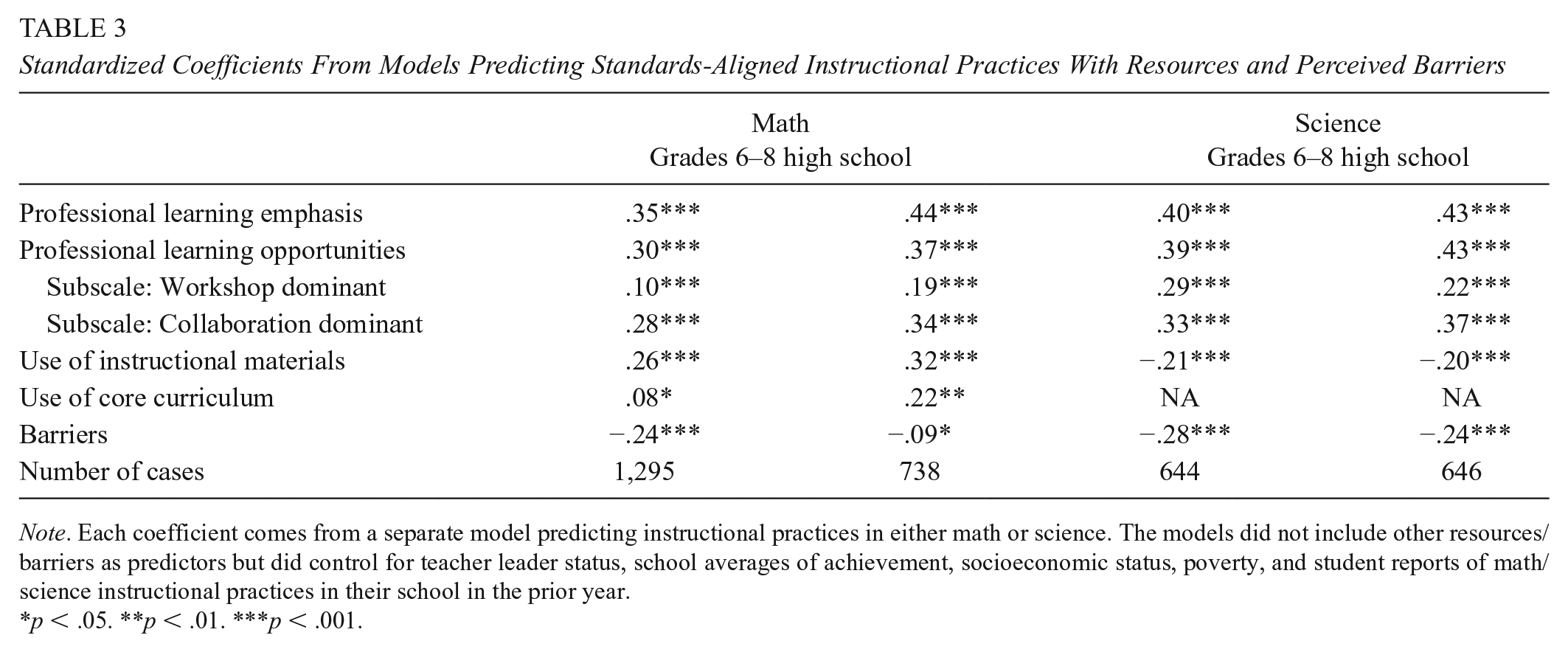
Note. Each coefficient comes from a separate model predicting instructional practices in either math or science. The models did not include other resources/barriers as predictors but did control for teacher leader status, school averages of achievement, socioeconomic status, poverty, and student reports of math/science instructional practices in their school in the prior year.
p < .05. **p < .01. ***p < .001.
Models Predicting Teachers’ Reports of Standards-Aligned Practices in 2018 With All Supports as Predictors
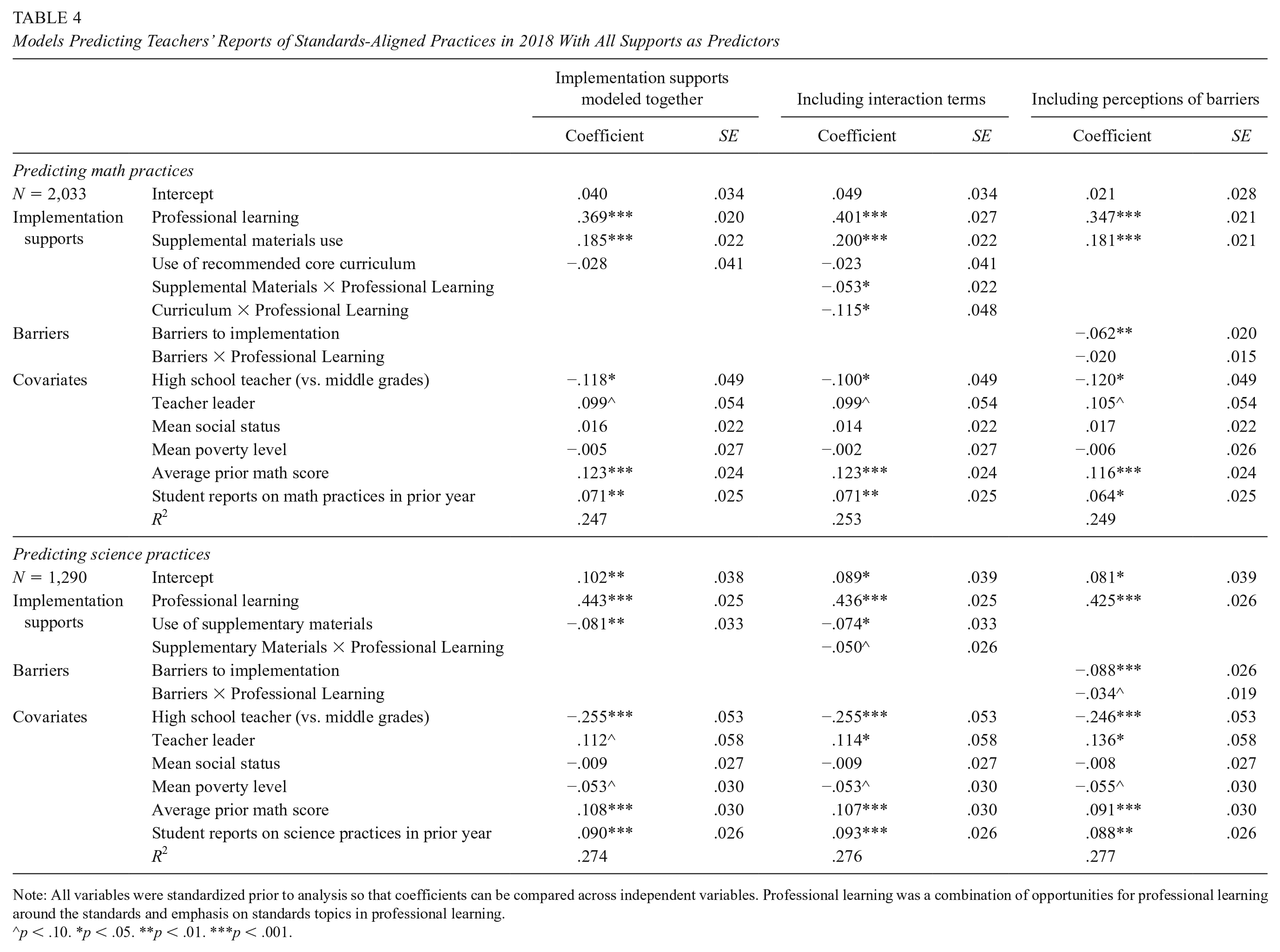
Note: All variables were standardized prior to analysis so that coefficients can be compared across independent variables. Professional learning was a combination of opportunities for professional learning around the standards and emphasis on standards topics in professional learning.
^p < .10. *p < .05. **p < .01. ***p < .001.
Use of a recommended core curriculum showed a modest positive relationship with instructional practices in models that did not control for other implementation supports (Table 3) but was not associated with stronger practices in the combined models (Table 4). This suggests that teachers using a core curriculum were more likely to participate in PL around the standards (or vice versa), and this accounts for the positive relationship with instructional practices. In fact, there was a negative interaction between use of a core curriculum and PL (–.115; see Column 2 in Table 4); the relationship of PL with practices was less strong among teachers using a recommended curriculum.
Math teachers who used supplementary materials from the Knowledge Center reported their students participating more frequently in CCSS-M-aligned math practices, with coefficients of .26 SD for middle grade math teachers and .32 SD for high school math teachers (Table 3). In the combined models, the coefficient remained significant but was smaller (about .19). The coefficients are additive; thus, standards-aligned instructional practices were more frequent among math teachers who had both more PL around the standards and greater use of the Knowledge Center resources. There was a negative interaction between use of supplementary materials and PL in math. However, the main coefficient on use of supplementary materials was larger than the interaction term and positive so that the combination of PL and use of supplementary resources was associated with the strongest practices in math.
Among science teachers, a greater use of supplementary materials from the Knowledge Center showed a negative relationship with NGSS-aligned practices, with standardized coefficients of about –.20. The coefficient remained negative in the combined model. There was a slightly negative interaction between PL and the use of supplementary materials in science. Thus, there was no benefit to using the instructional materials in science even if science teachers had more PL around the standards.
Teachers who reported more barriers to standards implementation reported less use of standards-aligned instructional practices in their classes, as expected. In both math and science, the relationships were significant and negative. The coefficients on barriers were smaller than the coefficients on PL. The interaction terms were not significant, suggesting that PL did not matter more or less for teachers based on their perception of barriers to standards implementation. Even among teachers who felt there were substantial barriers to standards implementation, greater participation in PL around the standards was associated with more standards-aligned instructional practices.
Student survey data confirmed that teachers’ participation in PL around the standards at their school was positively associated with student reports of standards-aligned instruction, especially in middle school math. Other instructional supports showed lower or negative associations with student reports of instruction. See Online Appendix F for details.
How Did Teacher Leaders Describe the Barriers and Supports That Mattered for Changing Standards-Aligned Practices?
Even though teacher leaders had more access to supports and resources than other teachers, they still struggled to help students transition to the active learning processes required by the new standards. In interviews, teacher leaders pointed to issues with students’ lack of preparation to engage in open-ended tasks without a clear answer. Teachers believed their students felt uncomfortable engaging in mathematical and scientific practices to investigate problems and build conceptual understanding of core ideas. Math teachers explained that students were used to being taught procedures and then told whether or not they got the right answer. Under the new standards, students became frustrated with the need to persevere in problem-solving and construct their own explanations. Science teachers also reported that students struggled with the transition from being instructed about content to constructing their own explanations, insisting, “You’re the teacher, tell me.”
Diversity in prior content knowledge and skills became additional barriers in teachers’ struggles to do more open-ended and student-led instructional tasks. Because student-led problem-solving could be time-intensive, teachers reported it was difficult to help students with preexisting knowledge differences catch up to grade-level content. Teachers also found it difficult to adjust to variation in the amount of time different students needed to construct explanations, which posed problems for classroom management.
Both math and science teachers reported insufficient time to make all the instructional changes they envisioned around the standards on top of their other responsibilities. In science, high school teachers struggled to balance students’ need for instruction aligned to science AP and SAT Subject tests. Because there was no district science assessment, teachers felt strongly pushed to prioritize responsibilities other than aligning instruction to the NGSS. Even when additional PL opportunities were made available to them, some teachers reported not having capacity to participate as much as they wanted to.
Perceptions of PL
Consistent with the patterns seen in the survey analyses, teacher leaders highly valued what they learned from the PL experiences provided by the district. They felt they received support as they developed and tried out new techniques from the university partners and informal education institutions that were providing PL. PLCs provided opportunities for ongoing collaboration with other expert teachers in their district networks. These relationships provided continued access to resources and strategies for supporting standards-aligned teaching and assessment.
Teacher leaders found it particularly beneficial when multiple staff members from the same school could experience PL together. As one teacher put it, “If I didn’t understand something, I had someone there and they back up to help me understand how to roll out a lab or how to explain it.” Having multiple teachers who had attended PL also helped build momentum for change in their schools. Teacher leaders talked about sharing information with colleagues in their departments and schools and working jointly to make progress toward goals, including aligning content vertically and horizontally, building rubrics and assessments, and developing lessons and activities. They also found it beneficial to make their practice open and transparent by documenting strategies and observing one another.
Whether there was more than one teacher leader highly engaged in PL differed by school. Even though the district intended for schools to have multiple teacher leaders, they reported that turnover, lack of resources, and lack of time sometimes prevented that from happening. So while some teachers felt they had close colleagues who were knowledgeable and working on instructional change with them, others felt less supported. This made a sizable difference in teachers’ feelings of efficacy in shifting their instruction. In schools where collaboration was encouraged and supported, teacher leaders discussed the importance of having regular opportunities for exchanging resources, materials, and ideas to improve instruction throughout the school day. Much of this collaboration time was informal, taking the form of lunch meetings, consultations during prep time, or other check-ins throughout the day. But teachers also noted how important it was to have dedicated time for these exchanges within the school day. In some schools, teachers were able to point to school structures for collaboration that facilitated innovation and change in teachers’ instruction. In other schools, the lack of structures for collaboration was seen as a barrier.
Perceptions of CCSS-Aligned Curricula and Supplementary Resources
Math teacher leaders reported that use of a district-approved curriculum helped build vertical alignment and horizontal alignment within schools, ensuring teachers covered all of the grade-level standards by the end of the year. However, they felt that the curricula did not always cover each standard in sufficient depth, and they welcomed the additional instructional materials provided by the district to help engage students in the concepts and practices called for by each standard.
Math teachers felt the instructional materials in the Knowledge Center allowed them to focus more on teaching than on figuring out what to do in each class. The materials made it very clear which standard they were addressing in a given lesson. They appreciated both the large quantity of resources and their utility. Teacher leaders felt students enjoyed the supplemental materials, which required them to persevere in problem-solving at an appropriate level of challenge. One teacher referred to the math materials as “life changing.”
Unlike math teachers, science teachers felt they had to figure out how to build standards-aligned lessons, activities, and assessments with little guidance, which became a source of stress. Teachers reported that the thought and processing that the sparse instructional materials provided by the district required took time away from instructional planning. In schools that had a science curriculum, teachers had to work to supplement and align the curriculum to the NGSS. Some found it helpful to attend PL offered by district partners on making these adaptations. In other schools, teachers built most materials from scratch. Given the major shifts in instructional design required by the NGSS and the lack of guidance in constructing aligned resources, this process was a heavy lift on top of teachers’ other responsibilities.
Study Limitations
A primary limitation of this study is that although we were interested in the effects of different implementation supports on teacher practices, our data did not allow us to generate causal estimates. Instead, we examined the relative size of relationships between supports and instructional practices, controlling for student reports of teacher practices in the prior year and student and teacher covariates to account for some unobservable potential confounders. Because we lacked data on individual teachers’ practices the prior year, we could not know the extent to which individual teachers changed their practices in response to supports, only that teachers using particular supports reported more frequent use of standards-aligned practices than teachers that did not use those supports. We also were limited in the degree to which we could verify the analyses of the teacher survey responses using a different source of data, such as student reports. Student and teacher information could be linked only at the school level, and the meaning of teachers’ use of supports was somewhat different when aggregated to the school level than on an individual level. Results of those analyses are given in Online Appendix F.
Qualitative interviews were only conducted with teacher leaders. Teacher leaders were more likely than other teachers to use the implementation supports, and all teacher leaders participated in at least some of the PL workshops provided by the district. Thus, our descriptions of teachers’ use of the implementation supports were based only on those teachers who had experience with them and were actively trying to change their instructional practices. Other teacher leaders in the district may have experienced supports and barriers differently from how they were experienced by study participants.
Discussion
In the years since adopting the CCSS-M and NGSS, educators nationwide have attempted to improve instruction and student learning using a number of different standards implementation strategies, yet there is little knowledge about how different types of supports are related to instruction under standards reform. Although our study does not provide a causal account of these relationships, it does shed light on how supports compare to one another in their relationships with teachers’ instructional practices. These findings are valuable for leaders charged with implementing instructional reforms in schools, who must make choices about how to select among various options to best support instruction and student learning. We show that not all implementation supports were equally related to teachers’ instructional practices in Chicago.
One of the most basic ways to try to promote standards-aligned instruction is to ensure teachers are using a standards-aligned curriculum. A prior study found no relationship between standards-aligned curricula and learning gains (Blazar et al., 2019). We found modest relationships between using a recommended core curriculum in mathematics and teachers’ standards-aligned instructional practices, but curriculum was not significantly related to practices when controlling for PL. Furthermore, the relationship between PL and instruction was smaller among teachers using a core curriculum; it could be that teachers who used a standards-aligned core curriculum felt they were already teaching to the standards by using the curriculum. This suggests caution in trying to promote changes in instructional practices primarily by changing curriculum materials. Because the district had not recommended any science curricula at the time of the study, we were unable to examine how use of a standards-aligned curriculum related to science instruction.
The types of supplemental resources available for modifying instructional practices seemed to matter considerably. In math, instruction-ready resources made it easier for teachers to implement new instructional practices. In science, the resources that were available at the start of NGSS implementation, which provided guidance on aligning scope and sequence but did not include lesson plans or student activities, put more demands on teachers because they had to figure out what to do themselves. In the years after we collected teacher survey data, the district recommended NGSS-aligned curricula and provided a range of additional resources and assessment materials, as have many districts across the nation. But the initial analysis, based on a time when there were unequal supports across subjects, highlights the importance of the types of resources available. As has been highlighted in prior research (Ball & Cohen, 1996), materials that are not easily used in the classroom to promote strong practices may not improve instruction, and they could make it worse because they introduce more confusion for teachers.
PL requires time for teachers and can be more complicated and costly to implement than providing a new curriculum or new resources. However, PL around the standards emerged as the most important implementation support for standards-aligned instructional practices. Teachers’ participation in PL around the standards showed large, consistent relationships with their standards-aligned instructional practices, independent of other supports. The relationships were similar across grades and subjects, providing support for the conclusion that PL was instrumental in promoting strong practices. These findings are consistent with prior research on PL around the CCSS (Allensworth et al., 2021; Kane et al., 2016; Tyler et al., 2018).
It is important to note that our measure of PL included opportunities beyond district-sponsored workshops, including collaboration. Teachers in our qualitative study reported that collaboration with knowledgeable colleagues was key for translating PL into classroom practice. These findings echo other studies that have found that collaboration increases PL’s effectiveness (Daly et al., 2010; Darling-Hammond et al., 2017; Frank et al., 2004; Moolenaar et al., 2012; Sun et al., 2013). In Chicago, the district did not expect all teachers to implement the standards in the same way but asked teachers to experiment and collaborate with colleagues to figure out what worked for them. They provided opportunities for teachers to network, and these opportunities helped teachers work through the complexity involved in shifting instruction to align with the new standards. These findings stand in contrast to the study by Kane and colleagues (2016), which found no effect of teacher collaboration on student achievement. However, the same study found that classroom observation followed by feedback on the CCSS had a positive effect on student achievement, especially when feedback came from a department chair. Synthesizing the results of our study and findings from Kane and colleagues suggests that the effectiveness of collaboration may depend on how knowledgeable one’s colleagues are about the standards and/or the focus of that collaboration; it may not be helpful to collaborate if there is little expertise or if the collaboration is not focused on instructional change.
It is also noteworthy that supports around PL and math instructional resources were related to stronger instruction even when teachers reported facing barriers to implementing the standards. As found in other studies (Edgerton & Desimone, 2018; Scholastic and Bill & Melinda Gates Foundation, 2014), the most challenging barrier teachers reported was related to student preparation. The new standards called for students to build conceptual understanding by engaging in complex problems and phenomena. Teachers found it difficult to engage students in this type of work, and teachers who perceived these barriers reported engaging in fewer standards-aligned instructional practices, on average. But when they experienced strong PL, even teachers facing barriers reported much higher levels of standards-aligned instruction. In fact, the supports appear to have helped teachers experiencing barriers as much as they helped teachers who perceived no barriers. Additionally, teachers’ reports of standards-aligned practices in their classrooms were significantly related to gains on assessments in mathematics and science, even for students with low prior test scores.
Even in states that have made changes to their standards since first adopting the CCSS-M and NGSS, PL is a valuable support for teachers seeking to improve instruction for conceptual understanding, and it seems to be most effective when teachers can collaborate with knowledgeable colleagues as they work on instructional change. Simultaneously providing standards-aligned instructional materials that are easy to implement may provide time for teachers to focus on strategies for engaging diverse students in high-level thinking. Both the math and science standards call for students to engage in new approaches to problem-solving and explanation, and teachers seem to benefit from ample opportunity to try out new instructional approaches and learn from knowledgeable colleagues in much the same way.
Supplemental Material
sj-docx-1-ero-10.1177_23328584221088010 – Supplemental material for Supporting Change in Instructional Practices to Meet the Common Core Mathematics and Next Generation Science Standards: How Are Different Supports Related to Instructional Change?
Supplemental material, sj-docx-1-ero-10.1177_23328584221088010 for Supporting Change in Instructional Practices to Meet the Common Core Mathematics and Next Generation Science Standards: How Are Different Supports Related to Instructional Change? by Elaine Allensworth, Sarah Cashdollar and Amy Cassata in AERA Open
Footnotes
Acknowledgements
We would like to thank Jeanne Century from UChicago STEM Education, University of Chicago, and Jessica Mahon at the Chicago Public Schools for their partnership and input on this work. The research reported here was supported by the Institute of Education Sciences, U.S. Department of Education, through Grant R305A160162 to the University of Chicago. The opinions expressed are those of the authors and do not represent views of the Institute or the U.S. Department of Education.
Correction (January 2023):
Article updated to correct the grant number.

Authors
ELAINE ALLENSWORTH is the Lewis-Sebring Director of the University of Chicago Consortium on Chicago School Research. Her research examines factors influencing students’ educational attainment, school leadership, and school improvement.
SARAH CASHDOLLAR is a research specialist at the Illinois Workforce and Education Research Collaborative (IWERC) at the Discovery Partners Institute of the University of Illinois System. She researches efforts to improve adolescents' preparation for the transition from high school to postsecondary education and work.
AMY CASSATA is formerly a senior research scientist at Outlier Research & Evaluation, UChicago STEM Education, University of Chicago and is currently a senior consultant at Insight Consulting Group. While at UChicago, her research was focused on understanding supports and barriers to the implementation of innovative educational tools, programs, and policies.
References
Supplementary Material
Please find the following supplemental material available below.
For Open Access articles published under a Creative Commons License, all supplemental material carries the same license as the article it is associated with.
For non-Open Access articles published, all supplemental material carries a non-exclusive license, and permission requests for re-use of supplemental material or any part of supplemental material shall be sent directly to the copyright owner as specified in the copyright notice associated with the article.
