




Abstract
With the growing attention to the effective use of social network analysis in explaining student learning in STEM (science, technology, engineering, and mathematics) education, the authors explore why college students share knowledge and how they achieve their learning in a laboratory class. In particular, the authors investigate how the social capital each student builds influences individual knowledge sharing and its related learning. The authors establish a research model derived from social capital theory that explains the relational, structural, and cognitive capital the class builds. Network data from 120 students in a lab class in a mechanical engineering department in the United States were collected and analyzed to test the research model and hypotheses using the multiple regression quadratic assignment procedure and UCINET. The findings show that the knowledge sharing mechanism and student learning outcomes can be explained in terms of their social capital within social networks. Last, the authors discuss the theoretical and practical implications for college student learning in a laboratory class in STEM education.
On one hand, past research has proved knowledge sharing among individuals to be one of the major learning processes. Social capital theory can provide a useful theoretical lens, as it emphasizes the importance of social networks embedded in knowledge-sharing ties (Bordogna, 2019; Fearon et al., 2018). To explain learning performance through knowledge-sharing ties in postsecondary education, in this study we adopted social capital theory. On the other hand, it is important to improve methodological shortfalls in knowledge sharing research. Considering the dyadic nature of the learning process through knowledge-sharing ties, a network perspective and an approach to network analysis cannot be disregarded. Despite the growing interest in knowledge sharing on the basis of social interaction, there is surprisingly little empirical research regarding the knowledge-sharing processes of social networks and how social capital relates to sharing knowledge. To fill the gaps in the current literature, we explore social capital dimensions as antecedents of knowledge sharing and learning performance by using social network analysis. The purpose of this study is to better understand knowledge sharing and learning performance in a laboratory setting at a higher education institution by examining why students share knowledge and how they achieve better performance in a social capital framework. The laboratory learning environment of an engineering school was purposefully selected because there is strong pressure to learn the content by engaging in the laboratory projects creatively and collectively.
On the basis of an integrative literature review, in this research we focus on the relationships among students of a knowledge-sharing network as a source of social capital, operationalized as three dimensions following Nahapiet and Ghoshal’s (1998) framework. We also explore the mediating role of knowledge sharing between social capital and learning outcomes as follows (see Figure 1).

Research framework.
Literature Review
Social Capital and Learning in Higher Education
Social capital can be broadly defined as an investment with expected returns engendered in social relations and can be mobilized to facilitate collective action such as knowledge sharing and collaboration (Adler & Kwon, 2002). Social capital consists of embedded resources in a social structure motivating people to work together to achieve a shared goal (Lin, 2001). To explore learning performance through knowledge sharing, in this study we define social capital as the actual or potential learning resources that are linked to possession of a durable network of mutual acquaintances. Social capital represents the aggregate of individual students’ resources to secure common benefits through social obligations and interactions. Associated with knowledge-sharing ties, structural capital is manifested as interdependence and interaction ties, relational capital as a trust and reciprocity norm, and cognitive capital as awareness of expertise and shared norms (Nahapiet & Ghoshal, 1998). In this conceptualization, social capital needs to be managed and mobilized appropriately to achieve a desirable learning outcome (Pilbeam et al., 2013). In education research, the effect of social capital on a student’s academic achievement in K–16 and pathway to higher education has been extensively explored (Abada & Tenkorang, 2009; Anderson, 2008; Yamamura, 2012). For example, Sun (1999) argued that various characteristics of social capital are consistently associated with academic attainment, controlling for socioeconomic and demographic factors. In addition, Abada and Tenkorang (2009) examined how parental and community social capital affected immigrant youth’s pursuit of higher education in Canada. They confirmed that parental university education is an important predictor of children’s higher education attainment. Some forms of social capital are unique to certain groups and can be used to explain academic achievement in education (Hasan & Bagde, 2013; Mamas, 2018). Fuller (2013) suggested trust as a prerequisite for the investment and accumulation of social capital, facilitating “a student’s willingness to accept social norms and legitimacy of the education” (p. 143).
A higher education institution is a source of social capital for students. Social capital developed through college education can have a direct impact on a student’s employment experience and social mobility (Lee & Brinton, 1996). Learning performance is significantly influenced by how college students cultivated social capital in an education setting (Waters & Leung, 2013). In addition to the social network nurtured on college campuses and among alumni, class continues to play an important role in shaping a college student’s acquisition of social capital. The process of social capital acquisition by college students helps them achieve better employment (Lee & Brinton, 1996). Students’ collaborative learning experiences through group engagement can potentially increase their social capital after graduation (D’Agostino, 2010). On the basis of these findings, we argue that higher education institutions should develop and offer collaborative learning activity through knowledge sharing, a positive outcome of which is social capital. Social characteristics identified as facilitating such initiatives included a denser social network, higher institutional and social trust, and a tendency to follow regulations (Evangelinos & Jones, 2009). Thus, social capital can also be used to explain student achievement and learning performance.
Hypothesis 1: Social capital will be associated with student learning performance.
Definition of Knowledge Sharing
Knowledge sharing refers to the activities by which people exchange information, skills, or expertise with others (Bock et al., 2005). It includes the behaviors of giving knowledge to others and receiving knowledge from others (Ergun & Avci, 2018). Previous studies support the positive relationship between social capital and knowledge sharing in various contexts such as industry, academia, virtual or face-to-face environments, and different countries (e.g., Brouwer & Jansen, 2019; Chang & Chuang, 2011; Diep et al., 2016; Leana & Pil, 2006; Lefebvre et al., 2016). Not only is it important to recognize individuals’ cognitive processes in laboratory learning, but it is also critical to understand how they learn from social relations, determining how information is constructed into knowledge. The knowledge-sharing process in engineering education implies that knowledge is constructed through the facilitation of social capital. In other words, what constitutes knowledge for one might be information for others, and what counts as knowledge for the group in class might become a key asset for the group project. To understand the knowledge-sharing process, we used a social network analysis approach based on the theory of social capital. The main features of social capital can be measured by interactions among students in class. Characteristics of social relationships are viewed in terms of social capital. Individual students are actors within the social network, and ties represent the flow of relationships and knowledge sharing among students.
The Link Between Knowledge Sharing and the Main Features of Social Capital
The research on social capital and knowledge sharing in a college class is not plentiful; however, the positive relationships between knowledge sharing and the dimensions of social capital in higher education can be reasonably assumed on the basis of previous studies. Levin and Cross (2004) emphasized the role of trust, as trust relationships enable people to engage in more knowledge-sharing behaviors. In a similar vein, Brouwer and Jansen (2019) collected data from college students taking a psychology course regarding their knowledge sharing and other student variables such as altruism, trust, and belongingness. The research results show that trust, a component of the relational dimension, is strongly related to attitudes and outcome expectations of knowledge sharing. In other words, college students with greater trust have more positive attitudes toward knowledge sharing, and such positive attitudes enhance knowledge sharing outcome expectations. Thus, as the relational dimension of social capital, trust facilitates knowledge sharing among students.
In this study, cognitive social capital refers to students’ perceived awareness of an expert in a class. It has been suggested that individuals who possess awareness of expertise can better see the potential value of sharing their resources. A number of studies have demonstrated a positive relationship between the cognitive dimension of social capital and knowledge sharing (e.g., Cross & Cummings, 2004; Cross et al., 2006). For example, Aslam et al. (2013) showed that students possessing shared cognitive capital such as a shared language and awareness of expertise are more engaged in knowledge-sharing activities with their peers. In sum, the awareness of expertise among students is associated with a higher ability to share knowledge and expertise. In addition, the structural characteristics of social capital are also related to knowledge sharing (Tsai & Ghoshal, 1998). Researchers reported the level of task interdependence as an important predictor of expertise exchange in project groups (Yuan et al., 2006) and knowledge sharing leading to project work performance (Pee et al., 2010). In the context of higher education, van den Bossche et al. (2006) found that task interdependence and social interaction enhance college students’ team-learning behaviors, including creating and sharing knowledge together as a team. Recently, Han et al. (2020) explored the relationship between dimensions of social capital and knowledge sharing in a graduate-level management classroom. They found that the structural dimension of social capital had a stronger influence in predicting knowledge sharing, despite the significant effect of all three dimensions of social capital on knowledge sharing. Considering the previous studies on social capital and knowledge sharing among college students, we propose the following hypotheses:
Hypothesis 2: Social capital will be associated with knowledge sharing.
Hypothesis 2a: Structural capital will be associated with knowledge sharing.
Hypothesis 2b: Relational capital will be associated with knowledge sharing.
Hypothesis 2c: Cognitive capital will be associated with knowledge sharing.
Knowledge Sharing and Learning Performance
The importance of knowledge sharing in class has been gaining attention in academic environments (e.g., Héliot et al., 2019; Rienties & Héliot, 2018). Academic environments such as universities are important hubs for students to obtain and experience such practical knowledge and skills (Twale et al., 2002). In their research of knowledge-sharing behaviors in learning environments, Boateng et al. (2017) examined the factors influencing students’ knowledge-sharing attitudes and found that trustworthy qualities of their peers such as integrity, benevolence, and ability were positively related to students’ attitudes toward knowledge sharing.
It is important to encourage and facilitate knowledge sharing in classrooms because learning is a social process. From the social constructivist perspective of learning, social interactions with peers and instructors play a critical role in one’s thinking and learning (National Academies of Sciences, Engineering, and Medicine, 2018). Students’ learning and development are achieved through their interactions with more capable peers (Vygotsky, 1978). Bandura (1999)’s social cognitive theory and the human agency principles also emphasize the social nature of learning and the achievement of desired performance. As a great deal of knowledge emerges from social interactions among students, a classroom can serve as a learning community in which students can socially share knowledge and engage in the sharing of knowledge conducive to positive learning outcomes.
Particularly, how learning communities should be established and facilitated in classrooms has been actively discussed in the education literature (Han et al., 2020). In a classroom as a learning community, the ultimate goal is to establish a learning culture such that every student participates in a collective effort of understanding and in that way to support that growth of the individual student (Bielaczyc & Collins, 1999). For an individual student to work as a learner and a contributor, the sharing of diverse knowledge among students should be valued and supported to develop their own expertise and expand collective knowledge. In line with social capital and an educational context, the community of inquiry model (Garrison, 2017) is a useful theoretical framework to design, support and analyze students’ learning via social interaction in asynchronous learning environments. A strong community of inquiry can facilitate critical discourse and reflection, leading to students’ meaningful knowledge construction and learning experience. The importance of students’ interaction and learning with peers has been emphasized and explored in the areas of learning communities and collaborative learning. However, the focus of our scholarly efforts has often been understanding or improving students’ interaction and discourse centered on learning activities. Exploring students’ knowledge sharing from a social capital perspective will further expand our current understanding of the social nature of learning by examining students’ knowledge sharing and their knowledge network beyond the level of learning activities.
Although in early development, the relationship between knowledge sharing and learning performance has been excogitated in higher education. For example, Eid and Al-Jabri (2016) showed students’ knowledge-sharing behaviors and their learning performance by exploring university students’ ways of using social networking sites in relation to their learning. They found that chatting, online discussion, and file sharing using social networking tools were predictors of knowledge sharing and that knowledge sharing was a strong predictor of learning performance. Aslam et al. (2013) found that community-related outcome expectations have a significant impact on students’ knowledge sharing. That is, students would likely share knowledge in their academic social network when they perceive that their sharing would help the development of their learning performance. It is notable that both studies collected data from university students, yet the focus of knowledge sharing in these studies was not situated in a classroom environment in which students learn together with their peers. Therefore, on the basis of the positive impacts of knowledge sharing on learning performance and the social learning literature, we propose the following hypothesis:
Hypothesis 3: Knowledge sharing will be associated with students’ learning performance.
The Mediating Role of Knowledge Sharing Between Social Capital and Learning Performance
Among the various antecedents and mediators of students’ learning performance, social capital emerges as one important antecedent of students’ learning. As mentioned, classrooms can serve as social learning environments conducive to students’ building their social capital. Formed by establishing trust and shared languages with peers, such social capital can shape their knowledge-sharing attitudes and behaviors (Aslam et al., 2013; Brouwer & Jansen, 2019). Scholars advocating learning communities consider students’ participation in knowledge sharing as a critical component in building and advancing their shared understanding (Bielaczyc & Collins, 1999). Furthermore, for effective and meaningful knowledge sharing that facilitates students’ learning performance, three dimensions of social capital are often emphasized: structure for students to share, discuss, and collaborate (e.g., Yuan & Kim, 2014); students’ sense of belongingness and willingness to share (e.g., Chang & Lee, 2012); and an understanding of one another’s strengths and expertise (e.g., Fields et al., 2018).
In sum, considering the previous studies showing causal relationships between the positive effect of social capital and knowledge sharing (Aslam et al., 2013; Brouwer & Jansen, 2019; Han et al., 2020) and the positive effect of knowledge sharing on students’ learning performance (Abada & Tenkorang, 2009; Anderson, 2008; Yamamura, 2012), we can assume that students with high social capital will do more knowledge sharing, which can cause better learning performance. However, knowledge sharing as a mediator in the relationship between social capital and learning performance has yet to be clearly specified in the current empirical literature. Therefore, to investigate such a mediating role for knowledge sharing, we propose the following:
Hypothesis 4: Knowledge sharing will mediate the relationship between social capital and learning performance.
Methods
Participants and Data Collection
This study was conducted in a class in the mechanical engineering department at a public research university in the southeastern United States. The course requirements included a series of group-based projects to be completed at an instructional laboratory to provide the hands-on experience necessary to effectively gain the fundamental knowledge, practical techniques, and research capability readily applicable in real-world practice. More specifically, students were randomly assigned to groups to work together on four projects throughout the semester. Laboratory sessions were an important aspect of the course, as students sat with their group members and discussed ways to accomplish tasks together. As a practical discipline, an instructional laboratory is an essential learning environment for engineering education (Feisel & Rosa, 2005). Effective communication about laboratory work and effective teamwork are important fundamental objectives that students should achieve from learning in engineering instructional laboratories (Feisel & Peterson, 2002; Feisel & Rosa, 2005). In addition, the course also used an online discussion forum in a learning management system so that students could voluntarily share their group project experiences and progress. All students in this class were invited to participate in this network study.
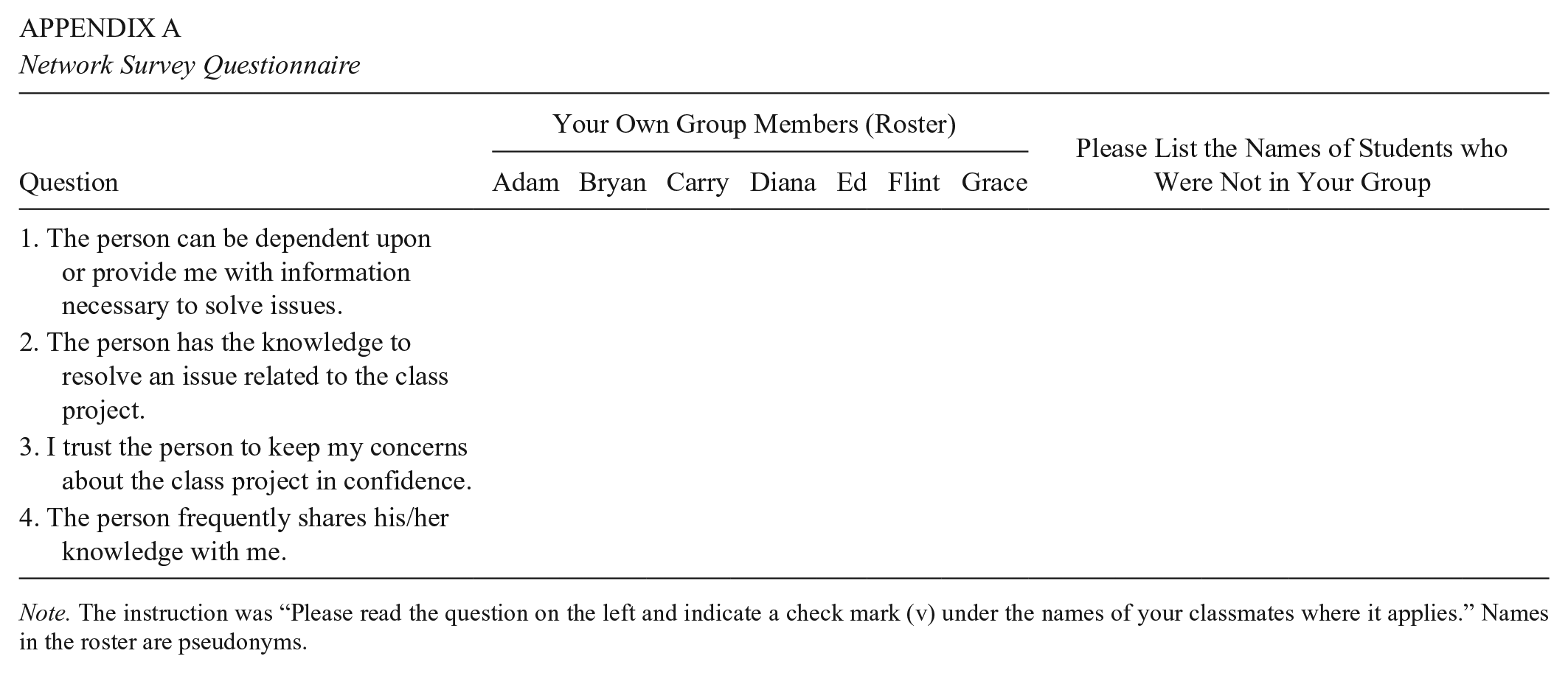
This study focused on how perceptions of intergroup collaboration in the framework of social capital influence knowledge sharing throughout the semester. To capture the intentions and behaviors produced by social ties in laboratory learning, researchers offered an orientation at the beginning of the semester and administered a network survey at the end of the semester. Survey data were collected to determine the effects of social capital and knowledge sharing experience in class. The survey contained measures of social structural, and relational influences (social capital), as well as knowledge-sharing networks, which were developed and validated (e.g., Cross et al., 2001; Han et al., 2020). All these key constructs were directly measured as network ties. Each survey listed group members (the roster approach) and each student was asked to indicate the alters regarding task interdependency, trust, awareness of expertise, and knowledge sharing. In addition, it added a free-recall column for identifying members of their network (the name-generators approach). After the survey was completed, we randomly chose 12 students and briefly interviewed them to assess how well they understood this network survey and to ask if they could note a critical incident with those whom they marked in the survey (see details in Appendix A).
Both perceived networks of social capital and knowledge sharing were regarded as asymmetric. That is, the fact that student i shared knowledge with student j does not guarantee that student j also shared knowledge with student i in return. To reduce response errors, before we distributed the questionnaire to the students, we asked instructors and teaching assistants to complete the network survey and clarified some words in the questionnaire. As a result of our efforts through interviews and a pilot test, we concluded that respondents needed to learn how to fill out the network survey. Thus, all network data were gathered after the information session for the network survey. Of the 119 students in this same lab course (91 men and 28 women, average age = 19.8 years), all students completed a network survey questionnaire as part of the final assignment. We described the research as a study of the effects of networks in laboratory learning. Because it is important to minimize missing data, follow-up data collection was conducted during the final exam week. As a result, 119 × 119 network matrices for each of the variables were created. Each of the matrices was first correlated with one another, similar to the bivariate correlations. Finally, to control for interdependencies among the influence matrices, each of the matrices was regressed on the full set of matrices as a series of quadratic assignment procedure (QAP) multiple regressions (Krackhardt, 1988).
Measures
All variables were measured in dyadic format, and attribute data such as gender, grade, and race were converted into pairs of homophily. Because of characteristics of network data, the assumptions of ordinary procedures for statistical inference were not adopted (Krackhardt, 1988). Instead, all network indexes, including social capital and knowledge-sharing networks, were analyzed on the basis of nonparametric significance tests. To capture respondents’ cognitive maps of the social capital in this class, we asked each person about his or her perceptions concerning every other person’s network links as per three dimensions: interdependency, awareness of expertise, and trust. For interdependence relations, the corresponding item was “The person can be dependent upon or provide me with information necessary to solve issues” (Cross et al., 2001; Perry et al., 2018). For awareness of expertise, the corresponding item was “The person has the knowledge to resolve an issue related to the class project” (Tsai & Ghoshal, 1998). For trust, each person responded to the following item about every other person: “I trust the person to keep my concerns about the class project in confidence” (Cross et al., 2001). For the knowledge-sharing network, we asked the students to list “the person [who] frequently shares his/her knowledge with me.”
Network survey questions asked about dyadic relationships on the basis of an ordered pair of participants. All the items were directly measured as network relations. That is, each survey questionnaire asked the respondent to indicate the social capital dimensions and knowledge sharing from each of the other participants. Following Marsden’s (1990) recommendation, several steps were taken to ensure reliability. First off, questions were constructed to be specific and provide details regarding the construct of interest: trust, interdependency, and perceived expertise. Then, we sought to elicit typical patterns of interaction, as prior research indicates that recall of specific interactions that occurred in specific time intervals has lower reliability than more general measures of typical interactions. This was pretested on a group of students from a pilot group. A pilot group debriefing of this response suggested that people were interpreting items correctly on the basis of both general understanding of the items and their ability to recount specific instances in which they received the three dimensions of social capital.
The form of the present data is four 119-by-119 (Respondents × Respondents) matrices. For each pair (i, j), participant i’s relationships with participant j were measured on the basis of the respondent’s choice of acknowledging the existence of said relationship. To examine the efficacy of the model and the significance and comparative strength of structural, relational, and cognitive networks, we used multivariate logistic regression on the basis of the QAP (Borgatti et al., 2013; Dekker, Krackhardt, & Snijders, 2003). Likewise, we collected the performance ratings in a 119-by-119 matrix. Each row on the dependent variable matrix indicated the group project scores concerning the performance of others. Similarly, each column in the matrix represented the learning performance held by all those group members. To decrease the possibility of random error from a one-item measure of performance, the performance matrix contained scores, combining the group project scores with the peer evaluation (Scott, 1991).
To control the potential influence of individual demographic attributes, gender, academic year, and race were recorded. These components are recognized attributes of a network node. The assumption of homophily is that one has positive ties with those who are similar to oneself in socially significant ways (Borgatti et al., 2013). For instance, it is reasonably expected that a senior student will be more likely to share knowledge with those who are in the same cohort. These attribute data were converted into matrix data as similarities and differences comparing the value of the column vector to the same information represented by the row vector. That is, when participant i identified j as the same gender, they were coded 1, and different-gender pairs were coded 0.
The results of network-level analysis show that the knowledge-sharing network consisted of 413 dyadic relationships, having network density 1 and diameter of 0.034 and 10, respectively (see Table 1). The knowledge-sharing network, which was a focus of this study, had relatively smaller numbers of dyadic relationships compared with those of structural and relational capital. Given its size and degree of interconnectedness, the knowledge-sharing network had fewer students in the central circle and more remote people connected through direct paths (see Figure 2). Although the trust and awareness of expertise networks showed similar degrees of density with knowledge sharing, trust’s diameter was greater than that of any other network, indicating trust network efficiency with loose compactness of network.
Network-Level Indicators


Networks of social capital and knowledge sharing.
The network diagrams shown in Figure 2 present a social structure by visually depicting the distinct collaboration patterns of the four constructs in the research framework. The striking aspect of these maps is the relatively different patterns of clustering and structures. Comparing the task interdependence map with the trust relations that broadly connected one student to others shows that tasks for group projects were tightly interdependent through a few members of the groups who were located at the center of the network. In this case, the density of task interdependence is relatively higher than that of other networks. This indicates that the network’s tendency for task interdependence to form dense local pockets of connectivity results in actual groups in this class having a high degree of clustering (0.483). Each network shows a different level of centrality 2 for each student. The node size in Figure 2 represents the individual-level degree-centrality magnitude of each relationship, and the color represents the participants’ group. In the knowledge-sharing network, for instance, Student 3 functions as an intermediary who is positioned between students of more power and influence. It is found that Student 3 was a key player for knowledge sharing, as indicated by the highest in-degree on knowledge sharing. With regard to knowledge sharing, Student 3 is the most popular and influential person in this class. Student 57 is also known as a bottleneck, who acts as a link between two groups. This student could not spare time to answer the group members’ questions. Student 60 was another key player for knowledge sharing as a central connector with the highest in-degree on knowledge sharing. Each group was connected to one another through a specific student who acted as a cut point in bridging knowledge between groups.
Analysis
We tested our hypotheses using the QAP. Krackhardt (1988) introduced the QAP to the analysis of relational data as similar to ordinary multiple regression. This approach is a useful technique to correct the autocorrelation problem in the comparison of sociomatrices. We used the multiple regression QAP (MRQAP) suggested by Krackhardt (1993). First, ordinary least squares estimates of regression coefficients are calculated in the usual manner. Then, the rows and columns of the dependent variable matrix are permuted to give a new matrix. The ordinary least squares regression calculation is then repeated with the new dependent variable. This new regression produces different β coefficients and overall R2 values that are stored away. Another permutation of the dependent variable is then drawn, another regression is performed, and these new values are also calculated.
This permutation-regression process is repeated an arbitrarily large number of times (n = 5,000). The distribution of the stored β coefficients and R2 values for each of the independent variables under the set of permuted regressions becomes the reference distribution against which the observed original values are compared. The advantage of this procedure is in its robustness against varying and unknowable amounts of row and column autocorrelation in the dyadic data. If a sample is drawn from an autocorrelated population in which the null hypothesis is true, the probability that the results will appear significant by this MRQAP test is .05 (a = .05). This feature of the MRQAP occurs because the test is a conditional nonparametric test. That is, each permutation of the dependent variable retains the structure of the original dyadic data and therefore preserves all the autocorrelation in each permuted regression; the test is conditioned on the degree of autocorrelation that exists in the data.
Results
Table 2 presents the mean values, standard deviations, and correlations for the constructs of social capital dimensions and knowledge sharing in this study. Relationships captured in each matrix were asymmetrical, meaning that the captured relationship was directional, not reciprocal (Krackhardt, 1993). The QAP correlations used a matrix form to be tested. All social capital dimensions are strongly correlated with knowledge sharing, providing initial evidence for the hypotheses of this study. Interestingly, homophily assumptions of grade and gender are significantly correlated with knowledge sharing. That is, participants tend to share more knowledge with those of the same academic year and gender.
Descriptive Statistics and Correlations

Note. N = 120, permutations = 5,000. NA = not applicable.
p < .05. **p < .01.
Hypotheses Testing
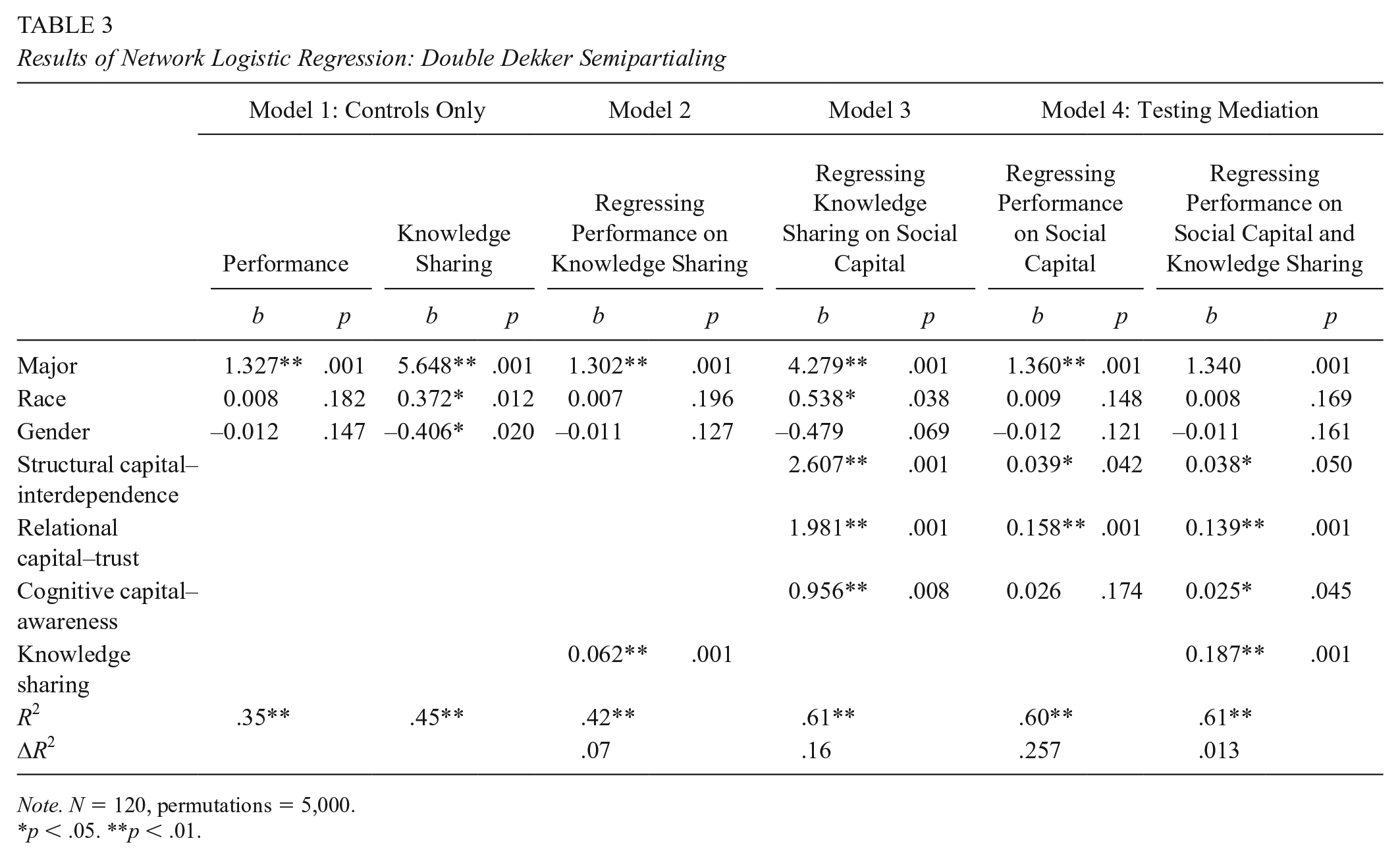
Table 3 shows the results of the MRQAP. Several models are estimated. Model 1 includes control variables: the same attributes of grade, race, and gender. Model 2 adds social capital dimensions to estimate the direct effects of structural task interdependence, mutual trust, and cognitive awareness of expertise. Hypothesis 1 suggests that knowledge sharing will be positively related to learning performance. Model 2 in Table 3 suggests that introducing the knowledge-sharing variable into the control variable model explains an additional 7% of performance variance (p < .01). The regression coefficient is positive, supporting Hypothesis 1.
Results of Network Logistic Regression: Double Dekker Semipartialing
Note. N = 120, permutations = 5,000.
p < .05. **p < .01.
Hypotheses 2a, 2b, and 2c predict that social capital will be positively associated with knowledge sharing. These hypotheses suggest that structural, relational, and cognitive capital are independently related to knowledge sharing between individuals. The correlation table suggests all three dimensions of social capital are positively related to knowledge sharing (p < .05). Model 3 in Table 3 shows that entering task interdependence (β = 2.607, p < .01), trust (β = 1.981, p < .01), and awareness of expertise (β = .956, p < .01) into the regression equation after the three control variables explains an additional 16% of the variance in knowledge sharing (p < .01). The coefficients for all social capital are significant and positive, supporting Hypothesis 2. Hypothesis 3 suggests that knowledge sharing will be positively related to learning performance. Model 2 in Table 3 suggests that introducing the knowledge-sharing variable into the control variable model explains an additional 7% of performance variance (p < .01). The regression coefficient is positive and weak, supporting Hypothesis 3 (β = .062, p < .01).
Hypothesis 4 suggests that knowledge sharing will independently mediate the relationships between social capital and learning performance. In light of Shrout and Bolger (2002)’s protocol to assess mediation, the mediating effects of knowledge sharing between social capital and performance were tested. First, the relationship between the mediator and the dependent variable was examined. This result supported Hypothesis 1. Second, relationships between the independent variables and the mediator were tested. The results for Hypotheses 2a, 2b, and 2c support the association of social capital with knowledge sharing. Task independence, trust, and awareness of expertise were all significantly related to knowledge sharing. Third, an association between social capital and performance was tested. The first column of Model 4 in Table 3 shows that the inclusion of the three social capital variables explains an additional 25% (p < 0.01) of the performance variance. Interdependence and trust are positively associated with learning performance (p < .05). The greater task interdependence and trust were, the higher the learning performance among the group students. Then, the inclusion of the knowledge sharing in Model 4 that includes the control variables and the three social capital variables explains an additional 1.3% of the variance (p < .01) of learning performance. The knowledge-sharing coefficient is positive and significant (p < .01). The regression coefficients for interdependence and trust decreased (.001 and .018, respectively), providing an initial estimate of the indirect mediating effect of knowledge sharing for these two variables.
In summary, knowledge sharing is associated with learning performance. In Step 2, Model 4 confirmed a positive relationship between social capital and knowledge sharing. Next, a relationship between social capital and learning performance is confirmed. As seen in Model 4a in Table 3, all social capital dimensions are independently positively associated with performance (Hypothesis 1). Unlike consistent mediation, where in Step 4 one expects to see a reduction in the relationship between the main variable and the dependent variable following the introduction of the mediator, one expects to see a strengthening of this relationship in the presence of inconsistent mediation. As seen in Model 4b in Table 3, this effect is not observed. Thus, Hypothesis 4 predicted that task interdependence and trust would have an indirect, positive relationship with learning performance mediated by knowledge sharing. The positive relationship between cognitive capital and performance, independent of knowledge sharing, was also observed, providing support for Hypothesis 4 (β = .038, p < .01).
Discussion
The main purpose of this study is to explore the social relations and knowledge sharing in laboratory learning in engineering education. Although previous research highlighted the importance of social capital to knowledge sharing in the workplace (e.g., Han et al., 2019), few studies have systematically examined the network effectiveness of different dimensions of social capital on knowledge sharing for college students’ learning. The results of this research contribute to the literature on college students’ learning by demonstrating how a social ability to share and create knowledge is influenced by both formal social structure and informal mutual relations in the classroom.
Formal structure represented by task interdependence shows a positive impact on knowledge sharing. The more task interdependence became prominent in the project process, the more the participants were willing to share critical knowledge with others. This finding confirms the existing literature in workplace and higher education learning that task interdependence as a social structure facilitates knowledge sharing and creation between individuals (Cross et al., 2001; Han et al., 2019; van den Bossche et al., 2006). Regarding a social network structure being a vehicle for facilitating collaboration through the forming of social capital, a network of strongly interconnected relationships based on task interdependence generates a knowledge sharing opportunity effectively and facilitates collaboration efficiently (Gargiulo & Benassi, 2000). Thus, a cohesive network of groups results in an extensive amount of knowledge sharing between students. For college students’ learning, this result suggests the importance of instructors’ creating learning tasks and their structure conducive to building optimal interdependence among students during their group projects and collaborative learning.
Mutual trust manifested in social interaction shows a significant positive effect on knowledge sharing among individuals. Having trust in others makes one more likely to share knowledge with others. The results confirm the importance of social interaction as an effective mutual trust mechanism in knowledge sharing in college classes (Brouwer & Jansen, 2019). Social interaction allows individual units to accumulate relational capital and a norm of reciprocity that can help them gain access to new knowledge or new information (Chow & Chan, 2008). The flow of knowledge through social networks requires social interaction to promote mutual trust among students. Knowledge sharing consists of complex patterns of social relations that demand collaborative efforts based on trust.
In this study we also examine the cognitive dimensions of social capital by factoring in an awareness of the other’s expertise. Information and know-how are not evenly shared in the project, and the advice of key members is more sought after. Through the semester, the informal expertise of key members emerges whose status is clear among their peer members and who receive respect from them through social interactions. This cognitive recognition from peers is informal but becomes a remarkable motivation to engage in knowledge sharing (Yuen & Majid, 2007).
It is important to note that the outcome variable for this research is knowledge sharing as marked by students in the class, rather than a self-report of knowledge sharing. Although knowledge sharing illustrates a social exchange among individuals, the existing literature measured the knowledge sharing intention by relying on students’ own perceptions. Indeed, the study participants may be far more likely to ask a peer for advice regarding the project than to ask an instructor or teaching assistant. Such exchanges are voluntary and undertaken with the expectation of reciprocity. Thus, knowledge sharing can be considered as rewarding reciprocity in the project progress.
Examining knowledge sharing among students on the basis of a network matrix offers important implications for research on the laboratory learning of engineering students. First, laboratory learning involves social processes through which one is affected by others’ knowledge (Corter et al., 2011). Although studies have elaborated the concept of laboratory learning, there is much less systematic understanding of the social processes that underlie how individual students learn from each other in an instructional laboratory setting. The results of this research contribute to the laboratory learning literature by providing evidence that laboratory learning is a social concept requiring social interactions among students.
Regarding research methods, the social network analysis used provides a new approach to collecting information about the social structure of knowledge sharing and to exploring the role of such mutual learning processes in the workplace. Such social patterns and structure of knowledge sharing contain useful information for research on networks in organizations seeking to achieve competitiveness. Social network research has provided many insights concerning how structural relations affect important outcomes (e.g., Rienties & Héliot, 2016). The findings of this study advance this stream of research by including the different dimensions of social capital in its view of social interaction.
For actual teaching practice in higher education classes, our research suggests several ideas for better understanding student learning. First, for college students’ learning, this research suggests the importance of instructors’ creating the design of learning tasks and their structure conducive to building optimal interdependence among students during their group projects and collaborative learning. For example, in-class activities and group projects requiring collective decision making would encourage student knowledge sharing and learning. Students frequently conduct their group work in a cooperative manner, such that they divide the work, accomplish their portion of the task, and then merely combine the portions together. This cooperative approach can hinder knowledge sharing and learning from one another. It would be helpful to select interdependent tasks and to provide clear instructions and scaffolding for collaboration such as collective decision making King Smith et al. (2020). Second, our research shows the practical need for instructional strategy to enhance trust among students in a class and a group. Activities to augment trust among students can be critical for student learning, which has been often neglected in engineering classes in higher education. Not only tasks for content knowledge learning but also activities to build trust among students should be carefully designed in class, and establishment of the trust culture in class should be articulated. For example, Nortvedt et al. (2019) reported that group discussion among college students provides them with opportunities to learn from and about one another, and these opportunities enhance trust among students. Encouraging students to participate in the class activities also helps trust building (Marques da Silva, 2021). A classroom culture of effective and honest communications can be a strategy for trust building as well (McManus & Mosca, 2015)
The results should be considered in light of some limitations. One concern is the external validity and generalizability of this research, as we focused on only a single university for network data collection. Although a one-site sampling scheme as a boundary specification is common in social network research, the findings may not be generalized to other contexts. According to the pilot interview with the instructors and teaching assistants, the class contained the most informed individuals regarding project activities throughout the semester. The pilot interview before network data were collected was useful, highlighting that prior experience in laboratory learning suggested that instructional interpretation is critical to collaborative learning (Lave & Wenger, 1991). For future study, we recommend conducting network analysis from multiple sources and multiple classes across different universities and contexts. In addition, we collected the network data for student interaction with their team members as well as other classmates at the end of the class because our research interest is to examine the overall effects of social capital and knowledge sharing via group work in a course. In future research, it would be worth measuring the network data at the beginning of the semester and the end of the semester, so that researchers could clarify the emerging network through class activities and the existing network before the class. Furthermore, it would be useful to measure the class level interaction data and the within-group interaction data at two different times at the end of the semester to differentiate the effect of group work from general relationships with others. Last, a future study using a mixed-methods approach can further advance our understanding by capturing college students’ networks and knowledge sharing patterns in the classrooms as well as uncovering the reasons behind them.
Footnotes
Appendix
Network Survey Questionnaire
| Question | Your Own Group Members (Roster) | Please List the Names of Students who Were Not in Your Group | |||||||||||
|---|---|---|---|---|---|---|---|---|---|---|---|---|---|
| Adam | Bryan | Carry | Diana | Ed | Flint | Grace | |||||||
| 1. The person can be dependent upon or provide me with information necessary to solve issues. | |||||||||||||
| 2. The person has the knowledge to resolve an issue related to the class project. | |||||||||||||
| 3. I trust the person to keep my concerns about the class project in confidence. | |||||||||||||
| 4. The person frequently shares his/her knowledge with me. | |||||||||||||
Note. The instruction was “Please read the question on the left and indicate a check mark (v) under the names of your classmates where it applies.” Names in the roster are pseudonyms.

Notes
Authors
SEUNG-HYUN HAN is an associate professor of learning, leadership, and organization development at the University of Georgia. His research work uncovers and tests the mechanisms by which individuals learn and develop from others’ expertise and experiences at work. He can be reached at
EUNJUNG GRACE OH is an associate professor at the University of Illinois at Urbana-Champaign. Her research interests include learning and engagement in online and enhanced environments, design-based research, instructional design, design, and different generational workforce. She can be reached at
SUNG “PIL” KANG is an associate professor at the University of New Mexico. His academic interests include human performance technology processes and standards, performance analysis, and change management. He can be reached at