



Abstract
Inclusive education is vital for the rights of all children to education to be met and teacher aides are key players in inclusive education efforts. But inclusive education policy aspirations, like other policies, often fail to be fully realised. In this article we focus on the inclusion of teacher aides in educational networks and the extent to which both teacher aides and teachers can access, borrow, and leverage each other's resources. Our investigation drew on social capital theory and social network analysis to provide insights into this aspect of inclusive education. We administered a social network survey to 701 educators in two communities of learning—comprising four and eight schools respectively. Our analysis involved whole network statistics, analysis of TA-inclusive dyads, centrality measures, statistical tests of the centrality measures, core-periphery analyses, and sociograms. We found that patterns of relational activity between TAs and other educators were low; connections (of any kind) were infrequent. While teacher aides were accessible to others from a network perspective, people did not directly access them. They were, despite policy aspirations to the contrary, rarely considered valued sources of knowledge and expertise or identified as collaborators. In most schools, teacher aides were on the periphery of the network. It is clear that ambitious and well-intentioned inclusive education policies are not yet working as intended. We argue for the vital contribution of the relational space—the relational ties amongst teachers and teacher aides— to realizing inclusive education goals. In turn, we argue for educational leadership focused on belonging and inclusion not only for students, but also for all of the adults who support inclusive education aspirations in school communities.
Keywords
Introduction
Making progress in relation to inclusion in schools is one of the greatest challenges facing education systems across the globe (Ainscow & Viola, 2023). Teacher aides (TAs) have a vital role to play in efforts to meet that challenge by working with teachers to support the belonging and learning of all children in a school community and to influence how fully these children's rights to education are met (Blatchford et al., 2012; Chopra & Giangreco, 2019; Rutherford, 2012a, 2012b, 2014). For TAs to play their role in supporting the inclusion of all learners, they also need to be included in the school's wider relational space and the wider networks of which they are a part. The focus of this study is whether TAs are, in reality, positioned in the relational space in ways that indicate their inclusion and therefore support aspirations for inclusive education. We question the extent to which TAs and teachers interact and collaborate; these are important issues, given that research findings have associated such collaboration with important outcomes, including TAs’ job satisfaction and efficacy (Cramer & Cappella, 2019), levels of classroom quality (Curby et al., 2012), and student outcomes (Webster et al., 2011). Without this collaboration, aspirations for the inclusion of all children and young people are, at best, unlikely to be realized and, at worst, impossible.
Prior studies on TAs have tended to focus on their role in terms of their work with particular learners (Webster & de Boer, 2019), their views and experiences (Page & Ferrett, 2018), their professional roles and relationships with teachers within schools, and their marginalization. In this study exploring relational ties amongst educators across 12 New Zealand primary schools, we are guided by two key purposes that extend this prior work.
First, we take a systems perspective to investigate relational ties amongst all educators and to consider the role of both teachers and TAs specifically. Second, we investigate the issue through a methodology–social network analysis (Daly, 2010; Moolenaar, 2012)–that is particularly suited to surfacing invisible relational ties and revealing the inclusiveness of the social infrastructure. Previous studies have used SNA to explore the inclusive education field more broadly; most attend to the relational ties of students (e.g., Garrote et al., 2023; Trisokka et al., 2021), and some of those focus on disabled students (e.g., Mamas et al., 2020, Rey et al., 2022). Social network analysis has also been used to look at other related issues, including teacher collaboration; teachers’ relational ties in support of different sorts of inclusion, such as migrant inclusion (Pantić et al., 2024); and teachers’ beliefs about inclusion and differentiated instruction (Sannen et al., 2021). There are also studies of ties between inter-governmental organizations and non-state groups in relation to inclusive education efforts that take a systems perspective and use social network analysis (Schuster & Kolleck, 2021).
However, despite our best efforts, we have not found any studies that use social network analysis both to explore inclusive education and to surface patterns in ties to and from TAs in educational networks. Even studies of inclusive education that use other methodologies often exclude TAs from the sample (e.g., Leifler et al., 2024; Webster et al., 2011). Furthermore, studies that have attended to the TA role have at times, perhaps inadvertently but nonetheless explicitly, excluded TAs in their references to “everyone,” as illustrated in the following claim: “Inclusion is about enabling everyone–pupils, teachers, school leaders, parents and community members–to participate as fully as possible and to exercise agency in all aspects of school life” (Swaffield & Major, 2019, p. 1151). Other studies have included TAs (e.g., Harris & Aprile, 2015; Page & Ferrett, 2018; Quill & Kahu, 2022), but they have not conducted analyses that highlight their relational position, their ties with others, or their inclusion or otherwise.
Our study offers an important contribution by addressing this gap in the literature; it takes a systems perspective and uses a fine-grained and robust social network approach to shine a light on how TAs are positioned. The study focuses particularly on communities of learning known in New Zealand as Kāhui Ako, which consist of a group of schools that work together to address shared achievement challenges. In line with both the systems perspective and social network approach, we adopt three guiding research questions about the relational patterns in these as Kāhui Ako:
What is the overall pattern of interaction in Kāhui Ako networks? To what extent are TAs interacting with others in each Kāhui Ako? How prominent are TAs in the relational patterns within each Kāhui Ako?
In the rest of this article, we describe the inclusive education context for this research and TAs’ importance in inclusive education efforts. We touch on the policy imperative for those efforts and the challenge of translating such policy to practice. We then detail the theoretical framework of social capital that underpins our work, as well as the associated social network concepts, before detailing our empirical work and its findings.
An additional and related purpose of our work, picked up in the discussion, is to bring a leadership policy and practice lens to the insights we surface. We discuss the implications for policy makers and educational leaders in creating, sustaining, and improving relationships amongst teachers and TAs that can support inclusive practice in educational settings. Before we proceed, it is important to comment on the terminology used in this piece.
Terminology
We use the terms “disabled students/children/young people,” while respecting that some individuals or groups prefer the term “child/young person with a disability.” Placing the word “disabled” first is consistent with the identity-first position advocated by disability rights’ groups. From a critical disability perspective, “disabled people” acknowledges the ways in which socially constructed barriers oppress some members of society. People are disabled by a society that takes no account of people who have impairments and thereby excludes them. Some children are disabled by education systems and teaching practices that define them as separate and different in negative ways and/or fail to provide the high-quality, inclusive environments needed to fully participate, learn well, and have friends (MacArthur, 2022; Morton et al., 2021).
We use the term “teacher aide” (TA) to refer to adults in schools whose role is funded by and/or is related to inclusive education for disabled children. TAs add value to what teachers do; they do not replace them but rather support a diverse classroom community. There is some variation in the terms used for this role (e.g., paraprofessionals, teaching/educational/learning support assistants, and so on) across schools and countries.
The Inclusive Education Context
The roles and responsibilities of teachers and TAs, including the positioning of TAs in the relational space of schools and school networks, can best be understood when the wider policy and practice context of inclusive education itself is understood. “Inclusive education” can be thought of as both a concept and a way of practising. The concept of “inclusive education” references an expectation for equity and the valuing of human diversity in systems, policies, leadership, and teaching in local education settings. Practising inclusive education involves bringing those aspirations to life through an ongoing process of inclusive school development. Teachers–together with their practice communities, students, and families–connect inclusive values with actions: leading; designing policy and curricula; and teaching and collaborating to ensure every child is fully participating, experiencing belonging, and learning well (Ainscow, 2020a, 2020b). Both the concept and the practice are central to our study.
Inclusive education has a foundation in children's rights. The right to inclusive education and non-exclusion is set out in Article 24 of the United Nations Convention on the Rights of Persons with Disabilities (United Nations, 2006). Its principle of universalism requires that all children can participate in quality education and be protected from discrimination (United Nations, 1989). These rights are particularly important for disabled children who are at risk of disadvantage through marginalization and segregation internationally due to a pervasive “them and us” mentality (Danforth & Naraian, 2015; Rutherford, 2016; Rutherford & MacArthur, 2018; Slee, 2018).
The concept of inclusive education is a response to these rights not being met, which highlights the need for practices that identify and remove barriers to the presence, participation, and success (academic and social) of all children and young people in their local education setting (Ainscow & Messiou, 2018; Florian, 2014; Slee, 2018). The practice of inclusive education and the school development process towards the goal of inclusion are based on the idea that every learner matters and matters equally; human diversity is expected and welcomed (Booth & Ainscow, 2016; Runswick-Cole, 2011; United Nations Educational, Scientific and Cultural Organization [UNESCO], 2017). How children and adults in a school community think about disability, disabled children, and the support they receive is important because ways of thinking impact disabled students’ school experience (Morton et al., 2021). Inclusive teaching demands a shift in thinking from the commonly held perspective of the disabled child as “the problem” that requires fixing to recognition that aspects of the school context are the problem and place for change. The context includes relationships within a school and the question of how students, families, teachers, TAs, and others can work most effectively together. Such relationships are shaped by school cultures, values, norms, and commitments that privilege equity and social justice concerns and they have clear implications for school leaders who embody these ideals (Ainscow & Messiou, 2018; Florian, 2017).
The Role of TAs is Central to Inclusive Education
TAs are school staff who assist teachers and have an increasingly vital part to play in supporting the learning community of the classroom. Their roles and responsibilities vary in different jurisdictions. In some schools, TAs are employed to provide instruction, often directly to disabled children and young people; in others, the role focuses on non-instructional tasks (Sharma & Salend, 2016; Sharples et al., 2015). Increasingly, in many jurisdictions, TAs share responsibility with teachers for ensuring all children and young people participate in and have a rich experience of curriculum (Stoll & Sinnema, 2024) and can also experience success. Through their relationships with students, peers, teachers, families, and the wider school community, TAs can play a connecting role by acting as interpreters, mediators, and advocates who use their knowledge of disabled students and their peers in the classroom to support justice and inclusion at school (Rutherford, 2012a, 2012b). Nevertheless, their role is also complex and ambiguous, and they have been described as “both helping and hindering students’ presence, participation and achievement in school life” (Rutherford, 2012a, p. 770). Paradoxically, given this pivotal role, they are also typically remunerated poorly, sometimes underappreciated, and often the least qualified and possibly least powerful members of the educational workforce (Chopra & Giangreco, 2019).
Rutherford (2012b) describes the relationships amongst teachers, TAs, and students as central to their construction of knowledge of each other
The Policy Imperative for Inclusive Education
The policy imperative for inclusive education is well established. In the 1990s, the United Nations Education for All (EFA) movement recognized the disadvantage faced by many children who were excluded from education, and it worked to make education available to all children and youth while addressing barriers to educational opportunities for some learners. The Salamanca Statement called for major reform in education systems to combat discriminatory attitudes, create welcoming communities, build an inclusive society, and achieve education for all, but particularly for disabled students (UNESCO, 1994). Those calls have been responded to in educational policies across the world (de Bruin, 2019). Inclusive education policies are to be found internationally, including, for example, in Estonia (Education Estonia, 2023), Italy (D’Alessio, 2012) Canada (Inclusive Education Canada, 2023), Lithuania (Lithuanian Ministry of Education, Science and Sports, 2023), Malta (Government of Malta, 2023), Portugal (Alves, 2019) the Seychelles (Government of Seychelles, 2015), and Wales (Welsh Government, 2016) to name but a few.
In New Zealand, the context of this study, inclusive education policies also make clear that our diversity is our strength. Education policies require that all learners be “welcomed by their local early learning service and school, and supported to play, learn, contribute and participate in all aspects of life at the school or service” (Ministry of Education, 2023, “What inclusive education means” section, para. 2). The belief that “every learner has the potential to make a valuable contribution to the wellbeing of their family, whānau, 1 community and to Aotearoa New Zealand as a whole” is prominent across a range of policies (Ministry of Education, n.d.-a, “What is inclusive education?” section, para. 2). The New Zealand Disability Strategy (Office for Disability Issues, 2024), for example, guides schools to develop policies and services that support the vision of a non-disabling society. Under the Strategy, the compulsory school sector has binding obligations to inclusive education. Prior to a recent change in government, a refresh of New Zealand's national curriculum was focused on it being an inclusive one, in which all ākonga 2 participate in and enjoy an education and that that extends every learner's open-ended potential, produces success in multiple forms, and enables the fulfilment of lifelong ambitions and dreams. That call gained significant traction, and whilst it appears the new more conservative government has removed it as a central focus of the curriculum, surrounding policies and the commitment of the profession itself make clear that rights to inclusive education must be met.
The Challenge of Getting Policy to Practice
Despite best intentions, educational policies (like other policies) do not always succeed. Changes to practice are often too little, too slow, or misdirected, leaving policy goals unmet. There is complexity, unpredictability, and nonlinearity involved in efforts to implement policies successfully (Braithwaite et al., 2018); these efforts necessitate adaptability and attention to how implementation phases can be strengthened and supported (Hudson et al., 2019).The policy-to-practice challenge occurs across policy types in education; for example, there are challenges in achieving depth, reach, spread, and pace when attempting to realize aspirations of curriculum policy (Sinnema & Stoll, 2020; Hannah et al., 2022) and policies relating to collaboration in education (Sinnema et al., 2020, 2022). The status quo persists too often, with inequality and discrimination reinforced, and learners’ rights are not met despite policy intentions (Lloyd, 2000; Slee & Allan, 2001). The problem of implementing inclusive education policies extends across educational sectors, including in early childhood education (Macartney & Morton, 2013), compulsory education (MacArthur, 2022), and higher education (Gibson, 2015). It also extends across borders, as attested by international accounts of issues encountered during the implementation of inclusive education (Giangreco et al. 2014; Komabu-Pomeyie, 2023; Sannen et al., 2021; Sharma & Salend, 2016). While contexts differ, the challenge is universal.
The Issue: how to Include Rather Than Marginalize TAs in Support of Inclusive Education
The capacity to realize policy aspirations for learners’ belonging and learning in inclusive contexts demands the collective effort of teachers and TAs. The knowledge and understandings held by both, and their respective capabilities, are unique and important resources to bring to inclusive education efforts because they ensure there is there is an investment in the “social relations through which the resources of other individuals can be accessed, borrowed, or leveraged” (Daly, 2010, p. 4). The connectedness of teachers and TAs (i.e., the relational space amongst them) is similarly critical if those resources are to be leveraged in ways that make a positive difference to learners’ experiences at school. And yet, even studies of inclusive leadership and inclusive collaboration initiatives rarely attend to the role or position of TAs in such collaboration.
All learners are surrounded by networks of teachers, TAs, and others. Social network theory helps us understand both the importance of connectedness and reciprocity in those networks and the importance of paying attention to the informal social structures that are at play (Rodway, 2018; Rodway & Farley-Ripple, 2020). Social network theory also draws attention to the need for collaborative ways of working that position TAs as mutual partners in the collaboration. As Ainscow (2020b) explained, collaboration can help shift how adults see situations so that “learners who cannot easily be educated within the school's established routines are not seen as ‘having problems’” (p. 13). Instead, he argued, teachers (and we would suggest TAs also) are challenged to re-examine their practices and to become more responsive and flexible (Ainscow, 2020b).
Guidance associated with inclusive education policies often directs attention to how teachers and TAs work together. In New Zealand, for example, schools are directed to consider how their systems, processes, and training facilitate effective teamwork between teachers and TAs. Little is known, however, about the kinds of relationships TAs do have with teachers and others in the wider school community. This is an important gap to address given the joint role that teachers and TAs share in developing and sustaining inclusive practice in schools. TAs are in the classroom space, but are they included in the school community's wider relational space? They play an important role in supporting learning in diverse classroom communities, and in this regard, exploring their inclusion in schools has implications for the learning of all students and for inclusive education practice in schools generally.
Theoretical Framework
Social Capital
We draw heavily on social capital theory to inform our investigation of the position of TAs in educational networks. Social capital describes the resources that are embedded in social relations and structures. And, as Lin (2001) explained, these resources “can be mobilized when an actor wishes to increase the likelihood of success in purposive action” (p. 24). Liou and Canrinus (2020) built on this definition to highlight the particular role of relational exchanges in “the development of trust and the achievement of mutual obligations and expectations between individuals in social networks” (p. 4). With regard to schools and school system contexts, our concern is focused on the extent to which educators (in this case, TAs) can access, borrow, and leverage social capital to support inclusive education. Similarly, we also consider the extent to which TAs’ own resources can be accessed, borrowed, and leveraged by other educators engaged in the same pursuit. When TAs and teachers are well-connected and working collaboratively, their social exchanges produce individual and collective benefits to adults (TAs, teachers, and other education professionals), as well as to students. In this study, we focus on two different, yet interrelated, types of social capital: structural and relational social capital.
Structural Social Capital and the Prominence of TAs
The concept of structural social capital emphasizes that individuals’ positions in social networks (i.e., the patterns of relational ties) enables or constrains access to resources (Liou & Canrinus, 2020); it also stresses that educators’ positions in social networks affect their access to knowledge and expertise in support of educational change. Social network analysis is an analytic approach that quantifies the structure of social ties and describes an individual's social position within a network. Like other studies using SNA (e.g., Liou & Daly, 2019), we pay attention to both instrumental and affective relationships. Instrumental ties provide access to resources that help accomplish a task (e.g., advice, collaboration), whereas affective ties contribute to identity, belonging, and social support (Umphress et al., 2003). SNA offers an extensive set of measures and analytical approaches to understand the structure of relational patterns and their influence on facilitating (or constraining) resource exchange. These measures focus on individual network positions (e.g., centrality), ties between pairs or triads (e.g., reciprocity, triadic closure), and the overall network structure (e.g., core–periphery analysis). The social network concepts of popularity and prestige, accessibility, and core–periphery structures—each of which is elaborated below—help to understand structural social capital in the context of relationships among and between TAs and other educators (i.e., teachers and school leaders).
Popularity and Prestige
Popularity and prestige are important concepts in studies of social networks (Prell, 2012). The extent to which actors are nominated as sources of knowledge and support signals how “popular” they are in their network (Liou & Daly, 2018) and connotes the perceived value of their knowledge and expertise. In other words, these network actors hold prestige among their peers. Thus, it follows that TAs should be central actors within these social networks if their unique perspectives on curriculum, teaching, and learning are valued, along with their distinctive insights into the needs, interests, and strengths of disabled children and young people.
Degree centrality is a social network concept that considers popularity and prestige. It examines the extent to which actors are directly implicated in resource exchange within a network (Carolan, 2013). Teachers who are more centrally located than others in the social network have been found to have higher levels of student achievement (Daly et al., 2021). When people turn to them, an “iterative and reinforcing cycle of improvement” (Daly et al., 2021, p. 21) is established. Teachers who are sought by others engage in a metacognitive process as they explain their work, and this has benefits for their effectiveness and for students’ outcomes (Daly et al., 2021). There is no reason to suggest that these positive impacts of being sought would not apply to TAs just as they apply to teachers.
Accessibility to Others
Awareness and access are key ideas in knowledge sharing (Cross & Parker, 2004), which is fundamental to collective and collaborative work. Ideally, connections between TAs and other educators should be easy to establish and sustain. But many TAs in New Zealand face challenges with time and availability because they are often employed part-time, and their work hours are often linked to individual children's funding. Those challenges need mitigating through relational convenience and ease.
In-closeness is another form of network centrality that shows the extent to which network actors can be easily reached by others (Borgatti et al., 2018). It represents “the proportion of the number of shortest distances/paths required for other individuals to access [an] actor in a directed network” (Liou et al., 2017, p. 642). In-closeness is a useful index for thinking about how efficiently TAs’ resources can be accessed by others. In social network terms, increased closeness centrality indicates that actors can receive and offer social resources more efficiently (Wasserman & Faust, 1994), and a recent study found that in-closeness centrality explained 24% of the variance in teacher performance (Liou et al., 2017). When people turn to TAs, this creates opportunities for upward influence (Geertshuis et al., 2013; Kipnis & Schmidt, 1988; Yukl & Falbe, 1990) which in turn enables TAs to be part of teaching teams that advocate for disabled learners, inspire others, and foster and sustain inclusion.
Core and Peripheral Locations
Analyses of core–periphery structures in social networks examine the extent to which the network structure is comprised of a densely connected core and a periphery that is sparsely connected to the core and other peripheral members (Borgatti & Everett, 2000). These analyses characterize patterns of interaction within a network by segmenting them into groups: those who are most connected and active within the network (i.e., the core) and those who are not (i.e., the periphery). Social network research has demonstrated that core–periphery structures have negative effects on team and organizational performance (e.g., Cummings & Cross, 2003). They are indicative of social patterns where “elite” members in the core (Csermely et al., 2013) have greater access to resources than actors in the periphery, thereby potentially creating structural inequities within the social system (Cummings & Cross, 2003).
Supporting the learning of disabled students, and indeed of any student in a classroom where student diversity is both expected and valued, demands collaboration between teachers and TAs that addresses complexity through responsiveness, adaptive expertise, and innovation. Such demands are not well met through core–periphery structures, wherein network actors are either part of a densely connected core or part of a set of peripheral actors loosely connected to one another and to the core. Thus, we pay attention to core–periphery patterns in our work to consider if networks are well-placed to support inclusive practices.
Relational Social Capital and Mutuality
Relational social capital is concerned with the quality of ties between people. In the context of educators’ professional learning, it is often characterized by trust and knowledge sharing (Liou & Canrinus, 2020). The concept of mutuality expresses the bidirectionality of ties. It signals that each member in the relational pair (i.e., a dyad) shares resources with the other. Reciprocity is a social network measure that considers the proportion of mutual ties within a network, and it is often considered a measure of tie strength. Reciprocal ties (i.e., mutual ties) are deemed more robust and more likely to be sustained over time because of the relational social capital imbued within them. Such give and take indicates symmetry in terms of power in relationships (Kadushin, 2012); high levels of mutuality mean that “power differentials embedded within the relationship are assumed not to be problematic” (Rodway & Farley-Ripple, 2020, p. 181).
The notion of power differentials has relevance when considering the position of TAs in the relational space. Power can be unevenly held in teacher–TA relationships, and TAs can be afforded less status than their qualified teacher counterparts in educational networks (Rutherford, 2012a). In such a situation, mutual ties are less likely, and this is problematic because the presence or absence of reciprocity is critical in shaping conditions for learning (Cann et al., 2022; Rodway & Farley-Ripple, 2020).
Methods
Sample and Context
The social network survey was administered to educators in two Kāhui Ako in a large urban area of New Zealand. Kāhui Ako are communities of learning that comprise a group of schools, typically in close proximity, which work together to define and address shared achievement challenges. All educators from the two Kāhui Ako (including TAs, general classroom teachers, school leaders, and those with responsibility for Special Education Needs Coordination [SENCOs] and Learning Support Coordination [LSCs]) were invited to complete an online survey that included a set of network questions. Inviting all members of a particular population is known as a bounded-saturated approach (or full network census; see Borgatti et al., 2018; Hanneman & Riddle, 2005). This approach has been used regularly in network research in schools–for example, in studies of advice seeking (Sinnema et al., 2021), data use (Farley-Ripple & Buttram, 2015), and curriculum implementation (Hopkins et al., 2017). When combined with high response rates, this approach produces valid information that provides a thorough picture of the relationships within a network (Hanneman & Riddle, 2005; Scott, 2000).
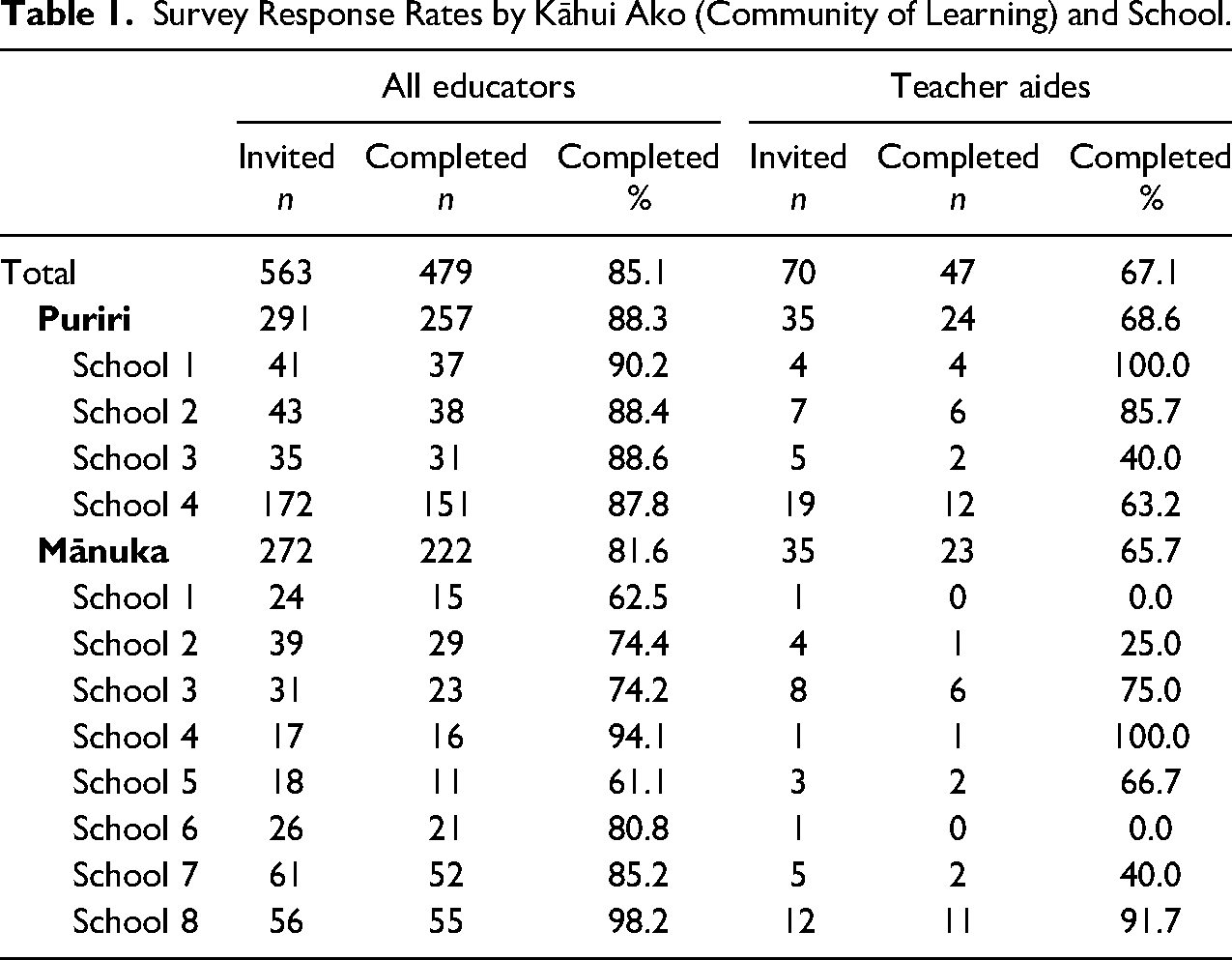
Kāhui Ako 1, which we refer to by the pseudonym of Puriri, comprised four schools–two elementary schools, a middle school, and one high school. Kāhui Ako 2, or Mānuka, comprised eight schools—three elementary schools, one middle school, three high schools, and one composite school (combined elementary, middle, and high school). Invitations to participate were provided to all members of the networks who had any responsibility for curriculum, teaching, learning, and learners. A total of 563 educators were invited to participate between July and August 2021, and overall, 85% (n = 479) completed the survey. The response rate for each Kāhui Ako is outlined in Table 1.
Survey Response Rates by Kāhui Ako (Community of Learning) and School.
Data Collection
The administration of the online survey involved the following steps: (a) providing schools with information and tools to support their understanding of the survey and the study; (b) distributing the online survey to coincide with staff meetings in an attempt to increase response rates; (c) monitoring response rates and providing updates to school liaison staff; and (d) following up on schools with lower response rates. The online survey comprised network questions, psychometric scales, and demographic questions. This study focuses on the network questions and demographics, which we outline below in more detail.
Network Questions
The survey comprised five network questions to collect data about educators’ interactions with colleagues in their Kāhui Ako. For each question, a network roster (a list of all educators in each Kāhui Ako) was presented. The rosters were based on information provided by participating schools, including all educators’ contact details and roles. Respondents indicated with whom they interacted—in other words, their “ties” to all others in the network. Three network questions asked about instrumental ties: advice, collaboration, and teaching and learning resources and materials. For example, we asked, “How frequently do you turn to the following people for advice about curriculum?”; “How frequently do you collaborate with the following people to design or refine curriculum?”; and “Which of the following people do you turn to for curriculum-related resources or materials?” The other two network questions asked about expressive ties: close relationships and positive energy. For example, we asked, “With whom do you have a close relationship?” and “Which colleague(s) give you an increase in positive energy after an exchange?” Short explanations were provided to explain the meaning of key terms in each question. The advice and collaboration network questions used a frequency scale, with options for daily, weekly, monthly, termly, and yearly interactions. The other network questions allowed for a dichotomous (yes or no/blank) response. All networks were “directed,” as responses indicated the direction of a relationship between pairs of individuals, which may or may not have been reciprocated.
To prepare for data analysis, we aggregated expressive ties (i.e., close relationship and positive energy) into one network, which we called the “expressive network.” Similarly, instrumental relationships were combined into a single network comprising all instrumental ties (i.e., advice, collaboration, and materials), which we referred to as the “instrumental network.” As the advice and collaboration networks included a frequency of interaction, this was also included in the instrumental network. For example, for the monthly instrumental network, if person A indicated they interacted with person B for any one or more of: monthly or more frequent advice, monthly or more frequent collaboration, or materials (binary network), then a tie from A to B was included in the instrumental monthly network.
Demographic Questions
The demographics section of the survey comprised questions on the participants’ role within the school, number of years working as an educator, number of years in current school, role in current school, qualifications, gender, and ethnicity. For this study, we used the role information to identify TAs and to group respondents into three categories for analyses: TAs, classroom teachers, and educators with a leadership responsibility.
Data Analyses
Analyses were conducted on the network data from both Kāhui Ako. These analyses included whole network statistics (measures that provide a description of the overall patterns of interaction), the proportion of TA-inclusive dyads, centrality measures (sets of measures related to individuals’ positions in a network), statistical tests of the centrality measures, core–periphery analyses, and sociograms (visual maps of the network). Analyses were conducted using the social network package igraph for R (Csardi & Nepusz, 2006), except for the Kruskal-Wallis tests used to account for the non-independence of observations and non-normality of the data, which were conducted in SPSS. The core-periphery analyses were conducted in UCINET (Borgatti et al., 2002). Details on the specific network measures and approaches to analysis are provided below.
Whole Network Measures
There is a suite of whole network measures that are used to characterize the overall patterns of interaction within a social network (Carolan, 2013). In this study, we focused on three whole network measures to characterize relational patterns in each Kāhui Ako—density, centralization, and reciprocity. While social network surveys often capture a range of interaction frequencies (as we did with daily, weekly, monthly, termly, and yearly frequency options), it is common for educational research to report on monthly ties. There are at least two reasons for this. First, it would be unduly complex to report on all frequencies, especially when networks of different types (e.g., advice, collaboration, etc.) are being considered. Second, focusing on interactions that occur on a “monthly or more frequent” basis is common because it represents a reasonable interaction frequency from a practical perspective, especially given the nature of teaching work, the physical proximity of teachers to each other, and the time and opportunity for potential interaction. It would be unreasonable, for example, to expect any one teacher in an average-sized school to interact every day or every week with every other teacher. It would, however, be reasonable to expect them to interact with multiple others on a monthly basis. Reasonable expectations for interactions extended to/from TAs are slightly less, particularly given their often part-time status and the fact that their role is oriented to within-school than across-school work. For this reason, we also refer to termly ties, thereby expanding the temporal frame in a way that is consistent with reasonable expectations for TA interaction.
Proportion of TA-Inclusive Dyads
To explore the relational embeddedness of TAs within the Kāhui Ako, we conducted analyses that described the proportion of dyads in the networks which included at least one TA in the relational pair. We refer to these ties as “TA-inclusive” ties. We disaggregated these dyads into two groups: (a) “TA–other” dyads, which refer to relational pairs that include one TA and one other educator (i.e., teacher, school leader), and (b) “TA–TA” dyads, which consider the extent to which TAs are interacting with each other within the same role group. This highlighted the extent to which TAs were active in the whole network as described by the whole network measures.
Centrality Measures
Centrality refers to a range of measures that provide information about an individual's position in a network. In this study, we focused on two types of centrality. We used degree centrality (specifically in-degree) to measure network prominence, and we used closeness centrality (specifically in-closeness) to measure the accessibility of TAs to their peers. Each is described further below.
To test for differences in centrality scores between the three role groups (TAs, teachers, and school leaders), we performed Kruskal-Wallis tests, as the data violated the normality assumption needed for ANOVA (analysis of variance). The Kruskal-Wallis tests were performed in SPSS and included pairwise comparison follow-up tests to check for any statistically significant differences between groups.
Results
Our findings indicate that TAs were not highly active in either the Mānuka or Puriri Kāhui Ako. While the network analyses demonstrated the accessibility of the TAs to their colleagues, TAs were rarely directly accessed as providers of information or support within their learning communities. In the subsequent sections, we elaborate on these findings, addressing each of the three research questions. We report results for both Kāhui Ako, and where it is helpful to draw attention to patterns, we make comparisons between them.
Overall Patterns of Interaction in Each Kāhui Ako
Activity levels were low in both Kāhui Ako. Table 2 provides an overview of the whole network statistics used to characterize the relational patterns (RQ#1), within each Kāhui Ako.
Relational Patterns Across the Mānuka and Puriri Kāhui Ako.
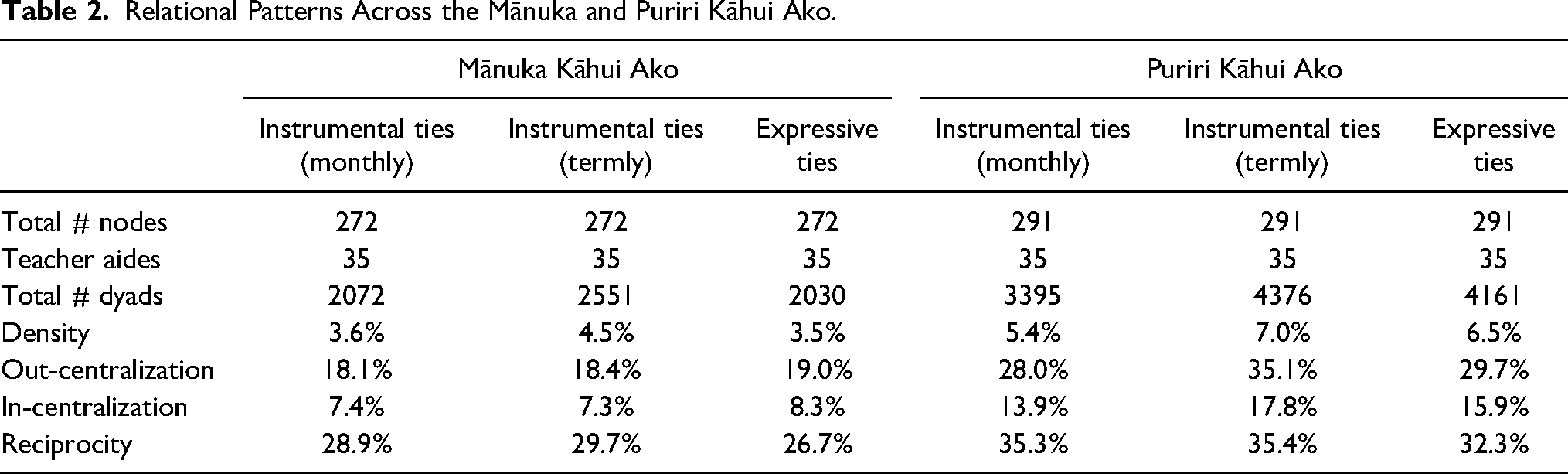
Figure 1 shows network maps of the monthly instrumental resource exchange networks for the Mānuka and Puriri Kāhui Ako as sample illustrations of the relational patterns in these networks.
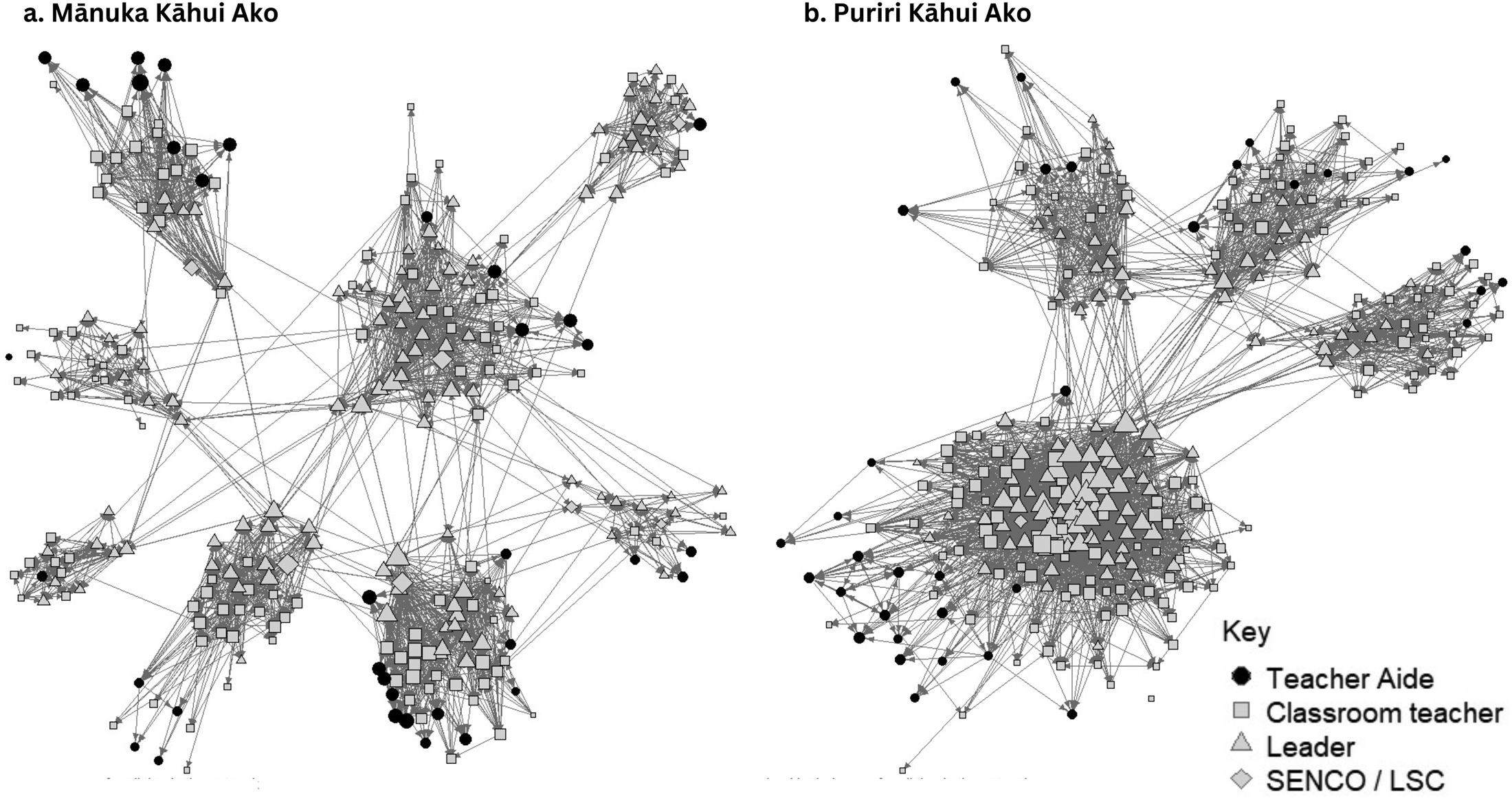
Overall Relational Patterns for Instrumental Monthly Ties for Each Kāhui Ako. Note. Nodes are sized by indegree for all ties in the network. SENCO refers to Special Education Needs Coordinators and LSC refers to Learning Support Coordinators.
In the Mānuka Kāhui Ako, network density scores ranged from about 4%–5% across relational dimensions, and in Puriri, they ranged from about 5%–7%. Instrumental resource exchange (i.e., advice, collaboration, and/or materials) was most frequent at the termly level, yet the difference between monthly and termly instrumental resource exchange was small (from 3.6%–4.5% in Mānuka and 5.4%–7% in Puriri).
Both networks indicated a very slight tendency towards a centralized network structure (i.e., patterns of interaction that focus on a subset of central actors). This was evident predominantly in the resource-seeking behaviour (out-centralization), particularly in Puriri where scores ranged from 28%–35%. In-centralization scores indicated much less concentration in terms of resource provision, again with a greater tendency towards centralization in Puriri, where scores ranged from about 14%–18%. Nevertheless, in general, the patterns of interaction in both Mānuka and Puriri indicated that relational activity was fairly well-distributed across relational dimensions.
Reciprocity is a measure of tie strength and reports the proportion of ties that represent two-way resource flow within dyads (i.e., mutual ties). Mutual ties are more durable over time and indicate cohesive relational structures that support collaboration and joint work. In the Mānuka Kāhui Ako, slightly more than 1 in 4 ties was a mutual tie, as indicated by reciprocity scores ranging from about 27%–30%. In the Puriri Kāhui Ako, about 1 in 3 ties was reciprocal, with reciprocity scores ranging from about 33%–35% across relational dimensions. In the Kāhui Ako networks overall, reciprocity was higher (28%–35%) in all ties (Table 2) than it was in TA–other ties (Table 3), where it ranged between 16% and 25%.
Description of TA-Inclusive Ties within Kāhui Ako Networks.
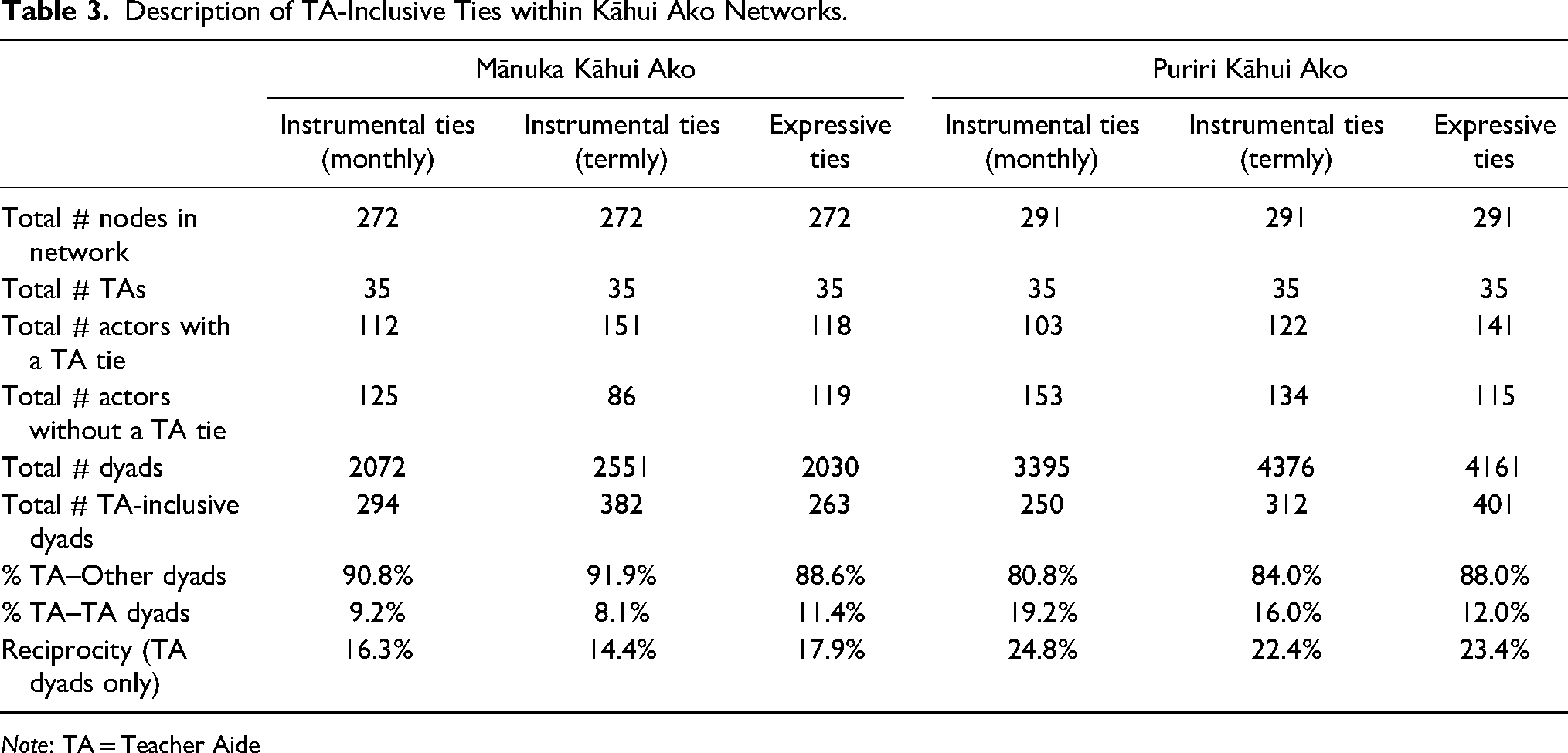
Note: TA = Teacher Aide
Interactions Between TAs and Others
To better understand the extent to which TAs were interacting with their colleagues (RQ#2), we focused our attention on network dyads that included at least one TA to yield a more nuanced view of how TAs were interacting with colleagues in each Kāhui Ako. Table 3 provides details on the proportion of network dyads that included a TA (including TA–TA ties) and the extent to which these relationships were reciprocal.
In the Mānuka Kāhui Ako, the number of dyads that included a TA varied across relational dimensions, from 263 dyads in the expressive resources network (13% of the total number of dyads in the entire network) to 382 in the termly instrumental resources network (15% of the total number dyads). Across the relational dimensions, there were high numbers of network actors (i.e., nodes) who were not connected with a TA at all. For example, in the expressive ties dimension, there were 119 educators (44% of network members) who had no relational activity with TAs. This number increased slightly to 125 educators (46%) when monthly instrumental ties were considered. TAs interacted with other educators (e.g., teachers and school leaders) more often than with their TA colleagues: approximately 1 in 10 relationships was a TA–TA tie. Across relational dimensions, fewer than 1 in 5 relationships comprised mutual ties (reciprocity scores ranged from 14%–18%); thus, in Mānuka, resource flow to/from TAs was most often unidirectional.
In the Puriri Kāhui Ako, TAs also interacted with their peers, but not often. The number of dyads including a TA ranged from 250 dyads in the monthly instrumental ties network (7% of the total number of dyads in the entire network) to 401 dyads in the expressive ties network (10% of the total number of dyads in the entire network). Depending on the relational dimension, approximately 40%–50% of network actors did not have a relationship (either in instrumental or expressive terms) with a TA. Nevertheless, there was a greater proportion of TA–TA dyads in the Puriri Kāhui Ako than in the Mānuka Kāhui Ako, with nearly 20% of all monthly instrumental dyads (i.e., 1 in 5 dyads) and 12% of expressive ties representing TA–TA interactions. Approximately 1 in 4 dyads (about 25%) represented mutual relations; thus, as in the Mānuka Kāhui Ako, relationships tended to be unidirectional, yielding ample room to strengthen relationships with TAs in this community of learning. Figure 2 provides a visualization of the monthly instrumental ties between TAs and their colleagues in the Mānuka and Puriri Kāhui Ako.
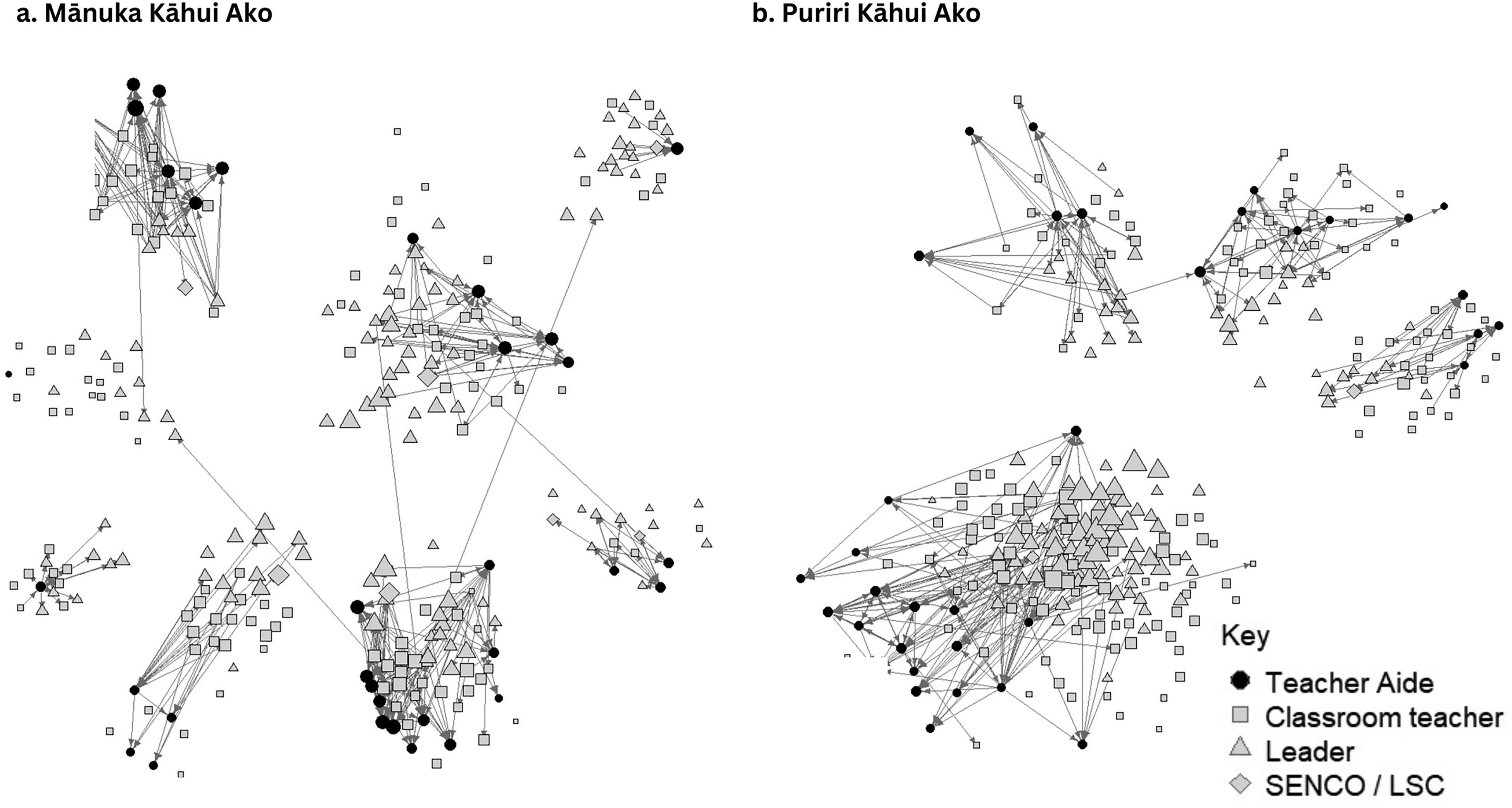
Instrumental Monthly Ties for Teacher Aide Networks in Each Kāhui Ako. Note. Nodes are sized by indegree for all ties in the network. SENCO refers to Special Education Needs Coordinators and LSC refers to Learning Support Coordinators. The four clusters of nodes in Puriri Kāhui Ako correspond to the four schools in this Kāhui Ako.
The Prominence of TAs in the Relational Patterns in Each Kāhui Ako
Our final analytic step for understanding the social lives of TAs focused on prominence—or how “popular” TAs were within the networks (RQ#3). To explore network prominence, we used egocentric network measures to consider relational patterns at the level of each individual actor in the network. We did this in two ways: first, we compared centrality scores for TAs, teachers, and school leaders, focusing on in-degree and in-closeness scores (at the individual level). Second, because our analyses indicated that TAs were not central actors in the overall Kāhui Ako networks, we conducted core–periphery analyses at the school-level networks to investigate the extent to which TAs were central figures in their daily workplaces, which comprised the broader Kāhui Ako networks.
Centrality Comparisons
As noted in the results (see Table 4), there were significant differences between all role groups across all relational dimensions. Further post-hoc tests to investigate differences between TAs and teachers only indicated that TAs did not have significantly different in-closeness scores than teachers, meaning that TAs were as easily accessible as teachers in these networks. However, TAs had significantly lower in-degree scores than teachers, showing that TAs were less sought out than teachers. They were much less often identified as collaborators or providers of advice or materials. In other words, TAs were accessible, but people were not directly accessing them.
Centrality Differences Between Role Groups: Kruskal-Wallis Test Results.
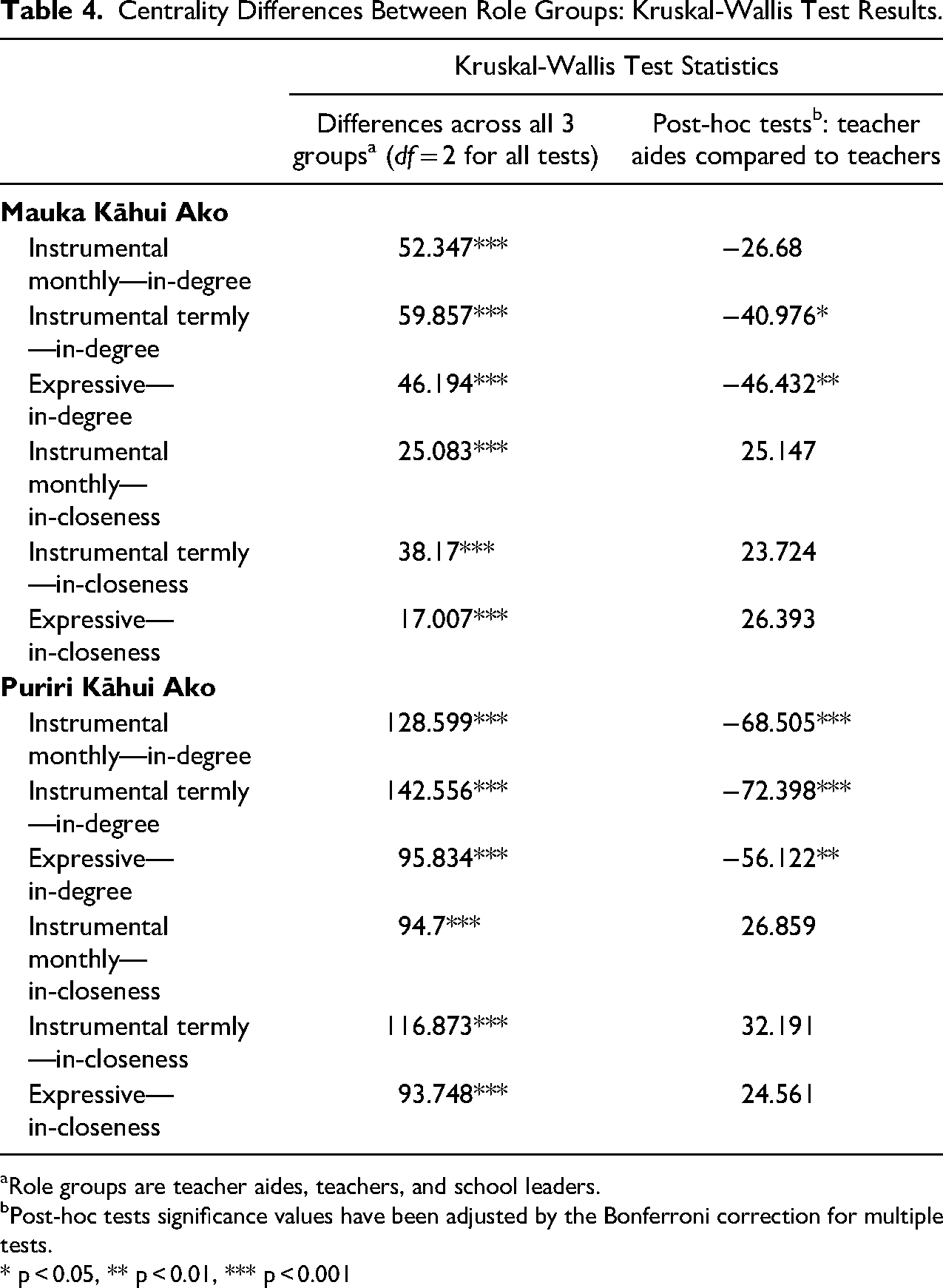
Role groups are teacher aides, teachers, and school leaders.
Post-hoc tests significance values have been adjusted by the Bonferroni correction for multiple tests.
* p < 0.05, ** p < 0.01, *** p < 0.001
Core-Periphery Analyses
To deepen our understanding of the position of TAs within the Kāhui Ako network, we ran core-periphery analyses at the school level to examine where TAs were situated within their daily networks (i.e., their schools). Table 5 shows the results of those analyses, identifying the number of TAs whose social location was in the core (i.e., densely connected people) versus the periphery (i.e., less well-connected people) of the network.
Summary of Core-Periphery Analysis: Position of Teacher Aides in Each School-Level Network.
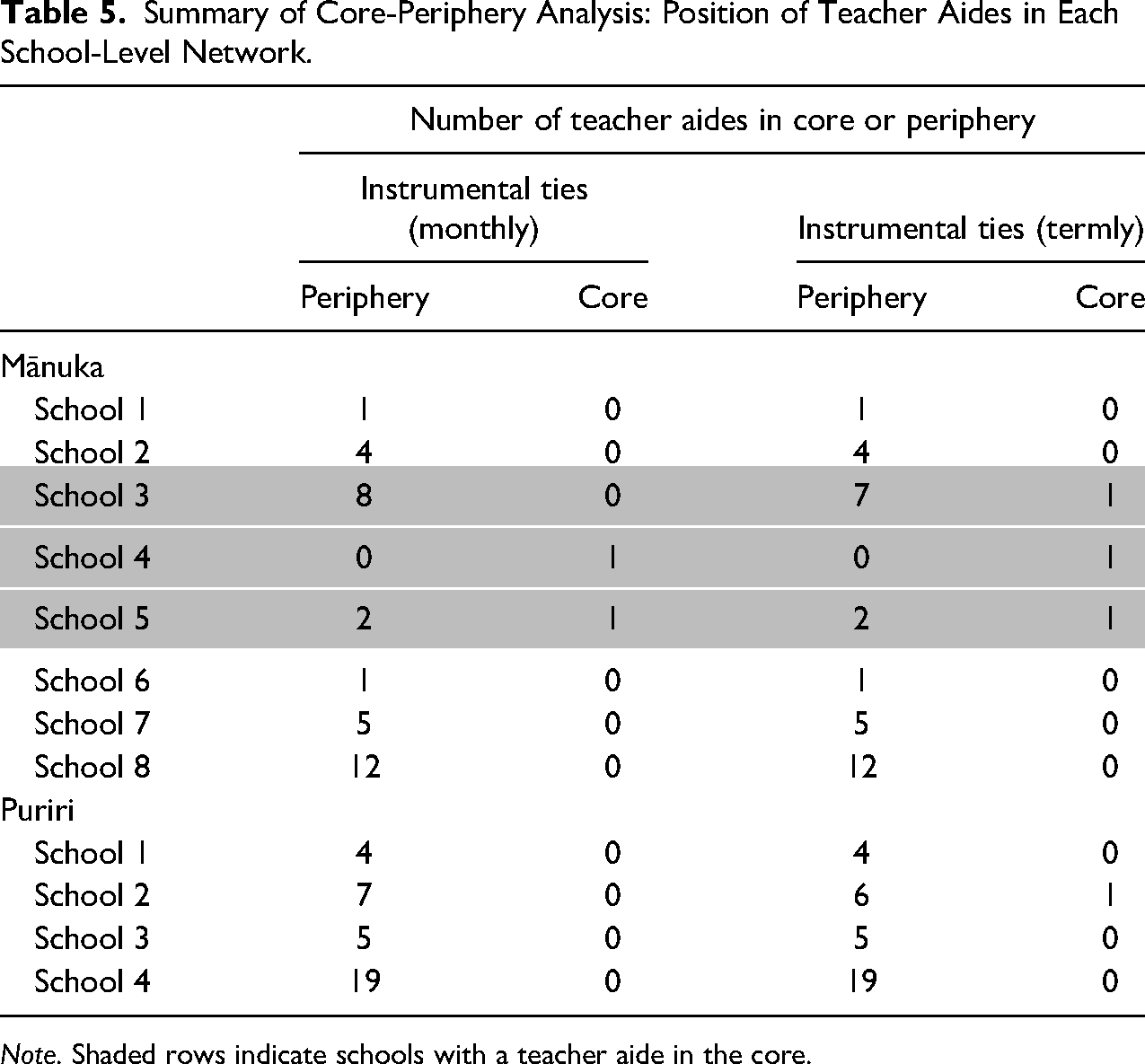
Note. Shaded rows indicate schools with a teacher aide in the core.
For most schools, TAs are on the periphery of the network. In the Mānuka Kāhui Ako, however, there were four schools (out of 12 schools in total) in which a TA was in the network core for termly instrumental ties, and there were two schools that included a TA in the network core for monthly instrumental ties. Despite a very limited number of exceptions (about 5% of TAs were part of core network structures), TAs were generally not well connected to other educators in their schools. Figure 3 provides a visualization of both situations, showing maps of two schools where, in one case TAs were included in both the network core and the network periphery and, in the other case, there were no TAs in the network core.
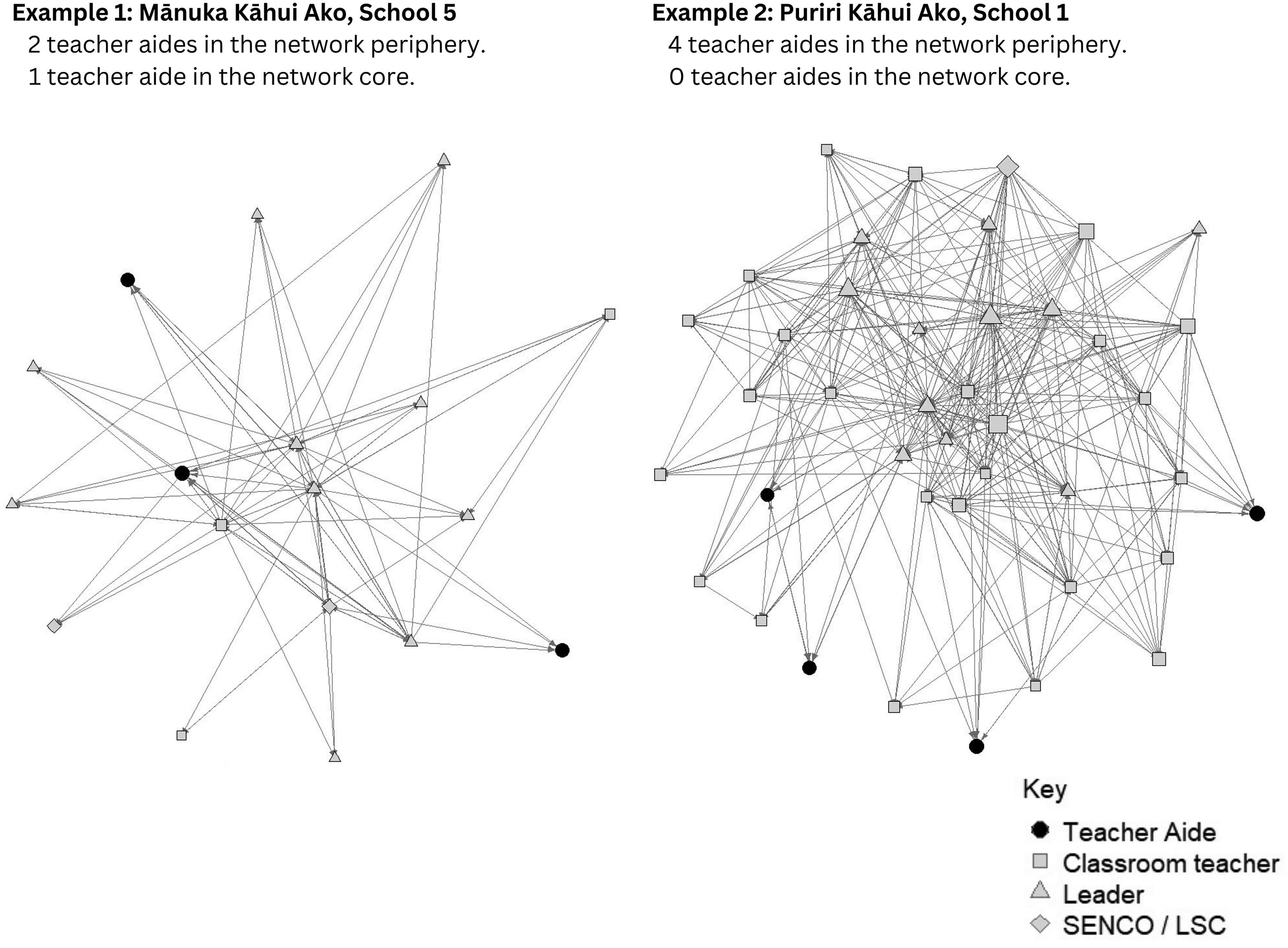
Visualization of School Network Instrumental Monthly Ties with Core-Periphery Structure. Note. Nodes are sized by indegree for all ties in the school. SENCO refers to Special Education Needs Coordinators and LSC refers to Learning Support Coordinators.
Discussion and Implications
The Missed Potential of TAs Being Accessible but Not Directly Accessed
These investigations into relational patterns within each Kāhui Ako reveal who was included and who was excluded from the relational space. In short, we found that, most often, teachers were included and TAs were not. Connections (of any kind) between TAs and others were infrequent; even the most common type of connection—instrumental resource exchange (i.e., advice, collaboration, and/or materials)–occurred, on average, on less than a monthly basis within schools. TAs had fewer incoming ties than other roles and were rarely identified as collaborators, despite recognition in the research that collaboration is central to their role in effectively supporting teachers’ work and students’ inclusion (Chopra & Giangreco, 2019; Sharples et al., 2015). A limitation of the study is that our instrumental relational dimensions are very specific; future work in this area could broaden the networks of focus to include, for example, general discussion networks in order to capture other relational possibilities.
Most typically, TAs were situated on the periphery of the networks, even within their own schools. These findings indicate that they were rarely considered valued sources of knowledge and expertise among their peers. While the typically low qualification status of TAs might be misconstrued as suggesting they do not have relevant expertise to share, we critique that view. TAs may not always have formal qualifications, but they often have very direct relationships with students and their families, and they have important knowledge and expertise to share with students, families, and teachers. This includes practical knowledge through their collaboration with teachers and others about supporting disabled students, facilitating learning assessments, communicating effectively, engaging with specialists and agencies, managing challenging behaviours, and providing cultural connections. They can also have knowledge related to the requirements, interpretation, and implementation of policy, which can be shared with teachers. We acknowledge that TAs, like teachers, will have learning needs, including gaps in their knowledge and room to improve; being more strongly connected to others across the network would make it more likely that those learning needs are met.
Furthermore, some might argue that relationships of mutual exchange are unlikely to develop at a core level when there are only a few people filling a certain role, as was the case with the TAs in our sample. We would argue, however, that the small number of TA roles in any given school (a) does not preclude their participation in the core and (b) makes it even more concerning that they are as peripheral as they are. If schools are upholding their commitments to equity and inclusion in their day-to-day practice, we might expect the few TAs they have to be more rather than less central in discussions of curriculum, teaching, and learning. Belonging to a minority group should not limit educators’ participation to the periphery of the network.
We acknowledge that peripheral positioning is not inherently bad; it has a role to play in accessing new ideas, fostering innovation, and forging connections to external networks; as Granovetter (1973) argued, there is strength to be had in weak ties. But as we outlined in the introduction, TAs have less power in the educational landscape, and their tendency to be peripheral rather than core network members exacerbates this lack of power. Those in the core have community power; they typically “run” communities, and they may not pay much attention to peripheral actors (Nordlund, 2018; Kadushin, 2012). When those peripheral actors are advocates for and knowledge-keepers about disabled learners (as teachers also can and should be), their position at the edge of the network becomes particularly problematic; it confounds the problem we highlighted in our introduction about people being disabled by the way in which the community around them operates, and it reduces the chance that both TAs and teachers can be both knowledge keepers about and advocates for disabled learners.
One possible explanation for other educators’ limited activity with TAs is that TAs are simply not accessible, but our findings do not support that theory. Our comparison of in-closeness centrality scores of both teachers and TAs (see Table 4) shows that TAs were accessible, as demonstrated by the lack of significant differences between TAs’ and teachers’ in-closeness scores. However, despite their accessibility, others were not directly accessing them. This pattern may be due to issues of status: as Rutherford (2012b) posited, TAs are often considered “just teacher aides,” suggesting their knowledge and expertise is undervalued as they straddle the teacher/not-teacher boundary. It may also be due to wider contextual conditions that see TAs (for the most part) left out, thereby limiting their structural or social capital and maintaining their existence on the fringes of knowledge and collaboration networks. All of this has implications for educational leadership practice.
Policy is Not Enough—The Need for a More Inclusive Relational Infrastructure
The low levels of activity involving TAs, as well as their peripheral positioning, occur despite the policies that strongly advocate for inclusive education and greater connectivity between teachers and TAs. New Zealand's inclusive education goals are clearly embodied in a range of educational policies that encourage a systems approach, school leaders’ support of collaborative practice, and reciprocal learning relationships between teachers and TAs (Ministry of Education, n.d.-b). For example, the national Education Council's professional standards, Our Code Our Standards (2017), emphasize the need to engage in “reciprocal, collaborative learning focused relationships with learners, families, and whānau; teaching colleagues, support staff and other professionals; agencies, groups and individuals in the community” (p. 18). Similarly, national School Evaluation Indicators (see Education Review Office, 2016) recognize collaboration and reciprocity as vital to the development of an inclusive education system. The system should help school leaders recognize that inclusive practice for learners requires social conditions which mirror inclusion for adults, including TAs. Yet, our findings show that there is a great deal of room for more meaningful action towards this inclusive and relational vision.
There are often “islands of excellence” (Togneri & Anderson, 2003) amidst overall failure in efforts to realize policy reform goals of any sort at scale (Elmore, 1996, 2016). This was reflected in our findings, where a TA in two different schools was an active member of the core of the monthly instrumental network. But given the more typical pattern we found of TAs being on the periphery, it is clear that policy alone is not enough. It is also clear that even policy accompanied by multiple associated initiatives is not enough if those initiatives overlook the relational infrastructure required to bring policy goals to life. In New Zealand, for example, the policy goals for inclusive practice are accompanied by many inclusive, education-specific initiatives, including those dealing with recruitment, induction, training for TAs, and professional learning for teachers (Ministry of Education, n.d.-c). However, there is rarely an explicit focus on developing relational spaces that create conditions conducive to carrying out this work. When policies and initiatives are limited to the individual, interpersonal, and technical dimensions of the work and system-level relational aspects are overlooked, the success of the policy is likely to be compromised from the outset. This leads us to ask the question: how might more inclusive relational spaces be activated?
The Role of Leadership in Intentionally Activating Inclusive Relational Structures
Educational leaders have a central and influential role in creating relational spaces that are conducive to the success of any policy implementation (Sinnema et al., 2023; Spillane & Shirrell, 2017); this role is especially critical in the context of inclusive education policy. Leaders shape the inclusivity (or otherwise) of social structures and organizational norms within school systems, which might support the fulfilment of inclusive education obligations (DeMatthews et al., 2021) (Stoll & Sinnema, 2024). A practical illustration of how organizational norms can work against inclusion can be seen in our own study and the survey completion process. Across many schools, principals provided teachers and other formal school leaders with the time to complete the social network survey; it was completed during work hours (i.e., paid time). However, TAs were typically not included in these meetings because they often worked part-time and were therefore not remunerated for attending them. In other words, they were structurally excluded from the research process because they (unlike teachers and school leaders) were mostly expected to participate in the study in their “off hours.” Norms like these therefore serve to marginalize some staff by creating barriers to inclusion; this presents a call for educational leaders to recognize and dismantle such norms.
There is much potential for small acts to have meaningful impacts on the cultural change we argue for. These might include, for example, prioritizing and funding time during work hours for teachers and TAs to meet and plan; including TAs in school staff meetings, Kāhui Ako meetings, and staff-only days; including them in school email chains; having their names on staff lists (but not tacked on at the end); ensuring they have access to databases and school resources; and giving them the time and opportunity to share their expertise and knowledge (Education Review Office, 2022, p. 16).
The role of leaders in this work can be framed as one of a social/relational architect (Sinnema et al., 2023); in the context of inclusive education, they are designers of social structures in which not only does every child and young person matter and matter equally but also all of the adults. Relational space is often taken for granted and assumed to be functioning as it ought to be. The insights we surfaced about the social positions of TAs in each Kāhui Ako demonstrate that relational space cannot be taken for granted. And so we call upon leaders at both school and system levels to be intentional in strengthening relational ties (see Moolenaar et al., 2014)—positioning themselves as brokers and influencing others to take on brokering roles to connect people who are otherwise disconnected. Greater brokerage of this sort (Burt, 1992) could generate flows of information, ideas, and other resources that support inclusion efforts. It would also allow both teachers and TAs to co-construct their understanding of disabled learners (as well as learners more generally), including how to engage and support them. In this way, new perspectives could be brokered that interrupt beliefs and practices not consistent with inclusive education goals, and good practices can be shared.
The Role of Cognitive Social Capital
Leaders’ efforts should also focus on building cognitive social capital—the shared representations, interpretations, and systems of meaning that become valuable resources for the whole school community (Nahapiet & Ghoshal, 1998). This is important given that the success of any policy implementation depends on how those involved understand the policy. As Spillane et al. (2002) explained, this understanding depends on implementing agents’ existing cognitive structures (including knowledge, beliefs, and attitudes), their situation, and the policy signals. It also hinges on interactions between implementing agents (and here we think of TAs and teachers); as Liou and Canrinus (2020) explained, when people “share their personal understanding and beliefs about particular change initiatives and how it may inform their practice, their individual mental models converge (or diverge) in shared (or divergent) mental models” (p. 5).
Building cognitive social capital is also important in the inclusive education context, especially given the persistence of well-intentioned practices in many schools and classrooms that nevertheless exclude some people. School leaders can organize activities that support and foster shared understandings of inclusive values and practice; this would benefit not only cognitive social capital through the content of the activity but also structural social capital through the relational composition of the participants involved. In other words, there is an important interplay between structural and cognitive social capital that leaders should leverage: bringing TAs and teachers together for joint work on and about inclusive education will simultaneously generate benefits in terms of relational ties.
Conclusion
To build an equitable school system that is inclusive of all learners’ needs, leaders and decision-makers must focus on creating the classroom, school, and system conditions that are necessary to realize an inclusive future. At the moment, school and system conditions are, at best, not conducive to or, at worst, counterproductive to the aspirations and goals set for inclusive education. Inclusive educational environments for students will remain difficult to realize if institutions are not inclusive for all those working within them.
Education systems around the globe are taking steps in the right direction with research-grounded policies that bring people in (at least on paper); but, as demonstrated in this research, these policies continue to push people out because they often operate in systems built within exclusionary paradigms. The opportunity here is for relationally-focused leadership—that is, leadership grounded in cultivating, honouring, and sustaining relationships between all people working within school systems. For collaborative and inclusive practice to be more than just an aspiration, we argue that policy and leadership must ensure belonging and inclusion for students and for all of the adults who support this aspiration in school communities.
Footnotes
Acknowledgements
We are very grateful to both Professor Yi-Hwa Liou, National Taipei University of Education, and Professor Alan Daly, University of California San Diego, for their colleagueship and contribution to a prior project that involved the same sample as the one used in this study. Their extensive expertise in social network analysis has inspired and continues to inspire our work in this area.

Declaration of Conflicting Interests
The authors declared no potential conflicts of interest with respect to the research, authorship, and/or publication of this article.
Funding
The authors received no financial support for the research, authorship, and/or publication of this article.
Statements and Declarations
Ethical approval for this study was granted by the University of Auckland Human Subjects Ethics Committee (Approval #022188).
Informed consent to participate was verbal.
The author(s) declared no potential conflicts of interest with respect to the research, authorship, and/or publication of this article.
This study was supported by internal funding from the University of Auckland.