




Abstract
COVID-19 has presented unprecedented challenges to schools, leaving principals to lead rapid organizational change with limited guidance or support. Drawing on interviews from a larger, national study of principals at the onset of the COVID-19 pandemic, we analyzed the experiences of 20 principals in four large, urban school districts—Boston, Denver, New York, and San Diego. We found that principals relied on both district guidance and preexisting school structures and conditions as they led through the crisis. Although no principals were satisfied with district guidance, principals responded to guidance on a spectrum—from abiding, to challenging, to subverting guidance. Principals’ responses were associated with their perceptions of the internal capacities of their schools, as well as the district guidance. Our findings support an emergent typology of principals as middle managers during crisis, which sheds light on how principals act as middle managers and how districts can support their work.
Keywords
Introduction
The COVID-19 pandemic has tested schools’ abilities to rapidly pivot their modes of teaching and learning in an unprecedented way—revealing how resilient schools are to crisis and organizational change more generally. Navigating the often-competing demands of district guidance and their schools’ growing needs, principals have been tasked with leading organizational change under historically challenging conditions. As middle managers (Spillane et al., 2002), principals are both proximate to the “frontline” and aware of the “big picture,” so they are uniquely positioned to identify organizational problems (Huy, 2001, p. 73). Simultaneously, principals work in resource-constrained environments and are frequently tasked with competing demands—for example, “maintaining stability while delivering change” and “operating through existing routines and processes while developing new ones” (McKenzie & Varney, 2018, p. 384).
Principals lead change within their schools by leveraging preexisting school structures and conditions, such as relationships, shared decision making, and professional community (Bryk & Schneider, 2002; Fink & Resnick, 2001; Fullan, 2002). Organizational conditions can supersede other environmental factors, such as economic disadvantage, in shaping schools’ capacity (Kraft et al., 2015; Simon & Johnson, 2015). Theory suggests that key organizational features, such as clearly defined role systems and norms of respectful interaction, are critical to organizations being resilient in times of crisis (Weick, 1993, p. 628). Less is known about how principals’ reliance on these conditions varies as they lead through crises, when school leadership looks fundamentally different (L. Smith & Riley, 2012).
Drawing on interviews with 20 principals conducted at the onset of the pandemic in four large, urban districts—Boston, Denver, New York City, and San Diego—we explore how principals respond to external guidance in times of crisis, with attention to the ways they lean on preexisting structures and conditions in their schools. We build on organizational learning (OL) theory and scholarship on the role of school structures and conditions to examine how principals operate as middle managers during periods of organizational change. Our central research question is
We find that principals’ responses to district guidance landed on a spectrum—from abiding to district mandates, to challenging district decisions to initiate change, to actively subverting guidance. Principals’ responses were shaped both by the nature of district support and guidance that they received, as well as their schools’ preexisting structures and conditions. Importantly, the patterns we describe are neither comprehensive nor causal; rather, they suggest a typology of how principals function as middle managers, and the organizational resources they rely on to lead. Thus, we build on the middle management and OL literature and present an emergent framework of how principals, as middle managers, conceptualize and operationalize their roles in times of crisis. Given the massive disruptions COVID-19 presented to schools (Kraft et al., 2021), understanding how principals conceptualize their roles during periods of crisis offers lessons for policy and practice to support school leadership more broadly.
Conceptual Framework and Prior Research
Our conceptual framework draws on OL theory and scholarship on the role of school working conditions in shaping OL (Figure 1). Together, this scholarship provides a lens to understand principals as middle managers in times of crisis—how they respond to external guidance and the ways they leverage the preexisting resources in their organizations to do so. In this section, we describe the theoretical and empirical grounding for the conceptual framework that guides this study.

Conceptual framework.
The Principal’s Role in Organizational Learning
Originating in management studies, OL theory posits that organizations like schools and districts learn by integrating knowledge from their interactions and previous experiences into their policies and routines (W. Cohen & Levinthal, 1990; Farrell et al., 2019; Levitt & March, 1988). OL relies on the “systemic thinking” of the whole organization (Senge, 1990, p. 6), and is triggered by a “stimulus,” such as a crisis, that brings about a perceived need to seek a solution to some problem within the organization (Leithwood et al., 1998). As middle managers, leaders can draw on organizational routines to interpret directives from above and justify organizational change efforts to those they lead (Rouleau, 2005), and provide other organizational members with the freedom and resources to innovate (Amabile, 1997). Principals can be considered “chief learning officer[s],” as they play a key role in shaping the conditions for OL (Weiner et al., 2021, p. 2).
Principals’ ability to orchestrate OL is shaped by their position within the nested organizational contexts of their schools, networks, and districts (Marsh et al., 2017; Spillane et al., 2002). They are responsive to external policy from the state and district; simultaneously, they face demands internally from their own school sites, which “pull [them] in two directions” (Spillane et al., 2002, p. 734). Additionally, principals operating within district networks navigate an added layer of organizational and management structures, which can offer additional venues for shared decision making and collaboration to support the implementation of district policies (Kelleher, 2014; A. K. Smith & Wohlstetter, 2001). These structures can also, however, present principals with further, potentially competing demands to attend to.
As middle managers, principals serve as brokers between their schools and districts (Spillane et al., 2002) and thus must determine which demands to attend to with any given decision: when they judge external guidance as illegitimate (Huy et al., 2014) or at odds with their self-interest (Guth & MacMillan, 1986), they can actively resist and even subvert organizational change efforts. As principals encounter external demands, they are left to foster “coherence” within their schools and districts by “negotiat[ing] connections among policy and school goals for teaching and learning” (Stosich, 2018, p. 204). Coherence is central to OL as it enables members of organizations to organize their work around shared goals (Johnson et al., 2014).
Our work builds on existing typologies which frame how principals exert agency in policy implementation. Honig and Hatch (2004) posit that schools can strategically “bridge” or “buffer” external demands from their central district office in order to craft coherence. For example, principals can filter external messages based on their own sense making (Coburn, 2005; Reinhorn et al., 2017)—thereby buffering teachers from external demands less aligned with the schools’ priorities (Yurkofsky, 2020). Donaldson and Woulfin (2018) frame principal’s agentic role in policy implementation on a spectrum: from “tinkering” with policy to “going rogue.” To better understand how principals see themselves as middle managers—and which conditions enable them to exercise more or less autonomy—it is also necessary to understand how principals’ responses to district guidance are associated with the organizational capacities of their schools.
Preexisting School Structures and Conditions
A central mechanism by which principals facilitate OL is through shaping and leveraging their schools’ organizational structures and conditions (Burkhauser, 2017; Johnson et al., 2012; Leithwood et al., 2008). When leading OL, leaders must attend to both their organizations’ formal structures—that is, the norms, routines, procedures, and policies, as well as the conditions—that is, the relationships, the politics, and the capacities—that need to be in place for those structures to function properly (Bolman & Lee, 2017). Organizational structures, such as routines for decision making, allow principals to rationalize ways of being and provide security for individuals in an organization (Feldman & Pentland, 2003; Hallett, 2010). For example, principals can leverage structures to more tightly couple the technical core of their schools with external regulations (Spillane et al., 2011).
At the same time, structures do not operate in a vacuum, but work alongside organizational conditions. OL may be stifled when leaders challenge preexisting conditions and ways of operating (Hallett, 2010; Spillane et al., 2002) or do not take into consideration preexisting relationships among staff (Lockton, 2019). Furthermore, social network scholarship highlights how the quality of relationships in schools is perhaps just as important as the structure of teachers’ social networks (Comstock et al., 2021; Kaul et al., 2021). As such, understanding how principals lead their schools through organizational change requires attending to both the organizational structures and conditions which they leverage.
Key Structures
Establishing norms and procedures for decision making—that is, the roles, routines, norms, and policies in place to facilitate decision making in schools—is an essential aspect of principals’ work as middle managers. Principals’ poor management skills can lead to lost instructional time and teacher attrition (Simon & Johnson, 2015), while organized systems for management and distributed leadership practices can support organizational change efforts (Leithwood et al., 2009; Spillane et al., 2004). Furthermore, continuity of roles within decision-making teams has been shown to facilitate change efforts (Higgins et al., 2012). Thus, principals’ reliance on structures and procedures for distributed decision making—and the continuity of those procedures—facilitates organizational change.
At the same time, principals establish the infrastructure for teachers to collaborate as instructional leaders (Simon & Johnson, 2015). Teacher collaboration structures—such as grade-level and department teams—enable teacher autonomy (Bowen et al., 2007; Johnson et al., 2018; Weiner, 2016), and are associated with teachers’ instructional improvement and increased student achievement (Ronfeldt et al., 2015). Teachers’ social networks have also been found to be associated with a range of important school-level outcomes, including innovation and reform sustainability (Atteberry & Bryk, 2010; Moolenaar, 2012; Penuel et al., 2009), and the policies principals enact can shape the nature of teachers’ social networks (Coburn & Russell, 2008). Thus, teacher collaboration structures are a key resource for organizations, and the nature of relational dynamics within them greatly influences those structures (Lockton, 2019).
Key Conditions
Significant scholarship speaks to the nature and quality of relationships among educators as an essential condition for organizational functioning (Bryk & Schneider, 2002; Cosner, 2009). At the heart of their work, principals shape the climate for learning—the level of trust and collaboration within their schools. Bryk and Schneider (2002) posit that relational trust—that is, the strength of relational quality among principals, staff, and the broader school community—is the bedrock of organizational change. Relational trust reduces the vulnerability of members of the organization to take risks and innovate (Cross et al. 2005; Giles & Hargreaves, 2006; Louis & Lee, 2016). Thus, by shaping the climate for learning, leaders influence the nature and quality of relationships and the social capital—that is, the resources that reside in the interactions among individuals in an organization (Coleman, 1988)—in their schools.
Finally, principals depend on teacher human capital—that is, expertise and capacity of staff. Teachers’ access to and knowledge of expertise in their schools can support reform implementation and instructional change (Frank et al., 2004; Coburn et al., 2013). The combination of social and human capital has been found to be more strongly associated with student learning than each individual form of capital alone (Daly et al., 2011). Leaders of well-functioning schools know the expertise that resides in their organizations and utilize that expertise to foster individual and organizational improvement (Harris, 2013). Thus, in their role as middle managers, principals have access to a set of key organizational resources that bolster their efforts to lead organizational change.
Method
This article is based on qualitative data drawn from a larger study conducted between April and August 2020 by a national team of 18 education researchers. In the present study, we draw on 20 interviews from a subsample of four large, urban districts (Table 1).
Characteristics of Sampled Districts (2019–2020)
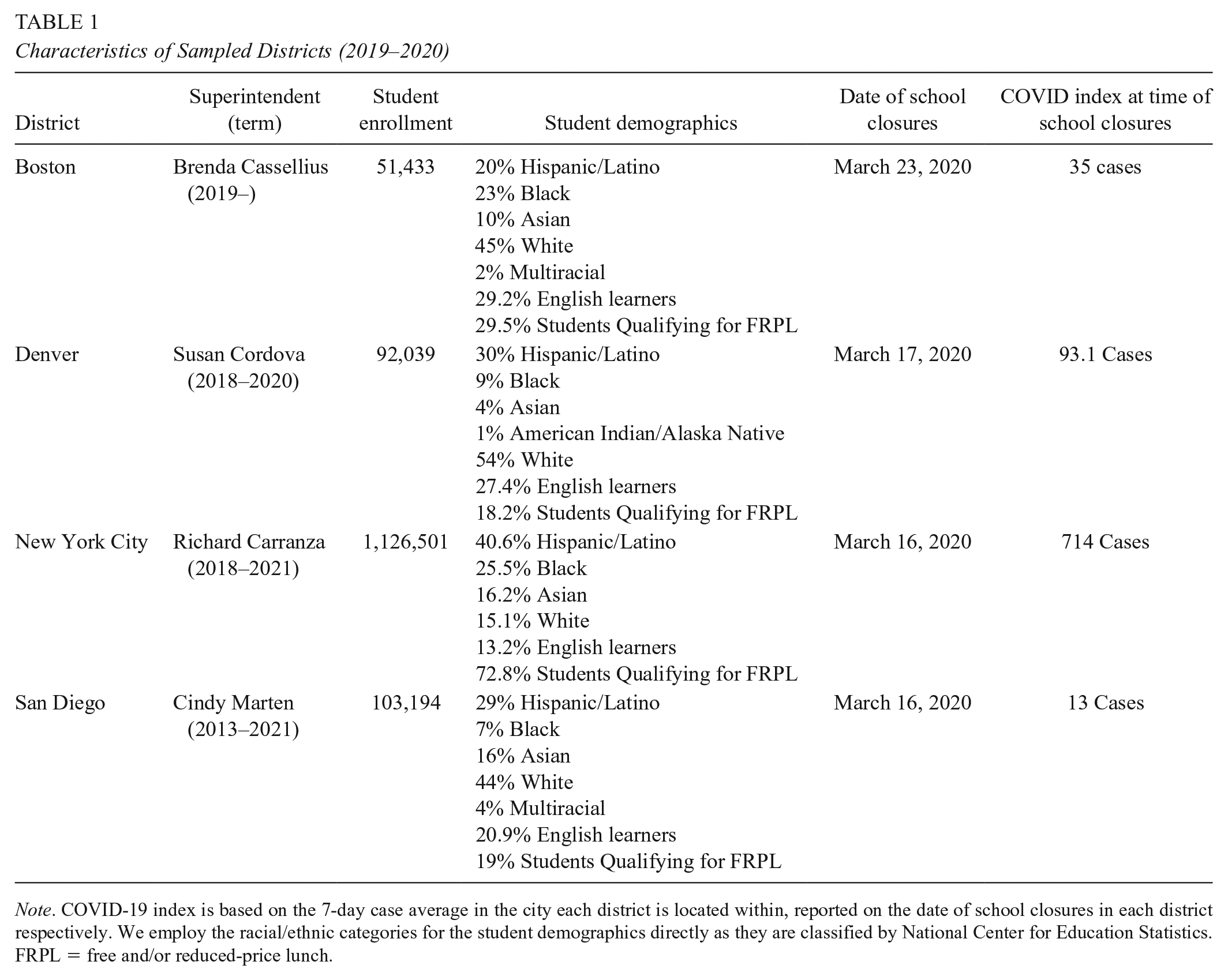
Note. COVID-19 index is based on the 7-day case average in the city each district is located within, reported on the date of school closures in each district respectively. We employ the racial/ethnic categories for the student demographics directly as they are classified by National Center for Education Statistics. FRPL = free and/or reduced-price lunch.
Sample and Data Collection
Sample
Districts in the full study sample were recruited by members of the larger research group, primarily based on where individuals had personal contacts with principals. We then employed a snowball method to recruit additional principals recommended by participants. The result was a large and heterogeneous sample of principals who differed in experience and personal background—leading schools which varied by grade level, size, demographics, geography, and performance level.
For this article, we drew on a subsample of 20 principals in four large, urban school districts: Boston Public Schools (BPS), Denver Public Schools (DPS), New York City Department of Education (NYCDOE), and San Diego Unified School District (SDUSD) (Table 2). We intentionally focused on urban districts because of the sustained focus nationally on urban school reform in recent decades, and because urban districts primarily serve low-income communities (Suitts, 2015). Given that COVID-19 has disproportionately affected low-income communities and communities of color (Parker et al., 2020), the crisis was particularly severe in these contexts. Large, urban districts, therefore, provide an important context to consider the role of school leaders as middle managers during crisis, as there is often heightened external pressure to deliver results, with more limited physical capital. Furthermore, we narrowed in on the four districts in our study with attention to geographic variation, as well as variation in the nature of district guidance—which we consider in the following section on District Contexts. NYCDOE principals represent a large proportion of the sample, which is appropriate given the system’s size and complexity relative to the other districts (Table 1).
Principal and School Characteristics

Note. All principal names are pseudonyms. We assigned pseudonyms to each principal beginning with the same first letter as their district. All enrollment numbers and student demographics (including racial/ethnic demographics and FRPL percentage) are rounded to ensure anonymity of research participants and schools. Student demographics are also not disaggregated to ensure anonymity. Dashes indicate missing data. FRPL = free and/or reduced-price lunch.
Interviews
Interviews were conducted via phone or Zoom and lasted between 60 and 90 minutes. Prior to each interview, principals completed a brief background survey. We used a semistructured protocol (Supplemental Appendix A, available in the online version of this article) to guide our interviews. The semistructured approach enabled us to elicit comparable data within and across sites and also granted flexibility to interviewers to probe further on particular topics (Maxwell, 1996). In each interview, we asked principals to describe their school’s transition to emergency remote teaching, and to describe district policies and directives during this period, and probed about whether and how they depended on school structures and conditions during the transition. We also asked principals to explain how they interacted with district officials, the teachers’ union, their staff, and students and families. All interviews were recorded and transcribed.
Document Collection
In preparation for interviews, and during the analysis phase, we reviewed school and district websites to better understand principals’ contexts. We collected descriptive information about the schools and districts from National Center for Education Statistics, including student and school-level demographic information. We also analyzed relevant documents—both publicly available documents, such as guidance memoranda issued by district officials, memoranda of understanding between the teachers and principals’ unions and the district, and news articles, and documents shared by participants, such as communiques to families or teachers.
Analysis
We developed and executed an analytic process specific to this article. After listening to interview recordings, we used thematic summaries to conduct a preliminary analysis of each site individually and to conduct cross-site comparisons, identifying common themes, similarities and differences. We used the preliminary analysis to supplement the etic codes with a list of emic codes that emerged from the data (online Supplemental Appendix B). We used this preliminary list of codes to review a small subset of transcripts, individually and together, to calibrate our understanding and use of the codes, as well as to refine the code list and definitions. We repeated this process to finalize the list of codes and to improve interrater reliability. We then coded each transcribed interview using Dedoose.
After coding, we wrote district-level memos synthesizing findings from across the key codes at the district-level and looked across memos to identify the preexisting structures and conditions which principals reported relying on the most across the districts (collaboration, decision making, teacher human capital, and relationships). We created data-analytic matrices to compare responses within and across schools and districts, identify emerging themes (Miles et al., 2014), and cross-check with data from relevant documents.
To develop the emergent typology of principals’ responses to district guidance, we reviewed all excerpts in which principals discussed district guidance. No principal’s response was consistent across all areas of their decision making, so we characterized principals based on how they described responding to the majority of district guidance. We coded each excerpt focused on district guidance based on principals’ response type. We then determined each principal’s primary response type by considering how they responded in the majority of excerpts. To place principals on the spectrum relative to one another (Figure 2), we placed principals who described abiding to more guidance further left on the spectrum, and those who described subverting more guidance further right on the spectrum. We addressed risks to validity by returning often to the data to review coding decisions, check our emerging conclusions, and consider rival explanations or disconfirming data (Miles et al., 2014).

Principals by district and response type.
Study Limitations
Interviews for this study were conducted in spring and summer 2020, as the pandemic was unfolding across the United States—a notoriously difficult time for principals and teachers. Consequently, the research team recruited a convenience sample of principals with whom we had existing connections; however, principals who have relationships with education researchers may be more likely to lead especially strong schools. Additionally, the percentage of principals interviewed in a single district differed widely. Thus, it is important to note that the sample is not representative of schools in the district—nor did we intend for it to be. Similarly, because we intentionally focus our analysis here on urban school districts, we do not seek to be reflective of all school districts. Although our recommendations cannot be transferred directly to other settings, our findings deepen conceptual understandings of principals as middle managers and provide considerations for districts and principals on how they might establish conditions that support principals in times of urgent change.
District Contexts
Each district in our study had a unique response to the pandemic. Our four district cases highlight variation in how large, urban districts responded to the pandemic more broadly. In this section, we summarize each district’s first response, noting variation in the amount/timing, substance, and flexibility of guidance to schools. Notably, collectively bargained agreements between districts and their teachers’ unions played a significant role in shaping the guidance of some districts (Mitchell et al., 1981).
San Diego
On Friday, March 13, 2020, Superintendent Marten announced the cancellation of in-person instruction effective the following week (Sevilla, 2020). The district continued offering school food to students and initially, students could access enrichment activities on the district website in lieu of formal instruction (Washburn & Hong, 2020). At the end of this period, the district initiated a “soft launch” of distance learning (SDUSD, 2020). Most of the formal guidance to schools came from a series of memoranda of understanding (MOUs) between the district and the teachers’ union. For example, an April MOU noted that teachers could not be expected to provide more than 240 minutes of direct instruction and flex time (SDUSD & SDEA, 2020). As per the MOUs, principals were restricted from observing virtual classrooms without permission from teachers, and were not allowed to consult with teachers over the summer to plan for the Fall 2020 semester.
Boston
On Friday, March 13, 2020, Mayor Walsh of Boston and BPS Superintendent Cassellius announced that the district would transition to remote instruction by March 17, 2020 (BPS, 2020). Families were provided guidance on picking up instructional materials from schools, access to internet and technology, and school food (Cassellius, 2020). The district did not issue formal guidance related to instruction, teacher work hours, or state assessments until mid-April when the Boston Teachers Union (BTU) and BPS signed an MOU (Vaznis, 2020). The MOU prescribed specific regulations regarding teachers’ work—limiting instructional hours, and requiring teachers and other staff to work at least 20 hours a week and attend at least 5 hours of professional development about virtual instruction (BPS & BTU, 2020).
New York City
On Sunday, March 15, 2020, Mayor de Blasio announced that in-person instruction would be cancelled beginning the following day (Shapiro, 2020). Staff were instructed to return to schools for 1 week for training before remote instruction began on March 23, 2020. Chancellor Carranza announced that students would be invited to retrieve learning materials from their schools (NYCDOE, 2020a), and later provided additional guidance on what virtual learning would entail, noting that each school would use its own online platform (NYCDOE, 2020b). Notably, in our sample, seven principals belonged to a common network within the district called the Affinity Group. Comprising 164 schools across the city, Affinity schools are supported by nonprofit and university partners, such as New Visions for Public Schools, Outward Bound, Urban Assembly, and the City University of New York. In collaboration with Affinity superintendents, Affinity partners offer a host of services, including leadership development and instructional support services, data analysis support, practitioner networks, operational support, technical and compliance support, and more (New Visions for Public Schools, n.d.). Typically, Affinity schools are associated based on shared substantive interests, rather than geography.
Denver
On Wednesday, March 18, 2020, DPS announced that the district would transition to remote instruction after an extended spring break, following an executive order from the governor suspending in-person instruction (Hernandez, 2020). The Colorado Department of Education also announced that the state test for the year was cancelled, and the district provided guidance to families regarding the distribution of school food (DPS, 2020a). Shortly thereafter, the district published a Remote Learning Plan, which provided schools with the flexibility to choose from one of three options for instruction: (1) district-provided digital instructional materials for students to access independently with some teacher support, (2) teacher-led hybrid instruction, or (3) teacher-led full digital instruction (DPS, 2020b). Schools had the flexibility to decide which option would best meet the needs of their schools, and the district suggested that schools select options aligned with their teachers’ level of proficiency with technology.
Findings
Within and across the four districts we studied, principals varied in their reliance on preexisting school structures and conditions. All principals relied on teacher collaboration, but principals’ reliance on decision-making structures, human capital, and relationships varied.
Principals varied in how they responded to district guidance, and within that typology, they varied in how they drew on existing resources. We classified principals’ responses to district guidance on a continuum—from abiding to district mandates, to challenging the district decisions, to turning inward to their schools to subvert guidance (Figure 2).
Based on principal response types, we then describe how they leveraged preexisting structures and conditions during their efforts to transition their school in response to the pandemic. We focus on four key preexisting structures and conditions that emerged in our analysis as salient: (1) decision making, (2) teacher human capital, (3) teacher collaboration structures, and (4) relationships. We observed key patterns within principal response types as well as cross-cutting themes we observed across all response types (Table 3).
Organizational Structures and Conditions by Principal Response Type

Abiders: Strictly Adhering to District Guidance
The largest proportion of principals—half of the principals in our sample (including two DPS principals, all five SDUSD principals, one BPS principal, and two NYCDOE principals)—were Abiders. These principals described waiting for district guidance before acting—even when they disagreed with the guidance. Abiders fell into one of two categories: (1) they felt that they had sufficient autonomy to carry out their work within the district, or (2) they were forced into compliance with the district by the collectively bargained agreement with the union. In both cases, Abiders worked within the existing system to enact and respond to guidance. In order to meet the demands of abiding to district guidance, there was wide variation across Abiders in their reliance on preexisting school structures and conditions.
Finding Pockets of Support Within the District
The principals who most strongly abided (two DPS principals, one BPS principal, and two NYCDOE principals) were those who found support within their districts. Typically, Abiders “waite[d] on [the] system to tell them what to do,” as one said, before making key decisions. Abiders largely credited this to the pockets of support within their districts to flexibly adapt guidance to fit their local needs. For example, Principal Newhart shared that he had an “amazing [network] superintendent” who created structures of support for principals. Although Principal Newhart saw the central district office’s guidance as largely technical in nature, his superintendent provided what Newhart characterized as “adaptive guidance of how to lead through a moment like this.” Newhart noted that his superintendent “basically reads all day and night, and so he was just finding resources [. . .] for leaders in uncertain times—readers or resources for incidents, you know, post 9/11, post-Katrina.” Similarly, DPS Principal Daniels reflected that he “always got support” when he reached out to the district, and noted: “It’s just the way [district] has been to me.” Despite these supports, however, Principal Daniels remained somewhat critical of his district’s response to the pandemic, but afforded them the “grace of patience” because he saw acting preemptively as “futile.” Some Abiders found sufficient support from within their districts, so they did not feel the need to challenge guidance and/or they were able to tolerate uncertainty in guidance before acting.
Pressure to Abide by Inflexible District Guidance
The other Abiders (all five SDUSD principals) expressed that, as one said, their “hands were tied” by their district’s collective bargaining agreement—not because they had sufficient support within the existing system. Notably, the MOUs signed between SDUSD and BPS with their respective teachers’ unions in response to COVID-19 were expansive—covering a wide range of topics concerning teachers’ workloads (e.g., work hours, grading, SPED staff, substitutes) as well as teachers’ nonteaching duties (Hemphill & Marianno, 2021). For SDUSD, principals reported that the inflexible nature of the MOU constrained their work—preventing them from consulting with teachers over the summer of 2020 to plan for the fall. As Principal Stewart said, “I was leading under the construct of the MOU between the district and teachers’ union. And so, we were [. . .] kind of limited.” Because the agreement prevented principals from making any demands on teachers’ time during the summer months of 2020, SDUSD principals expressed being constrained in their ability to support teachers or plan for the following academic year. As Principal Salas noted, “there was no way for principals to see supports that the teachers might have needed or to give feedback.” For these Abiders, it was not strong district support that influenced their responses; rather, as middle managers, they lacked channels to challenge or subvert guidance without potentially facing legal repercussions.
Reliance on Preexisting Structures and Conditions
Abiders’ responses were primarily dictated by the relationship between their schools and their districts and the intraorganizational routines that shaped those relationships, rather than their schools’ internal capacities. Abiders had the most varied reliance on preexisting structures and conditions across the three groups of principals; there were no clear patterns among Abiders except variation itself. Regarding decision making, there were instances of stakeholder input, delegation, sole decision making, and collaborative decision making. Abiders were also unique in that two put in place new processes for making decisions, rather than relying solely on preexisting structures: one principal established a remote leadership team to make decisions throughout the crisis, while the other became the sole decision maker on many decisions out of necessity to make many quick decisions. Abiders also characterized variation in teacher human capital in their schools—for example, several noted a range of experience among their staff with technology use, including many strong committed teachers, as well as teachers who were less engaged or who needed to “step up.”
Challengers: Networked Delegators
Six of the 20 principals in our sample (five NYCDOE principals and one DPS principal)—were Challengers. All challengers discussed leveraging their connections to resources and decision-making bodies outside of their schools. Challengers described themselves as mediators between their districts and their school sites, consistent with an understanding of their roles as middle managers. Challengers were highly critical of district guidance but proactive in working beyond their individual schools to improve district guidance and support. As Principal Davis shared, “Instead of complaining, wondering what’s going to happen, we need to organize to see what we can make happen.” Challengers identified channels of support within their districts, such as district representatives and/or networks, which buffered them while challenging guidance. They also felt that they had the internal school capacity to challenge guidance.
Seeing Value in Changing the System
Challengers were highly critical of their district guidance; however, they saw value in working alongside the existing systems to ensure coherence across their districts and they had the existing intraorganizational routines and structures with the district to share their voice in decision making beyond their school site. Importantly, challengers selectively deviated from district guidance when they felt it would not benefit their school communities. For example, Principal Noble noted that she ignored guidance from NYCDOE to transition away from Zoom to a new platform, because her staff had already been trained to operate on Zoom and switching mid-year would disrupt teaching and learning. Generally, however, challengers saw value in not deviating from district guidance when not necessary. Principal Davis, a veteran Denver principal who had led a school in the New Orleans post-Katrina, articulated the need to challenge from within the system in order to ensure coherence during moments of crisis: What I learned in Katrina [is that the] thing that happens is you got 15 people trying to make decisions and that just didn’t work. [. . .] We need to organize to see what we can make happen with those resources. [. . .] our internal systems, and then we reached out to make sure those systems were consistent with the district and the government policies.
Challengers saw the value of aligning their school operations with district guidance, even despite their dissatisfaction with that guidance. As Principal Davis reflected, “We’re trying to make this systematic, uniform, and consistent message in a time of organized chaos.”
District Networks as a Platform and Buffer to Challenge the System
In other cases, principals’ key platform for challenging the system was their district networks, such as the Affinity network in NYCDOE. For these principals, networks ended up being more important than central office leadership. Principals saw their networks as distinct from the central district offices, in part because the networks had some autonomy to deviate from central district guidance. Principal Nott, an NYCDOE principal who resigned at the end of the 2019–2020 academic year due to the lack of district support throughout the pandemic, reflected: “[the district] induced a lot of trauma on principals. [. . .] I would say our network was great. I think our superintendent is very supportive, but I think that his hands were tied.” Similarly, Principal Nelson shared that “the central [district] was in over their head with a lot of stuff,” but “it helped to be a part of that community [i.e., the network] of other like-minded schools.” When districts had access to a network, it was often their lifeline. Principal Nott expanded, “Without [my] network, I don’t know what it would be like to be a principal in New York City.” Principal Noble similarly noted that her network community served as “almost group therapy” because it made her feel less “alone” in dealing with unprecedented levels of uncertainty.
Reliance on Preexisting Structures and Conditions
Challengers emphasized their reliance on preexisting delegation or collaborative strategies for decision making in their schools, which facilitated buy-in. For those who delegated, they relied heavily on other administrators and teacher leaders to take the lead on various decisions. Principal Davis summarized, “sometimes you have to lead, and sometimes you have to follow.” In other cases, Challengers’ decision-making processes were highly collaborative, relying on input from across the school. For example, Principal Noble reflected that instituting daily staff meetings allowed ideas and needs to more efficiently “bubble up.” Across cases, Challengers emphasized leveraging their delegation-based or collaborative decision-making structures as a way to generate buy-in and “ownership” of their collective decisions. To do so, they depended on the strong relational quality in their schools. Principal Nott shared, for example: I learned a lot about my ability for adaptive leadership. I think that the relationships that I had prior to this, I was able to lean into. I think that people knowing that you care about them does volumes for their well-being and for the work.
Challengers did not discuss teacher human capital as a key component to their transition. Importantly, we do not suggest that teacher human capital was not important to these principals; rather, when discussing the key organizational structures and conditions that influenced their responses to crisis, Challengers focused primarily on their delegation strategies, engagement with their networks, and strong relationships in their schools. In doing so, these principals revealed that they relied on strong collaborative relationships and delegation of leadership responsibilities in their schools while they reached outward to gather support from their networks and to influence decisions outside their schools.
Subverters: Self-Sustaining Islands
The remaining principals in our sample—four of the 20 principals (three NYCDOE principals and one BPS principal)—were Subverters. Subverters were the most critical of district guidance, but reported that they lacked effective channels to voice their concerns to their districts. These principals took the risk of both preempting and actively ignoring district guidance because they trusted that they had the capacity as a school to respond. Subverters responded first by identifying the inadequacies of district guidance, and then turning inward to focus on leading change within their own schools, rather than seeking to enact change in the system at large.
Strong Opposition to District Guidance
Subverters were highly critical of district guidance. Principal Nasir, an NYCDOE principal with previous experience in health care, described on the shortcomings of district guidance: The directives I was getting from the DOE about how to handle situations were completely inadequate. And I was like, “Wait a minute, if this is supposed to be how you are going to contain an epidemic, this is inappropriate and impossible.” They even told me to assign a person to sit with a kid who might potentially be infectious. And I was like, “This is ridiculous.” And I refused to do it.
Some Subverters responded by attempting to voice their concerns to the district; however, they saw preexisting intraorganizational district-school routines as solely performative. Principal Nash poignantly shared her experience trying to engage with the district at a meeting for principals: [The district has] these [Zoom] meetings where everyone’s on and there’s a chat. Everyone is muted. No one can take themselves off mute. There’s a chat that you can type into, but you can’t see what anyone else is saying. You can type in questions, but no one ever responds to your questions.
When principals identified that the structures to influence decision making beyond their schools were futile, they often stopped attempting to engage in change at that level.
Turning Inward
Because they saw district guidance as inadequate, Subverters turned inward to their schools and leaned on other school staff to make decisions that they felt best met the needs of their school. Principal Norman synthesized this approach as “Stay out of my way. Let me do what I need to do and let me get the job done.” Subverters had nearly 10 years of experience at their schools on average, and had the foresight to anticipate the needs of their communities. Principal Norman, a leader with 15 years of experience leading his school, reflected: I knew on March 1st that March 13th was gonna be the last day of school. I was really clear about that, so I was ignoring everything that the politicians were saying and I was getting busy getting my community.
When Subverters perceived that district guidance would prevent them from meeting the needs of their school community, they did not hesitate to pursue any means necessary to support their community. In order to “get the job done,” Subverters guided their school staff to similarly ignore guidance. For example, when Principal Beale felt that asking her teachers to prepare students for the state test (the “MCAS”) was the wrong priority, she swiftly decided to encourage her staff to ignore the test: When I said I was distributing Chromebooks, [my teachers] all looked at me and said, “What about MCAS?” [. . .] “I said, “F*** the MCAS.” And I don’t normally talk like that to people, and they actually all cheered. I was like, “I don’t even care. I don’t care about MCAS anymore. I care about people being safe and kids learning.”
Subverters responded to the inflexible and delayed district guidance by both actively preempting and disregarding the guidance they received.
Reliance on Preexisting Structures and Conditions
Subverters emphasized that they were able to subvert guidance due to their reliance on stakeholder input or collaborative structures for decision making, strong school-family relations, and a school staff whom they viewed as highly competent. Related to decision-making, Subverters relied heavily on internal structures for soliciting input from educators. Principal Beale summarized: You cannot do things alone. The teamwork really matters, and I’m lucky enough to be [at a] big enough school that I have a leadership team. Without their support or their willingness to do whatever it takes with me, I personally probably would have quit.
The reliance on teachers for decision making aligned with Subverters’ perceptions of teacher human capital. Subverters consistently emphasized the high levels of teacher human capital in their schools, often referring to their teachers as “savvy” and “dedicated.” Principals described their school staff’s capacity as critical for shifting their norms and routines in response to COVID-19. Subverters also leveraged strong school–family relations to move through the crisis. Prioritization of school–family relationships fostered a sense of trust that may have been especially necessary during this time of transition. As Principal Nash in NYCDOE explained, We do things like that a lot where we say, “This is what DOE says, and this is what I think. This is what I’m doing with my kids.” There’s a high level of trust even though our families have a lot of reasons not to trust systems like the DOE.
Nash believed that her teachers had the space to experiment and had been supported in high-quality professional learning opportunities for years leading up to the pandemic, which facilitated the transition in response to COVID-19. These preexisting structures and conditions ultimately supported Subverters’ ability to turn inward. Principals perceived their staff to be highly skilled and were bolstered by the support and input from their students’ families.
Crosscutting Themes: Teacher Collaboration and Strong Relationships
While principals varied by response type, two key themes cut across all principals. First, across the board, principals heavily relied on preexisting team collaborative structures during the transition to support shifts in instruction and ongoing instructional planning. As Principal Newcombe, an Abider in NYCDOE, described, teachers could fall back on to these structures to “work through” the issues presented by COVID-19: When there’s a crisis, you’re like, “Okay, throw it all out the window. We have to start from scratch.” And when in reality, we had structures in place: the crew system, our professional learning is an instructional rounds model . . . so [teachers] knew how to [use] the structures and the protocols to sort of work through that.
Teachers typically met in content area and/or grade level teams each week to plan for instruction, share “best practices,” discuss student needs, “make sure they were on the same page,” and support each other with tech use. Teacher teams served as a way in which teachers contributed to ongoing decision-making through the COVID-19 transition, as well as a way to support ongoing instructional efforts.
Second, nearly all principals described the importance of high-quality relationships to their work—especially relationships among staff and between staff and students. This was true even among Abiders, who reported some uneven relationships in their schools. Consistent with Bryk and Schneider’s (2002) work on relational trust, principals reflected that relational quality and trust was a key condition for enabling effective use of organizational structures. As Principal Daniels, an Abider in Denver, explained, To be able to move through crisis and move through the unknown, you have to rely on the relationships that you have built with the team, and I’m so thankful that we had really built relationships we could rely on so that [. . .] we were able to jump into the crisis as a team.
Likewise, Principal Nott, a Challenger in NYCDOE explained, “I can’t underscore that enough, that having a really stable school environment when you’re in a moment of crisis is incredibly important.” As Principal Nash, a Subverter in NYCDOE, elaborated, There’s a lot of staff cohesion. [. . .] that meant that we were in the best possible position to figure out what we could do to help, and where the opportunities were, and create consensus among the staff about what the best way forward was.
Principals explained that strong relationships made their schools a safe space for teachers to bring their concerns to the table and attributed strong relationships in schools with high teacher morale, empowerment, and persistence to work through the crisis.
Discussion and Conclusion
Consistent with prior research, our findings highlight the importance of both district guidance and school conditions in shaping principals’ work. Building off of Spillane et al.’s (2002) notion of principals as middle managers, we find that how principals conceptualize their work is shaped by the nature of district guidance, as well as their perceptions of their schools’ internal capacities. When guidance was highly inflexible and legally binding, as was the case in SDUSD, principals did not see any option but to abide by it. Guidance alone did not determine principals’ responses, however. Notably, we categorize principals’ response types statically (i.e., based on how they responded in the majority of cases of district guidance), but all principals we studied fell on different places on that continuum for different decisions. This suggests that principals’ roles as middle managers may look different based on the demands they face, and principals’ relative autonomy and level of district support may vary by area of decision making.
We observed the greatest variation in principals’ responses in NYCDOE, where there was wide variation in how supported principals reported feeling by their district. Whereas some principals believed they had channels to voice their concerns to the district, others did not, and instead relied solely on the preexisting conditions at their schools. When district guidance was both inflexible and delayed, as was the case in Boston, principals were forced to either wait for guidance to arrive, or to preempt it. Even where the guidance was most flexible in DPS, however, one principal still challenged the guidance—suggesting that the substance of guidance, as well as its flexibility, matters to principals. Principals have been tasked with delivering on rapid organizational change, with oftentimes vague guidance that was uncoupled from supports. As such, ensuring that district guidance is both flexible and supportive of principals’ work is critical.
These findings also support well-established findings that schools’ organizational conditions matter (Bryk & Schneider, 2002; Johnson et al., 2012)—particularly in periods of crisis (Weick, 1993). We expand on this scholarship by exploring the ways in which principals frame their reliance on organizational conditions vis-à-vis their enactment of district guidance during a period of crisis. Although strong relationships and teacher collaboration mattered for all principals, certain conditions were associated with particular principal response types. For example, because Subverters depended on their school community to follow alongside them in rejecting district guidance, they benefited from collaborative school structures and strong family–school relations to back up their leadership. On the other hand, Abiders’ responses were primarily dictated by their adherence to district mandates, and their reliance on preexisting resources were more varied. In some cases, schools had the internal capacity to respond effectively; however, this was not always the case.
Additionally, we find that district networks can serve as a key district-level structure that supports principals’ work. According to Challengers, it was not a function of central district offices to provide the support and spaces for shared decision making that their networks afforded them; their primary function was to create new rules. Networks served as a buffer to challenge guidance, within otherwise large and highly bureaucratic working environments. This corroborates earlier findings that district networks support schools’ capacities for improvement (D. K. Cohen et al., 2014; Rowan et al., 2009). Our results are consistent with findings that such networks enable collaboration, knowledge and cost-sharing, and work with external partners (A. K. Smith & Wohlstetter, 2001), and are particularly influential when they create distributed structures for leadership and resource allocation amongst network members (Wohlstetter et al., 2003). We find that networks’ support is especially critical to principals when they are tasked with leading through periods of great organizational uncertainty.
Our emergent typology of principal responses to district guidance contributes to scholarship on school leadership by providing a lens to better understand the ways that principals conceptualize their roles as middle managers, and how district and school conditions shape those conceptions. This builds on existing conceptions of how principals exert agency when enacting policy (Donaldson & Woulfin, 2018; Honig & Hatch, 2004). We extend this work by drawing attention to the role of school conditions in shaping how principals employ agency in response to district policy. For example, we found that principals filtered, and even subverted, external policy guidance when they perceived it to be misaligned with the self-interest of their school. In line with previous research, our typology highlights the range of principal agency in responding to external demands. Even Abiders, however, regularly acted as “buffers” between the demands of their districts and the needs of their schools (Honig & Hatch, 2004). Together with existing scholarship, our findings offer a deeper understanding of principals both as agentic sense-makers of district policies, as well as leaders of their own organizations.
While not a focus of our data collection, several principals also reflected on how their personal identities shape their leadership. Future studies might build on our work to investigate which conditions and personal factors provide some principals the confidence to deviate from district guidance and which factors force others to comply—for example, their level of experience, what resources were at play, and how their personal identities tie in. Understanding how these roles intersect in principals’ work is key to better conceptualizing the nature of school leadership and middle manager roles more broadly.
These findings suggest several implications for policy and practice. For one, these findings highlight the need for district leaders to consider principals’ roles as middle managers when creating guidance and policy. Designing guidance to be flexible enough for principals to adapt to their contexts, while coupling that guidance with supports, is critical. This flexibility represents a need for districts to see themselves as learning organizations, too (Honig, 2012; Rusch, 2005). At every level of the system, organizational routines and policies need to be flexible enough to leverage the expertise of those closest to the work. Given principals’ role as middle managers, districts should leverage principals’ expertise in district decision making and consider the ways that principals need to be responsive to their school communities when enacting policy. Given that all but one of the superintendents in the districts we studied have left their roles since the onset of the pandemic (Table 1), the lack of leadership continuity at the district-level may create an additional hurdle for districts to learn—in a parallel way to how principal turnover affects schools’ capacities to learn (Useem et al., 1997).
Second, our findings highlight the importance of district networks for principals—particularly for role-alike networking and collaboration. Given the new terrain COVID-19 has forced principals to navigate, having formal forums to learn alongside one’s peers was a key support to principals. NYCDOE stands on its own as an outlier in size and complexity, as their district networks can be the size of other medium-sized districts. Particularly for large systems like NYCDOE, district networks may foster critical communities of practice for principals, and offer venues for decision making that are harder to foster across the broader system. Given that principal turnover is driven by poor working conditions (Levin et al., 2020) and professional isolation (Stephenson & Bauer, 2010), developing such spaces to support principals is critical to retaining principals and ensuring organizational stability in schools.
The COVID-19 pandemic has put tremendous stress on school leadership and provided schools with an impetus for learning. The extent to which principals are able to effectively lead organizational change in this moment depends on the broader district and organizational conditions which shape their work. Building schools which are resilient enough to not only survive, but even learn from crises such as COVID-19, requires better supporting principals’ work.
Supplemental Material
sj-docx-1-ero-10.1177_23328584221077303 – Supplemental material for Leading From the Middle: How Principals Rely on District Guidance and Organizational Conditions in Times of Crisis
Supplemental material, sj-docx-1-ero-10.1177_23328584221077303 for Leading From the Middle: How Principals Rely on District Guidance and Organizational Conditions in Times of Crisis by Maya Kaul, Meghan Comstock and Nicole S. Simon in AERA Open
Footnotes
Acknowledgements
The authors would like to thank all of the principals who shared their experiences as part of the Leading in Crisis study. We would also like to thank colleagues who helped us recruit principals for the study. The study was a collaborative data collection effort led by Jonathan Supovitz of the Consortium for Policy Research in Education at the University of Pennsylvania. The research team included: Erin Anderson (University of Denver), Bodunrin Banwo (University of Minnesota), Bradley Carpenter (Baylor University), Joshua Childs (University of Texas, Austin), Chantal Francois (Towson University), Sonya Hayes, (University of Tennessee, Knoxville), Lea Hubbard (University of San Diego), Maya Kaul (University of Pennsylvania), Julianna Kershen (University of Oklahoma), Hollie Mackey (University of North Dakota), Gopal Midha (University of Virginia), Daniel Reyes-Guerra (Florida Atlantic University), Nicole S. Simon (City University of New York), Corrie Stone-Johnson (University at Buffalo), Bryan A. VanGronigen (University of Delaware), Jennie Weiner (University of Connecticut), and Sheneka Williams, (Michigan State University). More about the study can be found at  . Additionally, the authors thank Lindsay Cameron and the fall 2020 members of the MGMT 932 seminar at the University of Pennsylvania, Amanda Datnow, Rand Quinn, and Jennie Weiner for their feedback on earlier versions of this work. The author(s) disclosed receipt of the following financial support for the research, authorship, and/or publication of this article: The authors gratefully acknowledge funding from the Institute of Education Sciences, U.S. Department of Education, under Grant R305B200035 to the University of Pennsylvania, which supported this work and provided support for its open-access publication. Any views or opinions expressed are those of the authors alone and do not represent the views or opinions of the Institute or the U.S. Department of Education.
Authors
MAYA KAUL is an Institute of Education Sciences Predoctoral fellow and PhD student in education policy at the University of Pennsylvania. Her research draws on organizational theory to examine teacher professionalization, teacher education, and policy implementation.
MEGHAN COMSTOCK is an Institute of Education Sciences Predoctoral fellow and PhD candidate in education policy at the University of Pennsylvania. Using an organizational lens, she studies implementation of teacher development and equity-oriented instructional policies.
NICOLE S. SIMON is a University Academic Affairs Director at the City University of New York. She earned her doctorate at the Harvard Graduate School of Education, where she remains a research affiliate with the Project on the Next Generation of Teachers.
References
Supplementary Material
Please find the following supplemental material available below.
For Open Access articles published under a Creative Commons License, all supplemental material carries the same license as the article it is associated with.
For non-Open Access articles published, all supplemental material carries a non-exclusive license, and permission requests for re-use of supplemental material or any part of supplemental material shall be sent directly to the copyright owner as specified in the copyright notice associated with the article.
