




Abstract
The purpose of the study was to determine if there was a difference in the ratings among senior administrators/managers, middle managers and classroom teachers of the four dimensions of leadership performance related to high-performing principals in the Jamaican public school system. The study showed that there were differences in how senior managers, middle managers and classroom teachers rated the dimensions of leadership, and philosophy and abilities; but there were similarities in how middle managers and classroom teachers rated both dimensions. For the dimensions of students support and community support and relationships, there were differences in the ratings between senior managers and middle managers and between middle managers and classroom teachers; but there were similarities between senior managers and classroom teachers. The study confirmed the existence of both bureaucratic and professional structures to leadership, as well as the loosely coupled relationship and a distributed leadership system. The power relationship was also evident. The implication for leadership in schools is that all constituents must work closer with each other to form a collaborative network with high-performing principals in order to enhance the effectiveness of principal leadership performance.
Keywords
Introduction
Preamble
The effectiveness of the high-performing principal is dependent on his or her ability to work with all constituents to realize the goals established for successful performance (Cordeiro and Cunningham, 2013). Similarly, the school board, along with middle managers and classroom teachers, must work in unison with the principal in order to achieve the challenging performance requirements of the school. Typically, differences in the ratings of high-performing principals by school constituents are expected because of the roles these constituents play and the nature of the working relationships formed, which are based on their different task assignments and overall responsibilities (Lunenburg and Ornstein, 2008)—for example, the traditional organizational setting, where middle managers and those who function in a supervisory capacity are expected to work in sync with the managers to ensure the implementation of goals set by those at a higher level (Yukl, 2013). In the school setting, supervisors are expected to play a similar role, because in order to achieve quality and effective performance, the high-performing principal 1 must apply leadership that is inclusive (Hutton, 2011). This means that constituents at all levels of the school are motivated to work harmoniously since only on that basis can the most challenging output be realized. Owings and Kaplan (2012) reminded us that the traditional relationships in organizations, which are hierarchal in nature, cannot provide the leadership necessary to transform schools that are dysfunctional. But it would seem that leadership does not only have to be transformational but also be defused (Hoy and Miskel, 2005). This should diminish the differences among different levels of constituents in the school system. The study is based on the four dimensions of leadership revealed in a study reported by Hutton (2015). The dimensions included personal philosophy and abilities, leadership, student support systems, and community support and relationships. Based on the three levels of constituents represented by senior administrators, 2 middle managers and classroom teachers, the study will determine if their ratings of the four dimensions of leadership of high-performing principals will be consistent for each level of leadership. For high-performing principals to further enhance their leadership performance, it is expected that a level of unity should be demonstrated among the three constituents in their ratings of the four dimensions of leadership. The following research questions were posed in order to assist in clarifying the issues raised:
What accounts for the differences and similarities, if any, in the ratings of the four dimensions of performance associated with high-performing principals by the three levels of leadership among school constituents?
What are the other findings, if any, which may be relevant in explaining similarities or differences in the ratings of the four dimensions of performance associated with high-performing principals by the three levels of leadership among school constituents?
Context for the study
Jamaica is a developing country with a population of 2.8 million persons. It has 999 schools in the public education system, 84% of which are primary, all-age, and primary and junior high schools; 11% are upgraded secondary schools and 5% are traditional high schools ((Hutton, 2013). Over 90% of teachers, senior academic staff and principals have the basic qualification of a diploma in education or a first degree in an area of specialization (Hutton, 2013). Most schools have Parent Teachers’ Associations (PTAs) which provide varying levels of support to their operations. The most vibrant PTAs are found mainly in the traditional high schools and in those schools which are credited with good academic performance. Each school is run by a school board, where the chairperson is selected by the political directorate, with input from the school leadership and community in some cases. This study is focused on three types of schools. First, the primary, all-age, and primary and junior high schools, all of which enrol grades 1 to 6 students. However, the all-age and primary and junior high schools enrol grades 7–9, which are normally a part of the secondary education system. Second, the traditional high schools, which have been in existence for many years; some for over 275 years. Third, the upgraded secondary schools, which started out in the 1960s as junior secondary schools and have since been upgraded to secondary schools. For this study, the upgraded secondary schools were placed in a separate category from the traditional high schools because of differences in academic performance and the level of resources available to these schools.
The Task Force on Educational Reform (2005) provided the context for the performance of the schools by pointing to the high level of overcrowding, poor and inadequate facilities, and the unacceptable level of illiteracy, which must be addressed in order to improve students’ performance. With this uncontested evidence of the poor performance of the school system, the government made a concerted effort to improve performance by implementing a number of reforms; but the system still has some way to go, if both local and international standards are to be achieved.
The academic performance of students reminds one of the areas of concern by stakeholders in Jamaica. For example, in summarizing the latest National Educational Inspectorate (NEI) report, the Minister of Education, Reverend Ronald Thwaites, showed that of the 129 schools inspected, 59% were assessed as ineffective. A similar trend was identified in the two previous inspections of over 674 schools (NEI, 2014). Overall, of the 803 schools inspected since the process started in 2011, 57% were assessed as satisfactory in the area of leadership and management while 43% were assessed as unsatisfactory. Student progress was assessed as satisfactory in 58% and 51% of the schools in English and Mathematics, respectively (Cunningham, 2014). So, although there are improvements in academic performance, it is unlikely that national targets will be met. It should be noted that the weaknesses in performance are occurring at all levels of the education system. The same trend in weak performance is evident in the support mechanism. For example, many schools are overcrowded, and the shift system, which accommodates two schools in one day, continues to rob students of valuable learning time.
The 2013 NEI report indicated that the schools which were rated as displaying exceptionally high and good leadership and management use the collaborative approach in dealing with all important issues; there was a focus on the vision of the schools and clear linkages were made with the direction and path taken by the central ministry (NEI, 2013). The fact is that the middle managers were empowered to manage the supervision of teachers and teaching because of its importance to student academic performance. School boards were active and prepared to provide positive leadership. It should not be surprising that the schools which were identified as unsatisfactory in students’ academic performance were also rated as weak in leadership and management. Hutton (2011), in a study on high-performing principals, reported that only 12.5% of the principals in the school system were identified as high performing and the category containing primary, all-age, and primary and junior high schools had the smallest per cent of principals that were identified as high performing.
Essential to the context of the school system is the nature of the structure which principals have to lead. The formal structure of the school system remains bureaucratic, with levels of seniority based on length of service and not necessarily professional competence. These include form teachers, who are at the bottom of the structure and are in the majority, and middle managers who are heads of departments (McCallum, 2013). This means that despite the fact that the structures remain bureaucratic, high-performing principals learned to operate within an inclusive context. On a more national perspective, one cannot lose track of the fact that Jamaica’s education is much more decentralized than others in the Caribbean. For example, school boards are a part of the formal structure with responsibility for policy issues in the schools. In addition, the schools are placed in regions which are assigned a number of roles, including the employment of teachers, which were normally carried out by the central ministry. This should not be surprising because “school leadership is a deeply personal activity, driven by factors related to personal beliefs, personal abilities and personal values—all of which are impacted by the individual’s socialisation, experience and motivation” (Miller and Hutton, 2014: 84).
Conceptual framework
The framework for the analysis of the leadership behaviour of high-performing principals is buttressed by two broad elements. First is the Hoy and Miskel (2005) model which identified two organizational patterns existing in the school system—bureaucratic and professional. These two organizational patterns are central in influencing the role power plays in decision making. The second element of the analysis is a governance system which reflects a more decentralized school structure (Dyer, 2005). It is the decentralized structure which facilitates a more loosely coupled relationship among senior administrators, middle managers and classroom teachers, and supports the practice of distributed leadership.
Organizational pattern
Bureaucratic school system
Hoy and Miskel (2005) contended that the bureaucratic pattern emphasizes an authoritarian structure where “power is concentrated and flows from top to bottom. Rules and procedures are impersonally applied [and] the superior always has the last word” (p.99). Against this backdrop, Hoy and Miskel (2005) asserted that, just as other organizations are led by individuals who set goals, design structures, hire and manage employees, and monitor activities to ensure success and optimum performance of the institution, so does a school operate in order to meet its mandate. This places senior administrators in a superior position in the organization in terms of decision making, the allocation of resources and other actions taken, which will impact subordinates negatively or positively. Consequently, these relationships may be a reflection of the power associations in a typical traditional organization structure, but for the modern organization which is complex and diverse in its operations with competent and engaging persons at all levels of the organization, influence must be treated as symbiotic in order to realize effective performance.
Professional structure
Hoy and Miskel (2005) defined “professional structure as one in which substantial decision making is delegated to the professional staff. Members of the staff are viewed as professionals, who have expertise and competence to make important organizational decisions” (p.99). Describing the type of relationship which is necessary to improve the performance of schools, Leithwood et al. (2010) stated that “successful turnaround leaders engage their staff in building shared visions as a key strategy for strengthening staff motivation and commitment” (p.86). Schools, like many other types of organizations, have a structure with layers of persons who are assigned authority and responsibilities. Unlike many other types of business organizations where the middle managers stand between top managers and the workers, in the school system teachers play a vital role in the overall operation of the schools. Lunenburg and Ornstein (2008), explaining the importance of the teacher to the decision-making process, said that:
The ideal professional-type school is characterized by high complexity, adaptiveness, and job satisfaction. That is school administrators respect the professional knowledge of teachers, respond readily to the changing needs of school and society, and consider the intrinsic satisfaction of the teachers to be an important school outcome. (p.57)
In this respect, participation is a vital approach to leadership. It is also evident in the school-based approach to leadership that the critical stakeholders, including parents, students and other relevant communities, are fully integrated in the decision-making process of the school. At the top level of leadership, principals, vice principals board chairpersons and PTAs heads work closely together within the board structure of the school system. With school boards playing a vital role in the recruitment of staff, including principals and the monitoring and implementation of school policies, they effectively function as one of the key constituents in the management of schools. In fact, the structure of school boards brings together representatives from the teaching staff, middle management, students, community, central ministry and senior staff in making decisions related to the running of schools. Based on the fact that the school by its nature requires the support of all constituents in order to perform effectively, it is expected that teachers as well as middle managers would support the leadership practices of high-performing principals.
With high-performing principals being the target of this study, it is expected that both bureaucratic and professional patterns will be illustrated in the ratings of the four dimensions of their leadership behaviour by senior administrators, middle managers and classroom teachers. In addition, because high-performing principals rely on good relationships with all constituents in order to perform effectively, the professional pattern of organization should be dominant.
Governance structure and leadership
Loosely coupled system
Consistent with this position of the two different organizational patterns co-existing at the same time, Hanson (2003) advanced the view that there exists a loosely coupled relationship among subunits in school, which is also evident among the different levels of leadership. This loose coupling is characterized at times by low levels of chaos, goal ambiguity, autonomous actions by teachers, among others. Ingersoll (1993) described loosely coupled organizations as “those that exhibit an inordinate lack of cohesion and integration, but it is power—the ability of one actor to control or influence another . . .” (p.97). Yukl (2013), examining the nature of relationships in large organizations, noted that influence over superiors and peers, as well as influence over subordinates, ultimately dictates the effectiveness of managers and the value of their service in the said capacities in a more vivid sense; the influence is a symbiotic one whereby influence in one direction will propel influence in other directions. The nature of schools and power distribution provides a level of authority for the different levels of leadership. Teachers’ authority lies in professional training and mastery of the content they impart to students. The role of middle managers is designated by senior managers and authorized by the system. With these clear levels of authority, middle managers have the privilege to act with some level of autonomy from time to time.
Decentralization
Addressing the different types of structures existing in the school system, Lunenburg and Ornstein (2008) said that the decentralized system delegates authority between the superiors and the subordinates, while centralized systems tend to leave power in the hands of superiors but require that subordinates bear the sole responsibility of carrying through decisions. Daft (1998), however, maintains that “all employees along the vertical hierarchy have access to some sort of power… [because] each level in the hierarchy tends to be concerned with different power issues and to rely on different power sources” (p.443).
While schools continue to reflect the traditional bureaucratic structure, their operations have increasingly taken on a more democratic approach. Sergiovanni (2009) frowned on the traditional approach to management, which is characterized by inflexible standards and routines, and instead emphasized the need for teachers and administrators to facilitate an environment characterized by “… uniqueness and specialness in their interactions with each other and with students” (Sergiovanni, 2009: 89). This distinction is supported by Hoy and Miskel (2005) who identify two types of rational structures, which include the bureaucratic pattern, denoting a traditional structure, and the professional structure, which recognizes that not only do teachers have competence in their area of expertise—teaching and learning—but that they are also vital to the decision-making process.
The importance of responding to the increasing flexibility, which is necessary to improve the performance of the education system, has heralded the process of decentralization (Hanson, 2003). Bass and Bass (2008), examining the benefits of a decentralized organization over a centralized one, noted that leaders are able to react speedily and flexibly to opportunities and threats to the organization. In addition, they are better able to adopt an open learning philosophy and adapt best practices to suit local circumstances. Centralization on the other hand “promotes greater coordination of efforts and activities among units, and more uniform policies with respect to common goals of larger organizations” (Bass and Bass, 2008: 742). However, in the practical world, Kulipossa (2004) pointed out that these challenges need to be balanced by leaders in order to have an equilibrium to serve both the organization and the entities they lead. The verdict of the effect of decentralization on organizational effectiveness is still inconclusive. Nevertheless, persons at the lower level of the organization are being empowered to play an active role in the decision-making process, thus enabling the promotion of democratic practice in schools.
Power and decision making
Gorton et al. (2007), in clarifying the nature of the influence of the different constituents in the school system, said that when power is shared among all the parties within a school, they will begin to feel more involved in the decision-making process and so, will be more accepting and amicable towards the leadership being administered. It is, however, very important that a brief examination of the various characterizations of power is carried out in order to clarify its role in organizations and, in particular, school organizations. Hoy and Miskel (2005), citing Weber (1947), described power as charismatic, and stated that it is based on the leaders’ personal qualities and appeal; traditional authority is based on a position that is rooted in customs and legal authority is linked to a legally established position in the organization. Hoy and Miskel (2005) also discussed five types of power which they placed in two categories: organizational and personal. The organizational power includes rewards, coercive power and legitimate power, while personal power includes referent power and expert power. Yukl (2002) indicated that different types of power (when used by administrators) can elicit commitment, simple compliance or resistance by subordinates. Referent power, for example, which emphasizes the personal abilities of the administrators, causes subordinates to demonstrate respect and loyalty to the administrators. Additionally, Yukl (2013) pointed out that the “…optimal mix of power for leaders are complicated by the interdependence among different sources of power” (p.199). Furthermore, it comes down to the ability of administrators to skilfully integrate different types of power that will bring forth the desired success without alienating subordinates or peers.
Central to the role played by persons at different job levels within the school’s organization is participation in the decision-making process. Gorton et al. (2007) identified three types of decision-making models: the rational model, which assumes that those in authority are designated to make decisions as they see fit; the shared decision-making model, which is participative in nature and recognizes that decisions must respond to the needs of the different interests and constraints; and the strategic decision-making model, which takes into consideration the impact of the external environment.
Lunenburg and Ornstein (2008) asserted that increased decision quality, creativity, acceptance, understanding, judgement and accuracy are the most potent benefits of shared decision making over individual decision making. Green (2010) shared similar sentiments and added that educators should constantly nurture the school environment in such a way and to such an extent that shared decision making becomes a norm. Hoy and Miskel (2005) reminded us, however, that excessive cohesiveness, as well as participation in decision making, are equally capable of creating group conflict. The decision-making process, which is shared and participative, must be facilitated by effective leadership. Further, in order to embrace and maintain transformation leadership, principals have to rely on all levels of the organization to cooperate (Hutton, 2011). Green (2010) explained the importance of the academic staff in the schools working collaboratively when he said that “even though they may have diverse interests, they share ideas, resources, and accountability for meeting the goals of the organization. More importantly, faculty members have regards for one another, trust one another, and respect each other’s opinion” (p.163). The underlying principle that decisions are made without the involvement of the critical constituents is bound to encounter resistance. For the modern school system, it is evident that shared decision making must be coupled with strategic decision making in order to optimize performance. But notwithstanding the justification for the use of both, the rational approach continues to be used extensively by school leaders.
Distributed leadership
Finally, distributed leadership recognizes that leadership is diffused and exists at different levels of the organization (Harris and Spillane, 2008). In a modern and progressive school system with high-performing principals, the sharing of philosophy, visions and values should be the normative and expected behaviour to coincide at all levels of a school. Therefore, it is expected that the distributed leadership approach would be confirmed in the findings of this study.
Distributed leadership may be the best approach for deliberately involving all levels of leadership in the operation of schools. As Yukl (2013) said, “an alternative view of organizations is that distributed leadership, power sharing and political activities are inevitable in organizations, and they cannot be understood by focusing on the decisions and actions of individual leaders” (p.290). Harris (2012) emphasizing the more transformational perspective of distributed leadership said that it is about “relinquishing of some authority and power . . . and a repositioning of the role from exclusive leadership to a form of leadership that is more concerned with brokering, facilitating and supporting others in leading innovation and change” (p. 8). Northouse (2013) provided the more classical definition as “the sharing of influence by team members who step forward when situations warrant providing the leadership necessary and then stepping back to allow others to lead” (p.289). Leadership, like all the other factors addressed, embraces a democratic approach to how things should be done in order to maximize performance in schools. Given the literature presented, it is reasonable to hypothesize that there will be differences between senior administrators, middle managers and classroom teachers on their ratings of the components of the Principal Leadership Performance Scale.
Method
Sample
Quota sampling was used to select respondents from the 125 schools used in the study. This sample comprised 1523 respondents. The subjects for the study included: senior administrators, which included board chairpersons, vice principals, PTA presidents and education officers (11.8%); middle management, which was composed of grade coordinators, senior teachers and heads of department (36.4%); and classroom teachers (51.9%). By gender, there were more females in the sample (76%) compared to males (24%). Most of the respondents were employed at a primary school (39.3%), while the rest of the sample was represented in upgraded high schools (35.3%) and traditional high schools (25.5%).
Data collection and analysis
A questionnaire was used to assess principals’ leadership performance. The instrument consisted of a demographics section which captured sex, age, position, education level and number of years working with the principal and the school. The other portion of the instrument consisted of 69 Likert scale items that comprised eight sub-scales of high leadership performance.
The data was cleaned and analysed using the Statistical Package for the Social Sciences (version 17). Internal consistency tests using the Cronbach’s Alpha was performed on all sub-scales to establish reliability. (However, the ninth category “relationship with the formal structure” was removed because it did not meet the minimum standard for test of reliability.) Within the context of this study, Principal Component Analysis (PCA) was used to test the theoretical premise that leadership performance could be explained by a number of factors. Prior to performing PCA, the suitability of the data for this analysis was assessed using inter-correlations between the items in the instrument. PCA was used to determine which component(s) accounted for the variance in the correlation matrix generated from this sample. Once the factors were obtained from the PCA analysis, they were correlated with each other to ascertain how closely associated these factors were.
Selection criteria and procedure
A set of factors representing the qualities of excellent principals (Reynolds, 2003) were used as the criteria for selecting high-performing principals by regional directors and their senior education officers. All six regional directors, representing Regions 1–6, along with their senior education officers were asked to select the high-performing principals based on the criteria provided. This resulted in 125 high-performing principals being selected from three types of schools: newly upgraded secondary schools; traditional secondary school; and the third category encompassing primary, all-age, and primary and junior secondary schools. The regional directors, along with 20 of the high-performing principals who were ranked among the top three in each region, were interviewed by the researcher. As a result of these interviews, qualitative data were obtained which the researcher used as the basis to develop an instrument with a total of 69 items. The items were placed in nine categories or dimensions, which represented the areas of performance of the high-performing principals.
The questionnaires were both mailed and hand delivered to all 125 schools identified with high-performing principals over a six-week period. The questionnaires were administered to the respondents by a designated teacher within each school who also collected and returned the instruments upon completion. Respondents were allowed to keep the instruments for up to three weeks. In cases where the administration of the questionnaire was delayed, the researcher made phone calls to the principals and the designated persons in order to complete the data collection process. The completed instruments were returned via mail by the designated teacher or collected from the school be the researcher.
Results
A one-way ANOVA between groups was performed to compare scores among constituent levels (senior administrators, middle managers and classroom teachers) on the components of: personal philosophy and abilities; leadership; student support systems; and community support and relationships. The Levene’s test showed that the equality of variances was not assumed for all four components in the analysis. Results from the analysis showed that there were differences in the scores between the senior administrators, middle managers and classroom teachers on all of the components: personal philosophies [F (2, 1520) = 11.992, p = .000]; leadership [F (2, 1517) = 17.478, p = .000]; student support systems [F (2, 1511) = 9.020, p = .000]; and community support relationships [F (2, 1517) = 10.473, p = .000].
Post-hoc comparisons using the Games–Howell test showed that there were differences in scores between senior administrators (M = 84.3, SD = 7.7) and middle managers (M = 79.8, SD = 12.4), as well as senior administrators and classroom teachers (M = 79.8, SD = 11.24) on the personal philosophy and abilities component; however, there were no differences between middle managers and classroom teachers on this component. Games–Howell comparisons also found that there were differences between middle managers (M = 32.5, SD = 7.1) and senior administrators (M = 35.5, SD = 5.3) on the leadership component. As with the first component, there were also differences between senior administrators and classroom teachers (M = 32.2, SD = 7.1) on the leadership component. There were also no differences between middle managers and classroom teachers on this component. Post-hoc comparisons for the last two components—student support systems and community support and relationships—similarly did not produce any differences between senior administrators and classroom teachers; however, differences were produced between senior administrators and middle management, as well as middle managers and classroom teachers (see Table 1). The strength of the differences between the three constituent levels as measured by the eta square (η2) showed that differences in scores between groups were very weak on all components.
A one-way between group analysis of variance for leadership performance areas and the three levels of leadership.
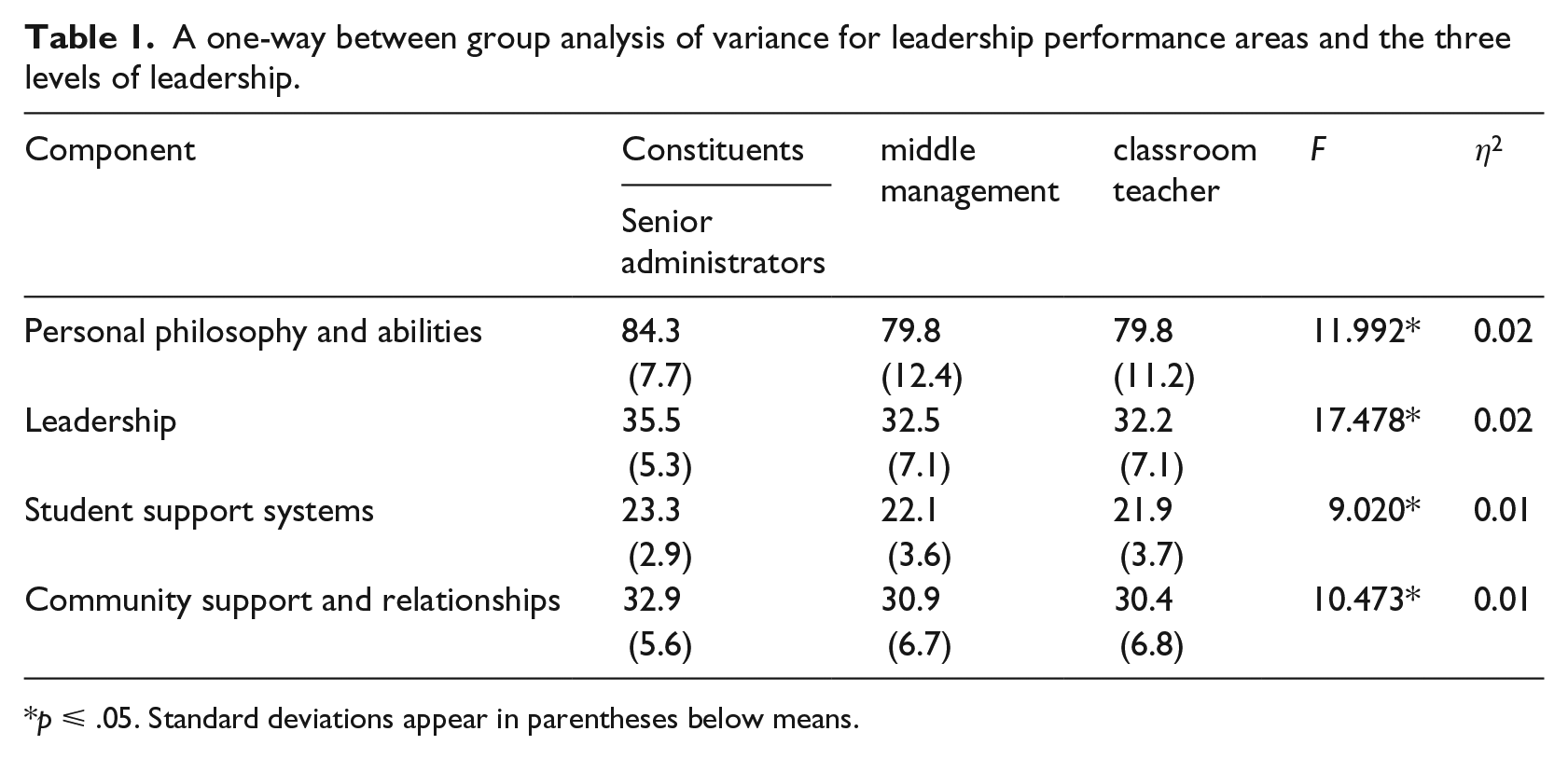
p ⩽ .05. Standard deviations appear in parentheses below means.
Discussion
Research questions
The findings of the study showed both similarities and differences in how the three levels of leadership rate the four dimensions of high-performing principals. In seeking to interpret these findings, two research questions were posed, and they assisted in providing plausible responses in order to better understand how to improve leadership and management in the public school system in Jamaica.
1. What accounts for the differences and similarities, if any, in the ratings of the dimensions of performance associated with high-performing principals by the three levels of leadership among school constituents?
The findings of the study showed that senior administrators, middle managers and classroom teachers rated high-performing principals in the same way on the dimensions of personal philosophy and abilities and leadership. That is, there were differences in how senior managers, middle managers and classroom teachers rated the dimensions of leadership and philosophy and abilities. On the other hand, there were similarities in how middle managers and classroom teachers rated both dimensions. For the dimensions of student support systems and community support and relationships, the data also revealed similarities and differences in how constituents rated the performance of high-performing principals. There were differences between senior managers and middle managers, and between middle managers and classroom teachers on the ratings of high-performing principals on both dimensions.
Differences in the ratings of high-performing principals by senior administrators and middle managers, and senior administrators and classroom teachers (on the dimensions of personal philosophy and abilities and leadership) may be explained by the nature of the power relationship between principals and the three levels of respondents. This means that those working closest to the principal, in this case, senior administrators, would tend to rate them more favourably because of the traditional power relationship present. Lunenburg and Ornstein (2008) intimated that in a centralized system, which is still a feature of many schools, including some operated by high-performing principals, senior managers are empowered to direct the actions of teachers with little consideration given to their professional competence. The fact that there is no difference in the ratings of middle managers and classroom teachers in regards to the two dimensions may be a further demonstration that the bureaucratic relationship continues to exist, even among schools which are operated by high-performing principals.
The differences in ratings may also signal that the professional structure was not evident in how the three levels of school leadership rated high-performing principals on the four dimensions of leadership. For the respondents whose ratings showed a difference, they may still harbour residual views that the bureaucratic structure continues to be important, even with high-performing principals at the helm. With Jamaica continuing to have a strong bureaucratic structure in the way schools are organized and administered (McCallum, 2013), the difference in ratings should not be unexpected. On the other hand, the similarities may be a confirmation that the professional approach to leadership is being demonstrated by the findings of this study. This too is consistent with the effort to decentralize the education system which facilitates participation in the decision-making process among all levels of leaders (Hutton, 2015). Further, with more efforts being made by high-performing principals to emphasize a more distributed approach to leadership in order to empower other levels of leadership (Hutton, 2011), there will be an increased likelihood of more support for the policies and programmes by teachers and middle managers.
But the nature and context of the challenges facing public schools in Jamaica will also be impacting leadership behaviours in the schools. It is the teacher who has to work directly with the problems of overcrowding, absenteeism (especially at the primary levels), lack of teaching equipment and resources to improve teaching among others. While the principals and other senior administrators are close to the situation the impact will always be different for each of the constituents. Differences will arise in the solutions proposed to address these problems, which are directly related to the context in which schools operate in Jamaica. The timeliness in the implementation of the solutions is also problematic. Solutions which are agreed to may not be implemented over an extended period of time. This can easily lead to frustration and negative responses or even demotivation, especially from classroom teachers. Within a loosely coupled structure, there are agreements and disagreements, but all have to continue to co-exist. In those cases, where progress is being made, even though not at a pace that is expected by some stakeholders, high-performing principals are usually recognized and appreciated for the role they play in assisting the schools and children to make measureable progress.
2. What are the other findings, if any, which may be relevant in explaining similarities or differences in the ratings of the four dimensions of performance associated with high-performing principals by the three levels of leadership among school constituents?
The second general finding is that even though there was a difference between the groups—senior administrators, middle managers and classroom teachers—in how they rated high-performing principals on the four dimensions of performance, the results showed that these differences were weak. An interpretation of this could be that the three levels of respondents may be more inclined to agree with these dimensions than disagree. Further, the weak differences in the ratings of high-performing principals may suggest a closing of the gap on how senior administrators, middle managers and classroom teachers rated high-performing principals on both leadership and personal factors. In fact, the differences and similarities among respondents in how they rated the performance of high-performing principals on the four dimensions supports the theory of a loosely coupled relationship existing in how decisions are being made and how tasks are performed in the school system (Hanson, 2003). In other words, the similarities and differences in the ratings made by both senior managers and classroom teachers, middle managers and classroom teachers, and senior managers and middle managers are indications that autonomous thinking and behaviour do exist among respondents. In addition, personal factors (Miller and Hutton, 2014) which have been shown to play a significant role in the decision-making process of high-performing principals may place those who work closer with these principals in a better position to view and assess their leadership.
The nature of leadership is borne more by the differences and similarities in the ratings of the four dimensions of leadership by respondents. Note that the similarities tended to be between middle managers and classroom teachers for personal philosophy and abilities and leadership. For student support system and community support and relationships, the similarities in ratings were among senior managers and classroom teachers. The data show that the similarities always include classroom teachers and the differences in all cases involved senior administrators. Where the findings show similarities in the ratings of dimensions between the senior managers and classroom teachers, a greater level of unity is expected to exist between both constituents. This type of similarity should be encouraged by deepening decentralization, distributed leadership and the professional structure. Where the opposite is true, steps have to be taken to overcome these differences.
Some implications for the school system
All levels of school leadership must embrace the four dimensions related to the performance of high-performing principals. However, it would appear that the dimensions of student support systems must be given full attention, especially by senior managers, middle managers and classroom teachers. This is because they all work directly with students on a day-to-day basis; thus, their impact and influence are immediate and constant. Community support and relationships which emphasize parenting support also need significant attention by principals, middle managers and classroom teachers. This is crucial to students’ learning. Those aspects of community support and relationships dealing with the external entities of a public and private nature seem to need the attention of senior administrators including principals, even more than teachers and middle managers. Finally, the dimensions of personal philosophy and abilities and leadership are the factors in the domain of the principals which emphasize their personal attributes and characteristics. This does not mean that the middle managers and classroom teachers are not required to display these attributes and characteristics, but the fact is that the principals must take full responsibility in order to retain the role of instructional and transformational leader.
Government and the central ministry must continue to strengthen the structures and systems in order to better facilitate greater quality collaboration among all levels of leadership in the schools. For example, it is imperative that school boards comprise persons with the competencies and motivation to improve the performance of schools and students. Having boards of governance is one thing, but it is more important to have boards that are independent and effective. Similarly, it should be persons who have demonstrable competencies and commitment that are selected for leadership positions in the school system, and more emphasis should be placed on fostering the creation of structures that are democratic and participative and leadership that is defused. Based on the ratings of the performance dimensions of high-performing principals by the three levels of leadership, the differences and similarities should be further examined to determine the specific factors or elements to be embraced and those which may need corrective measures.
Footnotes
Declaration of Conflicting Interests
The author(s) declared no potential conflicts of interest with respect to the research, authorship, and/or publication of this article.
Funding
The author(s) received no financial support for the research, authorship, and/or publication of this article.