




Abstract
Increasing and improving the science, technology, engineering, and mathematics (STEM) educational pipeline has been a point of emphasis for decades, and federal policy in the United States has urged high schools to embed new types of STEM courses into the curriculum. As one example, applied STEM courses—one growing branch within career and technical education (CTE)—are designed to reinforce traditional academic STEM content and to motivate students’ interests and long-term pursuits in STEM areas. That said, little is known about who takes these courses, and applied-STEM-CTE enrollment in these courses has not been explored in the research for students with learning disabilities. Using the High School Longitudinal Study (a nationally representative data set of high school students), we asked whether CTE coursetaking differed for students with learning disabilities compared with those without disabilities, and whether there were specific coursetaking differences in applied-STEM-CTE. We found that students with learning disabilities were more likely to earn more units in CTE courses compared with students without disabilities. Yet, when looking at applied-STEM-CTE courses, we see that although students with learning disabilities earn more CTE units than students without disabilities, students with learning disabilities do not take different amounts of applied-STEM-CTE courses. Implications are discussed.
In an effort to address students with learning disabilities’ underrepresentation in STEM, determining ways to promote persistence and success along this STEM pipeline has become focal in educational policy. One noteworthy example is the federal Perkins legislation (i.e., the Carl D. Perkins Strengthening Career and Technical Education for the 21st Century Act, most recently authorized in 2006 as Perkins IV and in 2018 as Perkins V), which provides funding to maintain and further expand career and technical education (CTE) programming. Through the Perkins legislation, high school CTE courses are designed to provide “competency-based applied learning that contributes to the academic knowledge, higher-order reasoning and problem-solving skills, technical skills and occupation-specific skills” (Carl D. Perkins Career and Technical Education Act, p. 4). A primary goal of the act is to align applicable career-related skills with academically challenging coursework in high school. As it relates to STEM, the most recent two reauthorizations of the Perkins Act (2006 and 2018) include two particular calls to action: (a) equalizing access to CTE, specifically for students with disabilities; and (b) increasing applied-STEM coursetaking through this CTE curriculum (referred to as “applied-STEM-CTE”). This is critical, because these two recent iterations of the Perkins Act identify a need for CTE high school courses to provide students with the academic and technical skills, particularly in STEM, necessary for employment in high-skill, high-wage, and high-demand careers, whether that be with or without a college education.
From a policy perspective, the Perkins Act has recently placed emphasis on increasing access to and participation in CTE by special populations, including students with disabilities, as well as increased attention to STEM courses. In this study, we examine both CTE in general as well as applied-STEM-CTE. While we begin by examining CTE coursetaking generally in order to examine a broad description of CTE enrollment rates, we are most interested in applied-STEM-CTE coursetaking by students with learning disabilities. Conceptually, applied-STEM-CTE courses may be an effective way for students with learning disabilities to be engaged in STEM content. Empirically, there is evidence applied-STEM-CTE courses may serve as a way for students to enter and remain in the STEM pipeline, such as taking advanced STEM classes, graduating from college, and pursuing STEM in college (Plasman & Gottfried, 2018; Shifrer & Callahan, 2010). Given this, it is clear that there is a need to document whether students with learning disabilities are indeed actually participating in these courses in high school, and if so, at what rates?
If students with learning disabilities do participate in applied-STEM-CTE courses, they might be better positioned to reap the benefits of such classes, as shown in prior research on the general education student population (Gottfried, 2015). Yet, given we have no prior baseline levels regarding applied-STEM-CTE coursetaking by students with learning disabilities, our analyses will provide a valuable tool by which to understand key predictors of applied-STEM-CTE coursetaking with respect to learning disability status. With this policy backdrop in mind, we asked the following research questions:
A broad empirical base of research has established the relationship between high school STEM coursetaking and short- and long-term STEM outcomes for the general population, such as high school STEM achievement, choosing to pursue more advanced STEM coursework in high school, selecting a STEM college major, and ultimately picking a STEM-based career (Adelman, 2006; Burkam et al., 1997; Federman, 2007; Long et al., 2012; Trusty, 2002; Wang, 2013). Yet, one critical gap in the literature is understanding high school STEM coursetaking for students with learning disabilities, with almost no attention being paid specifically to applied-STEM-CTE participation. The overall lack of knowledge about the pursuit of students with learning disabilities in STEM and applied-STEM-CTE areas in high school limits our understanding of the best way to support enrollment and, ultimately, educational and employment opportunities (Moon et al., 2012; National Science Foundation, 2013). Hence, our study contributes to addressing this gap by examining participation in applied-STEM-CTE courses for students with learning disabilities using nationally representative data—the High School Longitudinal Study.
The CTE Coursetaking Landscape
CTE Overview
Under the 2006 and 2018 reauthorizations of the Perkins Act, CTE coursework is emphasized as needing to align hands-on, applicable skills with academically challenging material to foster the connection between coursework and college and career opportunities (Brand et al., 2013). In its current form, CTE coursework is separated into 16 unique clusters. These include agriculture and natural resources; architecture and construction; communications; business, management, and administration; education and training; finance; government and public administration; health sciences; hospitality and tourism; human services; information technology; law, public safety, corrections, and security; manufacturing; marketing; STEM; and transportation (National Forum on Education Statistics, 2014).
Recent research has explored the category of “CTE” as this broad measure of coursetaking. In sum, research links CTE coursetaking with a wide range of positive outcomes for students, including better attendance rates, improved odds of graduation, improved odds of earning an industry-recognized credential, higher probabilities of enrolling in postsecondary education, and higher wages after high school (Gottfried & Bozick, 2016; Gottfried & Plasman, 2018; Hemelt et al., 2017; Kemple & Willner, 2008; Plasman & Gottfried, 2018; Plasman & Gottfried, 2020). Therefore, given these established benefits of the CTE category of coursetaking, there is little information on whether students from diverse learning backgrounds are enrolling in these courses at the same rates as students from the general population. If this is not true, then it does not position these diverse learning groups from being able to capitalize on these said benefits. This motivates our first research question—to determine if there are general CTE enrollment differences for students with learning disabilities compared with those without disabilities. This will help paint a broad portrait of whether there are differences in enrollment in CTE when classified most generally.
Applied-STEM-CTE Courses
Gottfried et al. (2014) identified two distinct strands of STEM high school curriculum: traditional academic STEM and applied-STEM-CTE. Traditional academic STEM courses include common math and science courses such as algebra and physics. On the other hand, as encouraged by the Perkins Act, applied-STEM-CTE courses focus on applying math and science skills in more relevant ways and fall into two of the 16 broad CTE categories: engineering technology and information technology (Bradby & Hudson, 2007). Examples courses in applied-STEM-CTE include wind energy and biotechnical engineering in engineering technology, and C++ programming and database management in information technology. Courses within these two categories emphasize skill acquisition and focus on direct, specific, and tangible challenges to real-world STEM problems. These courses are intended to build on the material taught in traditional math and science courses and are correlated with a range of positive STEM outcomes at the high school level for the general education population, such as subsequent enrollment in advanced math and science courses, higher chances of high school completion, improved STEM self-efficacy, and improved overall achievement in high school, even after controlling for factors that might be associated with selection into these courses (Burkam & Lee, 2003; Gottfried & Plasman, 2018; Sublett & Plasman, 2017).
“STEM-Related” CTE Courses
Courses that lie within the applied-STEM-CTE curriculum are undoubtedly STEM-focused (Gottfried et al., 2014) and promote the development of skills and knowledge that have direct relevance to college and careers in STEM fields (National Science Board, 2014). That said, other clusters within the CTE framework also have the potential to expose students to STEM-related content and promote skill acquisition in STEM contexts. While Health Sciences (known as “health-CTE”) and Architecture/Construction (known as “architecture CTE”) are not “officially” considered STEM-CTE by the U.S. Department of Education (2009), they make up a notable portion of CTE programs and can prepare students to pursue degrees and occupations in STEM-related fields as classified by the National Science Foundation (National Science Board, 2014).
Examples of courses found in health CTE programs of study would include pharmacology, dental science, biotechnology, and nursing, and examples of courses found in architecture CTE programs of study would include architectural drafting, civil and structural drafting, and CAD design and software. Courses in health CTE and architecture CTE impart skills and knowledge that directly relate to the daily challenges and problems students will face should they pursue a STEM-related career, including positions such as health care workers, technicians, and architects. That said, we consider these courses as STEM-related CTE rather than unequivocally as applied-STEM-CTE, as there is a degree of uncertainty and disagreement between federal designations in K–12 as well as whether colleges consider them STEM courses.
However, these courses are designed to motivate students’ interests and long-term pursuits in STEM-related areas. That said, nothing is known in the research about “STEM-related” CTE courses. We explore them here in a subsequent analysis below.
CTE Coursetaking for Students With Learning Disabilities
Reasons to Enroll
Though the vast majority of students with learning disabilities have been educated along with the general education population in recent decades (Cawley et al., 2002), evidence suggests that traditional STEM courses could pose significant educational challenges. For example, traditional STEM courses rely heavily on text-based instruction. This creates an emphasis on language-based learning and consequently may place students with learning disabilities, many of whom experience vocabulary and reading challenges, at a disadvantage (Parmar et al., 1994). In contrast, applied-STEM-CTE courses might support students with learning disabilities’ learning through the implementation of applied instructional approaches taken in CTE courses (Maccini & Gagnon, 2000; Witzel, 2005), such as hands-on learning, activity-based learning, connections to real-life applications as opposed to textbook learning, verbal learning, and memorization (Jenson et al., 2011; Scruggs et al., 1993). In fact, students with learning disabilities have a history of performing better when learning through an applied approach as opposed to strictly textbook-based learning (Brigham et al., 2011; Moon et al., 2012). Applied-STEM-CTE coursework, therefore, may be uniquely positioned to improve STEM outcomes for students with learning disabilities.
We propose that there are three ways by which applied-STEM-CTE courses might be might be well suited for students with learning disabilities to enroll in them. First, recommended accommodations for students with learning disabilities include using multiple senses, participating in hands-on and lab experiences and employing more demonstrations by the instructor (Erwin et al., 2001; Fraser & Maguvhe, 2008; Orr & Hammig, 2009; Scruggs & Mastropieri, 2007; Steele, 2008). Such accommodations are also closely related to the Universal Design for Learning as outlined in the Higher Education Opportunity Act, a guiding set of principles which emphasize the need for flexible teaching approaches to create access to educational curricula for all students, including those with disabilities (Dell et al., 2015). This act promotes the idea that education should be presented in a manner preventing barriers to learning, providing appropriate accommodations, and maintaining “high achievement expectations for all students, including students with disabilities . . .” (Higher Education Opportunity Act, p. 12). CTE instruction often includes the provision of individualized academic interventions, regardless of whether a student has a disability (Vaughn & Linan-Thompson, 2003), thereby aligning with the learning needs of students with disabilities.
Second, traditional math and science courses tend to be abstract in nature of, which can potentially create significant difficulties for students with learning disabilities who are enrolled in these courses (Jenson et al., 2011). The hands-on, applied learning approaches that form the foundation of applied-STEM-CTE courses tend to align with the type of instruction that is more effective for students with learning disabilities (Jenson et al., 2011; Scruggs et al., 1993). Students with learning disabilities have exhibited improved academic performance when provided with applied learning approaches as opposed to textbook-based learning approaches (Brigham et al., 2011; Moon et al., 2012).
Finally, applied-STEM-CTE courses are intended to emphasize the relevance of traditional STEM concepts as they relate to later college and career opportunities (Karweit, 1993; Stone et al., 2008). This connection between abstract and practical is especially promising for students with learning disabilities, as it promotes increased school engagement (Thurlow et al., 2002). Through applied-STEM-CTE coursework, students may develop a greater interest in developing the skills and knowledge necessary to obtain these jobs after high school graduation or after college (Stone & Lewis, 2012).
Benefits of CTE Coursetaking
In addition to potential improved alignment between instructional techniques and optimal learning opportunities provided in CTE coursework for students with learning disabilities, there is evidence that CTE in general links to a range of benefits for this population of students. Recent work out of Massachusetts by Dougherty et al. (2018) found that students with disabilities who enrolled in regional career centers were more likely to graduate from high school within 4 years and were more likely to earn an industry-recognized credential than those in other educational settings. Using Washington state data, Theobald et al. (2017) identified CTE concentration (i.e., earning four or more CTE units) as a predictor of improved attendance rates and improved likelihood of employment after high school for students with disabilities. Lee et al. (2016) found further evidence to support the idea that CTE concentrators with disabilities were more likely to be employed after high school using national-level secondary data.
As for applied-STEM-CTE in particular, what small literature exists suggests that applied-STEM-CTE coursetaking is linked to STEM success for students with learning disabilities. Shifrer and Callahan (2010) found that all students (in a nationally representative data set of the graduating class of 2004) who took more units of applied-STEM-CTE coursework had higher odds of taking more advanced academic math and science courses. Importantly, students with learning disabilities had even higher odds in comparison with students without disabilities. Using the same national data on the class of 2004, Plasman and Gottfried (2018) found that students with learning disabilities in the class of 2004 who took applied-STEM-CTE courses in high school had higher math test scores, lower chances of dropping out of high school, and higher chances of enrolling in college within two years of graduating from high school. Importantly, the effect sizes were larger for students with learning disabilities than general education students. In sum, these studies provide some evidence that specific needs of students with learning disabilities might be addressed through the nature of applied-STEM-CTE coursetaking (Brigham et al., 2011; Plank et al., 2008; Scruggs et al., 1993).
While there is existing evidence about the benefits of students with learning disabilities taking applied-STEM-CTE courses, there are two gaps in the literature. First, the Shifrer and Callahan (2010) and Plasman and Gottfried (2018) articles mentioned above (and are the only two in this area of research) analyzed outdated data from high schoolers in the early 2000s. That said, the recent Perkins Act reauthorizations that called for more STEM-focused CTE and for a greater participation of students with disabilities occurred after the data utilized in the prior studies had been collected. Hence, our study expands the STEM students with learning disabilities literature by examining a nationally representative data set from a more recent cohort of students after the fourth reauthorization of Perkins in 2006.
Second, the body of research does not explore the landscape of CTE coursetaking among students with learning disabilities in high school. That is, no known study has documented the extent of enrollment of students with learning disabilities in applied-STEM-CTE courses. This is problematic because if policy is concerned about students with learning disabilities’ persistence in STEM fields, it would behoove researchers to address where enrollment gaps exist.
Method
Data Set Overview
This study utilized a large-scale nationally representative, longitudinal data set developed by the National Center for Education Statistics (NCES) at the U.S. Department of Education. The High School Longitudinal Study (HSLS) of 2009 data set follows a cohort of more than 20,000 ninth-grade students in more than 900 public and private schools across the United States throughout secondary and into postsecondary years. Fall 2009 served as the baseline year for data collection, at which time survey questionnaires were administered to ninth-grade students along with their parents, teachers, school administrators, and school counselors in an effort to establish a complete record of a student’s developmental and educational environment.
Over the course of the 2013–2014 school year, NCES also collected full transcript data after a majority of students had completed high school and degree verification was complete. This transcript data included full information on all courses that students took, thereby allowing us to identify applied-STEM-CTE coursetaking for our sample of students.
To address missing values, we used multiple imputation. Specifically, we imputed all of the control variables included in our analysis by imputing 20 data sets to resemble the original distribution of observed variables (Royston, 2004). In the reporting of our results, per NCES rules, all sample sizes have been rounded to the nearest 10 to provide disclosure protection for the restricted-use data used in the analysis. Note that the high school transcript probability weight provided by the HSLS:2009 data set, W3HSTRANS, was used to ensure that estimates based on subsamples are appropriately representative of all students in the United States.
Students With Learning Disabilities
HSLS recorded students as having a learning disability based on parent responses to NCES as to whether a doctor, health care provider, teacher, or school official had ever diagnosed their child with a specific learning disability. From this variable, we created a binary indicator equal to 1 if the student was reported to have a learning disability, and 0 otherwise. Approximately 8% of the entire sample in the data set was classified as having a learning disability according to the parent survey responses. This is consistent with prior research that used other nationally representative data to explore students with learning disabilities’ high school coursetaking (Plasman & Gottfried, 2018; Shifrer and Callahan, 2010). Additionally, given the nationally representative sampling design of the HSLS data set, this 7% figure is consistent with the national estimates at the time of the data collection (Spellings et al., 2007).
Note that in this study, our sample includes students with learning disabilities and students without disabilities. In order to identify students without disabilities, we relied on a combination of two survey measures provided by HSLS. First, the data set included indicators as to the specific disabilities students had based on parent responses. Next, we relied on a variable provided by HSLS, which reported if the student had an individualized education plan (IEP) in high school. We then created a binary indicator for whether a student had a reported disability or IEP at school (1 = yes, 0 = no). In other words, in order for a student to be identified as not having a disability, their parents did not indicate the student had any of the identified disabilities, and their school must have reported that they never received special education services through an IEP. This way, all comparisons in the tables are between students with learning disabilities and students without disabilities. The total sample included N = 18,250 observations for which we have transcripts and nonzero weights.
IEPs are designed for students with disabilities to describe the individualized goals and support needed for each student. It is important to note that not all students identified in the data set as having a learning disability had an IEP on file with the school. It is possible for parents of a child with a learning disability to choose not to accept an IEP for that child, as parents have the right to determine whether they want their child to receive special education services. In other words, a student can have a disability but not have an IEP (hence our decision to rely on the parental report of having a disability rather than IEP designation to identify students with learning disabilities). We chose this approach because students with learning disabilities who do not have an official IEP with their schools will likely still benefit from the teaching methods and accommodations provided through CTE instruction. However, as an added test of robustness, we created a binary indicator for whether a student had a reported learning disability and an IEP at school. Using this indicator as the key predictor in our model (described below) yielded the same results as our preferred learning disability predictor described above.
CTE Coursetaking
Key to the analysis were the high school transcripts for students in the sample. For each student, we could thus determine which courses he or she took, how many units they earned in each class, and the grades earned. Transcripts were available for approximately 94% of the students who participated in the original baseline year sample in 2009. Transcripts were calibrated to indicate Carnegie units as a standardized measure of units earned, such that one Carnegie unit is equivalent to a course taken every day, one period a day, for an entire school year.
For the first research question, the two key coursetaking variables were participation in CTE courses in high school and the number of CTE units earned in high school. To measure CTE participation in high school, we created a binary variable to indicate whether a student had earned CTE credit at any time during high school based on the reported transcript data. If the student had ever earned CTE units in high school, the student was assigned a value of 1 on the indicator variable, and 0 otherwise. We then explored the number of CTE units earned in high school as a continuous variable for our second measure. The outcomes were constructed analogously for the second research question, except we limited participation and unit completion measures specifically to applied-STEM-CTE courses.
Control Variables
Table 1 presents the descriptive statistics for variables we use in this study—consistent with those that have been utilized in prior studies of CTE coursetaking (Adelman, 2006; Bozick & Dalton, 2013; Gottfried, 2015; Gottfried et al., 2014; Long et al., 2012; Shifrer and Callahan, 2010; Tyson et al., 2007). These variables include sociodemographic student data (gender, race/ethnicity, language status, if the student had an IEP at school, if the student received free/reduced lunch); household measures (family arrangement, parental education, socioeconomic status); and students’ academic investments (ninth-grade GPA, ninth-grade math score, most advanced math course taken in eighth grade, grade received in eighth-grade match course, math efficacy scale created by NCES, science efficacy scale created by NCES, and an indicator of whether the student agreed that education was important). To classify the most advanced math course taken in eighth grade, we created a series of indicators to group courses into five major subdivisions following the mathematics coursetaking classifications recommended by Burkam and Lee (2003): (a) nonacademic courses; (b) low academic courses; (c) middle academic courses; (d) advanced academic courses; and (e) other courses. The grade received in the eighth-grade math course was transformed to fit a 4.0 scale: A is 4 points, B is 3 points, C is 2 points, D is 1 point, and F is 0 points.
Descriptive Statistics

Note. Standard deviations are reported for continuous variables only.
Data Analysis
Both research questions relied on the same analytic approach. For each question, we began our analyses with the following baseline model specified as follows:

where Y represented our outcome of interest for student i in high school s. When Y was a binary indicator, this constituted a linear probability model, and the coefficients in the regression represented a percentage point increase or decrease in the likelihood of taking a CTE course. We chose linear probability models over logistic regressions as described by recent research (Gomila, 2020). When Y was the number of units, the model was a standard ordinary least squares, where the coefficients represented the number of earned units in CTE courses. The predictors denoted by LD, S, H, and I represented the sets of independent variables described above, namely learning disability (LD), sociodemographic variables (S), household measures (H), and academic investments (I). Finally, the error term was clustered by school to account for the nesting of students within high schools.
The first research question addressed whether students with learning disabilities were more or less likely to take CTE coursework compared to other students in high school. For this question, we fit two separate models. First, we fit a model where Y was the binary indicator of whether a student i in school s had completed a CTE course during high school. In the second, we regressed the number of CTE units student i in school s had completed in high school on all independent measures. The independent variable of interest was LD i —an indicator for whether a student was classified as having a learning disability.
The second research question addressed whether students with learning disabilities were more or less likely to take applied-STEM-CTE courses compared with other students in high school. For this question, we conducted two separate analyses. First, Y was the binary outcome indicating whether a student i in school s had ever taken at least one applied-STEM-CTE course during high school. Second, Y was the number of applied-STEM-CTE units student i in school s had completed in high school. Again, our key measure was LD i , which identifies the degree to which students with learning disabilities were more or less likely to enroll in and earn units in applied-STEM-CTE courses as compared to students without disabilities.
Model Adjustments
When considering the baseline model above, one issue that could arise when comparing students across schools is the presence of unobserved school-level differences. It is highly likely that experiences of students in specific schools might differ in meaningful ways. For example, high schools (or their feeder districts) may classify students with learning disabilities differently or offer different kinds of special education resources. There is potential of this, given that 80% but not 100% of students with learning disabilities have IEPs on file, which may highlight potential differences in school or district practices. Therefore, the probability of having the right IEP supports might differ from school to school. With respect to coursetaking, schools may offer different CTE and applied-STEM-CTE courses, and teachers or administrators might have different attitudes about resources for students wishing to take these courses. Therefore, comparing students across schools may be biased in some unobservable respects. To account for such differences, the first model was revised to include school fixed effects:

Here, the term
Results
Research Question 1
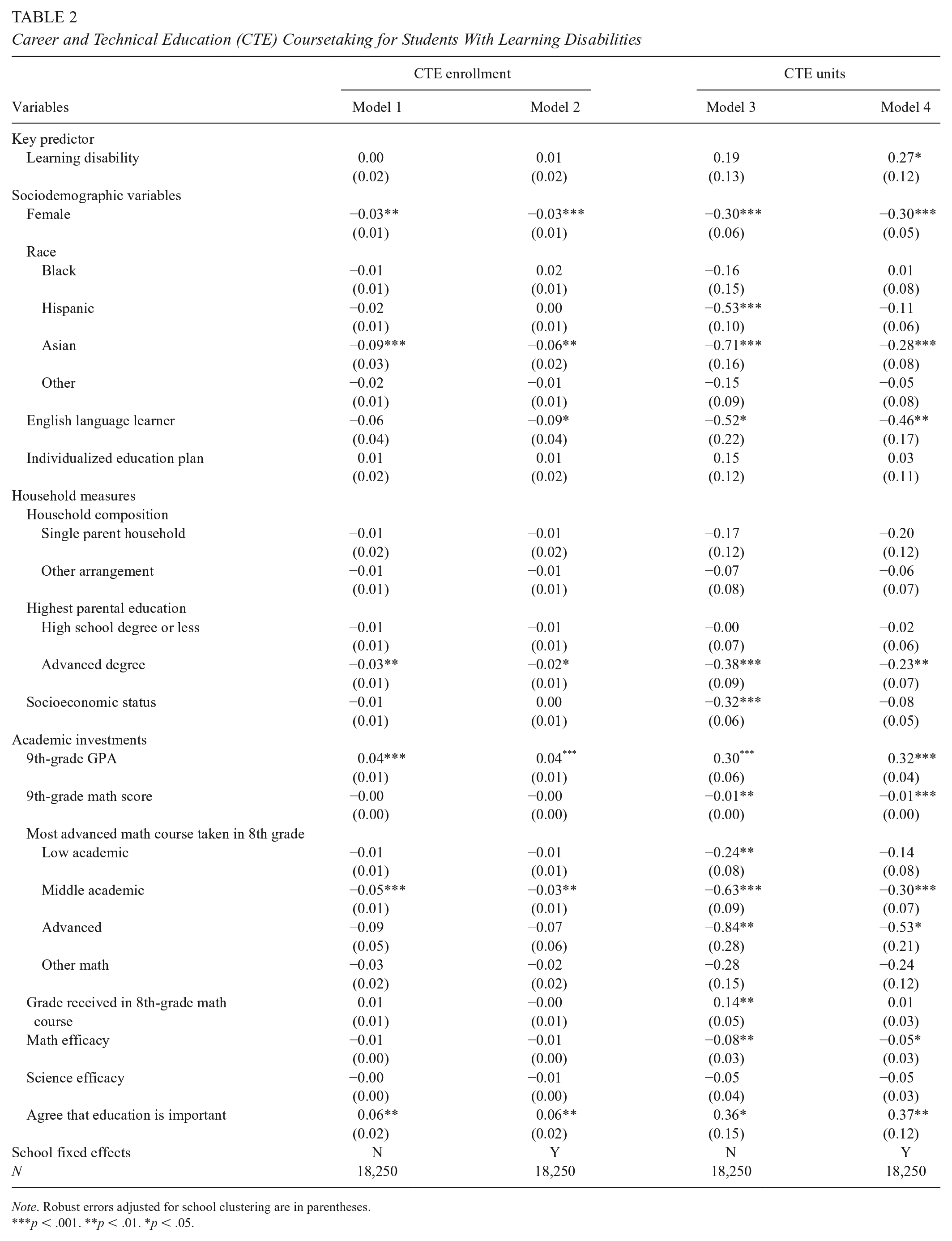
Table 2 presents the findings related to CTE participation and units earned based on employing the baseline and school fixed effects models, described above. Each column represents a unique regression, where the outcome is designated at the top of the columns. Models 1 and 2 estimate the probability of enrolling in any type of CTE course by the end of high school, and Models 3 and 4 estimate the number of CTE units that a student had completed by the end of high school. Coefficients are presented with clustered standard errors in the parentheses below each coefficient estimate. Recall that this analysis focuses on the comparison of students with learning disabilities to students without disabilities. All independent variables are labeled in the first column of the table.
Career and Technical Education (CTE) Coursetaking for Students With Learning Disabilities
Note. Robust errors adjusted for school clustering are in parentheses.
p < .001. **p < .01. *p < .05.
The key variable of interest is found in the first row of the table—an indicator variable for whether a student has a learning disability. The learning disability coefficient in the model represents the difference between participation rates or units earned for students with learning disabilities versus students without disabilities, when holding all else constant. Across both the baseline and school fixed effects models estimating CTE participation (Models 1 and 2), there is no evidence suggesting that students with learning disabilities are more or less likely to enroll in CTE as compared to students without disabilities.
Models 3 and 4 examine the number of units earned in CTE classes in high school. In our baseline model (Model 3), there is no evidence suggesting that students with learning disabilities earned more CTE units in high school compared with students without disabilities. That said, under our preferred model employing school fixed effects (Model 4), students with learning disabilities earned more CTE units in high school compared with students without disabilities. Practically speaking, students with learning disabilities were expected to earn about 0.27 more CTE units than students without disabilities over the course of high school. Compared with the average of 2.83 units of CTE earned by students without disabilities, this represents an approximately 10%–increase in the number of CTE units earned.
Research Question 2
Table 3 presents the findings related to applied-STEM-CTE participation and applied-STEM-CTE units earned. As in Table 2, each column represents a unique regression, where the outcome is designated at the top of the columns. Models 1 and 2 pertain to enrollment in applied-STEM-CTE courses, and Models 3 and 4 pertain to the number of applied-STEM-CTE units a student had completed by the end of high school.
Applied Science, Technology, Engineering, and Mathematics–Career and Technical Education (STEM-CTE) Coursetaking for Students With Learning Disabilities

Note. Robust errors adjusted for school clustering are in parentheses.
p < .001. **p < .01. *p < .05.
Across both the baseline and school fixed effects models, there is no evidence suggesting that students with learning disabilities were more or less likely to enroll or earn units in applied-STEM-CTE as compared to students without disabilities. In other words, coursetaking in high school looks very similar with respect to applied-STEM-CTE courses for both students with learning disabilities and students without disabilities.
In order to gain a more nuanced understanding of applied-STEM-CTE participation and units earned, we disaggregated the engineering technology and information technology clusters. Outcomes were constructed analogously to those for the applied-STEM-CTE more broadly. Table 4 presents the findings related to participation and units earned in engineering technology and information technology courses individually. Each column represents a unique regression, where the outcome is designated at the top of the columns. Note that in this table, only the LD coefficient is presented—equivalent to the top row of coefficients in Table 3. All other variables are included in the model, as per Table 3, though they are not shown for the sake of parsimony.
Engineering Technology and Information Technology Coursetaking for Students With Learning Disabilities

Note. Robust errors adjusted for school clustering are in parentheses.
p < .001. **p < .01. *p < .05.
Across baseline and school fixed effects models, there was no evidence suggesting that students with learning disabilities were more or less likely to enroll or earn units in engineering technology or information technology courses as compared with students without disabilities. In other words, applied-STEM-CTE coursetaking for both students with learning disabilities and students without disabilities looks very similar across both types of applied-STEM-CTE courses. These results are consistent with our findings presented in Table 3.
“STEM-Related” CTE Courses
While the focus of our study was CTE and applied-STEM-CTE coursetaking for students with learning disabilities compared with students without disabilities, we were also curious if these findings would be consistent in other STEM-related CTE courses. Though health CTE and architecture CTE do not directly fall within the applied-STEM-CTE framework, they prepare students to pursue degrees and occupations in STEM-related fields, and likely have many STEM applications, such as medicine, mathematics, and physics. Because of their ambiguous classification, we omitted them from our main analysis, but include them here as an added measure to test the robustness of our findings.
The data set recorded the number of units earned in both health CTE and architecture CTE courses. To measure participation in health CTE, we created a binary variable to indicate whether a student had earned any health CTE credit in high school based on the reported transcript data. If the student had ever earned any health CTE units, the student was assigned a value of 1, and a 0 otherwise. We also explored the number of health CTE units earned in high school as a continuous variable. The same approach was taken to determine participation and number of units earned in architecture CTE courses ever taken in high school based on the reported transcript data. Table 5 presents the findings related to health CTE and architecture CTE participation and units earned based on employing the school fixed effect model, as described above. Each column represents a unique regression, where the outcome is designated in the top row. In each analysis, students with learning disabilities are compared to students without disabilities.
Health CTE and Architecture CTE Coursetaking for Students With Learning Disabilities

Note. CTE = career and technical education. Robust errors adjusted for school clustering are in parentheses.
p < .001. **p < .01. *p < .05.
Columns 1 and 2 pertain to enrollment and number of units earned in health CTE courses, and columns 3 and 4 pertain to the enrollment and number of units earned in architecture CTE courses. Across all four school fixed effects models, there was no evidence suggesting that students with learning disabilities were more or less likely than students without disabilities to participate in or earn units in health CTE and architecture CTE. Practically speaking, high school health CTE and architecture CTE coursetaking for both students with learning disabilities and students without disabilities are similar. These results are consistent with our findings regarding applied-STEM-CTE coursetaking presented in Tables 3 and 4.
Discussion
With growing concerns about the underrepresentation of students with learning disabilities in the STEM pipeline (National Science Foundation, 2013) and the general concerns about secondary students’ lack of STEM proficiency as a policy backdrop (President’s Council of Advisors on Science and Technology, 2010), this study examined broad CTE and more specific applied-STEM-CTE coursetaking of students with learning disabilities in high school. We did so by evaluating national data collected after the 2006 reauthorization of the Carl D. Perkins Career and Technical Education Act, commonly referred to as “Perkins IV.” It was this act that put students with disabilities and STEM pipelines in the forefront of thinking about access to high school CTE curricula. This is the first study to use the most current nationally representative data available to investigate whether students with learning disabilities were more or less likely to enroll in CTE and applied-STEM-CTE courses in high school.
Through our analyses, we were able to respond to each of our research questions about CTE and applied-STEM-CTE participation for students with learning disabilities. As for the first research question, while we found no evidence that students with learning disabilities were more or less likely to participate in CTE in high school compared to students without disabilities, we did find that they were more likely to earn more CTE units in high school. This is a noteworthy finding given federal policymakers’ recent focus (via the Perkins Acts) on diversifying and increasing CTE enrollment for our nation’s high school students. Here, we provide some evidence of this occurring. Furthermore, these findings align with prior research indicating that students with disabilities are more likely to complete CTE programming (Levesque et al., 2008). Considering participation in CTE may be particularly beneficial for students with learning disabilities (Plasman & Gottfried, 2018), this finding that students with learning disabilities are earning more units than students without disabilities may also indicate that students with learning disabilities have higher exposure to the potential benefits from CTE instruction.
The results for the second research question provide insight into access to the first “node” of the STEM pipeline. Even though students with learning disabilities were taking more CTE units in general, we found no evidence that students with learning disabilities were taking different rates of applied-STEM-CTE courses compared with students without disabilities. That said, it does not appear that there were any statistical differences between the applied-STEM-CTE coursetaking rates between the two groups of students in the data. In other words, we show no evidence of a students with learning disabilities–coursetaking gap specifically in applied-STEM-CTE areas. Given the previously established benefits of these courses (Plasman & Gottfried, 2018; Shifrer and Callahan, 2010), it is notable that we find no evidence of students with learning disabilities taking fewer applied-STEM-CTE courses compared to students without disabilities. Perkins IV called for specific focus to increase access and participation in CTE for students with disabilities and particularly in STEM. Therefore, the results here might suggest this: statistically equivalent applied-STEM-coursetaking rates among those with and without learning disabilities, and perhaps movement toward this policy objective of Perkins to increase access and participation. However, a question remains: if applied-STEM-CTE courses are being taken at the same rates by students with learning disabilities and those without disabilities and yet students with learning disabilities are taking more of other types of CTE as shown by our first set of results, then what courses are being left behind in order to make room for these other CTE courses? While out of the scope of this study, a next step would be to see how students with learning disabilities are substituting away from other core high school courses in order to make room for other non-STEM CTE classes.
The goal of this study was to understand the CTE and applied-STEM-CTE coursetaking for students with learning disabilities compared with students without disabilities, and through further exploration we also examined coursetaking for other STEM-related CTE courses, namely health CTE and architecture CTE courses. While there is no evidence that students with learning disabilities are more likely to take these STEM-related CTE courses than students without disabilities, they are taking these courses in a comparable way. Given our findings regarding applied-STEM-CTE coursetaking for students with learning disabilities this is not surprising, and again may show movement toward the policy objectives of Perkins.
Considering the findings from our research questions together perhaps sheds lights on implications for policy. Previous research has exposed the academic stratification and marginalization of students with disabilities across all subjects (Shifer et al., 2013), and more specifically in STEM subjects (Blackorby & Wagner, 1996; Shrifer et al., 2013; U.S. Department of Education, 2009). These are critical findings for our work given that students were more likely to earn more units in CTE courses yet no more likely to take or earn units in applied-STEM-CTE courses. It is certain that we do not see a students with learning disabilities-STEM gap in our findings, but we must question why students with learning disabilities are taking more units of CTE but not applied-STEM-CTE courses compared with students without disabilities. It may be possible that there is sorting across CTE areas for high school students with disabilities, which is why we see students with learning disabilities taking more of other types of CTE courses but not more applied-STEM-CTE courses in particular. For instance, it is possible that students with disabilities are being disproportionately advised to take other types of non-STEM CTE courses, or perhaps students with disabilities feel less motivated to take STEM-focused CTE courses. This is beyond the scope of our study, but these are certainly issues that merit consideration.
Furthermore, if a goal of policymakers is to drastically equalize STEM participation rates for students with learning disabilities, then policymakers might consider reevaluating how to increase participation of students with learning disabilities (as well as students with other disabilities) not only into applied-STEM-CTE courses (as we see in this study) but also into other types of STEM courses that may complement applied-STEM-CTE coursework. One mechanism to increase recruitment of students with learning disabilities into applied-STEM-CTE and other STEM courses may be through school counselor recommendations about these courses and how they may fit together across academic and CTE STEM courses. School counselors are in a unique position to not only inform students, parents, teachers, and administrators of the benefits of applied-STEM-CTE coursetaking for students with learning disabilities, but also to develop systems for creating individual high school planning with a focus on applied-STEM-CTE. By making students aware of the short- and long-term outcomes associated with applied-STEM-CTE coursetaking, counselors could help increase access across multiple areas of STEM, both applied and academic, for students with learning disabilities. Finally, the potential benefit students with learning disabilities may receive from applied-STEM-CTE courses speaks directly to the teaching practices within these courses. In the case that high schools do not have applied-STEM-CTE courses available for students, teachers in academic STEM courses can use applied-STEM-CTE principles in their classrooms. By introducing a practical application of skills and hands-on learning opportunities in academic STEM, students with learning disabilities can receive accommodations they need in order to be successful in STEM material in high school linking them to college and/or STEM careers.
In conclusion, given the policy goals of Perkins Act to create an emphasis on equalizing access to CTE for students with disabilities with a particular focus on STEM-themed CTE courses, the findings of this study provide a valuable contribution to the literature on applied-STEM-CTE coursetaking for students with learning disabilities. The current study was the first to expand the current applied-STEM-CTE literature by examining a nationally representative data set using the most recent data available. We do not find a students with learning disabilities-STEM gap in applied-STEM-CTE coursetaking. Our study will help spark further inquiry as to how to continue supporting access and increasing participation of students with learning disabilities in STEM subjects, applied and otherwise.
Limitations
There are several limitations of this study. First, this study explored secondary data to predict whether students with learning disabilities were more or less likely to enroll in CTE and applied-STEM-CTE courses compared with the general student population. While we found sufficient evidence pertaining to whether or not students with learning disabilities are taking these courses, it is not possible to draw any conclusions about the mechanisms behind those decisions. Future research should consider qualitative approaches in order to gain a deeper understanding about the motivations and perceptions behind a student’s choice to enroll or abstain from taking applied-STEM-CTE courses.
Second, while HSLS:2009 is nationally representative and longitudinal, the data set does not contain any measures on course content. Future research should also consider investigating details about the rigor, quality, and design of applied-STEM-CTE courses, which can affect a student’s decision to enroll in or continue taking similar courses. Without more information available about the course content, it is not possible to understand what might deter students with learning disabilities or other students from enrolling in these courses.
Third, while HSLS:2009 does give information on the courses taken by each student, we do not know the full CTE offerings by each individual school, so we cannot control for how many courses in different fields are available for students. Future researchers should rely on the findings of this study to develop a research study that explores the different course taking options available at high schools in the United States, and how this relates to the coursetaking patterns of students with learning disabilities.
Fourth, through the use of school fixed effects we attempted to control for unobserved factors that might bias the observed relationships. However, it is not possible to randomly assign students into learning disability status, so it is impossible to fully address selection bias caused by unmeasured factors, such as individual differences between students. Therefore, the results in this study should be interpreted as descriptive rather than causal.
Finally, although this study does not find disparities by learning disability status in applied-STEM-CTE coursetaking in high school, this cannot (and should not) be generalized beyond the scope of this study. That is to say, while this study examined the CTE sector, there remain disparities in the STEM pipeline for students with learning disabilities, such as academic STEM courses, college majors, and careers. Therefore, we urge caution to policy makers to interpret the findings of this study only within the scope of CTE, and that attention must still be paid to persistence in the STEM pipeline.
In sum, this study was the first to use the most current data available to investigate whether students with learning disabilities were more or less likely to enroll in CTE and applied-STEM-CTE courses in high school. This study has shown that high school students with learning disabilities were more likely to earn units in CTE courses compared with students without disabilities, but this was not evident for applied-STEM-CTE courses. While the previously explained avenues for future research have suggested smaller scale studies, there is also room for additional research with national data sets. For instance, future research can evaluate the longer-term effects of applied-STEM-CTE courses on postsecondary outcomes, such as enrolling in college, course selection, and major selection in postsecondary education. In doing this, we will be able to evaluate whether taking these applied-STEM-CTE courses has any long-term effects with respect to ensuring that students with learning disabilities continue to progress along the STEM pipeline.
Footnotes
Funding
The author(s) disclosed receipt of the following financial support for the research, authorship, and/or publication of this article: The research reported here was supported, in whole, by the Institute of Education Sciences, U.S. Department of Education, through Grant R324A200233. The opinions expressed are those of the authors and do not represent the views of the Institute or the U.S. Department of Education.

Authors
MICHAEL A. GOTTFRIED is an associate professor in the Graduate School of Education at the University of Pennsylvania. His research interests focus on education policy and the economics of education.
JAY PLASMAN is an assistant professor in the College of Education at The Ohio State University. His interests focus on career and technical education and education policy.
JENNIFER A. FREEMAN is a PhD student in the Graduate School of Education at the University of Pennsylvania. Her interests focus on career and technical education and education policy.
SHAUN DOUGHERTY is an associate professor in the Peabody School of Education at Vanderbilt University. His interests are in education policy and career and technical education.