




Abstract
Teacher turnover across the country presents a persistent and growing challenge for schools and districts, with the highest rates of turnover geographically concentrated in the American South. Research on teacher staffing and turnover problems consistently highlight two subsets of schools as struggling to attract and retain well-credentialed, effective educators—predominantly Black schools and rural schools. However, research has rarely explicitly examined the schools that meet both these criteria. We use administrative records and unique climate survey data from Georgia to examine how the intersecting roles of race, money, and school climate shape evolving teacher turnover patterns in rural schools. Findings suggest that while teacher mobility is generally less common in rural schools, considerable inequities exist within the rural space, with majority Black rural schools bearing far more of the brunt of rural teacher turnover. Among rural teachers, Black teachers have higher mobility rates—more likely to make interdistrict moves and to exit rural settings for teaching opportunities in urban and suburban contexts. However, in majority-Black rural schools, higher salaries and school climate factors, such as relational climate and parental involvement, were strong predictors of retention, even after controlling for a rich set of covariates.
Introduction
While many schools and districts throughout the nation struggle to manage the consequences of teacher turnover, the burden does not fall equally across demographics or geographies. Nationally, teacher turnover averages approximately 15% annually, with schools in the Northeast and less diverse rural areas generally experiencing the least turnover, and Southern schools and those in more diverse urban centers dealing with the most (Carter-Thomas & Darling-Hammond, 2017). Reducing disparities in teacher turnover is an important policy goal with equity implications, as higher turnover rates have been shown to harm student learning outcomes, through both disruption and staff compositional change (Redding & Henry 2018, 2019; Ronfeldt et al., 2013; Sorensen & Ladd, 2020). Teacher turnover also often carries substantial budgetary costs and disproportionately burdens lower-resourced communities and schools with harsh financial constraints (Sutcher et al., 2016). The National Commission on Teaching and America’s Future estimated that districts spend between $10,000 to $17,000 in exit, recruitment, and induction costs for each teacher who leaves a district (Barnes et al., 2007; Milanowski & Odden, 2007), with numbers varying by contexts (DeFeo et al., 2017). On the remedy side, increased resources targeting lower turnover rates, especially among effective teachers in struggling schools, has shown promise in elevating student outcomes (e.g., Henry et al., 2010; Swain et al., 2019) though statewide reforms have had differential impacts on teacher turnover by school urbanicity (e.g., Rodriguez et al., 2020).
Research on teacher staffing and turnover problems consistently highlights two subsets of schools as struggling to attract and retain well-credentialed, effective educators—predominantly Black schools (Allensworth et al., 2009; Borman & Dowling, 2008; Clotfelter et al., 2008; Goldhaber et al., 2015; Goldhaber et al., 2018; Ingersoll, 2001, 2003; Simon & Johnson, 2015) and rural schools (Cowan et al., 2016; Cowen et al., 2012; Gates et al., 2006; Robson et al., 2019). However, researchers rarely examine the schools and districts that meet both these criteria. Even the sparse research that examines teacher labor markets in rural areas tends to focus on states in the Northeast, Appalachia (e.g., Cowen et al., 2012), and the Midwest (Bisaha, 2018; Lazarte Alcalá & Miller, 2018; Nguyen, 2020; Sisk, 2015), where few African Americans tend to live. Only a few studies speak to the potential intersection of race, retention, and the rural context in the South (e.g., Curran, 2017), but the general lack of diversity within many rural contexts leaves important questions unanswered around how Black teachers and students survive and thrive in these unique environments.
Historically, both majority Black schools and rural schools have faced their own pandemics—in terms of funding and resources—that constrain their access to both human and fiscal capital (Tate, 2020). When studied independently, majority Black schools, often treated as synonymous with urban schools, are frequently painted with a deficit lens (Milner, 2012; Welsh & Swain, 2020) as schools with high discipline rates, low teacher quality, and low-achieving, high-poverty student populations (Bankston & Caldas, 1996; Mickelson, 2003). Significantly and historically disinvested and underfunded (e.g., Ladson-Billings, 2006; Baker, 2018), they have also been characterized as schools having low morale among faculty and staff, and a consistent pattern of high teacher turnover (e.g., Guryan, 2001; Hanushek et al., 2004; Scafidi et al., 2007). By contrast, rural schools, generally characterized as homogenously White, have near average scores on standardized tests, though they consistently underperform suburban schools, with growing gaps in recent years (Graham & Provost, 2012). The relatively low property wealth in these rural settings has long limited their capacity to supplement state block grants and compete with their property-rich, nonrural counterparts (Imazeki & Reschovsky, 2003). While rural schools often benefit from hiring teachers from within their smaller communities, the small size of the local potential-educator pool makes it more challenging to recruit and replace teachers when they leave (Boyd et al., 2005; McClure & Reeves, 2004; Monk, 2007). Qualified teacher shortages in rural contexts have become more pronounced in the past decade, as population trends continue to shift toward metropolitan areas (Bisaha, 2018; Lazarte Alcalá & Miller, 2018; Sisk, 2015). It is clear that rural schools and predominantly Black schools face systematic challenges in recruiting and retaining teachers. What is less clear, however, due to an underexamination of the variance within rural spaces, is the extent to which these challenges inequitably affect the diverse populations across rural contexts, particularly Black teachers and students in the rural South.
To fill this gap, this study examines the diverse rural teacher labor markets in Georgia. Well known for Atlanta, the largest majority-Black city in the South, Georgia is also home to a substantial number of rural districts with majority Black populations. In this statewide quantitative study, we use teacher-level administrative data, school characteristics, and a climate survey to examine rural teacher mobility patterns and predictors thereof across Southern rural school contexts. This study adds to the extant literature in at least two ways. First, it provides detail on the distinct and underanalyzed context of rural schools in the Deep South that have high concentrations of Black students and teachers. Second, we use unique data from an annual school climate survey where teachers rate their schools on a number of dimensions (e.g., safety, relationships, parental involvement, and physical environment), to explore these nonpecuniary school characteristics’ association with teacher mobility patterns across geographic contexts with particular attention to equity implications. Ultimately, this study seeks to answer two related research questions: (1) “To what extent do teacher turnover patterns differ in diverse rural and nonrural school communities across demographics, geographies and time?” and (2) “To what extent are differences in school climate, compensation, and student characteristics associated with higher rates of teacher turnover across these contexts?”
In the sections that follow, we provide brief but important background on the racialized history of schooling in rural communities in the Deep South, including the unique position of Black teachers and leaders. We then offer a present-day snapshot of rural Georgia. We describe the methods used to guide the study and subsequently discuss our primary findings and their implications.
Teaching in the Deep South: An Abbreviated Historical Background
To fully understand the contemporary realities of rural education in the Deep South, generally, and Georgia, specifically, would require going back to 1619 when the first ship carrying enslave African people arrived on the shores of what would later become the United States. While we cannot do that fully in this space, we do highlight a few monumental moments for the education of African Americans in the U.S. South. During the first 35 years of the 19th century, most southern states passed legislation making it a crime to teach enslaved individuals to read or write. However, as adherence to and awareness of the 1863 Emancipation Proclamation gained momentum, so did systemized schooling of African Americans. The first attempts at Reconstruction Era Southern Black education were short-lived, as the early 1880s ushered in a time when African Americans were again disenfranchised by law and force. Their citizenship, voting, and schooling rights faced consistent forceful, state-sanctioned resistance by Whites until at least the passage of the Civil Rights Act of 1964 (J. Anderson, 1988). However, in the face of tremendous obstacles in the late 19th and 20th centuries, many African Americans began their own schools for their own children (Fairclough, 2009; Siddle-Walker, 1996). With help from the Freedmen’s Bureau, formerly enslaved Americans taught themselves how to survive and influence in their political and economic reality.
Discriminatory policies and practices, of both the past and the present, disproportionately affected the schooling contexts and labor markets of minoritized communities in the South. By the 1930s, the gaps in resources in segregated Southern schools remained profound. Whites-only schools operated an average of 30 more instructional days, with 10 to 20 fewer students per teacher, compared with schools educating Black students (Ashenfelter et al., 2006). Many Southern rural communities had no high school option at all for Black students (Ashenfelter et al., 2006; Card & Krueger, 1992). While Brown v. Board of Education transformed Black students’ access to radically better funded schools with lasting economic benefits (Guryan, 2004; Johnson, 2011, 2019), its negative ramifications for the strength of Black teacher and leader professions throughout the South have proved substantial and long lasting. Due to segregated schooling and occupational discrimination, Black educators were numerous and highly concentrated in the American South (Cole, 1986). The aftermath of the Brown decision and the inequitable implementation of desegregation orders, however, decimated the Black teacher labor market in the South, as many desegregating locales across the country, and predominantly in the South (Hawkins, 1994; Hudson & Holmes, 1994; Tillman, 2004), participated in “the widespread firing of Black teachers” (Orfield, 1969, p. 106). Within a decade of the ruling, estimates suggest that 25% to 50% of Black teachers and leaders lost their jobs throughout the Southern states (Ethridge, 1979; Holmes, 1990; Thompson, 2019). In the years following Brown, the number of Black students studying education declined (Smith, 1987) and, subsequently, so too did the number of Black educators (Foster, 1997; Irvine, 1998; Madkins, 2011; Tillman, 2004;). However, the removal of Black teachers was less pronounced in rural schools, as a substantial number of Black teachers were sent to teach in newly desegregated schools. Black teachers played a leading role in the successes of Black students in desegregated rural schools and held status in Black communities in the rural South (Milner, 2020). This remains salient today, as Black teachers in majority Black rural communities remain as pillars in the community.
Reductions in the Black teacher and leader labor forces have had long-standing implications spanning all contexts, evidenced by the fact that in the 2011–2012 school year, nationally only 7% of the teaching force was Black, while Black students constituted over 15% of public school students (U. S. Department of Education, 2016). As we discuss in greater detail below, Georgia’s current Black teacher force remains much stronger (roughly 25% of Georgia teachers are African American) than the national average, though it is still disproportionate to the large Black student body (nearly 40% of Georgia public school students are identified as African American).
Rural Georgia’s Contemporary Context
While contemporary characterizations of predominantly Black schools and educators that serve them tend to focus on urban communities (Cowen et al., 2016; Milner, 2012; Welsh & Swain, 2020), throughout the South, the White-rural versus diverse urban/suburban binary paradigm simply does not hold. Rural Georgia schools, on average, have higher shares of White students and teachers than their urban and increasingly diverse suburban counterparts. However, more than half of rural schools have Black student body populations that exceed 20%, and roughly 25% of rural schools in the state are majority Black.
Diversity among teachers has also been underexamined in rural contexts, leading many to presume that teachers in these settings are homogeneously White. This presumption may also incompletely suggest that the Black and Latinx students in rural contexts miss the important benefits of access to Black and Latinx teachers. While this is true on average, as Black and Hispanic teachers are woefully underrepresented in rural Georgia, the rural contexts with higher concentrations of Black students are also staffed with many Black teachers. In rural schools with more than 50% Black students, an average of 45% of teachers are Black. In fact, in rural schools in Georgia, the correlation between the percentage of Black students and the percentage of Black teachers is more than 0.85 (see online Supplemental Appendix A for the visual representation). The strong relationship between the proportion of Black teachers and students in a school is not by coincidence, given the history of Black communities, Black schools, and Black teachers in the Deep South. Majority Black communities have long taken pride in “educating their own” (Siddle-Walker, 1996; Milner & Howard, 2004) and that trend continues in majority Black rural communities in the Deep South today.
Figure 1 shows the geographic overlap between the counties that are designated as rural and the variation in student demographic concentrations across the state. It depicts substantial diversity both in the racial and socioeconomic composition of schools in rural settings, such that many rural counties have sizeable shares of students identified as Black or Latinx, as well as students who are eligible for free or reduced-price lunch (FRPL). It also makes clear that the poorest parts of the state, by concentration of student poverty, are the predominantly Black rural communities that form a band across the middle of the state, often referred to as the Black Belt (e.g., Falk & Rankin, 1992; Owens, 2019). The relatively smaller but rapidly growing Hispanic population is concentrated in the less-poor, predominantly White rural bands in the northern and southern parts of the state. Notably, the Black Belt of rural Georgia (the darker shaded, middle parts in Figure 1) has historically and recently experienced some of the worst school funding in the state (Owens, 2019). Even as state education budgets have continued to rebound from cuts made in the wake of the Great Recession—Georgia’s were among the deepest and longest lasting (Swain & Redding, 2019)—roughly one third of school districts in the Black Belt had less money in 2018 than they had in 2007 (Owens, 2019). This funding disproportionality is uniquely specific to the Black Belt, as outside this region, only two school districts’ budgets have declined over that same time.
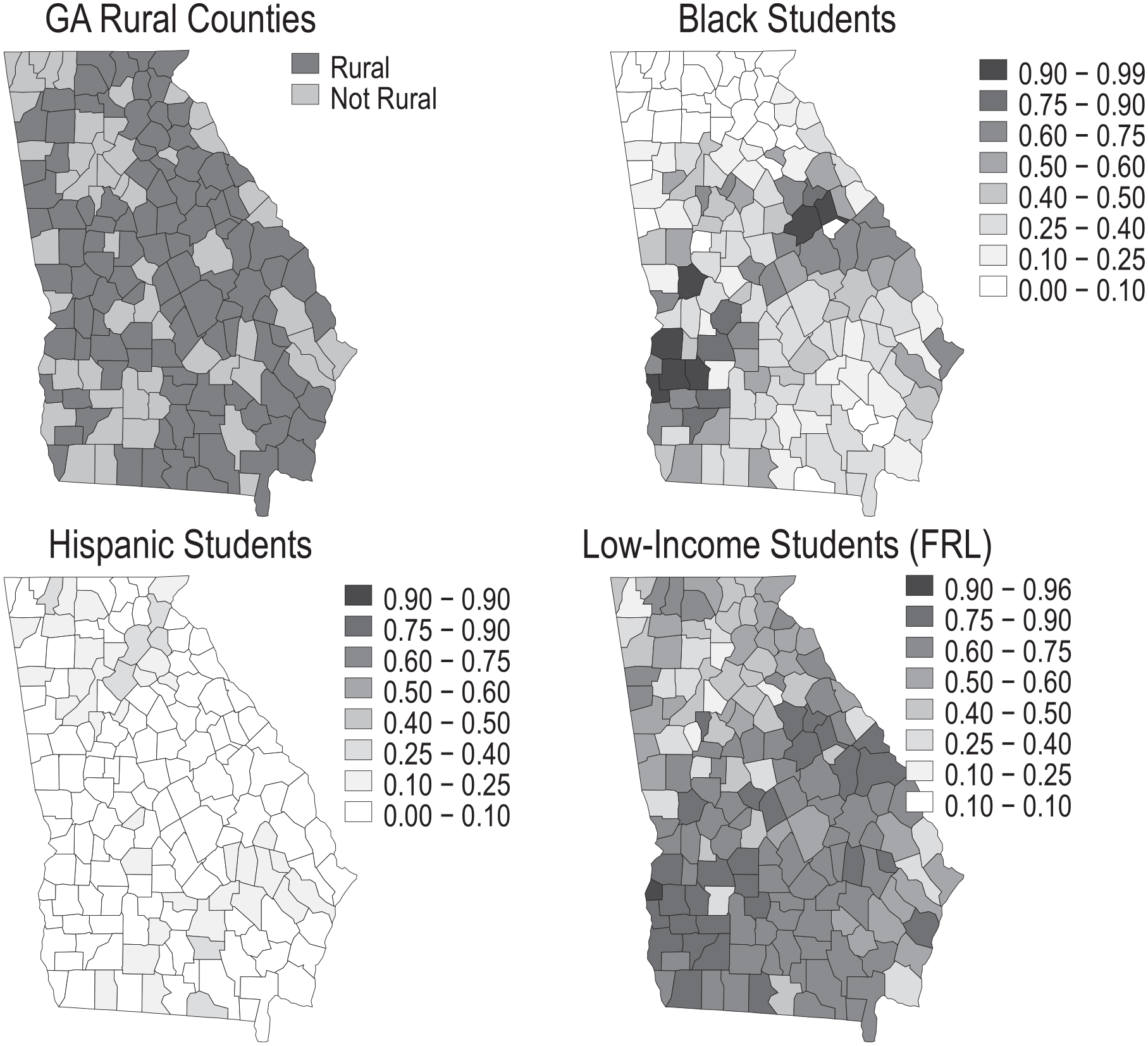
Mapping Georgia rural context.
Data and Measures
To add to the growing body of scholarship centering the intersections of school climate or working conditions (Burkhauser, 2017; Hughes, 2012; Ladd, 2009, 2011; Tickle et al., 2011; Loeb et al., 2005), school characteristics, and teacher turnover, we use data from schools in Georgia between the 2010 and 2011 and 2019 and 2020 school years (varied by the availability of the data source). We begin with 9 years of teacher-level data provided by the Georgia Department of Education called the Georgia Certified Personnel Information. The Certified Personnel Information includes information on teachers’ degree attainment, years of experience, certification levels (e.g., professionally licensed or provisionally licensed), individual salary, and employment status (e.g., part-time or full-time). These data also include teachers’ racial-ethnic backgrounds. Next, we merge these teacher characteristics with school-level student demographic data from the Georgia Department of Education and the Governor’s Office of Student Achievement, including school-level percentages of students designated as Hispanic, American Indian, Asian, Black, Pacific Islander, White, and two or more races, as well as the proportion of students eligible for FRPL and students with disabilities.
To capture teachers’ school climate perceptions and examine their relation to mobility patterns, we link the data described above to administrative data files that annually track school climate perceptions among all school personnel in Georgia (these data are available from 2014–2015 through 2017–2018). We use a version of the Georgia School Personnel Survey (GSPS) that is restricted to teachers. The GSPS is broken up into six different subscales, each assessing a different element of school climate—staff connectedness, structure for learning, school safety, physical environment, peer and adult relationships, and parental involvement. Responses to the GSPS are recorded on a 4-point Likert-type scale (0–3), ranging from strongly disagree to strongly agree. Examples of items from this scale include “I get along well with other staff members at my school” and “Teachers at my school have high standards for achievement.” Teachers’ responses to survey items are standardized in regression models, and higher scores reflect more favorable perceptions of schools’ climates. 1 Teachers’ responses are anonymous and include only a teacher’s school and district id and responses to the 31 items of the GSPS. Thus, responses are aggregated to the school level, such that each year every school receives an aggregated score of its teachers’ perceptions of school climate. The survey is mandatory, and schools scores are not published until schools reach 75% response rates.
Finally, we merge our state administrative dataset with national, district-level data from the Stanford Education Data Archive (SEDA). We use NCES rural and urban classifications and district- and county-level characteristics from SEDA. The SEDA is an open data resource that brings together quantitative data from multiple sources, including the National Center for Education Statistics and the American Community Survey (Reardon, 2019; Reardon, Kalogrides et al., 2018; Reardon, Ho et al., 2019).
Method
Our descriptive analysis of Southern rural teacher mobility in Georgia begins with comparisons of measurable turnover-relevant characteristics across the rural, urban, and suburban contexts, and then examining the diversity of patterns within rural school spaces. We graphically examine trends over time and across contexts in the different forms of teacher mobility—leaving one’s school at all, intradistrict moves, interdistrict moves, and exiting the state system (potentially a crude proxy for leaving the profession). We then graphically analyze associations between the unique data on teacher perceptions of school climate and the probability of turnover.
Finally, in a multiple regression framework, we examine the extent to which individual and school-level factors predict teacher turnover across all geographic locales and regress the four types of mobility, and adding and indicator for leaving rural in the models restricted to rural schools. 2 We model the relationship between individual and school contextual factors and teacher mobility by fitting the following ordinary least squares, linear probability model (LPM) across available years of data:
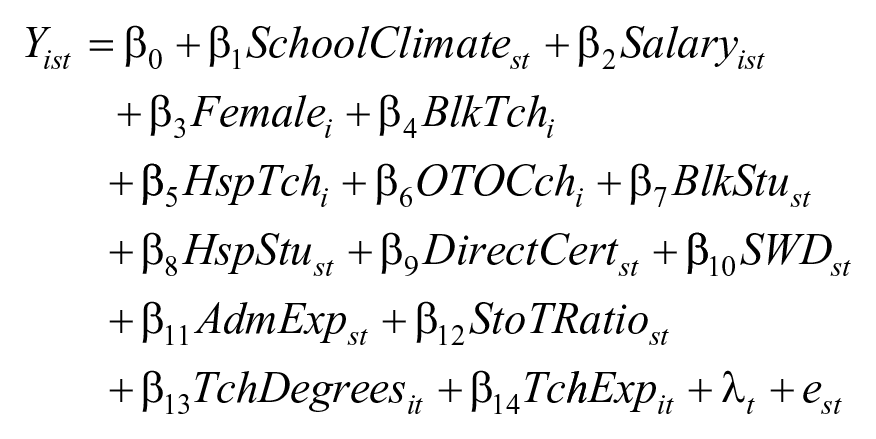
where Yist represents (in the primary model) a binary indicator for whether teacher i in school s at time t left their school at all, or in other models the alternative types of teacher moves. The
Describing the Contexts of Teacher Turnover Across Georgia Geographies
Table 1 shows descriptive statistics for teachers and students in all Georgia schools across rural, urban, and suburban district classifications for the academic year 2017–2018, which is the most recent year for which all our data are available. While we are primarily concerned with rural schools and variation within that context, it is worth first investigating the ways in which they are similar to or different from their urban and suburban counterparts in the state. On average, rural schools in Georgia have a smaller percentage of Black teachers (12%) and students (26%) than the state’s urban (41% of teachers and 58% of students) and suburban (31% of teachers and 37% of students) schools. They have more White students (57%) and teachers (85%) but similar numbers of Hispanic students to urban districts (roughly 10%) and similarly low proportions of Hispanic teachers (roughly 1%). The average proportion of students directly certified as economically disadvantaged in rural schools is slightly higher than the overall average at 32%, which is considerably higher than suburban schools (24%) and lower than urban schools (44%). We use this “directly certified” to measure most models, because of complications with the traditional FRPL measure due to community free-lunch eligibility policies, but under that measure almost 62% of rural students are eligible for FRPL—lower than that of the average urban school (75%) but higher than the 55% of students in the average suburban school.
School Summary Statistics by Geographic Locale

Note. All descriptive statistics represent means and standard deviations for all schools in Georgia during the 2017–2018 academic year, which is the final year for which we have complete data. “Other” race teachers include those who identify as Asian, multiracial, American Indian, or Pacific Islander. SWD = students with disabilities.
We also find important differences regarding teachers’ credentials and experience levels, which is consistent with other studies (Clotfelter et al., 2007; Rivkin et al., 2005). Rural schools in Georgia have slightly more part-time personnel, but fewer provisional licensed teachers than urban or suburban schools. The average teacher also has more than 1.5 years more experience in rural settings than their suburban and urban counterparts (just over14 years, compared with roughly 12 years). Rural schools in Georgia also tend to have substantively more teachers with advanced degrees, particularly those with specialist’s degrees (21%), which is a more advanced than a master’s degree, compared to urban (17%) and suburban (16%). Despite these relative advantages on the two primary components of the state salary schedule (experience and credentials), average salaries are typically lower in rural areas, with substantial differences in starting and ceiling salaries driven by higher local funding supplements in relatively property rich suburbs and urban centers.
On average, rural schools, similar to suburban schools, appear to benefit from relatively higher levels of perceived school climate compared with urban schools. This finding is consistent with rural education literature suggesting that these communities are generally more cohesive and have tighter social networks than those in urban and suburban locales (Nelson, 2016). While Georgia schools have higher teacher turnover rates than the national average, consistent with prior studies (Crouch & Nguyen, 2020; Donaldson & Johnson, 2010; Imazeki, 2005; Kelly, 2004; Moore, 2011), Georgia’s rural schools tend to have slightly lower teacher turnover rates than suburban schools (15% vs. 17%), and substantially lower rates than urban schools (22%). The patterns of teacher turnover are consistently lower in rural contexts for all racial-ethnic backgrounds, and the variance in retention rates is more stable across schools (SD = 36%) compared with urban districts (SD = 41%), where they are more varied.
While rural communities commonly have low population densities and distance from economic centers of metropolitan areas, literature that treats rural communities as monolithic spaces ignores both the rich diversity and the stark inequalities present within them. To capture how these complexities interact with teacher mobility patterns, we stratify rural contexts on the important sociodemographic factors of race and income. Table 2 shows descriptive differences in key variables related to teacher mobility patterns across four types of rural contexts (majority Black and White, high- and low-poverty student body compositions). Rural districts where most of the students are Black have characteristics that mirror urban districts across many observed variables. These communities have large shares of students directly certified, 44% (roughly 78% FRPL), which reflects how race and class are similarly linked across geographic contexts. Teachers in majority Black rural schools, as well as those in schools with majority directly certified (high poverty) students, report less favorable views of school climate relative to more advantaged communities, with the largest gaps in perceptions about relational climate and parental involvement.
Variation in School Climate and Instability Within Rural Contexts

Note. All descriptive statistics represent means and standard deviations for schools located in rural settings in Georgia for school year 2017–2018. SWD = students with disabilities.
Overall teacher turnover for the 2017–2018 year in majority Black and low-income rural schools were 23% and 20%, respectively, which is substantially higher than that of rural schools with high proportions of White and non-FRPL eligible students (around 14%). While turnover rates are consistently high among all teacher racial groups in majority Black schools, within majority White rural schools, there are substantial differences in turnover rates by teacher race, with Black teacher turnover exceeding 26%. Teachers in majority Black schools earn roughly $1,600 fewer dollars on average than rural teachers serving in schools with mostly White students. This funding inequality is even more pronounced when comparing schools based on their concentration of economically disadvantaged students, wherein teachers’ average salaries are closer to $4,000 less than those of teachers serving a more financially secure student body. These relative differences reflect the economic heterogeneity of White rural context, which are wealthier overall but include many high-poverty schools and property-poor tax bases.
Teacher Turnover Over Time and Contexts
Rates and types of teacher turnover vary substantially over time and context in Georgia. In the height of the great recession and its aftermath, fewer teachers left the profession and mobility generally declined with unemployment rates high and new job openings rare. As communities rebounded, teacher turnover increased across almost all contexts (see Figure 2). As we show in the descriptive tables above, teacher turnover is generally lowest in rural schools, and has remained so across time, when compared with that of both suburban and urban schools. However, the experience of teacher turnover in rural communities is decidedly unequal, with substantially and persistently lower retention rates in majority Black rural districts.

Teacher turnover over time and contexts.
Figure 2 shows that majority Black rural schools do not share the more stable nature of teacher retention common in average rural settings, as they have high and rising turnover rates that mirror those in urban core schools. The teacher turnover rates of the average rural school were less than 13% in 2011 and rose slightly to around 16% by 2019. In contrast, rural schools with a majority of Black students had a teacher turnover rate above 15% in 2011 that had risen to nearly 25% by 2016, with little decline since. The growing gap between majority Black and White rural schools’ teacher turnover is a facet of the labor market likely less visible in other studies examining teacher mobility rates in more racially homogenous rural schools.
We also find substantial variation in the types of teacher mobility patterns across geographic contexts as depicted in Figure 3. Overall (the black line in the graph) and in every context, teacher turnover has risen substantially, in spite of modest declines in intradistrict movement, mostly in urban and suburban contexts. In rural schools, mobility rates for intradistrict movers remain around 4% across the full length of the panel, which is not surprising because rural school districts tend to have fewer schools within them. However, we see wider variation across time for the subset of rural schools that are majority Black, where teachers’ within-district moves began to separate from the rural average around 2015. The starkest representation of the difference between predominately Black rural schools and rural schools as a whole shows when examining interdistrict exit rates, where Black rural schools outpace all other geographic locales by a wide margin for all years. While rural districts serving mostly Black students have state exit rates (a crude proxy for leaving the profession) near or below the average each year, recent years have shown a sharp uptick, mirroring and exceeding the statewide trend across contexts. However, it is notable that, while the overall turnover rate in Black rural schools tends to mirror the high rates of teacher turnover in urban schools, on this measure of remaining a public school teacher in the state, the pattern is closer to the relatively stable suburbs.

Teacher mobility over time and contexts.
Within rural contexts, exit rates and patterns also vary substantially by teacher race. On average, we see higher turnover rates among Black teachers for each mobility type and for the vast majority of years relative to White teachers, with the notable exception of exiting the state. 3 There appears to be sharper increases in Black teachers’ mobility patterns in rural settings, such that their turnover rates started below 15% in 2011 and steadily increased to 23% in 2019, whereas the turnover rate of White teacher in rural schools rose from 11% to just over 15% in the same period (Figure 4). The divergence in turnover rates between Black and White teachers appears to be mostly driven by Black teachers making interdistrict exits at nearly twice the rate of White teachers. Black and White teachers in rural settings have rates of within district turnover and leaving the state system that are relatively low and comparable across time.

Georgia rural teacher mobility rates by race and time.
A graphical exploration of the relationship between schools’ perceived climate (measured by teacher surveys) and the different mobility measures is expressed in Figure 5. Figure 5 shows a consistent negative relationship between teachers’ overall perceptions of school climate and the probability of exit across all types and contexts, such that schools with higher climate ratings have higher retention rates in every year of the survey. In particular, schools that employ teachers with the least favorable perceptions of school climate have turnover rates that hover around 22% across all years, which is 7% to 10% higher than those of rural schools where teachers endorse more positive views of school climate. These results suggest that climate surveys may reflect teachers’ revealed preferences, such that they remain in schools where they feel supported, connected, and safe, and leave schools where these elements are not present. The relationship between climate and turnover is not as strong when considering teachers who leave the profession, implying that the underlying causes of leaving the profession (or state), which other studies have found are often financial, family-related, or other personal reasons (e.g., Carter-Thomas & Darling-Hammond, 2017), are less tied to the climate of the building where they last worked.

School climate and teacher mobility.
As we note above, the lower rated climates of schools (on every measure but safety) are disproportionately majority Black rural schools, which also have substantially lower teacher pay, higher student poverty, and the potential feedback loop of very high teacher turnover. It is likely difficult, for example, to establish a sense of connectedness if a quarter of the faculty is leaving every year, which implicates schools’ climates. The unmeasured structural inequalities that make teaching harder and perhaps more stressful in those environments might also explain why teacher retention remains high in majority Black rural schools, even when teachers rate the climates favorably. While we are unable to probe this relationship further in the study, future qualitative and explanatory research should examine the potential causes of high turnover in majority Black rural schools.
In the section that follows, we seek to elucidate the relative importance of these factors associated with turnover across the diverse rural Georgia contexts in a ceteris paribus multiple regression framework.
Predictors of Southern Rural Teacher Mobility Across Contexts
Overall, our regression models point to important roles for school climate, teacher salary, and race as predictors of turnover in diverse rural teacher labor markets. All else equal, rural teachers are considerably less likely to leave schools where the overall climate is rated better and their salaries are higher. Rural schools with higher concentrations of Black students, and (to a lesser degree) more Hispanic students, suffer from higher probabilities of teacher turnover. Female teachers are also considerably more likely than male teachers to remain in rural schools, in contrast to urban and suburban schools where the role of gender is less clear. Though majority Black rural schools have higher overall levels of turnover than the average rural school, the predictors of turnover are similar, with the notable exception being that Black teachers are significantly less likely to leave these schools. Child poverty is also more associated with teacher turnover in Black rural schools than in rural schools generally. Figure 6 plots the coefficients from four separate LPMs that are subset by geographic contexts for summary comparison. Tables 3, 4, and 5 examine these relationships in greater detail.
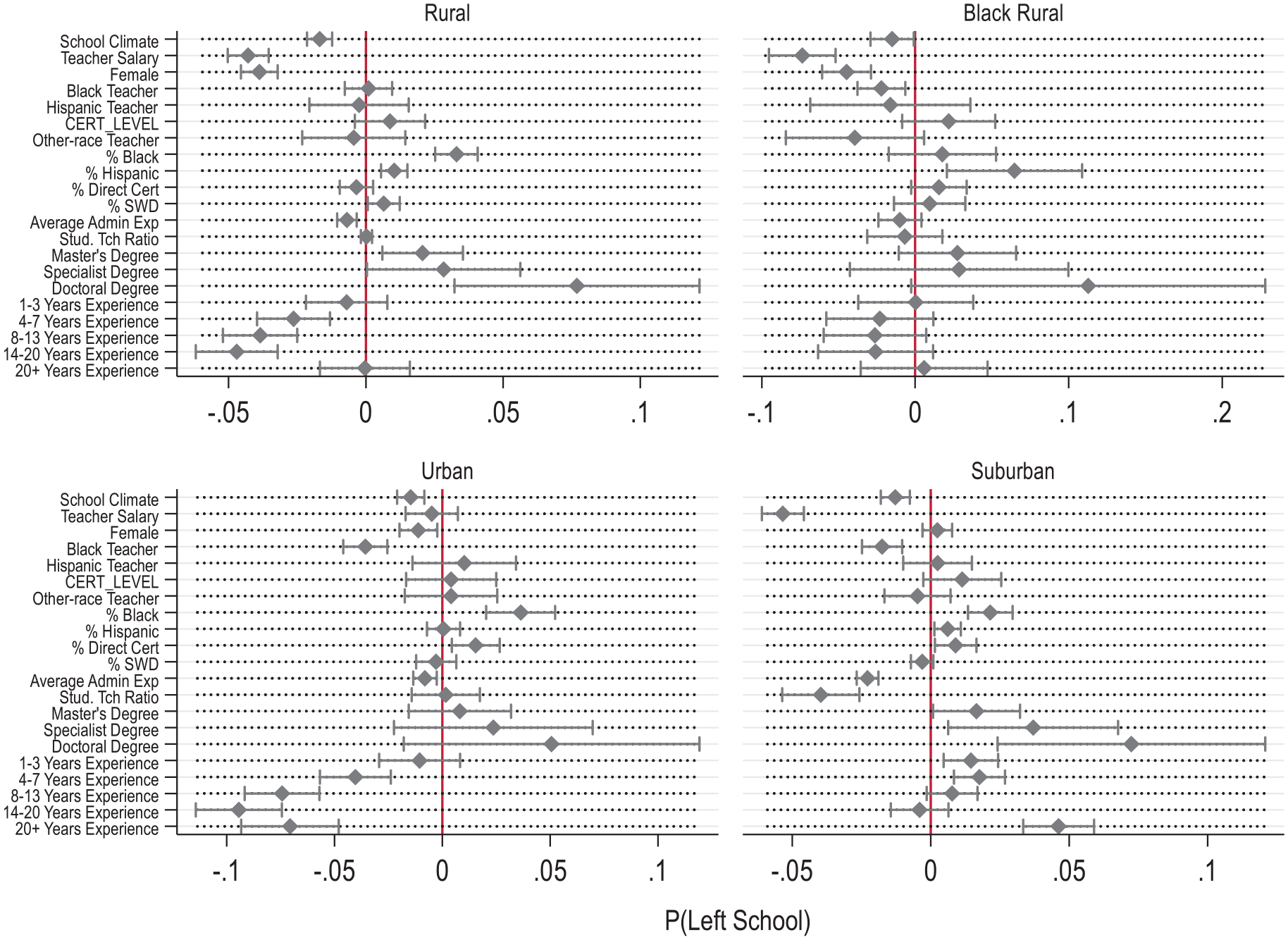
Linear probability model of turnover across contexts.
Predicting the Probability of Teacher Turnover Across Locales
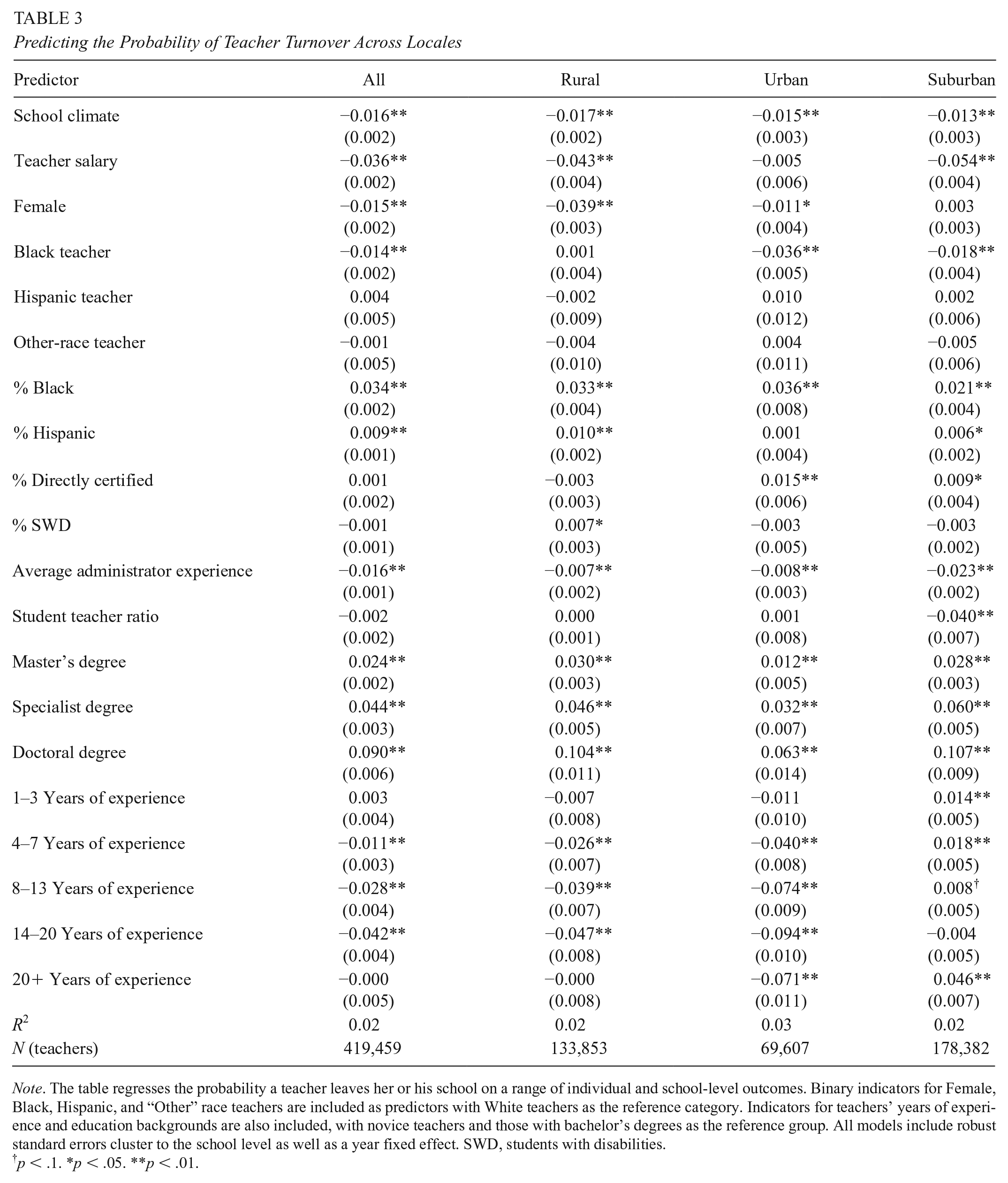
Note. The table regresses the probability a teacher leaves her or his school on a range of individual and school-level outcomes. Binary indicators for Female, Black, Hispanic, and “Other” race teachers are included as predictors with White teachers as the reference category. Indicators for teachers’ years of experience and education backgrounds are also included, with novice teachers and those with bachelor’s degrees as the reference group. All models include robust standard errors cluster to the school level as well as a year fixed effect. SWD, students with disabilities.
p < .1. *p < .05. **p < .01.
Differential Mobility Patterns Within Rural Settings

Note. The table regresses the probability a teacher leaves her or his school on the fully specified model. Each column represents a different exit pattern for the 2014–2015 through 2017–2018 school years. Intradistrict movers represent teachers who leave their school but remain in their district and interdistrict movers represent teachers who leave their schools and districts. A teacher who “exits rural” leaves rural districts but remains in teaching. The last column represents teachers who exit the state system for any reason. We estimate these linear probability models compared against the counterfactual of staying in the school. All models include robust standard errors cluster to the school level and year fixed effects. SWD = students with discabilities.
p < .1. *p < .05. **p < .01.
School Contextual Factors and Teacher Attrition Within Rural Settings

Note. In this table, each column mirrors prior linear probability models but with the sample subset for different context within rural spaces, which captures how our model changes conditional on the sociodemographic characteristics of rural schools. High and low poverty refer to teachers in rural schools where the percentage of students with directly certified classification is at or above or below the average for schools overall. SWD, students with disabilities.
p < .1. *p < .05. **p < .01.
To again situate the rural teacher mobility patterns of Georgia comparatively within their broader state context, Table 3 shows the results of the primary model predicting teacher turnover overall and then separately across rural, suburban, and urban contexts. 4 Consistent with prior literature (Carroll et al., 2000; Engel et al., 2014; Grissom et al., 2016; Horng, 2009; Yesil Dagli, 2012), we find that teacher turnover patterns in rural Georgia have some of the same primary predictors of teacher instability as observed elsewhere. In particular, we find similarly meaningful relationships between schools’ sociodemographic composition and teacher turnover whether schools are rural, suburban, or urban. Increase in the percentage of Black students in a school is consistently associated with increased turnover. However, increasing concentrations of rural student economic disadvantage (% directly certified) has a distinctly weaker tie to teacher turnover than in urban and suburban schools, where it significantly predicts higher rates of teacher exit. Notably, the apparent disparity in teacher turnover associated with higher concentrations of Black and low-income students is less pronounced here than in the simple descriptive comparisons, after accounting for school contextual variables such as school climate and salary, which we discuss in greater detail below.
While we previously described the higher rates of turnover among Black teachers across all geographic locales, it is notable here, after controlling for contextual factors, we find Black teachers are significantly less likely to leave their schools than White teachers everywhere but in rural schools. We do not observe this same trend for Hispanic and “Other” race teachers. These results imply that Black teachers are substantially less likely, relative to White teachers, to leave schools with larger shares of Black students across all school contexts, consistent with the growing body of literature explicating differential exit rates for teachers across racial backgrounds.
Differences in teacher salary are a strong predictor of teacher turnover, both overall and particularly in rural contexts, such that every 1 SD increase in teacher salary is associated with a roughly 4 percentage point decrease in the probability of teacher turnover (more than 25% of the overall rural turnover rate). This pattern, where rural districts who are able to offer higher salaries have lower turnover than their lower salaried rural counterparts, differs from potentially more competitive urban labor markets, where the association between teacher salary and turnover is not statistically significant. This general finding is consistent with literature positioning teacher pay as a key stated and reveled determinant in teachers’ decisions to join or leave schools (Griffeth et al., 2000; Rubenstein et al., 2018; Viano et al., 2020) though it highlights potential differences by geographies.
As was apparent in univariate analyses, teachers’ perceptions of school climate are also both significantly and substantively related to retention across all geographies even after controlling for resources demographics and teacher characteristics. Though consistently predictive, the relationship between overall school climate and turnover is strongest in rural schools, where a 1 SD higher school climate rating is associated with a 1.7 percentage point reduction in rural teacher turnover (or a roughly 11% decrease in probability of rural teacher turnover). We later examine differences by climate subscales, such as relational climate, safety, and parental involvement across contexts (see Figure 7), but note here the consistent importance overall. Across the board, average administrator experience is associated with small reductions in turnover and teachers with more advanced degrees are more likely to exit.
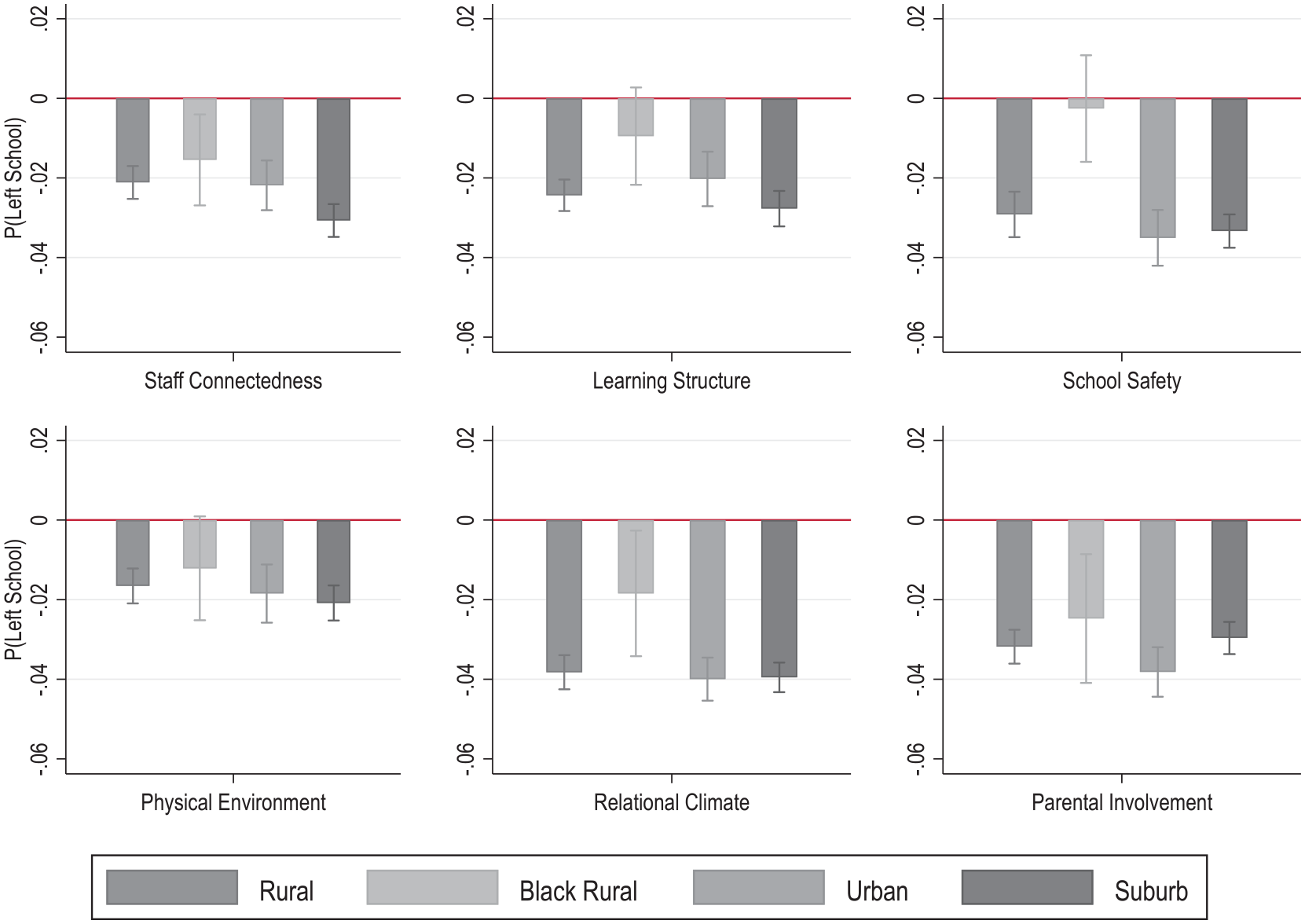
School climate components and teacher mobility.
Next, we narrow our focus to Georgia’s rural schools alone and compare predictors of types of teacher exits, with retained teachers as the counter factual. In other words, we model the factors that make exiting teachers more likely to make intradistrict moves, make interdistrict moves, leave the rural context, or leave public school teaching in Georgia altogether. Table 4 shows that overall school climate ratings are negatively associated with turnover (except within district moves, which are rare in rural contexts), such that teachers across the board are more likely to stay in schools with better rated climates. 5 Salary differences are significantly associated with reductions in all forms of rural teacher mobility, though the magnitude of the relationship is strongest with respect to exiting rural schools for nonrural schools, or leaving the Georgia public school system.
Black teachers in rural schools are significantly less likely to change schools within their district (Column 1) or leave teaching in the state (Column 4) but more likely to leave their district (Column 2) and rural settings (i.e., to teach in suburban or urban settings, Column 3), relative to White teachers after accounting for the other variables in the model. Rural schools with higher proportions of Black students experience significantly more of every type of teacher turnover, while higher-poverty rural schools (controlling for race) have higher rates of interdistrict exits but are less likely to see teachers leave the state system. Rural teachers in their first year (omitted for comparison) are generally the most mobile, and those with greater than 20 years of experience (a crude proxy for retirement eligibility) are the least likely to make moves and most likely to exit the system. In rural schools, teachers with higher degrees are more likely to make every type of move and female teachers are less likely to make any of them.
Returning to the simple outcome of turnover, we examine differences in predictors of teacher exit across the diversity of Georgia’s rural context with particular attention to high (and low) concentrations of minoritized and low-income students. Specifically, we run LPMs mirroring those in Table 3 but restricting the sample first to rural schools where the majority of students are Black (Column 1) or White (Column 2), and then to schools with a majority of students directly certified as economically disadvantaged (Column 3) and to schools where poor students are in the minority (Column 4). 6 Here, several interesting patterns of difference and commonality emerge. Across all rural contexts, school climate ratings are associated with similarly large reductions in likelihood of teacher exits. The role of salary is substantial in all rural schools but particularly pronounced in high-poverty and majority Black schools (6-7 percentage point reductions in the likelihood of exit associated with a 1 SD increase in salary). This is particularly notable, as these schools are also where the settings where average turnover was highest and salaries lowest.
All else equal, Black teachers are slightly more likely to stay in high-poverty and majority Black rural schools and more likely to exit majority White rural schools, relative to White teachers. Both majority White and majority Black rural schools with higher proportions of Hispanic or Latinx students experience higher rates of turnover, while the proportion of children in poverty is only predictive of turnover within majority poor and majority Black rural contexts. Rural teachers who are women are again consistently less likely to leave all school settings than men who are, and teachers with advanced degrees are more likely to leave relative to those without them.
Finally, we move beyond the overall school climate measure to examine differences in the apparent importance of specific school climate measures across contexts. Figure 7 shows the coefficients of six LPMs mirroring those in the tables, and in the same four contexts as Figure 6, but substituting out specific climate measures, such that staff connectedness (based primarily on how teachers and administrators treat one another), relational climate (based primarily on how students treat one another and staff), perceptions of safety, or parental involvement. Overall, the strongest predictors of turnover among climate subscales are teachers’ perceptions of relational climate and parental involvement, where magnitudes of coefficients are typically nearly twice that of the overall measure. Physical environment and staff connectedness are significant predictors of teacher retention across most contexts though smaller in magnitude than relational dynamics and parental involvement. The most notable difference by context has to do with perceptions of safety and “learning structure,” which relates primarily to having high expectations for student achievement. Both school safety and learning structure are strong predictors in most context but are neither significantly nor substantively meaningful drivers of turnover in majority Black rural schools; they are also both relatively highly rated by teachers in these contexts.
Discussion and Conclusion
Our findings provide important nuance to our understanding of the intersection of the two school community contexts at the center of concerns about teacher shortages and turnover—majority Black schools and rural communities. We find that while overall turnover is lower within rural Georgia schools than their urban and suburban counterparts, the issue of teacher turnover is far more pronounced in majority Black rural communities. Differences in salary and climate are strongly associated with differences in turnover patterns, particularly in high-poverty and majority Black rural schools. Black rural schools have the lowest average salaries, and teachers are more likely to leave their district but remain teaching elsewhere (no longer in rural schools). However, we find that, within majority Black rural schools, higher salaries and better school climates, particularly with respect to perceptions of relational climate and parental involvement, are associated with reductions in teacher turnover of all forms.
Like their urban and suburban counterparts, we find that rural schools serving larger numbers of low-income and Black students experience higher rates of teacher turnover, perpetuating racial and ethnic inequities within the rural space that are too often considered synonymous with Whiteness. We show, however, that rural spaces in Georgia are homogenous neither in composition nor in their labor market patterns by shedding light on the diversity present within rural communities. Our study also replicates the conventional finding that student demographics are highly correlated with teacher instability, although this relationship is attenuated significantly after accounting for salary and school climate differences across schools. While we do not intend to understate the role that racial and socioeconomic contexts play in teachers’ career decisions, nor the racism and marginalization captured by these constructs, our findings suggest that school climate—a potentially leadership malleable, nonpecuniary factor—and salary differences—a policy driven factor—play substantial roles in disparities in teacher stability. Both measures are strong predictors of turnover in high-poverty and majority Black schools and substantially mitigate the differentials in turnover associated with student race and income.
While descriptive and associational in nature, our findings should prompt greater interests in research and interventions to improve school climate and equity-oriented teacher compensation including diverse rural contexts. School leaders have considerable influence in shaping the climate of their schools, and several studies suggest that teachers’ career decisions are greatly influenced by their perceptions of their school principals (Grissom, 2011; Johnson & Birkeland, 2003; Nagy & Wang, 2007; Waruwu, 2015; Williams & Graham, 2019). These studies suggest that teachers who have higher levels of administrative support (L. B. Anderson, 2007; Boyd et al., 2011; Flamini et al., 2020) and teachers who receive mentoring are less likely to leave teaching (Hahs-Vaughn & Scherff, 2008; Redding & Smith, 2016). Similarly, other studies have shown that teachers were responsive to salary supplements and retention bonuses targeting low-income schools and districts, often with benefits for student outcomes (e.g., Clotfelter et al, 2008; Henry et al., 2010; Springer et al., 2016; Swain et al., 2019). Future explanatory work should examine these types of interventions in rural schools.
Black Rural Matters
Our findings suggest reasons for concern in treating rural spaces as uniform and White, especially when it comes to the American South. While Black rural communities may share in some of the challenges and strengths of majority White rural communities, Black rural schools exhibit turnover rates more comparable with those of urban districts, and their committed educators are taking their teaching services out of the rural space at strikingly high rates. The rates at which Black teachers are exiting rural spaces, nearly twice that of White teachers, are surely multifaceted, including potential growing demand for Black teachers in better resourced suburban and urban schools. However, they are likely related to the histories the undergird Black teachers educating in the Deep South. This encourages us to question whether the benefits often touted by rural schools (community cohesiveness, strong relationships, etc.) hold in Black rural school settings to the same degree that they hold in non-Black rural schools, on average. We find that Black rural schools that have an above-average climate rating, as indicated by strong relationships and staff cohesiveness, have retention rates that look comparable with those of rural districts on average but that these schools do not fully represent the average Black school in rural Georgia. Qualitatively examining schools with more positive school climates or simply higher retention rates, in an anti-deficit achievement framework à la, Harper (2010) might highlight how leaders and teachers in them cultivate the kinds of schooling environments that attract and retain teachers.
Many of the inequalities that predispose Black students to schools with below-average school climate ratings, poor working conditions, and lower teacher pay transcend the geographic labels of urban, suburban, and rural. Scholars, advocates, and policymakers, interested in closing these inequities, must look to the South, and look beyond the large metro areas, with race-conscious policy to counteract years of divestment, oppression, and neglect. Future qualitative work should give voice to the committed educators and leaders in these important and challenging contexts to better understand their view of what is needed to secure the type of stability enjoyed by their lower-turnover rural counterparts, including the experiences of Black leaders and teachers in majority White rural schools (e.g., Flowers, 2020). Similarly, future causal work is needed to better demonstrate the efficacy of targeted salary improvements and supports in order to facilitate more connected, responsive, school climates in diverse rural schools. Finally, while our analysis focuses primarily on the underdocumented teacher mobility patterns and contexts of Black rural educators and students, it is worth reiterating the radical underrepresentation of Latinx or Hispanic identifying teachers in the rural South, where Hispanic students represent the fastest growing racial-ethnic group in these low-density geographies. Future research and policy should examine and combat barriers to entry, inclusion, and retention of Hispanic teachers who may be uniquely equipped to address the needs of this growing student group and enrich the educational experiences of their Black and White classmates.
Several prominent scholars (e.g., Hudson & Holmes, 1994; Siddle-Walker, 1996, 2013) have highlighted the pivotal role Southern Black teachers have played in the fight for racial justice and as pillars of the communities where they lived, worked, and led. Black teachers saw their job and role to exceed far beyond the hallways of a school or a classroom during segregation and in all-Black schools after Brown (Milner, 2020; Siddle-Walker, 2013). In Black rural communities today, the Black teacher is held in high regard, as they often provide leadership in faith communities and local organizations such as the Southern Christian Leadership Conference and the National Association for the Advancement for Colored People. As Foster (1990) noted, Dismissed in large numbers following the Brown v. Board of Education decision and denied access to teaching positions through increased testing at all levels, the lives and careers of African American teachers have been seriously affected by racism. (p. 124)
While our findings highlight the relative hardship and challenges of Black rural teachers, they also point to the potential for and surge in financial empowerment through salary supplements and commitment to responsive leadership focused on connectedness to drive a renaissance for Black educators in the rural South and beyond.
Supplemental Material
sj-docx-1-ero-10.1177_2332858421995514 – Supplemental material for Race, Climate, and Turnover: An Examination of the Teacher Labor Market in Rural Georgia
Supplemental material, sj-docx-1-ero-10.1177_2332858421995514 for Race, Climate, and Turnover: An Examination of the Teacher Labor Market in Rural Georgia by Sheneka M. Williams, Walker A. Swain and Jerome A. Graham in AERA Open
Footnotes

Notes
Authors
SHENEKA M. WILLIAMS is professor and Chairperson of the Department of Educational Administration. Her research focuses on rural education, particularly the education of African Americans in rural spaces. Her research also centers on school desegregation and cross-racial friendships.
WALKER A. SWAIN is an interdisciplinary quantitative policy researcher focused on issues of educational equity, poverty, and inequality. His recent work has examined intersections of education and health, teacher policy, early childhood education, neighborhood change, and school choice.
JEROME A. GRAHAM is an assistant professor of educational leadership and policy studies. His research focuses broadly on the interaction of race and class in educational policy and practice. He uses mixed-methods designs to evaluate the effects of education reforms that target minority and disadvantaged students and the mechanisms that drive such reforms. His current research background emphasizes how schools can provide constructive school climates for students.
References
Supplementary Material
Please find the following supplemental material available below.
For Open Access articles published under a Creative Commons License, all supplemental material carries the same license as the article it is associated with.
For non-Open Access articles published, all supplemental material carries a non-exclusive license, and permission requests for re-use of supplemental material or any part of supplemental material shall be sent directly to the copyright owner as specified in the copyright notice associated with the article.
