




Abstract
Despite public interest and government action toward diversifying the teaching workforce in U.S. public schools, our knowledge about the retention and transfer patterns of Black teachers lacks specificity and clarity. In this study, I find that Black teachers’ annual retention rate was about 4 percentage points lower than that of White teachers in North Carolina elementary and secondary schools from 2004 to 2015. This Black-White teacher retention gap can largely be explained by Black teachers’ experience and education and the challenging school and community contexts in which these teachers worked. Compared with White teachers who had similar professional attributes and worked in similar school settings, Black teachers were more likely to stay in schools serving a larger proportion of Black students and to move to a school that served a higher proportion of Black students. The marginal probability of Black teachers’ retention received an additional boost with an increase in teachers’ observational ratings and math value-added scores. Stronger school leadership and higher-quality professional development predict a higher retention rate of more effective Black teachers.
The first context, demographic change in student populations, signifies that although the student population is becoming increasingly diverse, the teaching workforce has not maintained corresponding change at the same pace. By 2012, students of color represented 49% of the national preK–12 student population; they are projected to represent 54% by 2024. In contrast, teachers of color made up only 18% of the national educator workforce in 2012 (National Center for Education Statistics, 2014; U.S. Department of Education, 2016). This raises concerns over racial underrepresentation in the teacher workforce (Center for American Progress, 2014; U.S. Department of Education, 2016).
The second context, potential benefits from a diverse teaching workforce for student learning, derives from emerging research evidence: a diverse teacher workforce benefits students, particularly students of color, in several dimensions by providing high-quality learning opportunities (Grissom, Kern, & Rodriguez, 2015). Teachers of color devote more time to students of color, judge their learning potential more favorably, and refer them to gifted programs at higher rates (Dee, 2004; Grissom, Nicholson-Crotty, & Nicholson-Crotty, 2009; Gershenson, Holt, & Papageorge, 2016). Furthermore, teachers of color who are more informed about minority students’ heritage and culture cultivate those students’ sense of institutional belonging and their confidence to learn (Murphy & Zirkel, 2015). This increase in learning opportunities and belonging leads to positive outcomes for students of color in both achievement and discipline (Dee, 2004; Losen & Skiba, 2010; Meier, 1993; Meier & Stewart, 1992). It leads also to a reduction in dropout and an increase in student aspiration to attend a 4-year college (Gershenson, Hart, Lindsay, & Papageorge, 2017). It is important to note that those who advocate for increasing diversity in the teacher workforce do not claim (a) that White teachers cannot be effective teachers for students of color, (b) that all teachers of color are effective with students of color, or (c) that teachers of color benefit only students of color. Yet proponents claim that the demographic discrepancy of the racial and cultural backgrounds between teachers and students may contribute to the “democratic failure” of providing minority students and their parents with “descriptive representation” (Achinstein, Ogawa, Sexton, & Freitas, 2010; Banks, 1995; Cochran-Smith, 2004; Dilworth, 1992; Grissom et al., 2015). “Teachers of color are positive role models for all students in breaking down negative stereotypes and preparing students to live and work in a multiracial society” (U.S. Department of Education, 2016, p. 1).
The affect that teachers of color have not only relates to their own students’ learning but can also influence their colleagues’ beliefs and practices (Sun, Loeb, & Grissom, 2017; Sun, Penuel, Frank, Gallagher, & Youngs, 2013). For instance, since teams of teachers collectively contribute to student learning outcomes, the presence of a teacher of color in a teaching team may resocialize other teachers to increase their cultural awareness and to change their interactions with minority students (Grissom et al., 2015). These findings underscore the importance of recruiting and retaining teachers of color.
The third context, misconceptions about the turnover rate for teachers of color, is grounded in a lack of knowledge about the labor market specificity for teachers of color. Prior studies on these labor markets showed that teachers of color are more likely to be initially placed in high-need schools that serve a large proportion of poor and minority students and that these teachers of color possibly have a higher turnover rate than that of White teachers (Ingersoll & May, 2011; Murnane, Singer, Willett, Kemple, & Olsen, 1991; Villegas & Lucas, 2004). However, we still do not know about the effectiveness of teachers who tend to leave, what influences their career decisions, and where they go upon departure. We have limited knowledge about which school supports can help in retaining teachers of color, particularly effective ones. Our limited knowledge of the movement patterns for teachers of color constrains our understanding of the possible ways to diversify the teaching workforce and distribute effective teachers equitably across schools.
In this study, I examine the career movement patterns of Black or African American teachers (hereafter referred to as “Black teachers”), using a decade of state administrative and teacher survey data from North Carolina (NC). Specifically, the data extend from 2004 (i.e., the spring of the 2003–2004 school year; hereafter, “the spring of the school year”) to 2015. Black teachers composed 8% of the U.S. teacher workforce in 2014, the second-largest group of teachers of color (right after Hispanic teachers, who composed about 9% of the U.S. teacher workforce in 2014). 1 Among all ethnic-racial subgroups of teachers in 2012–2013, 2 Black teachers had the lowest retention rate, at 78%, as compared to 85% for White, 79% for Hispanic, 96% for Asian and Pacific Islander, and 89% for multiracial teachers (U.S. Department of Education, 2016). 3 In NC, Black teachers constituted >90% of teachers of color, with an annual retention rate of about 75%. Different racial minority groups exhibit different turnover patterns; thus, it is not appropriate to combine all racial minority groups (Goldring, Taie, & Riddles, 2014; Kirby, Berends, & Naftel, 1999; see details later). I thus focus only on Black teachers in this study. Specifically, I ask the following:
Research Question 1: What were the trends and patterns of Black teacher retention in NC as compared with that of White teachers? How did these trends and patterns vary depending on teachers’ effectiveness and subjects?
Research Question 2: Which school supports (e.g., leadership, mentoring, and professional development) were associated with higher Black teacher retention?
Research Question 3: Who left their previous year’s school? Where did they subsequently move if they remained as classroom teachers in the NC education system?
In addressing these questions, I first review the literature on teacher labor markets and the factors that influence teachers’ career movements. Next, I introduce labor market matching and identity utility frameworks to conceptualize motivations for teachers’ career movements and to generate hypotheses. I then describe the data and the analytic strategies for testing these hypotheses and present main findings. I conclude with a discussion of research and policy implications.
Literature Review
The literature on Black teachers’ labor market and on the factors influencing their career movements is sparse. Therefore, I briefly review here teacher turnover patterns in general and then discuss the different turnover patterns for teachers of color, focusing on Black teachers in particular, when studies separated Black teachers from other teachers of color.
Overall, high-need schools that serve a large proportion of historically disadvantaged students typically find it hard to recruit and retain teachers, particularly effective ones (e.g., Borman & Dowling, 2008; Clotfelter, Ladd, Vigdor, & Wheeler, 2007; Darling-Hammond, 2007; Goldhaber, Gross, & Player, 2011; Guarino, Santibañez, & Daley, 2006; Ingersoll & May, 2012; Lankford, Loeb, & Wyckoff, 2002). Teachers generally prefer low-need schools for their first job placement; those placed initially in high-need schools are likely to transfer to low-need schools later (Lankford et al., 2002). This annual asymmetric reshuffling—as effective teachers move from high- to low-need schools—exacerbates the unequal distribution of teacher quality. Furthermore, it appears to be a key reason for disparities in student achievement (Sass, Hannaway, Xu, Figlio, & Feng, 2012) and ultimately for unequal occupational outcomes (Darling-Hammond, 2007; Liu, Rosenstein, Swan, & Khalil, 2008).
Teacher career movements also vary among subgroups of teachers. Ingersoll and May (2011) discovered that teachers of color were 2 to 3 times more likely than White teachers to work in high-poverty, high-minority urban schools. Although school demographic characteristics may be important factors in initial employment decisions for teachers of color, these characteristics do not necessarily influence their later decisions to stay or depart. Neither students’ socioeconomic status (SES), nor the percentage of students of color, nor the percentage of peer colleagues of color, nor a school’s location in an urban setting seems to consistently and significantly predict the departure of teachers of color (Ingersoll & May, 2011).
Although early studies examining cohorts of teachers showed little difference in turnover rates between teachers of color and White teachers, more recent studies described a higher turnover rate for teachers of color. For example, Ingersoll (2001) analyzed the 1990–1991 SASS (Schools and Staffing Survey) and 1991–1992 TFS (Teacher Follow-Up Survey) and found that teachers of color were less likely to depart than White teachers, although the coefficients were small and not statistically significant. However, Ingersoll and May’s (2011) study, which included more recent cohorts of teachers up to 2009, showed a higher turnover rate among teachers of color, both when changing schools and when leaving teaching altogether. Breaking out subgroups further, Marvel, Lyter, Peltola, Strizek, and Morton (2006) reported that the 2003–2004 cohort of Black teachers had a higher turnover rate (e.g., 20.7%) than Hispanics (19.4%) nationwide. The disparity in retention rates between Black and White teachers is not replicated with other racial subgroups, although the sample sizes of many other racial minorities are too small to precisely estimate national averages and their standard errors.
Turnover patterns between male and female teachers of color are also different. Analyzing a statewide longitudinal data set from 1979 to 1996 on public school teachers in Texas, Kirby et al. (1999) reported that, among teachers of color, African American 4 males had consistently higher attrition rates than African American females. Among all groups, African American males and White females had the highest annual attrition rate. Ingersoll and May (2011) also identified a higher turnover rate for male teachers of color than for other teachers.
Although teachers of color are influenced by the same set of factors as White teachers, they might make different compromises in their job. Hanushek, Kain, and Rivkin’s (2004) study of Texas public schools from 1993 to 1996 showed that Black or Hispanic teachers were significantly less likely than other teachers to leave districts serving a high proportion of Black or Hispanic students, respectively. After they departed, Black teachers with 0 to 9 years of experience tended to move to schools with a higher proportion of Black student enrollment than that of the schools they left, regardless of whether they changed districts. However, this pattern did not apply to Hispanic teachers, who moved to schools with a smaller proportion of students of color.
Similarly, studies on beginning teachers of color emphasized their commitment to reducing social and structural inequalities and their close ties to minority students and communities (Achinstein et al., 2010). Qualitative studies of Black and Latina/o teachers highlighted the value of teaching as “community work” that propelled their decision to teach and remain working in disadvantaged communities (Achinstein et al., 2009; Achinstein & Ogawa, 2008a, 2008b; Belcher, 2001; Dixson & Dingus, 2008; Kauchak & Burback, 2003; Rios & Montecinos, 1999; Villegas & Irvine, 2009). Kottkamp, Cohn, McCloskey, and Provenzo (1987) surveyed 2,718 teachers in Dade County, Florida, and found that although intrinsic rewards related to serving students were primary for all teachers, Black teachers perceived their importance at higher rates than those of Whites. Lewis (2006) surveyed 147 beginning Black male teachers in three urban districts in Louisiana and found that although the teachers rated “job security” as the most important retention factor, this was closely followed by “contributions to humanity.” Lewis also reported that structural factors, such as classroom autonomy and faculty inputs in school decision making, strongly predicted the retention of teachers of color.
Despite these findings, our knowledge about Black teachers’ career movement is still limited. We know little about the degree to which Black teacher retention varies depending on their effectiveness (e.g., value added or classroom observational ratings; Hanushek et al., 2004). This critical information would allow us to hypothesize whether higher or lower Black teacher turnover would affect the equitable distribution of high-quality teachers. We also know little about the degree to which Black teachers’ retention depends on the interactions among their effectiveness, working conditions (e.g., leadership, professional development), and subjects. With this information, we could suggest different policy-malleable strategies in different subject areas to boost the retention of effective Black teachers. Additionally, we know little about Black teachers’ new transfer schools—such as school working conditions—other than school performance, student demographic composition, and poverty, as examined by Hanushek et al. (2004). Policy makers and school leaders would need this information to speculate on the impact of teachers’ transfer on students’ learning and to develop policy tools for addressing the potentially inequitable reshuffling of teachers across schools. The intent of this study is to update our knowledge of Black teachers’ retention and transfer patterns with newer data and more detailed descriptive analyses.
Conceptual Framework
The dynamics of the teacher labor market result from the utility maximization of teachers (the supply side) and schools and districts (the demand side) in a local labor market. I use labor market matching and identify utility concepts to understand the various elements that may affect Black teachers’ labor market (e.g., Clotfelter, Ladd, Vigdor, & Diaz, 2004; Ehrenberg & Schwarz, 1983; Farber, 1999; Guarino, Brown, & Wyse, 2011; Hanushek et al., 2004; Theobald, 1990). In this study, while I can observe the outcomes of transition, I cannot observe whether a transition was initiated by a teacher or by a district. However, the detailed consideration of various elements that may affect teacher career movements will help to develop well-informed, testable hypotheses.
On the supply side, a teacher’s choice of workplace can be modeled as the maximization of utility. Utility can be a combination of human capital return, monetary compensation, workplace amenities, and intrinsic rewards. When deciding whether or where to continue to teach, teachers are likely to weigh the utility that they can expect from continuing to teach in their current schools against the utility of transitioning to other schools or occupations. Teachers can derive utility directly from a gain in human capital returns, such as becoming more effective in doing what they do. As prior studies showed, teachers who produce higher achievement gains, as measured by value added, or who are effective, according to their principals’ ratings, 5 are less likely to transfer or leave the teaching profession (Boyd et al., 2011; Goldhaber et al., 2011; Hanushek & Rivkin, 2010; Hanushek et al., 2004; Jackson, 2013; Murnane, 1984; Sass et al., 2012; West & Chingos, 2009). Effective teachers’ preference to stay holds true even for teachers in the lowest-performing schools (e.g., Boyd et al., 2011; West & Chingos, 2009). Similarly, the effort to change schools can be rewarded by a gain in human capital returns—becoming more effective in teaching.
While the increase in productivity return may subsequently lead to a higher salary or bonus in other workplaces, this is not necessarily true in the teaching profession. This is due to structural factors; for example, a teacher’s salary in NC is based primarily on one’s experience and level of education (Jackson, 2013). However, this does not mean that a teacher’s decision would not be affected by potential pecuniary returns, which can be increased by moving to a more affluent district where local property taxes are high and schools receive more supplemental funds. Alternately, teachers may move to hard-to-staff schools to respond to NC’s new monetary incentives, although this program is small in scope and probably generates little disruption in statewide trends and patterns (NC Department of Public Instruction, 2013). Taken together, the variations in teacher salaries can be absorbed by teachers’ experience and education levels or by the variations in student, school, and neighborhood characteristics.
Teachers also derive utility from an increase in their nonpecuniary returns, such as pursuing a better working environment. Principal leadership that builds a sense of community, establishes school routines and safety, provides teachers with necessary resources, and advocates for the school with external stakeholders (Hallinger, 2005; Leithwood, Louis, Anderson, & Wahlstrom, 2004; Waters, Marzano, & McNulty, 2003) was found to predict teachers’ intended and actual retention in the school (Boyd et al., 2011; Ladd, 2011). Opportunities created through professional development programs, coaching, and mentoring shape teachers’ experience in schools and influence the likelihood of a teacher moving to another school or leaving the teaching profession after the first year of teaching (Smith & Ingersoll, 2004).
In addition, the decision to stay or switch schools can be driven by intrinsic rewards related to serving a particular community or student population (Achinstein et al., 2010; Belcher, 2001; Kauchak & Burback, 2003; Villegas & Irvine, 2009). Although intrinsic rewards are primary for all teachers, teachers of color perceive the importance of intrinsic rewards at a higher level than that of White teachers (Lewis, 2006; Kottkamp et al., 1987; Su, 1997). Social commitment to reducing social and academic inequalities often drives teachers of color to teach in urban schools to make a difference in the lives of historically disadvantaged students (Belcher, 2001; Kauchak & Burback, 2003; Villegas & Irvine, 2009). These identity-matching and mission-driven career movements can be confounded with teachers of color choosing a school close to their home communities (Boyd, Lankford, Loeb, & Wyckoff, 2005). Finally, other idiosyncratic factors may affect an individual’s decision to stay or switch schools, such as relocation for one’s spouse or family, personal preference for the job, and other factors that cannot be incorporated into the analysis.
Individuals’ choices are not unlimited: Schools and districts on the demand side of the labor market also have the choice to select the applicants with the best observable characteristics (e.g., credentials, experience, prior teaching performance) from among those who are willing to work in the institutions. A state’s public school system consists of districts and schools that vary in the intrinsic and extrinsic rewards that they offer, thus providing varied choices for teachers. Just as districts and schools within the system compete for teachers among themselves, public schools compete for talent with other potential employers in the labor market (Guarino et al., 2011). To position themselves well in competing for talent, schools can increase their attractiveness to teachers by offering them financial incentives to improve their productivity (e.g., signing or returning bonuses), by improving school supports (e.g., supportive administrators, professional development, mentoring), or by appealing to some teachers’ desire for intrinsic rewards. Schools and districts with a high percentage of minority students may benefit from having teachers with similar racial and ethnic backgrounds and thus place a higher priority on hiring teachers of color (Lankford et al., 2002). In sum, I use these labor market matching and identity utility frameworks to guide the data analyses and frame my empirical results in this study.
Sample and Measures
I used longitudinal data from 2004 to 2015 on students, teachers, and schools in NC. This analysis focuses on teachers in public elementary and middle schools because of the similarity in teacher effectiveness measures in these grade levels, a topic that I explain further. Charter schools are excluded from the analysis because the teacher labor markets for charter schools and traditional public schools are notably different (Stuit & Smith, 2012). The sample includes teachers who appeared in the state salary data set primarily as full-time classroom teachers. Of approximately 61,000 to 69,000 teachers included in the study each year, an average of 13% were Black teachers (ranging from 11% to 14% depending on the year, equivalent to 7,000 to 9,200 Black teachers), while 79% were White teachers (ranging from 68% to 81%, equivalent to 43,000 to 55,600 White teachers).
NC has compiled teacher evaluation scores based on the state’s professional teaching standards since 2011. I used these teacher evaluation scores in this analysis because they are the primary indicators of teacher effectiveness available in teacher labor markets to both the supply side (teachers) and the demand sides (districts and schools). Six professional standards inform the scores: (a) teachers demonstrate leadership; (b) teachers establish a respectful environment for a diverse population of students; (c) teachers know the content they teach; (d) teachers facilitate learning for their students; (e) teachers reflect on their practice; and (f) teachers contribute to academic success of students. The first five standards are applied in observational ratings that are usually conducted by the school principal or by someone whom the principal designates. Ratings are given on a 5-point scale (1 = not demonstrated, 2 = developing, 3 = proficient, 4 = accomplished, 5 = distinguished). I developed a composite measure of teacher observation scores, standardizing them with a mean of 0 and a SD of 1 in a given year and then taking the mean across these five standards. The sixth standard is assessed by the value-added measure of teachers’ contribution to student growth, as captured by Education Value-Added Assessment System scores across the three subject areas of math, reading, and science.
In each year covered in the data set, 10,970 to 18,050 teachers 6 were given either observational or value-added scores based on their students’ end-of-grade test scores in Grades 3 to 8. Among these teachers, roughly 13% were Black, and 81% were White. These percentages are consistent with those of Black and White teachers in the general NC teacher workforce in elementary and middle schools.
I then combined these data with teachers’ responses on the Teacher Working Conditions Survey, which has been given to all staff in NC public schools every 2 years from 2004 to 2014. Approximately 98% of NC schools met or exceeded a 40% response rate during each wave of data collection. The survey items solicit teachers’ perceptions on various aspects of their school environments. I selected items that were common in survey versions across years 7 and over which policymakers or school leaders have primary control: principal leadership, mentoring, and professional development (e.g., Boyd et al., 2011; Kraft & Papay, 2014; Ladd, 2011; Loeb, Darling-Hammond, & Luczak, 2005; Simons & Johnson, 2015). I then used exploratory factor analysis with the oblique rotation method to obtain relatively independent constructs with eigenvalues >1. Items whose factor loadings were at least 0.4 are included in a factor. No items are loaded on more than one factor. Each factor has high internal consistency in each year (Cronbach’s α > 0.7).
Factor scores were aggregated to the school level and aligned with the constructs of school supports. These aggregated measures avoid common-source bias in the subsequent analysis of predicting teacher turnover and performance improvement. Common-source bias refers to the endogenous relationship between teachers’ responses to Teacher Working Conditions Survey questions and their decisions of whether to return to their schools in the following year. For example, a teacher who had decided to leave might rate her school working conditions more poorly than she would have otherwise; a teacher’s responses could also be shaped by her perceptions of her students’ performance in that year. Rather than using teachers’ responses to predict their turnover status directly, aggregating multiple teachers’ responses to the school level ameliorates this problem. To facilitate interpretation, I standardized factor scores for a given year. The original survey items pertaining to each measure on working conditions are briefly described in turn.
Principal Leadership
Using a 5-point scale (1 = strongly disagree, 2 = somewhat disagree, 3 = neither disagree or agree, 4 = somewhat agree, 5 = strongly agree), teachers rated their principal leadership in three areas: consistently enforcing rules for student conduct; consistently supporting teachers; addressing teacher concerns about facilities and resources, the use of time, professional development, and leadership issues.
Mentoring Effectiveness
Teachers were asked to rate the helpfulness of their mentors’ support 8 on a 5-point scale (1 = no help at all, 2 = has helped a little, 3 = has helped some, 4 = has helped a lot, 5 = help was critical). Ratings covered the following domains: instructional strategies, curriculum and the subject content, classroom management and discipline strategies, school or district policies and procedures, completing products or documentation required of new teachers, completing other school or district paperwork, and social support and general encouragement.
Professional Development
Using a 5-point scale (1 = strongly disagree, 2 = somewhat disagree, 3 = neither disagree or agree, 4 = somewhat agree, 5 = strongly agree), teachers assessed their professional development on the following characteristics: sufficient funds and resources available to allow teachers to take advantage of professional development activities, adequate professional development time, whether teachers had sufficient training to utilize instructional technology fully, and whether professional development provided teachers with the knowledge and skills most needed to teach effectively.
Methods
In this section, I describe the approach and rationale for addressing each research question. I also describe my exploration and assessment of alternative analysis methods, where applicable.
Research Question 1
How did Black teachers’ retention patterns, when compared with those of their White counterparts, vary depending on teachers’ effectiveness and subjects? The dependent variable in this analysis is whether teachers stayed in their current year’s schools and remained as classroom teachers in the next school year (1 = stayed, 0 = else). 9 I mainly utilized a linear probability model, as simplified in Equation 1, to estimate teacher i’s relative probability of staying in school s in year t, as a function of his race, the characteristics of schools where he worked, and his effectiveness:

where β1 indicates the relative probability of Black teachers’ retention versus their White peers and β2 represents the relationship between teacher effectiveness and teachers’ likelihood to stay. Teacher effectiveness is indicated by one of four measures: observation scores or value-added scores for math, English language arts, or science.
Contrast School Contexts Where Black and White Teachers Worked 2004–2014

Note. The difference between Black and White teachers is significant for each variable at the significance level of .001.
I then added interaction effects (Black teacher) i × (percentage of Black students) st to see if Black teachers were more or less likely to stay in schools with a higher percentage of Black students. Similarly, I included interactions between Black teachers and teacher effectiveness measures to examine if teacher effectiveness moderated Black teachers’ likelihood to stay.
Because the data include teacher-by-year observations and teacher observations within schools, multilevel models are a possible methodological choice that can account for the correlation among observations of career movements within the same teacher and among teachers who worked in the same school. Because the multilevel models that include teacher and school random effects yielded findings similar to those from Equation 1, I primarily present the results from this simpler model specification.
One may also speculate that nonlinear models—for instance, logistic regression or the Cox proportional hazards models 11 —may be more appropriate to model a dichotomy dependent variable of teacher retention. I tried both of these approaches. The statistical inferences of the coefficients are largely consistent with those from the linear models, as illustrated by comparing Tables A1 and A2 of logistic regression results with those in Tables 2 and 3 in the main text (see Tables 2 and 3 in the Results section). 12 Prior simulation studies of contrasting linear probability with logic regression models yield a similar conclusion that the differences between these types of models are of little practical importance when sample sizes are large (e.g., in this study; Hellevik, 2009). Moreover, the interaction effects—which are key inferences in this study—are difficult to interpret in nonlinear models (Ai & Norton, 2003; Karaca-Mandic, Nortton, & Dowd, 2012). I thus decided to present the linear probability models primarily because the interpretation of linear estimates as differences in retention probabilities between Black and White teachers are practically meaningful and intuitive (Allison, 2014; Hellevik, 2007).
Regression Results Explain Teachers’ Retention
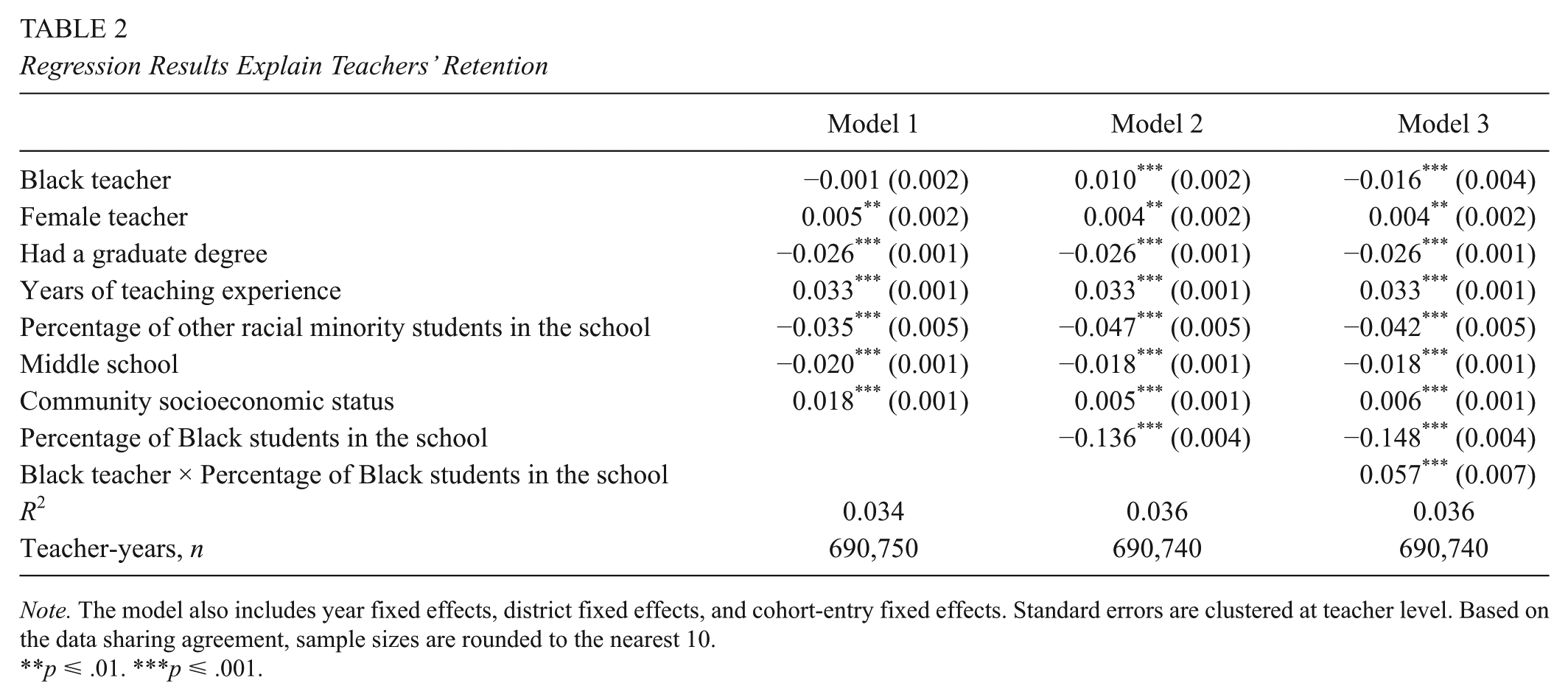
Note. The model also includes year fixed effects, district fixed effects, and cohort-entry fixed effects. Standard errors are clustered at teacher level. Based on the data sharing agreement, sample sizes are rounded to the nearest 10.
p ⩽ .01. ***p ⩽ .001.
Teacher Retention Varies Depending on Their Effectiveness

Note. The model also includes year fixed effects, district fixed effects, and cohort-entry fixed effects. Standard errors are clustered at teacher level. Based on the data sharing agreement, sample sizes are rounded to the nearest 10. OBS = observation; VA = value added.
p ⩽ .1. *p ⩽ .05. **p ⩽ .01. ***p ⩽ .001.
Last, I implemented several specifications of the school fixed effects models, as shown in Tables A3 and A4. The estimates from school fixed effects were largely similar to the district fixed effects models used in Tables 2 and 3 in the main text. After many additional covariates were added to the model (as a result of including these school fixed effects), the inferences of key variables did not change—such as estimates of the interactions between being a Black teacher and the share of Black students and teacher effectiveness. Particularly in model specifications that included teacher value added, I also observed that many schools had very few Black teachers (e.g., one or two teachers). Thus, including school fixed effects did not gain much from the district fixed effects model.
Research Question 2
Which school supports (e.g., leadership, mentoring, and professional development) were associated with Black teacher retention? “School supports” refer to policy-malleable factors that shape teachers’ career movements and performance growth, including principal leadership, professional development, and mentoring. As noted, prior studies found that teachers are less likely to move out of schools with better supports (e.g., Boyd et al., 2011; Ingersoll, 2001; Ladd, 2011). This study extends that prior work by examining which supports influence the retention of effective Black teachers. To model the association between school supports and teacher retention, I used an estimation model as depicted in Equation 2.

School support factors were added to Equation 2 one at a time because these factors are collinear with one another. Given that school support factors are biennial measures, I used year t values to replace missing values of corresponding measures in year t + 1. I assumed that (a) school supports would not change dramatically in two adjacent years and (b) prior school supports could still contribute to teachers’ decision to leave at year t + 1. β4 identifies school supports that are particularly useful for retaining Black teachers. β5 captures the extent to which the relationship between school support and teacher retention depends on teacher effectiveness. β6 indicates the differential associations between school support and teacher retention with 1-SD change in Black teachers’ effectiveness. The remaining terms are the same as those explained in Equation 1.
Research Question 3
Who left their previous year’s school? Where did they subsequently move if they remained as teachers in the NC education system? This section of the analysis includes “teacher mobility,” defined as teachers who moved to another NC school in the next year but remained classroom teachers. Although I briefly report on the characteristics of teachers who left the NC educational system, the analysis mainly focuses on these transfer teachers who remained in the teaching profession, with the goal of strengthening our understanding of the redistribution of Black teacher workforce across schools. I examined four features of teachers’ receiver schools in the year of transfer: the percentage of Black students; school performance as captured by the average of the percentage of students at proficient level and above in math and reading; the school community’s SES; and the composite measure of school support obtained by averaging across the measures of principal leadership, mentoring effectiveness, and PD quality. These four features, as indicated by schit, are modeled in isolation in Equation 3.

where β1 indicates the extent to which new schools for Black teachers, on average, differed from their White counterparts, accounting for teachers’ gender and professional characteristics (
Results
Research Question 1
How did Black teachers’ retention patterns, when compared with those of their White counterparts, vary depending on teachers’ effectiveness and subjects? I start with a broad description of teacher retention in NC public schools. Figure 1 shows that elementary teachers had a significantly higher average retention rate than that of middle school teachers. The difference was largest in 2006 when the elementary teacher retention rate was 4.9% higher than that of middle school teachers, while the difference was smallest in 2009 when it was 1.6% higher. Black teachers had a lower retention rate than White teachers consistently, across years and in both elementary and middle schools. The size of this retention gap varied across years. In 2011, for instance, the Black teacher retention rate was 77%, and the White teacher retention rate was 82%: a 5–percentage point retention gap. The smallest gap was about 2 percentage points in 2007, when the Black teacher retention rate was 78% and the White teacher retention rate was 80%. Across all the years of these data, the average retention gap was 3.6%.

Teacher retention in North Carolina public elementary and secondary schools, 2004–2014.
In probing the pattern of teacher retention, I first contrasted Black teachers’ school contexts with those of White teachers (see Table 1). Black teachers worked in schools with significantly higher percentages of Black students and other ethnic-racial minority students, lower-achieving students, and students with long-term suspensions. The schools where Black teachers worked also had weaker principal leadership, less effective mentoring, and lower-quality professional development. Compared with their White peers, the communities where Black teachers worked had, on average, higher percentages of Black or African American residents, lower income, more unemployed residents, higher percentages of residents below the federal poverty line, and a lower percentage of residents with a bachelor degree. This pattern occurred in both elementary and middle schools.
Do these challenging work contexts explain the overall Black-White retention gap in NC? I used regression to examine which factors explained the variation in teachers’ likelihood to remain teaching in the same school for the next school year. The findings in Table 2 are consistent with those from prior studies that teachers generally tend to leave challenging work contexts, such as low-achieving schools or schools serving a larger proportion of Black and other racial minority students, while they tend to stay in schools that are in higher SES communities. Male teachers, teachers with a graduate degree, and more experienced teachers had a lower retention rate. Without controlling for the percentage of Black students, Model 1 in Table 2 shows that Black teachers’ retention probability was about 0.1 percentage point lower than that of their White counterparts who worked in similar schools and community contexts and who had similar personal and professional characteristics. The difference may be largely practically insignificant. This finding does suggest that the observed Black-White retention gap can be partially explained by these challenging work context and professional characteristics.
However, after controlling for the percentage of Black students (see Model 2), Black teachers’ retention rate was estimated to be about 1 percentage point higher than that of their White counterparts (p < .001). That is, the change in the coefficient for Black teachers in Model 2 indicates that for teachers who worked in schools serving similar proportions of Black students and with similar professional characteristics, Black teachers were more likely than their White counterparts to stay. Results in Model 3 further verify that the increase in the percentage of Black students served is associated with additional positive gain in Black teachers’ retention (β = 0.057, p < .001). Figure 2 plots the marginal probability of staying for Black teachers against the percentage of Black students in the school. The marginal difference in the probability of staying was significantly higher for Black teachers than White teachers when the percentage of Black students in the school was ⩾40%.

Conditional marginal effects of Black teachers; error bars indicate 95% confidence intervals. This figure is based on Equation 1 with the interaction effect of
Does this pattern of Black teachers’ retention increasing with the increase in the percentage of Black students vary depending on teachers’ effectiveness? Results are shown in Table 3. Overall, effective teachers were more likely to stay, as shown in the main effect models: with a 1-SD increase in teachers’ observational ratings, the retention probability would increase 1.7 percentage points. Furthermore, with a 1-SD increase in teachers’ value-added scores, the likelihood to stay would increase by about 1.7 percentage points for math teachers, 1.2 percentage points for reading teachers, and 1.9 percentage points for science teachers. The interaction terms between the Black teacher indicator and the variables of teacher effectiveness showed that when Black and White teachers’ observational ratings were about 1 SD above the state average, Black teachers’ probability to stay would be about 3.5 percentage points higher than that of their White counterparts. 13 Similarly, when Black and White teachers’ math value added was about 1 SD above the state average, Black teachers’ retention rate would be about 3.9 percentage points higher than that of White teachers. However, Black teachers did not have the marginal positive gain in retention with an additional increase in reading or science value added.
Research Question 2
Which school supports were associated with Black teacher retention? Research has documented well the association between school working conditions and teachers’ career decisions, teacher effectiveness, and student achievement (Boyd et al., 2011; Johnson, Kraft, & Papay, 2012; Kraft, Marinell, & Yee, 2015; Ladd, 2011). Relevant school professional environments include principal leadership, mentoring, and professional development. I extend this literature by examining how school supports influence Black teachers differently than their White peers and how teachers’ effectiveness moderates the association between school supports and teacher retention.
Table 4 confirms the findings in the literature: improving teachers’ working environments in schools, as measured by strong leadership, effective mentoring, and high-quality professional development, could show greater success in retaining teachers (Kennedy, 2010; Kraft & Papay, 2014). While better school supports are associated with a greater likelihood to retain in general, regardless of race, it seems that effective leadership in schools has a larger influence on the retention of White teachers than Black teachers.
Black Teacher Retention and School Supports

Note. The model also includes year fixed effects, district fixed effects, and cohort-entry fixed effects. Standard errors are clustered at teacher level. Based on the data sharing agreement, sample sizes are rounded to the nearest 10. PD = professional development.
p ⩽ .05. **p ⩽ .01. ***p ⩽ .001.
I examined how supportive school environments differentially influence effective Black teachers’ retention, considering its particular relevance to policy: successful strategies are needed to retain effective teachers and exit ineffective ones to build a high-quality teacher workforce. As Table 5 shows, better school supports—particularly stronger school leadership and higher-quality professional development—were associated with an additional retention rate increase for Black teachers who have higher observational ratings and math value-added scores (as interpreted from the row of “Black × School Support × Teacher Effectiveness”).
School Supports for Effective Teachers’ Retention

Note. Covariates include teachers’ gender, years of teaching experience, quadratic term of years of teaching experience, graduate degree, schools’ percentages of black students, other racial minority, socioeconomic status, and middle school. The model also includes district fixed effects, year fixed effects, and cohort entry fixed effects. Based on the data sharing agreement, sample sizes are rounded to the nearest 10. Standard errors are clustered at teacher level. PD = professional development.
p ⩽ .1. *p ⩽ .05. **p ⩽ .01. ***p ⩽ .001.
Research Question 3
Who did leave their previous year’s school? Where did they move subsequently if they remained as classroom teachers in the NC education system? Figure 3 shows that about 10% of Black teachers moved to another school but remained in the teaching profession and about 12% left the NC public school system. To better understand the difference between those who transferred and those who left, I compared the characteristics and effectiveness among stayers, movers, and leavers. Among Black and White teachers, the percentage of leavers who had a graduate degree was higher than that of stayers or movers. Leavers had more average years of experience than stayers and movers. However, stayers had the highest average effectiveness in all four measures: observational ratings and value added in math, reading, and science.

Fractions of teachers who stay, move, and leave by race.
Furthermore, when Black and White teachers are compared within stayers, movers, and leavers, a higher percentage of Black teachers had a master degree or higher and more years of experience (Table 6). But Black teachers, on average, had lower effectiveness in each of the four categories (observational ratings and math, reading, and science value added). 14
Teachers Characteristics for Stayers, Movers, and Leavers

Note. The total teacher-year observations include 784,850. Subgroup sample sizes are included in the parentheses.
Variables with no differences between Black and White teachers at the .05 significance level. All other variables have significant differences between Black and White teachers within stayers, movers, and leavers at the .05 significance level.
Table 7 shows that Black and White teachers moved to schools that had lower percentages of Black and other racial minority students, were higher performing, and had better working conditions. However, significant differences between original and destination schools in neighborhood SES were not apparent for Black teachers or for White teachers.
Contrasting Original and Destination Schools

Note. School-years, n = 53,990. The destination schools are significantly different from original schools for all four variables at the significance level of .05, except for socioeconomic status (not significant for either Black or White).
Averaging math and reading.
After accounting for teacher characteristics and the characteristics of Black and White teachers’ original schools, Black teachers with average effectiveness transferred to schools with more difficult working conditions. As shown in the first panel of Table 8, with observational ratings as the measure of teacher effectiveness, the destination schools of Black teachers who had ratings at the state average served more Black students (by 15 percentage points) and fewer proficient students (by 7 percentage points) than those of their White teacher peers. Black teachers’ destination schools also provided poorer school supports (β = −0.053) and were located in lower SES communities (β = -0.23). The inferences on the main effects of Black teachers are similar with different measures of effectiveness.
Explaining Receiver Schools’ Characteristics

Note. I ran a separate regression model for each combination of teacher effectiveness measure and school characteristics. Covariates in these models include original schools’ corresponding characteristics, geo-distance from original schools to destination schools, and dummy indicator of middle schools. They also include teachers’ gender, years of teaching experience, quadratic term of years of teaching experience, graduate degree, and total times moved between 2004 and 2015.
p ⩽ .1. *p ⩽ .05. **p ⩽ .01. ***p ⩽ .001.
Moreover, Table 8 shows that teachers’ movement varied depending on their effectiveness. Within the mover sample, effective teachers generally moved to schools with a lower percentage of Black students, with higher performance and better working conditions, and in higher SES communities. When White and Black teachers were contrasted, greater teacher effectiveness was associated with a greater positive difference in the percentage of Black students for the Black teachers’ destination schools. For example, as indicated in the first panel of Table 8, if Black and White teachers had observational ratings that were 1 SD above the state average, the schools to which Black teachers transferred had, on average, 17.8–percentage point more Black students than their White counterparts. 15 Moreover, greater effectiveness in the teachers was associated with a lower proportion of proficient students in the Black teachers’ destination schools. Specifically, if Black and White teachers’ observational ratings were 1 SD higher than the state average, Black teachers’ destination schools would have 8.5–percentage point fewer proficient students. Similar patterns exist when teacher effectiveness was measured by math and reading value added. However, a statistically significant difference between Black and White teachers was not evident for either reading or science teachers.
Discussion
The findings from this analysis lead to several main takeaways. I observed that Black and White teachers had about 3.6 percentage points of average annual retention gap in NC elementary and middle schools from 2004 to 2014. This retention gap is consistent with the national pattern for the years when teacher mobility and attrition data are available from the National Center for Education Statistics (Ingersoll & May, 2011; Marvel et al., 2006). Consistent with prior studies, I found that Black teachers tended to work in hard-to-staff schools that serve a larger proportion of students of color or underperforming students, have poorer school supports, and are in lower SES communities. These challenging school and community contexts, as well as personal and professional characteristics, explained a large proportion of Black-White retention gap.
I then observed that Black teachers’ retention patterns paralleled those of White teachers in multiple aspects. Middle school teachers had a higher turnover rate than that of their elementary counterparts. Black teachers, like their White counterparts, were more likely to stay in schools with stronger leadership, more effective mentoring, and higher-quality professional development. In addition, Black and White teachers both moved to schools that served lower percentages of Black and other racial minority students, were higher performing, and had stronger school supports.
However, Black teachers’ retention and transfer patterns show distinctive features. When compared with White teachers who had similar characteristics and worked in similar contexts, Black teachers were more likely to stay in schools serving larger proportions of Black students. Among teachers who moved schools, Black teachers were more likely to move to another school serving a higher proportion of Black students than that of their White counterparts with similar professional characteristics (e.g., years of working experience, graduate degree) and similar effectiveness. This observation is generally consistent with the findings from the study by Hanushek and colleagues, using data from Texas (Hanushek et al., 2004).
However, this study extends Hanushek and colleagues’ (2004) work in several ways. First, Hanushek et al. considered only the quantity of Black teacher turnover with little attention to teacher quality, which constrains the applicability for policy. Policies developed solely on turnover without explicit consideration of the quality of teachers who stayed or left would not be effective. This study further examined how Black teachers’ career movement varied depending on teacher effectiveness and subject areas. The marginal probability of Black teachers’ retention received an additional boost by the increase in the teachers’ observational ratings and math value added but not by reading and science value added. The second extension of Hanushek and colleagues’ work concerns separating the influence of school contexts (e.g., the share of Black students served) from that of school conditions (e.g., leadership, professional development, and mentoring). Although school contexts help policy makers to understand the pattern of teacher distribution, the separate influence of school conditions—factors that are more policy malleable—on effective Black teachers’ retention can better inform policy solutions (Borman & Dowling, 2008). Controlling for school contextual factors showed that stronger school leadership and higher-quality professional development heightened the retention of effective Black teachers who were identified by observational ratings and math value added.
In sum, with the increasing diversity of student populations and a societal striving to achieve educational equity, the issue of developing a diverse and effective teaching workforce remains urgent and pressing. More research on the turnover patterns of teachers of color is needed to build more understanding about this segment of the teacher labor market. This descriptive study calls for more causally rigorous studies of programs or policy that aim to attract and retain effective teachers of color in schools serving historically underserved students. This area can be fertile ground for yielding knowledge that will directly inform the management of educator talent.
Footnotes
Appendix Tables
Teachers Characteristics for Stayers, Movers, and Leavers After Removal of Teachers With 30+ Years of Experience

| Stayers |
Movers |
Leavers |
||||
|---|---|---|---|---|---|---|
| Black | White | Black | White | Black | White | |
| Master degree or higher | 0.333 | 0.312 | 0.349 | 0.310 | 0.389 | 0.343 |
| Years of experience according to pay scale | 11.370 | 11.357 | 9.455 | 8.517 | 10.853 | 10.702 |
| Average observational rating scores | −0.161 | 0.124 | −0.355 | −0.139 | −0.358 | −0.016 |
| Value added | ||||||
| Math | −0.079 | 0.043 | −0.312 | −0.098 | −0.244 | −0.096 |
| Reading | −0.035 | 0.037 | −0.202 a | −0.154 a | −0.148 a | −0.074 a |
| Science | −0.191 | 0.069 | −0.331 | −0.153 | −0.186 a | −0.074 a |
Note. Total teacher-year observations, n = 751,730.
Variables with no differences between Black and White teachers at the .05 significance level. All other variables have significant differences between Black and White teachers within stayers, movers, and leavers at the .05 significance level.
Acknowledgements
This study is supported by a grant from the National Science Foundation (DRL-1506494). Any opinions, findings, and conclusions or recommendations expressed in this material are those of the authors and do not necessarily reflect the views of the National Science Foundation. I thank the NC Education Research Data Center and NC Department of Public Instruction, particularly Clara Muschkin, Kara Bonneau, Thomas Tomberlin, and K. C. Elander, for their support with data access. I also greatly appreciate the excellent research assistantship from Nathan Adkins, Junmeng Zhu, and Zach LeClair.
Notes
Author
MIN SUN is an associate professor in education policy in the College of Education at the University of Washington. Her work focuses on teacher quality, school accountability, and school improvement.