




Abstract
The purpose of this study is to advance our thinking about race and racism in geospatial analyses of school choice policy. To do so, we present a critical race spatial analysis of Detroit students’ suburban school choices. To frame our study, we describe the racial and spatial dynamics of school choice, drawing in particular on the concepts of opportunity hoarding and predatory landscapes. We find that Detroit students’ suburban school choices were circumscribed by racial geography and concentrated in just a handful of schools and districts. We also find notable differences between students in different racial groups. For all Detroit exiters, their schools were significantly more segregated and lower quality than those of their suburban peers. We propose future directions for research on families’ school choices as well as school and district behavior at the intersection of race, geography, and school choice policy.
Keywords
Purpose and Research Questions
Supporters of school choice have argued that policies such as charter schools, vouchers, magnet schools, and open enrollment provide better educational opportunities to racially minoritized students (J. Scott, 2013), especially in urban districts (J. Scott & Holme, 2016), by giving them higher quality or less segregated school options than their residentially assigned school. In the United States, this premise is complicated by historical policy decisions related to geography, such as redlining, school segregation, and district zoning (Frankenberg, 2013). Even as school choice breaks the link between residence and school, the educational “geography of opportunity” (Tate, 2008) remains racially stratified across political and economic zones that created and have maintained residential racial segregation (e.g., Frankenberg et al., 2017; Siegel-Hawley et al., 2017; Taylor et al., 2019). It is within these geographically stratified contexts that families weigh the costs of choosing schools with the potential benefits (Lareau et al., 2021; Posey-Maddox et al., 2021), and schools and districts compete to enroll students (Lubienski et al., 2009).
Thus, especially as theories and methodologies from geography have become more popular in educational research (Butler & Sinclair, 2020; Cobb, 2020; Mann & Saultz, 2019; Yoon et al., 2018), researchers have increasingly examined the role of geography in enabling or restricting school choices (Lubienski & Lee, 2017). Much of the geographic research on school choice has focused on spatial factors, such as where schools are located and students’ commute distance and time (M. R. Scott & Marshall, 2019), with subsequent attention to the role of transportation access (e.g., Stein et al., 2020; Trajkovski et al., 2021). Others have studied social aspects of geography, such as racialized and class-based perceptions of schools and neighborhoods (Bell, 2009; Yoon & Lubienski, 2017); the construction of district and school assignment boundaries and perception of boundaries related to physical features (Burdick-Will et al., 2020); and the strategic locational decisions of schools based on neighborhood characteristics (Gulosino & Lubienski, 2011).
The purpose of this study is to advance our thinking about race and racism in geospatial analyses of school choice policy and propose future directions for research on the interconnected role of race and geography in the dynamics of school choice. To do so, we present a critical race spatial analysis (Vélez & Solórzano, 2017) of Detroit students’ suburban school choices. We use the term exiters for Detroit resident students who use school choice to exit the city and enroll in suburban schools. Our research questions are:
To frame our study, we use the concepts of opportunity hoarding (Diamond & Lewis, in press) and predatory landscapes (Hidalgo, 2017; Small et al., 2021) to elaborate a critical race spatial perspective on how school choice can perpetuate racial and spatial inequality. For our analysis, we used a unique combination of student- and school-level administrative data, public-use community data, and data on the racial geography of the metro Detroit region from the 2015–2016 school year.
Our findings show that Detroit exiters’ suburban school choices are circumscribed by racial geography and driven by a handful of schools and districts. The enrollment patterns we observe challenge the notion that interdistrict open enrollment and suburban charter schools will provide higher quality or more racially integrated school choices. They also point toward important directions for future research, which are necessary to understand precisely how the sociospatial dynamics of school choice may reproduce racial and spatial inequalities.
Study Context: Detroit
The context for this study is the metropolitan Detroit area. Detroit’s racial geography is connected to a complex history of residential containment, racial violence, deindustrialization, and suburbanization (Nickson, 2020). The Milliken v. Bradley (1974, 1977) Supreme Court ruling, which blocked a regional interdistrict integration plan, helped codify racial segregation by preserving suburban school districts as White enclaves (Holme et al., 2016). This nexus of residential and school segregation persists today: while the percentage of Black suburban residents has grown, the metro Detroit area remains one of the most segregated in the country, with majority-Black Detroit largely racially isolated in a majority-White metropolitan area (Nickson, 2020). That residential segregation is reflected in metro Detroit’s schools: over eighty percent of Detroit students are Black, while over 60% of suburban students are White.
To build on prior research by ourselves and others, we focus specifically on the suburban school choices of Detroit students. Only about one out of five students living in Detroit attend their residentially assigned public school (Singer, 2020), with nearly one in four Detroit resident students attending a school in the suburbs via interdistrict open enrollment or suburban charters (Lenhoff et al., 2020).
This choice-rich context is shaped by some of the most permissive school choice laws in the country. In the mid-1990s, after revising the state’s funding formula to a dollars-follow-students model, Michigan passed laws allowing for the authorization of charter schools by school boards, intermediate school districts, and college and universities; and for interdistrict open enrollment into public school districts located in neighboring intermediate school districts (Pogodzinski et al., 2018). While there was an initial cap on the total number of charter schools in the state, it was lifted to allow for more charters to open in the metro Detroit area (Goenner, 2011). The state also has no restrictions on for-profit or low-performing charter management organizations (Kang, 2020). Open enrollment expanded quickly as well, as public school districts saw nonresident student enrollment as an opportunity to boost their operating revenues (Pogodzinski et al., 2018). District boards have the discretionary power to remain closed entirely, or limit nonresident enrollment to certain schools or by certain amounts, and they can further restrict access through administrative burdens, such as difficult-to-navigate application processes and enrollment deadlines (Fong & Faude, 2018; Lenhoff, 2020). Suburban public school districts are also not required to provide transportation to nonresident students, reinforcing spatial constraints (Cowen et al., 2015).
Evidence so far suggests that school choice policies that enable Detroit students to choose suburban schools have not meaningfully facilitated racial integration or sustained access to higher-quality options. For example, charter school enrollment in Michigan is highest in the metro Detroit area, and Black and economically disadvantaged students disproportionately enroll in charters (Edwards & Cowen, 2019). Likewise, while open enrollment in Michigan overall is used at greater rates by low-income and racially minoritized students, these students are also the most likely to leave their nonresident districts to enroll back in their home districts (Cowen et al., 2015). Furthermore, the flow of Black nonresident students into metro Detroit suburban districts has been concentrated in just a handful of districts and accompanied by an increasing outflow of White resident students into different open enrollment districts (Pogodzinski et al., 2018).
Racial geography and policy play a role in shaping Detroit students’ suburban school choices. Different levels of “openness” among metro Detroit districts (based on the discretionary policy decisions of local school boards) are associated with the region’s racial geography and result in exclusionary enrollment patterns. When suburban districts are closer to a school district with a large Black residential population, they are more likely to enact restrictive enrollment policies; and these restrictions are associated with significantly lower levels of nonresident Black student enrollment (Lenhoff, 2020). In addition, while Detroit students (and especially Black Detroit students) who choose suburban schools are pushed by inequitable access to quality schools in Detroit and pulled toward schools with higher overall test scores (Lenhoff et al., 2020), far distances prevent them from enrolling in schools with the highest test scores (Edwards, 2021). 1 The present study builds on this prior research by contextualizing these policy arrangements and enrollment dynamics with theoretical insight and empirical evidence about the racialization of space and sociospatial dynamics of school choice.
The Racial and Spatial Dynamics of School Choice
Bowe et al. (1994) use the metaphor of a “landscape” to describe the context in which families choose schools, and by extension the context in which schools and districts operate (Jabbar, 2016). These “landscapes of choice” (Bowe et al., 1994) are structured by political economy, geography, and policy—each of which are racialized. As a consequence of discriminatory policies and racially stratifying political–economic developments, school choice policies create educational marketplaces in racially and spatially unequal contexts (J. Scott & Holme, 2016). Racially minoritized families are more likely to live in high-poverty and racially segregated neighborhoods or districts, served by high-poverty and racially segregated schools, and with worse access to transportation and economic opportunities (Bierbaum et al., 2020; Candipan et al., 2021; Massey, 2016; Owens, 2020). This racial stratification of people and resources in space contributes to the racial construction of place, as racially segregated populations engage in racialized placemaking and develop racialized perceptions of places as (un)welcoming or (un)desirable (Allen et al., 2019; Jenkins, 2020; Lipsitz, 2011). In these racially stratified contexts, policymakers construe low-income and racially minoritized families as “dependents needing to be rescued” from their neighborhood schools (Jabbar et al., 2021, p. 9), yet they design and enact school choice policies that do not provide adequate resources (e.g., affordable housing near desirable schools, adequate transportation) or legal and administrative support (e.g., designated spots in desirable schools, minimal administrative barriers, oversight of exclusionary practices).
In these racialized landscapes, families’ choices are also racialized. Choosing schools is a cognitive, emotional, and subjective act (Jabbar & Lenhoff, 2019), and thus one’s racial socialization plays a role (Bonilla-Silva et al., 2006; Yoon, 2017). For example, White (and middle class) parents may use racial (and socioeconomic) composition and other racialized signifiers as shorthand to identify “good” and “bad” schools (Jenkins, 2020; Roda & Wells, 2013). Likewise, racially minoritized parents may view majority-White schools or schools located in majority-White areas as inaccessible to them (Yoon & Lubienski, 2017), or may express a preference for schools with a larger number of same-race students or teachers out of concerns that their children will experience racial discrimination (Nickson, 2020; Rowley & McNeill, 2021). These racialized dispositions operate in tandem with unequal access to social and financial resources and information about schools (Corcoran & Jennings, 2019; Haley-Lock & Posey-Maddox, 2016), and in residentially segregated contexts where White families and racially minoritized families live near different schools (Denice & Gross, 2016).
The strategic behavior of schools and districts, spurred by the pressure to compete for student enrollment and per-pupil funding (Jabbar, 2015), is also racialized. Schools often strategically locate themselves in order to serve a particular racial demographic (Henig & MacDonald, 2002; Riel, 2021). Schools also engage in racialized recruitment campaigns, with language and images in their advertising that implicitly (or explicitly) signal which racial groups they are seeking to attract (Hernandez, 2016; Wilson & Carlsen, 2016). Schools may also establish and advertise niches or special programs that function as race- and class-coded signals to prospective families, such as gifted-and-talented tracks, unique academic or extracurricular offerings, and internationally recognized curricula or pedagogical approaches (Yoon, 2020).
The concepts of opportunity hoarding and predatory landscapes help synthesize the way that the racial and spatial dynamics of school choice can reproduce inequality and deny racially minoritized students educational opportunity. White (and socioeconomically advantaged) families and majority-White schools and districts hoard educational opportunity, while racially minoritized (and socioeconomically disadvantaged) students encounter a predatory landscape of racially segregating schools and districts competing to enroll them for financial benefit.
Opportunity Hoarding Through School Choice
Tilly (1998) coined the phrase opportunity hoarding to describe the way that social groups maintain advantages by monopolizing access to resources. Diamond and Lewis (in press) argue that opportunity hoarding is not only pervasive in education, but is specifically a racialized phenomenon, wherein White families and communities hoard educational goods through individual action and institutionalized policies and practices. Their application of opportunity hoarding is informed by critical race theorists’ insights on “whiteness as a form of capital, property, or as a credential” (Diamond & Lewis, in press). Residential segregation into majority-White suburban districts is a quintessential example of educational opportunity hoarding (Holme, 2002; Rury & Rife, 2018), but Diamond and Lewis (in press) stress that the phenomenon operates via individual and institutional behavior even when racialized boundaries (e.g., suburban districts) are more porous to racially minoritized families.
Opportunity hoarding through public school choice can be observed in the way that White (and socioeconomically advantaged) parents exercise their social, cultural, and economic capital to enroll their children in desirable schools (Wells et al., 2019). White families may share privileged information through segregated social networks (Corcoran & Jennings, 2019), or enroll in schools that are segregated from racially minoritized families or that have a “critical mass” of advantaged families (Posey-Maddox et al., 2016). In addition, opportunity hoarding can be observed in the way that districts intentionally or functionally limit the ability of racially minoritized families to enroll in predominantly White educational spaces. Such policies and practices include enrollment systems that afford privileges based on residential location and demonstrated interest (Sattin-Bajaj & Roda, 2020), school leadership- or school board-initiated restrictions on enrollment in majority-White schools and districts (Grooms, 2019; Lenhoff, 2020), and the private investigation and public prosecution of “district hoppers” (Faw & Jabbar, 2020).
Predatory Landscapes for School Choice
The term predatory landscapes has been used in urban geography to describe the constellation of payday lenders and other fringe financial services—emerging in the wake of redlining and racial discrimination, and the absence of mainstream banking—that financially exploit racially minoritized communities (Hidalgo, 2017; Small et al., 2021). The concept is useful to describe intersections of race, geography, and financial incentives under school choice, as policy makers have rolled back public schooling in racially segregated and high-poverty neighborhoods and districts, and rolled out educational marketplaces through the authorization of charter schools and enactment of open enrollment (Cohen, 2020; Green et al., 2019; Pedroni, 2011; Williams, 2019).
As racially minoritized families turn to school choice to seek educational opportunities (Lyken-Segosebe & Hinz, 2015; Nickson, 2020), they present financial opportunities for schools and districts. Charter schools compete for enrollment to boost their per-pupil funding (Jabbar, 2015). They also create profit opportunities for educational management companies and other private contractors (Farmer et al., 2020; Robertson, 2015), and for investors and real estate developers via school building leases and construction (e.g., Medema, 2019). Some public school districts, especially increasingly diverse inner-ring suburban districts that have suffered enrollment losses, are also motivated to compete for students in order to maintain financial solvency (Cohen, 2020; Pogodzinski et al., 2018).
Our use of the term predatory landscapes is not meant to suggest that leaders of every charter school or suburban public school district recruiting racially minoritized (and socioeconomically disadvantaged) families from urban districts are acting with exploitative intent (Henig et al., 2005); nor is it meant to diminish the agency of families who choose those schools (Cooper, 2005; Pedroni, 2006). Indeed, schools of choice may still serve the public good for distinct communities (Eckes, 2015; Wilson, 2016). Rather, as Wells et al. (1999) write, school choice presents a “postmodern paradox,” in which schools of choice can simultaneously be “localized projects that celebrate difference over uniformity and fight for cultural recognition” and part of “larger global trends of less redistribution and more privatization” that exacerbate inequality (p. 174).
Thus, in the aggregate, the constellation of charter schools and public school districts that target racially minoritized urban communities can be seen as constituting a predatory educational landscape, insofar as racially minoritized families are pressed to choose these schools in lieu of policies that substantively redistribute educational goods. Charter schools may locate themselves in or near urban neighborhoods with high proportions of racially minoritized families to recruit these students (Henig & McDonald, 2002). In addition, suburban districts may adjust their open enrollment policies to balance recruitment of nonresident students with the hoarding of educational opportunities for resident students (Lenhoff, 2020). Importantly, charter schools often strategically choose locations that confer desirability, such as downtown business districts (Green et al., 2019) or areas with relatively lower levels of socioeconomic disadvantage (Gulosino & Lubienski, 2011); and public and charter schools in suburban districts benefit from the spatial perception of the suburbs as a place of opportunity (Diamond et al., 2021). As racially minoritized families choose among these schools, they direct per-pupil funds out of their neighborhood schools or home districts, while remaining largely constrained to racially segregated (and high-poverty) options (Cohen, 2020; Williams, 2019).
Methodology
Our review of the racial and spatial dynamics of school choice, and in particular the concepts of opportunity hoarding and predatory landscapes, underscores the need to incorporate critical perspectives on race and racism into geographic analyses of school choice. Of particular relevance is Du Bois’s (1903/1999) articulation of the “color line,” or the sociospatial nature of racial segregation and subordination: Black Americans are separated from White Americans in social relations and physical spaces. This sociospatial segregation functions to reinforce racial ideologies, racially exclusionary social networks, and the racially unequal distribution of goods and economic opportunities. These insights have been foundational for understanding how White Americans enforce sociospatial boundaries to hoard social and economic capital (Diamond, 2018), and how racism (particularly antiblackness) facilitates the extraction of economic value from racially minoritized (particularly Black) urban communities (Hackworth, 2021). Research on race, geography, and school choice policy requires a conceptual and methodological grounding that can account for the historical and ongoing construction, enforcement, and consequences of the “color line.”
Critical race spatial analysis, which combines insights from critical race theory and critical geography, offers this sort of methodological direction. As Vélez and Solórzano (2017) write, critical race spatial analyses use geospatial methods as tools for “underscoring the relationship among race, racism, history, and space” and “exposing how racism operates to construct space in ways that limit educational opportunity for Students of Color, their families, and their communities” (p. 21). Importantly, the maps produced in a critical race spatial analysis are only a “point of departure” and do not “speak for themselves” (Vélez & Solórzano, 2017, p. 21). Rather, they help illuminate sociospatial relationships that require a combination of different disciplinary and methodological approaches for further investigation. The goal of our exploratory analysis is thus to motivate further research that critically examines the racial and geographic dimensions of families’ school choices and school and district competitive behavior.
Data
Using survey data from a study of local district open enrollment policies (see Lenhoff [2020] for details on the survey), we determined the relative “openness” of suburban districts to Detroit residents. We combined these data with geographic information: the boundaries of school districts in Michigan (in the form of shapefiles 2 ) and the physical address of all Michigan schools, both available as public state data. School addresses were translated to latitude and longitude using an online geocoding service (www.geocod.io), and charter schools were matched to the geographic districts in which they are located using the spatial join function of the geography information systems software QGIS. This allowed us to identify the geographic district to which a student exited in addition to the public or charter school in which they enrolled.
These geographic and policy data were combined with demographic and academic state administrative data on all students who lived in or attended school in the metro Detroit area in 2015–2016 and a geocode for their residential block; and public data from the American Community Survey on the residential demographics of school districts in metro Detroit. 3 By combining these data, we were able to map the nonresident school options and enrollment patterns for Detroit students in 2015–2016 and use descriptive statistics to further analyze the characteristics of the suburban schools in which Detroit exiters were enrolled. (See Supplemental Appendix A, available in the online version of this article, for summary statistics on Detroit exiters and their suburban schools.)
One limitation of the available race and ethnicity data on students and district residents is that Middle Eastern or North African (MENA) students and residents are categorized as White (Beydoun, 2015; Kayyali, 2013; Wang, 2020). Of note for our study, metro Detroit has the largest MENA population of any metropolitan area in the country, with a particularly high concentration of MENA families in Dearborn, which borders Detroit to the west (Cwiek, 2014; Jouppi, 2017). The inability to distinguish students and residents who would identify as MENA limits our ability to highlight the patterns of suburban enrollment for those students and the place of MENA families in the racialized suburban school landscape. We refer to all students and residents categorized as White in the administrative data as White/MENA; and in the findings we propose some possible distinct patterns related to MENA exiters based on our analysis of metro Detroit’s racial geography.
Analysis
Our analysis proceeded in two phases. First, we used QGIS to map the enrollment patterns of Detroit students in suburban charter and public schools within suburban district boundaries, along with the degree of openness of the school districts and the racial composition of the districts’ residential populations. For Detroit exiters’ enrollment patterns, we chose the share of Detroit students as our measure of interest. This allowed us to highlight the relative concentration of students in different suburban geographies and schools, and more clearly compare those patterns for Black, Hispanic, White/MENA, and Asian students. 4 For the open enrollment policies of suburban public school districts, we categorized districts as “open” (few or no restrictions), “managed” (some restrictions), and “closed” (completely restricted) based on our prior research (Lenhoff, 2020). For the racial demography of the metro Detroit area, we produced racial dot maps, showing the dispersion and density of residents in the metro Detroit area based on the following five categories: Back, Hispanic, White/MENA, Asian, and other race (combining the following categories: American Indian or Alaska Native, Native Hawaiian or other Pacific Islander, and Two or more races).
We approached this mapping as a way to explore the racial and spatial dimensions of Detroiters’ suburban school choices, and refined our spatial analysis as patterns emerged (Morrison & Garlick, 2017). We started by examining the share of all Detroit students across suburban public and charter schools, displayed over a map of the racial demography of school districts and then over a map of districts’ open enrollment policies. These maps helped show where Detroit exiters were concentrated, the residential racial demographics of those places, and the type of school in which they were enrolled (i.e., public or charter) in relation to district enrollment policies. Next, we reproduced these maps separately for Black, Hispanic, White/MENA, and Asian students, to compare their enrollment patterns in suburban schools. For each group, we looked at the suburban districts in which exiters were concentrated (and the racial demographics and enrollment policies of those districts) along with their residential patterns within Detroit. Informed by the patterns we observed through mapping, we produced a set of complementary summary statistics to further detail the patterns revealed in our mapping analysis, related to distance, concentration of exiters, and enrollment by school type.
Second, we used the administrative data to analyze the characteristics of schools in which Detroit exiters were enrolled. To examine the levels of racial and socioeconomic segregation in exiters’ schools, we summarized school demographics, including racial and socioeconomic composition. We also summarized math and English language arts test scores, school discipline rates (the number of suspensions per student), and stability rates (the percentage of students who remain at the school between nontransition years), as an incomplete set of factors that could be related to school quality (Lenhoff et al., 2020; Yaluma et al., 2021). We compared these characteristics of Detroit exiters’ schools with the schools that suburban students attend, as well as to the Detroit exiters’ choices in the city. To construct Detroit school choice sets, we used a methodology that creates a weighted average of the characteristics of schools attended by a student’s neighborhood peers, defined as those in the same grade level and living in the same neighborhood (Lenhoff et al., 2020). We also disaggregated these analyses by exiters’ identified race; and, for comparisons with Detroit choice set schools and suburban students’ schools, we tested differences for all students and for only students in districts bordering Detroit.
Findings
How Is Detroit Exiter Enrollment in Suburban Schools Patterned by Space, Race, and Policy?
Mapping Detroit exiters’ enrollment into suburban districts in 2015–2016 highlights the salience of racial geography. Figure 1 shows the racial demographics of metro Detroit districts alongside the concentration of Detroit exiters into those districts. The large majority of Detroit exiters chose a school located in a bordering district, where they lived on average several miles closer to their schools than the exiters enrolled in farther-away districts (Table 1). Notably, however, even for students choosing schools in bordering districts, exiters lived on average 1.5 to 2 miles farther away from their schools than both Detroit students remaining in the city and suburban students (Table 2). Among districts bordering Detroit, exiters were especially concentrated in Southfield, Oak Park, Harper Woods, and Dearborn, which received nearly half of all exiters (see Figure 2 and the online Supplemental Appendix B). These districts have large communities of color: Southfield, Oak Park, and Harper Woods each have large Black residential populations, and Dearborn is a hub for metro Detroit’s MENA population. Within this racial geography, Detroit exiters’ suburban school choices are also patterned by policy. In districts that have few restrictions on open enrollment (“open”), slightly more exiters enroll in public schools; in districts with some restrictions to open enrollment (“managed”), slightly more exiters enroll in charter schools; and in districts that do not offer open enrollment (“closed”), exiters enroll almost exclusively in charter schools (Table 3).

Racial composition of metro Detroit and concentration of Detroit exiters in suburban districts, 2015–2016.
Suburban District Location and Share of Detroit Exiters, 2015–2016

Distance to School for Detroit Students, Detroit Exiters, and Suburban Students, 2015–2016
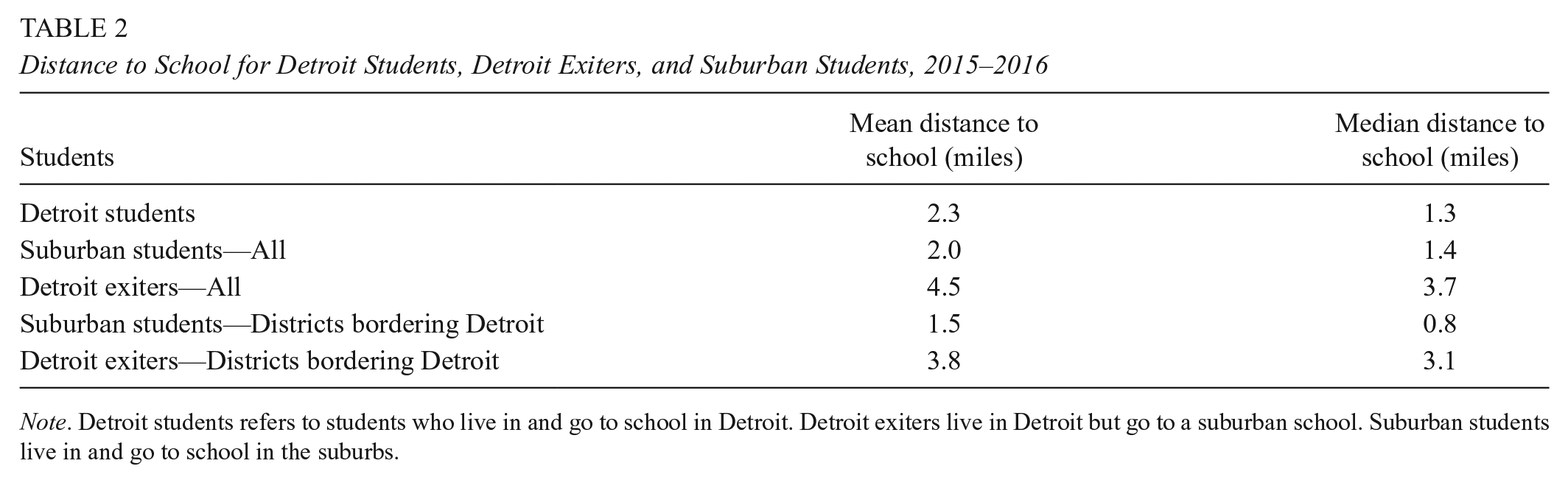
Note. Detroit students refers to students who live in and go to school in Detroit. Detroit exiters live in Detroit but go to a suburban school. Suburban students live in and go to school in the suburbs.

Detroit exiter enrollment by suburban district geographies, 2015–2016.
Suburban District Open Enrollment Policy and Share of Detroit Exiters in Geography, 2015–2016

Note. This table excludes Highland Park, which is a separate municipality from Detroit but does not have its own public school district. The non-zero percentage of students enrolled in public schools in closed districts may reflect administrative error or discretionary exceptions to the enrollment policy, for example, if an employee lives outside of the district and wants to enroll their child.
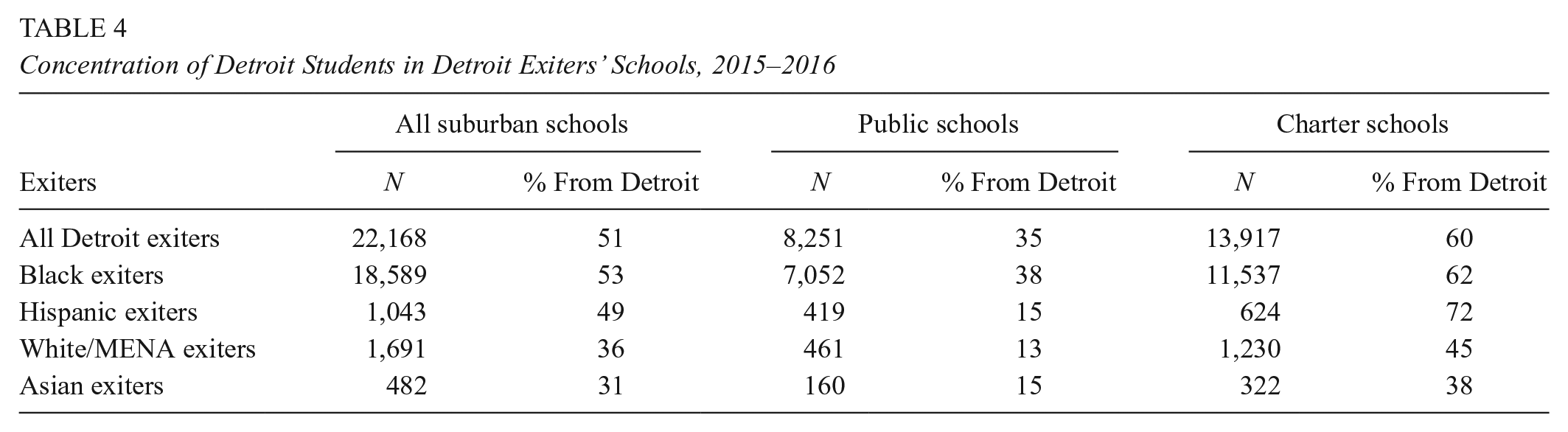
Within suburban districts, Detroit exiters were concentrated in particular schools, as depicted in Figure 3. (Figures 4 to 7 show these uneven enrollment patterns for Black, Hispanic, White/MENA, and Asian students separately.) In fact, Detroit exiters are so highly concentrated in particular schools that the average exiter goes to a school where the majority of their classmates are also Detroit exiters. As Table 4 shows, this intense concentration of exiters is highest for Black students, and is especially driven by suburban charter schools.
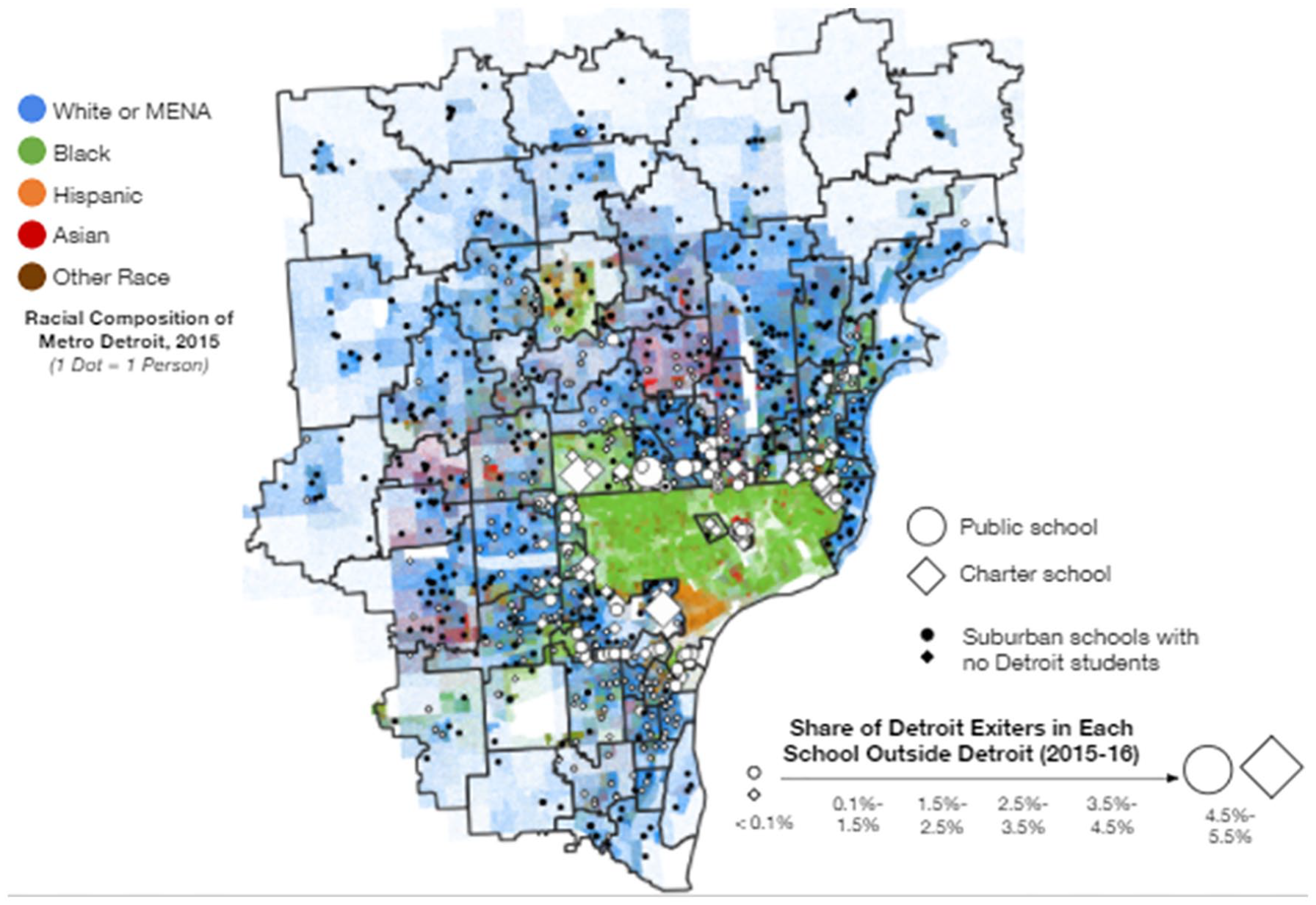
Enrollment of Detroit exiters in metro Detroit suburban schools, 2015–2016.
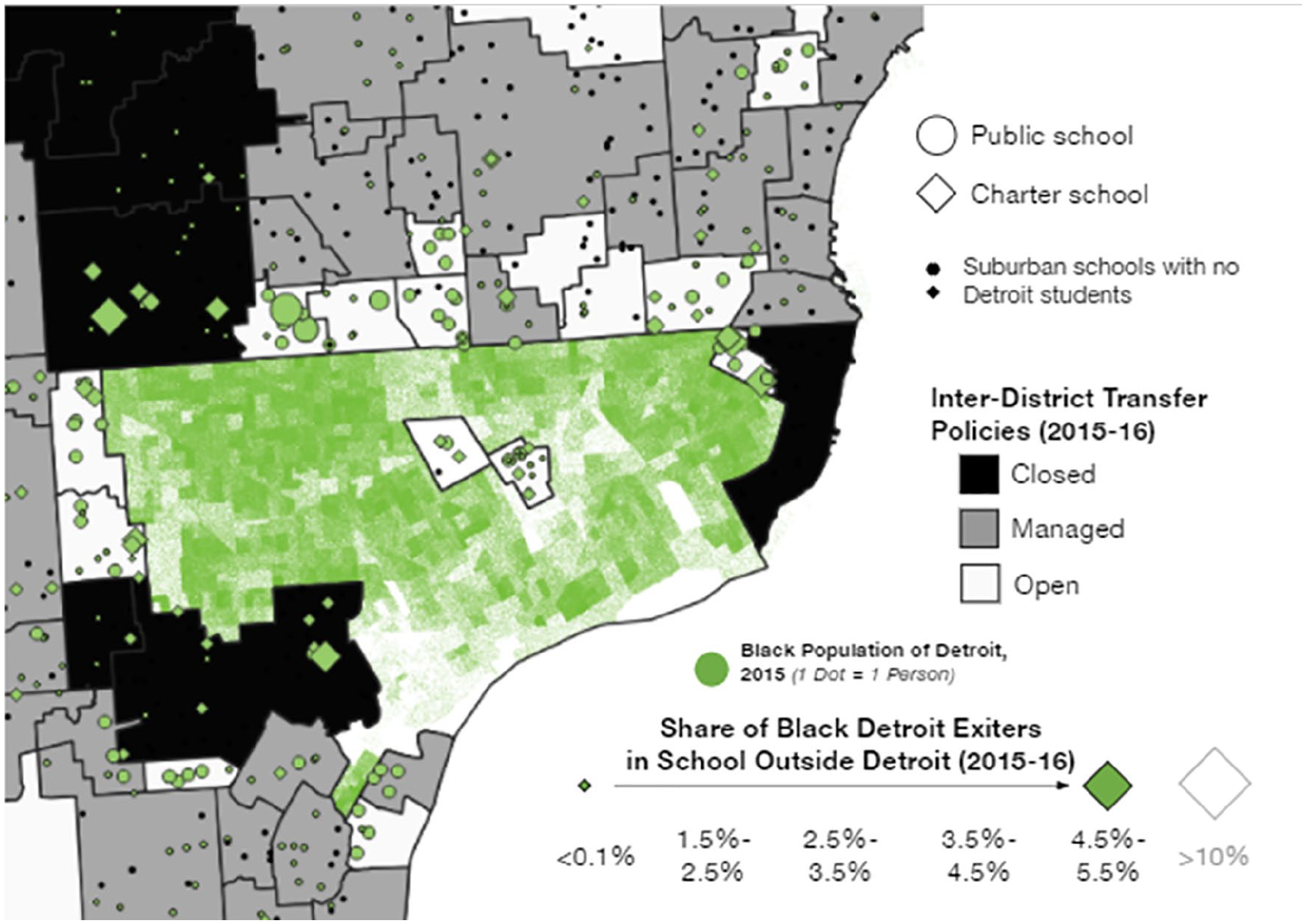
Detroit’s Black population and Black Detroit exiters’ enrollment patterns, 2015–2016.

Detroit’s Hispanic population and Hispanic Detroit exiters’ enrollment patterns, 2015–2016.

Detroit’s White/MENA population and White/MENA Detroit exiters’ enrollment patterns, 2015–2016.

Detroit’s Asian population and Asian Detroit exiters’ enrollment patterns, 2015–2016.
Concentration of Detroit Students in Detroit Exiters’ Schools, 2015–2016
Importantly, this intense concentration of Detroit exiters also reflects an intense segregation from suburban students. We measured segregation with the dissimilarity index, which examines how evenly Detroit exiters are distributed among schools within a suburban district; and the isolation index, which measures the extent to which Detroit exiters are exposed only to one another within a suburban district (Massey & Denton, 1988; Reardon & Townsend, 1999; see the online Supplemental Appendix C). Both indices range from 0 (perfectly integrated) to 1 (perfectly segregated). The average of the dissimilarity index for exiters was 0.58, indicating that the average exiter is relatively highly segregated from suburban students. Likewise, the average of the isolation index was 0.50, with the level of isolation particularly high in the districts receiving the most exiters, such as Southfield (0.60), Oak Park (0.53), Harper Woods (0.70), and Dearborn (0.70).
Suburban Enrollment Patterns by Race
The suburban school choices of Detroit exiters differ by race. Figures 4, 5, 6, and 7 show suburban enrollment patterns for Black, Hispanic, White/MENA, and Asian students, respectively. The maps also show the residential population from those racial groups in Detroit. The large majority of Detroit students and residents are Black, as are the large majority of Detroit exiters. Thus, the overall patterns for Detroit exiters described earlier largely reflect Black exiters’ suburban school choices, as seen in Figure 4. By contrast, the enrollment patterns for Hispanic, White/MENA, and Asian exiters differ significantly.
Figure 5 shows the enrollment patterns of Hispanic exiters, and residential patterns for Hispanic families in Detroit. While there is not a large enclave of Hispanic families outside of Detroit (as shown in Figure 1), Detroit’s Hispanic community is concentrated in the southwest part of the city, and Hispanic exiters mostly enroll in schools southwest of the city. Notably, over one third of Hispanic exiters are enrolled in just two Dearborn charter schools.
Figure 6 shows the enrollment patterns of White/MENA exiters, and residential patterns for White/MENA families in Detroit. Three Dearborn charter schools, along with one charter school in Crestwood (a school district bordering Dearborn to the west), enroll nearly half of White/MENA exiters. A large share of White/MENA students are also enrolled in Hamtramck charter and public schools. Together, schools in Dearborn, Hamtramck, and the one charter school in Crestwood enroll 70% of White/MENA exiters. There is reason to believe that it is MENA students who are largely concentrated in those schools. MENA Detroiters likely reside in the western part of the city bordering Dearborn and in the middle of the city bordering Hamtramck (Hill, 2018). Furthermore, more than half of students are identified as English language learners at the Dearborn and Hamtramck schools that enrolled most White/MENA exiters, as are 47% of students at the Crestwood charter school. Thus, MENA exiters may be concentrated in schools that serve a large concentration of MENA students, many of whom are English language learners, whereas White exiters may enroll in different suburban schools and be more broadly dispersed throughout the metro area. Data limitations prevent us from distinguishing between White and MENA students and residents and confirming this possibility.
Finally, Figure 7 shows the enrollment patterns of Asian exiters, and residential patterns for Asian families in Detroit. Hamtramck is home to a large Asian population that extends north into Detroit (Silmi & Raymond, 2019). Nearly all (87%) of Asian exiters chose Hamtramck schools. A single Hamtramck elementary-middle charter school enrolled 38% of Asian exiters.
The differences in enrollment patterns among Black, Hispanic, White/MENA, and Asian students are reflected in the distinct racial composition of their schools. As Figure 8 shows, Hispanic exiters and especially White/MENA and Asian exiters enrolled in schools with fewer Black students. The large majority of White/MENA exiters’ classmates were White/MENA; and about half of Asian exiters’ classmates were Asian. In addition to differences in racial composition, there were differences in school quality: Black exiters attended suburban schools with higher discipline rates, lower stability rates, and lower test scores (Figure 9).

Average racial composition of Detroit exiters’ school by student race, 2015–2016.

School characteristics of Detroit exiters’ school by student race, 2015–2016.
How Do Detroit Exiters’ School Characteristics Compare With Their Detroit Choice Sets and to the Schools of Suburban Students?
We compared school quality indicators and racial and socioeconomic demographics of Detroit exiters’ schools with those of their choice sets in Detroit. We also compared the characteristics of Detroit exiters’ schools with the suburban schools attended by suburban students, for the entire metro Detroit area and just for the districts bordering Detroit. Figure 10 summarizes these comparisons. (Online Supplemental Appendices D through H show the results of t tests.)
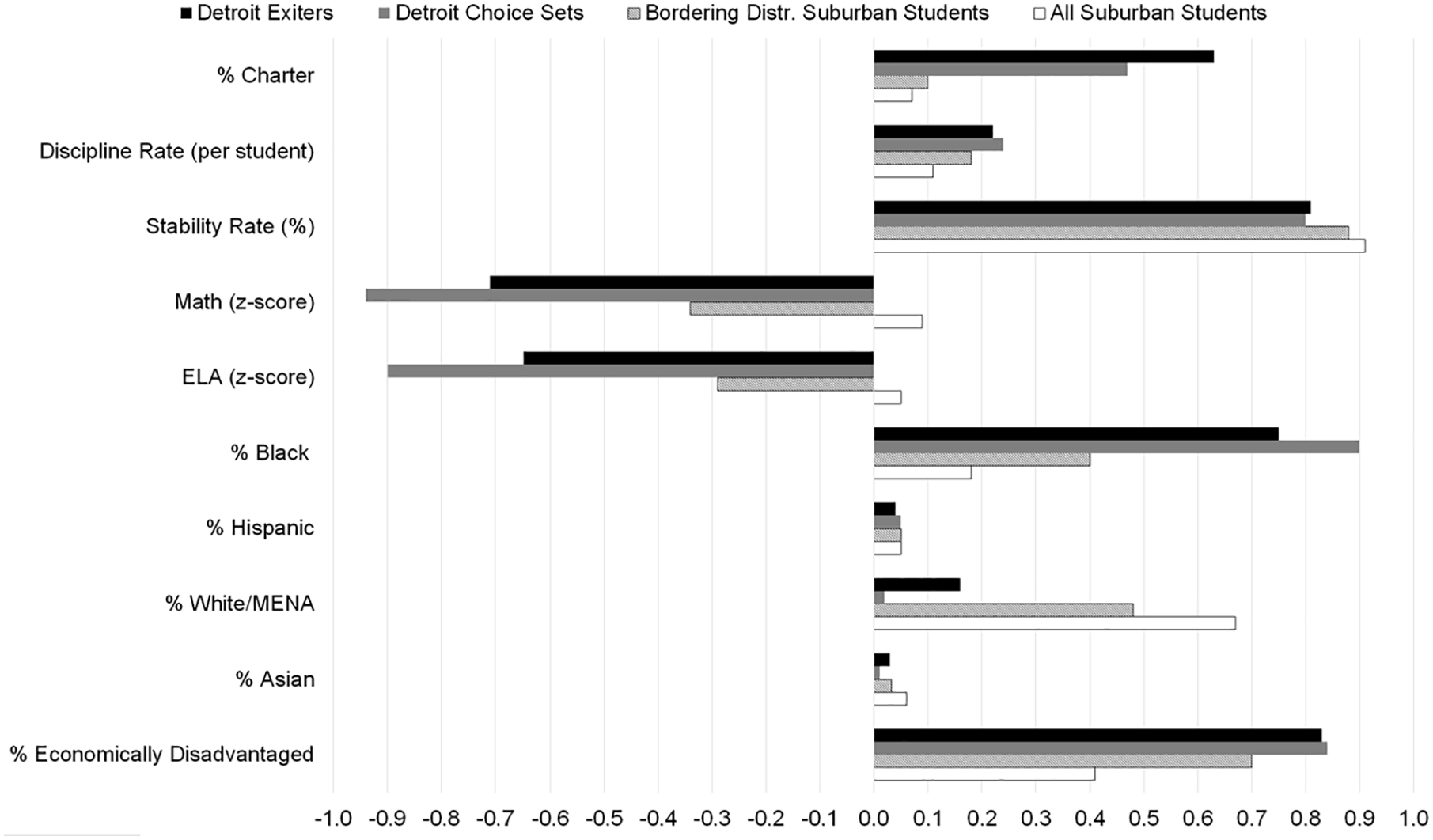
Characteristics of Detroit exiters’ schools compared to their choice sets and to suburban students’ schools, 2015–2016.
Compared with their choice sets in Detroit, the average Detroit exiter goes to a school with slightly more positive indicators of school quality, slightly lower levels of racial isolation, and about the same level of economic disadvantage. Exiters enrolled in schools with a slightly lower discipline rate, a slightly higher stability rate, and somewhat better average Math and English language arts state test scores than their Detroit options. In terms of school composition, the average Detroit exiter attended a school with fewer Black students than in their Detroit choice set schools—though, as shown in Figure 8, racial composition differed significantly by race. Notably, the average exiter across racial groups attended suburban schools with the same amount or more economically disadvantaged students (over 80%) compared with their Detroit choice set schools.
Compared with the schools of other suburban students, however, Detroit exiters’ school characteristics differ more significantly. While a majority of exiters enrolled in charter schools, only a small share of suburban students enrolled in charter schools. Suburban students also went to schools with more positive discipline rates (half as many infractions per student), higher stability rates (10% points higher), much higher standardized test scores (nearly 1 standard deviation higher), a much large share of White/MENA and Asian students, and about half as many economically disadvantaged students. These differences are partially mediated by suburban districts’ distance from Detroit: for suburban students attending schools in bordering districts (where the majority of exiters go to school), their schools had smaller but still significantly different characteristics from exiters.
Discussion
The enrollment patterns of Detroit exiters highlight the salience of racial geography in school choice. Reflecting prior research on school choice in general and in Detroit specifically (e.g., Bell, 2009; Edwards, 2021), distance appears to be a significant limiting factor for Detroit exiters’ choices. Indeed, even the large majority of Detroit exiters who choose schools in bordering districts travel significantly farther than other students in Detroit and suburban districts. Compared with the rest of metro Detroit, the suburban districts bordering Detroit have more racially minoritized and low-income residents, and have schools with lower test scores, lower stability rates, and higher discipline rates. Thus, limitations due to distance (and transportation) structure an already-constrained set of suburban school choices for Detroit exiters. The differences in exiters’ enrollment patterns by race further highlight the structuring role of racial geography: Hispanic, White or (most likely) MENA, and Asian students overwhelmingly exit to the suburban districts closest to where they live in Detroit. For White/MENA and Asian exiters, those districts also have large same-race residential populations.
Yet Detroit exiters’ enrollment patterns reflect more than spatial constraints. Exiters are highly concentrated in just a handful of districts—especially Southfield, Oak Park, Harper Woods, Dearborn, and others bordering the city. Within those districts, they are highly concentrated and isolated in just a handful of schools. Black exiters face the greatest level of racial isolation and lowest level of school quality in suburban schools; but Hispanic, White/MENA, and Asian exiters also go to schools that are significantly more racially and socioeconomically isolated and that have worse indicators of school quality compared with their suburban peers, even when compared only with other schools in bordering districts. While nearly a quarter of Detroit resident students leave the city for school every day, they attend schools where an average of 51% of students are also Detroit residents.
The simultaneous hoarding of suburban educational resources and recruitment of Detroit students for suburban enrollment has led to a perverse system in which Detroit families are proffered an idea of higher quality through choice that is not manifest in the available options. Instead, Detroit families bear the costs of enrolling in suburban schools (e.g., longer commutes, lack of political influence over their schools) without many of the perceived benefits (i.e., higher quality or racially integrated schools). In addition, this shift of Detroit students to suburban schools has significant costs for school systems in Detroit, as resources follow students into suburban schools (Lenhoff et al., 2020). Given the significant concentration of Detroit students in particular suburban schools, this raises questions about suburban school choice as a vehicle for Detroiters’ opportunity and the state’s interest in funding Detroit students’ suburban enrollment.
Suburban schools near Detroit are able to financially benefit from the enrollment of Detroit exiters, who are largely bound by spatial constraints. Indeed, a majority of schools receiving Detroit exiters rely on them for a significant share of their enrollment (10% or more), including a number of suburban schools in which 50% or more of the students are from Detroit. This concentration is especially driven by charter schools, such as those in Dearborn, Southfield, and Harper Woods, which would not have financially sustainable levels of enrollment without Detroit exiters. Likewise, a number of inner-ring suburban public school districts, with Oak Park as the most extreme example, receive a large enrollment benefit from Detroit exiters (Cohen, 2020). These suburban schools position themselves as a resource for Detroit families and draw substantial financial benefit from enrolling them. Yet by drawing per-pupil funding away from Detroit schools, they actively contribute to the unequal conditions that push Detroit families to consider exiting the city.
With Detroit exiters so highly concentrated and intensely isolated into particular schools, suburban communities have largely preserved separate educational opportunities. The design and implementation of open enrollment make this possible, by providing a high level of discretion to districts over nonresident enrollment and allowing for a proliferation of charter schools through loose regulations over charter authorization and management. Districts can formally exclude students by policy, or unofficially deny them access by withholding transportation services or through administrative burdens. Charters can then offer separate options for nonresident students that are geographically located in those same suburban districts. As a result, suburban districts can financially benefit from the enrollment of Detroit students while hoarding the most desirable educational resources for the majority of suburban families.
Our findings show the utility of critical race spatial analysis in educational policy research. For school choice, traditional policy analyses of charter schools or open enrollment would fail to capture the role of racial histories and construction of racialized spaces in structuring the school choice landscape. Critical race spatial analysis helps us consider how a combination of race, space, and policies function to maintain inequality, exposing gaps between the policy rhetoric and practiced reality of school choice (Young & Diem, 2017). Our findings also illustrate the usefulness of opportunity hoarding and predatory landscapes as anchoring concepts for the intersections of race, geography, and school choice policy. Each concept captures the way that inequalities are simultaneously structured by existing racial and spatial stratification and reinforced by the individual and aggregate actions of families or organizations. When considered together, they help theorize how stratified enrollment is reproduced by the dynamic interaction between the “supply” and “demand” dimensions of school choice.
Directions for Future Research
Ultimately, our exploratory analysis raises more questions than answers about the mechanisms by which race, geography, and policy lead to the enrollment patterns we observe. The sociospatial dynamics of school choice mean that we need to account for family decision making as well as school and district behavior within this landscape of choice.
How are different families making sense of their options within this landscape? How are their spatial dispositions (Yoon & Lubienski, 2017) shaped by particular racial histories and racialized geographies, and how do those relate to racially stratified enrollment patterns? What are the roles of racialized preferences (Rowley & McNeill, 2021) and racial-group information networks (Corcoran & Jennings, 2019)? How might differences within racial groups, such as immigrant status and ethnic or national identities (Powers & Pivovarova, 2021), relate to enrollment patterns? And, how do socioeconomic differences among them further constrain or enable choices (Singer, 2020)? Even in a landscape that is structurally constrained by racial segregation and restrictive policies, these “demand side” dimensions of school choice must be understood (Jabbar & Lenhoff, 2019).
On the “supply side,” how do charter schools respond to racial geography when making strategic decisions about location and student recruitment (Riel, 2021)? Do these decisions vary based on their mission or profit orientation (Henig et al., 2005), target populations (Eckes, 2015), connection to a local or national network (Gulosino & Miron, 2020), or perceptions of the competitive market environment (Jabbar, 2016)? How does the existing physical infrastructure affect those decisions (James-Wilson, 2020)? In what ways do authorizers take racial geography and the landscape of educational options into account? When setting open enrollment policies, how do school boards balance financial incentives with the interests and demands of their residents? How does racial geography shape those calculations? As with family behavior, these organizational decisions and actions are fundamental to shaping the school choice landscape (Lubienski et al., 2009).
The racial and spatial dimensions of school choice call for further critical race spatial analyses. This research agenda should draw inspiration from Yoon et al.’s (2018) proposed mixed-methods geospatial approach to educational policy analysis, combining geographical information systems and quantitative methods with qualitative “accounts of lived experiences and perceptions that guide and shape institutional and individual behaviors, decisions, and time-space constraints” (p. 59). Qualitative methods like story mapping, grounded theory, portraiture, and geo-narratives can help examine historical and present-day racialized placemaking and its relationship to school choice (Mann & Dudek, 2019; Vélez & Solórzano, 2017); and participatory mapping research can help catalyze community action and educational policy making to disrupt opportunity hoarding and predatory landscapes (Hidalgo, 2017).
Supplemental Material
sj-docx-1-ero-10.1177_23328584211067202 – Supplemental material for Race, Geography, and School Choice Policy: A Critical Analysis of Detroit Students’ Suburban School Choices
Supplemental material, sj-docx-1-ero-10.1177_23328584211067202 for Race, Geography, and School Choice Policy: A Critical Analysis of Detroit Students’ Suburban School Choices by Jeremy Singer and Sarah Winchell Lenhoff in AERA Open
Footnotes
Authors’ Note
This research result used data structured and maintained by the MERI-Michigan Education Data Center (MEDC). MEDC data are modified for analysis purposes using rules governed by MEDC and are not identical to those data collected and maintained by the Michigan Department of Education (MDE) and/or Michigan’s Center for Educational Performance and Information (CEPI). Results, information and opinions solely represent the analysis, information and opinions of the author(s) and are not endorsed by, or reflect the views or positions of, grantors, MDE and CEPI or any employee thereof.

Notes
Authors
References
Supplementary Material
Please find the following supplemental material available below.
For Open Access articles published under a Creative Commons License, all supplemental material carries the same license as the article it is associated with.
For non-Open Access articles published, all supplemental material carries a non-exclusive license, and permission requests for re-use of supplemental material or any part of supplemental material shall be sent directly to the copyright owner as specified in the copyright notice associated with the article.
