




Abstract
Alongside the immediate challenges of operating schools during the COVID-19 pandemic, over the past year, parents, students, and policymakers around the country have also debated equity and access to some of the country’s most elite and segregated public schools. This qualitative case study examines how New York City activists conceptualized educational equity during the pandemic. Conceptually framed by Labaree’s (1997) typology of the three competing purposes of education—democratic equality, social efficiency, and social mobility—we document different lessons learned from the pandemic by integration activists, who emphasized school integration for democratic equality; and meritocratic activists, who prioritized retaining the existing stratified system mainly to foster social mobility and social efficiency. Our findings highlight the challenge of sustaining a vision oriented around the public good amid powerful framings emphasizing the individual purposes of education.
Keywords
Over a year into the COVID-19 pandemic, alongside immediate concerns over school safety, educational equity and racial desegregation debates have spread across the United States. Boston, San Francisco, and the Washington, D.C. suburbs have all taken steps to address segregation in elite public schools (Natanson, 2020; Tucker, 2021; Woolhouse, 2020). However, New York City (NYC), where stakeholders have debated school integration policy for the past decade, remains one of the most segregated districts in the nation (Castillo et al., 2021; Cohen, 2021; Kucsera & Orfield, 2014).
School segregation in NYC stems from a residentially based elementary and middle school system combined with a highly stratified choice system, including the largest number of selective middle and high schools in the country (Cohen, 2021; Hu & Harris, 2018; Kucsera & Orfield, 2014). Activist efforts over the past decade to remedy this inequality have resulted in pilot integration programs at select schools, expansion of these pilot programs to several of NYC’s 32 Community School Districts (CSDs), and an advisory committee that developed a citywide integration plan (Castillo et al., 2021; Veiga & Zimmer, 2019).
The arrival of the COVID-19 pandemic in New York in March 2020 could have halted this momentum, as educators and families focused on the shift online, technology needs, and configuring vital special education services, among others (Amin, 2020; Shapiro, 2020a). Yet amid these immediate needs, the COVID-19 pandemic, alongside calls for racial justice following the murder of George Floyd in May 2020—what many activists called the “dual pandemics” (Aguilera, 2020)—added urgency to the long-standing call from activists to revoke selective admissions and other school choice measures advantaging privileged families. However, the pandemic also motivated activists who supported maintaining the existing school selection process.
To understand activists’ competing visions during the pandemic, we draw from Labaree’s (1997, 2018) conceptualization of the tensions between education’s public and private goals. We examine how debates during the pandemic were linked to broader battles over the purpose of schooling: whether public education should serve to maximize democratic equality, foster social efficiency through training future workers, or emphasize individuals’ social mobility (Labaree, 1997). Applying Labaree’s framework to education in a time of crisis, we ask, “How do education activists in NYC conceptualize educational equity during the pandemic?”
Building on prior studies examining how the tension between parents’ public ideals and individual choices often exacerbates school segregation in NYC (Freidus, 2019; Hannah-Jones, 2016; Mader et al., 2018; Roda, 2018; Roda & Wells, 2013), this qualitative case study examines how these tensions play out against the backdrop of the dual pandemics. Using data from 72 interviews with student, parent, and community activists; and 36 hours of observations from public meetings, we document how two distinct groups of activists organizing during the pandemic framed their visions of equity around the public good or the private good by using one or more of Labaree’s (1997) educational purposes. Specifically, integration activists emphasized school integration for democratic equality; and meritocratic activists prioritized retaining the existing stratified system to foster social mobility and social efficiency, and, to a different extent, democratic equality. In one of the first studies documenting integration activism during the COVID-19 pandemic, we find that the pandemic briefly opened a window to activists advancing policies oriented around the public good, but in a political context favoring individual choice, this move was ultimately pushed back by other activists emphasizing the individual purposes of education.
Case Context: School Segregation in NYC
On March 16, 2020, barely 2 weeks after the first case of COVID-19 was reported in NYC and only 1 week after Chancellor Richard Carranza emphasized the safety of riding the subway to school, the NYC public school system closed all buildings, moving all classes online for the remainder of the school year (DOE Chancellor, 2020; Shapiro, 2020a). In the months that followed, NYC became the epicenter of the COVID-19 pandemic in the United States, tallying over 621,000 cases and over 27,350 deaths by February 2021 (McKinley, 2020).
Added to the complications of remote pandemic schooling was the question of how NYC’s selective school choice process would function for 1.1 million students at over 1,800 schools. The choice system includes a gifted and talented (G&T) elementary school track with a test for 4-year-olds, extensive middle and high school options, and eight specialized high schools that admit students on the basis of a single exam, the Specialized High School Admissions Test (SHSAT). Additional schools “screen” students based on a combination of test scores, grades, attendance records, auditions, essays, demonstrated interest, and interviews. Scholars have demonstrated how these screens often privilege students from affluent, white, and English-speaking families (Pérez, 2011; Roda, 2015; Sattin-Bajaj, 2014).
Prior to COVID-19, NYC’s school choice system contributed to its status as one of the country’s most segregated districts (Cohen, 2021; Kucsera & Orfield, 2014). Students of color and poor students form the majority: 41% are Latinx, 26% are Black, and 73% are “economically disadvantaged,” qualifying for free or reduced-price lunch. Additionally, 16% are Asian and 15% are white. In 2019, roughly three quarters of Black students attended a school with under 10% white enrollment, and over two thirds of Black and Latinx students attended a school in which 75% or more of the student body lived in poverty (New York City Council, 2019; New York City Department of Education [NYCDOE], 2020). These schools also have fewer resources, advanced courses, and sports teams (Rosario, 2021). And although Black and Latinx students comprise two thirds of overall district enrollment, they comprise only approximately 25% of G&T enrollment and 10% of students at specialized high schools (Shapiro, 2021a; Veiga, 2019). NYC’s ethnically diverse Asian student population has the second highest concentration of poverty, after the Latinx population, yet Asian students are less likely to attend high-poverty and segregated schools and are overrepresented, alongside white students, in G&T programs and specialized high schools (Shapiro, 2021d; NYC Mayor’s Office for Economic Opportunity, 2020).
In recent years, multiple efforts have attempted and failed to significantly diversify access to NYC’s selective public schools. Mayor Michael Bloomberg (2002–2012) added five specialized high schools and expanded G&T programs, and private donors funded free test preparation programs, but neither initiative significantly increased Black and Latinx enrollment in selective schools (Shapiro, 2019). More recently, in 2018, Mayor Bill de Blasio expanded the summer academic Discovery Program, which provides an alternate tutoring pathway for low-income students into a specialized high school. Yet this effort also did little to boost Black and Latinx specialized high school enrollment (Veiga, 2020). In fact, the admission of only eight Black students to Stuyvesant High School in 2021 made national headlines (Shapiro, 2021d).
With mayoral control, effective since 2002, the person most able to address persistent school segregation is NYC’s mayor, who could change admissions policies at many screened middle and high schools throughout the city (Lewis, 2013). However, Mayor Bill de Blasio has proceeded cautiously in this area, with the exception of announcing his opposition to the SHSAT in 2018 (Harris, 2018). 1 When school district leaders, such as Chancellor Richard Carranza, have pushed further on addressing segregation, they have had limited power to make changes without the mayor’s assent, ultimately contributing to Carranza’s March 2021 resignation (Shapiro, 2021b).
Thus, challenging the mayor to address school segregation has been central to activists’ efforts over the past decade (Castillo et al., 2021). Much of this activism has emphasized remedying inequities in choice-based and selective admissions and has resulted in pilot integration programs at a few schools and CSDs. In addition, in 2019, a year-long School Diversity Advisory Group (SDAG), comprising district and community leaders and activists, issued policy recommendations for the city (SDAG, 2019a, 2019b). Regarding enrollment, SDAG recommended that, in the short-term, schools work to be more reflective of their surrounding CSD by race, socioeconomic status, and share of multilingual learners and students with disabilities; and, in the longer term, more reflective of the borough in which they are located. The SDAG further recommended that nine CSDs with sufficiently diverse populations develop diversity plans. These plans would rely on building community consensus, involving elected parent leaders, appointed community members, and high school students who serve on Community Education Councils (CECs). Yet some integration efforts have mobilized opposition, including in Queens’ CSD 28, the mayor’s proposal to eliminate the SHSAT, and the SDAG’s recommendations to eliminate G&T and middle and high school screens. Hence, addressing segregation has long been debated prior to the COVID-19 pandemic.
Conceptual Framework
To examine competing activist visions around educational equity in NYC during the pandemic, we draw on Labaree’s (1997) conceptualization of the competing goals of American public education. In doing so, we situate activists’ visions during a pandemic in the context of broader tensions shaping long-standing education reform debates.
According to Labaree (1997), three competing goals inform school reform efforts: democratic equality, social efficiency, and social mobility. Democratic equality positions education as a public good benefitting all members of society. This framing emphasizes students’ equal access to, and equal treatment within, schools, and underpins initiatives, including universal public schooling, desegregation, and school finance reform, that promote opportunities for all students regardless of race, class, gender, and other traits. The democratic equality framing similarly underpins recent efforts advancing integration rather than desegregation to move beyond numerically diverse schools to ensuring equitable conditions within schools for students of all backgrounds and learning needs (IntegrateNYC, 2018; Tyson, 2011).
Whereas democratic equality frames public education as a public good in terms of promoting egalitarianism, social efficiency defines schooling as a public good in terms of advancing a productive workforce and a strong economy. This goal emphasizes vocationalism, or training students for particular jobs based on their perceived abilities. Relatedly, social efficiency underpins efforts to measure students’ skills and abilities through standardized tests in order to sort them into distinct “tracks,” both within schools (e.g., between honors and nonhonors classes) and across schools (e.g., between community colleges and 4-year universities). The student’s track therefore has implications for their future positions in the capitalist economy. However, this framing undermines the collective goals of equal access and treatment, as schools sort students into stratified socioeconomic roles. Indeed, researchers have documented how tracking reinforces racial and socioeconomic segregation (Oakes, 1985), in part because standardized tests more accurately measure a student’s socioeconomic background, rather than their academic abilities (Au, 2010; Reardon, 2013).
In contrast to democratic equality and social efficiency, social mobility frames public education as a private good providing students with credentials for individual advancement in a competitive workforce. Oriented around the market values of choice and competition, social mobility frames schools as commodities and students as consumers competing for access to desirable schools. Furthermore, social mobility centers meritocracy, a system that advances students with the most individual merit. Some scholars have critiqued social mobility’s emphasis on market values and the meritocratic narrative for exacerbating segregation. Indeed, an educational market in which students compete for access to top-tier schools advantages students from white, affluent, and English-speaking families. Yet the social mobility goal frames these students’ “success” in terms of their supposed merit, rather than in terms of their structural advantages (Pérez, 2011; Sattin-Bajaj, 2014). In the higher education context, the social mobility goal has had salience among groups who claim that race-conscious admissions, or affirmative action, unfairly denies access to some academically qualified white and Asian students. However, this perspective obscures how the structure of K–12 educational opportunities disproportionately advantages college applicants from white, Asian, and affluent families, and those whose parents are college graduates (Poon et al., 2019, Warikoo, 2016).
In sum, Labaree’s educational goals have each underpinned past and ongoing policy efforts with implications for desegregation and racial equity. At times, policymakers and advocates have attached multiple goals to such policies, thus broadening their appeal and likelihood of implementation (Tichnor-Wagner & Socol, 2016). For example, desegregation advocates have combined the democratic equality and social mobility goals in framing desegregation as ensuring equal access and collective academic and socioemotional benefits for all students while also advancing their individual economic opportunities (Johnson, 2019; Taylor, 2001; Wells et al., 2016). The expansion of school choice similarly stems from its association with multiple goals: political conservatives view market-based choice as facilitating social efficiency, while civil rights leaders perceive choice as expanding marginalized students’ access to quality schools and, in turn, democratic equality (Lubienski & Weitzel, 2010; Pedroni & Apple, 2005). Social efficiency and democratic equality also came together in the push to garner broad support for standards-based reform and accountability policies among business leaders concerned about future workers and civil rights groups interested in highlighting racial achievement gaps (DeBray-Pelot & McGuinn, 2009).
At other times, however, the three educational goals conflict, resulting in ineffective attempts to advance systemic school reform. In particular, social mobility’s dominance over other goals has led education to be increasingly framed as an individual commodity, normalizing selective admissions, academic tracking, and other stratifying systems at the expense of policies aimed at advancing the public good (Labaree, 1997; Roda, 2015). Indeed, for many parents and other stakeholders, especially white and affluent ones, the individual purposes of schooling are more “material, immediate, and personal,” and even if they support the public good in theory, doing so is secondary to “[taking] care of their own” (Labaree, 2018, p. 11). As a result, given white and affluent stakeholders’ disproportionate influence over education policy (e.g., Cucchiara, 2013; Ewing, 2018), “efforts to promote the public good are deferred to the indeterminate realm of political action for possible resolution in the distant future” (Labaree, 2018, p. 12).
In NYC, one of the first U.S. epicenters of COVID-19, the pandemic put the competing goals of public education on stark display. As schools transitioned to remote instruction and the virus disproportionately infected poor communities and communities of color, many parents sought to protect their own children’s well-being, whereas other stakeholders argued that policies advancing the public good were more necessary than ever. Therefore, this study draws on Labaree’s (1997) framework to examine how NYC activists invoked one or more educational goals in framing their visions of equity during the pandemic. We examine the extent to which activists attached their visions to democratic equality, social efficiency, social mobility, or a combination of these goals, in order to mobilize policy support. Additionally, Labaree’s framework enables us to situate tensions among activists within broader conflicts between the public and private purposes of education. This framing allows us to capture the complexities underpinning school integration debates in NYC.
Methods
This research is part of a qualitative case study of NYC activism around school integration during the COVID-19 pandemic from spring 2020 through spring 2021. Data collection included in-depth interviews with 72 activists (including youth, parent, and community organizers) and 36 hours of observation at public events and meetings. We triangulate these data with print and social media coverage of integration in NYC during the pandemic. Table 1 details the individuals from NYC activist organizations included in our study. We use pseudonyms for all interviewees.
New York City School Integration Organizations Included in Our Study
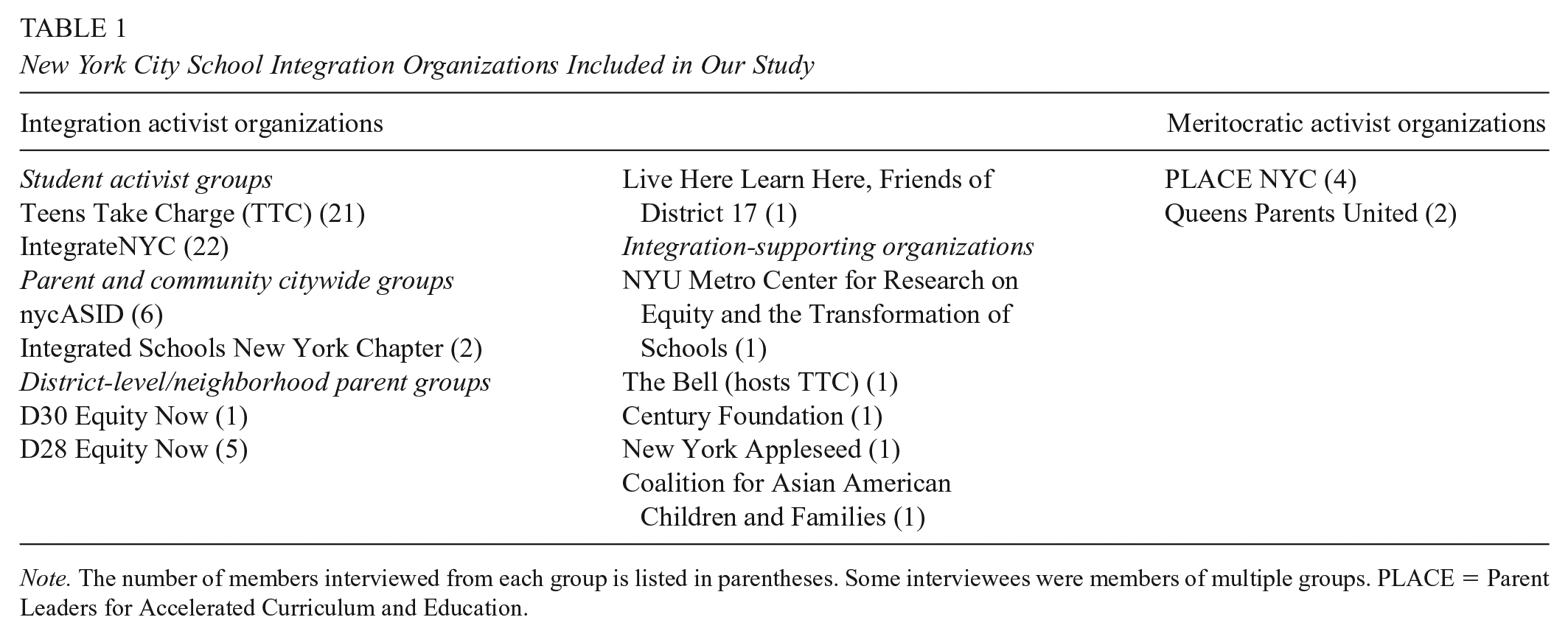
Note. The number of members interviewed from each group is listed in parentheses. Some interviewees were members of multiple groups. PLACE = Parent Leaders for Accelerated Curriculum and Education.
Our methodology included codesigning the semistructured interview protocol with youth at two activist organizations, IntegrateNYC and Teens Take Charge (TTC). Interviews ranged from 20 to 90 minutes and included questions about involvement in activism before and during the pandemic, experience in and with NYC schools, and what policy outcomes they would like to see and why. For the youth interviews, two alumni members of each organization conducted 40 interviews with youth, developing a strategic sample that represented the racial, ethnic, gender, and geographic diversity of each organization and included new and longtime group members. We compensated the youth interviewers and, at their recommendation, provided youth interviewees with $20 gift cards for groceries. From discussions with IntegrateNYC and TTC, we determined it would be beneficial to have youth interview their peers. This not only empowered youth interviewers as novice researchers but also leveraged their peer rapport and sensitivity to the ways youth experienced trauma during the pandemic. At the youth interviewers’ request, we cosponsored an event prior to their data collection focused on trauma-informed interviewing. This collaborative design, with frequent check-ins, supported and empowered the youth interviewers.
In addition, the co–principal investigators interviewed 32 parent and community activists between July and December 2020 and met weekly to discuss emerging themes. We initially recruited participants via snowball sampling from our networks, intending to focus on integration activists whose work aligned with the SDAG’s recommendations. As we realized that parent activists working to maintain selective schools and programs were also framing their work around integration, we added them to our sample. We then used purposive sampling to ensure representation from all boroughs and from a range of ethnic and racial backgrounds and positions on integration, although we interviewed fewer activists supporting selective schools. As Table 2 demonstrates, although we surveyed a racially diverse group of parents and students, the composition of activist groups resulted in interviewing a higher proportion of students of color than adults of color and more women overall. The concentration of parent activism in Brooklyn, Queens, and Manhattan was also reflected in our parent interviews.
Interviewee Demographics (n = 72)

Note. We use race/ethnicity categories from the U.S. Department of Education, recognizing that “multiracial” includes interviewees who self-identify as Afro-Latinx. NYC = New York City.
We conducted all semistructured interviews remotely via Zoom and, with participants’ permission, recorded and transcribed each interview. We conducted the first five interviews in pairs to ensure consistency and provide feedback to one another. We recorded field notes immediately after each interview to accurately capture our reflections and insights.
Throughout, we worked to listen to and empathetically analyze activists from all groups (Warikoo, 2016). Despite interviewing remotely, we were able to establish rapport with participants due to shared backgrounds, including as former public school teachers, current college instructors teaching virtually, and, for Authors 2 and 3, as parents grappling with virtual schooling during the pandemic. However, there were some limitations to our interview process. As white and Asian American middle-class professors living outside NYC, we maintained a continuous dialogue examining our racial and class positionality, and our reflexive practice led us to continuously question and revise our findings and work to minimize our bias (Holmes, 2020; Rowe, 2014). The youth interviewers, who identify as Latinx and Black and are NYC public school alumni, more closely identified with youth participants, a strength for recruitment and establishing rapport. However, in some cases, their personal connections through group membership may have influenced responses, and, as novice researchers, they may have missed opportunities for follow-up questions and clarifications. Additionally, although we interviewed activists with multiple perspectives, our small sample of those supporting selective schooling and elite tracks limits the power of our findings.
We supplemented interview data by observing 36 hours of virtual events and meetings in NYC and recording field notes. These events included IntegrateNYC and TTC meetings and events, CEC meetings for seven districts, an NYCDOE teach-in, and mayoral candidate forums. During these meetings, we watched and listened for how participants framed their visions of equity during the pandemic. An undergraduate student researcher assisted with observing meetings and recording field notes.
We analyzed all data via deductive coding, based on concepts from Labaree’s (1997) educational goals framework; and inductive coding, based on themes emerging from interview transcripts and field notes (Miles et al., 2014). Using NVivo qualitative data analysis software, we first coded together for consistency, then coded the remaining data individually.
Findings
How Activists Framed Their Work Around the Purposes of Schooling
We find that educational equity debates during the pandemic involved two perspectives. First, integration activists mobilized around integration policies to undo selective admissions and elite tracks, arguing that the dual pandemics lent greater urgency to their vision. Second, meritocratic activists sought to preserve selective admissions policies and what they referred to as “accelerated learning,” claiming that these policies fairly rewarded hardworking students during the pandemic. Integration activists primarily framed their vision around democratic equality, whereas meritocratic activists emphasized social efficiency, social mobility, and, to a different extent, democratic equality. In Table 3, we summarize the policy preferences and framings among integration and meritocratic activists:
Integration and Meritocratic Activist Policy Goals
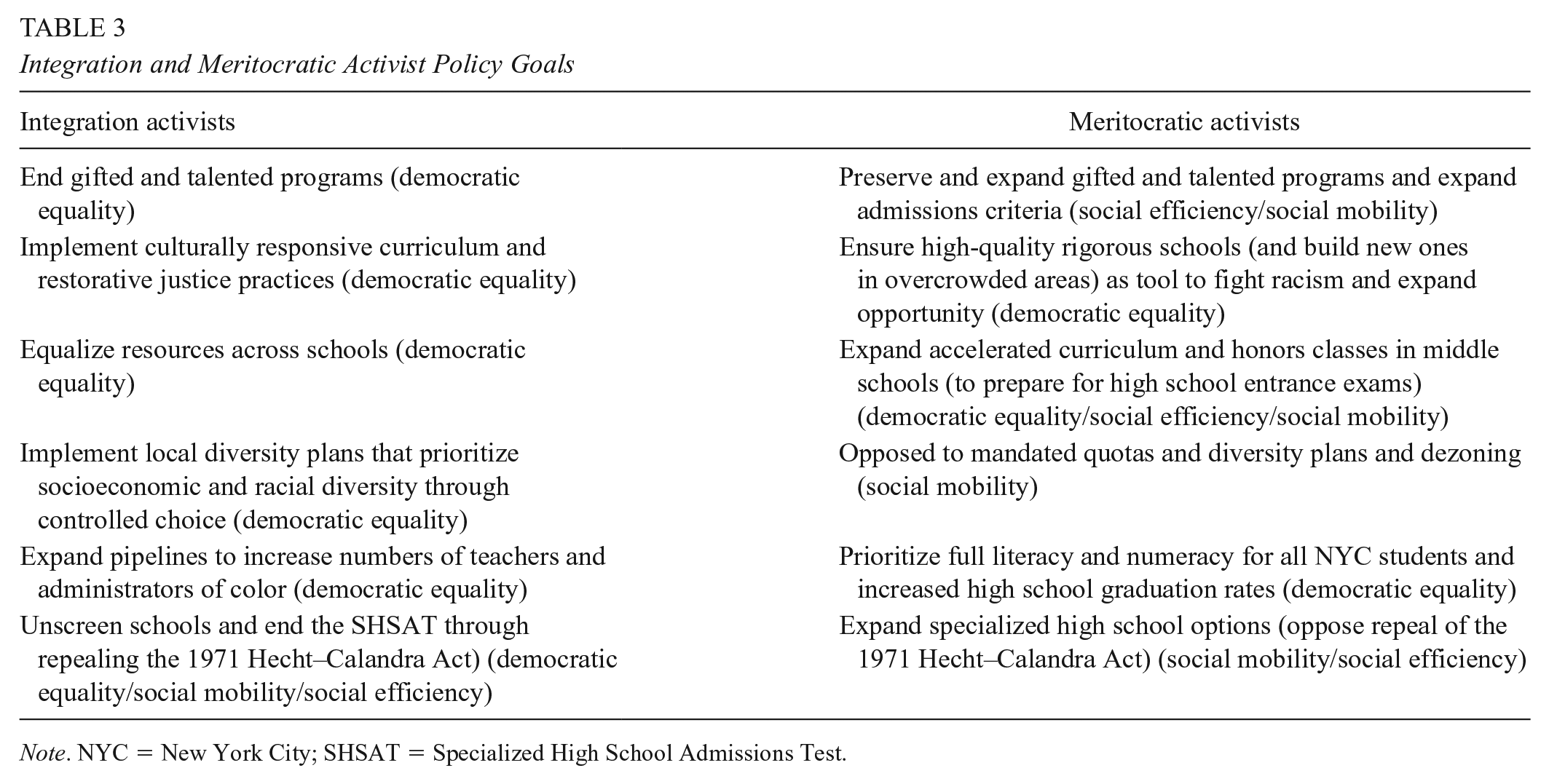
Note. NYC = New York City; SHSAT = Specialized High School Admissions Test.
Integration to Advance Democratic Equality
Prior to the pandemic, many students and parents got involved in integration activism from personally experiencing the disparities between and within NYC public schools, disparities that were exacerbated during the pandemic. The privilege or lack of privilege they experienced compelled them toward a vision of equity consistent with the democratic equality goal (Labaree, 1997). white youth activist Brett Dosser noted the contrast between the predominantly Black and Latinx high school where his father taught and the “super white” high school he attended: “My dad would be like, ‘My high school looks like a prison.’ And my high school looked like a private school. It had 12 music studios, a library, a dance studio, art studio.” Latinx youth organizer Julio Marquez remembered he “learned about [school segregation] and then I realized, damn. I’m in a segregated school.” When activist students of color attended screened high schools, they described the sadness of being one of a few, and “tokenized.” Students of color in majority-Black and Latinx schools noted inadequate resources and predominantly Eurocentric curricula. Similarly, Black parent Demetria Pepin, who worked in several public schools, observed inequalities in how students were treated in predominantly white schools compared with predominantly Black and Latinx schools. In predominantly white schools, students could “be reckless . . . cursing out teachers,” but still be regarded as “a good kid.” In her majority-Black neighborhood, “those kids would have been suspended.”
While integration activists wanted a good education for themselves and their children, they believed that the NYCDOE should establish policies to benefit the collective (Labaree, 1997). As white parent activist David Stein explained, “people are naturally selfish,” but the “government needs to try to match the goals of individuals with the goals of society.” To these students and parents, ending school segregation through integration would advance the goal of democratic equality and benefit the collective good (Labaree, 1997). To address the limitations of past desegregation efforts, which primarily focused on enrollment without an accompanying cultural change within schools, in 2016, IntegrateNYC student activists developed “The 5Rs of Real Integration.” The 5Rs called for (1) revising race and school enrollment policies; (2) equalizing school resources; (3) building strong relationships through culturally responsive curricula, ethnic studies courses, and designating all school buildings ICE sanctuaries; (4) restorative justice to reduce racially disproportionate discipline; and (5) representation through hiring more teachers of color (Gonzales, 2018; IntegrateNYC, 2018). Together, the 5Rs reflect the democratic equality goal’s emphasis on equal access and equal treatment (Labaree, 1997). Indeed, Latinx student activist Mitchell Mendoza explained that integration “was much deeper than moving bodies.” It included making sure that our schools are well-resourced, making sure that we’re using more restorative practices, making sure that our teachers are more representative and making sure that the overall school climate is somewhere that’s a safe space for students of all backgrounds.
Over a period of collaboration, most critically the year-long SDAG in 2019 that brought together 40 citywide organizations, activists developed a vision of integration that involved the elimination of meritocratic programs and the expansion of programs that support democratic equality through the 5Rs. The 5Rs were subsequently endorsed by both policymakers and other integration organizations. In our interviews, student and parent activists repeatedly referenced the 5Rs as a means of advancing the collective good.
Dual Pandemics Create an Urgency for Integration
Throughout spring 2020, the dual pandemics of COVID-19 and racial justice came together to amplify activists’ urgency around integration as a means of advancing democratic equality. First, policymakers and activists alike realized that, with school closures and many students’ learning disrupted, admissions based on grades, attendance, testing, and auditions made little sense. As Black youth activist Janet Moss explained, Now that we are doing fully remote, we can’t really do attendance screens anymore. . . . Now we can truly sit down and really question them and say, “Okay, now that we can’t do this, what’s a better alternative?”
These activists sought to highlight how the disruption of usual processes made it difficult to maintain existing policies that undermined equal treatment and equal access.
Second, the national Black Lives Matter demonstrations in the wake of the murder of George Floyd in May 2020 made many white Americans better understand and demonstrate their support for ending anti-Black racism and inequity (Buchanan et al., 2020). Many integration activists shared that the dual pandemics demonstrated the consequences of segregation and validated their vision of democratic equality. Student activists described how disparities in infection rates alongside racially inequitable access to housing and technology during school closures made things “crystal clear,” “stripped away a lot of the facade,” “put a bright spotlight on issues that were already existing,” “opened Pandora’s box on all the problems we had,” and helped them “see things clearly for what they are.”
To illustrate how the dual pandemics intersected to undermine equal treatment and equal access, IntegrateNYC worked with the nonprofit Territorial Empathy to organize an online event, “Segregation is Killing Us,” which used data visualizations to show the tight overlay of school and residential segregation alongside health conditions and rates of COVID-19 (Territorial Empathy, 2020). Similarly, Latinx parent activist Mattias DeLeon would steer parents interested in responding to Black Lives Matter demonstrations toward the diversity work underway in his district: “If you want to really support Black Lives Matter in our neighborhood . . . there’s a diversity planning process, and Black Lives Matter should matter in schools, too.” Black parent activist Akilah Fuller described how COVID-19 put integration activists in a position to say, “Yeah, exactly. This is what we’ve been saying all along . . . you should join the fight to help us desegregate the schools, because that directly links to housing, to health care, to mental health, to rezoning, to resource allocation.”
For integration activists, the dual pandemics clarified how existing educational and public health policies undermine equal access and equal treatment, and helped them frame school integration around democratic equality.
Meritocracy to Advance Social Mobility, Social Efficiency, and Democratic Equality
In contrast to integration activists, other parent organizers pushed for meritocratic systems as the best way to improve NYC public schools. These parents articulated the long-standing view, especially among immigrant communities, that education primarily serves as a pathway for individual social mobility, and they were comfortable with a system that sorted children by ability (Labaree, 1997; Poon et al., 2019). Contrary to integration activists who supported removing academic screens and eliminating G&T programs, meritocratic activists, affiliated with groups such as Parent Leaders for Accelerated Curriculum and Education (PLACE) and Queens Parents United (QPU), argued that the NYCDOE should instead expand such programs. Democratic equality goals came up as well: PLACE includes “integrated classrooms” and “advancing integration” as part of its mission, but the group viewed an “accelerated curriculum” as the critical way to do so, seeing expanded G&T programs and tracking in majority Black and Latinx schools as the way to bring more Black and Latinx students into selective high schools (PLACE NYC, n.d.). As Julia Davenport, a white parent organizer, explained, rather than focus on culturally responsive pedagogy and hiring more teachers of color, [it] would be really helpful if the DOE doubled down on academic excellence and accepted and understood the truly, deeply nonracist tenant, that there are children of every color, from every socioeconomic group, from every borough who are really capable of academic excellence and we should support that.
This view reflects research arguing that gifted programs for low-income children advance both individual success and the collective good (Duflo et al., 2011; Wai & Worrell, 2020). Yet other scholars point out that such programs have historically exacerbated segregation and, in turn, undermine the public good (Labaree, 1997; Roda, 2020).
Similarly, QPU emerged with a mission to support “excellence in our public school system for all by improving schools within each local community.” Both groups were in conversation with each other, and some parents were members of both. However, QPU formed in opposition to CSD 28 diversity efforts, and more explicitly opposed integration measures that would redistribute students across their district, which they called “government imposed quotas, forced busing/transit plans for children, and de-zoning” (QPU, 2020). Despite these differences, the broad consensus among meritocratic activists was that creating more selective programs would benefit students around the city, and that expanding pathways to individual social mobility could lead to broader democratic equality.
Some meritocratic activists shared the experience of being both an immigrant and the beneficiary of NYC’s selective programs, and they personally experienced social mobility gains as a result. Many, though not all, of QPU and PLACE members identified as Asian American, and had previously organized in 2018 to oppose the mayor’s proposed elimination of the SHSAT. Judy Lee, a first-generation Asian American immigrant, started in NYC public schools as an English learner. Lee believed that she benefitted from academic tracking, which put her in the “pipeline” to a specialized high school. Similarly, Latinx parent activist Ana Caro, who also attended a specialized high school, remembered the impact of her immigrant parents [who] came . . . with nothing . . . I lived in the projects until I was 18. My parents finally were able to save money to buy a house. . . . And they taught us: study hard. Take every opportunity for what it is.
Here, in describing their own experiences, activists connected their vision of meritocracy, being rewarded for working hard, to the educational goal of social mobility.
Even while highlighting how meritocratic systems facilitated their own social mobility, meritocratic activists emphasized that they were far from privileged. Participants at public meetings and in interviews cited their modest living situations (e.g., “crappy apartment,” “small one-bedroom with a family of four,” “we’re not Park Avenue”), longevity in the local community, and backgrounds as immigrants and people of color as evidence that they were not simply privileged white parents. They also often pointed out the hypocrisy of several integration parent activists whom they understood had sent their children to selective schools. Asian American parent organizer Eddie Shin explained, You ask them, “Well, where do your kids go to school?” “Oh, they go to a G&T school. They go to a screened middle school. They go to a specialized high school.” Wait a minute, you’re against those schools. Oh, well, now that you’re in, you’re suddenly woke.
Finally, these activists critiqued policymakers for overlooking how Asian Americans had one of the highest poverty rates among all racial and ethnic groups in NYC, second only to Latinx Americans (NYC Mayor’s Office for Economic Opportunity, 2020). Critiquing Mayor de Blasio and his 2018 proposal to eliminate the SHSAT—which would reduce the number of Asian American students at specialized high schools—Shin explained, “he just never bothered or cared to learn” about Asian American students’ economic backgrounds. Thus, meritocratic activists resented the framing of their position as privileged, when many students, notably, Asian American students, are not.
In addition, meritocratic activists supported tests as objective measures of merit and argued that children of color, past and present, performed well on them. Here, activists invoked Labaree’s (1997) social efficiency goal, framing meritocratic systems as efficiently sorting students into academic tracks that reflect a hierarchical social structure. Julia Davenport argued that the public should “celebrate and encourage” the success of Asian students: “the Bangladeshi kids and the Pakistani kids and the Chinese kids who are coming from really humble homes in New York City, but outperforming white kids who are supposedly these paragons of privilege.” Echoing long-standing arguments that the success among “model minorities” demonstrates tests’ fairness (Poon et al., 2019), Davenport emphasized, “They’re just New York City school kids who are doing really well and studying hard and learning material that sometimes isn’t being taught to them in school, because they’re invested, and their families are invested in advancement through education.” Countering charges that tests are racist and measure socioeconomic background rather than intelligence (Au, 2010; Reardon, 2013), Judy Lee remembered that, in the 1980s, “Brooklyn Tech was majority Black and Hispanic. Bronx Science was probably about a third.” For Lee, arguing that standardized tests are racially biased “just doesn’t ring true . . . because of the historical facts,” echoing data shared by meritocratic activists (KeepSHSAT, n.d.). Interviewees’ perspectives reflect a common argument that standardized tests fairly demonstrate students’ intelligence and individual merit and efficiently sort them into academically stratified groups (Wai & Worrell, 2020).
Instead of blaming the test, meritocratic activists focused on integration plans as incompatible with academic rigor, echoing the views of white parents who moved away from neighborhoods under court-ordered desegregation (Goyette et al., 2012). These parents argued that unscreened admissions would result in holding some students back while placing other students in an overly challenging environment. Ana Caro worried that admitting children without academic qualifications would result in “lower[ing] the level” and parents complaining that “the work is too hard,” such that “the aspects of those schools that make them specialized will be lost.” Julia Davenport was concerned that eliminating selective tracks would increase inequality because parents with resources “will supplement,” while “low-income kids and kids who have the least parental support . . . are hurt the most.” In arguing that stratifying students by academic ability or preparedness is both more efficient and more equitable, Davenport rhetorically connects the social efficiency and democratic equality goals. Notably, however, Labaree (1997) highlights how these two goals are often in tension, as social efficiency’s emphasis on stratifying students undermines democratic equality’s orientation toward equal treatment and equal access.
In addition, reflecting common discourses that meritocracy should be colorblind (Poon et al., 2019), meritocratic activists rejected allegations of racism, arguing that their focus on rigor is not racist. Judy Lee explained, “Fighting for accelerated excellent education seems not to be in vogue, and anyone who speaks up wanting these programs is immediately labeled as a racist.” Mabel Chong similarly noted, “Meritocracy is under attack. . . . Wanting to work hard is considered racist, or it’s a dog whistle for racism.” For advocates of meritocracy, “it takes a certain amount of personal courage” to organize amid accusations of racism, Judy Lee commented. These perspectives reflect dominant discourses, such as the model minority narrative, suggesting that academic success emerges from students’ hard work more so than from a racialized structure of educational opportunity (Poon et al., 2019).
Justifying Why Meritocracy Matters During COVID-19
Because meritocratic activists believed the existing system fairly rewarded hardworking students, they argued that selective admissions should continue during the pandemic. For example, PLACE members criticized the NYCDOE’s relaxation of admissions requirements during the pandemic, arguing that G&T and honors programs were even more necessary given that “remote learning has widened the education gap” (PLACE NYC, 2020). Mabel Chong explained that maintaining an admissions system based on grades and test scores rewarded “children [who] are working hard,” despite the challenges of remote learning and family illnesses. Furthermore, Chong felt that the NYCDOE’s pivot in spring 2020 to a simplified “meets standards” or “needs improvement” grading policy was “an insult” in that it would conflate “a child who might be making C’s or not even logging into their Zoom meets or their Google Meets” with “a child who has been working hard throughout the day.” Whereas integration activists highlighted how the pandemic undermined democratic equality by unequally affecting students’ ability to complete their schoolwork given disproportionate access to technology and Wi-Fi, meritocratic activists emphasized the need to reward students who surmounted these and other challenges.
In addition, whereas integration activists felt the pandemic illuminated inequalities caused by segregation, advocates of meritocracy felt that the NYCDOE and integration activists were strategically “using COVID as an opportunity to advance certain ideologies,” as white parent Tommy Strickland said. Some parent activists interpreted Chancellor Carranza’s invocation to “never waste a good crisis to transform a system” as evidence that the NYCDOE was using the pandemic to achieve predetermined policy goals. Julia Davenport compared Carranza’s response with New Orleans’s “wiping away the public school systems and making the whole damn city charter” in the aftermath of Hurricane Katrina. Seeing integration activists and policymakers shift toward integration further motivated meritocratic activists.
How Activists’ Framings of the Purposes of Schooling Shaped Participation and Confrontation During COVID-19
Growing Group Membership and Advocacy Efforts
Increased debates surrounding integration during COVID-19 were accompanied by a bump in activist participation and group membership in May and June 2020 among groups motivated by both the individual and collective purposes of schooling. When the pandemic began, it seemed that the immediacy of school closures might halt activists’ efforts. Some parent activists reported being overwhelmed by caregiving for their children. Several had left NYC temporarily, and a number described organizing efforts pausing in March 2020. However, growth in group membership during the pandemic illustrates how the rhetorical framings of both integration activists mobilizing around the common good and meritocratic activists organizing primarily around education’s private purposes galvanized support for their respective educational visions.
Starting in April 2020, while NYC was still the epicenter of COVID-19 in the United States, activist efforts moved online, making it easier for many (with technology and internet access) to organize and, in some cases, expand their work. Attending online meetings was easier, especially for youth organizers who often had long commutes from the outer boroughs into Manhattan. Attendance dramatically increased at public events, including CEC meetings which usually drew 10 to 50 people in person. One CEC member recalled having to upgrade their Zoom account beyond 100 participants midmeeting when “within the first 5 minutes of opening the meeting . . . we ended up with 200 more people in the waiting room.” Numerous CEC meetings we observed had upward of 200 parents participating.
In addition, during the pandemic, there was a wave of support for integration organizations. Several new parent integration organizations, motivated by a desire to advance the public good, accelerated, including D28 Equity Now and the first NYC branch of the national movement Integrated Schools. Latinx parent activist Krystal Hernandez reflected with optimism after white allies reached out via “text messages, emails, even calls [asking], ‘How can I be better?’” Even NYCDOE bureaucrats began taking action to call for expanded antiracist policies, drafting an open letter to the Chancellor and, in December 2020, hosting a virtual public teach-in focused on the history of segregation in NYC. This event was significant for the number of NYCDOE bureaucrats organizing in their official capacity to support integration, including specific reforms supporting democratic equality (Bureaucrats for Black Lives, 2020). An emphasis on integration for the common good galvanized support from allies, bureaucrats, and parents responding to the inequalities exposed by the dual pandemics.
Similarly, the dual pandemics inspired youth activists to accelerate their efforts to advance the public good and brought many new activists into the fold. Laurel Keys, a Black youth activist, described the “inspiring” feeling of so many students coming out “to discuss such important issues,” noting, “the first meeting that we had for the issues assembly had 150 people there. And it was sick to see because at a regular weekly meeting, there’s maybe 60 people total.” During summer 2020, according to a staff member, IntegrateNYC received a record 750 applications for 30 youth organizer positions, and by the fall, the organization had doubled in size. Activists also reported new grants and a surge of individual donations to student organizations. TTC and IntegrateNYC also filed lawsuits and civil rights complaints against the NYCDOE, alleging that admissions screens and G&T programs are racially discriminatory (Mode, 2020; Shapiro, 2021c).
Organizations supporting meritocracy also saw a rise in membership and support as parents worried about disruptions to their children’s education and feared that support for integration efforts would undermine systems such as selective admissions that they perceived as rewarding the most deserving students. To illustrate, although PLACE NYC’s active parent leadership team comprises around 25 members, hundreds of other parents have supported the organization’s advocacy work, for example, by participating in a summer 2020 meeting with the NYCDOE’s Office of Enrollment about preserving screened admissions based on academic metrics. Moreover, over 12,000 individuals signed PLACE NYC’s online petition calling on Mayor de Blasio and Chancellor Carranza to maintain screened admissions during the pandemic (Change.org, n.d.-b). Invoking social efficiency’s emphasis on a hierarchy of skills to support different levels of the workforce, the petition asserts that “academics-based criteria ensure that the children attending the schools can handle the course work expected of them—this is vital in a city where student proficiency and reading, writing, and math vary greatly.” Here, PLACE NYC, along with its broad support base, argues that meritocratic systems are an efficient means of sorting students, matching them “with the schools that would best serve them,” during the pandemic. In sum, amid COVID-19, the public and private purposes of education resonated with many, prompting a rise in group membership and continued advocacy activity among both meritocratic and integration activists.
Public Tension Over Competing Visions
Spurred on by their competing visions of the purpose of schooling amid the dual pandemics, and with easier access to meetings across NYC, activists frequently clashed online, heightening tension between activists with different interpretations of the purposes of education. Interview participants agreed that the virtual meeting format contributed to a loss of civility. Meritocratic activist Julia Davenport described online meetings where “viciousness has now permeated the conversation, where people really want to destroy you.” Similarly, integration activist Akilah Fuller described a meeting where she was so disturbed by several attendees’ remarks that she paused the meeting: “I said, you know what, guys? I just want you to understand that this is a glimpse [into] the violence that marginalized folks experience every day.” Thus, although the virtual meeting allowed for increased participation, it also contributed to heightened conflicts over competing visions of educational goals.
These tensions were often on dramatic public display in Manhattan’s CSD 2, which includes some of NYC’s most selective public schools. There, CEC leaders, divided between several parents supporting meritocracy and others who supported integration, had long debated school screens as part of conflicting visions of education as a public or private good. In a dispute over the extent to which several white members understood the seriousness of structural racism and antiracism, a majority of CEC members voted to strip the leader of her CEC 2 presidency, following a 5-hour meeting with nearly 300 parents in attendance and 50 parents testifying, mostly in support of the president. In our observations of the meeting, a council member advancing antiracism was accused of no longer having children in the district and participating in a “power grab,” a “coup,” a “circular firing squad” based on “ideological purity.” Parents subsequently circulated a petition to try to remove this member from the CEC (Change.org, n.d.-a). These conflicts received attention not only in NYC but also nationally (Friedersdorf, 2020).
Confrontations surrounding competing visions of education spilled over to in-person gatherings, as well, which were covered in the local media. In October 2020, PLACE and TTC activists scuffled during dueling rallies at City Hall Park. PLACE activists were calling upon the Mayor and Chancellor to maintain meritocracy by preserving the SHSAT and the G&T exam and scheduling exam dates during the pandemic. TTC activists organized a counterprotest, trying to place a banner reading “Unscreen Our Schools” behind the speaker podium. TTC activists accused PLACE members of tearing down their banner, whereas PLACE leaders maintained that they had stumbled into it. Rival chants of “Black Students Matter” and “All Students Matter” echoed demonstrations from the summer (Elsen-Rooney, 2020). Both of these episodes demonstrate how tensions among the competing goals of education played out during the pandemic in NYC, both online and in-person.
Discussion and Implications
Over two decades ago, Labaree (1997) argued that school reform debates are tied to competing visions regarding the purpose of education. During the COVID-19 pandemic, parents, students, and other community stakeholders engaged in such debates as they struggled over whether education should reflect public or private goals. In NYC, one of the first places in the United States affected by the pandemic, some activists pointed to the urgency of integration policies to support the public good, especially as the virus upended the grading and admissions processes that they had long criticized as racist. However, the pandemic also galvanized activists who argued for preserving and expanding existing policies to reward individual students who were persevering during a challenging time.
Our findings illustrate how activists with distinct perspectives on the purposes of schooling felt similarly mobilized during the pandemic, yet their divergent perspectives led them to support different policies. On one hand, the pandemic and racial justice demonstrations provided a boost to integration activists’ efforts to rally around the collective good. Their efforts led to some short-term policy changes: In December 2020 and January 2021, Mayor de Blasio and Chancellor Carranza suspended middle school selective admissions for 1 year, removed residential preferences for high school admissions, and suspended the elementary G&T exam for 2022, alongside a plan for a community review to evaluate whether the test should continue in the future (Cruz, 2021; Shapiro, 2020b). However, meritocratic activists quickly organized to counter these changes. For example, in June 2021, a coordinated campaign by PLACE NYC resulted in the election of a number of their members to CECs, demonstrating these activists’ commitment to influencing future admissions and curricular policies (Veiga, 2021).
Although meritocratic activists primarily framed selective admissions and accelerated programs in terms of the social mobility and social efficiency goals, at times, they also drew on the rhetoric of democratic equality. Notably, Labaree (1997) argues that the stratifying effects of reforms oriented around social mobility and social efficiency are at odds with democratic equality’s emphasis on equal treatment and equal access. Despite such contradictions, going forward, meritocratic activists may gain wider policy support for their vision given that they framed it in terms of all three educational goals. Indeed, research on past school reform efforts suggests that policies garner broader support and are more likely to be implemented when they appeal to multiple educational goals (DeBray-Pelot & McGuinn, 2009; Labaree, 1997; Lubienski & Weitzel, 2010). In addition, meritocratic activists enjoy the advantage of a policy and political context that has long privileged the individual purposes of education (Labaree, 1997). In contrast, activists advancing integration attached their vision largely to one goal, democratic equality, though they sometimes invoked social efficiency in highlighting integration’s implications for the college and career trajectories of marginalized students. These patterns illuminate the ongoing challenge of advancing the collective good amid powerful narratives arguing in favor of education’s individual purposes.
In analyzing how activists in NYC rhetorically framed their visions of educational equity, our study demonstrates the continued salience of Labaree’s (1997) educational purposes during a time of crisis. Additionally, this study makes important contributions by illuminating the framings among integration and meritocratic activists in NYC, who, to date, remain underresearched. Future research could delve more deeply into the complexity of meritocratic activism, attending to how nonpublic-facing stakeholders understand and frame educational equity and integration. Future research should also examine the framings of educational activists and stakeholders in contexts beyond NYC where school integration is contested.
These findings also hold implications for policy and advocacy. First, integration activists could incorporate social efficiency and social mobility into their framings of integration, noting its long-term positive impact on students’ career trajectories and future earnings (Johnson, 2019). More explicitly framing integration around these data could expand its appeal to business leaders, philanthropists, and other interest groups animated by the potential of education to enhance the collective goal of a productive workforce and strong economy (Labaree, 1997). Additionally, if meritocratic activists continue to use the language of democratic equality to support the expansion of G&T and other tracked programs, they should connect their work to integration activists’ ongoing efforts to equalize resources and school funding (IntegrateNYC, 2018).
Competing visions over educational equity during the pandemic illuminate the ongoing tension between public and private purposes of education. Postpandemic, in NYC and beyond, whether education policies center public goals or private goals depends, in part, on activists’ successful deployment of narratives that resonate with the broader public.
Footnotes
Acknowledgements
This research was supported with funding provided by a Spencer Foundation COVID-19-Related Research Grant. The authors thank Madeline Pérez, Meredith McConnochie, and Stefanie Wong for their insights and editorial suggestions; and Aneth Naranjo, Dekaila Wilson, Alex Rodriguez, Ayana Smith, and Josephine Steuer Ingall for their research assistance.

Notes
Authors
ELISE CASTILLO is an assistant professor of educational studies at Trinity College, Hartford, CT. Her research examines school choice policies and their possibilities for, and limitations to, advancing racially equitable, integrated, and democratic public education.
MOLLY VOLLMAN MAKRIS is an associate professor of urban studies at Guttman Community College, City University of New York. Her research interests are school choice, school segregation, gentrification, and the privatization of public education, housing, and space.
MIRA DEBS is the executive director of Yale’s Education Studies Program and a lecturer in the Department of Sociology. Her research examines how parents create meaning around their choice and involvement in their children’s schooling, and the implications of these decisions for creating racially diverse and progressive public schools.