




Abstract
Scholars have examined the effects of same-gender teachers on student achievement, but the findings are mixed. In this study, we use 7 years of administrative data from students in elementary and middle schools (i.e., Grades 3 through 8) in Indiana to test links between gender matching and student achievement. We find that female teachers are better at increasing both male and female students’ achievement than their male counterparts in elementary and middle schools. The positive effects of having female math teachers are particularly large for female students’ math achievement, but we do not find evidence for a positive gender matching effect in English language arts. In addition, contrary to popular speculation, boys do not exhibit higher academic achievement when they are assigned to male teachers. Our findings suggest that the effects of teacher gender on student learning vary by subject and gender, but the effect sizes are small.
Women comprise the majority of the teacher workforce in the United States. Approximately 90% of U.S. elementary school teachers and 77% of secondary school teachers are female (U.S. Department of Education, 2017). Some parents and educators are concerned about the scarcity of male teachers, in part because the parents and educators assume that the lack of male role models in school contributes to boys’ underachievement (Brown, 2012; Deese, 2017). Meanwhile, given that women are underrepresented in science, technology, engineering, and mathematics (STEM) fields, the importance of having female STEM teachers who can serve as role models for female students in math and science classes has received increased attention (Marx & Roman, 2002; Stearns et al., 2016).
Despite heated discussion on teacher gender, we have only a handful of empirical studies on the student–teacher gender matching effects in U.S. K–12 school contexts. Furthermore, the findings are contradictory. One study shows that student–teacher gender matching is associated with both female and male students’ improved educational achievement (Dee, 2007), whereas other research finds that gender matching negatively affects female students’ math achievement (Antecol et al., 2015). Yet another scholar concludes that student–teacher gender matching has little impact on male students’ achievement (Krieg, 2005).
The goal of this study is to provide a better understanding of the role of teacher gender in student learning by investigating the varying links between student–teacher gender matching and student achievement across school levels and subjects. The role of teacher gender in student learning likely differs by context (Cho, 2012). However, because most scholars use data from students at a specific grade or school level, whether the roles of teacher gender in student achievement vary across students’ developmental stages remain largely unexplored (cf. Winters et al., 2013). Given that students’ gender role concept and gender stereotype tend to intensify with age (Ambady et al., 2001; Hill & Lynch, 1983), the impacts of a teacher’s gender on students in elementary school might be different from the effects in middle school. In addition, given that, in contrast to female reading teachers, female math teachers signal that women can be the experts in domains traditionally considered to be a male field (Marx & Roman, 2002; Stearns et al., 2016), the impacts of gender matching on student learning likely vary across subjects. Thus, examining whether the associations between student–teacher gender matching and student achievement vary by school level and subject is essential. In this study, we ask the following research questions:
Is student–teacher gender matching associated with student achievement?
Do the associations between student–teacher gender matching and student achievement vary across school levels?
Do the associations between student–teacher gender matching and student achievement vary across subjects?
Our analyses reveal a heterogeneous link between student–teacher gender matching and student achievement across school levels and subjects. In both elementary and middle schools, we find that, on average, female teachers are associated with increased math and English language arts (ELA) achievement (ranging from 0.010 SD to 0.033 SD). For female students, student–teacher gender matching is associated with increased math achievement but not ELA achievement. The positive effects of female teachers on middle school girls’ math performance are consistently robust across alternative analytic models. We find no evidence in either the elementary or the middle school setting to support the popular belief that gender matching is associated with enhanced achievement for male students.
Mixed Evidence: Student–Teacher Gender Matching Effects
Previous research on the effect of being assigned to a same-gender teacher on student learning is inconclusive. Some studies show that student–teacher gender matching is linked to positive student outcomes (Dee, 2007; Lim & Meer, 2015). For example, using data on 8th graders from the National Education Longitudinal Study of 1988, Dee (2007) finds that having a teacher of the same gender is associated with an increase in student achievement for both female and male students. Dee’s findings are aligned with studies that show that gender matching improves female secondary school students’ academic achievement in South Korea and China, particularly in STEM fields (Lim & Meer, 2015; Xu & Li, 2018).
Scholars who use data from younger children, however, tend to find that teacher gender has little impact on student learning. Krieg (2005) uses data from about 50,000 U.S. fourth graders in Washington and concludes that teacher gender has no impact on boys’ achievement. Given that the shortage of male teachers is a common phenomenon in many developed countries (McGrath & Van Bergen, 2017), scholars around the globe test whether gender matching affects students’ academic performance. Consistent with the findings from Krieg (2005), studies in non-U.S. contexts (e.g., the United Kingdom, Germany, and Canada) reveal that having a teacher of the same gender does not have any significant effect on student learning (Carrington et al., 2008; de Zeeuw et al., 2015; Neugebauer et al., 2011; Puhani, 2018; Sokal et al., 2007).
A group of scholars show that gender matching negatively affects the math learning of very young female students. Antecol et al. (2015) use data with approximately 1,900 students and 100 teachers in elementary schools and find that having a female teacher decreases female students’ math achievement. Antecol and colleagues further find that the negative gender matching effects disappear when the female teachers have strong math backgrounds (i.e., math or math-related majors). The findings of Antecol et al. resonate with Beilock et al.’s (2010) argument that female elementary school teachers with high math anxiety can undermine female students’ math achievement. Although Antecol et al. (2015) provide useful insight that the effects of gender matching on student achievement can vary by teachers’ academic strengths, their sample is drawn from a unique population (i.e., 97% of students are eligible for free or reduced-price lunch, and all teachers are in Teach for America programs). As such, examining whether their findings are consistent with data of broader populations is necessary to better understand the role of student–teacher gender congruence in student achievement.
Context Matters: Varying Links Between Teacher Gender and Student Achievement
The effects of teacher gender on student achievement are unlikely to be homogeneous. For example, the roles of teacher gender vary across grades if those students react differently to a teacher’s gender based on students’ developmental stages. Although children’s gender identity starts to develop at a very early age (Cvencek et al., 2011), adolescence is a period when gender identity can be amplified (Katz & Ksansnak, 1994). For instance, middle school is the period when female students’ gender stereotypes (e.g., boys are better at math than girls) begin to noticeably damage their math achievement (Ambady et al., 2001; Muzzatti & Agnoli, 2007), and students start to specify educational and occupational aspirations that reflect gender stereotypes (Miller & Budd, 1999). Because students can be motivated to conform to whichever group identity (e.g., gender and race/ethnicity) is salient at any given moment (Oyserman, 2013), the roles of same-gender teachers in student learning thus can vary across students’ developmental stages (Marx & Roman, 2002).
It is also plausible that the effects of gender matching vary across school levels because teachers’ academic backgrounds are different by school level. Elementary school educators’ academic records tend to be weaker than secondary school educators (Gitomer, 2007), and individuals who pursue elementary school teaching careers tend to have higher levels of math anxiety than individuals who major in other fields (Hembree, 1990). If female elementary school teachers’ weak academic histories and high math anxiety level can hamper female students’ math learning (Antecol et al., 2015; Beilock et al., 2010), the effects of gender matching may be thus more positive on middle school students than elementary school students.
In addition to school level, the role of a teacher’s gender in student learning varies across subjects. Female math teachers in secondary schools likely exemplify that women can be experts in subjects that are stereotyped as men’s fields (e.g., STEM), whereas female ELA teachers likely confirm rather than counteract gendered stereotypes. The positive effects of gender matching on female students’ learning might be more salient in subjects that are perceived as male domains (Paredes, 2014; Xu & Li, 2018). Similarly, given that some male students tend to view reading as feminine activity (Katz & Sokal, 2003), male reading teachers may facilitate male students’ reading achievement more effectively.
Although it is possible that the role of a teacher’s gender in student learning can vary across students’ ages, teachers’ academic backgrounds, and subjects, much of the research on gender matching only focuses on a specific context. Winters et al. (2013) is a rare study that uses data from students from multiple school levels. Winters and colleagues find that female teachers are associated with increased math and ELA achievement for students in secondary but not elementary schools, and the associations between a teacher’s gender and student achievement differ by subject. They show that gender matching is associated with higher math achievement but not ELA achievement of female secondary school students (i.e., 6th to 10th grades). In elementary schools (i.e., 3rd to 5th grades), gender matching is not associated with math and ELA achievement for both female and male students. Winters et al. highlight the heterogeneous links between gender matching and student achievement across school levels and subjects, but their effect sizes are small (approximately 0.01 SD).
In sum, the role of teacher gender in student development likely varies depending on context, including student age and subject that a teacher teaches, but most existing studies focus on a single context. This study uses 7 years of administrative data from Indiana to advance understanding of the varying effects of a teacher’s gender in student achievement by school level and subject. Like Winters et al. (2013), we test the association between gender matching and student achievement in math and ELA by using data from both elementary and middle school students. Winters et al. use data from students in 3rd through 10th grades in Florida between 2000–2001 and 2004–2005 academic years, whereas we use data from students in 3rd through 8th grades in Indiana between 2010–2011 and 2016–2017 academic years. Given that male students lack opportunities to learn from teachers of the same gender, our study additionally sheds light on the effects of a teacher’s gender on the academic achievement of male students. By using a new and more recent administrative data set, our findings offer deeper knowledge about the role of teacher gender in student learning by context and provide insight into gender imbalances in teaching and students’ educational progress.
Data and Methods
Data
To investigate the links between gender matching and student outcomes, we use administrative data from the Indiana Department of Education (IDOE) that span the 2010–2011 through 2016–2017 school years that includes all Indiana students in third through eighth grades who took part in standardized testing. IDOE has a rich data set that includes information about schools and students, as well as teacher demographic characteristics and professional traits. In addition, the data include subject titles that allow us to identify math and ELA classes.
Additionally, our data include academic achievement measures—Indiana Statewide Testing for Educational Progress-Plus (ISTEP+). The ISTEP+ is a No Child Left Behind–mandated assessment of general mathematics and ELA learning that is required annually for all state-certified schools. The content of ISTEP+ aligns with state standards and focuses on reading comprehension, writing, “foundational math skills” (i.e., general arithmetic), and algebra. Parents can opt for their student to be out of the ISTEP+ exam. As a result, these data are a census record of all ISTEP+ test takers. Data are collected annually, and the panel design of these data allows us to compare student performance across the years. The ISTEP+ is aimed to measure student achievement over the course of the school year, and students take these tests every spring. Across most school contexts, elementary school refers to all grades prior to Grade 6, but we include Grades 3 through 5 because Grade 3 is the earliest grade that students take ISTEP+. Middle school refers to Grades 6 through 8 in this study.
Our analysis uncovers the effects of student–teacher gender matching on student achievement across the state of Indiana. Indiana’s student population is somewhat comparable with the population of the United States as a whole. Similar proportions of students are Black (11% in Indiana vs. 13% in the United States), identify as mixed race, or with no listed race/ethnic group (5% vs. 5%); qualify for free or reduced-price lunch (47% vs. 52%); and are designated as special education (14% vs. 13%). However, more students in Indiana are White (70% vs. 51%) due to the lower proportion of Asian (2% vs. 6%) and Latinx (12% vs. 25%) students, with a corresponding lower rate of English language learners (ELL; 4% vs. 10%; National Center for Education Statistics, 2017).
We link student-level data to math and ELA teacher-level data. Although a majority of elementary school students (i.e., 70%) are taught math and ELA by the same teacher in a given year, a vast majority of middle school students (i.e., 92%) have a separate teacher for each subject. At both levels, we matched students to their math and ELA teachers separately. Most students have only one math and ELA teacher in a given year (88% and 78% students for math and ELA, respectively). The remaining cases had multiple teachers on record, which could occur either because students changed classrooms or schools during the middle of the year or because multiple teachers were assigned to a single classroom during the year. Following Winters et al. (2013), we endeavored to identify the teacher most likely to be held responsible for the students test score. Ideally, we would identify teachers who spent the most time with students during the year; however, these data are not available to us. Instead, we first screened these instances of multiple teachers by selecting the more qualified teacher—that is, the teacher with more experience, a higher degree, or a National Board Certification. In the remaining cases where multiple teachers had similar qualifications (about 1%), we randomly identified the teacher-observation to include. 1
Missing data are rare, but they do exist; we performed listwise deletion, which removed 4.0% of cases. This yields a data set with more than 2.6 million student-year cases describing 766,519 students in 1,957 schools. Listwise deletion was performed separately for each dependent variable, so the samples presented differ slightly but never by more than 1% of the total.
We present descriptive statistics for student-level variables in Table 1. Overall, elementary school students and middle school students have similar characteristics. For example, almost half of elementary and middle school students are female. Similarly, we find no noticeable differences between elementary and middle school students by race/ethnicity, though middle school students are slightly less likely to be designated as special education (13.0% vs. 10.8%) and as ELL (5.0% vs. 3.4%). Our analyses include two distinct student academic outcomes: math and ELA achievement. To compare test scores across school years and grades, we standardize ISTEP+ test scores by school year and grade. Our key independent variable is the gender of the teacher to whom a student is assigned, and we run separate analyses for male and female students.
Student Descriptive Characteristics for Key Variables by School Level
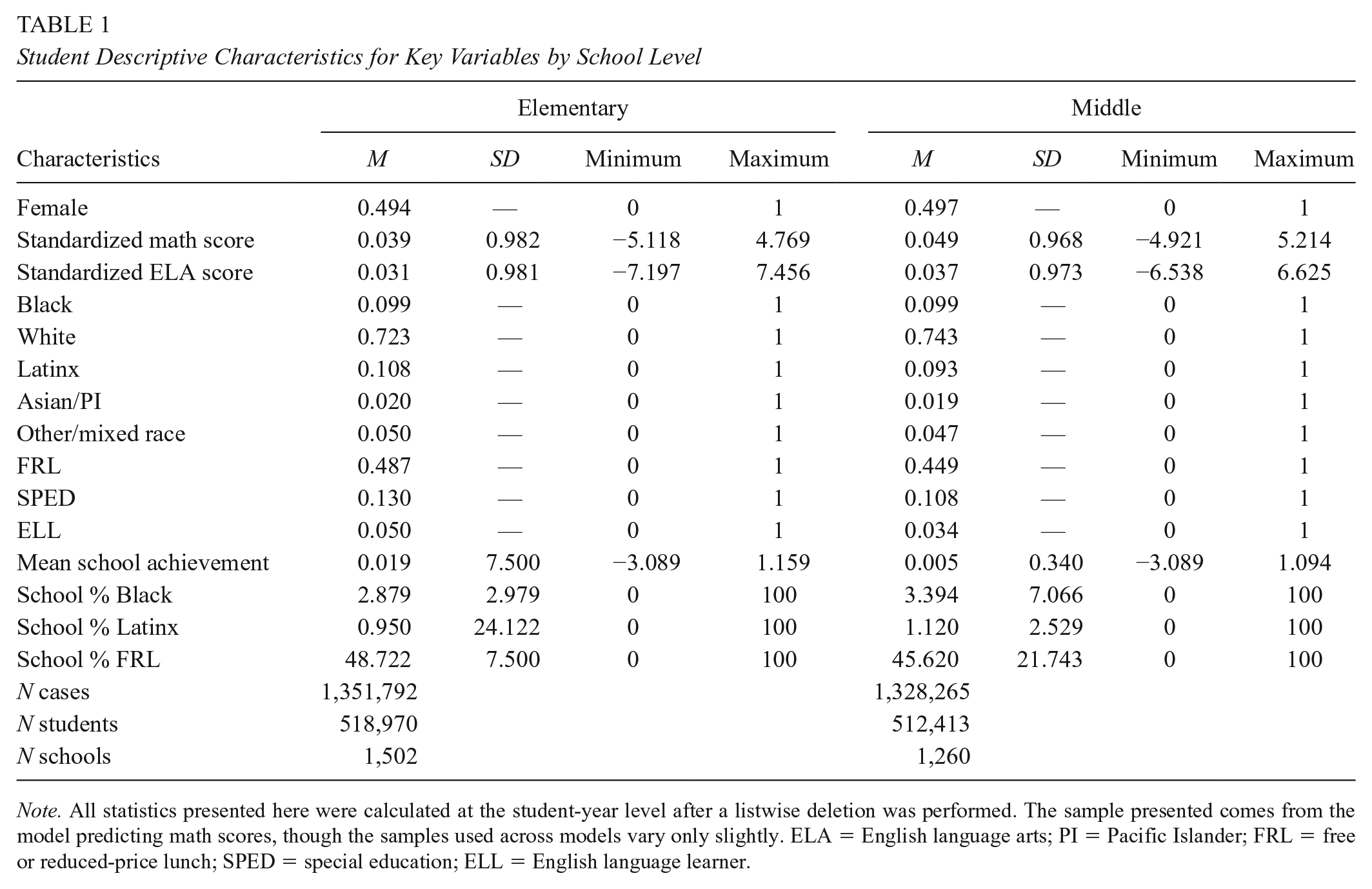
Note. All statistics presented here were calculated at the student-year level after a listwise deletion was performed. The sample presented comes from the model predicting math scores, though the samples used across models vary only slightly. ELA = English language arts; PI = Pacific Islander; FRL = free or reduced-price lunch; SPED = special education; ELL = English language learner.
Table 2 shows descriptive statistics for available teacher-level characteristics. These include teacher gender and race/ethnicity, which mirror the categories used for students. Across subjects and school levels, teachers in our data are predominantly female and White. Teachers on average have 13 years of teaching experience, and almost half of the teachers have graduate degrees.
Mean and Standard Deviations for Teacher Characteristics by School Level

Note. All statistics presented here were calculated at the teacher-year level after listwise deletion. PI = Pacific Islander; ELA = English language arts.
Like national trends, female teachers make up the majority of the teaching workforce in Indiana; the proportion of teachers who are female depends on the grade level and subject. For example, 70% among middle school math teachers are female, whereas 88% among elementary ELA teachers are female. As Figure 1 shows, the proportion of female teachers is negatively correlated with grade level. However, female students are far more likely to experience gender matching than male students even in middle school math classrooms where the proportion of male teachers is highest, since female teachers make up the majority of teachers in all relevant grades. Nevertheless, across all grades, the number of male teachers is sufficient for our modeling strategy’s reliance on students having both a male teacher and a female teacher.
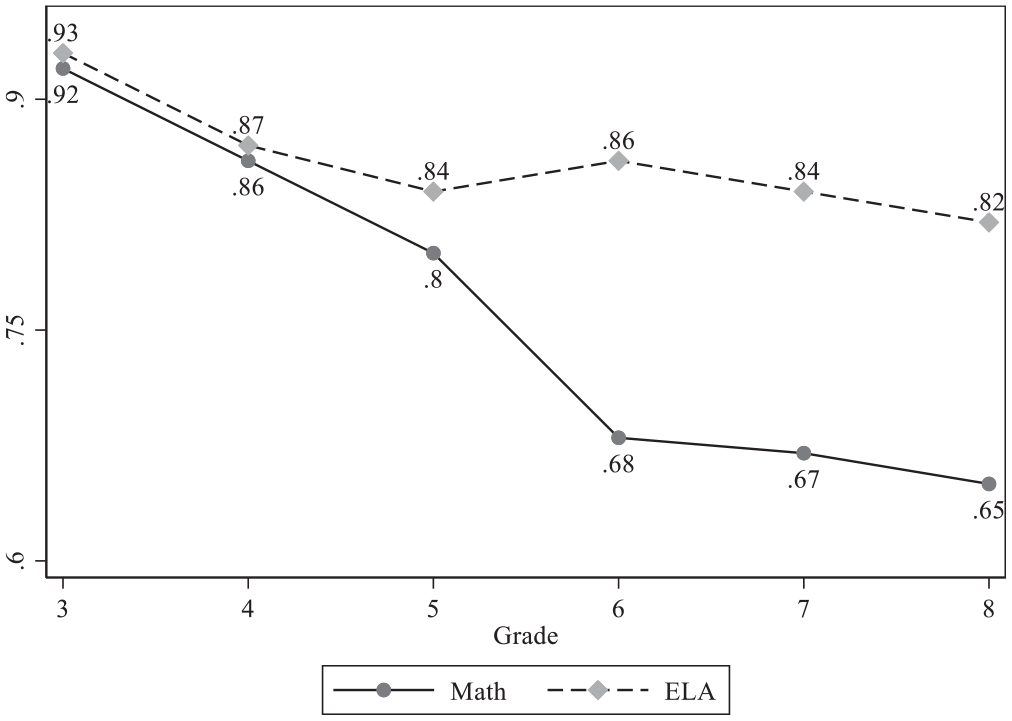
Proportion of students assigned to a female teacher by grade.
Methods
Following Winters et al. (2013), we use student fixed effects and run separate analytic models by gender to investigate the links between student–teacher gender matching and student achievement. If school administrators take both student and teacher gender into account when assigning students to teachers, comparing academic achievement between students who are assigned to teachers of the same gender and students who are not would lead to biased estimations. Our student fixed effects design, which controls for any time-invariant differences between students, deals with this potential source of bias by comparing students with themselves over time. Our models take the following equation:

where Yijgst is the academic achievement of student i, assigned to teacher j, in grade g, in school s, and school year t. Female Teacherigst indicates whether a teacher is female (female = 1, male = 0). We calculate this model separately by student gender;
Results
Main Results
We present our main findings from the regression models described in Equation 1 in Table 3. The coefficient of interest, “female teacher,” is an estimate of academic achievement differences between years when students were placed with a female teacher compared with years when they were placed with a male teacher. As a result, students who only had teachers of one gender during our study period do not contribute to the corresponding estimate.
Student Fixed Effects Regressions Estimating the Effect of Teacher Gender on Student Achievement
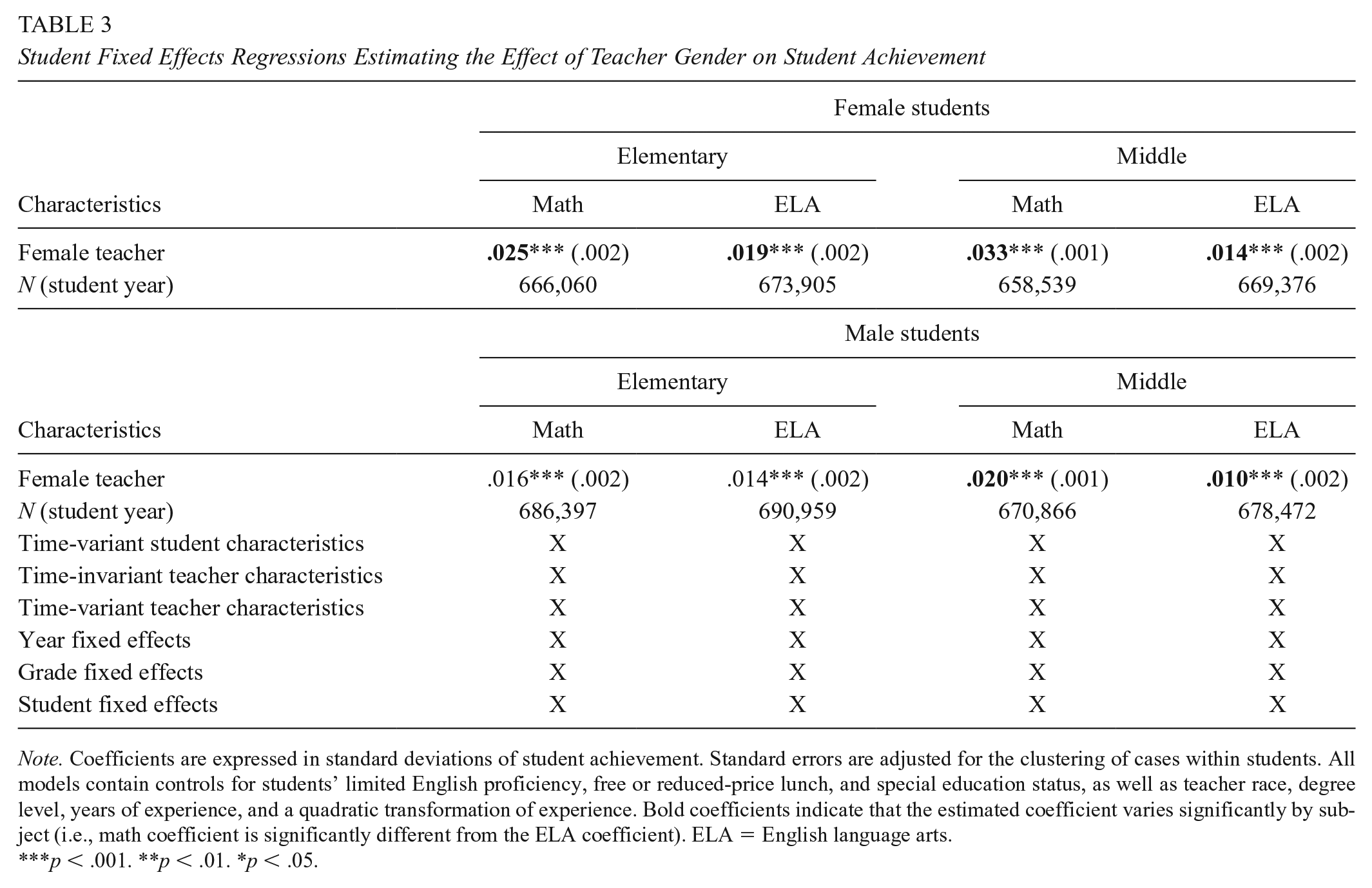
Note. Coefficients are expressed in standard deviations of student achievement. Standard errors are adjusted for the clustering of cases within students. All models contain controls for students’ limited English proficiency, free or reduced-price lunch, and special education status, as well as teacher race, degree level, years of experience, and a quadratic transformation of experience. Bold coefficients indicate that the estimated coefficient varies significantly by subject (i.e., math coefficient is significantly different from the ELA coefficient). ELA = English language arts.
p < .001. **p < .01. *p < .05.
We find that, across subjects and grade levels, students tend to learn significantly more when they are placed with a female teacher. This trend is strongest for female students learning math in middle school. However, the size of this teacher gender effect is never large, ranging from 0.010 SD to 0.033 SD. We also find small differences when comparing male and female students. The female teacher coefficient in elementary math is 0.025 SD for female students compared with 0.016 SD for male students. In middle school math, the coefficient is 0.033 SD and 0.020 SD for female and male students, respectively. Both of these differences are statistically significant. The female coefficient in ELA ranges from 0.010 to 0.019 SD, and the differences by student gender are not significant. All effect sizes discussed here fall below a 0.05 SD benchmark and are viewed as small (Kraft, 2020). 3
The estimated effect of having a female teacher is larger in math than in ELA for both female and male students in both elementary and middle school, but these differences may not be significant. To test this, we run an alternate set of models that pool data on students’ math and ELA scores. We then ran models similar to our preferred model, but that interacts with the teacher gender coefficient with a dichotomous variable indicating test score subject. This model also includes student-by-subject, grade-by-subject, and year-by-subject fixed effects. The results of this model replicate the results shown in Table 3, although the addition of a teacher gender-by-subject interaction tests whether the effect of a female teacher in math is significantly larger than the corresponding ELA coefficient. The female teacher coefficients for male students in elementary school are not significantly different; for the other three pairs of coefficients, the effects are larger for female students compared with male students.
Alternative Specifications
We ran three supplemental analyses to check the robustness of our findings. First, we reran the main models without student fixed effects but with controls for a student’s prior test score. Controlling for a lagged dependent variable is common in models of student achievement as a method of accounting for nonrandom sorting of students into classrooms (e.g., Antecol et al., 2015). While small fluctuations in the coefficients exist (i.e., no more than a 0.004 SD difference), the results are nearly identical to our main findings (Appendix Table A1).
Additionally, we reran our main models using fixed effects specifications that constrain the model to only compare students with their peers within students’ local contexts. We achieve this by specifying models with either teacher or classroom fixed effects in addition to student fixed effects. Teacher fixed effects allow us to net out unmeasured, time-invariant differences between teachers, and classroom fixed effects constrain our estimates to compare students within classroom settings. 4 These coefficients mostly align with our main findings—the gender matching effect is largest for female students in middle school math, is present in math across all settings, and there is insignificant evidence of a gender matching effect in elementary and middle school ELA (Appendix Table A2). 5
Our third alternative model specification only includes students for whom there is only one teacher on record in a given year. Because some students have multiple teachers in a given year on record, our screening method of identifying the one teacher most responsible for the students learning may provide imperfect estimations. As such, we check whether our findings are consistent with the analytic sample of only one-teacher students. Our results from the alternative sample do not change the main findings (Appendix Table A3).
Discussion
This study examines whether students exhibit higher academic achievement when they are assigned to teachers of the same gender. Although policymakers, educators, and parents are concerned about the gender imbalance of the U.S. teacher workforce, empirical evidence on the effects of student–teacher gender matching on student achievement across school levels and subjects is rare. By leveraging 7 years of data from Indiana students in Grades 3 through 8, we find that having a female teacher is associated with an increase in math and ELA achievement for both female and male students in elementary and middle schools. The benefits of having female teachers are greater for female students’ math performance but not ELA for both elementary and middle school settings, underscoring the heterogeneous effects of teacher gender on student learning by subject.
Unlike prior research that addresses concerns about potentially negative gender matching effects for very young female students (Antecol et al., 2015; Beilock et al., 2010), we find no evidence that female students gain less than their male counterparts when they are assigned to study with female teachers. When girls’ gender stereotypes start to damage their math achievement (Ambady et al., 2001; Muzzatti & Agnoli, 2007), female math teachers may protect girls from negative gender stereotypes that hinder math achievement (Marx & Roman, 2002; Paredes, 2014). Our findings suggest that female teachers may play an important role in student learning in subjects that are stereotyped as men’s fields even in elementary school level.
Our results also show that having male teachers does not improve either elementary or secondary male students’ math and ELA achievement, which resonates with findings from existing studies in U.S. (Krieg, 2005) and non-U.S. contexts (Carrington et al., 2008; de Zeeuw et al., 2015; Driessen, 2007; Neugebauer et al., 2011; Puhani, 2018; Sokal et al., 2007). Adding more male teachers to classrooms may be desirable, in part, because the presence of male teachers can send a message that men can be caring and nurturing, thereby reducing gendered stereotypes (McGrath et al., 2020; McGrath & Sinclair, 2013). Additionally, male teachers potentially play an important role in student development, particularly for those who lack positive male role models in their lives (Cushman, 2005; Pollitt & Oldfield, 2017). Nevertheless, our findings suggest that male students tend to learn less when assigned to a male teacher.
Our study advances the knowledge of the role of teacher gender in students’ learning, but it has limitations. First, our findings do not inform us about the long-term effects of teacher gender on student outcomes. Teachers can have a long-lasting effect on students (Chetty et al., 2014; Rivkin et al., 2005), but we only focus on the end of school year achievement. Future studies that focus on the longer-term effects of teacher gender on student outcomes will deepen our knowledge about teacher gender and student learning. Second, we note that more research that tests our research questions in other settings (e.g., other states) is necessary. Unlike our findings, Winters et al.’s (2013) study with Florida data show that there are no varying effects of female teachers on student achievement by student gender in elementary school. It is unclear whether the differences between the current study and the findings of Winters et al. are due to differences across states, time, or other factors. Given that the effects of teacher gender on student learning are context-dependent (Cho, 2012), additional replications would certainly be warranted.
A teacher’s gender is a frequent topic of educational research because teachers can play an essential role in students’ educational and developmental trajectories. For girls, having female math teachers is associated with improved math achievement. For boys, despite a great deal of popular discussion that young male students are better off with a male teacher, we find evidence that being assigned to male teachers likely does not enhance male students’ academic achievement. Nevertheless, the magnitude of effects presented here are on the small side. Given that teachers affect varies by context, we recommend further research on teacher gender and student learning.
Footnotes
Appendix
Main Model Re-Estimated on Students with Only One Teacher on Record

| Characteristics | Female students | |||
|---|---|---|---|---|
| Elementary |
Middle |
|||
| Math | ELA | Math | ELA | |
| Female teacher | .030*** (.002) | .018*** (.003) | .033*** (.001) | .016*** (.002) |
| N (student year) | 539,321 | 495,889 | 585,135 | 464,184 |
| Characteristics | Male students | |||
| Elementary | Middle | |||
| Math | ELA | Math | ELA | |
| Female teacher | .020*** (.002) | .011*** (.003) | .021*** (.001) | .013*** (.002) |
| N (student year) | 555,130 | 506,260 | 593,366 | 464,156 |
| Time-variant student characteristics | X | X | X | X |
| Time-invariant teacher characteristics | X | X | X | X |
| Time-variant teacher characteristics | X | X | X | X |
| Year fixed effects | X | X | X | X |
| Grade fixed effects | X | X | X | X |
| Student fixed effects | X | X | X | X |
Note. Coefficients are expressed in standard deviations of student achievement. Standard errors are adjusted for the clustering of cases within students. All models contain controls for students’ limited English proficiency, free or reduced-price lunch, and special education status, as well as teacher race, degree-level, years of experience and a quadratic transformation of experience.
p < .001. **p < .01. *p < .05.
Acknowledgements
The authors wish to express appreciation to Douglas Downey, Heidi Gansen, Sabrina Solanki, Mette Evelyn Bjerre, Mark Berends, Eric Grodsky, Amy Langenkamp, and Bill Carbonaro for their comments and suggestions. This article was supported by Notre Dame’s Center for Research on Educational Opportunity and the Institute of Educational Initiatives. We are grateful to the Indiana Department of Education for providing access to state administrative records and for supporting independent analyses. We are also grateful to Roberto Peñaloza who provided help with organizing the data. All opinions expressed in this article represent those of the authors and not necessarily of those of the institutions with which they are affiliated. All errors in this article are solely the responsibility of the authors.
1.
As a robustness check, we also run models with only a one-teacher student sample. The results are consistent with our main findings (see Appendix  ).
).
2.
We run models separately at the elementary and middle school levels to replicate the methodological approach used in . However, this approach does diminish the amount of variation in both test scores and teacher gender that students experience over time. We ran a sensitivity check that pooled elementary and middle school data and then interacted the key coefficient (teacher gender) with a dichotomous variable indicating level of schooling. The results of this model are similar to those presented here (results available on request).
3.
For conciseness, we use terms like effect sizes when we describe the size and significance of gender matching coefficients in the results. Nevertheless, we do not claim that these estimations are causal because we do not use experimental data. We note that our identification strategies are still susceptible to omitted variable biases such as teacher gender stereotypes.
4.
These advantages come at a cost, however, and the fact that teacher gender does not change over time in these data and that classrooms are matched to a single teacher in any given school year means that we cannot run models separately by gender and estimate “female teacher” coefficients. To get around this, we pool female and male students and run a model that interacts with female student and teacher coefficients. The combination of student fixed effects along with teacher or classroom fixed effects means that we cannot calculate main coefficients for either student or teacher gender, only the interaction effect. As a result, the coefficients in Appendix can be interpreted as the difference between the female teacher coefficient for female student compared with the female teacher coefficient for male students.
5.
The difference in elementary math is inconsistent across models, which suggests that we do not have robust evidence that the female teacher effect is more pronounced for female compared with male students at this level.
Authors
NAYOUNG HWANG is a postdoctoral fellow in the Truman School of Public Affairs at the University of Missouri. Her research focuses on educational policy, youth development, and sociology of education.
BRIAN FITZPATRICK is a doctoral candidate in sociology at the University of Notre Dame. His work focuses on selection into teaching, the reproduction of inequality, and quantitative methods.