



Abstract
Parents and educators commonly assume that male teachers serve as more effective disciplinarians for boys than female teachers. Do schools tend to assign male teachers to teach boys with perceived behavioral issues? Our study uses administrative data in Indiana to investigate male teacher assignment in elementary school. We find that boys with at least one suspension record in the previous year are 12% more likely to be assigned to a male teacher than boys without suspensions, whereas girls’ suspension histories do not predict assignments to male teachers. In addition, teachers who have 10% or more of students with suspension histories are 19.5% more likely to migrate to another school and 16.2% more likely to leave the state’s teacher workforce. Our study suggests that male teachers have an elevated risk of being assigned to teach male students with suspension histories, which may contribute to teacher turnover.
Around the world, men are underrepresented in the elementary school teacher workforce (McGrath & Van Bergen, 2017). 1 The United States is not an exception—only one out of 10 elementary school teachers are male (U.S. Department of Education, 2017). The lack of male teachers has raised concerns about student learning, particularly for male students (Cushman, 2005; McGrath & Sinclair, 2013; Moreau & Brownhill, 2017; Pollitt & Oldfield, 2017). Based on the assumption that male teachers likely function as role models for male students and connect with male students more effectively, there is a widespread perception that the lack of male teachers are more likely to have adverse effects on male students’ learning and development (Deese, 2017; Martino, 2008; Mills et al., 2004; Moreau & Brownhill, 2017).
Relatedly, there is a popular idea that male teachers are more effective at disciplining boys. Parents and educators call for more male teachers in the classroom, citing their belief that male teachers can serve as disciplinarians (Carrington & McPhee, 2008; Francis et al., 2008; McGrath & Sinclair, 2013). Preservice male teachers perceive that they are more likely to be expected to teach students with boys who are considered as troublemakers (Stroud et al., 2010). Black male teachers in particular encounter greater pressure to discipline boys with behavioral issues (Bristol & Mentor, 2018; Brockenbrough, 2012, 2015). Given that student discipline is associated with a reduction in teachers’ job satisfaction and lower teacher retention rates (Hughes, 2012; Ingersoll, 2001; Ingersoll & Smith, 2003), the burden of teaching boys with challenging behaviors may contribute to teacher turnover.
In this study, we document the links between students with disciplinary records and male teacher assignments in Indiana’s elementary schools. 2 Qualitative studies based on interview data demonstrate that female teachers believe that male teachers have advantages of disciplining students (Carrington & McPhee, 2008), and male teachers are expected to take a more active role in disciplining boys with behavioral issues (Bristol & Mentor, 2018; Brockenbrough, 2012, 2015). 3 However, whether boys with behavioral challenges are systematically assigned to male teachers remains an open question. We thus use statewide administrative data from elementary school students and their teachers between 2010–2011 and 2016–2017 academic years to quantitatively assess whether schools disproportionately assign male teachers to boys with suspension histories. 4 Given that dealing with student disciplinary issues predicts teacher turnover (Ingersoll, 2001; Kersaint et al., 2007), we further test whether being assigned to teach students with suspension histories predicts teacher turnover. We ask the following research questions:
Our results show that male students with suspension histories are more likely to be assigned to male teachers in the subsequent year, whereas female students with suspension histories are not associated with male teacher assignment. In addition, we find that teachers who teach classes where 10% or more of the students have suspension records exhibit a 19.5% higher probability of migrating to another school and a 16.2% higher probability of leaving the state’s teacher workforce.
One limitation of our study is that we do not investigate male teacher assignment by race/ethnicity because of insufficient sample size of male teachers across racial/ethnic groups. This is especially relevant because race/ethnicity can play a critical role in school disciplinary decisions (Barrett et al., 2019; Owens & McLanahan, 2020). 5 Nevertheless, our study advances our knowledge of male teacher assignment in elementary school by focusing on gender, in light of the fact that the concerns about the shortage of male elementary school teachers is not limited to a certain race/ethnicity (Cushman, 2007; Snyder, 2008). To our knowledge, we first quantitively document elementary school male teacher assignments and the links between students with suspension and teacher turnover, which offers useful insight into male teachers’ working environments and teacher attrition.
Male Teachers as Disciplinarians
Parents and educators often believe that male teachers serve as more effective disciplinarian than their female counterparts, especially for boys (Coulter & Greig, 2008; Mills et al., 2004). This common notion that male teachers have the upper hand when disciplining boys is based on a couple of underlying assumptions. First, it is frequently assumed that male teachers are better able to connect with boys and meet the boys’ developmental needs (Carrington & McPhee, 2008; McGrath & Sinclair, 2013; Mills et al., 2004). For example, one parent says that “. . . [boys] can talk to the male teachers because maybe they (male teachers) have been through the same thing” (McGrath & Sinclair, 2013, p. 541). A teacher mentions that “. . . very often the male teachers are interested in things that the male pupils are interested in” (Carrington & McPhee, 2008, p. 114). Second, there is a common assumption that male teachers are more natural positive role models for male students and male students derive a special benefit from placement with a male teacher (Deese, 2017; Martino, 2008; Moreau & Brownhill, 2017). For instance, a mother states that “. . . if my child was male, a male teacher as a ‘role-model’ would matter more. I also think that as there are many male students who don’t have male influence having a male teacher is beneficial” (McGrath & Sinclair, 2013; p. 538). Similarly, another teacher mentions that “There’re a lot of them [boys] that don’t have father figures, apart from at school. And just having a male person, it just helps calm the children down” (Carrington & McPhee, 2008, p. 114).
A few social theories are in line with these assumptions. Gender schema theory posits that children regulate their behavior depending on their own gender as they develop the concepts about femininity and masculinity (Bem, 1981). From a very early age, children consistently search for gender cues to make sense of society around them (Gansen & Martin, 2018; Martin & Ruble, 2004). Despite the lack of clear evidence, same-gender parents (i.e., mothers for girls and fathers for boys) are often assumed to play a more critical role in child development (see Downey & Powell, 1993 for further discussion). Social learning theory also suggests that children learn how to behave by observing and imitating people who shared the same gender around them, underscoring the importance of same-gender adults in student development (Gold & Reis, 1982). Like home environments, same-gender adults at schools (i.e., teachers) possibly play a heightened role in student development. According to identity-based motivation theory, students tend to exhibit higher motivation levels when students perceive that their identity (e.g., gender or race/ethnicity) is aligned with teachers, which can lead to positive student outcomes (Oyserman & Destin, 2010).
Although both assumptions and theories predict that boys benefit from having male teachers, empirical evidence shows that teacher gender has little impact on male elementary school students (Carrington et al., 2008; Krieg, 2005). For example, Sokal et al. (2007) use data from Canadian third and fourth graders and show that studying with male teachers does not increase boy’s reading test scores. Puhani (2018) uses data from German elementary students and finds that teacher gender has hardly any impact on school tracking decisions and grade retention. Consistent with findings from Sokal et al. (2007) and Puhani (2018), Krieg (2005) who uses data from U.S. elementary school students also shows that male teachers are not associated with higher achievement for male students. There is a lack of evidence that male teachers are better at educating students and whether male teachers’ effectiveness varies by student gender (Neugebauer et al., 2011; Puhani, 2018), but educators and parents continue to view male teachers as vital to young male students’ development (Cushman, 2008; McGrath & Sinclair, 2013; Moreau & Brownhill, 2017; Pollitt & Oldfield, 2017). 6
Moreover, the assumption that male teachers are in a better position than their female counterparts in promoting boys’ positive development may result in unintended consequences. Because student misbehavior is a main source of teacher stress and burnout (Abel & Sewell, 1999; Bottiani et al., 2019), pushing male teachers toward the role of disciplinarian can create difficult working environments for male teachers (Bristol & Mentor, 2018; Brockenbrough, 2015). An ethnographic study shows that male teachers’ classrooms are often interrupted because school staff send students with behavioral challenges to male teachers (Bristol & Mentor, 2018). Pushed to correct student misbehavior, male teachers come to see their main role to be not teaching but disciplining boys with behavioral challenges (Bristol & Mentor, 2018; Brockenbrough, 2015). Another qualitative study shows that male teachers are asked to be strict and firm disciplinarians (Brockenbrough, 2012). Although the majority of these studies focus on Black male teachers in U.S. schools, their findings are in line with studies that show the challenges and struggles that elementary school male teachers face in their workplaces in U.S. and non-U.S. context (Carrington & McPhee, 2008; Stroud et al., 2010).
Student Discipline and Teacher Turnover
A growing number of scholars examines the causes of teacher turnover and reveal that one driver of teacher turnover is student discipline (Borman & Dowling, 2008; Brill & McCartney, 2008; Hughes, 2012; Ingersoll, 2001). For example, a nationally representative data set, Schools and Staffing Survey (SASS) and Teacher Follow-up Survey (TFS), shows teachers tend to list student discipline as a major reason for job dissatisfaction, which is associated with teacher attrition (Ingersoll, 2001). Similarly, a study that uses data from teachers in Florida shows that student discipline problems are linked with teacher attrition (Kersaint et al., 2007).
An increase in the number of students with challenging behavior can lead to higher teacher turnover for two main reasons. First, student misbehavior increases teachers’ stress and lowers teachers’ job satisfaction (Abel & Sewell, 1999; Bottiani et al., 2019). Teachers often feel frustrated because of student discipline issues, especially when schools do not help teachers guide students with behavioral challenges (Marinell & Coca, 2013). Student behavior plays a critical role in teachers’ work conditions (Johnson & Birkeland, 2003; Loeb et al., 2005), which is an important predictor of teacher turnover (Borman & Dowling, 2008; Loeb et al., 2005). Thus, being assigned to teach more students with suspension histories may contribute to teacher migration or teacher attrition.
Second, student misbehavior lowers teacher efficacy because disruptive behavior hinders teacher effectiveness (Hughes, 2012). When teachers teach students with behavioral problems, they likely spend more time disciplining students instead of teaching content (Boyd, 2012). As a result, teachers who are assigned to teach students with behavioral issues might evaluate themselves as ineffective teachers, thereby potentially motivating teachers to leave their teaching positions.
Current Study
Our study contributes to the literature on teacher assignment and teacher turnover in the following ways. Existing work sheds light on working conditions for male teachers by showing how fellow teachers have different expectations for male teachers (Bristol & Mentor, 2018; Brockenbrough, 2015). Nevertheless, because these studies focus on very small numbers of Black male teachers (i.e., less than 30), little is known whether schools create more challenging working environments for male teachers in general by assigning male teachers to boys with suspension records. We use administrative data from elementary school students and teachers in Indiana to identify whether boys with disciplinary histories are more likely to be assigned to male teachers. Our aim is to test whether the popular assumption that male teachers are more effective disciplinarians for boys reflect male teacher assignment.
Furthermore, we provide useful information on the impact of sorting trends by examining whether teachers who teach a higher number of students with disciplinary records are more likely to exit their schools or the state’s teacher workforce. Studies show that student discipline issues are one of the major contributing factors of teacher turnover (Borman & Dowling, 2008; Brill & McCartney, 2008; Hughes, 2012; Ingersoll, 2001), and schools with discipline and safety problems are linked to high teacher turnover (Kraft et al., 2016). However, little is known about whether and the extent to which being assigned to teach students with disciplinary histories is associated with teacher turnover. By revealing the link between students’ school disciplinary histories and teacher migration and attrition, this study offers insight about the roles that teacher assignment plays in teacher turnover.
Data and Method
To uncover whether there is a link between suspended students, male teacher assignment, and teacher turnover, we use administrative data from the Indiana Department of Education, which includes information on schools, teachers, and students. Our analyses include longitudinal data on elementary schools from the 2010–2011 to 2016–2017 academic years and includes all public schools as well as most private schools. We focus on elementary school because teacher assignment in elementary school is dependent on administrators’ decisions and is not constrained by the distribution of teachers across subjects. In addition, because the majority of elementary school students study in a self-contained classroom with one main teacher, we are able to easily link students to a single teachers. 7 On average, 9% of elementary teachers are male in Indiana, which is very close to the national average (U.S. Department of Education, 2017), and 7% of Indiana’s elementary schools have no male teachers. Nearly one third of Indiana’s elementary school (defined as students in kindergarten through fifth grade) student population are students of color. Across all schools, 11% of students are Black, 70% are White, 12% are Latinx, 2% are Asian, and 5% do not identify as any of the categories listed here. Over half of students are eligible for free or reduced-price lunch (FRPL; 53%), 15% are enrolled in special education (SPED), and 7% are English language learners (ELLs).
The data are initially structured as a student-level longitudinal data set, as all relevant variables are collected annually. Student-year cases are clustered within students who are clustered within teachers and schools. All of these strata are crossed, as both students and teachers can and do move between schools over time. To examine the associations between student characteristics and male teacher assignment (Research Question 1), we use student-year level data. To examine the associations between students with suspension histories and teacher turnover (Research Question 2), we use teacher-year level data with all student-level information aggregated for teachers each year.
For the first set of models, we use a subset of Indiana’s student population. The model requires information from the previous year, so all cases representing the first year a student exists in the data are removed from the analytic sample. As a result, most kindergarten students are not included in the analysis, with the exception of the 5% of students in kindergarten for the second time. Also, because the goal of our analysis is to identify predictors of placement with a male elementary teacher when there is a choice between male and female teachers, we restrict the data to students in school and grade settings where at least one male and one female elementary teacher is employed. Finally, missing data are rare but do exist. Given the size of the data and the uncommon nature of missing data, we employ listwise deletion, removing 4.2% of cases. The resulting analytic sample includes 875,668 student-year cases with data on 537,181 students, 18,044 teachers, and 1,202 schools. 8
Key variables in the first set of models are teacher gender, student gender, and a dichotomous indicator of whether a student received a suspension in the prior year. 9 On average, 3.6% of students are suspended in any given year. Even students in early grades receive suspensions and the suspension rates increase as students age: 2.0% of kindergarteners receiving at least one suspension compared with 6.1% of fifth graders. Male students are far more likely to be suspended (7.3% vs. 2.2% of female students). This annual rate adds up over time: 18.7% of male students are suspended at least once during their time in elementary school (i.e., kindergarten through fifth grade).
We employ suspension incidents as a rough proxy of whether a student is perceived to have behavioral problems in the previous year. Given that teacher biases and perceptions can play a role in disciplinary actions (e.g., Barrett et al., 2019; Owens & McLanahan, 2020), suspensions do not directly measure student behavior. However, disciplinary records are indicators that capture the school staff’s perception of a student’s misbehavior. 10
Because student characteristics may affect both perceived behavioral problems and assignment to a male teacher (Bristol & Mentor, 2018; Brockenbrough, 2012, 2015; Chin et al., 2020; Gregory et al., 2010), we include a number of control variable in our analysis. Our control variables include student race/ethnicity, SPED enrollment status, whether students are ELLs, and whether students are eligible for FRPL, which prevents such background characteristics from confounding our main estimates. We use a linear probability model to identify the link between student characteristics and assignment to a male teacher:

where placement with a male teacher (
In the second set of models, we identify whether the within-school sorting of students to teachers is related to teacher turnover. Student-level data are aggregated to the teacher level in a given year. The two dependent variables used in our analysis are dichotomous variables for teacher migration (i.e., whether a teacher leaves their school at the end of the year but remains an educator in the state), or teacher attrition (i.e., whether they exit Indiana’s teacher workforce). To compare teachers who attrite with those who remain, we exclude teachers who change schools in the analysis of who leaves Indiana’s teaching field and vice versa. For context, 7.5% of teachers leave their school for another by the end of each year and 3.6% exit Indiana’s teacher workforce. Because information on the next year is required to identify whether teacher turnover takes place, the final year of data collection cannot be included in this analysis. The teacher-level data overall includes 120,832 cases on 32,424 teachers from the 2010–2011 to 2016–2017 academic years.
The key independent variable in our second set of models is the percentage of a teacher’s students who received at least one suspension in the previous year. Our exploratory analysis reveals that the links between the percentage of students with disciplinary histories and teacher attrition are nonlinearities. 11 We find that teaching 10% or more of students with suspension histories are significantly associated with teacher migration or attrition to Indiana’s teacher workforce. We thus converted this continuous variable into a categorical variable that grouped teachers with no students with disciplinary histories (66.5% of teachers), teachers for whom 1% to 10% of students received a previous suspension (24.0% of teachers), and teachers where that number is greater than 10% (9.6% of teachers).
We again rely on a linear probability model to predict teacher turnover:

where teacher turnover (
The above equations describe our final and preferred models, as they include all relevant control variables. Models with school fixed effects account for nonrandom sorting of teachers across schools, given that school fixed effects control for all time-invariant differences between schools. Including school fixed effects is important because school characteristics are associated with rates of exclusionary discipline as well as teacher turnover (Kraft et al., 2016; Sullivan et al., 2013). School fixed effects allow us to identify whether teachers within a school that are assigned more students with previous behavioral issues are more likely to leave their school compared with teachers in the same school.
Results
Suspended Boys and Male Teacher Assignment
Table 1 shows the raw differences in the average characteristics of students assigned to male and female teachers. These descriptive statistics are based on the student-year data used in the first set of models. There are very few differences between the students taught by men and women, with one exception: 4.4% of students placed with male teachers were suspended in the previous year, compared with 3.6% of students placed with female teachers. This difference indicates that students placed with male teachers are 22.2% more likely to have been suspended in the previous year than those placed with female teachers.
Descriptive Statistics for Student and Teacher Characteristics by Teacher Gender

Note. Mean values are presented in each cell with standard deviations in parentheses when appropriate. All student-level variables, except race and gender, are lagged—they represent student characteristics from the previous year. Cases span the 2010–2011 to the 2016–2017 academic years and include students in first through fifth grade. FRPL = free or reduced-price lunch; SPED = special education; ELL = English language learner.
To answer our first research question, we examine the link between students’ disciplinary histories and male teacher assignment in the subsequent year. Table 2 displays a series of linear probability models predicting placement with a male teacher. Models 1 and 2 indicates that, net of differences across years, grades, and schools, male students are 1.2 percentage points more likely to be assigned to a male teacher than their female peers. This is the case regardless of the inclusion of school fixed effects. This result, consistent across models, shows that male students are more likely to be placed with male teachers. Model 3 in Table 2 shows that this relation is robust to the inclusion of controls, and that a disciplinary history also predicts placement with a male teacher. Model 4 reveals that male students tend to be placed with male teachers at a disproportionate rate within schools, particularly for male students who received a prior suspension. For female students, suspension history is not associated with placement with a male teacher.
Linear Probability Models Predicting Placement With a Male Teacher

Note. All variables, except race and gender, are lagged—they represent student characteristics from the previous academic year. Coefficients indicate the change in probability of placement with a male associated with a one-unit change for a given variable. Cases span the 2010–2011 to the 2016–2017 academic years and include students in first through fifth grade. Year and grade fixed effects are included in the model but excluded from the table. Standard errors are in parentheses. FRPL = free or reduced-price lunch; SPED = special education; ELL = English language learner.
p < .05. **p < .01. ***p < .001.
Figure 1 visualizes Model 4 and displays the predicted probability of placement with a male teacher by student gender and suspension history. Suspended boys in the previous year have a significantly higher chance of placement with male teachers than any other groups (i.e., boys without suspensions, girls with suspensions, and girls without suspensions). More specifically, boys with at least one suspension record are 12.0% more likely to be placed with a male teacher than boys with no prior suspension and 16.2% more likely when compared to girls without a prior suspension. By contrast, girls with at least one suspension record are not significantly more likely to be placed with a male teacher than girls without a previous suspension.

Predicted probability of placement with a male teacher by student gender and previous-year suspension.
Student Discipline and Teacher Turnover
We present the results of the second set of models, where we test whether assignment to teach students with suspension histories is related to teacher turnover, in Tables 3 and 4. In Table 3, the dependent variable is whether teachers leave their schools at the end of the year, without including teachers who exit Indiana’s teacher workforce. Models 1 and 2 in Table 3 show that male teachers are more likely to leave their school at the end of the year with and without teacher-level controls. Model 1 reveals that the migration rate for male teachers is 27.7% higher (i.e., 2.6 percentage point) than among female teachers. In Model 2, we control for other teacher characteristics and still find that male teachers tend to move to another school at higher rates than their female counterparts.
Teacher-Level LPMs Predicting Teacher Migration

Note. Coefficients indicate the change in probability of a teacher transferring within the state at the end of the year. Cases span the 2010–2011 to the 2016–2017 academic years and includes students in first through fifth grade. Year and grade fixed effects are included in the model but excluded from the table. LPM = linear probability model.
p < .05. **p < .01. ***p < .001.
Teacher-Level LPMs Predicting Teachers Exiting Indiana Teacher Workforce

Note. Coefficients indicate the change in probability of exiting the state’s teacher workforce at the end of the year. Cases span the 2010–2011 to the 2016–2017 academic years and include students in first through fifth grade. Year and grade fixed effects are included in the model but excluded from the table. Standard errors are in parentheses. LPM = linear probability model.
p < .05. **p < .01. ***p < .001.
Model 3 in Table 3, our preferred model, reveals that being assigned students with previous suspensions predicts teacher migration. The results of Model 3 are visualized in Figure 2. Here, we see that teachers with more than 10% of students who received a suspension during the previous year are more likely to move to another school. Specifically, teachers with more than 10% of students with disciplinary records have an 11.3% chance of migration, compared with a 9.5% chance among teachers with no suspended students. That is, teachers assigned a high number of suspended students are 1.8 percentage points more likely to leave for another school than their fellow teachers, which equates to a 19.5% increased chance of leaving.
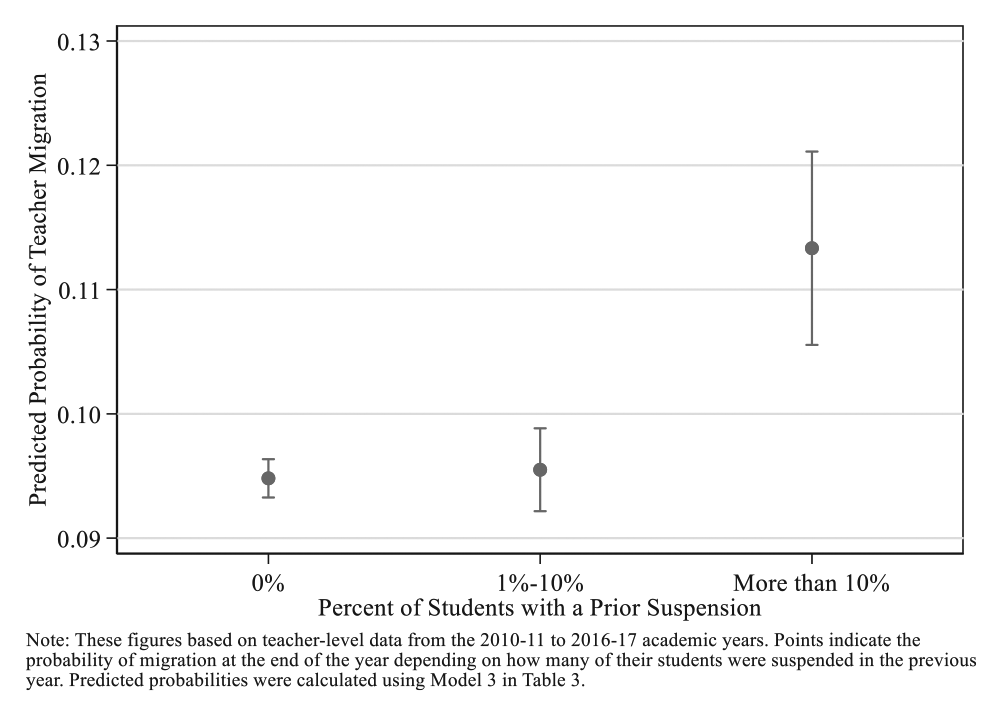
Predicted probability of teacher migration by percentage of students with a previous-year suspension.
We perform a similar analysis that predicts teacher attrition from the Indiana teacher workforce. Model 1 in Table 4 reveals that, unlike teacher migration, there is no significant association between teacher gender and attrition, and Model 2 shows that this trend holds when teacher-level controls are included in the model. However, the results pertaining to the link between student discipline and teacher movement mirror those presented above. Being assigned students with a suspension history is associated with teacher attrition, but only for teachers with a greater than 10% of students with previous suspensions. Model 3, our preferred model, shows that teachers for whom more than 10% of their students received a suspension in the previous year are 0.8 percentage points, or 16.2%, more likely to leave Indiana’s teacher workforce. This rate represents an increase from a 4.7% to a 5.5% rate of teacher attrition. Figure 3 illustrates the associations between student discipline and teacher attrition based on the result from Model 3.
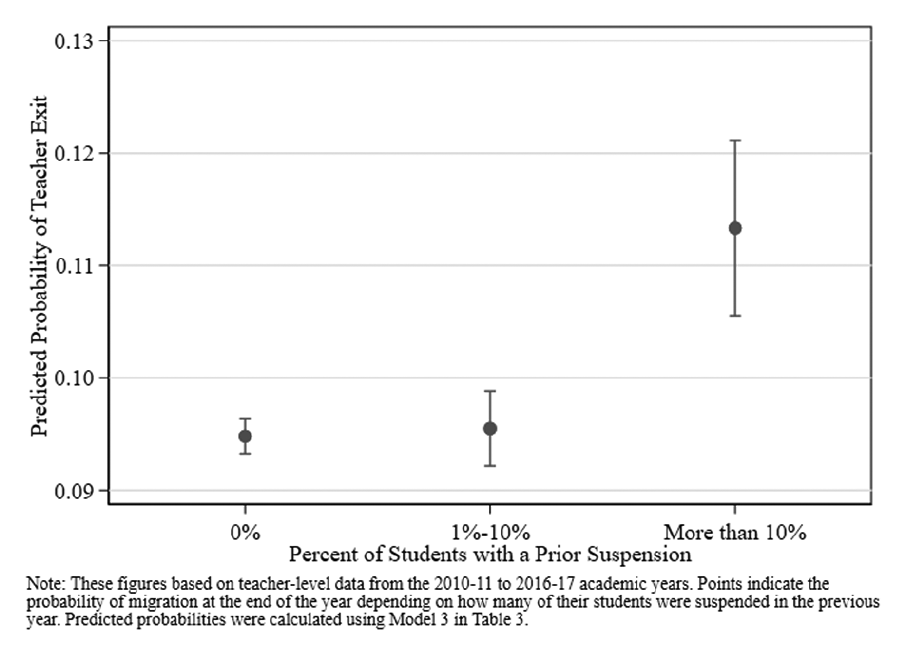
Predicted probability of teacher exit by percentage of students with a previous-year suspension
Discussion
We use data from elementary school students and teachers in Indiana and find that male students with disciplinary records exhibit higher likelihood of being assigned to male teachers in the subsequent year. For female students, however, disciplinary records are not associated with male teacher assignment. By examining the patterns of male teacher assignment, we find that male teachers exhibit an elevated risk of teaching boys with suspension histories. Our results suggest that expectations around discipline by teacher gender (i.e., male teachers are more effective at disciplining male students than their female counterparts) may influence the ratio of previously suspended boys assigned to male teachers.
Our analyses further show that teachers’ probability of migration and attrition is higher when teachers are assigned to a higher proportion of students with disciplinary histories, resonating prior studies that show that student discipline is one of major factors that are linked to teacher turnover (Brill & McCartney, 2008; Ingersoll, 2001). We extend research on teacher turnover by providing evidence that the links between suspended students and teacher turnover can trickle down to a within-school process. Being assigned to teach students with perceived challenging behavior might cause teacher turnover by lowering teacher job satisfaction and teacher efficacy (Hughes, 2012; Ingersoll, 2001).
Additionally, our investigation provides insights into how different societal expectations by gender may influence teacher assignment and the male teacher shortage. Men who aspire to be a teacher of young students face many barriers as a result of gendered expectations (Stroud et al., 2000). For example, a career in elementary education is often considered undesirable for men but not for women (Cushman, 2005; Pollitt & Oldfield, 2017, Weaver-Hightower, 2011). Our results suggest that differential expectations by gender continue even after entering teaching occupation as we show schools push male teachers to teach boys with suspension histories.
Increasing the number of male teachers could be desirable from teacher diversity perspective. Schools are institutions where children develop and negotiate their gender identities (Francis & Skelton, 2001), the presence of male teachers thus can mitigate gendered stereotypes by providing environments where students see men can be caring and nurturing (McGrath et al., 2019). However, pushing male teachers into disciplinarian roles may counteract this benefit and might even bolster gendered stereotypes for young students.
This study furthers scholarly understanding about male teacher assignment and teacher turnover, but it has limitations. First, although we include important control variables in our models, the findings are descriptive rather than causal. Research designs that effectively isolate casual estimations from other confounding variables will further advance our understanding about interplay between students with suspension histories, male teacher assignment, and teacher turnover. Second, although male teacher assignment patterns may vary across different racial/ethnic groups, our data do not allow us to delve into race/ethnicity. Future research that examines whether male teachers of color face an even greater probability of being assigned to suspended boys will thus further provide insights into how gender and race/ethnicity play in administrators’ decision that may eventually affect teacher turnover.
Despite the limitations of this study, our study contributes to the literature on teacher assignment and teacher turnover. Consistent with a common assumption that men are more effective disciplinarians than women, male teachers are assigned to guide boys with suspension histories. Pushing male teachers to discipline boys with suspension histories, however, can create a more challenging working environment. Different expectations by teacher gender around school discipline may eventually influence teacher migration and attrition. School administrators and policymakers should consider the costs of assigning boys with suspension histories to male teachers.
Footnotes
Appendix
Teacher-Level LPMs Predicting Migration and Exit

| Variable | Migration | Exit | ||
|---|---|---|---|---|
| Model 1 | Model 2 | Model 3 | Model 4 | |
| Male teacher | 0.020*** (0.004) | 0.020*** (0.004) | 0.001 (0.003) | 0.001 (0.003) |
| Years of experience | −0.009*** (0.001) | −0.009*** (0.001) | −0.007*** (0.000) | −0.007*** (0.000) |
| Teacher race | ||||
| Black (ref. White) | −0.011 (0.008) | −0.011 (0.008) | −0.001 (0.007) | −0.001 (0.007) |
| Latinx | 0.025* (0.010) | 0.025* (0.010) | −0.001 (0.008) | −0.001 (0.008) |
| Asian/Pacific Islander | 0.003 (0.027) | 0.002 (0.027) | 0.059* (0.026) | 0.058* (0.026) |
| Other race | 0.025 (0.015) | 0.025 (0.015) | −0.016 (0.011) | −0.016 (0.011) |
| Graduate degree | 0.016*** (0.002) | 0.016*** (0.002) | −0.003 (0.002) | −0.003 (0.002) |
| Class size (10s) | −0.007*** (0.001) | −0.007*** (0.001) | −0.001 (0.001) | −0.001 (0.001) |
| Percentage of students previously suspended | ||||
| 1% to 10% (ref. 0%) | 0.001 (0.002) | 0.000 (0.002) | ||
| More than 10% | 0.019*** (0.004) | 0.008** (0.003) | ||
| Log of % suspended | 0.004*** (0.001) | 0.002* (0.001) | ||
| School-level coefficients | × | × | × | × |
| Year fixed effects | × | × | × | × |
| Grade fixed effects | × | × | × | × |
| School fixed effects | × | × | × | × |
| Constant | 0.146*** (0.025) | 0.146*** (0.025) | 0.095*** (0.013) | 0.095*** (0.013) |
| Number of: teacher-year cases | 107,368 | 107,368 | 101,859 | 101,859 |
| Adjusted R2 | .085 | .085 | .039 | .039 |
Note. Coefficients indicate the change in probability of transferring within Indiana or exiting the state’s teacher workforce. Year and grade fixed effects are included in the model but excluded from the table. Cases span the 2010–2011 to the 2016–2017 academic years and include students in first through fifth grade. Standard errors are in parentheses. LPM = linear probability model.
p < .05. **p < .01. ***p < .001.
Acknowledgements
We express our appreciation to Mark Berends, Simone Ispa Landa, and Roberto Peñaloza for the support for the project. We are grateful to the Indiana Department of Education and Oregon Department of Education for providing access to state administrative records and for supporting independent analyses. This article was supported by Notre Dame’s Center for Research on Educational Opportunity (CREO) and the Institute of Educational Initiatives. All opinions expressed in this article represent those of the authors and not necessarily the institutions with which they are affiliated. All errors in this article are solely the responsibility of the authors. The analysis files for this article can be found at  .
.
Notes
Authors
NAYOUNG HWANG is a postdoctoral fellow in Truman School of Public Affairs at the University of Missouri. Her research focuses on educational policy, youth development, and sociology of education.
BRIAN FITZPATRICK is a post-doctoral researcher at the Center for Research in Educational Policy at the University of Memphis. His work focuses on selection into teaching, the reproduction of inequality, and quantitative methods.