




Abstract
The role of two leadership factors (autonomy-supportive and autonomy-thwarting leadership) and one personal resource (workplace buoyancy) were examined as predictors of three teacher outcomes: somatic burden, stress related to change, and emotional exhaustion. Data were collected from 325 Australian teachers in May, 2020 during the first wave of COVID-19. During this time, many Australian children were being taught remotely from home, while other students were attending schools in-person. Findings showed that autonomy-supportive leadership was associated with greater buoyancy and, in turn, lower somatic burden, stress related to change, and emotional exhaustion (while controlling for covariates, including COVID-19 work situation). Autonomy-thwarting leadership was positively associated with emotional exhaustion. In addition, autonomy-supportive leadership was indirectly associated with the outcomes. The findings provide understanding of factors that may be harnessed to support teachers during subsequent waves of COVID-19 and other future disruptions to schooling that may occur.
Introduction
Across the globe, the COVID-19 pandemic has wrought substantial challenges on individuals and societies. As part of this, teachers have faced significant stressors in relation to their work. The pandemic required a very sudden shift to remote learning, and teachers were called upon to support students’ academic development and well-being throughout this shift, while also navigating adversity and stress in their own lives. In many countries, students have returned to classrooms and teachers have been called upon to make this return as smooth as possible. Given prior research on the negative impact of major societal disruptions on teachers’ well-being (Malinen et al., 2019), the potential for teachers to experience maladaptive outcomes during COVID-19 is heightened. However, such widespread disruption has not occurred in living memory, highlighting the need for research to examine teachers’ experiences during COVID-19. In addition, given the potential for subsequent waves of COVID-19 over the next few months and years—and indeed, different disruptions in the future—it is important to ascertain whether there are factors positively associated with teachers’ outcomes in these challenging times.
The broad purpose of the current study was to provide knowledge about teachers’ work-related experiences during COVID-19. Using job demands–resources theory (Bakker & Demerouti, 2017), this study sought to ascertain the unique roles of two leadership factors (autonomy-supportive and autonomy-thwarting leadership) and one personal resource (workplace buoyancy) as predictors of three teacher outcomes during COVID-19: somatic burden (i.e., experience of common physical symptoms), stress related to change, and emotional exhaustion. Figure 1 displays the model under examination. Autonomy-supportive leadership refers to practices that promote individuals’ self-initiation and empowerment (Ryan & Deci, 2017), whereas autonomy-thwarting leadership refers to practices that exert external control and reduce individuals’ self-determination (Ryan & Deci, 2017). As a personal resource, workplace buoyancy is the capacity to effectively navigate experiences of adversity and challenge that occur at work (Martin & Marsh, 2008)—a highly relevant capacity during the work-related challenges wrought by COVID-19. To the extent that the two leadership factors and workplace buoyancy are associated with lower levels of the outcomes among teachers, these factors may then form a focus for efforts to support teachers during subsequent waves of COVID-19 or other disruptions to schooling that may arise in the future.

Hypothesized model.
COVID-19 and Schooling in Australia
By and large, Australia was very fortunate during the first wave of COVID-19, with relatively low cases and deaths due to the pandemic. Data for the present study were collected between May 13 and May 25, 2020, when Australian states and territories were in various stages of lockdown that saw many students being schooled remotely from home. As of May 25, 2020, Australia had recorded 7,109 total cases of COVID-19, the average daily increase was 12 cases over the 2-week data collection period, and there was on average less than one death per day during the data collection period (World Health Organization [WHO], 2020). 1 By comparison, the United Sstates had recorded 1,618,757 total cases of COVID-19 with an average daily increase of 22,823 cases and 1,329 deaths per day over the same 2-week period (WHO, 2020). The United Kingdom had recorded 244,612 cases during that same time with an average daily increase of 2,607 and 337 deaths per day (WHO, 2020). Looking at cases per 1 million people (as of May 25, 2020), the Australian rate was 278 cases, compared with 4,890 cases for the United States and 3,594 cases for the United Kingdom. All in all, these statistics indicate that the medical impact of COVID-19 in Australia was milder than in other countries in the first half of 2020. However, strict lockdown procedures were nonetheless rolled out in many of the country’s states and territories, which resulted in school closures and remote learning situations for substantial numbers of students and teachers. Indeed, during the data collection period, Australia’s eight states and territories were in various stages of relaxing restrictions for schooling postlockdown (while other lockdown restrictions remained in place; e.g., restaurants were closed, social gatherings were banned or allowed in reduced numbers). In the online Supplementary Materials, examples are provided about the schooling situation in government schools across Australia. Catholic and independent schools (the other two major educational systems in Australia) had their own schedules and rules for returning to school.
Given the varied schooling situations that were occurring across Australia during the data collection period (see online Supplementary Materials for details), teachers were asked to report on whether they were teaching remotely due to COVID-19, teaching half remotely (and half in-person at school) due to COVID-19 (e.g., teaching children of essential workers in-person, while others were being taught remotely), teaching in-person as usual (i.e., as per their pre-COVID-19 situation), or teaching remotely as usual (for schools in remote locations). Taken together, teachers were engaged in a range of working situations, while also navigating broader concerns related to COVID-19.
Conceptual Framework
Job demands–resources (JD-R) theory (Bakker & Demerouti, 2017) explicates the roles of job demands, job resources, and personal resources in predicting employees’ functioning at work. Job resources and demands can take many forms, including physical, social, psychological, or organizational factors (e.g., leadership practices; Collie et al., 2016). In the current study, autonomy-supportive leadership was positioned as a job resource, whereas autonomy-thwarting leadership was positioned as a job demand. According to JD-R theory, job resources lead to positive outcomes, whereas job demands lead to negative outcomes (Bakker & Demerouti, 2017). In addition, JD-R theory posits two interaction processes (Bakker & Demerouti, 2017). The buffering process posits that high job resources buffer (or reduce) the aggravating effects of high job demands on negative outcomes. The boosting process posits that job demands boost the beneficial impact of job resources on positive outcomes.
Personal resources are malleable capacities reflecting an individuals’ perceived ability to influence and contribute to the work environment (Hobfoll, 1989). In the present study, workplace buoyancy was examined as a personal resource. According to JD-R theory, personal resources promote positive outcomes (Bakker & Demerouti, 2017). In addition, job resources positively predict personal resources, whereas job demands negatively predict personal resources (Collie, Guay, et al., 2020; Skaalvik & Skaalvik, 2017; Xanthopoulou et al., 2007).
Taken together, JD-R theory has been employed in myriad studies about employee’s functioning at work (e.g., Xanthopoulou et al., 2007). Notably, the current study will extend prior knowledge by examining teachers’ experience during COVID-19. More precisely, JD-R theory was used to extend understanding of how two leadership factors (autonomy-supportive and autonomy-thwarting leadership) are associated with workplace buoyancy and, in turn, three outcome variables. Alongside these main associations, the boosting and buffering processes were also examined.
Autonomy-Supportive and Autonomy-Thwarting Leadership
Principals’ leadership practices lay a foundation for teachers’ personal resources and outcomes at work. As a job resource, autonomy-supportive leadership involves practices that promote individuals’ empowerment and self-initiation (Ryan & Deci, 2017). More precisely, autonomy-supportive leadership involves participative practices that encourage input and involvement, along with attuning practices that involve understanding the needs of each individual (Aelterman et al., 2019). In contrast to this and as a job demand, autonomy-thwarting practices involve controlling or pressuring others to feel, act, and think in particular ways (Ryan & Deci, 2017). This second leadership factor involves demanding practices that insist or command compliance (e.g., “you must”), as well as domineering practices that incite feelings of guilt or shame to ensure compliance (Aelterman et al., 2019). Of importance, autonomy-supportive and autonomy-thwarting leadership practices are considered distinct constructs. Indeed, prior research has shown that the absence of one does not automatically denote the presence of the other, and that individuals can engage in both types of practices simultaneously (Haerens et al., 2015). This is because the two types of practices involve qualitatively different behaviors. Low levels of autonomy-support are not necessarily controlling—controlling (i.e., autonomy-thwarting) behaviors need to directly suppress individuals’ volitional functioning (Aelterman et al., 2019). Likewise, low levels of autonomy-thwarting practices are not necessarily supportive of self-determination (Aelterman et al., 2019).
A growing body of research has shown that teachers’ who perceive their school leaders to be autonomy-supportive report a range of positive outcomes such as greater buoyancy (Collie, Bostwick, & Martin, 2020), lower general work stress (Nie et al., 2015) and lower emotional exhaustion (Klassen et al., 2012). Much less is known about autonomy-thwarting leadership. However, research on transactional leadership provides some understanding. Transactional leadership is similar to the demanding aspect of autonomy-thwarting leadership in that it focuses on ensuring compliance among employees and involves leaders monitoring employee behavior (Bass, 1995). Transactional leadership is associated with greater burnout among teachers (Eyal & Roth, 2011). Given that autonomy-thwarting leadership is a broader construct (also encompassing domineering aspects), it is important to examine this factor specifically.
Taken together, there is a growing body of research on autonomy-supportive leadership but very little on autonomy-thwarting leadership. Moreover, prior research has demonstrated links between several job demands (e.g., time pressure, role ambiguity, and poor teacher–student relationships) and greater somatic burden among teachers (Bartholomew et al., 2014; Pisanti et al., 2003; Sann, 2003). However, the associations that autonomy-supportive and autonomy-thwarting leadership have with somatic burden remain unexamined. The current study, therefore, involved examining the leadership factors together to ascertain their unique and moderated associations with workplace buoyancy and the outcomes.
Based on prior research, it was anticipated that autonomy-supportive leadership would be positively associated with buoyancy and negatively associated with the outcomes. These associations were expected because autonomy-supportive leadership allows teachers to feel more supported at work and greater agency in their teaching (Klassen et al., 2012)—which help them navigate adversity in their work (Collie, Bostwick, & Martin, 2020). It was hypothesized that the reverse would occur for autonomy-thwarting leadership, which may leave teachers feeling unsupported, little to no volition, and as if their efforts are rarely good enough (Eyal & Roth, 2011; Pisanti et al., 2003). These experiences would likely make it harder for teachers to overcome work-related adversity. Finally, it was anticipated that autonomy-supportive leadership would buffer (or reduce) the negative association between autonomy-thwarting leadership and the outcomes, whereas autonomy-thwarting leadership would boost the positive association between autonomy-supportive leadership and workplace buoyancy (Bakker & Demerouti, 2017).
Workplace Buoyancy
Workplace buoyancy is a personal resource that teachers draw on to help navigate challenge or adversity at work such as competing demands and high workloads (Martin & Marsh, 2008). Workplace buoyancy is related to, but distinct from, the construct of resilience. Resilience refers to an individual’s capacity to navigate major or chronic adversity that is a significant assault on their functioning (e.g., job loss, chronic underperformance), and is generally the experience of a relative few (Martin & Marsh, 2008). In contrast, workplace buoyancy refers to the ability to effectively deal with the challenge and adversity that are part of work, and that occur for many (Martin & Marsh, 2008). During COVID-19, most teachers would have experienced challenges at work, including potential difficulties in rapidly shifting in-class learning to remote settings, challenges with making online software work effectively for remote learning, setbacks in maintaining a work-home distinction, and difficulties in differentiating learning for diverse students. These are widespread challenges that require teachers to navigate competing demands and high workload—which may be supported by workplace buoyancy. At the same time, workplace buoyancy also has a role to play in helping individuals navigate major adversity. When individuals have greater workplace buoyancy, this puts them in a better position to handle any major experiences of adversity because they are not overrun with the more common work-related challenges (Martin, 2013). Thus, workplace buoyancy has an important mitigating role to play in helping teachers deal not only with work-related challenges but also the broader impact of the pandemic.
Prior research has shown that workplace buoyancy is associated with positive outcomes, such as greater work engagement (Parker & Martin, 2009). More recently, researchers have demonstrated that teachers with greater workplace buoyancy reported lower failure avoidance motivation (i.e., motivation driven by fear of failure) and lower work disengagement (which occurs when teachers put in little to no effort in their work; Collie, Guay, et al., 2020; Collie & Martin, 2017). In the present study, it was hypothesized that workplace buoyancy would be negatively associated with the three outcomes because buoyancy helps teachers navigate adversity—and thus stave off negative outcomes (Collie, Guay, et al., 2020). More precisely, it is proposed that teachers who are able to effectively overcome adversity at work are able to avoid the physical or emotional load of that adversity, resulting in fewer somatic symptoms, less stress related to change, and less emotional exhaustion (Chang, 2013). In addition, it was anticipated that there may be significant indirect associations from the leadership factors to the outcomes via workplace buoyancy. More precisely, the leadership factors are anticipated to lay a foundation for buoyancy (either positively or negatively), which then goes on to support the outcomes (Collie, Bostwick, & Martin, 2020).
Teachers’ Outcomes
Somatic burden, stress related to change, and emotional exhaustion are three work-related outcomes that provide understanding about teachers’ functioning. The first of these outcomes, somatic burden, refers to individuals’ experiences of physical symptoms, such as back or joint pain, headaches, shortness of breath, dizziness, or trouble sleeping (Gierk et al., 2014). Somatic complaints such as these are a common feature of many medical and mental health conditions, and they are associated with a decreased quality of life and increased use of health care services (Gierk et al., 2014).
In the literature focused on teachers’ experiences at work, teacher stress is commonly defined as the experience of unpleasant emotions resulting from teaching work (Kyriacou, 2001). In the broader literature, this operationalization is referred to as strain and refers to the psychological or physiological outcomes of experiencing stressors (Bliese et al., 2017). Teacher stress occurs when teachers feel their job demands exceed their ability to manage them (Lazarus & Folkman, 1984). In the present study, stress related to change was the specific focus and is defined as teachers’ negative psychological outcomes (sense of worry, pressure) that result from recent changes to their work. This parallels Putwain and von der Embse (2019) who examined stress related to curriculum change, and showed that it was negatively associated with teachers’ broader work stress and their self-efficacy. Given the broad and widespread transformations to teachers’ work from COVID-19, the current study focused on recent changes in teachers’ work broadly.
The third outcome, emotional exhaustion, is a core dimension of burnout and occurs when individuals feel depleted of emotional and physical resources (Maslach et al., 2001). Emotional exhaustion leaves individuals feeling emotionally drained and experiencing low energy and fatigue. This outcome is associated with a range of negative experiences among teachers (e.g., lower organizational commitment and work engagement; Collie et al., 2018; Klassen et al., 2012).
Together, the three outcomes were chosen because they provide understanding about teachers’ functioning. In addition to examining the leadership factors and workplace buoyancy in relation to these outcomes, the present study also investigated the role of several background characteristics.
The Role of Teachers’ Background Characteristics
Teachers’ background characteristics are known to be associated with their workplace experiences and outcomes. Three different groups of characteristics served as covariate controls in the current study to better isolate the unique variance shared among substantive constructs. The first group comprised teacher gender, teaching experience, and school location. Prior research has shown, for example, that male teachers report higher buoyancy (Collie, Bostwick, & Martin, 2020). Teachers with greater experience report greater somatic symptoms (Pisanti et al., 2003), but there are mixed findings for emotional exhaustion (Collie et al., 2018; Pisanti et al., 2003). Researchers have also highlighted the unique supports and challenges in different school locations that influence teachers’ workplace outcomes (Castro et al., 2010; Klassen et al., 2009).
The second group of covariates were specifically related to COVID-19 and asked teachers about their working situation: teaching fully remotely, teaching half remotely (and half in-person at school), and reduced work (fewer hours) due to COVID-19. Prior research has shown that different modes of instructional delivery are associated with different experiences among teachers and these may translate to differences in the outcomes (Besser et al., 2020). Given the novelty of COVID-19, prior research has not considered these covariates in the current context.
The third group of covariates were the Big Five personality domains: openness (i.e., open to new experiences, unconventional), agreeableness (i.e., kind, warm), conscientiousness (i.e., dependable, disciplined), extraversion (i.e., sociable, enthusiastic), and neuroticism (i.e., low emotional stability; Norman, 1963). Research on the Big Five personality domains has shown these are linked with a range of outcomes among teachers, such as stress (Zysberg et al., 2017) and emotional exhaustion (Kokkinos, 2007). Moreover, personality factors are implicated in the JD-R theory processes: Neuroticism is positively associated with job demands and somatic burden, whereas extraversion is positively associated with job resources and organizational commitment (Bakker et al., 2010). Taken together, the inclusion of these different covariates will shed important light on the role of background characteristics in teachers’ workplace experiences and outcomes.
Study Overview
The present study examined teachers’ work-related outcomes during COVID-19 and the role of two leadership factors and workplace buoyancy in relation to these outcomes. Autonomy-supportive leadership and autonomy-thwarting leadership were examined as predictors of buoyancy. In turn, the three predictors were examined in relation to the outcomes: somatic burden, stress related to change, and emotional exhaustion. Figure 1 displays the hypothesized model. In addition to the main associations, an interaction effect was examined between the two leadership factors to examine the buffering and boosting processes proposed in JD-R theory (Bakker & Demerouti, 2017). Indirect associations among the substantive factors were also examined. Finally, several alternative models were tested to provide additional support for the construct ordering in the hypothesized model.
To summarize the hypotheses established in the literature review, it was expected that autonomy-supportive leadership would be positively associated with workplace buoyancy (Collie, Bostwick, & Martin, 2020), whereas the reverse would be true for autonomy-thwarting leadership (Eyal & Roth, 2011). In turn, it was assumed that autonomy-supportive leadership and workplace buoyancy would be negatively associated with the three outcomes (Collie, Guay, et al., 2020), whereas positive relations would be evident between autonomy-thwarting leadership and the outcomes (Pisanti et al., 2003). For the interaction effect, it was anticipated that autonomy-supportive leadership would buffer (or reduce) the negative association between autonomy-thwarting leadership and the outcomes, whereas autonomy-thwarting leadership would boost the positive association between autonomy-supportive leadership and workplace buoyancy (Bakker & Demerouti, 2017). It was also hypothesized that there would be significant indirect associations via buoyancy (Collie, Guay, et al., 2020). Finally, for the alternative model testing, it was anticipated that the hypothesized model would be retained given its basis in theory and prior research (Bakker & Demerouti, 2017).
Method
Sample and Procedure
The sample comprised 325 teachers from across the eight states and territories of Australia. Of the sample, 67% were female, 31% were male, and 2% were nonbinary or used a different term to describe gender. The average age of participants was 39 years (SD = 12) and they had on average 12 years (SD = 11) of experience as a teacher. In terms of participants’ highest qualification, most held a bachelor’s degree (52%) or a postgraduate degree (32%), with the remaining having completed school (4%) or a certificate/diploma (11%). Most of the participants spoke only English at home (84%). Participants taught in primary school (48%), secondary school (39%), or both primary and secondary school (13%), and they worked in government (64%), Catholic (15%), or independent schools (20%). In terms of socioeconomic status, participants reported their school of employment to be low (9%), below average (12%), average (48%), above average (25%), or high (5%). Schools were located in inner city (13%), suburban (61%), rural (23%), or remote (3%) locations.
Data were collected between May 13 and May 25, 2020 when Australia’s eight states and territories were in various stages of relaxing restrictions for schooling postlockdown that saw widespread remote schooling. Of the present study’s sample, 29% were teaching in-person in school, 41% were teaching fully remotely due to COVID-19, 21% were teaching half remotely to some students and half in-person at school to some students (e.g., essential workers’ children), 2% were teaching remotely as usual (at schools in remote locations), and 6% were not teaching at the time due to COVID-19. Across the sample, 37% were looking after dependents at home (e.g., children, elderly parents) while working fully or half remotely. In addition, 10% had received a COVID-19 diagnosis in their household, 42% had their hours reduced due to COVID-19, and 5% had lost their job due to COVID-19. Of the participants with partners, 29% had their hours reduced due to COVID-19 and 8% had lost their jobs.
Data were collected via an online questionnaire and participants were recruited through Qualtrics and their market research partners. These market research companies have contact details of a broad sample of the Australian population. Participants had previously signed up to receive information about studies run by Qualtrics and their partners. Given the various stages of lockdown due to COVID-19 that were occurring at the time of data collection, this approach enabled sampling from across Australia without breaching quarantine rules. The study invitation was sent out via email or app notification to Australian adults who had specified that they were working in the education sector. Participants clicked on the questionnaire URL to participate and provide consent. Following that, a screening question was used and asked potential respondents whether they were working in a primary or secondary school. Respondents who were not working in schools were thanked and withdrawn from the questionnaire. Participants who passed the screening question but completed the survey very quickly (less than 1/3 of the median time for completion) or who responded the same way across many items in a row were excluded from the final sample. Respondents IP addresses cross-referenced with their sociodemographic characteristics were used to ensure there were not duplicate respondents. Participants completed the questionnaire in one sitting. Of participants who passed the screening question, the response rate for the study was 36%. Notably, the sample statistics are similar to the population parameters of the teaching profession in Australia. For example, in the recent Teaching and Learning International Survey 2018, which included a representative sample of Australian teachers, 62% of the Australian sample was female and the average age was 42 years (OECD, 2019). Institutional review board ethics approval was attained for the study.
Measures
Unless otherwise stated, items from substantive scales were scored from 1 (disagree strongly) to 7 (agree strongly).
Autonomy-Supportive and Autonomy-Thwarting Leadership
New items were developed for this study and were based on theoretical understanding and guidance from self-determination theory (Ryan & Deci, 2017), including recent conceptualizing (e.g., Aelterman et al., 2019). For autonomy-supportive leadership, the new items assess participative and attuning leadership. Five items were used: “My principal listens to my perspective,” “My principal invites me to ask questions at work,” “My principal provides me with choice for how I go about my work,” “When I am assigned a new task at work, my principal explains why it is important,” and “My principal invites me to have input in the decisions that are made at work.” Reliability was calculated with omega coefficient and was adequate at ω = .93.
The items for autonomy-thwarting leadership were developed to assess domineering and demanding leadership practices. Five items were used: “My principal makes me feel guilty if I haven’t done things their way,” “My principal expresses disappointment if I don’t do things their way,” “My principal pressures me to do my job their way,” “My principal often uses controlling language such as “you must” when talking to me about how I do my job,” and “My principal is inflexible when I suggest doing things in different or new ways.” Reliability was adequate (ω = .89).
Because there were newly developed scales, measurement invariance tests were run to test whether the items functioned similarly across teacher subgroups. These tests provided evidence of invariance across gender, teaching experience, and school level (see online Supplementary Materials for details). Further evidence of validity for the scores of both scales is provided in the confirmatory factor analyses outlined below.
Workplace Buoyancy
The four-item Workplace Buoyancy Scale (Martin & Marsh, 2008) was used to assess workplace buoyancy (e.g., “I think I'm good at dealing with work pressures”). Prior research has demonstrated evidence of validity for the scale scores in similar populations, including adequate factor loadings, expected relation with correlates (e.g., negatively associated with anxiety at work), and measurement invariance across key subgroups (e.g., Collie & Martin, 2017; Martin & Marsh, 2008). The measurement invariance tests conducted in the current study provide further evidence (see online Supplementary Materials). Reliability was adequate in the current study (ω = .79).
Somatic Burden
The eight-item Somatic Symptom Scale (Gierk et al., 2014) was used to assess somatic symptom burden. The scale includes questions about the presence and severity of common somatic symptoms: “Stomach or bowel problems, “Back pain,” “Pain in your arms, legs, or joints,” “Headaches,” “Chest pain or shortness of breath,” “Dizziness,” “Feeling tired or having low energy,” and “Trouble sleeping.” Participants were asked to rate their experiences of these symptoms over the past month. This time frame was selected to capture the time period in which most schools moved from in-person to remote teaching and, in some case, back to in-person teaching. The scale was scored as follows: 0 (not at all), 1 (a little bit), 2 (somewhat), 3 (quite a bit), and 4 (very much). A sum score is taken of the 8 items. As per Gierk et al. (2014, 2015), sum scores were classified as thresholds: 0 to 3 (no to minimal somatic burden; 34% of sample), 4 to 7 (low; 26%), 8 to 11 (medium; 17%), 12 to 15 (high; 12%), and ≥15 (very high; 11%). In analyses, this threshold score was used and scored from 1 (no or minimal somatic burden) to 5 (very high somatic burden). Prior research has provided evidence of validity of the scale scores, including accurate prediction of mental health outcomes (e.g., anxiety) and expected relations with correlates (e.g., sick days) within a range of different populations (Gierk et al., 2015; Toussaint et al., 2017).
Stress Related to Change
Stress related to change was measured with three items adapted from Putwain and von der Embse (2019) to be relevant to general changes in teachers’ work: “I have felt increased stress as a result of recent changes that have occurred in my work,” “I am worried about how recent changes in my work have impacted my teaching,” and “I feel pressure as a result of recent changes that have occurred in my work.” Putwain and von der Embse (2019) demonstrated sound psychometric properties for the scores of the original scale in their research among teachers, including adequate factor loadings and expected relations with correlates (e.g., perceived stress). Reliability was adequate in the current study (ω = .79), and sound factor structure was evident in the confirmatory factor analyses (details below; see also measurement invariance tests in online Supplementary Materials).
Emotional Exhaustion
Emotional exhaustion was assessed with Maslach and Jackson’s (1981) four items: (e.g., “I feel emotionally drained from my work,” “I feel burnout out from my job”). Researchers have provided evidence of the sound psychometric properties of the scale scores, including adequate factors loadings, expected relations with correlates, and adequate reliability (Collie et al., 2018; Klassen et al., 2012). The measurement invariance tests conducted in the current study provide further evidence (see online Supplementary Materials). Coefficient omega was .88 in the current study.
Covariates and Personality
Gender was scored 0 (male) or 1 (female). Teaching experience was a continuous variable measured in years. School location was scored 0 (rural/remote) or 1 (urban/suburban). Teaching fully remotely was scored 0 (no) or 1 (yes, teaching fully remotely). Teaching half remotely was scored 0 (no) or 1 (yes, teaching half time remotely and half time in-person at school). Reduced work was scored 0 (for no change in work situation due to COVID-19) or 1 (less work due to COVID-19). For personality, Gosling et al.’s (2003) brief five-item measure of the Big Five personality dimensions was used to assess openness (“I see myself as open to new experiences, complex”), agreeableness (“I see myself as sympathetic, warm”), conscientiousness (“I see myself as dependable, self-disciplined”), extraversion (“I see myself as extraverted, enthusiastic”), and neuroticism (“I see myself as anxious, easily upset”). This brief measure was chosen because it was suitably short to include as a covariate control, while also providing preliminary understanding about the role of personality in relation to the substantive variables. Prior research has provided evidence of the validity of scores from this scale, including expected correlations with multiple-item measures of personality (Gosling et al., 2003). A larger measure including the same five items, along with an additional negatively worded five items, also demonstrated adequate test-retest reliability (Gosling et al., 2003).
Data Analysis
For all analyses, Mplus 8.4 (Muthén & Muthén, 2017) was used with robust maximum likelihood (MLR) as the estimator. The full information maximum likelihood (FIML) estimator embedded in Mplus was used to handle missing data (≤1%). When used in combination with the MLR estimator, FIML has been shown to be appropriate under missing-at-random (MAR) assumptions, in situations of high missing data (<50%), and even in some situations when MAR assumptions have been violated (Enders & Bandalos, 2001; Shin et al., 2009). Thus, FIML was deemed appropriate, particularly given the very low levels of missing data (Nicholson et al., 2017). Model fit was assessed with the comparative fit index (CFI), Tucker–Lewis index (TLI), and the root mean square error of approximation (RMSEA). CFI and TLI values of ≥.90 and ≥.95 indicate adequate and good fit, respectively (Hu & Bentler, 1999). RMSEA values of ≤.08 and ≤.05 or less indicate adequate and good fit, respectively (Hu & Bentler, 1999).
In the confirmatory factor analysis (CFA) and structural equation modeling (SEM), latent factors were specified for each substantive construct using the items for the scales. The exception to this was somatic burden. For somatic burden, as well as the personality factors, error-adjusted mean scores were estimated with the loading set to 1 and the residual set using the following equation:
Preliminary analyses included calculating means and standard deviations. CFA provided the opportunity to assess the factor structure of the different scales, to calculate reliabilities using omega coefficient, and to obtain latent correlations. Multigroup CFA was also run to provide additional measurement support for substantive latent factors across key subgroups (see online Supplementary Materials).
SEM was conducted to estimate the structural relations. As shown in Figure 1, the leadership factors were entered as predictors of buoyancy. In turn, the leadership factors and buoyancy were entered as predictors of somatic burden, stress related to change, and emotional exhaustion. Covariates (including personality) served as controls for all constructs. Factors within each part of the model were allowed to correlate in order to control for shared variance. The latent interaction between the two leadership factors was also tested as a predictor of buoyancy and the outcomes using latent moderated SEM. The latent interaction paths were run using the “XWITH” option in Mplus (Muthén & Muthén, 2017). As per Maslowsky et al. (2015), after adding the interaction paths to the latent moderated SEM, a log-likelihood ratio test was run to ascertain whether their addition improved model fit significantly. Then, the interaction effects were tested for their significance, and change in R2 for the outcomes was determined (Maslowsky et al., 2015). Indirect associations were run to ascertain the extent to which the leadership factors are associated with the outcomes indirectly via buoyancy. A nonparametric bootstrapping approach (1,000 draws) was used for this (Shrout & Bolger, 2002). Finally, several alternative models were tested to provide additional support for the construct ordering in the hypothesized model (see online Supplementary Materials).
Results
Table 1 shows the reliability coefficients, means, standard deviations, factor loading means, and factor loading ranges for the substantive variables. Together, these results provide measurement support for the scales. The test of measurement invariance also provided psychometric support for the scale scores showing invariance across gender, teaching experience, and school level (primary vs. secondary school) for the latent factors (see online Supplementary Materials). In an initial CFA, a strong correlation between two of the personality factors (agreeableness and conscientiousness) was evident. To retain the strength of having personality factors as covariate controls while avoiding nonessential multicollinearity, agreeableness and conscientiousness were thus used as indicators of a latent meta-trait in all analyses. This meta-trait was called constraint as per prior work that has identified an overarching trait reflecting the commonality across agreeableness and conscientiousness (Hengartner et al., 2017).
Reliability and Descriptive Statistics
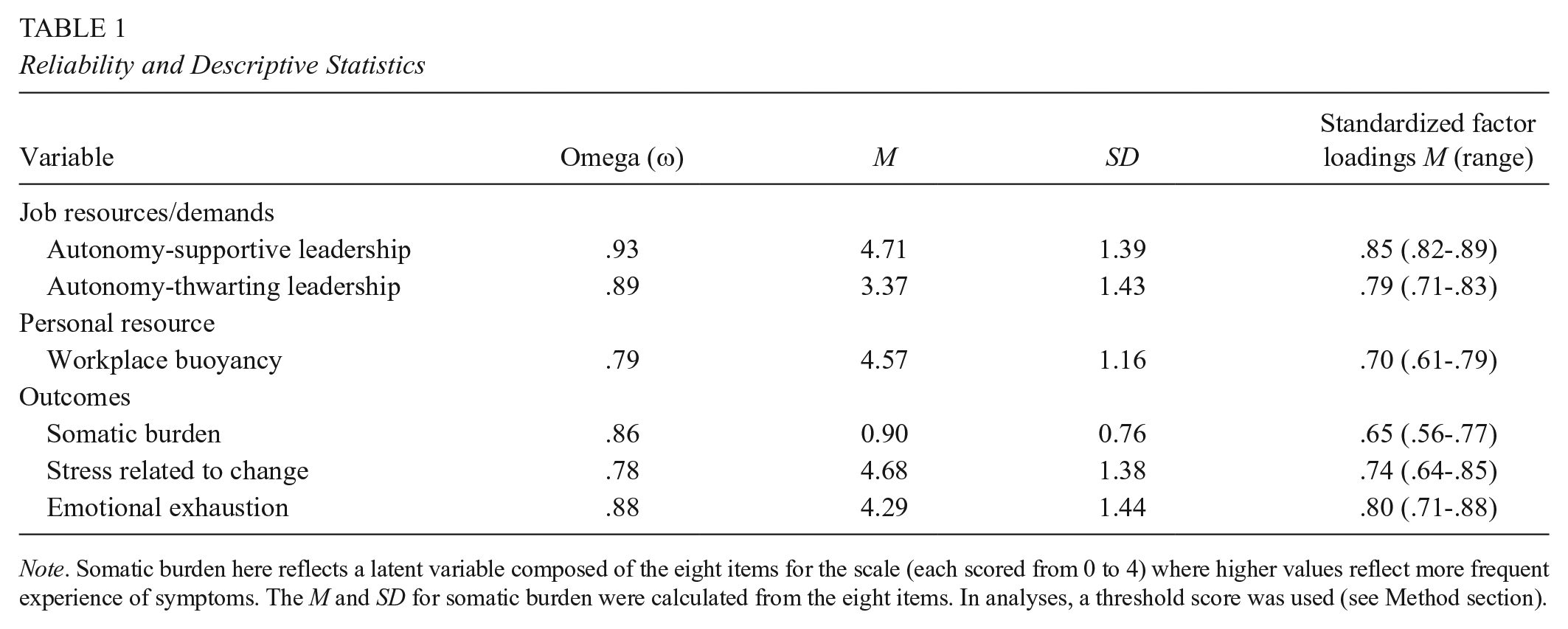
Note. Somatic burden here reflects a latent variable composed of the eight items for the scale (each scored from 0 to 4) where higher values reflect more frequent experience of symptoms. The M and SD for somatic burden were calculated from the eight items. In analyses, a threshold score was used (see Method section).
The CFA yielded adequate fit: χ2(385) = 604.27, p < .001, CFI = .95, TLI = .93, RMSEA = .042. Table 2 shows all correlations from the CFA. Autonomy-supportive leadership was associated with lower autonomy-thwarting leadership, greater buoyancy, and lower emotional exhaustion. In contrast, autonomy-thwarting leadership was positively associated with somatic burden, stress related to change, and emotional exhaustion. Buoyancy was negatively associated with somatic burden and emotional exhaustion. The three outcomes were all positively interrelated. For a summary of the correlations involving covariates, see the online Supplementary Materials.
Latent Correlations From Confirmatory Factor Analysis

Note. Gender was scored 0 (male teachers) or 1 (female teachers). School location was scored 0 (rural/remote) or 1 (urban/suburban). Teaching fully remotely was scored 0 (regular in-person teaching at school) or 1 (teaching fully remotely). Teaching half remotely was scored 0 (regular in-person teaching at school) or 1 (teaching half time remotely and half time in-person at school). Reduced work was scored 0 (for no change in work situation due to COVID-19) or 1 (less work due to COVID-19). Lead. = leadership; M/F = male/female.
Constraint is a latent factor representing agreeableness and conscientiousness (see Method section for more detail).
Moving on to the SEM, the associations shown in Figure 1 were examined, while including controls for shared variance and covariates. When the latent interaction between the two leadership factors was added to the model, the log-likelihood ratio test indicated no significant difference in the fit between the original SEM and the latent moderated SEM. 2 In addition, none of the interaction effects were significant, and the change in R2 was minimal for buoyancy and the three outcomes (<.004). Notably, the pattern of findings was very similar to the original SEM with all associations among substantive factors remaining significant. Given all these factors, the original SEM was retained for the remaining analyses.
The SEM showed adequate fit: χ2(385) = 604.27, p < .001, CFI = .95, TLI = .93, RMSEA = .042. Table 3 shows the standardized beta estimates and R2 values for the SEM. 3 Figure 2 displays the final model. Starting with the substantive factors, autonomy-supportive leadership was positively associated with buoyancy. There was no significant association between autonomy-thwarting leadership and buoyancy; however, autonomy-thwarting leadership was positively associated with emotional exhaustion. Buoyancy was negatively associated with all three outcomes: somatic burden, stress related to change, and emotional exhaustion.
Standardized Beta Estimates From Structural Equation Modeling

Note. Gender was scored 0 (male teachers) or 1 (female teachers). School location was scored 0 (rural/remote) or 1 (urban/suburban). Teaching fully remotely was scored 0 (regular in-person teaching at school) or 1 (teaching fully remotely). Teaching half remotely was scored 0 (regular in-person teaching at school) or 1 (teaching half time remotely and half time in-person at school). Reduced work was scored 0 (for no change in work situation due to COVID-19) or 1 (less work due to COVID-19). Lead. = leadership; M/F = male/female.
Constraint is a latent factor representing the meta-trait of agreeableness and conscientiousness (see Methods for more detail).

Standardized beta estimates involving substantive paths from structural equation modeling.
For covariates, female teachers reported less autonomy-thwarting leadership and less stress related to change. Less experienced teachers reported greater autonomy-supportive leadership and greater somatic burden. Teachers working fully remotely due to COVID-19 reported greater autonomy-supportive leadership, whereas teachers working half remotely (and half in-person at school) reported greater stress. Teachers who had reduced work due to COVID-19 reported lower autonomy-supportive leadership, greater autonomy-thwarting leadership, greater buoyancy, and greater somatic burden. Teachers higher in openness reported greater autonomy-supportive leadership and stress. Teachers higher in constraint reported greater somatic burden, stress, and emotional exhaustion. Teachers higher in extraversion reported greater buoyancy. Teachers who scored higher on neuroticism reported lower autonomy-supportive leadership, greater autonomy-thwarting leadership, lower buoyancy, and greater stress and emotional exhaustion.
Three significant indirect associations were found: autonomy-supportive leadership → buoyancy → somatic burden (β = −.12, 95% CI [−.22, −.01], SE = .05, p = .031); autonomy-supportive leadership → buoyancy → stress (β = −.16, 95% CI [−.27, −.04], SE = .06, p = .006); and autonomy-supportive leadership → buoyancy → emotional exhaustion (β = −.12, 95% CI [−.22, −.02], SE = .05, p = .018). Thus, autonomy-supportive leadership was indirectly and negatively associated with the three outcomes. Finally, the alternative models provided preliminary support for the construct ordering in the hypothesized model (see online Supplementary Materials).
Discussion
The aim of this study was to examine teachers’ somatic burden, stress related to changes at work, and work-related emotional exhaustion during COVID-19, along with the role of two leadership factors and workplace buoyancy in relation to these outcomes. Findings showed that autonomy-supportive leadership was associated with greater buoyancy and, in turn, lower somatic burden, stress, and emotional exhaustion. Autonomy-supportive leadership was also indirectly associated with the outcomes via buoyancy. In contrast, autonomy-thwarting leadership was positively associated with emotional exhaustion. Background characteristics were associated with the substantive factors in various ways.
Findings of Note Involving Substantive Factors
The positive association between autonomy-supportive leadership and buoyancy confirms prior work (Collie, Bostwick, & Martin, 2020) and provides initial evidence of validity for the scores of the new scale developed for the current study. Autonomy-supportive leadership facilitates teachers’ sense of empowerment at work through participative (i.e., encouraging input) and attuning practices (i.e., endeavoring to support the individual staff member; Aelterman et al., 2019). Such practices help teachers feel supported and have the agency required to navigate adversity in their teaching (Collie, Bostwick, & Martin, 2020). In terms of implications for practice, school leaders may want to use autonomy-supportive practices, such as inviting teachers to have input in decisions and school policies, providing choice and control over when and how teachers undertake their work, acknowledging teachers’ perspectives and listening to their needs, and providing rationales for the purpose of work tasks (Collie et al., 2018).
Autonomy-thwarting leadership was negatively associated with emotional exhaustion. Autonomy-thwarting leadership involves demanding (i.e., dictating what is to be done) and domineering practices (i.e., inciting guilt or shame to ensure compliance; Aelterman et al., 2019). It is possible these types of practices are associated with emotional exhaustion because they leave teachers feeling unsupported, little to no volition, and like their efforts are never enough (Eyal & Roth, 2011; Pisanti et al., 2003). For practice, school leaders may want to avoid domineering and demanding behaviors. Domineering behaviors include activating teachers’ feelings of guilt or shame, using disappointment to ensure compliance, and withdrawing attention if a teacher does things in a different way (Aelterman et al., 2019; Soenens et al., 2012). Demanding behaviors include dictating or commanding how things need to be done, being inflexible, and using controlling language such as “you must” (Aelterman et al., 2019; Soenens et al., 2012).
As the results showed, the interaction between the two leadership practices was not significantly associated with workplace buoyancy or the outcomes. Although unexpected, perhaps this finding relates to the nature of the two leadership factors. When teachers are able to draw on support in the face of job demands, those demands are easier to navigate (Bakker et al., 2007); however, this may not be possible when the demand and resource emanate from the same source. Additional research is needed to further explore this, including with person-centered research that can further disentangle the manner in which the two leadership factors cooccur (Bartholomew et al., 2018).
Buoyancy was negatively associated with the three outcomes. These findings extend knowledge from prior research, where buoyancy has been negatively associated with maladaptive forms of motivation and engagement (Collie, Guay, et al., 2020; Collie & Martin, 2017). Moreover, the findings suggest that buoyancy acts a protective personal resource. It appears that teachers who can effectively overcome adversity at work are able to avoid the physical or emotional load of that adversity—which results in fewer somatic symptoms, less stress related to change, and less emotional exhaustion (Chang, 2013). In terms of implications for practice, buoyancy may be promoted by helping teachers to recognize common challenges in their working environment, identifying and then using strategies and resources to offset the challenges, and finally evaluating and refining the strategies and resources for future use (Collie, Guay, et al., 2020; Martin & Marsh, 2008).
Finally, autonomy-supportive leadership was indirectly associated with the three outcomes via buoyancy. Prior research has demonstrated that autonomy-supportive leadership is negatively associated with emotional exhaustion (Collie et al., 2018) and general work stress (Nie et al., 2015) but has not considered the mediating role of buoyancy. The participative and attuning aspects of autonomy-supportive leadership likely mean that teachers are better able to navigate challenges at work. In turn, teachers are likely to experience fewer somatic symptoms and feel less stressed and emotionally drained at work (Bartholomew et al., 2014; Collie et al., 2018). In future research, it will be important to ascertain the role of autonomy-supportive leadership in the face of other school- and system-level demands (e.g., additional lockdowns due to COVID-19, accountability).
Findings of Note Involving Covariates
Focusing on the COVID-19 related covariates, teaching fully remotely was positively associated with autonomy-supportive leadership, whereas teaching half remotely (and half in-person) was associated with greater stress related to change. Perhaps by teaching fully remotely, teachers felt their principals trusted them and their self-initiation. In contrast, by teaching half remotely and half in-person at school, teachers were effectively needing to do two jobs: teach some students in class throughout the day, while also monitoring and supporting remote learners. It understandable that this increased workload would have been stressful for teachers. Although there was no link with emotional exhaustion, perhaps this will manifest later, as shown in prior research on teachers’ experience after major disruptions to schooling (Malinen et al., 2019). Reduced work due to COVID-19 was not only associated with many of the substantive variables, including greater buoyancy, but also greater somatic burden. This is an intriguing finding. Perhaps reduced work means teachers have more time to navigate challenges in their teaching, but it may also raise additional concerns relevant to life more broadly (e.g., financial concerns), which are known to be associated with health complaints (Vander Elst et al., 2016).
The personality variables had various relations with the substantive factors. Two notable patterns are discussed here. Although multicollinearity meant it was not possible to examine the unique roles of agreeableness and conscientiousness (see Limitations and Future Directions section for further on this), the meta-trait was linked with greater somatic burden, stress, and emotional exhaustion. Perhaps this occurred because highly agreeable and conscientious teachers are driven to be thoughtful, effective, dependable, and to follow social norms and rules (Norman, 1963). Such motives can be stressful and exhausting at times (Kokkinos, 2007), and may be particularly so during the additional demands brought on by COVID-19. Neuroticism was linked with lower buoyancy and greater stress and emotional exhaustion. These associations are understandable given that neuroticism means that individuals tend to have stronger emotional reactions, which could increase susceptibility to adversity, stress, and emotional exhaustion (Kokkinos, 2007). Emotional instability, a hallmark of neuroticism, may also explain the connection with the leadership factors: High neuroticism may mean teachers experience insecurity and negative emotions relating to their job, which might color their view of their principals as being less autonomy-supportive and more autonomy-thwarting (Felfe & Schyns, 2006).
Limitations and Future Directions
Several limitations should be considered when interpreting the findings. First, the data were cross-sectional and so causal ordering cannot be determined. The hypothesized model was derived from theory, which guided the positioning of factors. In addition, the alternative model testing provided preliminary support for the hypothesized ordering. Notwithstanding this, additional research including longitudinal and experimental research is needed to test the associations, including the possibility of bidirectional relations among the factors. Second, the data were all self-report. Given the study focused on teachers’ perceptions at work, this is an appropriate approach. Going forward, it will be interesting to see whether principals’ reports of their leadership practices are associated with teachers’ work-related outcomes. Third, due to the recruitment methods used in the present study, it was not possible to identify the schools at which teachers worked. This means it was not possible to take into account possible nesting of teachers within schools. Although this is unlikely to be an issue here because the sample was collected across the whole country, it is an important consideration for research in future. Fourth, personality was measured with single items for each of the five domains. This was deemed a necessary limitation to avoid undue burden on the participants (which would occur with longer personality scales) and given that personality was included as a covariate, rather than a variable of central interest. Including personality meant that more shared variance was controlled for in the modelling. As such, the associations among the substantive factors are notable because they were significant beyond the role of the personality factors. Nonetheless, the findings involving the personality factors should be taken with some caution. Going forward, it will be important to test these associations with multiple item scales. In addition, given that agreeableness and conscientiousness had to be modelled as a meta-trait, additional research that disentangles the difference between these two personality factors is essential.
The fifth limitation is that in future it will be important to extend the job demands and resources to consider other factors, including system-level factors, that have been linked with teacher stress and burnout in prior research (Putwain & von der Embse, 2019). For example, it is possible that external mandates regarding accountability, standardized testing requirements, and the reopening of schools despite increasing COVID-19 cases would act as potential moderators in the associations examined in the present study (von der Embse & Mankin, 2020). These are important issues to examine for broadening understanding about the nature of COVID-19 and how its impact may vary from context to context. Finally, Australia’s experience through the first wave of COVID-19 in 2020 was milder than some other countries. The findings here may represent the tip of the iceberg in terms of teachers’ maladaptive outcomes during COVID-19. It will be important to bolster the findings here with studies conducted in other countries either in subsequent waves of COVID-19 or during other major disruptions to understand the ramifications where the illness rates are much higher. On a related point, workplace buoyancy was clearly salient in relation to teachers’ experiences in the present study. However, it may be that workplace buoyancy is not as salient in contexts where COVID-19 has wrought much greater adversity. Future research examining resilience in relation to COVID-19 is also important.
Conclusion
The aim of the present study was to examine teachers’ maladaptive work-related outcomes during COVID-19 and to ascertain whether two leadership factors (autonomy-supportive and autonomy-thwarting leadership) and one personal resource (workplace buoyancy) were associated with lower maladaptive outcomes. Findings showed that autonomy-supportive leadership was associated with greater buoyancy and, in turn, lower somatic burden, stress related to change, and emotional exhaustion. In contrast, autonomy-thwarting leadership was positively associated with emotional exhaustion. Autonomy-supportive leadership was also indirectly associated with stress and emotional exhaustion via buoyancy. Together, the findings provide understanding of factors to prioritize (autonomy-supportive practices, workplace buoyancy) and avoid (autonomy-thwarting practices) in future research and practice in order to support teachers during subsequent waves of COVID-19—and other future disruptions to schooling that may occur.
Footnotes
Acknowledgements
The author has no conflict of interest to declare. The author thanks the Australian Research Council for supporting this research (DE200100436).
1
Data on COVID-19 cases and deaths for Australia, the United States, and the United Kingdom were downloaded from the World Health Organization website ( ) on September 1, 2020. Data collection and reporting practices on COVID-19 cases differ between the three countries and thus are reflected in these statistics reported here. World Health Organization had not yet provided country data weighted for different methods of data collection at the time the statistics were downloaded from their website.
2
To test the interaction effect, pared down models that only included the substantive factors were run. Given the complexity of latent moderated SEM, this ensured the models were able to converge and reduced the number of free parameters to estimate. The first model involved the associations among the substantive factors (original SEM) and the second model was the same but with the addition of the interaction term as a predictor of buoyancy and the outcomes (latent moderated SEM).
3
For completeness, a model excluding the personality factors was also run. Results were very similar and are detailed in the online Supplementary Materials.
Author
REBECCA J. COLLIE, is a Scientia Associate Professor of educational psychology in the UNSW School of Education. She conducts research in the broad areas of motivation, well-being, and social-emotional development using quantitative research methods.
References
Supplementary Material
Please find the following supplemental material available below.
For Open Access articles published under a Creative Commons License, all supplemental material carries the same license as the article it is associated with.
For non-Open Access articles published, all supplemental material carries a non-exclusive license, and permission requests for re-use of supplemental material or any part of supplemental material shall be sent directly to the copyright owner as specified in the copyright notice associated with the article.
