




Abstract
Understanding the relation between federal investment and research has implications for promoting science production in early childhood, a rapidly expanding area in education research and policy. Federally funded research has shaped fundamental issues in early childhood, yet few studies have systematically examined the relation between federal investment and publication output. Our study applies topic modeling and regression analyses on a text corpus of 15,608 publication and grant abstracts in early childhood education to distill the most prominent topics, and the relationship between grant funding and later publications within these topics. We find that grants topics focused on health and early intervention, while publications covered a wider interdisciplinary range. A topic’s prevalence in grants, as a proxy of federal investment, was positively associated with its prevalence in publications in the following year. The study illustrates the affordances of textual analyses and contributes insights about how federal investment motivates scholarly production.
Introduction
Investment in research and development (R&D), which amounts to over $134 billion in 2020, is a substantial component of federal expenditures in the United States (Sargent, 2020). The extent to which federal grants sustain an infrastructure for research is key to establishing research rigor and evaluating replicable practices (Burkhardt & Schoenfeld, 2003; Jacob & Lefgren, 2007). Understanding the impact of federal expenditures on research is important to identify scientific fields where funding can productively incentivize research and evidence-based practices (Jacob & Lefgren, 2007). Science policy scholars have explored this relationship between grants, research output (i.e., publications), and subsequent funding attainment, mostly in different scientific fields (Hicks, 2012; Jacob & Lefgren, 2007; Payne & Siow, 2003).
In the fields of education and child development, federally funded research has shaped fundamental issues, including our understanding of development and learning across the life cycle, teacher preparation in K–12 systems, and child health (Diamond et al., 2013; Koppich & Knapp, 1998). Yet few studies have systematically examined the relation between federal grants in education research and publication output. Prior work that traces research findings to funding sources has used a case study approach or manual review of small subsets of publications (Diamond et al., 2013; Walsh & Sanchez, 2010). However, these approaches may not scale easily or account for the highly interdisciplinary nature of development and education research.
This study explores the relation between publications and federal grants in early childhood education (ECE). We focus on ECE for several reasons. First, it represents the multidisciplinary intersection of educational and developmental inquiry. Second, this research field has experienced substantial growth in policy and scientific interest (Gormley, 2011); yet federal funding only supports a small fraction of scholarship (Walsh & Sanchez, 2010). Thus, studying the potential mismatches between federal expenditures and publications can help identify areas for funding incentives. Finally, grant support for ECE research has direct implications for educational practices, such as regulation of and resource allocation for early care programs. Effective funding can help bridge policies, research, practice, and scholarly output.
To capture the broad range of topics in ECE, we apply natural language processing (NLP) approaches to provide a first parse of cleaning and categorizing to a text corpus of 15,608 publication and grant abstracts published between 1990 and 2020. We use these data in topic modeling and regression analyses to examine the following research questions:
This study has three main contributions. To the best of our knowledge, our study is the first to examine at-scale patterns in grant and publication in education, and ECE in particular. While prior work has focused on a small set of topics in education and development (Diamond et al., 2013; Walsh & Sanchez, 2010), our analysis covers a wide range of disciplines, from program administration to child health.
Second, we illustrate the affordances of NLP approaches, namely structural topic modeling, to derive the underlying themes of a large document corpus in a data-driven manner, without prior researcher input on which topics the corpus covers (Roberts et al., 2014). In the process, we outline the steps to establish the semantic, predictive, and hypothesis validity of the results.
Third, our study provides methodological considerations for science policy research. Researchers have commonly used bibliometrics (e.g., citation, publication counts) to study the impact of funding on research output (Boyack & Börner, 2003; Jacob & Lefgren, 2007). We use results from the structural topic models, namely the prevalence of output (grants or publications) in a given topic area as an outcome variable. We find differences in both how often a topic occurred and which words were more frequently used in grants and publications. Tapping into document content by using a data-driven approach may capture the language nuances from varied discipline-specific perspectives in funded versus published research, rather than relying on predefined keywords.
Overall, our findings reflect the interdisciplinarity of the ECE research field, with implications for scholarly output and funding allocation. We find substantive trends in ECE funding, such as grants’ focus on health interventions, compared with the wide range of topics in publications. Regression results indicate that the prevalence of a topic in grants in a given year is positively associated with its prevalence in publications in the following year. This provides some evidence that federal investment in ECE research can support research production in immediate terms. Together, findings reveal opportunities for diversifying funding to support multidisciplinary ECE research.
Background
Overview of Research Trends and Federal Investments in Early Childhood
Our review paints the broad strokes of ECE research that other scholars have comprehensively reviewed (e.g., Chaudry & Datta, 2017; Haslip & Gullo, 2018). To foreground later discussions of development in publications and grants, we note major trends in demographics, child development, education, and teacher professionalization, and discuss how they relate to funding initiatives. The review illustrates the interdisciplinary nature of ECE and the far-reaching implications for children, parents, teachers, and administrators of federal investments.
Changing Demographics
The demographics of students entering early childhood programs has become increasingly diverse in terms of family structures, language proficiencies, socioeconomic status, and school preparedness (Chaudry & Datta, 2017; Jiang et al., 2015). Bassok et al. (2016) study two nationally representative samples of kindergarteners in 1998 and 2010 and find that while the gap in parental investment in many facets of early care (e.g., increases in access to home technology, home reading practices, child’s participation in enrichment activities) has become narrower, the gap in participation in formal preschool has widened between low- and high-income children. The types of curricula and programs that children engage in (e.g., full-day vs. half-day, academic vs. social focus) may also influence children’s readiness by the time they enter the primary grades (Haslip & Gullo, 2018).
Thus, from a federal funding perspective, there has been an increasing emphasis on the scaling of effective prekindergarten programs and the development of universal versus targeted programs for students from different backgrounds (Greenberg, 2018). Researchers have increasingly called for the development and adoption of tools that meet the needs of all children, including English language learners, children with special needs, and underrepresented children of color (National Research Council, 2008).
Enhanced Understanding of Child Development
A growing understanding of children’s cognition also informs federal investments. Over the past 40 years, convergent research from psychology, education, neuroscience, and economics have all demonstrated the critical importance of high-quality early care and education experiences for positive, healthy child development, especially for children from low-income families and those with special needs (Barnett, 2011; Bowman et al., 2000; Hackman & Farah, 2009; NICHD Early Child Care Research Network, 2005; Sarneroff, 2010; Shonkoff & Phillips, 2000). Early childhood experiences can have long-term impacts. For example, trauma and toxic stress during early life has been linked to developmental disorders and poor health in adulthood (Shonkoff et al., 2012). This research highlighted the need for policies to comprehensively support the family and home environments as contexts for early learning (Britto et al., 2017).
Over time, these scientific discoveries gradually changed the notion that caring for young children was simply adult work support and framed early childhood services as an economic investment (Kirp, 2007; Rose, 2010). In turn, this body of work created major policy and research implications: to promote early learning programs that cultivate the foundations for school readiness, and to continue examining the link between early learning experiences and development and wellbeing (Sripada, 2012; Webster-Stratton & Herman, 2009).
Curricular Shift
The 1990s and 2000s witnessed a shift in the rhetoric of early childhood from “caregiving” to “education” (Rose, 2010). Researchers have documented the positive impact of quality pre-K on individuals beyond school entry and on society at large (Heckman, 2011). As a result, there have been growing efforts to align the preschool classrooms with learning standards in language literacy, math, science, and social emotional learning, among others (Haslip & Gullo, 2018). These efforts are particularly salient following calls for incorporating child care into the K–12 system (Rose, 2010). Assessment of standard implementation, student learning outcomes, and prescriptive curriculum development come to the forefront in evaluating the effectiveness of early childhood programs (Black et al., 2017).
The shift to “education” instead of “care” also influences early learning activities. Traditionally, the early childhood experiences emphasize exploratory, play-based experiences and social interactions (Bresler, 2013; Graue et al., 2015). However, alignment with accountability standards may promote scripted activities that focus on certain disciplines and skills (e.g., language, math) in place of exploratory learning (Lewin-Benham, 2011). Additionally, emerging curricula seek to integrate arts, science, and technology content, with a growing body of work that explores the potential of such curricula on children’s learning (Aldemir & Kermani, 2017; French, 2004; Kermani & Aldemir, 2015; Wang et al., 2010). These efforts drive researchers and early care practitioners to develop activities, create assessments, and update prior theories of child development to align with the shifts in curricular focus.
Professionalization
The focus on accountability has also influenced the policy and research agenda to improve teacher learning, with multiple states adopting quality standards in public preschools (Barnett, 2011; Whitebook et al., 2012). Changes in approaches to teacher professional development also came about in part from the multiple shifts in student demographics, curricular expectations, and the growing understanding of young children’s development (Artman-Meeker et al., 2015). Thus, in recent years, teacher preparation not only focuses on developmentally appropriate practices but also the integration of technology and social emotional learning, among other factors, into early childhood classrooms (Rosen & Jaruszewicz, 2009).
In sum, a growing recognition of diverse children and learners as well as enhanced understanding of children’s cognitive development has led to shifts in ECE program structure, professionalization, and curricula in practice. In turn, funding initiatives present opportunities for researchers to study the impacts and implications of different policies and research-based practices across diverse early childhood settings. These patterns drive our hypotheses that there is more scholarly production, in terms of publications, across topics in ECE over time, and that prevalence in publications and grants for certain topics, such as early care, would be on the rise following federal initiatives.
Federal Investments and Research Production
Federal Investments in ECE
Government institutions can serve as a mechanism to foster competition for quality research and scientific production, one channel of which is through federal investment (Whitty, 2006). Federal investment in research is based on the assumption that knowledge production and knowledge transfer are primary resources for economic growth (Geuna & Muscio, 2009; Stewart & Capital, 1997). In addition to producing basic research, researchers can collaborate with practitioners to turn knowledge into practical applications (Geuna & Muscio, 2009).
In the field of early childhood, the role of federal investments in advancing research in teacher professional development, child health, school readiness, and consequently public policies around child care and social programs has been recognized in reviews of notable literature across fields (Diamond et al., 2013; Gormley, 2011; Kilburn & Karoly, 2008; Koppich & Knapp, 1998; Lee et al., 2017). For example, a synthesis of research funded by the Institute of Education Sciences (IES) finds significant contributions of the funded work to our knowledge of effective instructional practices for promoting children’s development of language and literacy (Diamond et al., 2013). Building on past research helps the authors identify gaps in existing knowledge and propose follow-up funding opportunities. This example illustrates how federal investments can (1) motivate research and (2) influence future research through building on and broadening areas of inquiries in subsequent funding opportunities.
Despite its promise for advancing research, recent reviews of articles in major journals in ECE reveals that federal funding is the exception rather than the norm in the field (Walsh & Sanchez, 2010). A potential reason is that federal initiatives often focus on specific areas in ECE, rather than covering a broad range of topics. These areas include evidence-based research that employs experimental design (e.g., randomized control trial), longitudinal studies, and meta-analyses to determine “what works” (Barnett, 2011; Engle et al., 2011; Gormley, 2011; Heckman, 2006, 2011). Evidence-based and outcome-focused research, however, may not account for the varied experiences of childcare practitioners, children, and parents (Vandenbroeck et al., 2012). Thus, researchers have called for policy and practice to make use of exploratory and responsive research that considers participants’ perspectives in early childhood settings (Cutspec, 2004; Vandenbroeck et al., 2012).
Science Policy Approaches
Tracing the alignment between funding initiatives and research development can offer insights into areas where funding could further motivate scholarly output. Beyond direct counts of funding acknowledgments in publications, there has been limited work that traces federal funding to research output in ECE. We thus turned to the literature on research policy to explore other approaches to examining the relation between governmental investment and R&D. For instance, researchers have focused on linking funding levels to measures of scientific productivity—the submission of findings in publications and grant proposals for peer review, application, and extension in research and practice.
Such measures include scholarly activity metrics (e.g., counts of publications or patents), impact (e.g., citation), and linkages between publications and grants (Boyack & Börner, 2003; Jacob & Lefgren, 2007; McAllister & Narin, 1983). For example, Jacob and Lefgren (2007) use regression analyses to estimate a small positive impact of receiving NIH funding on publication rate. Ebadi and Schiffauerova (2016) apply topic modeling approaches (i.e., latent Dirichlet allocation [LDA]) to extract title keywords and curate research domains to match researchers in publication information to funding database. Their results suggest evidence of the positive association between funding and publication quantity and citation impacts.
In sum, the literature in science policy informs our hypotheses that there may exist a positive association between funding amount and subsequent publication rate or quantity. Prior research highlights the need to consider time lags (accounting for the peer review process that affects publication metrics) when studying research production (Ebadi & Schiffauerova, 2016). A limitation to this body of work, however, is that citation metrics or indexed titles may not capture the broader content in which the publications or grants are situated.
In our study, we employ topic modeling to conduct a first parse of analyzing and categorizing the data corpus in ECE before using the output from the models to study the relation between grants and publications. As an unsupervised approach that uses an unsupervised machine learning algorithm to infer topic from the data, topic modeling can offer new insights into data patterns. This helps researchers to gain a deeper understanding of the data and confirm or revise existing theoretical frameworks (Blei et al., 2003). In so doing, our study applies conceptual approaches from science policy to exploring the underlying, interdisciplinary structure of a new field—early childhood—using data science methodologies.
Method
Data Sources
We first prepared the data corpus for grants and publications in one data set, by compiling a target journal list using Google Scholar’s h index. The h index of a publication is the largest number h, such that h articles in that publication were cited h times each at minimum. We obtained a “high impact” sample (highest h index) to represent journals in ECE, education, educational psychology, educational administration, and educational technology. We excluded journals that targeted different subjects (e.g., higher education). Then, we retrieved all publications related to ECE from the journal list, using the database Scopus. For journals that included publications across the age range (e.g., infant–adult), we searched in the title or abstract for the keywords: early child*, preschool, preK, pre-K, pre-kindergarten, or kindergarten. We limited publication year to 1990–2020, because a preliminary search for articles that contained “early childhood education” in their titles or abstracts returned fewer than 25 articles on Scopus per year, for publications prior to 1990. From 12,824 publications, after removing those with no available abstract, we retained 12,446 publication abstracts. The online Supplemental Table S1 lists the 72 journals and distribution of publications.
We searched for grants that contained any of the following keywords in their title or abstract: early child*, preschool, preK, pre-K, pre-kindergarten, or kindergarten. The grant databases included the top funding agencies for ECE in the United States, namely the IES, the National Science Foundation, and the National Institute of Child Health and Human Development (NICHD). We limited our search to grants awarded between 1990 and 2020 to match the publication corpus. In total, we retrieved 3,199 grant abstracts (2,022 from the NICHD, 756 from the IES, and 421 from the National Science Foundation). The data set included the grant’s title, abstract, award year, funding agency, and funding amount.
Because the number of grants prior to 1997 was small (number in each year <7; Figure 1), to avoid skewing later analyses predicting topic prevalence by publication year, we limited our corpus for grants to 1997–2020. The final data set consisted of 15,608 abstracts (12,446 publications and 3,162 grants). Figure 1 presents the descriptive statistics for abstract counts (Panel A) and average funding by year (Panel B). Omitting the grants prior to 1997 did not substantially change the overall representation of each category in the data set.

Descriptive statistics by year for abstract count and average funding.
Structural Topic Model
We applied structural topic models (STM) to cluster the data into topics using an unsupervised approach (for technical details, see Roberts et al., 2016). The approach is similar to other mixed-membership models such as LDA (Blei et al., 2003): any document is defined as a mixture of topics, with each word in the document representing one topic. Two main outputs of the mixed-membership models for each document include (1) topic prevalence, or the proportion of different topics in a document (
An affordance of STM, compared with other topic modeling approaches such as LDA, is that STM incorporates covariates (e.g., information about the type of publication, years, authors, etc.) into the topic models. Including the covariates can account for structural changes that predict (1) topic prevalence—how the covariates relate to the prevalence of the topics and (2) topical content—which words are frequently used in a topic, in relation to a covariate. STM achieves these metrics by allowing the topic prevalence (
Research Question 1: Prominent Topics in Grants and Publications Over Time
The workflow to examine topic patterns in grants and publications consisted of three steps. First, we selected a topic model by running several models with different number of topics k (k ranges from 5 to 40) and compared the results with another topic model methodology (LDA). We evaluated the models based on their semantic coherence and exclusivity. Second, we used researcher judgment to examine different facets of validity for the results. Finally, we used STM to visualize and estimate topic prevalence and content, topic correlations, and differences in topic prevalence and content in relation to year and abstract type.
Model Selection
The text from the abstracts was preprocessed prior to running the STM by removing common stop words (e.g., “the,” “and”). Next, to determine the number of topics, we ran a series of topic models with the number of topics k from 5 to 40, segmented by 5. We also ran models with k = 100. We ran each model up to 75 iterations. All models allowed the topic prevalence to vary by years and types of abstract (grants vs. publications). The selection of these covariates was informed by prior research to examine the following hypotheses:
We compared the models along several model fit diagnostics to determine k, namely held-out likelihood, residual check, exclusivity, and semantic coherence.
Held-out likelihood captures the predictive validity of the model. For a subset of documents, the algorithm removes half of the set and evaluates the probability of detecting the words that are held out (Asuncion et al., 2012). Higher held-out likelihood indicates higher predictive power. We also examined residual check, which tested for the dispersion of variance within the data. Lower residuals suggest that fewer topics would be needed to account for the data variance (Roberts et al., 2014). Finally, we turned to semantic coherence to evaluate the consistency of a given topic, such that high-frequency words for that topic are likely to cooccur within documents (Mimno et al., 2011; Roberts et al., 2014).
In our data set, generally, a higher number of topics was associated with higher predictive power (i.e., higher held-out likelihood). However, semantic coherence appeared to drop noticeably when the topic number exceeded 25 (online Supplemental Appendix A). These different evaluations revealed that the optimal number of topics was in the range from 15 to 25.
On identifying the range of topic numbers, we compared the exclusivity and semantic coherence of models with k equaled to 15, 20, and 25. Exclusivity describes how unique a topic’s high-frequency words are, such that the words tend to not appear within the top words of other topics (Airoldi & Bischof, 2012; Roberts et al., 2014). To illustrate the tradeoff between semantic coherence-exclusivity, we included a model with k = 100. Our criteria for selecting the number of topics k was that topics in the selected model were both exclusive and cohesive.
The online Supplemental Appendix B reports the exclusivity and semantic cohesion from different models. We noticed broader categories when the number of topics was small. Take the 15-topic model as an example. One topic in this model captured aspects of research (keywords: education, teacher, early, learn, research), but these words likely appeared in a large number of topics and thus may have low exclusivity. Although the 100-topic model had high exclusivity (online Supplemental Appendix B), several topics in this model had low semantic coherence. The result suggested k = 25 may be the optimal number of topics to achieve a balance between semantic coherence and exclusivity, with only two outliers with low exclusivity.
To validate the STM, we estimated a 25-topic model using another method (LDA), with the alpha parameter set at the default .1 and 1,000 iterations (alpha represents document to topic proportion). The online Supplemental Appendix D reported the top 15 high-frequency words associated with the LDA topics. Overall, several topics in the two models appeared to overlap in high probability words, suggesting that the 25-topic STM, and later interpretation, reflect robust features of the text corpus.
Validity Checks
We followed prior work (Quinn et al., 2010) to establish different criteria of validity—determining whether the results are creditable. Semantic validity refers to the extent to which each document or topic had a coherent underlying meaning and could be related to each other meaningfully. Predictive validity is the extent to which the predicted topics correspond to external events. Finally, hypothesis validity represents the extent to which the measures can be applied to testing hypotheses.
Semantic validity
To examine semantic validity, we inspected intratopic and intertopic semantic validity (Quinn et al., 2010). For intratopic semantic validity (i.e., whether topics were semantically coherent and thus valid), we first examined the representative words and exemplar abstracts. The STM returned four different word lists: highest frequency, FREX, lifts, and scores. Highest probability keywords are those with the highest frequency in a topic. These words are nonexclusive, which means that these words may be associated with any number of topics. FREX, which is the weighted harmonic means of the word’s rank, suggests words that are both exclusive and frequent (Roberts et al., 2014). Lift (Taddy, 2012) is the word’s probability within a topic, divided by its probability within the corpus. Lift captures words that are generally distinct from other topics. Score, which divides the log frequency of the word in the topic by its log frequency in other topics (Chang, 2011), has similar interpretations to lift. Table 1 shows example keywords from the three most prevalent topics in our corpus, and online Supplemental Appendix C lists the remaining topics.
Topic, Topic Prevalence, and Top Words from the 3 Most Prevalent Topics

Note. Highest Prop = highest probability words; FREX = words that are frequent and unique to the topics; Lift and Scores indicate unique words. Topic prevalence = proportion of the topic within a document.
In addition, we manually examined the top five representative abstracts from each topic. The authors (including an expert in ECE) examined the keywords and abstracts to create potential labels for the topics, through two iterations of discussion. The online Supplemental Appendix E shows exemplar abstracts for two related topics: early intervention and child care quality. The labels for these topics stemmed from our observation that one set of abstracts covered environmental factors (e.g., nutrition, pregnancy, etc.), while the other appeared to focus on care arrangements and impact of certain policy initiatives (e.g., subsidies) on the quality of care.
Next, we examined intertopic semantic validity (i.e., the relationship between topics) through topic correlations. Topics that tended to appear together in a document would be more highly correlated and would cluster closer together in the network graph. We aimed to understand whether the topics clustered together in meaningful ways.
Predictive validity
Predictive validity describes the correlation between a predicted topic and an external event not included in the modeling process (Quinn et al., 2010). We examined topic prevalence over time, in relation to major grant initiatives in early childhood, such as the federal Race to the Top-Early Learning Challenge that occurred between 2011 and 2016. The program aimed to increase access to early learning programs for disadvantaged children, design and implement systems of services, and provide rigorous measurements of outcomes and progress. We would expect a change in topic prevalence in related topics, for example, classroom interventions, school readiness, education policy, and child care quality, during and following this initiative. Alternatively, we could trace topic prevalence in topics that are presumably unrelated to the federal initiative. We could gather evidence for predictive validity, if these unrelated topics did not indicate a distinct trend in prevalence in the period of the initiative.
Hypothesis validity
Finally, we examined the hypothesis validity, defined as the usefulness of a measure for evaluating theoretical and empirical hypotheses (Quinn et al., 2010). Prior work in R&D, particularly in early childhood research, has suggested that federal investment in grants tended to concentrate on outcome-focused research (e.g., intervention), in place of exploratory research (Vandenbroeck et al., 2012). We hypothesized that grants in our ECE corpus would be more prevalent in outcome-focused research, including topics with more emphasis on evaluation, assessment, and intervention. The topic model results would show validity if they could be used toward testing this hypothesis, which we explored in our research questions.
Research Question 1a: Difference in Topic Prevalence Between Grants and Publications
We turned to our research question about potential differences in topic prevalence and content between publications and grants. We first examined how the topic prevalence may differ across grants versus publications. Here, the topic prevalence is the outcome variable in a linear regression (Roberts et al., 2014). Each document is an observation, and the predictor variable is a variance-covariance matrix of user-specified predictors (i.e., abstract type, year).
Research Question 1b: Difference in Topic Content Between Grants and Publications
We then explored how the frequency of certain words from the same topic may differ across grants versus publications. We created another STM with k = 25, which was similar to our original model in the model selection step (i.e., using abstract type and year as predictors for topic prevalence), but also allowed the content words of the topics to vary by abstract type. The model used a multinomial logistic regression, where the outcome variable was a parameter of the rate of use for a word w (i.e., occurrence of a word w, divided by its distribution in the whole corpus). The predictor variables included the topic that the word w belongs to, abstract type, and the interactions between the topic and the abstract type. Intuitively, this model allows us to explore whether the rate of use of an individual word within a topic differs by abstract type. We hypothesized that differences between grant and publication topics (e.g., on evidence-based practices) would be reflected in the rate of word use between grants and publications.
Research Question 2: Predicting Topic Prevalence in Publications
We then used outcomes from the topic model to examine the extent to which grant topic prevalence—as a proxy of federal investment—was associated with topic prevalence in subsequent publications. For each of the two subsets (grants, publications), we calculated the mean prevalence of a specific topic for each year (i.e., the average value of topic prevalence in a year). The data formed a panel of topics from 1997 to 2020 for 25 topics (575 topic-year observations; as stated in the Data Sources section, observations prior to 1997 were excluded due to the small number in grants). We then estimated the following regression model to examine topic prevalence in publication, as a measure of grant (R&D):
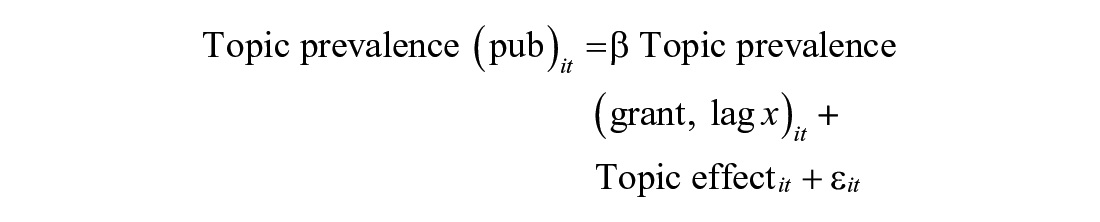
where i denotes the individual topic and t denotes the annual time period. Following prior work (e.g., Brodnax & James, 2018), we used topic fixed effects to control for observable and unobservable differences between the topics, for example, for more popular fields, or differences in research methods across the highly interdisciplinary corpus. This restricts our predictions of grant topic prevalence to publication topic prevalence to be within-topic over time, such that
We examined the appropriateness of the fixed effect over random effect alternatives for panel data. The assumption of the random effects model is that there exists no significant correlation between the unique errors and the model’s predictors (i.e., no unobserved variables). We ran the Hausman test to detect whether the coefficients in the fixed versus random effects model were systematically different. If the null hypothesis is rejected (p < .05), we can conclude that the predictors are correlated with the error terms and the fixed effect model is preferred. Hausman test provided evidence to reject the null hypothesis for models at 1, 3, and 5-year lags and suggested that the use of fixed effect for the topics was appropriate (
We note that for the regression analyses, we do not consider the results to represent a causal relationship. Rather, they reflect a descriptive analysis of the relation between grants and publications, two important components of scientific production.
Findings
In this study, we explore how federal investment focus, as indicated by topic prevalence in grants, may be related to scholarly output in ECE. We report the validity of the STM models, before using these results to answer our research questions.
Validity
Semantic Validity
Our results suggest evidence for intratopic and intertopic semantic validity. The STM revealed interesting patterns about the underlying topics of our data corpus. For example, the topic about Teaching and Professional Development was represented by high-frequency keywords such as “teach,” “profession,” and “classroom.” The FREX words, which listed words that were both frequent and unique to the topic, illuminated different aspects of the teaching profession, such as teacher attitude, self-efficacy, or classroom climate.
We further examine the relationships between topics. The online Supplemental Appendix F visualizes the topic correlations as connected networks with the cutoff of .08 for correlation values (i.e., small correlation). The results for the topic correlation suggest evidence of intertopic semantic validity, as the clusters generally appeared homogeneous and well-defined. Consider the large cluster of topics around school readiness at the bottom of online Supplemental Appendix F, with topics around Assessment/Measurement, School Readiness, Social/Emotional/Behavioral Learning, English learners, and Language. This cluster was connected to a smaller triad around teaching and learning (STEM; Teaching and Professional Development; Writing). Another cluster emerged for the topics related to child health intervention (early intervention; child health; and risk factors) and appeared distinct from the school readiness cluster.
Predictive Validity
Figure 2, Panel A plots the topic prevalence over time for four topics: education policy/administration, school readiness, child care quality, and assessment. The x-axis displays the years, and the y-axis shows the expected topic prevalence. The dashed lines show 95% confidence intervals. The general pattern of topic prevalence appears to confirm our conjecture: There was an increase in prevalence in school readiness, care quality, and assessment between 2011 and 2016 in grants (blue line) and publications (red) and an increase in prevalence in publications of policy/administration during this period.

Topic prevalence over time, in relation to Race to the Top: Early Learning challenge.
Another way to examine predictive validity is to examine prevalence in topics that would not be feasibly related to the Race to the Top initiative. Panel B of Figure 2 displays the same plot for an unrelated topic, Theory/Concept, which did not show corresponding patterns (i.e., increase in the same period) and provides evidence for predictive validity.
Research Question 1a: Topic Prevalence in Grants and Publications
To explore topical patterns in grants versus publications, we first examine the difference in frequency of topic prevalence by abstract type. Results confirm our hypothesis that grants would have prevalence in a narrower range of topics, and suggest potential distinctions between publication and grant focus. Table 2 presents the average topic prevalence per topic for publications and grants. For example, a topic prevalence of .08 means that on average, this topic accounted for 8% of the content in a document in the corpus. Figure 3 shows the differences in prevalence of topics for publications and that for grants, with the whiskers indicating 95% confidence interval. Positive values toward grants indicate that this topic was more likely to appear in grants.
Descriptive Statistics for Topic Prevalence in Publication and Grant
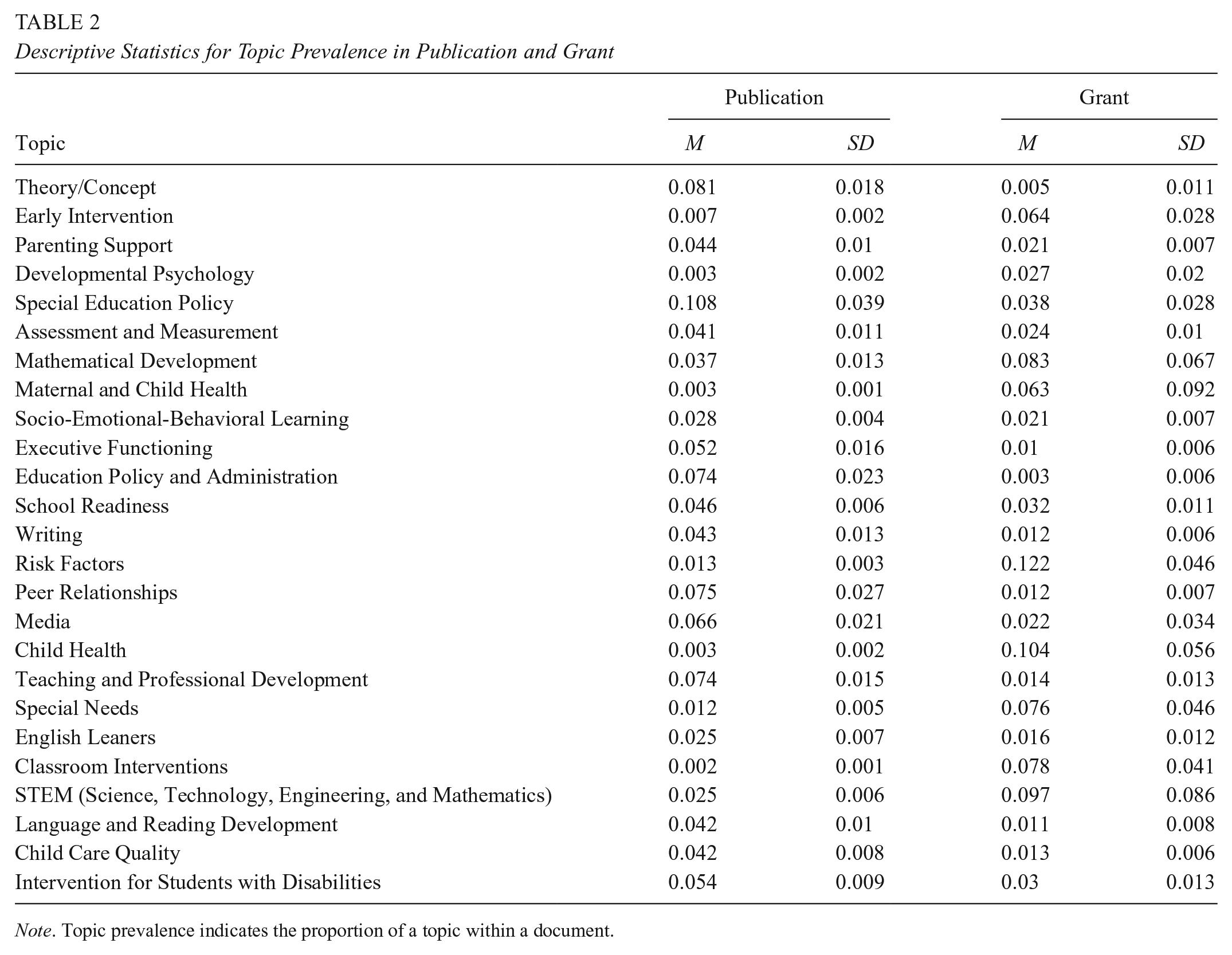
Note. Topic prevalence indicates the proportion of a topic within a document.

Coefficient plots (topic prevalence difference between grants and publications).
A noticeable difference is in topics related to health (e.g., maternal and child health), which was associated with a higher prevalence in grants; b = 0.26, SE = 0.06, p < .001. The average topic prevalence, or proportion of the maternal and child health topic in a grant abstract tended to be .26, or 26 percentage points higher than that in publications, after accounting for fiscal or publication year. Topics about interventions were also more likely to appear in grants, b = 0.08, SE = 0.03, p = .04. Meanwhile, the publication corpus showed a higher association with a range of topics, for example, topics related to theory/concept, policy and administration, teacher professional development, peer relationships, and use of media, among others (Figure 3). Topics such as assessment/measurement, school readiness, and math development appeared to show a less distinct difference in prevalence between the two corpora.
Research Question 1b: Topic Content in Grants and Publications
Building on prior review of ECE research, we hypothesize that grants would be more likely to include words related to evidence (Barnett, 2011; Engle et al., 2011; Gormley, 2011). However, across the 25 topics, we did not find consistent distinctions between grants and publications in terms of key word frequencies. The two STMs—one using abstract type as predictor for topical content (Research Question 1b) and one without (Research Question 1a)—yielded similar FREX words (i.e., words that are both exclusive and frequent). This suggests that the results about the underlying topic patterns and associated keywords did not vary by abstract type.
Still, using abstract type as a predictor for a topic’s content words illuminates grants’ focus on “data,” compared with publications, in a number of topics. Figure 4 illustrates this pattern. In this figure, the bigger, bolded text suggests words that were more frequently used within each corpus (publication or grant), compared with those words’ distribution for the whole data set. Looking at abstracts related to education policy/administration, the word “data” appeared more frequently in the grant corpus than the publication corpus, indicating a focus on evidence-based work. Within the same topic, publications made use of words like “practitioners” and “profession” more frequently, suggesting a focus on practice. The same focus on “data” and “valid items” in grants can be found in topics about assessment/measurement and child care.
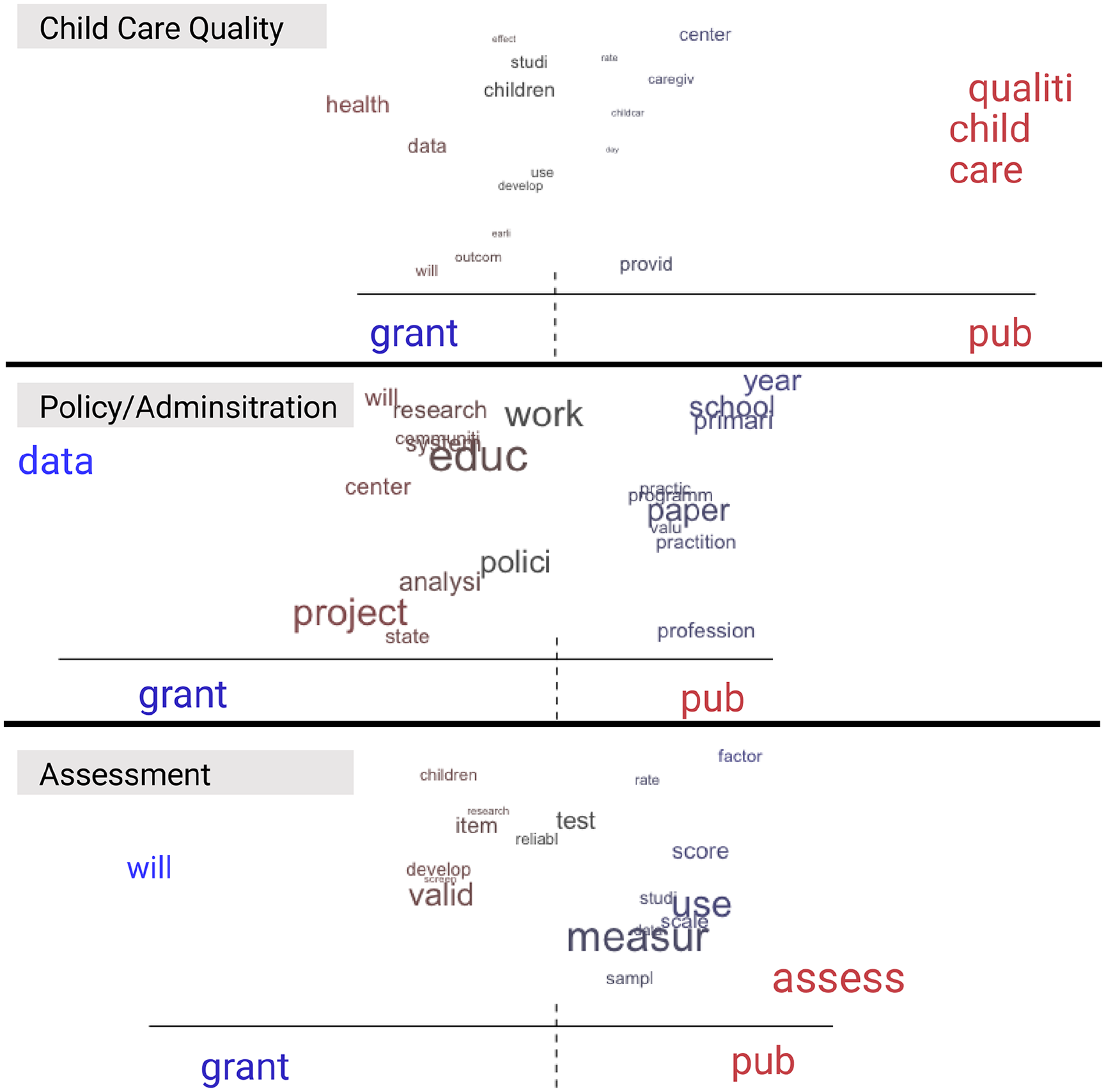
Comparing content word in the same topic between grants and publications.
Research Question 2: Predicting Topic Prevalence in Publications
We use topic prevalence in grants to examine its association with topic prevalence in publications in subsequent years. The online Supplemental Appendix G shows topic prevalence over time for grants and publications for all topics. Table 3 presents results to predict topic prevalence in publications (Models 1–3). Overall, the models confirm our hypothesis of a positive association between prior federal investment and publication output.
Predictors of Topic Prevalence in Publications

Note. Coefficients are standardized.
p < .05. **p < .01. ***p < .001.
We find that topic prevalence in grants in the previous year was significantly associated with topic prevalence in publication, after controlling for topic. An increase of one standard deviation (SD = .047, or 4.7 percentage points) in the grant topic prevalence in the previous year was associated with an increase of .046 standard deviation (.2 percentage points), SE = .020, in publication topic prevalence, p = .02 (Table 3, Models 1). This means that a 5-percentage-point increase in average topic prevalence in grants would be associated with an increase of .2-percentage-point in topic prevalence in publications in the following year. Intuitively, an increase in the average proportion that a topic made up grant documents was associated with an increase in that topic’s prevalence in publications in the subsequent year.
In general, topic prevalence in publication was not associated with topic prevalence in grants in the 3–year lag:
Discussion
The motivation for this research was to map out associations between grant and publication topic prevalence, as a mechanism to drive research production. Although the ECE field has witnessed growth in policies and scholarly interest, federal funding only supports a limited fraction of research (Walsh & Sanchez, 2010). This observation is reflected in our data set (Figure 1). While publication quantity has consistently increased over time, funding has not followed the same pattern of growth. Thus, studying the potential misalignments between federal investments and publications can help pinpoint areas for funding allocation.
Topic Patterns in Early Childhood Federal Grants and Publications
We observe patterns in how frequent a topic appeared in grants and publications over time, in ways that are consistent with external policy initiatives (i.e., the Race to the Top: Early Learning Challenge) and influential publications. We find that grants tended to focus on topics of health and intervention, whereas publications tended to more frequently cover a wide range of topics, from teaching and care quality to literacy. Interestingly, we also notice differences in the frequency of vocabulary use within the same topic in grants versus publications, for example, grants appeared to more frequently use words like “data” in discussing topics of policy, administration, and assessments. These patterns are consistent with trends in ECE, as revealed by smaller-scale content analyses of education grants’ focus on evaluation-based work (Barnett, 2011; Engle et al., 2011; Heckman, 2006, 2011).
We find topics with less of a difference in prevalence in grants and publications, such as assessment and measurement. The discussion on standards and evaluation can be linked to the growing amount of evidence that quality child care has long-term impacts for academic and behavioral outcomes into adolescence (Vandell et al., 2010). Teacher’s use of formative assessments is important for improving program quality because it provides teachers with information about each child’s developmental progress, allowing for individualized instruction and care (Ackerman & Coley, 2012). Indeed, the recent Race to the Top: Early Learning Challenge initiative gave priority to states that focused on strengthening their use of evidence-based assessments (Congressional Research Service, 2016). The topic prevalence in both grants and publications studying child assessments maps onto the need to develop psychometrically sound measures of children’s development and learning for diverse populations of young children, and to study the impacts of early care and its potential fadeout in later years (Russo et al., 2019; Vandell et al., 2010; Yoshikawa et al., 2013).
Importantly, the more numerous prevalence of topics such as professional development or theory/concept in publications, compared with grants, may reflect advances in the ECE field and areas for increased federal investment. Take an example of the topic around teaching and professional development. The professional development topic occurs more frequently in publications, which highlights the growing attention to the preparation of teachers, observation of classroom practices and interactions with children, and effective professional development (Vitiello et al., 2018; Whitebook et al., 2012; Zaslow et al., 2010). Assessing the components of teacher performance and effective practices for early care practitioners is complicated, as there is no universal standard for high-quality practice (Early et al., 2007; Lin & Magnuson, 2018; Whitebook et al., 2012). Thus, to inform policy, gaps remain to understand nuances in early care professional development, effective practices, and variation in teacher–child interactions (Zigler et al., 2011).
Overall, the topic prevalence results highlight areas that can benefit from focused funding attention, such as policy/administration, theory/concept, or special education policy. These topics have the highest average prevalence in our corpus, but are less present in grant abstracts. Our findings illuminate potential areas for grant reallocation with the aim of a comprehensive advancement of the ECE field.
Predicting Topic Prevalence in Publications
Aligning grant focus with publication topic is important, because prior work suggests that grants can drive subsequent publication production. Our findings largely converge with findings from prior research about the positive association between publication and grants. We find that a topic that appears more frequently in federal grants would be associated with higher prevalence in publications in the subsequent year. This increase in topic prevalence can be attributed to the publications from the funded projects. The observed association can also indicate the broader ECE field’s response to the grants topics in a given year. This finding consequently suggests that grants may motivate future scientific activities, by allocating funding to certain areas of inquiries. However, these regression results only reflect a descriptive analysis of the relation between grants and publications, rather than causal relations.
We contribute to understanding of science research policy, an area that is largely underexplored in education, and in early childhood in particular. Our findings suggest a more immediate follow-up effect, compared with the 5-year lag in the association between federal research funding and research output in science fields that prior research has observed (Jacob & Lefgren, 2007). Frameworks on the interaction of R&D and grants have posited a two-way mechanism, where federal investments and scholarly production are interlinked (Van Der Meulen, 1998). Science knowledge production can inform federal initiatives, and government institutions can provide incentives for scientific productivity (Whitty, 2006).
While it is encouraging that grants appeared to motivate research, we find a lack of strong alignment over longer time periods. This finding highlights the state of early childhood investments, where federal initiatives and research in ECE have historically been driven by multiple stakeholders with varied interests, as opposed to building on one agenda (Cohen-Vogel, 2005; Gormley, 2011; Nadeem et al., 2010; Rose, 2010). Our findings illustrate the need for more consistent funding schemes, and future inquiries into how funding may motivate publication over longer time periods.
Methodological Contributions
In this study, we extend prior work (Walsh & Sanchez, 2010) by applying computational approaches to review a more comprehensive corpus of work, rather than manually pulling from subsets of journals. There are two main affordances for this approach. First, we reduce the manual coding of the document content. Second, STM provides affordances for exploring potential differences in topical content by covariates (grants vs. publications), in ways that are semantically meaningful and useful toward hypothesis testing. The STM offers key insights into the different focus in the same topic, leading to new research directions. For example, a future content analysis can delve into the difference in data types proposed in grants versus publications in intervention studies, and how these focuses may shape future publications and follow-up grants.
Limitations and Future Research
Our analyses only explore the association between grants and publications, rather than establishing causality. In addition, we do not include other predictors in prior research on the relation between funding and R&D, such as researchers’ collaboration network, career seniority, and citation impact (Ebadi & Schiffauerova, 2016). Finally, our publication corpus focuses on education fields, and may be exclusive of other fields such as health. Future research should consider those variables to examine whether topics with high responsiveness between grants and publications predict more productivity in subsequent scholarly output. Researchers can examine variations across state policies and private investments, as there may exist crowd-out effect of federal funding on publications and funding at the state and organizational levels (Lanahan et al., 2016). Finally, beyond comparing keywords and topics, future work can leverage emergent NLP techniques to examine the overlapping content structure between grants and publications.
Conclusions
In this study, we explore the topic prevalence and content in publications and grants in early childhood over time. To the best of our knowledge, this is the first study to apply NLP approaches to examine research and federal investment trends in education. We summarize our main findings in light of their implications for policy and research.
We find that grants appeared to more likely focus on health and intervention studies, while publications appeared to cover a wider range of topics. This finding illuminates the shifting landscape in the field to emphasize broad, systemic aspects of early childhood. Findings further indicate that higher topic prevalence in grants in a given year was related to higher prevalence in subsequent publications, echoing science policy research.
These findings have practical implications for the administration of federal resources. It is encouraging that federal investment appeared to motivate scholarly production. However, grants appeared to only cover a smaller range of topics, compared with publications. A relevant policy recommendation is to establish centralized resources to link research findings across disciplines to inform future policies and subsequent R&D.
We illustrate the affordances of text analyses approaches, namely structural topic modeling, to explore the latent topics of a large document corpus. While prior work in science policy has relied on bibliometrics, we tap into the document content to explore the relation between funding and research. In the process, we illustrate ways to establish semantic, predictive, and hypothesis validity for the results.
In sum, findings reflect the landscape of early childhood and underlying structures of research and grants content. Understanding the relation between research and government agenda has implications for promoting publications in early childhood, a rapidly expanding area that has far-reaching impacts for children, families, educators, and society.
Supplemental Material
sj-docx-1-ero-10.1177_2332858420979568 – Supplemental material for In or Out of Sync: Federal Funding and Research in Early Childhood
Supplemental material, sj-docx-1-ero-10.1177_2332858420979568 for In or Out of Sync: Federal Funding and Research in Early Childhood by Ha Nguyen and Jade Jenkins in AERA Open
Supplemental Material
sj-xlsx-2-ero-10.1177_2332858420979568 – Supplemental material for In or Out of Sync: Federal Funding and Research in Early Childhood
Supplemental material, sj-xlsx-2-ero-10.1177_2332858420979568 for In or Out of Sync: Federal Funding and Research in Early Childhood by Ha Nguyen and Jade Jenkins in AERA Open
Footnotes

Authors
HA NGUYEN is a PhD student in STEM Teaching and Learning, School of Education, University of California-Irvine. She applies learning analytics to understand ways to promote student-centered, equitable learning in STEM through responsive digital environments.
JADE JENKINS is an assistant professor at the School of Education, University of California-Irvine. Her research interests include early childhood development, child and family policy, policy analysis and management, and program evaluation.
References
Supplementary Material
Please find the following supplemental material available below.
For Open Access articles published under a Creative Commons License, all supplemental material carries the same license as the article it is associated with.
For non-Open Access articles published, all supplemental material carries a non-exclusive license, and permission requests for re-use of supplemental material or any part of supplemental material shall be sent directly to the copyright owner as specified in the copyright notice associated with the article.
