




Abstract
The modern classroom is becoming increasingly diverse, with many countries seeking to develop teacher self-efficacy in multicultural classrooms (TSMC) to effectively teach diverse students by offering professional development in multicultural education (PDME). Using the Teaching and Learning International Survey 2018, we examine whether the teachers’ experience in PDME improves TSMC, as well as whether TSMC mediates the relationship between PDME and teachers’ perceptions of school climate in secondary schools in the United States and South Korea. We find a significant positive relationship between PDME and TSMC and that TSMC plays a mediating role between PDME and school climate. The findings suggest that PDME not only plays a key role in enhancing TSMC but also promotes a positive school climate.
Keywords
Classrooms are becoming culturally, racially, ethnically, and linguistically diverse. In 2018, more than half of U.S. students were non-White (52.5%), and such diversity continues to rise (Hussar & Bailey, 2019). This trend is seen not only in the United States and other Western countries such as Germany and the Netherlands (Koehler & Schneider, 2019) but also in some Asian countries, such as South Korea (hereafter Korea), Japan, and Taiwan, where cultural homogeneity is a general demographic—though one recently challenged by globalization (McAuliffe & Ruhs, 2017; Parreñas & Kim, 2011). Although classroom diversity allows teachers and students to have different perspectives and a rich learning opportunity (Banks et al., 2001), not all teachers are equipped with the efficacy of teaching students in multicultural classrooms in both Western and Asian countries (Castro, 2010; J. Kim & Jeon, 2017). In fact, teachers often teach according to their own cultural biases, with teacher preparation programs being far from successful when it comes to incorporating multicultural perspectives into their programs (Allen et al., 2017; Gorski, 2009; Sleeter, 2001). Accordingly, in both Western and Asian countries, research has shown that students from marginalized groups, including students of color, second-language learner, and immigrant students, fall behind in terms of academic performance (Kirksey et al., 2020; Lin & Lu, 2016), high school graduation rates (Heckman & LaFontaine, 2010), access to postsecondary education (Lemmermann & Riphahn, 2018), and a feeling of belonging to country (S. Choi & Cha, 2019).
In order to better prepare teachers for teaching in diverse classrooms, professional development in multicultural education (PDME) is a useful and viable approach among educational leaders (Irvine, 2003; Molle, 2013). In other words, in light of the increasing awareness of the diversity of students, cultural and ethnic gaps between students and teachers, and goals of instructional practices (Banks et al., 2001; Ladson-Billings, 1995), PDME has been used to help teachers reflect upon their teaching, grasp the cultural diversity of their students, synthesize the connection between teaching and learning, and promote inclusive learning environments among diverse students (Banks et al., 2001; Parkhouse et al., 2019). Although the features of these programs vary, PDME is designed to help to develop teacher self-efficacy in multicultural classrooms (TSMC; Grimberg & Gummer, 2013; Voltz et al., 2003). As a result, PDME serves to “contribute to teachers’ self-efficacy [emphasis added] and success in working with culturally diverse students” (Parkhouse et al., 2019, p. 416), while incorporating several approaches, such as culturally relevant pedagogy (CRP; Ladson-Billings, 1995), culturally responsive teaching (CRT; Gay, 2002), and culturally sustaining pedagogy (Paris, 2012) into their programs. While qualitative research has shown the importance of these approaches (e.g., Brown & Crippen, 2016; Y. Choi, 2013), quantitative evidence on the effectiveness of PDME on TSMC is scarce (Parkhouse et al., 2019). In fact, only two studies respectively used quantitative analysis and found a positive association of PDME with teachers’ cultural competence (DeJaeghere & Cao, 2009) and the use of equitable teaching practices (Grimberg & Gummer, 2013). Yet, despite the contributions, these studies were both based on a relatively small number of teachers in a few U.S. regions.
Not surprisingly, after reviewing the literature on PDME, Parkhouse et al. (2019) argued for the need for studies using large-scale datasets to shed more light on PDME and its effectiveness on teachers. Furthermore, research suggests that PDME is not limited to develop TSMC but may extend to encourage teachers to enhance the elements of school environments such as inclusive and collaborative learning capacities and social relationships (Aujla-Bhullar, 2011; Dimitriadou et al., 2012; Voltz et al., 2003). These school environments have been shown to build a positive school climate, defined as the quality and characteristics of schools (Bear et al., 2014; Cohen, 2009). While TSMC posits the various aspects of school climate including positive teacher-student relations, collaboration, and teaching and learning as the key criteria that teachers use to teach students in multicultural classrooms (Brown-Jeffy & Cooper, 2011; Siwatu, 2007), we know less about how PDME, TSMC, and school climate are interrelated with each other. Given the roles of PDME in TSMC and the possible mechanism that PDME may help create a school-wide climate of learning, collaboration, and student-teacher relationships through TSMC, its association with both TSMC and school climate warrants further study.
To attempt to close this gap in the literature, as well as contribute to understanding of teacher professional development, we examined whether participating in PDME related to TSMC and school climate. Specifically, we used a mediation analysis on the Teaching and Learning International Survey (TALIS) 2018 to understand how the relationship between PDME and school climate was mediated by TSMC. Because PDME aims to develop TSMC (Parkhouse et al., 2019), and as the main principles of TSMC are consistent with the components of school climate (Brown-Jeffy & Cooper, 2011; Siwatu, 2007), we hypothesize that TSMC plays a mediating role between PDME and school climate. Since the relationship between PDME, TSMC, and school climate has been not explored with quantitative approaches to date, this study aims to provide a fuller picture of the complicated relationship. The following research questions will guide this study:
One of the advantages of TALIS is that it allows us to explore our research questions in different educational systems. Scholars have noted that multicultural education has been widely institutionalized across the world, chiefly due to transnational isomorphism in multicultural education policy (Cha & Ham, 2014). The Korean government has also adopted PDME as a means of teacher training to respond to the increase in diversity in schools (Mo & Lim, 2013). However, after a rigorous review of the literature, we found that no study has provided insights into the relationship between PDME, TSMC, and school climate based on a comparative perspective. As Noah (1984) states, “Properly done, comparative education can deepen understanding of our own education and society; it can be of assistance to policymakers and administrators, and it can form a most valuable part of the education of teachers” (p. 551). From a comparative perspective, this study examines whether an internationally traveling policy—PDME—produces transnational results, even in different contexts (Nir et al., 2018).
In this study, we consider two countries, the United States and Korea, to examine whether our research questions hold in different contexts and provide implications for both Western immigrant and Asian emerging immigrant societies. We chose these countries because they have similar and dissimilar education systems—that is, they are sufficiently alike to warrant a comparison but sufficiently unalike to offer a useful contrast. We discuss their characteristics in detail in the literature review, while also addressing the following question:
Literature Review
Understanding of TSMC
TSMC is another domain of teacher self-efficacy, defined as “beliefs in one’s capabilities to organize and execute the courses of action required to produce given attainments” in a particular context (Bandura, 1997, p. 3) while combining it with the cultural pedagogies including CRP and CRT. Grounded in Bandura’s (1997) social cognitive theory and the cultural pedagogies such as CRP and CRT, Siwatu (2007) argued that teachers should be equipped with culturally responsive/relevant self-efficacy, which indicates teachers’ beliefs in their ability to adopt and employ teaching practices associated with CRP and CRT to promote teaching and learning in multicultural classrooms. Such efficacy beliefs of teachers include but are not limited to their capabilities to adapt instruction to diverse students, use students’ diverse backgrounds as a learning resource, encourage students to work together with respect for diversity, create an inclusive learning environment, and build positive relations with students (Siwatu, 2007, 2011).
In a similar vein, the literature of CRT, CRP, and multicultural education supports the idea that teachers with high TSMC contribute to students’ engagement, motivation, and competence in learning (Y. Choi, 2013; Nykiel-Herbert, 2010; Rodriguez et al., 2004) and that they help students develop cultural identity and expand social relationships that cross racial, gender, and socioeconomic lines (Gutstein, 2003; Milner, 2011; Thompson & Byrnes, 2011). Teachers with high TSMC are also able to support students in understanding sociopolitical issues and questioning existing social inequality and injustice by bridging home and school culture (Banks, 2001; Gay, 2002; Ladson-Billings, 1995). Similarly, Yoonjung Choi’s (2013) case study of a Korean American social studies teacher found that teachers who bridged the gap between the home culture and school curriculum and empowered students’ cultural identity built a strong relationship with students and helped students think critically about various social, cultural, political, and historical issues and develop cross-cultural competency.
While much of the literature has used a qualitative approach (e.g., Aguirre & del Rosario Zavala, 2013; Gutstein, 2003; Nykiel-Herbert, 2010; Milner, 2011), Dee and Penner (2017) found a causal effect when teachers focused on topics of social justice, discrimination, and stereotypes on academic outcomes such as GPA, attendance, and earned credits by using a regression discontinuity design. Scholars have also argued for more large-scale quantitative research in TSMC. For example, Sleeter (2012) said that large-scale studies that examine how to help teachers teach in a culturally responsive and relevant way are needed to obtain public and political support. However, quantitative evidence that focuses on understanding the ways in which teachers improve their efficacy of teaching in multicultural classrooms is limited.
PDME
As professional development for in-service teachers is a key focus of teacher reform initiatives (Darling-Hammond & McLaughlin, 2011), there is also a growing interest in PDME to prepare teachers to teach in multicultural classrooms (Parkhouse et al., 2019). Moreover, since teacher preparation programs have been less successful in equipping teachers with the appropriate pedagogy to teach diverse students in both the United States and Korea, PDME can be an effective way to help teachers teach diverse students (Allen et al., 2017; Mo, 2009). PDME incorporates the tenets of CRP and CRT into programs to increase TSMC while providing teachers with a learning opportunity to critically reflect on teaching practices, understand the complex characteristics of diversity, and view students’ diverse backgrounds as a rich resource for teaching and learning (Alfaro & Quezada, 2010; Banks et al., 2001; Parkhouse et al., 2019).
Research reveals that PDME helps teachers abandon deficit thinking and challenge social injustice and inequality (Brown & Crippen, 2016; Schniedewind, 2001). Schniedewind (2001) found that teachers in New York, who participated in PDME, increased their awareness of the forms of discrimination based on social group membership and encouraged students to discuss issues of discrimination and stereotyping. PDME also helped teachers adapt their teaching to the cultural diversity of students (Bishop et al., 2009; Brown & Crippen, 2016; O. Lee et al., 2007). For example, teachers in New Zealand schools with students drawn largely from Māori communities learned Māori culture that they used to create an inclusive learning environment and positive student-teacher relationships (Bishop et al., 2009; Savage et al., 2011). A case study of 54 Korean teachers also found that PDME, developed based on the principles of the U.S. National Council for Accreditation of Teacher Education and Geneva Gay’s work, contributed to the efficacy of understanding diversity and ethnicity and teaching students from immigrant families (Mo et al., 2010).
Two quantitative studies, in particular, show a positive relationship between PDME and TSMC. Using data from 86 teachers in U.S. elementary schools, DeJaeghere and Cao (2009) found that participating in PDME was associated with an increase in teachers’ cultural competence. Similarly, a study by Grimberg and Gummer (2013), using data from about 30 teachers in Native American reservations in Montana, documented a positive relationship between PDME and teachers’ ability to adapt their teaching to the needs of diverse students such as second-language learners. While these studies contribute to our understanding of the effectiveness of PDME on TSMC, their findings were drawn from a relatively small number of teachers in only a few U.S. regions. Supporting evidence from large-scale or international studies is rare (Parkhouse et al., 2019). Furthermore, while the research shows that both the principles of TSMC and the outcomes of PDME are aligned with school climate, including student-teacher relations, teaching and learning, and collaborative environments (Alfaro & Quezada, 2010; Bishop et al., 2009; Siwatu, 2007), no study has distinguished the effects of PDME on school climate from those on TSMC or examined the mediating effect of TSMC on the relationship between PDME and overall school climate.
PDME, TSMC, and School Climate
The literature implies that not only does PDME play a role in equipping teachers with TSMC but also it may contribute to improving school climate in general through TSMC (C. C. Johnson & Marx, 2009). PDME may function as a comprehensive school reform tool in enhancing school climate by stimulating teachers to reflect critically on teaching practices, build positive relationships with diverse students, and collaboratively work with colleagues (Alfaro & Quezada, 2010; Bishop et al., 2009). At the same time, TSMC may function as a mediator between PDME and school climate because TSMC incorporates the various aspects of school climate such as student-teacher relations, collaboration, and enthusiasm for learning and knowledge into its principles (Brown-Jeffy & Cooper, 2011; Siwatu, 2007).
Research suggested that the various outcomes of PDME were consistent with the components of school climate (Alfaro & Quezada, 2010; Bishop et al., 2009; C. C. Johnson & Marx, 2009), which reflects the quality and characteristics of schools, including student-teacher relationships, teaching and learning practices, and collaborative capacities (Bear et al., 2014; Cohen, 2009; Malinen & Savolainen, 2016). The positive impacts of school climate have been well documented. For instance, research found that school climate had a positive impact on academic engagement and achievement (Konold et al., 2018), self-esteem (Booth & Gerard, 2014), and emotional health (Lewis et al., 2017). Research also showed that teachers’ perceptions of school climate were positively associated with reducing disruptive behavior (Mitchell et al., 2010) and improving academic achievement (Bear et al., 2014; B. Johnson & Stevens, 2006).
Our study, therefore, proposes a mechanism through which PDME contributes to enhancing school climate via TSMC given that the objectives of PDME include the various components of school climate as well as of TSMC (Parkhouse et al., 2019) and that teacher self-efficacy is constructed while interacting with the school context in which they are situated (Bandura, 1986, 1993). Various literature supported this mechanism of the relationship between PDME, TSMC, and school climate (e.g., Brown-Jeffy & Cooper, 2011; Collie et al., 2012; Thapa et al., 2013). Brown-Jeffy and Cooper’s (2011) theoretical study of synthesizing CRP and CRT argued that the cultural approaches involved teaching and learning, student-teacher relationships, and collaboration. A systematic review of school climate concluded that both teachers’ professional learning opportunities and beliefs that they can develop teaching and learning in classrooms related to school climate (Thapa et al., 2013). Research also found that the relationship between professional learning and inclusive school climate was mediated by teacher self-efficacy (Geijsel et al., 2009). Although the theoretical and empirical research supports that the benefits of PDME may extend beyond the development of TSMC to enhance school climate, after a meticulous review of the literature, we found that no research has examined the mediating effect of TSMC on the relationship between PDME and school climate by using large-scale and international data.
Contexts of Multicultural Education in the United States and Korea
In the United States, multicultural education stemmed from the ferment of the civil rights movement of the 1960s and the demands to eliminate discrimination in all elements of civil life, including education (Banks, 2013, 2015). It has been expanded to include comprehensive school reform and a change of curriculum and pedagogy of teachers to ensure an equal opportunity to learn for all students and promote equity and social justice (Banks, 1988, 1999; Sleeter & Grant, 2003). The effort has received considerable support in the notion that teachers need to understand the complicated characteristics of diversity to teach students in multicultural classrooms and help students become knowledgeable and reflective citizens (Banks, 2001; Sleeter, 2018). Meanwhile, U.S. classrooms are becoming more diverse than ever before—the number of students of color exceeded the White student population in public schools in 2014—while the teaching force has remained predominantly White, middle-class women (Cormier, 2020; Snyder et al., 2018; U.S. Department of Education, 2016). This gap between the student and teacher body is expected to widen as students of color will make up roughly 44% of the public school student population by 2028 (Snyder et al., 2019). Proponents of multicultural education have demanded that the teaching force should be more diverse to meet the needs of diverse students (Banks, 2015). Research has shown that ethnic matching has a positive effect on academic achievement among students of color by enhancing the cultural congruency between home and school (Easton-Brooks, 2019; Egalite & Kisida, 2018). Since it would take time for teachers to represent the student population demographically, Easton-Brooks (2019) stressed that ethnic matching alone cannot address the educational needs of diverse students. He emphasized that it is essential to support all teachers in working towards attaining high cultural competencies and efficacy to better serve diverse students in their classrooms. As a response, scholars have embraced PDME as a tool to compensate for the demographic imbalance between teachers and students (Banks et al., 2001; Easton-Brooks, 2019) and help teachers to understand students from different cultural, ethnic, and linguistic backgrounds. Not surprisingly, PDME has received much attention as a complementary way to equip in-service teachers with the necessary efficacy to teach diverse students based on scholarship and practices from researchers and policymakers in the field of multicultural teacher education in recent years (Parkhouse et al., 2019).
While Korea had been largely ethnically and culturally homogeneous until recently (Heo, 2018), Korean schools have also been faced with increasing classroom diversity (Park & Park, 2018). According to a recent report, the number of students hailing from an immigrant background has increased more than threefold—from about 38,000 in 2012 to about 137,000 in 2018, which accounts for roughly 3% of the student population (Korean Ministry of Education, 2019). Despite the rapid increase in diversity among students, the Korean teaching force—similar to the United States—has been predominantly monoracial, monocultural, and monolingual while the lack of diversity among teachers may result in the cultural discontinuity between teachers and students (Joshi et al., 2018; C. S. Lee, 2016; Redding & Baker, 2019). For instance, a teacher was convicted in 2015 because the teacher stated, “Why can’t you eat kimchi (Korean traditional food) even though you are a half Korean” to an immigrant student; the teacher also forced the other students to call the immigrant student an idiot (Yoo, 2015). Most Korean teachers receive little multicultural teacher education during their teacher preparation programs (Hong, 2010; Mo, 2009), and even when they do, it focuses on immigrant students’ assimilation into Korean culture (Kang, 2010). This approach was criticized by the United Nations (UN), which pointed out that “[the program] may represent an obstacle to the promotion of understanding, tolerance, and friendship among the different ethnic and national groups” (UN, 2007, p. 87). Instead, the UN advised that Korea should adopt “appropriate measures in the fields of teaching, [and] education” (UN, 2007, p. 87). Scholars have also argued that the limited scope of multicultural education in Korea stigmatizes minority students as a vulnerable group (J. K. Kim et al., 2018). Thus, in response, the Korean government has identified multicultural teacher education policy as a key agenda item, mobilizing PDME to help teachers deal with the growing diversity in schools (Mo et al., 2010; Mo & Lim, 2013). However, the effectiveness of PDME has not been well documented in the literature in either Korea or the United States, leaving unanswered whether PDME serves as a vehicle for preparing teachers to teach in multicultural classrooms or improves overall school climate.
The United States and Korea share similar and dissimilar aspects of PDME, diversity, and multicultural education. The two countries differ in the following respects: (1) the scope of U.S. multicultural education and PDME is relatively wide regarding aspects of identity such as race/ethnicity, culture, language, gender, religion, social class, and so on whereas the focus of multicultural education in Korea is mainly limited to immigrant groups (i.e., North Korean defectors, international marriages, and migrant workers); and (2) U.S. PDME is decentralized by local districts and schools, but in Korea, it is centralized and mainly coordinated by the government and the national institutions. At the same time, they have similarities in the following areas: (1) the student population is becoming more diverse while the teaching force remains homogeneous; (2) teachers expressed and often have a lack of efficacy of teaching in multicultural classrooms; and (3) they have implemented PDME as a means of teacher training to deal with this challenge.
From a comparative perspective, the investigation into the relationship between PDME, TSMC, and the school climate in both countries where the similarities and dissimilarities exist provides practical and theoretical implications. Practically, it offers U.S education researchers, practitioners, and policymakers evidence for the generalizability and adaptability of PDME while persuading stakeholders of the advantages of maintaining and implementing it (Phillips, 2000). For Korea, it can also support their strategy of adopting PDME for successfully preparing teachers for multicultural classrooms. Other countries where there are an increase in student diversity and the challenge of preparing teachers for diverse students may find an advantage by considering adopting PDME from the results of the current study. Last, given that PDME is an example of policy borrowing in the multicultural education policy, which has been exported from the United States to Korea, to improve their educational system, our comparative study advances the literature by examining whether the traveling policy—PDME—functions in the same direction in the different contexts (Nir et al., 2018).
Method
To examine our research questions, we employed a mediation analysis by using the data from the TALIS (2018) coordinated by the Organisation for Economic Co-operation and Development (OECD). TALIS is a large-scale international dataset that captures the perspectives and experiences of teachers regarding learning and working environments in lower secondary schools (OECD, 2019). In 2018, for the first time, TALIS collected detailed information about PDME and TSMC, which provide an opportunity to assess the research questions of this study (Ainley & Carstens, 2018). TALIS employed a stratified two-stage cluster sampling technique in each country: A first-stage random sample of 200 schools was followed by a second-stage random sample of 20 teachers from selected schools.
Analytical Sample
We used teacher surveys, which consisted of 2,931 teachers in 165 schools in Korea and 2,560 teachers in 166 schools in the United States. Although TALIS 2018 surveyed TSMC and participation in PDME, the questionnaires asked only those who had taught in a classroom with students from different cultures. This restricted our analytical sample to 696 teachers in 152 schools (Korea) and 2,050 teachers in 165 schools (the United States)—a decrease of about 75% and 20%, respectively. Although this decrease is considerable in Korea, the proportion of teachers who have taught in a diverse classroom mirrors the general educational context in Korea. In other words, while the number of students from diverse cultural backgrounds is increasing in Korea, the number of teachers who teach or have taught students from diverse cultural, racial, linguistic, or national backgrounds represents less than 25% of all teachers in our data set.
Missing Data
The percentage of missing data used in the present study ranged from less than 1% (gender) to no more than 11% (school type) for Korea, and from less than 1% (years of teaching experience) to no more than 3% (school type and location) for the United States. To determine if the missing data were completely random, we conducted R. J. Little’s (1988) missing completely at random tests. Our results indicate that the missing data were not completely random, χ2 = 396.98, p < .05, and χ2 = 413.09, p < .05, for Korea and the United States, respectively.
To deal with the missing data, this study employed several approaches (i.e., listwise deletion, the multiple imputation technique, and the full information maximum likelihood estimation with structural equation modeling). The results from all approaches showed the same pattern and narrative, and the results using listwise deletion were represented for the sake of simplicity (Enders & Bandalos, 2001; Graham, 2009).
Measures
Dependent Variable: School Climate
Based on the well-documented literature on school climate (e.g., Bear et al., 2014; Cohen, 2009; Thapa et al., 2013), we used 12 survey items, which reflects teaching and learning practices, student-teacher relationships, and collaborative environments (e.g., “Most teachers in this school strive to develop new ideas for teaching and learning,” “teachers and students usually get on well with each other” and “engage in discussions about the learning development of specific students”) to construct a latent variable of school climate. Specifically, we measured school climate using factor analysis with varimax rotation on the data of the teachers’ responses to identify the dimension of school climate captured by 12 items, while also maximizing the amount of variance in the measure. We extracted one dominant factor according to two criteria: Kaiser eigenvalues-greater-than-one rule and a big dropoff in the size of eigenvalues. More detailed information on the procedure and results of factor analysis are presented in online Supplemental Appendix A and the survey items and factor loadings can be found in online Supplemental Table A.
Mediating Variable: TSMC
TALIS 2018 asked teachers, “In teaching a culturally diverse class to what extent can you do the following?” by using five items (e.g., “adapt my teaching to the cultural diversity of students” and “raise awareness for cultural differences amongst students”). The questions employed 4-point Likert-type scales (1 = not at all, 2 = to some extent, 3 = quite a bit, and 4 = a lot). We extracted one dominant factor for TSMC by using the same method as above. More detailed information on the results of factor analysis is presented in online Supplemental Appendix A and the survey items and factor loadings can be found in online Supplemental Table A.
Independent Variable: PDME
PDME was included in our model as a primary independent variable. It is a dichotomous variable indicating whether the respondents had received professional development in a multicultural or multilingual setting during the past 12 months (0 = no; 1 = yes).
Covariates
We accounted for various teacher and school level characteristics, which were identified by the literature as possible confounders. At the teacher level, gender, advanced degree (master’s degree or higher), years of teaching experience, and hours of professional development were included in the analysis (Garet et al., 2001; Pas et al., 2012). At the school level, the school type, the proportion of low-socioeconomic status (SES) students and second-language students, school location (rural or city), and school size were included (Brault et al., 2014; Garet et al., 2001). We obtained the information on the proportion of low-SES and second-language students from the teacher survey and information on the school type, location, and size from the principal survey. Table 1 lists detailed information about the names and descriptions of the variables in our study. It is important to note that while TALIS contains demographic data for teachers, it does not collect information on areas such as race/ethnicity. This restrains the present study from providing further information about the teachers. Few international datasets collect information about race since “race” is a socially constructed concept where its classification, meaning, and connotations differ by country and culture (Harris & Sim, 2002). Thus, while this study does not control for all demographic information, covariates at both the teacher and school levels in the analyses are sufficient to account for possible confounders.
Description of Variables in the Present Study
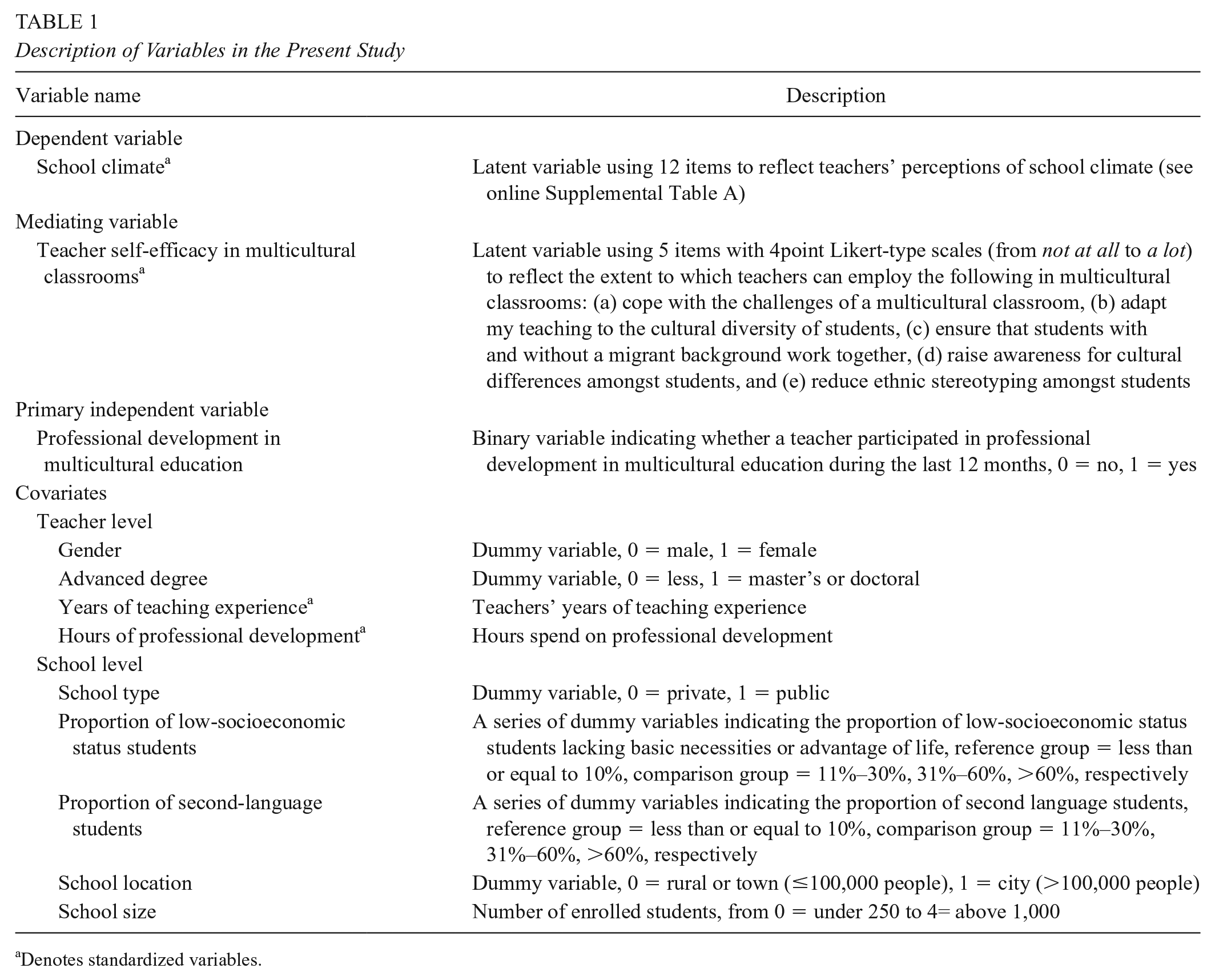
Denotes standardized variables.
Descriptive Statistics
The results in Table 2 showed that the proportion of teachers who received PDME during the past 12 months was 45% for Korea and 44% for the United States in our sample. This suggested that PDME has been widely implemented in both countries, despite their different contexts. In our sample, the proportion of female teachers was 73% for Korea and 67% for the United States. The proportion of teachers who had an advanced degree (i.e., master’s degree or higher) was 38% for Korea and 63% for the United States.
Descriptive Statistics of the Variables in the Present Study

Note. TSMC = teacher self-efficacy in multicultural classrooms; PDME = professional development in multicultural education; SES = socioeconomic status.
Denotes standardized variables.
The proportion of teachers working in a public school was 90% for Korea and 94% for the United States. For Korea, more than half of the teachers worked in a school where low-SES students accounted for less than or equal to 10%, and for the United States, it was about 33%. In terms of the proportion of second-language students, 95% of teachers in Korea worked in schools with less than or equal to 10%, but it was relatively lower (70%) in the United States. Nearly 80% of teachers in Korea worked in a school located in a city (>100,000 people) whereas 36% of those in the United States worked in a school located in a rural or town (<100,000 people). Finally, on average, teachers in the United States worked in schools with larger enrollment—from 500 to 749 students—than those in Korea—from 250 to 499 students.
Analytical Design
To examine the relationships between PDME and school climate, as well as to explore the mediating effect of TSMC on the relationship, we employed a mediation analysis to answer our research questions.
Although Baron and Kenny’s (1986) mediation procedure has been used widely in the field, scholars in the past decade have pointed out that the basis for mediation analysis can be limited. Specifically, although Baron and Kenny require the significance of the relationship between the independent and dependent variables (direct effect), this neglects other possible mediation links via other mechanisms between independent and dependent variables of interest (Pituch et al., 2005). Thus, after synthesizing past research, Rucker et al. (2011) argued that “the significance of the relationship between the independent and dependent variables, both before and after mediation tests, is unjustified and can impair theory development and testing” (p. 359).
To address this issue, we followed the guidelines for mediation analysis outlined by Zhao et al. (2010), conducting two regression models with robust clustered standard errors at the school level to account for the nested structure of the data as follows: (1) the mediator (TSMC) was regressed on the key independent variable (PDME) while adjusting for the covariates; and (2) the dependent variable (school climate) was regressed on the key independent and the mediator while adjusting for all the covariates in our model. Our model is represented by Equations 1 and 2:


In Equation 1,
Results
Within each section, we explained how the results were similar or different between both countries. Figure 1 summarizes all of the relevant coefficients of the research questions, while also accounting for all of the study’s analytic considerations. Table 3 presents all of the results of the analytic models.
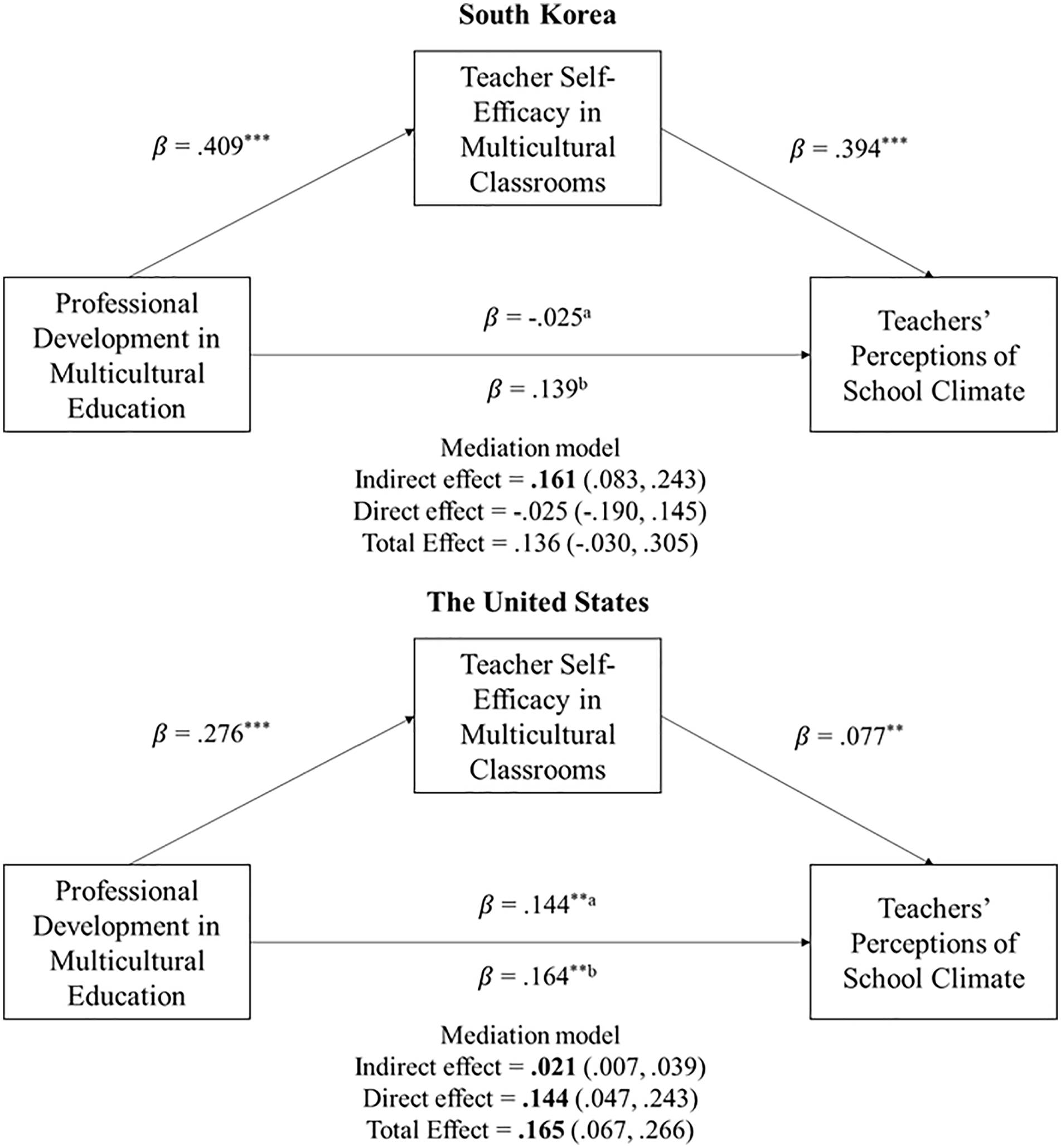
Diagram showing the main results of the mediation model.
Results of the Mediation Analyses
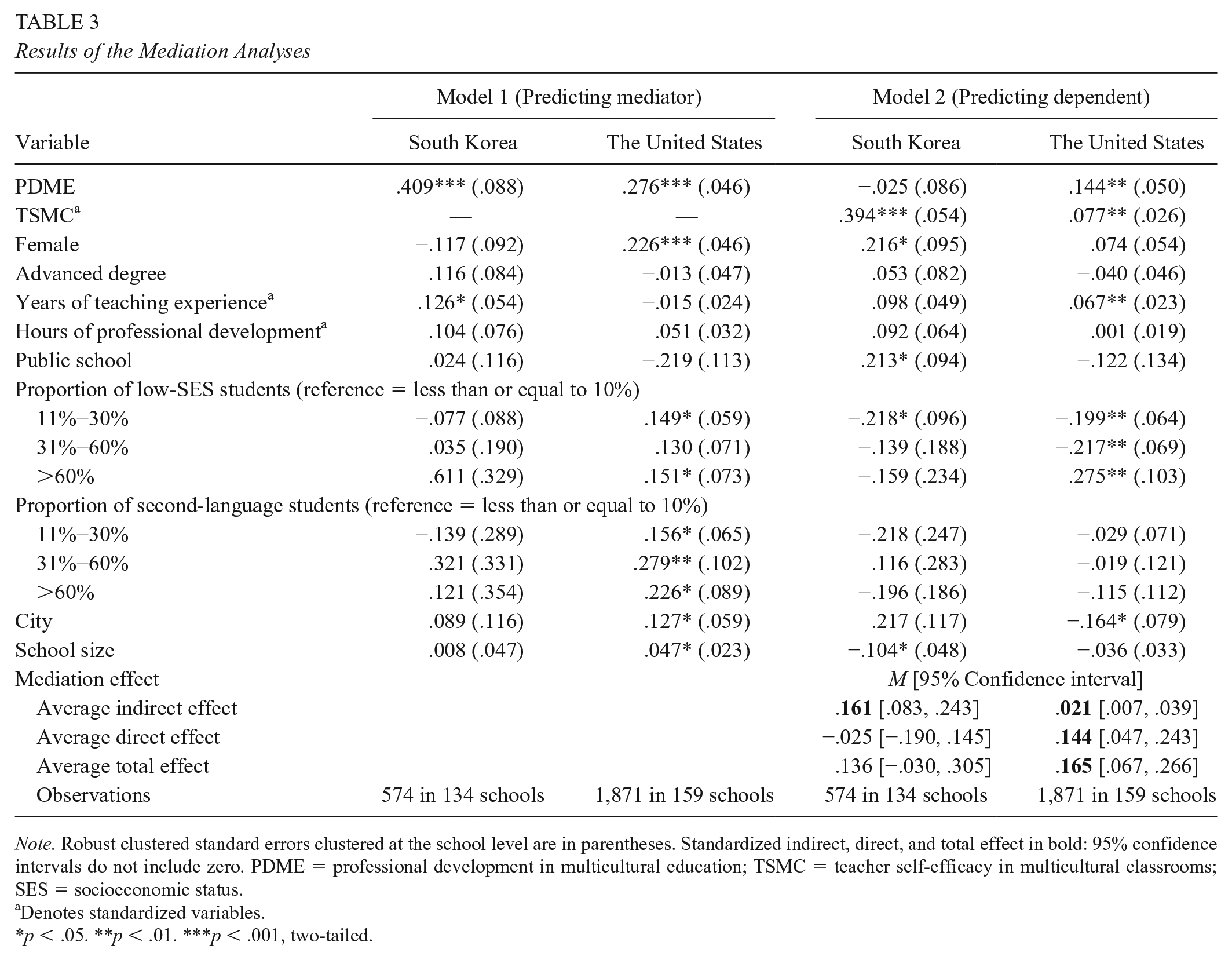
Note. Robust clustered standard errors clustered at the school level are in parentheses. Standardized indirect, direct, and total effect in bold: 95% confidence intervals do not include zero. PDME = professional development in multicultural education; TSMC = teacher self-efficacy in multicultural classrooms; SES = socioeconomic status.
Denotes standardized variables.
p < .05. **p < .01. ***p < .001, two-tailed.
As seen in Model 1, we found that PDME was significantly positively related to TSMC, both for Korea (β = .409, p < .001) and for the United States. (β = .276, p < .001), when the other factors are held constant. This indicated that the participation in PDME was associated with an increase in TSMC of .409 SD for Korea and .276 SD for the United States. The effect sizes of PDME on TSMC in Korea were relatively larger than those in the United States. Moreover, the results analyzing the direct effect of PDME without the mediator (TSMC) on the teachers’ perceptions of school climate showed that the participation in PDME was positively associated with school climate in the United States, but it was not statistically significant in Korea after accounting for the other predictors (see Figure 1). It indicated that being participated in PDME was directly related to an increase in teachers’ perceptions of school climate of .164 SD for the United States. As it is possible that the direct effect was partly carried out indirectly by the mediator (Hayes, 2009; Zhao et al., 2010), we continued to analyze our data to examine whether there was a mediating effect of TSMC on the relationship between PDME and school climate.
For our Research Question 2 as seen in Model 2, we tested whether TSMC mediated the relationship between PDME and the teachers’ perceptions of school climate. The results showed that TSMC positively mediated the relationship between PDME and the perception of school climate both for Korea (β = .161, p < .05) and for the United States (β = .021, p < .05), conditional on the other predictors. Specifically, the association of PDME with teachers’ perceptions of school climate was mediated by TSMC, resulting in an increased TSMC by .161 SD and .021 SD for Korea and the United States, respectively, even after controlling for all of the other factors in this study. The effect size of the mediating effect of TSMC on the relationship between PDME and the perception of school climate was relatively larger among Korean teachers than among those in the United States. Given that the average total effect was .136 SD and .165 SD for Korea and the United States, the proportion of the total effect explained by the mediator was roughly 1.18 and 0.13, respectively.
For the United States, we also found that the significance of the direct effect of PDME on the perception of school climate maintained in the mediation model (β = .144, p < .01), though the effect size became smaller because it passed through the mediator. Our findings indicated that, for Korea, the positive relationship between PDME and the teachers’ perceptions of school climate existed only when it was mediated by TSMC. For the United States, our results suggested that the positive relationship between PDME and the teachers’ perceptions of school climate primarily resulted from the direct effect—although the indirect effect was also significant, if relatively marginal compared to the indirect effect in Korea.
As the covariates in our analyses were conditional on other predictors, as seen in Model 1 predicting TSMC, the results of Korea showed that a 1 SD increase in teaching experience was associated with an increase of TSMC by .126 SD while the other predictors were not statistically significant. For the United States, female teachers tended to have a higher level of TSMC by .226 SD than male teachers. In terms of the school characteristics, on average, the higher proportion of low-SES and second-language students was positively associated with TSMC compared to the reference group. In addition, teachers worked in schools with larger enrollments and located in the city were likely to have a higher level of TSMC.
As seen in Model 2 predicting school climate, for Korea, the results showed that female teachers and teachers worked in public schools were likely to have a higher perception of school climate than their counterparts by .216 SD and .213 SD, respectively. Yet, on average, teachers worked in schools with a higher proportion of low-SES students and with larger enrollments had a lower level of school climate compared to their comparison groups by .218 and .104 SD. For the United States, a 1 SD increase in teaching experience was associated with an increase in school climate by .067 SD. However, in terms of the school characteristics, on average, a high proportion of low-SES students and being located in the city were negatively related to school climate compared to their counterparts.
Notably, in both countries, the proportion of low-SES and second-language students was positively related to TSMC whereas they were negatively associated with the perceptions of school climate despite the differences in the significance and effect size. The results were consistent with the previous literature on school climate (e.g., Brault et al., 2014; Kotok et al., 2016) whereas more studies on TSMC and the teacher and school characteristics are needed to provide conclusive evidence.
The Result of the Sensitivity Analysis
This study checked the sensitivity of the mediation model to sequential ignorability by testing unobserved confounding of the relationship between the mediator and outcome (Forastiere et al., 2018; Imai, Keele, & Tingley, 2010). The estimate of the sensitivity analysis—ρ (rho)—indicated the correlation between the error terms in the mediator and outcome models, which would need to be explained by unobserved confounders for the mediation effect to vanish (Imai, Keele, & Yamamoto, 2010). The results represented that ρ was .38 and .08 at the point where the average indirect effect became zero for Korea and the United States, respectably (see online Supplemental Appendix B for more details). Although this study was not able to make strong causal assertions, the results of the sensitivity analysis showed a moderate risk of violating the sequential ignorability assumption for Korea. However, more caution is needed in the interpretation of the results for the United States.
Discussion and Implications
The findings of this study suggest that professional learning experience in multicultural education has an important role to play in equipping teachers with TSMC in classrooms. Moreover, our analysis finds that TSMC in both the United States and Korea positively mediates the relationship between teachers’ participation in PDME and their perceptions of school climate. In other words, our study reveals that PDME not only improves TSMC but also enhances school climate through TSMC. The study has both local and global implications for teacher development and multicultural teacher education policy, as well as for practices related to professional development for promoting TSMC and school climate.
First, our findings provide evidence that PDME significantly helps teachers develop their TSMC, which has been shown to make learning more relevant and help empower students culturally and socially (Gutstein, 2003; Milner, 2011; Rodriguez et al., 2004). The results of our study are particularly significant given that teachers are called upon to better understand students’ diverse backgrounds, reduce stereotypes among peers, and promote educational justice and equity for all students to ensure that all students learn in a welcoming environment (Aronson & Laughter, 2016; Banks et al., 2001). Moreover, aligning with the prior literature (DeJaeghere & Cao, 2009; Grimberg & Gummer, 2013), this study provides strong quantitative evidence on the effect of PDME on TSMC, which was one of the concerns and limitations in the existing literature (Parkhouse et al., 2019). Notably, the findings from both countries further reveal that the effectiveness of PDME on TSMC is not exclusive to specific regional boundaries but also holds in different educational contexts. Given the limited data sources, translatable finding contexts (Urrieta & Noblit, 2018) can further our understanding of the contributions of PDME and TSMC in education (Parkhouse et al., 2019).
Second, our findings show that in both the United States and Korea, TSMC positively mediates the relationship between PDME and the perceptions of school climate. In other words, the benefits of participating in PDME go beyond TSMC to enhance school climate, which has been shown to have positive effects on students’ behavioral, social, and academic outcomes (Booth & Gerard, 2014; Konold et al., 2018; Lewis et al., 2017). This aligns with Judith Warren Little’s (1993) argument where she stated, “The most promising of these efforts [professional development] engage teachers collectively in studying classroom practices in ways that sometimes lead to more systemic changes at the school level” (p. 131). Moreover, for some time, this result provides a significant insight into multicultural teacher education policy since some critics of multicultural education argue that multicultural education works only for targeted groups, such as students of color (Gorski, 2009). In fact, we argue that PDME not only promotes TSMC but also help teachers to shape and build a positive school climate, from which all students benefit.
Third, in the United States, educational practitioners and scholars have devoted considerable effort to prepare teachers to accommodate and embrace the diversity of students (Villegas & Irvine, 2010). Our study suggests that PDME is an effective measure for helping teachers develop their efficacy in multicultural classrooms, which aligns with prior literature using qualitative methods (Brown & Crippen, 2016; Schniedewind, 2001). Findings of this study are particularly important as teachers are called upon to connect teaching and learning to the vast diversity of students (Banks et al., 2001; Gay, 2002), encourage students to collaborate regardless of their migrant background (Robbins, 2001), and raise students’ awareness for cultural diversity and race (Gutstein, 2003); these are all the main elements of TSMC in this study. Therefore, leaders in education need to utilize PDME to help teachers effectively teach students across racial, ethnic, and cultural lines and mobilize diversity to enrich the learning and educational experiences of their students (Cherng & Davis, 2019; Schniedewind, 2001).
The findings of this study also provide strong empirical evidence regarding the effectiveness of PDME on teachers in Korea. In fact, teachers in Korea have stated that they struggle both to embrace students’ cultural diversity and stimulate the engagement of students from different backgrounds in classrooms due to the lack of knowledge and skills concerning multicultural education (J. Kim & Jeon, 2017; Mo & Lim, 2013). Moreover, some teachers also have cultural biases that are reflected in their classrooms, with many refusing to integrate multicultural perspectives into their teaching because they believe that multicultural education works only for immigrant students (Chang, 2017). Not surprisingly, despite its potential for both teachers and students, a retreat from a multicultural education policy has often been witnessed in Korea and many other Asian countries (N. H.-J. Kim, 2015; M. Lee et al., 2019). Moreover, criticisms regarding the limited beneficiaries of the policy (e.g., immigrant and refugee students), its failure to achieve intended goals (Kymlicka, 2010), and antimulticulturalism (Ceobanu & Escandell, 2010; Inglehart & Norris, 2016) have contributed to this movement. However, the findings of this study refute those concerns, suggesting that PDME can effectively function as a multicultural teacher education policy to achieve its intended effects and produce positive school environments—TSMC and overall school climate—which may lead to a positive effect on students’ educational experience and success (Bear et al., 2014; Berkowitz et al., 2017; Dee & Penner, 2017).
Limitations and Implications for Future Research
In addition to this study’s contributions to multicultural teacher education and its effects, it also has several implications for future research.
First, its scope was to examine the relationship between PDME, TSMC, and school climate at the teacher level. Although previous research has also examined the relationship between PDME and teachers’ learning (Brown & Crippen, 2016; Charity & Mallinson, 2017; Molle, 2013), much less attention has been paid to its relation with students’ educational outcomes. As Sleeter (2012) noted that “there is a clear need for evidence-based research that documents connections between culturally responsive pedagogy and student outcomes” (p. 578), we encourage future researchers to look at how PDME and TSMC relate to student outcomes (e.g., academic achievement, global competence, and interpersonal relations) and further examine how school organization and leaders facilitate the relationship. Regrettably, to date, there are few international or national large-scale datasets from which researchers can investigate these issues. While the OECD has linked TALIS data for nine countries with the 2018 Programme for International Student Assessment, it does not include the United States and Korea (OECD, 2019). The OCED, the National Center for Education Statistics, and other agencies that collect educational datasets should consider both incorporating PDME and TSMC into their surveys and allowing the data to be merged with student surveys. This should encourage researchers to investigate any links between PDME, TSMC, and educational outcomes.
Second, as we mentioned above, the survey item of PDME was a dichotomous variable, indicating whether teachers had participated in PDME. Because PDME may vary by its contents, duration, and formats (Parkhouse et al., 2019) and the differences in professional development may lead to a varying effect on teachers’ learning (Garet et al., 2001), there might exist a heterogeneous effect of PDME on TSMC and school climate as well. In addition to the suggestion above, we suggest incorporating the different features of PDME into surveys to allow researchers to explore what makes PDME more effective or ineffective.
Although the principal domains of TSMC consist of the various competencies including academic learning, cultural competence, and sociopolitical consciousness (Ladson-Billings, 2014), the survey items in the present study primarily cover cultural competence and sociopolitical consciousness. These domains should be given greater emphasis by education researchers since we know how easily conflicts arise from cultural diversity, nationality, and race (Mak, 2020; Will, 2020). Yet, given the significant influence teachers have on their students’ academic success (Hanushek et al., 2019; S. W. Lee, 2018), future research should explore how PDME improves the academic approach of TSMC and how its development affects academic achievement such as engagement, competence, and performance.
Conclusion
Our study shows that PDME may function as a means of not only developing TSMC but also promoting their perceptions of school climate. The findings are important given that teacher preparation programs in both countries have been less successful in preparing teachers for multicultural classrooms; further, teachers often have difficulty teaching diverse students. The findings also suggest that multicultural teacher education is important not only for developing multicultural classrooms but also for improving school climate from which all students can benefit. It advocates that multicultural teacher education does not focus solely on specific student groups but functions as a vehicle for comprehensive school reform and improvement by both making learning more relevant in classrooms and building constructive learning environments and social relationships in schools.
Supplemental Material
sj-docx-1-ero-10.1177_2332858420973574 – Supplemental material for Enhancing Teacher Self-Efficacy in Multicultural Classrooms and School Climate: The Role of Professional Development in Multicultural Education in the United States and South Korea
Supplemental material, sj-docx-1-ero-10.1177_2332858420973574 for Enhancing Teacher Self-Efficacy in Multicultural Classrooms and School Climate: The Role of Professional Development in Multicultural Education in the United States and South Korea by Soobin Choi and Se Woong Lee in AERA Open
Footnotes
Acknowledgements
We would like to thank Professor Christine Sleeter for valuable comments and suggestions on this research. We also appreciate the valuable comments by the anonymous reviewers and the editor.
Declaration of Conflicting Interests
The author(s) declared no potential conflicts of interest with respect to the research, authorship, and/or publication of this article.

Authors
SOOBIN CHOI is a doctoral student in the Department of Educational Leadership and Policy Analysis at the University of Missouri, Columbia. His research interest is in teacher development, school organization/improvement, and leadership, focusing on equity and diversity.
SE WOONG LEE is an assistant professor in the Department of Educational Leadership and Policy Analysis at the University of Missouri, Columbia. His research focuses on educator quality, educator evaluation, and the educator labor market, with an emphasis on social inequality.
References
Supplementary Material
Please find the following supplemental material available below.
For Open Access articles published under a Creative Commons License, all supplemental material carries the same license as the article it is associated with.
For non-Open Access articles published, all supplemental material carries a non-exclusive license, and permission requests for re-use of supplemental material or any part of supplemental material shall be sent directly to the copyright owner as specified in the copyright notice associated with the article.
