




Abstract
More than half of community college courses are taught by part-time faculty. Drawing on data from six community colleges, this study estimates the effects of part-time faculty versus full-time faculty on students’ current and subsequent course outcomes in developmental and gateway courses, using course fixed effects and propensity score matching to minimize bias arising from student self-sorting across and within courses. We find that part-time faculty have negative effects on student subsequent enrollments. These negative effects are driven by results in math courses. We also find that course schedules could explain substantial proportions of the estimated negative effects, while faculty individual characteristics could not. Survey results on faculty professional experiences suggest that part-time faculty had less institutional knowledge regarding both academic and nonacademic services. We infer that inferior working conditions for part-time faculty, rather than inferior instructional practices, contribute to the negative effects we observed on students’ subsequent course enrollment.
Keywords
Introduction
One of the most significant trends in postsecondary education in the past few decades is an increasing reliance on part-time faculty: The ratio of part-time to full-time faculty increased from 2:3 to 1:1 from 1993 to 2013 (U.S. Department of Education, Institute of Education Sciences, National Center for Education Statistics, 2016). The dependence on part-time faculty is even greater at community colleges, where about 67% of instructional faculty are employed part-time (Hurlburt & McGarrah, 2016) and more than half of courses are taught by part-time faculty (Center for Community College Student Engagement, 2014).
The magnitude of this trend, particularly at community colleges, makes it crucial to understand the effects of part-time versus full-time faculty on student outcomes. Findings from previous research are suggestive of two hypotheses—one related to faculty member’s individual characteristics, the other to their working conditions—about why part-time faculty affect student outcomes. On one hand, part-time faculty differ from full-time faculty in many demographic and professional characteristics, including gender, race/ethnicity, degree attainment, years of teaching experience, and professional experiences in other industries (Cataldi et al., 2005). Some of these characteristics have been found to be correlated with instructional effectiveness and students’ academic outcomes (e.g., Carrell et al., 2010; Fairlie et al., 2014). On the other hand, part-time faculty members’ professional experiences at their institutions—often characterized by a lack of belonging, limited resources, and a lack of professional development opportunities—leave many part-time faculty feeling like they have to teach the most academically vulnerable students with fewer resources to support their work than their full-time colleagues have (Coalition on the Academic Workforce, 2012; Kezar, 2012; Kezar & Maxey, 2012; Leslie & Gappa, 2002). These working conditions could significantly hinder part-time faculty members’ ability to promote student success.
Determining which of these hypotheses is more valid is important, as it has implications for colleges’ recruitment and personnel practices. If empirical evidence supports the first hypothesis, colleges should focus on recruiting faculty members with characteristics that are associated with better student outcomes; if it supports the second hypothesis, colleges should focus on providing better support for part-time faculty and integrating them more fully into the institution. These two potential mediators of part-time faculty members’ effects on student outcomes are not mutually exclusive and could interfere with each other. For example, nonacademic professionals could potentially enhance students’ educational experience as a result of their work experience in private sectors, but with less teaching experiences, they may require more institutional support and professional development in pedagogy to achieve the same student outcomes as a more experienced teacher.
This article examines the effects of part-time faculty on students’ academic outcomes in developmental and gateway courses 1 at community colleges and explores potential explanations for these effects using data from six community colleges participating in a part-time faculty engagement initiative led by Achieving the Dream (ATD), a national nonprofit organization that works to strengthen student outcomes in community colleges. We used course fixed effects and propensity score matching (PSM) to minimize bias arising from student self-selection into course sections and adjust the differences in student and course characteristics in sections taught by full- and part-time faculty.
Our results show that students in course sections taught by part-time faculty tend to have better current course outcomes in both developmental and gateway courses but are less likely than their peers taught by full-time faculty to enroll in the next course in the sequence. Those who do enroll are equally likely to pass. The magnitude of the difference in subsequent enrollment rates is reduced from 5 to 3 percentage points (a 7% reduction compared with the sample mean) when the model adjusts for differences in full- and part-time faculty members’ course schedules, while instructor characteristics, including gender, race, and highest degree attainment, could not explain much of the differences in the outcome. Results from a faculty survey (N = 482) suggest that contextual and institutional factors surrounding part-time employment, rather than part-time faculty members’ individual traits, are more likely to be the mediators of the associations between part-time faculty and student outcomes.
This study contributes to the literature on the effects of part-time faculty on student outcomes in three ways. First, it is one of the few studies to explore variables related to working conditions as potential mechanisms for the effects of full- versus part-time faculty on student outcomes. Prior studies (e.g., Bettinger & Long, 2006, 2010; Burgess & Samuels, 1999; Xu, 2019) have established an association between faculty employment characteristics and student academic outcomes but have not explained why such an association exists. Findings from the current study suggest that the fact that part-time faculty are substantially more likely to teach night classes could account for a large proportion of the differences in student subsequent outcomes, while instructors’ individual characteristics could not. Survey results further illuminate how course schedules could affect part-time faculty members’ working conditions and relationships with students: When teaching only at night, part-time faculty were much less likely to have reliable access to physical resources on campus or spaces where they could meet with students. This finding suggests an important direction for further research—how factors related to part-time faculty employment affect student success.
Second, results from our faculty survey help explain why previous studies have found that community college students taught by part-time faculty tend to have higher course pass rates but lower enrollment persistence. The survey showed that the areas in which part-time faculty lack knowledge (e.g., academic advising and financial aid) may not directly interfere their teaching, but they would prevent part-time faculty from providing their students useful information on future enrollment. These findings accord with previous literature highlighting the multiple ways in which faculty could affect student success in college (Kezar & Maxey, 2012), especially through the early college experiences in their first few courses (Pascarella & Terenzini, 2005).
Last, this study is one of the first to examine how part-time faculty affect student outcomes in developmental and introductory college-level courses in math and English. The sequential nature of these courses creates an ideal context for looking at subsequent course enrollment (a proxy for learning that is not vulnerable to grade inflation) for large numbers of college students. In addition, developmental course is a unique context that should garner more attention, in part because more than 60% of community college students enroll in at least one developmental course (Chen, 2016), and in part because part-time faculty are much more likely to teach developmental courses than their full-time counterparts (Center for Community College Student Engagement, 2014). In response to low student success rates, developmental math and English courses are sites of major reform initiatives such as accelerated or corequisite pathways. Successful implementation of these reforms sometimes is faced by numerous challenges, including providing training and professional development for instructors on reformed course structure, as well as issues related to course scheduling and advising (Daugherty et al., 2018)—the same sets of barriers that part-time faculty face highlighted in this study. Given the current landscape of developmental education reforms, it is especially relevant and timely to inform colleges about the consequences that students would bear when their faculty face challenging working conditions.
Literature Review
A growing body of research is exploring the relationships between faculty characteristics and student outcomes, particularly persistence, transfer, and completion (Hurlburt & McGarrah, 2016). The earlier studies in this area mainly used data aggregated at the institutional or departmental level and found that in addition to being associated with lower persistence rates (Bettinger & Long, 2006), higher proportions of part-time faculty were often associated with lower rates of student transfer to 4-year institutions (Eagan & Jaeger, 2009; Gross & Goldhaber, 2009). Greater reliance on part-time faculty has also been found to affect graduation rates negatively. Ehrenberg and Zhang (2005), Jaeger and Eagan (2009), and Jacoby (2006) all found that graduation rates declined as proportions of part-time faculty increased in both 2- and 4-year colleges.
More recent studies have used classroom-level data linked with the course’s instructor to examine causal links between instructor quality and student outcomes. One consensus that emerged from these studies is that students’ outcomes in subsequent coursework are better measures of instructional quality than their course evaluations for the instructor or performance in the current course (Braga et al., 2014; Carrell & West, 2010). These studies found evidence that instructors who excelled at promoting contemporaneous student outcomes taught in ways that improved their course evaluations but harmed their students’ subsequent achievement in more advanced courses.
The effects themselves, however, vary across contexts. Studies using data from 4-year colleges have found positive effects of contingent faculty (those employed part-time or not eligible for tenure) on students’ subsequent course outcomes (Figlio et al., 2015) and enrollment persistence in particular majors (Bettinger & Long, 2010), though one study concluded that the importance of differences between college instructors was small (Hoffmann & Oreopoulos, 2009). Studies focusing on community colleges, meanwhile, have found negative effects of contingent faculty on students’ subsequent academic outcomes (Ran & Xu, 2019; Xu, 2019). The differences in these studies’ results are likely due to the variations in students’ academic preparedness between education sectors, the types of contingent faculty different institutions were able to attract and employ, and the employment arrangements of contingent faculty at different institutions. As Figlio et al. (2015) noted, their results could have been driven by the context of their study—Northwestern University, where students come from a rarefied portion of the preparation distribution and almost all contingent faculty have long-term contracts.
Further investigation is needed to clarify the effects of part-time faculty on student outcomes in different contexts. Among the studies cited above, only one focused on the effects of part-time faculty in a community college setting. Xu (2019) found that community college students who took their first course in a subject with part-time faculty tended to receive higher grades in that course but were less likely to enroll in and pass subsequent courses. This study only looked at outcomes in college-level courses, however, and around two thirds of community college students start in developmental courses (Chen, 2016). Students in developmental courses better represent the academic preparation distribution of community college students overall. Developmental education is also a crucial setting for promoting college completion, since high attrition rates in development sequences hinder students’ progression toward a college degree (Bailey et al., 2010).
In considering the mechanisms for any effects of part-time faculty on student outcomes, it is important to consider that part-time employment presents unique difficulties for faculty members, often entailing challenging working conditions and limited institutional support (Kezar, 2013; Kezar & Sam, 2013; Schuster & Finkelstein, 2007). Despite being held to the same pedagogical and academic standards as full-time faculty, part-time faculty have less engagement with their departments, fewer opportunities for professional training, less institutional support, and considerably lower salaries (Coalition on the Academic Workforce, 2012). Some of the challenges they experience make it more difficult for them to support students in and outside the classroom. Many part-time faculty receive teaching assignments not long before classes begin, leaving them little time to prepare their lessons. Additionally, because of their low salaries, part-time faculty often have to make teaching commitments to more than one institution to support themselves, dividing their time and attention across institutions. Some colleges do not provide office space for part-time faculty, making it more difficult for students to seek them out. These conditions limit their ability to connect with their students.
Data and Descriptive Statistics
Data Sources
The data for this article are from the six community colleges that participated in ATD’s Engaging Part-Time Faculty in the Student Success Movement project, which ran from 2016 to 2018 and for which the Community College Research Center served as the external evaluator. The colleges were selected based on their proposals for building institutional capacity to engage part-time faculty members in efforts to promote student success. Each college identified two departments or divisions to focus on and formed project teams to aid in the planning, implementation, and assessment of its engagement strategies. The data used for this article are from the project’s baseline data collection, which included student transcript data from fall 2014 to summer 2016 and a faculty survey administered in fall 2016. 2
All of the colleges selected for the project were ATD leader colleges, meaning that they had shown at least 3 years of steady improvement in specific student success metrics. 3 The colleges were selected to represent public 2-year colleges with different characteristics, and they comprise a mix of large and small colleges; rural, suburban, and urban colleges; and unionized and nonunionized colleges. As shown in Table 1, they are largely comparable with a nationally representative sample of public 2-year colleges in terms of gender and age composition, retention rate, student-to-faculty ratio, and proportion of students receiving Pell grants. They are distinct from the national sample in that they enroll higher proportions of African American students and lower proportions of Hispanic students and full-time students, and they employ lower percentages of part-time instructional staff. Given that they were designated ATD leader colleges, they may also differ from the average public 2-year college in terms of their institutional capacity in personnel and programs.
Institutional Characteristics of Six ATD Colleges Versus Public 2-Year Colleges Nationally
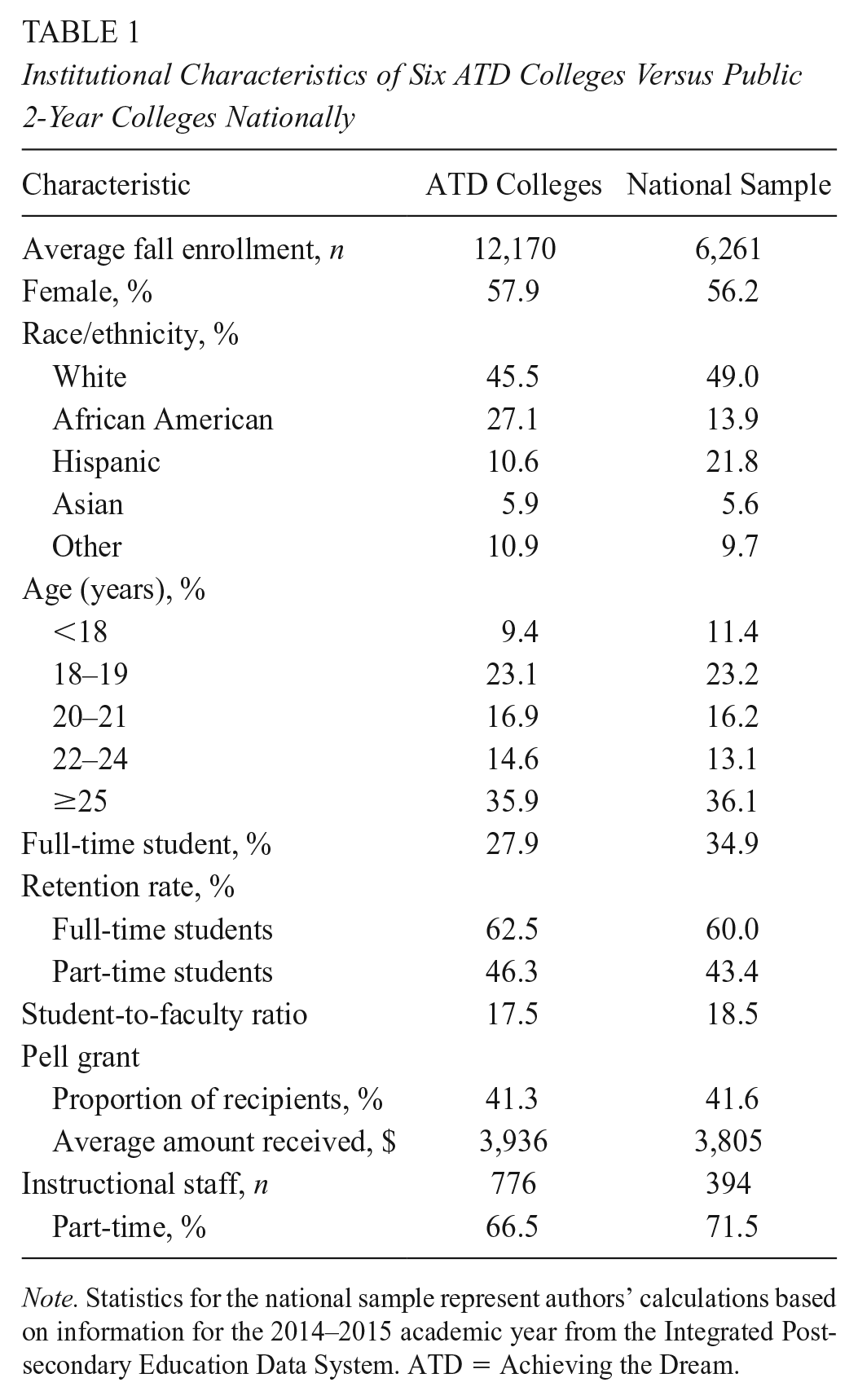
Note. Statistics for the national sample represent authors’ calculations based on information for the 2014–2015 academic year from the Integrated Postsecondary Education Data System. ATD = Achieving the Dream.
During the period of this study (from fall 2014 to summer 2016), all six community colleges offered prerequisite developmental education. Under this system, students who were placed into developmental courses or sequences had to pass them before they could enroll in gateway math and English courses. One of the colleges incorporated technology into the curriculum to support student progress in math through developmental education, where all math developmental courses were fully modularized, as shown in Appendix Table A1 (College D). Since fall 2016, three of the six colleges started to pilot Accelerated Learning Program or other forms of corequisite developmental education in both math and English. Under the new developmental course system, students deemed not college-ready are mainstreamed into college-level gateway math and English courses while concurrently enrolling in developmental courses or other forms of just-in-time academic support. 4
To assess the effects of part-time faculty on students’ academic outcomes, we used administrative data sets from the six colleges containing student transcripts at the classroom level. Our analytic sample comprises students who enrolled in the six colleges in the 2014–2015 academic year and highest level of developmental courses and gateway math and English courses they enrolled in from fall 2014 to summer 2016—a total of 38,799 course enrollments. For developmental courses, we only analyzed the last developmental courses prior to gateway courses to make sure that the subsequent outcomes for students in these courses are comparable. At the student level, the data set includes demographic information, such as gender, race/ethnicity, age at time of enrollment, and Pell grant eligibility; it also includes information on their academic attributes, such as high school credentials, high school grade point average, college placement test results, previous college enrollments, credential attainment, and dual enrollment status. Additionally, the data set includes information on each developmental and college-level course that the students took, such as course number, course delivery format, and final grade (ranging from a failing grade of 0 to an excellent grade of 4). We identified the characteristics of faculty teaching each course section via indicators provided by the college for their full-time or part-time employment status, gender, race/ethnicity, and degree attainment.
Information from a faculty survey complements our quantitative analyses of administrative transcript data. Administered to both full-time and part-time faculty in the two selected departments at each of the six community colleges in fall 2016, the survey was designed to collect baseline data on faculty members’ background and employment information, departmental culture and involvement, professional development, time usage, teaching and student services knowledge, and job satisfaction. The aggregate response rate was 39% with a total of 482 respondents, of whom 53% were part-time faculty. Though the survey data could not be matched with transcript data directly, they provide useful information on the experiences of part-time faculty members at the colleges in our study and help contextualize our quantitative findings.
Descriptive Statistics
Table 2 shows student characteristics in course sections taught by full- and part-time faculty in the analytic sample. In general, part-time faculty were more likely to teach students from disadvantaged backgrounds in developmental courses. Students in developmental math and English courses taught by part-time faculty were more likely to be racial/ethnic minorities (by 2 percentage points), were more likely to be eligible for Pell grants (by 3 percentage points), and received $112 more in grant aid on average. In gateway math and English courses, part-time faculty were more likely to teach students without a high school diploma (by 2 percentage points) and students who were not college-ready in math (by 5 percentage points), but full-time faculty were more likely to teach racial/ethnic minority students (by 3 percentage points) and Pell-eligible students (by 2 percentage points).
Student and Course Characteristics in Sections Taught by Full- and Part-Time Faculty

Note. Standard deviations are shown in parentheses.
p < .01.
Table 2 also shows differences in the classroom and faculty characteristics of course sections taught by part- and full-time faculty. Notably, part-time faculty were significantly more likely to teach weekend and night sections, especially in developmental courses. More than three times as many developmental course sections meeting after 5:00 p.m. were taught by part-time faculty than by full-time faculty. Part-time faculty were much less likely to teach online. In developmental course sections, almost all sections taught by part-time faculty were traditional face-to-face courses.
In addition, there were noticeable differences in the demographic characteristics and degree attainment of full- and part-time faculty, particularly in developmental courses. Part-time faculty members were more likely to be male and White. In terms of degree attainment, part-time faculty were much less likely to hold an advanced degree. Only 1.2% of developmental course sections with full-time faculty were taught by an instructor without a postgraduate degree; in comparison, about 20% of developmental course sections with part-time faculty were taught by an instructor without a master’s degree or higher. In college-level courses, the proportions of course sections taught by instructors without a postgraduate degree were 2.3% for full-time faculty and 12% for part-time faculty.
Method
Course Fixed Effects Model
To assess the effects of part-time faculty on students’ academic outcomes, we used a basic model relating student i’s outcome in course c, section s, at campus j, in semester t to the type of instructor the student had in course c.

The key explanatory variable in this equation is the type of instructor.
The main methodological challenge in estimating how part-time faculty influence students’ academic outcomes is students’ self-selection into different course sections according to faculty status. There are two types of sorting of concern for our estimations. First, in choosing their coursework, students may sort across different courses. Then, for example, if there were more part-time faculty teaching math courses than English courses, students who chose to take more math courses would be more likely to enroll in sections taught by part-time faculty compared with students who chose to take more English courses. Second, students may sort across sections within the same course based on scheduling preferences or preferences for different types of faculty. Controlling for course fixed effects addresses the first type of sorting by comparing only students in the same course, but endogeneity concerns remain if the second type of sorting exists.
To assess the prevalence of the second type of sorting, we conducted a student sorting test by regressing faculty employment status on a series of student characteristics after controlling for course fixed effects and section characteristics. Table 3 presents the results of that test, which indicate that after ruling out sorting across courses, students who enrolled in sections taught by part-time faculty were less likely to have a high school diploma, less likely to be deemed college-ready, and more likely to be eligible for Pell grants, suggesting that the second type of sorting remains a concern. After controlling for course scheduling, although still present, differences in student characteristics in sections taught by full- versus part-time faculty became less prevalent.
Student Sorting Test: Characteristics of Students Taking Courses With Part-Time Faculty

Note. The model controls for college-course fixed effects and section characteristics, including class size and delivery mode (face-to-face or online). Standard errors, shown in parentheses, are two-way clustered at the student and course levels.
p < .1. **p < .05. ***p < .01.
Propensity Score Matching
Since there was still evidence of student self-selection after controlling for course fixed effects and adjusting for differences in course section characteristics, we used PSM to account for student sorting within a course. The underlying assumption of the PSM model is that there are no unobserved confounding factors independent of the student-level characteristics
We used a logistic regression model controlling for course fixed effects to estimate propensity scores:

Here,
Figure 1 shows the balance of covariates before and after matching for developmental and gateway courses. After matching, the standardized percentage bias across covariates is less than 5% for all variables controlled for in Equation 2. 6 Figure 2 presents the density of propensity scores before and after matching for developmental and college-level courses; the distributions of propensity scores for students with full- and part-time instructors are similar after matching.

Balance of covariates before and after matching: (Panel A) developmental courses and (Panel B) gateway courses.

Propensity score density before and after matching: (Panel A) developmental courses and (Panel B)gateway courses.
Outcome Measures
We examined the effects of part-time faculty on two sets of outcomes: (1) current course outcomes, including persistence to the end of the course and passing the course, and (2) subsequent outcomes, including whether students enrolled in and passed the next course in the sequence and pass rates in that course conditional on enrollment. Previous studies (Ran & Xu, 2019; Xu, 2019) have demonstrated the importance of looking at outcomes beyond current course grades in community colleges. When the instructor of the course is the one assigning the grades, current course outcomes may be driven by other factors, such as different standards of grading, and may not accurately reflect how much students learned from the course.
The analyses of subsequent course outcomes required us to ensure that the courses in the analytic sample are nonterminal (i.e., that they serve as prerequisites for at least one more advanced course in the same subject). Developmental courses are necessarily nonterminal because they prepare students for gateway courses. For the gateway course analyses, we included only courses in a clearly defined sequence in the college’s course catalog. For example, College Algebra is the prerequisite for Precalculus, so we examined the effects of instructors in College Algebra on whether students continued on to Precalculus and how they performed in that course. Conversely, students are not required to enroll in more than one statistics course in most programs, so in these cases, we considered Statistics to be a terminal course and excluded it from our analyses. The identified course sequences are listed in Appendix Tables A1 and A2.
In examining student pass rates in the next course of the sequence, we also modified the main model as follows:

In addition to controlling for everything noted in Equation 1, Equation 3 includes college-course-section fixed effects (
Results
Propensity Score Matching Estimates
Table 4 presents the main estimates of part-time faculty members’ effects on students’ current course outcomes (columns 1–2) and subsequent course outcomes (columns 3–5). Students who took their developmental and gateway courses with part-time faculty tended to have better outcomes in their current course but were less likely to enroll in and pass the next course of the sequence. For example, as shown in Panel A of Table 4, compared with otherwise similar students who took their developmental course with a full-time instructor, students who took the same course with a part-time instructor were 2 percentage points more likely to persist to the end of the course and equally likely to pass it, but they were about 5 percentage points less likely to enroll in the subsequent gateway course. Considering that about one in three students in our data set who started in developmental courses later enrolled in a gateway course, this suggests that part-time faculty in developmental courses reduce students’ likelihood of enrolling in gateway courses by about 15%.
Effects of Part-Time Faculty on Developmental and Gateway Course Outcomes

Note. Results are based on the PSM model controlling for course fixed effects, term fixed effects, and student characteristics presented in Table 2, Panel A. Standard errors are clustered at college-course level. PSM = propensity score matching.
p < .1. **p < .05. ***p < .01.
The patterns are similar for gateway courses. As shown in Panel B of Table 4, compared with otherwise similar students who took their gateway courses with a full-time instructor, students who took the same course with a part-time instructor were about 2 percentage points more likely to persist to the end of the course and 6 percentage points more likely to pass the course, but they were about 2 percentage points less likely to enroll in and pass the next college-level course in the sequence.
For both developmental and gateway courses, the negative effects on enrollment in the subsequent course (column 3) are even larger than the negative effects on students’ likelihood of enrolling in and passing that course (column 4). That means the negative effects of part-time faculty mostly stem from their students’ reduced likelihood of enrolling in the subsequent course. Students who do enroll in the subsequent course are just as likely as their peers taught by full-time faculty to pass it (as indicated by the nonsignificant findings on conditional course pass rates shown in column 5).
Table 5 displays the estimated effects of part-time faculty by course level and subject. Students who took developmental English with a part-time instructor were about 3 percentage points more likely to persist to the end of the course than similar students who took the same course with a full-time instructor and equally likely to pass; they were no less likely than those peers to enroll in and pass subsequent courses. Students who took developmental math with a part-time instructor, meanwhile, were not significantly more likely to persist to the end of the course and pass than their peers who took the same course with a full-time instructor, but they were about 4 percentage points less likely to enroll in and pass the subsequent gateway math course.
Effects of Part-Time Faculty on Developmental and Gateway Course Outcomes by Subject

Note. Results are based on the PSM model controlling for course fixed effects, term fixed effects, and student characteristics presented in Table 2, Panel A. Standard errors are clustered at the college-course level. PSM = propensity score matching.
p < .1. **p < .05. ***p < .01.
In gateway courses, the patterns are fairly similar. Students in gateway English sections taught by a part-time instructor were 3 percentage points more likely to persist to the end of the course and 15 percentage points more likely to pass it than their peers who took the same course with a full-time instructor, and they were no less likely than those peers to enroll in and pass subsequent courses. In gateway math, students taught by a part-time instructor were 1 percentage point more likely to persist to the end of the course and equally likely to pass it; they were about 3 percentage points less likely to enroll in and pass the next math course in the sequence. It may not be self-evidence that enrolling and completing an additional college-level math course is a positive outcome, since students only need to complete gateway math course as the degree requirement for most non-STEM (science, technology, engineering, and mathematics) program. However, additional college-level credits in math, relative to other coursework, are found to be associated with higher probabilities of award receipt, which lead to higher earnings indirectly, even for students who do not major in math (Belfield & Liu, 2015). This makes the negative effects of part-time faculty on students’ subsequent enrollment in college-level math worrisome.
These results suggest that the positive effects of part-time faculty on current course outcomes are mostly driven by English course outcomes. The negative effects of part-time faculty on subsequent course outcomes, on the other hand, are almost entirely driven by math course outcomes. Overall, the effects of part-time faculty appear to be heterogeneous across subjects.
As shown in Table 2, there are substantial differences in both faculty characteristics and course schedules of sections taught by full- and part-time faculty, which are especially dramatic in developmental courses. Table 6, therefore, presents the results with controls for course scheduling differences (column 2) and the results after adjusting for the differences in individual faculty characteristics (column 3). After including indicators for weekend and night sections in the main model, the estimated negative effect of part-time faculty teaching developmental courses on subsequent course enrollment decreases by almost 40%, from 4.8 to 2.9 percentage points. The estimated negative effect of part-time faculty teaching gateway courses on subsequent course enrollment decreases from 2.4 to 2.1 percentage points. This smaller reduction is probably due to the less dramatic differences in part- and full-time faculty schedules for gateway courses. In contrast, after controlling for instructors’ gender, race/ethnicity, and highest degree attained, the estimated negative effects of part-time faculty on subsequent course enrollment in both developmental and gateway courses remain quite similar to the estimates from the original PSM model.
Effects of Part-Time Faculty on Subsequent Course Enrollment Controlling for Course Scheduling

Note. Results in column 1 are the same as those shown in Table 4, column 3, and are based on the PSM model controlling for college-course fixed effects, term fixed effects, and student characteristics presented in Table 2, Panel A. Results in column 2 are based on the same model with additional controls for course scheduling. Results in column 3 are based on the model used for column 1 with additional controls for faculty characteristics presented in Table 2, Panel C. PSM = propensity score matching.
p < .1. **p < .05. ***p < .01.
Robustness Checks
Common Support
One important assumption for the PSM model is the common support or overlap condition, which in our setting requires that students with the same observable characteristics have a positive probability of enrolling in course sections taught by both full- and part-time faculty. For both the developmental and gateway course models, nearly all (96%) of the observations are within the range of common support. We conducted robustness checks using observations with thick common support (propensity score of .85 or lower) and present those results in Appendix Table A3. The patterns are the same as those seen in the main results in Table 4. Students who took developmental courses with part-time faculty were about 2 percentage points more likely to persist to the end of the course (a finding significant at the 10% level) but 5 percentage points less likely to enroll in the subsequent course. Those who took gateway courses with part-time faculty were 2 percentage points more likely to persist to the end of the course and 6 percentage points more likely to pass it but 2 percentage points less likely to enroll in the subsequent course. These findings suggest that the common support condition does not pose a barrier to the main analyses.
Alternative Models
As with any nonexperimental analysis, it is impossible to rule out the possibility that students who enrolled in course sections taught by part-time faculty differ in unobservable ways from those who enrolled in course sections taught by full-time faculty, even when extensive controls are included in the analytic model. To assess the robustness of our main results, therefore, we estimated the effects of part-time faculty on subsequent course enrollment using models with different underlying assumptions; our results are shown in Appendix Table A4. Column 1 presents the estimates from our preferred model with college-course fixed effects with PSM, column 2 presents the estimates from a model controlling for college-course fixed effects only, and column 3 shows the estimates from a model controlling for college-course fixed effects and student individual fixed effects. The results of all three models reveal similar patterns. As discussed in the Propensity Score Matching section, the model controlling for student individual fixed effects uses within-student, across-subject variation in the type of instructor with whom the student took developmental or gateway courses. In our sample, only 9.7% of students took their developmental courses with different types of faculty across subjects, and as a result, the estimates in column 3, Panel A, are quite noisy. Nevertheless, the results are consistent with our preferred model.
Potential Explanations for the Effects of Part-Time Faculty
Course Scheduling
Part-time faculty teaching a much higher proportion of night and weekend course sections could contribute to their estimated negative effects on students’ subsequent outcomes in two ways. Course scheduling is directly related to the types of students attending the course sections. As the results from our student sorting tests show in Table 3, after adjusting for differences in course schedules, gaps in student characteristics in sections taught by part-time versus full-time faculty became less prevalent. In this regard, controlling for course scheduling reduces the bias in the estimated effects of part-time faculty on student outcomes. Additionally, course scheduling could also be a mediator for the effects of part-time faculty on student outcomes. Working outside of regular business hours makes it difficult for part-time faculty to access campus resources, and it could also reduce their opportunities for interacting with students (e.g., during office hours) and prevent them from engaging with students outside of the classroom.
The results from the faculty survey suggest that these phenomena are occurring at our six colleges. Among survey respondents, about one third of part-time faculty reported that they taught only night or weekend classes, whereas around 4% of the full-time faculty stated the same. (These findings are largely consistent with the results from the transcript data.) As shown in Figure 3, working outside of regular business hours made it significantly harder for faculty to access physical resources on campus. Notably, among part-time faculty teaching only evening or weekend classes, 33% had no access to space to meet with students, 19% did not have a regular desk or workstation, and 24% lacked basic office and teaching supplies. Since we could not match these survey findings with administrative data directly, we cannot rule out other potential factors that are overlapping with the fact that part-time faculty members teach more night or weekend classes. There might be other explanations related to part-time faculty members’ working conditions that are driving the results presented in this study. This is an important direction for future research to explore.
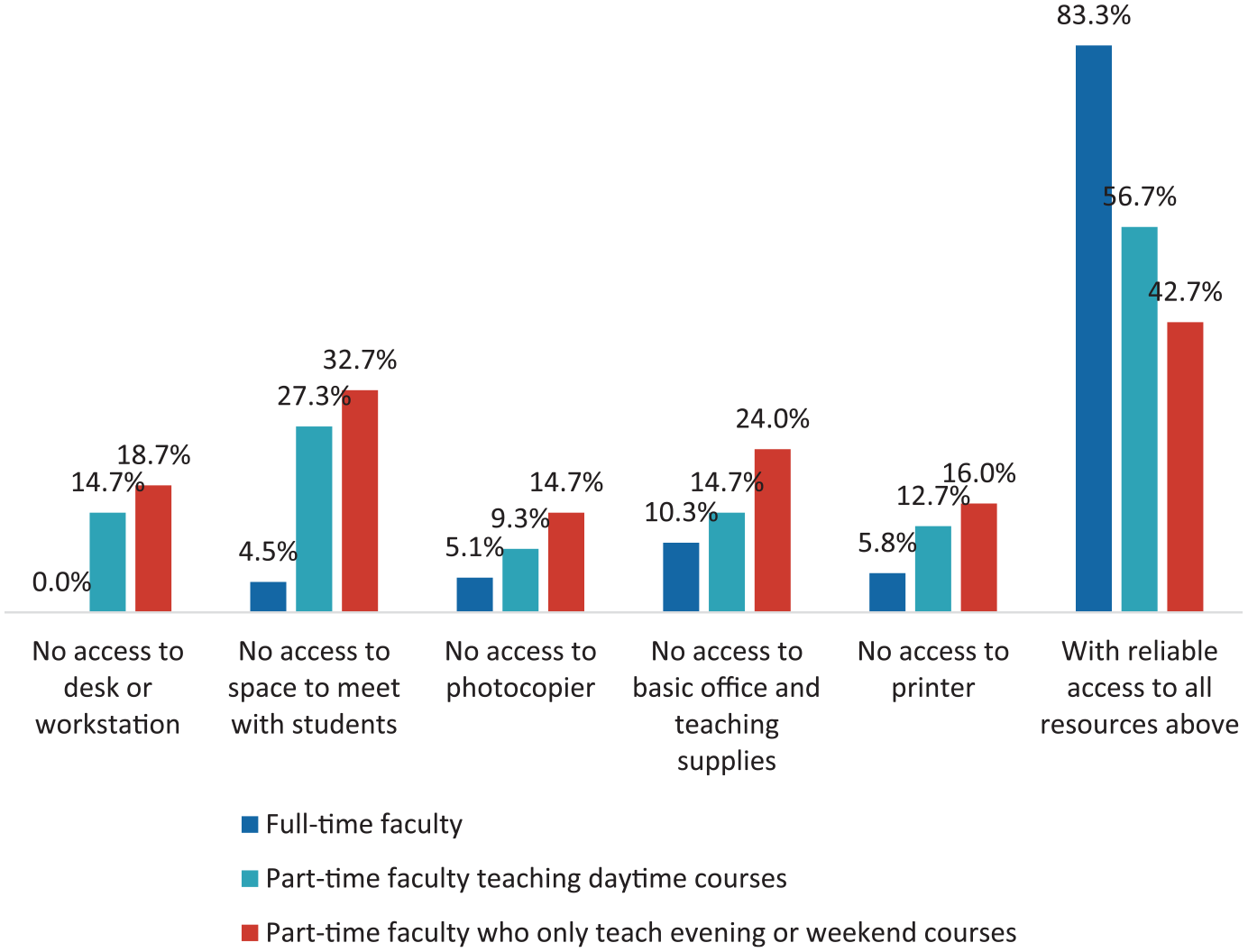
Reliable access to physical resources on campus.
Institutional Knowledge
As discussed in the Propensity Score Matching Estimates section, students who took their first developmental or gateway course in a sequence with a part-time faculty member were less likely to enroll in the next course in the sequence than students who took the same courses with a full-time faculty member. One potential explanation is that part-time faculty may be weaker instructors than their full-time counterparts or less responsive to students’ needs. Alternatively, part-time faculty may not have the institutional or departmental support they need to advise students effectively on which courses to take. For example, they may lack knowledge about course sequences and the credit requirements for a degree and, therefore, be unable to advise students to finish a full course sequence. The fact that the negative effects of part-time faculty are mostly concentrated on enrollment in the next course instead of passing the next course leads us to believe that the second hypothesis is more plausible.
The results of the faculty survey also support this hypothesis. As shown in Figure 4, significantly fewer part-time faculty than full-time faculty agreed with the statement that they had received information on various student support services, including advising students, effective instructional practices, and instructional technology. For example, about half of part-time faculty reported that they had received information on advising students compared with 70% of full-time faculty.

Faculty reporting they somewhat to strongly agree they had received information on student support strategies.
Part-time faculty also reported having less knowledge about both academic and nonacademic student services. Figure 5 shows that part-time faculty were less likely to report being knowledgeable about academic supports, academic advising and planning, and identifying students in need of support. In addition, part-time faculty were less knowledgeable about nonacademic services that are directly related to student success, such as financial aid. These survey results suggest that part-time faculty are at a disadvantage when it comes to accessing information on students’ performance, advising students, and helping students engage with college life.

Faculty reporting they were somewhat to very knowledgeable about student support services.
Discussion
Understanding the effects of part-time faculty on community college student outcomes in developmental and gateway courses is of great importance, in part because of the heavy reliance on part-time faculty to teach these courses in public 2-year colleges (Center for Community College Student Engagement, 2014; Hurlburt & McGarrah, 2016), and in part because of the critical role these courses play in community college students’ progression toward college completion (Bailey et al., 2010).
Evidence from the current study suggests that community college students who take their developmental and gateway English and math courses with part-time faculty tend to have better outcomes in those courses than their peers who take the same courses with full-time faculty; the former, however, are less likely to enroll in and pass the next course in the sequence. The negative effects of part-time faculty on subsequent course outcomes are mostly driven by their effects on enrollment and are more pronounced in math than in English. These results could help explain the negative associations between reliance of part-time faculty and institution- or department-level student transfer and completion outcomes (e.g., Eagan & Jaeger, 2009; Jaeger & Eagan, 2009), and they largely accord with findings from the only other study to date examining the causal effects of part-time faculty on student outcomes in the context of public 2-year colleges (Xu, 2019).
The current article advances the literature on the effects of college instructors on student outcomes by exploring the mechanisms for such effects. While individual characteristics, including gender, race/ethnicity, and highest degree attained, could not explain the negative effects part-time faculty had on students’ subsequent course outcomes, adjusting for differences in the course schedules of part- and full-time faculty could account for a substantial proportion of the effects. Results from a faculty survey further suggest that teaching a higher proportion of night or weekend sections exacerbates the challenges associated with part-time employment. Part-time faculty at the six colleges in our study were more likely than their full-time colleagues to lack access to campus resources when teaching outside of regular office hours, especially spaces to meet with students. They also tended to be less knowledgeable about academic and nonacademic supports available to students. A lack of resources and institutional knowledge may prevent part-time faculty from advising and engaging with their students as effectively as their full-time counterparts. The survey results help contextualize our findings, which contrast with those from earlier studies on the effects of contingent faculty on student outcomes using data from elite research university and other public 4-year colleges (e.g., Bettinger & Long, 2010; Figlio et al., 2015). Context is important in interpreting our results, since part-time faculty at different types of higher education institutions may experience different working conditions.
This study also provides some of the earliest evidence on how part-time faculty affect student outcomes in developmental and introductory gateway courses. Students enrolled in these courses may require more guidance from faculty about institutional supports such as tutoring and advising relative to students enrolled in other college courses. They may also benefit from out-of-class assistance on course content (Gerlaugh et al., 2007). Part-time faculty’s lack of access to physical resources on campus may further hinder college success for the most academically vulnerable students. Many of the challenges faced by part-time faculty highlighted in this study are likely to be amplified during the implementation of developmental education reforms such as corequisite courses. 7 Limited instructional preparation and support, lack of institutional knowledge, and issues with scheduling and advising would pose particular challenges, as colleges need to accommodate students in more course sections in a given semester with limited staff and resources. It requires colleges to do a better job of ensuring that all instructors, regardless of employment status, understand the goals for new developmental education models and how to implement them and provide faculty with ideas for instructional content (Daugherty et al., 2018).
When considering the implications of this study, there are several limitations to keep in mind. First, due to the participation requirements of the project, these ATD leader colleges have better institutional capacity to engage part-time faculty and promote student success compared with an average community college. There could be a downward bias if the results were to be generalized to all community colleges. Second, the survey data could not be linked with the transcript data, so the faculty who responded to the survey might not be entirely representative of faculty whose students’ outcomes are captured in the administrative data. Nonetheless, the negative student outcomes we found appear to speak to the myriad challenges accompanying part-time faculty status. Future studies should explore the structural, institutional, and departmental challenges faced by part-time faculty; how these issues directly affect students; and potential strategies to address these issues.
Footnotes
Appendix
Effects of Part-Time Faculty on Subsequent Course Enrollment: Model Comparison

| Course Fixed Effects + PSM |
Course Fixed Effects |
Course Fixed Effects + Student Fixed Effects |
|
|---|---|---|---|
| (1) | (2) | (3) | |
| Panel A: Developmental courses | |||
| Part-time faculty | −0.0477*** (0.0094) | −0.0411*** (0.0070) | −0.0199 (0.0148) |
| N | 10,109 | 10,109 | 10,109 |
| Panel B: Gateway courses | |||
| Part-time faculty | −0.0235*** (0.0060) | −0.0428*** (0.0054) | −0.0301** (0.0118) |
| N | 28,690 | 28,690 | 28,690 |
Note. Results in column 1 are the same as those shown in Table 4, column 3, and are based on the PSM model controlling for college-course fixed effects, term fixed effects, and student characteristics presented in Table 2, Panel A. Results in column 2 are based on a model controlling for course fixed effects, term fixed effects, and student characteristics. Results in column 3 are based on a model controlling for course fixed effects, term fixed effects, and student individual fixed effects. Standard errors are clustered at the college-course level. PSM = propensity score matching.
p < .1. **p < .05. ***p < .01.
Notes
Authors
FLORENCE XIAOTAO RAN is a postdoctoral research associate at the Community College Research Center. Her research interests include economics of education, higher education policy, and experimental and quasi-experimental research designs.
JASMINE SANDERS is a PhD student in sociology at the University of California, Berkeley. Her research explores organizational & institutional inequality, culture, workplace policies, and social identifies.