




Abstract
Reverse credit transfer (RCT) is an emerging policy designed to award associate’s degrees to students who transfer from 2-year to 4-year colleges after transfer. The purpose of this study is to estimate the impact of RCT degree receipt on students’ university and labor outcomes using data from Texas, where the legislature passed RCT policy in 2011. We find that posttransfer associate’s degree recipients are significantly more likely to persist and attain in universities compared to their peers who were eligible for RCT but did not receive the degree, and these benefits are often larger for students from populations historically marginalized from higher education. However, these estimates are suggestive given the potential of self-selection biasing the estimates upward, and the results are sensitive to moderate bias from unobserved variables. We find limited evidence of additional benefit of these associate’s degrees, which are largely academic and transfer-oriented degrees, on labor outcomes.
Keywords
Background
Reverse credit transfer (RCT) policies are proliferating around the nation. RCT enables students who transferred from a community college to a 4-year institution to transfer back their credits from the 4-year institution to earn an associate’s degree. Research shows that many students transfer from a community college to a university without the associate’s degree (Hoachlander et al., 2003; McCormick & Carroll, 1997; Shapiro et al., 2013) and that many transfer students never make it across the bachelor’s degree finish line (Schudde & Brown, 2019). Yet emerging research on RCT suggests that receiving an associate’s degree posttransfer may help boost students’ likelihood of completing a bachelor’s degree (Taylor & Giani, 2019).
In many respects, Texas has led the nation in RCT as the policy origin of RCT is often traced back to a 2006 partnership between El Paso Community College and the University of Texas at El Paso. RCT expanded significantly between 2012 and 2016 when 16 states were funded to develop and scale RCT as part of the Credit When It’s Due (CWID) initiative (Taylor et al., 2017). Texas was one of these states, and the CWID effort in Texas was led by a partnership between Lone Star Community College and The University of Texas at Austin. A total of 32 Texas colleges and universities partnered as part of Texas’ CWID grant under the Texas Reverse Transfer Initiative.
During the past several years, there have been a number of RCT policy developments in Texas. In 2011, the Texas legislature passed House Bill 3025 (HB 3025), which directed higher education institutions to begin implementing RCT policies. This policy established a common policy framework for RCT in Texas, creating a common residency requirement of 30 credits 1 and a common eligibility requirement of 90 cumulative credits; in 2013, Senate Bill 498 lowered the cumulative credit requirement to 66 credits. Shortly thereafter, the ApplyTexas application was modified to include a consent option for transfer students so they could consent to have their university transcripts sent back to their community college for the purpose of RCT.
Although Texas’ postsecondary administrative data do not contain an indicator for whether associate’s degrees were awarded through RCT, research on the Texas Reverse Transfer Initiative implementation in Texas found that thousands of students who transfer from community colleges to universities without an associate’s degree earn one en route to the bachelor’s each year (Giani et al., 2014). Despite the widespread interest and implementation of RCT in Texas and around the country, there is surprisingly little evidence on the impact of RCT on students’ education and employment outcomes. The purpose of this study is to use Texas’ longitudinal data to examine how receiving an associate’s degree via RCT influences students’ progress toward the bachelor’s degree and their employment outcomes.
Reverse Credit Transfer and University Outcomes
The relationship between community college attendance, completing an associate’s degree, and university outcomes such as retention and baccalaureate completion has most often been researched in the context of how transfer students perform compared with students who began their studies at a university. Results are mixed, with some finding that students who began at a community college were as much as 14.5% less likely to complete a bachelor’s degree within 9 years compared with those who started at 4-year institutions (Long & Kurlaender, 2009; Milesi, 2010), and others reporting that the likelihood of completing a bachelor’s degree was not affected by prior community college enrollment for those who successfully transferred to a university (Andrews et al., 2014; Kane & Rouse, 1995; Leigh & Gill, 2003; Xu et al., 2016).
The contribution of receiving an associate’s degree prior to transfer to a 4-year institution on baccalaureate attainment is equally ambiguous. Data from the National Student Clearinghouse showed that 72% of students who transferred from a community college to a university after completing an associate’s degree went on to earn a bachelor’s within 6 years compared to only 56% of students who transferred before earning an associate’s degree (Shapiro et al., 2013). However, Turk (2018) found that earning an associate’s degree prior to transfer has no impact on the likelihood of completing a bachelor’s degree for students who started at a community college and transferred to a 4-year institution. Earning the associate’s degree may not promote bachelor’s degree attainment if the credits earned at the community college do not transfer, and research has shown that credit loss is both common and negatively associated with baccalaureate attainment (Giani, 2019; Monaghan & Attewell, 2015; Simone, 2014; U.S. Government Accountability Office, 2017). Associate’s degree type may also influence bachelor’s degree completion, as Kopko and Crosta (2016) found that transfer-oriented associate degrees have a significant positive impact on completing a bachelor’s degree within 6 years while workforce-oriented degrees do not have an impact on baccalaureate completion.
Despite ambiguity in the research about whether earning an associate’s degree pretransfer is positively associated with retention and attainment at the university, many states have implemented policies that encourage students to earn the associate’s prior to transfer. For example, the Education Commission of the States (2020) identified that roughly 35 states have a policy that guarantees the transfer of credits for students who earn an associate’s degree prior to transferring to a university. While the policy specifics vary across states, these programs often mandate that students who earn an associate’s degree prior to transfer come in with junior standing to the university and are not required to take any further lower division courses for their major. RCT is therefore an interesting wrinkle in this policy context; students could transfer to the university earlier and still earn their associate’s degree posttransfer, but state policies may encourage them to earn their associate’s degree prior to transferring. No evidence exists on which approach best promotes students’ university outcomes.
Indeed, there is limited research or evidence on the influence of RCT on students’ educational outcomes at all. This is an important limitation given that one could hypothesize that receiving an associate’s degree via RCT could either increase or decrease one’s odds of persistence and attainment. One hypothesis states that awarding students the associate’s degree could motivate students to “cross the finish line,” and the affirmation of receiving a degree could be particularly effective for low-income and first-generation students. On the other hand, if the associate’s degree has labor market value, receiving the degree could encourage “marginal” students, or those unsure of whether to persist or stop-out, to exit postsecondary education and test the labor market. Anecdotally, a number of 4-year college personnel expressed this concern in the implementation study of CWID (Taylor et al., 2017). Given the limited quantitative research on RCT, evidence on the relationship between receiving the associate’s degree via RCT and university outcomes is limited.
Recent descriptive research from the CWID initiative provided outcome data in three CWID states: Hawaii, Minnesota, and Ohio. Researchers examined the outcomes of cohorts of students who were potentially eligible for RCT and compared the retention and bachelor’s degree completion rates of students who received and did not receive an associate’s degree via RCT. Across all three states, they found that students who received an associate’s degree via RCT had retention or bachelor’s degree completion rates that were between 5% and 18% higher than those students who did not receive an associate’s degree (Taylor & Kauppila, 2017). Taylor and Giani (2019) used logistic regression analysis to examine the influence of RCT on students’ retention and bachelor’s degree completion in Hawaii and Minnesota. Generally, they found that receiving an associate’s degree via RCT was a positive predictor of bachelor’s degree completion within 1 year, but they found mixed results on the influence of RCT on retention. They concluded that the results are somewhat preliminary and that more time is needed to observe students’ outcomes toward the bachelor’s degree. Overall, the existing evidence is mostly promising but warrants additional analysis on the influence of RCT on students’ progression toward the bachelor’s degree.
Reverse Credit Transfer and Labor Market Outcomes
An extensive amount of literature has documented the strong relationship between postsecondary attainment and labor market outcomes, such as the likelihood of employment and earnings (Backes et al., 2015; Baum et al., 2013; Card, 1999; DesJardins et al., 2002; Kim & Tamborini, 2019; Scott-Clayton & Wen, 2019). Although bachelor’s degree holders have better socioeconomic outcomes than students with subbaccalaureate credentials, workers with associate’s degrees still outearn those with a high school diploma or less by a significant margin. These national findings hold true in Texas as well. A recent study by Schneider and Columbus (2017) of the American Enterprise Institute used Texas data to identify the postsecondary programs with the greatest return on investment and found that a number of associate’s degree programs provide great economic value to students.
However, the labor market outcomes of associate’s degrees vary greatly by field of study and type of degree (Dadgar & Trimble, 2015; Grubb 1993, 1997; Kane & Rouse, 1995; Kim & Tamborini, 2019; Liu et al., 2015). For example, Kim and Tamborini (2019) found using the Survey of Income and Program Participation and administrative tax data that long-term earnings returns were higher for associate’s degrees and vocational certificates in fields such as engineering, business, computing, and health sciences than for bachelor’s degrees in liberal arts, education, and social sciences. Minaya and Scott-Clayton (2017) found that the immediate payoff impact on quarterly earnings is 3 to 5 times greater for students who completed associate’s degrees in health-related fields compared with other fields of study. This variation in labor market outcomes of associate’s degree by field of study is important to consider in this examination of the impact of associate’s degrees earned via RCT.
Although associate’s degrees have been shown to improve workers’ employment outcomes, it is unclear if this is the case for students who receive associate’s degrees via RCT. There are three primary reasons for this possibility. First, the majority of associate’s degrees awarded via RCT are academic associate’s (Associate of Arts [AA] and Associate of Science [AS]) that are generally designed to prepare students for upper-division courses at a university rather than to signify certain labor market skills. As Schneider and Columbus (2017) showed, the vast majority of high–return on investment associate’s degrees were in technical fields rather than transfer-oriented programs. Second, the majority of RCT students intend to complete a bachelor’s degree, as evidenced by their university enrollment. It is unknown whether the associate’s degree would confer labor market value to university students, particularly those who go on to receive a bachelor’s degree. Finally, although we can identify students who receive an associate’s degree while enrolled at a university in state data, it is unknown the extent to which students are being notified of their degree conferral. This is a particular concern in states like Texas that allow students to consent to RCT at the time of transfer to the 4-year college, which may allow for institutions to award degrees to students without notifying them. However, outreach to students was at the discretion of community colleges in Texas, and data from the CWID initiative suggest that it was common for community colleges in most states to notify students of a degree conferral, and many reported holding graduation ceremonies for students (Taylor et al., 2017). Given the lack of research on the employment outcomes of students who receive associate’s degrees via RCT, it is unknown whether these concerns will be borne out in the data.
Associate’s Degree Outcomes by Demographics
The benefits and outcomes of higher education are not always equally distributed, and it is important to understand if RCT policies affect groups of students differently. As highlighted above, although there has been little research on the effect of associate’s degrees earned via RCT, there is other research on the effect of associate’s degrees in general on students’ outcomes. For example, several studies have highlighted differences by gender. Dadgar and Trimble (2015) found substantial positive returns on associate’s and long-term certificates, particularly for women. Belfield and Bailey (2011) found that completing an associate’s degree leads to a 13% gain in average earnings for men and 22% for women compared with only a high school diploma. Marcotte et al. (2005) also found a difference by gender utilizing National Education Longitudinal Survey data reporting that the earnings effect of an associate’s degree for women is twice that of men. Other studies also reported greater economic returns to associate’s degrees for women compared with men (Backes et al., 2015; Grubb, 2002; Jacobson et al., 2005; Jepsen et al., 2014; Liu et al., 2015; Minaya & Scott-Clayton, 2017; Scheld, 2019; Stevens et al., 2018), although Bahr et al. (2015) reported greater returns for men over women.
In addition to differences in labor outcomes by gender, race/ethnicity is also a factor. In their examination of the benefits of occupational postsecondary education Bailey et al. (2004) found that Black men earn significantly less than White men with similar levels of education. However, the difference is insignificant for Black (and Latinx) women when compared with White women. Sanchez et al. (1999) also reported that White students have greater returns compared with Students of Color. However, Henderson, Polachek, and Wang (2011) utilized nonparametric kernel regression and census data from 1940 to 2005 and found that when examining years of school, on average Blacks have higher economic returns than Whites, younger workers fare better than older workers, and natives have greater returns than immigrants. Barrow and Rouse (2005) also found no difference in economic returns to school between African American and Latinx students and nonminorities.
Age and socioeconomic status may also affect the economic returns to postsecondary education. Brand and Xie (2010) found that those most likely to benefit from college through economic gains (e.g., those with low-socioeconomic origins or parents without postsecondary education) are least likely to complete. Turner (2016) found that for female Colorado Welfare recipients, completing an associate’s degree leads to significant and large earnings gains. Sanchez et al. (1999) reported that economically disadvantaged students gain economic benefit from subbaccalaureate occupational education, though the effects are different by gender. They also found that younger students (under 24 years old) generally experience economic benefits to postsecondary education while those for older students are negligible.
Research Questions
The following research questions are addressed in this study:
Method
Data Source
The data for this study come from the Texas Education Research Center (TERC) at the University of Texas at Austin. TERC houses Texas’ longitudinal student data system, which integrates K–12 data from the Texas Education Agency, postsecondary education data from the Texas Higher Education Coordinating Board (THECB), and workforce data from the Texas Workforce Commission (TWC). Each student who enrolls in an educational institution in Texas is assigned a unique identification number that is common across all three Texas data sources, allowing researchers to follow individual students from the time they enter prekindergarten through their postsecondary enrollment and into the workforce, provided the student remains in Texas.
The THECB data include students’ demographic characteristics, enrollment history, credits attempted, and credentials earned for all public institutions in the state. One limitation is that THECB did not collect data on credits earned by students until 2012. The implication of this limitation will be discussed below. Data from the TWC include quarterly employment and earnings information collected through Texas’s Unemployment Insurance collection. Because both the THECB and TWC data are specific to Texas, students who leave the state during college or for employment are not captured in state records. No data from the Texas Education Agency were used in this study.
Samples
The primary sample is drawn from the population of students who transferred from a public community college to a public university in Texas during the fall 2011 or spring 2012 semesters (n = 38,036). This is the first year after HB 3025 was passed, and research conducted through CWID and exploratory analyses of state data suggested that students who transferred during this academic year were receiving associate’s degrees through RCT.
From this population, we restricted the sample to students who were potentially eligible to receive an associate’s degree through RCT. To be potentially eligible, students must have met five criteria: (1) transferred from a public community college to a public university, (2) completed the minimum number of credits prior to transfer, (3) did not earn an academic associate’s degree (AA or AS) prior to transfer, (4) earned at least 60 cumulative credits (pretransfer community college credits and posttransfer university and community college credits), and (5) did not transfer back to the community college. The Texas state policy mandated that universities initiate RCT when eligible students reach 66 cumulative credits, but we chose a slightly lower threshold for estimating eligibility (60 credits). Frist, many associate’s degrees only require 60 credits, so students can be eligible for a degree with only 60 and not 66 credits. Second although 66 credits were mandated in state policy, universities could send transcripts back to the community college before 66 credits, and implementation data suggest that many institutions sent transcripts once students reached 60 credits (Taylor et al., 2017).
HB 3025 (2011) specified that students who earned at least 30 semester credit hours (SCH) at a public community college prior to transferring to a public university were eligible for RCT, but research conducted through CWID uncovered that many institutions were using 15 SCH as the minimum pretransfer credit threshold (Taylor et al., 2017). This was due to the fact that the Southern Association of Colleges and Schools, the accrediting agency with jurisdiction over public colleges in Texas, specifies that 25% of the credits required for a degree must be earned at the institution awarding the degree. Thus, students need to have earned only 15 credits at the community college to receive an associate’s degree composed of 60 credits from that institution. We therefore explored defining eligibility using both 15 SCH attempted and 30 SCH attempted as the pretransfer eligibility thresholds. Because the findings differed little when using either threshold, we used the 15 SCH threshold in the majority of analyses as it provided a larger sample size and greater statistical power to detect significant differences.
Pretransfer credential attainment was determined by merging all credentials awarded by community colleges between fall 2006 and the last semester before transfer (summer 2011 for fall 2011 transfers, and fall 2011 for spring 2012 transfers). Students who earned an associate’s degree prior to transfer were excluded from the sample of potentially eligible students. However, because there is significant policy interest in strategies that encourage students to earn their associate’s degree prior to transfer, we sought to compare students who received the associate’s degree posttransfer to students who earned the associate’s pretransfer. We therefore used students who earned an associate’s degree pretransfer as a secondary control group.
Because students needed to have earned at least 60 credits in order to be eligible for an associate’s degree, we combined the number of SCH attempted at the community college prior to transfer (the same time line as pretransfer credential attainment) with the number of SCH earned from the university posttransfer. Because data on credits earned were available beginning in 2012, SCH earned at the university was able to be directly measured in contrast to pretransfer SCH earned, which had to be proxied with pretransfer SCH attempted. Only students who earned at least 60 cumulative credits remained in the sample.
The final eligibility criterion was that students could not have transferred back to the community college. Although this requirement is not in state policy, because state data in Texas also omit a flag indicating whether an associate’s degree was received through RCT, we sought to ensure that students in our sample did not transfer back to the community college and earn the associate’s degree through traditional means rather than by transferring university credits back to the community college. We assumed that students who earned more than 12 credits from a community college after university may have transferred back to the community college, so we excluded students who earned more than 12 credits at the community college. Roughly three quarters (73.1%) of the original population of 38,036 transfer students earned 12 or fewer credits from the community college posttransfer.
With those filters applied, the sample of potentially eligible students with the 15 pretransfer credit criterion was n = 13,962 students, and the sample contained n = 11,164 students with the 30 pretransfer credit criterion. Descriptive characteristics of the population of transfer students, the sample of RCT eligible students, and the subsamples of RCT eligible students who did and did not received associate’s degree through RCT are included in Supplemental Table A1 of the online appendix.
Independent Variables
The primary independent variable of interest is whether students received an associate’s degree through RCT. We consider degrees to be earned through RCT if the student was eligible for RCT as defined above, received an associate’s degree, and had not transferred back to a community college and earned more than 12 credits there. In addition to this variable, the postsecondary models control for students’ demographic characteristics (race/ethnicity, gender, Pell receipt, age at the time of transfer), academic characteristics (pretransfer credits earned, pretransfer GPA, core curriculum completion, declared major the semester of transfer), and transfer and receiving institutions.
Some models control for employment after university transfer, which was calculated by combining all quarterly wage records between the semester the student transferred and the final semester when the student either stopped out or earned a bachelor’s degree, summing the number of quarters students were employed and their total earnings during this period. Mean quarterly wage was calculated as the mean of all quarters in which the student had nonzero earnings and up through their last semester of enrollment or bachelor’s degree completion. This variable was then bottom- and top-coded at the 1% ($176.80) and 99% ($22,558.44), respectively, to reduce the influence of outliers. The natural logarithm of the bottom- and top-coded variable was used in the analyses. Students with no quarterly wages during university enrollment were also bottom-coded at the 1% to maintain their inclusion in the sample, as the natural logarithm of zero is undefined. The models control for the number of quarters employed and students’ mean quarterly log-wage.
Outcome Variables
The six outcomes that are analyzed include (1) whether a student received a bachelor’s degree by spring 2016, or within 5 years posttransfer (1 = yes, 0 = no); (2) whether a student received a bachelor’s degree or was still enrolled by spring 2016 (1 = yes, 0 = no); (3) whether a student was employed in any of the four quarters between July 2016 and June 2017 (“any employment”; 1 = yes, 0 = no); (4) whether the student was employed for all four quarters between July 2016 and June 2017 (“full employment”; 1 = yes, 0 = no); (5) the student’s annual earnings during the four quarters between July 2016 and June 2017; and (6) the student’s log-earnings, calculated by taking the natural logarithm of their annual earnings, in order to limit the influence of earnings outliers and normalize the distribution of this variable. For the second outcome variable, we combined retention and attainment as both of those outcomes would still be considered a positive result in contrast to stopping out.
Statistical Methods
The study uses propensity score matching (PSM; Austin, 2011; Glynn & Quinn, 2010; Rosenbaum & Rubin, 1983; Tan, 2010; Xie et al., 2012) to estimate the average treatment effect on the treated (ATT) of receiving an associate’s degree through RCT on university and labor market outcomes. This method is part of the class of techniques that use propensity scores, or the estimated probabilities of treatment, to estimate a treatment effect. We use the teffects psmatch command in Stata to implement our PSM procedure.
In the first step of PSM, logistic regression is used to estimate the probability of treatment controlling for pre-eligibility characteristics (demographic characteristics, pre-transfer academic characteristics, major, and institution of enrollment). We estimate the ATT, rather than the average treatment effect, because our interest is on the effect of RCT on students who were potentially eligible to receive the associate’s degree. To estimate the ATT, each student in the treatment group is matched to the nearest observably equivalent student in the control group. This matching results in the treatment and control groups being statistically indistinguishable overall. After matching, the mean difference in the outcome for the matched groups constitutes our ATT estimate. The online supplemental appendix describes multiple tests we employed to determine that the PSM method had produced observably equivalent groups (What Works Clearinghouse, 2015).
While many of our analyses are interested in the ATT, our fourth and final research question sought to examine whether the effect of RCT varied across subgroups. We did this in two ways. First, we fit separate PSM models to samples of particular demographic groups (by race/ethnicity, Pell eligibility, and age) to explore the extent to which the impact of RCT varied across these groups. However, while PSM is well-suited to estimate an ATE or ATT, the teffects procedure in Stata does not allow one to interact the treatment effect variable with other moderators. We therefore fit fixed effects logistic regression models to our retention and attainment outcomes and included an interaction term to explore whether demographic covariates were significant moderators of the relationship between RCT degree receipt and university outcomes.
Sensitivity Analysis
Although PSM may produce unbiased estimates of the treatment effect if the matching procedure results in the treatment and control groups being balanced on both observed and unobservable characteristics, PSM cannot guarantee that the samples will be balanced on unobservables and researchers cannot directly examine whether this assumption has been met. We conducted a number of sensitivity tests to explore the robustness of our results. The methods and results of these tests are described in detail in the online supplemental appendix.
Limitations
There are a number of limitations that should be kept in mind when reviewing the results. The first is that Texas, like many states, does not track in a systematic, statewide manner whether students are eligible for RCT or whether associate’s degrees were received through RCT. Although we attempted to accurately estimate which students received degrees through RCT by applying eligibility criteria related to pretransfer SCH, no associate’s degree pretransfer, and minimal community college SCH posttransfer, it is possible that we excluded students who received associate’s degrees through RCT or included students whose degrees were conferred using traditional methods.
Second, while the TERC is a robust statewide longitudinal student data system, both the postsecondary and labor market data are available only for in-state residents. Data from the National Student Clearinghouse show that Texas’ out-of-state college transfer rates are lower than the U.S. average (Shapiro et al., 2015). Across the country, roughly one quarter of students who transferred from a 4-year institution transferred across state lines, while in Texas this rate was only 6%. However, no data exist on the rates of students who transferred from a Texas university to an out-of-state university after first transferring from a Texas community college to a Texas university. If students in our sample who do not receive an associate’s degree through RCT are more likely to transfer out-of-state, our estimates of the relationship between associate’s degree receipt and persistence and attainment may be biased upward.
Third, although we do not know which students were notified that they received a degree, implementation data from other states’ RCT implementation suggest that many community colleges try hard to notify students that degrees were conferred (Taylor et al., 2017) That said, implementation of RCT did vary across institutions, and advising is often not equally received by all students within institutions. If we assume that some students were not aware a degree was conferred, they might not have acted to realize the economic benefits of the degree, which could bias our estimates downward.
On the other hand, the fourth limitation is that we do not have data on which students “opted in” or not to the RCT process. Students who opted in may have received better advising or were generally more knowledgeable of their postsecondary opportunities compared to students who did not opt in. This would bias our estimates upwards, as the treatment group would be systematically more informed about navigating the higher education system compared to the control group.
The fifth limitation is the relatively short time span to examine students’ labor outcomes. Research suggests that the labor market benefits of associate’s degrees grows substantially over time after graduation (Minaya & Scott-Clayton, 2017). Given that initial earnings postcompletion might be small, we may be underestimating the effect on earnings had we had more time to observe earnings outcomes.
The final limitation is the noncausal nature of the research design. Although we attempt to control for a wide range of covariates that theory suggests are related to either the likelihood to receive the associate’s degree through reverse transfer or the likelihood of persistence and attainment (or both) and use statistical methods such as PSM that can produce unbiased estimates of treatment effects if the method’s assumptions are met, our results should still be interpreted as correlational rather than causal. It is possible that there are unobserved variables that are influencing the estimates and likely that the effects on university outcomes are biased upward. Sensitivity analyses included in the online supplemental appendix further investigate this possibility.
Results
Reverse Credit Transfer and University Outcomes
Figure 1 shows the rates at which students potentially eligible to receive the degree through RCT based on both the 15 SCH and 30 SCH thresholds of completed bachelor’s degrees or persisted at the university. Students who received the degree through RCT had higher outcomes compared to similarly eligible students who did not receive the degree. The magnitude of the difference was quite consistent across outcomes and eligibility groups, whereby RCT degree recipients had bachelor’s degree attainment and persistent rates that were roughly 5% higher than those students that did not receive an associate’s degree.
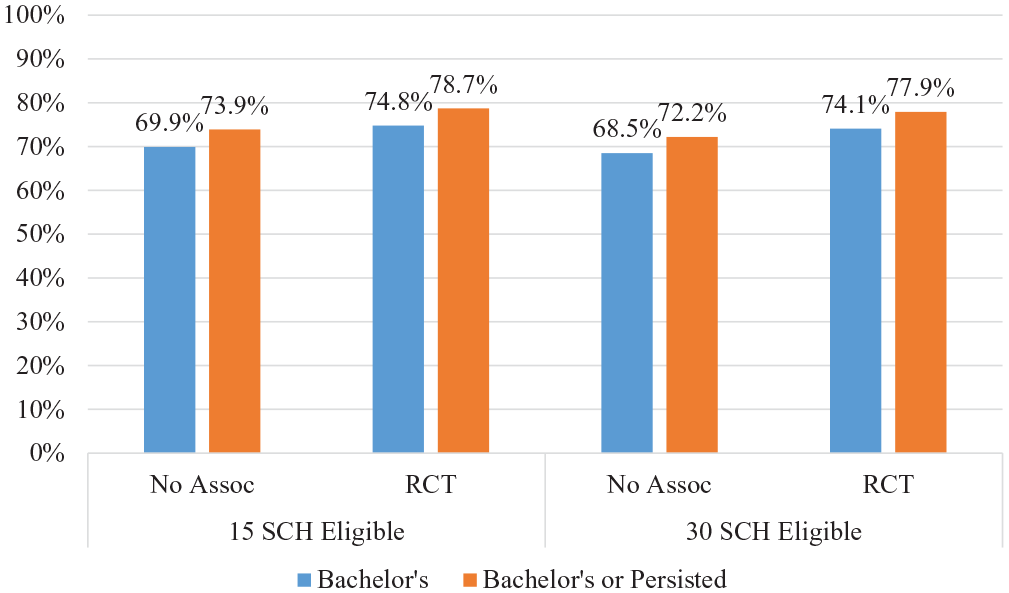
Bachelor’s degree attainment and university retention rates for students potentially eligible for RCT, by pretransfer SCH threshold and RCT degree receipt.
As shown in Figure 2, the gap in university outcomes between associate’s degree recipients and non-recipients was even greater for low-income students. The gap in bachelor’s degree attainment was 8.3% for the 15 SCH group and 9.2% for the 30 SCH group, and the gap in bachelor’s degree or retention was 6.5% and 8.5% for these two groups, respectively. Although low-income transfer students still lag behind their non-disadvantaged peers on university persistence and attainment, these equity gaps are much smaller for students who received an associate’s degree through RCT.

Bachelor’s degree attainment and university retention rates for Pell eligible students potentially eligible for RCT, by pre-transfer SCH threshold and RCT degree receipt.
Table 1 contains the estimates of the ATT of receiving an associate’s degree through RCT on university outcomes for all eligible students. These estimates were generated using the PSM method. The results show that receiving an associate’s degree through RCT is associated with roughly a 7 to 8 percentage point increase in the likelihood of baccalaureate attainment and persistence. The matched control group’s estimated rates for the two outcomes of bachelor’s degree attainment and attainment/retention were 67.8% and 74.2%, respectively. This suggests RCT degree receipt was associated with a 10% increase in these outcomes. The estimates are remarkably consistent across both outcomes (bachelor’s attainment and attainment or persistence) as well as for the two eligibility groups, ranging from a low of 7.2 percentage points to a high of 7.7%. All of these estimates are significant at the p < .001 level. Because of the consistency of estimates between the 15 SCH and 30 SCH subgroups, we use the latter for the following analyses as it provides a larger sample size.
Average Treatment Effects on the Treated of RCT Associate’s Receipt on University Outcomes, All RCT-Eligible Students

Note. Average treatment effects on the treated estimates were generated using propensity score matching. The treatment models control for student demographic characteristics; pretransfer SCH attempted; pretransfer GPA; pretransfer completion of the core curriculum; pretransfer certificate completion; the number of developmental education SCH attempted in math, reading, and writing prior to transfer; and declared major. RCT = reverse credit transfer; SCH = semester credit hours.
***p < .001.
Because many states and postsecondary institutions recommend that students complete their associate’s degree prior to transfer, we next investigated the relative university persistence and bachelor’s completion rates for students who earned their associate’s degree prior to transfer compared to students who received an associate’s through RCT. The results of the PSM models are found in Table 2. For both outcomes, RCT degree recipients were significantly more likely to persist and complete their bachelor’s degree compared to students who earned their associate’s degree prior to transfer. RCT degree recipients were 5.3% more likely to complete their bachelor’s degree and 7.1% more likely to have persisted or earned their bachelor’s compared to students who earned their associate’s before transferring. These results suggest that, on average, receiving an associate’s degree after transfer via RCT is a faster route to bachelor’s degree completion than completing an associate’s degree prior to transfer.
Average Treatment Effects on the Treated of RCT Associate’s Receipt on University Outcomes, RCT Degree Recipients vs. Pretransfer Associate’s Degree Recipients

Note. Average treatment effects on the treated estimates were generated using propensity score matching. The treatment models control for student demographic characteristics; pretransfer SCH attempted; pretransfer GPA; pretransfer completion of the core curriculum; pretransfer certificate completion; the number of developmental education SCH attempted in math, reading, and writing prior to transfer; and declared major. RCT = reverse credit transfer; SCH = semester credit hours.
p < .001.
How Students’ Demographic Backgrounds Moderate the Impact of Reverse Credit Transfer on University Outcomes
We next assessed whether the relationship between receiving an associate’s degree through RCT and university outcomes was moderated by students’ demographic backgrounds. We first used PSM models to estimate these relationships, in this instance fitting separate models to each demographic group. The results of these models are found in Table 3.
Average Treatment Effects on the Treated of RCT Associate’s Receipt on University Outcomes, by Demographic Background

Note. Average treatment effects on the treated estimates were generated using propensity score matching. The treatment models control for student demographic characteristics; pretransfer SCH attempted; pretransfer GPA; pretransfer completion of the core curriculum; pretransfer certificate completion; the number of developmental education SCH attempted in math, reading, and writing prior to transfer; and declared major. RCT = reverse credit transfer; SCH = semester credit hours.
p < .05. **p < .01. ***p < .001.
In all instances but one, the estimated relationship between receiving the associate’s degree through RCT and university outcomes was larger for groups historically underrepresented in higher education. The estimates for Pell recipients were 3.7% to 6.3% larger than for non-Pell recipients, the estimates for older students were 2.3% to 2.7% larger than for younger students, and the estimates for Latinx students were 3.8% 5.9% larger than for White students. The one exception to this trend was Black students, among whom associate’s degree recipients were no more or less likely to persist or complete their bachelor’s degree compared to nonrecipients. While the point estimate for Black students was larger than that for White students in the bachelor’s or persisted model (6.2% vs. 4.7%), the smaller sample size for Black students made it less likely for this relationship to be statistically significant.
We wanted to understand if low–socioeconomic status students may derive even greater benefit from RCT. Given the findings above, we further explored whether the differences between Pell recipients and non-Pell recipients in the benefits derived from RCT were significant. We estimated this moderation using a fixed effects logistic regression model and including an interaction term between RCT degree receipt and Pell receipt. The results of this model are found in Table 4.
Fixed Effects Logistic Regression Estimates of RCT Associate’s Receipt on University Outcomes, Pell Receipt by Associate’s Receipt Interaction

Note. Estimates are expressed as odds ratios. The models control for student demographic characteristics; pretransfer SCH attempted; pretransfer GPA; pretransfer completion of the core curriculum; pretransfer certificate completion; the number of developmental education SCH attempted in math, reading, and writing prior to transfer; university major; university fixed effects; community college fixed effects; SCH completed at the community college posttransfer; number of quarters employed after university transfer; and average quarterly earnings after university transfer. RCT = reverse credit transfer; SCH = semester credit hours
p < .05. **p < .01. ***p < .001.
For both outcomes, RCT degree recipients were more likely to experience the outcome than eligible students who did not receive the associate’s degree, and Pell recipients were less likely to persist and attain compared to their nondisadvantaged peers, controlling for all other variables in the model. However, the models of baccalaureate attainment found that the relationship between associate’s degree receipt via RCT and baccalaureate attainment was significantly greater for Pell recipients. This differential benefit of receiving the associate’s degree was even greater than the negative relationship between Pell receipt and baccalaureate attainment. Put differently, receiving the associate’s degree was estimated to more than offset the disadvantage of being low-income in terms of completing the bachelor’s degree. The interaction terms between Pell and associate’s degrees in the models of persistence or attainment were also positive but not statistically significant.
Reverse Credit Transfer and Short-Term Labor Outcomes
We begin our analyses of labor outcomes by descriptive analyzing the employments rates of the 15 SCH eligible group by their associate’s degree receipt. Given prior literature on how the type of associate’s degree students receive moderates its relationship with labor outcomes, we explored this outcome by the type of associate’s degree received. As shown in Figure 3, there were essentially no differences in the employment rates of RCT eligible students who did not receive an associate’s degree and those who received an academic associate’s degree. This was the case for the full sample and stop-outs specifically. And while students who received an applied associate’s degree were 2.7% more likely to be employed in the full sample, there was no difference in the employment rates of stop-outs who received an applied associate’s degree compared to students who received no associate’s degree.

Any employment between 2016Q3 and 2017Q2 for all RCT-eligible students and RCT-eligible stop-outs specifically, by RCT degree receipt.
The relationship appears slightly more positive for applied associate’s degree earnings in regards to annual earnings, as shown in Figure 4. Students who received the applied associate’s degree earned roughly $2,000 more annually compared to students who did not receive the associate’s degree, both for the full sample and stop-outs specifically. However, students who received the academic associate’s degree earned even less than nondegree earners. This difference was roughly $500 in the full sample and $800 among stop-outs.

Annual earnings between 2016Q3 and 2017Q2 for students who were potentially eligible to receive the associate’s degree through reverse transfer and stopped out of college without a bachelor’s degree, by RCT degree receipt.
Although the descriptive analyses suggested that receiving the academic associate’s degree in particular had minimal relationship with students’ short-term labor outcomes, they did not control for factors that could influence both students’ likelihood of receiving the degree through RCT and their short-term labor outcomes. We therefore estimated the relationship between receiving the associate’s and short-term labor outcomes using the same PSM models as were used in the analyses of university outcomes. The treatment variable includes any associate’s degree received (academic or applied), given that the sample of students who received applied associate’s degrees was too small to run separate analyses. The ATT estimates of these models are found in Table 5. Using this method, we found no evidence of positive relationships between associate’s receipt and short-term labor outcomes for the full sample once we controlled for baccalaureate attainment.
Average Treatment Effects on the Treated of RCT Associate’s Receipt on Short-Term Labor Outcomes, All RCT Eligible Students

Note. Average treatment effects on the treated estimates were generated using propensity score matching. The treatment models control for student demographic characteristics; pretransfer SCH attempted; pretransfer GPA; pretransfer completion of the core curriculum; pretransfer certificate completion; the number of developmental education SCH attempted in math, reading, and writing prior to transfer; and declared major. RCT = reverse credit transfer; SCH = semester credit hours.
While the previous models included all eligible students as the sample, the relationship between receiving an associate’s degree through RCT and students’ short-term labor market outcomes may vary based on whether the student subsequently received the bachelor’s degree. The next models examine the impact of the RCT degree separately for university stop-outs and baccalaureate recipients. The results of these models are found in Table 6.
Average Treatment Effects on the Treated of RCT Associate’s Receipt on Labor Outcomes, by Bachelor’s Degree Receipt

Note. Average treatment effects on the treated estimates were generated using propensity score matching. The treatment models control for student demographic characteristics; pretransfer SCH attempted; pretransfer GPA; pretransfer completion of the core curriculum; pretransfer certificate completion; the number of developmental education SCH attempted in math, reading, and writing prior to transfer; and declared major. RCT = reverse credit transfer; SCH = semester credit hours.
p < .05.
Once again, we find few significant relationships between RCT degree receipt and students’ labor outcomes, regardless of whether students earned a bachelor’s degree. In fact, the only statistically significant finding estimated that, among stop-outs, students who received the associate’s degree were less likely to be employed compared to students who did not receive the degree. Although the point estimates for raw and log earnings among stop-outs were both positive, neither was statistically significant. No significant estimates were found for the sample of bachelor’s degree recipients.
Although the previous analyses found no positive and significant relationships between RCT degree receipt and labor outcomes for stop-outs, we further explored whether this relationship might vary across demographic groups by fitting separate PSM models to each group, the results of which are found in Table 7. The models found no significant relationship between RCT degree receipt and either employment or earnings for any demographic group in the model, and the majority of point estimates were actually negative (although nonsignificant).
Average Treatment Effects on the Treated of RCT Associate’s Receipt on Short-Term Labor Outcomes of Stop-outs, by Demographic Background

Note. Average treatment effects on the treated estimates were generated using propensity score matching. The treatment models control for student demographic characteristics; pretransfer SCH attempted; pretransfer GPA; pretransfer completion of the core curriculum; pretransfer certificate completion; the number of developmental education SCH attempted in math, reading, and writing prior to transfer; and declared major. RCT = reverse credit transfer; SCH = semester credit hours.
Discussion
Reverse credit transfer has transformed from a niche practice undertaken by a handful of community colleges and universities a decade ago to a national movement, driven largely by the CWID initiative and philanthropic funding that provided support for the implementation of this practice. The rationale for RCT is compelling. The majority of students who transfer from a community college to a university do so without the associate’s degree (Hoachlander et al., 2003; McCormick & Carroll, 1997; Shapiro et al., 2013). Even though college noncompleters do receive economic benefits from college attendance (Giani et al., 2020), if transfer students without the associate’s do not complete their bachelor’s degree, they are at risk for having spent significant time and resources on their higher education with potentially limited social and economic returns. RCT therefore has the potential to promote equity in two ways: by providing students with the academic credentials they have justifiably earned, and by providing a labor market safeguard to students who began their studies at a community college who are disproportionately low-income and Students of Color compared to the population of students who begin at 4-year institutions (Taylor, 2016).
Despite these ostensible benefits of RCT, two key concerns related to the practice had been insufficiently addressed. The first is the impact of receiving the associate’s degree on university outcomes. Students who are awarded the associate’s degree via RCT, and particularly students who might have less interest in a bachelor’s degree or otherwise be predisposed to not finish their bachelor’s degree, may be incentivized to stop-out if they believe the associate’s degree may improve their short-term labor market position and perceive less relative benefit of the bachelor’s degree after receiving the associate’s degree. On the other hand, receiving the associate’s degree could have a motivational effect that promotes persistence and attainment (Cortes-Lopez & Taylor, 2018). This could be particularly true for low-income and first-generation transfer students, whose college identities are at times more tenuous than nondisadvantaged students and those who began at a 4-year college. Although one study of two states suggested this was not the case (Taylor & Giani, 2019), the evidence base remains thin.
The second concern is the lack of evidence related to the impact of receiving an associate’s degree through RCT on students’ short-term labor outcomes. Although an extensive body of literature has demonstrated the economic benefits provided by the associate’s degree (Backes et al., 2015; Baum et al., 2013; Kim & Tamborini, 2019; Scott-Clayton & Wen, 2019), no research to date had examined how posttransfer associate’s degrees affect students’ employment and earnings. This concern is driven not only by the fact that one of the primary motivational impulses for RCT is to improve students’ position in the labor market but also by the fact that the majority of credentials awarded through RCT are the academic or transfer-oriented associate’s degrees (particularly the AA in liberal arts and general studies) rather than applied or occupationally oriented degrees (such as the AAS and AAT).
The results of this study provide tentative support for the benefits of RCT on students’ posttransfer university outcomes. We found no evidence that receiving the associate’s degree incentivizes students to stop-out. On the contrary, we found that students who received an associate’s degree via RCT were significantly more likely to persist and complete a bachelor’s degree compared to students who were eligible for RCT but did not receive an associate’s degree. For the entire sample of eligible students, the estimated benefit was approximately 7 to 7.5 percentage points, or a roughly 10% increase in comparison to the matched comparison group. This benefit was even greater for students who received Pell grants, as low-income students who received the associate’s degree were roughly 9 to 10 percentage points more likely to persist and attain a bachelor’s degree compared to their low-income peers who did not receive the associate’s degree. Our sensitivity analyses described in the online supplemental appendix suggest that these findings are robust to moderate bias introduced from unobserved variables, such as the treatment group receiving better advising and being more likely to “opt in” to RCT. These findings add to Taylor and Giani’s (2019) study, which found similar results based on data in Minnesota and Hawaii.
We also found that receiving an associate’s degree after transfer benefits students more than receiving an associate’s degree prior to transfer. Students who completed an associate’s degree after transfer via RCT were about 5% to 7% more likely to persist or complete a bachelor’s degree compared to students who completed an associate’s degree prior to transfer. One explanation for this result is that students who receive a transfer-oriented associate’s degree prior to transfer may accumulate a large number of elective credits that ultimately do not count toward their bachelor’s degree program—the credit may transfer, but it does not apply toward a program. This credit loss, which can be substantial, may be an impediment to students’ persistence at the university (Monaghan & Attewell, 2015). Students who transfer without the associate’s degree and earn it via RCT may be more likely to enroll in and complete applicable credits once at the university, therefore providing a more efficient and faster pathway to the bachelor’s degree.
The findings on the benefits of the associate’s degree on students’ short-term labor outcomes are far less persuasive. Overwhelmingly, these analyses found that the posttransfer associate’s degree provides minimal if any labor market benefits, either for employment or for earnings. We hypothesize this may be due to the short observation period of the study, or it may be due to the fact that nearly two thirds of the associate’s degrees awarded to students in the sample were the AA in liberal arts and general studies, a degree designed to signify the completion of the first 2 years of a bachelor’s degree but that is not aligned with the requirements of a specific occupation. Although the AA may provide labor benefits in some contexts, it may be less of a signal among the population of students who have already attended a university. While our descriptive analyses suggested that students who earned technical associate’s degrees had better labor outcomes, the sample of these students was too small to allow inferential analyses. The descriptive finding aligns with prior research from Florida that found that applied technical associate’s degrees recipients had higher earnings relative to recipients with an AA (Holzer & Baum, 2017). Because there were no short-term labor market benefits to those who receive an AA degree via RCT, the study suggests it is not advantageous to students to stop-out and seek employment once they receive their AA via RCT.
Recommendations for Policy and Practice
The results from this study suggest that RCT may be a viable strategy for increasing associate’s degree attainment and bachelor’s degree attainment, and we believe Texas and other states should continue to advance RCT policies. Because we found that completing an associate’s degree via RCT is associated with higher rates of bachelor’s degree completion, policymakers and institutional leaders should communicate the benefit of RCT on bachelor’s degree completion to students and families. The finding that completing an associate’s degree post-transfer via RCT has a greater impact on bachelor’s degree completion than pretransfer has implications for transfer and transfer pathways reform. It suggests that community college and university partnerships should identify the optimal points of transfer and associate’s degree completion within a transfer pathways framework. Although community colleges might be concerned about early transfer and decreased associate’s degree completion if they promote RCT policies, the results from this study suggest that RCT policies may provide more benefit than harm because they increase associate’s degree attainment and more timely bachelor’s degree attainment than completing an associate’s degree pretransfer.
Finally, the results generally found no additional impact of the associate’s degree via RCT on short-term labor market outcomes. Some transfer students may complete the associate’s degree via RCT and have to stop-out for reasons beyond their control, but our results suggest they will have no labor market advantage in the short term. However, longer term data on lifetime labor market outcomes suggest that associate’s degree completers will have better labor market outcomes compared to the some college, no-degree population, so it might just take more time for these outcomes to be realized (Minaya & Scott-Clayton, 2017). Again, the results suggest that policymakers and leaders should be aware of these short-term and longer term labor market effects and adjust their communication with students and families. Future research should explore whether RCT policies that allow for awarding of associate’s degrees better tied to the labor market are more effective at improving students’ economic opportunities.
Supplemental Material
sj-docx-1-ero-10.1177_2332858421989998 – Supplemental material for Examining the Educational and Employment Outcomes of Reverse Credit Transfer
Supplemental material, sj-docx-1-ero-10.1177_2332858421989998 for Examining the Educational and Employment Outcomes of Reverse Credit Transfer by Matt S. Giani, Jason L. Taylor and Sheena Kauppila in AERA Open
Footnotes

1
The residency requirement is the number of credits needed at the community college to receive a degree from the college.
Authors
MATT S. GIANI is director of research and data science for the Office of Strategy and Policy and an assistant professor of practice in the Department of Educational Leadership and Policy at the University of Texas at Austin. His research focuses on policies, practices, and interventions that promote social mobility and reduce socioeconomic stratification in K–12 and higher education, particularly those that promote college access and success of low-income students.
JASON L. TAYLOR is an assistant professor in the Department of Educational Leadership and Policy at the University of Utah. His broad research interests are at the intersection of community college and higher education policy and educational and social inequality.
SHEENA KAUPPILA is an assistant professor of higher education administration in the Spadoni College of Education at Coastal Carolina University. Dr. Kauppila’s research interests are focused on the success and outcomes of community college students, student-faculty engagement, and faculty development.
References
Supplementary Material
Please find the following supplemental material available below.
For Open Access articles published under a Creative Commons License, all supplemental material carries the same license as the article it is associated with.
For non-Open Access articles published, all supplemental material carries a non-exclusive license, and permission requests for re-use of supplemental material or any part of supplemental material shall be sent directly to the copyright owner as specified in the copyright notice associated with the article.
