




Abstract
This mixed-methods observational study analyzes Advanced Placement (AP) Biology teachers’ engagement in microblogging for professional learning. Data from three hashtag-based Twitter communities—#apbiochat, #apbioleaderacad, and #apbioleaderacademy (121 users; 2,253 tweets)—are analyzed using educational data mining, qualitative two-cycle content analysis, social network analysis, linear and logistic regression analyses, and hierarchical linear modeling. Results indicate that teachers’ use of Twitter reflects aspects of high-quality professional development. Notably, Twitter’s nonhierarchical organization affords shared content creation and distribution. Additionally, Twitter allows for different temporal participation patterns and supports the personalization of learning experiences aligned to teachers’ needs and preferences. Furthermore, teachers frame their interactions on Twitter positively—thus, creating a supportive environment for professional learning that might reduce perceived professional isolation. Based on this analysis, policymakers and school leaders should feel comfortable encouraging teachers to use microblogging as part of their professional learning activities.
Keywords
In times of accelerated technological advancements, traditional framings of teacher learning stand to benefit from reexamination in new contexts. These include opportunities that might extend, complement, or replace traditional face-to-face professional development (PD) activities. Microblogging platforms, which allow users to communicate with their followers through short messages, are an example of new contexts in which teachers engage in activities that may rise to the level of more established PD. Twitter is the largest of the microblogging platforms with more than 313 million monthly active users whose postings can be seen by more than 1 billion unique visitors (Twitter, Inc., 2017). Features that distinguish Twitter from other online communities are its usability (e.g., limited technology knowledge necessary), accessibility (e.g., support of mobile applications), personalization (e.g., unique information displayed to every user), low financial costs (e.g., no sign-up fees or other costs), breadth and depth of available information (e.g., diverse user groups), limited time commitments for individual tweets (e.g., 280-character limit), and dynamic display of new information (e.g., real-time updates). These attributes distinguish Twitter from other platforms meant to support online teacher communities, such as web-based discussion boards, including the College Board’s own Advanced Placement Teacher Community (APTC; Frumin et al., 2018); more comprehensive social media sites such as Facebook, Reddit, or Pintrest (Carpenter, Cassaday, & Monti, 2018; Hu, Torphy, Opperman, Jansen, & Lo, 2018; Trust, Krutka, & Carpenter, 2016; Willet & Carpenter, 2019); simulations (Arici, Barab, Sewell, & Mcllroy, 2014); or older online media such as email-based discussion groups and listserves (McMahon, 1996). Twitter also has norms different from many social media sites, and teachers often use it for professional purposes including interactions with students and teacher-to-teacher interactions without students (Carpenter, Kimmons, Short, Clements, & Staples, 2019; Forte, Humphreys, & Park, 2012). By contrast, student-teacher interactions on Facebook have traditionally been more contentious and sometimes prohibited (Hew, 2011; Petronzio, 2012).
Educators have recognized the potential of Twitter as a useful tool for enhancing professional practice. For instance, practitioner-focused publications describe how Twitter can transform interactions with students, parents, and administrators; change instructional practices; or —on an anecdotal level—contribute to professional learning (Domizi, 2013; Krutka & Milton, 2013; Kurtz, 2009; Porterfield & Carnes, 2011). However, scholarly literature on teachers’ Twitter use is growing regarding its methodological rigor and implications for educational stakeholders. Most research is descriptive, analyzing and examining teacher engagement, usage patterns, and perceived benefits of Twitter use (Carpenter & Krutka, 2014, 2015; Lord & Lomicka, 2014; Mills, 2014; Risser, 2013; Rosenberg, Greenhalgh, Koehler, Hamilton, & Akcaoglu, 2016; Wesely, 2013). For instance, Carpenter and Krutka (2014) analyzed survey responses from 755 K–16 educators describing how and why they use Twitter. Similarly, Rosenberg et al. (2016) scraped data from 47 statewide educational hashtags, comprising more than 550,000 tweets over 6 months, to describe user participation patterns in these educational hashtags. However, studies that use advanced quantitative methodologies to analyze how Twitter may reflect characteristics of high-quality PD are currently underrepresented in the scholarly literature.
Decades of systematic empirical research studies on the impact of teacher professional learning has identified several design elements that contribute to high-quality PD experiences such as practice orientation, focus on content knowledge, collaboration and community building among colleagues, and intensity and continuation of professional learning (Darling-Hammond, Wei, Andree, Richardson, & Orphanos, 2009; Desimone, 2009; M. M. Kennedy, 2016). The rise of new technologies for teacher professional learning, with accompanying changes in contexts and potential affordances for learning, has resulted in several calls for research to analyze the potential of online environments for teacher learning (Borko, Jacobs, & Koellner, 2010; Dede, 2006; Dede, Ketelhut, Whitehouse, Breit, & McCloskey, 2008), and recent studies responded to these calls by analyzing impacts of online teacher learning on teachers’ knowledge, classroom instruction, and student learning and achievement (Frumin et al., 2018; M. J. Kennedy, Rodgers, Romig, Lloyd, & Brownell, 2017; Macià & García, 2016). This study responds by exploring how Advanced Placement (AP) Biology teachers’ Twitter use exhibits characteristics described as important for high-quality professional learning and, thus, how Twitter might play a role in teacher’s overall professional learning experiences.
Conceptual Framework
This observational, mixed-methods study uses a broad conceptualization of professional learning, encompassing the range of activities that afford learning opportunities to teachers in service or after the completion of formal teacher certification programs. These learning opportunities may range from traditional workshops, university-offered courses, and conferences to interactive and social learning communities such as book clubs, teacher networks, and study groups. As social media use is widespread in today’s society, social media platforms may also afford online professional learning opportunities. In turn, some teachers may even view their engagement in microblogging as a form of PD. Given that many formal PD contexts are intentionally designed, and contexts like Twitter represent a more emergent set of activities, it is reasonable to question whether and how these new contexts “fit” into a teacher’s continuum of professional learning. Notably, formal professional learning is geared toward increasing teachers’ knowledge and skills, as well as changing their attitudes and beliefs—as described in Desimone’s (2009) logic model of teacher PD. In turn, increases in teachers’ knowledge and skills are linked to instructional changes, which ultimately lead to improved student learning and achievement (Desimone, 2009). This study explores whether teachers can use Twitter to engage in professional learning that fulfills “collective participation” and “duration” design characteristics of Desimone’s framework, which are important components of high-quality professional learning opportunities. Notably, the analysis of teachers’ Twitter use in this study is guided by Bruns and Moe’s (2013) description of structural layers of Twitter communication. This framework classifies interactions in three cross-layered categories on a microlevel (e.g., reply conversations and mentioning other users), a mesolevel (e.g., follower-followee networks), and a macrolevel (e.g., hashtagged exchanges).
A Continuum of Online Professional Development and Teacher Learning
As professional learning opportunities for teachers are increasingly offered in online settings, Dede, Eisenkraft, Frumin, and Hartley (2016) synthesize how digital technologies and social media are leveraged for teacher learning in STEM (science, technology, engineering, and mathematics) settings. Notably, Dede and Eisenkraft (2016) illustrate how “PD” and “teacher learning” are differentiated regarding formality and agency on a continuous spectrum. Whereas “PD” is “generally a formal experience with a fixed duration, curriculum, and instructional strategy and expected outcomes” (p. 2), “teacher learning” is characterized as a more informal experience with “duration, content, form of learning, and eventual impact uncertain at its inception” (p. 2).
Professional learning activities along this continuum include online courses, discussion forum–based online communities, and open education resources—in descending order regarding formality and agency. An example of an online PD course is the Massively Open Online Courses for Educators (MOOC-Ed) initiative (Kleiman & Wolf, 2016). The MOOC-Ed initiative developed several massively open online courses based on principles of effective PD and online learning to provide teachers with formalized opportunities for self-directed learning (Kleiman & Wolf, 2016; Lee & Stangl, 2015). An example of a discussion forum–based online community is College Board’s online APTC. The APTC hosts a web-based platform that enables teachers to connect with each other, to post and comment on discussion board threads, and to share resources (Frumin et al., 2018). Notably, teachers’ APTC participation is associated with teachers’ self-reported instructional practices and student performance on the AP examinations (Fishman et al., 2014; Frumin et al., 2018). An example for open education resources that support teachers’ use of digital library resources is the Instructional Architect (Recker et al., 2005). The Instructional Architect intends to support teachers with the exploration of resources in the National Science Digital Library and teachers’ planning of classroom instruction (Recker et al., 2005; Recker et al., 2007; Recker & Sumner, 2018).
In this context, Twitter communities might be viewed as an informal professional learning context that is not only situated on the teacher learning side of the continuum but also includes elements of high-quality PD for some teachers. Based on the examples of online professional learning activities described above, the Twitter communities examined in this study could be situated between College Board’s APTC and the Instructional Architect. Notably, at the time of this study, the AP Biology program was undergoing large top-down mandated curriculum and examination changes, resulting in the need for teachers to reexamine their practice. Therefore, some teachers might have purposefully chosen to engage in Twitter conversations to advance their knowledge and skills and in response to the AP Biology reform (agency). Also, this study does not broadly explore teachers’ overall engagement on Twitter but focuses only on activities using purposefully selected hashtags that explicitly relate to AP Biology. One of these hashtags (#apbiochat) frequently hosts Twitter chats with discussions on preselected topics relevant to the AP Biology redesign during prespecified time and dates (formality). These Twitter chats may be described as “quasi-synchronous” as most of teacher interaction are directed at each other, and time stamp data indicate that they occur mostly simultaneously in contrast to more asynchronous interaction patterns typically exhibited on social networking sites.
Design Characteristics of Effective Professional Development
Effective PD activities are theorized to enable teacher learning that increases teachers’ knowledge and skills, enabling teachers to modify their instruction to ultimately increase student learning and achievement (Desimone, 2009). This logic model has been mirrored in a range of studies concluding that PD can lead to increases in teachers’ knowledge and modifications to classroom instruction (Fischer, Fishman, et al., 2018; Fishman et al., 2013; Garet, Porter, Desimone, Birman, & Yoon, 2001; Matsumura, Garnier, & Resnick, 2010; Roth et al., 2011). Additionally, numerous studies detected direct effects of teachers’ PD participation on student performance (Blank & de las Alas, 2009; Fischer et al., 2020; Fishman, Marx, Best, & Tal, 2003; Lai & McNaughton, 2016; Penuel, Gallagher, & Moorthy, 2011). Based on decades of teacher education research, Desimone (2009) summarized five core design features necessary for high-quality PD: active learning, content focus, coherence, collective participation, and duration. This study examines two characteristics of high-quality professional learning identified by Desimone (2009)—“collective participation” and “duration”—in the context of teachers’ engagement on Twitter.
Collective and Collaborative Professional Learning
Desimone (2009) defines “collective participation” as “participation of teachers from the same school, grade, or department. Such arrangements set up potential interaction and discourse, which can be a powerful form of teacher learning” (p. 184). This definition has geographic- and activity-related components. AP Biology teachers are often the only AP Biology teachers in their school, which constrains opportunities for collaborative engagement in professional learning targeted toward the AP Biology redesign; they have no local colleagues. Meaningful collaborative interactions with other AP Biology teachers in virtual learning communities could be a means to overcome geographical boundaries and isolation.
Twitter as a collaborative learning environment
Collective participation and collaboration in learning communities among educators can enhance teacher learning, knowledge gains, and changes to instructional practice (Garet et al., 2001; Hadar & Brody, 2013; Penuel, Fishman, Yamaguchi, & Gallagher, 2007). Communities of practice are a prime example of such collaborative environments that facilitate learning situated in individuals’ contexts (Lave, 1991; Wenger, 1998). Some researchers argue that participation on Twitter can enable learners to form virtual communities of practice and create social capital (Lord & Lomicka, 2014; Rehm & Notten, 2016; Wesely, 2013).
Several of Twitter’s design characteristics afford such informal, democratic, and bottom-up learning. First, Twitter’s peer-to-peer interaction structure reduces perceived distance between learners and experts. Flat hierarchical communication structures might afford increases of informal collaborations and shared responsibilities for learning processes (Ardichvili, 2008; Kirschner & Lai, 2007). Second, Twitter’s asynchronous following-followee structure and personalized display of tweets allows learners to personalize their experiences. In contrast to the “one-size-fits-all” approach of some traditional PD activities, teachers on Twitter can interact with selected resources and participants based on their individual needs and contexts (Carpenter & Krutka, 2014, 2015). Third, Twitter removes potential participation barriers, which affords collaborations among more diverse teacher populations. Twitter does not cost money to sign up for, and is easily accessible via smart phones, thus reducing participation barriers by socioeconomic status (Pew Research Center, 2017a). Also, Twitter learning communities can be accessed anywhere, anytime, and with any intensity, reducing geographic and temporal participation barriers (Carpenter & Krutka, 2014; Rosenberg, Akcaoglu, Willet, Greenhalgh, & Koehler, 2017; Rosenberg et al., 2016). Thus, Twitter may fulfill both price and proximity features that have been shown to be influential in teachers’ participation in PD activities (McCoy et al., 2019).
Twitter as a supportive learning environment
Teachers can experience emotional stress and isolation if their school environment does not support them (Moore & Chae, 2007), which not only negatively affects teachers’ well-being but also their teaching performance. Research indicates that online communities have potential to provide positive and supportive learning environments that promote collaboration, foster the development of professional identities, and potentially reduce isolation (Carpenter et al., 2019; Dodor, Sira, & Hausafus, 2010; Hanuscin, Cheng, Rebello, Sinha, & Muslu, 2014; Lieberman & Mace, 2010; Trust et al., 2016).
Adverse effects of Twitter use for teachers
While Twitter is often described as supportive, encouraging, and positive environment for teachers (Carpenter & Krutka, 2014, 2015; Wesely, 2013), Twitter use can also have adverse effects as the public nature of tweets can evoke responses with extreme forms of disapproval or harsh commentary (Burbules, 2016; Mandavilli, 2011). Twitter and other social media sites are battling growing problems of harassment, where users are expressing hate, slurs, or other offensive speech to each other (Blackwell, Dimond, Schoenebeck, & Lampe, 2017; Pew Research Center, 2017b). There are also growing concerns about the spread of misinformation on Twitter, which can negatively affect access to quality information as well as introduce more fundamental concerns like threats to democracy (Hindman & Barash, 2018; Starbird, Maddock, Orand, Achterman, & Mason, 2014).
Finally, the prevalence of harassment and misinformation may disproportionately affect people from marginalized identities (Blackwell et al., 2017; Pew Research Center, 2017b; Starbird et al., 2014). Also, student-teacher relationships may be affected if students view their teachers’ social media interactions as inappropriate or unprofessional (DeGroot, Young, & VanSlette, 2015; Mazer, Murphy, & Simonds, 2007).
Temporal Aspects of Professional Development Participation
Desimone’s (2009) definition of “duration” includes “both [the] span of time over which the activity is spread . . . and the number of hours spent in the activity” (p. 184). Notably, both intensity (i.e., contact hours) and continuation (i.e., time span, frequency) of PD participation are integral for teacher learning (Darling-Hammond et al., 2009; M. M. Kennedy, 2016). While duration thresholds are not specified, Desimone’s (2009) estimate of 20 hours of contact time and Darling-Hammond et al.’s (2009) estimate of 50 hours spread across 6 to 12 months provide some insights on lower PD duration thresholds to yield potential teacher knowledge and resulting in potential student performance gains. Twitter provides a flexible platform for professional learning regarding teachers’ preferred temporal engagement patterns, offering access to a large repository of resources, personalized just-in-time information to immediate questions, requests, and statements in an affinity space within a community of colleagues (Carpenter & Krutka, 2014; Rosenberg et al., 2016; Rosenberg et al., 2017).
Notably, “collective participation” and “duration” should be viewed as necessary but not sufficient characteristics of high-quality PD. For instance, collective participation affords active learning. Teachers might observe and respond to teaching practices modeled by other teachers in the Twitter communities and engage in discussions based on reflections with their own classroom experience. These interactions and discourses can provide a meaningful form that contributes a component to teachers’ overall learning process. In contrast, teachers whose tweets only share resources without any reciprocal engagement with their fellow teachers might still provide learning opportunities for others, but their own knowledge and skill growth might be limited. Similarly, without sufficiently high duration, teachers might be less able to focus on the content to develop their knowledge and skills. For example, teachers whose engagement is limited to a few tweets might not sufficiently reflect and engage in discussions, for instance, that link subject matter knowledge with approaches to student learning to subsequently improve their own instruction.
User Interactions on Twitter
Microlevel User Interactions
Bruns and Moe’s (2013) microlevel conversational practice refers to replies between users, as well as mentions of users in tweets. Both replying and mentioning are signified through the inclusion of the @-sign preceding the username of the person being replied to or mentioned in the tweet. The Twitter syntax defaults the @-username for replies to the beginning of a tweet, whereas the @-username for mentions can be at any position in the tweet. Both microlevel conversational practices allow users to specifically address another user, which may allow for more interpersonal communication. Consequently, both mentioning another user in a tweet and replying to a user’s tweet can initiate and further informal collaborations between users (Bruns & Moe, 2013; Honeycutt & Herring, 2009).
Mesolevel User Interactions
Bruns and Moe’s (2013) mesolevel conversational practice describes the follower-followee network structure on Twitter. Users can follow other users (i.e., subscription to the followed users’ stream of tweets) without permission of the followed users (for all public user profiles). Thus, following is not reciprocal, which is different from other social network systems such as Facebook. Notably, all tweets a user posts to Twitter are disseminated to the audience of followees and the public, as they appear on each followee’s personalized Twitter feed and the original user’s profile page. While Twitter allows users to seamlessly follow each other, follower-followee structures often remain fairly stable and exhibit low levels of reciprocity, which contrasts typical human social networks (Bruns & Burgess, 2012; Kwak, Lee, Park, & Moon, 2010).
Macrolevel User Interactions
Bruns and Moe’s (2013) macrolevel conversational practice relates to users’ dissemination of content (i.e., tweets) to a broader audience by contributing to a hashtag-based conversations (i.e., #-sign preceding the name of conversation included in tweet). Such tweets are not restricted to users’ follower networks. Notably, macrolevel conversational practices are often situated within numerous meso- and microlevel interactions, which Bruns and Moe (2013) describe as a “cross-layer communication flows” (p. 20). In particular, all macrolevel interactions also exhibit features of mesolevel interactions (but not vice versa) as tweets are always distributed to users’ follower networks. Furthermore, macrolevel user interactions can also include microlevel conversational practices as users may reply to tweets in the hashtag-based communities or mention other users. In general, hashtags have conversational and social tagging functions that allow users to filter and promote content, foster conversations, and initiate and sustain collaborations with other users (Bruns & Moe, 2013; Huang, Thornton, & Efthimiadis, 2010).
Research Questions
This study explores teachers’ interactions and engagement on three AP teacher communities as an example of a professional learning community on Twitter. Also, this study examines whether Twitter exhibits design features that afford components of an overall teacher learning process. The research questions (RQ) are as follows:
Research Question 1: What are the participation structures in AP teacher Twitter communities?
Research Question 2: Do AP teacher Twitter communities provide a positive environment for teachers engaging in professional learning activities?
Research Question 3: What are teachers’ temporal Twitter usage patterns in AP teacher Twitter communities?
From the perspective of Desimone’s (2009) high-quality PD design features, “collective participation” is explored by analyzing hierarchical participation structures (RQ1) and support structures (RQ2). “Duration” is examined by analyzing temporal participation patterns (RQ3).
Method
Study Setting
This study is situated in the context of the AP program. AP courses provide college-level learning experiences for high school students. The corresponding AP examinations are high stakes to students and their teachers because they relate to higher enrollment rates in 4-year colleges, increased college graduation rates, and higher college GPAs (Chajewski, Mattern, & Shaw, 2011; Mattern, Marini, & Shaw, 2013; Patterson, Packman, & Kobrin, 2011). Responding to recommendations from the National Research Council (2002), College Board, the provider of the AP program, redesigned the AP examinations to decrease its emphasis of memorization while foregrounding deep content understanding, scientific inquiry, and reasoning. Many of these changes are consistent with the Next Generation Science Standards (NGSS; NGSS Lead States, 2013). Participating in professional learning is particularly important during curriculum reforms as teachers are key stakeholders to implement reform efforts to influence student learning and achievement (Hattie, 2009, 2012; Seidel & Shavelson, 2007). Given the large-scale top-down curriculum changes and the high-stakes nature of the AP examinations, teachers have many incentives to engage in professional learning activities to improve their instruction, which provides a great opportunity for research.
Data Sources and Sample
This observational study analyzes public data from three purposefully selected hashtag-based AP Biology Twitter teacher communities (#apbiochat, #apbioleaderacademy, #apbioleaderacad). Findings of a study that distributed web-based surveys to all AP Biology, Chemistry, and Physics teachers in the nation informed the selection process (Fischer, Eisenkraft, Fishman, Hübner, & Lawrenz, 2018; Fischer et al., 2016; Fischer, Fishman, et al., 2018; Fischer, McCoy, Foster, Eisenkraft, & Lawrenz, 2019). The survey asked teachers to describe their PD participation in face-to-face and online settings. The selected Twitter hashtags—#apbiochat, #apbioleaderacademy, and #apbioleaderacad—were the most commonly used Twitter communities across all teachers and across disciplines in the survey responses.
This study uses the full public tweet history from the beginning of each hashtag until June 14, 2016 (4 weeks after the 2016 AP Biology examination) using Twitter’s search function, the Twitter API, the R package twitteR, and custom Python scripts. Additionally, Python scripts collected basic biographical information (i.e., username, biography, location, website information, join date) and descriptive Twitter usage data (i.e., total number of tweets, followings, followers, likes, lists). Notably, this study adheres to ethical standards for social media research to protect user privacy, despite all data being publicly available (Bruckman, 2006; Moreno, Goniu, Moreno, & Diekema, 2013). For instance, instead of verbatim quotations of tweets, which might lead to an identification of teachers’ true identities, synthetic tweets illustrate tweet content and sentiment categories (but are not used for any analyses).
Users in these communities fall into four different groups: teachers, school administrators, representative from professional organizations, and unclassifiable users. Unclassifiable users (17 tweets, 14 users) were removed from both data preparation and data analysis. Such users mostly posted single tweets with unrelated content (e.g., “Purchase land on Mars for $30 #apbiochat” or “haha, so that’s where teachers complain about us #apbiochat”).
Data preparation to generate variables for subsequent statistical analyses utilized the full combined data set with tweets from school administrators and representatives from professional organizations (219 tweets, 28 users) and tweets from teachers (2,040 tweets, 93 teachers). Notably, data preparation used all data because teachers’ interactions with school administrators and representatives from professional organizations could have shaped teachers’ experiences and discourses, which potentially influenced teachers’ relational positionings in these Twitter communities.
As this study focuses on teachers’ experiences in Twitter communities, statistical analyses solely use the teacher data set. On average, teachers posted 21.9 tweets, although roughly 60% of teachers contributed only five or less tweets to the communities. At the time of the data collection, teachers posted an overall average of 3,919 tweets (SD = 9,648), followed on average 564 users (SD = 1,038), had an average of 1,324 followers (SD = 7,519), contributed on average 1,357 likes (SD = 3,097), and were on average affiliated with 3.1 lists (SD = 7.9).
Measures
This study applied three primary analytical approaches to generate variables for subsequent quantitative analysis: qualitative content analysis to capture tweet content and sentiment, quantitative summaries of quantifiable tweet and user characteristics, and social network analysis (SNA) to capture teachers’ relational positioning.
Tweet Content and Tweet Sentiment Measures
On the tweet level, qualitative coding approaches elicited tweet content and sentiment. The unit of analysis is single tweets. The initial coding schema uses an exploratory two-cycle coding strategy with descriptive coding (first cycle) and subcoding (second cycle; Miles, Huberman, & Saldana, 2014). This study inductively developed all tweet content categories. In contrast, this study deductively developed tweet sentiment categories. Notably, tweet sentiment analysis could have been automated through natural language processing techniques—for instance, using the Linguistic Inquiry and Word Count tool (Pennebaker, Boyd, Jordan, & Blackburn, 2015). However, this study chose to use human coders as the effort required to do so was acceptable, and human coding tend to produce higher accuracy than automated coding.
The first author developed the code book based on the exploratory two-cycle coding strategy on the full data set. The initial code schema included definitions and multiple example tweets illustrating occurrence and absence of tweet content category characteristics. Three additional external coders evaluated the reliability of this coding schema. All additional external coders were advanced doctoral students with extensive expertise in qualitative educational research. The additional external coders independently coded an identical subset of 225 randomly selected tweets (more than 10% of the full sample) after a face-to-face training session with the code book and the first author (Lombard, Snyder-Duch, & Bracken, 2002). The training sessions included in-depth explanations and discussions about each tweet content and tweet sentiment category with their respective inclusion and exclusion criteria. Think-aloud approaches illustrated the coding processes. After multiple iterative improvements of the code book, interrater reliability (tweet content: 91.5 mean percentage agreement, average Cohen’s κ rating of .74; tweet sentiment: 69.3 percentage agreement, Cohen’s κ rating of .65) met benchmarks of “substantial” agreement (Landis & Koch, 1977). Subsequently, the first author recoded all tweets using the final code book as the deductive coding framework.
The code book has the following tweet content categories that relate to AP learning and teaching: (a) sharing AP Biology content knowledge, (b) sharing resources, (c) seeking information, (d) organizing professional learning on Twitter, (e) mentioning curricular elements, (f) sharing information about laboratory investigations, and (g) assessments. The tweet content category definitions are as follows: Tweets classified as sharing AP Biology content knowledge provide content information relevant for AP Biology, common content knowledge, misconceptions, use of biological language, and recommendations for content knowledge resources. Tweets classified as sharing resources provide information on accessing additional resources or the use of these resources. Tweets classified as seeking information ask questions or request resources related to student learning, instructional enactments, curricular standards, and assessments. Tweets classified as organizing professional learning on Twitter include selections of chat topics, scheduling of chats, reminders of upcoming chats, recruitment, and confirming absence or participation in upcoming chats. Tweets do not exhibit this characteristic if Twitter is used to organize face-to-face meetings. Tweets classified as mentioning curricular elements include references to other state or national curricula, the AP lab manual, practice exams, conceptual graphics, standards-based grading, free- and open-response questions, and AP curriculum framework elements. Tweets classified as sharing information about laboratory investigations include descriptions of experiments, equipment and supplies, and lab reports. Tweets classified as assessments include information about AP examinations, test preparations, and summative and formative assessments strategies. Table 1 illustrates these tweet content definitions with example tweets.
Synthetic Examples for Tweet Content and Tweet Sentiment Categories
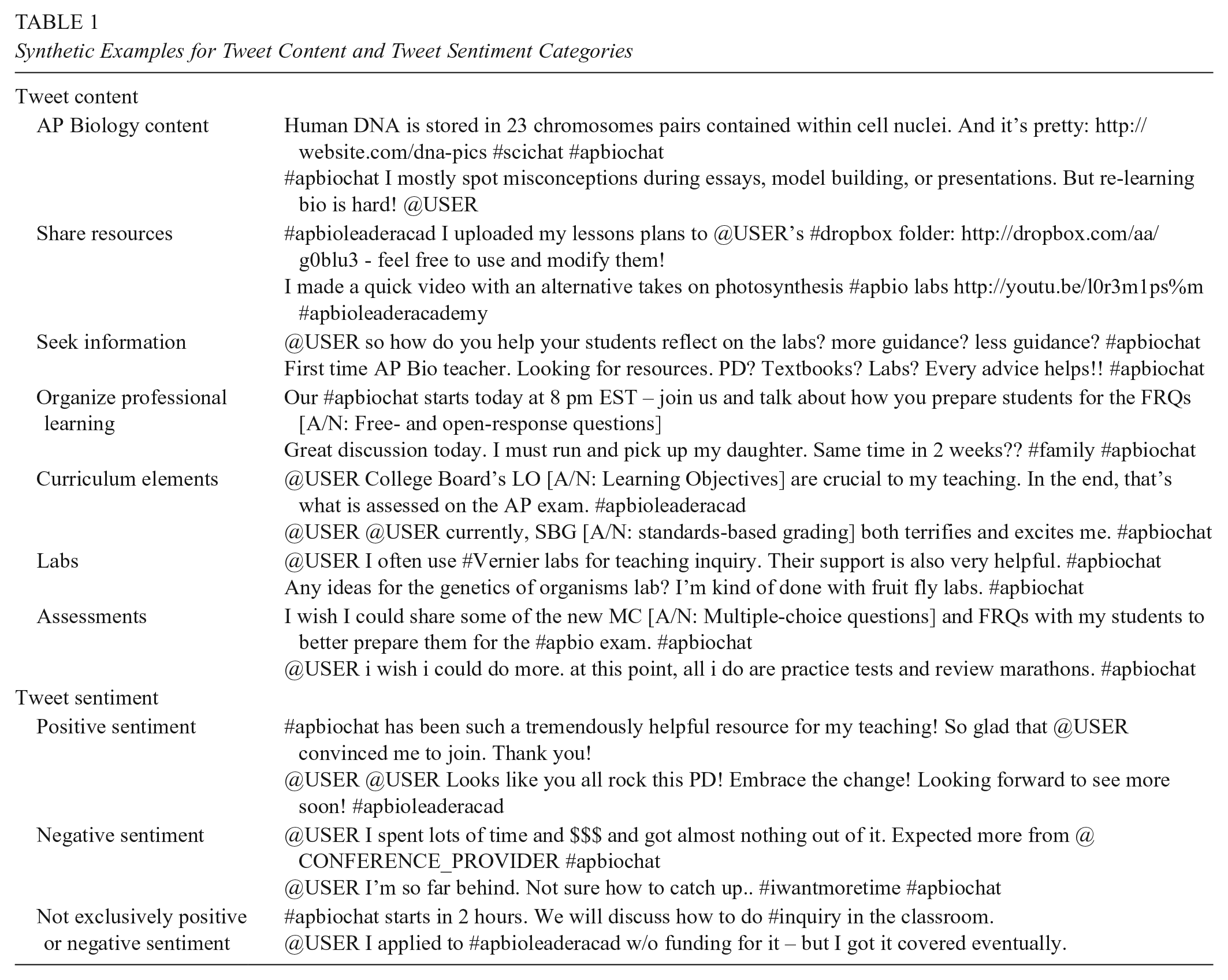
Each tweet is classified as exhibiting the characteristics of a tweet content category (“1”) or not (“0”). Tweets can exhibit any number of tweet content categories simultaneously. To this degree, teachers’ tweets most frequently shared resources (14.6%), sought information (12.3%), and related to assessments (9.2%).
Tweet sentiment coding follows an emotion coding approach (Miles et al., 2014) and classifies tweets as more positive, more negative, and not exclusively positive or negative. Each tweet has a single sentiment category. Tweet sentiment evaluations also account for tone, emoticons, hashtags, sarcasm, and irony. The tweet sentiment definitions in this study are as follows: Tweet sentiments classified as more positive include expressions of joy, excitement, liking, motivation, inspiration, and thankfulness. Tweet sentiments classified as more negative include expressions of being overwhelmed, struggle, anxiety, and admittance of mistakes. Tweet sentiments classified as not exclusively positive or negative include tweets that exhibit neutral, neither positive nor negative sentiment, or both positive and negative sentiments. Table 1 illustrates these tweet sentiment definitions with example tweets.
Quantitative Tweet Measures
Quantitative information include the number of retweets and likes a tweet received, the number of mentions, hashtags, and links incorporated in a tweet, teachers’ life span of community participation (number of days between first and last tweet), and frequency of teachers’ engagement in the communities (total number of tweets divided by life span; Table 2). Notably, standard deviations of quantitative tweet measures are considerably large as roughly 60% of teachers contributed only five or less tweets to the communities. For example, all tweets of 54 teachers (58.1%) did not include any links. Similarly, tweets of 48 teachers (51.6%) did not receive any retweets.
Descriptive Sample Information, n tweet = 2,040, n teacher = 93

Inferential Social Network Measures
This study analyzed Bruns and Moe’s (2013) microlevel conversational practice of “mentioning” (i.e., including the “@”-sign in their tweet) by examining relational positions of teachers in the selected Twitter communities. The “mentions network” comprises all interactions of users mentioning another in the selected communities. SNA measures analyze the hierarchical structures using data from school administrators and representatives of professional organizations, teachers, and school administrators to avoid misrepresentations of teachers’ relational positions in the communities. However, the analysis solely utilize teacher data as teachers are the core population of interest of this study. Notably, the research base that uses SNA to analyze social ties among educators has grown in recent years (Atteberry & Bryk, 2010; Coburn, Russell, Kaufman, & Stein, 2012; Penuel & Riel, 2007).
Figure 1 illustrates the mentions network with the ForceAtlas2 algorithm of the open-source software Gephi (Jacomy, Venturini, Heymann, & Bastian, 2014). Nodes, the circles, represent users in the mentions network. Node sizes reflect users’ in-degree (i.e., number of users mentioning the user). Edges, the line between two nodes, represent that User A (source node) mentions User B (target node). Clockwise-curved edges illustrate that the source node mentions the target node, and vice versa. Tweets not mentioning other users are treated as self-referential (source identical to target). Edge thickness represents the number of mentions between two users. Edge colors are identical to source node colors. Such visualizations provide insights on the relative importance of users based on their positioning in the network. For instance, teachers mostly mention other teachers and rarely representatives from professional organizations, who hold generally less prominent roles in the communities.

Mentions network visualization of teachers (green), school administrators (red), and representatives from professional organizations (blue) in the communities; node size = in-degree; edge thickness = number of mentions between two users.
Out of the many possible SNA measures, this study selected variables that help guide understandings of user hierarchies, collaboration patterns among participants, and information flows. Consequently, eigenvector centrality, closeness centrality, and betweenness centrality were selected as core measures (Scott, 2013). These SNA variables seem most relevant to make inferences about teachers’ interaction patterns and potential relations to professional learning and networking on Twitter. In particular, eigenvector centrality describes teachers’ influence in the communities. This measure accounts for users’ own connectedness and the connectedness of their neighbors. For instance, teachers with high eigenvector centrality could be interpreted to have more “prestige” in the communities. Others might more likely follow guidance from such “high-prestige” teachers. Closeness centrality describes teachers’ connectedness in the communities. This measure represents the inverse of the sum of the shortest paths between the user and all other users in the network. For instance, teachers with high centrality may distribute information to other teachers more efficiently. Betweenness centrality describes teachers’ “broker ability” to connect more distant subnetworks in the communities. This measure describes how often a user is part of the shortest path between two other users. For instance, teachers with high broker ability might encourage participation in larger networks.
For each SNA measure, this study classifies teachers in four groups. The classification uses numerical thresholds in addition to the social network diagrams: Eigenvector centrality: no importance (<0.001), low importance (0.001–0.150), medium importance (0.150–0.375), high importance (0.375–1.000); closeness centrality: no centrality (<0.001 and outside largest connected network), low centrality (0.001–0.350), medium centrality (0.350–0.425), and high centrality (>0.425); betweenness centrality: no broker ability (<0.1), low broker ability (0.1–30), medium broker ability (30–300), and high broker ability (>300; Table 2). Thresholds were established based on qualitative examination of the network structure and natural breaks within the distribution. For instance, nodes outside the largest connected network are assigned the “no centrality” closeness centrality group. Sensitivity analyses that varied these thresholds ensured the robustness of the results.
Analytical Methodologies
Research Question 1
Teacher-level proportional odds ordered logistic regression models with robust standard errors analyze teachers’ engagement patterns in the selected communities (Harrell, 2015). Dependent variables include ordinal variables that describe teachers belonging to teachers’ influence (eigenvector centrality), centrality (closeness centrality), and broker ability (betweenness centrality) groups. Independent variables include the percentages of tweets in which teachers share AP Biology content knowledge, share resources, seek information, and organize professional learning on Twitter, as well as tweet content and teachers’ community participation variables.
Research Question 2
Contingency tables illustrate tweet sentiment distributions across the different topics discussed in the communities. Two-level fixed-effects hierarchical linear models with Huber-White sandwich estimators as robust standard errors analyze associations of tweet sentiment with tweet engagement (Raudenbusch & Bryk, 2002). Multilevel modeling is necessary because tweets (Level 1) are nested within teachers (Level 2). Notably, the intraclass correlation coefficient (ICC; ICC = .23) exceeds common ranges of ICC values in social science research (.05–.20; Peugh, 2010) confirming the appropriateness of multilevel modeling. The dependent variable describes the sum of the number of retweets and likes a tweet receives. Independent variables describe tweet sentiment. Covariates include tweet content, tweet characteristics, and teachers’ community participation variables.
Research Question 3
Descriptive analyses and teacher-level ordinary least squares multiple regression analysis with Huber-White sandwich estimators as robust standard errors explore temporal participation patterns (Montgomery, Peck, & Vining, 2012). The dependent variable describes teachers’ life span of participation in the online communities. Independent variables describe tweet content, tweet sentiment, quantitative tweet characteristics, and community participation characteristics.
Limitations
The most important limitations of this study relate to the external validity of the data. AP teachers might not be representative of the overall teacher population. Also, the observed teachers might not represent average teachers as two hashtags are connected to an intense 2-year PD program. Thus, teachers’ PD participation could also shape some of the interaction patterns observed in the corresponding hashtags. Additionally, the studied AP Biology hashtags are very specific in scope such that generalizations to more general hashtag-based teacher communities should be drawn with caution. Also, teachers can only engage in these Twitter communities if they are sufficiently tech-savvy to navigate the Twitter platform. This self-selection bias may further skew the data and limit potential inferences to average teachers. Furthermore, Schlager and Fusco (2003) argue that online teacher learning is most effective if connected to face-to-face learning activities to extend professional conversations across multiple platforms. Thus, teachers on Twitter might be more motivated to engage in professional learning, might have a higher affinity to use online-based learning environments, and might have higher self-efficacy than average teachers.
Another potential sampling and self-selection bias is that teachers who contributed tweets with primarily negative sentiments might feel discouraged to continue their participation. However, this bias might be small because Twitter users often express their dissent regarding topics such as politics or products/brands (Jansen, Zhang, Sobel, & Chowdury, 2009; Small, 2011). With respect to the AP redesign, negative sentiments might have been more prominent if teachers felt a larger sense of disagreement with core elements of the science curriculum reform. Another threat to validity is that this study relies solely on publicly available data. Learning experiences of lurkers are not captured although lurkers fulfill important roles and might benefit from the visible interactions of posters (Edelmann, 2013; Preece, Nonnecke, & Andrews, 2004).
Potential threats to reliability relate to the format of the collected data. While Twitter allows attachments of pictures and videos, this study solely focuses on the text-based tweet components. This omitted additional information might lead to different tweet content or sentiment assignments. Similarly, content deleted by users prior to the data collection and private communication between users were unavailable. Additionally, other potentially important variables such as attitudes toward PD and Twitter, prior social media use, self-efficacy, school affluence, or administrative support, which might influence the examined relationships as either extraneous or confounding variables, were not collected and, thus, not included in the models.
Results
Hierarchies in Twitter Participation Structures
Teachers’ group classifications based on influence, centrality, and broker ability ratings explore leadership structures on Twitter. Logistic regression analyses indicate that teachers’ sharing of content knowledge helps predict teachers’ belonging to influence-based teacher groups, whereas teachers’ sharing of resources does not provide a significant contribution (Table 3). A 10% positive difference in tweets that relate to AP Biology content knowledge is significantly associated with 2.7% lower odds of teachers belonging to higher influence teacher groups, holding everything else constant. Teachers’ information seeking behavior does not significantly predict belonging to centrality-based teacher groups, whereas teachers’ resource sharing behavior was a predictor. A 10% positive difference in tweets that share resources is significantly associated with 2.4% lower odds of teachers belonging to higher centrality groups, holding everything else constant. Teachers’ engagement in the organization of professional learning on Twitter predicts teacher classifications in broker ability–based groups. A 10% positive difference in tweets that relate to the organization of professional learning activities on Twitter is significantly associated with 1.6% lower odds of teachers belonging to higher broker ability groups, holding everything else constant. This supports the idea that persons organizing and recruiting participants are not the focal interaction partners for new community members. Instead, new community members may feel confident in interacting with all other community members, indicating lowered barriers for participation.
Ordinal Regression Analyses With Robust Standard Errors Predicting Teacher Influence (Model 1), Teacher Centrality (Model 2), and Teacher Broker Ability (Model 3) Classifications
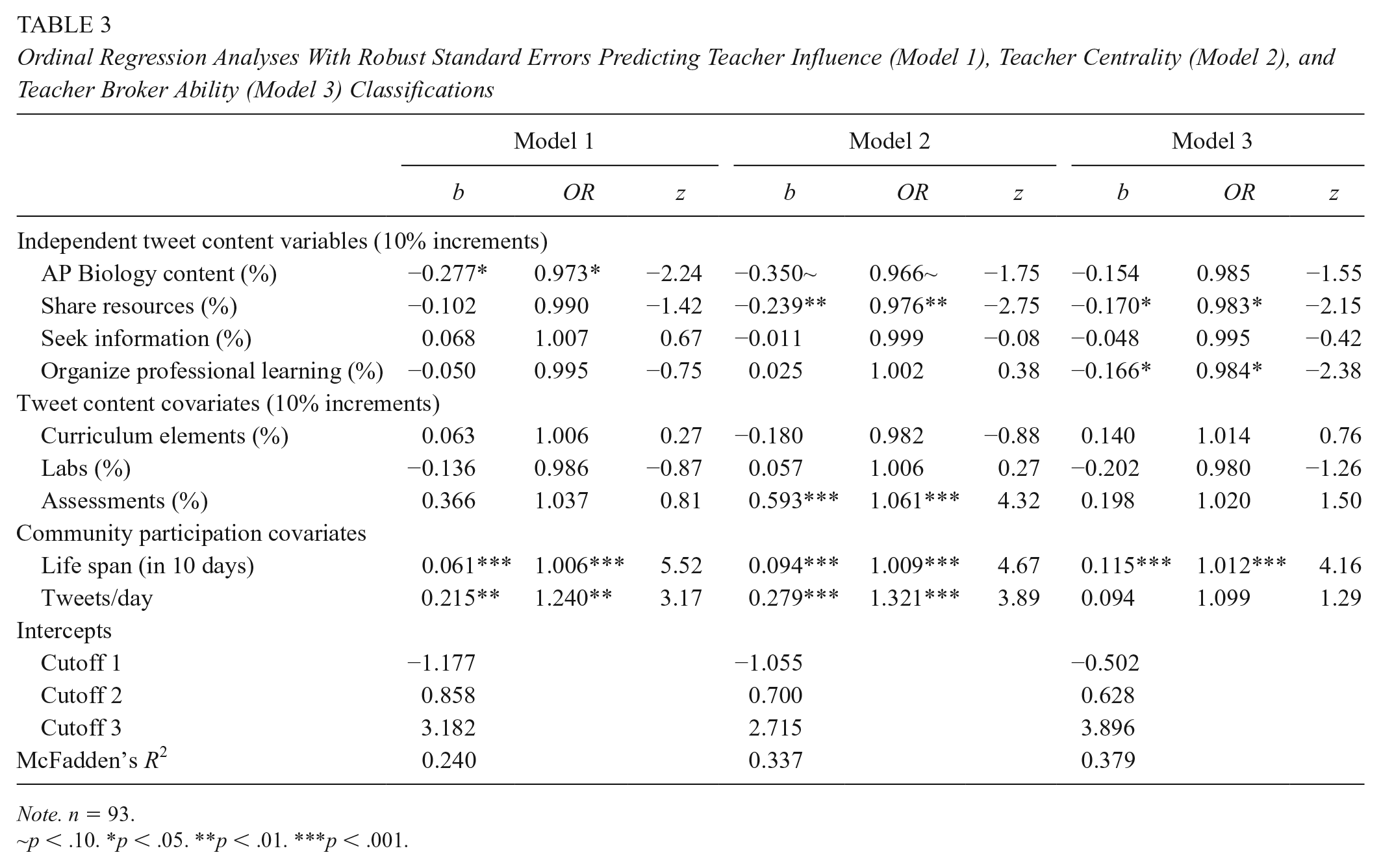
Note. n = 93.
p < .10. *p < .05. **p < .01. ***p < .001.
Notably, teachers’ life span and frequency of participation significantly predict teacher affiliations to higher leadership-related teacher groups. Each positive 10-day difference in teachers’ life span of community participating is significantly associated with 0.6% higher odds of belonging to higher teacher influence–based groups, 0.9% higher odds of belonging to higher teacher centrality–based groups, and 1.2% higher odds of belonging to higher teacher broker ability–based groups. Similarly, tweeting on average one additional tweet per day is significantly associated with 24.0% higher odds of belonging to higher teacher influence–based groups and 32.1% higher odds of belonging to higher teacher centrality–based groups. Therefore, teachers’ seniority and visibility in the community can be viewed as influential for assuming leadership roles in online teacher communities. Consequently, teachers have increased agency to build reputation and grow in these leadership roles through continuous, visible engagement in the teacher community.
Tweet Sentiments and Community Engagement
The topics teachers discussed in the selected Twitter communities have more often positive than negative tweet sentiments. Nonetheless, tweets are mostly not characterized by exclusively positive or negative sentiments. Topics most often framed positively are sharing resources (28.6%), organizing professional learning activities on Twitter (24.4%), and laboratory investigations (24.0%; Table 4). This indicates that Twitter may be approached from a positive perspective for some teachers.
Contingency Table, Tweet Sentiment on Content, n tweet = 2,040

Direct associations of tweet sentiment with tweet engagement (i.e., number of retweets and likes) are examined to explore this initial finding in more depth (Table 5). Tweet engagement can be interpreted as the ability to distribute information within teachers’ communities and beyond. Thus, tweets with high tweet engagement are more likely to shape interaction patterns and potential knowledge gains. Hierarchical linear models indicate that positive tweet sentiment is significantly associated with .44 higher tweet engagement, b = 0.44, z = 2.83, p < .01, compared with tweets with not exclusively positive or negative sentiments. In contrast, negative tweet sentiment is not significantly associated with changes in tweet engagement, b = −0.20, z = −1.62, p = ns.
Two-Level Fixed-Effect Hierarchical Linear Models With Robust Standard Errors
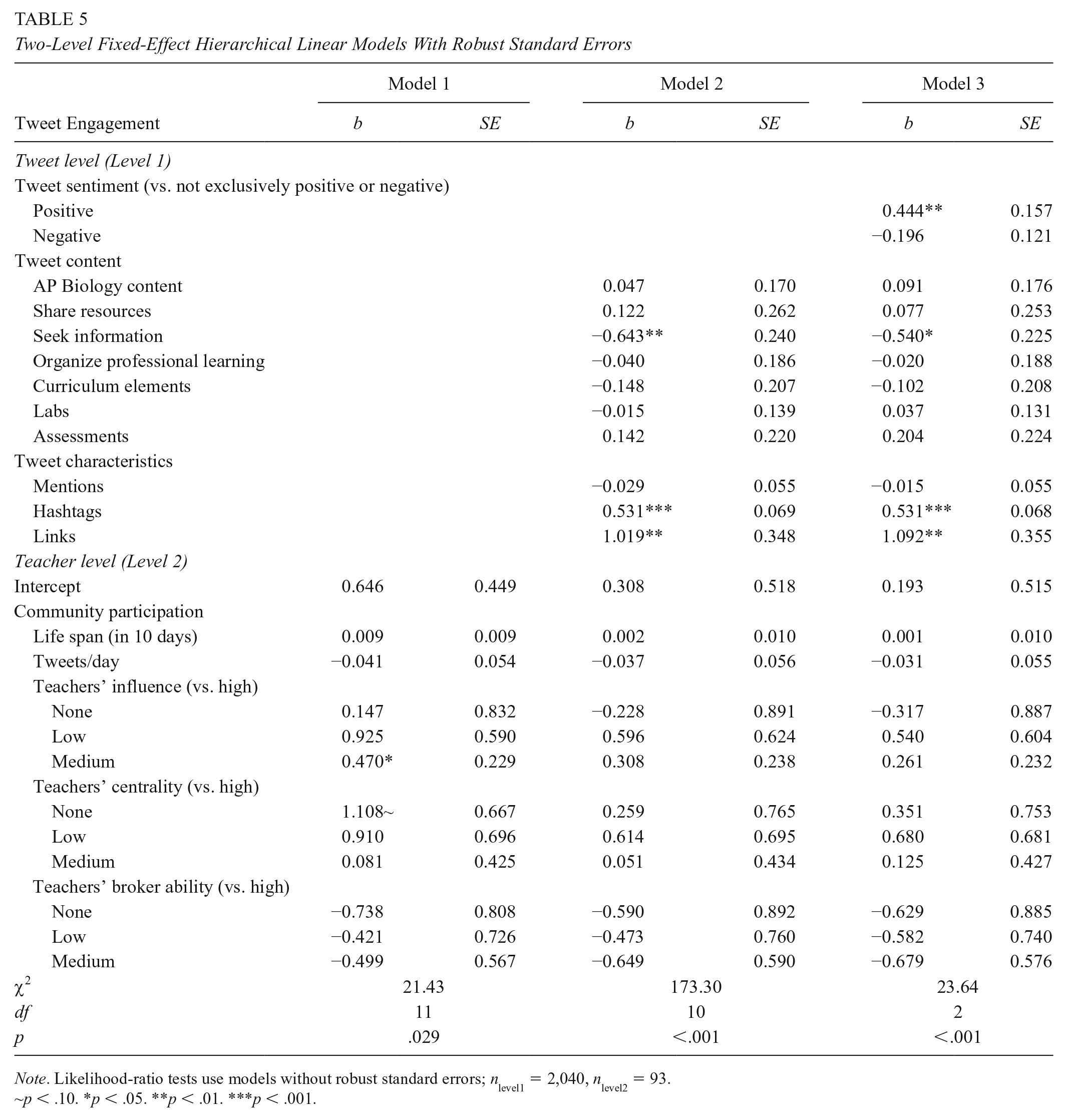
Note. Likelihood-ratio tests use models without robust standard errors; n level1 = 2,040, n level2 = 93.
p < .10. *p < .05. **p < .01. ***p < .001.
These findings support the idea that some teachers might perceive Twitter as a supportive environment. In particular, teachers who are the only teachers in their subject area in a school, which is common for AP Biology, might benefit from these positive and potentially supportive teacher communities. Consequently, participation with colleagues in Twitter communities might be viewed as adhering to the “collective participation” high-quality PD characteristic.
Temporal Engagement Patterns
In traditional PD activities, the total duration of the learning activities is usually predetermined by the PD provider without affording teachers flexibility. For instance, PD might be offered as a 2-hour online course, a 1-day workshop at the teachers’ school, or a weeklong course at a summer institute. In contrast, temporal engagement patterns in Twitter communities indicate that life span and frequency of participation vary highly across teachers (Figure 2).

Scatter plots of teachers’ life span (i.e., number of days between first and last tweet in communities) and frequency of participation in the community in tweets per day; all teachers (left), only teachers with frequency of participation below one tweet per day (right).
Teachers’ community life span serves as a strong predictor for all analyzed forms of leadership roles (teachers’ influence, centrality, and broker ability). However, teachers’ community life span is uncorrelated with their frequency of participation if teachers’ participation exceeds one week, r = −0.08, p > .05 (Figure 2). In particular, teachers with high Twitter community life spans and tweet frequencies fulfill the “duration” high-quality PD characteristic. In this study, 16% of teachers could be viewed as using Twitter in accordance with duration thresholds by participating in the community for at least 100 days and tweeting on average at least once every 2 weeks.
No significant direct associations were found between teachers’ community life span and tweet content, quantitative tweet characteristics, and community participation variables (Table 6). Nevertheless, factors that significantly contributed to teachers’ community life span, and factors that approach significance (likely due to the small sample size), provide insights in teachers’ temporal participation patterns. For instance, a 10% positive difference of tweets that share AP Biology content knowledge is associated with an approximate 11-day longer community life span, b = 10.59, t = 1.82, p < .10. A 10% positive difference in tweets with positive sentiment is associated with an approximate 8-day longer community life span, b = 7.87, t = 1.93, p < .10. The implication that positive-oriented content creation lead to a longer participation duration promotes perspectives that view Twitter as a supportive environment for teachers. Regarding quantitative tweet characteristics, mentioning on average an additional user per tweet is significantly associated with an approximate 36-day shorter community life span, b = −35.67, t = −2.22, p < .05, and including on average one additional hashtag per tweet is associated with an approximately 57-day longer community life span, b = 57.14, t = 2.07, p < .05. This indicates that both microlevel (mentioning) and macrolevel (hashtags) conversational practices are related to temporal participation patterns. Thus, Twitter affords interaction patterns fitting teachers’ individual contexts, professional needs, and professional learning preferences, contrasting “one-size-fits-all” approaches.
Ordinary Least Squares Regression Analysis With Robust Standard Errors

Note. n = 93.
p < .10. *p < .05. **p < .01. ***p < .001.
Discussion
This observational mixed-methods study contributes to the research base on teacher PD and how platforms such as Twitter may support components of an overall teacher learning process. This study extends the research base on teachers’ microblogging by using educational data mining, SNA, and other more quantitative approaches. Furthermore, this is one of the first empirical studies that analyzes teachers’ engagement on Twitter in the context of a nationwide high-stakes curriculum reform. This is important because it gives teachers in these AP Biology communities a concrete and shared overall goal: to help their students perform better on the standardized AP exam. Consequently, this study might inform a range of educational stakeholders regarding engagement in online teacher communities when faced with other large-scale curriculum reforms.
An important feature of teacher interactions on Twitter is an absence of hierarchical leadership and participation structures. Teachers who often share resources or organize Twitter chats do not necessarily hold more prominent leadership roles. This finding supports the view of Twitter as a more open, democratic, and collaborative environment that may contribute to democratization of teacher learning (Lord & Lomicka, 2014; Wesely, 2013; Zeichner, Payne, & Brayko, 2015), or at the least, encourage more teachers to feel enhanced agency in their own learning process. Similarly, Twitter allows temporal engagement patterns that fit teachers’ individual contexts, professional needs, and learning preferences to engage in teacher learning both “just-in-time” and “just-for-me” instead of a traditional “just-in-case” learning approach. This finding supports the view that Twitter affords personalization of professional learning as opposed to the traditional “one-size-fits-all” paradigm (Carpenter & Krutka, 2015; Wesely, 2013) of more traditionally organized face-to-face PD. Consequently, teachers might feel empowered to explore Twitter as an alternative, complementary professional learning environment to receive information and personalize their unique selection of professional learning activities aligned with their individual needs and goals.
Second, Twitter reflects some design characteristics of high-quality professional learning. In particular, teacher participation in Twitter communities has the potential to fulfill the “collective participation” and “duration” high-quality PD characteristics, depending on how it is used, which may support components of an overall teacher learning process. This study provides evidence that Twitter allows for flexible engagement patterns and highly personalized content, leading to diverse experiences in Twitter communities based on teachers’ individual choices. Desimone’s (2009) high-quality PD design characteristic of “collective participation” can be fulfilled for teachers who utilize the collaborative and positive participation structure. For instance, AP Biology teachers could use Twitter communities to collectively engage in discussions with colleagues experiencing similar challenges with the AP reform. Teachers could use Twitter networks to seek out supportive relationships with more experienced colleagues whose interactions might include aspects of informal mentoring (Desimone et al., 2014). Similarly, Desimone’s (2009) high-quality PD design characteristic of “duration” can be fulfilled because of Twitter’s adaptivity to teachers’ needs and preferences regarding temporal participation patterns. While some teachers experience all their interactions with Twitter communities in a brief or concentrated way—within 1 day or 1 week—other teachers continuously contribute to the communities over extended periods of time exceeding duration thresholds for effective professional learning experiences (Darling-Hammond et al., 2009; Desimone, 2009). Thus, this study indicates that online teacher communities have the potential to provide components for effective professional learning opportunities for teachers to engage in virtual communities of practice.
We note that these properties are not unique to Twitter. Some of these properties may be shared by alternative or emerging technologies like Slack, Instagram, or Reddit. While not the focus of this article, how the designs and norms of those sites might facilitate, or inhibit, PD is a fruitful area for future work. Finally, social media researchers have documented growing concern about the prevalence of harassment and misinformation on Twitter, which may disproportionately affect people from marginalized identities (Blackwell et al., 2017; Pew Research Center, 2017b; Starbird et al., 2014). Our observational data do not yield insights into teachers who may have left Twitter, or who may be reading tweets but not contributing to conversations because they do not feel safe doing so. Future work should consider whether teachers experience equitable PD opportunities on Twitter based on their identities and backgrounds. Nonetheless, school leaders and other policymakers may consider how platforms like Twitter may be a component of teacher professional learning. State and district policies and teacher contracts that limit what “counts” as valid PD may inadvertently devalue potential sources of professional learning. Also, organizers of “traditional” PD may integrate Twitter into their professional learning activities to potentially enhance and extend teacher engagement, possibly allowing these types of microblogging platforms to support key characteristics of effective PD.
Conclusion and Future Work
This study analyzed a platform that might contribute to the continued evolution of current paradigms for PD. This study suggests that Twitter can adhere to standards of high-quality PD activities. In particular, this study examined “collective participation” and “duration” high-quality PD design characteristics, which may support components of an overall professional learning process. It is conceivable that microblogging may also adhere to other high-quality PD design characteristics, such as coherence, active learning, or content focus. For instance, affordances of Twitter to personalize content would afford learning coherent to teachers’ knowledge and beliefs. Teacher engagement in specific communities, such as AP Biology or NGSS-related hashtags, would enhance coherence regarding nation- or statewide reforms. Therefore, future studies are encouraged to further examine microblogging platforms like Twitter with respect to other high-quality PD design characteristics. Additionally, future studies could gather more in-depth information on how teachers perceive and use Twitter to complement their professional learning or target lurkers in the Twitter communities. Furthermore, future work may shift the current emphasis of macrolevel conversational practices to mesolevel analysis of selected teachers’ ego networks exploring tweet sequences and follower-followee structures, or utilize conceptualizations that extend Bruns and Moe’s (2013) framework. An interdisciplinary application in the intersection of cognitive science and natural language processing would be to automate the detection (and basic analysis) of teachers’ sentiment and learning processes to analyze social network communities at scale. Finally, it is also important to investigate how different microblogging engagement patterns and characteristics of microblogging communities may more directly affect teacher knowledge and instruction and, ultimately, student learning. Nonetheless, educational policymakers and school leaders should be aware of the potential benefits of Twitter and other microblogging platforms for components of their professional learning and consider providing support for teachers who choose to engage in online teacher communities in addition to other more traditional professional learning outlets.
Footnotes

Authors
CHRISTIAN FISCHER is an assistant professor of educational effectiveness at the Hector Research Institute of Education Sciences and Psychology at the University of Tübingen, Germany. His research is situated in the intersections of STEM (science, technology, engineering, and mathematics) education, teacher education, and educational technologies with a particular focus on the role of digital technologies to transform teaching and learning.
BARRY FISHMAN is Arthur F. Thurnau Professor of Learning Technologies in the University of Michigan School of Information and School of Education. His research focuses on video games as models for learning environments, teacher learning and the role of technology in supporting teacher learning, and the development of usable, scalable, and sustainable learning innovations through design-based implementation research, which he helped establish.
SARITA YARDI SCHOENEBECK is an associate professor in the School of Information at the University of Michigan where she directs the Living Online Lab and codirects the Social Media Research Lab. Her research is in the areas of social computing, social media, and human-computer interaction, with some current projects exploring ways of mitigating online harassment, ecommerce in peer-to-peer communities, and families’ use of social media.