




Abstract
Situated in the context of advanced placement (AP) reform in the United States, we investigated profiles of teachers’ motivation for participating in professional development (PD) courses in a two-cohort sample of nt1 = 2,369 and nt2 = 2,170 chemistry teachers via multilevel latent class analysis. In addition, the study investigated to what extent profile membership was related to factors at the teacher, school, and PD levels. Participation in PD courses was associated with one of three profiles, labeled “reform-motivated,” “convenience-motivated,” and “interaction-motivated.” Participation in PD courses was more likely to be reform-motivated if a teacher had a major in chemistry, more experience teaching AP, more positive attitudes toward PD, or higher enactment of AP redesign in the classroom, or if the PD course was formal and face-to-face. The results show that teachers have different motivations for participating in PD courses and provide insight into how to engage teachers in professional learning.
Keywords
Introduction
Research has shown that effective implementation of large-scale curriculum reforms depends strongly on teachers and their preparation to meet the new requirements introduced by reforms (Desimone, 2009; Hübner et al., 2021; Porter et al., 2015). Professional development (PD) courses have been identified as an important measure for equipping teachers with the knowledge and skills needed to meet the new requirements (Borko et al., 2003; Dede et al., 2009; Marrongelle et al., 2013). However, teachers usually cannot be forced to participate in PD courses. Thus, teachers’ motivation to participate in PD courses is a crucial factor in predicting their PD participation (Fütterer et al., 2023; D. Richter et al., 2019) and is an important aspect in determining the effectiveness of PD within reform initiatives. Recent studies have successfully identified various motivations for participating in PD, such as personal interest in a topic or improving instructional skills (Appova & Arbaugh, 2018; Gorozidis & Papaioannou, 2014; Kao et al., 2011). Knowing that teachers have several interrelated motivations for participating in PD, current research has begun to analyze the different motivations teachers have for participating in PD holistically and not in isolation from one another (Jansen in de Wal et al., 2014).
However, to more specifically motivate teachers to participate in PD courses, we need to know more about their different motivations and how these relate to their personal situations as teachers, the way they teach, or the conditions in their schools. Furthermore, a major research gap in studies on teachers’ motivation to participate in PD is based on the fact that the vast majority of studies available to date measure motivation to participate in PD on a one-off basis. In such studies, teachers are asked about the reasons why they usually participate in PD courses—irrespective of a specific course. Such a simplistic approach ignores the fact that teachers may have different motivations for attending different PD courses and that certain features of a course may be associated with particular motivations.
With this study, we aim to fill the research gaps and contribute to the existing literature on teachers’ motivation to participate in PD in three ways: First, we take a profile approach to group teachers with motivational profiles. Second, we predict profile membership based on factors at the personal and school levels, taking into account characteristics of teaching and school composition. Third, we base our analysis on repeated data from teachers, which allows us to examine the relationships between PD course characteristics and teachers’ motivations in a more nuanced way. The findings of this study could help PD providers and administrators ensure that many teachers participate in PD courses.
Theoretical Framework
Teachers’ Motivation for Participating in PD
The number of days teachers participate in PD courses varies substantially between teachers (Organisation for Economic Co-operation and Development [OECD], 2014, 2019). Such inter-individual differences can be explained using the Theory of Planned Behavior (TPB; Ajzen, 2020), which argues that intentions are important predictors of human behavior. Intentions, however, capture “the motivational factors that influence a behavior” (Ajzen, 1991, p. 181). TPB has been successfully applied to explain and predict behavior in various fields, e.g., teachers’ participation in PD courses (Dunn et al., 2018).
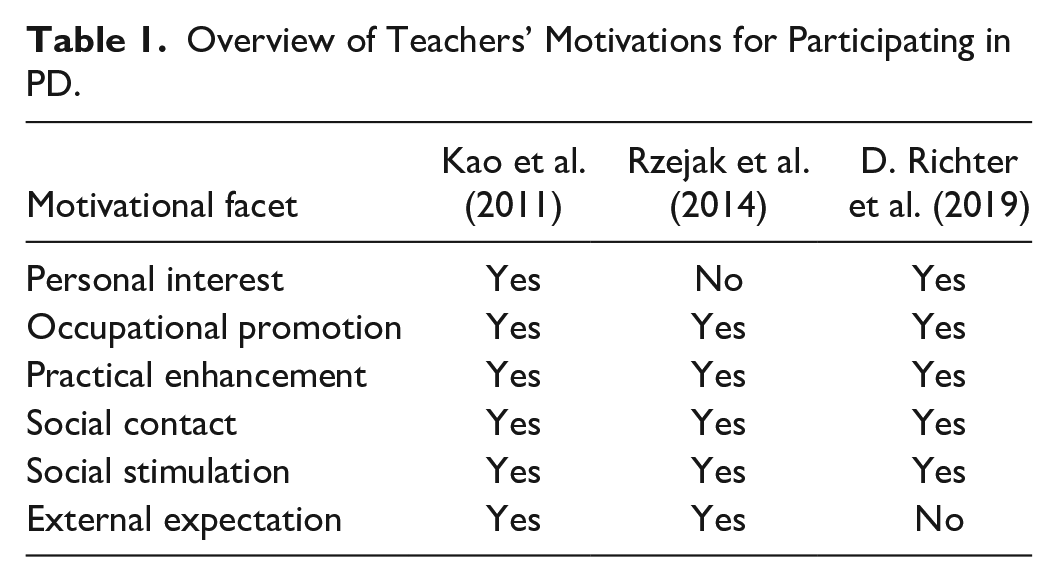
Teachers’ motivations for participating in PD are diverse. Building on research in the field of adult learning that has looked at why adults choose to participate in PD courses in different occupations across the lifespan (Boshier, 1971; Fujita-Starck, 1996), recent studies have used factor analysis to attempt to synthesize the different reasons for teachers’ participation in PD courses into overarching factors. The studies generally agree that there are a number of different motivations for teachers to participate in PD courses, even though different and varying numbers of motivations were identified in the different studies (Table 1). For example, Kao et al. (2011) assessed six different motivations of teachers for participating in PD courses (personal interest, occupational promotion, practical enhancement, social contact, social stimulation, and external expectation), while Rzejak et al. (2014) identified four statistically and substantively distinct motivational facets (social interaction, external expectation, career enhancement, and practical enhancement) and D. Richter et al. (2019) measured five reasons to attend PD courses (personal interest, occupational promotion, practical enhancement, social contact, and social stimulation). Although difficult to compare due to differences in measurement instruments, these studies suggest that the motivation for teachers to participate in PD courses comes from a desire to improve their own practice, connect with colleagues, or learn something new, or because someone else wants the teacher to participate.
Overview of Teachers’ Motivations for Participating in PD.
Motivations for participating in PD courses have been shown to be interrelated, leading to the assumption that teachers have not just one but several motivations when participating in PD courses (Gorozidis & Papaioannou, 2014; D. Richter et al., 2019; Rzejak et al., 2014). For this reason, researchers have started to consider facets of teachers’ PD motivation simultaneously rather than isolating them as individual predictors of participation. For instance, Jansen in de Wal et al. (2014) used data from 2,360 teachers to conduct a latent profile analysis (LPA) regarding teachers’ motivation to engage in professional learning. While Jansen in de Wal et al. (2014) did not measure teacher motivation to engage in professional learning based on specific reasons for attendance, they relied on self-determination theory (SDT) and operationalized motivation using the distinction between intrinsic and extrinsic motivation (Ryan & Deci, 2000). The authors identified four distinct profiles (i.e., extremely autonomous, moderately motivated, highly autonomous, and externally regulated) of motivational dimensions related to engagement in professional learning activities. With their LPA approach, they showed that teachers can experience different types of motivation for engaging in professional learning. Examining profiles of motivational dimensions is theoretically interesting because it can uncover subgroups of individuals that are not represented by characteristics of the overall sample, such as the mean. Also, seen from an applied perspective, the identification of motivational profiles will be useful in the development of new PD programs, as it will allow for better tailoring to specific groups of teachers.
Although profiling teachers’ motivation for participating in PD provides a fruitful way to better understand what drives teachers to participate in professional learning opportunities, one obstacle faced in previous research is that most studies rely only on cross-sectional data. This might be insufficient, as research on motivation in various fields has shown that motives change over time. This is true, for example, for students’ motivational beliefs (Lazarides et al., 2021; Watt, 2004) and teachers’ career choice motivation (Kaçaniku et al., 2022; König et al., 2016). However, the vast majority of studies available to date measure motivation to participate in PD on a one-time basis, asking participants to report on their general motivation to participate in PD over a specific period, usually within the last 12 to 24 months. This type of data measurement leads to distortions, as it ignores the fact that people may have participated in different PD courses for different reasons.
Aspects Related to Teachers’ Motivation for Participating in PD
As PD is supposed to help teachers acquire the knowledge and skills needed to implement changes in classroom practice, it would be especially important to motivate teachers to participate in PD who do not have the knowledge and skills to implement the new requirements in their classes or who teach students under difficult conditions. Desimone et al. (2006) refer to this as the educative function of PD. However, previous research has shown that PD often serves a catalytic function, primarily motivating teachers to participate who already have a high level of (self-reported) knowledge, self-efficacy, or instructional skills prior to participating in PD courses (Desimone et al., 2006; E. Richter et al., 2021; Yoon & Kim, 2022) or who are already interested in the topic of the PD course (Fütterer et al., 2023).
These findings draw attention to how teacher and school factors are related to teachers’ motivation for participating in PD courses. McMillan et al. (2016) developed a model to describe the effects of such factors on teachers’ motivation to participate in learning activities and provided a comprehensive overview of the factors that motivate teachers to participate in PD courses at three levels: personal, school, and educational system. We focus here on personal and school factors because our study was conducted within an educational system, and we did not aim to examine the effects of systemic factors (e.g., statewide PD course requirements, see Kuschel et al., 2020).
The personal level includes factors known as intrinsic factors. Intrinsic factors lead teachers to express a preference for professional learning activities that they value for personal reasons and in response to their own personal or professional needs. Studies examining the relationship between personal factors and teachers’ motivation to participate in PD courses underscore their importance. Based on SDT, for instance, Zhang et al. (2021) found that teachers with higher levels of self-efficacy reported higher levels of autonomous motivation to participate in PD courses. In contrast, teaching experience was negatively associated with autonomous motivation to participate in PD courses. These two findings are consistent with a set of other studies: First, self-efficacy is positively related to motives, which can be considered part of autonomous motivation, such as personal interest, social interaction, or practical improvement (Kao et al., 2011; E. Richter et al., 2022; Rzejak et al., 2014). Second, teaching experience seems to be negatively related to a number of different motivations for participating in PD courses, such as personal interest or career promotion ( D. Richter et al., 2019). However, there is a lack of studies examining how motivation to participate in PD courses relates to teacher instruction.
At the school level, factors related to workplace conditions that can either promote or inhibit teachers’ motivation to learn. These include interpersonal relationships and school policies. Interpersonal relationships refer to the relationships between teachers and their colleagues and school leaders. School policies refer to the overall support at the school. In the same vein, studies suggest that school factors, in addition to personal factors, are related to teachers’ motivation to participate in PD courses. Zhang et al. (2021) reported that transformational leadership of principals, which includes providing individualized support, appears to have a positive relationship with autonomous motivation to participate in PD courses. However, previous studies have not examined the relationship between the characteristics of the school in which a teacher teaches and the teacher’s motivation for participating in PD courses. Investigating this relationship may prove fruitful, as studies on the relationship between school location and participation in PD courses have found that teachers working in urban schools participate more intensively in PD courses than their counterparts working in suburban and rural areas (Wei et al., 2010; Yoon & Kim, 2022).
Whereas McMillan et al. (2016) suggest that factors at the personal, school, and educational system levels are associated with teachers’ motivation to participate in PD courses, some recent studies also focus on how this motivation is related to the characteristics of the PD course itself. On the one hand, D. Richter et al. (2019) found that teachers seeking practical enhancement were more likely to take courses that taught pedagogical skills but less likely to take courses that taught subject knowledge or school management content. On the other hand, teachers indicate that they are more likely to take courses on school management if they are seeking occupational promotion. Finally, teachers who opted for a face-to-face course rather than an online course report higher motivation in the area of social interaction (E. Richter et al., 2022).
Research Questions
In this study, we aimed to fill some important research gaps regarding teachers’ motivation to participate in PD courses. Based on the general finding that teachers exhibit different motivations to participate in PD courses which can be categorized into profiles, we focused on personal, school, and PD course characteristics that may be associated with belonging to a particular profile. Insights into such profiles can help explain why certain groups of teachers use PD in different ways and could help identify high-risk teachers. Furthermore, we do not base our analyses on a global measure of motivation to participate in PD courses, but rather ask teachers to indicate why they chose each PD course they participated in. To expand the research on teachers’ motivation for participating in PD, we also try to predict profile membership. In doing so, we use a holistic approach and include predictors at the personal, school, and PD course levels. With this in mind, we pursue two research questions (RQ) in the present study:
Method
Study Setting and Sample
This study is connected to a large National Science Foundation-funded research project that aims to better understand teachers’ PD patterns in response to the advanced placement (AP) reform in the sciences (Fischer et al., 2018, 2020; Hübner et al., 2021). The AP program provides rigorous and inexpensive college-level coursework to high school students and is often seen as an avenue to increase students’ competitiveness and success in college (Chajewski et al., 2011; Gurantz, 2021). Data were collected from two sources: First, student- and school-level data for all students and schools were provided by the College Board, the provider of the AP exams. Second, teacher-level data were collected through a web-based survey sent to all AP science teachers in the nation, unless they opted out of the College Board’s official communication.
This study used cross-sectional data from two cohorts of Chemistry teachers who took at least one PD course in the first (t1) or second (t2) year after the AP Chemistry reform (the first redesigned AP Chemistry exam took place in 2014). Overall, this led to a full sample of nt1 = 2,369 teachers, of whom 55.3% had a major in primary or secondary education, and nt2 = 2,170 teachers, with 54.4% holding a major in primary or secondary education.
To assess the generalizability of the study sample, Mann–Whitney U tests for t1 indicated that teachers in the sample taught in schools with slightly higher socioeconomic status (as measured through the percentage of students enrolled in free and reduced-priced lunch programs), z = −6.92, p < .001, d = 0.18. However, there are no differences in terms of schools’ overall funding from the district (as measured through per-student funding allocations for instructional materials), z = −0.05, p < .958, d = 0.18, or students’ performance (measured through students’ Grade Point Average (GPA) scores), z = −0.63, p = .528, d = 0.02. Moreover, Mann–Whitney U tests for t2 indicated that teachers in the sample taught in schools with slightly higher socioeconomic status, z = −7.05, p < .001, d = 0.18, and in schools that received slightly higher overall funding from the district, z = −2.12, p = .034, d = 0.01. However, there are no differences in terms of students’ performance, z = −1.17, p = .283, d = 0.01. All in all, these differences are considerably small (Cohen, 1992; Ferguson, 2009), so our study can sufficiently represent all AP Chemistry teachers in the nation.
Measures
Indicators of Motivation for Participation in PD Courses
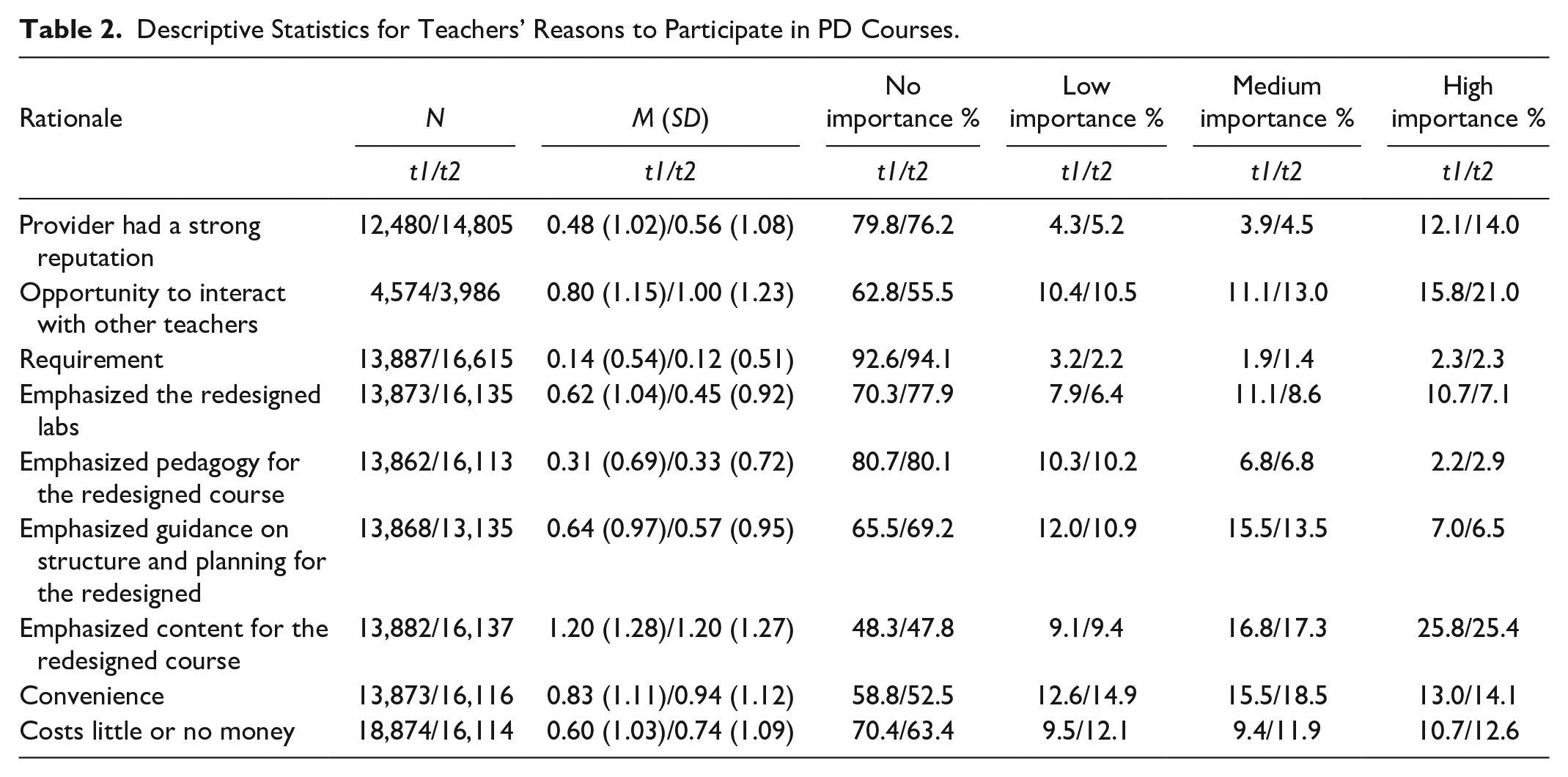
Teachers’ motivation to participate in PD courses was assessed at two measurement points (t1 and t2; Table 2). Teachers were first asked which AP reform PD opportunities they had attended in the past year. For each PD opportunity in which teachers participated, they were asked to rank the three most important reasons for their participation from a provided list of nine reasons. Reasons for PD participation were assigned values between 0 and 3, with values of 3 (most important reason), 2 (second most important reason), and 1 (third most important reason) each being given only once. The remaining six reasons not selected as most, second most, or third most important were assigned a value of 0 (no importance).
Descriptive Statistics for Teachers’ Reasons to Participate in PD Courses.
Teacher Covariates
We used teacher covariates that are assumed to affect teachers’ motivation to participate in PD courses. We included gender (dichotomous; 0 = male, 1 = female; additional choices, e.g., non-binary, were not offered at the time of the study), major in chemistry (dichotomous; 0 = no, 1 = yes), and years of AP teaching experience (continuous).
Moreover, we used a continuous composite variable that describes teachers’ attitudes toward PD courses (i.e., “PD is important for student performance”), measured using a 5-item scale on a 5-point Likert-type scale (from “Strongly disagree” to “Strongly agree”). Similarly, teachers’ self-efficacy (i.e., “students perform better because of my extra effort”) was gauged with a 4-item scale on the same 5-point Likert-type scale. For an in-depth understanding of the instruments and their application within the context of the AP program, we refer readers to the comprehensive analyses presented in Fischer et al. (2018, 2020).
We also assessed teachers’ classroom teaching prior to AP reform and prior to participation in PD courses related to AP reform. Teachers’ classroom teaching was measured with a continuous variable describing teachers’ self-reported number of laboratory investigations (number of prior AP labs) and two continuous composite variables that consisted of teachers’ enactment of practice elements (i.e., providing guidance on open and free-response questions) and teachers’ enactment of curriculum elements (i.e., referring to the “Big Ideas” of Chemistry), both related to the AP redesign.
School Covariates
We used school covariates including a continuous variable that describes socioeconomic status as measured by the school-level percentage of students enrolled in free or reduced-priced lunch programs. Lunch program enrollment is often used to describe poverty levels (National Center for Education Statistics, 2011, 2012). We also utilized an ordinal variable to represent school districts’ support, measured by per-student funding allocations for instructional materials (1 = less than $200, 2 = $200-$300, and 3 = more than $300). 1 Moreover, we analyzed students’ GPA. 2 In addition, we used a continuous composite variable that describes teachers’ perceived administrative support (i.e., principal supports PD participation), measured using a 6-item scale on a 5-point Likert-type scale (from “Strongly disagree” to “Strongly agree”). For detailed information on the instruments and their AP program application, see Fischer et al. (2018, 2020).
PD Covariates
We used PD course covariates including information about the characteristics of the course in which a teacher participated. We distinguished between the dimensions of formality (dichotomous; 0 = formal, 1 = informal) and modalities (dichotomous; 0 = online, 1 = face-to-face) of a specific PD course.
Data Analysis
Description of Multilevel Latent Class Analysis
We performed Multilevel Latent Class Analysis (MLCA) with the covariates to examine latent classes describing teachers’ motivation to participate in PD courses and the relationship between latent classes and personal, school, and PD course-level variables. The MLCA approach is based on Latent Class Analysis (LCA; B. Muthén & Muthén, 2000). LCA provides probability estimates (posterior probability) of how likely an individual is to belong to each class (Howard & Hoffman, 2018; B. Muthén & Muthén, 2000). One assumption of LCA is that observations are independent, which is problematic when data are interleaved. Failure to account for the non-independence of observations can lead to inflated type I error rates, biased standard errors, and inaccuracies in parameter estimation (Kaplan & Keller, 2011). MLCA overcomes this limitation by allowing the estimation of level 1 (L1) latent classes while accounting for level 2 (L2) clustering.
Modeling Process
Following Henry and Muthén (2010), in the first step, we estimated a traditional (single-level) LCA with nine indicators using items measuring the importance of different reasons for PD participation to identify L1 latent classes (see also: Bakk et al., 2022). We identified the best-fitting solution of latent classes for both measurement points by conducting a series of LCA separately for t1 and t2. We selected the number of latent classes based on both model fit values following recommendations by Nylund et al. (2007) and content decisions described by Spurk et al. (2020). Regarding the model fit values, we included the Bayesian information criterion (BIC: lowest; Schwarz, 1978), entropy (>0.80; Celeux & Soromenho, 1996), and adjusted Lo–Mendell–Rubin likelihood ratio test (aLMR: p-value is used to determine whether the null k−1 class model should be rejected in favor of the k class model; Lo et al., 2001). However, different fit indices may allow for different final solutions. In such cases, the fit values can be overruled by theoretical decisions (Spurk et al., 2020). One criterion that should be considered is how well an additional profile can be distinguished from an already retained profile (e.g., Berlin et al., 2014).
In the second step, after deciding the number of L1 latent classes, the hierarchical structure of the data was considered, calculating a non-parametric MLCA to obtain groups of teachers. That is, a second latent class model was specified at L2 (i.e., teacher level; Henry & Muthén, 2010). The further procedure was identical to the procedure described for step 1. Following Henry and Muthén (2010), each model was evaluated based on BIC values, the magnitude of change in log likelihood (a lower magnitude means that adding another class does not significantly improve fit; Nylund-Gibson et al., 2010), interpretability, and theoretical significance.
Finally, the covariates were added to the model (Nylund-Gibson et al., 2010). L1 latent classes were predicted by L1 and L2 covariates. Covariate effects were tested using multinomial logistic regression. All models were estimated in Mplus version 8.8 (L. Muthén & Muthén, 1998-2019) using a maximum likelihood estimator with robust standard errors, which accounts for data missing at random.
Results
Traditional (Single-Level) LCA
First, a traditional LCA of the nine reasons for participating in courses as indicators were examined for t1 and t2 separately. These initial analyses ignored the clustering of the data. Table 3 presents the class solutions for one to four latent classes (t1) and one to three classes (t2). Regarding t1, a comparison of fit indices indicated a best-fitting profile solution. The model with three classes and 83 free parameters showed the best fit (lowest BCI, highest entropy) compared to the models with one, two, or four classes. Moreover, the aLMR test was only statistically significant for the two-profile and three-profile solutions, indicating that these profile solutions showed a better fit to the empirical data than the models tested one step before. The four-profile solution did not fit better than the three-profile solution. We chose the three-class solution as the best model. Regarding t2, the comparison of fit indices did not indicate a clear best-fitting profile solution. That is, the BIC value consistently declined across profile solutions and the entropy showed a good fit for all profile solutions. However, the aLMR test was again statistically significant only for the two-profile and three-profile solutions. Thus, we chose the three-class solution as the best model.
Model Fit Criteria for Model Specifications at t1 and t2.
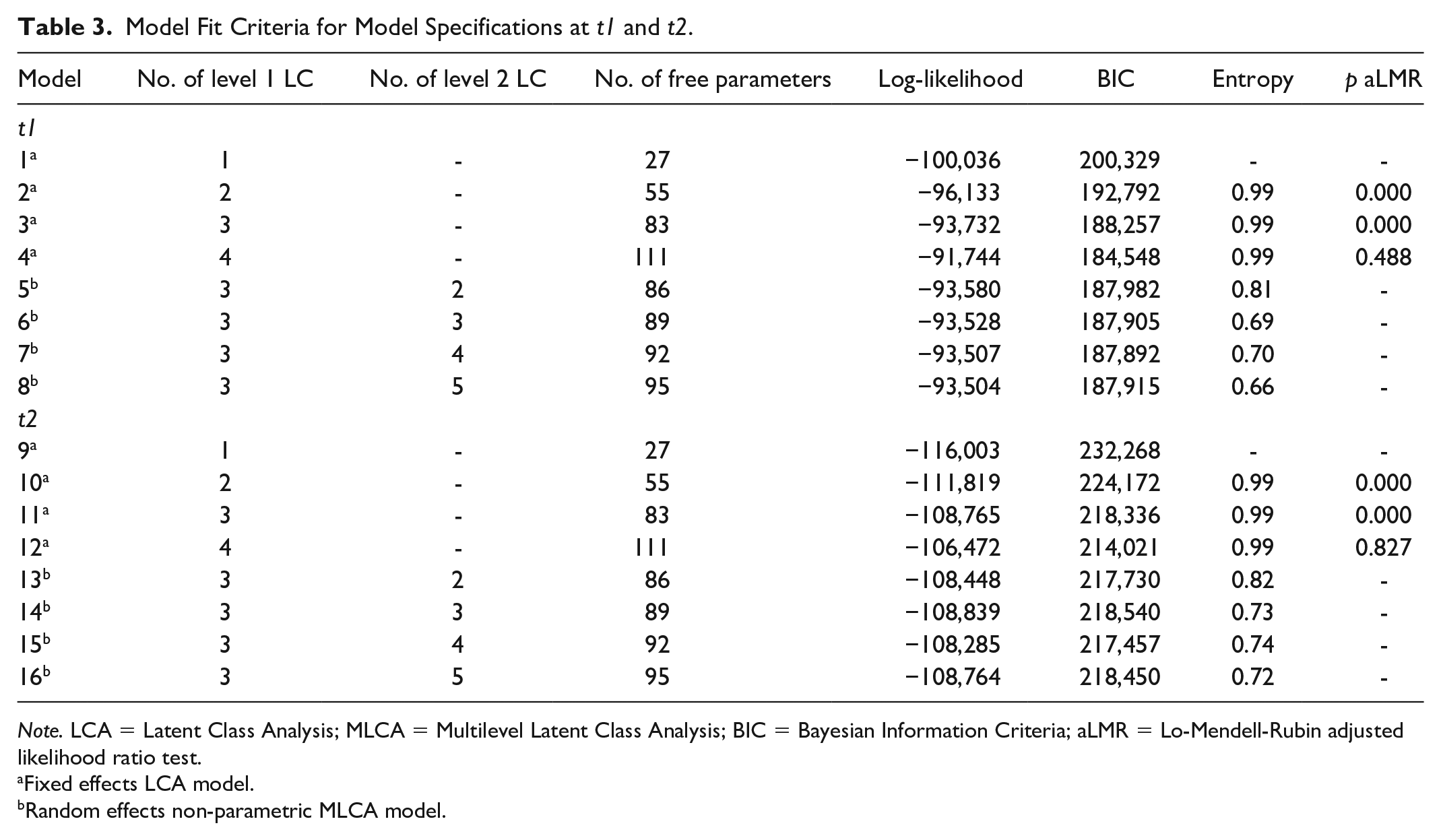
Note. LCA = Latent Class Analysis; MLCA = Multilevel Latent Class Analysis; BIC = Bayesian Information Criteria; aLMR = Lo-Mendell-Rubin adjusted likelihood ratio test.
Fixed effects LCA model.
Random effects non-parametric MLCA model.
For the three-profile solution at t1, the largest class comprised 61.7% of the PD participation and can be labeled interaction-motivated (Figure 1). The main reason for choosing the PD course of this group was interaction with other teachers (see Supplemental Appendix A, available with the online version of this article). The second class comprised 22.8% of the PD participation and can be labeled reform-motivated, as the main reasons for selecting a PD course lay in learning about the content of the redesigned course and receiving guidance on the structure and planning of the redesigned course. The third class comprised 15.5% of the PD participation and could be labeled convenience-motivated, as the main reason for selecting a PD course lay in convenience and low cost. The average latent class probabilities for the three-profile solution were very high (<0.95), indicating separated latent profiles. For t2, we also found a three-profile solution. These three groups corresponded to the three groups of the first measurement point in terms of content and included a similar number of PD activities (interaction-motivated: 60.4%; reform-motivated: 21.2%; convenience-motivated: 18.4%). Again, the average latent class probabilities for the three-profile solution were very high (<0.95), indicating separated latent profiles.
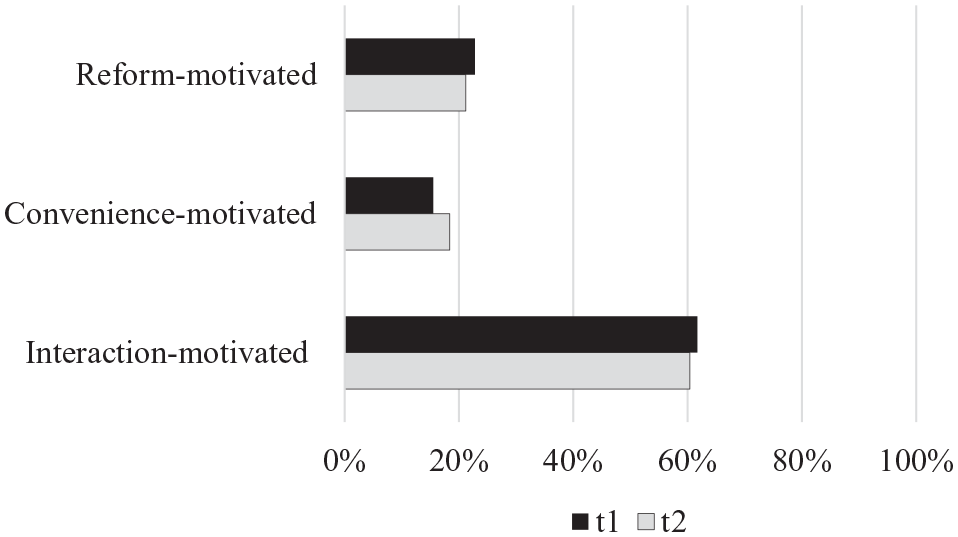
L1 Profile Solutions for t1 and t2.
Non-parametric MLCA
Second, building on the 2 three-profile solutions, we specified a model for each measurement point that utilized a non-parametric approach. We used a non-parametric approach to account for the nested structure of the data because the random means of our LCA indicators were not normally distributed (Henry & Muthén, 2010; Vermunt, 2008). The results of the models are presented in Table 3. In the non-parametric model for t1, fit indices did not indicate a clear best-fitting profile solution: The BIC value consistently declined from a solution with two L2 classes to a solution with four L2 classes. However, entropy dramatically dropped from a solution with two L2 classes to a solution with three L2 classes. Therefore, we selected the model with two L2 classes and 86 free parameters as the best model. These L2 classes represent two types of teachers (Figure 2). The first L2 class is composed of teachers who mainly chose PD courses for reform-motivated reasons. This class represents 17.5% of all teachers. The second L2 class is composed of teachers who participated in PD courses primarily motivated by interaction. This class represents 82.5% of all teachers. In the non-parametric model for t2, fit indices indicated a best-fitting profile solution because BIC increased from a solution with two L2 classes to a solution with three L2 classes. Although the BIC of the solution with four L2 classes was slightly lower compared to the solution with two L2 classes, we found that the entropy was drastically lower for the solution with four L2 classes. Thus, we selected the model with two L2 classes and 86 free parameters as the best model. Also, these L2 classes represent two types of teachers and correspond to the two L2 classes of t1 (Figure 3). However, we found that the group of teachers that chose PD courses mainly for reform-motivated reasons comprised 30.7% of all teachers at t2.
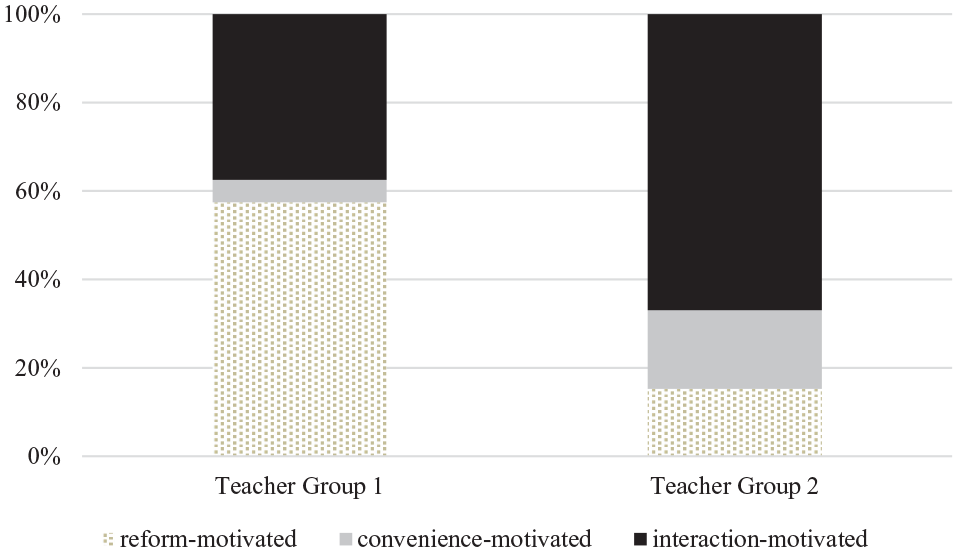
Non-parametric Multilevel Latent Class Solution (t1).
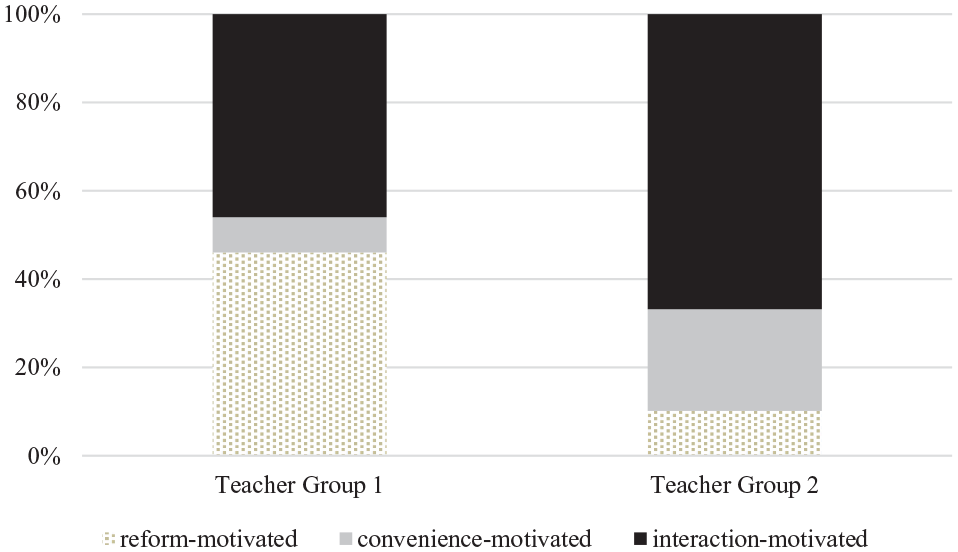
Non-parametric Multilevel Latent Class Solution (t2).
Addition of Covariates
Finally, we added predictors to the models. Multinomial regressions were used to assess the effects of different predictors on L1 latent classes (t1: Table 4; t2: Table 5). The results for t1 in the first three columns of Table 4 are the results from comparing PD courses that were reform-motivated or interaction-motivated. Results indicate that the odds of participation in PD courses being reform-motivated (compared to interaction-motivated) were statistically significantly higher if the teacher identified as female (odds ratio (OR) = 1.09; 95% CI = 1.03, 1.15), had a major in chemistry (OR = 1.05; 95% CI = [1.01, 1.11]) or more experience teaching AP (OR = 1.07; 95% CI = [1.01, 1.12]), or if the PD was formal (OR = 1.49; 95% CI = [1.43, 1.56]). Furthermore, the odds were statistically significantly lower if the PD course took place online (OR = 0.85; 95% CI = [0.81, 0.89]). As in any regression model, the effect of each covariate represents its unique effect after adjusting for all other variables in the model. Covariates were all standardized to a mean of 0 and a standard deviation of 1. Therefore, we can interpret the coefficients for all continuous covariates as follows: For each 1 standard deviation increase in experience teaching AP, the odds of participation in a PD course being reform-motivated (compared to interaction-motivated) increased by about 7 %. Regarding the dichotomous covariates, we can interpret the coefficients as follows: The OR indicates that the odds of participation in a PD course being reform-motivated (compared to interaction-motivated) were about 1.1 times higher if a teacher identified as female.
MLCA Odds Ratio (OR) Result for Teacher, School, and PD Course-Level Predictors (t1).
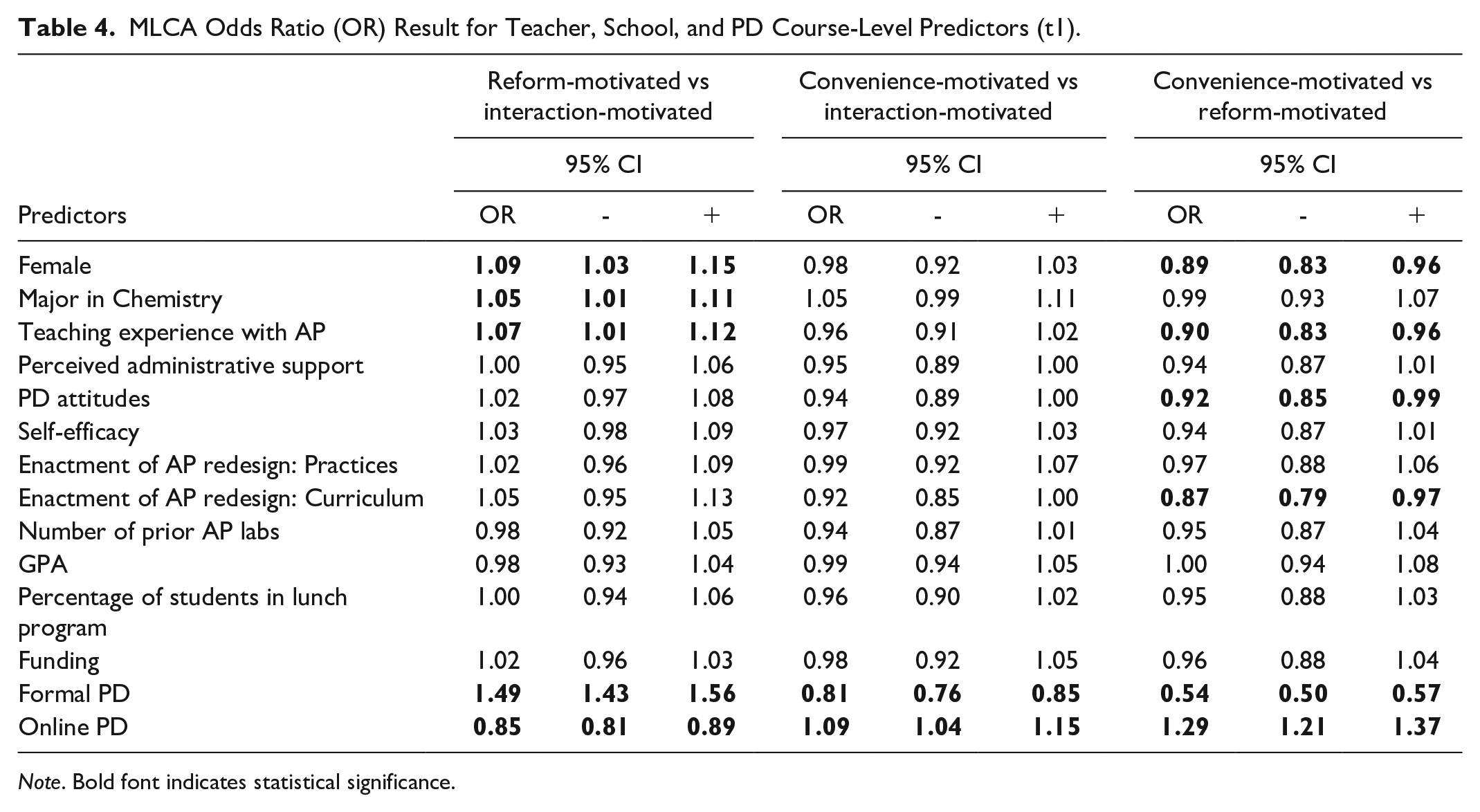
Note. Bold font indicates statistical significance.
MLCA Odds Ratio (OR) Result for Teacher, School, and PD Course-Level Predictors (t2).
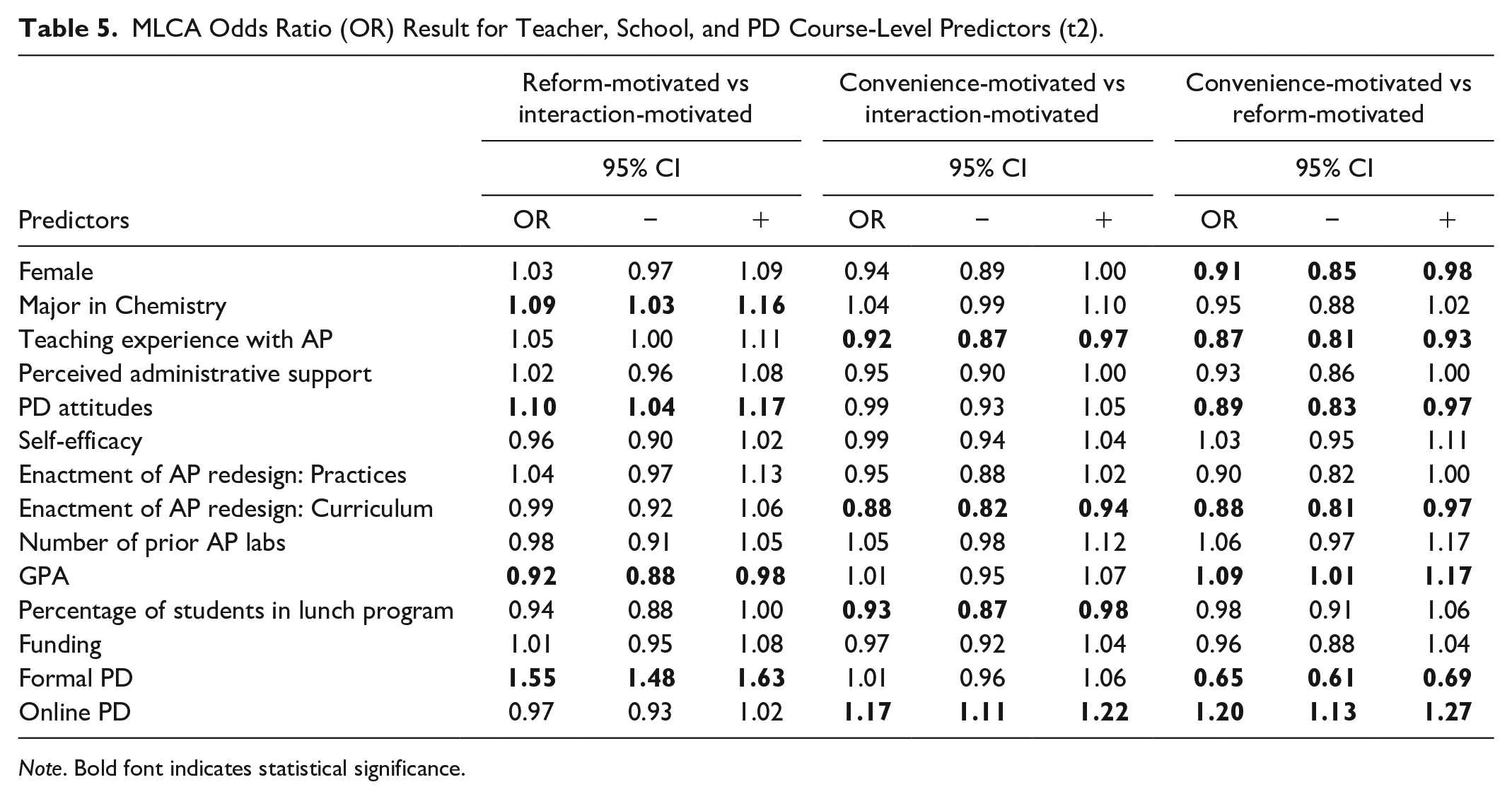
Note. Bold font indicates statistical significance.
The results in the next three columns (i.e., columns 4, 5, and 6) in Table 4 are the results from comparing PD participation in the convenience-motivated and interaction-motivated participation groups. Results indicate that the odds of participation in a PD course being convenience-motivated (compared to interaction-motivated) were statistically significantly higher if the PD course took place online (OR = 1.09; 95% CI = [1.04, 1.15]). Furthermore, the odds were statistically significantly lower if the PD course was formal (OR = 0.81; 95% CI = [0.76, 0.85]).
The third set of results in Table 4 (columns 7, 8, and 9) presents the odds for PD participation belonging to either the convenience-motivated or reform-motivated participation group. Results indicate that the odds of participation in a PD course being convenience-motivated (compared to reform-motivated) were statistically significantly higher if the PD course took place online (OR = 1.29; 95% CI = [1.21, 1.37]). Furthermore, the odds were statistically significantly lower if the teacher identified as female (OR = 0.89; 95% CI = [0.83, 0.96]), had more experience teaching AP (OR = 0.90; 95% CI = [0.83, 0.96]), had more positive attitudes toward PD (OR = 0.92; 95% CI = [0.85, 0.99]), or had higher enactment of AP redesign (Curriculum) (OR = 0.87; 95% CI = [0.79, 0.97]), or if the PD course was formal (OR = 0.54; 95% CI = [0.50, 0.57]).
The results for t2 in the first three columns of Table 5 are the results from comparing PD course participation that was either reform-motivated or interaction-motivated. Results indicate that the odds of participation in a PD course being reform-motivated (compared to interaction-motivated) were statistically significantly higher if the teacher had a major in chemistry (OR = 1.09; 95% CI = [1.03, 1.16]) or more positive attitudes toward PD (OR = 1.10; 95% CI = [1.04, 1.17]), or if the PD course was formal (OR = 1.55; 95% CI = [1.48, 1.63]). Furthermore, the odds were statistically significantly lower if GPA was higher (OR = 0.92; 95% CI = [0.88, 0.98]).
The results in the next three columns (i.e., columns 4, 5, and 6) in Table 5 are the results from comparing PD participation belonging to either the convenience-motivated or interaction-motivated participation group. Results indicate that the odds of participation in a PD course being convenience-motivated (compared to interaction-motivated) were statistically significantly higher if the PD course took place online (OR = 1.17; 95% CI = [1.11, 1.22]). Furthermore, the odds were statistically significantly lower if the teacher had more experience teaching AP (OR = 0.92; 95% CI = [0.87, 0.97]) or had higher enactment of AP redesign (Curriculum) (OR = 0.88; 95% CI = [0.82, 0.94]), or more students were in the lunch program (OR = 0.93; 95% CI = [0.87, 0.98]).
The third set of results in Table 5 (columns 7, 8, and 9) presents the odds for PD participation belonging to either the convenience-motivated or reform-motivated participation group. Results indicate that the odds of participation in a PD course being convenience-motivated (compared to reform-motivated) were statistically significantly higher if GPA was higher (OR = 1.09; 95% CI = [1.01, 1.17]) or the PD course took place online (OR = 1.20; 95% CI = [1.13, 1.27]). Furthermore, the odds were statistically significantly lower if the teacher identified as male (OR = 0.91; 95% CI = [0.85, 0.98]), had more experience teaching AP (OR = 0.87; 95% CI = [0.81, 0.93]), had more positive attitudes toward PD (OR = 0.89; 95% CI = [0.83, 0.97]), or had higher enactment of AP redesign (Curriculum and Practice) (OR = 0.88; 95% CI = [0.81, 0.97]), or if the PD course was formal (OR = 0.65; 95% CI = [0.61, 0.69]).
Discussion
The purpose of this study was to examine teachers’ motivation for participating in PD courses. We were particularly interested in profiling teacher motivation based on several measures, taking into account that teachers have different reasons for attending PD courses, which vary from course to course. We also examined how motivational profiles were related to different teacher-level, school-level, and PD course-level characteristics.
Profiling Teachers’ Motivation for Participating in PD Courses
Using data from two cohorts, we identified for both measurement points three distinct motivational profiles associated with participation in PD courses. That is, a teacher’s decision to attend a particular PD course is related to his or her particular motivational profile, taking into account that the same teacher’s next decision to attend another PD course might be related to a different motivational profile. Each profile is based on a unique combination of individual reasons for participating in PD courses derived from research on teacher professional learning. The three profiles were labeled reform-motivated, convenience-motivated, and interaction-motivated. The fact that we were able to find the three profiles in independent analyses for both measurement points is an indication of the robustness of the results.
Participation in PD courses assigned to the reform-motivated profile is characterized by a high level of a teacher’s agreement with reasons related to a reform. This type of participation was primarily due to teachers seeking information on how to incorporate reform elements into their daily teaching. Participation in PD courses belonging to the convenience-motivated profile is characterized by a teacher’s high level of agreement with reasons related to low cost or few time conflicts. Thus, this type of participation is often more opportunistic, driven by convenience and availability rather than a deliberate decision to engage with new reform elements. Participation in PD courses that fall under the interaction-motivated profile is characterized by teachers agreeing to a high degree with the reasons related to the opportunity to exchange with colleagues when participating in PD courses. Thus, with this type of participation, teachers are in active pursuit of connecting with others.
Our findings revealed that the majority of teachers’ participation in PD courses was associated with the interaction-motivated profile. This finding is consistent with previous research showing the importance of the social aspect for teachers when selecting PD courses (Appova & Arbaugh, 2018; E. Richter et al., 2022). One explanation for this finding may be that the implementation of standards-based reforms puts pressure on teachers to adopt them, such as to improve state test scores (Datnow, 2018; Smith & Kovacs, 2011). In such challenging contexts, building collective and collaborative connections with colleagues in PD courses may be a process that builds teachers’ resilience during stressful times of policy reform (Datnow, 2018; Gu, 2014).
Our study offers new insights into the different motivations driving the same teachers to participate in different PD courses. We were able to identify two groups of teachers who share similarities but also show differences in terms of their motivations. One similarity between the two groups of teachers is that both groups do not have a single reason for attendance, but rather attend different PD courses for different reasons. The finding that the choice of a PD course is driven by multiple reasons illustrates the complex decision-making process teachers face when choosing PD courses. This phenomenon has already been shown in a more hidden form in other studies, in which correlations between different participation motives were found (e.g.,D. Richter et al., 2019). However, the two groups of teachers differ in the extent to which different motivational profiles emerge in the selection of PD courses. Whereas in Group 1 most PD participation can be assigned to the reform-motivated profile, this profile is least pronounced in Group 2. The members of Group 2 chose PD courses predominantly to interact with colleagues. Again, we found these two groups in independent analyses for both measurement points, indicating the robustness of the results. At both measurement points, substantially more teachers belonged to Group 2 than to Group 1. Interestingly, our results also show that the proportion of teachers belonging to the first group increased noticeably in Year 2 only. This finding reflects the assumption that teachers initially focus on building learning communities in PD courses when dealing with reforms. In this regard, Smylie (1999) argues that teachers can draw on the expertise and experiences of others in such communities during times of reform and that this can become a source of social support.
Predicting Teachers’ Motivation for Participating in PD Courses
Our findings indicate that teachers’ motivation for participating in PD courses is related to a number of predictors on the teacher level, school level, and PD course level. We found that participation in PD courses was more likely to be reform-motivated (rather than convenience- or interaction-motivated) if a teacher had a major in chemistry, more experience teaching AP, more positive attitudes toward PD, or higher enactment of AP redesign in the classroom, or if the PD course was formal and face-to-face. That is, teachers who already have more prior knowledge and a high affinity for learning and reform-motivated teaching are more interested in the reform content and see the reforms as a motivation to participate in PD courses. This finding is further evidence that PD courses may fulfill a rather catalytic instead of an educative function (e.g., Fütterer et al., 2023; E. Richter et al., 2021). A catalytic function of PD courses implies that teachers are more likely to attend PD courses on topics that interest them or in which they already have a good base of knowledge and skills rather than courses “reaching the teachers who need it most” (Desimone et al., 2006, p. 180).
A second interesting finding is that participation in PD courses was more likely to be convenience-motivated if the PD course was informal and online. Therefore, such low thresholds for participation in PD courses provide an opportunity for teachers to participate whose motivation prerequisites for professional learning would otherwise be rather unfavorable. On the one hand, this finding highlights that online PD courses offer potential such as expanded accessibility or greater flexibility (Dede et al., 2009; Fishman et al., 2013; Parsons et al., 2019). On the other hand, the question arises whether online PD courses are a suitable way to contribute to the professional growth of teachers who do not have a strong motivation to implement the reform or to exchange with colleagues, as learning in online environments can be challenging for learners (Martin & Borup, 2022).
Limitation and Implications
Although we present an innovative approach to studying teachers’ motivation for participating in PD courses, we would also like to point out the limitations of this study. First, the data in this study are cross-sectional, although they are based on multiple measurements per person. For this reason, we cannot interpret teachers’ motivation for participating in PD courses as a cause, even though this is more plausible than the reverse causal direction. In this context, it is important to note that teachers’ participation in PD courses represents past behaviors. That is, teachers had already completed these PD courses before we assessed the motivations for their decisions. Furthermore, we cannot conclude how teachers’ motivation may change over time. We did observe intra-individual differences in motivation, which were related to time-related factors (e.g., different courses), among other things. However, examining how motivation changes over the course of a reform could lead to a deeper understanding of what motivates teachers to participate in PD courses. A second limitation is that we basically rely on self-reported data. Whereas this is necessary for some of the variables we measure (e.g., self-efficacy), information on other variables could be richer from other data sources. Specifically, teachers’ teaching could also be assessed from the students’ perspective, or administrative support from the school leaders’ perspective.
Despite these limitations, our results have implications for research and practice. We were able to show that a teacher’s decision to participate in PD courses is related to a certain motivational profile. Whereas some profiles are strongly related to the content taught in the PD course (e.g., reform-motivated profile), other profiles relate more to the circumstances surrounding the PD course (e.g., convenience-motivated profile). In further research, we will need to gain more insight into the practical meaning of these profiles in terms of different teachers’ learning experiences depending on their motivation. It would be interesting to explore whether teachers with different motivation profiles are more or less engaged in PD courses (Fütterer et al., 2024) and whether they show stronger or weaker intentions to transfer what they have learned into their daily teaching (Osman & Warner, 2020). With regard to PD practice, we were able to show that even in times of reforms, PD was not primarily used by teachers to learn about the reform content itself. Instead, our findings indicate that the most frequent motivational profile was related to the exchange with other teachers. Thus, teachers seek social contact in PD courses, perhaps especially in times of reform. PD providers should consider how to incorporate forms of social contact into all forms of formal, informal, face-to-face, and online PD courses to foster teachers’ motivation to participate in PD courses.
Building on these insights, our study calls for a critical re-evaluation of existing PD design strategies. The traditional belief in a universal “one-size-fits-all” approach to PD is increasingly being questioned. Echoing Noonan (2019), our findings reveal that teachers enter PD environments with distinct preferences and values. This variance in PD course expectations necessitates a more nuanced, personalized approach to teacher learning experiences in PD—an approach that is capable of positively impacting teachers’ learning outcomes (Koellner & Jacobs, 2015). In addition, our perspective aligns with Hochberg and Desimone’s (2010) recommendation for PD programs that cater to teachers’ diverse backgrounds, knowledge, and beliefs. Our study not only corroborates their suggestion but also underscores the urgency for PD designers and policymakers to implement a more individualized and context-sensitive approach, while also emphasizing the need to thoroughly investigate PD quality (E. Richter & Richter, 2024). Such a strategy is critical to ensure that PD effectively meets the varied needs of teachers.
Supplemental Material
sj-docx-1-jte-10.1177_00224871241247777 – Supplemental material for Profiling Teachers’ Motivation for Professional Development: A Nationwide Study
Supplemental material, sj-docx-1-jte-10.1177_00224871241247777 for Profiling Teachers’ Motivation for Professional Development: A Nationwide Study by Eric Richter, Tim Fütterer, Arthur Eisenkraft and Christian Fischer in Journal of Teacher Education
Footnotes
Acknowledgements
The authors thank the following people for their contributions to this work: Amy Wheelock and Ted Gardella of the College Board, former members of the research team Barry Fishman, Chris Dede, Frances Lawrenz, Abigail Jurist Levy, Ayana McCoy, Kim Frumin, Brandon Foster, Yueming Jia, and Janna Fuccillo Kook, and the thousands of AP teachers who helped shape and participated in this project.
Declaration of Conflicting Interests
The author(s) declared no potential conflicts of interest with respect to the research, authorship, and/or publication of this article.
Funding
The author(s) disclosed receipt of the following financial support for the research, authorship, and/or publication of this article: This work is supported by the National Science Foundation through the Discovery Research PreK-12 program (DRK-12), Award 1221861. The views contained in this article are those of the authors and not their institutions, the College Board, or the National Science Foundation.

Supplemental Material
Supplemental material for this article is available online.
Notes
Author Biographies
References
Supplementary Material
Please find the following supplemental material available below.
For Open Access articles published under a Creative Commons License, all supplemental material carries the same license as the article it is associated with.
For non-Open Access articles published, all supplemental material carries a non-exclusive license, and permission requests for re-use of supplemental material or any part of supplemental material shall be sent directly to the copyright owner as specified in the copyright notice associated with the article.
